Aristotle on virtue Michael Lacewing

Published  . 0 views
↓ Download
Aristotle on virtue Michael Lacewing
1 / 1
Aristotle on virtue Michael Lacewing - slide 1 of 11 Aristotle on virtue Michael Lacewing - slide 2 of 11 Aristotle on virtue Michael Lacewing - slide 3 of 11 Aristotle on virtue Michael Lacewing - slide 4 of 11 Aristotle on virtue Michael Lacewing - slide 5 of 11 Aristotle on virtue Michael Lacewing - slide 6 of 11 Aristotle on virtue Michael Lacewing - slide 7 of 11 Aristotle on virtue Michael Lacewing - slide 8 of 11 Aristotle on virtue Michael Lacewing - slide 9 of 11 Aristotle on virtue Michael Lacewing - slide 10 of 11 Aristotle on virtue Michael Lacewing - slide 11 of 11
Description: Aristotle on virtue Michael Lacewing enquiriesalevelphilosophy.co.uk Michael Lacewing The good What is the good for human beings? What is it that we are aiming at? What would provide a successful, fulfilling, good life? Eudaimonia: The

Related Topics

Download Presentation

"Aristotle on virtue Michael Lacewing" is the property of its rightful owner. Permission is granted to download and print the materials on this website for personal, non-commercial use only, and to display it on your personal computer provided you do not modify the materials and that you retain all copyright notices contained in the materials. By downloading content from our website, you accept the terms of this agreement.

Presentation Transcript

slide1. Aristotle on virtue Michael Lacewing
enquiries@alevelphilosophy.co.uk © Michael Lacewing<br>
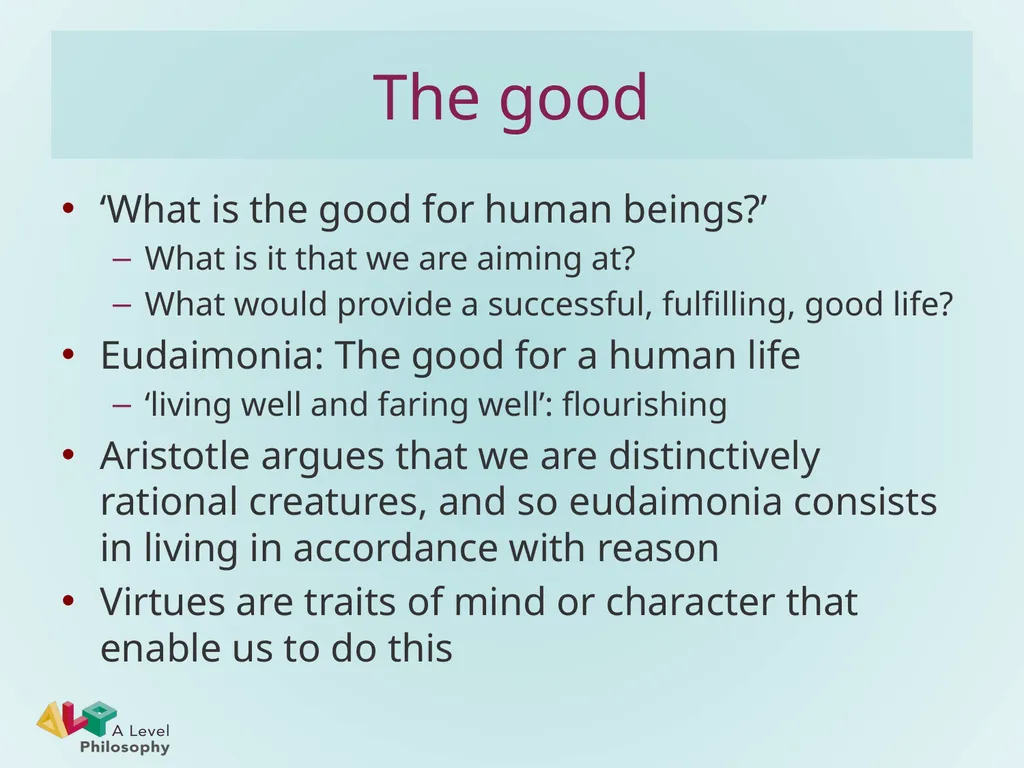
slide2. The good ‘What is the good for human beings?’
What is it that we are aiming at?
What would provide a successful, fulfilling, good life?
Eudaimonia: The good for a human life
‘living well and faring well’: flourishing
Aristotle argues that we are distinctively rational creatures, and so eudaimonia consists in living in accordance with reason
Virtues are traits of mind or character that enable us to do this<br>
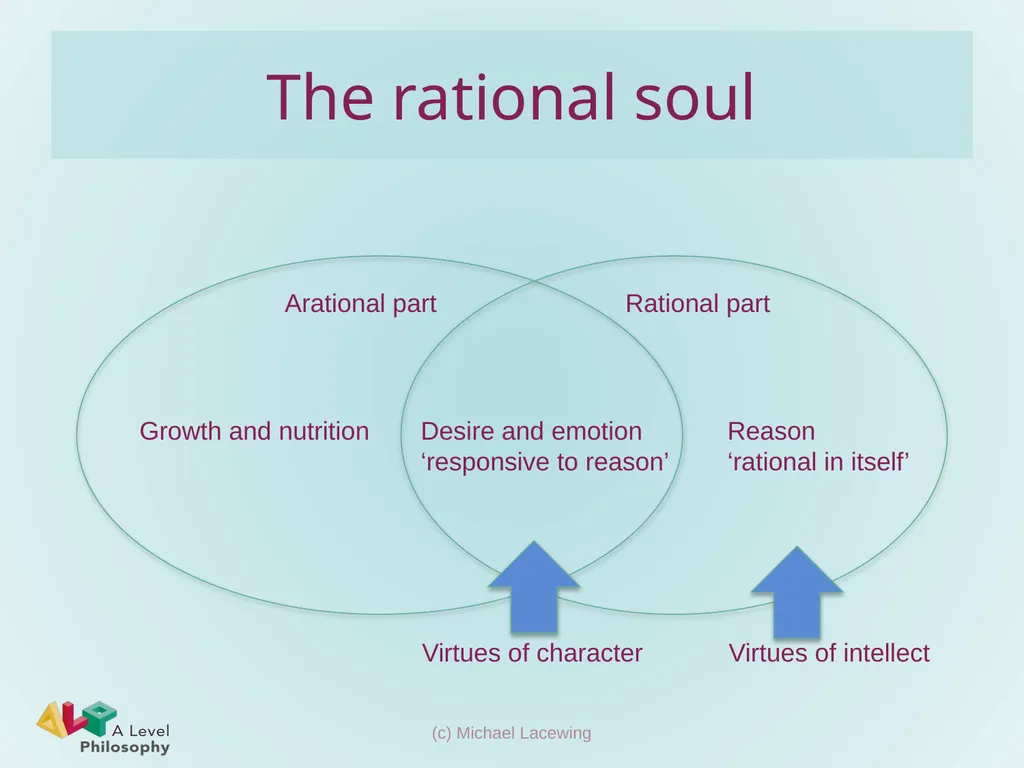
slide3. The rational soul Arational part Rational part Growth and nutrition Desire and emotion
‘responsive to reason’ Reason
‘rational in itself’ Virtues of character Virtues of intellect (c) Michael Lacewing<br>

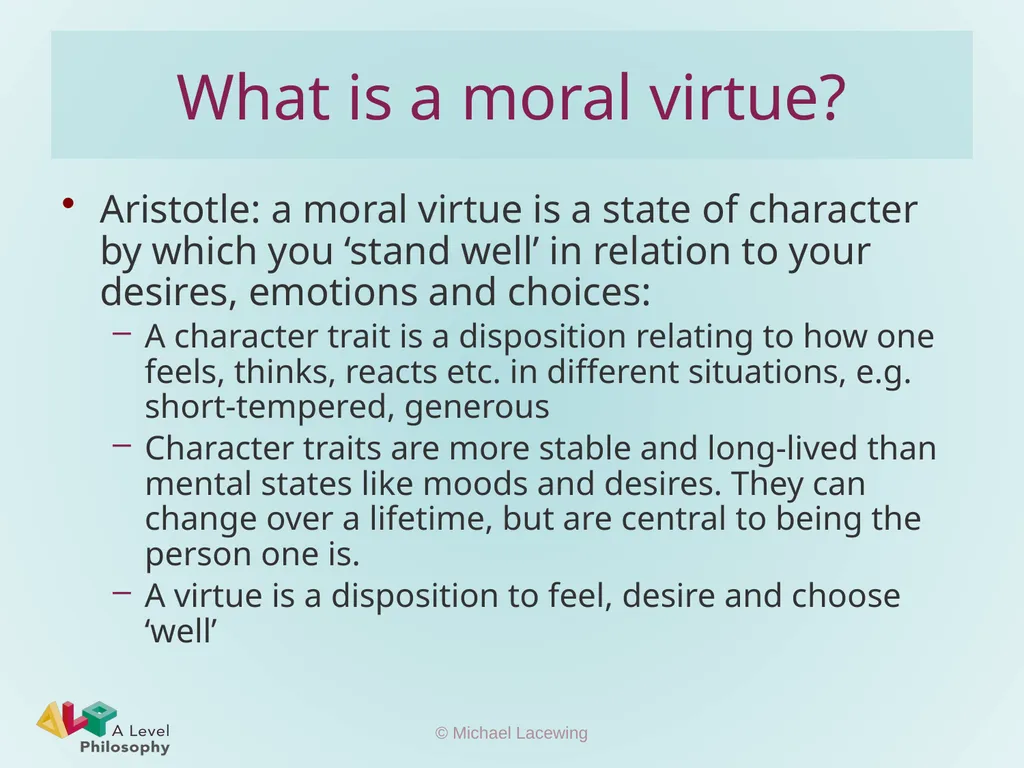
slide4. What is a moral virtue? Aristotle: a moral virtue is a state of character by which you ‘stand well’ in relation to your desires, emotions and choices:
A character trait is a disposition relating to how one feels, thinks, reacts etc. in different situations, e.g. short-tempered, generous
Character traits are more stable and long-lived than mental states like moods and desires. They can change over a lifetime, but are central to being the person one is.
A virtue is a disposition to feel, desire and choose ‘well’ © Michael Lacewing<br>
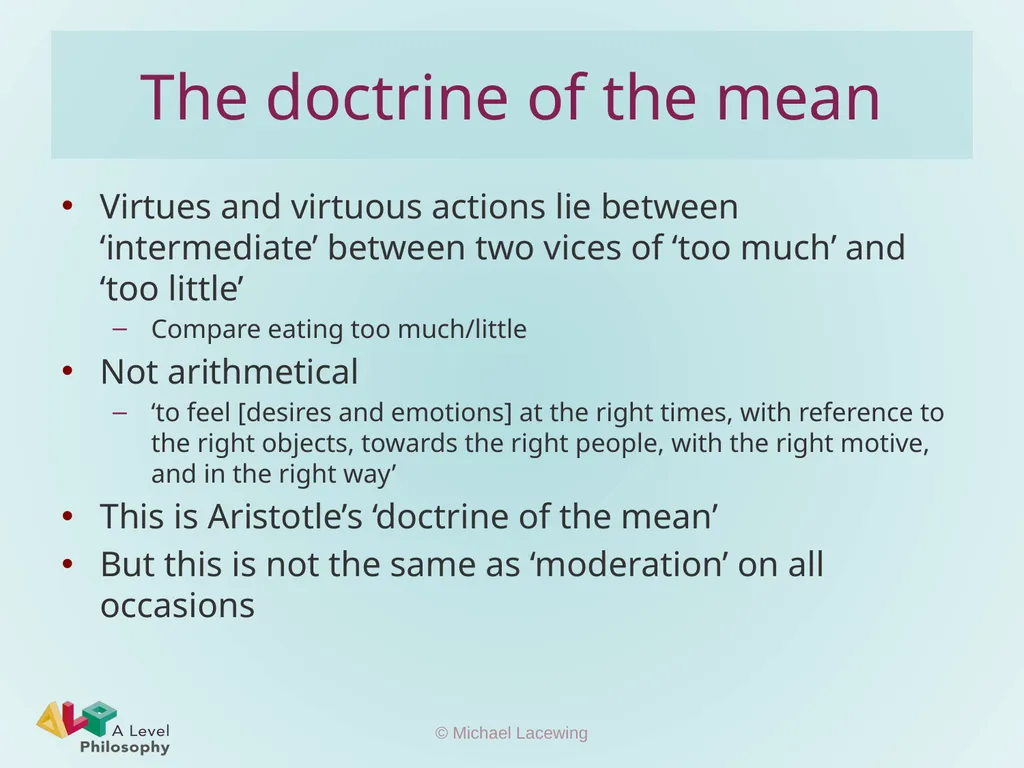
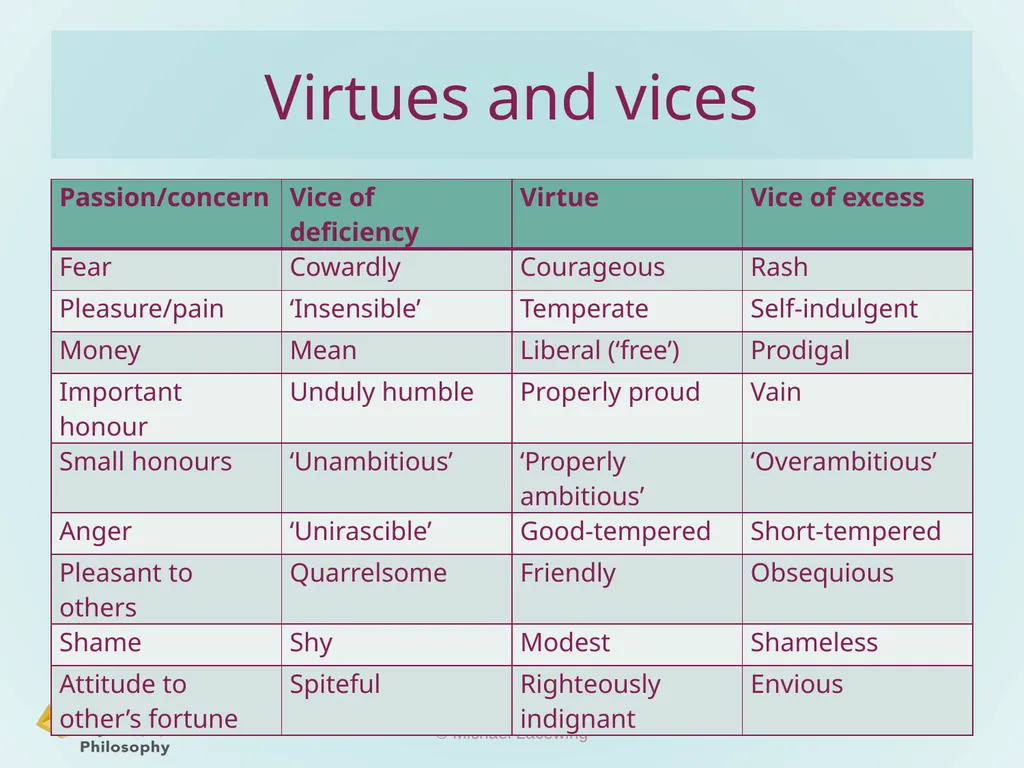
slide5. The doctrine of the mean Virtues and virtuous actions lie between ‘intermediate’ between two vices of ‘too much’ and ‘too little’
Compare eating too much/little
Not arithmetical
‘to feel [desires and emotions] at the right times, with reference to the right objects, towards the right people, with the right motive, and in the right way’
This is Aristotle’s ‘doctrine of the mean’
But this is not the same as ‘moderation’ on all occasions © Michael Lacewing<br>
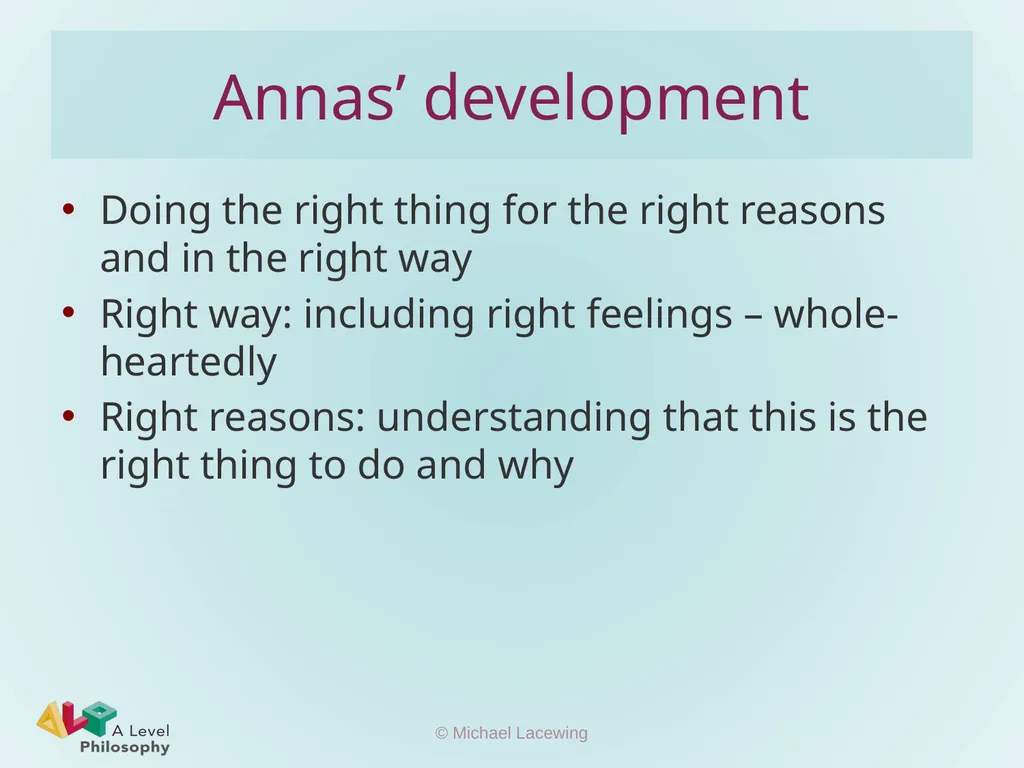
slide6. Annas’ development Doing the right thing for the right reasons and in the right way
Right way: including right feelings – whole-heartedly
Right reasons: understanding that this is the right thing to do and why © Michael Lacewing<br>
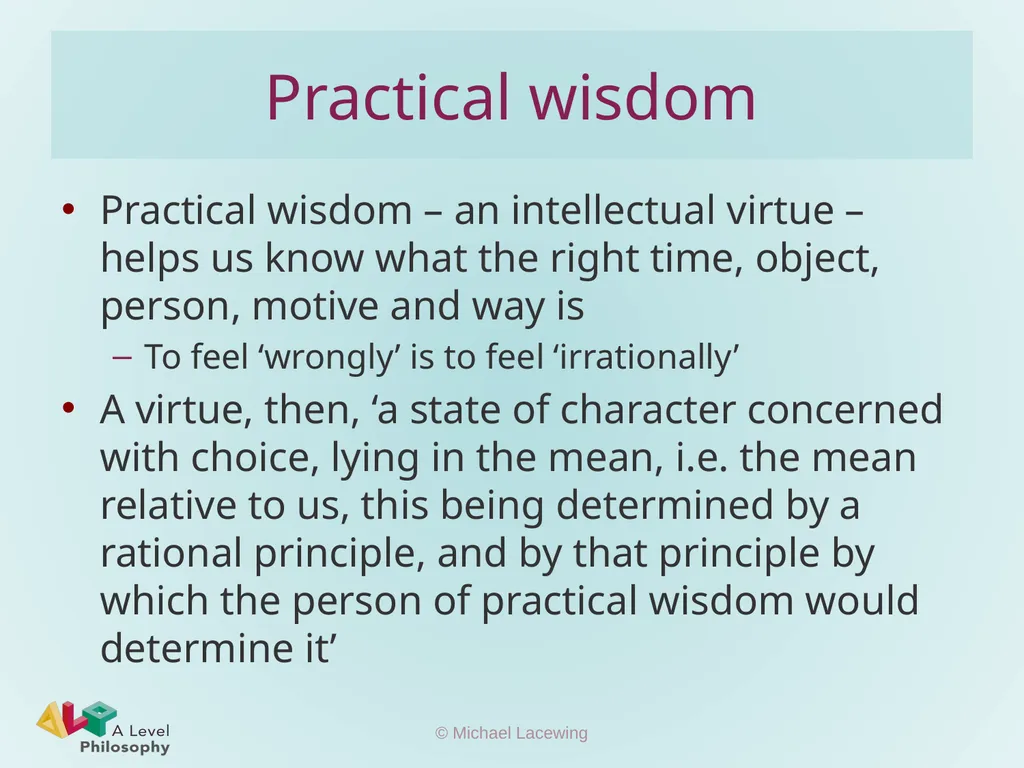
slide7. Practical wisdom Practical wisdom – an intellectual virtue – helps us know what the right time, object, person, motive and way is
To feel ‘wrongly’ is to feel ‘irrationally’
A virtue, then, ‘a state of character concerned with choice, lying in the mean, i.e. the mean relative to us, this being determined by a rational principle, and by that principle by which the person of practical wisdom would determine it’ © Michael Lacewing<br>
slide8. Virtues and vices © Michael Lacewing<br>
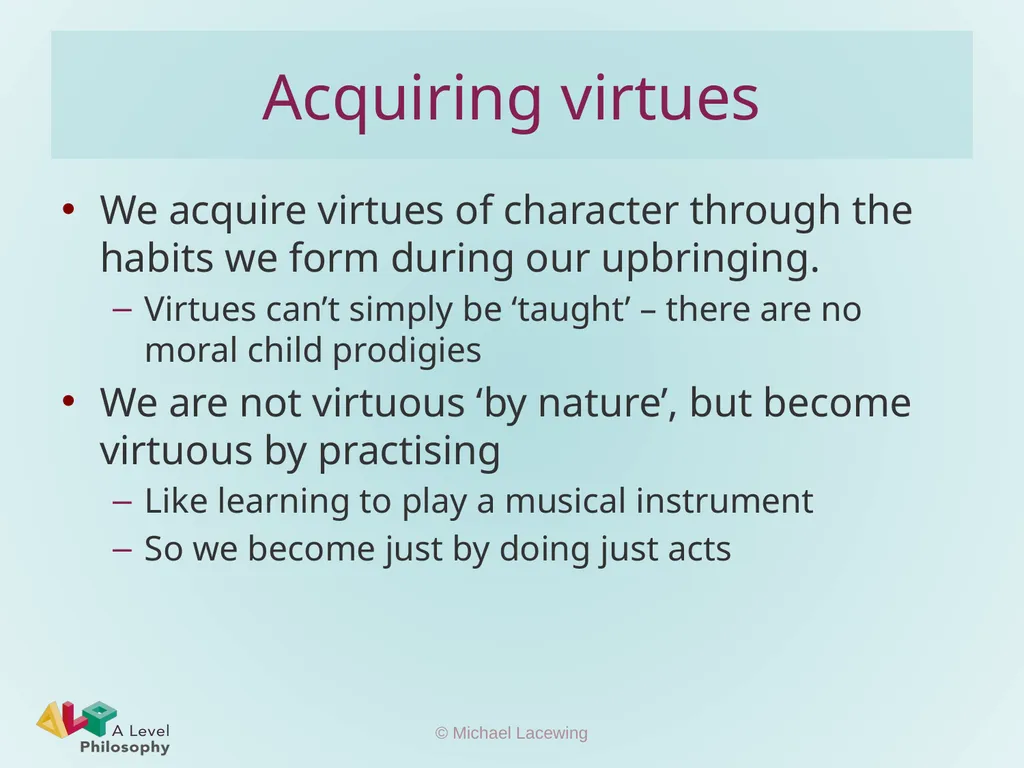
slide9. Acquiring virtues We acquire virtues of character through the habits we form during our upbringing.
Virtues can’t simply be ‘taught’ – there are no moral child prodigies
We are not virtuous ‘by nature’, but become virtuous by practising
Like learning to play a musical instrument
So we become just by doing just acts © Michael Lacewing<br>
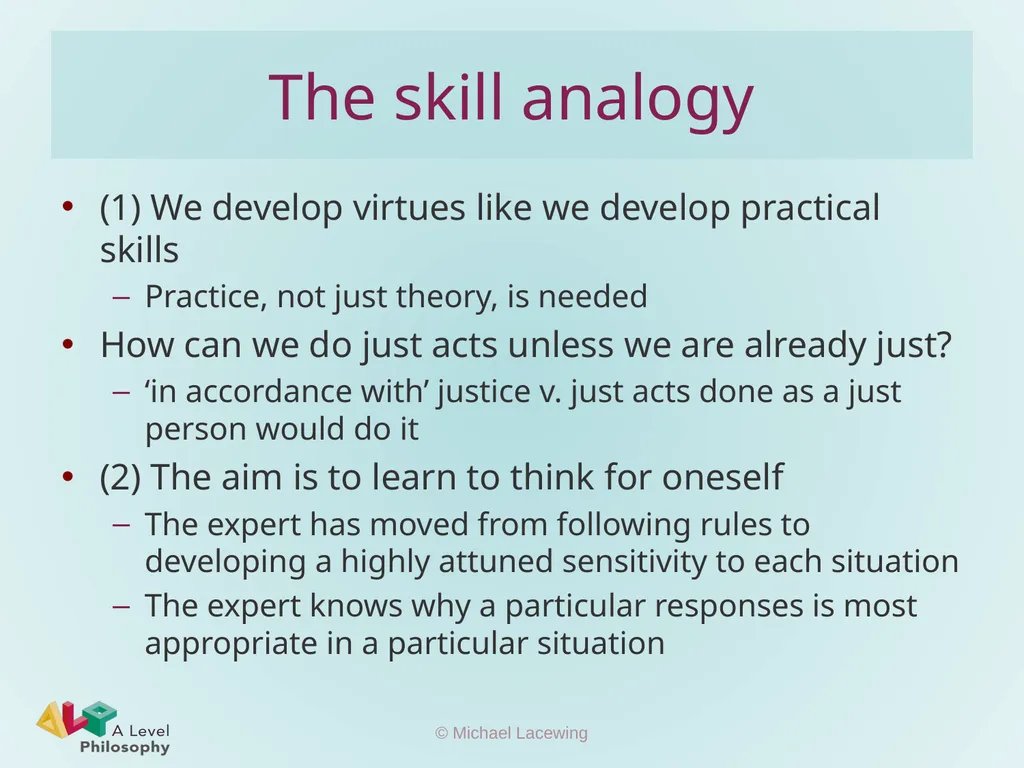
slide10. The skill analogy (1) We develop virtues like we develop practical skills
Practice, not just theory, is needed
How can we do just acts unless we are already just?
‘in accordance with’ justice v. just acts done as a just person would do it
(2) The aim is to learn to think for oneself
The expert has moved from following rules to developing a highly attuned sensitivity to each situation
The expert knows why a particular responses is most appropriate in a particular situation © Michael Lacewing<br>
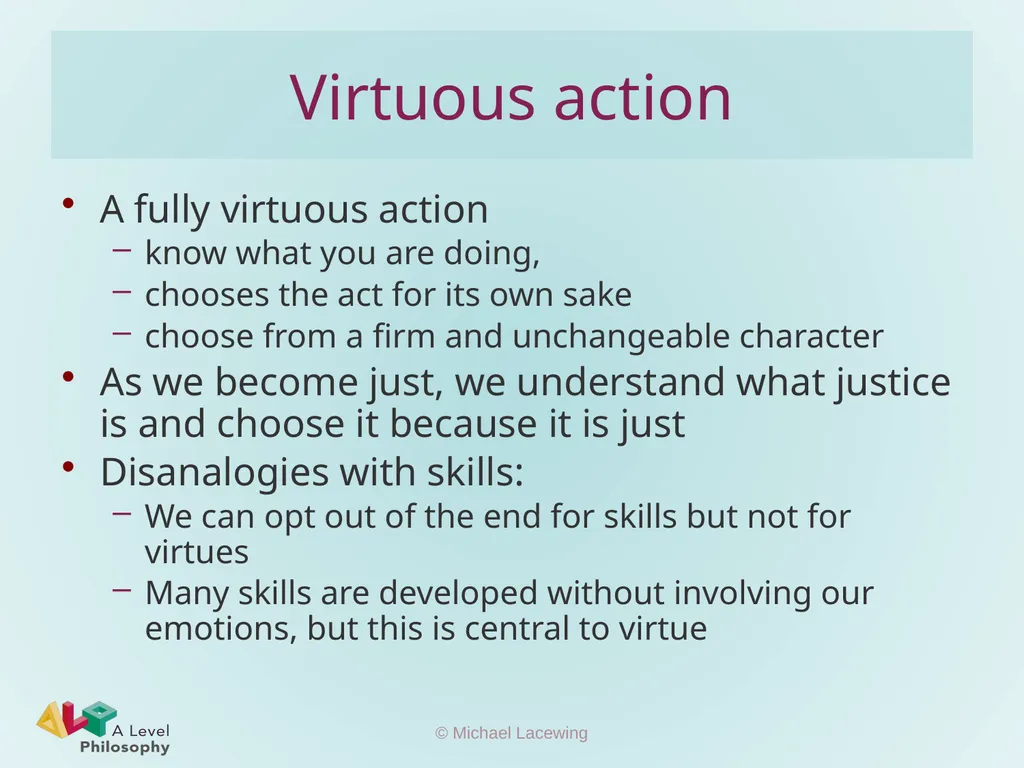
slide11. Virtuous action A fully virtuous action
know what you are doing,
chooses the act for its own sake
choose from a firm and unchangeable character
As we become just, we understand what justice is and choose it because it is just
Disanalogies with skills:
We can opt out of the end for skills but not for virtues
Many skills are developed without involving our emotions, but this is central to virtue © Michael Lacewing<br>