Artificial Consciousness: A CA IDMS™ Database
Description: Artificial Consciousness: A CA IDMS Database Solution to Autonomous Robotics MI480SN Modernize Optimize Your Mainframe Derek J. Smith International Software Products Derek J. Smith International Software Products The defining
Related Topics
Download Presentation
"Artificial Consciousness: A CA IDMS™ Database" is the property of its rightful owner. Permission is granted to download and print the materials on this website for personal, non-commercial use only, and to display it on your personal computer provided you do not modify the materials and that you retain all copyright notices contained in the materials. By downloading content from our website, you accept the terms of this agreement.
Presentation Transcript
slide1. Artificial Consciousness:A CA IDMS™ Database Solution to Autonomous Robotics MI480SN Modernize & Optimize Your Mainframe Derek J. Smith
International Software Products<br>
slide2. Derek J. Smith
International Software Products
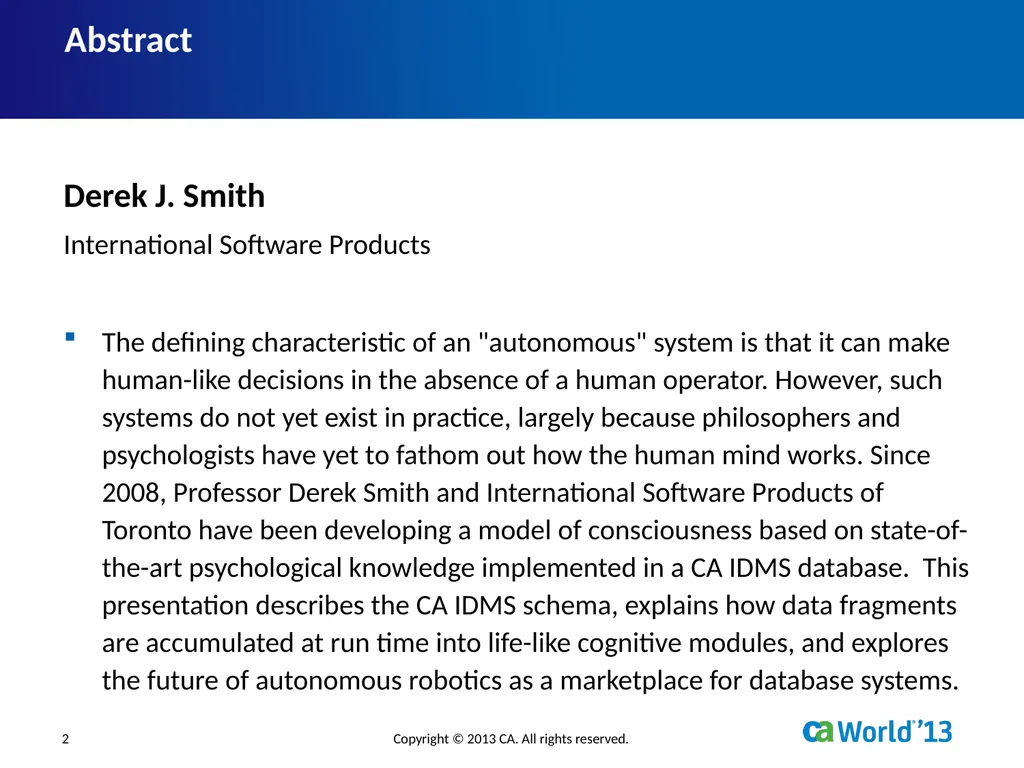
The defining characteristic of an "autonomous" system is that it can make human-like decisions in the absence of a human operator. However, such systems do not yet exist in practice, largely because philosophers and psychologists have yet to fathom out how the human mind works. Since 2008, Professor Derek Smith and International Software Products of Toronto have been developing a model of consciousness based on state-of-the-art psychological knowledge implemented in a CA IDMS database. This presentation describes the CA IDMS schema, explains how data fragments are accumulated at run time into life-like cognitive modules, and explores the future of autonomous robotics as a marketplace for database systems. Abstract<br>
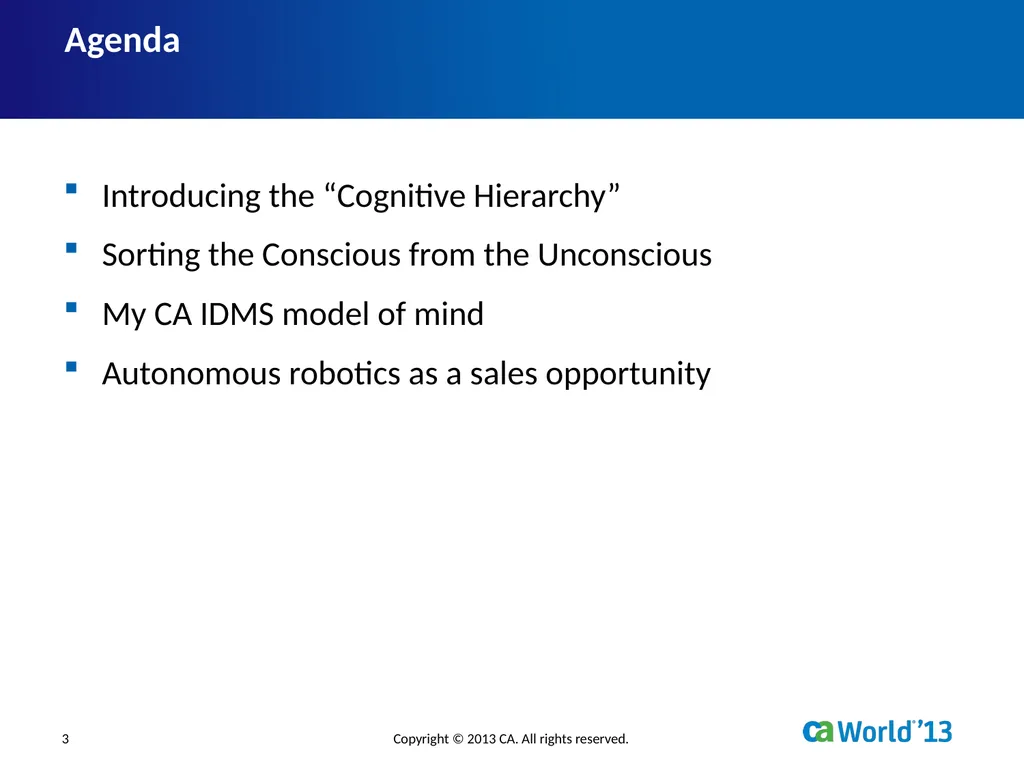
slide3. Introducing the “Cognitive Hierarchy”
Sorting the Conscious from the Unconscious
My CA IDMS model of mind
Autonomous robotics as a sales opportunity Agenda<br>
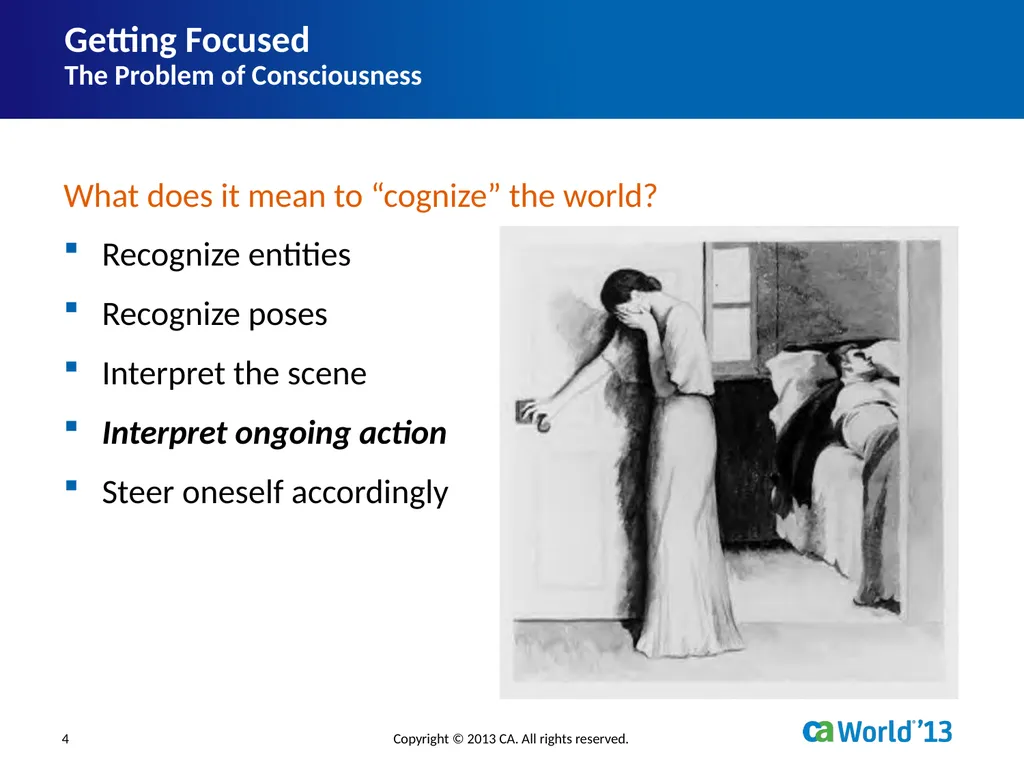
slide4. What does it mean to “cognize” the world?
Recognize entities
Recognize poses
Interpret the scene
Interpret ongoing action
Steer oneself accordingly Getting FocusedThe Problem of Consciousness<br>
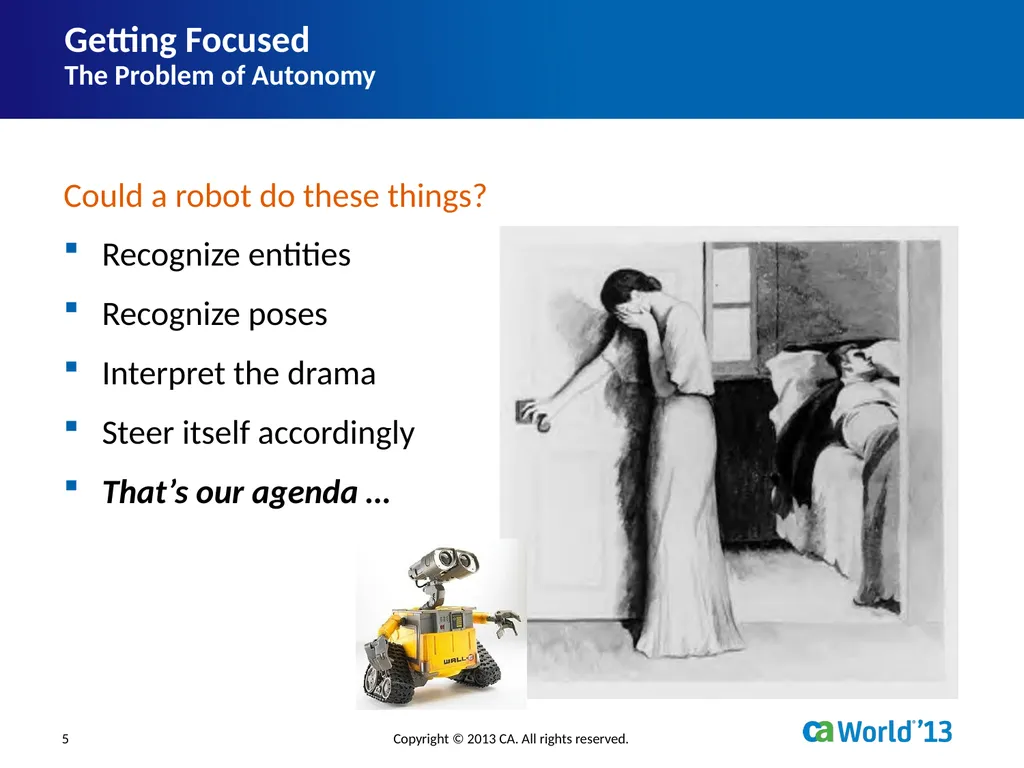
slide5. Could a robot do these things?
Recognize entities
Recognize poses
Interpret the drama
Steer itself accordingly
That’s our agenda … Getting FocusedThe Problem of Autonomy<br>
slide6. How the brain began
How it is built
Why it does what it does
Introducing the “Cognitive Hierarchy” Section 1 Neuroscience for Beginners<br>
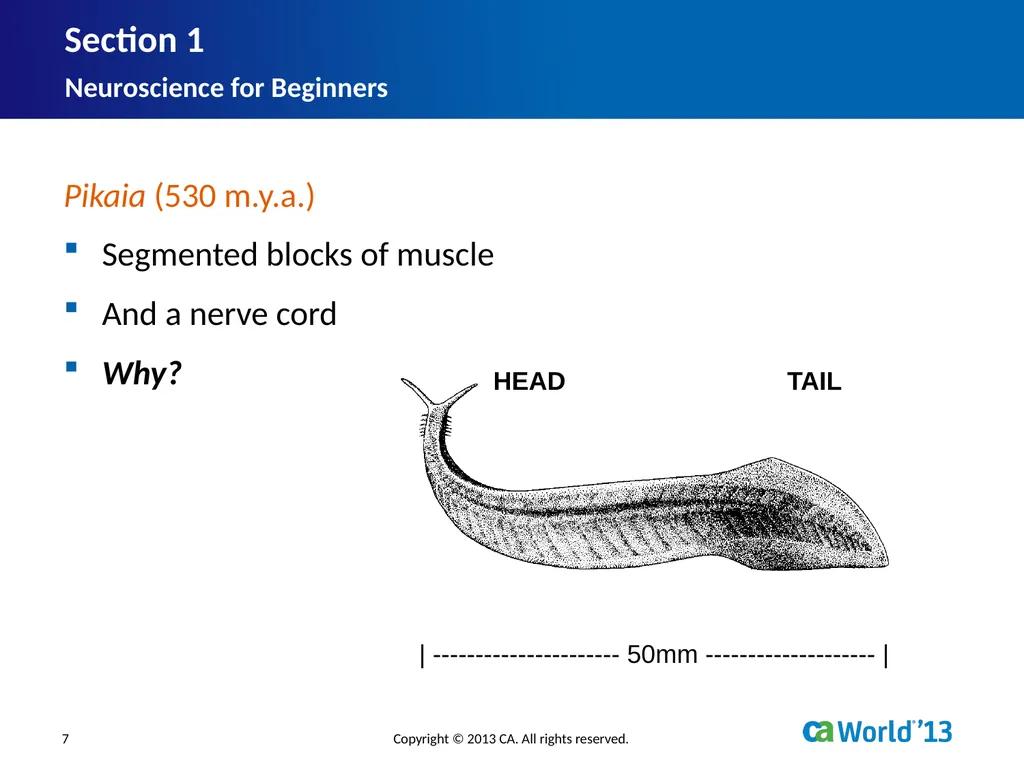
slide7. Pikaia (530 m.y.a.)
Segmented blocks of muscle
And a nerve cord
Why? Section 1 Neuroscience for Beginners<br>
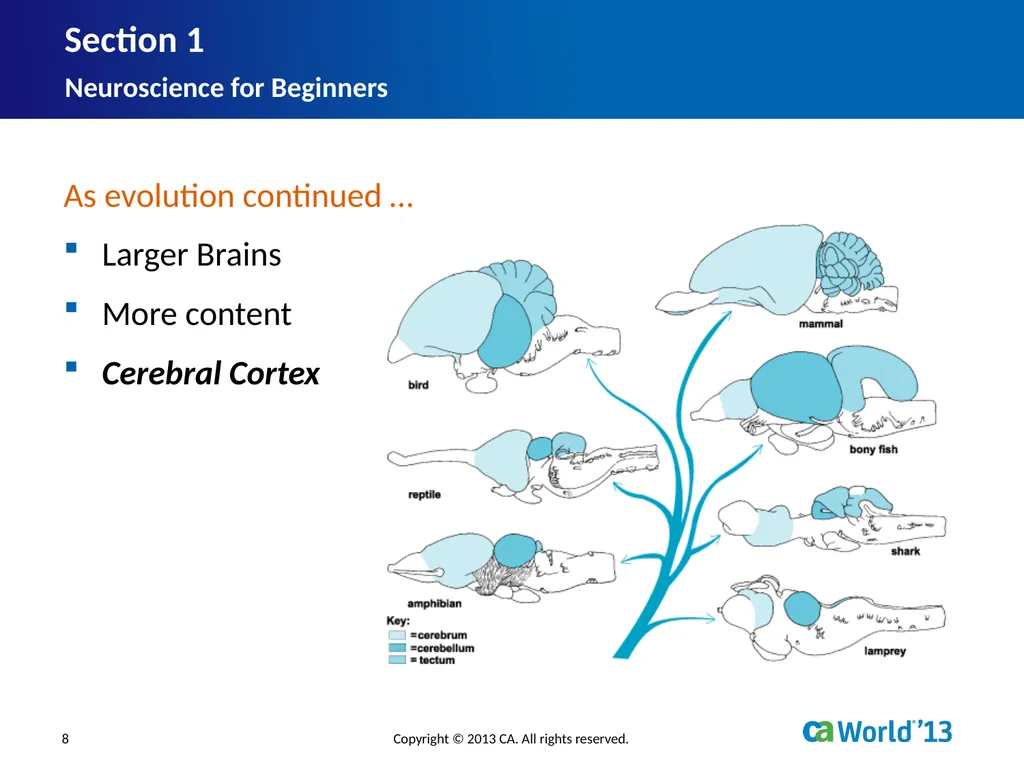
slide8. As evolution continued …
Larger Brains
More content
Cerebral Cortex Section 1 Neuroscience for Beginners<br>
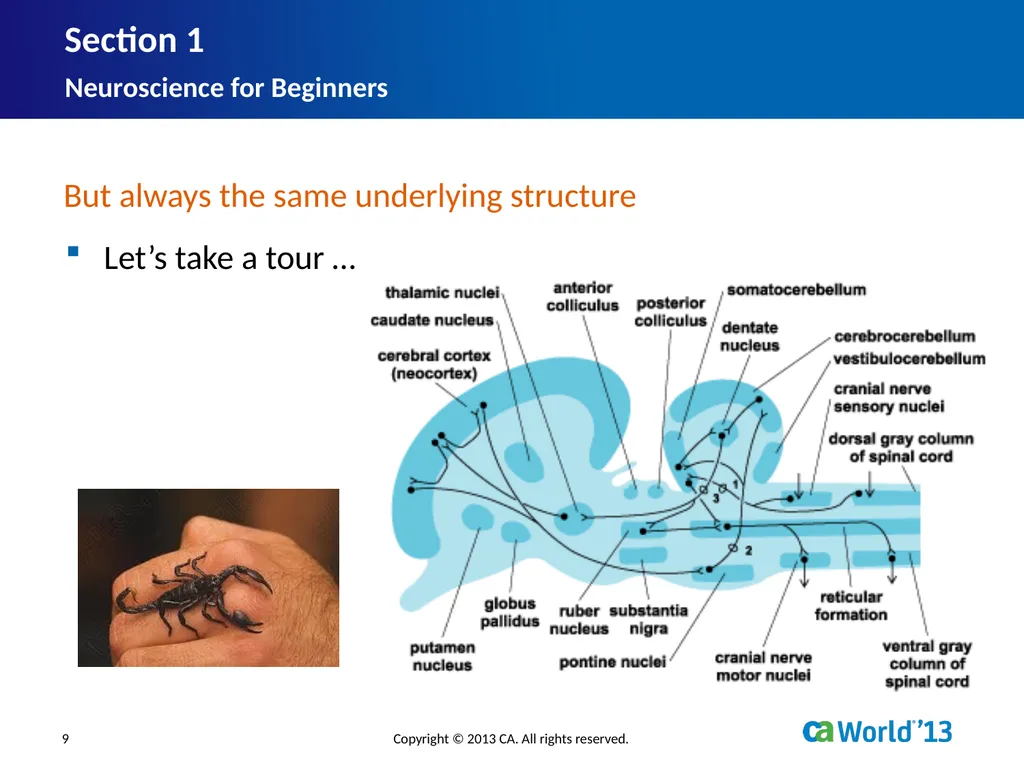
slide9. But always the same underlying structure Section 1 Neuroscience for Beginners<br>
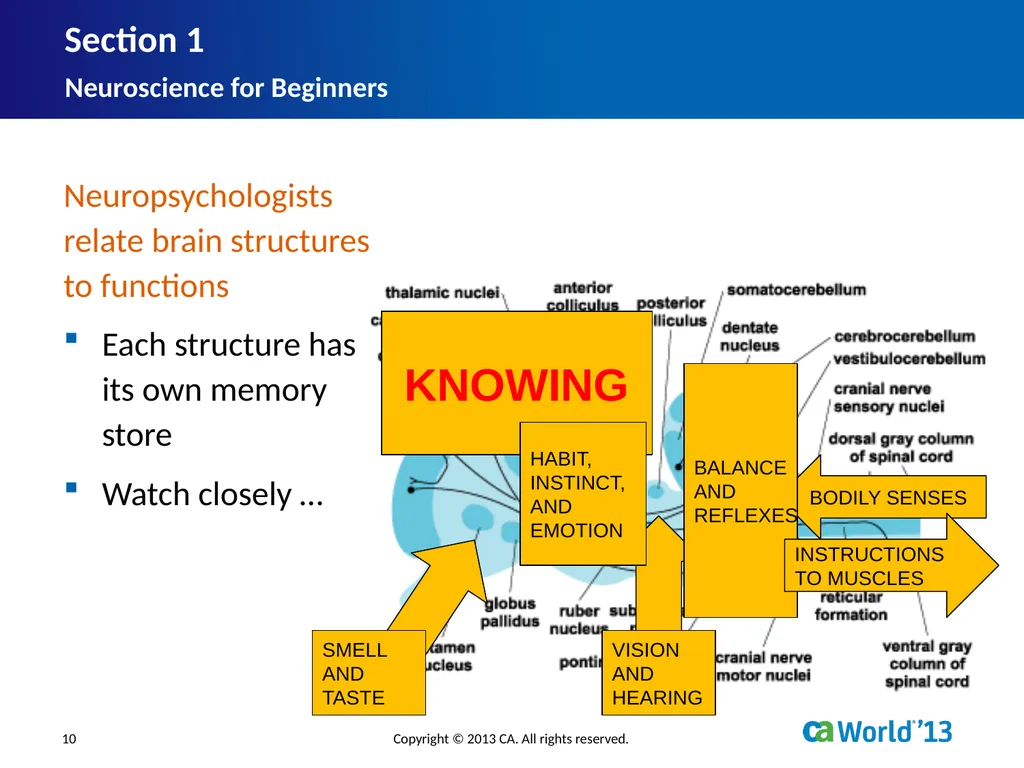
slide10. Neuropsychologists relate brain structures to functions
Each structure has its own memory store
Watch closely … Section 1 Neuroscience for Beginners<br>
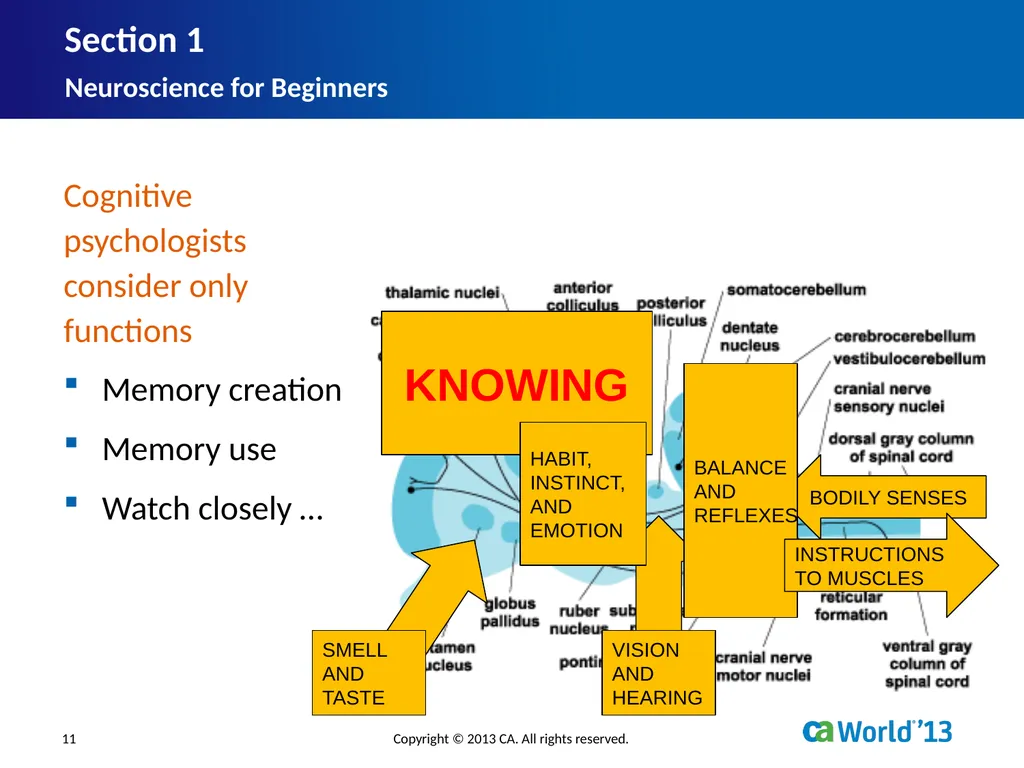
slide11. Cognitive psychologists consider only functions
Memory creation
Memory use
Watch closely … Section 1 Neuroscience for Beginners<br>
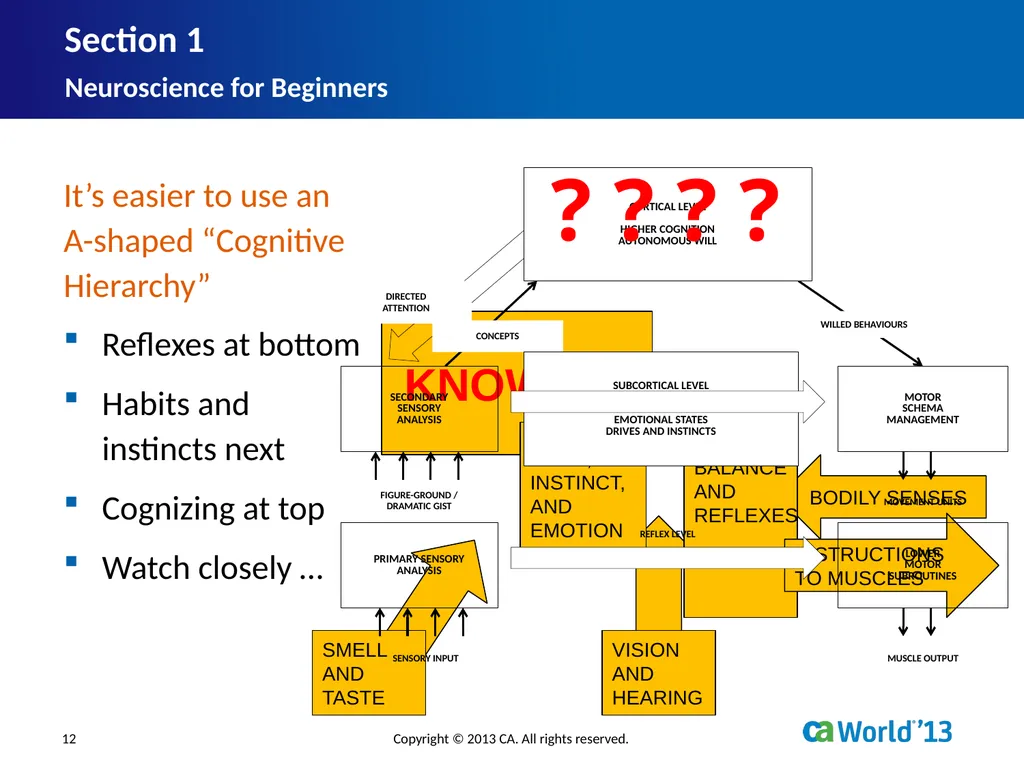
slide12. It’s easier to use an A-shaped “Cognitive Hierarchy”
Reflexes at bottom
Habits and instincts next
Cognizing at top
Watch closely … Section 1 Neuroscience for Beginners<br>
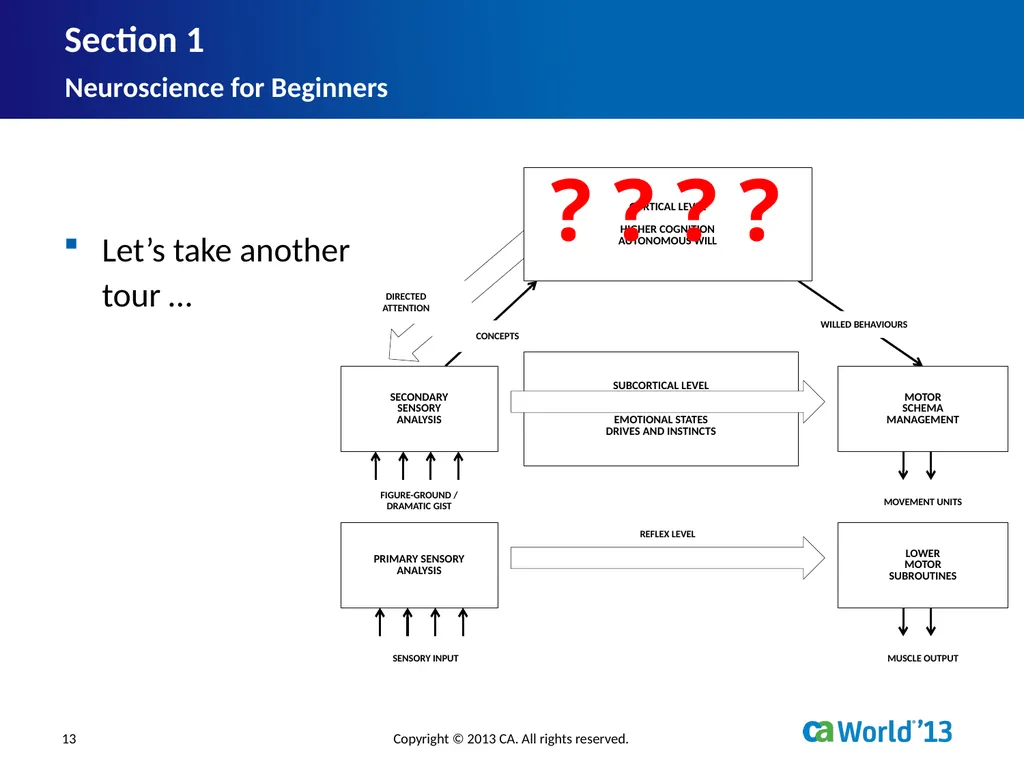
slide13. Let’s take another tour … Section 1 Neuroscience for Beginners<br>
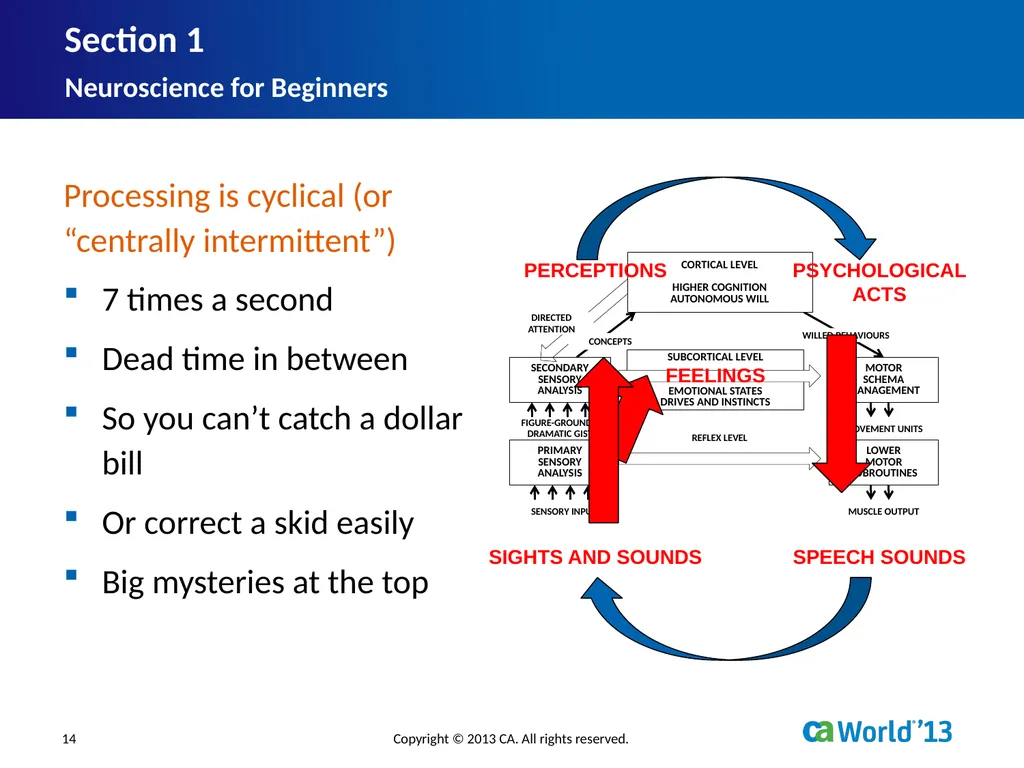
slide14. Processing is cyclical (or “centrally intermittent”)
7 times a second
Dead time in between
So you can’t catch a dollar bill
Or correct a skid easily
Big mysteries at the top Section 1 Neuroscience for Beginners<br>
slide15. Biological network memory
Consciousness as biology’s CA IDMS currency tables
Autonomy as outputting ideas to yourself so that you can think about them Section 2 The Conscious and Unconscious Minds<br>
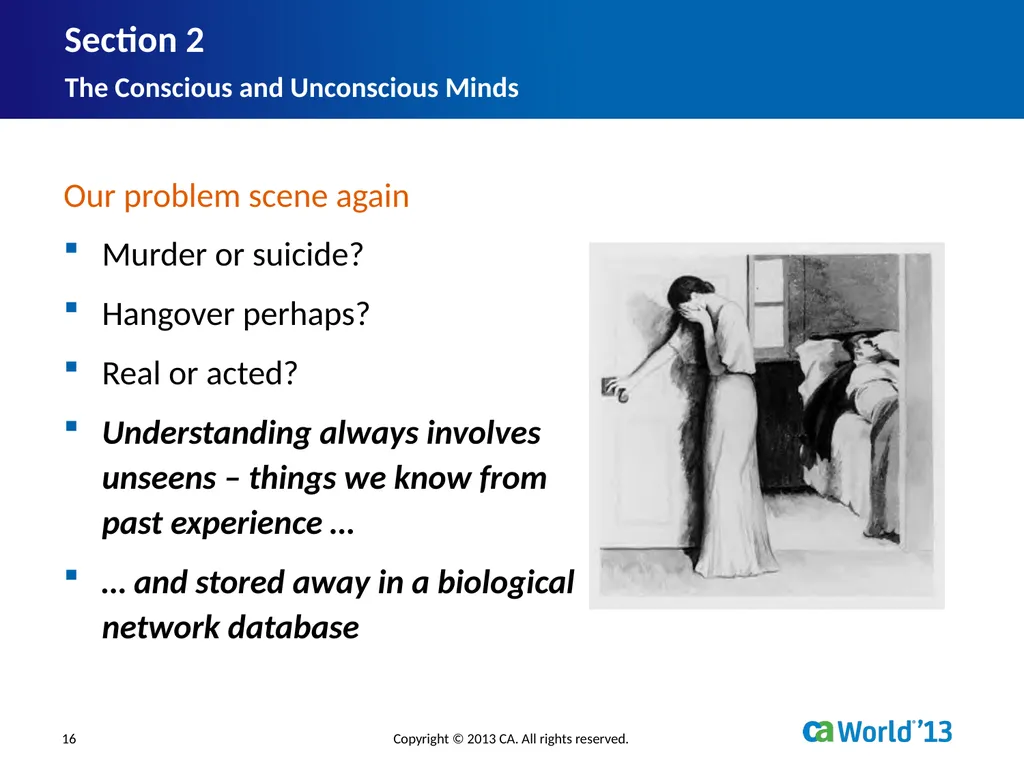
slide16. Our problem scene again
Murder or suicide?
Hangover perhaps?
Real or acted?
Understanding always involves unseens – things we know from past experience …
… and stored away in a biological network database Section 2 The Conscious and Unconscious Minds<br>
slide17. What can we say about this mental database?
Long-term, medium-term, and short-term memory
Long-term = your name, car number, partner’s birthday
Medium-term = the animal on the man’s hand earlier
Short-term = the letters I am about to say
Memory can’t all be active at the same time
Consciousness is the biological equivalent of the CA IDMS currency tables Section 2 The Conscious and Unconscious Minds<br>
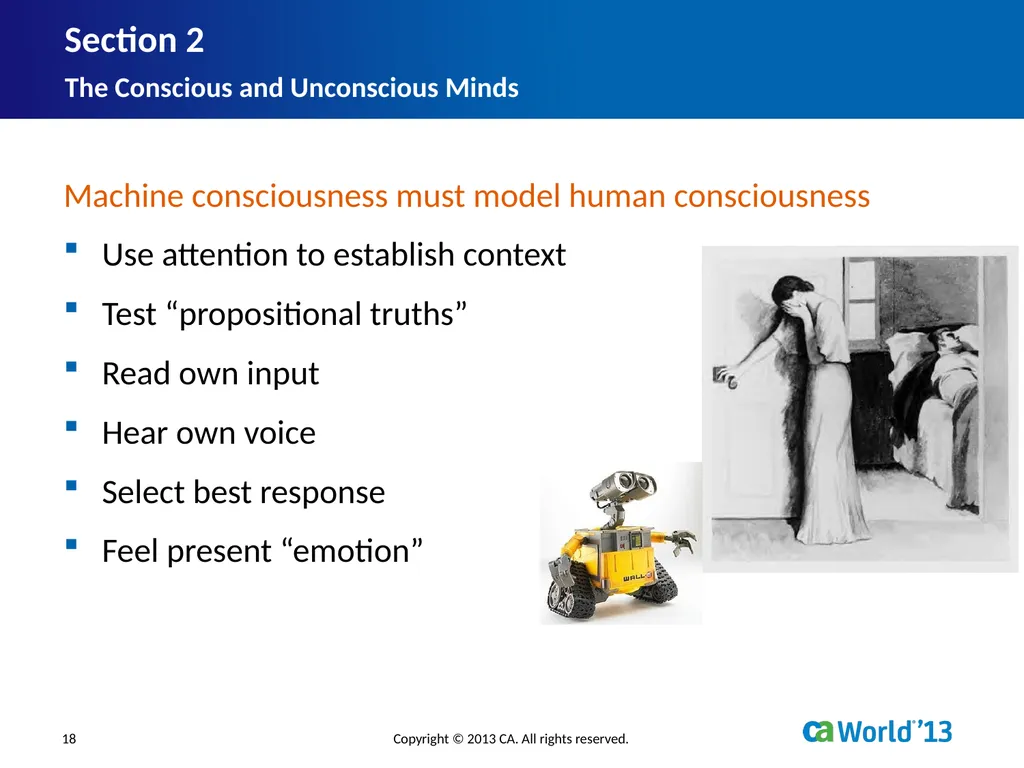
slide18. Machine consciousness must model human consciousness
Use attention to establish context
Test “propositional truths”
Read own input
Hear own voice
Select best response
Feel present “emotion” Section 2 The Conscious and Unconscious Minds<br>
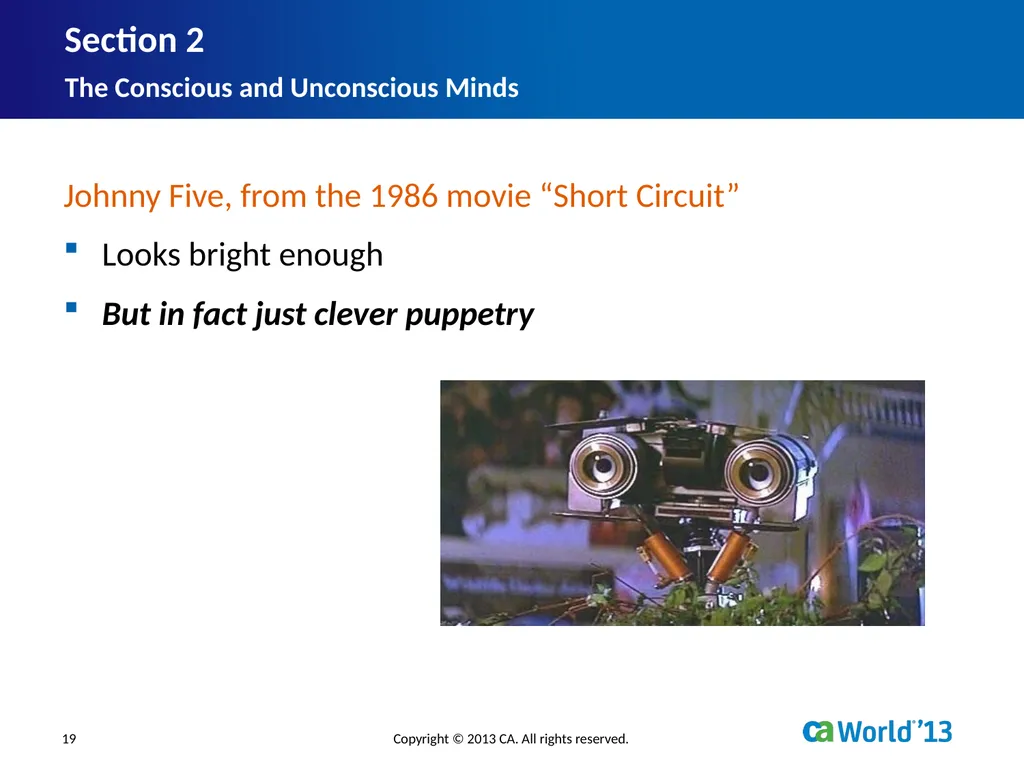
slide19. Johnny Five, from the 1986 movie “Short Circuit”
Looks bright enough
But in fact just clever puppetry Section 2 The Conscious and Unconscious Minds<br>
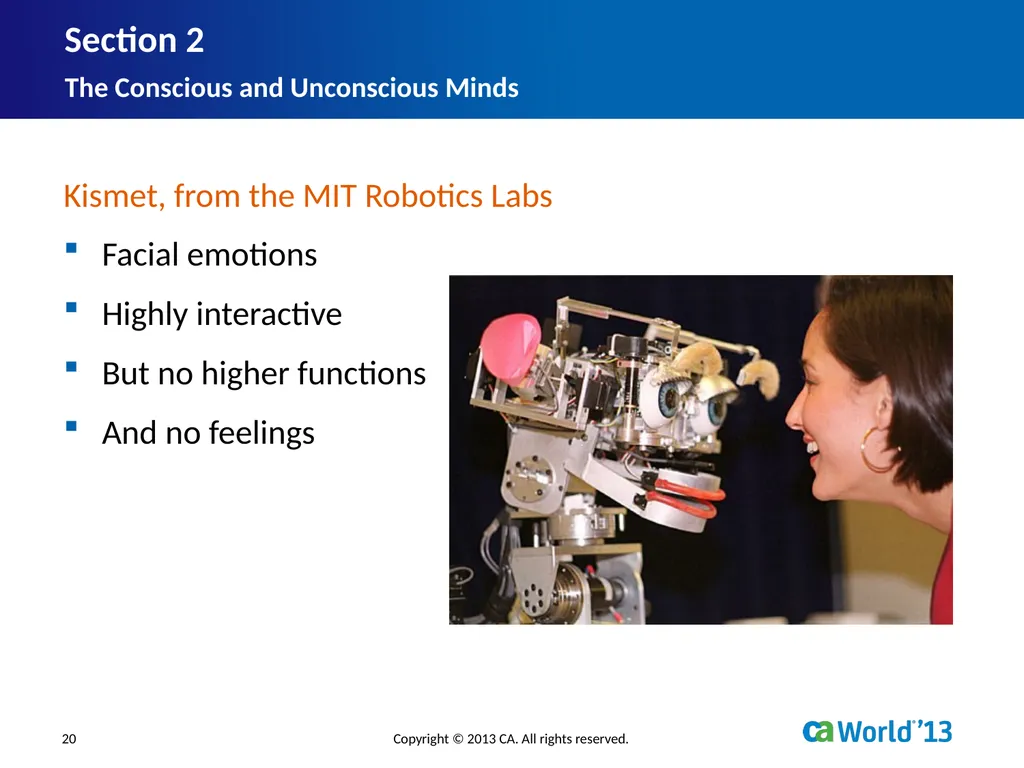
slide20. Kismet, from the MIT Robotics Labs
Facial emotions
Highly interactive
But no higher functions
And no feelings Section 2 The Conscious and Unconscious Minds<br>
slide21. The way forward
To understand the problems of cognition we must firstly understand its parts
Must simulate cognition in slow motion
Examine the output now in real time
Examine the processing logs later
This process started in the late 1940s …
… but has yet to solve consciousness and autonomy! Section 2 The Conscious and Unconscious Minds<br>
slide22. Where we’re good; where we’re bad Section 2 The Conscious and Unconscious Minds<br>
slide23. Konrad’s CA IDMS Schema
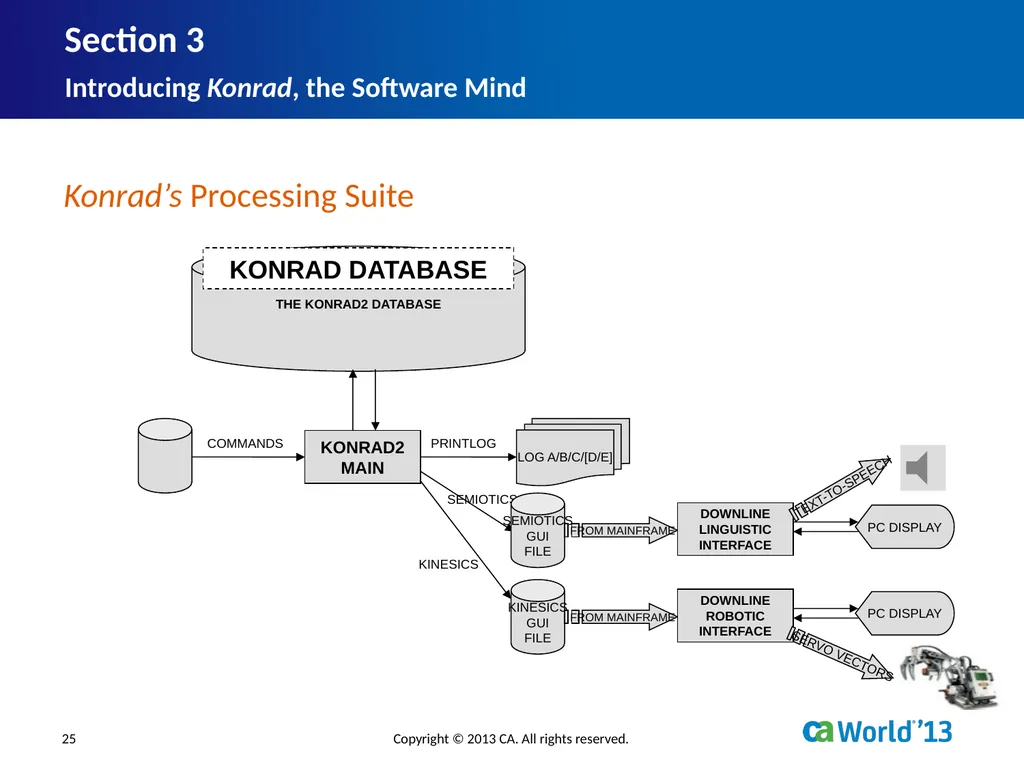
Konrad’s Processing Suite
Konrad’s Cognitive Hierarchy
Konrad as Cyclical Processing
Konrad in operation Section 3 Introducing Konrad, the Software Mind<br>
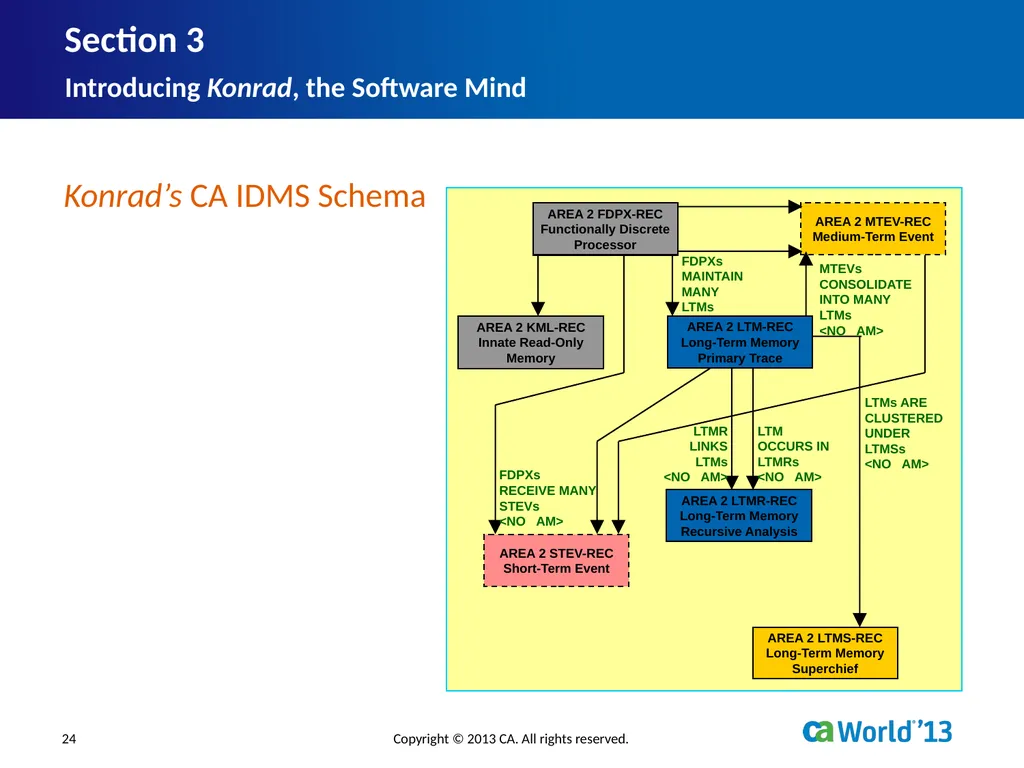
slide24. Konrad’s CA IDMS Schema Section 3 Introducing Konrad, the Software Mind<br>
slide25. Konrad’s Processing Suite Section 3 Introducing Konrad, the Software Mind<br>
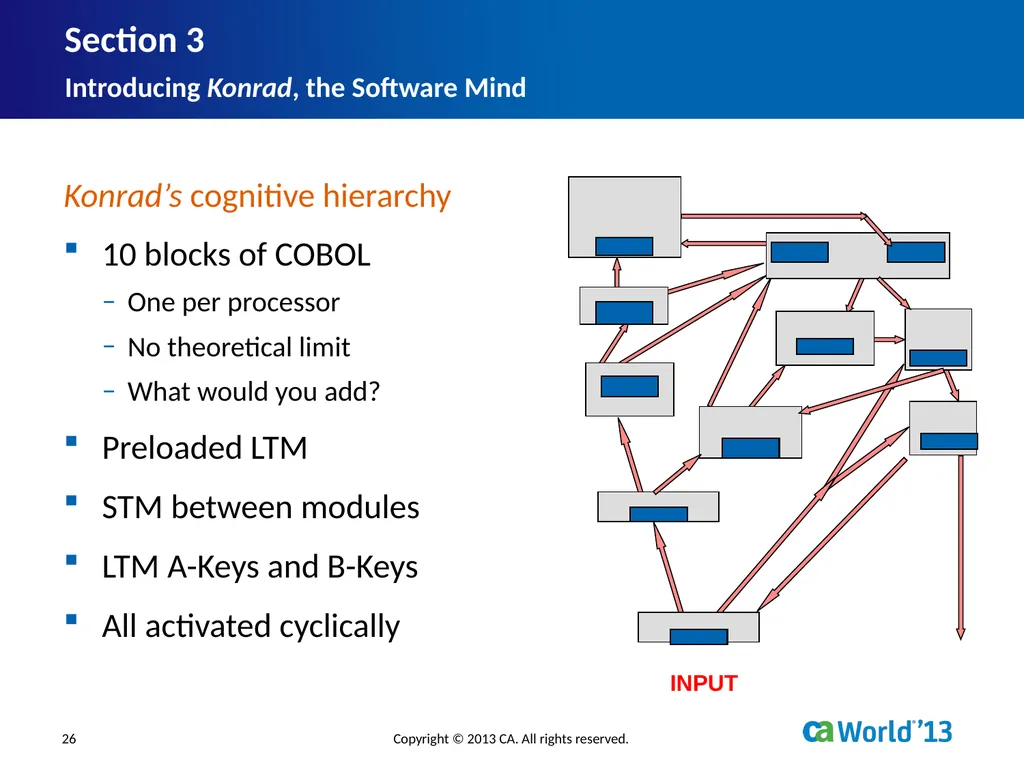
slide26. Konrad’s cognitive hierarchy
10 blocks of COBOL
One per processor
No theoretical limit
What would you add?
Preloaded LTM
STM between modules
LTM A-Keys and B-Keys
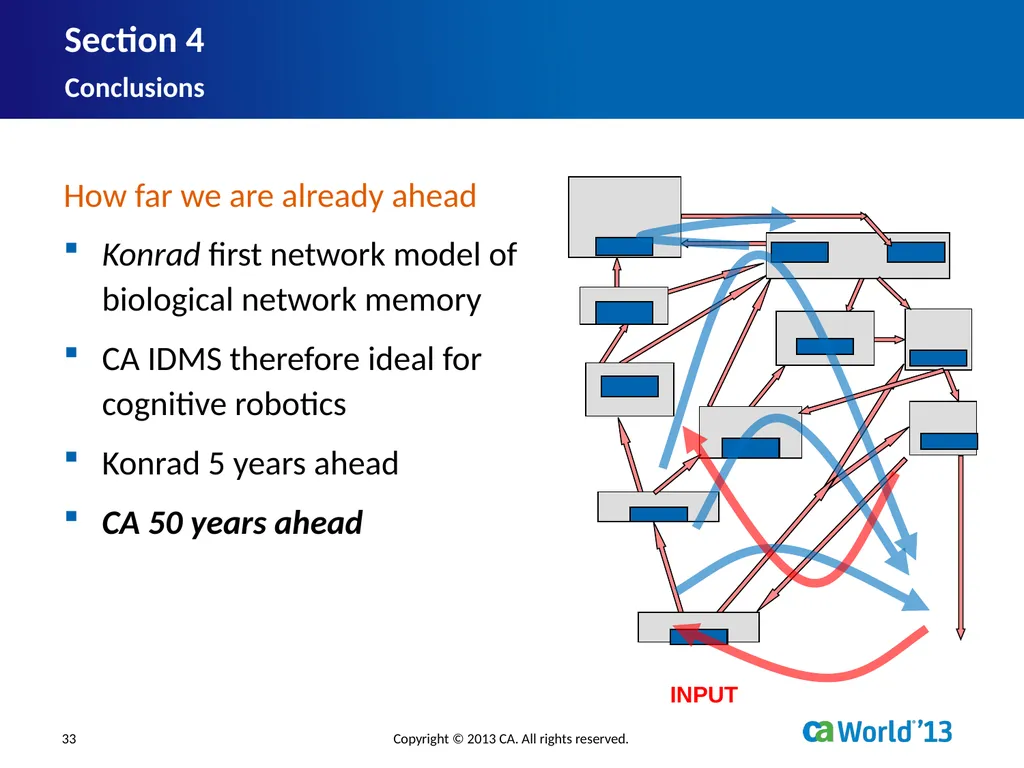
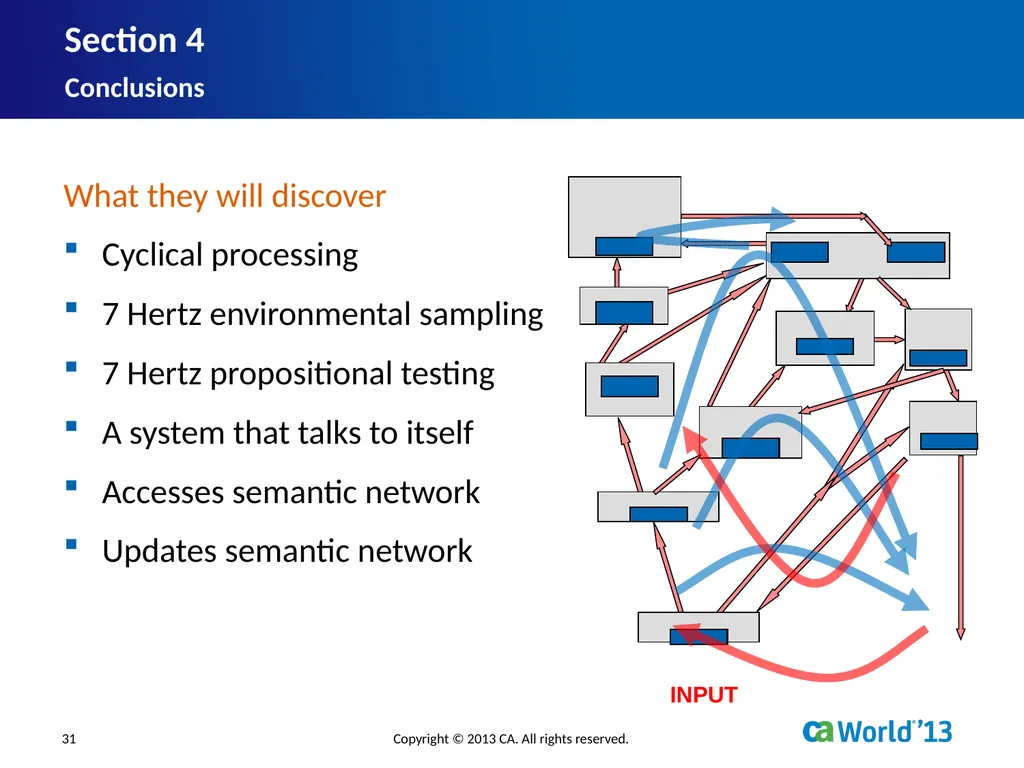
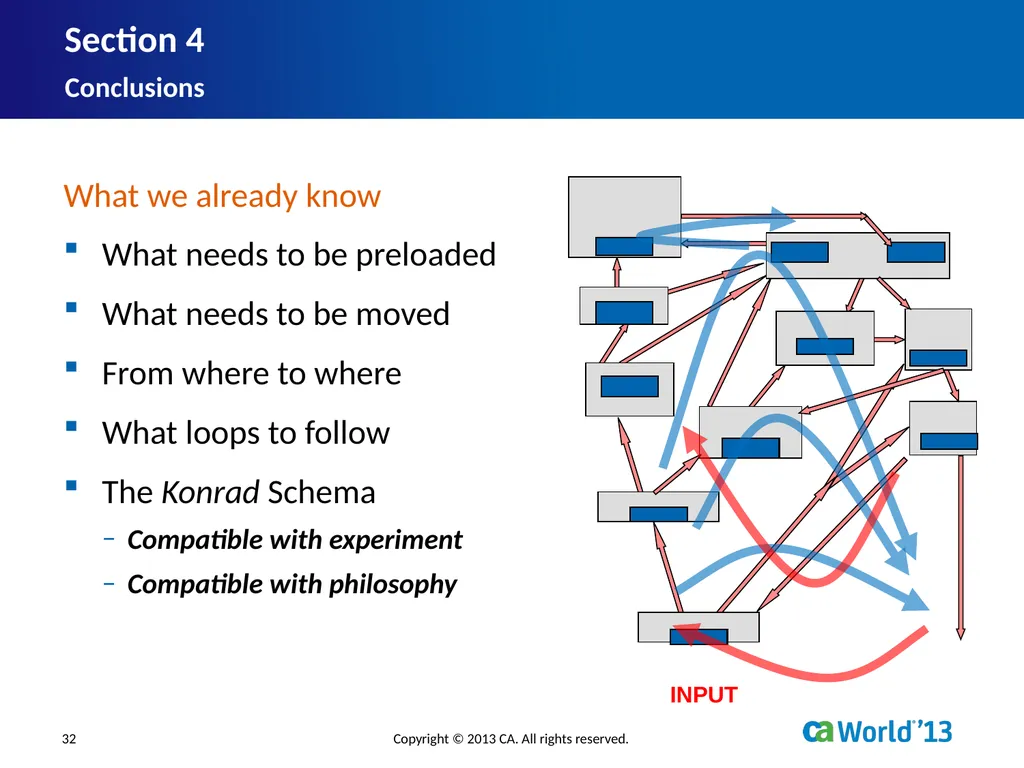
All activated cyclically Section 3 Introducing Konrad, the Software Mind INPUT<br>
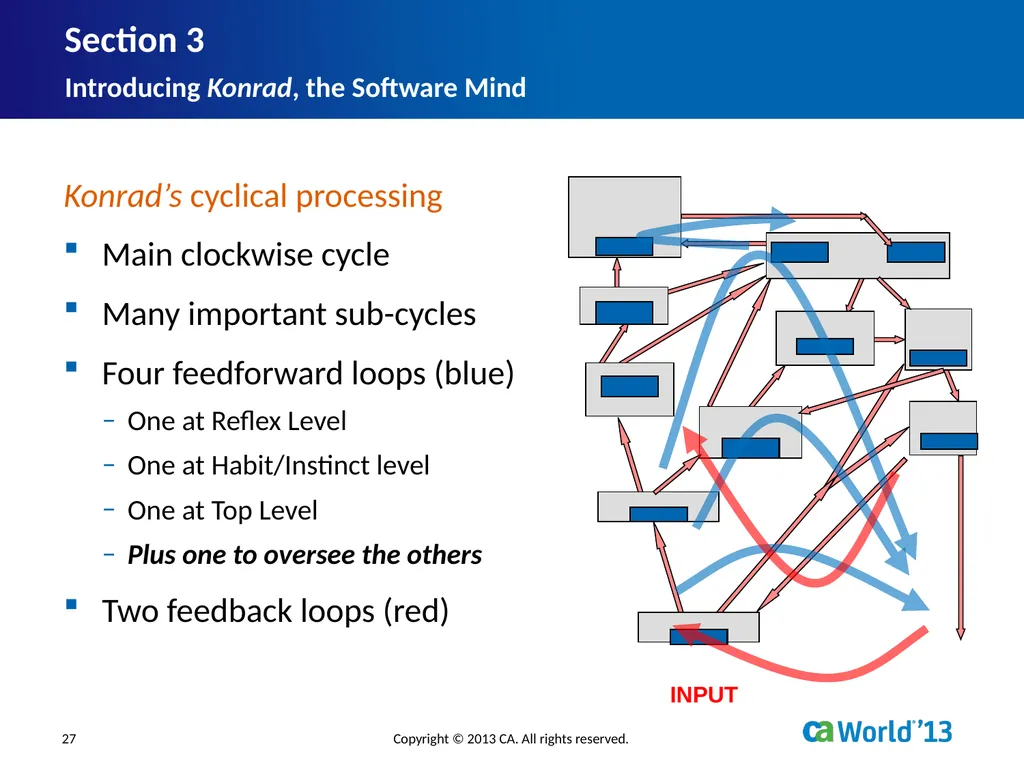
slide27. Konrad’s cyclical processing
Main clockwise cycle
Many important sub-cycles
Four feedforward loops (blue)
One at Reflex Level
One at Habit/Instinct level
One at Top Level
Plus one to oversee the others
Two feedback loops (red) Section 3 Introducing Konrad, the Software Mind INPUT<br>
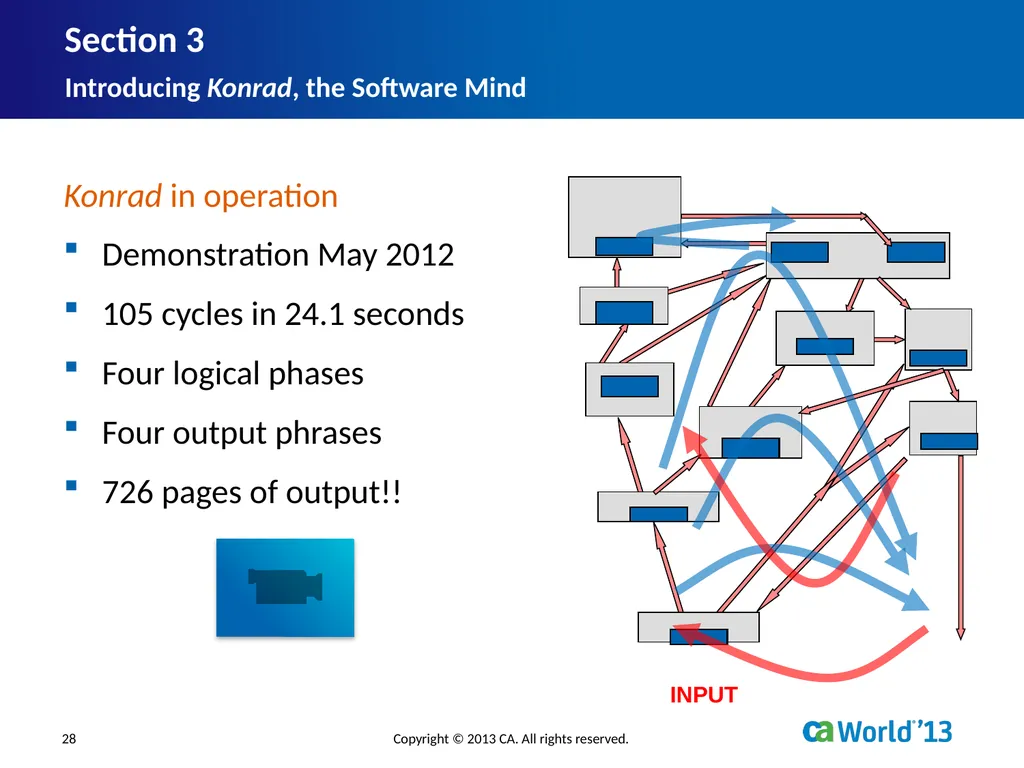
slide28. Konrad in operation
Demonstration May 2012
105 cycles in 24.1 seconds
Four logical phases
Four output phrases
726 pages of output!! Section 3 Introducing Konrad, the Software Mind INPUT<br>
slide29. What the opposition are up to
What they will discover
What we already know
How far we are already ahead Section 4 Conclusion<br>
slide30. Europe’s flagship Human Brain Project
10-year project worth 1.2 billion Euros
Centered in Lausanne (Switzerland) and Heidelberg (Germany)
“The project will develop ICT platforms for neuroinformatics, brain simulation, and supercomputing that will make it possible to federate neuroscience data from all over the world, to integrate the data in unifying models and simulations of the brain.” Section 4 Conclusion<br>
slide31. What they will discover
Cyclical processing
7 Hertz environmental sampling
7 Hertz propositional testing
A system that talks to itself
Accesses semantic network
Updates semantic network Section 4 Conclusions INPUT<br>
slide32. What we already know
What needs to be preloaded
What needs to be moved
From where to where
What loops to follow
The Konrad Schema
Compatible with experiment
Compatible with philosophy Section 4 Conclusions INPUT<br>
slide33. How far we are already ahead
Konrad first network model of biological network memory
CA IDMS therefore ideal for cognitive robotics
Konrad 5 years ahead
CA 50 years ahead Section 4 Conclusions INPUT<br>
slide34. Q&A<br>
slide35. Q&A<br>
slide36. Please provide your feedback about this session
Session #: MI480SN Session Evaluation<br>

International Software Products<br>
slide2. Derek J. Smith
International Software Products
The defining characteristic of an "autonomous" system is that it can make human-like decisions in the absence of a human operator. However, such systems do not yet exist in practice, largely because philosophers and psychologists have yet to fathom out how the human mind works. Since 2008, Professor Derek Smith and International Software Products of Toronto have been developing a model of consciousness based on state-of-the-art psychological knowledge implemented in a CA IDMS database. This presentation describes the CA IDMS schema, explains how data fragments are accumulated at run time into life-like cognitive modules, and explores the future of autonomous robotics as a marketplace for database systems. Abstract<br>
slide3. Introducing the “Cognitive Hierarchy”
Sorting the Conscious from the Unconscious
My CA IDMS model of mind
Autonomous robotics as a sales opportunity Agenda<br>
slide4. What does it mean to “cognize” the world?
Recognize entities
Recognize poses
Interpret the scene
Interpret ongoing action
Steer oneself accordingly Getting FocusedThe Problem of Consciousness<br>
slide5. Could a robot do these things?
Recognize entities
Recognize poses
Interpret the drama
Steer itself accordingly
That’s our agenda … Getting FocusedThe Problem of Autonomy<br>
slide6. How the brain began
How it is built
Why it does what it does
Introducing the “Cognitive Hierarchy” Section 1 Neuroscience for Beginners<br>
slide7. Pikaia (530 m.y.a.)
Segmented blocks of muscle
And a nerve cord
Why? Section 1 Neuroscience for Beginners<br>
slide8. As evolution continued …
Larger Brains
More content
Cerebral Cortex Section 1 Neuroscience for Beginners<br>
slide9. But always the same underlying structure Section 1 Neuroscience for Beginners<br>
slide10. Neuropsychologists relate brain structures to functions
Each structure has its own memory store
Watch closely … Section 1 Neuroscience for Beginners<br>
slide11. Cognitive psychologists consider only functions
Memory creation
Memory use
Watch closely … Section 1 Neuroscience for Beginners<br>
slide12. It’s easier to use an A-shaped “Cognitive Hierarchy”
Reflexes at bottom
Habits and instincts next
Cognizing at top
Watch closely … Section 1 Neuroscience for Beginners<br>
slide13. Let’s take another tour … Section 1 Neuroscience for Beginners<br>
slide14. Processing is cyclical (or “centrally intermittent”)
7 times a second
Dead time in between
So you can’t catch a dollar bill
Or correct a skid easily
Big mysteries at the top Section 1 Neuroscience for Beginners<br>
slide15. Biological network memory
Consciousness as biology’s CA IDMS currency tables
Autonomy as outputting ideas to yourself so that you can think about them Section 2 The Conscious and Unconscious Minds<br>
slide16. Our problem scene again
Murder or suicide?
Hangover perhaps?
Real or acted?
Understanding always involves unseens – things we know from past experience …
… and stored away in a biological network database Section 2 The Conscious and Unconscious Minds<br>
slide17. What can we say about this mental database?
Long-term, medium-term, and short-term memory
Long-term = your name, car number, partner’s birthday
Medium-term = the animal on the man’s hand earlier
Short-term = the letters I am about to say
Memory can’t all be active at the same time
Consciousness is the biological equivalent of the CA IDMS currency tables Section 2 The Conscious and Unconscious Minds<br>
slide18. Machine consciousness must model human consciousness
Use attention to establish context
Test “propositional truths”
Read own input
Hear own voice
Select best response
Feel present “emotion” Section 2 The Conscious and Unconscious Minds<br>
slide19. Johnny Five, from the 1986 movie “Short Circuit”
Looks bright enough
But in fact just clever puppetry Section 2 The Conscious and Unconscious Minds<br>
slide20. Kismet, from the MIT Robotics Labs
Facial emotions
Highly interactive
But no higher functions
And no feelings Section 2 The Conscious and Unconscious Minds<br>
slide21. The way forward
To understand the problems of cognition we must firstly understand its parts
Must simulate cognition in slow motion
Examine the output now in real time
Examine the processing logs later
This process started in the late 1940s …
… but has yet to solve consciousness and autonomy! Section 2 The Conscious and Unconscious Minds<br>
slide22. Where we’re good; where we’re bad Section 2 The Conscious and Unconscious Minds<br>
slide23. Konrad’s CA IDMS Schema
Konrad’s Processing Suite
Konrad’s Cognitive Hierarchy
Konrad as Cyclical Processing
Konrad in operation Section 3 Introducing Konrad, the Software Mind<br>
slide24. Konrad’s CA IDMS Schema Section 3 Introducing Konrad, the Software Mind<br>
slide25. Konrad’s Processing Suite Section 3 Introducing Konrad, the Software Mind<br>
slide26. Konrad’s cognitive hierarchy
10 blocks of COBOL
One per processor
No theoretical limit
What would you add?
Preloaded LTM
STM between modules
LTM A-Keys and B-Keys
All activated cyclically Section 3 Introducing Konrad, the Software Mind INPUT<br>
slide27. Konrad’s cyclical processing
Main clockwise cycle
Many important sub-cycles
Four feedforward loops (blue)
One at Reflex Level
One at Habit/Instinct level
One at Top Level
Plus one to oversee the others
Two feedback loops (red) Section 3 Introducing Konrad, the Software Mind INPUT<br>
slide28. Konrad in operation
Demonstration May 2012
105 cycles in 24.1 seconds
Four logical phases
Four output phrases
726 pages of output!! Section 3 Introducing Konrad, the Software Mind INPUT<br>
slide29. What the opposition are up to
What they will discover
What we already know
How far we are already ahead Section 4 Conclusion<br>
slide30. Europe’s flagship Human Brain Project
10-year project worth 1.2 billion Euros
Centered in Lausanne (Switzerland) and Heidelberg (Germany)
“The project will develop ICT platforms for neuroinformatics, brain simulation, and supercomputing that will make it possible to federate neuroscience data from all over the world, to integrate the data in unifying models and simulations of the brain.” Section 4 Conclusion<br>
slide31. What they will discover
Cyclical processing
7 Hertz environmental sampling
7 Hertz propositional testing
A system that talks to itself
Accesses semantic network
Updates semantic network Section 4 Conclusions INPUT<br>
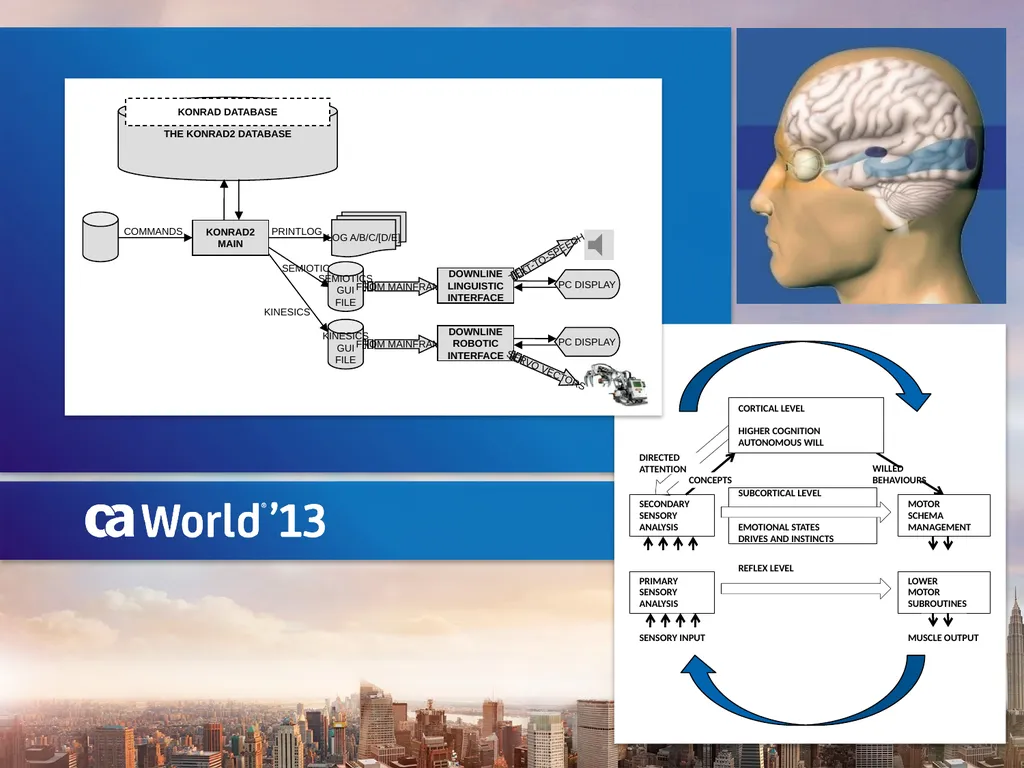
slide32. What we already know
What needs to be preloaded
What needs to be moved
From where to where
What loops to follow
The Konrad Schema
Compatible with experiment
Compatible with philosophy Section 4 Conclusions INPUT<br>

slide33. How far we are already ahead
Konrad first network model of biological network memory
CA IDMS therefore ideal for cognitive robotics
Konrad 5 years ahead
CA 50 years ahead Section 4 Conclusions INPUT<br>
slide34. Q&A<br>
slide35. Q&A<br>
slide36. Please provide your feedback about this session
Session #: MI480SN Session Evaluation<br>