Assessment Tool, Guidebook Support Assessment What is it Why use it? Patient Experience Self-Assessment: Easy to use, low effort tool that assesses the current maturity level of Patient Experience at the individual facility level and
"Assessment Tool, Guidebook & Support Assessment –" is the property of its rightful owner. Permission is granted to
download and print the materials on this website for personal, non-commercial use only, and to display it
on your personal computer provided you do not modify the materials and that you retain all copyright
notices contained in the materials. By downloading content from our website, you accept the terms of this
agreement.
Presentation Transcript
01
Assessment Tool, Guidebook & Support<br>
02
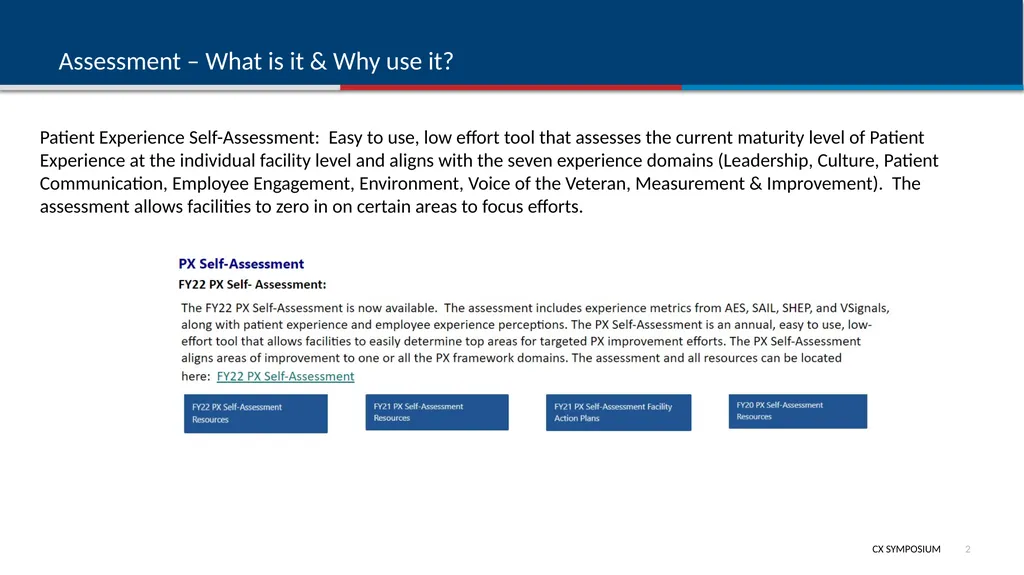
Assessment – What is it & Why use it? Patient Experience Self-Assessment: Easy to use, low effort tool that assesses the current maturity level of Patient Experience at the individual facility level and aligns with the seven experience domains (Leadership, Culture, Patient Communication, Employee Engagement, Environment, Voice of the Veteran, Measurement & Improvement). The assessment allows facilities to zero in on certain areas to focus efforts. 1<br>
03
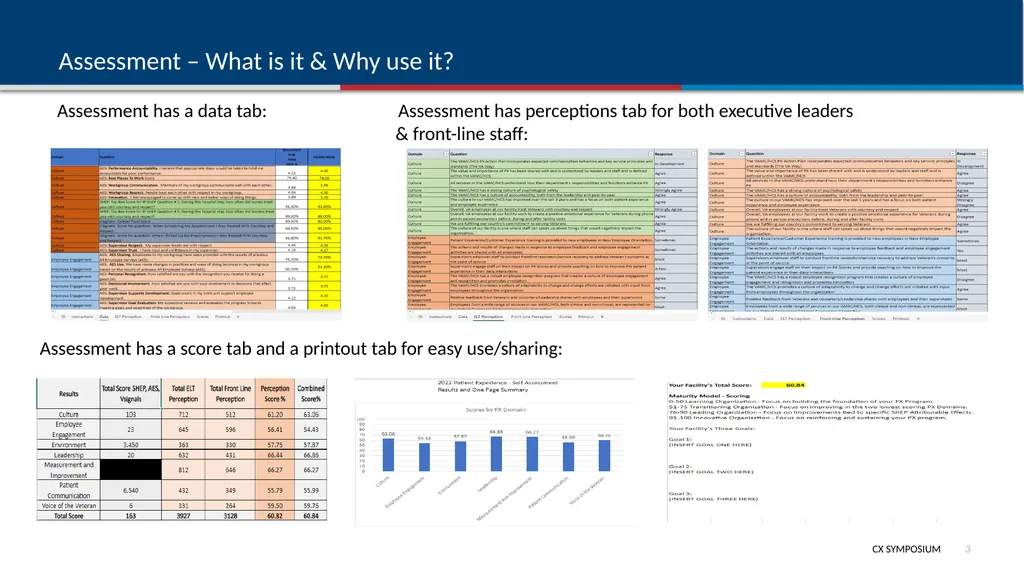
Assessment – What is it & Why use it? Assessment has a data tab: Assessment has perceptions tab for both executive leaders
& front-line staff:
Assessment has a score tab and a printout tab for easy use/sharing: 2<br>
04
Assessment Results – What Next? Maturity Model - Scoring
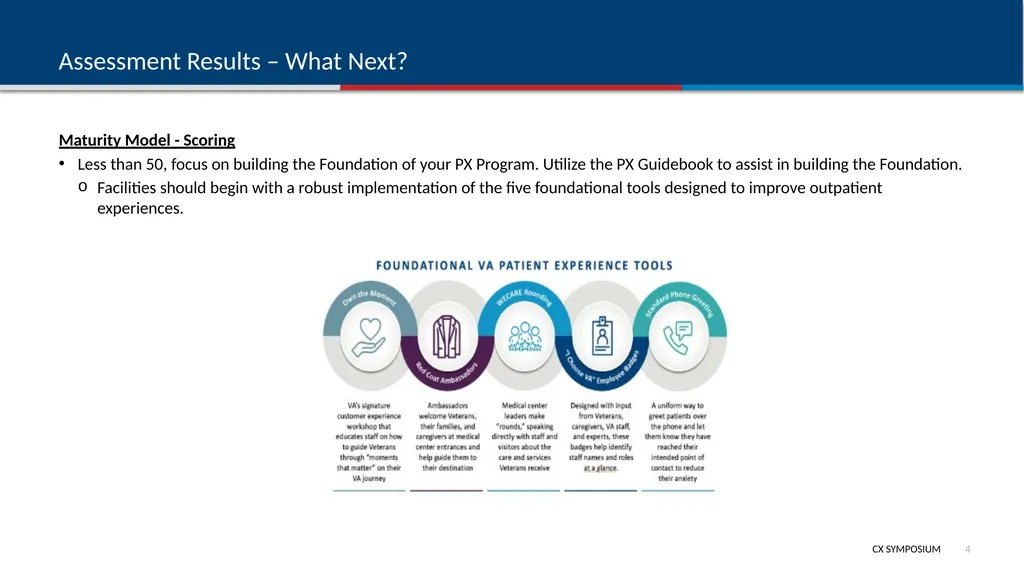
Less than 50, focus on building the Foundation of your PX Program. Utilize the PX Guidebook to assist in building the Foundation.
Facilities should begin with a robust implementation of the five foundational tools designed to improve outpatient experiences. 3<br>
05
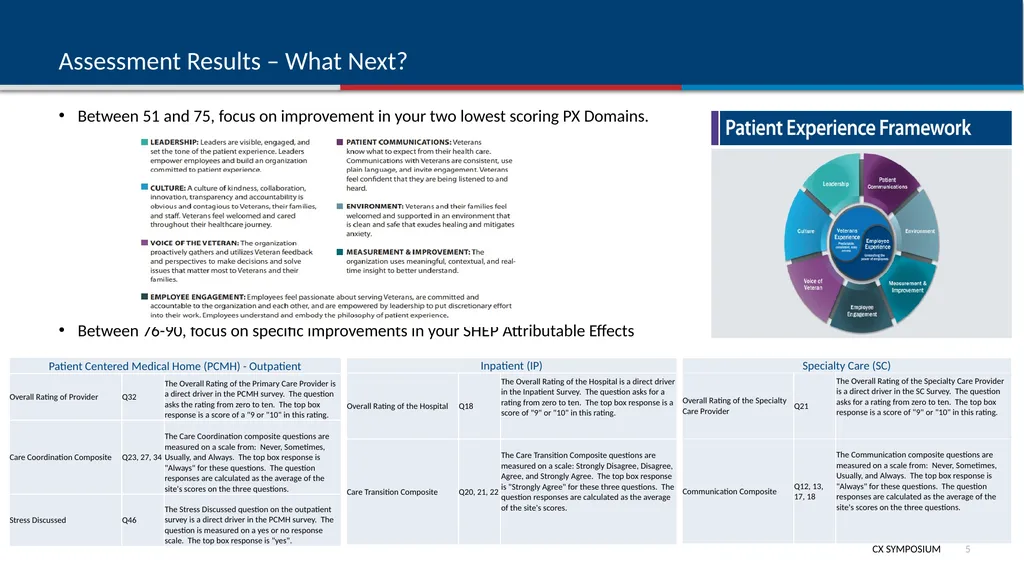
Assessment Results – What Next? Between 51 and 75, focus on improvement in your two lowest scoring PX Domains.
Between 76-90, focus on specific improvements in your SHEP Attributable Effects 4<br>
06
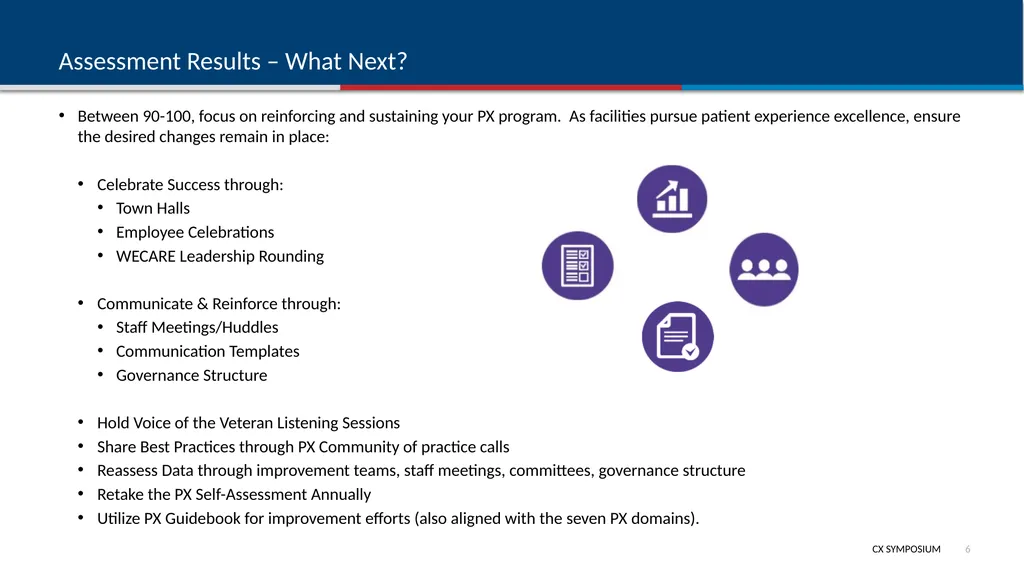
Between 90-100, focus on reinforcing and sustaining your PX program. As facilities pursue patient experience excellence, ensure the desired changes remain in place:
Celebrate Success through:
Town Halls
Employee Celebrations
WECARE Leadership Rounding
Communicate & Reinforce through:
Staff Meetings/Huddles
Communication Templates
Governance Structure
Hold Voice of the Veteran Listening Sessions
Share Best Practices through PX Community of practice calls
Reassess Data through improvement teams, staff meetings, committees, governance structure
Retake the PX Self-Assessment Annually
Utilize PX Guidebook for improvement efforts (also aligned with the seven PX domains).
Assessment Results – What Next? 5<br>
07
Guidebook - What is it & Why use it? Patient Experience Guidebook:
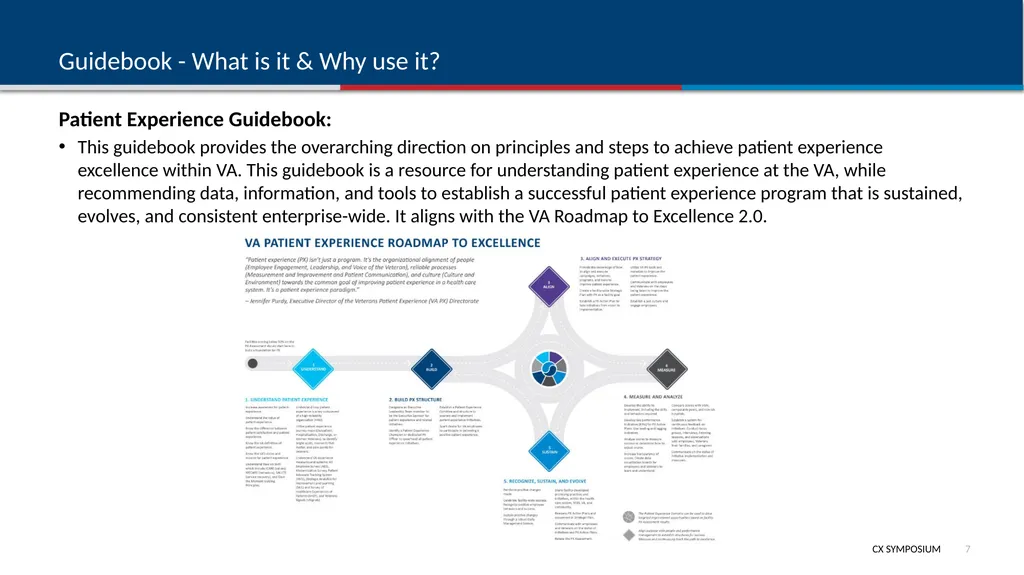
This guidebook provides the overarching direction on principles and steps to achieve patient experience excellence within VA. This guidebook is a resource for understanding patient experience at the VA, while recommending data, information, and tools to establish a successful patient experience program that is sustained, evolves, and consistent enterprise-wide. It aligns with the VA Roadmap to Excellence 2.0. 6<br>
08
Guidebook - What is it & Why use it? Patient Experience Guidebook:
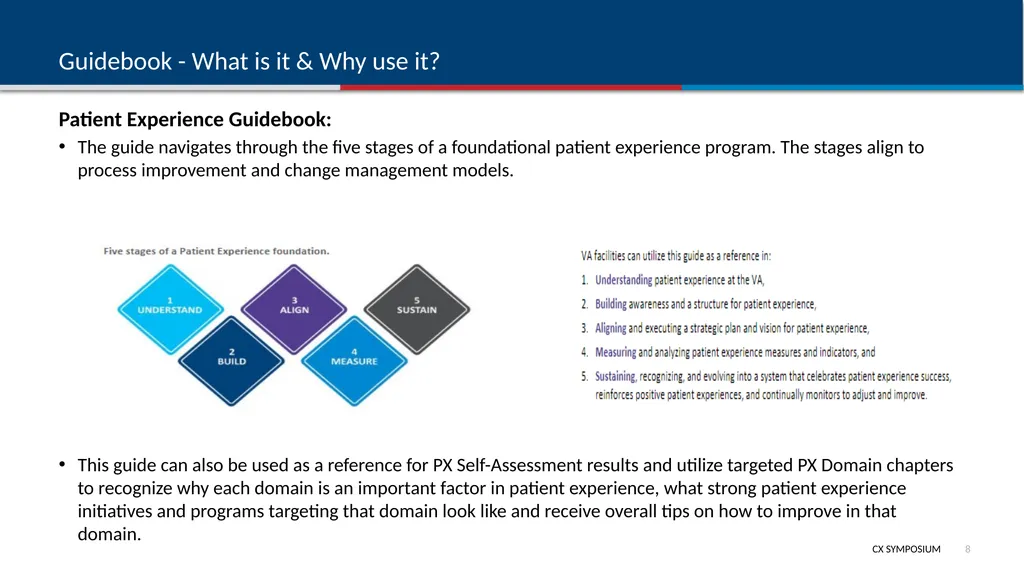
The guide navigates through the five stages of a foundational patient experience program. The stages align to process improvement and change management models.
This guide can also be used as a reference for PX Self-Assessment results and utilize targeted PX Domain chapters to recognize why each domain is an important factor in patient experience, what strong patient experience initiatives and programs targeting that domain look like and receive overall tips on how to improve in that domain. 7<br>
09
Support PX Data Deep Dive (Virtual; 2-3 hours): An interactive crosswalk for leaders and employees to understand bright spots and pain points pertaining to facility and clinic-level experience scores, covering Access to Care, VA’s All Employee Survey, CMS Hospital Compare, Strategic Analytics for Improvement and Learning (SAIL), the Survey of Healthcare Experience of Patients (SHEP), and Veterans Signals.
PX Consultation (On-Site; 2-3 days): An on-site consultation, encompassing a PX Data Dee of Dive, and a catered agenda for the facility that could include a traditional on-site consultation, a Program Review, Strategic Planning and/or Action Planning with focus groups, and interviews to gather the observations of employees and Veterans.
PX Coaching (1 Day Shadow/1-Hr Ongoing, Virtual & In Person): A Virtual or On- site visit with a catered agenda that could include options for 1:1 coaching, PX Self-Assessment Support, Experience Data Set Training and VISN VEC Support coaching.
Implementation (On-Site; 2-3 days): On-site and virtual implementation coaching and utilization of all Patient Experience Toolkits. Implementation also includes solutions derived from the Human-Centered Design (HCD) journey maps, addressing the moments that matter, development of new evidence-based new toolkits, and implementation support of opportunities identified through PX Consultation. 8<br>