Assumptions, Stereotypes, and Inclusivity in Comics What Values and Messages do the Visuals in Comics Say About the Creators, the Context, our World, and the Audience? Images and Assumptions Rhetorically speaking, when we discuss
"Assumptions, Stereotypes, and Inclusivity in" is the property of its rightful owner. Permission is granted to
download and print the materials on this website for personal, non-commercial use only, and to display it
on your personal computer provided you do not modify the materials and that you retain all copyright
notices contained in the materials. By downloading content from our website, you accept the terms of this
agreement.
Presentation Transcript
01
Assumptions, Stereotypes, and Inclusivity in Comics What Values and Messages do the Visuals in Comics Say About the Creators, the Context, our World, and the Audience?<br>
02
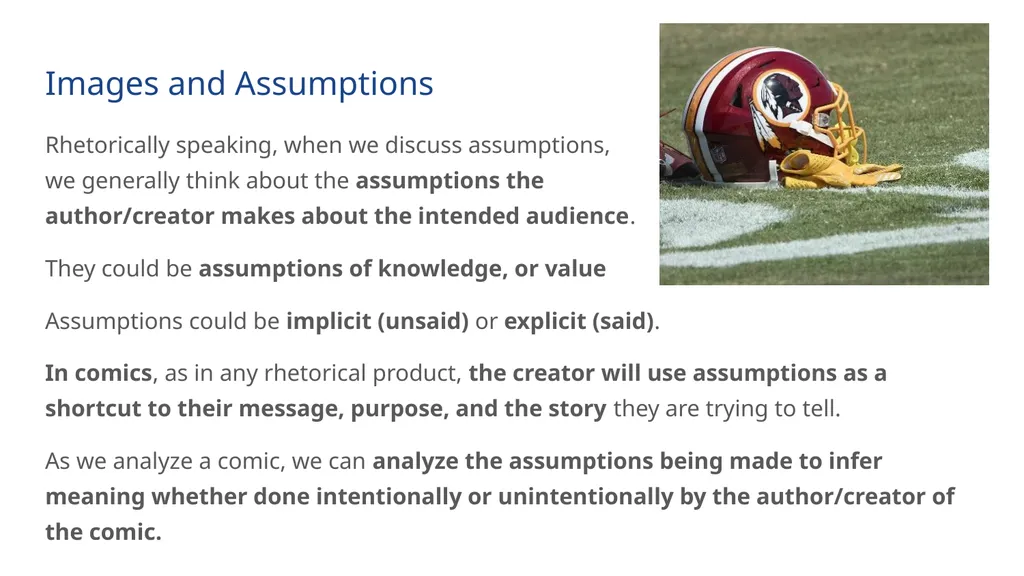
Images and Assumptions Rhetorically speaking, when we discuss assumptions, we generally think about the assumptions the author/creator makes about the intended audience.
They could be assumptions of knowledge, or value
Assumptions could be implicit (unsaid) or explicit (said).
In comics, as in any rhetorical product, the creator will use assumptions as a shortcut to their message, purpose, and the story they are trying to tell.
As we analyze a comic, we can analyze the assumptions being made to infer meaning whether done intentionally or unintentionally by the author/creator of the comic.<br>
03
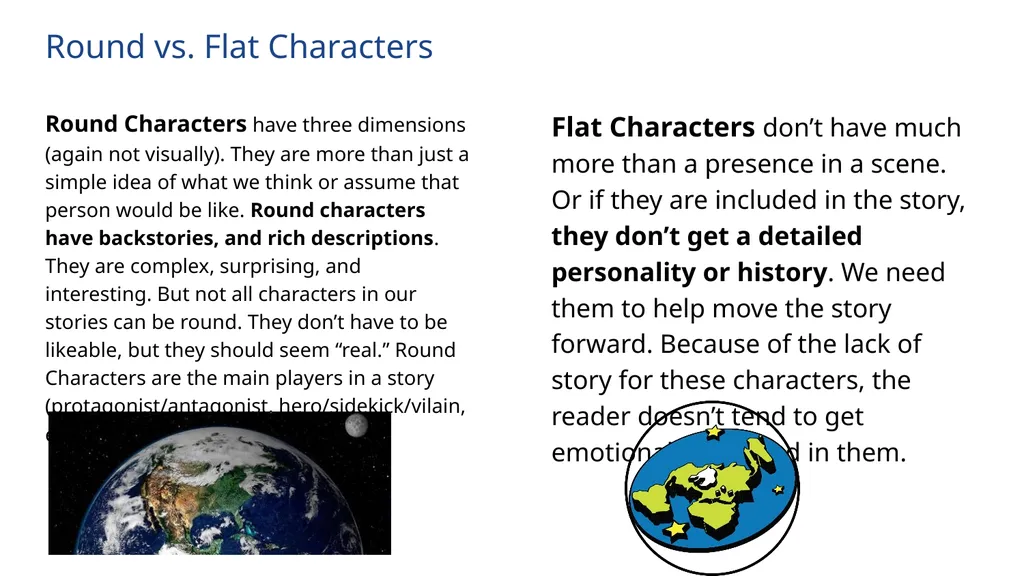
Round vs. Flat Characters Round Characters have three dimensions (again not visually). They are more than just a simple idea of what we think or assume that person would be like. Round characters have backstories, and rich descriptions. They are complex, surprising, and interesting. But not all characters in our stories can be round. They don’t have to be likeable, but they should seem “real.” Round Characters are the main players in a story (protagonist/antagonist, hero/sidekick/vilain, etc.) Flat Characters don’t have much more than a presence in a scene. Or if they are included in the story, they don’t get a detailed personality or history. We need them to help move the story forward. Because of the lack of story for these characters, the reader doesn’t tend to get emotionally invested in them.<br>
04
Stereotypes Stereotypes are shortcuts in communication, just like assumptions.
Writers and artists will sometimes use them to quickly tell their audience something about the characters and situations they are depicting.The authors and artists might do this consciously or unconsciously.
Likewise, creators might use these shortcuts because of values and beliefs they have about a person or group, and/or they might use them to speak to an audience who they think has these values/beliefs.
Assumptions can save time in communication, but they can quickly become problematic.<br>
05
Stereotypes continued… FLAT characters run the risk of being stereotypically depicted and portrayed in a negative way, but ROUND characters run the same risk.
This is something writer Chimamanda Ngozi Adichie calls “The Danger of the Single Story.” (check out her TED Talk here) Adichie’s talk basically discusses how people in a society may have limited knowledge of other cultures, and other types of people. This lack of understanding leads to misconceptions and assumed knowledge, which leads to misconstrued values and beliefs.
For example, you may think a certain type of person is lazy, or smart. These might be assumptions you hold based on what your society “tells” you, or they may be based on your own experiences.
These stereotypes, cliches, and Tropes often show up in how characters are drawn and depicted, and we can analyze those images to gain meaning and understanding from a comic.<br>
06
Inclusion and Exclusion and Diversity While stereotyping marginalized groups is bad, it’s hard to portray someone stereotypically if they aren’t even there.
The inclusion and exclusion of historically marginalized groups in comics is an ongoing issue.
The inclusion of marginalized groups in comics is a good thing. Making them the protagonists of the story is great!* But doing that in a disingenuous way is problematic.
“Token” characters can lessen the credibility and authenticity of a story.
And, often times “token” characters can be misrepresented and stereotyped by a creator that has assumed knowledge or beliefs about another person or group.
(*Introducing more diversity in the ranks of the creators of comics is amazing too!!)<br>
07
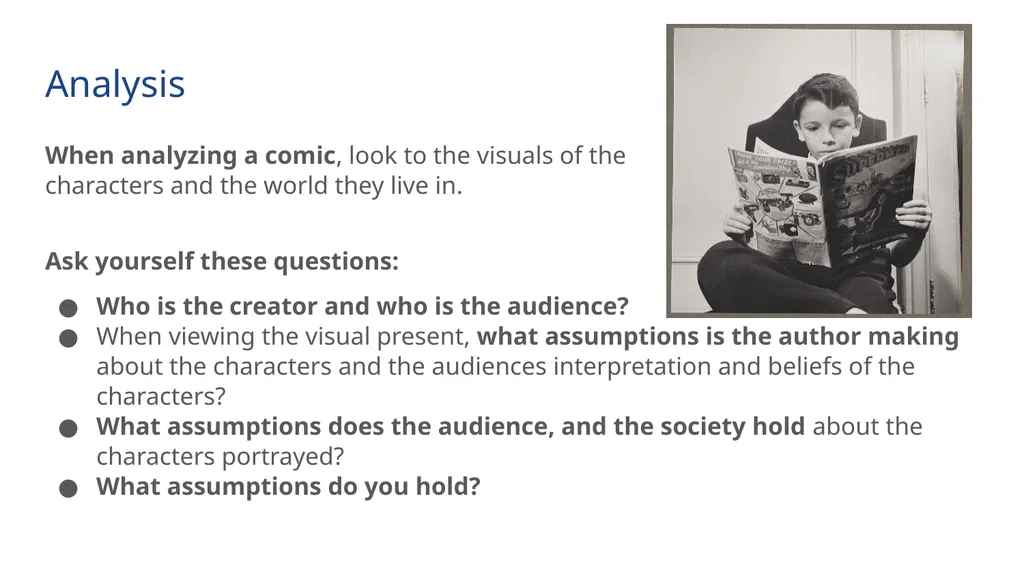
Analysis When analyzing a comic, look to the visuals of the characters and the world they live in.
Ask yourself these questions:
Who is the creator and who is the audience?
When viewing the visual present, what assumptions is the author making about the characters and the audiences interpretation and beliefs of the characters?
What assumptions does the audience, and the society hold about the characters portrayed?
What assumptions do you hold?<br>
08
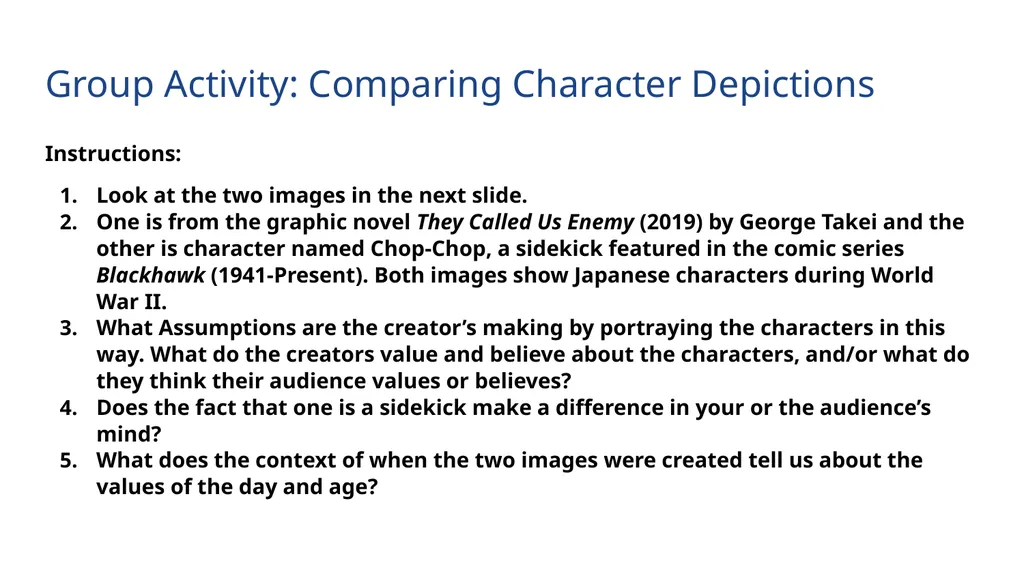
Group Activity: Comparing Character Depictions Instructions:
Look at the two images in the next slide.
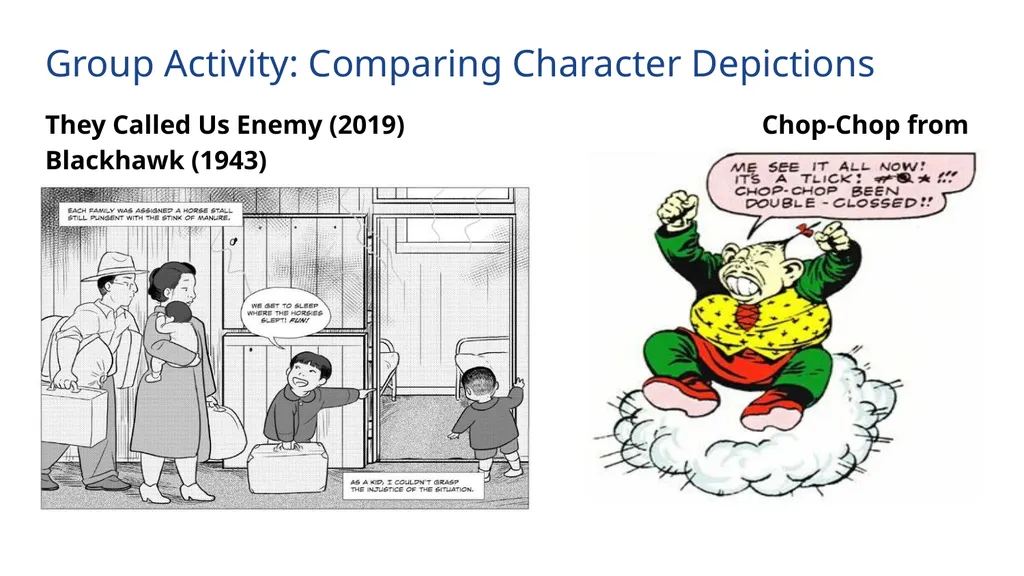
One is from the graphic novel They Called Us Enemy (2019) by George Takei and the other is character named Chop-Chop, a sidekick featured in the comic series Blackhawk (1941-Present). Both images show Japanese characters during World War II.
What Assumptions are the creator’s making by portraying the characters in this way. What do the creators value and believe about the characters, and/or what do they think their audience values or believes?
Does the fact that one is a sidekick make a difference in your or the audience’s mind?
What does the context of when the two images were created tell us about the values of the day and age?<br>
09
Group Activity: Comparing Character Depictions They Called Us Enemy (2019) Chop-Chop from Blackhawk (1943)<br>
10
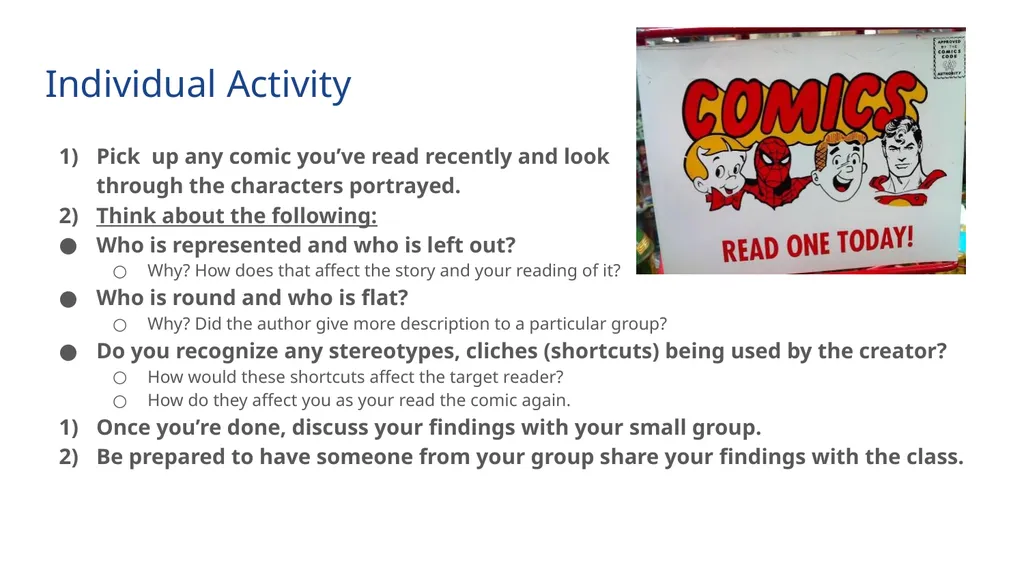
Individual Activity Pick up any comic you’ve read recently and look through the characters portrayed.
Think about the following:
Who is represented and who is left out?
Why? How does that affect the story and your reading of it?
Who is round and who is flat?
Why? Did the author give more description to a particular group?
Do you recognize any stereotypes, cliches (shortcuts) being used by the creator?
How would these shortcuts affect the target reader?
How do they affect you as your read the comic again.
Once you’re done, discuss your findings with your small group.
Be prepared to have someone from your group share your findings with the class.<br>
11
Works Cited Adichie, Chimamanda Ngozi. “The Danger of a Single Story.” TED, Nov. 2013, https://www.ted.com/talks/chimamanda_ngozi_adichie_ the_danger_of_a_single_story?language=en .
FURTHER READING
Robertson, Paul Lester. “Indians of the Apocalypse: Native Appropriation and Representation in 1980s Dystopic Films and Comic Books.” Journal of Popular Culture, vol. 51, no. 1, 2018, pp. 68–90, https://doi.org/10.1111/jpcu.12649.
Singer, Marc. “‘Black Skins’ and White Masks: Comic Books and the Secret of Race.” African American Review, vol. 36, no. 1, 2002, pp. 107–19, https://doi.org/10.2307/2903369.
Thompson, Katrina D. “The Stereotype in Tanzania Comics: Swahili and the Ethnic Other.” International Journal of Comic Art, vol. 8, no. 2, 2006, p. 228–.<br>