
Attack / Going Over the Top Siegfried Sassoon


Description: Attack Going Over the Top Siegfried Sassoon About Siegfried Sassoon Siegfried Sassoon was a major poet during the time of World War One. He grew up in the lap of luxury in a wealthy Jewish family in England but chose to enlist in war
Related Topics
Download Presentation
"Attack / Going Over the Top Siegfried Sassoon" is the property of its rightful owner. Permission is granted to download and print the materials on this website for personal, non-commercial use only, and to display it on your personal computer provided you do not modify the materials and that you retain all copyright notices contained in the materials. By downloading content from our website, you accept the terms of this agreement.
Presentation Transcript
slide1. Attack / Going Over the Top Siegfried Sassoon<br>
slide2. About Siegfried Sassoon Siegfried Sassoon was a major poet during the time of World War One. He grew up in the lap of luxury in a wealthy Jewish family in England but chose to enlist in war himself.
Sassoon fought on the Western front and wrote poetry about war. He has written many celebrated works, including the Sherston trilogy which is basically just a fictionalized version of his life.
Sassoon was known for his bravery in war and was nicknamed ‘Mad Jack’ because of his unbelievable, almost reckless bravery during battle. Despite his active participation in war he was known for protesting the continuation of war, especially after he lost one of his best friends during battle.
He died of stomach cancer at 81 years of age.<br>
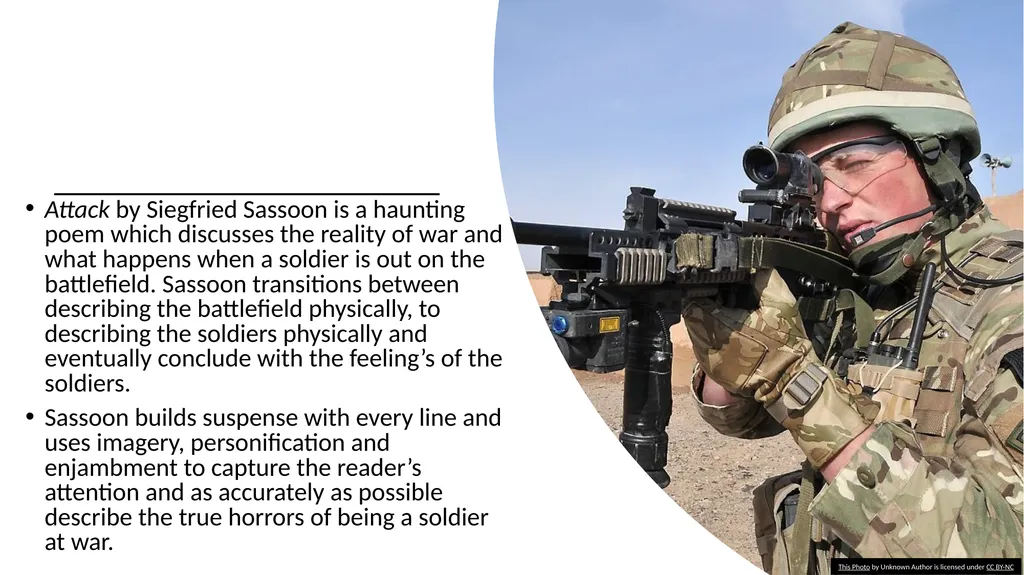
slide3. Attack by Siegfried Sassoon is a haunting poem which discusses the reality of war and what happens when a soldier is out on the battlefield. Sassoon transitions between describing the battlefield physically, to describing the soldiers physically and eventually conclude with the feeling’s of the soldiers.
Sassoon builds suspense with every line and uses imagery, personification and enjambment to capture the reader’s attention and as accurately as possible describe the true horrors of being a soldier at war. This Photo by Unknown Author is licensed under CC BY-NC<br>
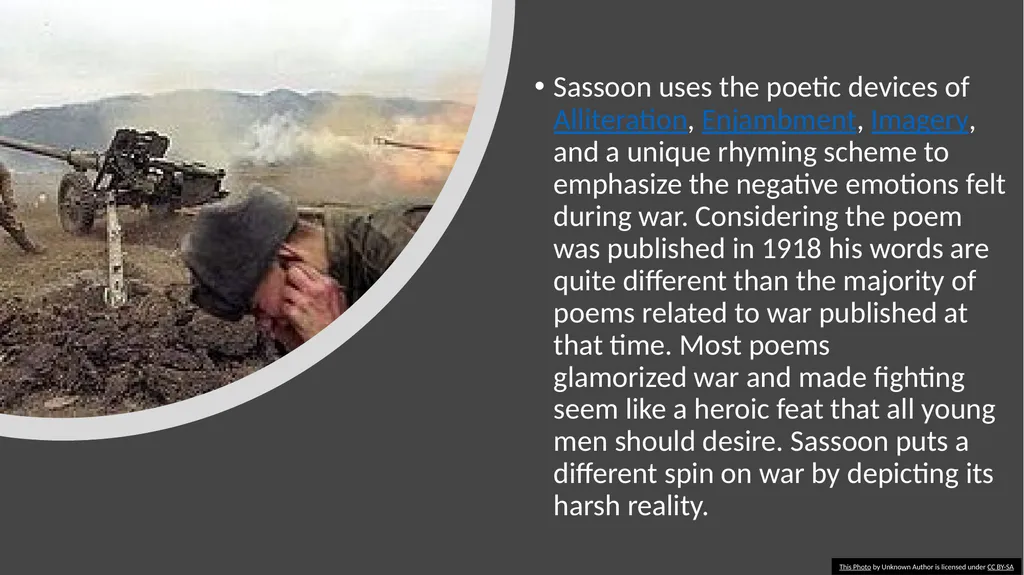
slide4. Sassoon uses the poetic devices of Alliteration, Enjambment, Imagery, and a unique rhyming scheme to emphasize the negative emotions felt during war. Considering the poem was published in 1918 his words are quite different than the majority of poems related to war published at that time. Most poems glamorized war and made fighting seem like a heroic feat that all young men should desire. Sassoon puts a different spin on war by depicting its harsh reality. This Photo by Unknown Author is licensed under CC BY-SA<br>
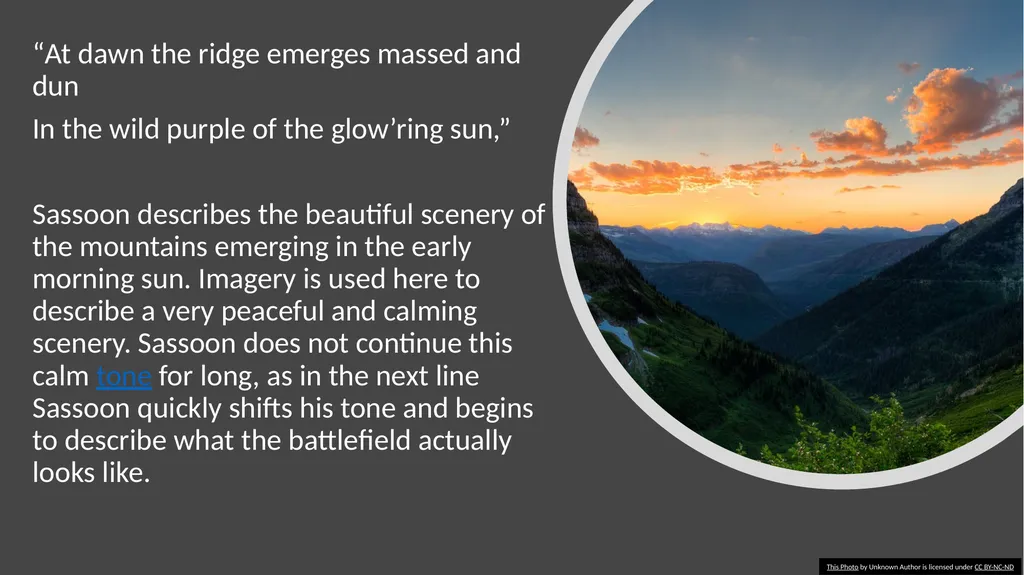
slide5. “At dawn the ridge emerges massed and dun
In the wild purple of the glow’ring sun,”
Sassoon describes the beautiful scenery of the mountains emerging in the early morning sun. Imagery is used here to describe a very peaceful and calming scenery. Sassoon does not continue this calm tone for long, as in the next line Sassoon quickly shifts his tone and begins to describe what the battlefield actually looks like. This Photo by Unknown Author is licensed under CC BY-NC-ND<br>
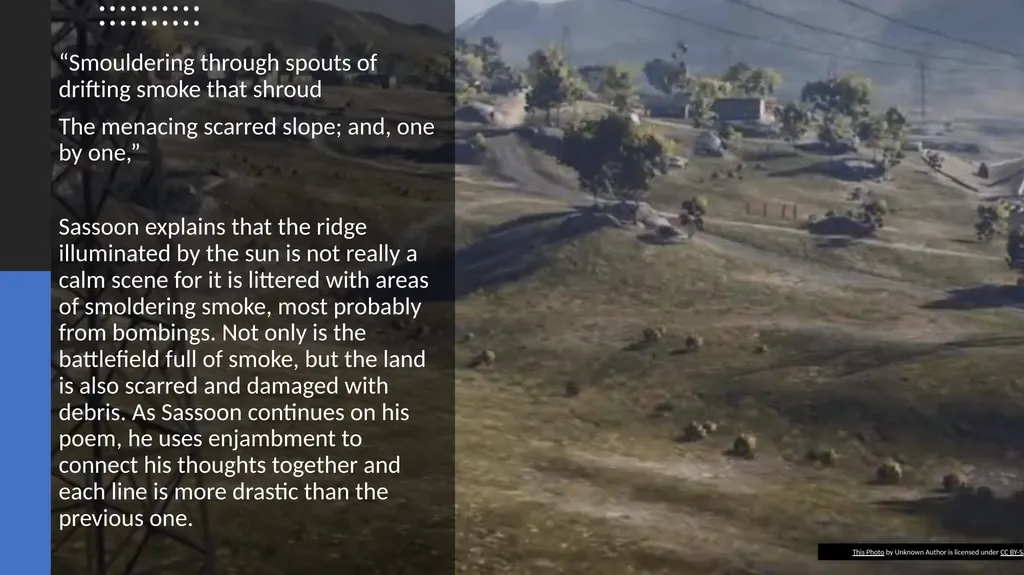
slide6. “Smouldering through spouts of drifting smoke that shroud
The menacing scarred slope; and, one by one,”
Sassoon explains that the ridge illuminated by the sun is not really a calm scene for it is littered with areas of smoldering smoke, most probably from bombings. Not only is the battlefield full of smoke, but the land is also scarred and damaged with debris. As Sassoon continues on his poem, he uses enjambment to connect his thoughts together and each line is more drastic than the previous one. This Photo by Unknown Author is licensed under CC BY-SA-NC<br>
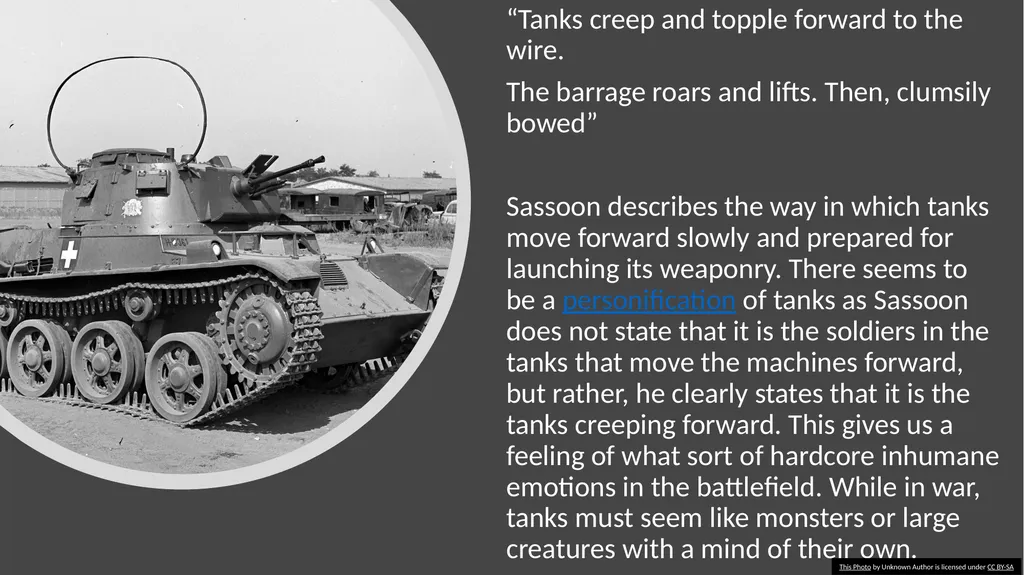
slide7. “Tanks creep and topple forward to the wire.
The barrage roars and lifts. Then, clumsily bowed”
Sassoon describes the way in which tanks move forward slowly and prepared for launching its weaponry. There seems to be a personification of tanks as Sassoon does not state that it is the soldiers in the tanks that move the machines forward, but rather, he clearly states that it is the tanks creeping forward. This gives us a feeling of what sort of hardcore inhumane emotions in the battlefield. While in war, tanks must seem like monsters or large creatures with a mind of their own. This Photo by Unknown Author is licensed under CC BY-SA<br>
slide8. “With bombs and guns and shovels and battle-gear,
Men jostle and climb to, meet the bristling fire.”
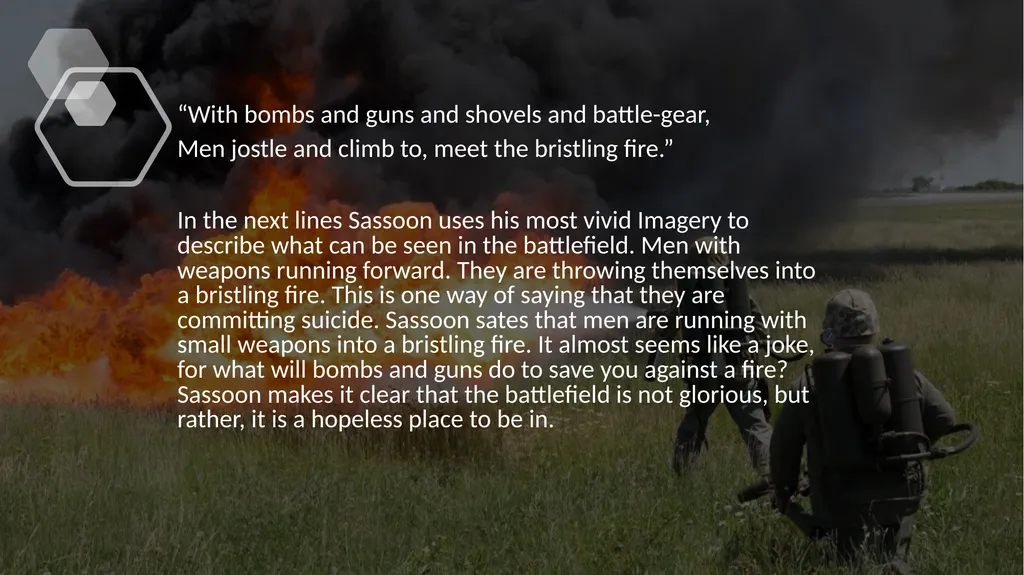
In the next lines Sassoon uses his most vivid Imagery to describe what can be seen in the battlefield. Men with weapons running forward. They are throwing themselves into a bristling fire. This is one way of saying that they are committing suicide. Sassoon sates that men are running with small weapons into a bristling fire. It almost seems like a joke, for what will bombs and guns do to save you against a fire? Sassoon makes it clear that the battlefield is not glorious, but rather, it is a hopeless place to be in.<br>
slide9. “Lines of grey, muttering faces, masked with fear,
They leave their trenches, going over the top,”
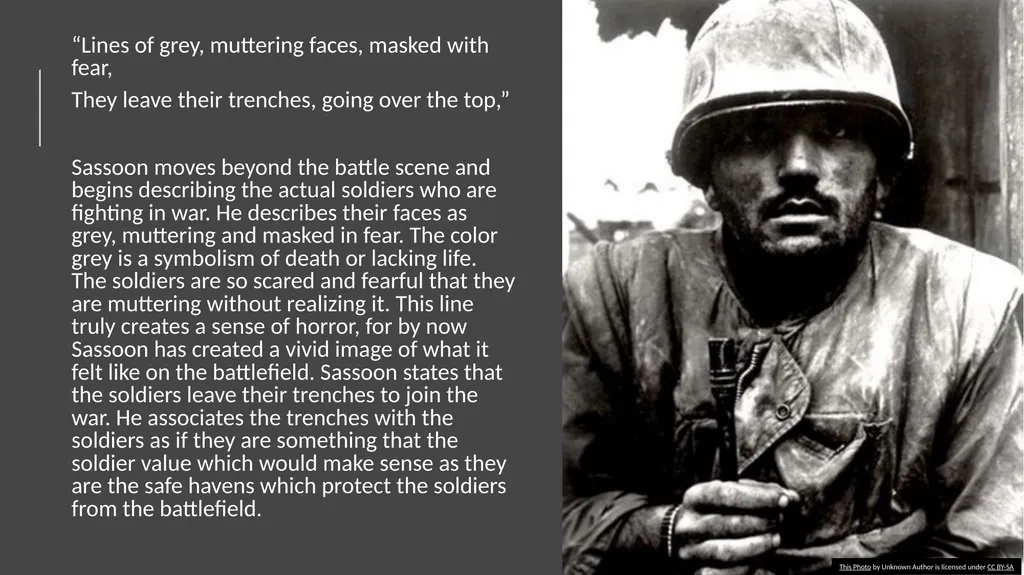
Sassoon moves beyond the battle scene and begins describing the actual soldiers who are fighting in war. He describes their faces as grey, muttering and masked in fear. The color grey is a symbolism of death or lacking life. The soldiers are so scared and fearful that they are muttering without realizing it. This line truly creates a sense of horror, for by now Sassoon has created a vivid image of what it felt like on the battlefield. Sassoon states that the soldiers leave their trenches to join the war. He associates the trenches with the soldiers as if they are something that the soldier value which would make sense as they are the safe havens which protect the soldiers from the battlefield. This Photo by Unknown Author is licensed under CC BY-SA<br>
slide10. “While time ticks blank and busy on their wrists,
And hope, with furtive eyes and grappling fists,”
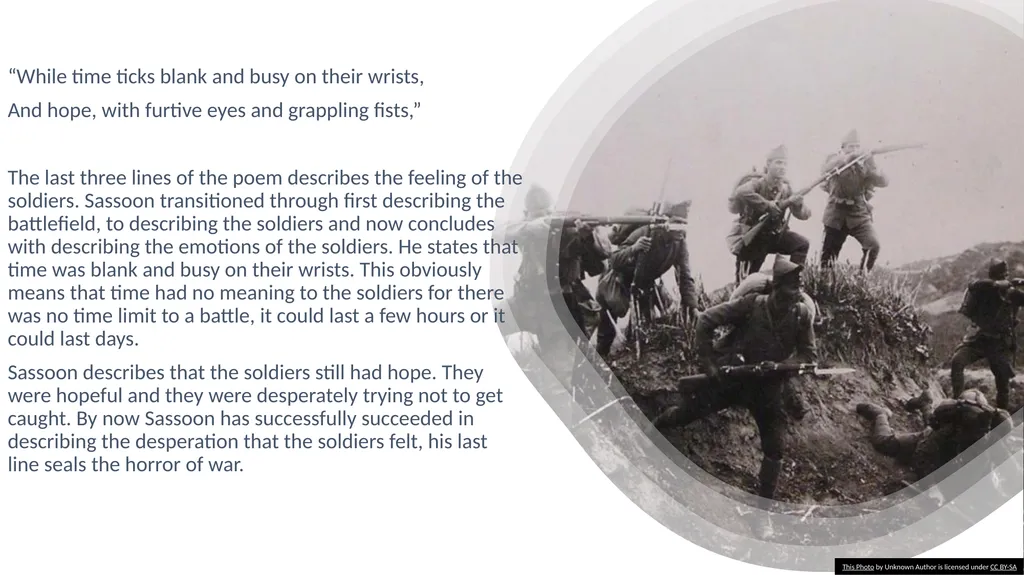
The last three lines of the poem describes the feeling of the soldiers. Sassoon transitioned through first describing the battlefield, to describing the soldiers and now concludes with describing the emotions of the soldiers. He states that time was blank and busy on their wrists. This obviously means that time had no meaning to the soldiers for there was no time limit to a battle, it could last a few hours or it could last days.
Sassoon describes that the soldiers still had hope. They were hopeful and they were desperately trying not to get caught. By now Sassoon has successfully succeeded in describing the desperation that the soldiers felt, his last line seals the horror of war. This Photo by Unknown Author is licensed under CC BY-SA<br>
slide11. “Flounders in mud. O Jesus, make it stop!”
The last line states that the soldiers were really in a pathetically hopeless situation. Flounders in mud.
Sassoon is stating that going to war is like committing suicide.
The last three words, make it stop show how these overtly strong soldiers are left with nothing at the end by crying and begging for the torture to stop. This Photo by Unknown Author is licensed under CC BY-NC-ND<br>
slide12. The title of the poem is Attack, this could be due to the nature of the poem itself. Sassoon builds up suspense throughout the poem and ends with a torturous ending, much like an attack. Otherwise, the title attack could be referring to the feelings of the soldiers. War may be glorified and described as a noble duty, but in reality it feels and is essentially nothing more than an attack. This Photo by Unknown Author is licensed under CC BY-SA<br>
slide2. About Siegfried Sassoon Siegfried Sassoon was a major poet during the time of World War One. He grew up in the lap of luxury in a wealthy Jewish family in England but chose to enlist in war himself.
Sassoon fought on the Western front and wrote poetry about war. He has written many celebrated works, including the Sherston trilogy which is basically just a fictionalized version of his life.
Sassoon was known for his bravery in war and was nicknamed ‘Mad Jack’ because of his unbelievable, almost reckless bravery during battle. Despite his active participation in war he was known for protesting the continuation of war, especially after he lost one of his best friends during battle.
He died of stomach cancer at 81 years of age.<br>
slide3. Attack by Siegfried Sassoon is a haunting poem which discusses the reality of war and what happens when a soldier is out on the battlefield. Sassoon transitions between describing the battlefield physically, to describing the soldiers physically and eventually conclude with the feeling’s of the soldiers.
Sassoon builds suspense with every line and uses imagery, personification and enjambment to capture the reader’s attention and as accurately as possible describe the true horrors of being a soldier at war. This Photo by Unknown Author is licensed under CC BY-NC<br>
slide4. Sassoon uses the poetic devices of Alliteration, Enjambment, Imagery, and a unique rhyming scheme to emphasize the negative emotions felt during war. Considering the poem was published in 1918 his words are quite different than the majority of poems related to war published at that time. Most poems glamorized war and made fighting seem like a heroic feat that all young men should desire. Sassoon puts a different spin on war by depicting its harsh reality. This Photo by Unknown Author is licensed under CC BY-SA<br>
slide5. “At dawn the ridge emerges massed and dun
In the wild purple of the glow’ring sun,”
Sassoon describes the beautiful scenery of the mountains emerging in the early morning sun. Imagery is used here to describe a very peaceful and calming scenery. Sassoon does not continue this calm tone for long, as in the next line Sassoon quickly shifts his tone and begins to describe what the battlefield actually looks like. This Photo by Unknown Author is licensed under CC BY-NC-ND<br>
slide6. “Smouldering through spouts of drifting smoke that shroud
The menacing scarred slope; and, one by one,”
Sassoon explains that the ridge illuminated by the sun is not really a calm scene for it is littered with areas of smoldering smoke, most probably from bombings. Not only is the battlefield full of smoke, but the land is also scarred and damaged with debris. As Sassoon continues on his poem, he uses enjambment to connect his thoughts together and each line is more drastic than the previous one. This Photo by Unknown Author is licensed under CC BY-SA-NC<br>
slide7. “Tanks creep and topple forward to the wire.
The barrage roars and lifts. Then, clumsily bowed”
Sassoon describes the way in which tanks move forward slowly and prepared for launching its weaponry. There seems to be a personification of tanks as Sassoon does not state that it is the soldiers in the tanks that move the machines forward, but rather, he clearly states that it is the tanks creeping forward. This gives us a feeling of what sort of hardcore inhumane emotions in the battlefield. While in war, tanks must seem like monsters or large creatures with a mind of their own. This Photo by Unknown Author is licensed under CC BY-SA<br>
slide8. “With bombs and guns and shovels and battle-gear,
Men jostle and climb to, meet the bristling fire.”
In the next lines Sassoon uses his most vivid Imagery to describe what can be seen in the battlefield. Men with weapons running forward. They are throwing themselves into a bristling fire. This is one way of saying that they are committing suicide. Sassoon sates that men are running with small weapons into a bristling fire. It almost seems like a joke, for what will bombs and guns do to save you against a fire? Sassoon makes it clear that the battlefield is not glorious, but rather, it is a hopeless place to be in.<br>
slide9. “Lines of grey, muttering faces, masked with fear,
They leave their trenches, going over the top,”
Sassoon moves beyond the battle scene and begins describing the actual soldiers who are fighting in war. He describes their faces as grey, muttering and masked in fear. The color grey is a symbolism of death or lacking life. The soldiers are so scared and fearful that they are muttering without realizing it. This line truly creates a sense of horror, for by now Sassoon has created a vivid image of what it felt like on the battlefield. Sassoon states that the soldiers leave their trenches to join the war. He associates the trenches with the soldiers as if they are something that the soldier value which would make sense as they are the safe havens which protect the soldiers from the battlefield. This Photo by Unknown Author is licensed under CC BY-SA<br>
slide10. “While time ticks blank and busy on their wrists,
And hope, with furtive eyes and grappling fists,”
The last three lines of the poem describes the feeling of the soldiers. Sassoon transitioned through first describing the battlefield, to describing the soldiers and now concludes with describing the emotions of the soldiers. He states that time was blank and busy on their wrists. This obviously means that time had no meaning to the soldiers for there was no time limit to a battle, it could last a few hours or it could last days.
Sassoon describes that the soldiers still had hope. They were hopeful and they were desperately trying not to get caught. By now Sassoon has successfully succeeded in describing the desperation that the soldiers felt, his last line seals the horror of war. This Photo by Unknown Author is licensed under CC BY-SA<br>
slide11. “Flounders in mud. O Jesus, make it stop!”
The last line states that the soldiers were really in a pathetically hopeless situation. Flounders in mud.
Sassoon is stating that going to war is like committing suicide.
The last three words, make it stop show how these overtly strong soldiers are left with nothing at the end by crying and begging for the torture to stop. This Photo by Unknown Author is licensed under CC BY-NC-ND<br>
slide12. The title of the poem is Attack, this could be due to the nature of the poem itself. Sassoon builds up suspense throughout the poem and ends with a torturous ending, much like an attack. Otherwise, the title attack could be referring to the feelings of the soldiers. War may be glorified and described as a noble duty, but in reality it feels and is essentially nothing more than an attack. This Photo by Unknown Author is licensed under CC BY-SA<br>