Attitude Change When attitudes are in formation stage and after attitudes are formed, attitudes can be modified and changed. Attitude Change There are major three major concepts- Concept of Balance (Fritz Heider)- also refers as P-O-X
"Attitude Change When attitudes are in formation" is the property of its rightful owner. Permission is granted to
download and print the materials on this website for personal, non-commercial use only, and to display it
on your personal computer provided you do not modify the materials and that you retain all copyright
notices contained in the materials. By downloading content from our website, you accept the terms of this
agreement.
Presentation Transcript
01
Attitude Change<br>
02
When attitudes are in formation stage and after attitudes are formed, attitudes can be modified and changed. Attitude Change<br>
03
There are major three major concepts-
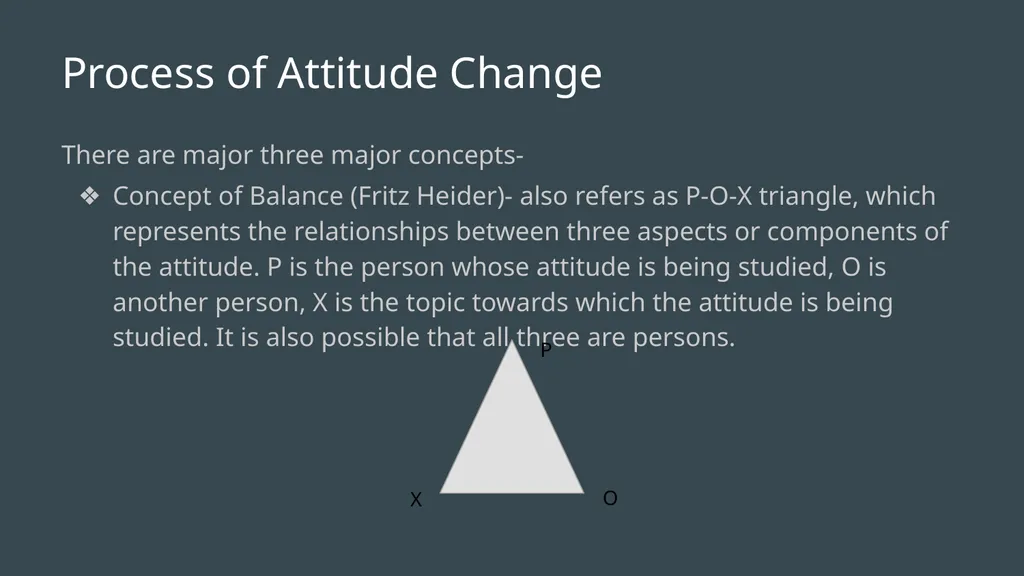
Concept of Balance (Fritz Heider)- also refers as P-O-X triangle, which represents the relationships between three aspects or components of the attitude. P is the person whose attitude is being studied, O is another person, X is the topic towards which the attitude is being studied. It is also possible that all three are persons. Process of Attitude Change P O X<br>
04
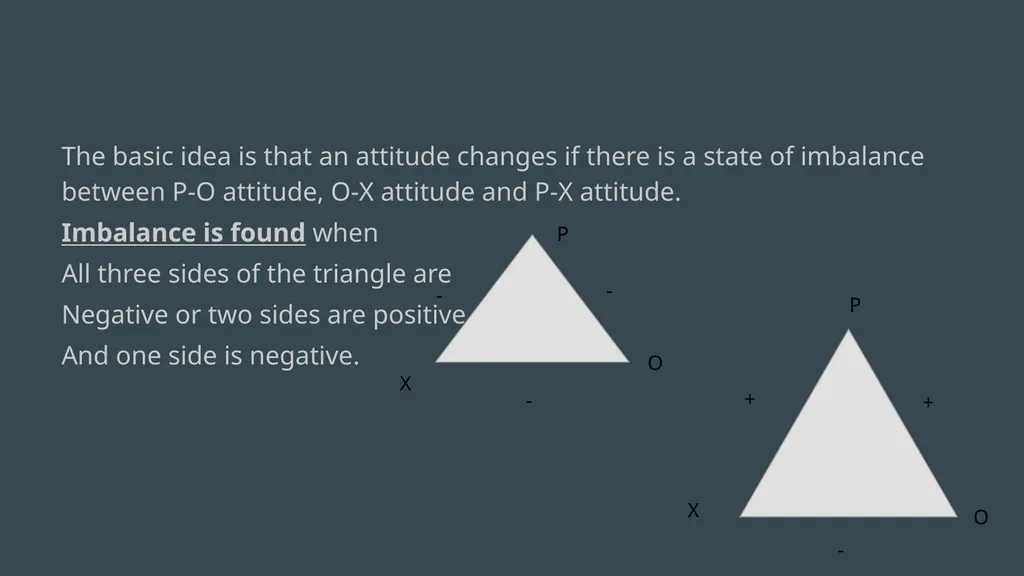
The basic idea is that an attitude changes if there is a state of imbalance between P-O attitude, O-X attitude and P-X attitude.
Imbalance is found when
All three sides of the triangle are
Negative or two sides are positive
And one side is negative. P O X - - - P X O + + -<br>
05
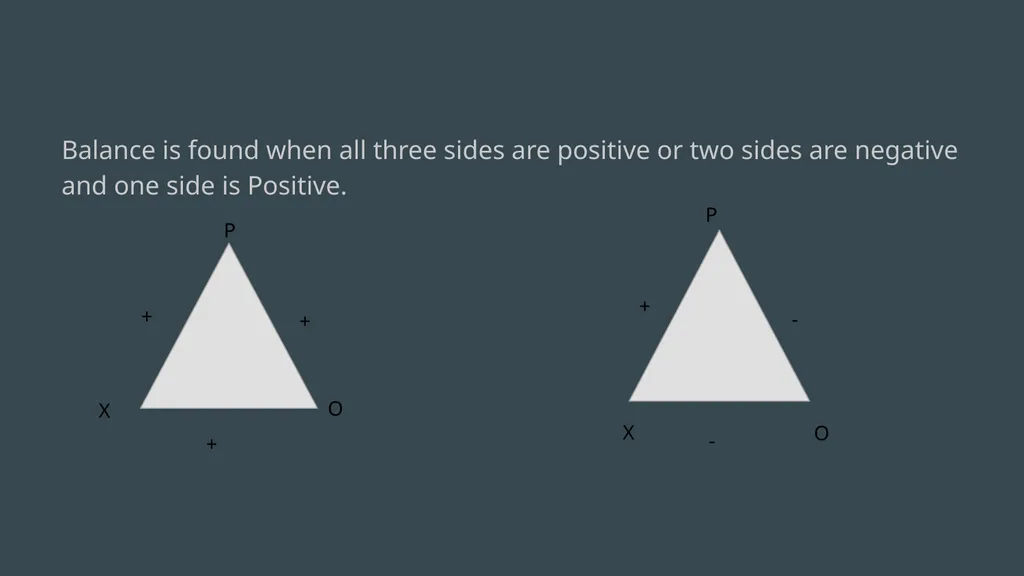
Balance is found when all three sides are positive or two sides are negative and one side is Positive. P X O P X O + + + + - -<br>
06
Concept of Cognitive Dissonance (Leon Festinger)- It emphasis on the cognitive component. The basic idea is that the cognitive components of an attitude must be consonant. That is they should be logically in line with each other. If an individual finds that two cognitions in an attitude are dissonant, then one of them will be changed in the direction of consonance.<br>
07
Two step concept (S.M. Mohsin)-Attitude change takes place in the form of two steps.
1st step- the target of change identifies with the source. The target is the person whose attitude is to be changed. The source is the person through whose influence the change is to take place. Identification means that the target has liking and regard for the source. She puts herself in the palace of the target, and tries to feel like her/ him. The source also have the positive attitude towards the target and the regard and attraction becomes mutual.
2nd step- the source herself shows an attitude change, by actually changing her behavior towards the attitude object. Observing the sources changed attitude and behavior, the target also shows an attitude change through behavior.This is a kind of imitation or observational learning.<br>
08
Positive attitudes are easier to change then negative attitudes.
Less extreme attitudes are easier to change then extreme attitudes.
Simple attitudes are easier to change then multiple attitudes.
Peripheral (less significant) attitudes are easier to change then central attitudes. Characteristics of the existing Attitude<br>
09
Congruent attitude change- positive attitudes may become more positive and negative may become more negative.
Incongruent attitude change- positive become less positive and negative become less negative. Direction and extent of Attitude change<br>
10
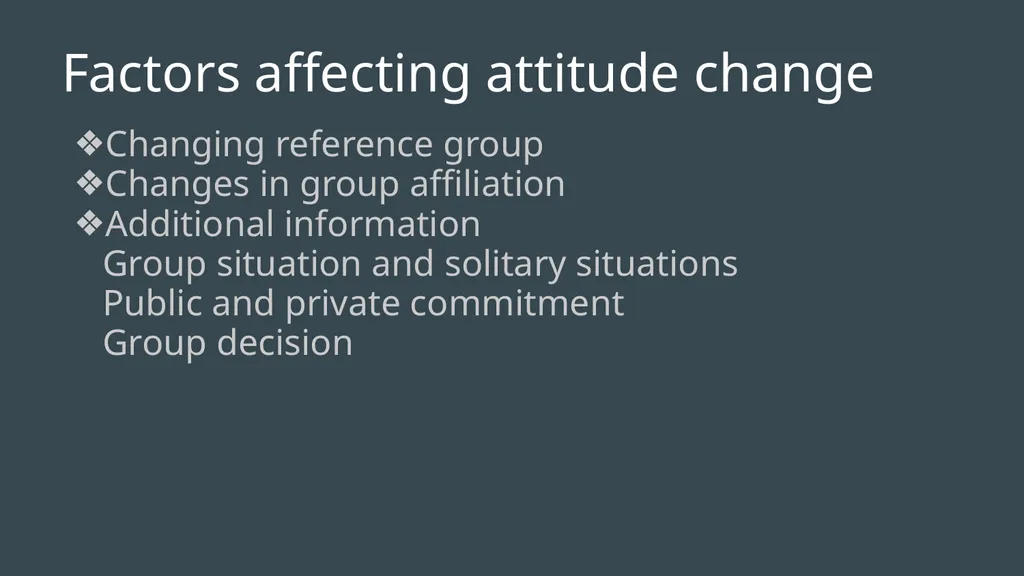
Changing reference group
Changes in group affiliation
Additional information
Group situation and solitary situations
Public and private commitment
Group decision Factors affecting attitude change<br>
11
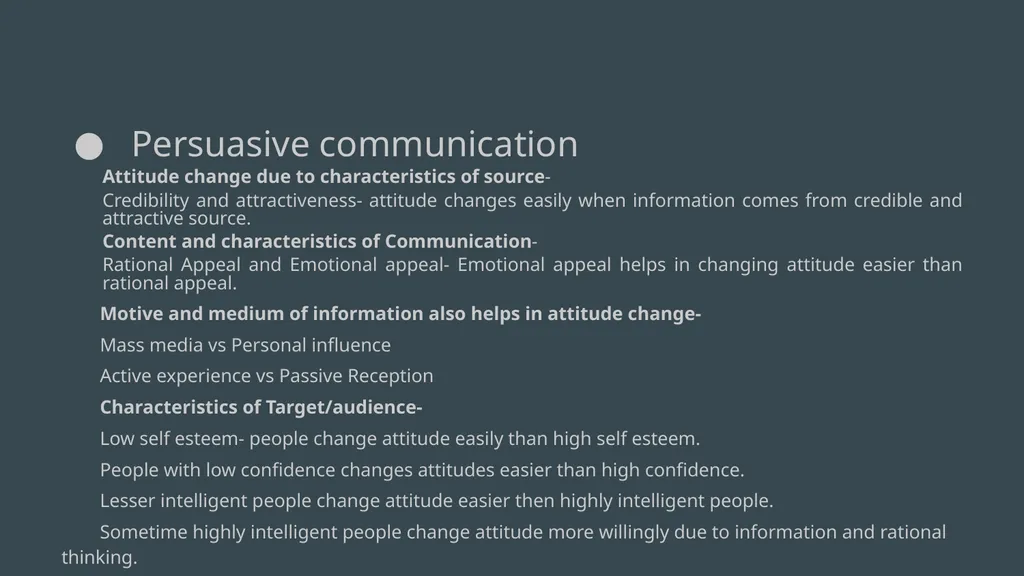
Persuasive communication
Attitude change due to characteristics of source-
Credibility and attractiveness- attitude changes easily when information comes from credible and attractive source.
Content and characteristics of Communication-
Rational Appeal and Emotional appeal- Emotional appeal helps in changing attitude easier than rational appeal.
Motive and medium of information also helps in attitude change-
Mass media vs Personal influence
Active experience vs Passive Reception
Characteristics of Target/audience-
Low self esteem- people change attitude easily than high self esteem.
People with low confidence changes attitudes easier than high confidence.
Lesser intelligent people change attitude easier then highly intelligent people.
Sometime highly intelligent people change attitude more willingly due to information and rational thinking.<br>
12
Enforced contact
Required role playing
Personality change techniques
Cultural factors
propaganda<br>