
Audit Week one Course Administration Professor

Description: Audit Week one Course Administration Professor Thomas Davis Email: tomas.davishotmail.com Student course leader Textbook: Auditing and Assurance Services, ArensElderBeaseley, 12th edition Course Assessment 30 midterm exam (5 Oct-22 Oct)
Related Topics
Download Presentation
"Audit Week one Course Administration Professor" is the property of its rightful owner. Permission is granted to download and print the materials on this website for personal, non-commercial use only, and to display it on your personal computer provided you do not modify the materials and that you retain all copyright notices contained in the materials. By downloading content from our website, you accept the terms of this agreement.
Presentation Transcript
slide1. Audit Week one<br>
slide2. Course Administration Professor Thomas Davis
Email: tomas.davis@hotmail.com
Student course leader
Textbook: Auditing and Assurance Services, Arens/Elder/Beaseley, 12th edition<br>
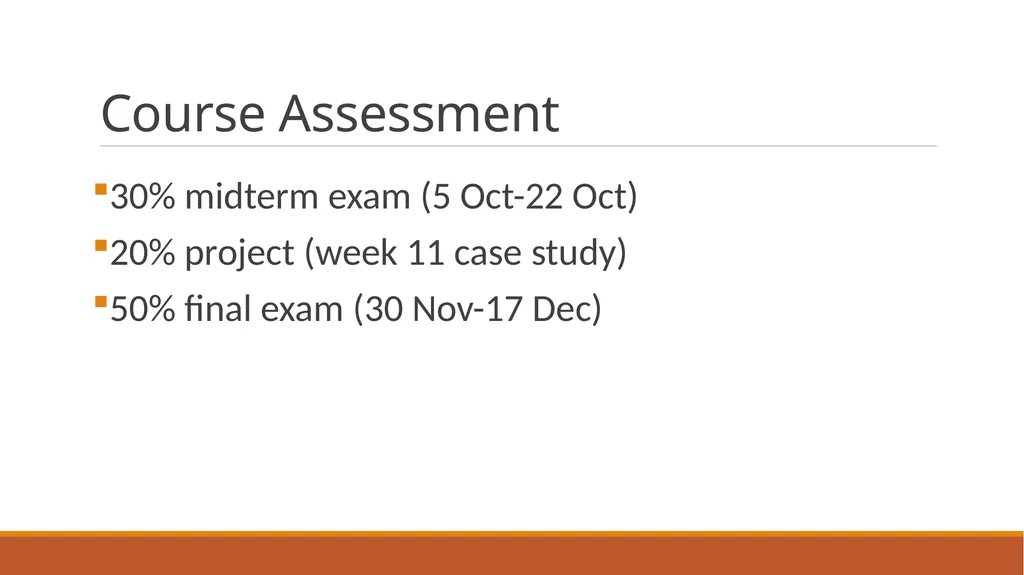
slide3. Course Assessment 30% midterm exam (5 Oct-22 Oct)
20% project (week 11 case study)
50% final exam (30 Nov-17 Dec)<br>
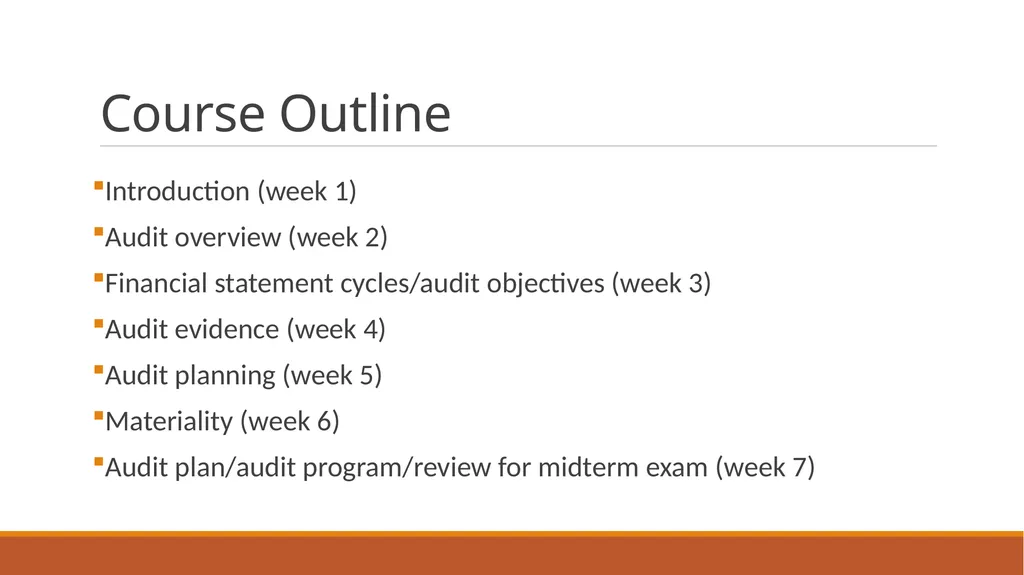
slide4. Course Outline Introduction (week 1)
Audit overview (week 2)
Financial statement cycles/audit objectives (week 3)
Audit evidence (week 4)
Audit planning (week 5)
Materiality (week 6)
Audit plan/audit program/review for midterm exam (week 7)<br>
slide5. Course Outline Sales cycle: controls and transactions testing (week 8)
Case study (week 9)
Sales cycle: analytical procedures/balances testing (week 10)
Case study (week 11)
Payroll and acquisition cycles (week 12)
Inventory and capital cycles/audit completion (week 13)
Review for final exam (week 14)<br>
slide6. Audit Week two<br>
slide7. Readings GAAS standards: http://www.aicpa.org/Research/Standards/AuditAttest/DownloadableDocuments/AU-00150.pdf
Audit reports http://en.wikipedia.org/wiki/Auditor's_report
Legal liability http://en.wikipedia.org/wiki/Legal_liability_of_certified_public_accountants<br>
slide8. Audit vs. Accounting Accounting: preparing financial statements
Auditing: verifying financial statements<br>
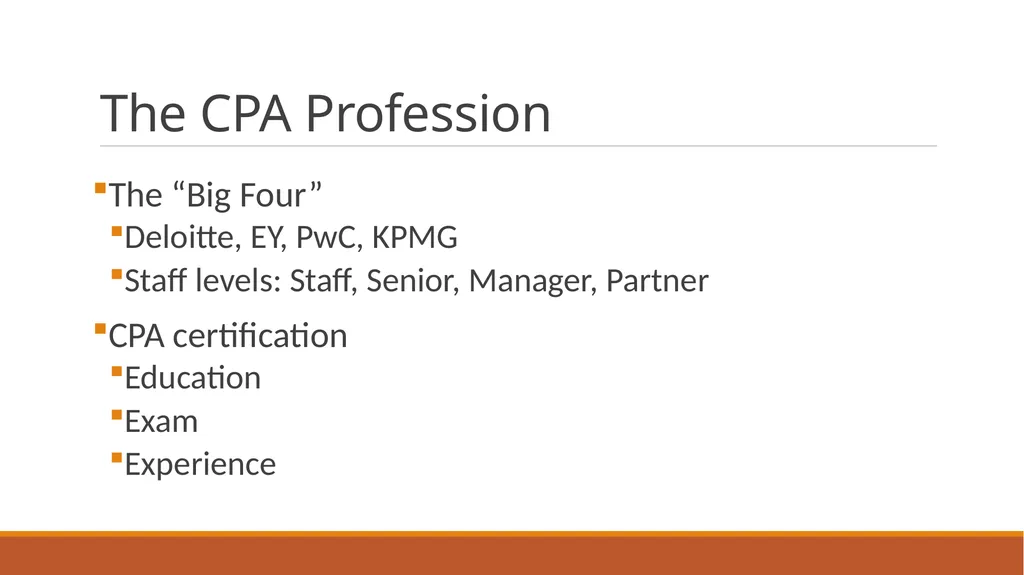
slide9. The CPA Profession The “Big Four”
Deloitte, EY, PwC, KPMG
Staff levels: Staff, Senior, Manager, Partner
CPA certification
Education
Exam
Experience<br>
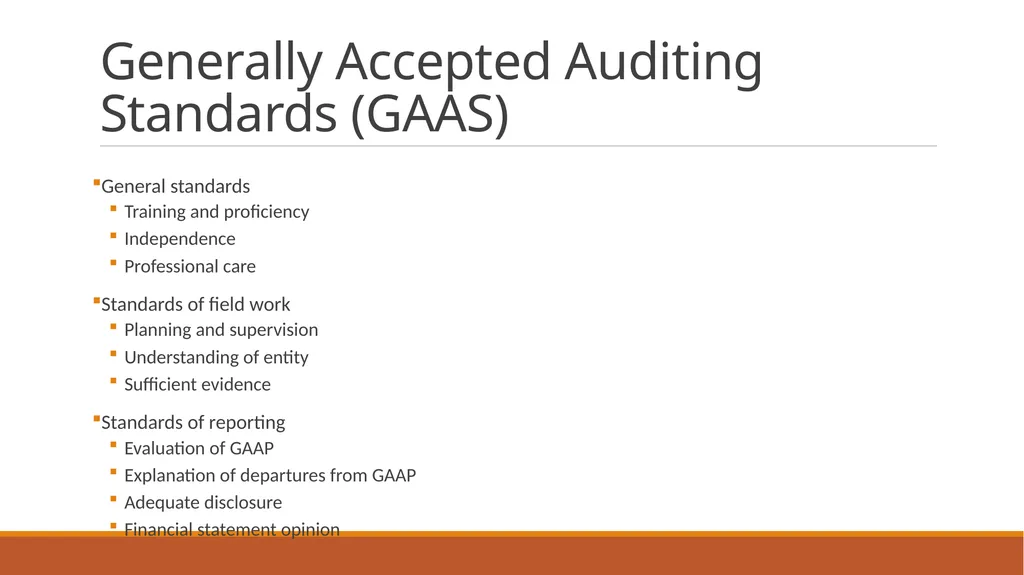
slide10. Generally Accepted Auditing Standards (GAAS) General standards
Training and proficiency
Independence
Professional care
Standards of field work
Planning and supervision
Understanding of entity
Sufficient evidence
Standards of reporting
Evaluation of GAAP
Explanation of departures from GAAP
Adequate disclosure
Financial statement opinion<br>
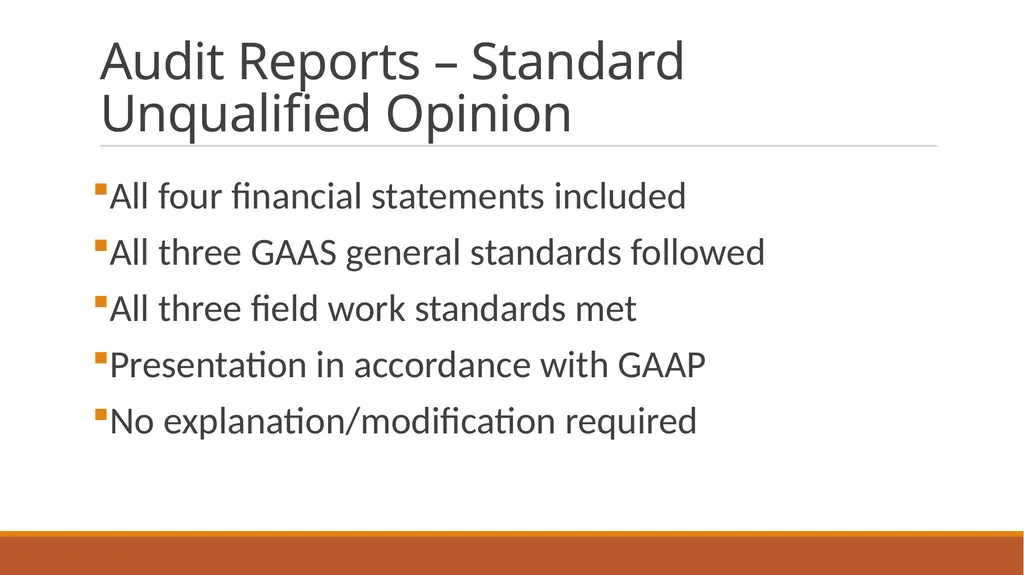
slide11. Audit Reports – Standard Unqualified Opinion All four financial statements included
All three GAAS general standards followed
All three field work standards met
Presentation in accordance with GAAP
No explanation/modification required<br>
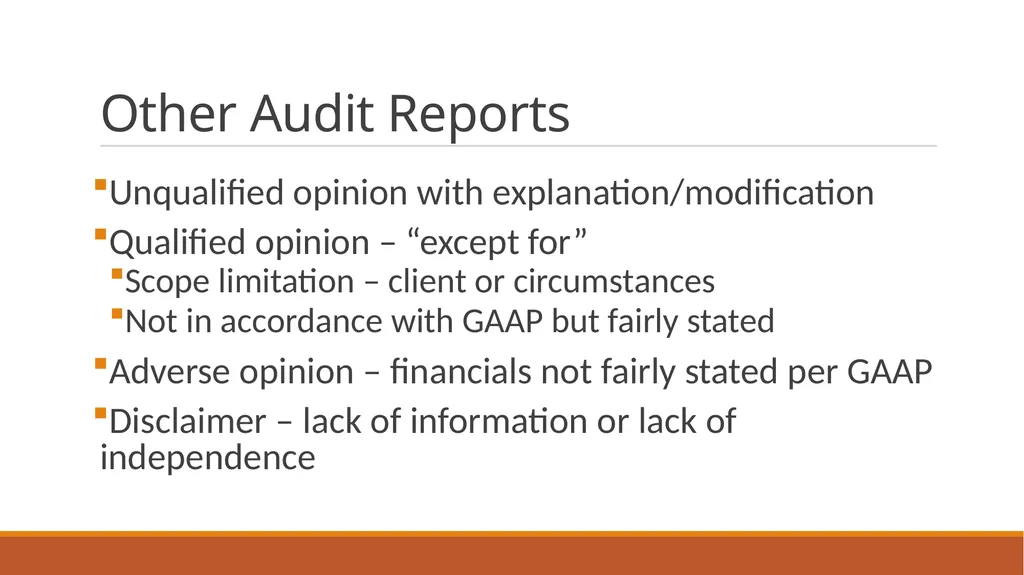
slide12. Other Audit Reports Unqualified opinion with explanation/modification
Qualified opinion – “except for”
Scope limitation – client or circumstances
Not in accordance with GAAP but fairly stated
Adverse opinion – financials not fairly stated per GAAP
Disclaimer – lack of information or lack of independence<br>
slide13. Materiality and Misstatements Immaterial – unlikely to affect decision of user: unqualified opinion
Material but financial statements are fair (one item/isolated situation): qualified opinion
Material – fairness of financial statements is in question: disclaimer or adverse opinion<br>
slide14. Ethics Independence
Integrity and objectivity
Confidential client information
Contingent fees
Audit and consulting… conflict of interest<br>
slide15. Legal Liability Business failure vs. audit failure
Audit failure vs. audit risk
Negligence vs. fraud
Third parties vs. clients
Civil (securities law) vs. criminal (federal law) liability
“Joint and several” vs. “separate and proportionate” liability<br>
slide16. Audit week three<br>
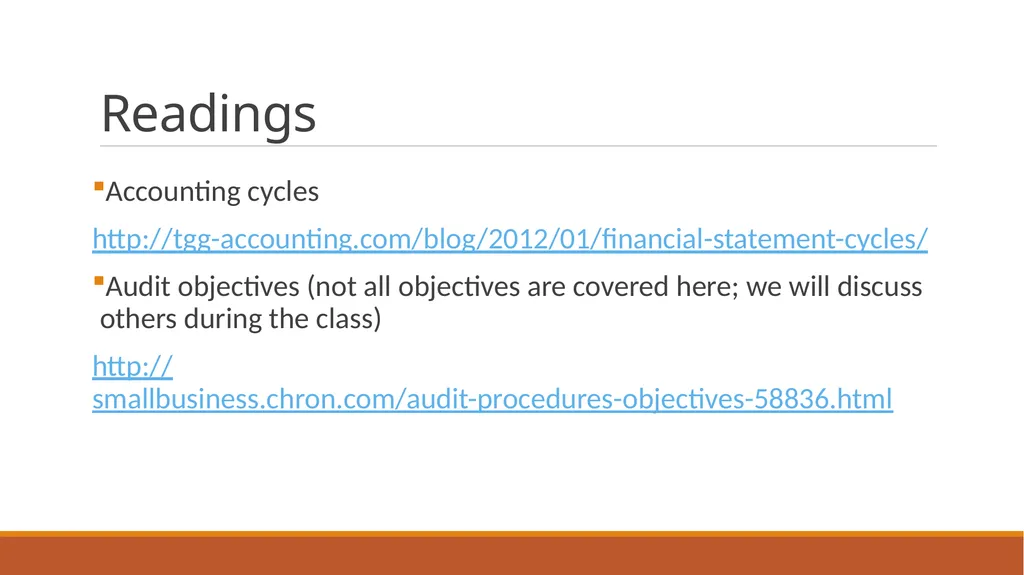
slide17. Readings Accounting cycles
http://tgg-accounting.com/blog/2012/01/financial-statement-cycles/
Audit objectives (not all objectives are covered here; we will discuss others during the class)
http://smallbusiness.chron.com/audit-procedures-objectives-58836.html<br>
slide18. Auditor Responsibilities Material vs. immaterial misstatements
Reasonable assurance
Errors vs. fraud
Professional skepticism – question everything!<br>
slide19. Financial Statement Cycles Sales and collection cycle
Acquisition and payment cycle (general assets and expenses)
Payroll and personnel cycle
Inventory and warehousing cycle (inventory and COGS)
Capital acquisition and repayment cycle (debt and equity transactions)<br>
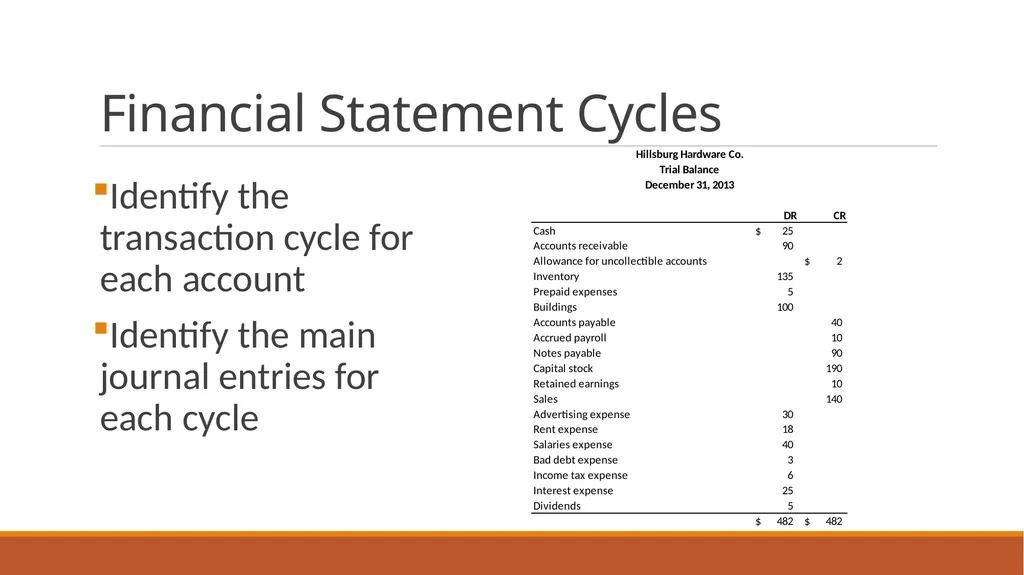
slide20. Financial Statement Cycles Identify the transaction cycle for each account
Identify the main journal entries for each cycle<br>
slide21. Objectives Transaction-related
Balance-related
Presentation and disclosure-related<br>
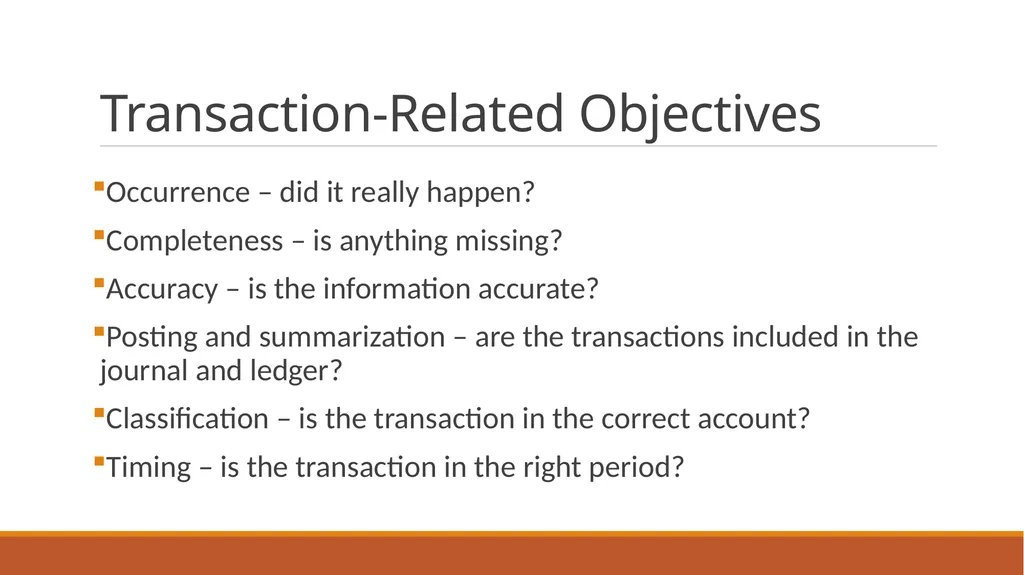
slide22. Transaction-Related Objectives Occurrence – did it really happen?
Completeness – is anything missing?
Accuracy – is the information accurate?
Posting and summarization – are the transactions included in the journal and ledger?
Classification – is the transaction in the correct account?
Timing – is the transaction in the right period?<br>
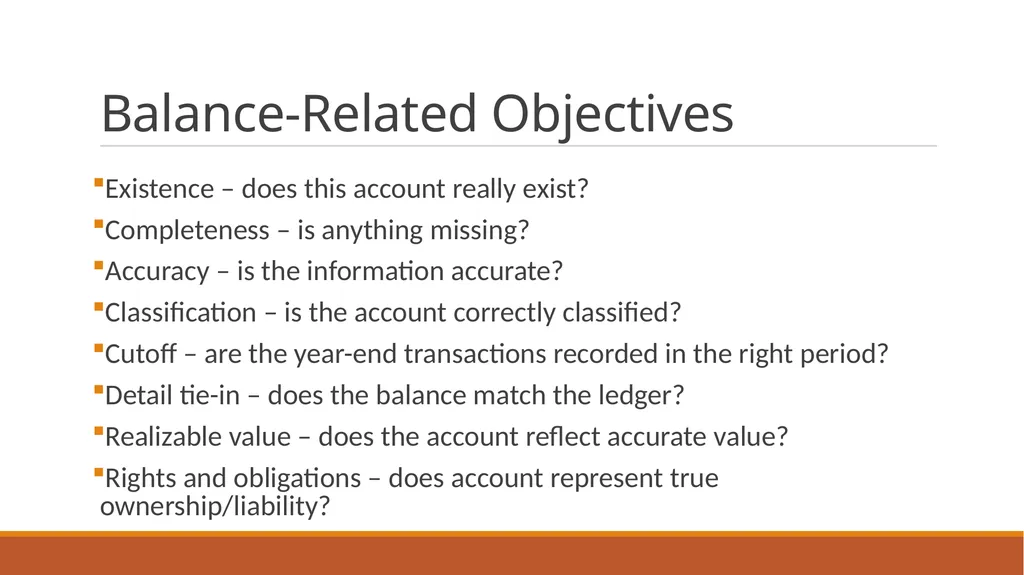
slide23. Balance-Related Objectives Existence – does this account really exist?
Completeness – is anything missing?
Accuracy – is the information accurate?
Classification – is the account correctly classified?
Cutoff – are the year-end transactions recorded in the right period?
Detail tie-in – does the balance match the ledger?
Realizable value – does the account reflect accurate value?
Rights and obligations – does account represent true ownership/liability?<br>
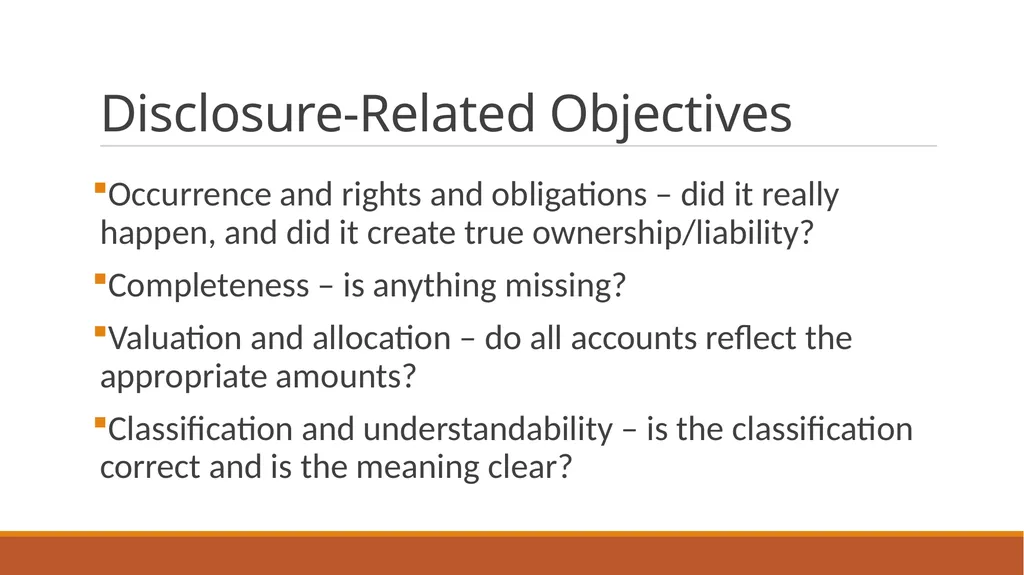
slide24. Disclosure-Related Objectives Occurrence and rights and obligations – did it really happen, and did it create true ownership/liability?
Completeness – is anything missing?
Valuation and allocation – do all accounts reflect the appropriate amounts?
Classification and understandability – is the classification correct and is the meaning clear?<br>
slide25. Four Phases of an Audit Plan the audit
Testing of controls and transactions
Analytical procedures and testing of balances
Audit report<br>
slide26. Audit week four<br>
slide27. Readings Chapter 7 from textbook<br>
slide28. Audit Evidence Decisions Which procedures?
What sample size? (quantity)
Which items to select for testing? (quality)
When?<br>
slide29. Persuasiveness of Evidence Appropriate
Relevant: right test for the right audit objective
Reliable: external information > internal information
Sufficient
Sample size: higher risk = larger sample
Item quality: large amounts and random amounts<br>
slide30. Types of Evidence Physical examination – auditor inspects physical assets
Confirmation – response from third party
Documentation – internal and external documents
Analytical procedures – comparisons and relationships
Inquiries of the client – client responses; may be biased
Recalculation – checking client calculations
Reperformance – checking non-calculation procedures
Observation – watch/listen/touch/smell<br>
slide31. Audit Documentation Sample documents from audit files (attachment)
Activity – notes receivable audit work (attachment)<br>
slide32. Audit week five<br>
slide33. Readings Chapter 8 from textbook<br>
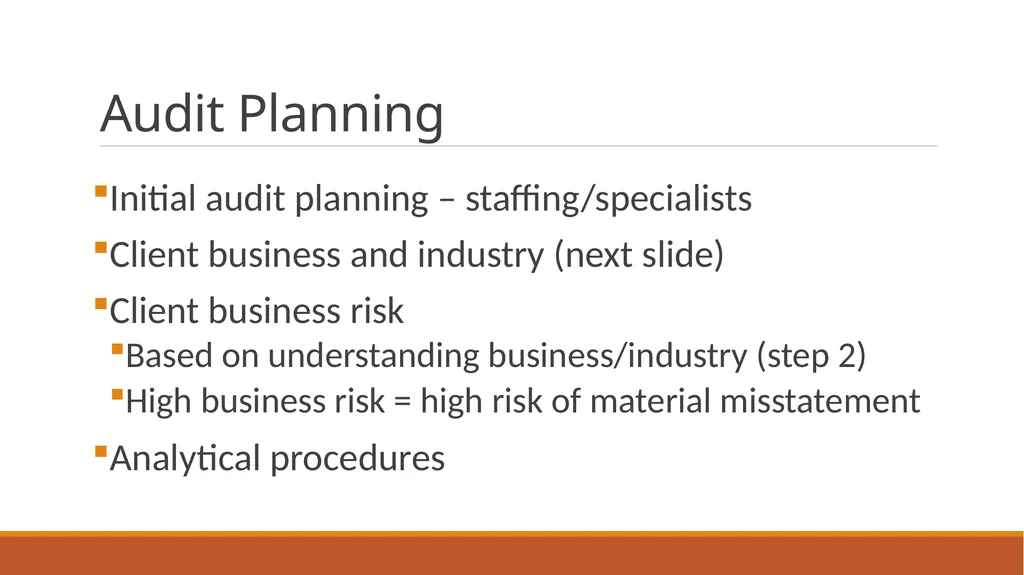
slide34. Audit Planning Initial audit planning – staffing/specialists
Client business and industry (next slide)
Client business risk
Based on understanding business/industry (step 2)
High business risk = high risk of material misstatement
Analytical procedures<br>
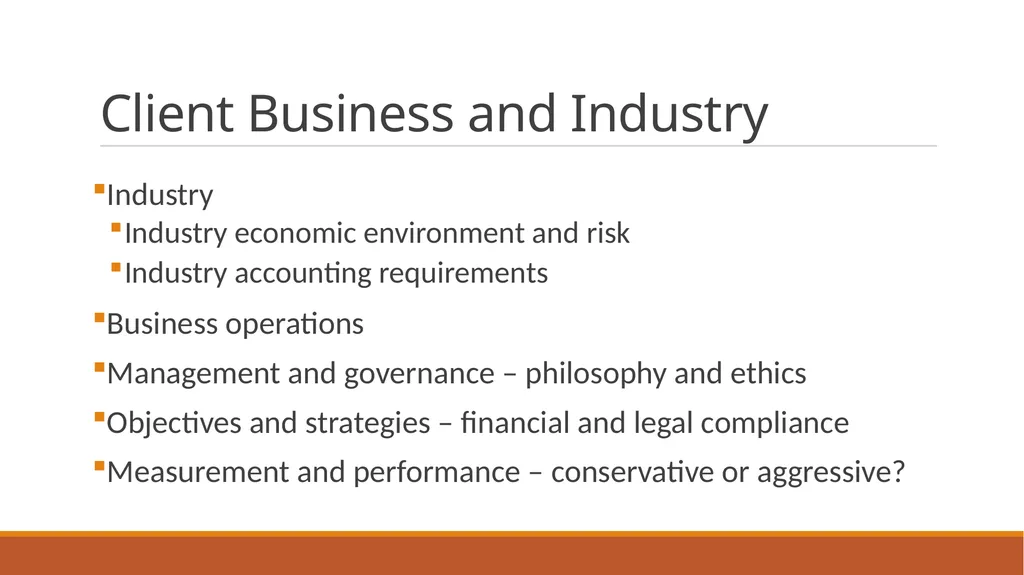
slide35. Client Business and Industry Industry
Industry economic environment and risk
Industry accounting requirements
Business operations
Management and governance – philosophy and ethics
Objectives and strategies – financial and legal compliance
Measurement and performance – conservative or aggressive?<br>
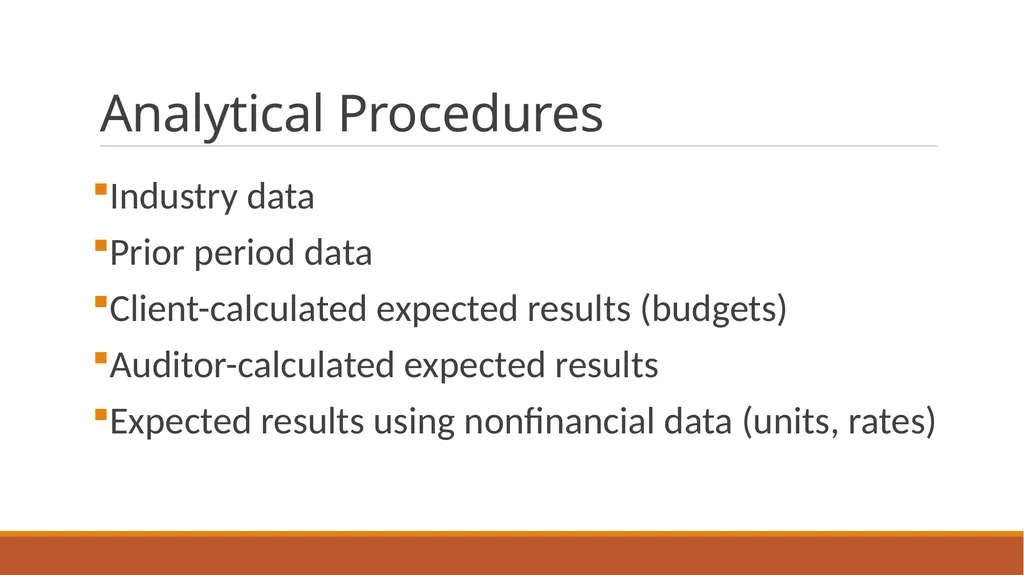
slide36. Analytical Procedures Industry data
Prior period data
Client-calculated expected results (budgets)
Auditor-calculated expected results
Expected results using nonfinancial data (units, rates)<br>
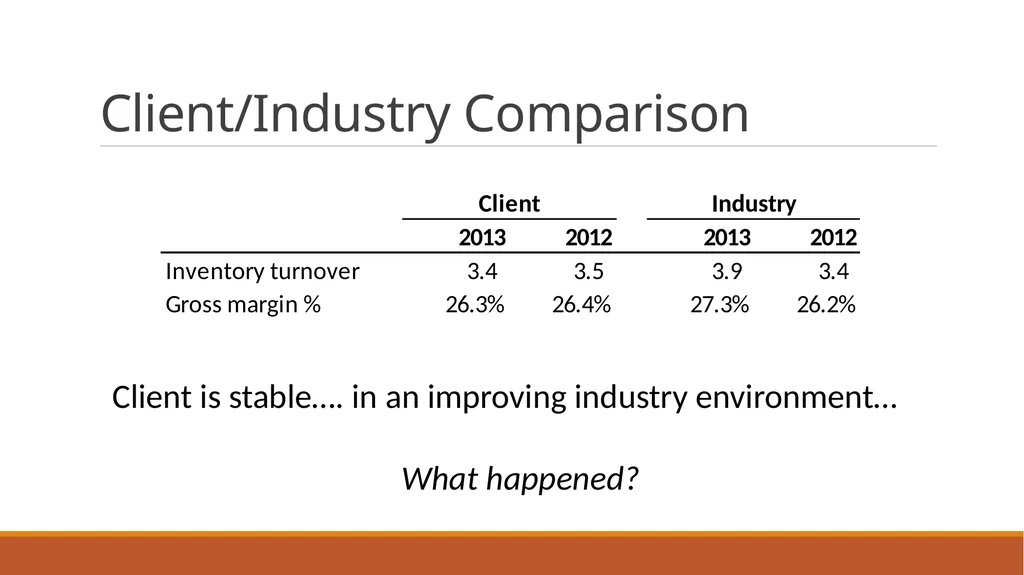
slide37. Client/Industry Comparison Client is stable…. in an improving industry environment…
What happened?<br>
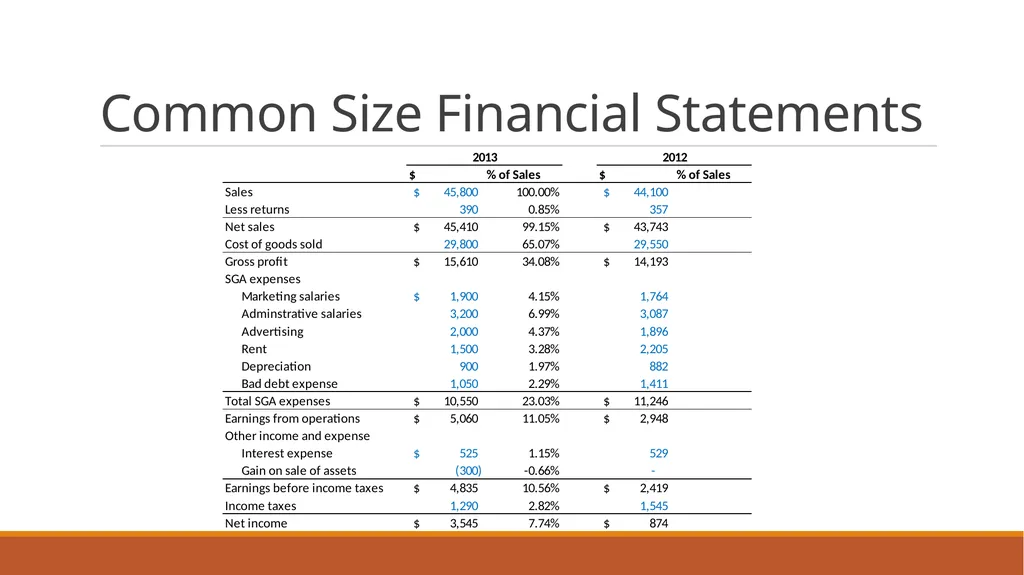
slide38. Common Size Financial Statements<br>
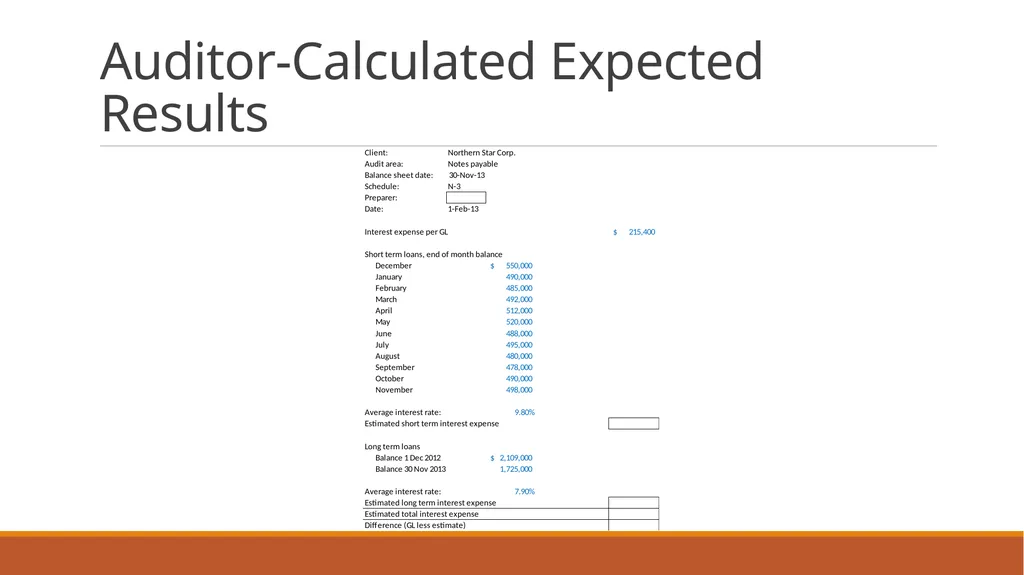
slide39. Auditor-Calculated Expected Results<br>
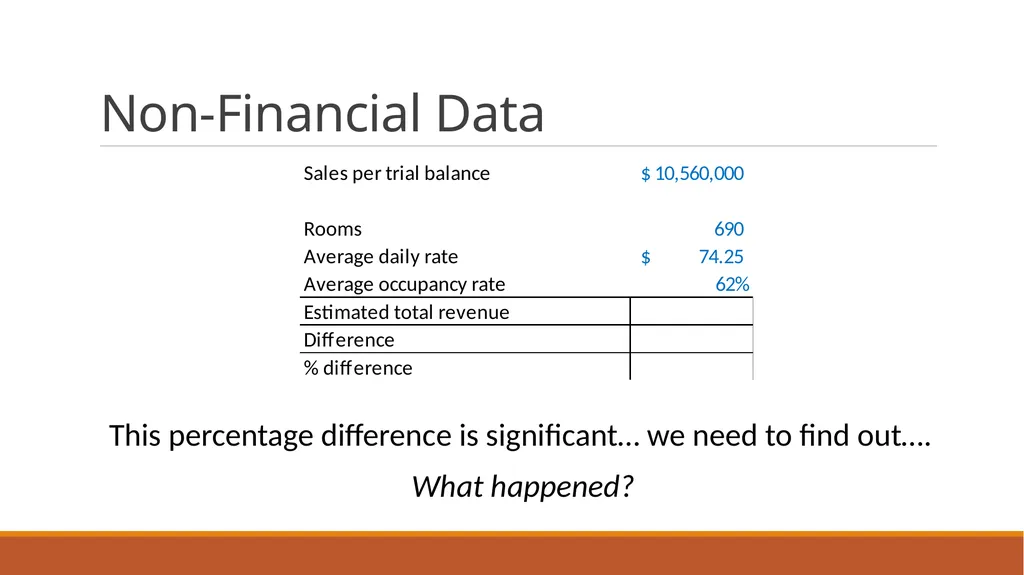
slide40. Non-Financial Data This percentage difference is significant… we need to find out….
What happened?<br>
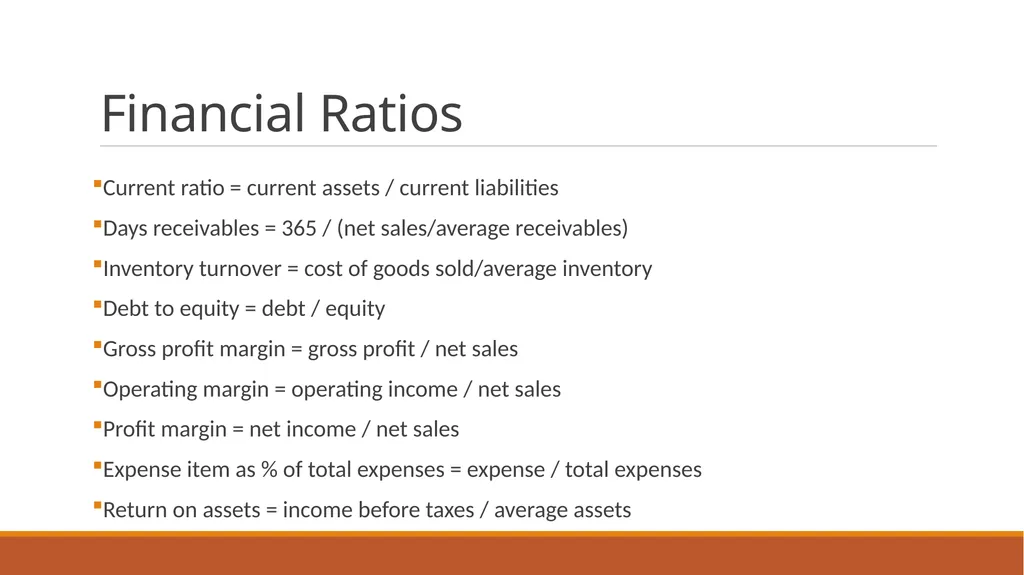
slide41. Financial Ratios Current ratio = current assets / current liabilities
Days receivables = 365 / (net sales/average receivables)
Inventory turnover = cost of goods sold/average inventory
Debt to equity = debt / equity
Gross profit margin = gross profit / net sales
Operating margin = operating income / net sales
Profit margin = net income / net sales
Expense item as % of total expenses = expense / total expenses
Return on assets = income before taxes / average assets<br>
slide42. Audit Week six<br>
slide43. Readings Chapter 9 from textbook, “Materiality and Risk”<br>
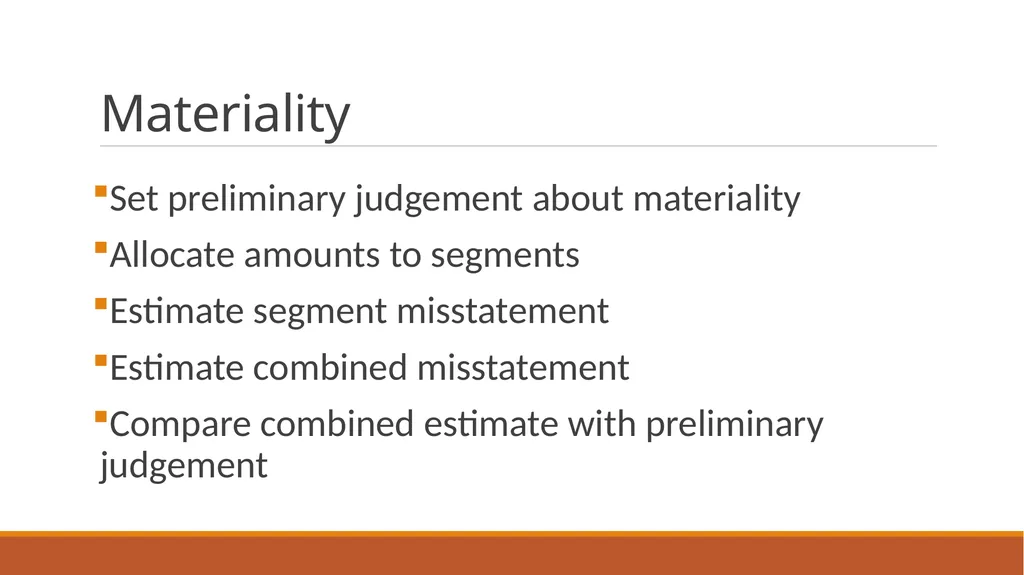
slide44. Materiality Set preliminary judgement about materiality
Allocate amounts to segments
Estimate segment misstatement
Estimate combined misstatement
Compare combined estimate with preliminary judgement<br>
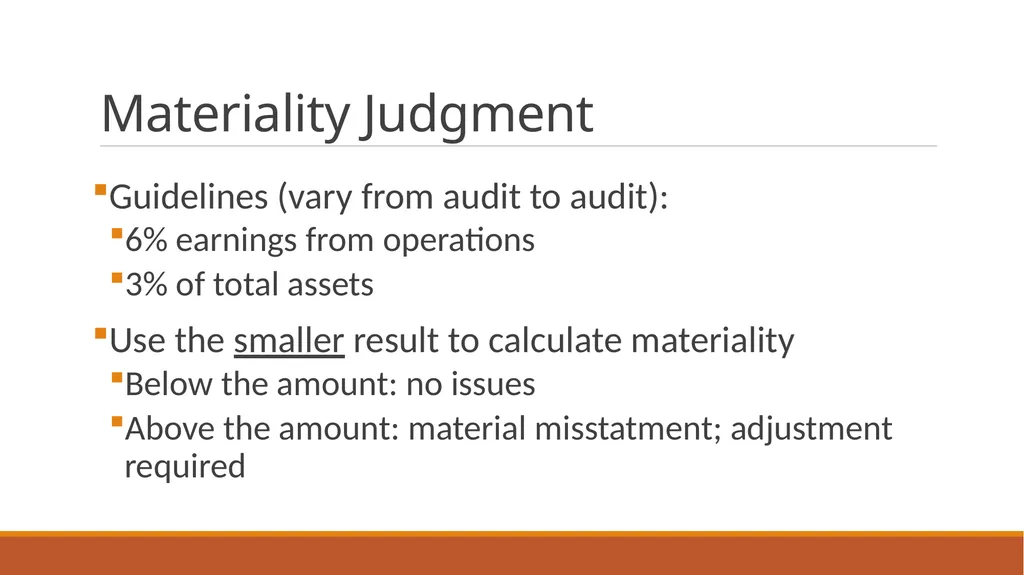
slide45. Materiality Judgment Guidelines (vary from audit to audit):
6% earnings from operations
3% of total assets
Use the smaller result to calculate materiality
Below the amount: no issues
Above the amount: material misstatment; adjustment required<br>
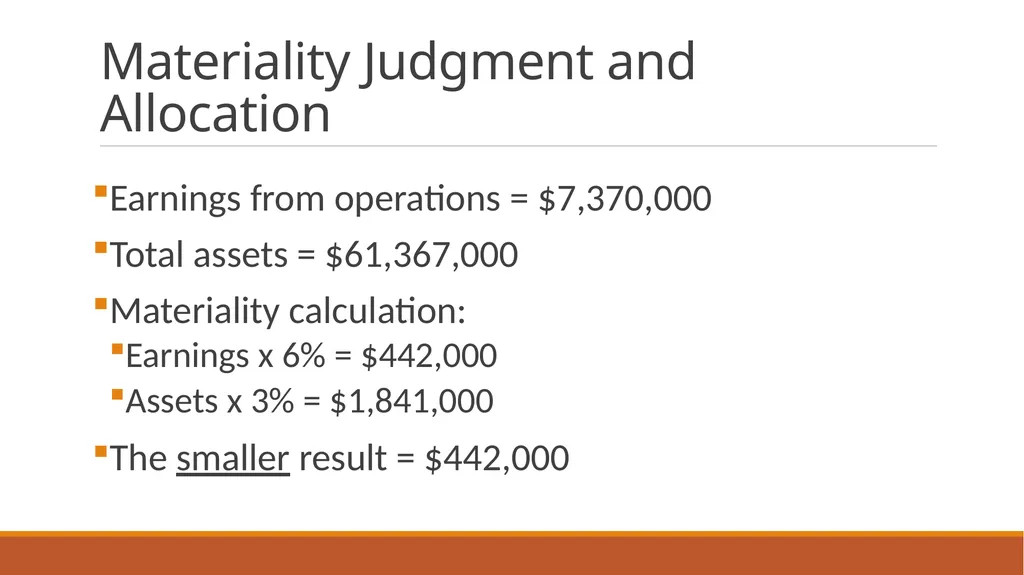
slide46. Materiality Judgment and Allocation Earnings from operations = $7,370,000
Total assets = $61,367,000
Materiality calculation:
Earnings x 6% = $442,000
Assets x 3% = $1,841,000
The smaller result = $442,000<br>
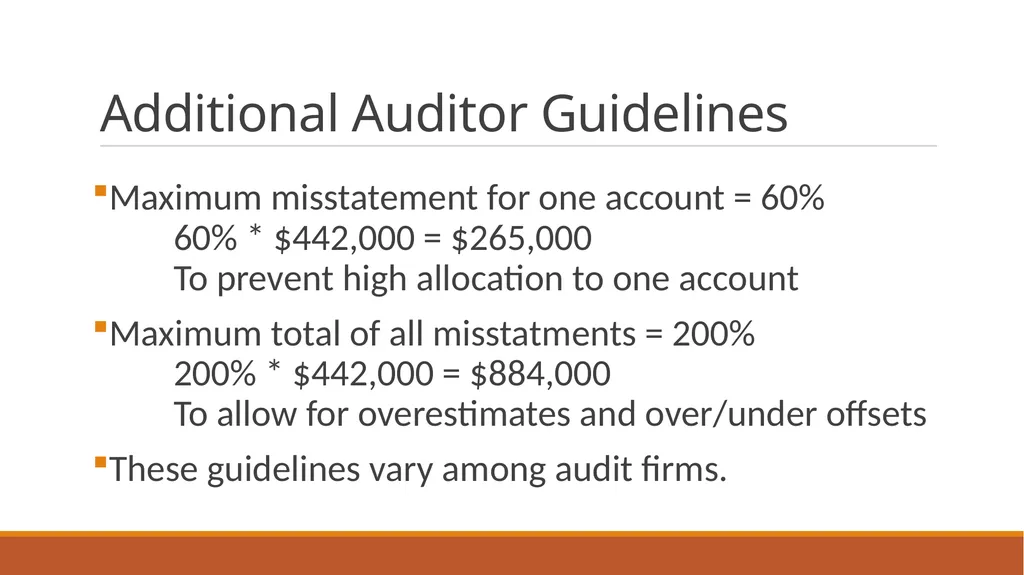
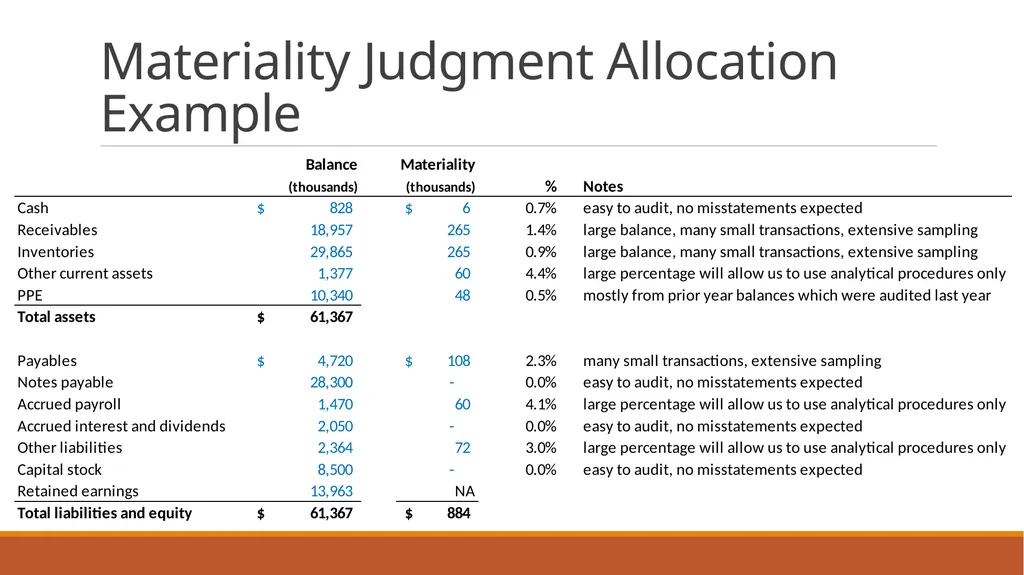
slide47. Additional Auditor Guidelines Maximum misstatement for one account = 60% 60% * $442,000 = $265,000 To prevent high allocation to one account
Maximum total of all misstatments = 200% 200% * $442,000 = $884,000 To allow for overestimates and over/under offsets
These guidelines vary among audit firms.<br>
slide48. Materiality Judgment Allocation Example<br>
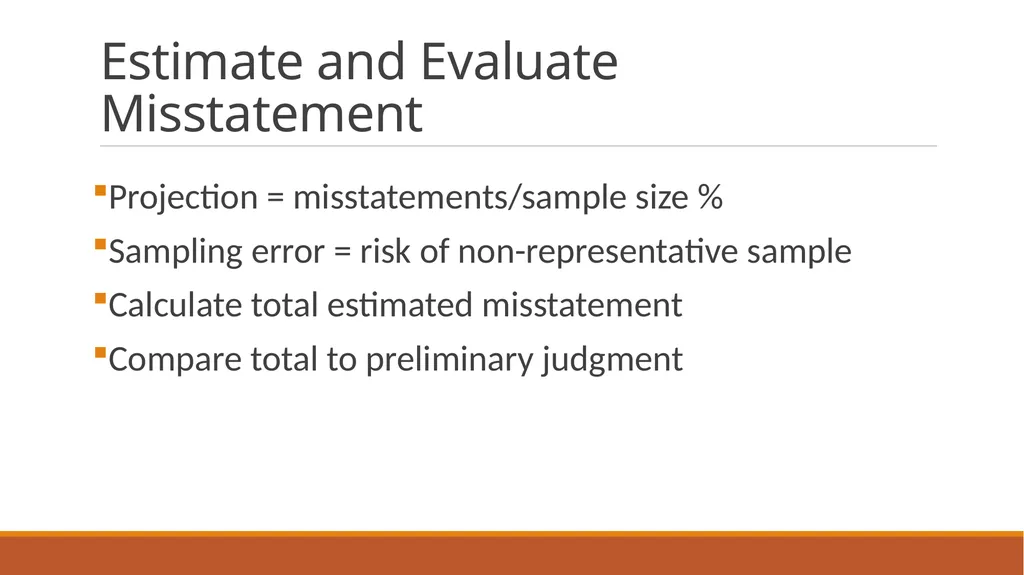
slide49. Estimate and Evaluate Misstatement Projection = misstatements/sample size %
Sampling error = risk of non-representative sample
Calculate total estimated misstatement
Compare total to preliminary judgment<br>
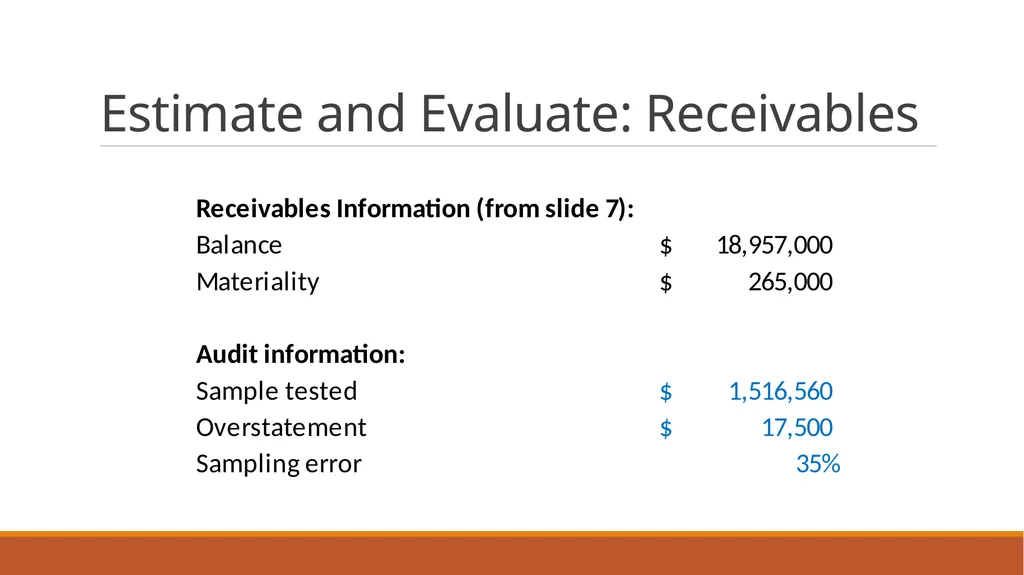
slide50. Estimate and Evaluate: Receivables<br>
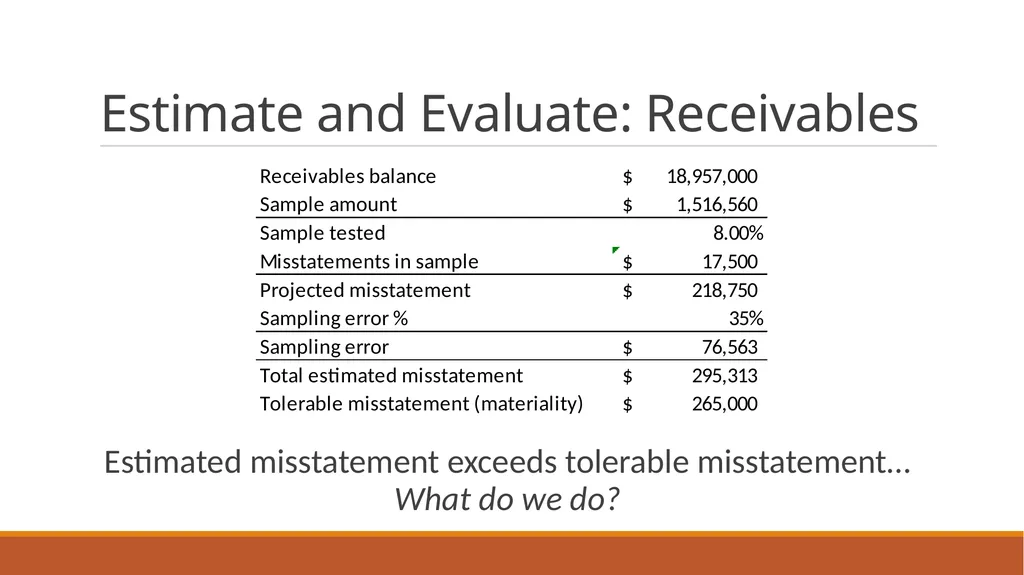
slide51. Estimate and Evaluate: Receivables Estimated misstatement exceeds tolerable misstatement… What do we do?<br>
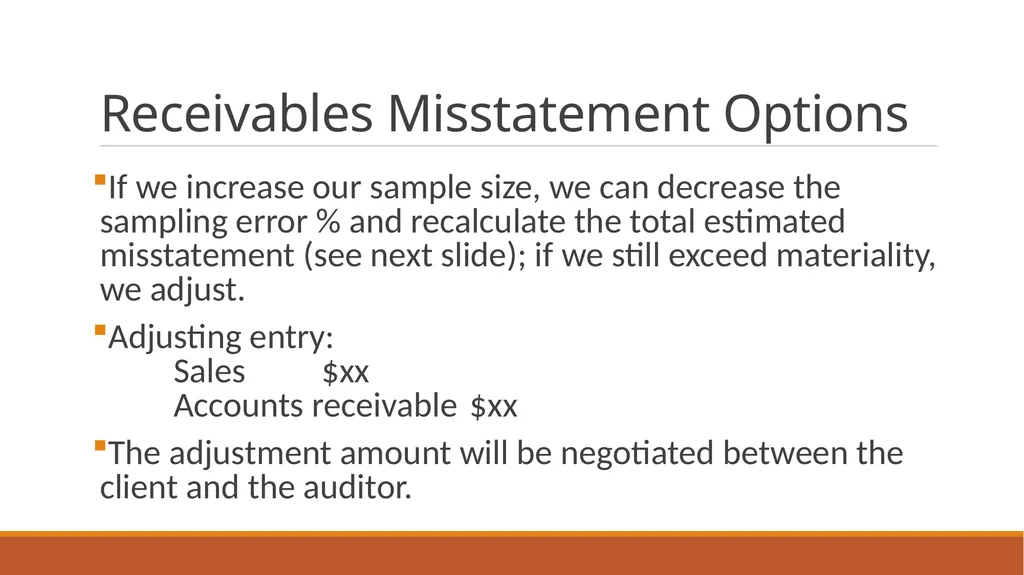
slide52. Receivables Misstatement Options If we increase our sample size, we can decrease the sampling error % and recalculate the total estimated misstatement (see next slide); if we still exceed materiality, we adjust.
Adjusting entry: Sales $xx Accounts receivable $xx
The adjustment amount will be negotiated between the client and the auditor.<br>
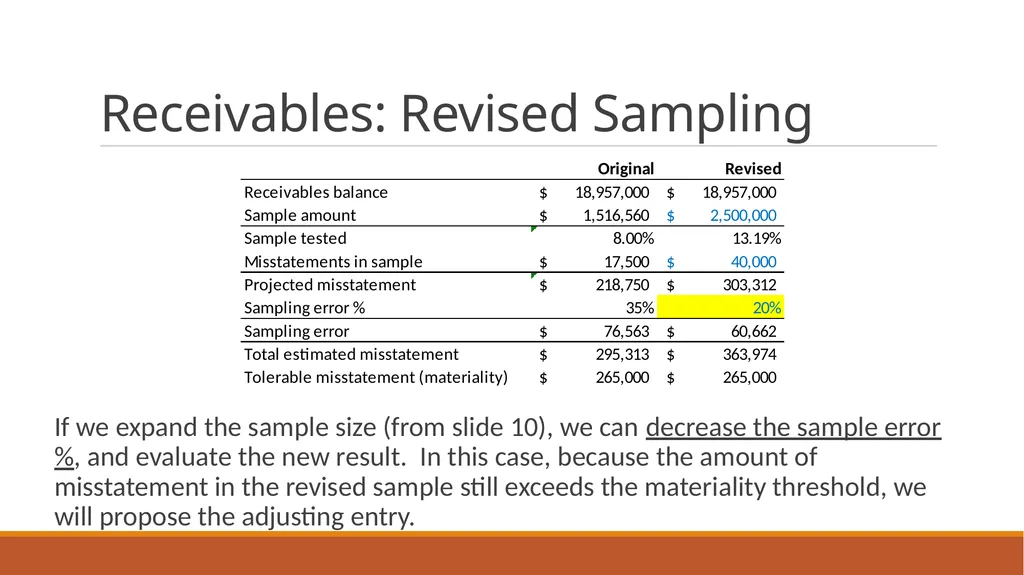
slide53. Receivables: Revised Sampling If we expand the sample size (from slide 10), we can decrease the sample error %, and evaluate the new result. In this case, because the amount of misstatement in the revised sample still exceeds the materiality threshold, we will propose the adjusting entry.<br>
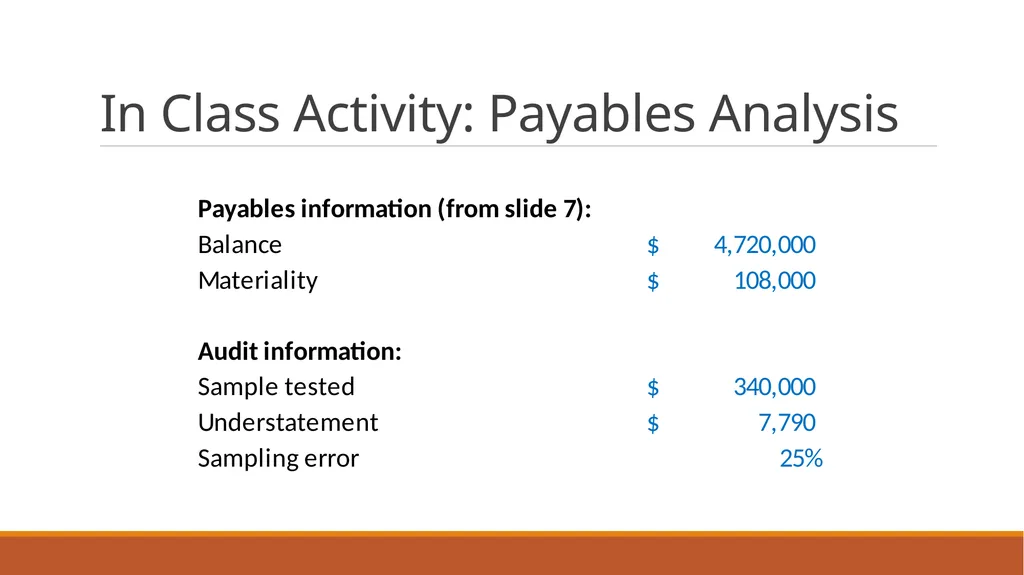
slide54. In Class Activity: Payables Analysis<br>
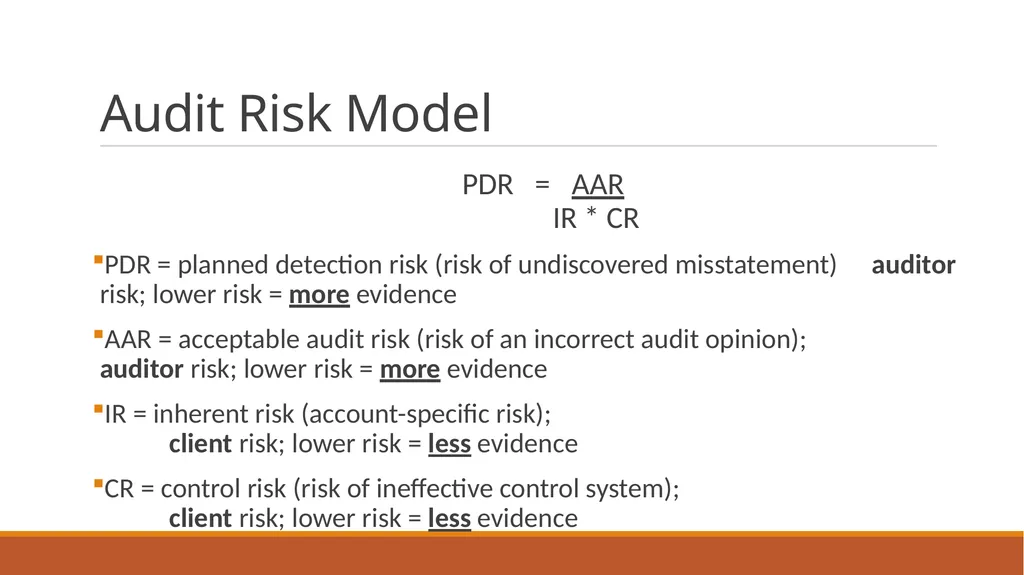
slide55. Audit Risk Model PDR = AAR IR * CR
PDR = planned detection risk (risk of undiscovered misstatement) auditor risk; lower risk = more evidence
AAR = acceptable audit risk (risk of an incorrect audit opinion); auditor risk; lower risk = more evidence
IR = inherent risk (account-specific risk); client risk; lower risk = less evidence
CR = control risk (risk of ineffective control system); client risk; lower risk = less evidence<br>
slide56. Audit Week eight<br>
slide57. Readings Chapter 14, “Audit of the Sales and Collection Cycle” and Chapter 15, “Audit Sampling for Tests of Controls” from textbook<br>
slide58. Sales and Collection Cycle Accounts Sales
Cash
Accounts receivable
Sales discounts
Sales returns and allowances
Allowance for uncollectible accounts
Bad debts expense<br>
slide59. Sales and Collection Cycle Documents Customer order
Sales order
Bill of lading (shipping document)
Sales invoice
Additional documentation: cash receipts, sales returns, bad debt provision, write-offs<br>
slide60. Sales and Collection Cycle Controls Separation of duties
Authorization (credit/shipping/pricing)
Documentation
Prenumbered documents (to prevent missing/duplicate documents)
Monthly statements
Internal verification<br>
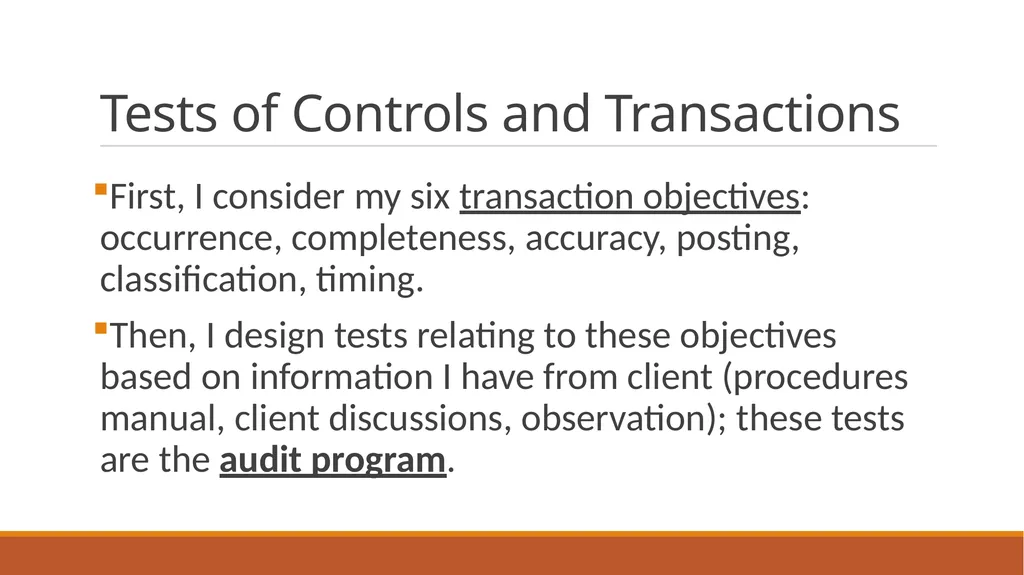
slide61. Tests of Controls and Transactions First, I consider my six transaction objectives: occurrence, completeness, accuracy, posting, classification, timing.
Then, I design tests relating to these objectives based on information I have from client (procedures manual, client discussions, observation); these tests are the audit program.<br>
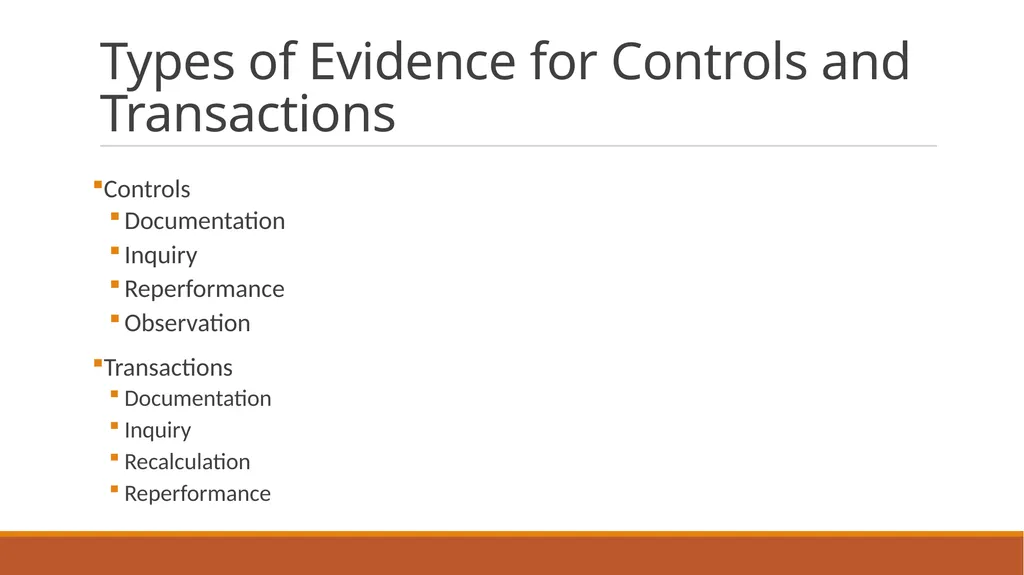
slide62. Types of Evidence for Controls and Transactions Controls
Documentation
Inquiry
Reperformance
Observation
Transactions
Documentation
Inquiry
Recalculation
Reperformance<br>
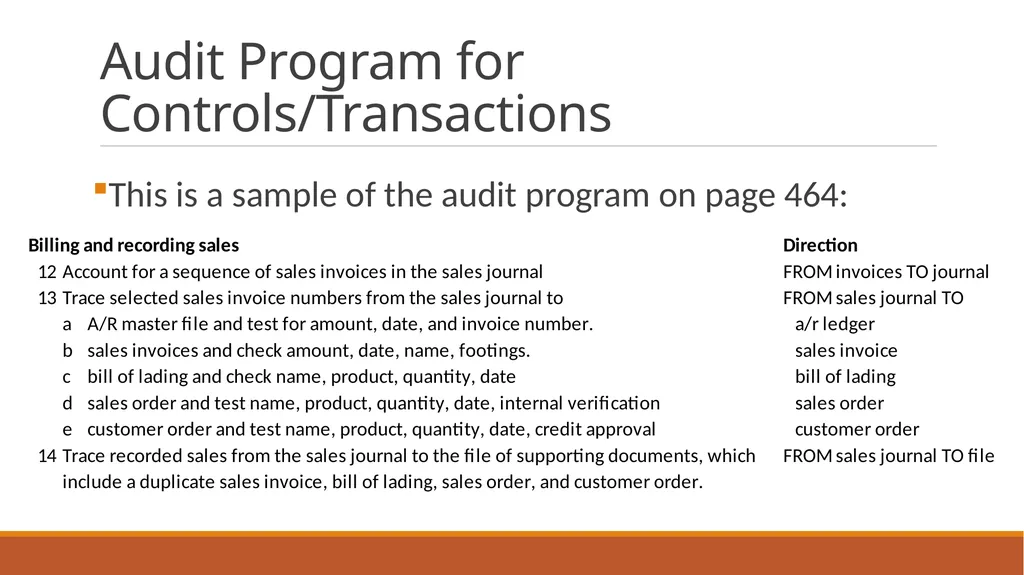
slide63. Audit Program for Controls/Transactions This is a sample of the audit program on page 464:<br>
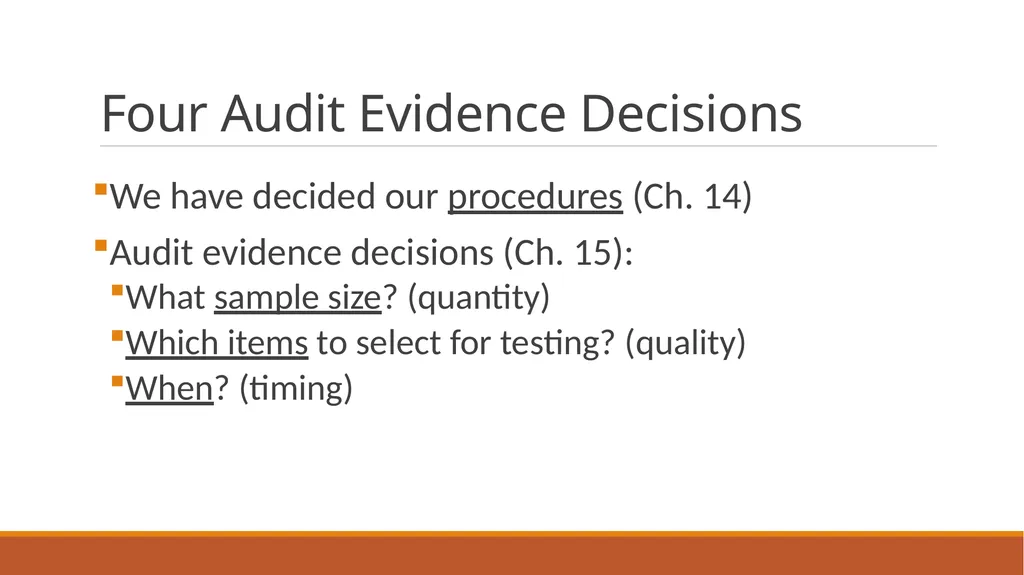
slide64. Four Audit Evidence Decisions We have decided our procedures (Ch. 14)
Audit evidence decisions (Ch. 15):
What sample size? (quantity)
Which items to select for testing? (quality)
When? (timing)<br>
slide65. Sampling for Controls and Transactions We sample and test for controls based on attributes, not dollar amounts.
Our assessment is based on number of errors.
Dollar amount does not matter.
Chapter 15 covers sampling procedures; we will not study this information, rather I will provide you with sampling instructions.<br>
slide66. Perform the Audit Procedures We set an estimated population exception rate based on our understanding of client controls.
We set a tolerable exception rate (generally from 3%-10%) based on what we consider acceptable.
We determine a sample size based on relationship between the estimated and tolerable amounts (big difference = smaller sample).
We perform our testing based on the audit program.<br>
slide67. What Do We Do with the Results? I compare my sample exception rate to my tolerable exception rate.
If TER>SER, I can rely on this control procedure.
If TER<SER, I either 1) increase testing or 2) revise control risk (I don’t rely on this control)
This evaluation of controls and transactions is the basis for the design of my audit program for balances (Chs. 16-17).<br>
slide68. Case Study Documentation Package Auditor documents
Audit program
Attributes defined
Sampling sheet
Sales invoice sequence
Company accounting documents
Sales journal
A/R ledger
Company operations documents
Customer order
Sales order
Bill of lading
Sales invoice<br>
slide69. Audit Week ten<br>
slide70. Readings Chapter 16, “Completing the Tests in the Sales and Collection Cycle” and Chapter 17, “Audit Sampling for Tests of Details of Balances” from textbook<br>
slide71. Sales and Collection Cycle Accounts Sales
Cash
Accounts receivable
Sales discounts
Sales returns and allowances
Allowance for uncollectible accounts
Bad debts expense<br>
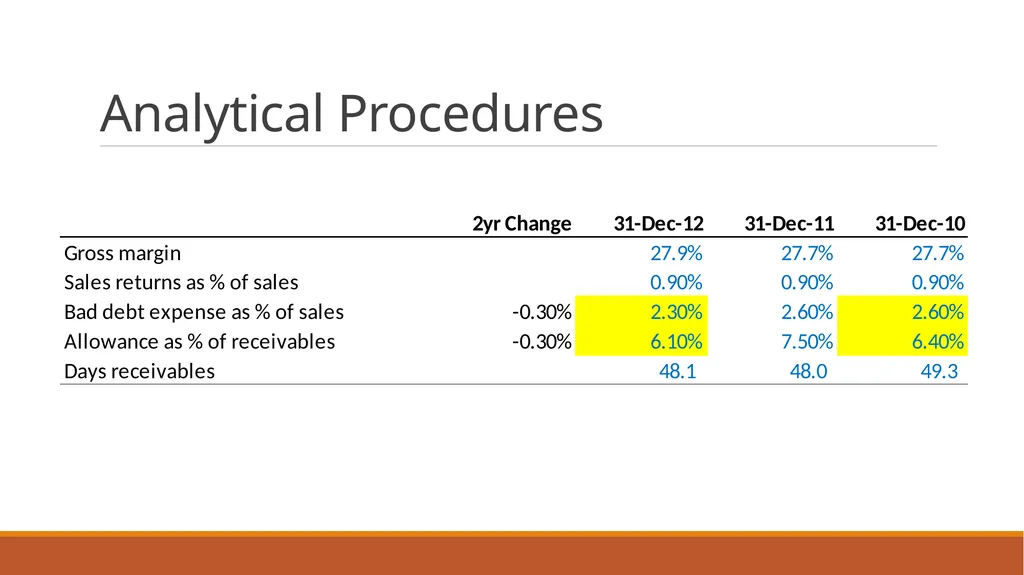
slide72. Analytical Procedures<br>
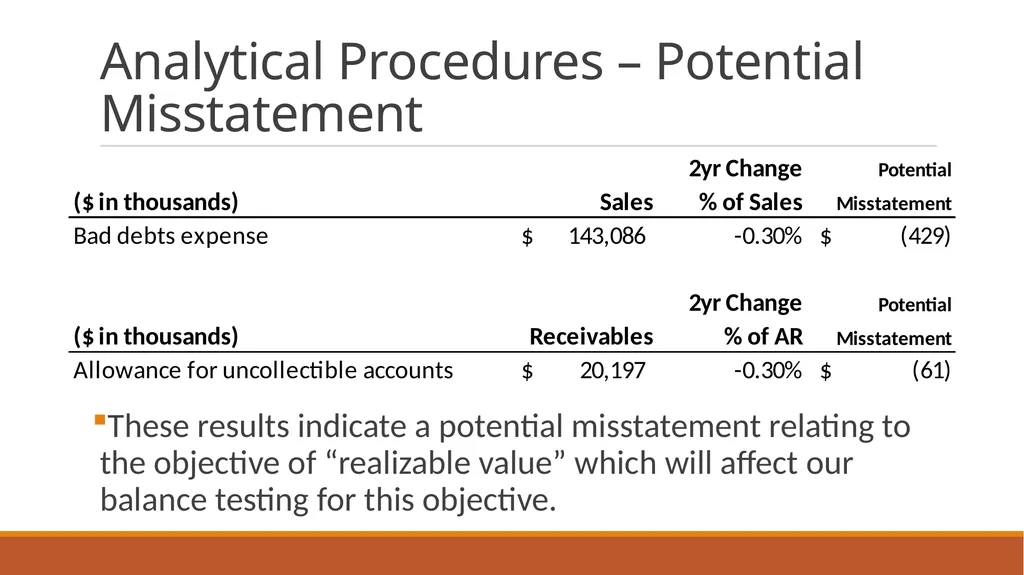
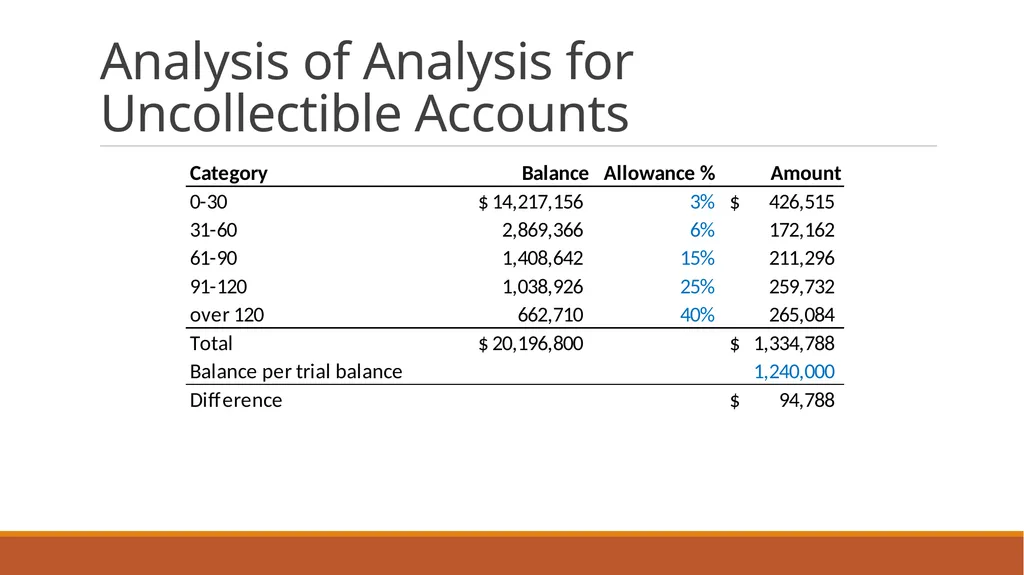
slide73. Analytical Procedures – Potential Misstatement These results indicate a potential misstatement relating to the objective of “realizable value” which will affect our balance testing for this objective.<br>
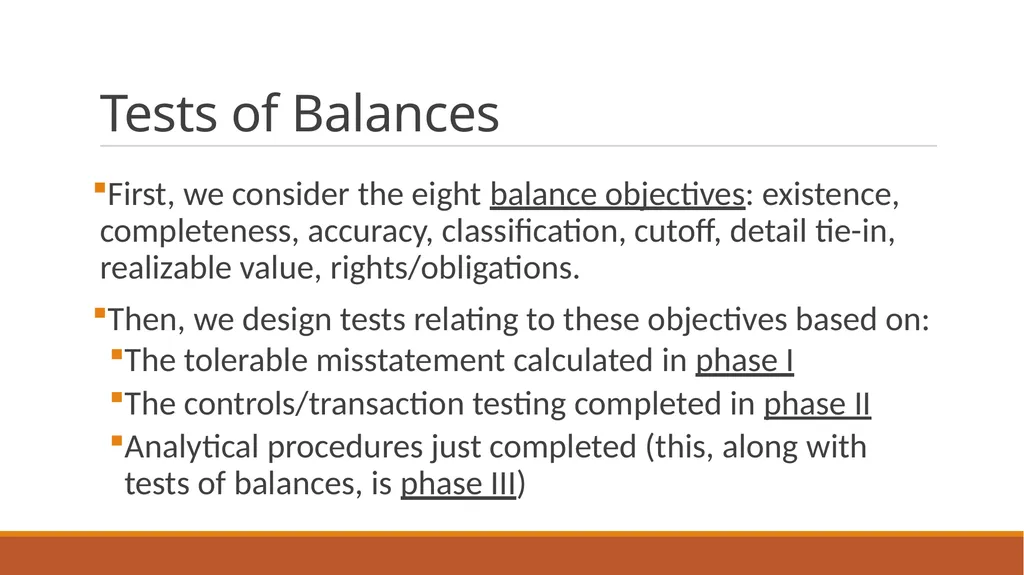
slide74. Tests of Balances First, we consider the eight balance objectives: existence, completeness, accuracy, classification, cutoff, detail tie-in, realizable value, rights/obligations.
Then, we design tests relating to these objectives based on:
The tolerable misstatement calculated in phase I
The controls/transaction testing completed in phase II
Analytical procedures just completed (this, along with tests of balances, is phase III)<br>
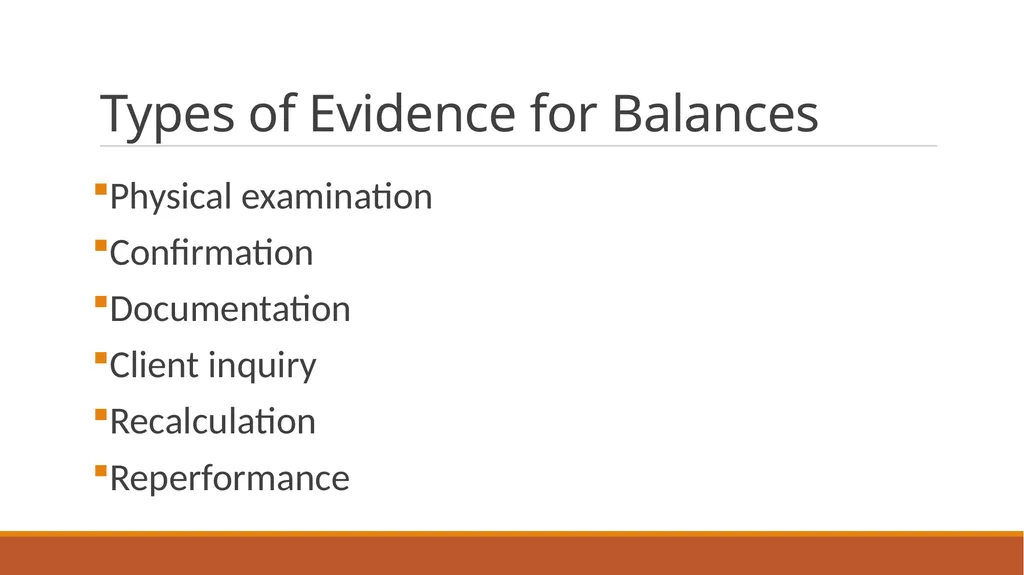
slide75. Types of Evidence for Balances Physical examination
Confirmation
Documentation
Client inquiry
Recalculation
Reperformance<br>
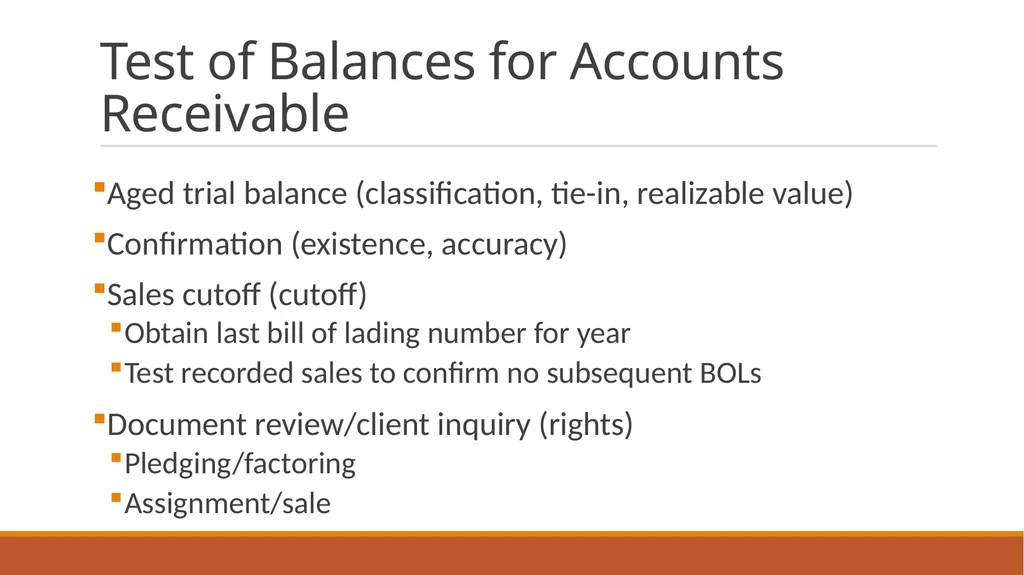
slide76. Test of Balances for Accounts Receivable Aged trial balance (classification, tie-in, realizable value)
Confirmation (existence, accuracy)
Sales cutoff (cutoff)
Obtain last bill of lading number for year
Test recorded sales to confirm no subsequent BOLs
Document review/client inquiry (rights)
Pledging/factoring
Assignment/sale<br>
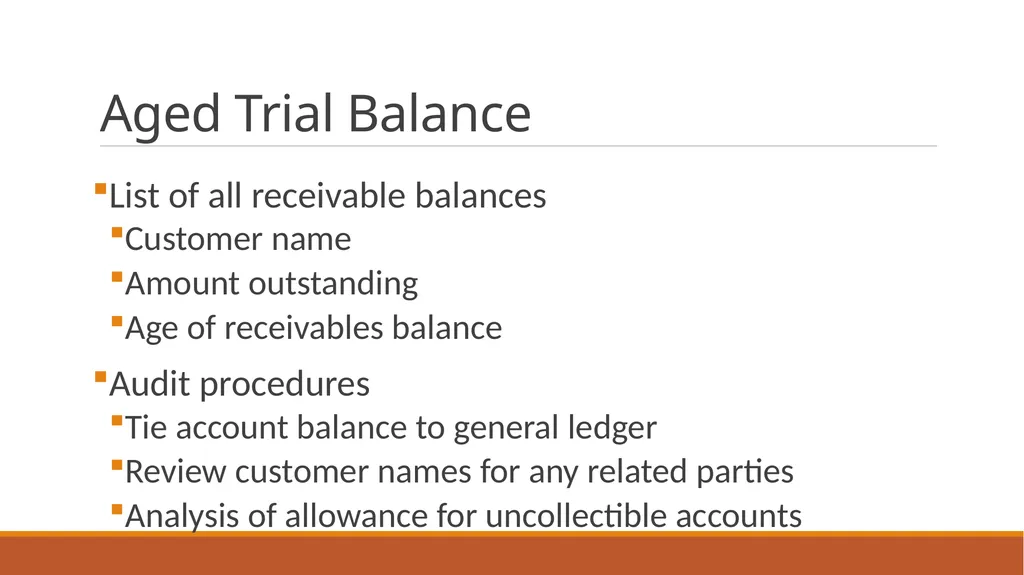
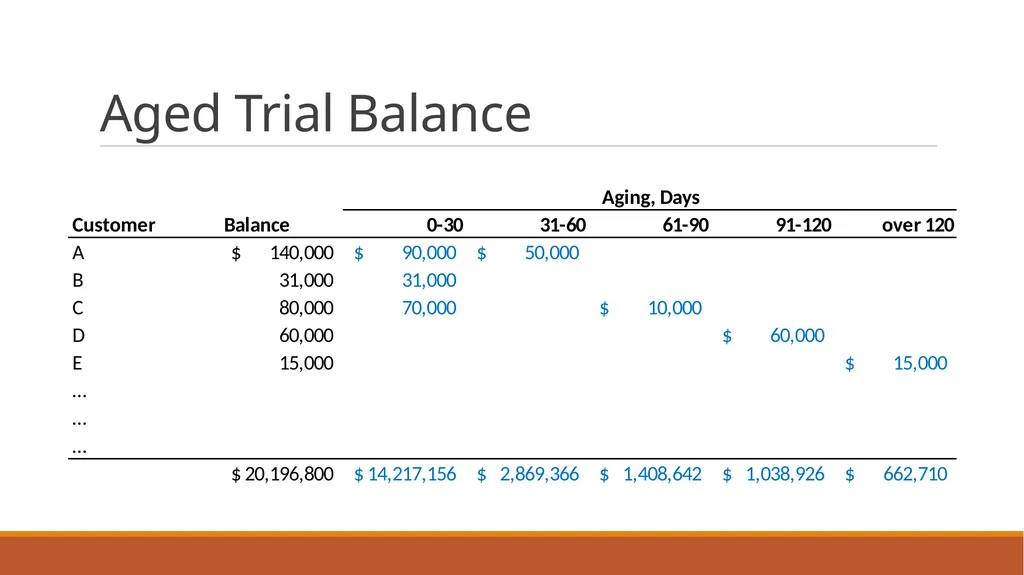
slide77. Aged Trial Balance List of all receivable balances
Customer name
Amount outstanding
Age of receivables balance
Audit procedures
Tie account balance to general ledger
Review customer names for any related parties
Analysis of allowance for uncollectible accounts<br>
slide78. Aged Trial Balance<br>
slide79. Analysis of Analysis for Uncollectible Accounts<br>
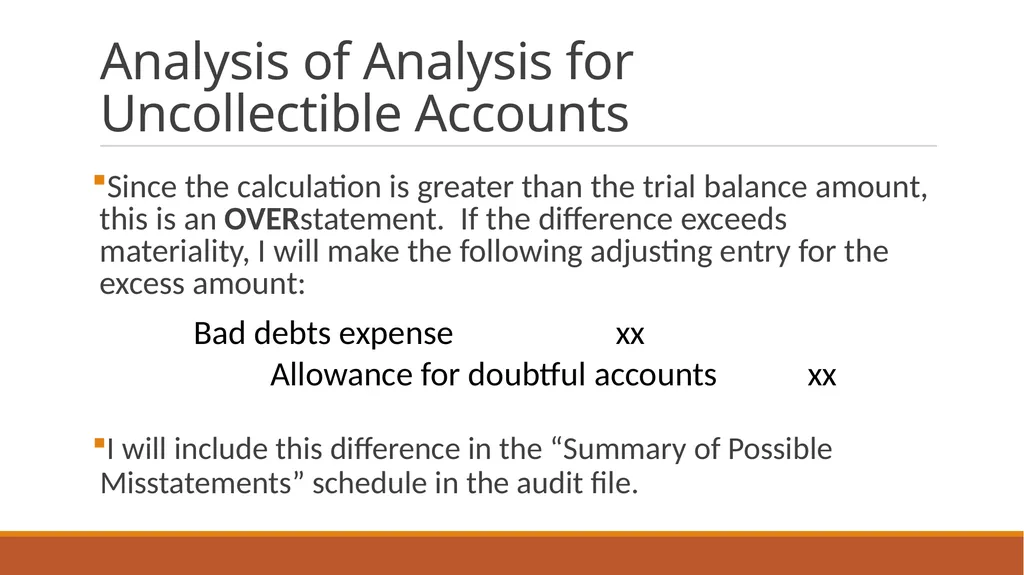
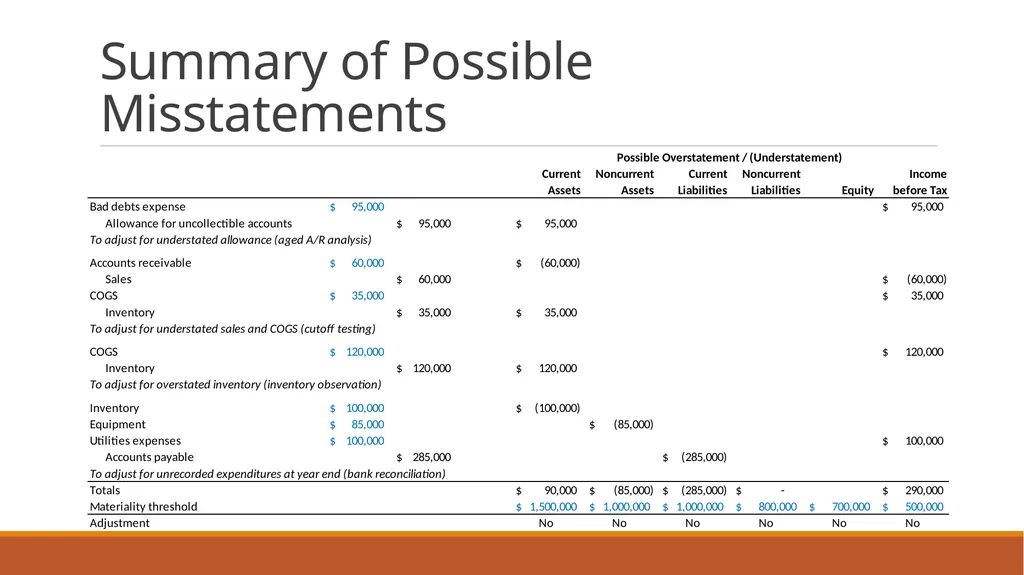
slide80. Analysis of Analysis for Uncollectible Accounts I will include this difference in the “Summary of Possible Misstatements” schedule in the audit file. Bad debts expense xx
Allowance for doubtful accounts xx Since the calculation is greater than the trial balance amount, this is an OVERstatement. If the difference exceeds materiality, I will make the following adjusting entry for the excess amount:<br>
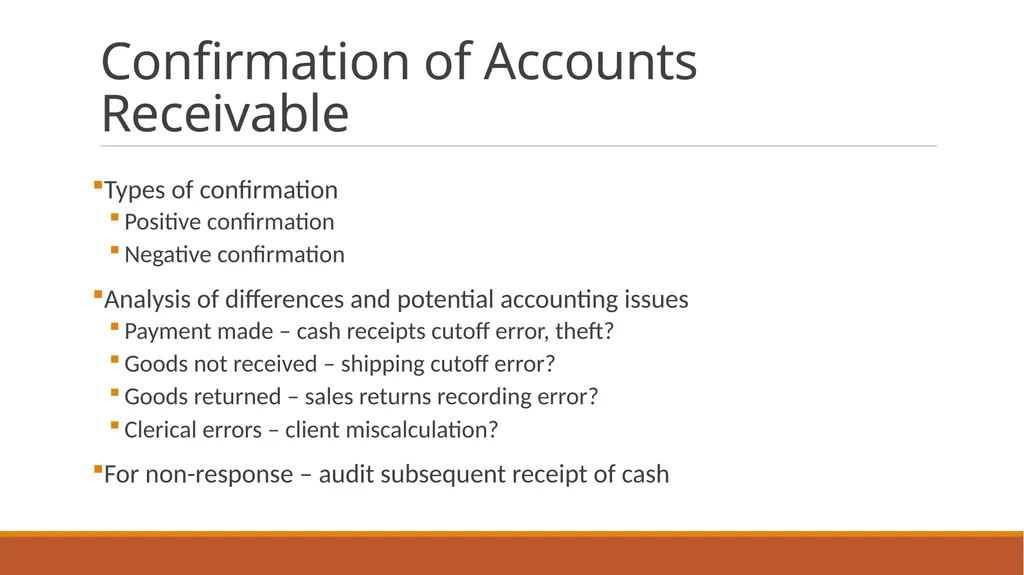
slide81. Confirmation of Accounts Receivable Types of confirmation
Positive confirmation
Negative confirmation
Analysis of differences and potential accounting issues
Payment made – cash receipts cutoff error, theft?
Goods not received – shipping cutoff error?
Goods returned – sales returns recording error?
Clerical errors – client miscalculation?
For non-response – audit subsequent receipt of cash<br>
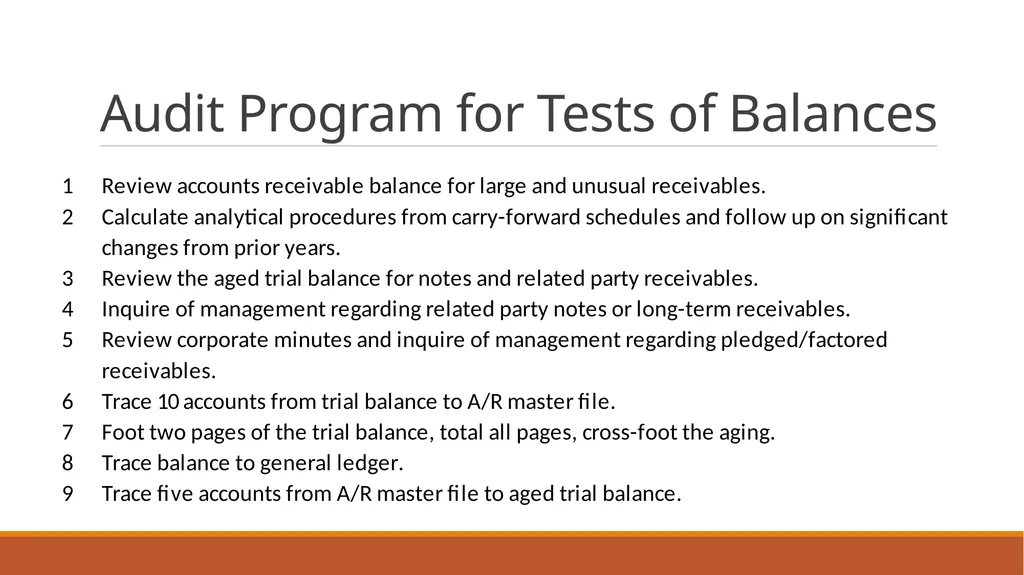
slide82. Audit Program for Tests of Balances<br>
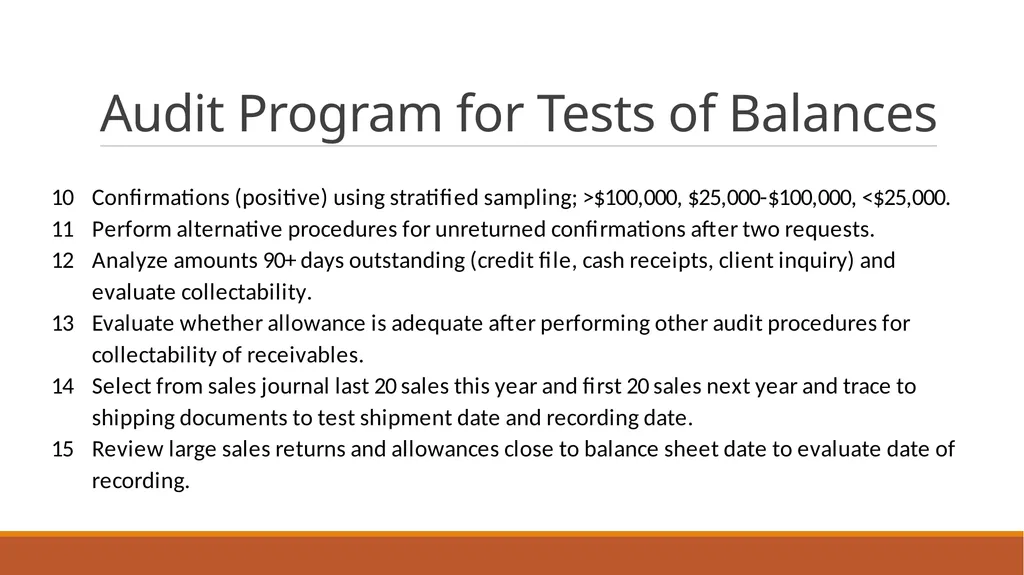
slide83. Audit Program for Tests of Balances<br>
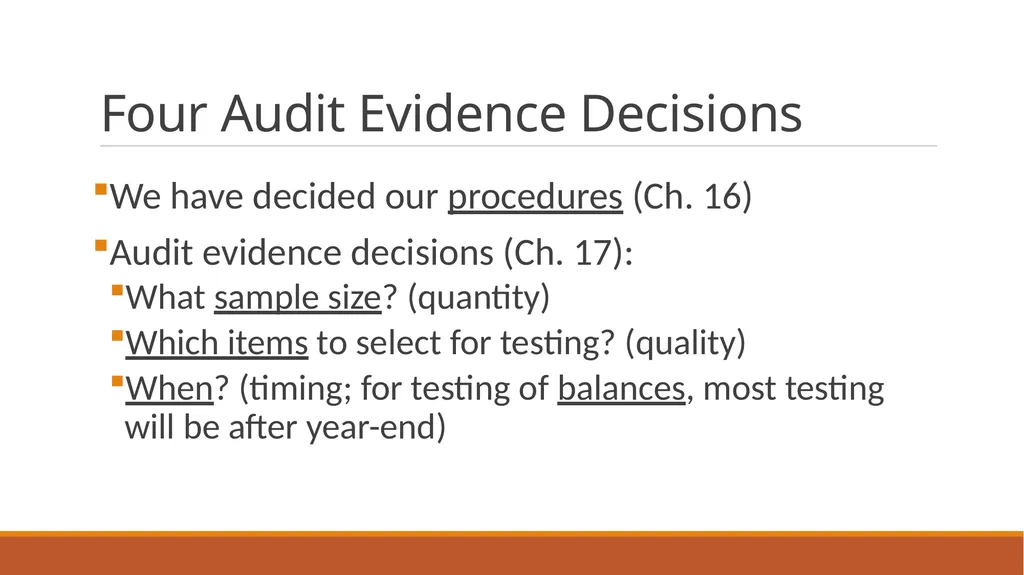
slide84. Four Audit Evidence Decisions We have decided our procedures (Ch. 16)
Audit evidence decisions (Ch. 17):
What sample size? (quantity)
Which items to select for testing? (quality)
When? (timing; for testing of balances, most testing will be after year-end)<br>
slide85. Sampling for Balances We sample and test for balances based on dollar amounts.
Chapter 17 covers sampling procedures; we will not study this information, rather I will provide you with sampling instructions.<br>
slide86. Perform the Audit Procedures We set the tolerable misstatement during phase I.
We determine a sample size and sample items using sampling procedures and considering the results of our controls and transactions testing (strong controls = less balance testing).
We perform our testing based on the audit program.<br>
slide87. What Do We Do with the Results? I analyze sample misstatements to calculate total projected misstatement.
I compare projected misstatement to tolerable misstatement
If projected misstatement < tolerable misstatement, account balance is presented fairly.
If projected misstatement > tolerable misstatement, I either 1) perform additional testing or 2) propose adjusting entry.<br>
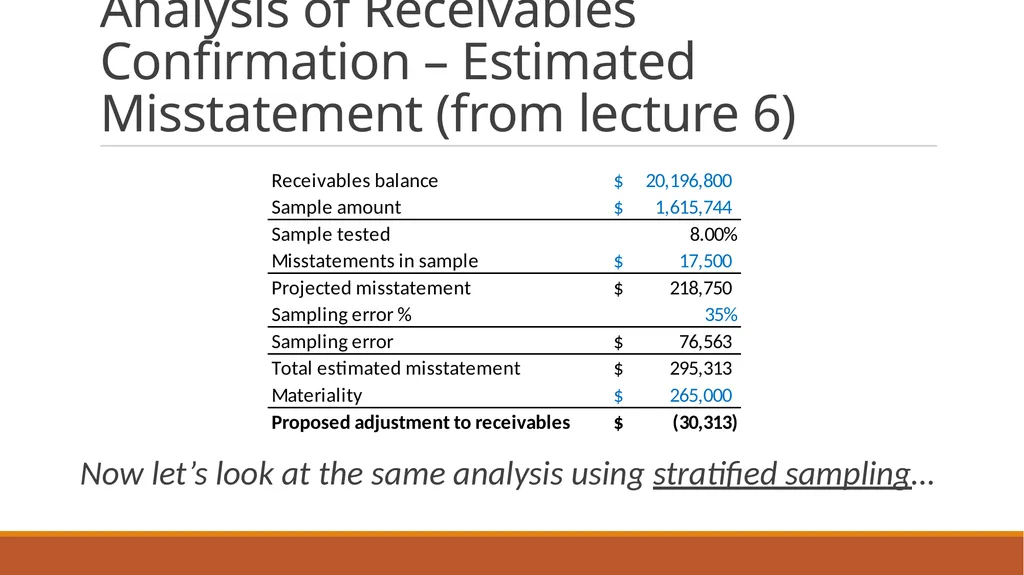
slide88. Analysis of Receivables Confirmation – Estimated Misstatement (from lecture 6) Now let’s look at the same analysis using stratified sampling…<br>
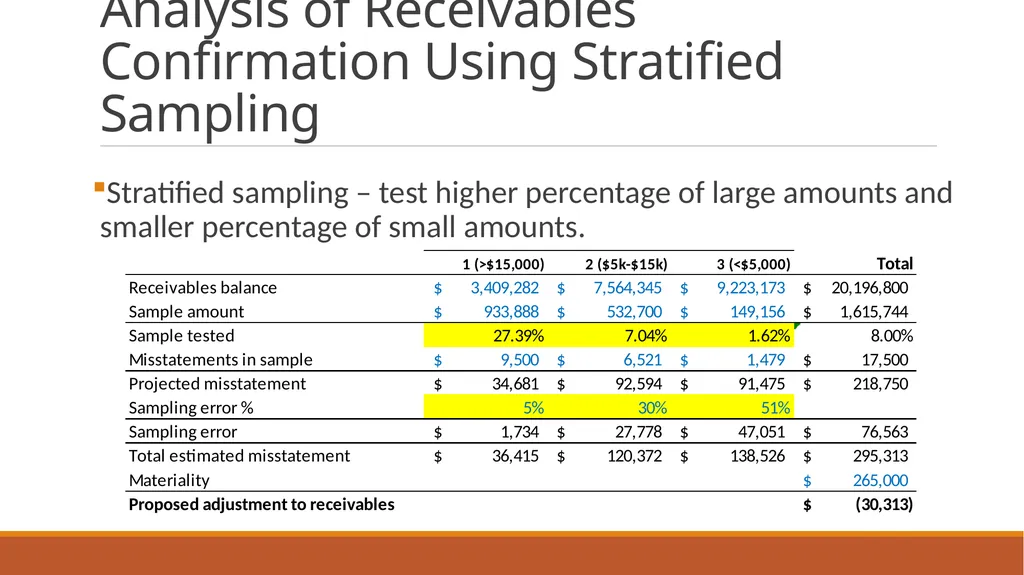
slide89. Analysis of Receivables Confirmation Using Stratified Sampling Stratified sampling – test higher percentage of large amounts and smaller percentage of small amounts.<br>
slide90. Adjustments to Financial Statements We are performing multiple tests to evaluate the sales cycle; once we complete our testing for this cycle, we will evaluate the need for adjusting entries.
The confirmations testing analysis on slide 19 is only one of these tests; other tests might indicate the need for a larger or smaller adjustment to accounts receivable.
Accounts receivables is only one account in the sales cycle; other tests might indicate the need to make adjustments to other accounts in the sales cycle.<br>
slide91. Audit Week twelve<br>
slide92. Readings Chapter 18, “Audit of the Payroll and Personnel Cycle”
Chapter 19, “Audit of the Acquisition and Payment Cycle”
Chapter 20, “Completing the Tests in the Acquisition and Payment Cycle”<br>
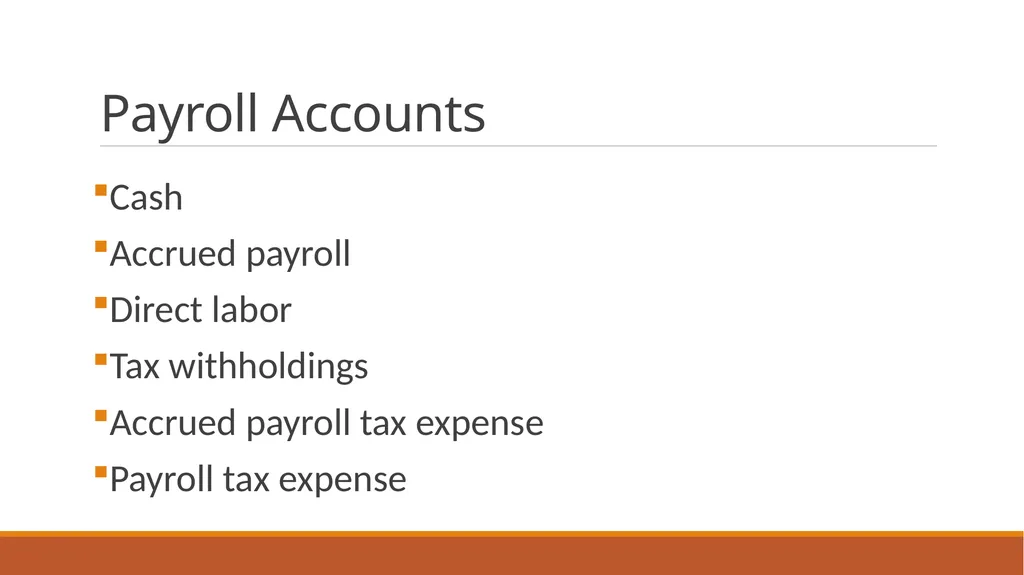
slide93. Payroll Accounts Cash
Accrued payroll
Direct labor
Tax withholdings
Accrued payroll tax expense
Payroll tax expense<br>
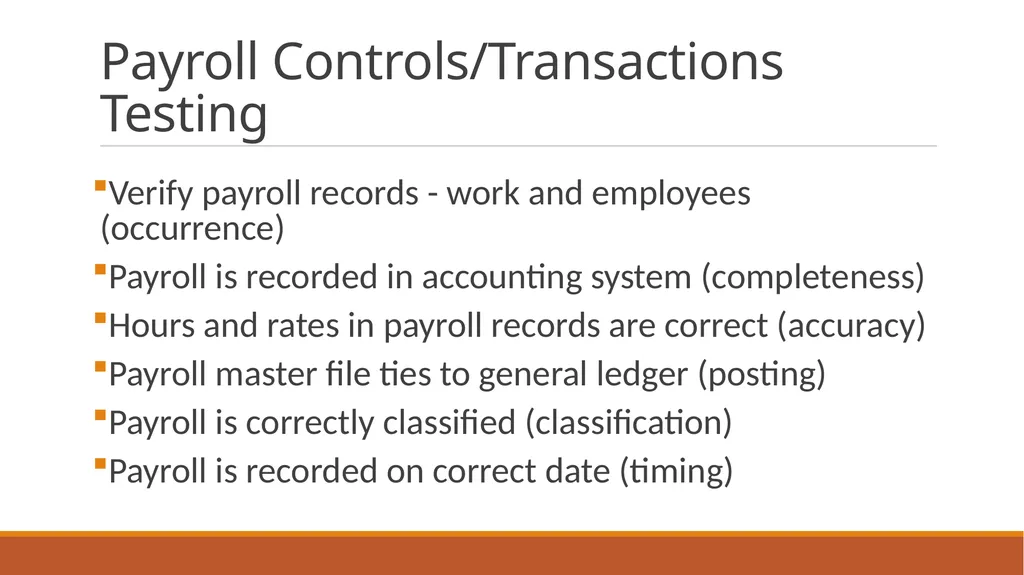
slide94. Payroll Controls/Transactions Testing Verify payroll records - work and employees (occurrence)
Payroll is recorded in accounting system (completeness)
Hours and rates in payroll records are correct (accuracy)
Payroll master file ties to general ledger (posting)
Payroll is correctly classified (classification)
Payroll is recorded on correct date (timing)<br>
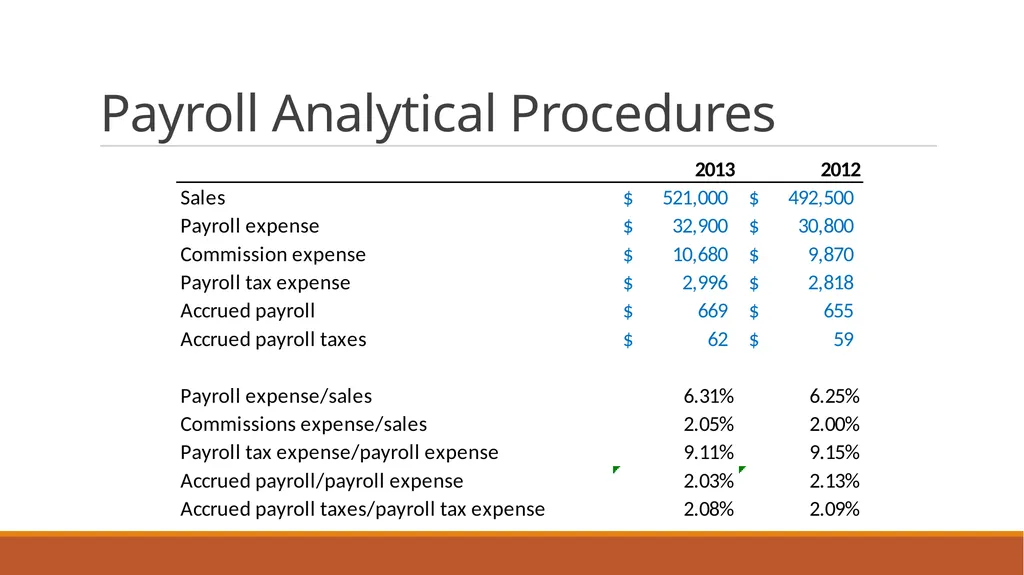
slide95. Payroll Analytical Procedures<br>
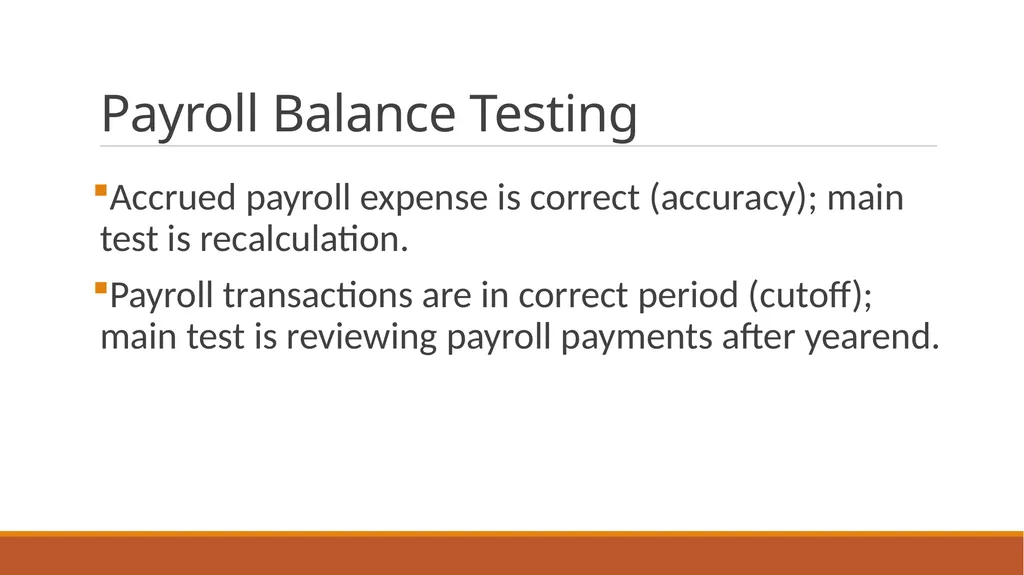
slide96. Payroll Balance Testing Accrued payroll expense is correct (accuracy); main test is recalculation.
Payroll transactions are in correct period (cutoff); main test is reviewing payroll payments after yearend.<br>
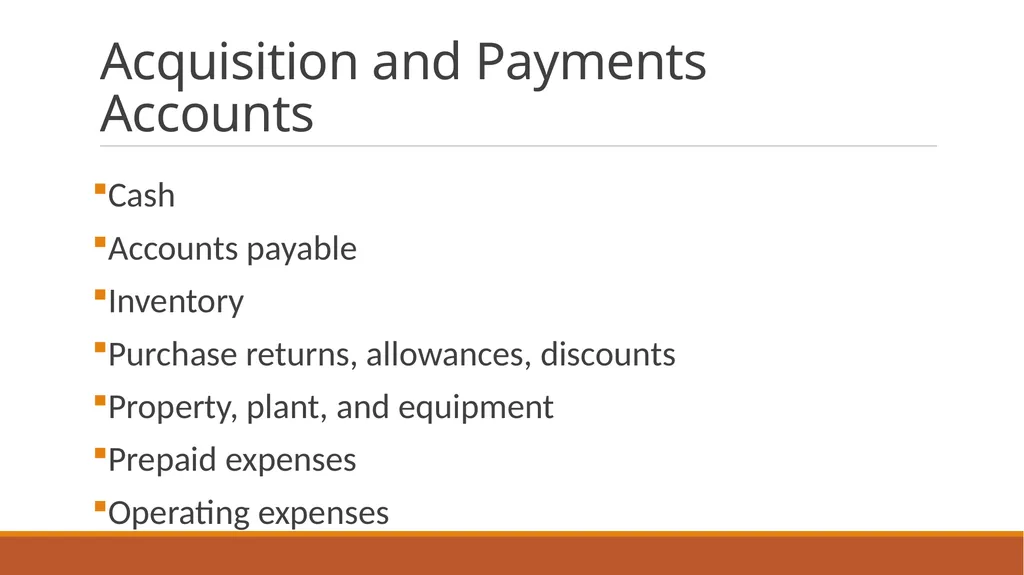
slide97. Acquisition and Payments Accounts Cash
Accounts payable
Inventory
Purchase returns, allowances, discounts
Property, plant, and equipment
Prepaid expenses
Operating expenses<br>
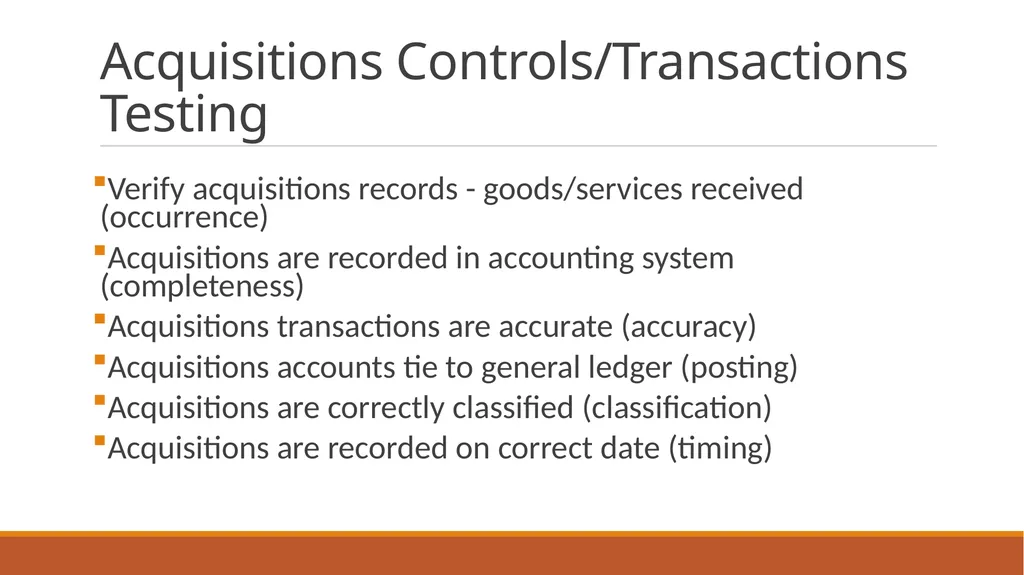
slide98. Acquisitions Controls/Transactions Testing Verify acquisitions records - goods/services received (occurrence)
Acquisitions are recorded in accounting system (completeness)
Acquisitions transactions are accurate (accuracy)
Acquisitions accounts tie to general ledger (posting)
Acquisitions are correctly classified (classification)
Acquisitions are recorded on correct date (timing)<br>
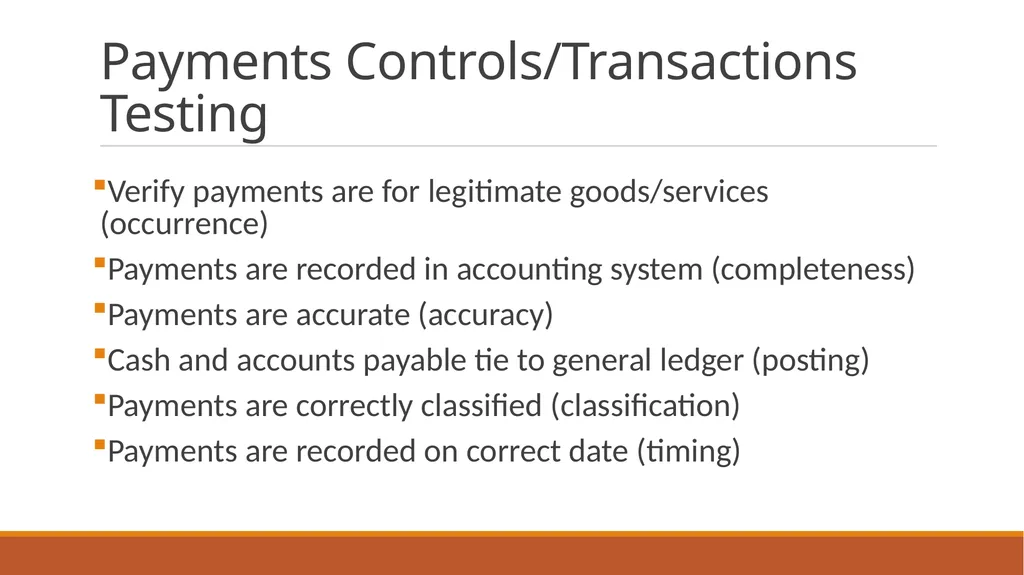
slide99. Payments Controls/Transactions Testing Verify payments are for legitimate goods/services (occurrence)
Payments are recorded in accounting system (completeness)
Payments are accurate (accuracy)
Cash and accounts payable tie to general ledger (posting)
Payments are correctly classified (classification)
Payments are recorded on correct date (timing)<br>
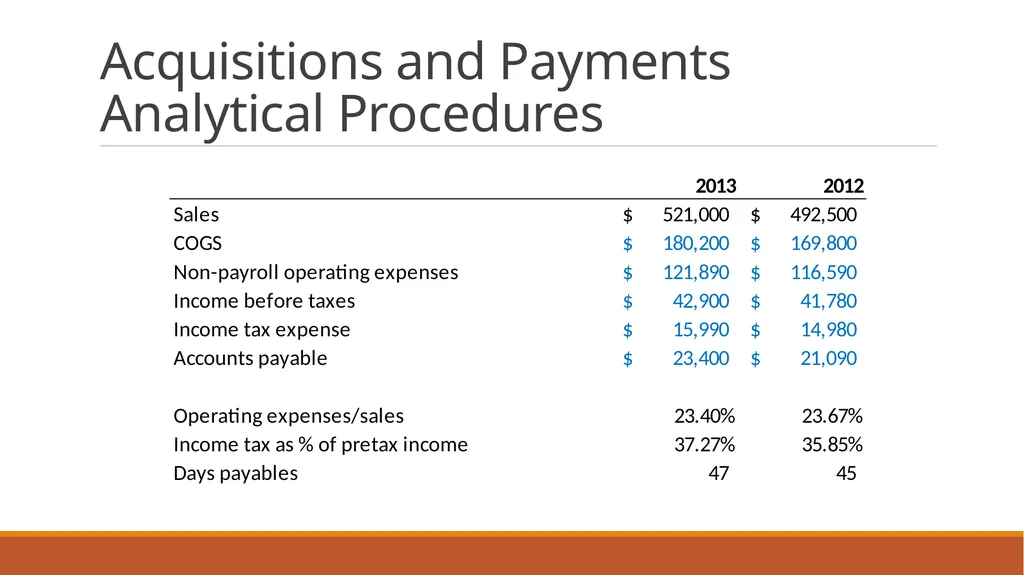
slide100. Acquisitions and Payments Analytical Procedures<br>
slide101. Accounts Payable Balance Testing All accounts payable are included in AP ledger (completeness); review subsequent cash disbursements and year-end receiving reports
Payables are correctly classified (classification)
Acquisition transactions are in correct period (cutoff)<br>
slide102. Other Acquisition/Payment Cycle Accounts Property, plant, and equipment – examine documentation of current year acquisitions to confirm existence and classification.
Prepaid assets – examine documentation to confirm existence and cutoff.
Accrued liabilities – ensure that normal accruals (taxes and payroll) are included in financials and are correctly calculated.
Income and expense accounts – ensure that normal expenses are included in financials and are correctly calculated.<br>
slide103. Audit Week thirteen<br>
slide104. Readings Chapter 21-24 (Inventory, Capital, Cash, Audit completion) from textbook<br>
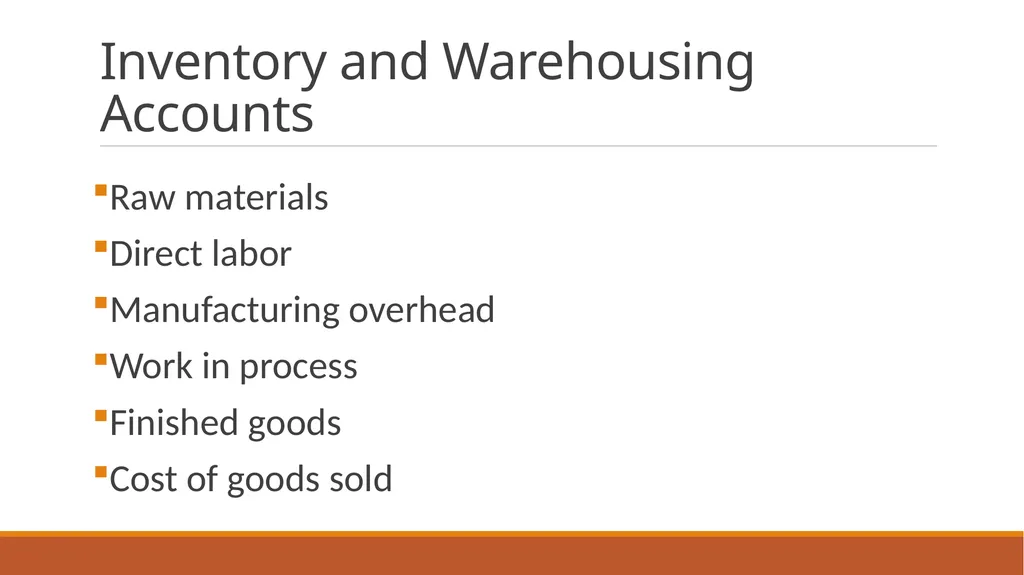
slide105. Inventory and Warehousing Accounts Raw materials
Direct labor
Manufacturing overhead
Work in process
Finished goods
Cost of goods sold<br>
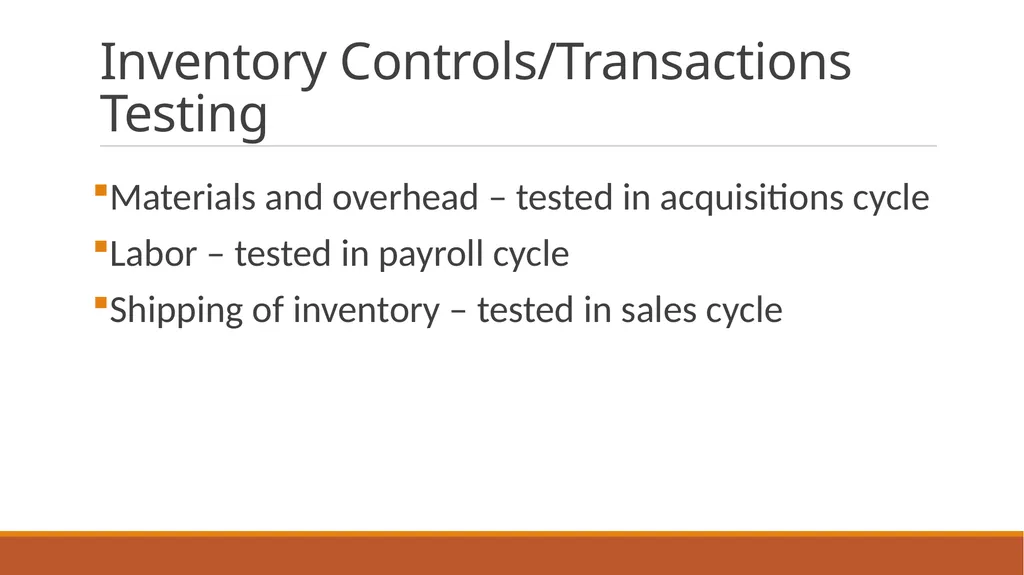
slide106. Inventory Controls/Transactions Testing Materials and overhead – tested in acquisitions cycle
Labor – tested in payroll cycle
Shipping of inventory – tested in sales cycle<br>
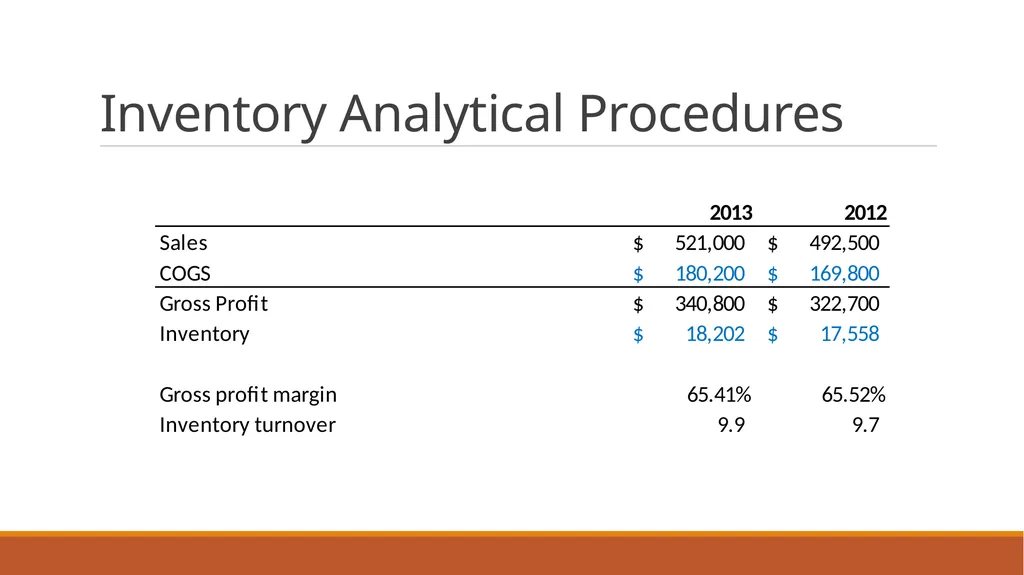
slide107. Inventory Analytical Procedures<br>
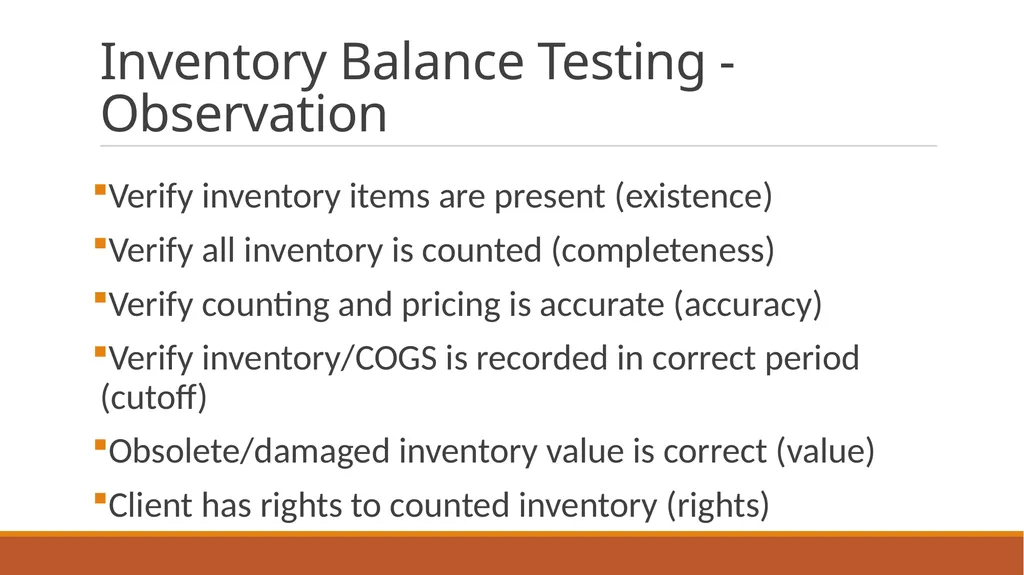
slide108. Inventory Balance Testing - Observation Verify inventory items are present (existence)
Verify all inventory is counted (completeness)
Verify counting and pricing is accurate (accuracy)
Verify inventory/COGS is recorded in correct period (cutoff)
Obsolete/damaged inventory value is correct (value)
Client has rights to counted inventory (rights)<br>
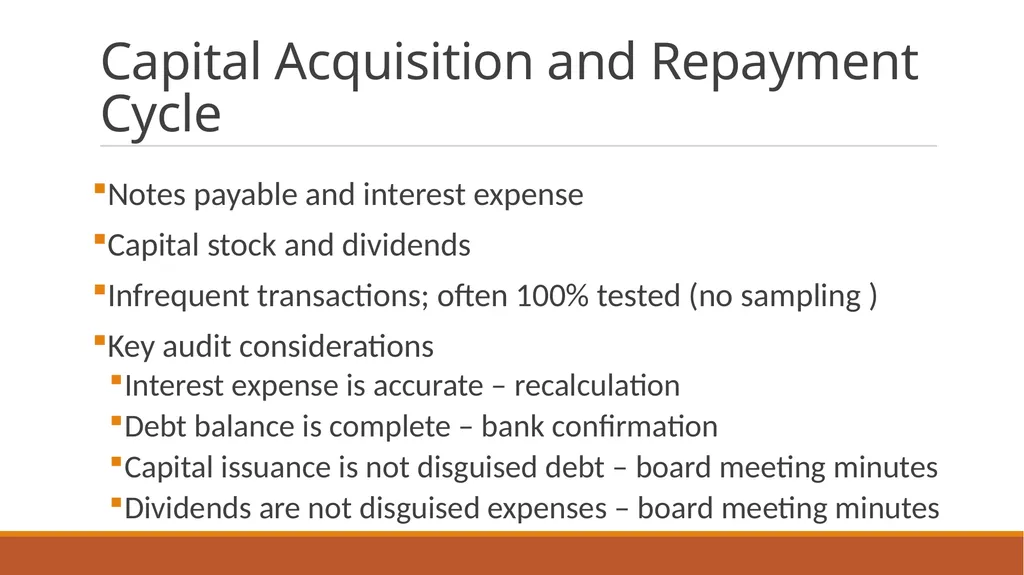
slide109. Capital Acquisition and Repayment Cycle Notes payable and interest expense
Capital stock and dividends
Infrequent transactions; often 100% tested (no sampling )
Key audit considerations
Interest expense is accurate – recalculation
Debt balance is complete – bank confirmation
Capital issuance is not disguised debt – board meeting minutes
Dividends are not disguised expenses – board meeting minutes<br>
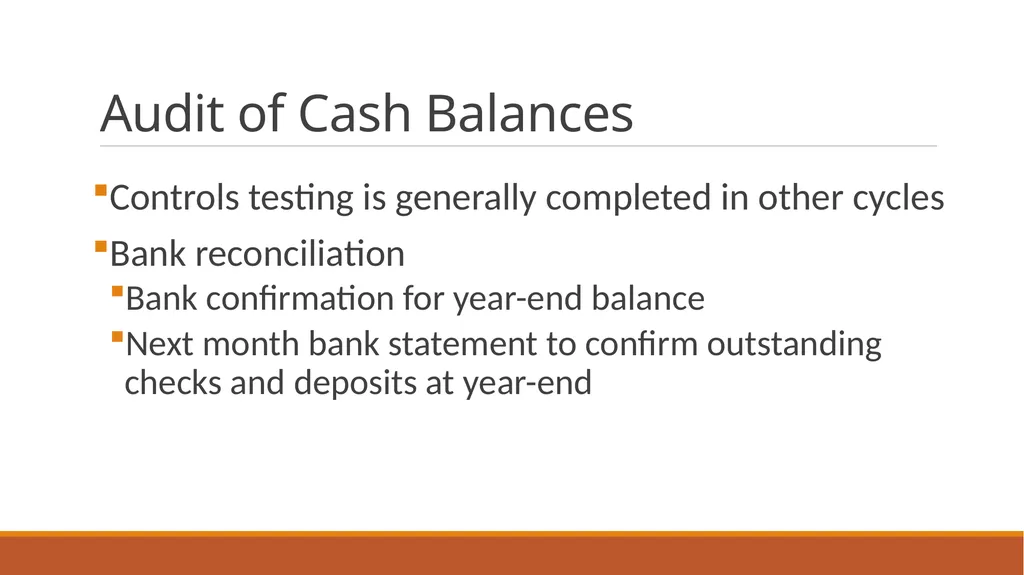
slide110. Audit of Cash Balances Controls testing is generally completed in other cycles
Bank reconciliation
Bank confirmation for year-end balance
Next month bank statement to confirm outstanding checks and deposits at year-end<br>
slide111. Presentation and Disclosure Testing Occurrence and rights and obligations
Completeness
Classification and understandability
Accuracy and valuation<br>
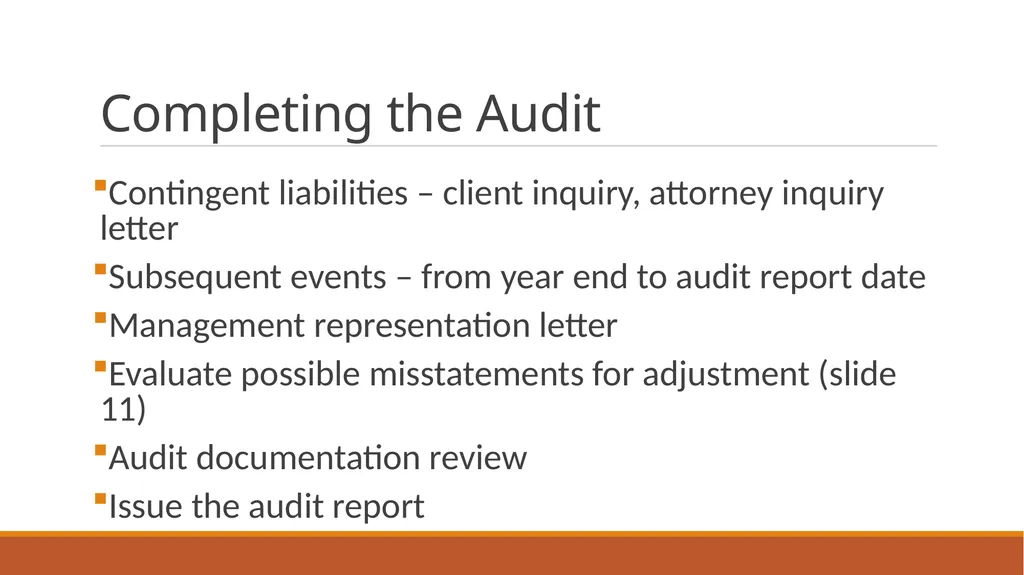
slide112. Completing the Audit Contingent liabilities – client inquiry, attorney inquiry letter
Subsequent events – from year end to audit report date
Management representation letter
Evaluate possible misstatements for adjustment (slide 11)
Audit documentation review
Issue the audit report<br>
slide113. Summary of Possible Misstatements<br>
slide2. Course Administration Professor Thomas Davis
Email: tomas.davis@hotmail.com
Student course leader
Textbook: Auditing and Assurance Services, Arens/Elder/Beaseley, 12th edition<br>
slide3. Course Assessment 30% midterm exam (5 Oct-22 Oct)
20% project (week 11 case study)
50% final exam (30 Nov-17 Dec)<br>
slide4. Course Outline Introduction (week 1)
Audit overview (week 2)
Financial statement cycles/audit objectives (week 3)
Audit evidence (week 4)
Audit planning (week 5)
Materiality (week 6)
Audit plan/audit program/review for midterm exam (week 7)<br>
slide5. Course Outline Sales cycle: controls and transactions testing (week 8)
Case study (week 9)
Sales cycle: analytical procedures/balances testing (week 10)
Case study (week 11)
Payroll and acquisition cycles (week 12)
Inventory and capital cycles/audit completion (week 13)
Review for final exam (week 14)<br>
slide6. Audit Week two<br>
slide7. Readings GAAS standards: http://www.aicpa.org/Research/Standards/AuditAttest/DownloadableDocuments/AU-00150.pdf
Audit reports http://en.wikipedia.org/wiki/Auditor's_report
Legal liability http://en.wikipedia.org/wiki/Legal_liability_of_certified_public_accountants<br>
slide8. Audit vs. Accounting Accounting: preparing financial statements
Auditing: verifying financial statements<br>
slide9. The CPA Profession The “Big Four”
Deloitte, EY, PwC, KPMG
Staff levels: Staff, Senior, Manager, Partner
CPA certification
Education
Exam
Experience<br>
slide10. Generally Accepted Auditing Standards (GAAS) General standards
Training and proficiency
Independence
Professional care
Standards of field work
Planning and supervision
Understanding of entity
Sufficient evidence
Standards of reporting
Evaluation of GAAP
Explanation of departures from GAAP
Adequate disclosure
Financial statement opinion<br>
slide11. Audit Reports – Standard Unqualified Opinion All four financial statements included
All three GAAS general standards followed
All three field work standards met
Presentation in accordance with GAAP
No explanation/modification required<br>
slide12. Other Audit Reports Unqualified opinion with explanation/modification
Qualified opinion – “except for”
Scope limitation – client or circumstances
Not in accordance with GAAP but fairly stated
Adverse opinion – financials not fairly stated per GAAP
Disclaimer – lack of information or lack of independence<br>
slide13. Materiality and Misstatements Immaterial – unlikely to affect decision of user: unqualified opinion
Material but financial statements are fair (one item/isolated situation): qualified opinion
Material – fairness of financial statements is in question: disclaimer or adverse opinion<br>
slide14. Ethics Independence
Integrity and objectivity
Confidential client information
Contingent fees
Audit and consulting… conflict of interest<br>
slide15. Legal Liability Business failure vs. audit failure
Audit failure vs. audit risk
Negligence vs. fraud
Third parties vs. clients
Civil (securities law) vs. criminal (federal law) liability
“Joint and several” vs. “separate and proportionate” liability<br>
slide16. Audit week three<br>
slide17. Readings Accounting cycles
http://tgg-accounting.com/blog/2012/01/financial-statement-cycles/
Audit objectives (not all objectives are covered here; we will discuss others during the class)
http://smallbusiness.chron.com/audit-procedures-objectives-58836.html<br>
slide18. Auditor Responsibilities Material vs. immaterial misstatements
Reasonable assurance
Errors vs. fraud
Professional skepticism – question everything!<br>
slide19. Financial Statement Cycles Sales and collection cycle
Acquisition and payment cycle (general assets and expenses)
Payroll and personnel cycle
Inventory and warehousing cycle (inventory and COGS)
Capital acquisition and repayment cycle (debt and equity transactions)<br>
slide20. Financial Statement Cycles Identify the transaction cycle for each account
Identify the main journal entries for each cycle<br>
slide21. Objectives Transaction-related
Balance-related
Presentation and disclosure-related<br>
slide22. Transaction-Related Objectives Occurrence – did it really happen?
Completeness – is anything missing?
Accuracy – is the information accurate?
Posting and summarization – are the transactions included in the journal and ledger?
Classification – is the transaction in the correct account?
Timing – is the transaction in the right period?<br>
slide23. Balance-Related Objectives Existence – does this account really exist?
Completeness – is anything missing?
Accuracy – is the information accurate?
Classification – is the account correctly classified?
Cutoff – are the year-end transactions recorded in the right period?
Detail tie-in – does the balance match the ledger?
Realizable value – does the account reflect accurate value?
Rights and obligations – does account represent true ownership/liability?<br>
slide24. Disclosure-Related Objectives Occurrence and rights and obligations – did it really happen, and did it create true ownership/liability?
Completeness – is anything missing?
Valuation and allocation – do all accounts reflect the appropriate amounts?
Classification and understandability – is the classification correct and is the meaning clear?<br>
slide25. Four Phases of an Audit Plan the audit
Testing of controls and transactions
Analytical procedures and testing of balances
Audit report<br>
slide26. Audit week four<br>
slide27. Readings Chapter 7 from textbook<br>
slide28. Audit Evidence Decisions Which procedures?
What sample size? (quantity)
Which items to select for testing? (quality)
When?<br>
slide29. Persuasiveness of Evidence Appropriate
Relevant: right test for the right audit objective
Reliable: external information > internal information
Sufficient
Sample size: higher risk = larger sample
Item quality: large amounts and random amounts<br>
slide30. Types of Evidence Physical examination – auditor inspects physical assets
Confirmation – response from third party
Documentation – internal and external documents
Analytical procedures – comparisons and relationships
Inquiries of the client – client responses; may be biased
Recalculation – checking client calculations
Reperformance – checking non-calculation procedures
Observation – watch/listen/touch/smell<br>
slide31. Audit Documentation Sample documents from audit files (attachment)
Activity – notes receivable audit work (attachment)<br>
slide32. Audit week five<br>
slide33. Readings Chapter 8 from textbook<br>
slide34. Audit Planning Initial audit planning – staffing/specialists
Client business and industry (next slide)
Client business risk
Based on understanding business/industry (step 2)
High business risk = high risk of material misstatement
Analytical procedures<br>
slide35. Client Business and Industry Industry
Industry economic environment and risk
Industry accounting requirements
Business operations
Management and governance – philosophy and ethics
Objectives and strategies – financial and legal compliance
Measurement and performance – conservative or aggressive?<br>
slide36. Analytical Procedures Industry data
Prior period data
Client-calculated expected results (budgets)
Auditor-calculated expected results
Expected results using nonfinancial data (units, rates)<br>
slide37. Client/Industry Comparison Client is stable…. in an improving industry environment…
What happened?<br>
slide38. Common Size Financial Statements<br>
slide39. Auditor-Calculated Expected Results<br>
slide40. Non-Financial Data This percentage difference is significant… we need to find out….
What happened?<br>
slide41. Financial Ratios Current ratio = current assets / current liabilities
Days receivables = 365 / (net sales/average receivables)
Inventory turnover = cost of goods sold/average inventory
Debt to equity = debt / equity
Gross profit margin = gross profit / net sales
Operating margin = operating income / net sales
Profit margin = net income / net sales
Expense item as % of total expenses = expense / total expenses
Return on assets = income before taxes / average assets<br>
slide42. Audit Week six<br>
slide43. Readings Chapter 9 from textbook, “Materiality and Risk”<br>
slide44. Materiality Set preliminary judgement about materiality
Allocate amounts to segments
Estimate segment misstatement
Estimate combined misstatement
Compare combined estimate with preliminary judgement<br>
slide45. Materiality Judgment Guidelines (vary from audit to audit):
6% earnings from operations
3% of total assets
Use the smaller result to calculate materiality
Below the amount: no issues
Above the amount: material misstatment; adjustment required<br>
slide46. Materiality Judgment and Allocation Earnings from operations = $7,370,000
Total assets = $61,367,000
Materiality calculation:
Earnings x 6% = $442,000
Assets x 3% = $1,841,000
The smaller result = $442,000<br>
slide47. Additional Auditor Guidelines Maximum misstatement for one account = 60% 60% * $442,000 = $265,000 To prevent high allocation to one account
Maximum total of all misstatments = 200% 200% * $442,000 = $884,000 To allow for overestimates and over/under offsets
These guidelines vary among audit firms.<br>
slide48. Materiality Judgment Allocation Example<br>
slide49. Estimate and Evaluate Misstatement Projection = misstatements/sample size %
Sampling error = risk of non-representative sample
Calculate total estimated misstatement
Compare total to preliminary judgment<br>
slide50. Estimate and Evaluate: Receivables<br>
slide51. Estimate and Evaluate: Receivables Estimated misstatement exceeds tolerable misstatement… What do we do?<br>
slide52. Receivables Misstatement Options If we increase our sample size, we can decrease the sampling error % and recalculate the total estimated misstatement (see next slide); if we still exceed materiality, we adjust.
Adjusting entry: Sales $xx Accounts receivable $xx
The adjustment amount will be negotiated between the client and the auditor.<br>
slide53. Receivables: Revised Sampling If we expand the sample size (from slide 10), we can decrease the sample error %, and evaluate the new result. In this case, because the amount of misstatement in the revised sample still exceeds the materiality threshold, we will propose the adjusting entry.<br>
slide54. In Class Activity: Payables Analysis<br>
slide55. Audit Risk Model PDR = AAR IR * CR
PDR = planned detection risk (risk of undiscovered misstatement) auditor risk; lower risk = more evidence
AAR = acceptable audit risk (risk of an incorrect audit opinion); auditor risk; lower risk = more evidence
IR = inherent risk (account-specific risk); client risk; lower risk = less evidence
CR = control risk (risk of ineffective control system); client risk; lower risk = less evidence<br>
slide56. Audit Week eight<br>
slide57. Readings Chapter 14, “Audit of the Sales and Collection Cycle” and Chapter 15, “Audit Sampling for Tests of Controls” from textbook<br>
slide58. Sales and Collection Cycle Accounts Sales
Cash
Accounts receivable
Sales discounts
Sales returns and allowances
Allowance for uncollectible accounts
Bad debts expense<br>
slide59. Sales and Collection Cycle Documents Customer order
Sales order
Bill of lading (shipping document)
Sales invoice
Additional documentation: cash receipts, sales returns, bad debt provision, write-offs<br>
slide60. Sales and Collection Cycle Controls Separation of duties
Authorization (credit/shipping/pricing)
Documentation
Prenumbered documents (to prevent missing/duplicate documents)
Monthly statements
Internal verification<br>
slide61. Tests of Controls and Transactions First, I consider my six transaction objectives: occurrence, completeness, accuracy, posting, classification, timing.
Then, I design tests relating to these objectives based on information I have from client (procedures manual, client discussions, observation); these tests are the audit program.<br>
slide62. Types of Evidence for Controls and Transactions Controls
Documentation
Inquiry
Reperformance
Observation
Transactions
Documentation
Inquiry
Recalculation
Reperformance<br>
slide63. Audit Program for Controls/Transactions This is a sample of the audit program on page 464:<br>
slide64. Four Audit Evidence Decisions We have decided our procedures (Ch. 14)
Audit evidence decisions (Ch. 15):
What sample size? (quantity)
Which items to select for testing? (quality)
When? (timing)<br>
slide65. Sampling for Controls and Transactions We sample and test for controls based on attributes, not dollar amounts.
Our assessment is based on number of errors.
Dollar amount does not matter.
Chapter 15 covers sampling procedures; we will not study this information, rather I will provide you with sampling instructions.<br>
slide66. Perform the Audit Procedures We set an estimated population exception rate based on our understanding of client controls.
We set a tolerable exception rate (generally from 3%-10%) based on what we consider acceptable.
We determine a sample size based on relationship between the estimated and tolerable amounts (big difference = smaller sample).
We perform our testing based on the audit program.<br>
slide67. What Do We Do with the Results? I compare my sample exception rate to my tolerable exception rate.
If TER>SER, I can rely on this control procedure.
If TER<SER, I either 1) increase testing or 2) revise control risk (I don’t rely on this control)
This evaluation of controls and transactions is the basis for the design of my audit program for balances (Chs. 16-17).<br>
slide68. Case Study Documentation Package Auditor documents
Audit program
Attributes defined
Sampling sheet
Sales invoice sequence
Company accounting documents
Sales journal
A/R ledger
Company operations documents
Customer order
Sales order
Bill of lading
Sales invoice<br>
slide69. Audit Week ten<br>
slide70. Readings Chapter 16, “Completing the Tests in the Sales and Collection Cycle” and Chapter 17, “Audit Sampling for Tests of Details of Balances” from textbook<br>
slide71. Sales and Collection Cycle Accounts Sales
Cash
Accounts receivable
Sales discounts
Sales returns and allowances
Allowance for uncollectible accounts
Bad debts expense<br>
slide72. Analytical Procedures<br>
slide73. Analytical Procedures – Potential Misstatement These results indicate a potential misstatement relating to the objective of “realizable value” which will affect our balance testing for this objective.<br>
slide74. Tests of Balances First, we consider the eight balance objectives: existence, completeness, accuracy, classification, cutoff, detail tie-in, realizable value, rights/obligations.
Then, we design tests relating to these objectives based on:
The tolerable misstatement calculated in phase I
The controls/transaction testing completed in phase II
Analytical procedures just completed (this, along with tests of balances, is phase III)<br>
slide75. Types of Evidence for Balances Physical examination
Confirmation
Documentation
Client inquiry
Recalculation
Reperformance<br>
slide76. Test of Balances for Accounts Receivable Aged trial balance (classification, tie-in, realizable value)
Confirmation (existence, accuracy)
Sales cutoff (cutoff)
Obtain last bill of lading number for year
Test recorded sales to confirm no subsequent BOLs
Document review/client inquiry (rights)
Pledging/factoring
Assignment/sale<br>
slide77. Aged Trial Balance List of all receivable balances
Customer name
Amount outstanding
Age of receivables balance
Audit procedures
Tie account balance to general ledger
Review customer names for any related parties
Analysis of allowance for uncollectible accounts<br>
slide78. Aged Trial Balance<br>
slide79. Analysis of Analysis for Uncollectible Accounts<br>
slide80. Analysis of Analysis for Uncollectible Accounts I will include this difference in the “Summary of Possible Misstatements” schedule in the audit file. Bad debts expense xx
Allowance for doubtful accounts xx Since the calculation is greater than the trial balance amount, this is an OVERstatement. If the difference exceeds materiality, I will make the following adjusting entry for the excess amount:<br>
slide81. Confirmation of Accounts Receivable Types of confirmation
Positive confirmation
Negative confirmation
Analysis of differences and potential accounting issues
Payment made – cash receipts cutoff error, theft?
Goods not received – shipping cutoff error?
Goods returned – sales returns recording error?
Clerical errors – client miscalculation?
For non-response – audit subsequent receipt of cash<br>
slide82. Audit Program for Tests of Balances<br>
slide83. Audit Program for Tests of Balances<br>
slide84. Four Audit Evidence Decisions We have decided our procedures (Ch. 16)
Audit evidence decisions (Ch. 17):
What sample size? (quantity)
Which items to select for testing? (quality)
When? (timing; for testing of balances, most testing will be after year-end)<br>
slide85. Sampling for Balances We sample and test for balances based on dollar amounts.
Chapter 17 covers sampling procedures; we will not study this information, rather I will provide you with sampling instructions.<br>
slide86. Perform the Audit Procedures We set the tolerable misstatement during phase I.
We determine a sample size and sample items using sampling procedures and considering the results of our controls and transactions testing (strong controls = less balance testing).
We perform our testing based on the audit program.<br>
slide87. What Do We Do with the Results? I analyze sample misstatements to calculate total projected misstatement.
I compare projected misstatement to tolerable misstatement
If projected misstatement < tolerable misstatement, account balance is presented fairly.
If projected misstatement > tolerable misstatement, I either 1) perform additional testing or 2) propose adjusting entry.<br>
slide88. Analysis of Receivables Confirmation – Estimated Misstatement (from lecture 6) Now let’s look at the same analysis using stratified sampling…<br>
slide89. Analysis of Receivables Confirmation Using Stratified Sampling Stratified sampling – test higher percentage of large amounts and smaller percentage of small amounts.<br>
slide90. Adjustments to Financial Statements We are performing multiple tests to evaluate the sales cycle; once we complete our testing for this cycle, we will evaluate the need for adjusting entries.
The confirmations testing analysis on slide 19 is only one of these tests; other tests might indicate the need for a larger or smaller adjustment to accounts receivable.
Accounts receivables is only one account in the sales cycle; other tests might indicate the need to make adjustments to other accounts in the sales cycle.<br>
slide91. Audit Week twelve<br>
slide92. Readings Chapter 18, “Audit of the Payroll and Personnel Cycle”
Chapter 19, “Audit of the Acquisition and Payment Cycle”
Chapter 20, “Completing the Tests in the Acquisition and Payment Cycle”<br>
slide93. Payroll Accounts Cash
Accrued payroll
Direct labor
Tax withholdings
Accrued payroll tax expense
Payroll tax expense<br>
slide94. Payroll Controls/Transactions Testing Verify payroll records - work and employees (occurrence)
Payroll is recorded in accounting system (completeness)
Hours and rates in payroll records are correct (accuracy)
Payroll master file ties to general ledger (posting)
Payroll is correctly classified (classification)
Payroll is recorded on correct date (timing)<br>
slide95. Payroll Analytical Procedures<br>
slide96. Payroll Balance Testing Accrued payroll expense is correct (accuracy); main test is recalculation.
Payroll transactions are in correct period (cutoff); main test is reviewing payroll payments after yearend.<br>
slide97. Acquisition and Payments Accounts Cash
Accounts payable
Inventory
Purchase returns, allowances, discounts
Property, plant, and equipment
Prepaid expenses
Operating expenses<br>
slide98. Acquisitions Controls/Transactions Testing Verify acquisitions records - goods/services received (occurrence)
Acquisitions are recorded in accounting system (completeness)
Acquisitions transactions are accurate (accuracy)
Acquisitions accounts tie to general ledger (posting)
Acquisitions are correctly classified (classification)
Acquisitions are recorded on correct date (timing)<br>
slide99. Payments Controls/Transactions Testing Verify payments are for legitimate goods/services (occurrence)
Payments are recorded in accounting system (completeness)
Payments are accurate (accuracy)
Cash and accounts payable tie to general ledger (posting)
Payments are correctly classified (classification)
Payments are recorded on correct date (timing)<br>
slide100. Acquisitions and Payments Analytical Procedures<br>
slide101. Accounts Payable Balance Testing All accounts payable are included in AP ledger (completeness); review subsequent cash disbursements and year-end receiving reports
Payables are correctly classified (classification)
Acquisition transactions are in correct period (cutoff)<br>
slide102. Other Acquisition/Payment Cycle Accounts Property, plant, and equipment – examine documentation of current year acquisitions to confirm existence and classification.
Prepaid assets – examine documentation to confirm existence and cutoff.
Accrued liabilities – ensure that normal accruals (taxes and payroll) are included in financials and are correctly calculated.
Income and expense accounts – ensure that normal expenses are included in financials and are correctly calculated.<br>
slide103. Audit Week thirteen<br>
slide104. Readings Chapter 21-24 (Inventory, Capital, Cash, Audit completion) from textbook<br>
slide105. Inventory and Warehousing Accounts Raw materials
Direct labor
Manufacturing overhead
Work in process
Finished goods
Cost of goods sold<br>
slide106. Inventory Controls/Transactions Testing Materials and overhead – tested in acquisitions cycle
Labor – tested in payroll cycle
Shipping of inventory – tested in sales cycle<br>
slide107. Inventory Analytical Procedures<br>
slide108. Inventory Balance Testing - Observation Verify inventory items are present (existence)
Verify all inventory is counted (completeness)
Verify counting and pricing is accurate (accuracy)
Verify inventory/COGS is recorded in correct period (cutoff)
Obsolete/damaged inventory value is correct (value)
Client has rights to counted inventory (rights)<br>
slide109. Capital Acquisition and Repayment Cycle Notes payable and interest expense
Capital stock and dividends
Infrequent transactions; often 100% tested (no sampling )
Key audit considerations
Interest expense is accurate – recalculation
Debt balance is complete – bank confirmation
Capital issuance is not disguised debt – board meeting minutes
Dividends are not disguised expenses – board meeting minutes<br>
slide110. Audit of Cash Balances Controls testing is generally completed in other cycles
Bank reconciliation
Bank confirmation for year-end balance
Next month bank statement to confirm outstanding checks and deposits at year-end<br>
slide111. Presentation and Disclosure Testing Occurrence and rights and obligations
Completeness
Classification and understandability
Accuracy and valuation<br>
slide112. Completing the Audit Contingent liabilities – client inquiry, attorney inquiry letter
Subsequent events – from year end to audit report date
Management representation letter
Evaluate possible misstatements for adjustment (slide 11)
Audit documentation review
Issue the audit report<br>
slide113. Summary of Possible Misstatements<br>