
Aunt Julia Norman MacCaig In your groups What do











Description: Aunt Julia Norman MacCaig In your groups What do you know about Gaelic? Where do you hear Gaelic being spoken now? Do you? What is the significance of that? Context Background Norman MacCaigs Aunt Julia lived on Scalpay, a small island off
Related Topics
Download Presentation
"Aunt Julia Norman MacCaig In your groups What do" is the property of its rightful owner. Permission is granted to download and print the materials on this website for personal, non-commercial use only, and to display it on your personal computer provided you do not modify the materials and that you retain all copyright notices contained in the materials. By downloading content from our website, you accept the terms of this agreement.
Presentation Transcript
slide1. Aunt Julia Norman MacCaig<br>
slide2. In your groups What do you know about Gaelic?
Where do you hear Gaelic being spoken now? Do you?
What is the significance of that?<br>
slide3. Context Background
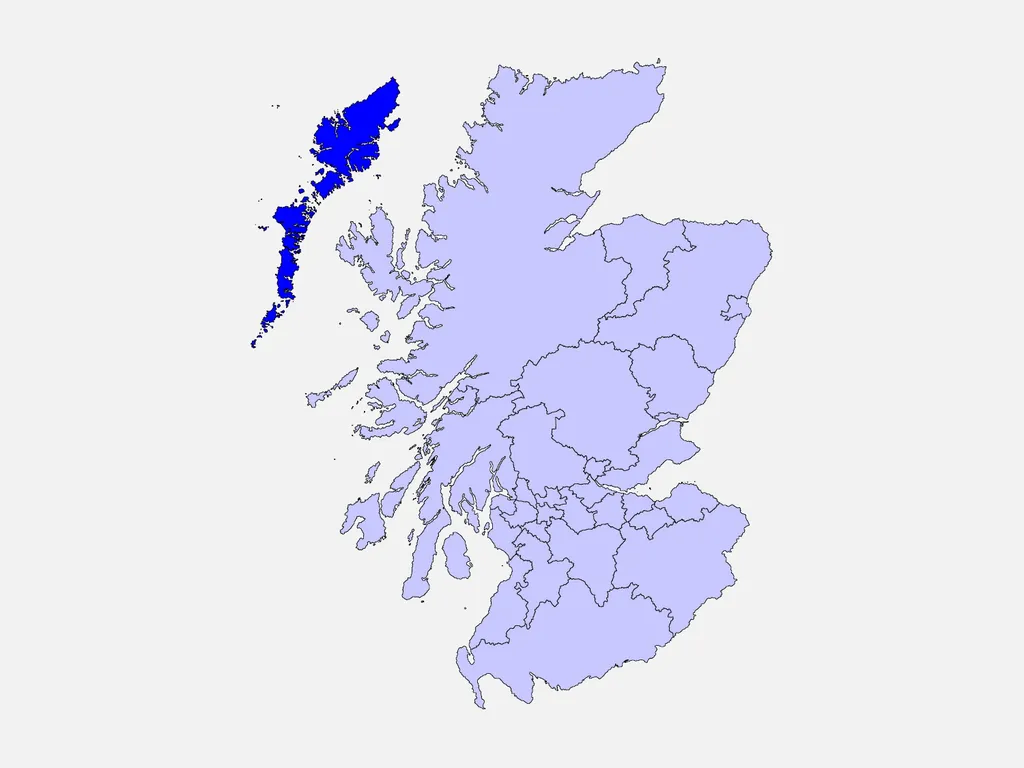
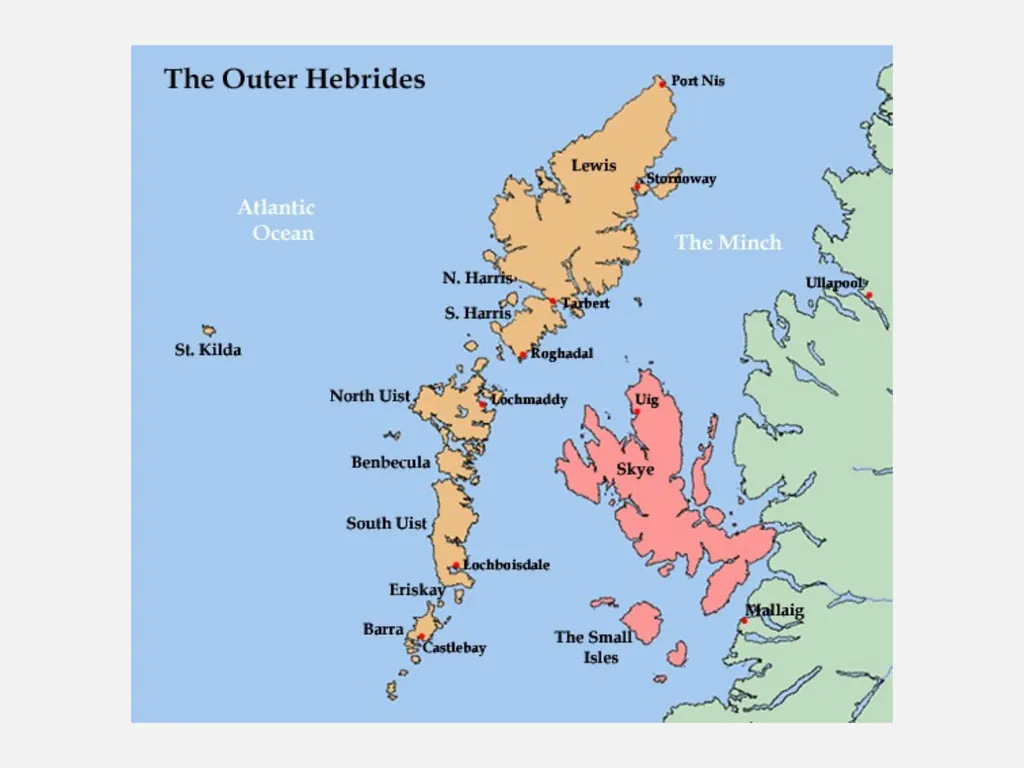
Norman MacCaig's Aunt Julia lived on Scalpay, a small island off the coast of Harris in the Outer Hebrides. Aunt Julia lived a traditional, hardworking life on a croft and she spoke only her native Gaelic language.<br>
slide7. Gaelic
Scottish Gaelic, or Scots Gaelic, is a Celtic language native to the Gaels of Scotland.
In 1018 after the conquest of the Lothians by the Kingdom of Scotland, Gaelic reached its social, cultural, political, and geographic zenith in Scotland. Elites spoke Gaelic although some commoners in the Lothians retained Old English.<br>
slide8. By the mid-14th century what eventually came to be called Scots emerged as the official language of government and law.
By the end of the 15th century, English/Scots speakers referred to Gaelic instead as 'Yrisch' or 'Erse’ (Irish) and their own language as 'Scottis'.
Gaelic was no longer the language of Scotland, and has been marginalised ever since.<br>
slide9. Do you know any ‘scots’? Do you speak in ‘scots’?<br>
slide10. Crofting What is a crofter?
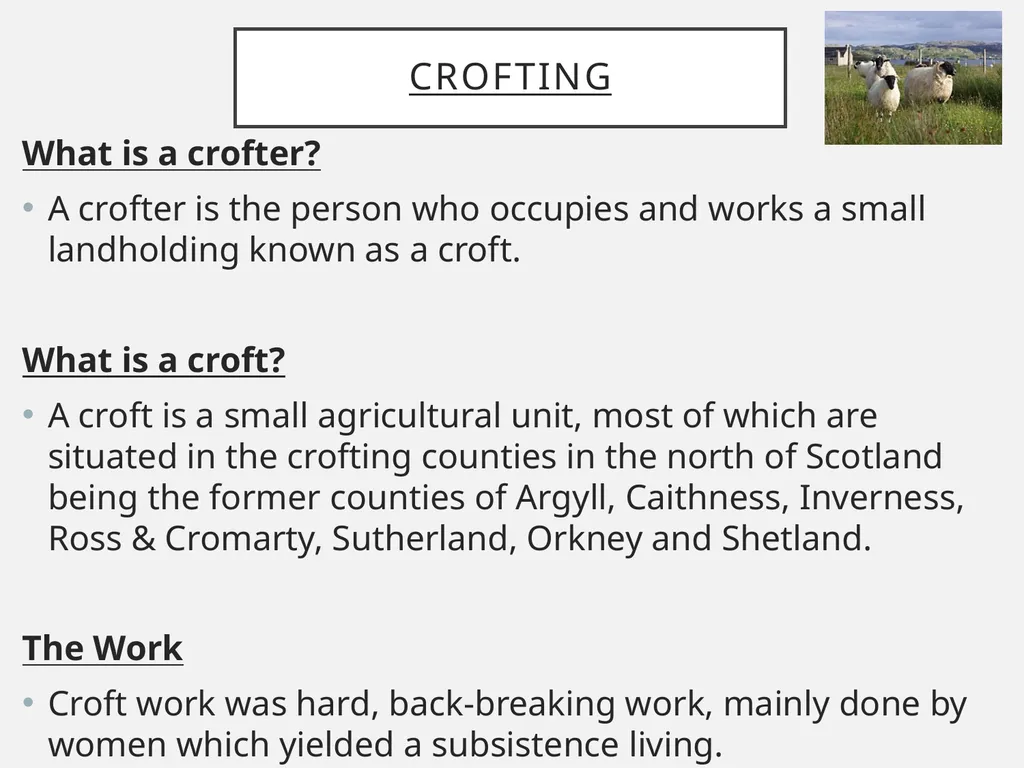
A crofter is the person who occupies and works a small landholding known as a croft.
What is a croft?
A croft is a small agricultural unit, most of which are situated in the crofting counties in the north of Scotland being the former counties of Argyll, Caithness, Inverness, Ross & Cromarty, Sutherland, Orkney and Shetland.
The Work
Croft work was hard, back-breaking work, mainly done by women which yielded a subsistence living.<br>
slide11. The Poem The poem focuses on MacCaig’s Aunt Julia and the language barrier that existed between them.
Aunt Julia lived a traditional, hardworking life on a croft and she spoke only her native Gaelic language.
The last stanza introduces a tone of regret as it was only after Julia's death that the poet learned enough Gaelic to be able to communicate with her. All of the questions that he would have asked to her must now remain unanswered, just as her questions to him as a child had been.<br>
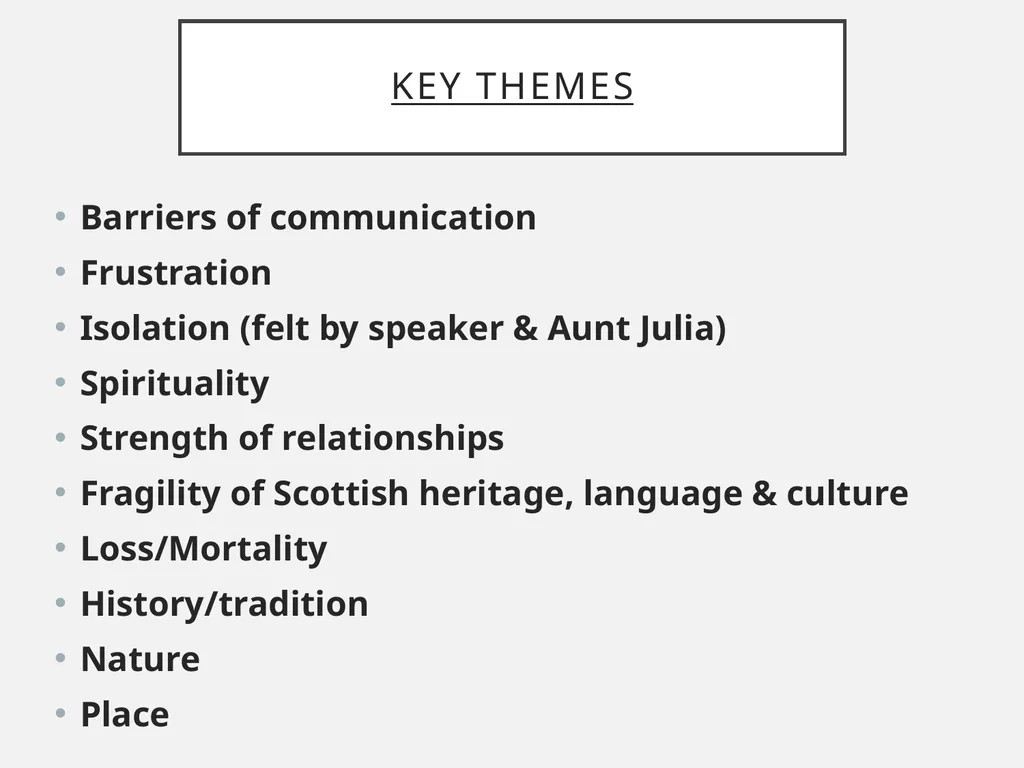
slide12. Key themes Barriers of communication
Frustration
Isolation (felt by speaker & Aunt Julia)
Spirituality
Strength of relationships
Fragility of Scottish heritage, language & culture
Loss/Mortality
History/tradition
Nature
Place<br>
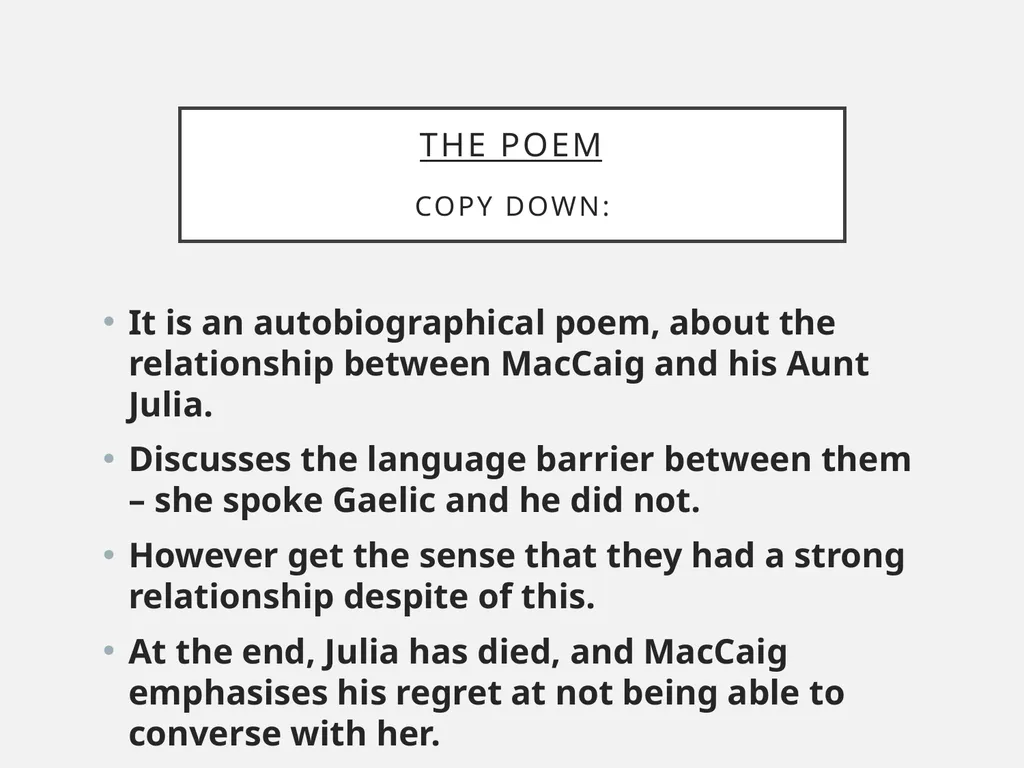
slide13. The Poem Copy down: It is an autobiographical poem, about the relationship between MacCaig and his Aunt Julia.
Discusses the language barrier between them – she spoke Gaelic and he did not.
However get the sense that they had a strong relationship despite of this.
At the end, Julia has died, and MacCaig emphasises his regret at not being able to converse with her.<br>
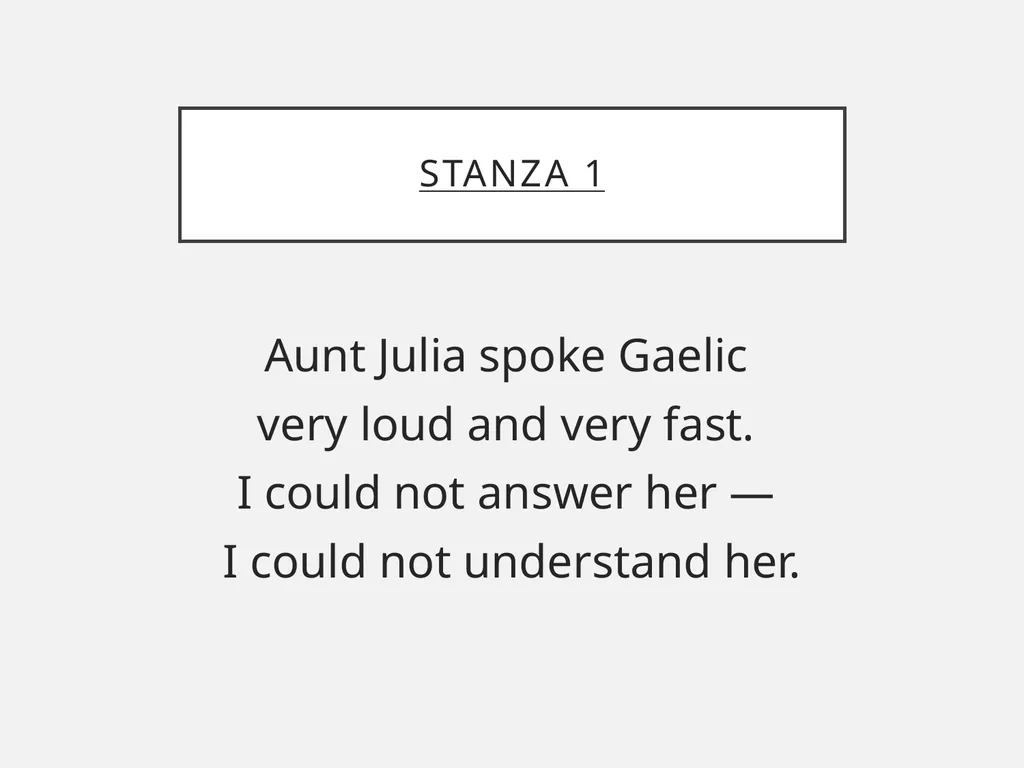
slide14. Stanza 1 Aunt Julia spoke Gaelic
very loud and very fast.
I could not answer her —
I could not understand her.<br>
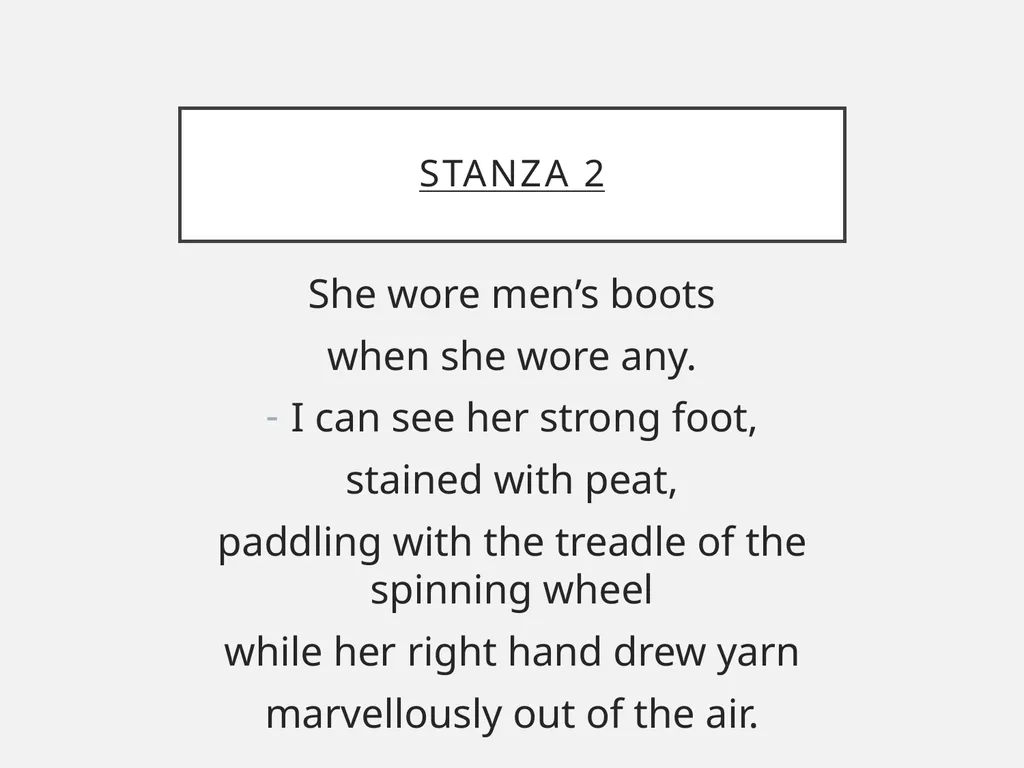
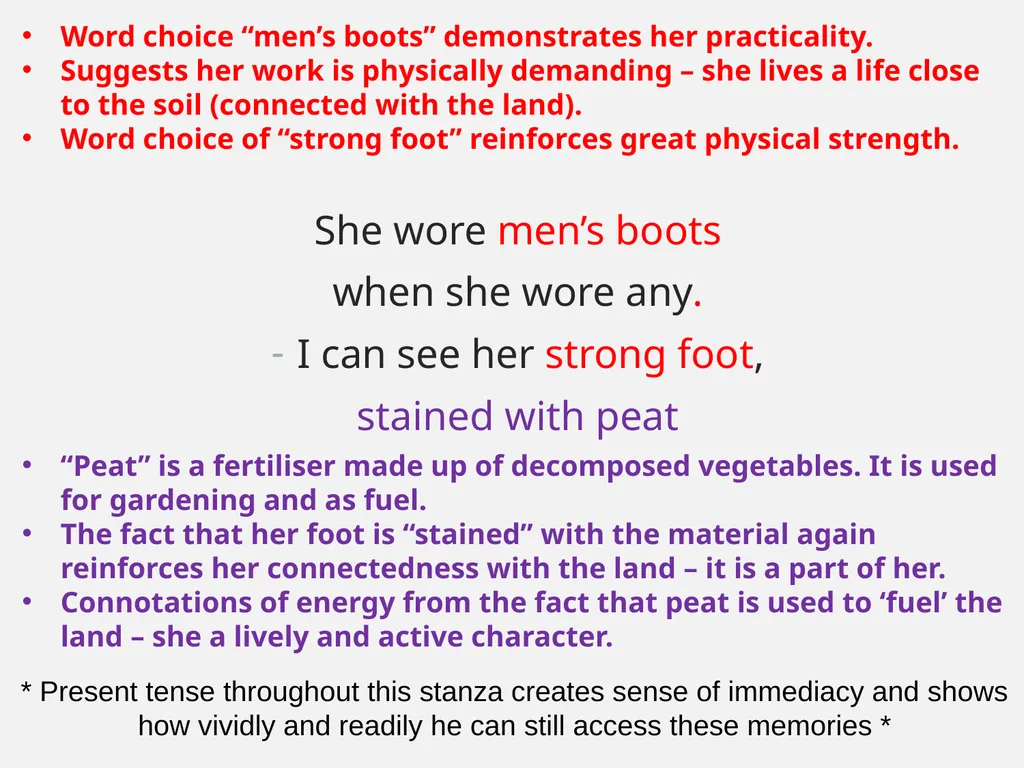
slide15. Stanza 2 She wore men’s boots
when she wore any.
I can see her strong foot,
stained with peat,
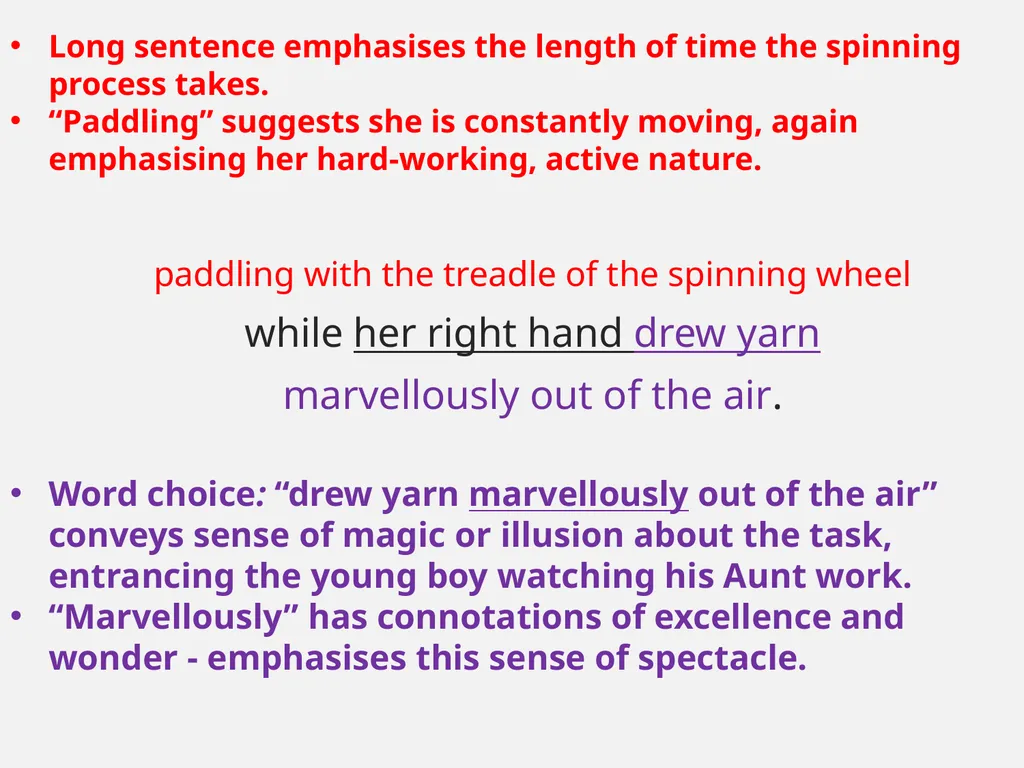
paddling with the treadle of the spinning wheel
while her right hand drew yarn
marvellously out of the air.<br>
slide16. Aunt Julia spoke Gaelic
very loud and very fast.
I could not answer her —
I could not understand her. Repetition
Poet begins with affectionate childhood memories of Aunt.
However, goes on to discuss the difficulties of relationship.
Repetition of “very” &“I could not” highlights difficulties speaker had in communicating with Aunt Julia, & frustration felt as a result of this. * Tone is affectionate here, despite the inability to communicate, demonstrating that even without a common language, strong bonds can be formed.<br>
slide17. She wore men’s boots
when she wore any.
I can see her strong foot,
stained with peat Word choice “men’s boots” demonstrates her practicality.
Suggests her work is physically demanding – she lives a life close to the soil (connected with the land).
Word choice of “strong foot” reinforces great physical strength. “Peat” is a fertiliser made up of decomposed vegetables. It is used for gardening and as fuel.
The fact that her foot is “stained” with the material again reinforces her connectedness with the land – it is a part of her.
Connotations of energy from the fact that peat is used to ‘fuel’ the land – she a lively and active character. * Present tense throughout this stanza creates sense of immediacy and shows how vividly and readily he can still access these memories *<br>
slide18. paddling with the treadle of the spinning wheel
while her right hand drew yarn
marvellously out of the air. Long sentence emphasises the length of time the spinning process takes.
“Paddling” suggests she is constantly moving, again emphasising her hard-working, active nature. Word choice: “drew yarn marvellously out of the air” conveys sense of magic or illusion about the task, entrancing the young boy watching his Aunt work.
“Marvellously” has connotations of excellence and wonder - emphasises this sense of spectacle.<br>
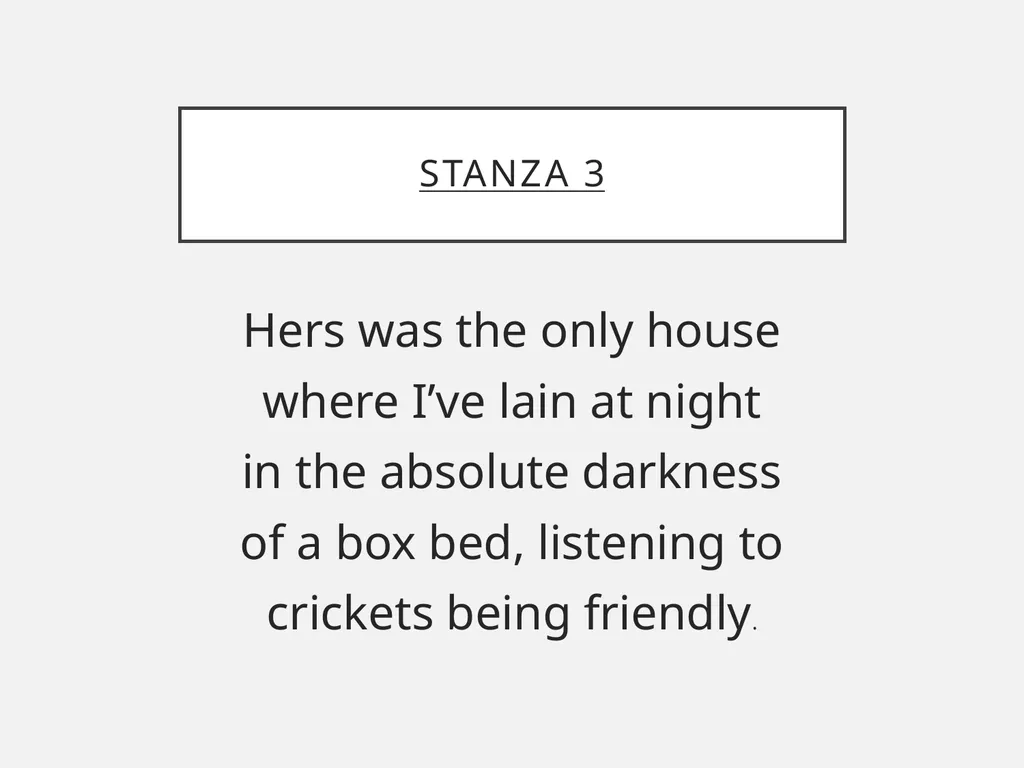
slide19. Stanza 3 Hers was the only house
where I’ve lain at night
in the absolute darkness
of a box bed, listening to
crickets being friendly.<br>
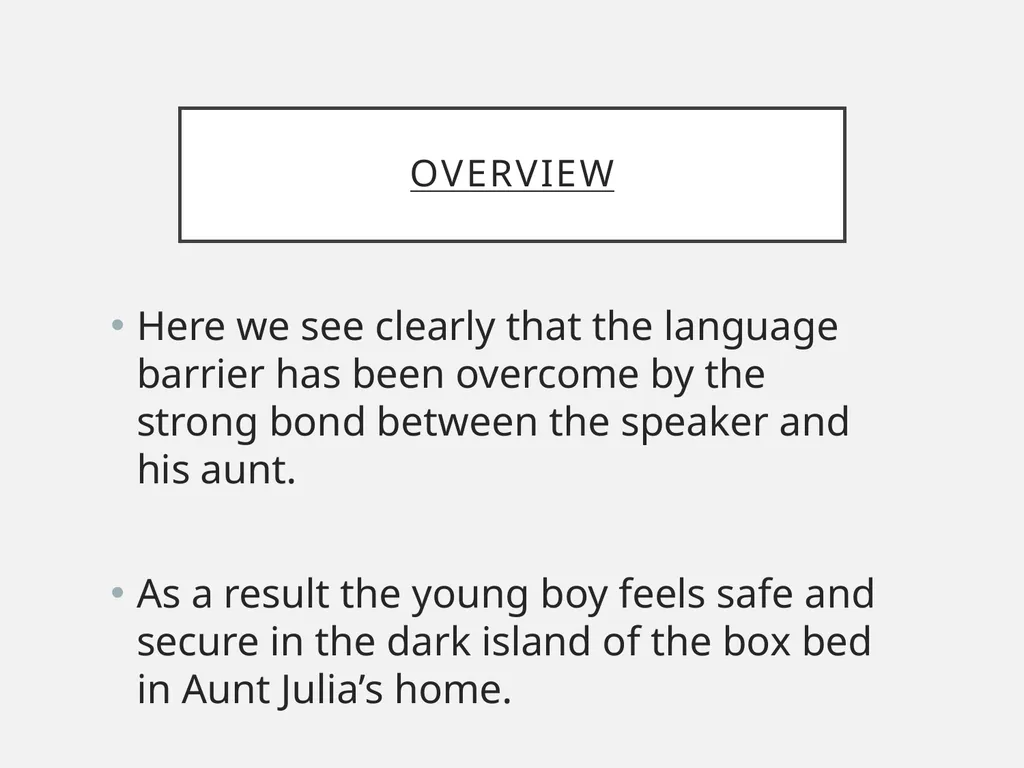
slide20. Overview Here we see clearly that the language barrier has been overcome by the strong bond between the speaker and his aunt.
As a result the young boy feels safe and secure in the dark island of the box bed in Aunt Julia’s home.<br>
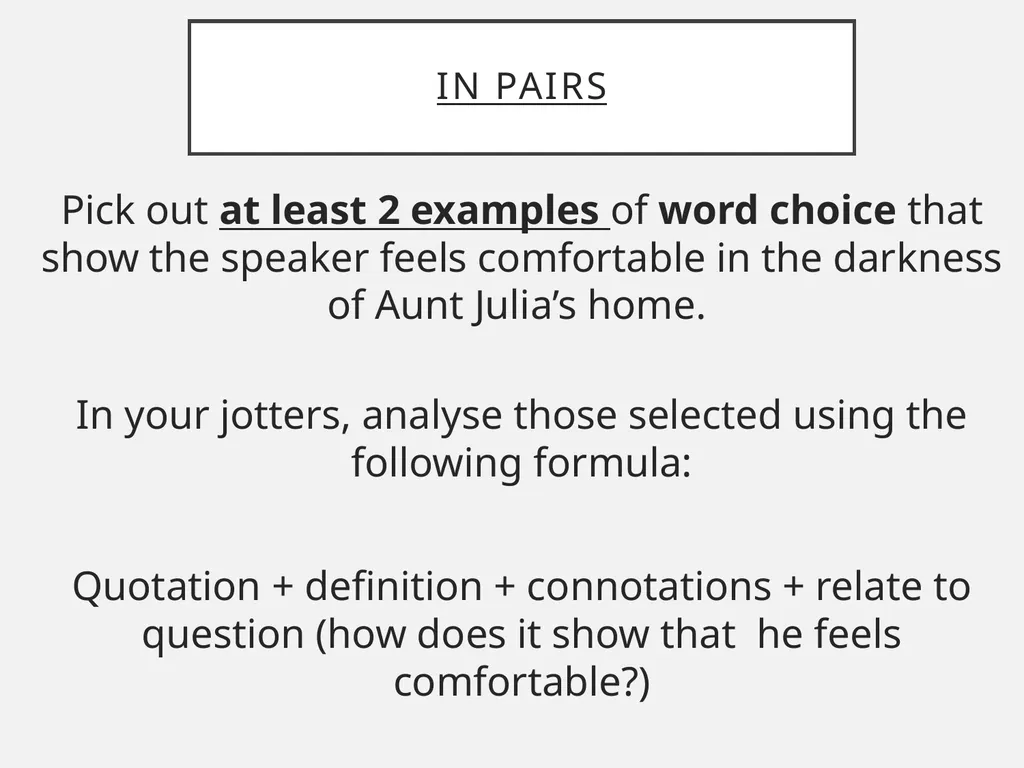
slide21. In Pairs Pick out at least 2 examples of word choice that show the speaker feels comfortable in the darkness of Aunt Julia’s home.
In your jotters, analyse those selected using the following formula:
Quotation + definition + connotations + relate to question (how does it show that he feels comfortable?)<br>
slide22. Word Choice
Contribution to sense of comfort<br>
slide23. Hers was the only house
where I’ve lain at night
in the absolute darkness
of a box bed, listening to
crickets being friendly. Word choice: “absolute darkness”.
“Darkness” has connotations of obscurity, depression & bleakness. Quite unusual that feels comfortable here.
However mention of “absolute darkness” changes perception of the word – it almost becomes a pure, perfect and reliable darkness: these more positive connotations creating a sense of comfort,
Darkness= a blanket of protection. “Crickets being friendly” – again positive connotations associated with “friendly”. Reinforces sense of comfort and safety.<br>
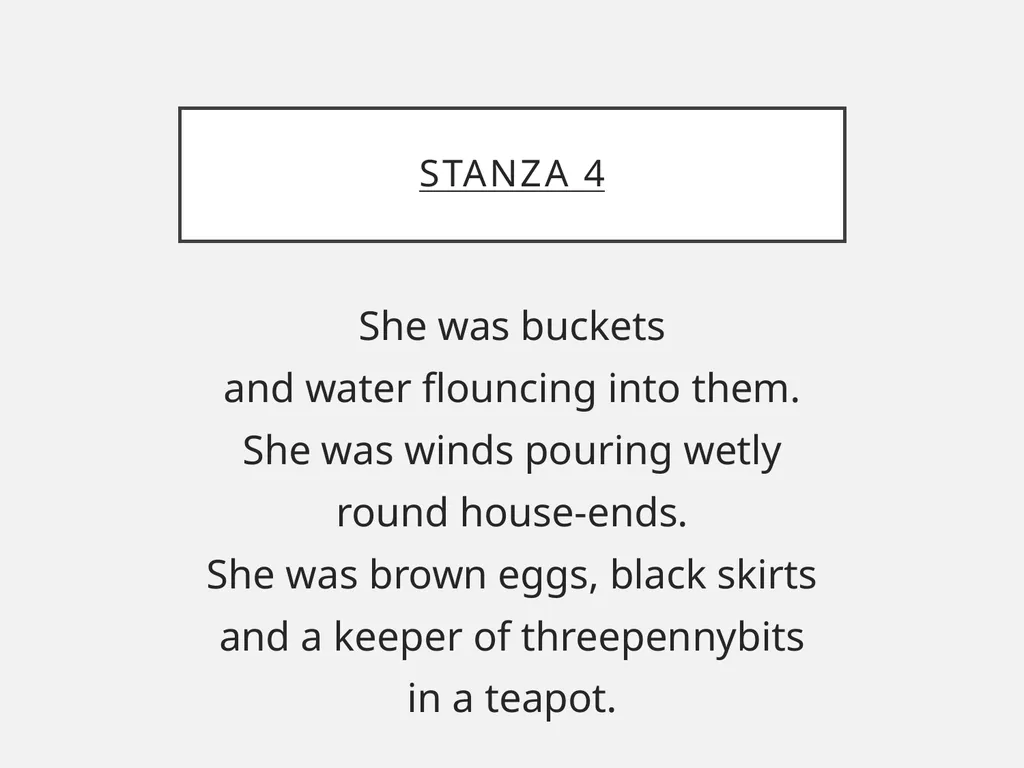
slide24. Stanza 4 She was buckets
and water flouncing into them.
She was winds pouring wetly
round house-ends.
She was brown eggs, black skirts
and a keeper of threepennybits
in a teapot.<br>
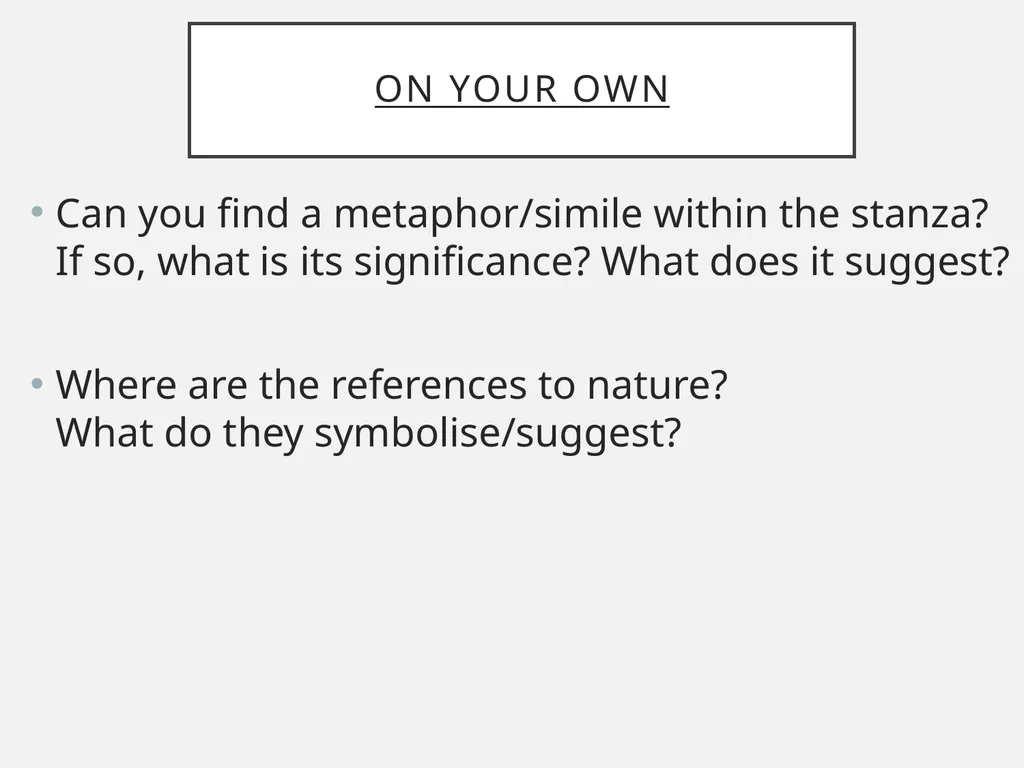
slide25. On your own Can you find a metaphor/simile within the stanza? If so, what is its significance? What does it suggest?
Where are the references to nature? What do they symbolise/suggest?<br>
slide26. Metaphor/simile?
Nature References<br>
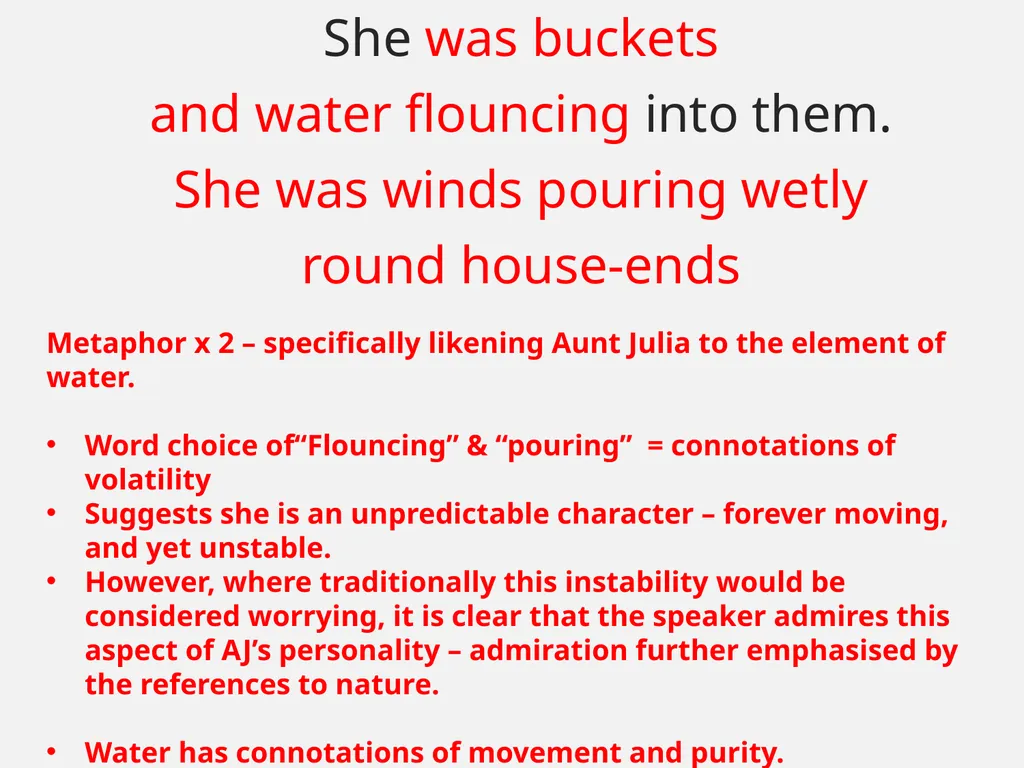
slide27. She was buckets
and water flouncing into them.
She was winds pouring wetly
round house-ends Metaphor x 2 – specifically likening Aunt Julia to the element of water.
Word choice of“Flouncing” & “pouring” = connotations of volatility
Suggests she is an unpredictable character – forever moving, and yet unstable.
However, where traditionally this instability would be considered worrying, it is clear that the speaker admires this aspect of AJ’s personality – admiration further emphasised by the references to nature.
Water has connotations of movement and purity.
In likening AJ to it, the speaker emphasises her own vitality and virtuousness (she is a ‘good’ character).<br>
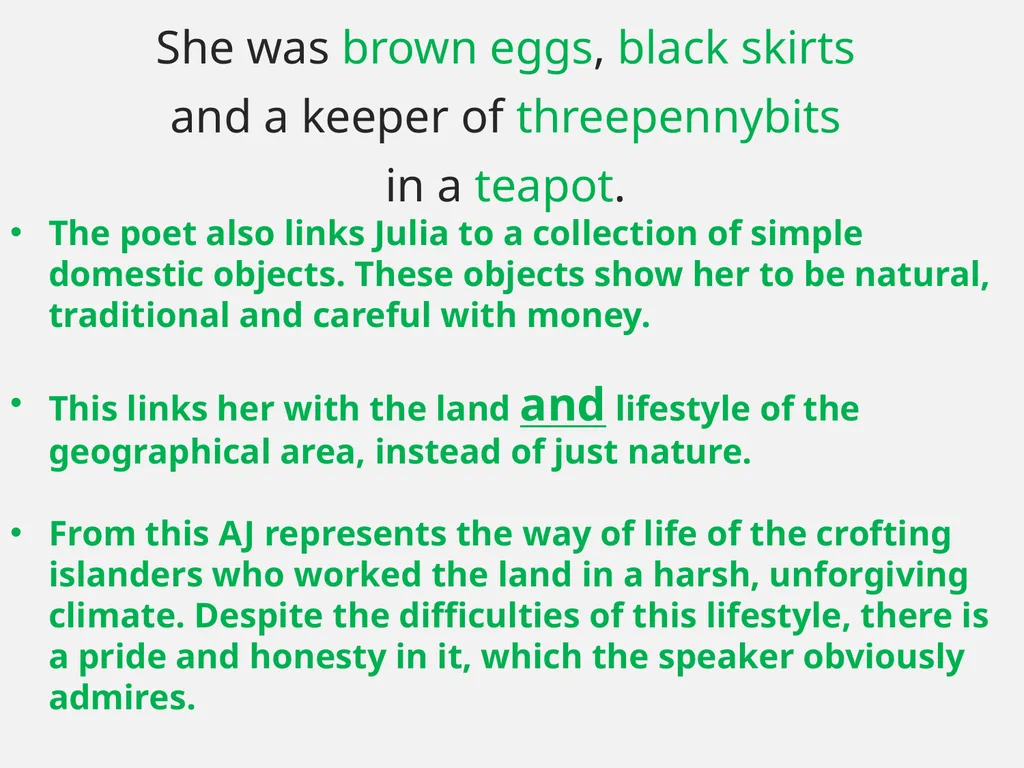
slide28. She was brown eggs, black skirts
and a keeper of threepennybits
in a teapot. The poet also links Julia to a collection of simple domestic objects. These objects show her to be natural, traditional and careful with money.
This links her with the land and lifestyle of the geographical area, instead of just nature.
From this AJ represents the way of life of the crofting islanders who worked the land in a harsh, unforgiving climate. Despite the difficulties of this lifestyle, there is a pride and honesty in it, which the speaker obviously admires.<br>
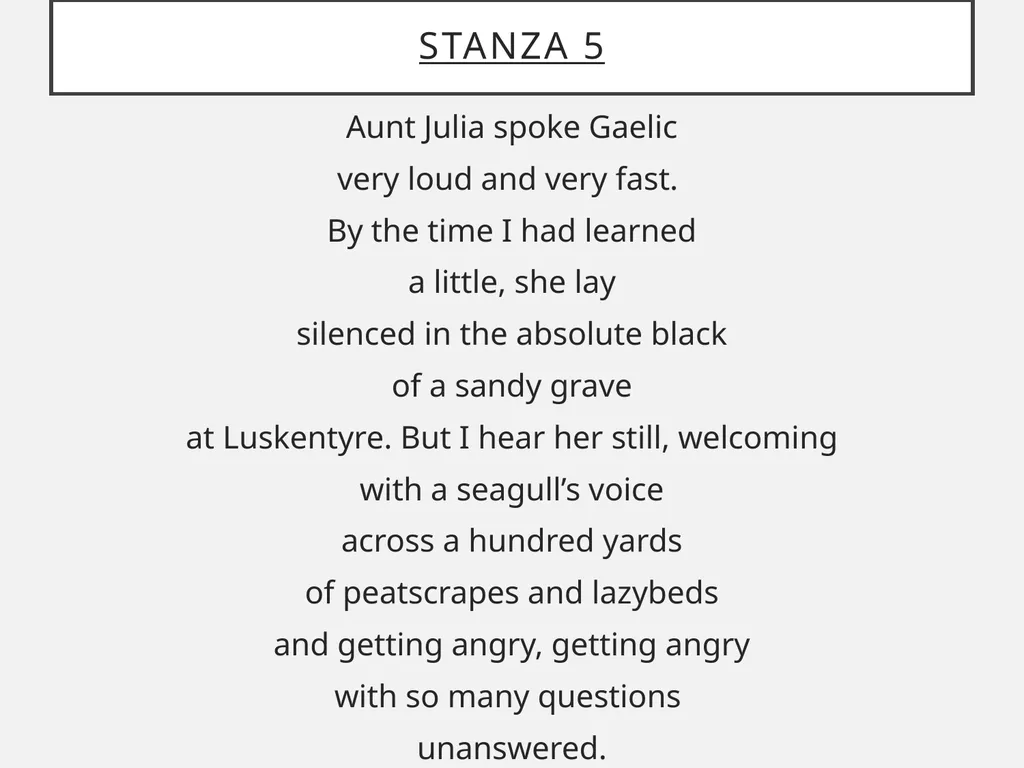
slide29. Stanza 5 Aunt Julia spoke Gaelic
very loud and very fast.
By the time I had learned
a little, she lay
silenced in the absolute black
of a sandy grave
at Luskentyre. But I hear her still, welcoming
with a seagull’s voice
across a hundred yards
of peatscrapes and lazybeds
and getting angry, getting angry
with so many questions
unanswered.<br>
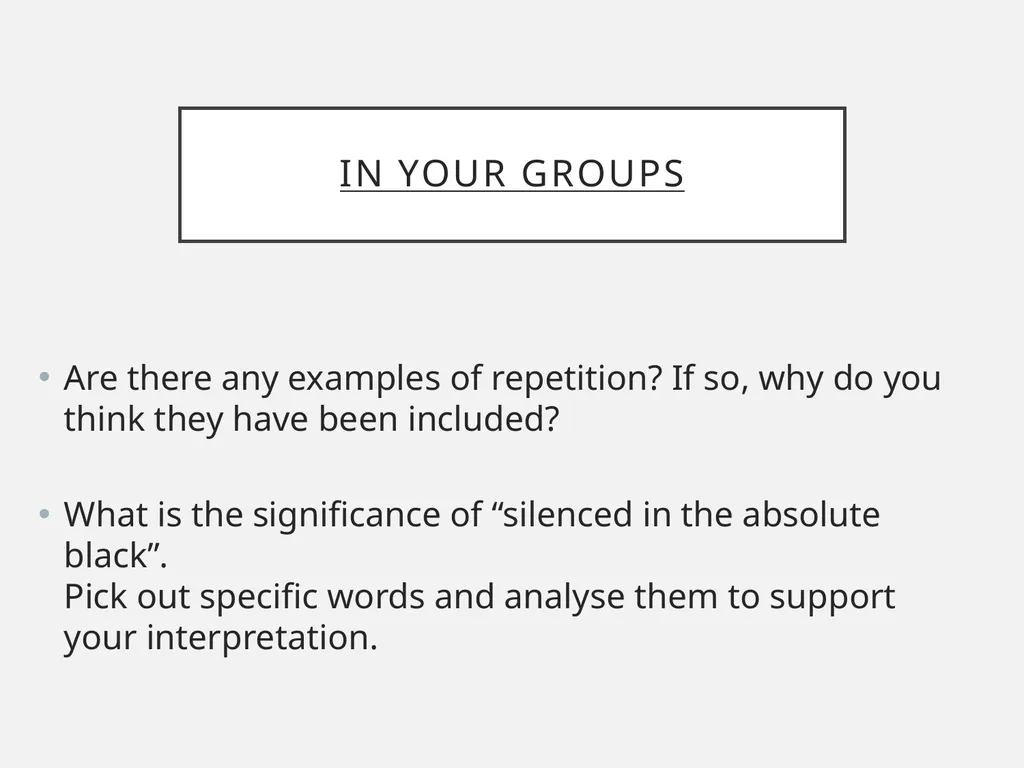
slide30. In your groups Are there any examples of repetition? If so, why do you think they have been included?
What is the significance of “silenced in the absolute black”. Pick out specific words and analyse them to support your interpretation.<br>
slide31. Repetition<br>
slide32. Significance of “silenced in the absolute black”:<br>
slide33. Aunt Julia spoke Gaelic
very loud and very fast.
By the time I had learned
a little, she lay
silenced in the absolute black
of a sandy grave
at Luskentyre. Repetition of first few lines of poem. Suggests that this is the beginning of a conclusion to the poem – as though it has come full circle. Indicates a change in tone – changes from one of affection, to one of regret and frustration Contrast between the loud, talkative vibrant Aunt Julia in life and the utter, absolute quiet of death = emphasised using enjambment to position “silenced” at the opening of the line – death has silenced her.
“Absolute black” echoes “absolute darkness” from before, suggesting a they are always connected, even in death.
However the darkness is no comfort as it was for the speaker – “black” shows this. It is more sinister than “darkness” –connotations of evil, death and fear, conveying a bleak vacuum of death.<br>
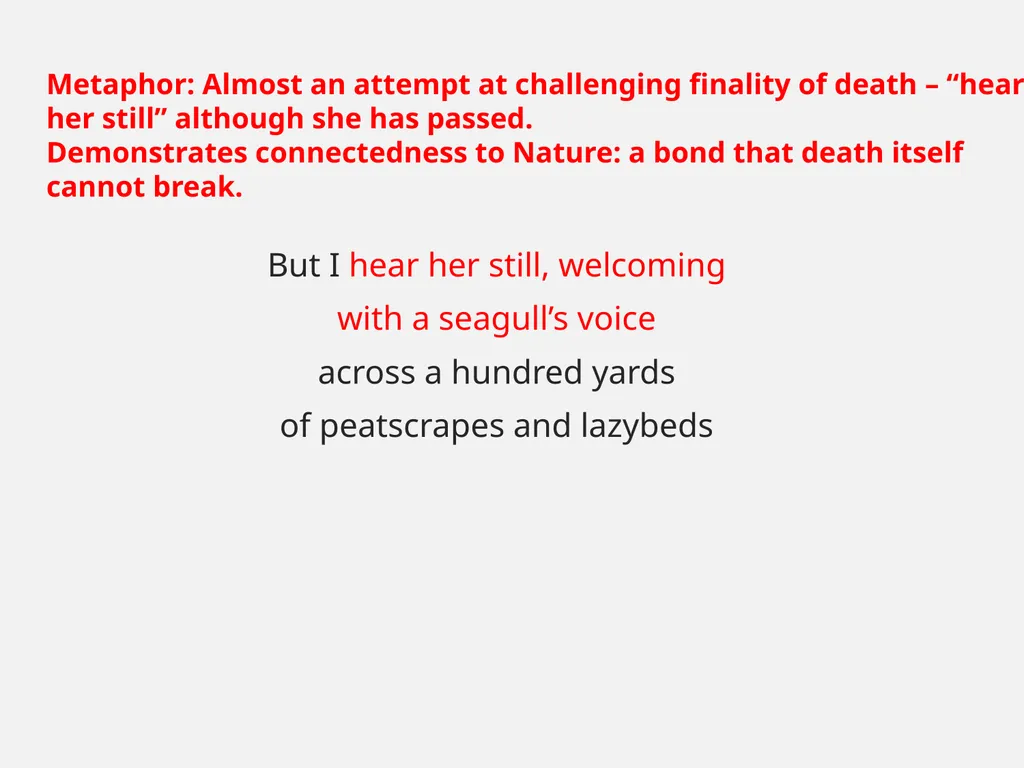
slide34. But I hear her still, welcoming
with a seagull’s voice
across a hundred yards
of peatscrapes and lazybeds Metaphor: Almost an attempt at challenging finality of death – “hear her still” although she has passed.
Demonstrates connectedness to Nature: a bond that death itself cannot break.<br>
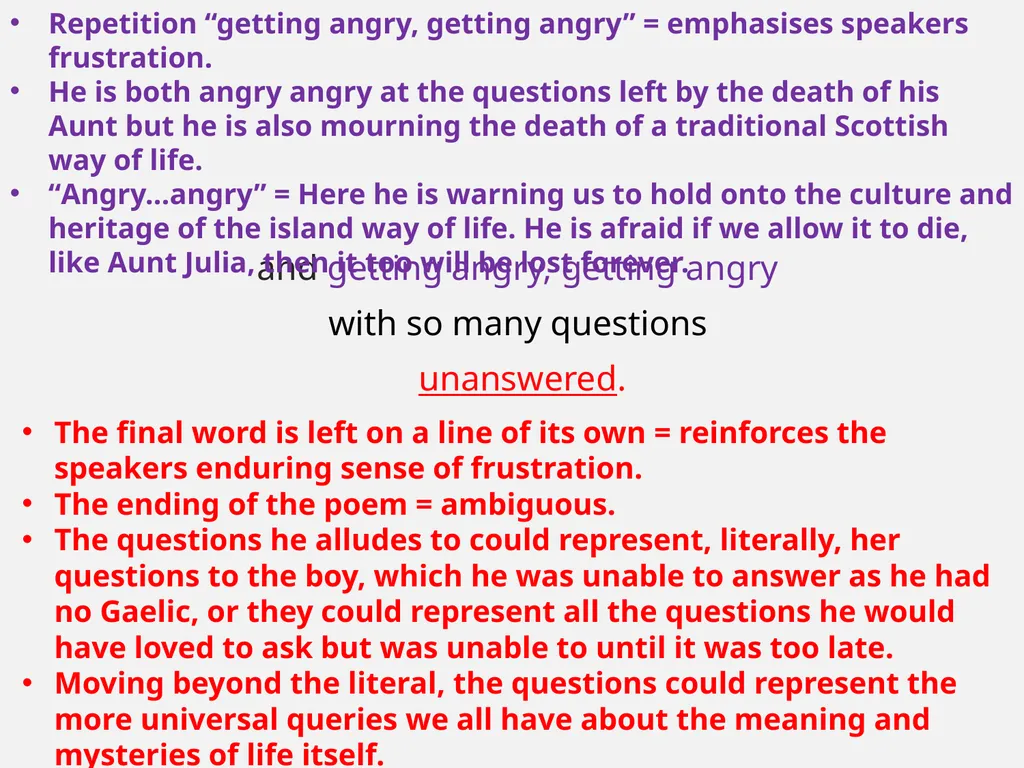
slide35. and getting angry, getting angry
with so many questions
unanswered. Repetition “getting angry, getting angry” = emphasises speakers frustration.
He is both angry angry at the questions left by the death of his Aunt but he is also mourning the death of a traditional Scottish way of life.
“Angry…angry” = Here he is warning us to hold onto the culture and heritage of the island way of life. He is afraid if we allow it to die, like Aunt Julia, then it too will be lost forever. The final word is left on a line of its own = reinforces the speakers enduring sense of frustration.
The ending of the poem = ambiguous.
The questions he alludes to could represent, literally, her questions to the boy, which he was unable to answer as he had no Gaelic, or they could represent all the questions he would have loved to ask but was unable to until it was too late.
Moving beyond the literal, the questions could represent the more universal queries we all have about the meaning and mysteries of life itself.<br>
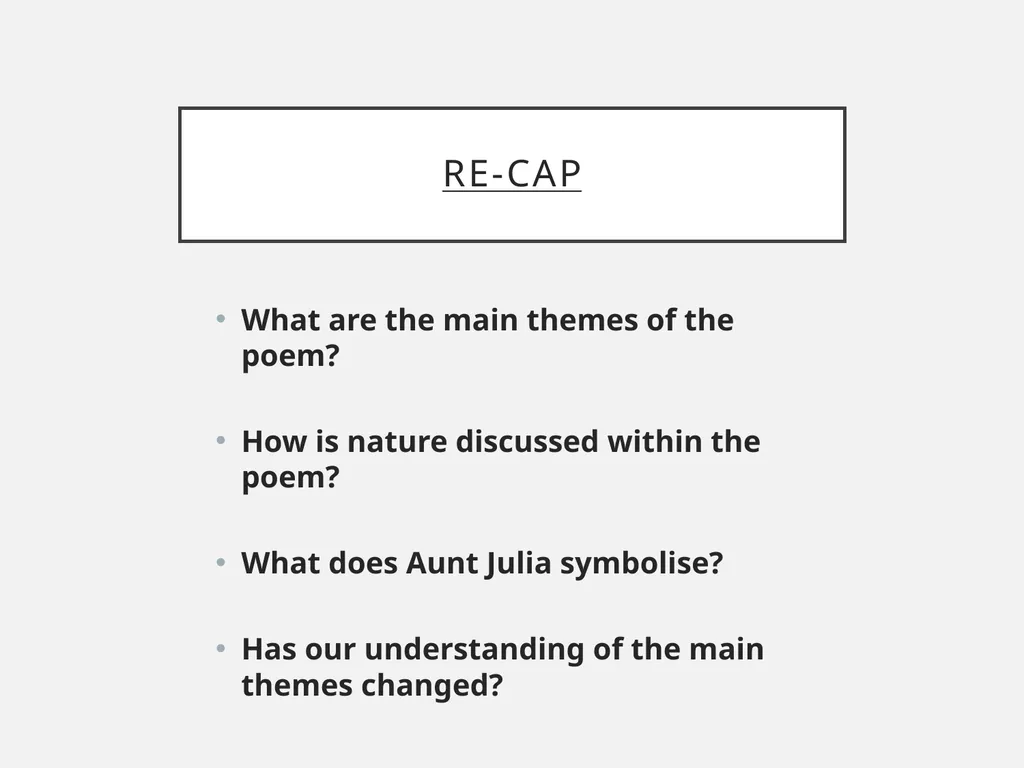
slide36. Re-cap What are the main themes of the poem?
How is nature discussed within the poem?
What does Aunt Julia symbolise?
Has our understanding of the main themes changed?<br>
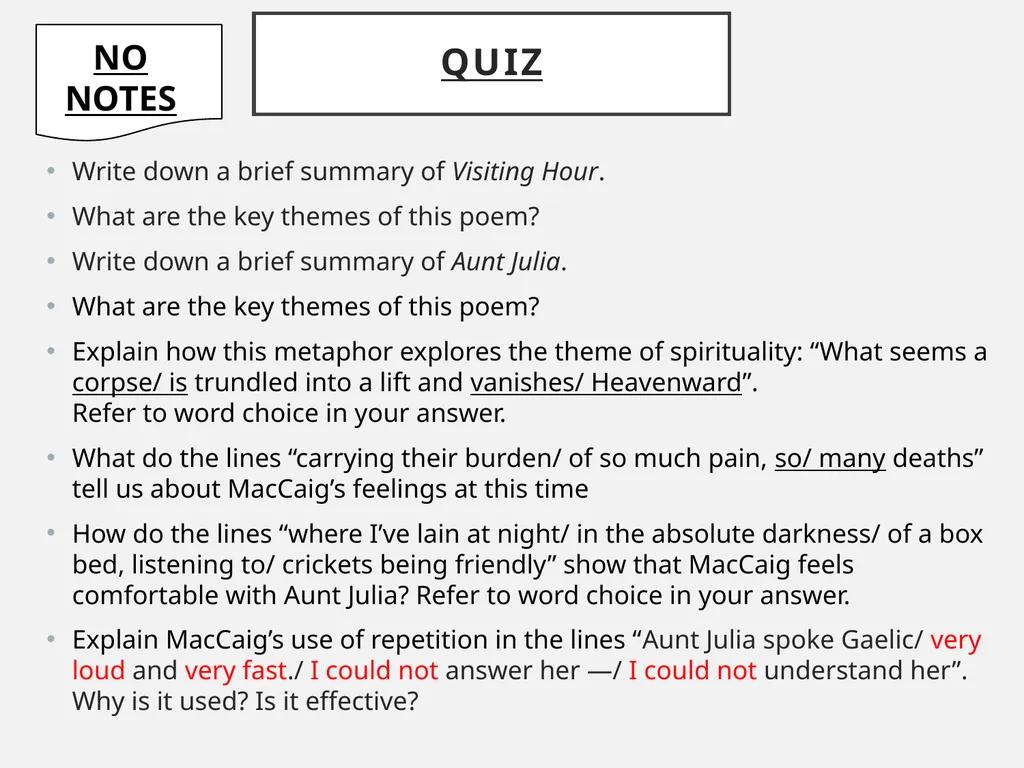
slide37. Quiz Write down a brief summary of Visiting Hour.
What are the key themes of this poem?
Write down a brief summary of Aunt Julia.
What are the key themes of this poem?
Explain how this metaphor explores the theme of spirituality: “What seems a corpse/ is trundled into a lift and vanishes/ Heavenward”. Refer to word choice in your answer.
What do the lines “carrying their burden/ of so much pain, so/ many deaths” tell us about MacCaig’s feelings at this time
How do the lines “where I’ve lain at night/ in the absolute darkness/ of a box bed, listening to/ crickets being friendly” show that MacCaig feels comfortable with Aunt Julia? Refer to word choice in your answer.
Explain MacCaig’s use of repetition in the lines “Aunt Julia spoke Gaelic/ very loud and very fast./ I could not answer her —/ I could not understand her”. Why is it used? Is it effective? 5 minutes to complete! NO NOTES<br>
slide38. My Blog I will put up all resources we have used, plus any resources I think will be of benefit to you, over the course of the coming year.
You should take note of the following URL, and sign up to email alerts that will tell you when I post (if there’s an option to subscribe).
https://missmcnaughtonsblog.wordpress.com/
If you lose a homework sheet, lose any of the worksheets given to you, or simply want to go over the PPTs, then you will find everything you need here!<br>
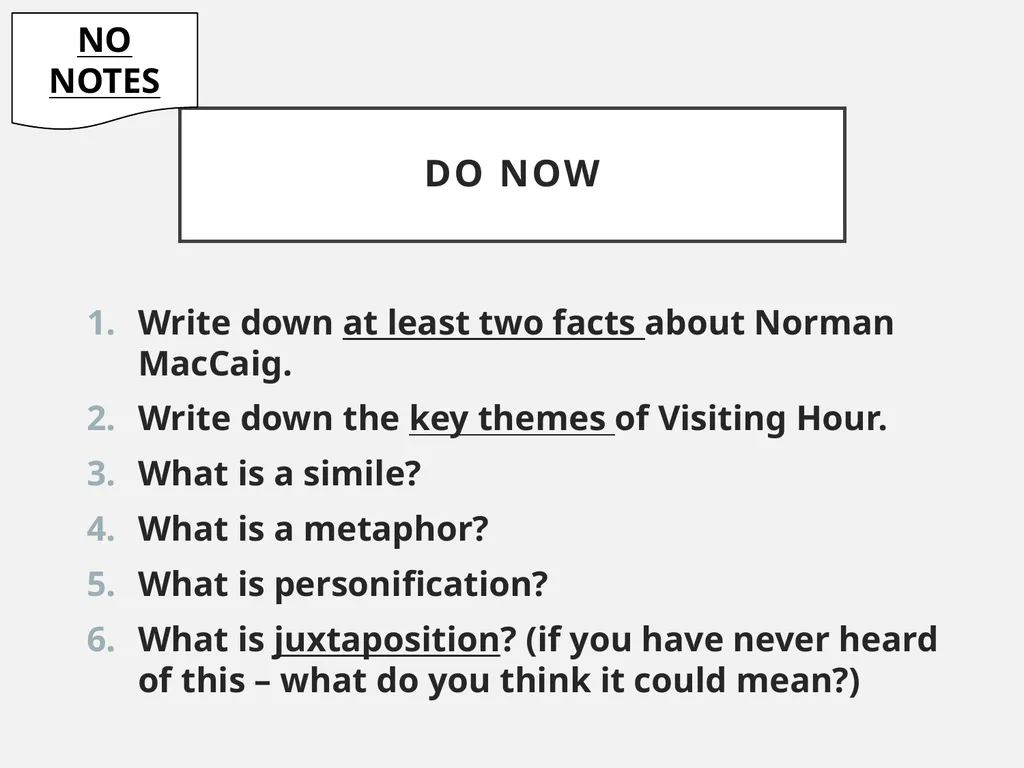
slide39. Do Now Write down at least two facts about Norman MacCaig.
Write down the key themes of Visiting Hour.
What is a simile?
What is a metaphor?
What is personification?
What is juxtaposition? (if you have never heard of this – what do you think it could mean?) 5 minutes to complete! NO NOTES<br>
slide40. Task Complete questions 2 + 3 from the question paper we were working on last week.
You will get 10 minutes to finish these responses.<br>
slide41. 8 Mark Question Textual Analysis<br>
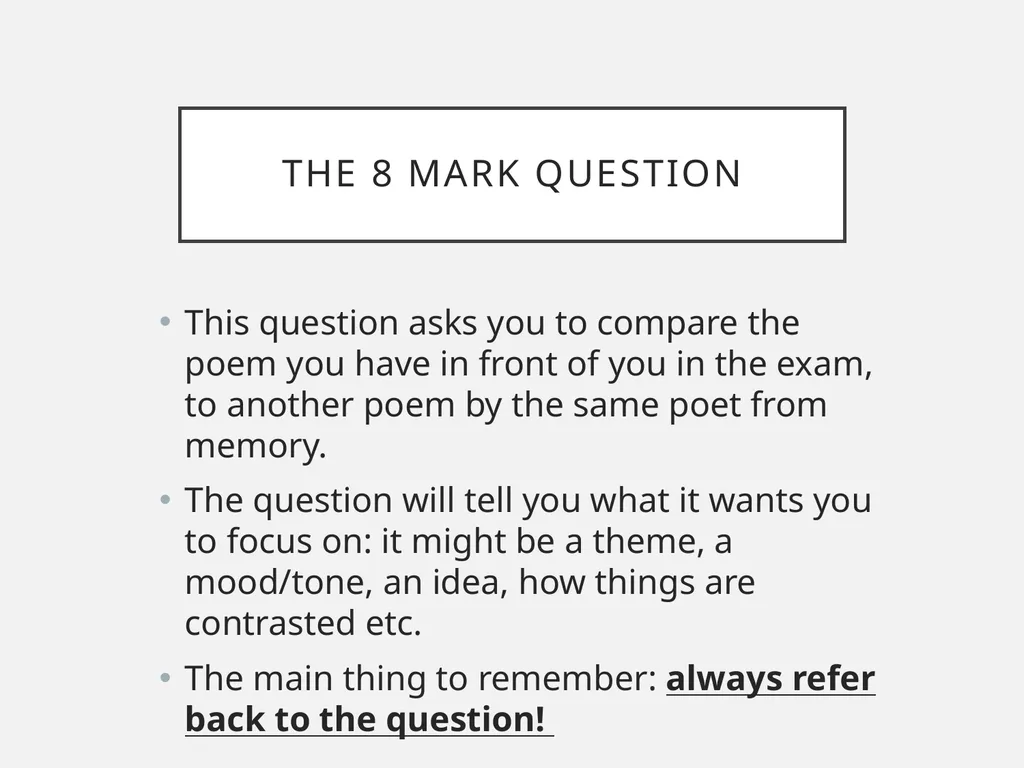
slide42. The 8 mark question This question asks you to compare the poem you have in front of you in the exam, to another poem by the same poet from memory.
The question will tell you what it wants you to focus on: it might be a theme, a mood/tone, an idea, how things are contrasted etc.
The main thing to remember: always refer back to the question!<br>
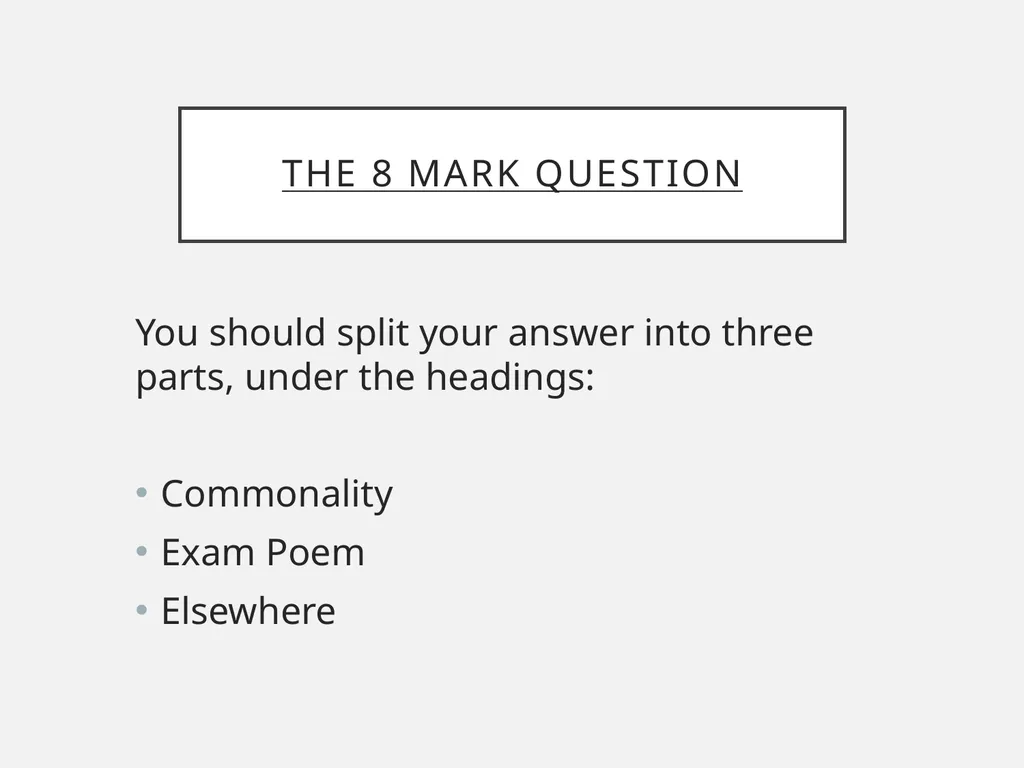
slide43. The 8 Mark Question You should split your answer into three parts, under the headings:
Commonality
Exam Poem
Elsewhere<br>
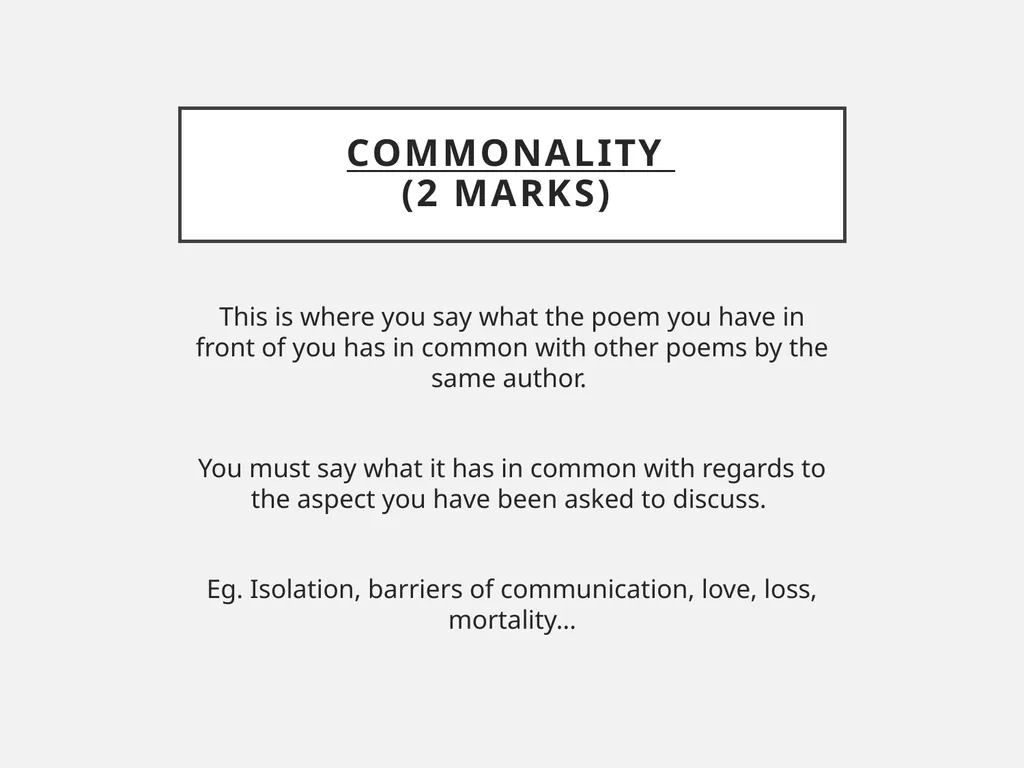
slide44. Commonality (2 marks) This is where you say what the poem you have in front of you has in common with other poems by the same author.
You must say what it has in common with regards to the aspect you have been asked to discuss.
Eg. Isolation, barriers of communication, love, loss, mortality…<br>
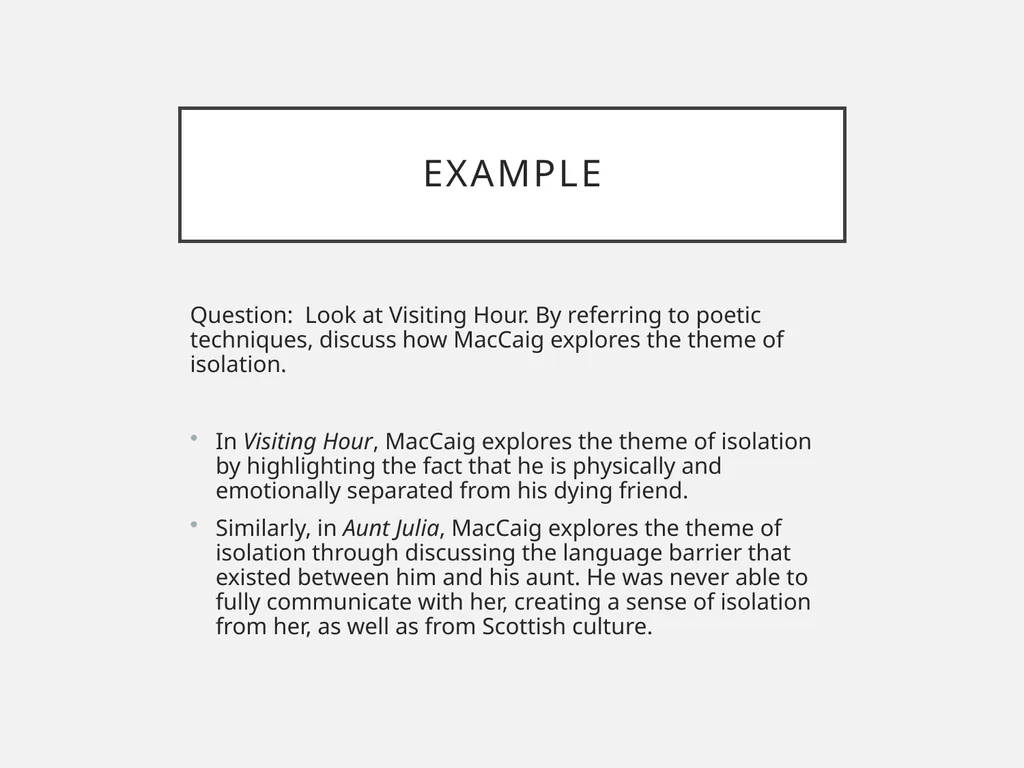
slide45. Example Question: Look at Visiting Hour. By referring to poetic techniques, discuss how MacCaig explores the theme of isolation.
In Visiting Hour, MacCaig explores the theme of isolation by highlighting the fact that he is physically and emotionally separated from his dying friend.
Similarly, in Aunt Julia, MacCaig explores the theme of isolation through discussing the language barrier that existed between him and his aunt. He was never able to fully communicate with her, creating a sense of isolation from her, as well as from Scottish culture.<br>
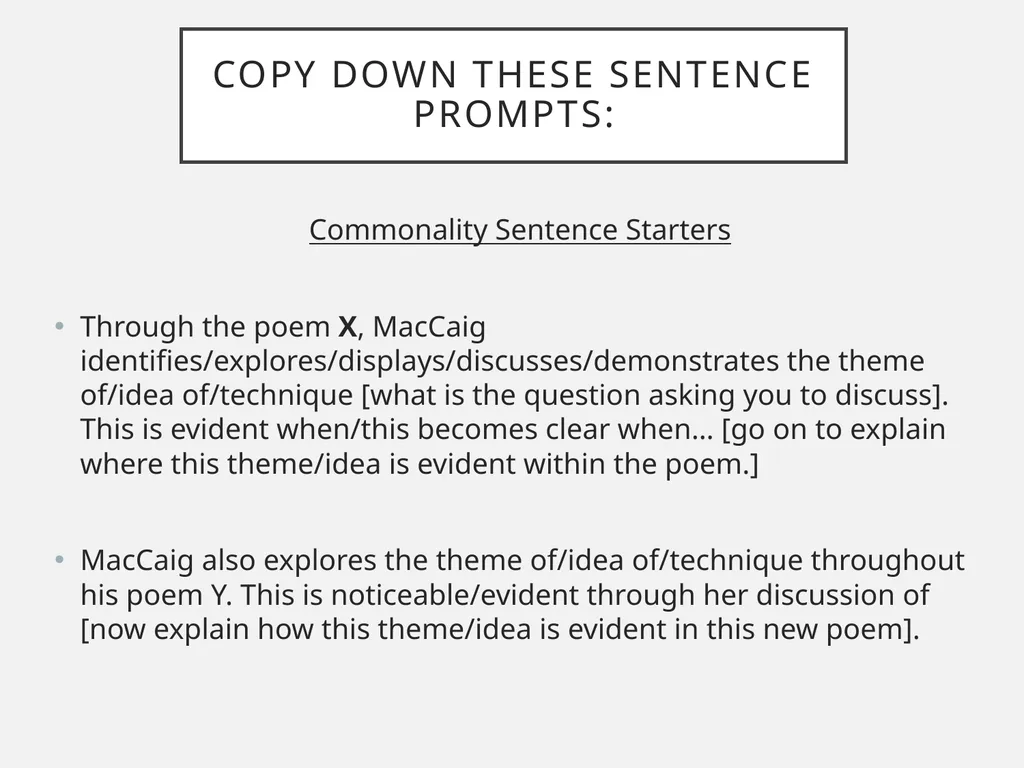
slide46. Copy down these sentence prompts: Commonality Sentence Starters
Through the poem X, MacCaig identifies/explores/displays/discusses/demonstrates the theme of/idea of/technique [what is the question asking you to discuss]. This is evident when/this becomes clear when… [go on to explain where this theme/idea is evident within the poem.]
MacCaig also explores the theme of/idea of/technique throughout his poem Y. This is noticeable/evident through her discussion of [now explain how this theme/idea is evident in this new poem].<br>
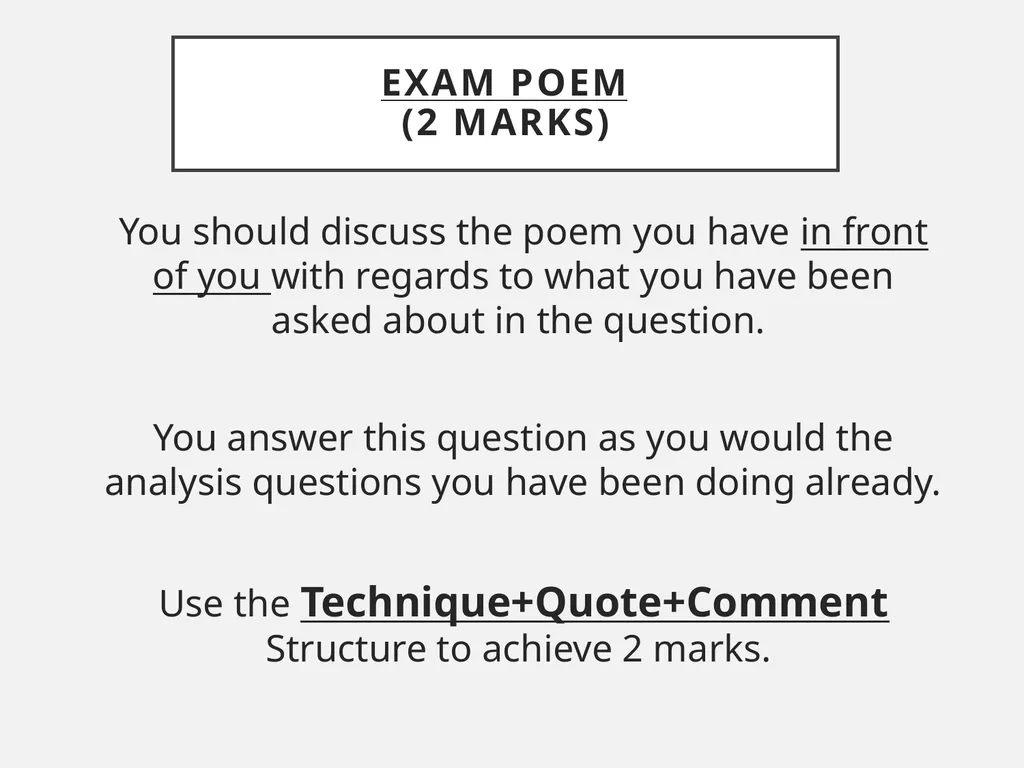
slide47. Exam Poem (2 marks) You should discuss the poem you have in front of you with regards to what you have been asked about in the question.
You answer this question as you would the analysis questions you have been doing already.
Use the Technique+Quote+Comment Structure to achieve 2 marks.<br>
slide48. In the poem X, Duffy identifies/explores/displays/discusses/demonstrates the theme of/idea of/technique [what is the question asking you to discuss]. This is done through the use of [technique] in the lines [quote]. This shows/suggests that [how does it relate to the question?]. This is made clear through the word choice of [quote word] which means [what does it mean]. It has connotations of [list 2-3 connotations] which successfully demonstrates the theme of/idea of/technique [refer back to question]. Copy down these sentence prompts:<br>
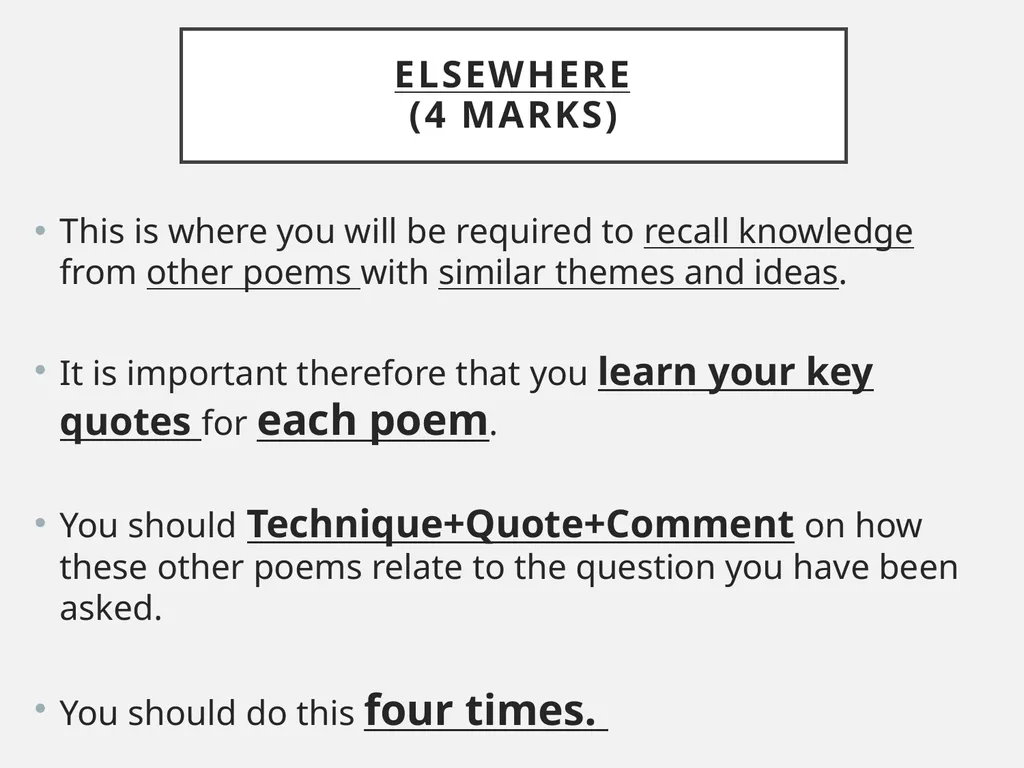
slide49. Elsewhere (4 marks) This is where you will be required to recall knowledge from other poems with similar themes and ideas.
It is important therefore that you learn your key quotes for each poem.
You should Technique+Quote+Comment on how these other poems relate to the question you have been asked.
You should do this four times.<br>
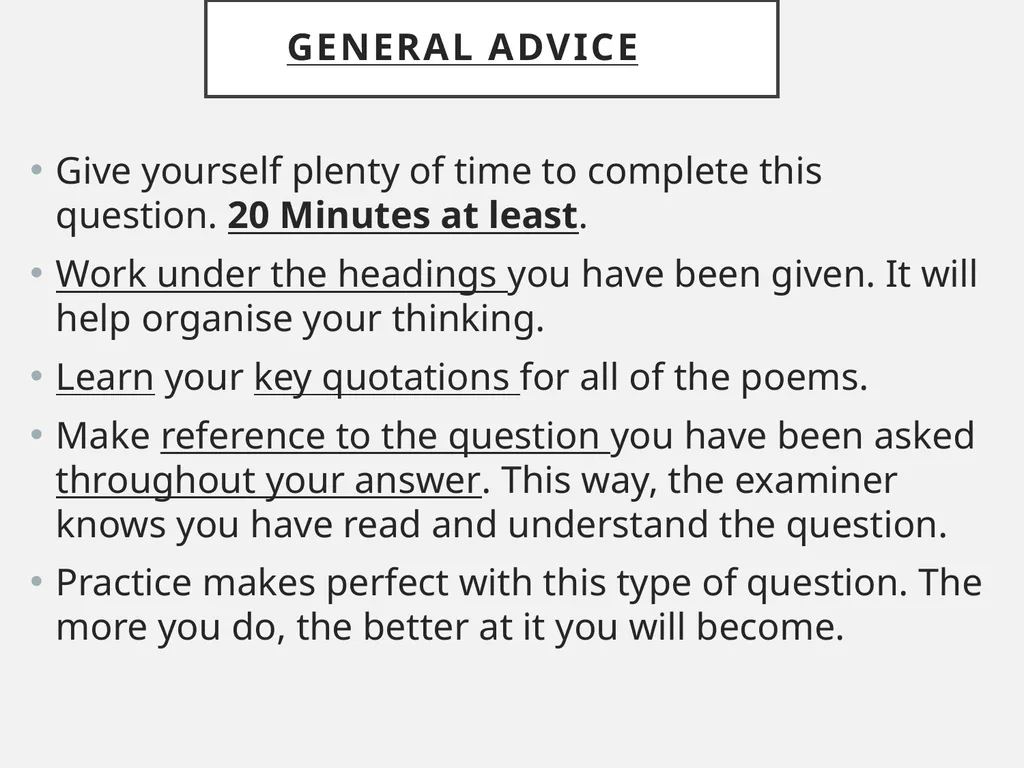
slide50. General Advice Give yourself plenty of time to complete this question. 20 Minutes at least.
Work under the headings you have been given. It will help organise your thinking.
Learn your key quotations for all of the poems.
Make reference to the question you have been asked throughout your answer. This way, the examiner knows you have read and understand the question.
Practice makes perfect with this type of question. The more you do, the better at it you will become.<br>
slide51. Look at Aunt Julia.
Question
MacCaig often observes people or places in his poetry. Referring closely to this poem, and to at least one other poem by MacCaig, show how MacCaig uses observation of people or places in his poems.<br>
slide52. Practice makes perfect! Question
Using close textual reference, show how the theme of isolation is explored in the poem Visiting Hour, and in at least one other poem, by Norman MacCaig.<br>
slide2. In your groups What do you know about Gaelic?
Where do you hear Gaelic being spoken now? Do you?
What is the significance of that?<br>
slide3. Context Background
Norman MacCaig's Aunt Julia lived on Scalpay, a small island off the coast of Harris in the Outer Hebrides. Aunt Julia lived a traditional, hardworking life on a croft and she spoke only her native Gaelic language.<br>
slide7. Gaelic
Scottish Gaelic, or Scots Gaelic, is a Celtic language native to the Gaels of Scotland.
In 1018 after the conquest of the Lothians by the Kingdom of Scotland, Gaelic reached its social, cultural, political, and geographic zenith in Scotland. Elites spoke Gaelic although some commoners in the Lothians retained Old English.<br>
slide8. By the mid-14th century what eventually came to be called Scots emerged as the official language of government and law.
By the end of the 15th century, English/Scots speakers referred to Gaelic instead as 'Yrisch' or 'Erse’ (Irish) and their own language as 'Scottis'.
Gaelic was no longer the language of Scotland, and has been marginalised ever since.<br>
slide9. Do you know any ‘scots’? Do you speak in ‘scots’?<br>
slide10. Crofting What is a crofter?
A crofter is the person who occupies and works a small landholding known as a croft.
What is a croft?
A croft is a small agricultural unit, most of which are situated in the crofting counties in the north of Scotland being the former counties of Argyll, Caithness, Inverness, Ross & Cromarty, Sutherland, Orkney and Shetland.
The Work
Croft work was hard, back-breaking work, mainly done by women which yielded a subsistence living.<br>
slide11. The Poem The poem focuses on MacCaig’s Aunt Julia and the language barrier that existed between them.
Aunt Julia lived a traditional, hardworking life on a croft and she spoke only her native Gaelic language.
The last stanza introduces a tone of regret as it was only after Julia's death that the poet learned enough Gaelic to be able to communicate with her. All of the questions that he would have asked to her must now remain unanswered, just as her questions to him as a child had been.<br>
slide12. Key themes Barriers of communication
Frustration
Isolation (felt by speaker & Aunt Julia)
Spirituality
Strength of relationships
Fragility of Scottish heritage, language & culture
Loss/Mortality
History/tradition
Nature
Place<br>
slide13. The Poem Copy down: It is an autobiographical poem, about the relationship between MacCaig and his Aunt Julia.
Discusses the language barrier between them – she spoke Gaelic and he did not.
However get the sense that they had a strong relationship despite of this.
At the end, Julia has died, and MacCaig emphasises his regret at not being able to converse with her.<br>
slide14. Stanza 1 Aunt Julia spoke Gaelic
very loud and very fast.
I could not answer her —
I could not understand her.<br>
slide15. Stanza 2 She wore men’s boots
when she wore any.
I can see her strong foot,
stained with peat,
paddling with the treadle of the spinning wheel
while her right hand drew yarn
marvellously out of the air.<br>
slide16. Aunt Julia spoke Gaelic
very loud and very fast.
I could not answer her —
I could not understand her. Repetition
Poet begins with affectionate childhood memories of Aunt.
However, goes on to discuss the difficulties of relationship.
Repetition of “very” &“I could not” highlights difficulties speaker had in communicating with Aunt Julia, & frustration felt as a result of this. * Tone is affectionate here, despite the inability to communicate, demonstrating that even without a common language, strong bonds can be formed.<br>
slide17. She wore men’s boots
when she wore any.
I can see her strong foot,
stained with peat Word choice “men’s boots” demonstrates her practicality.
Suggests her work is physically demanding – she lives a life close to the soil (connected with the land).
Word choice of “strong foot” reinforces great physical strength. “Peat” is a fertiliser made up of decomposed vegetables. It is used for gardening and as fuel.
The fact that her foot is “stained” with the material again reinforces her connectedness with the land – it is a part of her.
Connotations of energy from the fact that peat is used to ‘fuel’ the land – she a lively and active character. * Present tense throughout this stanza creates sense of immediacy and shows how vividly and readily he can still access these memories *<br>
slide18. paddling with the treadle of the spinning wheel
while her right hand drew yarn
marvellously out of the air. Long sentence emphasises the length of time the spinning process takes.
“Paddling” suggests she is constantly moving, again emphasising her hard-working, active nature. Word choice: “drew yarn marvellously out of the air” conveys sense of magic or illusion about the task, entrancing the young boy watching his Aunt work.
“Marvellously” has connotations of excellence and wonder - emphasises this sense of spectacle.<br>
slide19. Stanza 3 Hers was the only house
where I’ve lain at night
in the absolute darkness
of a box bed, listening to
crickets being friendly.<br>
slide20. Overview Here we see clearly that the language barrier has been overcome by the strong bond between the speaker and his aunt.
As a result the young boy feels safe and secure in the dark island of the box bed in Aunt Julia’s home.<br>
slide21. In Pairs Pick out at least 2 examples of word choice that show the speaker feels comfortable in the darkness of Aunt Julia’s home.
In your jotters, analyse those selected using the following formula:
Quotation + definition + connotations + relate to question (how does it show that he feels comfortable?)<br>
slide22. Word Choice
Contribution to sense of comfort<br>
slide23. Hers was the only house
where I’ve lain at night
in the absolute darkness
of a box bed, listening to
crickets being friendly. Word choice: “absolute darkness”.
“Darkness” has connotations of obscurity, depression & bleakness. Quite unusual that feels comfortable here.
However mention of “absolute darkness” changes perception of the word – it almost becomes a pure, perfect and reliable darkness: these more positive connotations creating a sense of comfort,
Darkness= a blanket of protection. “Crickets being friendly” – again positive connotations associated with “friendly”. Reinforces sense of comfort and safety.<br>
slide24. Stanza 4 She was buckets
and water flouncing into them.
She was winds pouring wetly
round house-ends.
She was brown eggs, black skirts
and a keeper of threepennybits
in a teapot.<br>
slide25. On your own Can you find a metaphor/simile within the stanza? If so, what is its significance? What does it suggest?
Where are the references to nature? What do they symbolise/suggest?<br>
slide26. Metaphor/simile?
Nature References<br>
slide27. She was buckets
and water flouncing into them.
She was winds pouring wetly
round house-ends Metaphor x 2 – specifically likening Aunt Julia to the element of water.
Word choice of“Flouncing” & “pouring” = connotations of volatility
Suggests she is an unpredictable character – forever moving, and yet unstable.
However, where traditionally this instability would be considered worrying, it is clear that the speaker admires this aspect of AJ’s personality – admiration further emphasised by the references to nature.
Water has connotations of movement and purity.
In likening AJ to it, the speaker emphasises her own vitality and virtuousness (she is a ‘good’ character).<br>
slide28. She was brown eggs, black skirts
and a keeper of threepennybits
in a teapot. The poet also links Julia to a collection of simple domestic objects. These objects show her to be natural, traditional and careful with money.
This links her with the land and lifestyle of the geographical area, instead of just nature.
From this AJ represents the way of life of the crofting islanders who worked the land in a harsh, unforgiving climate. Despite the difficulties of this lifestyle, there is a pride and honesty in it, which the speaker obviously admires.<br>
slide29. Stanza 5 Aunt Julia spoke Gaelic
very loud and very fast.
By the time I had learned
a little, she lay
silenced in the absolute black
of a sandy grave
at Luskentyre. But I hear her still, welcoming
with a seagull’s voice
across a hundred yards
of peatscrapes and lazybeds
and getting angry, getting angry
with so many questions
unanswered.<br>
slide30. In your groups Are there any examples of repetition? If so, why do you think they have been included?
What is the significance of “silenced in the absolute black”. Pick out specific words and analyse them to support your interpretation.<br>
slide31. Repetition<br>
slide32. Significance of “silenced in the absolute black”:<br>
slide33. Aunt Julia spoke Gaelic
very loud and very fast.
By the time I had learned
a little, she lay
silenced in the absolute black
of a sandy grave
at Luskentyre. Repetition of first few lines of poem. Suggests that this is the beginning of a conclusion to the poem – as though it has come full circle. Indicates a change in tone – changes from one of affection, to one of regret and frustration Contrast between the loud, talkative vibrant Aunt Julia in life and the utter, absolute quiet of death = emphasised using enjambment to position “silenced” at the opening of the line – death has silenced her.
“Absolute black” echoes “absolute darkness” from before, suggesting a they are always connected, even in death.
However the darkness is no comfort as it was for the speaker – “black” shows this. It is more sinister than “darkness” –connotations of evil, death and fear, conveying a bleak vacuum of death.<br>
slide34. But I hear her still, welcoming
with a seagull’s voice
across a hundred yards
of peatscrapes and lazybeds Metaphor: Almost an attempt at challenging finality of death – “hear her still” although she has passed.
Demonstrates connectedness to Nature: a bond that death itself cannot break.<br>
slide35. and getting angry, getting angry
with so many questions
unanswered. Repetition “getting angry, getting angry” = emphasises speakers frustration.
He is both angry angry at the questions left by the death of his Aunt but he is also mourning the death of a traditional Scottish way of life.
“Angry…angry” = Here he is warning us to hold onto the culture and heritage of the island way of life. He is afraid if we allow it to die, like Aunt Julia, then it too will be lost forever. The final word is left on a line of its own = reinforces the speakers enduring sense of frustration.
The ending of the poem = ambiguous.
The questions he alludes to could represent, literally, her questions to the boy, which he was unable to answer as he had no Gaelic, or they could represent all the questions he would have loved to ask but was unable to until it was too late.
Moving beyond the literal, the questions could represent the more universal queries we all have about the meaning and mysteries of life itself.<br>
slide36. Re-cap What are the main themes of the poem?
How is nature discussed within the poem?
What does Aunt Julia symbolise?
Has our understanding of the main themes changed?<br>
slide37. Quiz Write down a brief summary of Visiting Hour.
What are the key themes of this poem?
Write down a brief summary of Aunt Julia.
What are the key themes of this poem?
Explain how this metaphor explores the theme of spirituality: “What seems a corpse/ is trundled into a lift and vanishes/ Heavenward”. Refer to word choice in your answer.
What do the lines “carrying their burden/ of so much pain, so/ many deaths” tell us about MacCaig’s feelings at this time
How do the lines “where I’ve lain at night/ in the absolute darkness/ of a box bed, listening to/ crickets being friendly” show that MacCaig feels comfortable with Aunt Julia? Refer to word choice in your answer.
Explain MacCaig’s use of repetition in the lines “Aunt Julia spoke Gaelic/ very loud and very fast./ I could not answer her —/ I could not understand her”. Why is it used? Is it effective? 5 minutes to complete! NO NOTES<br>
slide38. My Blog I will put up all resources we have used, plus any resources I think will be of benefit to you, over the course of the coming year.
You should take note of the following URL, and sign up to email alerts that will tell you when I post (if there’s an option to subscribe).
https://missmcnaughtonsblog.wordpress.com/
If you lose a homework sheet, lose any of the worksheets given to you, or simply want to go over the PPTs, then you will find everything you need here!<br>
slide39. Do Now Write down at least two facts about Norman MacCaig.
Write down the key themes of Visiting Hour.
What is a simile?
What is a metaphor?
What is personification?
What is juxtaposition? (if you have never heard of this – what do you think it could mean?) 5 minutes to complete! NO NOTES<br>
slide40. Task Complete questions 2 + 3 from the question paper we were working on last week.
You will get 10 minutes to finish these responses.<br>
slide41. 8 Mark Question Textual Analysis<br>
slide42. The 8 mark question This question asks you to compare the poem you have in front of you in the exam, to another poem by the same poet from memory.
The question will tell you what it wants you to focus on: it might be a theme, a mood/tone, an idea, how things are contrasted etc.
The main thing to remember: always refer back to the question!<br>
slide43. The 8 Mark Question You should split your answer into three parts, under the headings:
Commonality
Exam Poem
Elsewhere<br>
slide44. Commonality (2 marks) This is where you say what the poem you have in front of you has in common with other poems by the same author.
You must say what it has in common with regards to the aspect you have been asked to discuss.
Eg. Isolation, barriers of communication, love, loss, mortality…<br>
slide45. Example Question: Look at Visiting Hour. By referring to poetic techniques, discuss how MacCaig explores the theme of isolation.
In Visiting Hour, MacCaig explores the theme of isolation by highlighting the fact that he is physically and emotionally separated from his dying friend.
Similarly, in Aunt Julia, MacCaig explores the theme of isolation through discussing the language barrier that existed between him and his aunt. He was never able to fully communicate with her, creating a sense of isolation from her, as well as from Scottish culture.<br>
slide46. Copy down these sentence prompts: Commonality Sentence Starters
Through the poem X, MacCaig identifies/explores/displays/discusses/demonstrates the theme of/idea of/technique [what is the question asking you to discuss]. This is evident when/this becomes clear when… [go on to explain where this theme/idea is evident within the poem.]
MacCaig also explores the theme of/idea of/technique throughout his poem Y. This is noticeable/evident through her discussion of [now explain how this theme/idea is evident in this new poem].<br>
slide47. Exam Poem (2 marks) You should discuss the poem you have in front of you with regards to what you have been asked about in the question.
You answer this question as you would the analysis questions you have been doing already.
Use the Technique+Quote+Comment Structure to achieve 2 marks.<br>
slide48. In the poem X, Duffy identifies/explores/displays/discusses/demonstrates the theme of/idea of/technique [what is the question asking you to discuss]. This is done through the use of [technique] in the lines [quote]. This shows/suggests that [how does it relate to the question?]. This is made clear through the word choice of [quote word] which means [what does it mean]. It has connotations of [list 2-3 connotations] which successfully demonstrates the theme of/idea of/technique [refer back to question]. Copy down these sentence prompts:<br>
slide49. Elsewhere (4 marks) This is where you will be required to recall knowledge from other poems with similar themes and ideas.
It is important therefore that you learn your key quotes for each poem.
You should Technique+Quote+Comment on how these other poems relate to the question you have been asked.
You should do this four times.<br>
slide50. General Advice Give yourself plenty of time to complete this question. 20 Minutes at least.
Work under the headings you have been given. It will help organise your thinking.
Learn your key quotations for all of the poems.
Make reference to the question you have been asked throughout your answer. This way, the examiner knows you have read and understand the question.
Practice makes perfect with this type of question. The more you do, the better at it you will become.<br>
slide51. Look at Aunt Julia.
Question
MacCaig often observes people or places in his poetry. Referring closely to this poem, and to at least one other poem by MacCaig, show how MacCaig uses observation of people or places in his poems.<br>
slide52. Practice makes perfect! Question
Using close textual reference, show how the theme of isolation is explored in the poem Visiting Hour, and in at least one other poem, by Norman MacCaig.<br>