
Autonomous interpretation method with regard to




Description: Autonomous interpretation method with regard to CMR John Kimbell KC CMR Colloquium 2024, Stockholm University 19-20 September 2024 www.quadrantchambers.com What is autonomous interpretation? www.quadrantchambers.com The method of
Related Topics
Download Presentation
"Autonomous interpretation method with regard to" is the property of its rightful owner. Permission is granted to download and print the materials on this website for personal, non-commercial use only, and to display it on your personal computer provided you do not modify the materials and that you retain all copyright notices contained in the materials. By downloading content from our website, you accept the terms of this agreement.
Presentation Transcript
slide1. Autonomous interpretation method with regard to CMR
John Kimbell KC
CMR Colloquium 2024, Stockholm University 19-20 September 2024 www.quadrantchambers.com<br>
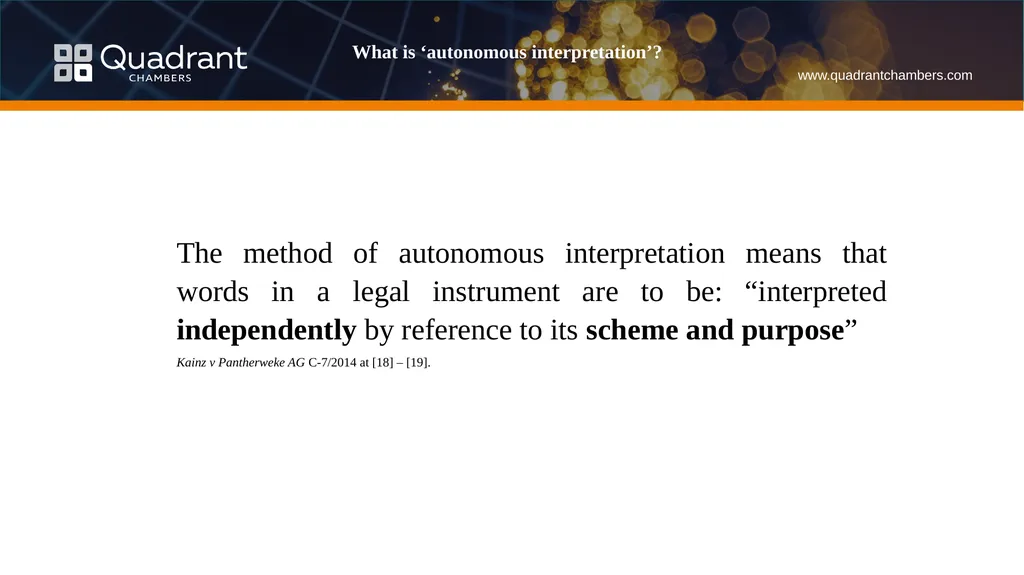
slide2. What is ‘autonomous interpretation’? www.quadrantchambers.com The method of autonomous interpretation means that words in a legal instrument are to be: “interpreted independently by reference to its scheme and purpose”
Kainz v Pantherweke AG C-7/2014 at [18] – [19].<br>
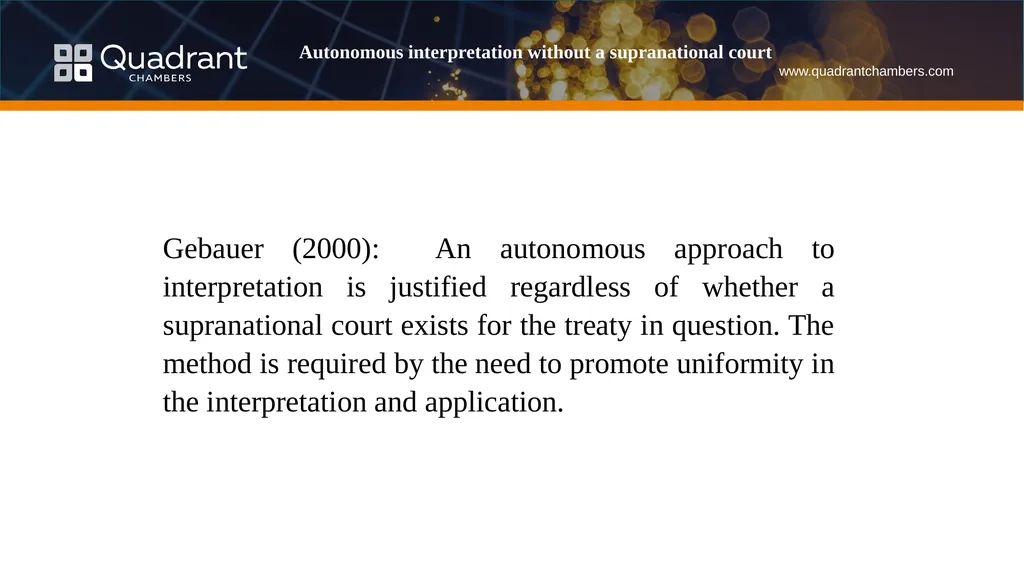
slide3. Autonomous interpretation without a supranational court www.quadrantchambers.com Gebauer (2000): An autonomous approach to interpretation is justified regardless of whether a supranational court exists for the treaty in question. The method is required by the need to promote uniformity in the interpretation and application.<br>
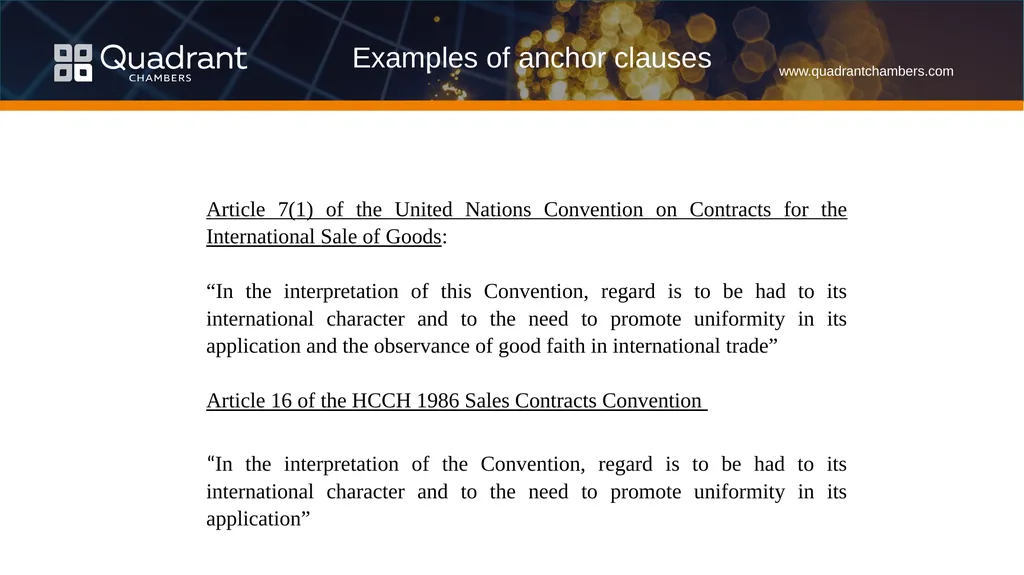
slide4. Examples of anchor clauses www.quadrantchambers.com Article 7(1) of the United Nations Convention on Contracts for the International Sale of Goods:
“In the interpretation of this Convention, regard is to be had to its international character and to the need to promote uniformity in its application and the observance of good faith in international trade”
Article 16 of the HCCH 1986 Sales Contracts Convention
“In the interpretation of the Convention, regard is to be had to its international character and to the need to promote uniformity in its application”<br>
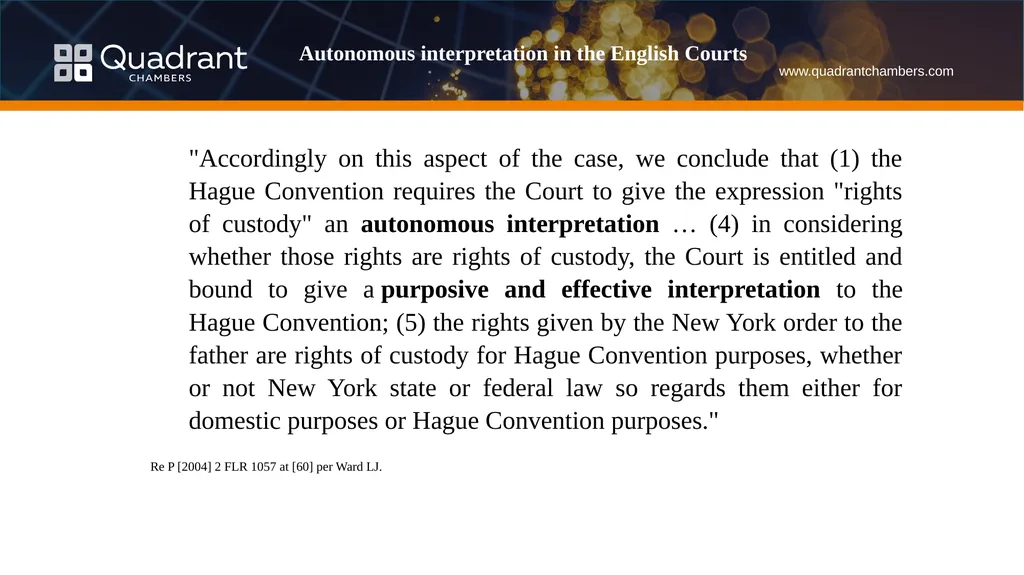
slide5. Autonomous interpretation in the English Courts www.quadrantchambers.com "Accordingly on this aspect of the case, we conclude that (1) the Hague Convention requires the Court to give the expression "rights of custody" an autonomous interpretation … (4) in considering whether those rights are rights of custody, the Court is entitled and bound to give a purposive and effective interpretation to the Hague Convention; (5) the rights given by the New York order to the father are rights of custody for Hague Convention purposes, whether or not New York state or federal law so regards them either for domestic purposes or Hague Convention purposes."
Re P [2004] 2 FLR 1057 at [60] per Ward LJ.<br>
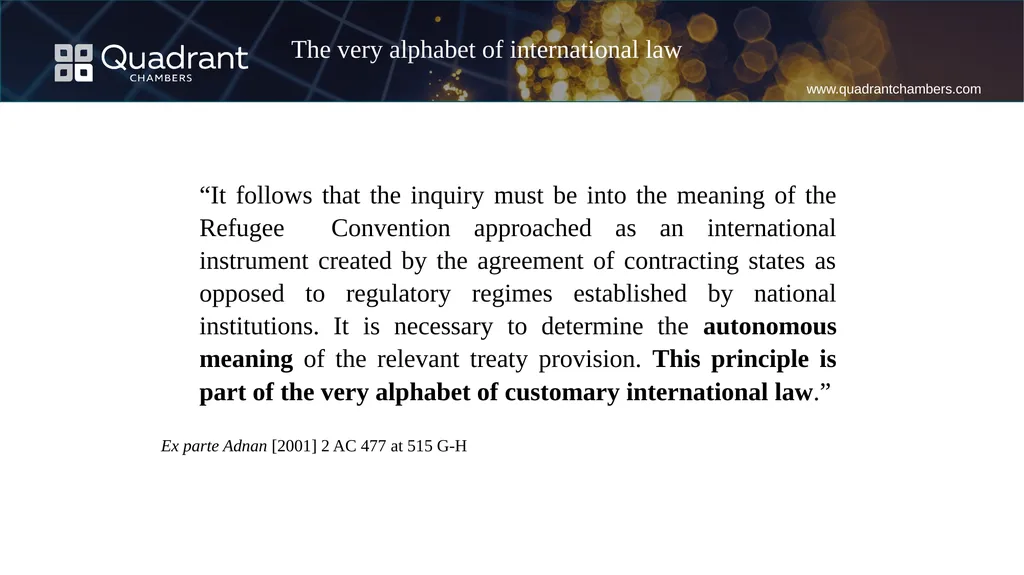
slide6. The very alphabet of international law “It follows that the inquiry must be into the meaning of the Refugee Convention approached as an international instrument created by the agreement of contracting states as opposed to regulatory regimes established by national institutions. It is necessary to determine the autonomous meaning of the relevant treaty provision. This principle is part of the very alphabet of customary international law.”
Ex parte Adnan [2001] 2 AC 477 at 515 G-H<br>
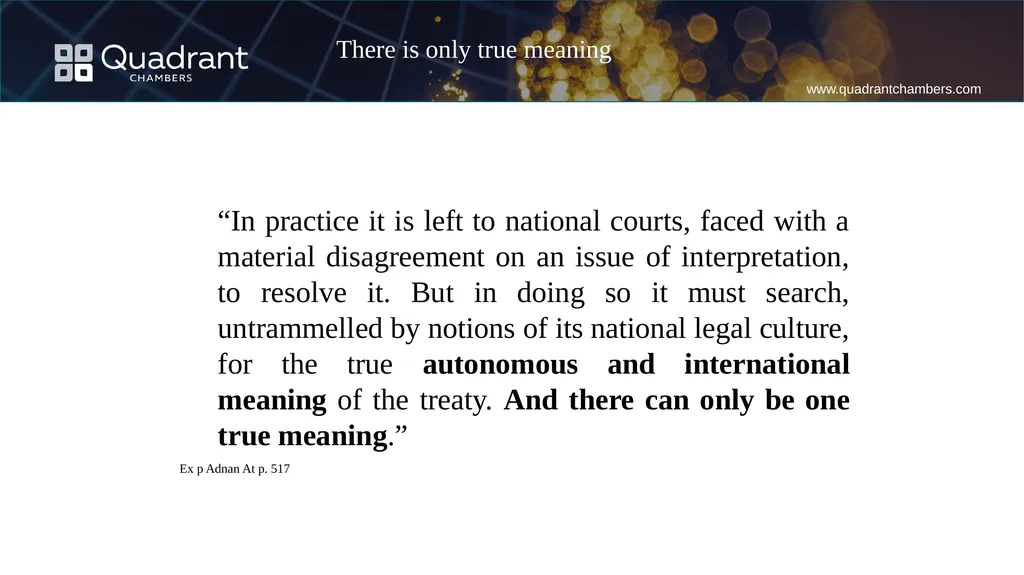
slide7. There is only true meaning “In practice it is left to national courts, faced with a material disagreement on an issue of interpretation, to resolve it. But in doing so it must search, untrammelled by notions of its national legal culture, for the true autonomous and international meaning of the treaty. And there can only be one true meaning.”
Ex p Adnan At p. 517<br>
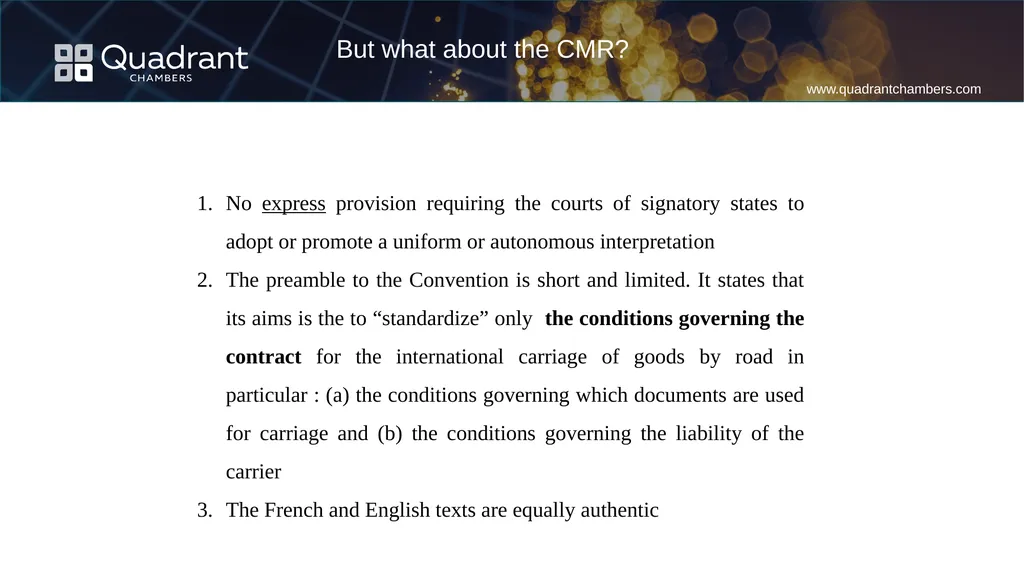
slide8. But what about the CMR? No express provision requiring the courts of signatory states to adopt or promote a uniform or autonomous interpretation
The preamble to the Convention is short and limited. It states that its aims is the to “standardize” only the conditions governing the contract for the international carriage of goods by road in particular : (a) the conditions governing which documents are used for carriage and (b) the conditions governing the liability of the carrier
The French and English texts are equally authentic<br>
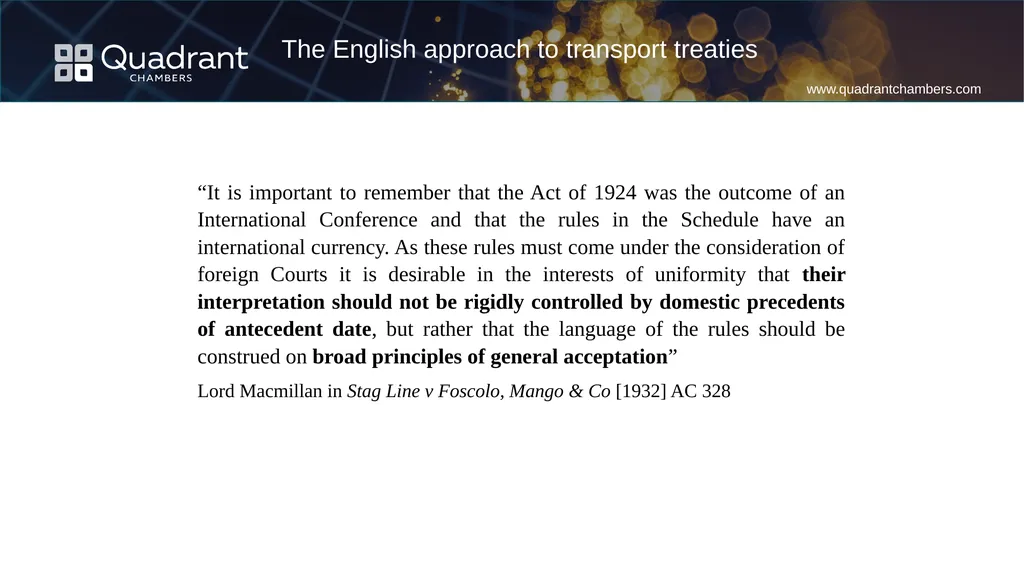
slide9. The English approach to transport treaties “It is important to remember that the Act of 1924 was the outcome of an International Conference and that the rules in the Schedule have an international currency. As these rules must come under the consideration of foreign Courts it is desirable in the interests of uniformity that their interpretation should not be rigidly controlled by domestic precedents of antecedent date, but rather that the language of the rules should be construed on broad principles of general acceptation”
Lord Macmillan in Stag Line v Foscolo, Mango & Co [1932] AC 328<br>
slide10. Buchanan v Babco “I think that the correct approach is to interpret the English text, which after all is likely to be used by many others than British businessmen, in a normal manner, appropriate for the interpretation of an international convention, unconstrained by technical rules of English law, or by English " legal precedent, but on broad principles of general acceptation: Stag Line Ltd. v. Foscolo, Mango and Co. Ltd. [1932] A.C. 328, per Lord Macmillan, at p. 350
Lord Wilberforce<br>
slide11. “The European method” “This article 23, paragraph 4, is an agreed clause in an international convention. As such it should be given the same interpretation in all the countries who were parties to the convention. It would be absurd that the courts of England should interpret it differently from the courts of France, or Holland, or Germany. Compensation for loss should be assessed on the same basis, no matter in which country the claim is brought. We must, therefore, put on one side our traditional rules of interpretation. We have for years tended to stick too closely to the letter - to the literal interpretation of the words. We ought, in interpreting this convention, to adopt the European method.”
Lord Denning in Babco v Buchanan (Court of Appeal)<br>
slide12. The European method rejected “The assumed and often repeated generalisation that English methods are narrow, technical and literal, whereas continental methods are broad, generous and sensible, seems to me insecure at least as regards interpretation of international conventions. (In the present context I do not get assistance from methods said to be used in interpreting the Treaty of Rome by the Court of Justice of the European Communities.)”
Lord Wilberforce in Babco v Buchanan<br>
slide13. So what method was actually used in Babco? "In respect of" is wide enough to include the way in which the goods were carried, miscarried or lost… . The carriers' duty was to carry the whisky to the port of embarkation—their failure to do so might, or might not, bring [an excise duty] charge into existence. But if it did, I think it right to say that the charge was in respect of the carriage.”
Lord Wilberforce<br>
slide14. JTI Polska v Jakubowski (2023) “Since Buchanan was decided there has been an increasing recognition by English courts of the role of the rules of interpretation set out in articles 31 and 32 of the Vienna Convention on the Law of Treaties 1969… Although the CMR predates the Vienna Convention, its principles of interpretation reflect customary international law and therefore bind states in the interpretation of earlier treaties.”
The Supreme Court did not comment on what Lord Wilberforce had said about autonomous interpretation<br>
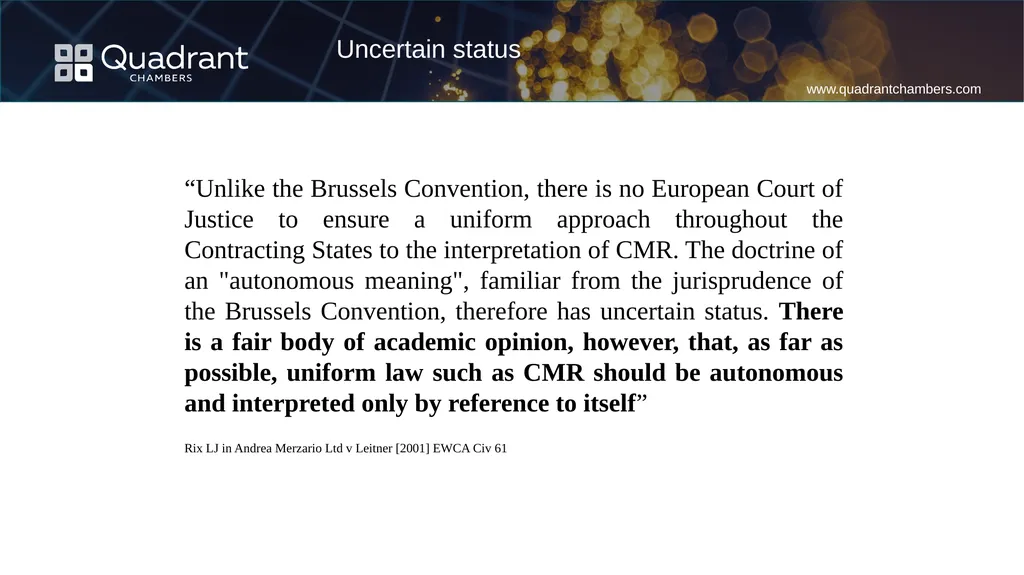
slide15. Uncertain status “Unlike the Brussels Convention, there is no European Court of Justice to ensure a uniform approach throughout the Contracting States to the interpretation of CMR. The doctrine of an "autonomous meaning", familiar from the jurisprudence of the Brussels Convention, therefore has uncertain status. There is a fair body of academic opinion, however, that, as far as possible, uniform law such as CMR should be autonomous and interpreted only by reference to itself”
Rix LJ in Andrea Merzario Ltd v Leitner [2001] EWCA Civ 61<br>
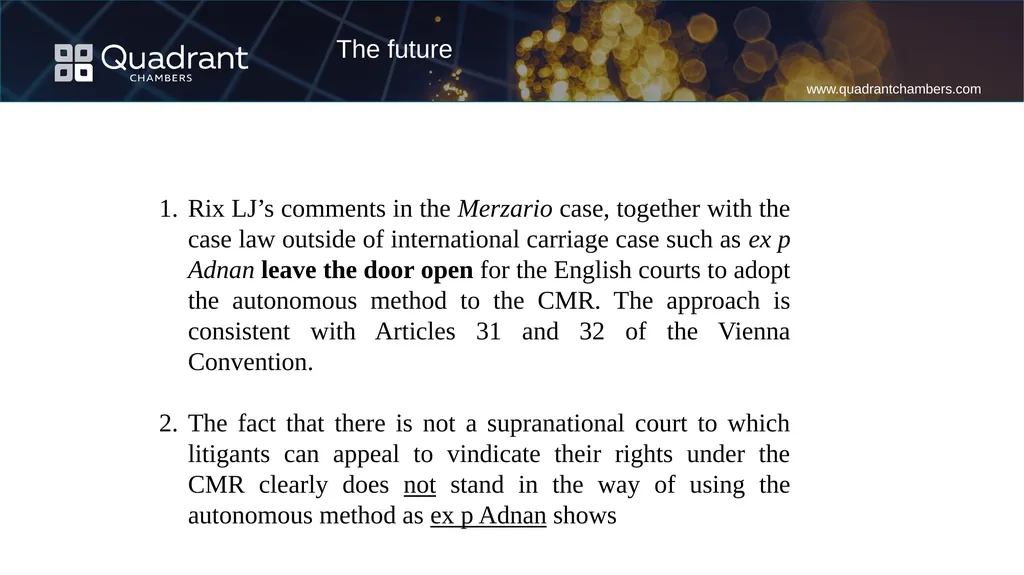
slide16. The future Rix LJ’s comments in the Merzario case, together with the case law outside of international carriage case such as ex p Adnan leave the door open for the English courts to adopt the autonomous method to the CMR. The approach is consistent with Articles 31 and 32 of the Vienna Convention.
The fact that there is not a supranational court to which litigants can appeal to vindicate their rights under the CMR clearly does not stand in the way of using the autonomous method as ex p Adnan shows<br>
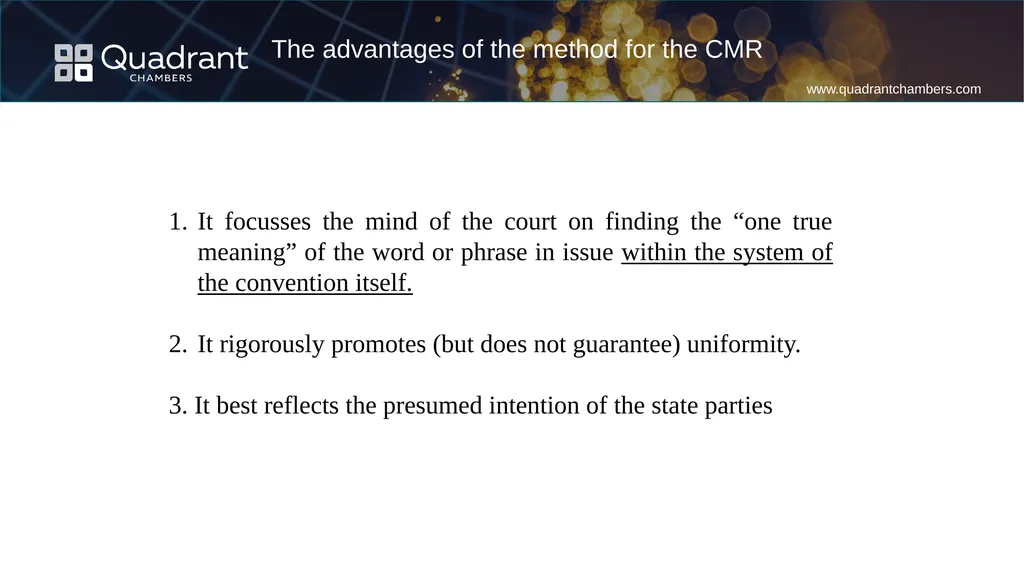
slide17. The advantages of the method for the CMR It focusses the mind of the court on finding the “one true meaning” of the word or phrase in issue within the system of the convention itself.
It rigorously promotes (but does not guarantee) uniformity.
3. It best reflects the presumed intention of the state parties<br>
slide18. www.quadrantchambers.com Quadrant House, 10 Fleet Street, London EC4Y 1AU T: +44 (0)20 7583 4444 F: +44 (0)20 7583 4455<br>
John Kimbell KC
CMR Colloquium 2024, Stockholm University 19-20 September 2024 www.quadrantchambers.com<br>
slide2. What is ‘autonomous interpretation’? www.quadrantchambers.com The method of autonomous interpretation means that words in a legal instrument are to be: “interpreted independently by reference to its scheme and purpose”
Kainz v Pantherweke AG C-7/2014 at [18] – [19].<br>
slide3. Autonomous interpretation without a supranational court www.quadrantchambers.com Gebauer (2000): An autonomous approach to interpretation is justified regardless of whether a supranational court exists for the treaty in question. The method is required by the need to promote uniformity in the interpretation and application.<br>
slide4. Examples of anchor clauses www.quadrantchambers.com Article 7(1) of the United Nations Convention on Contracts for the International Sale of Goods:
“In the interpretation of this Convention, regard is to be had to its international character and to the need to promote uniformity in its application and the observance of good faith in international trade”
Article 16 of the HCCH 1986 Sales Contracts Convention
“In the interpretation of the Convention, regard is to be had to its international character and to the need to promote uniformity in its application”<br>
slide5. Autonomous interpretation in the English Courts www.quadrantchambers.com "Accordingly on this aspect of the case, we conclude that (1) the Hague Convention requires the Court to give the expression "rights of custody" an autonomous interpretation … (4) in considering whether those rights are rights of custody, the Court is entitled and bound to give a purposive and effective interpretation to the Hague Convention; (5) the rights given by the New York order to the father are rights of custody for Hague Convention purposes, whether or not New York state or federal law so regards them either for domestic purposes or Hague Convention purposes."
Re P [2004] 2 FLR 1057 at [60] per Ward LJ.<br>
slide6. The very alphabet of international law “It follows that the inquiry must be into the meaning of the Refugee Convention approached as an international instrument created by the agreement of contracting states as opposed to regulatory regimes established by national institutions. It is necessary to determine the autonomous meaning of the relevant treaty provision. This principle is part of the very alphabet of customary international law.”
Ex parte Adnan [2001] 2 AC 477 at 515 G-H<br>
slide7. There is only true meaning “In practice it is left to national courts, faced with a material disagreement on an issue of interpretation, to resolve it. But in doing so it must search, untrammelled by notions of its national legal culture, for the true autonomous and international meaning of the treaty. And there can only be one true meaning.”
Ex p Adnan At p. 517<br>
slide8. But what about the CMR? No express provision requiring the courts of signatory states to adopt or promote a uniform or autonomous interpretation
The preamble to the Convention is short and limited. It states that its aims is the to “standardize” only the conditions governing the contract for the international carriage of goods by road in particular : (a) the conditions governing which documents are used for carriage and (b) the conditions governing the liability of the carrier
The French and English texts are equally authentic<br>
slide9. The English approach to transport treaties “It is important to remember that the Act of 1924 was the outcome of an International Conference and that the rules in the Schedule have an international currency. As these rules must come under the consideration of foreign Courts it is desirable in the interests of uniformity that their interpretation should not be rigidly controlled by domestic precedents of antecedent date, but rather that the language of the rules should be construed on broad principles of general acceptation”
Lord Macmillan in Stag Line v Foscolo, Mango & Co [1932] AC 328<br>
slide10. Buchanan v Babco “I think that the correct approach is to interpret the English text, which after all is likely to be used by many others than British businessmen, in a normal manner, appropriate for the interpretation of an international convention, unconstrained by technical rules of English law, or by English " legal precedent, but on broad principles of general acceptation: Stag Line Ltd. v. Foscolo, Mango and Co. Ltd. [1932] A.C. 328, per Lord Macmillan, at p. 350
Lord Wilberforce<br>
slide11. “The European method” “This article 23, paragraph 4, is an agreed clause in an international convention. As such it should be given the same interpretation in all the countries who were parties to the convention. It would be absurd that the courts of England should interpret it differently from the courts of France, or Holland, or Germany. Compensation for loss should be assessed on the same basis, no matter in which country the claim is brought. We must, therefore, put on one side our traditional rules of interpretation. We have for years tended to stick too closely to the letter - to the literal interpretation of the words. We ought, in interpreting this convention, to adopt the European method.”
Lord Denning in Babco v Buchanan (Court of Appeal)<br>
slide12. The European method rejected “The assumed and often repeated generalisation that English methods are narrow, technical and literal, whereas continental methods are broad, generous and sensible, seems to me insecure at least as regards interpretation of international conventions. (In the present context I do not get assistance from methods said to be used in interpreting the Treaty of Rome by the Court of Justice of the European Communities.)”
Lord Wilberforce in Babco v Buchanan<br>
slide13. So what method was actually used in Babco? "In respect of" is wide enough to include the way in which the goods were carried, miscarried or lost… . The carriers' duty was to carry the whisky to the port of embarkation—their failure to do so might, or might not, bring [an excise duty] charge into existence. But if it did, I think it right to say that the charge was in respect of the carriage.”
Lord Wilberforce<br>
slide14. JTI Polska v Jakubowski (2023) “Since Buchanan was decided there has been an increasing recognition by English courts of the role of the rules of interpretation set out in articles 31 and 32 of the Vienna Convention on the Law of Treaties 1969… Although the CMR predates the Vienna Convention, its principles of interpretation reflect customary international law and therefore bind states in the interpretation of earlier treaties.”
The Supreme Court did not comment on what Lord Wilberforce had said about autonomous interpretation<br>
slide15. Uncertain status “Unlike the Brussels Convention, there is no European Court of Justice to ensure a uniform approach throughout the Contracting States to the interpretation of CMR. The doctrine of an "autonomous meaning", familiar from the jurisprudence of the Brussels Convention, therefore has uncertain status. There is a fair body of academic opinion, however, that, as far as possible, uniform law such as CMR should be autonomous and interpreted only by reference to itself”
Rix LJ in Andrea Merzario Ltd v Leitner [2001] EWCA Civ 61<br>
slide16. The future Rix LJ’s comments in the Merzario case, together with the case law outside of international carriage case such as ex p Adnan leave the door open for the English courts to adopt the autonomous method to the CMR. The approach is consistent with Articles 31 and 32 of the Vienna Convention.
The fact that there is not a supranational court to which litigants can appeal to vindicate their rights under the CMR clearly does not stand in the way of using the autonomous method as ex p Adnan shows<br>
slide17. The advantages of the method for the CMR It focusses the mind of the court on finding the “one true meaning” of the word or phrase in issue within the system of the convention itself.
It rigorously promotes (but does not guarantee) uniformity.
3. It best reflects the presumed intention of the state parties<br>
slide18. www.quadrantchambers.com Quadrant House, 10 Fleet Street, London EC4Y 1AU T: +44 (0)20 7583 4444 F: +44 (0)20 7583 4455<br>