Aviation Meteorology Third Stage The second
Description: Aviation Meteorology Third Stage The second lecture DR.IQBAL KHALAF khames Drag When the airplane moves through the air, there is another aerodynamic force present The air resists the motion of the aircraft and the resistance force is
Related Topics
Download Presentation
"Aviation Meteorology Third Stage The second" is the property of its rightful owner. Permission is granted to download and print the materials on this website for personal, non-commercial use only, and to display it on your personal computer provided you do not modify the materials and that you retain all copyright notices contained in the materials. By downloading content from our website, you accept the terms of this agreement.
Presentation Transcript
slide1. Aviation Meteorology Third Stage
The second lecture
DR.IQBAL KHALAF khames<br>
slide2. Drag When the airplane moves through the air, there is another aerodynamic force present
The air resists the motion of the aircraft and the resistance force is called Drag
Drag is the Aerodynamic force that opposes an aircraft's motion through the air.<br>
slide3. Drag
Drag is generated by every part of the airplane (even the engines).
Drag acts in the direction opposed to the motion.
And directed along and opposed to the flight direction.<br>
slide4. There are many factors that affect the magnitude of the drag force including the
1-shape of the aircraft
2- the "stickiness" of the air
3-the velocity of the aircraft.
Drag acts through the aircraft center of pressure( Cp ).<br>
slide5. Factors that affect drag
There are many factors that affect drag. We can group these factors into:
(a) Those associated with the airplane
(b) Those associated with the motion of the airplane through the air
(c) Those associated with the air itself<br>
slide6. A : Those associated with the airplane
The drag depends:-
linearly on the size of the airplane moving through the air.
The cross-sectional shape of an airplane determines the form drag created by the pressure variation around the airplane.<br>
slide7. If the drag as aerodynamic friction
The amount of drag depends on the;
1-surface roughness of the aircraft.
2- A smooth surface produces less drag than a roughened surface.
This effect is called surface friction and is usually included in the measured Drag coefficient (Cd )of the aircraft.<br>
slide8. B: Those associated with the motion of the airplane through the air Drag is associated: with the movement of the aircraft through the air,
So drag depends on the velocity of the air.
Drag actually varies with the square of the relative velocity between the surface of aircraft and the air.<br>
slide9. The slope of an airplane's wing affects the flow, which affects the amount of drag an airplane produces
If the aircraft moves through the air at speeds near the speed of sound, shock waves are formed on the aircraft which create an additional drag component called wave drag.<br>
slide10. The motion of the aircraft through the air also causes boundary layers to form on the aircraft surface .
A boundary layer:- is a region of very low speed flow near the surface which contributes to the surface friction .<br>
slide11. C: Those associated with the air itself
Drag depends directly on the mass of the flow going past the aircraft.
The drag also depends in other properties of the air:-
1- viscosity of the air
2-compressibility of the air .<br>
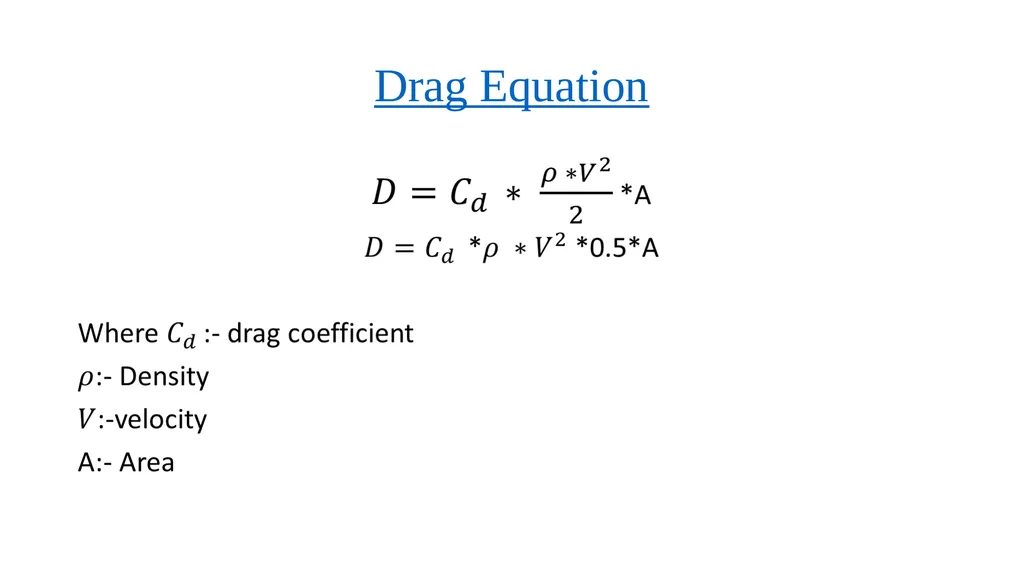
slide12. all of this information on the factors that affect drag into a single mathematical equation called the
Drag Equation.
With the drag equation we can predict how much drag force is generated by a given aircraft surface moving at a given speed through a given air.<br>
slide13. Drag Equation<br>
slide14. D = Cd x A x 0.5 x ρ x V 2<br>
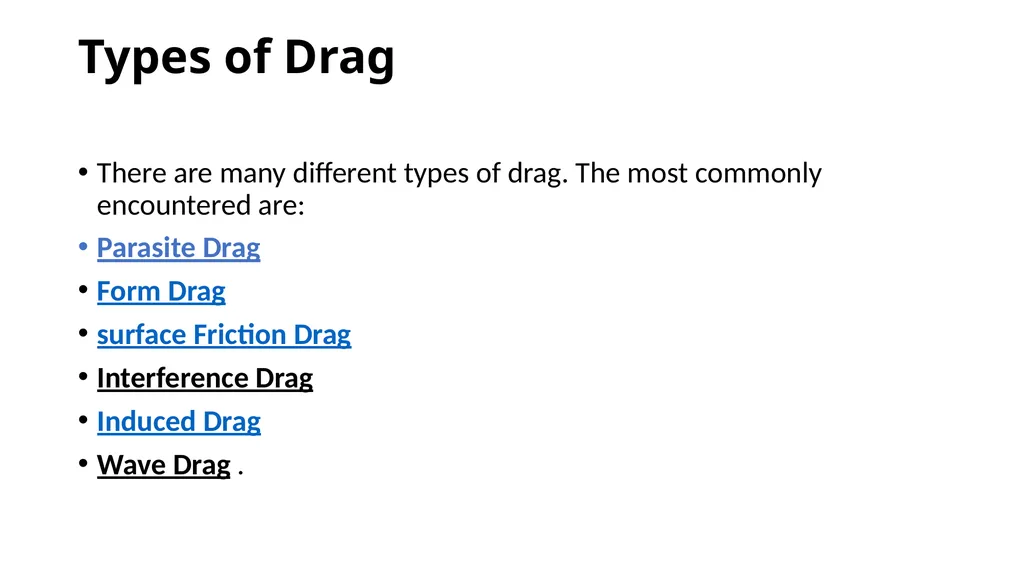
slide15. Types of Drag There are many different types of drag. The most commonly encountered are:
Parasite Drag
Form Drag
surface Friction Drag
Interference Drag
Induced Drag
Wave Drag .<br>
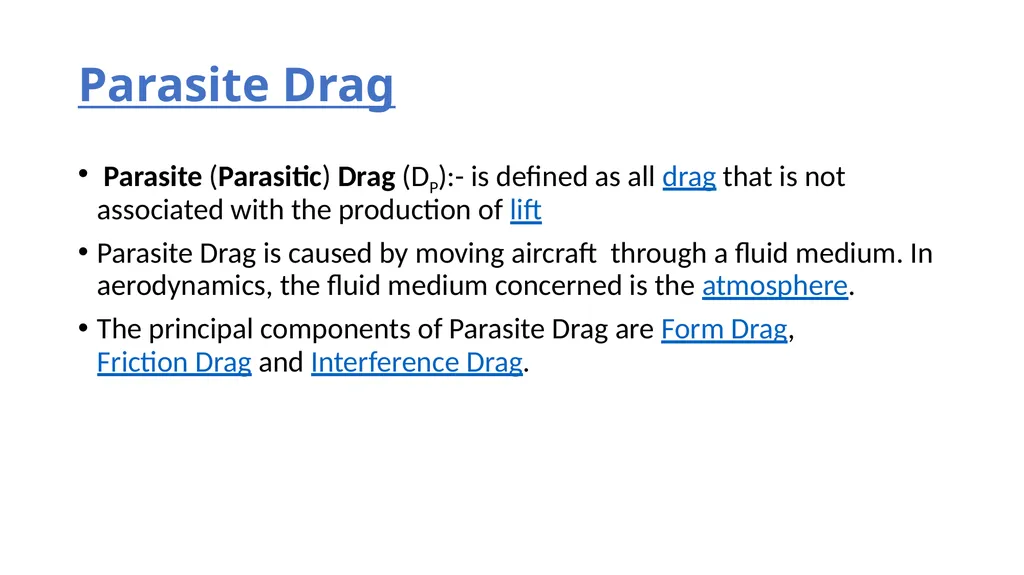
slide16. Parasite Drag Parasite (Parasitic) Drag (DP):- is defined as all drag that is not associated with the production of lift
Parasite Drag is caused by moving aircraft through a fluid medium. In aerodynamics, the fluid medium concerned is the atmosphere.
The principal components of Parasite Drag are Form Drag, Friction Drag and Interference Drag.<br>
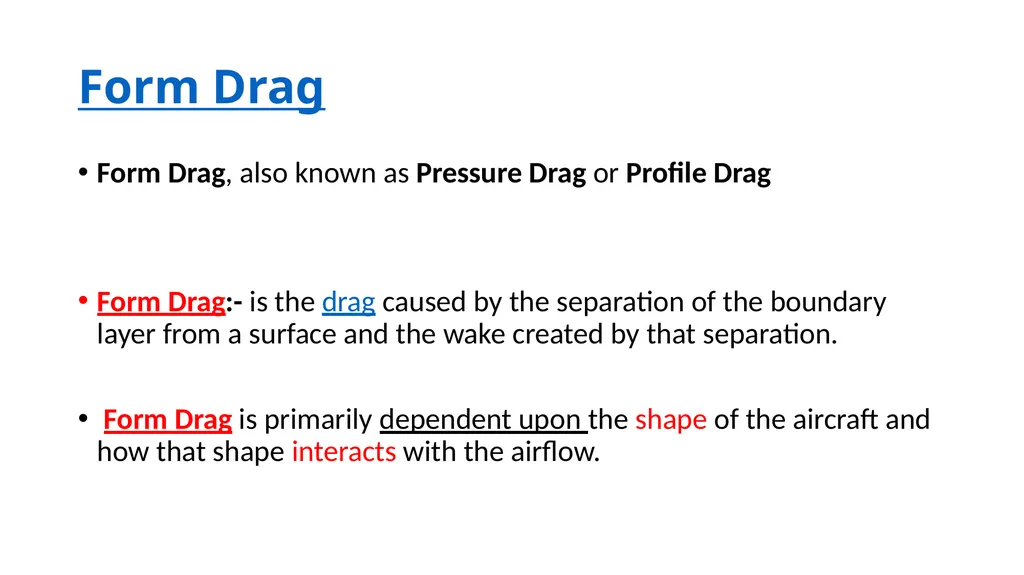
slide17. Form Drag Form Drag, also known as Pressure Drag or Profile Drag
Form Drag:- is the drag caused by the separation of the boundary layer from a surface and the wake created by that separation.
Form Drag is primarily dependent upon the shape of the aircraft and how that shape interacts with the airflow.<br>
slide18. surface Friction Drag Surface Friction Drag, also known as Skin Friction Drag
Surface Friction Drag:- is drag caused by
1-the friction of a fluid against the surface of an aircraft that is moving through it.
2-caused by rough spots on the surface of the aircraft.
Surface Friction Drag :- is directly proportional to the area of the surface in contact with the fluid and increases with the square of the velocity.<br>
slide19. Common sources of this type of surface friction drag are:-
1- snow
2-dirt
3- dead insects
4-and other debris
that accumulates on the airframe
surface friction drag is one of the reasons why airplane deicing is a crucial step before you take off during winter weather conditions.<br>
slide20. Interference Drag Interference Drag :-is drag that is generated by the mixing of airflow streamlines between airframe components such as the wing and the fuselage, the engine pylon and the wing.
In the case of a military or other special purpose aircraft, between the airframe and attached external stores such as fuel tanks, weapons or sensors.
Interference drag is greatest in areas with sharp angles like where:-
1-the wing strut meets the fuselage
2-the wings themselves attach to the fuselage.<br>
slide21. Induced Drag When higher pressure air from underneath the wings flows up and over the top of the wing, this is a source of induced drag.
The ratio between the width of the wing and the height of the wing is important in this type of induced drag.
The lower this ratio, the greater the induced drag force and vice versa.<br>
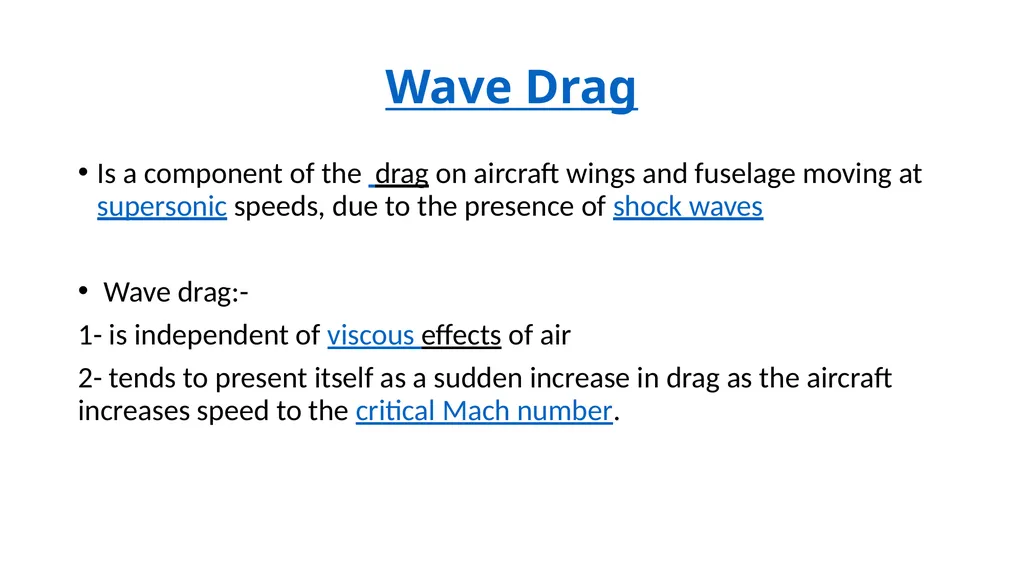
slide22. Wave Drag Is a component of the drag on aircraft wings and fuselage moving at supersonic speeds, due to the presence of shock waves
Wave drag:-
1- is independent of viscous effects of air
2- tends to present itself as a sudden increase in drag as the aircraft increases speed to the critical Mach number.<br>
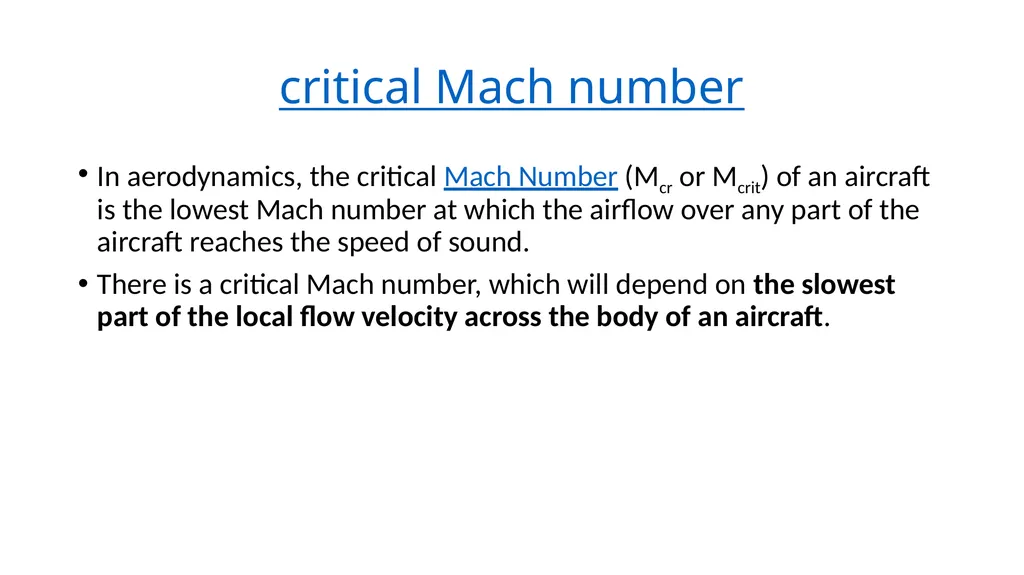
slide23. critical Mach number In aerodynamics, the critical Mach Number (Mcr or Mcrit) of an aircraft is the lowest Mach number at which the airflow over any part of the aircraft reaches the speed of sound.
There is a critical Mach number, which will depend on the slowest part of the local flow velocity across the body of an aircraft.<br>
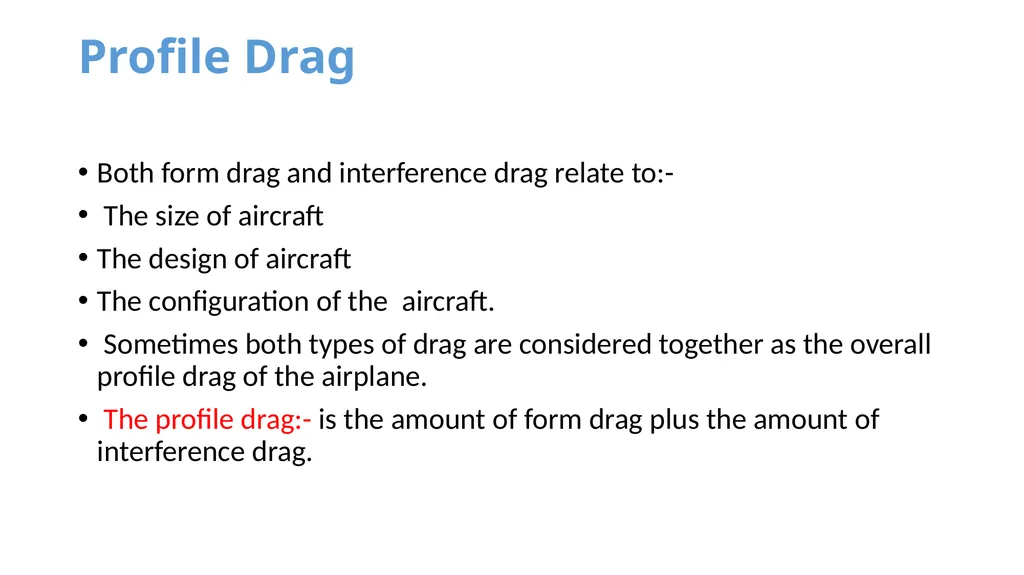
slide24. Profile Drag Both form drag and interference drag relate to:-
The size of aircraft
The design of aircraft
The configuration of the aircraft.
Sometimes both types of drag are considered together as the overall profile drag of the airplane.
The profile drag:- is the amount of form drag plus the amount of interference drag.<br>
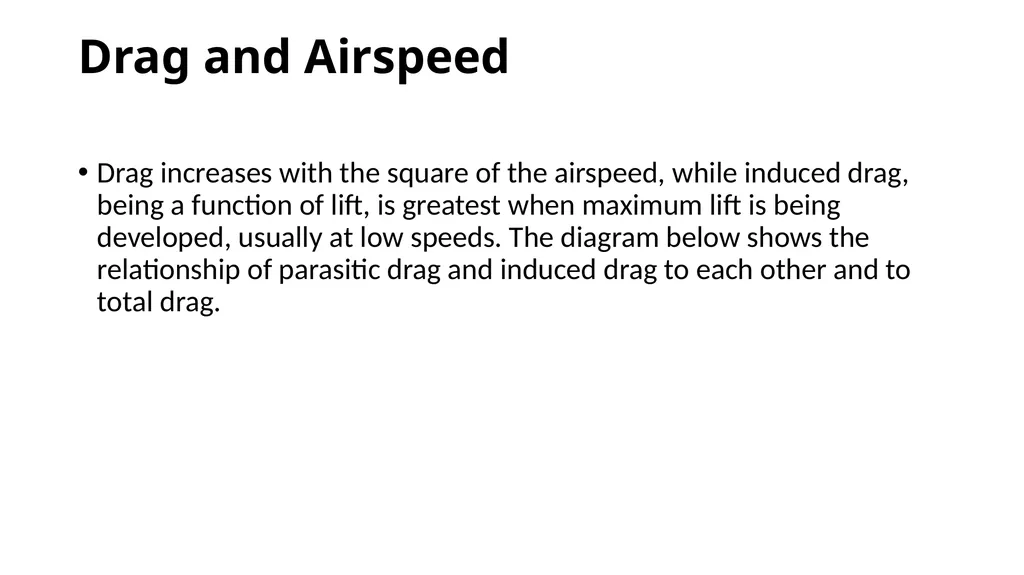
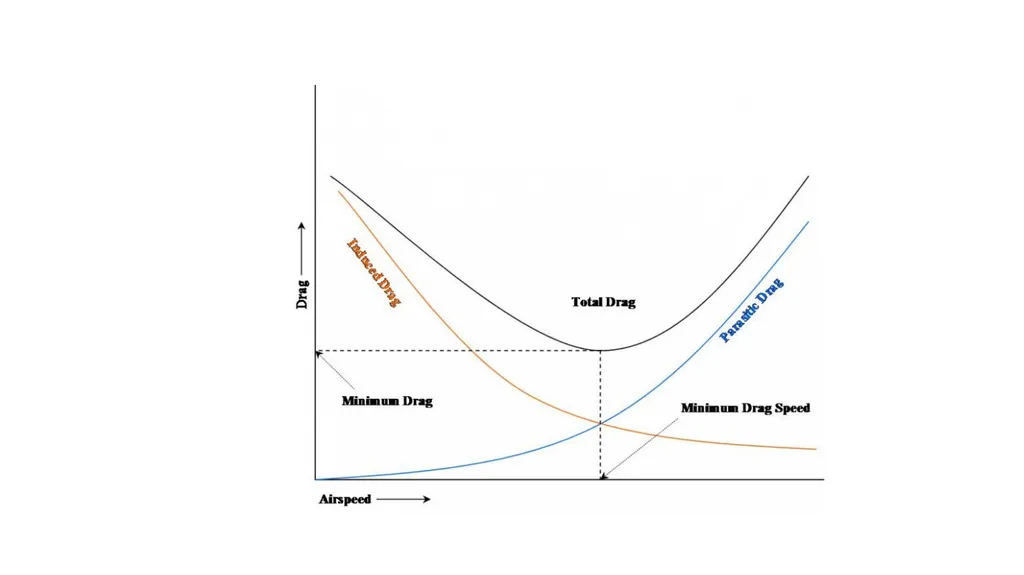
slide25. Drag and Airspeed Drag increases with the square of the airspeed, while induced drag, being a function of lift, is greatest when maximum lift is being developed, usually at low speeds. The diagram below shows the relationship of parasitic drag and induced drag to each other and to total drag.<br>
slide27. Relationship of Drag with Airspeed There is an airspeed at which drag is minimum, and in theory, this is the maximum range speed; however, flight at this speed is unstable because a small decrease in speed results in an increase in drag, and a further fall in speed. In practice, for stable flight, maximum range is achieved at a speed a little above the minimum drag speed where a small speed decrease results in a reduction in drag.<br>

The second lecture
DR.IQBAL KHALAF khames<br>
slide2. Drag When the airplane moves through the air, there is another aerodynamic force present
The air resists the motion of the aircraft and the resistance force is called Drag
Drag is the Aerodynamic force that opposes an aircraft's motion through the air.<br>
slide3. Drag
Drag is generated by every part of the airplane (even the engines).
Drag acts in the direction opposed to the motion.
And directed along and opposed to the flight direction.<br>
slide4. There are many factors that affect the magnitude of the drag force including the
1-shape of the aircraft
2- the "stickiness" of the air
3-the velocity of the aircraft.
Drag acts through the aircraft center of pressure( Cp ).<br>
slide5. Factors that affect drag
There are many factors that affect drag. We can group these factors into:
(a) Those associated with the airplane
(b) Those associated with the motion of the airplane through the air
(c) Those associated with the air itself<br>
slide6. A : Those associated with the airplane
The drag depends:-
linearly on the size of the airplane moving through the air.
The cross-sectional shape of an airplane determines the form drag created by the pressure variation around the airplane.<br>
slide7. If the drag as aerodynamic friction
The amount of drag depends on the;
1-surface roughness of the aircraft.
2- A smooth surface produces less drag than a roughened surface.
This effect is called surface friction and is usually included in the measured Drag coefficient (Cd )of the aircraft.<br>
slide8. B: Those associated with the motion of the airplane through the air Drag is associated: with the movement of the aircraft through the air,
So drag depends on the velocity of the air.
Drag actually varies with the square of the relative velocity between the surface of aircraft and the air.<br>
slide9. The slope of an airplane's wing affects the flow, which affects the amount of drag an airplane produces
If the aircraft moves through the air at speeds near the speed of sound, shock waves are formed on the aircraft which create an additional drag component called wave drag.<br>
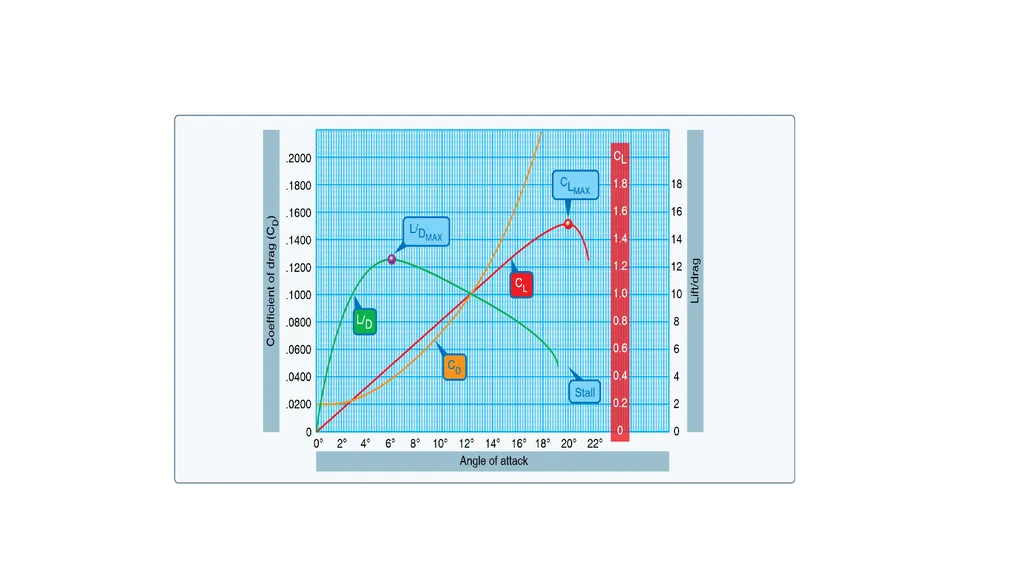
slide10. The motion of the aircraft through the air also causes boundary layers to form on the aircraft surface .
A boundary layer:- is a region of very low speed flow near the surface which contributes to the surface friction .<br>
slide11. C: Those associated with the air itself
Drag depends directly on the mass of the flow going past the aircraft.
The drag also depends in other properties of the air:-
1- viscosity of the air
2-compressibility of the air .<br>
slide12. all of this information on the factors that affect drag into a single mathematical equation called the
Drag Equation.
With the drag equation we can predict how much drag force is generated by a given aircraft surface moving at a given speed through a given air.<br>
slide13. Drag Equation<br>
slide14. D = Cd x A x 0.5 x ρ x V 2<br>
slide15. Types of Drag There are many different types of drag. The most commonly encountered are:
Parasite Drag
Form Drag
surface Friction Drag
Interference Drag
Induced Drag
Wave Drag .<br>
slide16. Parasite Drag Parasite (Parasitic) Drag (DP):- is defined as all drag that is not associated with the production of lift
Parasite Drag is caused by moving aircraft through a fluid medium. In aerodynamics, the fluid medium concerned is the atmosphere.
The principal components of Parasite Drag are Form Drag, Friction Drag and Interference Drag.<br>
slide17. Form Drag Form Drag, also known as Pressure Drag or Profile Drag
Form Drag:- is the drag caused by the separation of the boundary layer from a surface and the wake created by that separation.
Form Drag is primarily dependent upon the shape of the aircraft and how that shape interacts with the airflow.<br>
slide18. surface Friction Drag Surface Friction Drag, also known as Skin Friction Drag
Surface Friction Drag:- is drag caused by
1-the friction of a fluid against the surface of an aircraft that is moving through it.
2-caused by rough spots on the surface of the aircraft.
Surface Friction Drag :- is directly proportional to the area of the surface in contact with the fluid and increases with the square of the velocity.<br>
slide19. Common sources of this type of surface friction drag are:-
1- snow
2-dirt
3- dead insects
4-and other debris
that accumulates on the airframe
surface friction drag is one of the reasons why airplane deicing is a crucial step before you take off during winter weather conditions.<br>
slide20. Interference Drag Interference Drag :-is drag that is generated by the mixing of airflow streamlines between airframe components such as the wing and the fuselage, the engine pylon and the wing.
In the case of a military or other special purpose aircraft, between the airframe and attached external stores such as fuel tanks, weapons or sensors.
Interference drag is greatest in areas with sharp angles like where:-
1-the wing strut meets the fuselage
2-the wings themselves attach to the fuselage.<br>
slide21. Induced Drag When higher pressure air from underneath the wings flows up and over the top of the wing, this is a source of induced drag.
The ratio between the width of the wing and the height of the wing is important in this type of induced drag.
The lower this ratio, the greater the induced drag force and vice versa.<br>
slide22. Wave Drag Is a component of the drag on aircraft wings and fuselage moving at supersonic speeds, due to the presence of shock waves
Wave drag:-
1- is independent of viscous effects of air
2- tends to present itself as a sudden increase in drag as the aircraft increases speed to the critical Mach number.<br>
slide23. critical Mach number In aerodynamics, the critical Mach Number (Mcr or Mcrit) of an aircraft is the lowest Mach number at which the airflow over any part of the aircraft reaches the speed of sound.
There is a critical Mach number, which will depend on the slowest part of the local flow velocity across the body of an aircraft.<br>
slide24. Profile Drag Both form drag and interference drag relate to:-
The size of aircraft
The design of aircraft
The configuration of the aircraft.
Sometimes both types of drag are considered together as the overall profile drag of the airplane.
The profile drag:- is the amount of form drag plus the amount of interference drag.<br>
slide25. Drag and Airspeed Drag increases with the square of the airspeed, while induced drag, being a function of lift, is greatest when maximum lift is being developed, usually at low speeds. The diagram below shows the relationship of parasitic drag and induced drag to each other and to total drag.<br>
slide27. Relationship of Drag with Airspeed There is an airspeed at which drag is minimum, and in theory, this is the maximum range speed; however, flight at this speed is unstable because a small decrease in speed results in an increase in drag, and a further fall in speed. In practice, for stable flight, maximum range is achieved at a speed a little above the minimum drag speed where a small speed decrease results in a reduction in drag.<br>