
Avoiding the Babbling-Idiot Failure in a
Description: Avoiding the Babbling-Idiot Failure in a Time-Triggered Communication System System Nodes communicate on a broadcast bus (only one node may send a message at a time and all messages are broadcast) Enforced Synchronous communication Messages
Related Topics
Download Presentation
"Avoiding the Babbling-Idiot Failure in a" is the property of its rightful owner. Permission is granted to download and print the materials on this website for personal, non-commercial use only, and to display it on your personal computer provided you do not modify the materials and that you retain all copyright notices contained in the materials. By downloading content from our website, you accept the terms of this agreement.
Presentation Transcript
slide1. Avoiding the Babbling-Idiot Failure in a Time-Triggered Communication System<br>
slide2. System Nodes communicate on a broadcast bus (only one node may send a message at a time and all messages are broadcast)
Enforced Synchronous communication
Messages can be checked for corruption<br>
slide3. Fail-Silence Node sends correct messages at correct times
Node sends corrupt messages that can be determined as corrupt
Node sends no messages at all<br>
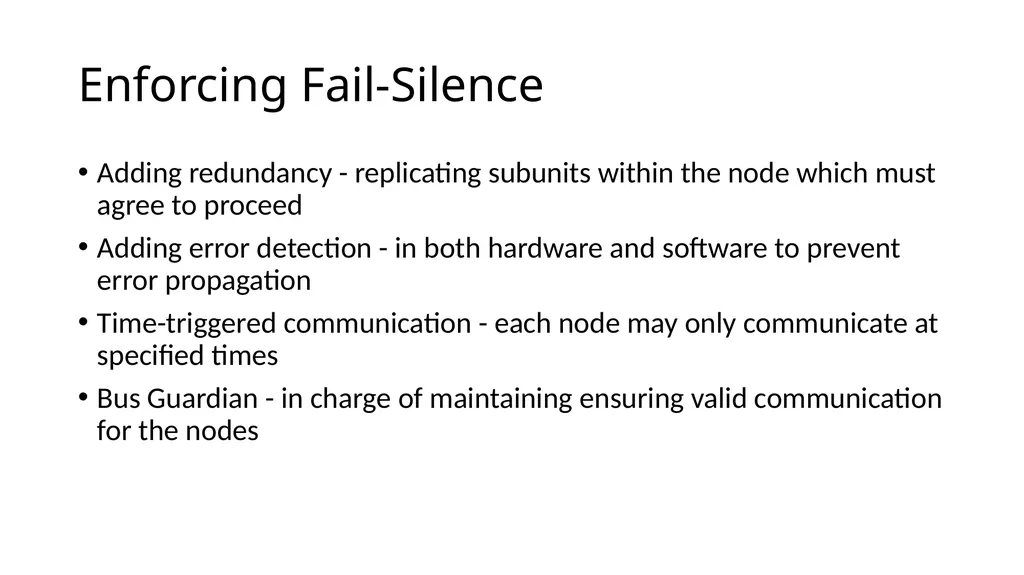
slide4. Enforcing Fail-Silence Adding redundancy - replicating subunits within the node which must agree to proceed
Adding error detection - in both hardware and software to prevent error propagation
Time-triggered communication - each node may only communicate at specified times
Bus Guardian - in charge of maintaining ensuring valid communication for the nodes<br>
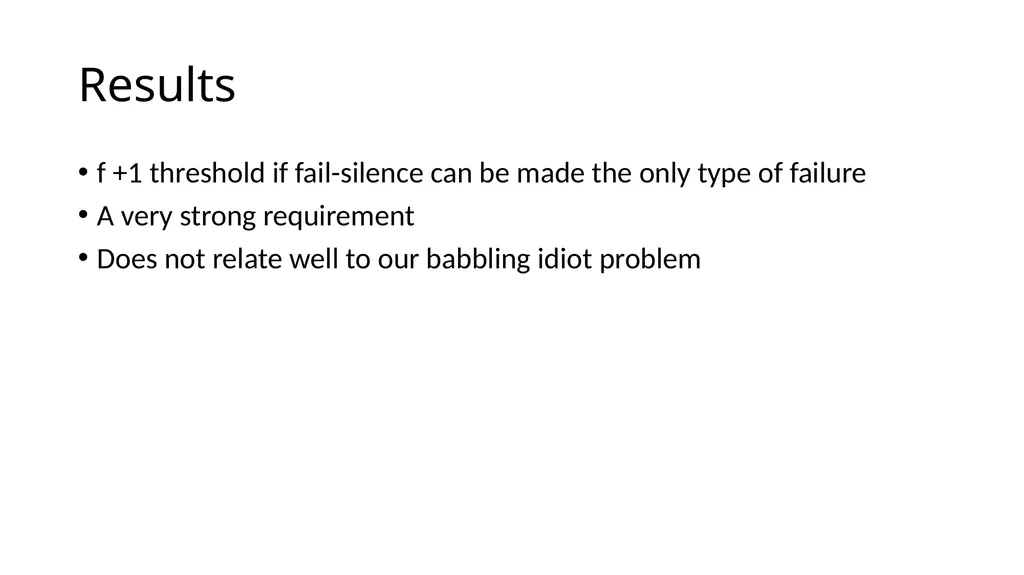
slide5. Results f +1 threshold if fail-silence can be made the only type of failure
A very strong requirement
Does not relate well to our babbling idiot problem<br>
slide2. System Nodes communicate on a broadcast bus (only one node may send a message at a time and all messages are broadcast)
Enforced Synchronous communication
Messages can be checked for corruption<br>
slide3. Fail-Silence Node sends correct messages at correct times
Node sends corrupt messages that can be determined as corrupt
Node sends no messages at all<br>
slide4. Enforcing Fail-Silence Adding redundancy - replicating subunits within the node which must agree to proceed
Adding error detection - in both hardware and software to prevent error propagation
Time-triggered communication - each node may only communicate at specified times
Bus Guardian - in charge of maintaining ensuring valid communication for the nodes<br>
slide5. Results f +1 threshold if fail-silence can be made the only type of failure
A very strong requirement
Does not relate well to our babbling idiot problem<br>