B: Deductive arguments- developments of the ontological argument Descartes: God is a being that possessed all perfections, whilst Descartes is vague what is perfect , it implies that God possesses the best form of all attributes. The
"B: Deductive arguments- developments of the" is the property of its rightful owner. Permission is granted to
download and print the materials on this website for personal, non-commercial use only, and to display it
on your personal computer provided you do not modify the materials and that you retain all copyright
notices contained in the materials. By downloading content from our website, you accept the terms of this
agreement.
Presentation Transcript
01
B: Deductive arguments- developments of the ontological argument Descartes: God is a being that possessed all perfections, whilst Descartes is vague what is ‘perfect’ , it implies that God possesses the best form of all attributes. The attributes of power (omnipotent , omniscient , omnibenevolent). For Descartes, God possess all therse qualities, if he did not possess them then God is not a supreme being.
‘God is that than which nothing greater can be conceived’. Descartes<br>
02
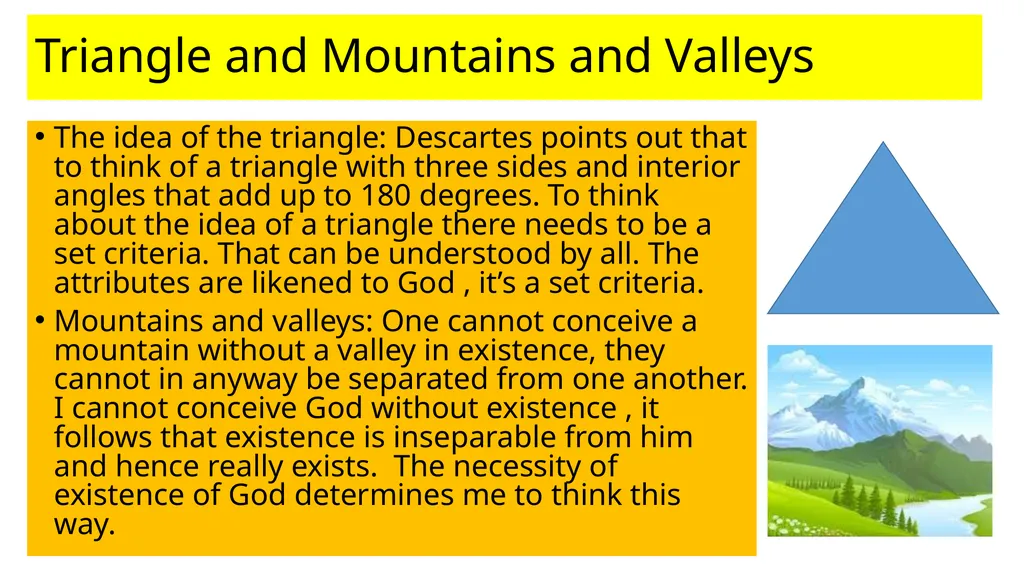
Triangle and Mountains and Valleys The idea of the triangle: Descartes points out that to think of a triangle with three sides and interior angles that add up to 180 degrees. To think about the idea of a triangle there needs to be a set criteria. That can be understood by all. The attributes are likened to God , it’s a set criteria.
Mountains and valleys: One cannot conceive a mountain without a valley in existence, they cannot in anyway be separated from one another. I cannot conceive God without existence , it follows that existence is inseparable from him and hence really exists. The necessity of existence of God determines me to think this way.<br>
03
Norman Malcolm- God as unlimited being : God’s existence as necessary rather than just possible The Philosophical Review 1960: Malcolm rejects Anselm’s Proslogion 2 and Descartes, Malcolm sides with Kant and Gaunilo. Malcolm rejects that somethings exists because it is greater to exist in reality OR because existence is a perfection that God possesses – these are false statements. You cannot add concept of existence to a list of qualities.
Malcolm sympathises Anselm Proslogion 3, God is the greatest being ever thought of then he must have necessary existence, if God is not the necessary being then it would be inferior. For Malcolm if God is a necessary being , this means God should be described as an unlimited being, for the religious believer God is worthy of worship.
If God, a being a greater than which cannot be conceived, does not exist then He cannot come into existence’<br>
04
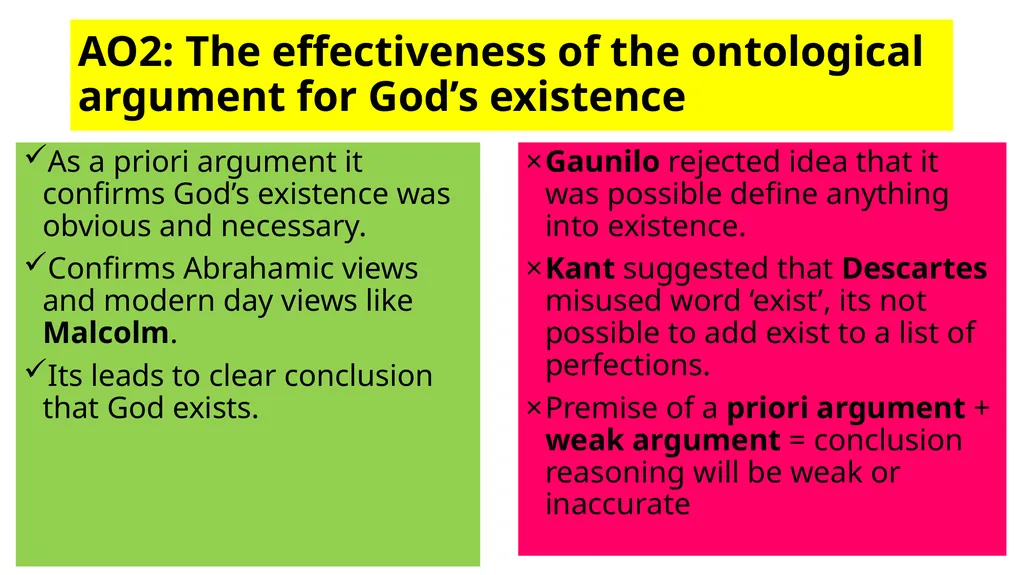
AO2: The effectiveness of the ontological argument for God’s existence As a priori argument it confirms God’s existence was obvious and necessary.
Confirms Abrahamic views and modern day views like Malcolm.
Its leads to clear conclusion that God exists. Gaunilo rejected idea that it was possible define anything into existence.
Kant suggested that Descartes misused word ‘exist’, its not possible to add exist to a list of perfections.
Premise of a priori argument + weak argument = conclusion reasoning will be weak or inaccurate<br>
05
AO2: Whether the ontological argument (Priori) is more persuasive than the cosmological/teleological (posteriori) arguments for God’s existence Based o the willingness of the individual to accept the deductive premises upon which is based (God nothing greater can be conceived). Gaunilo/Kant ontological argument fails entirely, existence follows from a definition is seen misleading and not persuasive.
Teleological (design) and Cosmological (cause) use empirical observation, empirical evidence is always valued in a modern scientific age. But why does the inductive reasoning have to be God?<br>
06
A02 Activity Consider each conclusion and collect evidence and examples to support your statement. Gather AO1 and AO2 arguments.
Now contrast this with a weak conclusion.<br>
07
The ontological argument effectively proves God’s existence beyond any reasonable doubt.<br>
08
Only later forms of the ontological argument are acceptable, the classical form from Anslem is entirely ineffective.<br>
09
Using the ontological argument to prove God’s existence is philosophically futile.<br>
10
The ontological argument’s effectiveness depends on your religious beliefs.<br>
11
The effectiveness of the ontological argument is undermined by modern scientific thought.<br>
12
The ontological argument is the most persuasive argument for the existence of God.<br>
13
The cosmological/ teleological arguments are the most persuasive arguments for the existence of God<br>
14
Neither cosmological/ teleological and ontological arguments are persuasive.<br>
15
Both the cosmological/ teleological and ontological arguments are persuasive.<br>
16
The cosmological/ teleological and ontological arguments relative persuasiveness will depend on the philosophical viewpoint of the individual.<br>
17
Read p48 of the text book, Use the Band descriptors to assess the Band. What are the strengths?<br>