Balancing Flexibility and Compliance in the COR Presenters 2 Karen Chow, ASCCC At-Large Representative Kris Costa, Vice President of Educational Services, Lemoore College Sarah Harris, 5C Member, College of the Sequoias Raul Arambula, Dean,
"Balancing Flexibility and Compliance in the COR" is the property of its rightful owner. Permission is granted to
download and print the materials on this website for personal, non-commercial use only, and to display it
on your personal computer provided you do not modify the materials and that you retain all copyright
notices contained in the materials. By downloading content from our website, you accept the terms of this
agreement.
Presentation Transcript
01
Balancing Flexibility and Compliance in the COR<br>
02
Presenters 2 Karen Chow, ASCCC At-Large Representative
Kris Costa, Vice President of Educational Services, Lemoore College
Sarah Harris, 5C Member, College of the Sequoias
Raul Arambula, Dean, Chancellor’s Office<br>
03
Description 3 As the California Community College Curriculum Committee (5C) awaits action on proposed Title 5 updates to incorporate DEIA in the COR, how can local and/or district curriculum committees and faculty be thinking proactively about integrating DEIA in their course outlines? In this session, presenters will cover current requirements for the COR and discuss how colleges can balance compliance needs with the flexibility to incorporate DEIA elements, as well as share ASCCC resources available to support this work.<br>
04
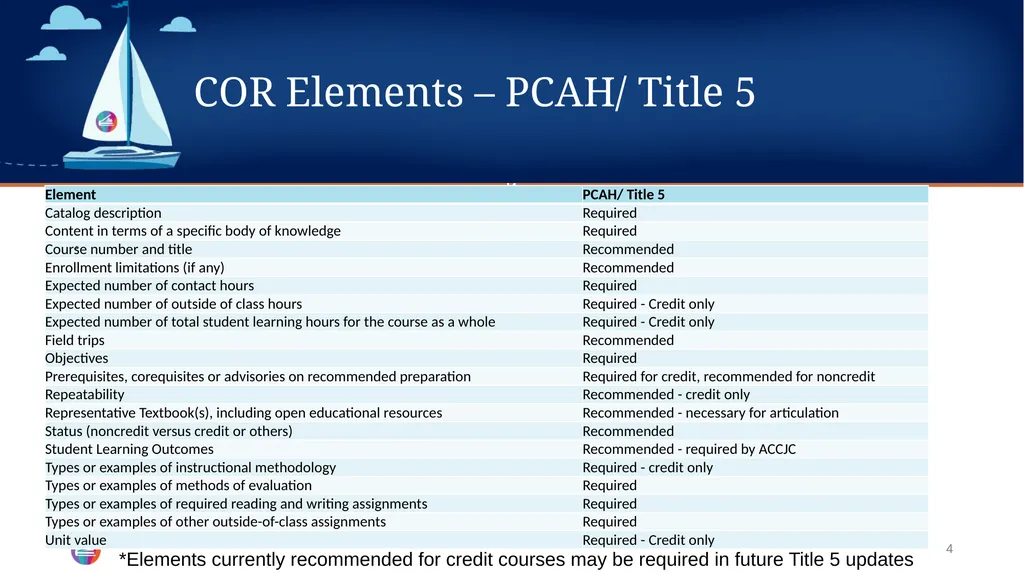
COR Elements – PCAH/ Title 5 . *Elements currently recommended for credit courses may be required in future Title 5 updates 4<br>
05
COR Elements – Other Considerations 5 Transfer/Articulation
C-ID
Accreditation
Common Course Numbering
College/District needs
COCI Updates<br>
06
COR Elements – Common Errors/ Omissions 6 Unit calculations
Identification of COR Elements
Content not separated
Content not clearly labeled
Current ADT alignment
Assist alignment/ changes (Title change, etc)
Current articulation by major<br>
07
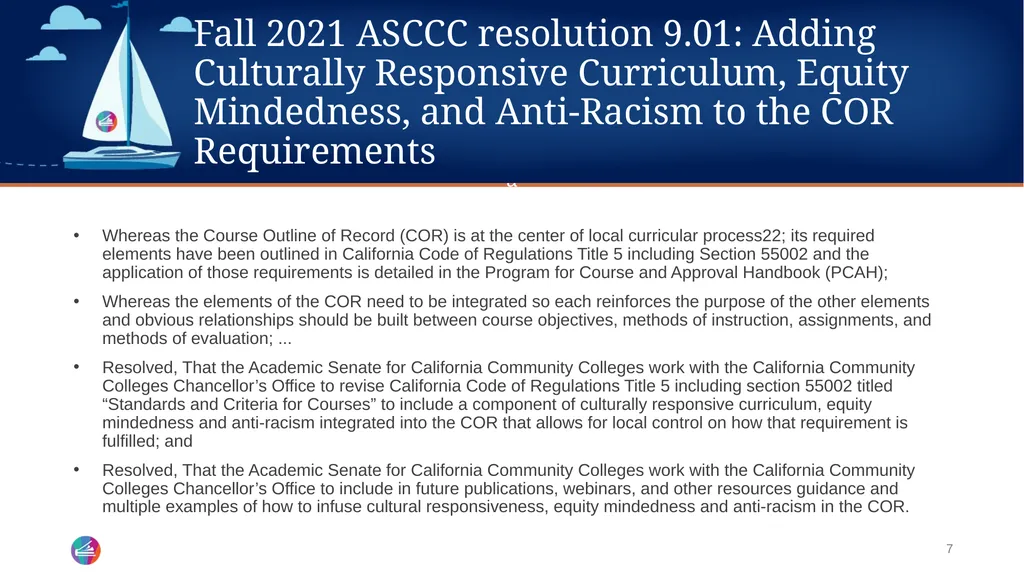
Fall 2021 ASCCC resolution 9.01: Adding Culturally Responsive Curriculum, Equity Mindedness, and Anti-Racism to the COR Requirements 7 Whereas the Course Outline of Record (COR) is at the center of local curricular process22; its required elements have been outlined in California Code of Regulations Title 5 including Section 55002 and the application of those requirements is detailed in the Program for Course and Approval Handbook (PCAH);
Whereas the elements of the COR need to be integrated so each reinforces the purpose of the other elements and obvious relationships should be built between course objectives, methods of instruction, assignments, and methods of evaluation; ...
Resolved, That the Academic Senate for California Community Colleges work with the California Community Colleges Chancellor’s Office to revise California Code of Regulations Title 5 including section 55002 titled “Standards and Criteria for Courses” to include a component of culturally responsive curriculum, equity mindedness and anti-racism integrated into the COR that allows for local control on how that requirement is fulfilled; and
Resolved, That the Academic Senate for California Community Colleges work with the California Community Colleges Chancellor’s Office to include in future publications, webinars, and other resources guidance and multiple examples of how to infuse cultural responsiveness, equity mindedness and anti-racism in the COR.<br>
08
In-Progress Title 5 Revisions 8 5C is drafting revisions to Title 5 55001 in response to ASCCC resolution
Revisions anticipated to BOG in September
Draft updates require curriculum committees to have training in DEIA and accessibility practices and to review outlines with these principles in mind<br>
09
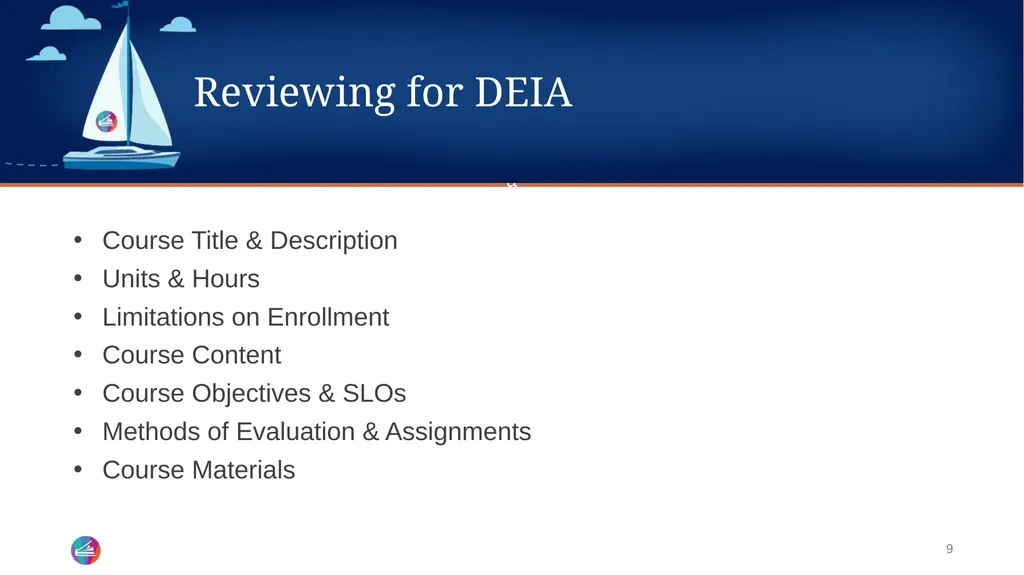
Reviewing for DEIA 9 Course Title & Description
Units & Hours
Limitations on Enrollment
Course Content
Course Objectives & SLOs
Methods of Evaluation & Assignments
Course Materials<br>
10
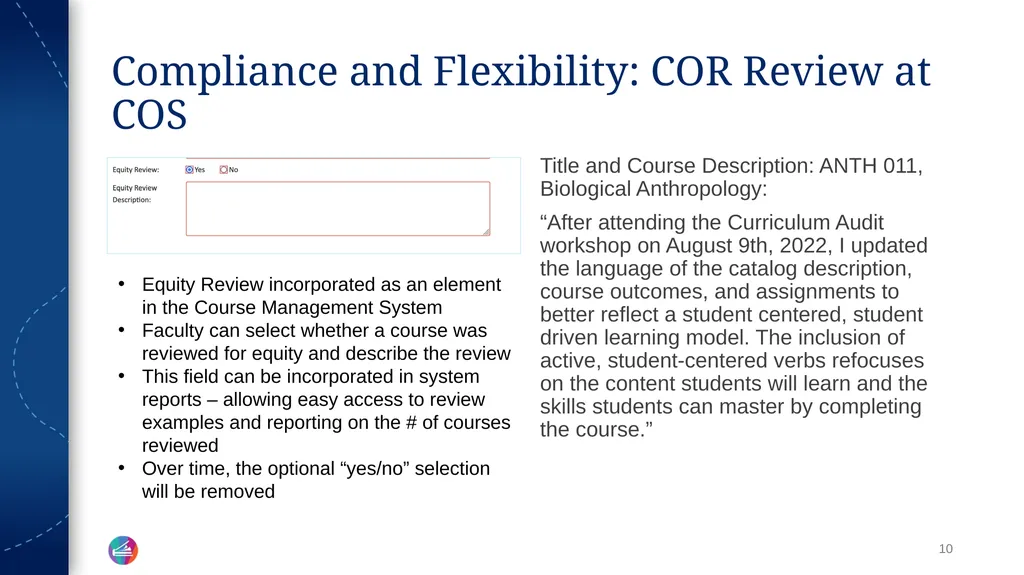
Compliance and Flexibility: COR Review at COS Equity Review incorporated as an element in the Course Management System
Faculty can select whether a course was reviewed for equity and describe the review
This field can be incorporated in system reports – allowing easy access to review examples and reporting on the # of courses reviewed
Over time, the optional “yes/no” selection will be removed Title and Course Description: ANTH 011, Biological Anthropology:
“After attending the Curriculum Audit workshop on August 9th, 2022, I updated the language of the catalog description, course outcomes, and assignments to better reflect a student centered, student driven learning model. The inclusion of active, student-centered verbs refocuses on the content students will learn and the skills students can master by completing the course.” 10<br>
11
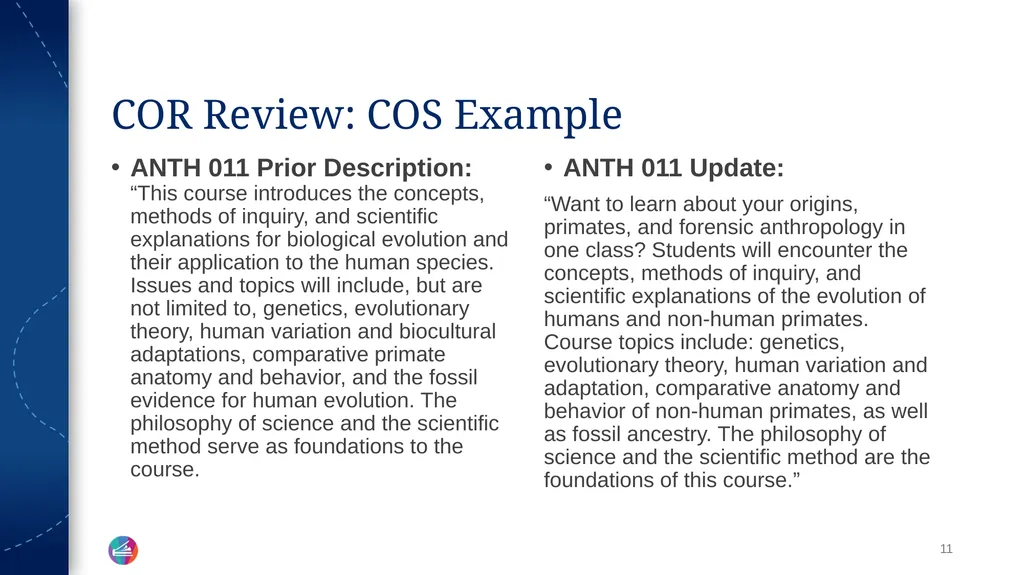
COR Review: COS Example ANTH 011 Prior Description: “This course introduces the concepts, methods of inquiry, and scientific explanations for biological evolution and their application to the human species. Issues and topics will include, but are not limited to, genetics, evolutionary theory, human variation and biocultural adaptations, comparative primate anatomy and behavior, and the fossil evidence for human evolution. The philosophy of science and the scientific method serve as foundations to the course. ANTH 011 Update:
“Want to learn about your origins, primates, and forensic anthropology in one class? Students will encounter the concepts, methods of inquiry, and scientific explanations of the evolution of humans and non-human primates. Course topics include: genetics, evolutionary theory, human variation and adaptation, comparative anatomy and behavior of non-human primates, as well as fossil ancestry. The philosophy of science and the scientific method are the foundations of this course.” 11<br>
12
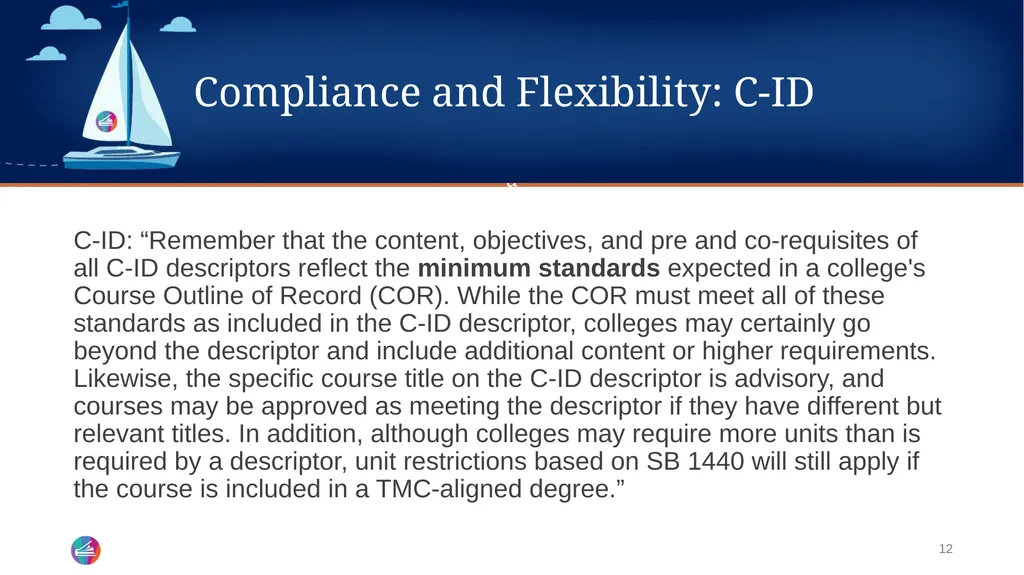
Compliance and Flexibility: C-ID 12 C-ID: “Remember that the content, objectives, and pre and co-requisites of all C-ID descriptors reflect the minimum standards expected in a college's Course Outline of Record (COR). While the COR must meet all of these standards as included in the C-ID descriptor, colleges may certainly go beyond the descriptor and include additional content or higher requirements. Likewise, the specific course title on the C-ID descriptor is advisory, and courses may be approved as meeting the descriptor if they have different but relevant titles. In addition, although colleges may require more units than is required by a descriptor, unit restrictions based on SB 1440 will still apply if the course is included in a TMC-aligned degree.”<br>
13
Compliance and Flexibility: Accreditation 13 2.2. The institution, relying on faculty and other appropriate stakeholders, designs and delivers academic programs that reflect relevant discipline and industry standards and support equitable attainment of learning outcomes and achievement of educational goals. (ER 3, ER 9, ER 11, ER 14)
2.6. The institution uses delivery modes and teaching methodologies that meet student and curricular needs and promote equitable student learning and achievement.
ACCJC policy on Social Justice (2024)- institutional improvement, staffing and resources, governance and responsibilities to support equitable success<br>
14
DEIA in Praxis 14 DEIA in Praxis is a Canvas course with resources that build upon the DEI in Curriculum: Model Principles and Practices toolkit.
Includes model questions, ideas, and resources to support deeper levels of local implemention of transformative change in curricular practices and mindsets based on equity-minded foundations and critical inquiries of practices.
Found at asccc.org's IDEAA Resources tab: https://asccc.org/asccc-inclusion-diversity-equity-anti-racism-and-accessibility-ideaa-tools<br>
15
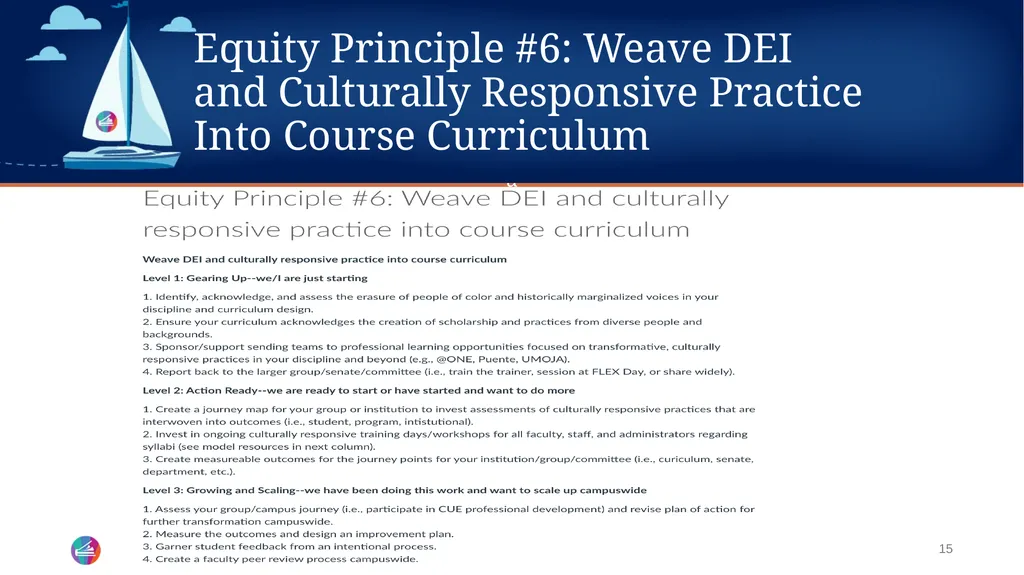
Equity Principle #6: Weave DEI and Culturally Responsive Practice Into Course Curriculum 15<br>
16
Q&A 16 Thank you for joining us!
Questions? Contact: info@asccc.org<br>
17
References & Resources 17 DEIA in Curriculum Model Principles and Practices: https://www.asccc.org/sites/default/files/CCC_DEI-in-Curriculum_Model_Principles_and_Practices_June_2022.pdf
ASCCC DEIA in Praxis: https://deanza.instructure.com/courses/34140