Basic HIV Course for Health Professionals Session 12: Contraceptives and HIV Learning Objectives By the end of this session participants should be able to: Describe at least three methods of contraceptives that are suitable for an HIV
"Basic HIV Course for Health Professionals Session" is the property of its rightful owner. Permission is granted to
download and print the materials on this website for personal, non-commercial use only, and to display it
on your personal computer provided you do not modify the materials and that you retain all copyright
notices contained in the materials. By downloading content from our website, you accept the terms of this
agreement.
Presentation Transcript
01
Basic HIV Course for Health Professionals Session 12: Contraceptives and HIV<br>
02
Learning Objectives By the end of this session participants should be able to:
Describe at least three methods of contraceptives that are suitable for an HIV positive patient on ART
Understands hormonal drug interactions
Be able to counsel women who wants to conceive on DTG<br>
03
Role of Contraceptive Services (1) Contraceptive services can:
Be sources of information and methods
Assist with preventing HIV transmission
Help patients consider effects of HIV on family health
Assist patients to make informed reproductive health (RH) choices<br>
04
Role of Contraceptive Services (2) People living with HIV need to think about:
Fertility decision:
Desire pregnancy?
Informed decisions:
Contraceptive method?
STI prevention?
Treatment decisions:
ART for self and partner?
EMTCT?<br>
05
Factors Affecting Decision to Use Contraception Health/well-being of self, partner, children
Access to ARV therapy
Fears related to disclosing HIV status (rejection, violence, financial loss)
Knowledge about contraceptives (including cultural myths and misconceptions)
Gender issues/partner opposition
Stigma regarding condom use<br>
06
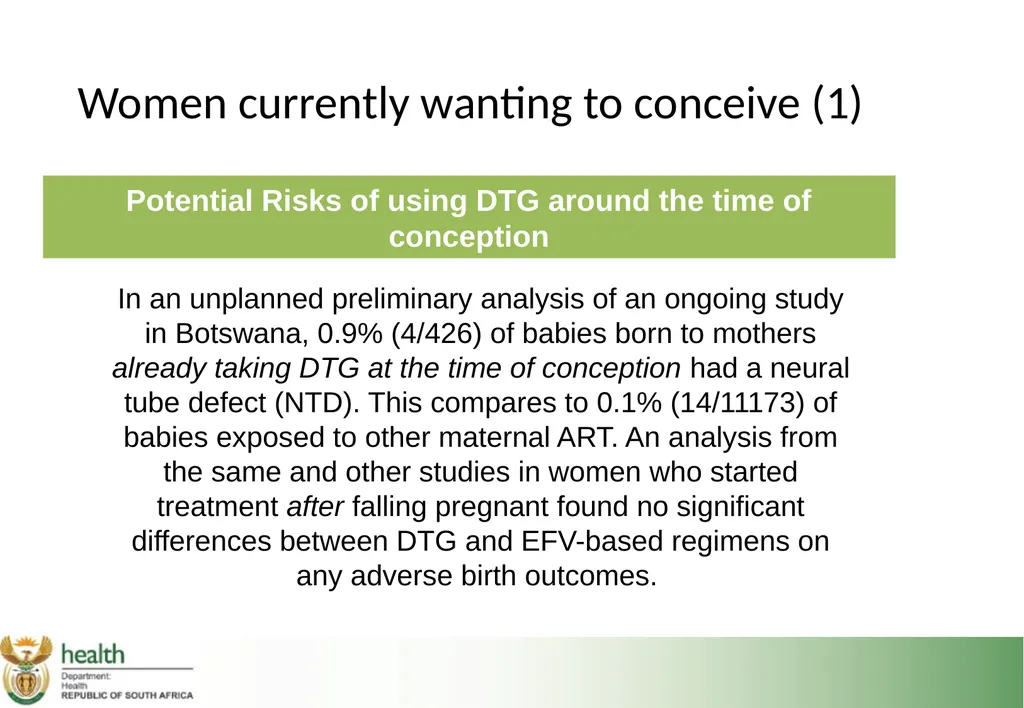
Potential Risks of using DTG around the time of conception In an unplanned preliminary analysis of an ongoing study in Botswana, 0.9% (4/426) of babies born to mothers already taking DTG at the time of conception had a neural tube defect (NTD). This compares to 0.1% (14/11173) of babies exposed to other maternal ART. An analysis from the same and other studies in women who started treatment after falling pregnant found no significant differences between DTG and EFV-based regimens on any adverse birth outcomes. Women currently wanting to conceive (1)<br>
07
Women should be counseled about the potential risk of NTDs when DTG is taken around the time of conception, and be allowed to make an informed choice.
For women starting ART
It is not recommended that women wishing to conceive be started on DTG: woman taking or starting DTG should be on effective contraception and folic acid supplements.
For women already on a DTG-containing regimen
Once she is taking DTG, fertility intentions should be discussed at every visit. Should she desire a pregnancy, it is recommended that DTG be switched to EFV.
If she chooses to start/remain on DTG, despite wanting to conceive and having received appropriate counselling, her choice should be documented in her clinical file Potential Risks of using DTG around the time of conception Women currently wanting to conceive (2)<br>
08
If she is currently in the 1st trimester, discuss with a doctor. If her gestational age can be accurately determined and the neural tube has already closed (6 weeks post-conception), she may be able to remain on her DTG-containing regimen
If she is in the 2nd or 3rd trimester, continue DTG. Counsel the mother on the risks of NTD’s for her subsequent pregnancies and discuss the need for contraception after delivery.
Enter her into the Antiretroviral pregnancy register (http://www.APRegistry.com/) Women who fall pregnant on DTG Women currently wanting to conceive (3)<br>
09
Factors Affecting Method Choice Women with HIV should consider:
Safety and effectiveness of method
Whether it is short-term, long-term, or permanent
Possible side effects
Ease of use
Cost and access to resupply
Effect on breastfeeding (if postpartum)
How method interacts with other medications including ART
Whether it provides protection from HIV/STI transmission and acquisition
Whether partner involvement or negotiation is required<br>
10
Drug-Drug Interactions with Hormonal Contraceptive Methods (1) Women should be counseled about the possibility of drug interactions between hormonal contraceptives and enzyme inducing drugs such as Efavirenz, Rifampicin, and certain epilepsy drugs.
These interactions do not decrease the effectiveness of the HIV or TB medications but can potentially lead to decreased effectiveness of some hormonal contraceptive methods
Providers should always ask which specific HIV or TB medications a woman is taking in order to appropriately advise her on interactions
The long acting injectables (e.g. Depo Provera®) are not affected by drug-drug interactions with HIV medications or Rifampicin and so remain very effective at preventing pregnancy. There is no need to reduce the interval between injections<br>
11
Drug-Drug Interactions with Hormonal Contraceptive Methods (2) All hormonal methods including implants (e.g. Implanon NXT®), the combined oral contraceptive pills (COCP), and the long acting injectables (e.g. Depo Provera®) are safe to use with Dolutegravir
The effectiveness of the hormonal implant (e.g. Implanon NXT®) is reduced when used with Efavirenz (NNRTI). Women who are already using an implant should consider an alternative non-hormonal method for contraception e.g. the IUCD
The COCP has reduced effectiveness with both efavirenz and rifampicin. They remain unreliable and should best be avoided
Regardless of the hormonal method used to prevent pregnancy, all women should continue to use condoms correctly and consistently to prevent transmission of HIV and other STIs.<br>
12
Contraceptive Method Options Refer to pages 178 - 179 of your participant manual to see a chart about contraceptive method options<br>