
Basic Practices of Freezing Food Washington State


Description: Basic Practices of Freezing Food Washington State University Sandy Brown Faculty Emeritus WHY FREEZING? Advantages: Easiest form of preservation for most foods. Less time consuming than canning or drying. Provides product closest to fresh
Related Topics
Download Presentation
"Basic Practices of Freezing Food Washington State" is the property of its rightful owner. Permission is granted to download and print the materials on this website for personal, non-commercial use only, and to display it on your personal computer provided you do not modify the materials and that you retain all copyright notices contained in the materials. By downloading content from our website, you accept the terms of this agreement.
Presentation Transcript
slide1. Basic Practices of Freezing Food
Washington State University
Sandy Brown
Faculty Emeritus<br>
slide2. WHY FREEZING? Advantages:
Easiest form of preservation for most foods.
Less time consuming than canning or drying.
Provides product closest to fresh
Good natural color and flavor retention.
Best nutritive value retention.
Adds convenience to food preparation.
Proportions can be adapted to needs unlike other methods.
Kitchen remains somewhat cool and comfortable.
Disadvantages:
Texture of some foods is undesirable because of changes due to the freezing process.
Product loses quality more quickly.
Initial investment and cost of maintaining a freezer is high.
Storage space is limited by how much the freezer will hold.<br>
slide3. FREEZER FACTS Determining the appropriate freezer size:
One cubic food holds 35 pounds of frozen food.
Freeze 4-6 cubic feet of food per person.
Freezer Facts
Stand-alone freezers maintain 0°F or below.
Refrigerator freezers only maintain about 15°F.
Defrost when frost is ½ inch thick.
Thick ice increases energy costs and reduces storage space.
Keep freezer full for best storage and energy use.<br>
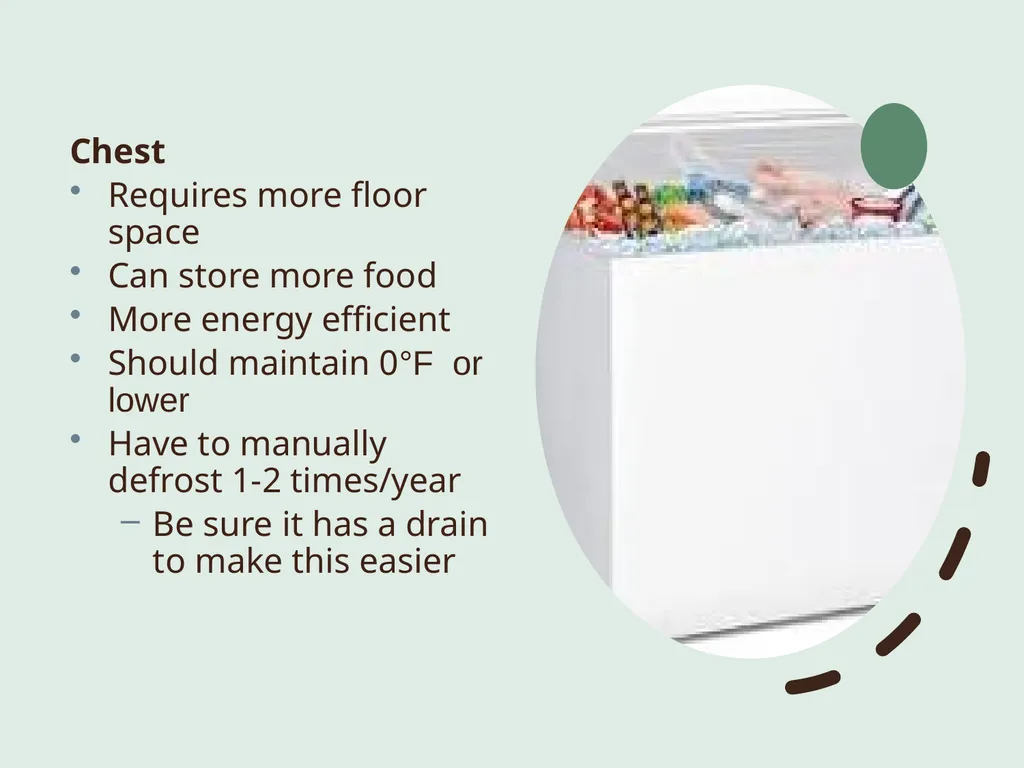
slide4. Types of Freezers Chest
Requires more floor space
Can store more food
More energy efficient
Should maintain 0°F or lower
Have to manually defrost 1-2 times/year
Be sure it has a drain to make this easier<br>
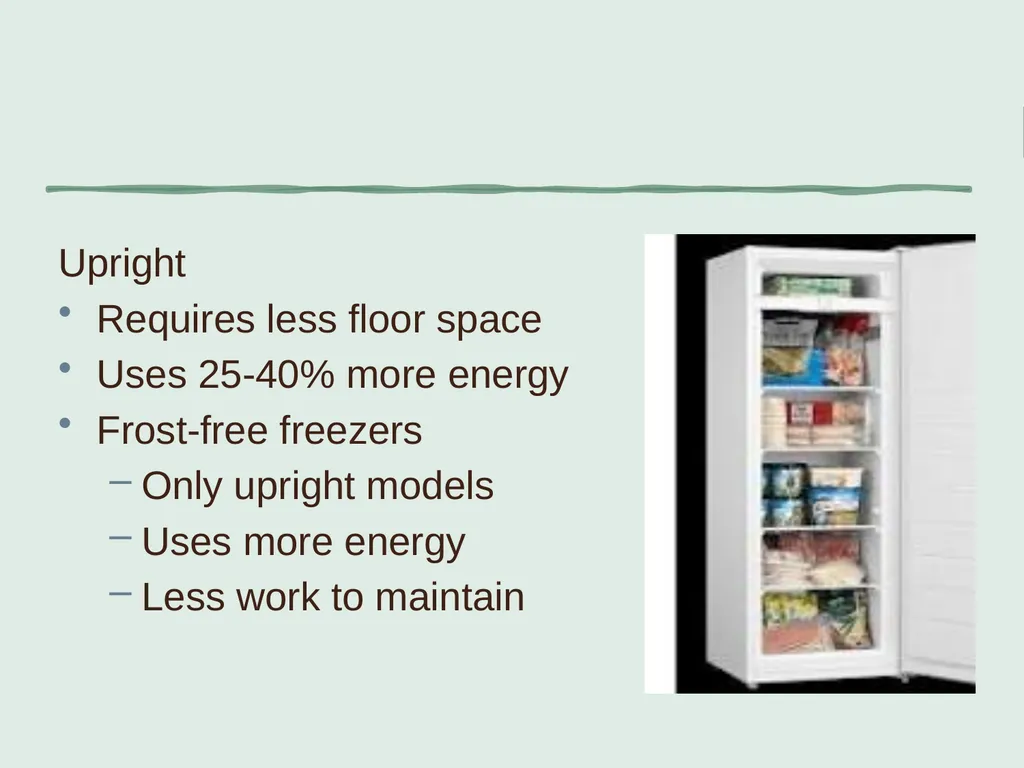
slide5. Types of Freezers Upright
Requires less floor space
Uses 25-40% more energy
Frost-free freezers
Only upright models
Uses more energy
Less work to maintain<br>
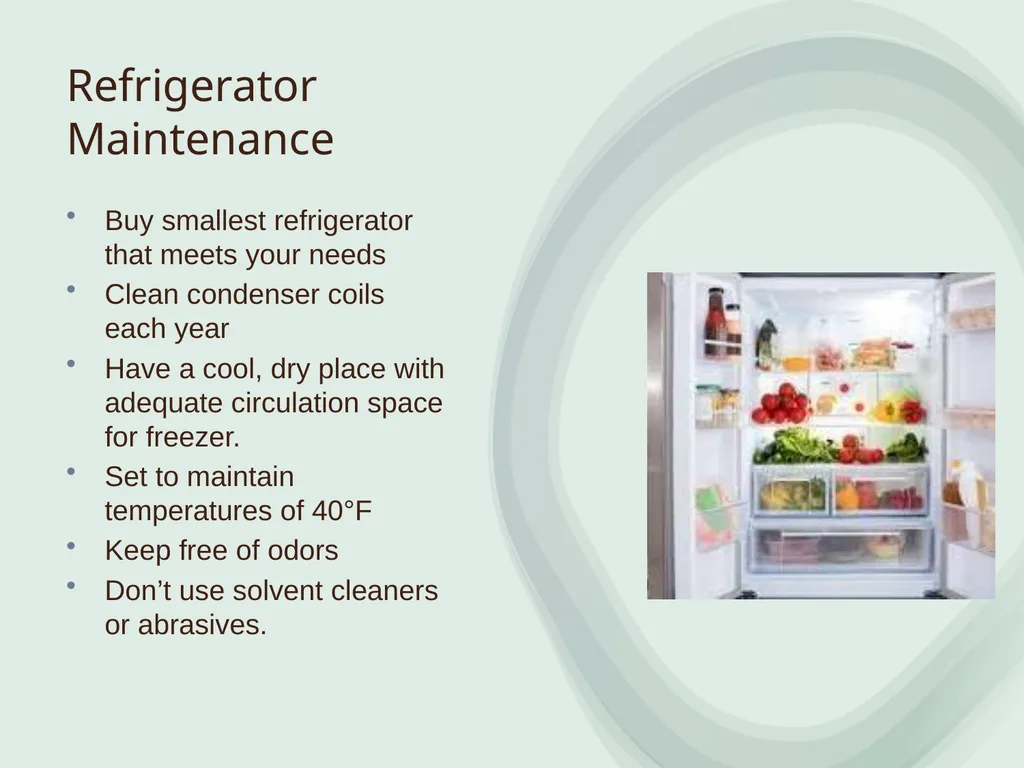
slide6. Refrigerator Maintenance Buy smallest refrigerator that meets your needs
Clean condenser coils each year
Have a cool, dry place with adequate circulation space for freezer.
Set to maintain temperatures of 40°F
Keep free of odors
Don’t use solvent cleaners or abrasives.<br>
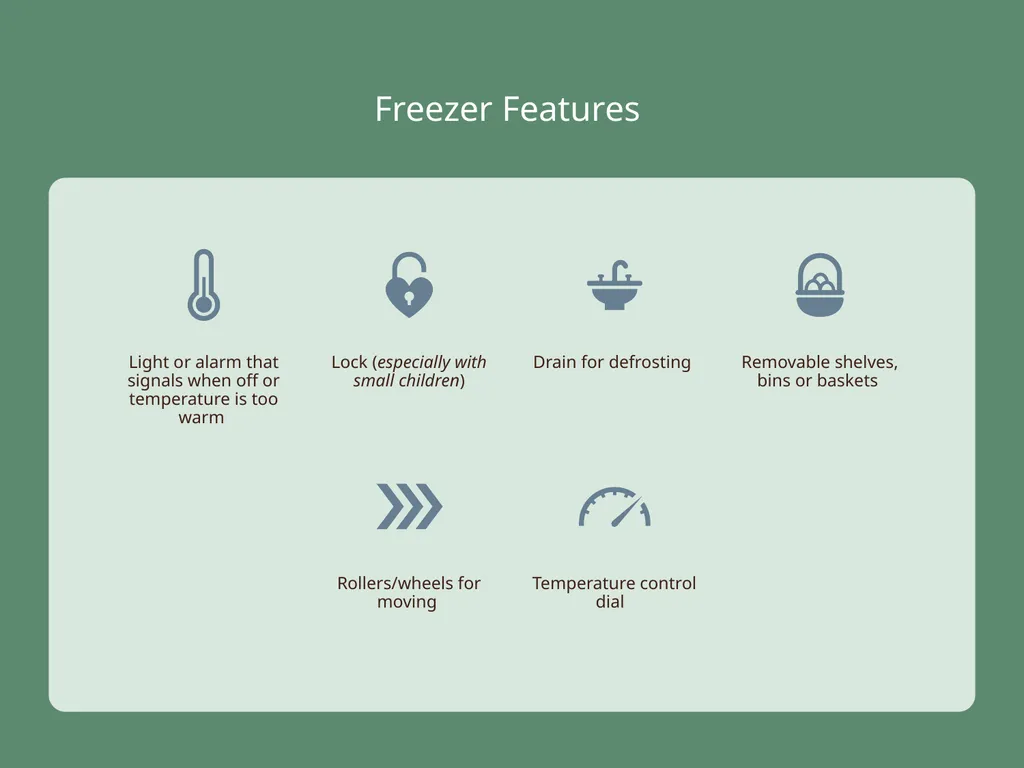
slide7. Freezer Features<br>
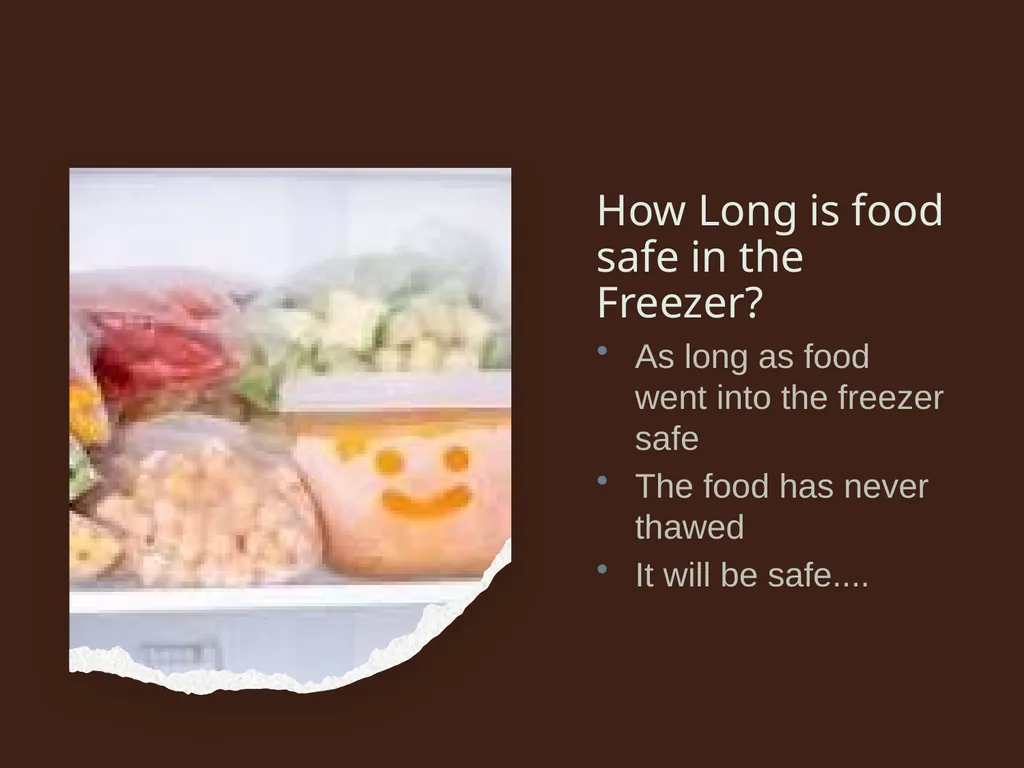
slide8. How Long is food safe in the Freezer? As long as food went into the freezer safe
The food has never thawed
It will be safe....<br>
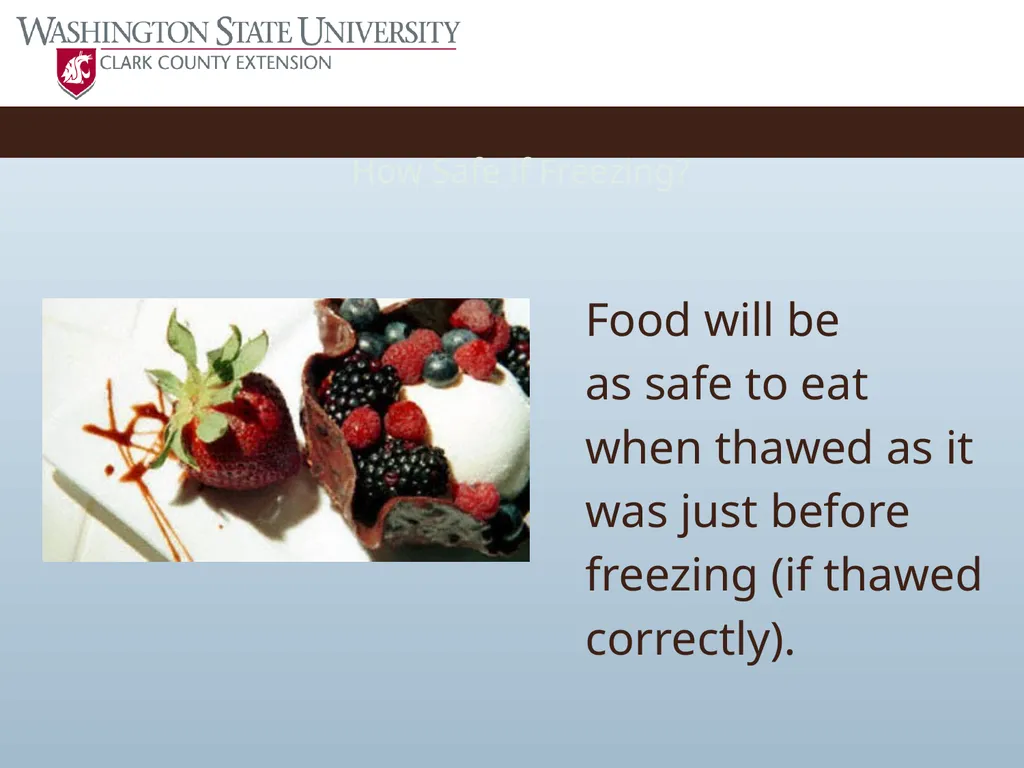
slide9. How Safe if Freezing? Food will be
as safe to eat
when thawed as it
was just before
freezing (if thawed
correctly).<br>
slide10. Why So Safe? Microbial growth (pathogens and spoilage bacteria) stops at 28°F.
Chemical changes occur at a very reduced rate.<br>
slide11. Safety of Frozen Foods Freezing does destroy some bacteria and parasites.
Because all organisms are not destroyed, good food handling skills are needed to control bacterial during thawing and once thawed.<br>
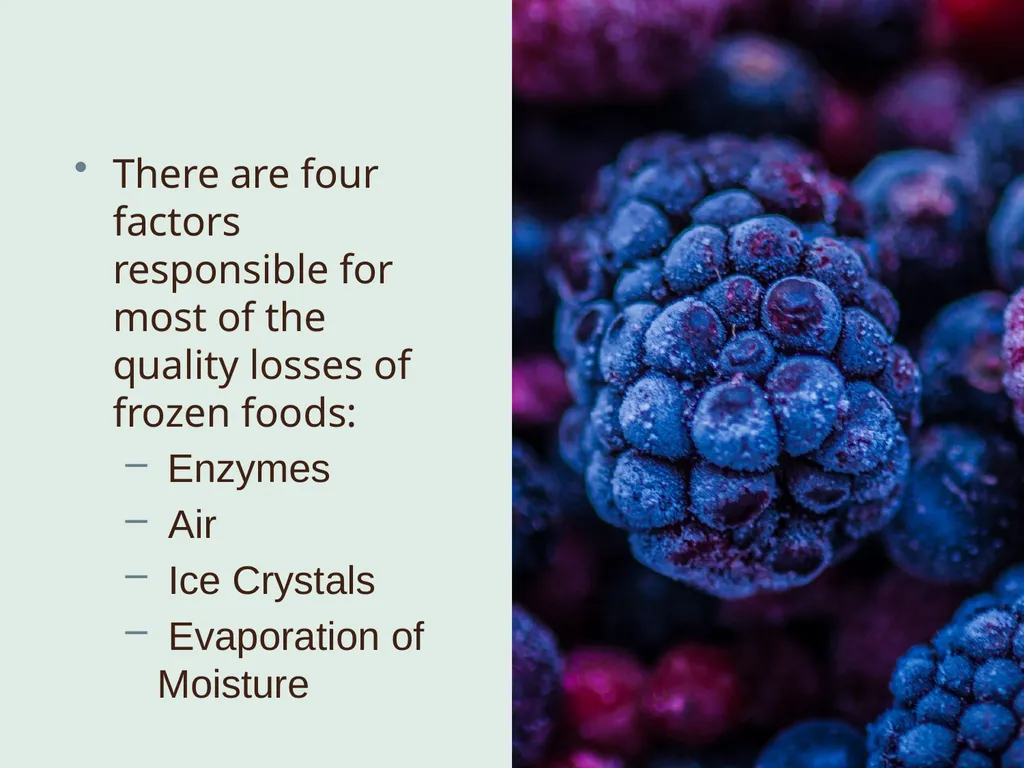
slide12. FREEZING PRINCIPLES There are four factors responsible for most of the quality losses of frozen foods:
Enzymes
Air
Ice Crystals
Evaporation of Moisture<br>
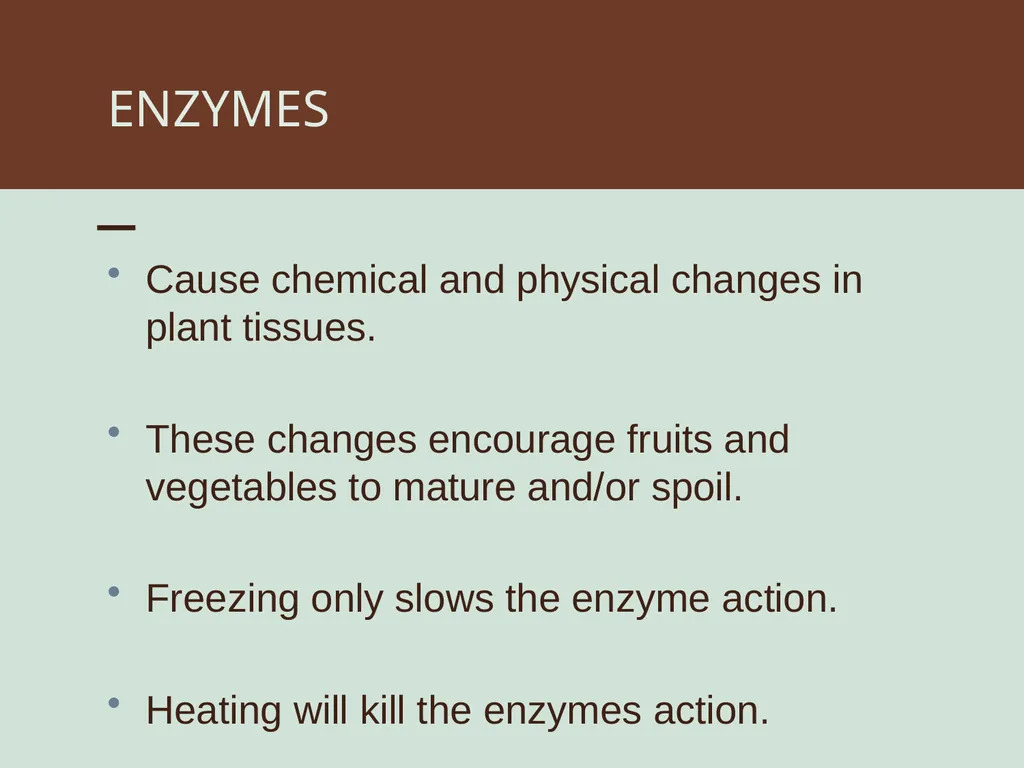
slide13. ENZYMES Cause chemical and physical changes in plant tissues.
These changes encourage fruits and vegetables to mature and/or spoil.
Freezing only slows the enzyme action.
Heating will kill the enzymes action.<br>
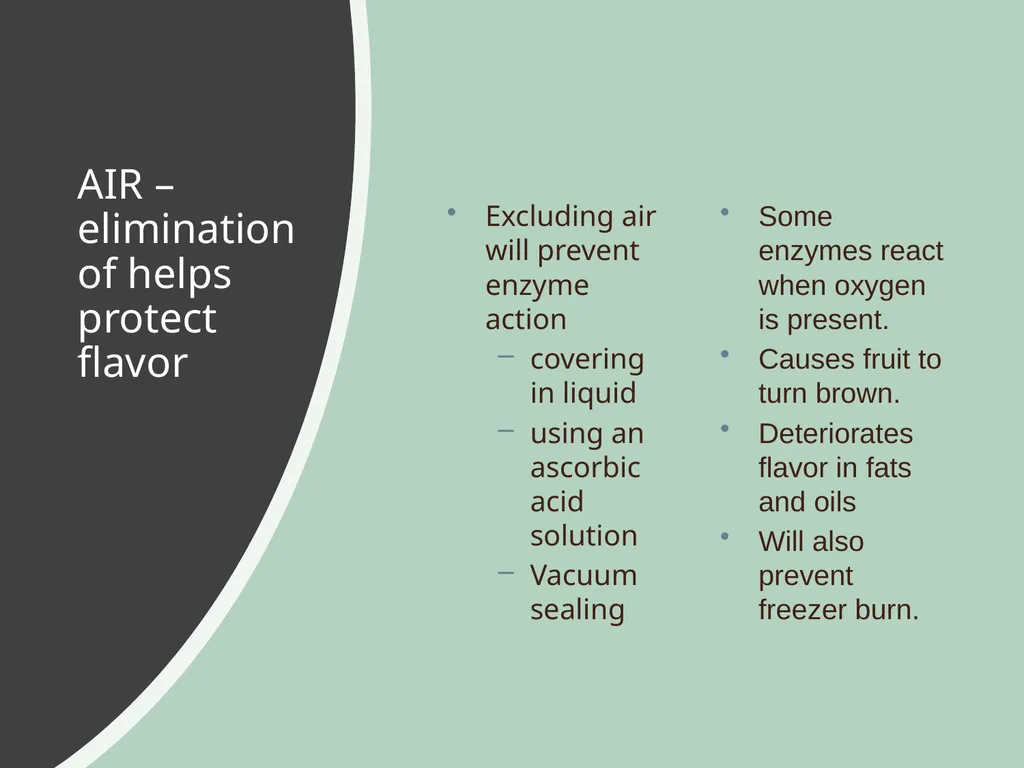
slide14. AIR – elimination of helps protect flavor Excluding air will prevent enzyme action
covering in liquid
using an ascorbic acid solution
Vacuum sealing Some enzymes react when oxygen is present.
Causes fruit to turn brown.
Deteriorates flavor in fats and oils
Will also prevent freezer burn.<br>
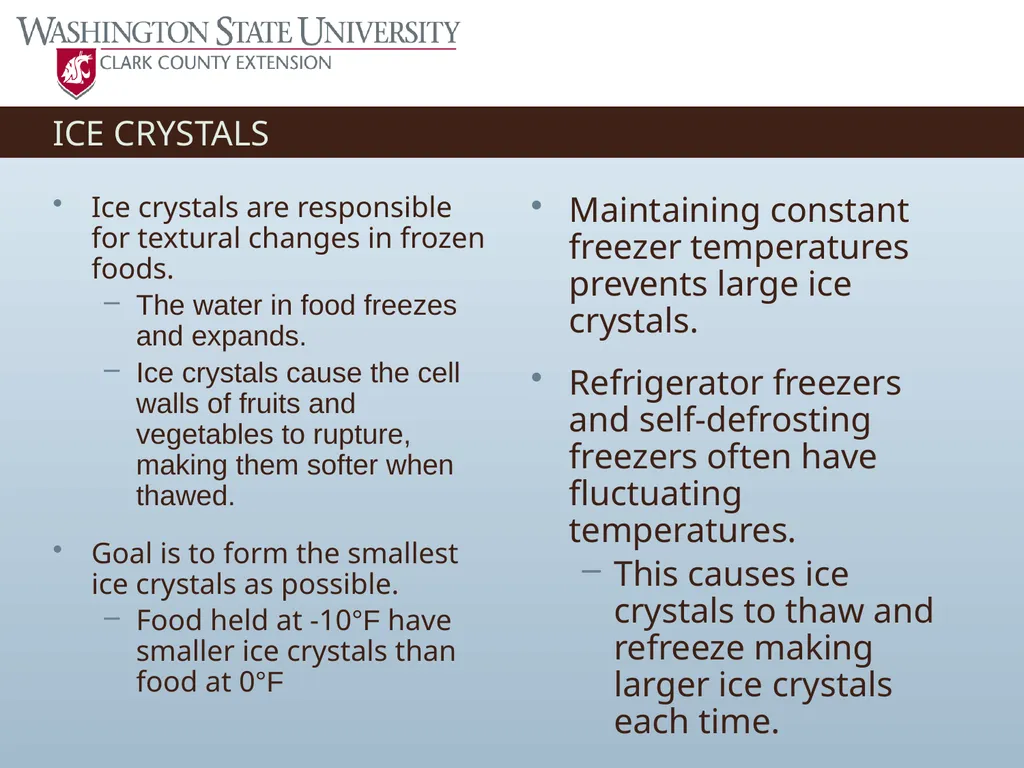
slide15. ICE CRYSTALS Ice crystals are responsible for textural changes in frozen foods.
The water in food freezes and expands.
Ice crystals cause the cell walls of fruits and vegetables to rupture, making them softer when thawed.
Goal is to form the smallest ice crystals as possible.
Food held at -10°F have smaller ice crystals than food at 0°F Maintaining constant freezer temperatures prevents large ice crystals.
Refrigerator freezers and self-defrosting freezers often have fluctuating temperatures.
This causes ice crystals to thaw and refreeze making larger ice crystals each time.<br>
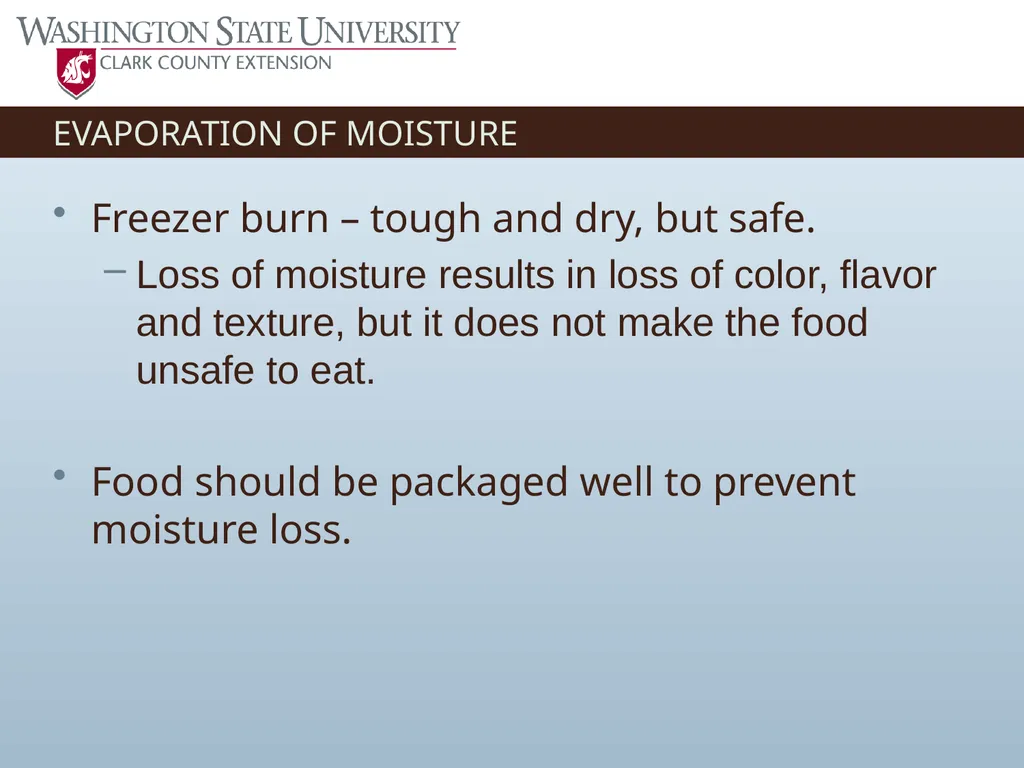
slide16. EVAPORATION OF MOISTURE Freezer burn – tough and dry, but safe.
Loss of moisture results in loss of color, flavor and texture, but it does not make the food unsafe to eat.
Food should be packaged well to prevent moisture loss.<br>
slide17. FOOD PACKAGING FOR FREEZING Moisture-vapor resistant.
Durable and leak proof.
Resistant to cracking at low temperatures.
Resistant to oil, grease, water.
Able to protect foods from absorbing odors and off-flavors.
Easy to seal and label.
Food will come out easily.<br>
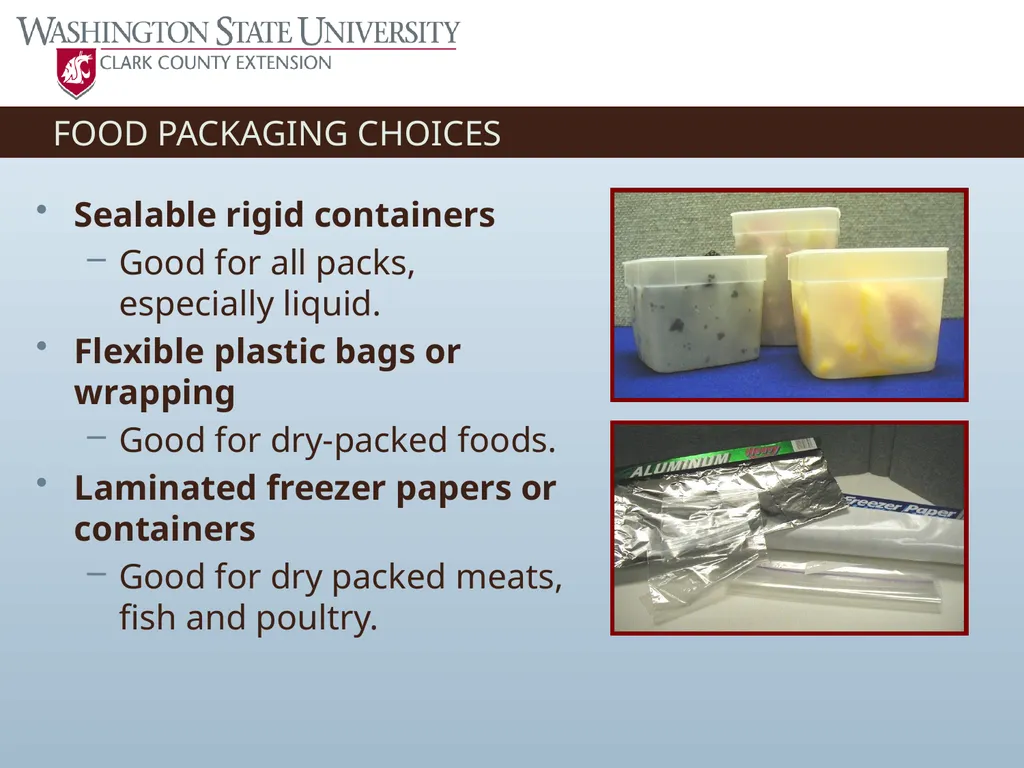
slide18. FOOD PACKAGING CHOICES Sealable rigid containers
Good for all packs, especially liquid.
Flexible plastic bags or wrapping
Good for dry-packed foods.
Laminated freezer papers or containers
Good for dry packed meats, fish and poultry.<br>
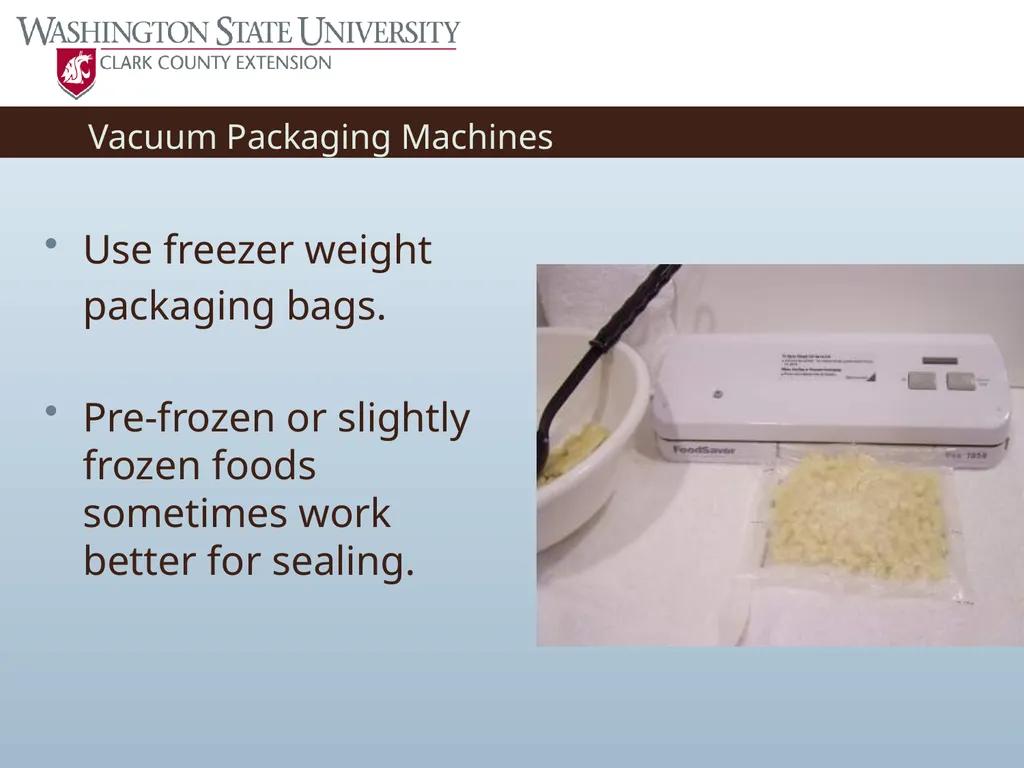
slide19. Vacuum Packaging Machines Use freezer weight
packaging bags.
Pre-frozen or slightly frozen foods sometimes work better for sealing.<br>
slide20. UNSUITABLE CONTAINERS Those that are not moisture-vapor proof enough.
Waxed paper.
Paper or milk cartons.
Rigid carton with cracks or poor fitting lids.
Re-used plastic dairy or meat containers (e.g. cottage cheese, yogurt, deli-meat containers)
Any containers used for ‘storage’ versus ‘freezing’<br>
slide21. Headspace for Frozen Foods Foods with Liquid: Wide opening: ½-inch per pint: 1 inch per quart
Narrow opening: ¾-inch per pint; 1 ½-inch per quart Foods without liquid: ½ inch for all containers
Foods that pack loosely need no headspace (e.g. green beans or broccoli)<br>
slide22. FREEZING QUALITY FOODS Set the freezer to 0°F or below 24 hours in advance.
Chill foods before freezing and freeze as soon as packaged.
Freeze 2-3 pounds per cubic foot at a time – overloading with unfrozen food will slow freezing time.
Remember slow freezing causes larger ice crystals.<br>
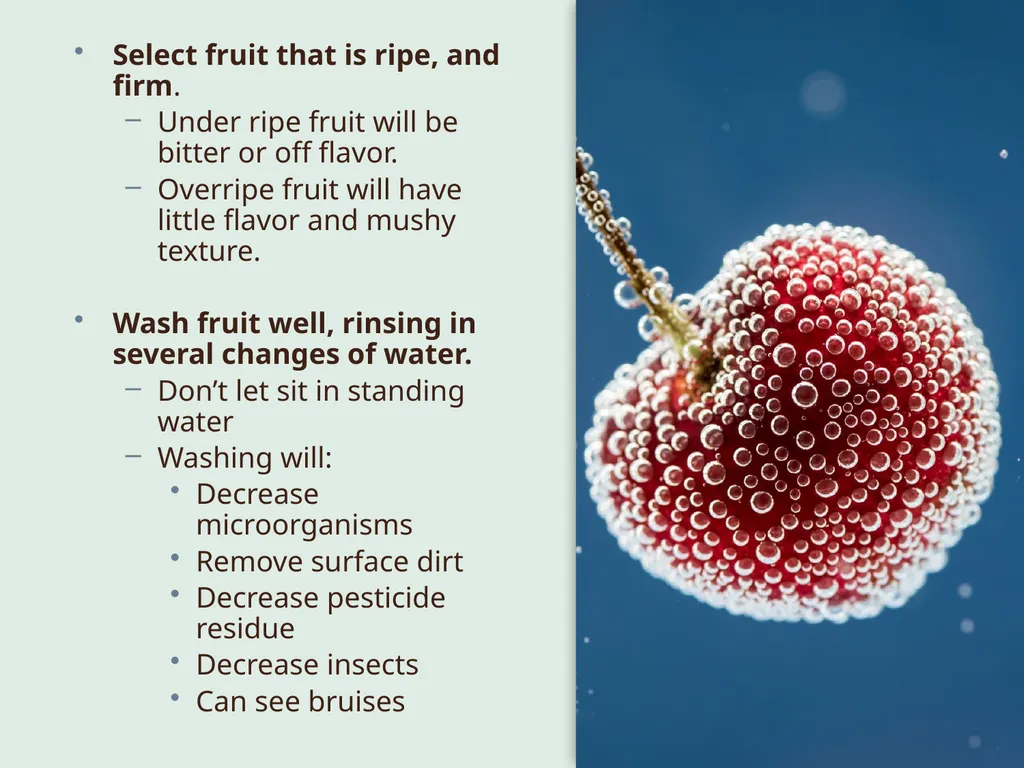
slide23. SELECTING & PREPARING FRUITS FOR FREEZING Select fruit that is ripe, and firm.
Under ripe fruit will be bitter or off flavor.
Overripe fruit will have little flavor and mushy texture.
Wash fruit well, rinsing in several changes of water.
Don’t let sit in standing water
Washing will:
Decrease microorganisms
Remove surface dirt
Decrease pesticide residue
Decrease insects
Can see bruises<br>
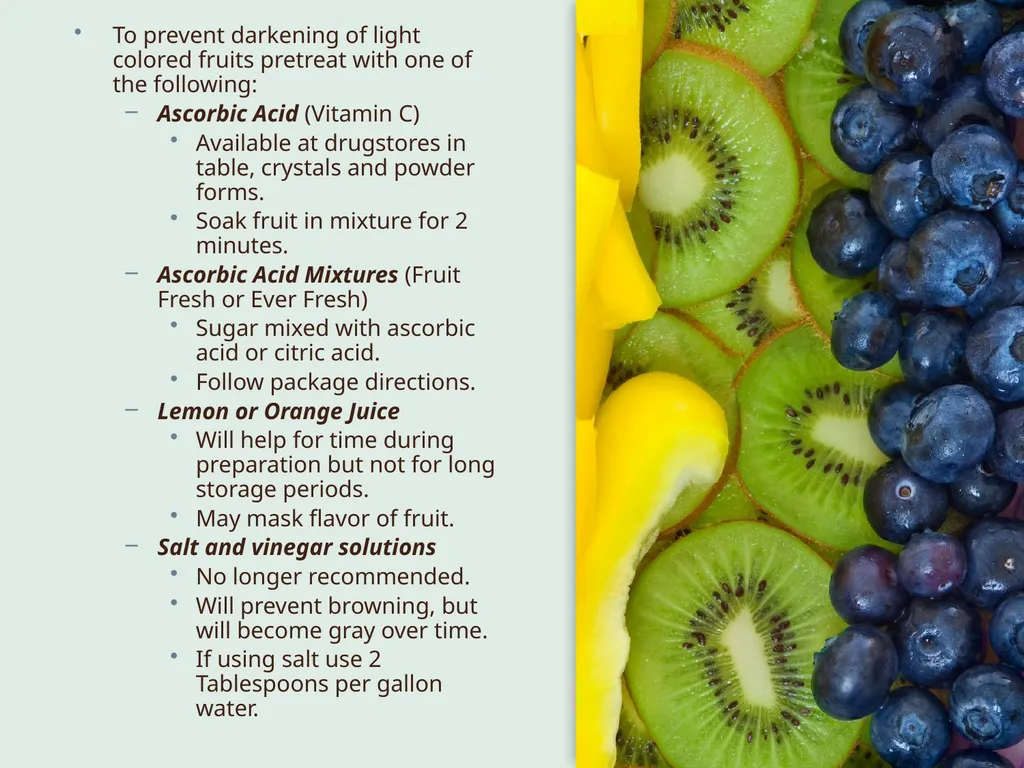
slide24. PRETREATING FRUITS FOR FREEZING To prevent darkening of light colored fruits pretreat with one of the following:
Ascorbic Acid (Vitamin C)
Available at drugstores in table, crystals and powder forms.
Soak fruit in mixture for 2 minutes.
Ascorbic Acid Mixtures (Fruit Fresh or Ever Fresh)
Sugar mixed with ascorbic acid or citric acid.
Follow package directions.
Lemon or Orange Juice
Will help for time during preparation but not for long storage periods.
May mask flavor of fruit.
Salt and vinegar solutions
No longer recommended.
Will prevent browning, but will become gray over time.
If using salt use 2 Tablespoons per gallon water.<br>
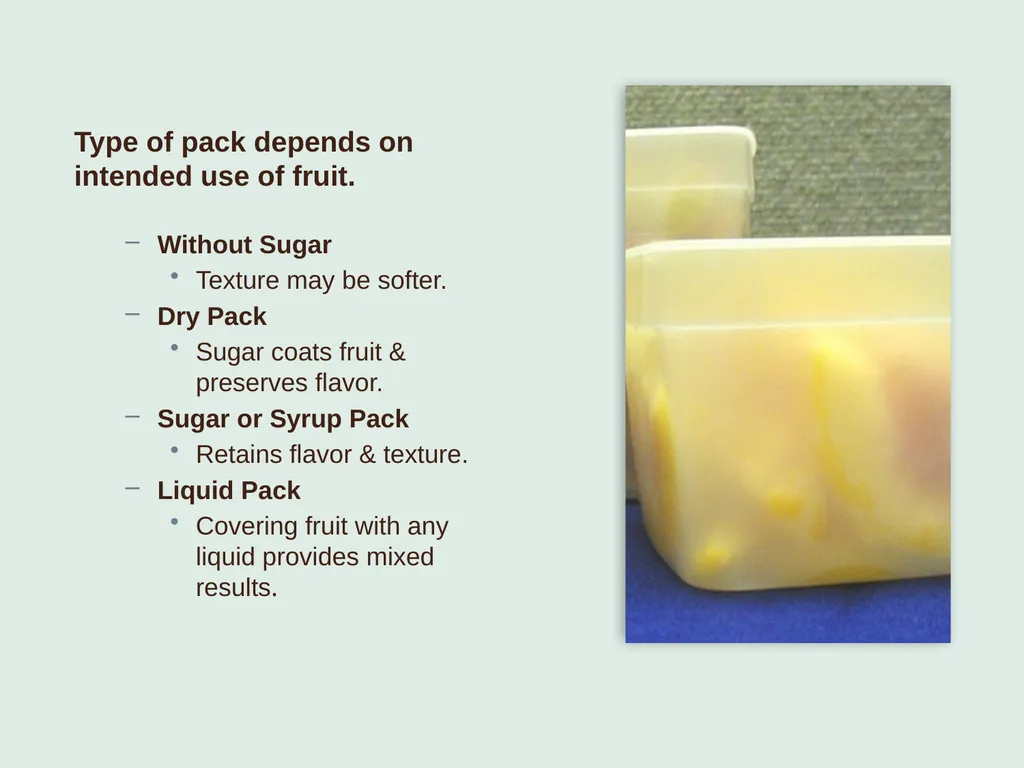
slide25. PACKING FRUITS FOR FREEZING Type of pack depends on intended use of fruit.
Without Sugar
Texture may be softer.
Dry Pack
Sugar coats fruit & preserves flavor.
Sugar or Syrup Pack
Retains flavor & texture.
Liquid Pack
Covering fruit with any liquid provides mixed results.<br>
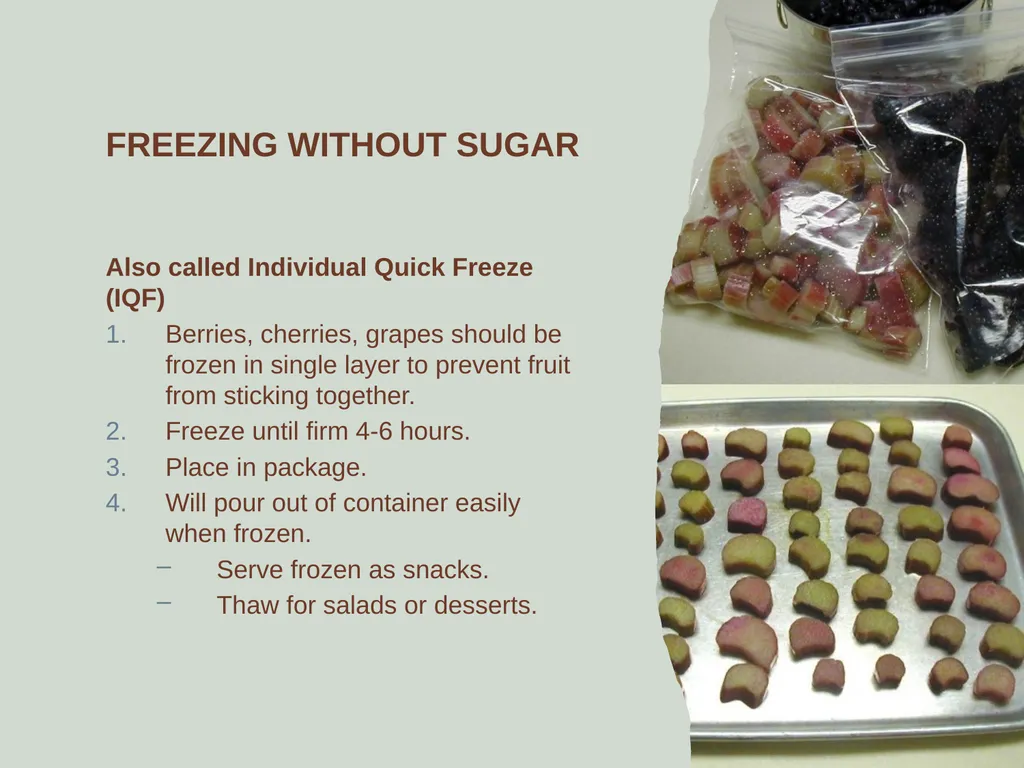
slide26. FREEZING WITHOUT SUGAR Also called Individual Quick Freeze (IQF)
Berries, cherries, grapes should be frozen in single layer to prevent fruit from sticking together.
Freeze until firm 4-6 hours.
Place in package.
Will pour out of container easily when frozen.
Serve frozen as snacks.
Thaw for salads or desserts.<br>
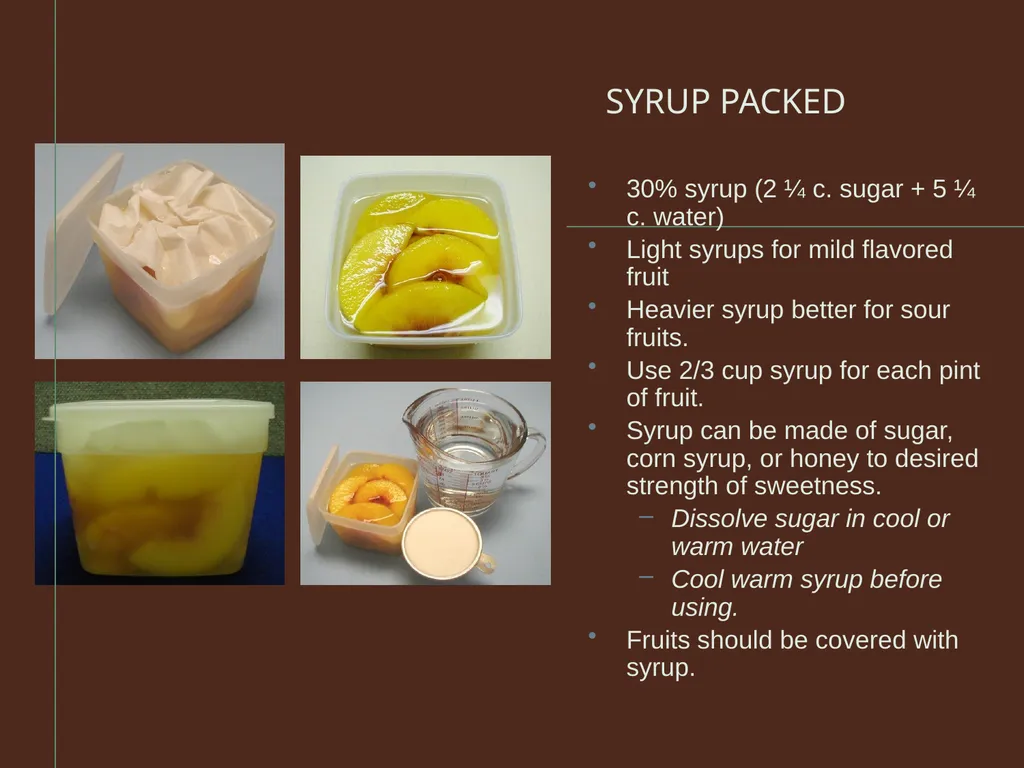
slide27. SYRUP PACKED 30% syrup (2 ¼ c. sugar + 5 ¼ c. water)
Light syrups for mild flavored fruit
Heavier syrup better for sour fruits.
Use 2/3 cup syrup for each pint of fruit.
Syrup can be made of sugar, corn syrup, or honey to desired strength of sweetness.
Dissolve sugar in cool or warm water
Cool warm syrup before using.
Fruits should be covered with syrup.<br>
slide28. SUGAR PACKED<br>
slide29. Unsweetened Pack Pack prepared fruit in containers:
Without liquid or sweetening
OR
With water containing 1 tsp. ascorbic acid per quart of water.
These fruits will be softer and less flavor.<br>
slide30. Artificial Sweeteners ARTIFICIAL SWEETNERS
Safe but alter product quality
No color protection
Now shape retention
Product freezes harder
Thaws more slowly
May become bitter<br>
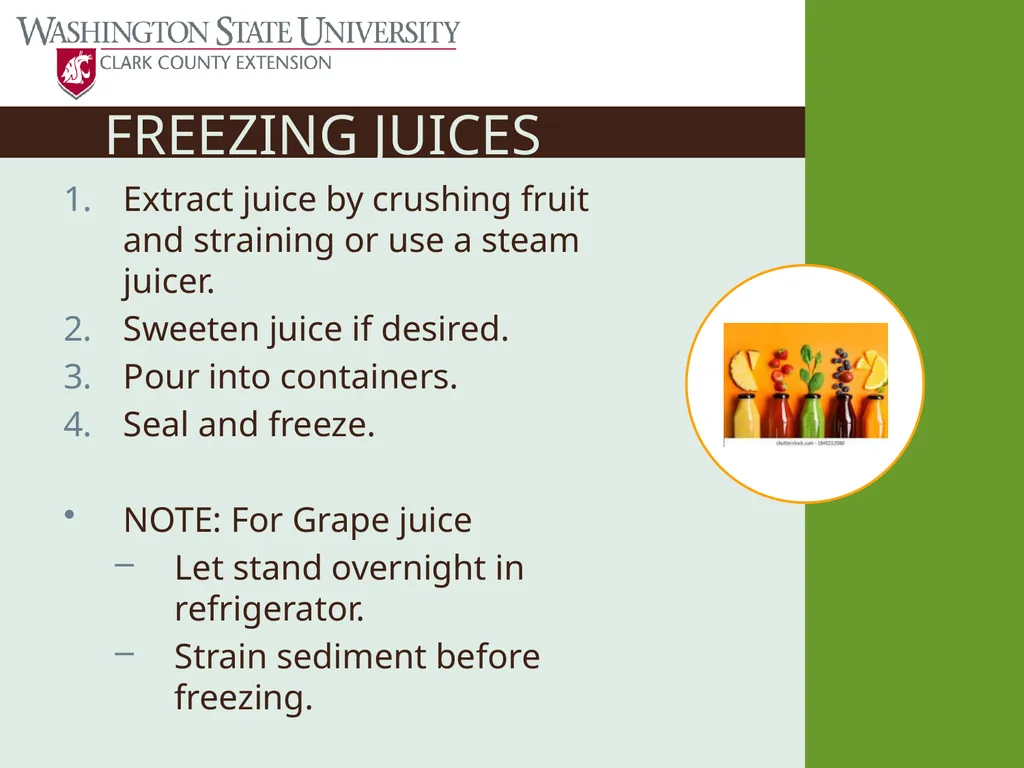
slide31. FREEZING JUICES Extract juice by crushing fruit and straining or use a steam juicer.
Sweeten juice if desired.
Pour into containers.
Seal and freeze.
NOTE: For Grape juice
Let stand overnight in refrigerator.
Strain sediment before freezing.<br>
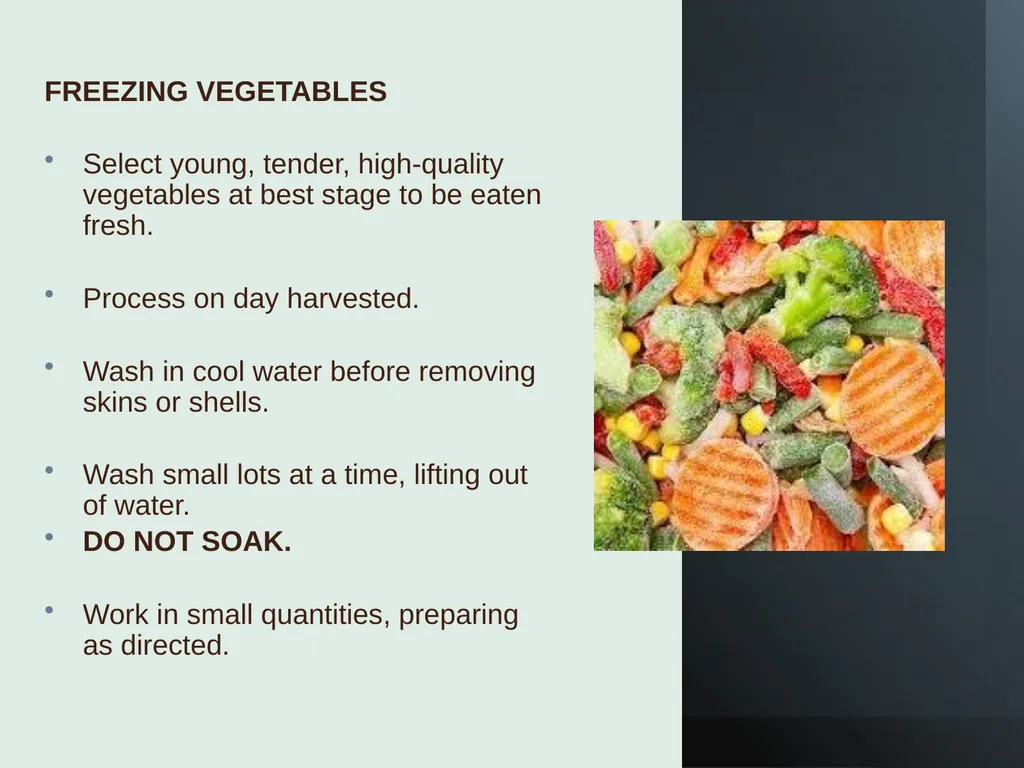
slide32. FREEZING VEGETABLES FREEZING VEGETABLES
Select young, tender, high-quality vegetables at best stage to be eaten fresh.
Process on day harvested.
Wash in cool water before removing skins or shells.
Wash small lots at a time, lifting out of water.
DO NOT SOAK.
Work in small quantities, preparing as directed.<br>
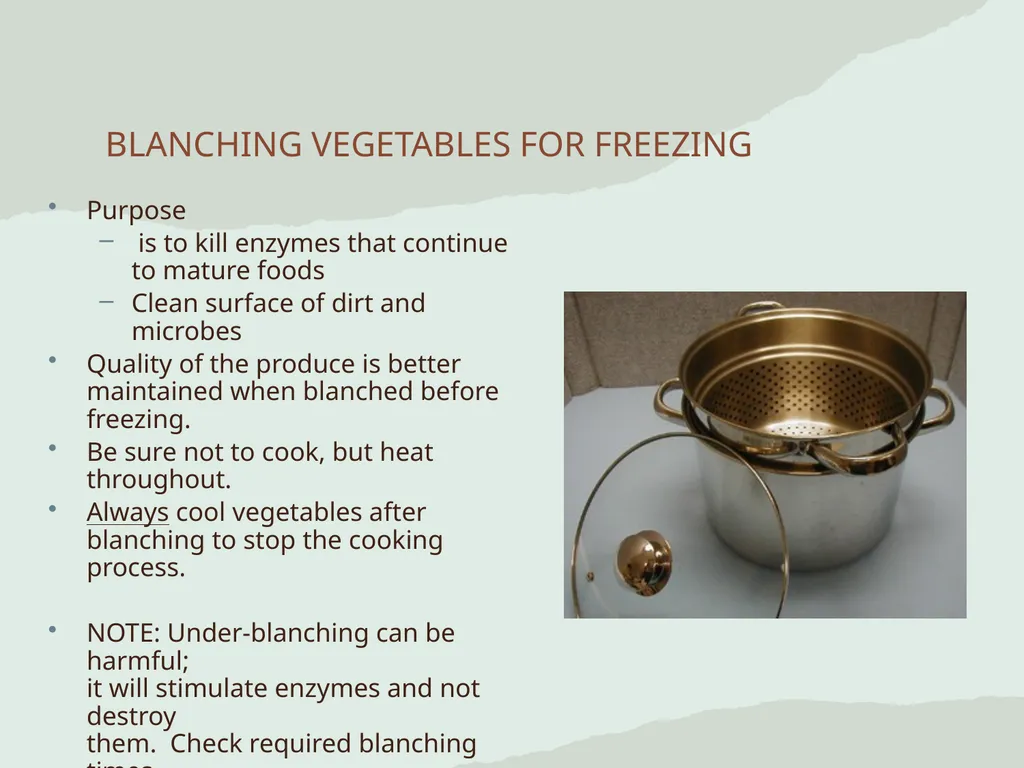
slide33. BLANCHING VEGETABLES FOR FREEZING Purpose
is to kill enzymes that continue to mature foods
Clean surface of dirt and microbes
Quality of the produce is better maintained when blanched before freezing.
Be sure not to cook, but heat throughout.
Always cool vegetables after blanching to stop the cooking process.
NOTE: Under-blanching can be harmful; it will stimulate enzymes and not destroy them. Check required blanching times for each food.<br>
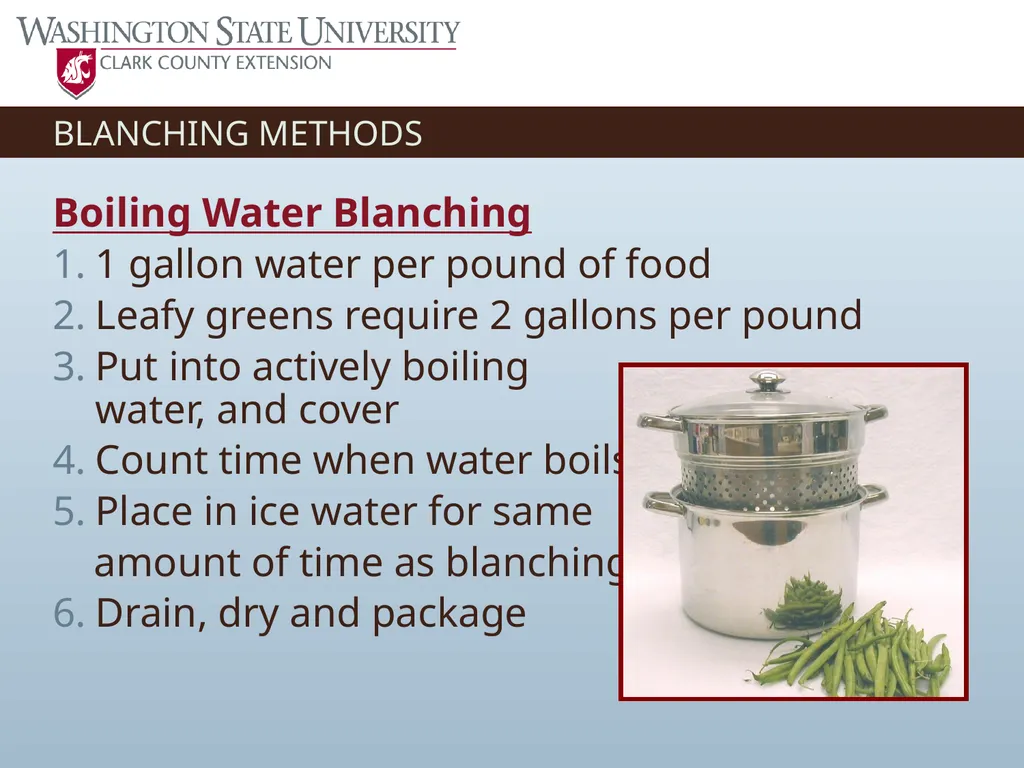
slide34. BLANCHING METHODS Boiling Water Blanching
1 gallon water per pound of food
Leafy greens require 2 gallons per pound
Put into actively boiling water, and cover
Count time when water boils
Place in ice water for same
amount of time as blanching
Drain, dry and package<br>
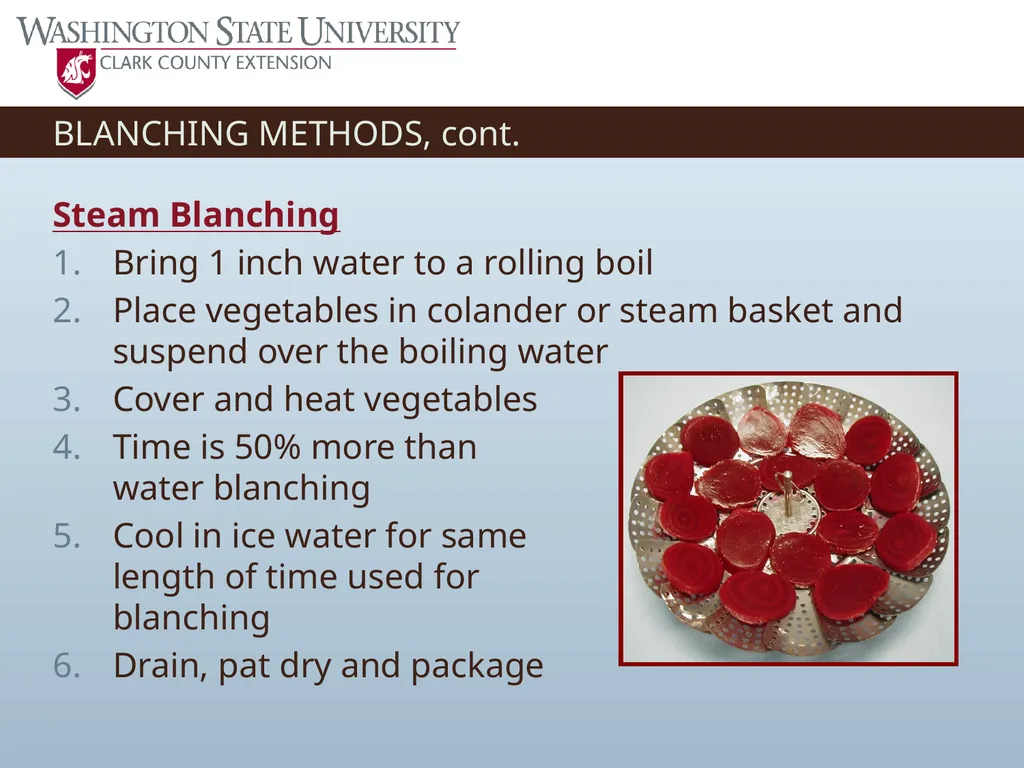
slide35. BLANCHING METHODS, cont. Steam Blanching
Bring 1 inch water to a rolling boil
Place vegetables in colander or steam basket and suspend over the boiling water
Cover and heat vegetables
Time is 50% more than water blanching
Cool in ice water for same length of time used for blanching
Drain, pat dry and package<br>
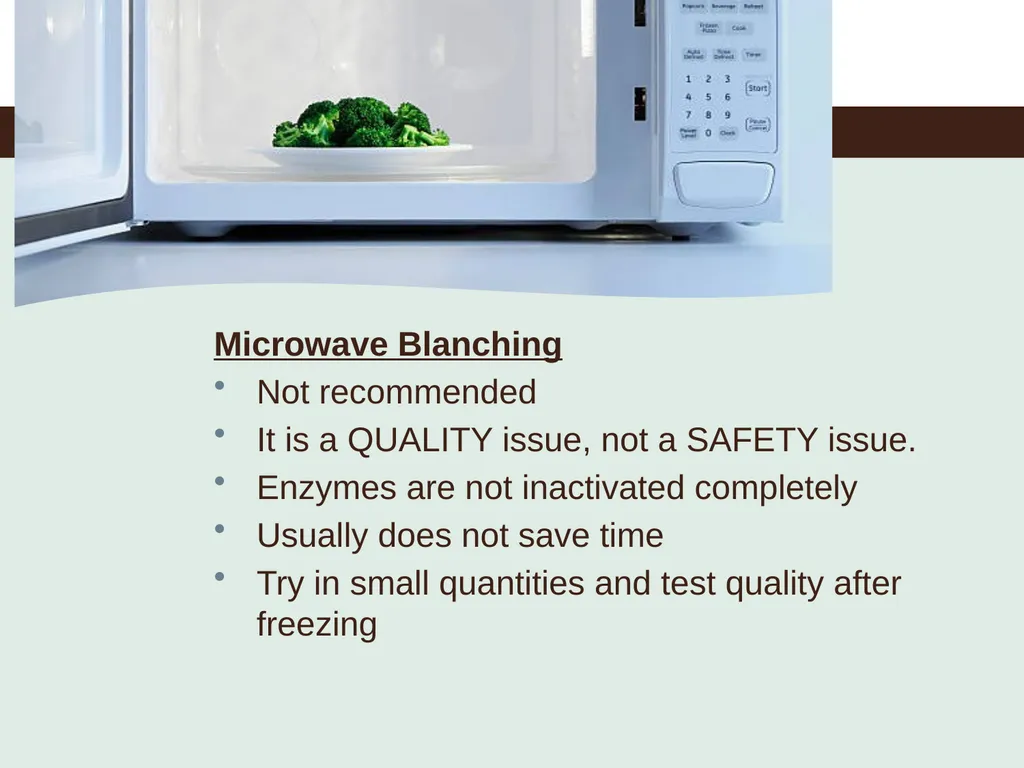
slide36. BLANCHING METHODS, cont. Microwave Blanching
Not recommended
It is a QUALITY issue, not a SAFETY issue.
Enzymes are not inactivated completely
Usually does not save time
Try in small quantities and test quality after freezing<br>
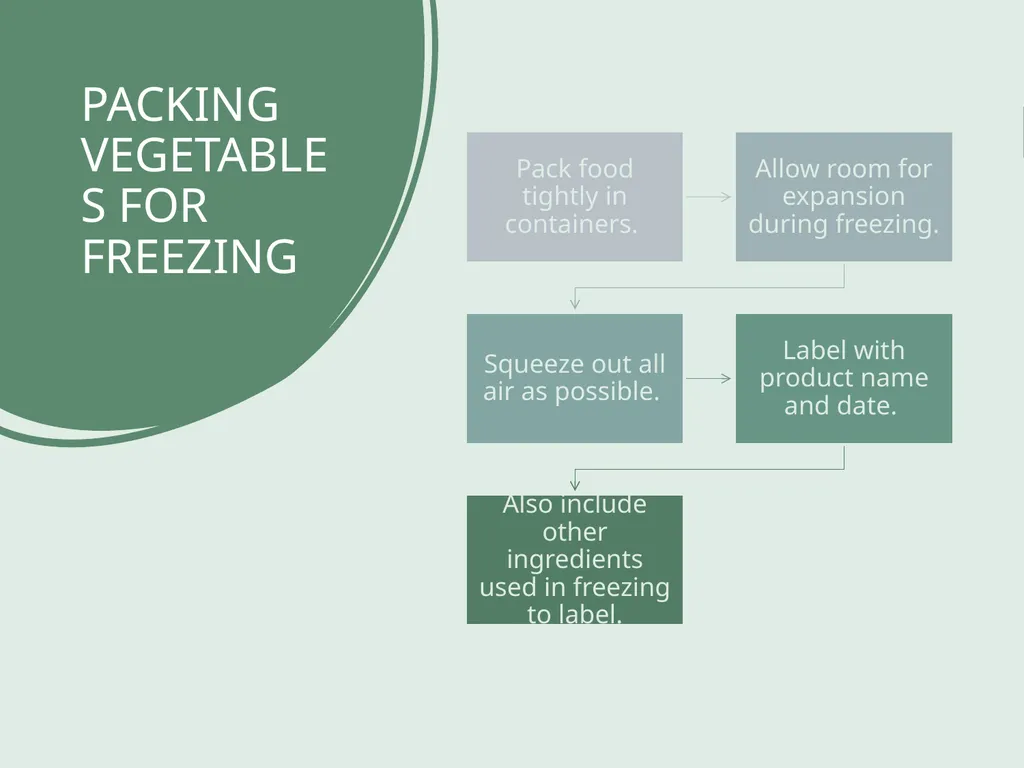
slide37. PACKING VEGETABLES FOR FREEZING<br>
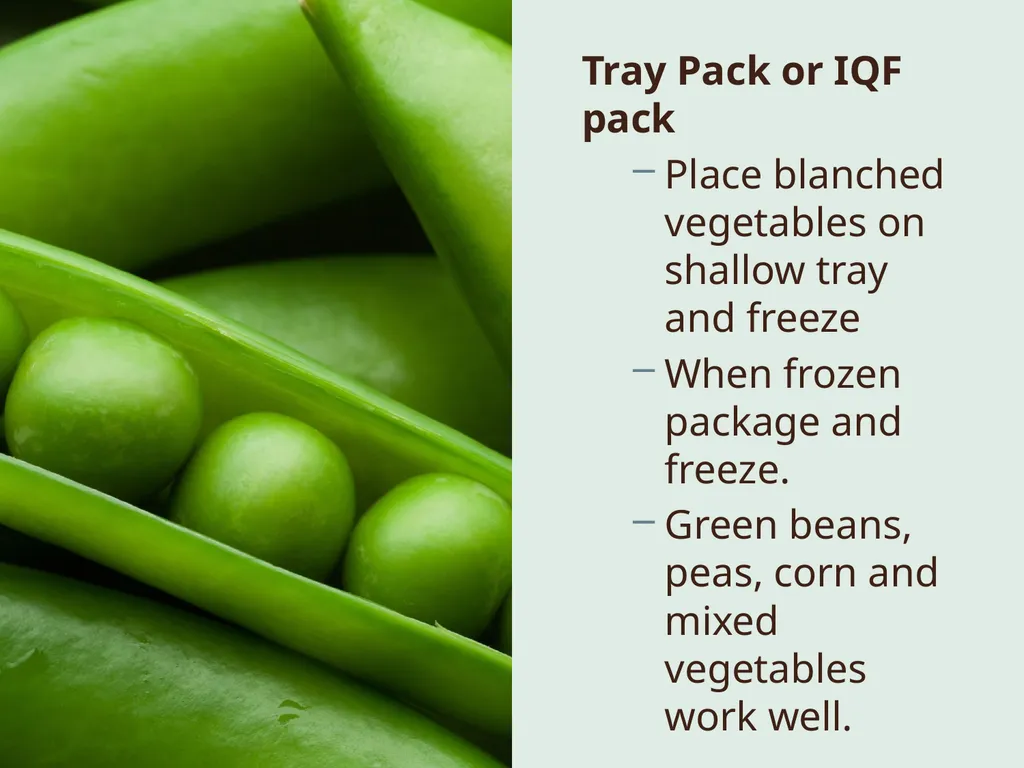
slide38. Packing Vegetables Tray Pack or IQF pack
Place blanched vegetables on shallow tray and freeze
When frozen package and freeze.
Green beans, peas, corn and mixed vegetables work well.<br>
slide39. GENERAL TIPS FOR FREEZING VEGETABLES Blanch cauliflower in boiling water with 1 Tablespoon of lemon juice.
Mature onions freeze raw diced or sliced
Peppers do not need to be blanched.
Flatten whole peppers to remove air
Freeze peppers with waxed paper between peppers.
Frozen raw, whole tomatoes become watery.
Cooked tomatoes freeze well<br>
slide40. FREEZING MEAT & SEAFOOD Freeze fresh, high-quality products.
Package in quantities to be cooked at one time.
Fresh meats should be wrapped or re-wrapped for quality
Fatty meats and fish, cured meats and shellfish have short quality life (3 months)
Other meats have longer life for quality (1 yr. or longer if double wrapped.
Place on freezer shelf and do not stack until frozen.<br>
slide41. Recommended wraps Bags – moisture-vapor resistant, flexible at low temperatures
Aluminum foil – moisture-vapor resistant, use heavy duty locker or freezer grade
Plastic Wrap – moisture vapor resistant, strong and flexible at low temperatures. Use heavy duty wrap
Laminated paper – moisture vapor resistant, but not flexible at low temperatures
NOT RECOMMENDED: waxed cardboard cartons, hard plastic containers<br>
slide42. F FREEZING MEATS
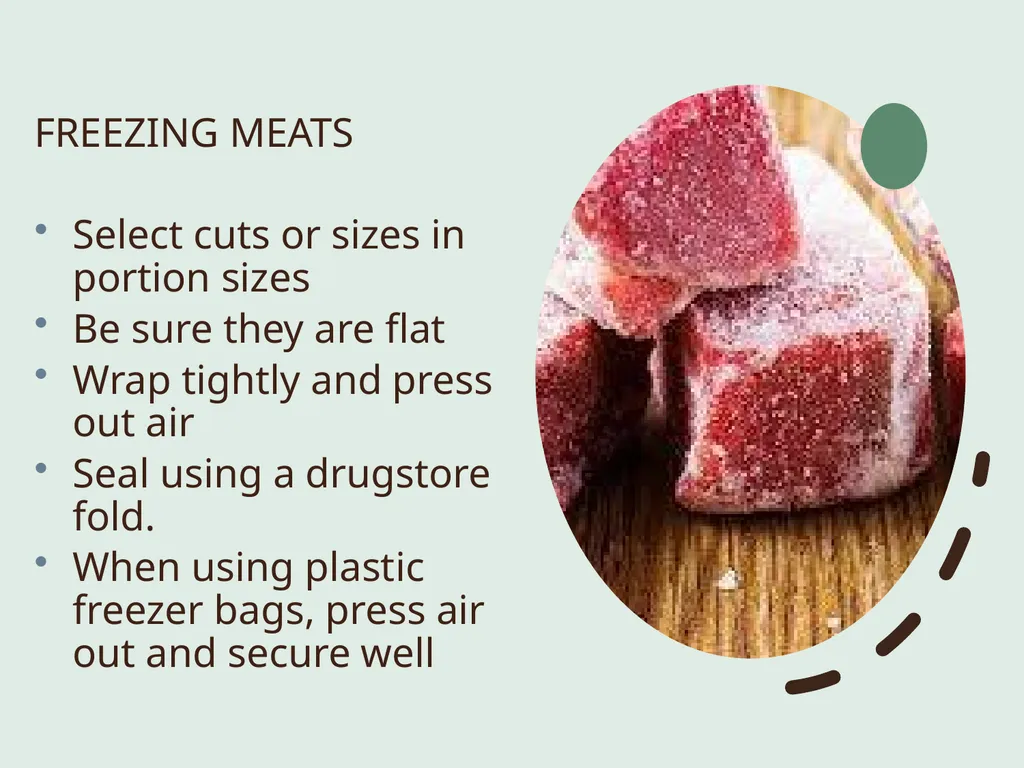
Select cuts or sizes in portion sizes
Be sure they are flat
Wrap tightly and press out air
Seal using a drugstore fold.
When using plastic freezer bags, press air out and secure well<br>
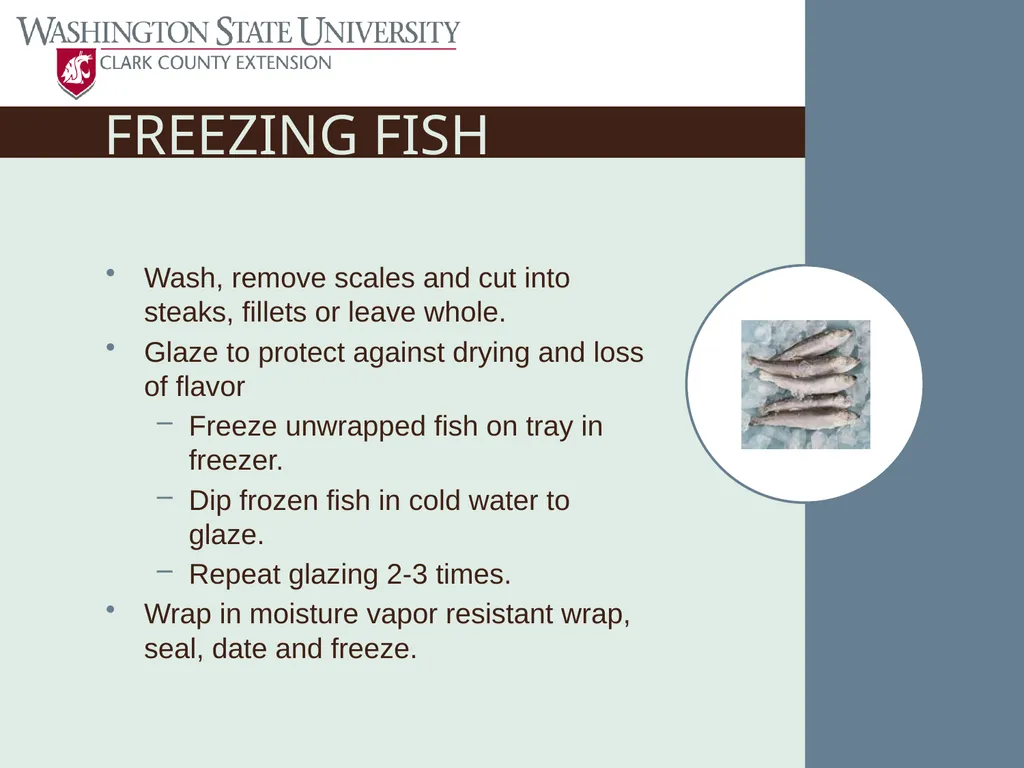
slide43. FREEZING FISH Wash, remove scales and cut into steaks, fillets or leave whole.
Glaze to protect against drying and loss of flavor
Freeze unwrapped fish on tray in freezer.
Dip frozen fish in cold water to glaze.
Repeat glazing 2-3 times.
Wrap in moisture vapor resistant wrap, seal, date and freeze.<br>
slide44. Freezing Dairy Foods Pasteurized homogenized milk
1/2 gallon – 1 month
Cream
(> 40% butterfat) – 3-4 months
Best for making ice cream or cooking
Doesn’t whip well
Butter, Margarine, Lard:
Up to 6 months
Freeze in original cartons or in freezer bag<br>
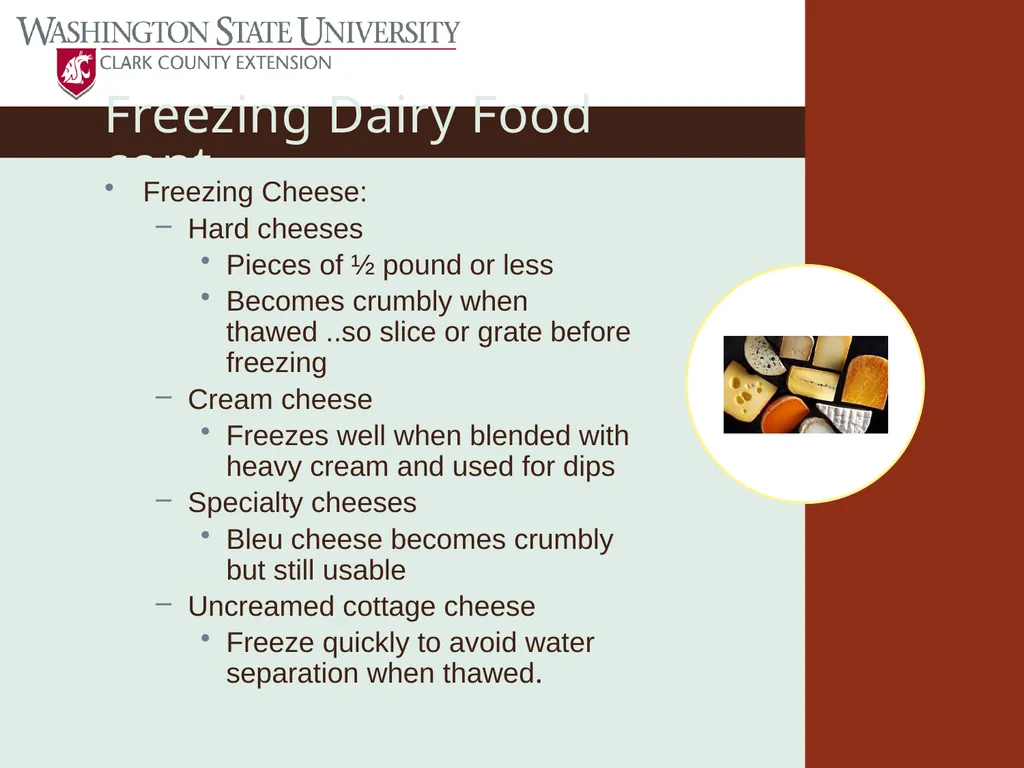
slide45. Freezing Dairy Food cont. Freezing Cheese:
Hard cheeses
Pieces of ½ pound or less
Becomes crumbly when thawed ..so slice or grate before freezing
Cream cheese
Freezes well when blended with heavy cream and used for dips
Specialty cheeses
Bleu cheese becomes crumbly but still usable
Uncreamed cottage cheese
Freeze quickly to avoid water separation when thawed.<br>
slide46. Freezing Seasonings Can be difficult
Pepper, cloves, garlic, green pepper, imitation vanilla and some herbs may become strong and bitter
Celery seasoning may get stronger
Herbs and spices may change flavor
Salt may lose flavor
When preparing foods to be frozen, may need to consider seasoning AFTER thawing.<br>
slide47. DO NOT FREEZE
Cabbage
Lettuce
Celery
Cucumber
Radishes
Baked or boiled potatoes<br>
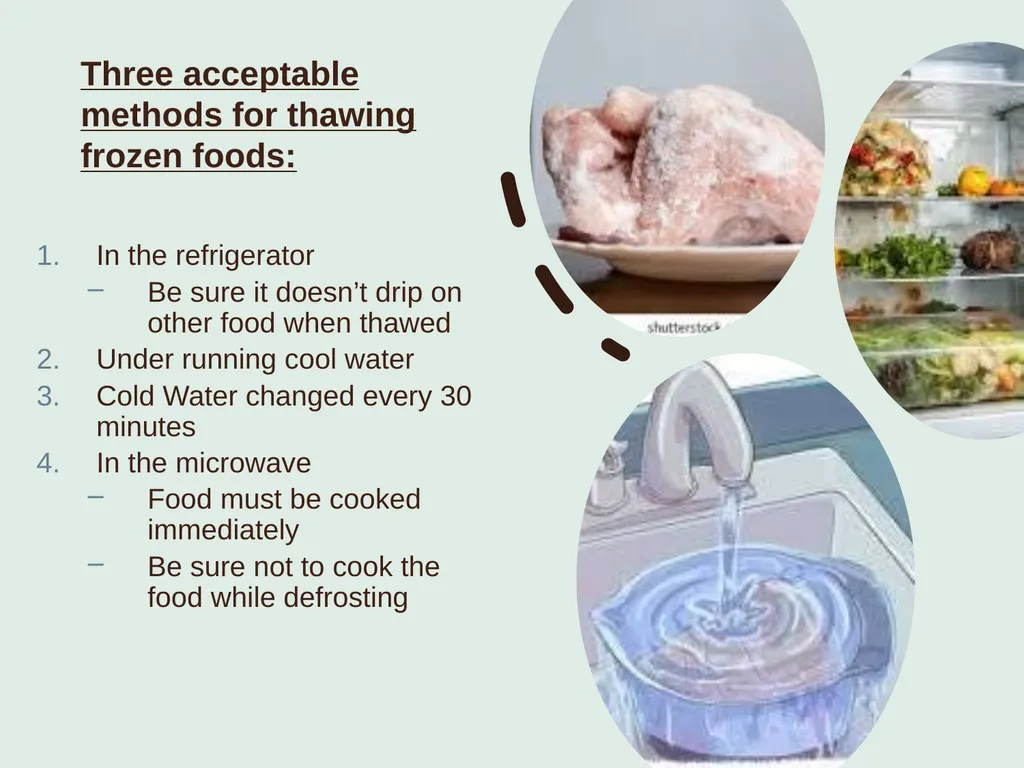
slide48. Three acceptable methods for thawing frozen foods: In the refrigerator
Be sure it doesn’t drip on other food when thawed
Under running cool water
Cold Water changed every 30 minutes
In the microwave
Food must be cooked immediately
Be sure not to cook the food while defrosting<br>
slide49. REFREEZING Texture will not be as good!
Refreeze foods that are not warmed above 40°F
If they contain ice crystals, they are cold enough to refreeze.
There will be a loss of quality after food has been thawed and refrozen.
Dispose foods that are:
Warmer than 40°F
Contaminated by raw meat juices<br>
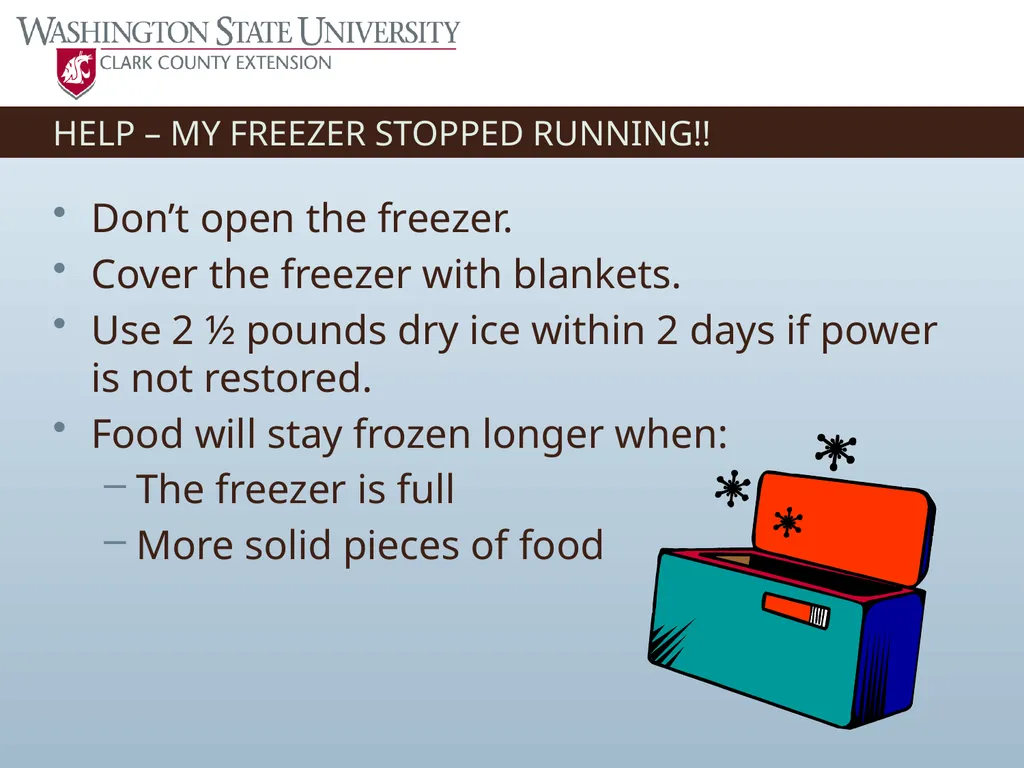
slide50. HELP – MY FREEZER STOPPED RUNNING!! Don’t open the freezer.
Cover the freezer with blankets.
Use 2 ½ pounds dry ice within 2 days if power is not restored.
Food will stay frozen longer when:
The freezer is full
More solid pieces of food<br>
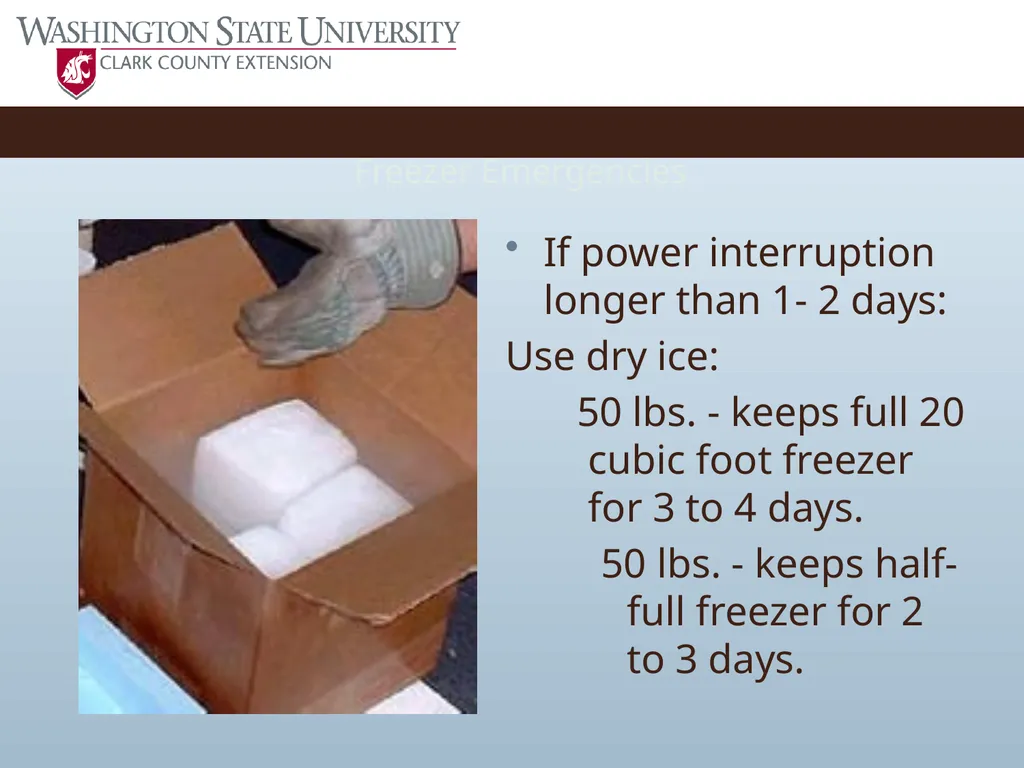
slide51. Freezer Emergencies If power interruption longer than 1- 2 days:
Use dry ice:
50 lbs. - keeps full 20 cubic foot freezer for 3 to 4 days.
50 lbs. - keeps half-full freezer for 2 to 3 days.<br>
slide52. Time for Questions<br>
slide2. WHY FREEZING? Advantages:
Easiest form of preservation for most foods.
Less time consuming than canning or drying.
Provides product closest to fresh
Good natural color and flavor retention.
Best nutritive value retention.
Adds convenience to food preparation.
Proportions can be adapted to needs unlike other methods.
Kitchen remains somewhat cool and comfortable.
Disadvantages:
Texture of some foods is undesirable because of changes due to the freezing process.
Product loses quality more quickly.
Initial investment and cost of maintaining a freezer is high.
Storage space is limited by how much the freezer will hold.<br>
slide3. FREEZER FACTS Determining the appropriate freezer size:
One cubic food holds 35 pounds of frozen food.
Freeze 4-6 cubic feet of food per person.
Freezer Facts
Stand-alone freezers maintain 0°F or below.
Refrigerator freezers only maintain about 15°F.
Defrost when frost is ½ inch thick.
Thick ice increases energy costs and reduces storage space.
Keep freezer full for best storage and energy use.<br>
slide4. Types of Freezers Chest
Requires more floor space
Can store more food
More energy efficient
Should maintain 0°F or lower
Have to manually defrost 1-2 times/year
Be sure it has a drain to make this easier<br>
slide5. Types of Freezers Upright
Requires less floor space
Uses 25-40% more energy
Frost-free freezers
Only upright models
Uses more energy
Less work to maintain<br>
slide6. Refrigerator Maintenance Buy smallest refrigerator that meets your needs
Clean condenser coils each year
Have a cool, dry place with adequate circulation space for freezer.
Set to maintain temperatures of 40°F
Keep free of odors
Don’t use solvent cleaners or abrasives.<br>
slide7. Freezer Features<br>
slide8. How Long is food safe in the Freezer? As long as food went into the freezer safe
The food has never thawed
It will be safe....<br>
slide9. How Safe if Freezing? Food will be
as safe to eat
when thawed as it
was just before
freezing (if thawed
correctly).<br>
slide10. Why So Safe? Microbial growth (pathogens and spoilage bacteria) stops at 28°F.
Chemical changes occur at a very reduced rate.<br>
slide11. Safety of Frozen Foods Freezing does destroy some bacteria and parasites.
Because all organisms are not destroyed, good food handling skills are needed to control bacterial during thawing and once thawed.<br>
slide12. FREEZING PRINCIPLES There are four factors responsible for most of the quality losses of frozen foods:
Enzymes
Air
Ice Crystals
Evaporation of Moisture<br>
slide13. ENZYMES Cause chemical and physical changes in plant tissues.
These changes encourage fruits and vegetables to mature and/or spoil.
Freezing only slows the enzyme action.
Heating will kill the enzymes action.<br>
slide14. AIR – elimination of helps protect flavor Excluding air will prevent enzyme action
covering in liquid
using an ascorbic acid solution
Vacuum sealing Some enzymes react when oxygen is present.
Causes fruit to turn brown.
Deteriorates flavor in fats and oils
Will also prevent freezer burn.<br>
slide15. ICE CRYSTALS Ice crystals are responsible for textural changes in frozen foods.
The water in food freezes and expands.
Ice crystals cause the cell walls of fruits and vegetables to rupture, making them softer when thawed.
Goal is to form the smallest ice crystals as possible.
Food held at -10°F have smaller ice crystals than food at 0°F Maintaining constant freezer temperatures prevents large ice crystals.
Refrigerator freezers and self-defrosting freezers often have fluctuating temperatures.
This causes ice crystals to thaw and refreeze making larger ice crystals each time.<br>
slide16. EVAPORATION OF MOISTURE Freezer burn – tough and dry, but safe.
Loss of moisture results in loss of color, flavor and texture, but it does not make the food unsafe to eat.
Food should be packaged well to prevent moisture loss.<br>
slide17. FOOD PACKAGING FOR FREEZING Moisture-vapor resistant.
Durable and leak proof.
Resistant to cracking at low temperatures.
Resistant to oil, grease, water.
Able to protect foods from absorbing odors and off-flavors.
Easy to seal and label.
Food will come out easily.<br>
slide18. FOOD PACKAGING CHOICES Sealable rigid containers
Good for all packs, especially liquid.
Flexible plastic bags or wrapping
Good for dry-packed foods.
Laminated freezer papers or containers
Good for dry packed meats, fish and poultry.<br>
slide19. Vacuum Packaging Machines Use freezer weight
packaging bags.
Pre-frozen or slightly frozen foods sometimes work better for sealing.<br>
slide20. UNSUITABLE CONTAINERS Those that are not moisture-vapor proof enough.
Waxed paper.
Paper or milk cartons.
Rigid carton with cracks or poor fitting lids.
Re-used plastic dairy or meat containers (e.g. cottage cheese, yogurt, deli-meat containers)
Any containers used for ‘storage’ versus ‘freezing’<br>
slide21. Headspace for Frozen Foods Foods with Liquid: Wide opening: ½-inch per pint: 1 inch per quart
Narrow opening: ¾-inch per pint; 1 ½-inch per quart Foods without liquid: ½ inch for all containers
Foods that pack loosely need no headspace (e.g. green beans or broccoli)<br>
slide22. FREEZING QUALITY FOODS Set the freezer to 0°F or below 24 hours in advance.
Chill foods before freezing and freeze as soon as packaged.
Freeze 2-3 pounds per cubic foot at a time – overloading with unfrozen food will slow freezing time.
Remember slow freezing causes larger ice crystals.<br>
slide23. SELECTING & PREPARING FRUITS FOR FREEZING Select fruit that is ripe, and firm.
Under ripe fruit will be bitter or off flavor.
Overripe fruit will have little flavor and mushy texture.
Wash fruit well, rinsing in several changes of water.
Don’t let sit in standing water
Washing will:
Decrease microorganisms
Remove surface dirt
Decrease pesticide residue
Decrease insects
Can see bruises<br>
slide24. PRETREATING FRUITS FOR FREEZING To prevent darkening of light colored fruits pretreat with one of the following:
Ascorbic Acid (Vitamin C)
Available at drugstores in table, crystals and powder forms.
Soak fruit in mixture for 2 minutes.
Ascorbic Acid Mixtures (Fruit Fresh or Ever Fresh)
Sugar mixed with ascorbic acid or citric acid.
Follow package directions.
Lemon or Orange Juice
Will help for time during preparation but not for long storage periods.
May mask flavor of fruit.
Salt and vinegar solutions
No longer recommended.
Will prevent browning, but will become gray over time.
If using salt use 2 Tablespoons per gallon water.<br>
slide25. PACKING FRUITS FOR FREEZING Type of pack depends on intended use of fruit.
Without Sugar
Texture may be softer.
Dry Pack
Sugar coats fruit & preserves flavor.
Sugar or Syrup Pack
Retains flavor & texture.
Liquid Pack
Covering fruit with any liquid provides mixed results.<br>
slide26. FREEZING WITHOUT SUGAR Also called Individual Quick Freeze (IQF)
Berries, cherries, grapes should be frozen in single layer to prevent fruit from sticking together.
Freeze until firm 4-6 hours.
Place in package.
Will pour out of container easily when frozen.
Serve frozen as snacks.
Thaw for salads or desserts.<br>
slide27. SYRUP PACKED 30% syrup (2 ¼ c. sugar + 5 ¼ c. water)
Light syrups for mild flavored fruit
Heavier syrup better for sour fruits.
Use 2/3 cup syrup for each pint of fruit.
Syrup can be made of sugar, corn syrup, or honey to desired strength of sweetness.
Dissolve sugar in cool or warm water
Cool warm syrup before using.
Fruits should be covered with syrup.<br>
slide28. SUGAR PACKED<br>
slide29. Unsweetened Pack Pack prepared fruit in containers:
Without liquid or sweetening
OR
With water containing 1 tsp. ascorbic acid per quart of water.
These fruits will be softer and less flavor.<br>
slide30. Artificial Sweeteners ARTIFICIAL SWEETNERS
Safe but alter product quality
No color protection
Now shape retention
Product freezes harder
Thaws more slowly
May become bitter<br>
slide31. FREEZING JUICES Extract juice by crushing fruit and straining or use a steam juicer.
Sweeten juice if desired.
Pour into containers.
Seal and freeze.
NOTE: For Grape juice
Let stand overnight in refrigerator.
Strain sediment before freezing.<br>
slide32. FREEZING VEGETABLES FREEZING VEGETABLES
Select young, tender, high-quality vegetables at best stage to be eaten fresh.
Process on day harvested.
Wash in cool water before removing skins or shells.
Wash small lots at a time, lifting out of water.
DO NOT SOAK.
Work in small quantities, preparing as directed.<br>
slide33. BLANCHING VEGETABLES FOR FREEZING Purpose
is to kill enzymes that continue to mature foods
Clean surface of dirt and microbes
Quality of the produce is better maintained when blanched before freezing.
Be sure not to cook, but heat throughout.
Always cool vegetables after blanching to stop the cooking process.
NOTE: Under-blanching can be harmful; it will stimulate enzymes and not destroy them. Check required blanching times for each food.<br>
slide34. BLANCHING METHODS Boiling Water Blanching
1 gallon water per pound of food
Leafy greens require 2 gallons per pound
Put into actively boiling water, and cover
Count time when water boils
Place in ice water for same
amount of time as blanching
Drain, dry and package<br>
slide35. BLANCHING METHODS, cont. Steam Blanching
Bring 1 inch water to a rolling boil
Place vegetables in colander or steam basket and suspend over the boiling water
Cover and heat vegetables
Time is 50% more than water blanching
Cool in ice water for same length of time used for blanching
Drain, pat dry and package<br>
slide36. BLANCHING METHODS, cont. Microwave Blanching
Not recommended
It is a QUALITY issue, not a SAFETY issue.
Enzymes are not inactivated completely
Usually does not save time
Try in small quantities and test quality after freezing<br>
slide37. PACKING VEGETABLES FOR FREEZING<br>
slide38. Packing Vegetables Tray Pack or IQF pack
Place blanched vegetables on shallow tray and freeze
When frozen package and freeze.
Green beans, peas, corn and mixed vegetables work well.<br>
slide39. GENERAL TIPS FOR FREEZING VEGETABLES Blanch cauliflower in boiling water with 1 Tablespoon of lemon juice.
Mature onions freeze raw diced or sliced
Peppers do not need to be blanched.
Flatten whole peppers to remove air
Freeze peppers with waxed paper between peppers.
Frozen raw, whole tomatoes become watery.
Cooked tomatoes freeze well<br>
slide40. FREEZING MEAT & SEAFOOD Freeze fresh, high-quality products.
Package in quantities to be cooked at one time.
Fresh meats should be wrapped or re-wrapped for quality
Fatty meats and fish, cured meats and shellfish have short quality life (3 months)
Other meats have longer life for quality (1 yr. or longer if double wrapped.
Place on freezer shelf and do not stack until frozen.<br>
slide41. Recommended wraps Bags – moisture-vapor resistant, flexible at low temperatures
Aluminum foil – moisture-vapor resistant, use heavy duty locker or freezer grade
Plastic Wrap – moisture vapor resistant, strong and flexible at low temperatures. Use heavy duty wrap
Laminated paper – moisture vapor resistant, but not flexible at low temperatures
NOT RECOMMENDED: waxed cardboard cartons, hard plastic containers<br>
slide42. F FREEZING MEATS
Select cuts or sizes in portion sizes
Be sure they are flat
Wrap tightly and press out air
Seal using a drugstore fold.
When using plastic freezer bags, press air out and secure well<br>
slide43. FREEZING FISH Wash, remove scales and cut into steaks, fillets or leave whole.
Glaze to protect against drying and loss of flavor
Freeze unwrapped fish on tray in freezer.
Dip frozen fish in cold water to glaze.
Repeat glazing 2-3 times.
Wrap in moisture vapor resistant wrap, seal, date and freeze.<br>
slide44. Freezing Dairy Foods Pasteurized homogenized milk
1/2 gallon – 1 month
Cream
(> 40% butterfat) – 3-4 months
Best for making ice cream or cooking
Doesn’t whip well
Butter, Margarine, Lard:
Up to 6 months
Freeze in original cartons or in freezer bag<br>
slide45. Freezing Dairy Food cont. Freezing Cheese:
Hard cheeses
Pieces of ½ pound or less
Becomes crumbly when thawed ..so slice or grate before freezing
Cream cheese
Freezes well when blended with heavy cream and used for dips
Specialty cheeses
Bleu cheese becomes crumbly but still usable
Uncreamed cottage cheese
Freeze quickly to avoid water separation when thawed.<br>
slide46. Freezing Seasonings Can be difficult
Pepper, cloves, garlic, green pepper, imitation vanilla and some herbs may become strong and bitter
Celery seasoning may get stronger
Herbs and spices may change flavor
Salt may lose flavor
When preparing foods to be frozen, may need to consider seasoning AFTER thawing.<br>
slide47. DO NOT FREEZE
Cabbage
Lettuce
Celery
Cucumber
Radishes
Baked or boiled potatoes<br>
slide48. Three acceptable methods for thawing frozen foods: In the refrigerator
Be sure it doesn’t drip on other food when thawed
Under running cool water
Cold Water changed every 30 minutes
In the microwave
Food must be cooked immediately
Be sure not to cook the food while defrosting<br>
slide49. REFREEZING Texture will not be as good!
Refreeze foods that are not warmed above 40°F
If they contain ice crystals, they are cold enough to refreeze.
There will be a loss of quality after food has been thawed and refrozen.
Dispose foods that are:
Warmer than 40°F
Contaminated by raw meat juices<br>
slide50. HELP – MY FREEZER STOPPED RUNNING!! Don’t open the freezer.
Cover the freezer with blankets.
Use 2 ½ pounds dry ice within 2 days if power is not restored.
Food will stay frozen longer when:
The freezer is full
More solid pieces of food<br>
slide51. Freezer Emergencies If power interruption longer than 1- 2 days:
Use dry ice:
50 lbs. - keeps full 20 cubic foot freezer for 3 to 4 days.
50 lbs. - keeps half-full freezer for 2 to 3 days.<br>
slide52. Time for Questions<br>