
Basic Principles of Uremic Toxicity and Uremic
MJ
Published · 20 slides · 0 views

1 / 1
Description
Basic Principles of Uremic Toxicity and Uremic Toxin Removal: Hemodialysis Raymond C. Vanholder, MD, PhD University Hospital Ghent Belgium Dialysis Core Curriculum 2021 Raymond C. Vanholder Consultancy: Nextkidney Project; Kibow; Jafron;
Related Topics
Share
Embed code
Download this presentation From Below
"Basic Principles of Uremic Toxicity and Uremic" is the property of its rightful owner. Permission is granted to download and print the materials on this website for personal, non-commercial use only, and to display it on your personal computer provided you do not modify the materials and that you retain all copyright notices contained in the materials. By downloading content from our website, you accept the terms of this agreement.
Presentation Transcript
01
Basic Principles of Uremic Toxicity and Uremic Toxin Removal:
Hemodialysis Raymond C. Vanholder, MD, PhD
University Hospital Ghent Belgium Dialysis Core Curriculum 2021<br>
University Hospital Ghent Belgium Dialysis Core Curriculum 2021<br>
02
Raymond C. Vanholder Consultancy: Nextkidney Project; Kibow; Jafron; BBraun; Baxter Healthcare; Fresenius Medical Care
Scientific Advisor/Membership: European Kidney Health Alliance; International Scientific Advisory Board Dutch Kidney Foundation; J Am Soc Nephrol; Nephrol Dial Transplant; NRN Reviews Nephrol Disclosures Dialysis Core Curriculum 2021<br>
Scientific Advisor/Membership: European Kidney Health Alliance; International Scientific Advisory Board Dutch Kidney Foundation; J Am Soc Nephrol; Nephrol Dial Transplant; NRN Reviews Nephrol Disclosures Dialysis Core Curriculum 2021<br>
03
Learning Objectives Describe the effects of hemodialysis and related strategies
Explain the basic classification of uremic toxins
Discuss how conventional hemodialysis and hemodiafiltration work, including their effect on uremic solute removal
Describe alternative modes of removal that have recently been developed or are under development Dialysis Core Curriculum 2021<br>
Explain the basic classification of uremic toxins
Discuss how conventional hemodialysis and hemodiafiltration work, including their effect on uremic solute removal
Describe alternative modes of removal that have recently been developed or are under development Dialysis Core Curriculum 2021<br>
04
Aims of Hemodialysis Restore volume status (fluid removal): mainly acute (short term) impact on outcomes
Restore electrolyte balance: mainly acute (short term – sodium, potassium) or mainly chronic (long term – phosphate, bicarbonate) impact on outcomes
Remove uremic retention solutes: mainly chronic (long term) impact on outcomes Dialysis Core Curriculum 2021<br>
Restore electrolyte balance: mainly acute (short term – sodium, potassium) or mainly chronic (long term – phosphate, bicarbonate) impact on outcomes
Remove uremic retention solutes: mainly chronic (long term) impact on outcomes Dialysis Core Curriculum 2021<br>
05
Classification of Uremic Toxins Small water soluble compounds (prototypes urea and uric acid): MW <500 Dalton; easily removed by any type of hemodialysis
Protein bound compounds (prototypes indoxyl sulfate, p-cresylsulfate): mostly MW <500 Dalton; difficult to remove by any type of hemodialysis
Middle molecules (prototypes β2-microglobulin, interleukins): MW >500 Dalton; only removed by hemodialyszers with large enough pore size (high flux) Dialysis Core Curriculum 2021<br>
Protein bound compounds (prototypes indoxyl sulfate, p-cresylsulfate): mostly MW <500 Dalton; difficult to remove by any type of hemodialysis
Middle molecules (prototypes β2-microglobulin, interleukins): MW >500 Dalton; only removed by hemodialyszers with large enough pore size (high flux) Dialysis Core Curriculum 2021<br>
06
Current Hemodialysis Modes Dialysis Core Curriculum 2021<br>
07
Diffusion vs. Convection Dialysis Core Curriculum 2021 Diffusion is the basic principle of hemodialysis; hereby, solutes move through a semi-permeable membrane from the area with the highest concentration (in dialysis for most molecules the blood side) to the area with the lowest concentration (for most molecules the dialysate side). Diffusion is essentially useful for removal of small molecules.
Convection is the basic principle of hemofiltration; hereby, a large volume of plasma water is pushed through the semipermeable membrane and with this volume also molecules in that plasma are dragged to the other side (from the Latin convehere – to drag). The volume that is filtered out of the plasma is replaced by an equivoluminous volume of substitution fluid containing electrolytes but no toxins keeping the volume status stable. Practically, if one puts a teabag in hot water without doing anything else, the brown color that escapes from the bag does so by diffusion. However, if one starts dragging the bag through the water, this is on the basis of convection. Generally, this procedure allows more brown color to escape. Convection is useful to remove large molecules. In hemodiafiltration, diffusion and convection are combined.<br>
Convection is the basic principle of hemofiltration; hereby, a large volume of plasma water is pushed through the semipermeable membrane and with this volume also molecules in that plasma are dragged to the other side (from the Latin convehere – to drag). The volume that is filtered out of the plasma is replaced by an equivoluminous volume of substitution fluid containing electrolytes but no toxins keeping the volume status stable. Practically, if one puts a teabag in hot water without doing anything else, the brown color that escapes from the bag does so by diffusion. However, if one starts dragging the bag through the water, this is on the basis of convection. Generally, this procedure allows more brown color to escape. Convection is useful to remove large molecules. In hemodiafiltration, diffusion and convection are combined.<br>
08
Impact of Low-Flux Dialysis on Various Types of Uremic Toxins Dialysis Core Curriculum 2021 Only the small-water soluble compounds cross easily the membrane. Also, some of the protein bound componds pass the membrane if they are free (unbound). The protein bound compounds which are bound to albumin, however, do not cross the membrane and are reflected, in the same way as the middle molecules.<br>
09
Effect of High-Flux Dialysis on Various Types of Uremic Toxins Dialysis Core Curriculum 2021 Not only the small water soluble compounds and the free protein bound compounds, but also the middle molecules cross the membrane. The protein bound compounds which are bound to albumin, however, do still not cross the barrier and are reflected. Whereas removal of middle molecules is more efficient than with low-flux, removal of small water soluble compounds and protein-bound compounds is virtually the same.<br>
10
Effect of Hemodiafiltration on Various Types of Uremic Toxins Dialysis Core Curriculum 2021 The middle molecules are removed even more efficiently than with high-flux hemodialysis. Also the protein bound compounds which are bound to their binding protein are now removed somewhat more efficiently. Small water soluble compounds roughly are removed in the same way as with the two other strategies.<br>
11
Uremic Solute Kinetics Has a Major Impact on Removal Dialysis Core Curriculum 2021 Eloot et al, NDT, 27, 4021-4029, 2012 From the moment dialysis starts, the dialyzer starts purifying the plasmatic volume, which results in mass transfer (MT) into the dialysate.
From the moment solute concentration decreases in the plasma, also diffusion of solutes from the extraplasmatic to plasmatic volume starts. This process is symbolized by K12 (clearance from compartment 2 (extraplasmatic) to compartment 1 (plasmatic)).
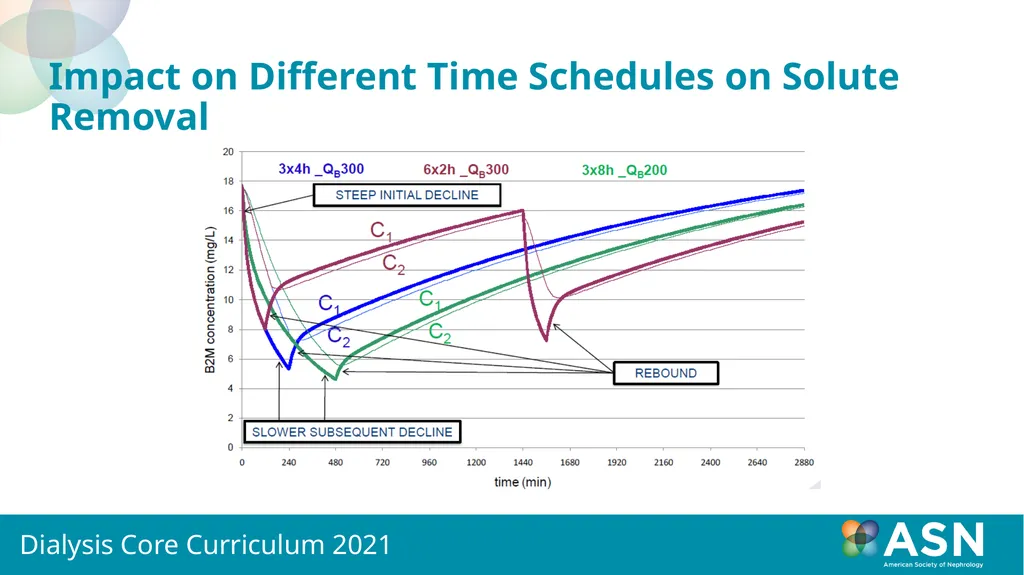
However, the shift of solutes from extraplasmatic to plasmatic is slower than the one from plasma to the dialysate. As a consequence, concentration in the plasma decreases more quickly than the extraplasmatic concentration, but a lower plasmatic concentration also means less solute available for diffusion and thus lower mass transfer and efficiency of dialysis. This phenomenon also gives rise to rebound after dialysis, as after the end of dialysis, solute continues to move from extraplasmatic to intraplasmatic. Thus, solute concentration after dialysis rises very quickly so that part of the removal effect is lost. The shorter dialysis is, the more pronounced this compartment disbalance and rebound will be.<br>
From the moment solute concentration decreases in the plasma, also diffusion of solutes from the extraplasmatic to plasmatic volume starts. This process is symbolized by K12 (clearance from compartment 2 (extraplasmatic) to compartment 1 (plasmatic)).
However, the shift of solutes from extraplasmatic to plasmatic is slower than the one from plasma to the dialysate. As a consequence, concentration in the plasma decreases more quickly than the extraplasmatic concentration, but a lower plasmatic concentration also means less solute available for diffusion and thus lower mass transfer and efficiency of dialysis. This phenomenon also gives rise to rebound after dialysis, as after the end of dialysis, solute continues to move from extraplasmatic to intraplasmatic. Thus, solute concentration after dialysis rises very quickly so that part of the removal effect is lost. The shorter dialysis is, the more pronounced this compartment disbalance and rebound will be.<br>
12
Effect of Kinetics on Solute Concentration Dialysis Core Curriculum 2021 Vanholder et al, KI, 88, 460-465, 2015 In general, removal by dialysis is easier from the plasmatic compartment than from extraplasmatic, as there is almost always some degree of resistance against the shift of solutes from extraplasmatic (correspondoing to tissues and organs, where often toxicity is exerted) to intraplasmatic. As a consequece, tissue concentration lags behind on plasma concentration. At the beginning of dialysis, removal is essentially limited to plasma, without equivalent refilling from extraplasmatic, and there is thus a steep concentration decline. However, after some time, the extraplasmatic compartment catches up and starts to refill the plasma, and both concentration curves run more or less in parallel, however without coming together. At the end of dialysis, the shift from extraplasmatic, where concentration is higher, to plasma continues, resulting in a rebound. The higher the resistance against a shift from extraplasmatic to plasma, the more both curves will be apart, and the higher the rebound, which is more or less a mirror image of the steep decline at the start of dialysis.<br>
13
Impact on Different Time Schedules on Solute Removal Dialysis Core Curriculum 2021<br>
14
Alternative Modes for Dialytic Solute Removal Dialysis Core Curriculum 2021<br>
15
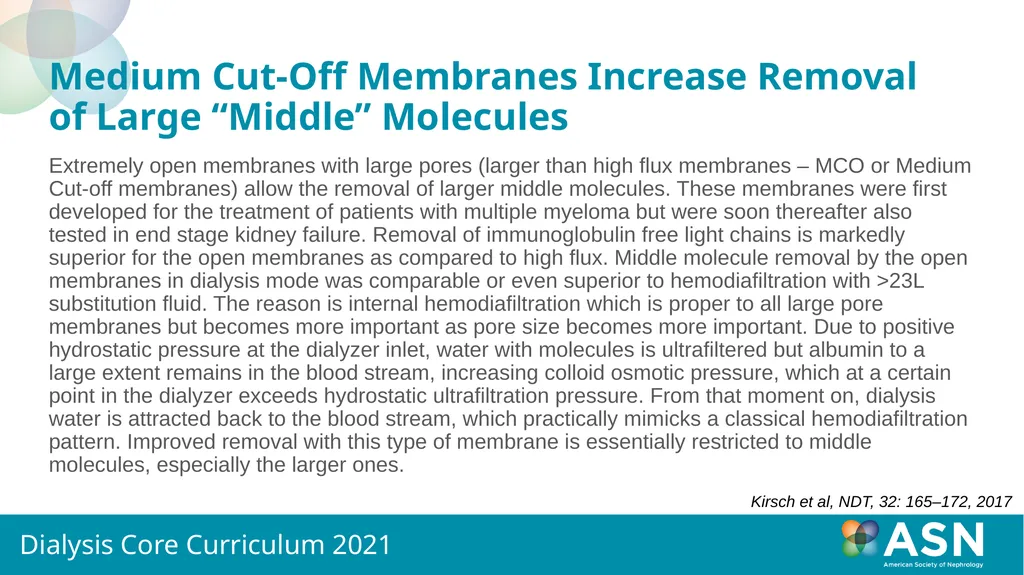
Medium Cut-Off Membranes Increase Removal of Large “Middle” Molecules Dialysis Core Curriculum 2021 Kirsch et al, NDT, 32: 165–172, 2017 Extremely open membranes with large pores (larger than high flux membranes – MCO or Medium Cut-off membranes) allow the removal of larger middle molecules. These membranes were first developed for the treatment of patients with multiple myeloma but were soon thereafter also tested in end stage kidney failure. Removal of immunoglobulin free light chains is markedly superior for the open membranes as compared to high flux. Middle molecule removal by the open membranes in dialysis mode was comparable or even superior to hemodiafiltration with >23L substitution fluid. The reason is internal hemodiafiltration which is proper to all large pore membranes but becomes more important as pore size becomes more important. Due to positive hydrostatic pressure at the dialyzer inlet, water with molecules is ultrafiltered but albumin to a large extent remains in the blood stream, increasing colloid osmotic pressure, which at a certain point in the dialyzer exceeds hydrostatic ultrafiltration pressure. From that moment on, dialysis water is attracted back to the blood stream, which practically mimicks a classical hemodiafiltration pattern. Improved removal with this type of membrane is essentially restricted to middle molecules, especially the larger ones.<br>
16
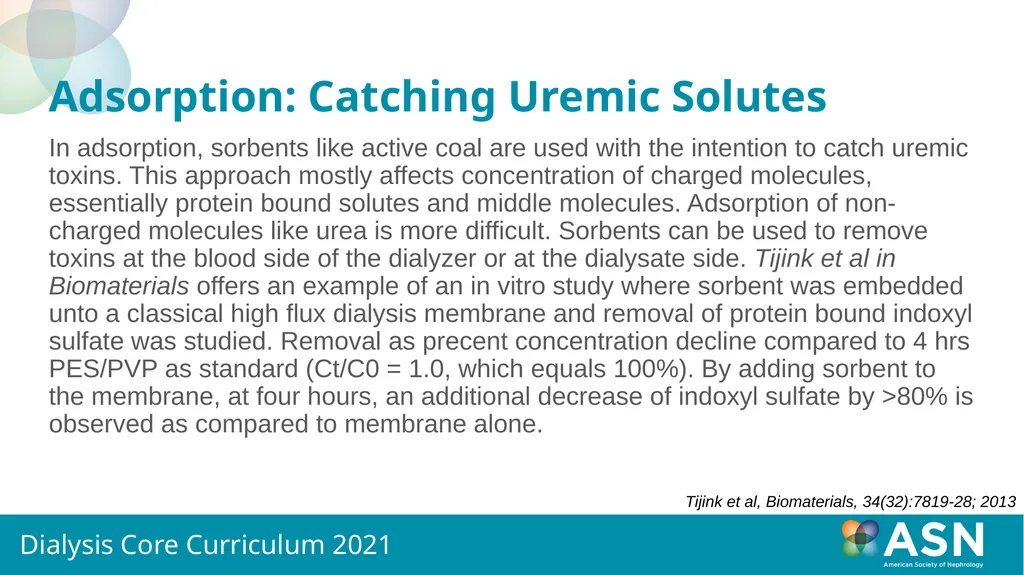
Adsorption: Catching Uremic Solutes Dialysis Core Curriculum 2021 Tijink et al, Biomaterials, 34(32):7819-28; 2013 In adsorption, sorbents like active coal are used with the intention to catch uremic toxins. This approach mostly affects concentration of charged molecules, essentially protein bound solutes and middle molecules. Adsorption of non-charged molecules like urea is more difficult. Sorbents can be used to remove toxins at the blood side of the dialyzer or at the dialysate side. Tijink et al in Biomaterials offers an example of an in vitro study where sorbent was embedded unto a classical high flux dialysis membrane and removal of protein bound indoxyl sulfate was studied. Removal as precent concentration decline compared to 4 hrs PES/PVP as standard (Ct/C0 = 1.0, which equals 100%). By adding sorbent to the membrane, at four hours, an additional decrease of indoxyl sulfate by >80% is observed as compared to membrane alone.<br>
17
Dialysis Core Curriculum 2021 Meijers et al, Artif Organs, 32: 214-219; 2008 Adsorption: Catching Uremic Solutes The sorbent can also be applied at the dialysate/ultrafiltrate side. In a pilot experiment in 3 patients, a combination of fractionated plasma separation + adsorption followed by reinfusion of the cleaned plasma filtrate (full lines) is compared to hemodialysis for relative removal of p-cresol (a surrogate for protein bound p-cresyl sulfate). In the clinic, this strategy is essentially used as artificial liver. Removal is almost doubled by the sorption technique, offering proof of concept of removal of uremic toxins by adsorption. However, a downside of this experiment was the frequent occurrence of clotting complications (in CKD patients), so that to our knowledge, this technique is currently not applied clinically as a dialysis technique (only in liver failure where coagulation is more suppressed than in CKD).<br>
18
Dialysis Core Curriculum 2021 Gura et al, JCI Insight, 1, 2016, doi: 10.1172/jci.insight.86397 Adsorption: Catching Uremic Solutes Sorbents can also be used at the dialysate side to catch uremic toxins and regenerate dialysate. This method is currently used and tested in prototypes of wearable artificial kidney (WAK), like the system above developed by Gura et al, or portable articficial kidney (PAK). In this setting, the sorbent is not used to increase removal, but to cleanse dialysate so that it can be recirculated in a closed loop system, dramatically decreasing the volume of dialysate needed and allowing to develop wearable or portable and thus more flexible systems. Some of these systems have reached the phase of pilot experimental studies (phase 2). This technique is described more extensively in this series in the presentation by Dr. A. Davenport, entitled: “Translational and transformative dialysis: wearable and bioartificial kidney.”<br>
19
Bio-Artificial Kidney: Applying Biology to Remove Uremic Toxins Dialysis Core Curriculum 2021 Buffington et al, Transl Res, 163:342-351; 2014 Another concept that is currently under development is bio-artificial kidney. Here, dialyzer membranes are seeded with kidney tubule cells containing organic anion transporters (OATs), which are pump systems actively transporting uremic toxins from the blood to the dialysate site, conform their function in the kidneys. These systems are still at an experimental stage. Also, this technique is described more in depth in Dr. A. Davenport’s contribution.
In the bioartificial renal epithelial cell system (BRECS) extracorporeal circuit schematic for future clinical treatment of acute renal failure, blood from the patient flows through a standard dialysis hemofilter, with ultrafiltrate (UF) generated by the hemofilter being directed through the BRECS. The 65-kDa molecular weight cutoff of the hemofilter provides immunoprotection to the cells in the BRECS from any immunoreactive molecules and/or cells from the patient. “Conditioned” UF containing BRECS cellular therapeutic products passes from the BRECS and is channeled back to the blood returning to the patient. Before being merged with the returning blood, the conditioned UF passes through an immunoisolation filter (I-Filter), which protects the patient from any large molecular by-products and/or cells released by the BRECS that could cause an adverse reaction.<br>
In the bioartificial renal epithelial cell system (BRECS) extracorporeal circuit schematic for future clinical treatment of acute renal failure, blood from the patient flows through a standard dialysis hemofilter, with ultrafiltrate (UF) generated by the hemofilter being directed through the BRECS. The 65-kDa molecular weight cutoff of the hemofilter provides immunoprotection to the cells in the BRECS from any immunoreactive molecules and/or cells from the patient. “Conditioned” UF containing BRECS cellular therapeutic products passes from the BRECS and is channeled back to the blood returning to the patient. Before being merged with the returning blood, the conditioned UF passes through an immunoisolation filter (I-Filter), which protects the patient from any large molecular by-products and/or cells released by the BRECS that could cause an adverse reaction.<br>
20
Conclusions Adequacy of removal of uremic solutes is hampered by characteristics of dialyzers and dialysis and by the multicompartmental distribution of most uremic toxins.
Removal can be enhanced by opening pore size and adding convection, but also by applying extended or frequent dialysis.
Novel concepts that are currently developed or tested include extremely open dialysis membranes, adsorption and bio-artificial kidney. Dialysis Core Curriculum 2021<br>
Removal can be enhanced by opening pore size and adding convection, but also by applying extended or frequent dialysis.
Novel concepts that are currently developed or tested include extremely open dialysis membranes, adsorption and bio-artificial kidney. Dialysis Core Curriculum 2021<br>