Behavioral Psychology Theory The philosophy that all behavior is acquired through conditioning All behavior can be observed due to that behavior is controlled by outside forces rather inside forces Began with Ivan Pavlov in 1943 Ivan Pavlov
"Behavioral Psychology Theory The philosophy that" is the property of its rightful owner. Permission is granted to
download and print the materials on this website for personal, non-commercial use only, and to display it
on your personal computer provided you do not modify the materials and that you retain all copyright
notices contained in the materials. By downloading content from our website, you accept the terms of this
agreement.
Presentation Transcript
01
Behavioral Psychology Theory<br>
02
The philosophy that all behavior is acquired through conditioning
All behavior can be observed due to that behavior is controlled by outside forces rather inside forces
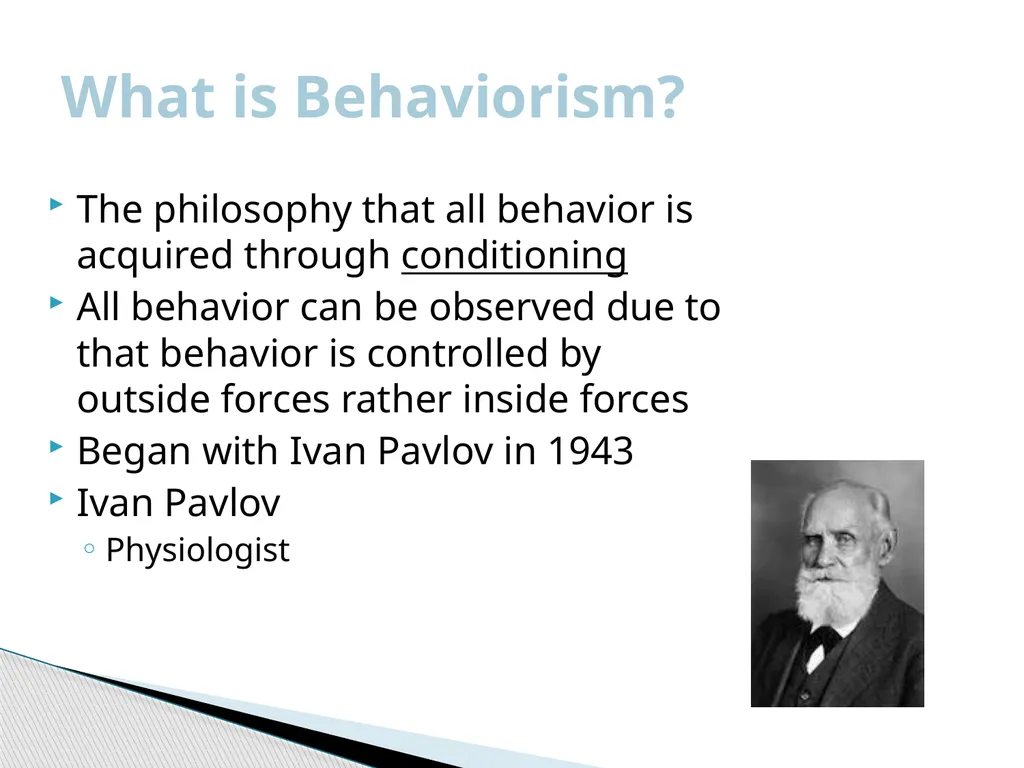
Began with Ivan Pavlov in 1943
Ivan Pavlov
Physiologist What is Behaviorism?<br>
03
US-Unconditioned Stimulus
UR-unconditioned Response
CS-Conditioned Stimulus
CR-Conditioned Response<br>
04
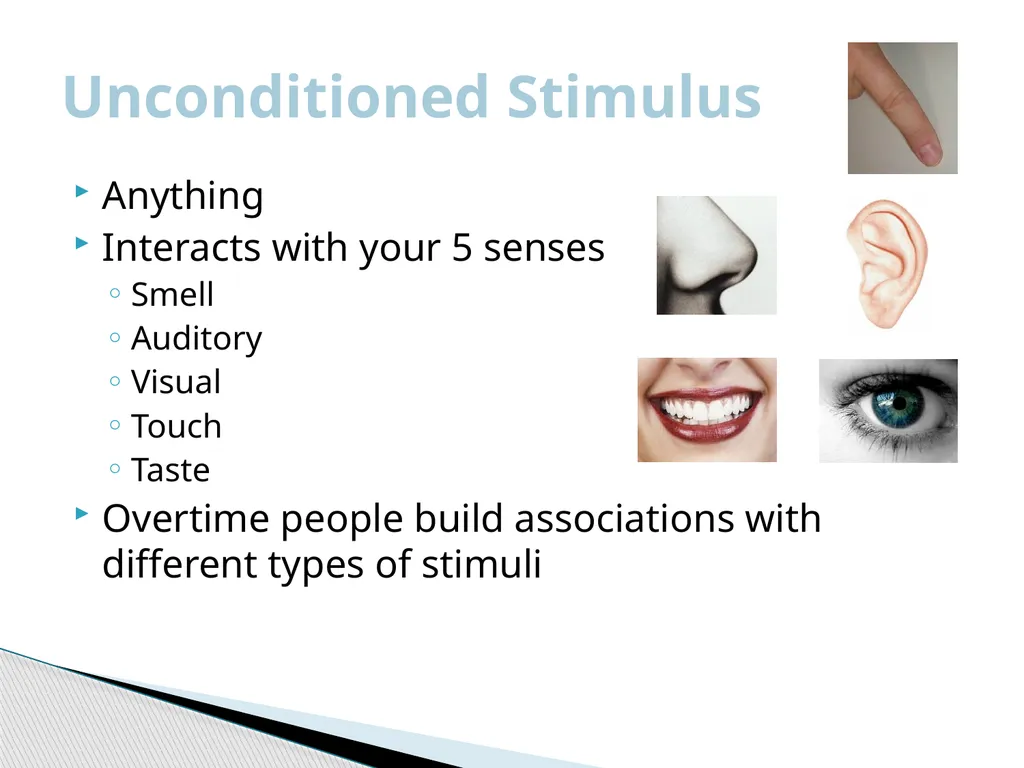
Anything
Interacts with your 5 senses
Smell
Auditory
Visual
Touch
Taste
Overtime people build associations with different types of stimuli Unconditioned Stimulus<br>
05
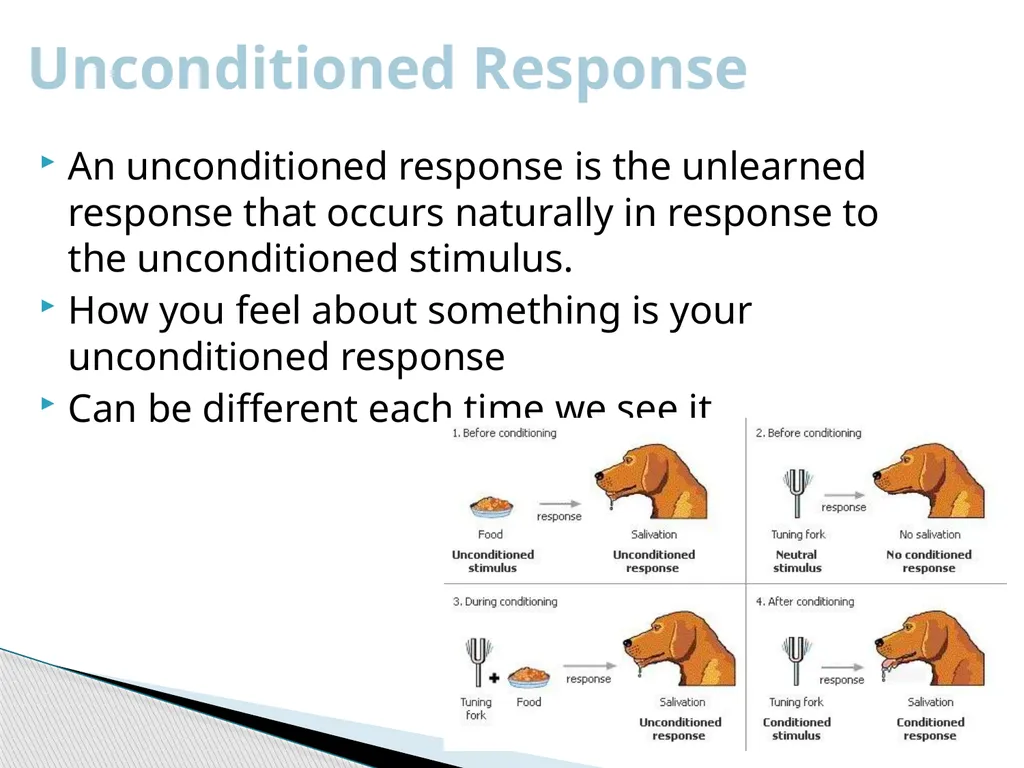
An unconditioned response is the unlearned response that occurs naturally in response to the unconditioned stimulus.
How you feel about something is your unconditioned response
Can be different each time we see it Unconditioned Response<br>
06
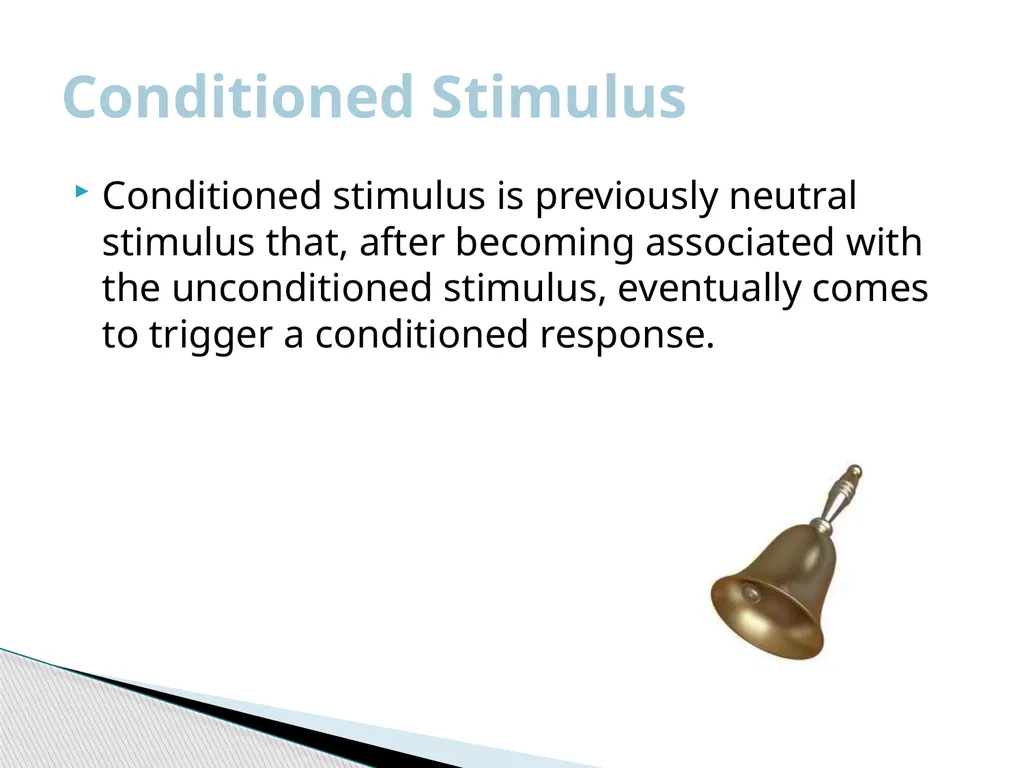
Conditioned stimulus is previously neutral stimulus that, after becoming associated with the unconditioned stimulus, eventually comes to trigger a conditioned response. Conditioned Stimulus<br>
07
Person or animal responds to conditioned stimuli the same as the event
The dog eventually developed a conditioned response to the sound of the bell Conditioned Response<br>
08
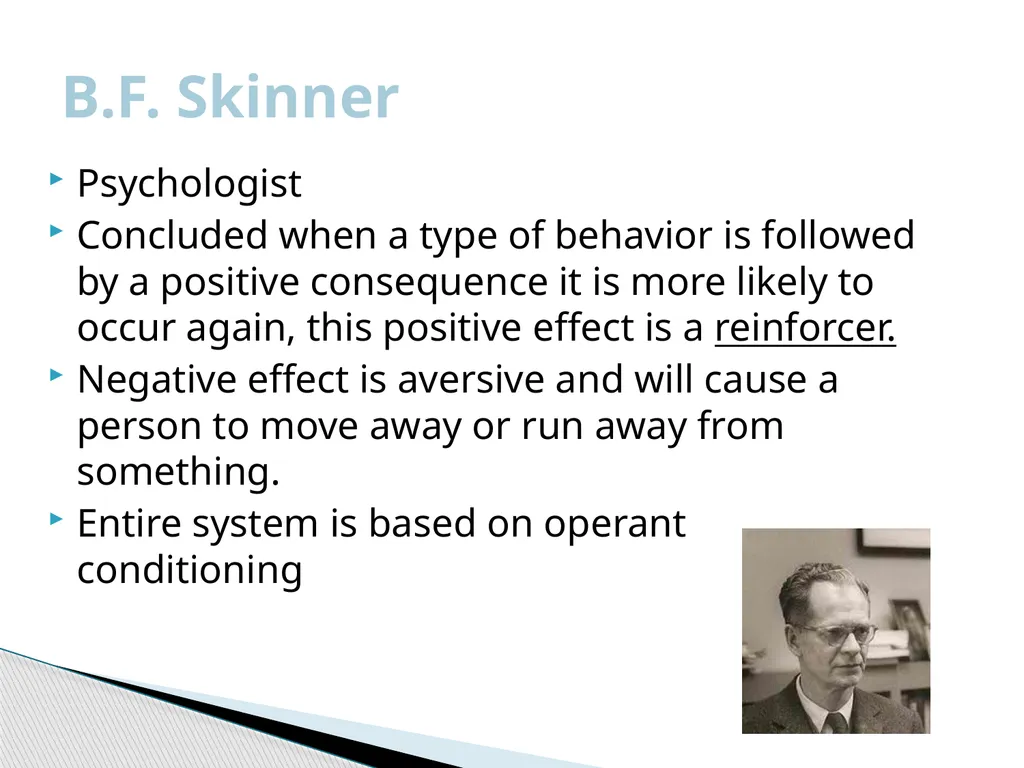
Psychologist
Concluded when a type of behavior is followed by a positive consequence it is more likely to occur again, this positive effect is a reinforcer.
Negative effect is aversive and will cause a person to move away or run away from something.
Entire system is based on operant conditioning B.F. Skinner<br>
09
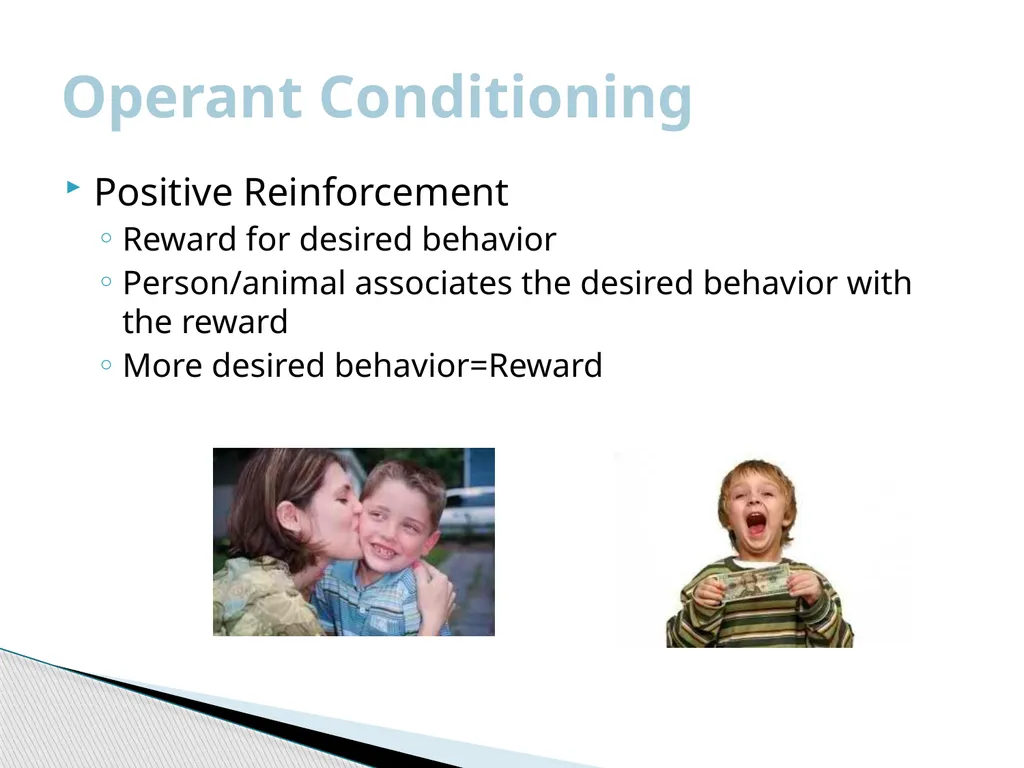
Positive Reinforcement
Reward for desired behavior
Person/animal associates the desired behavior with the reward
More desired behavior=Reward Operant Conditioning<br>
10
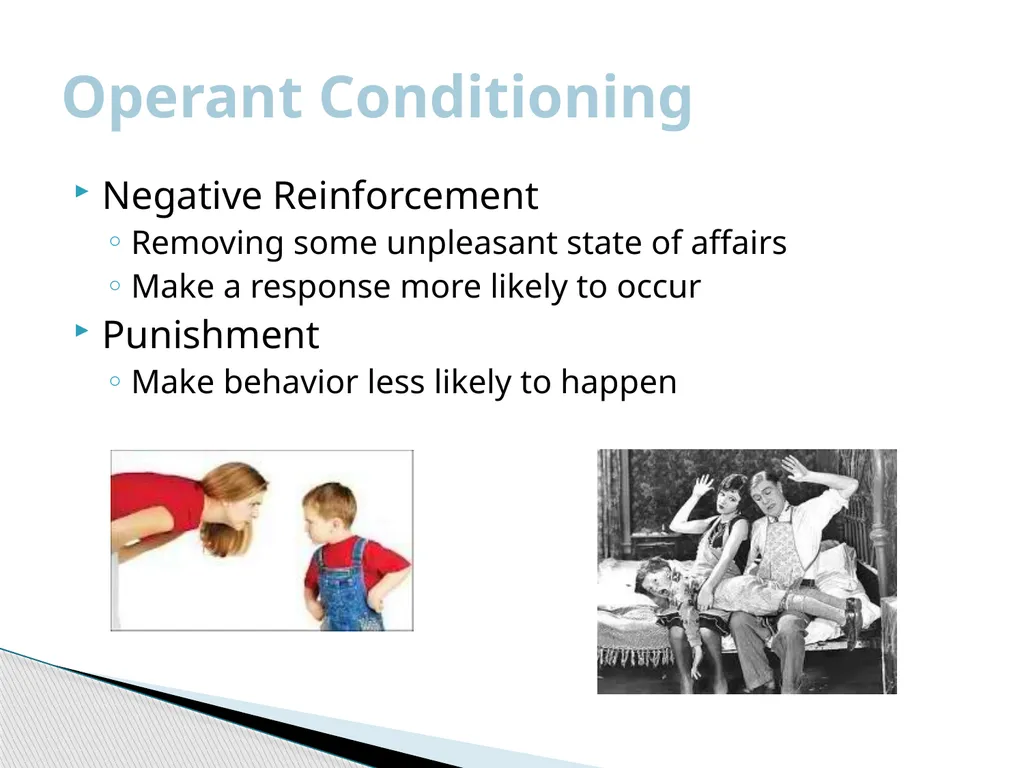
Negative Reinforcement
Removing some unpleasant state of affairs
Make a response more likely to occur
Punishment
Make behavior less likely to happen Operant Conditioning<br>
Intellecom.(2011). The Use of Reinforcement and Punishment in Shaping a Child's Behavior. Retrieved from http://www.youtube.com/watch?v=BVbGSVhKGwA
Ivan Petrovich Pavlov. (2012). Biography.com. Retrieved 11:16, Sep 17, 2012 from http://www.biography.com/people/ivan-petrovich-pavlov-9435332
Kendra, C.(2006). What is Behaviorism?. Retrieved from http://psychology.about.com/od/behavioralpsychology/f/behaviorism.htm
Lee, S.(2012). Behaviorism: Classical Conditioning and Operant Conditioning. Retrieved fromhttp://www.youtube.com/watch?v=b6DuDqqptiY
McLeod, S.(2007). Simply Psychology. Retrieved from http://www.simplypsychology.org/behaviorism.html
Zarhejo, K.(2009). The Big Bang Theory - Sheldon Trains Penny. Retrieved from http://www.youtube.com/watch?v=qy_mIEnnlF4 Resources<br>