
Being open and honest when things go wrong





Description: Being open and honest when things go wrong Learning objectives Firstly, who are our Healthcare professionals that are regulated by the HCPC? (HCPC, 2018) Do you know the 15 healthcare professions that are regulated by the HCPC? Firstly, who
Related Topics
Download Presentation
"Being open and honest when things go wrong" is the property of its rightful owner. Permission is granted to download and print the materials on this website for personal, non-commercial use only, and to display it on your personal computer provided you do not modify the materials and that you retain all copyright notices contained in the materials. By downloading content from our website, you accept the terms of this agreement.
Presentation Transcript
slide1. Being open and honest when things go wrong<br>
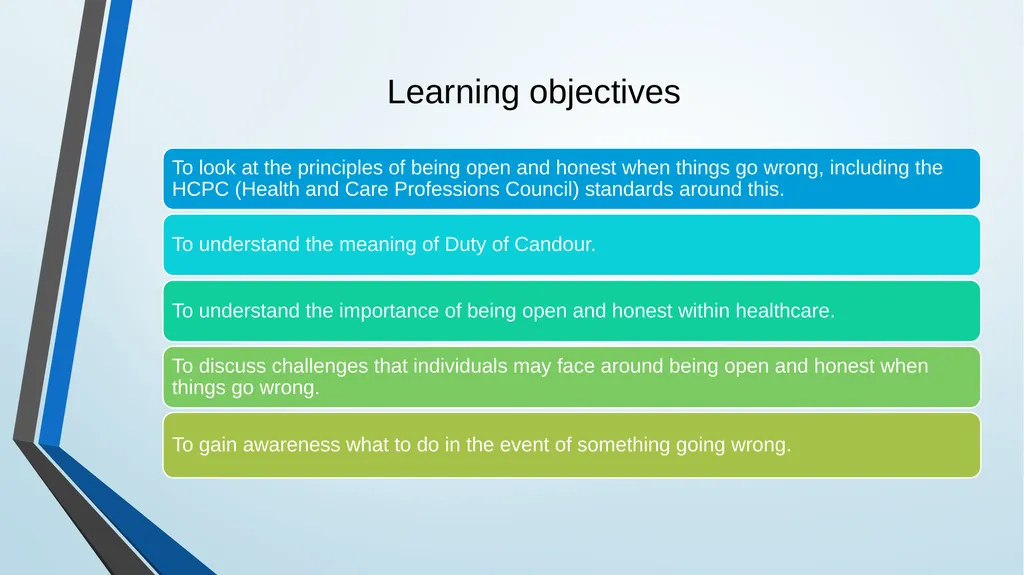
slide2. Learning objectives<br>
slide3. Firstly, who are our Healthcare professionals that are regulated by the HCPC? (HCPC, 2018) Do you know the 15 healthcare professions that are regulated by the HCPC?<br>
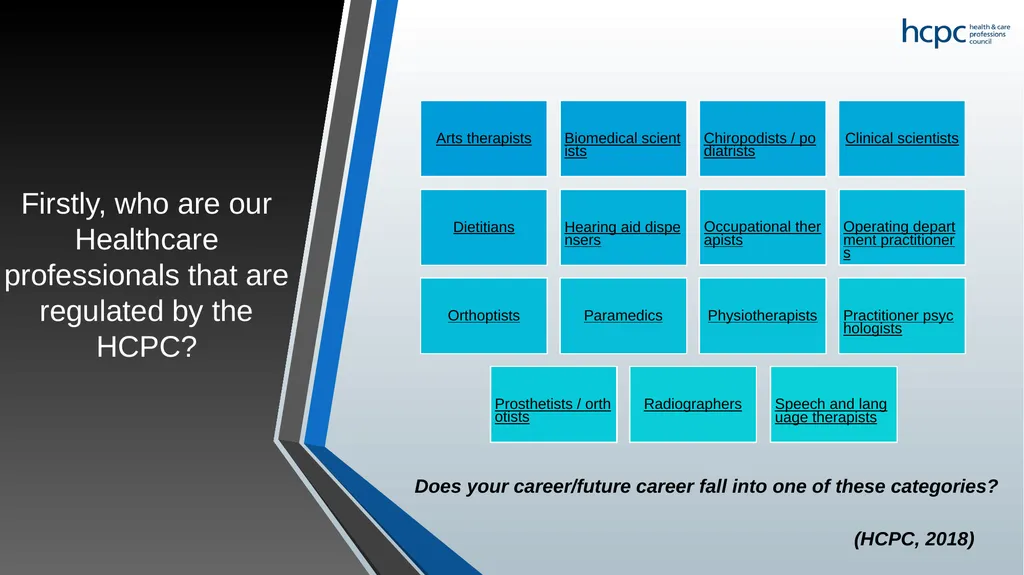
slide4. Firstly, who are our Healthcare professionals that are regulated by the HCPC? Does your career/future career fall into one of these categories? (HCPC, 2018)<br>
slide5. All of the healthcare professionals and students that fall under regulation by the HCPC have standards that detail what is expected of the healthcare professionals. They are regularly updated, so those regulated should stay up to date with the latest standards.
These are available to read here- Standards | (hcpc-uk.org) (HCPC, 2022). Including standards of proficiency for each of the healthcare professional categories.
All healthcare professionals should work within the ethical framework set by the HCPC.
In relation to this session, the standards include-
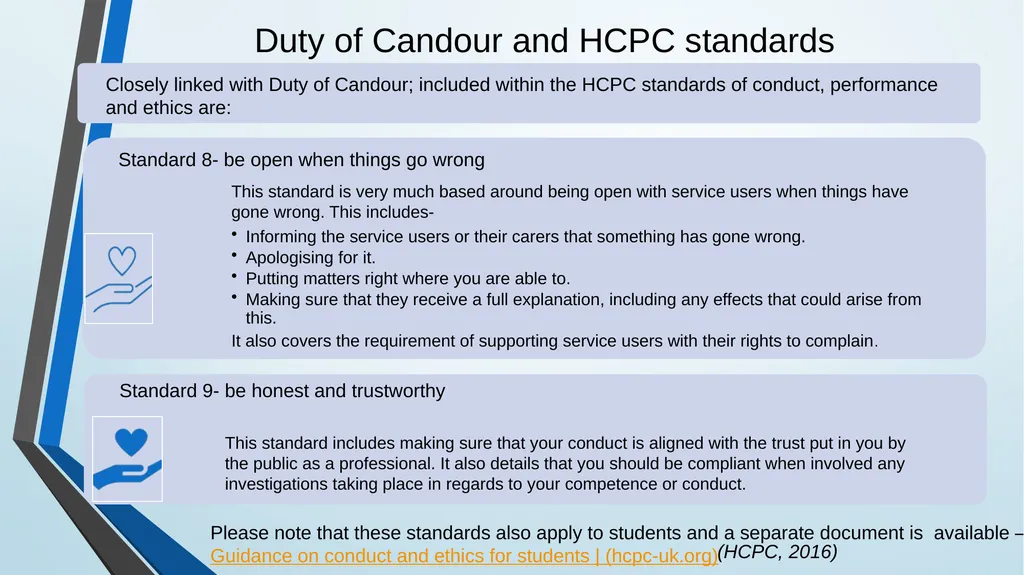
Being open when things go wrong
Be honest and trustworthy
(we will come back to these in more detail!) (HCPC, 2016)<br>
slide6. Is it okay for things to go wrong for a training healthcare professional? ? ? ? ? ? ? ? ? ? ?<br>
slide7. Is it okay for things to go wrong as a qualified healthcare professional? ? ? ? ? ? ? ? ? ? ?<br>
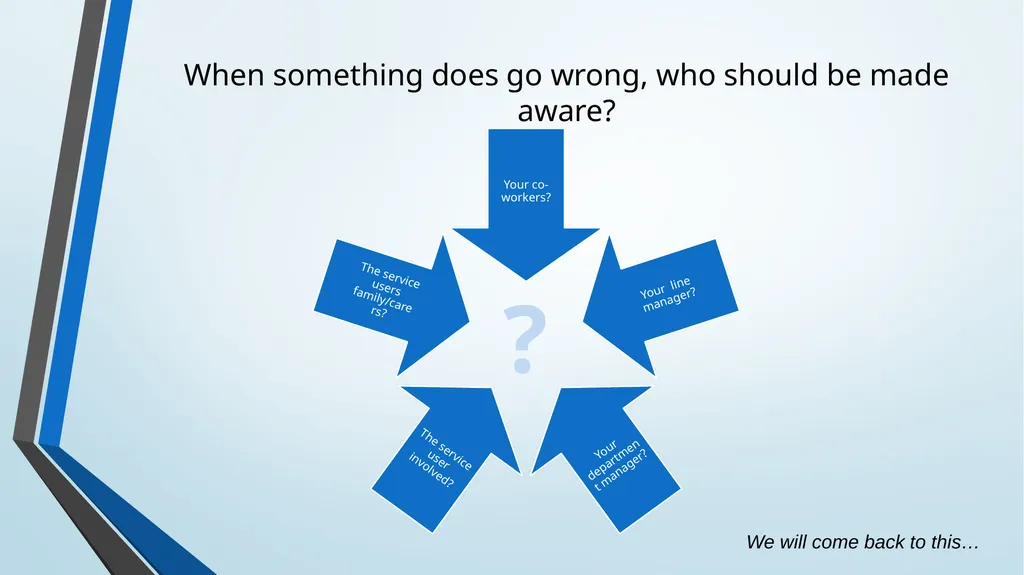
slide8. When something does go wrong, who should be made aware? We will come back to this… ?<br>
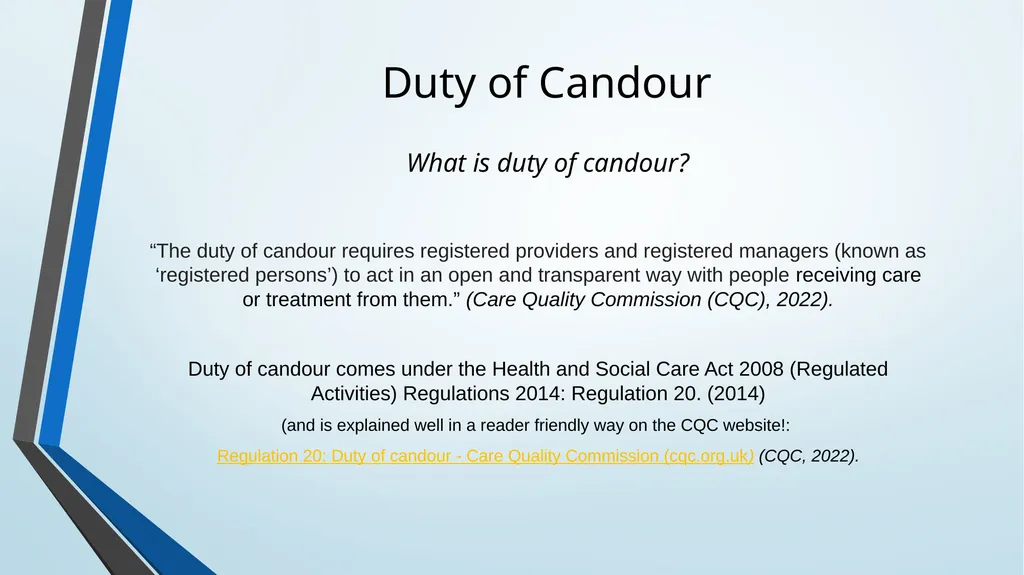
slide9. Duty of Candour “The duty of candour requires registered providers and registered managers (known as ‘registered persons’) to act in an open and transparent way with people receiving care or treatment from them.” (Care Quality Commission (CQC), 2022).
Duty of candour comes under the Health and Social Care Act 2008 (Regulated Activities) Regulations 2014: Regulation 20. (2014)
(and is explained well in a reader friendly way on the CQC website!:
Regulation 20: Duty of candour - Care Quality Commission (cqc.org.uk) (CQC, 2022). What is duty of candour?<br>
slide10. There are two types of duty of candour- Statutory Professional All healthcare professionals must be open and honest with people in their care when something goes wrong and causes, or could cause, harm or distress.
Health and care professionals must also be open and honest with their colleagues, employers, regulators and relevant organisations- this includes taking part in reviews and investigations (GMC and NMC, 2022). Since 2014, organisations registered with the CQC in England have a statutory duty of candour (Royal College of Nursing (RCN), 2022).
Reporting to the service user or relatives if there has been a ‘notifiable safety incident’. This refers to any unintended or unexpected incident that has or could have resulted in death, severe harm, moderate harm or prolonged psychological harm (General Medical Council (GMC) and Nursing and Midwifery Council (NMC), 2022).<br>
slide11. Duty of Candour and HCPC standards (HCPC, 2016) Please note that these standards also apply to students and a separate document is available –
Guidance on conduct and ethics for students | (hcpc-uk.org)<br>
slide12. So…going back to the previous question… When something does go wrong, who should be made aware? Your co-workers?
Your line manager?
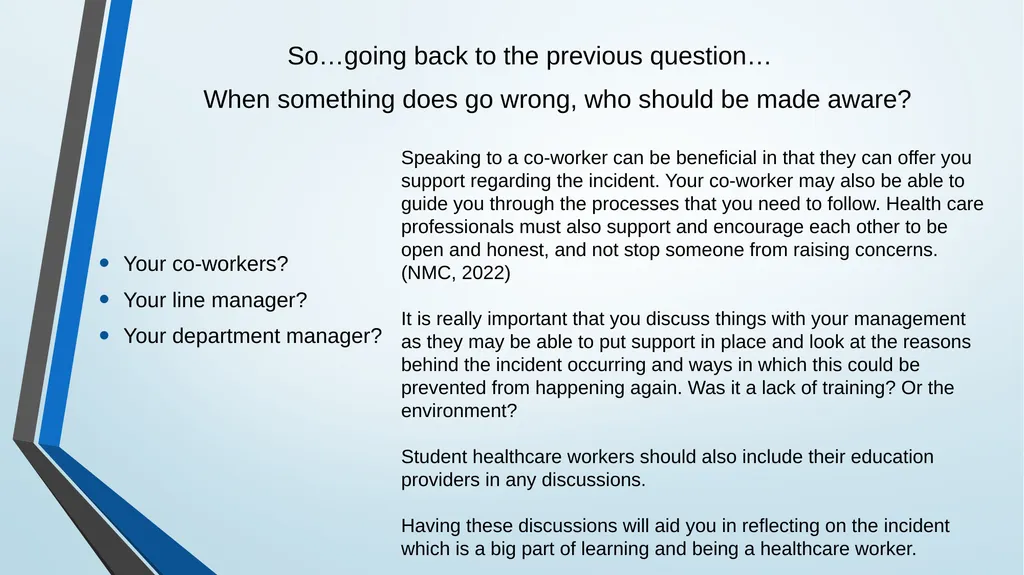
Your department manager? Speaking to a co-worker can be beneficial in that they can offer you support regarding the incident. Your co-worker may also be able to guide you through the processes that you need to follow. Health care professionals must also support and encourage each other to be open and honest, and not stop someone from raising concerns. (NMC, 2022)
It is really important that you discuss things with your management as they may be able to put support in place and look at the reasons behind the incident occurring and ways in which this could be prevented from happening again. Was it a lack of training? Or the environment?
Student healthcare workers should also include their education providers in any discussions.
Having these discussions will aid you in reflecting on the incident which is a big part of learning and being a healthcare worker.<br>
slide13. The service user involved?
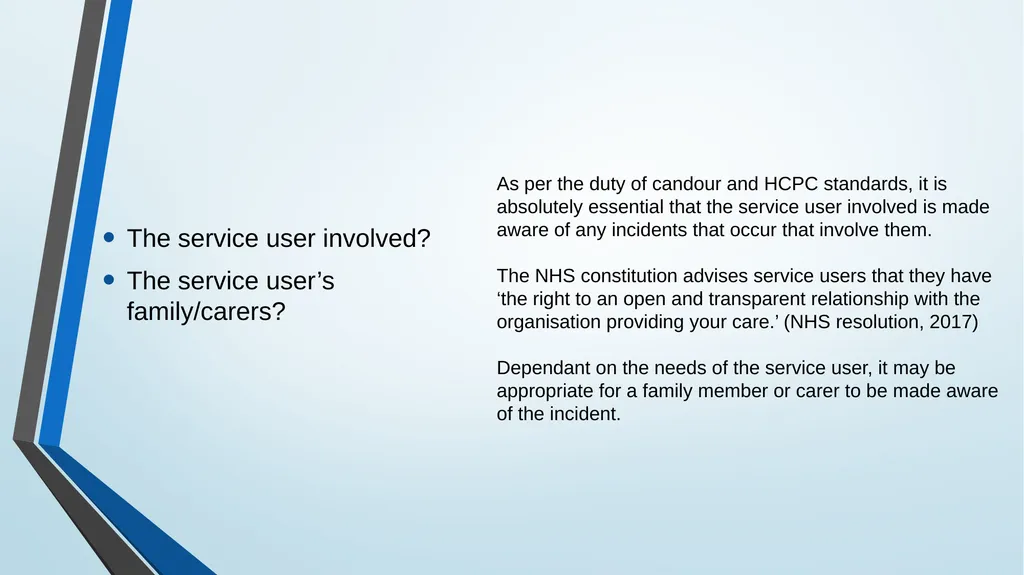
The service user’s family/carers? As per the duty of candour and HCPC standards, it is absolutely essential that the service user involved is made aware of any incidents that occur that involve them.
The NHS constitution advises service users that they have ‘the right to an open and transparent relationship with the organisation providing your care.’ (NHS resolution, 2017)
Dependant on the needs of the service user, it may be appropriate for a family member or carer to be made aware of the incident.<br>
slide14. Challenges What are some challenges that you can think of that may affect someone who has to report something that has gone wrong?<br>
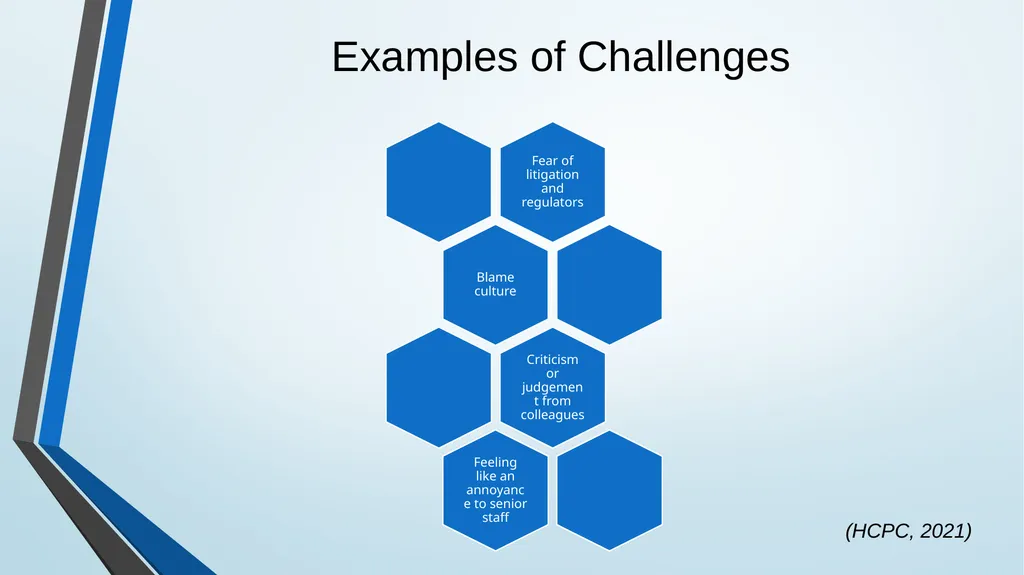
slide15. Examples of Challenges (HCPC, 2021)<br>
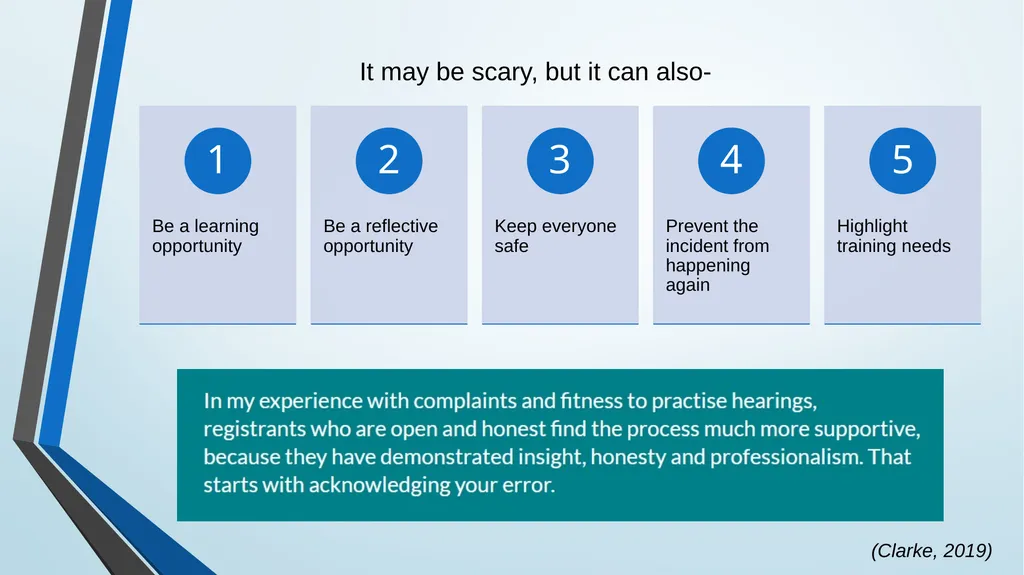
slide16. (Clarke, 2019) It may be scary, but it can also-<br>
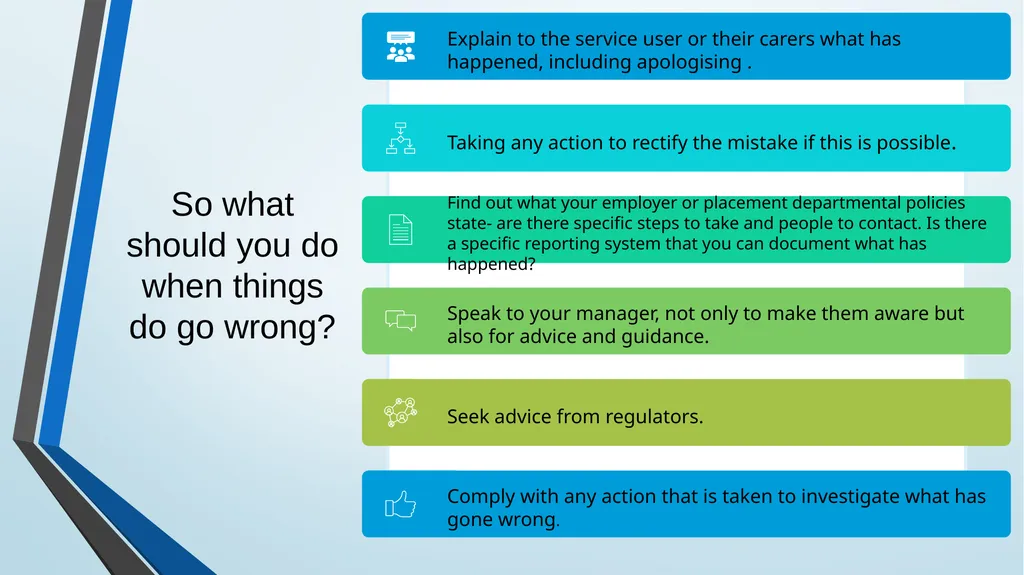
slide17. So what should you do when things do go wrong?<br>
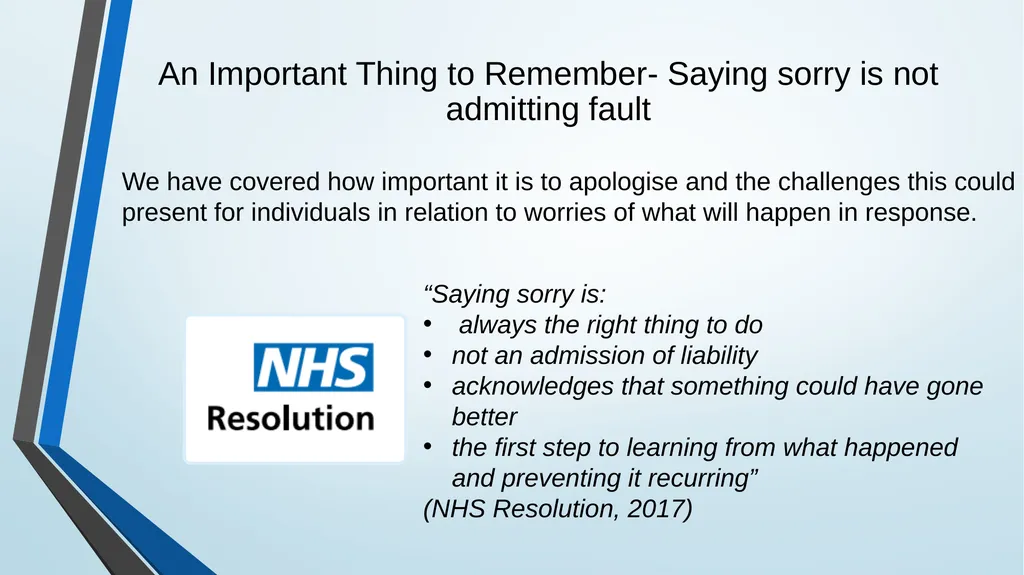
slide18. An Important Thing to Remember- Saying sorry is not admitting fault We have covered how important it is to apologise and the challenges this could present for individuals in relation to worries of what will happen in response. “Saying sorry is:
always the right thing to do
not an admission of liability
acknowledges that something could have gone better
the first step to learning from what happened and preventing it recurring”
(NHS Resolution, 2017)<br>
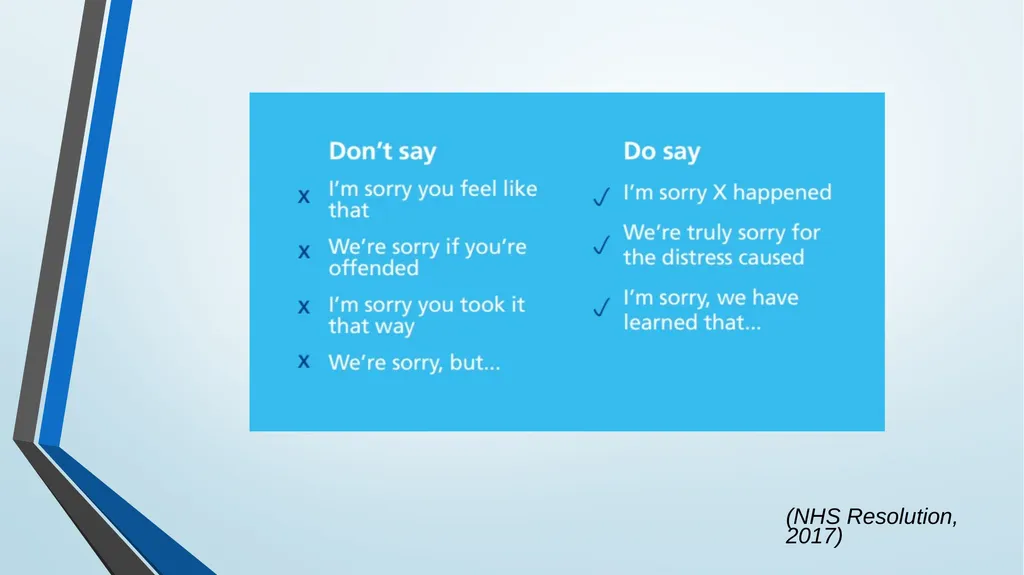
slide19. (NHS Resolution, 2017)<br>
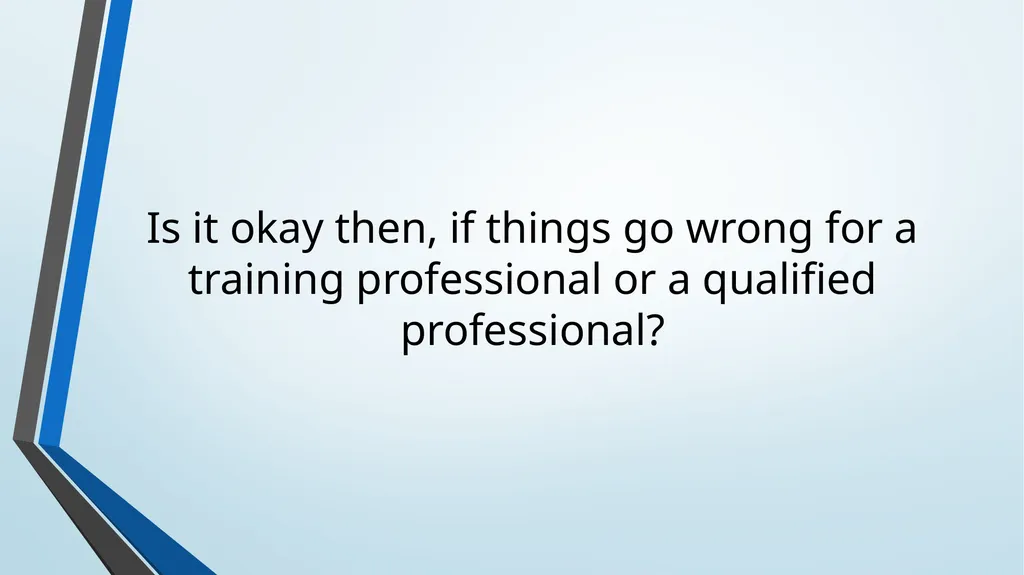
slide20. Is it okay then, if things go wrong for a training professional or a qualified professional?<br>
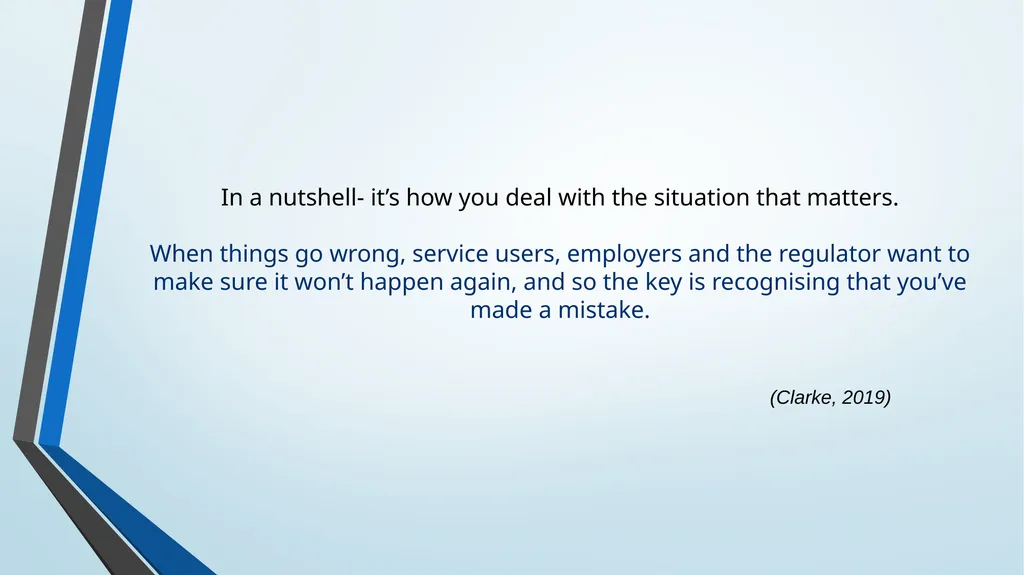
slide21. In a nutshell- it’s how you deal with the situation that matters. When things go wrong, service users, employers and the regulator want to make sure it won’t happen again, and so the key is recognising that you’ve made a mistake. (Clarke, 2019)<br>
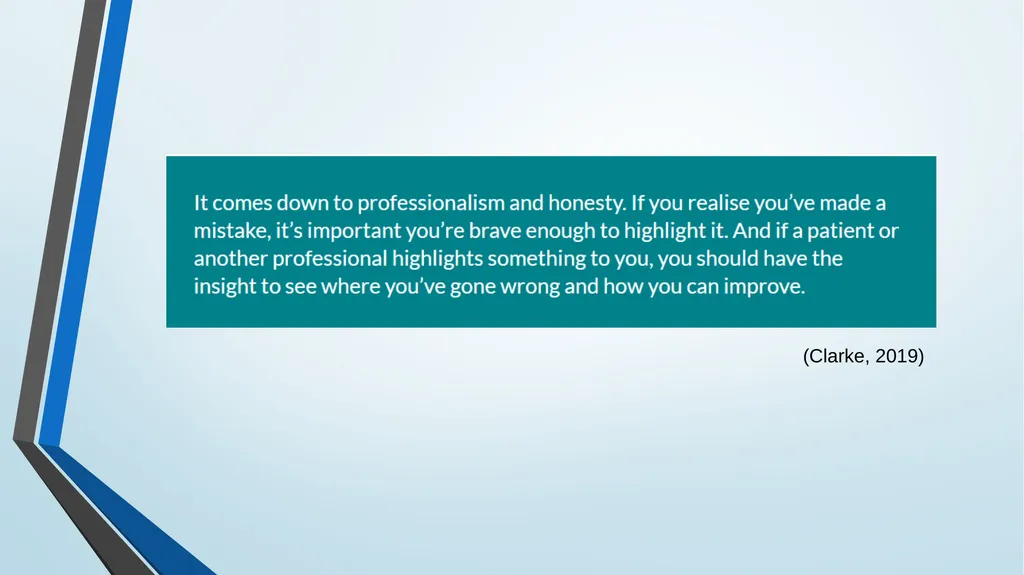
slide22. (Clarke, 2019)<br>
slide23. Now you have more insight: A case study based on students https://youtu.be/KFisdBqa19M<br>
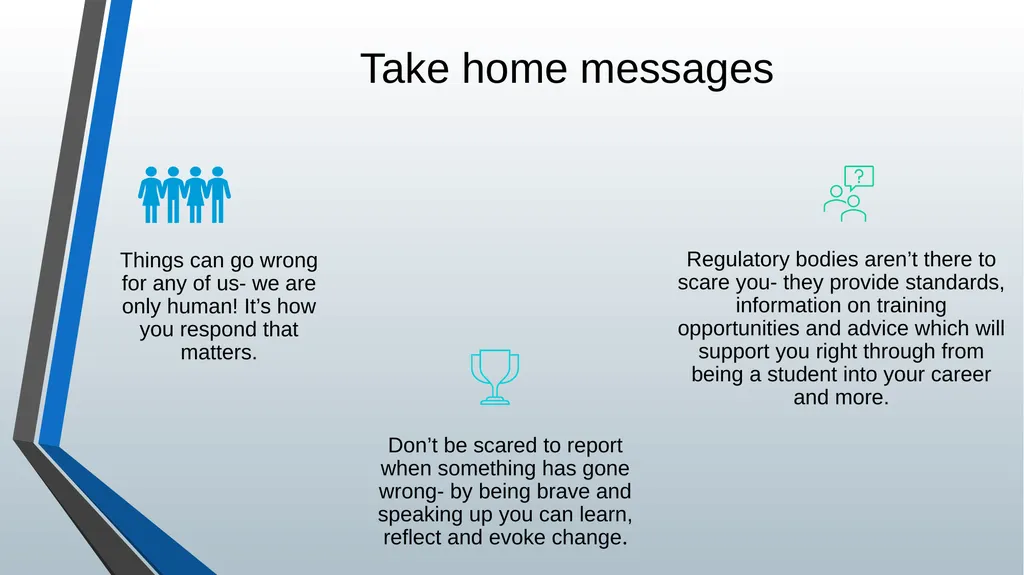
slide24. Take home messages<br>
slide25. Any Questions? ? ? ? ? ? ? ? ? ? ?<br>
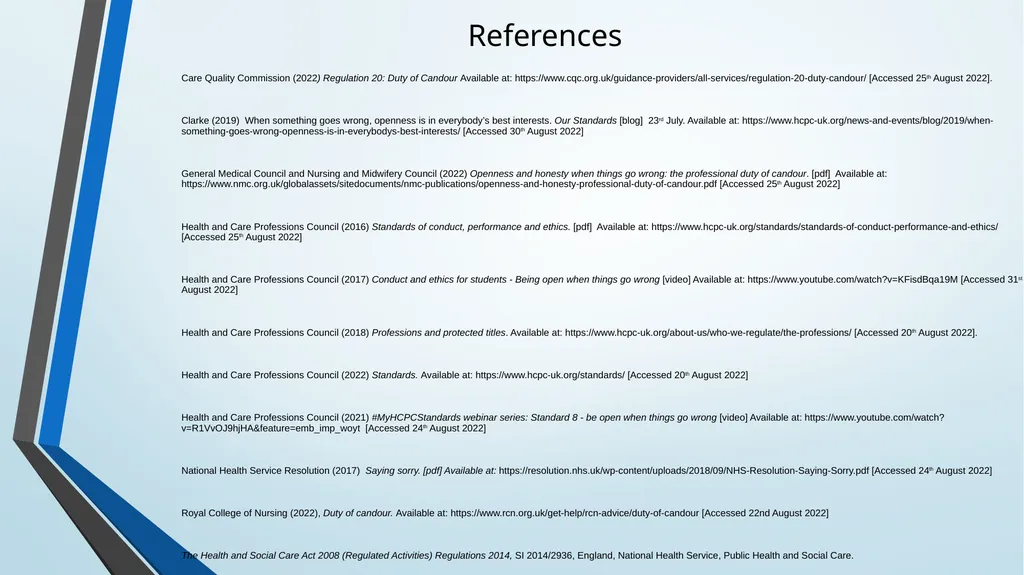
slide26. References Care Quality Commission (2022) Regulation 20: Duty of Candour Available at: https://www.cqc.org.uk/guidance-providers/all-services/regulation-20-duty-candour/ [Accessed 25th August 2022].
Clarke (2019) When something goes wrong, openness is in everybody’s best interests. Our Standards [blog] 23rd July. Available at: https://www.hcpc-uk.org/news-and-events/blog/2019/when-something-goes-wrong-openness-is-in-everybodys-best-interests/ [Accessed 30th August 2022]
General Medical Council and Nursing and Midwifery Council (2022) Openness and honesty when things go wrong: the professional duty of candour. [pdf] Available at: https://www.nmc.org.uk/globalassets/sitedocuments/nmc-publications/openness-and-honesty-professional-duty-of-candour.pdf [Accessed 25th August 2022]
Health and Care Professions Council (2016) Standards of conduct, performance and ethics. [pdf] Available at: https://www.hcpc-uk.org/standards/standards-of-conduct-performance-and-ethics/ [Accessed 25th August 2022]
Health and Care Professions Council (2017) Conduct and ethics for students - Being open when things go wrong [video] Available at: https://www.youtube.com/watch?v=KFisdBqa19M [Accessed 31st August 2022]
Health and Care Professions Council (2018) Professions and protected titles. Available at: https://www.hcpc-uk.org/about-us/who-we-regulate/the-professions/ [Accessed 20th August 2022].
Health and Care Professions Council (2022) Standards. Available at: https://www.hcpc-uk.org/standards/ [Accessed 20th August 2022]
Health and Care Professions Council (2021) #MyHCPCStandards webinar series: Standard 8 - be open when things go wrong [video] Available at: https://www.youtube.com/watch?v=R1VvOJ9hjHA&feature=emb_imp_woyt [Accessed 24th August 2022]
National Health Service Resolution (2017) Saying sorry. [pdf] Available at: https://resolution.nhs.uk/wp-content/uploads/2018/09/NHS-Resolution-Saying-Sorry.pdf [Accessed 24th August 2022]
Royal College of Nursing (2022), Duty of candour. Available at: https://www.rcn.org.uk/get-help/rcn-advice/duty-of-candour [Accessed 22nd August 2022]
The Health and Social Care Act 2008 (Regulated Activities) Regulations 2014, SI 2014/2936, England, National Health Service, Public Health and Social Care.<br>
slide2. Learning objectives<br>
slide3. Firstly, who are our Healthcare professionals that are regulated by the HCPC? (HCPC, 2018) Do you know the 15 healthcare professions that are regulated by the HCPC?<br>
slide4. Firstly, who are our Healthcare professionals that are regulated by the HCPC? Does your career/future career fall into one of these categories? (HCPC, 2018)<br>
slide5. All of the healthcare professionals and students that fall under regulation by the HCPC have standards that detail what is expected of the healthcare professionals. They are regularly updated, so those regulated should stay up to date with the latest standards.
These are available to read here- Standards | (hcpc-uk.org) (HCPC, 2022). Including standards of proficiency for each of the healthcare professional categories.
All healthcare professionals should work within the ethical framework set by the HCPC.
In relation to this session, the standards include-
Being open when things go wrong
Be honest and trustworthy
(we will come back to these in more detail!) (HCPC, 2016)<br>
slide6. Is it okay for things to go wrong for a training healthcare professional? ? ? ? ? ? ? ? ? ? ?<br>
slide7. Is it okay for things to go wrong as a qualified healthcare professional? ? ? ? ? ? ? ? ? ? ?<br>
slide8. When something does go wrong, who should be made aware? We will come back to this… ?<br>
slide9. Duty of Candour “The duty of candour requires registered providers and registered managers (known as ‘registered persons’) to act in an open and transparent way with people receiving care or treatment from them.” (Care Quality Commission (CQC), 2022).
Duty of candour comes under the Health and Social Care Act 2008 (Regulated Activities) Regulations 2014: Regulation 20. (2014)
(and is explained well in a reader friendly way on the CQC website!:
Regulation 20: Duty of candour - Care Quality Commission (cqc.org.uk) (CQC, 2022). What is duty of candour?<br>
slide10. There are two types of duty of candour- Statutory Professional All healthcare professionals must be open and honest with people in their care when something goes wrong and causes, or could cause, harm or distress.
Health and care professionals must also be open and honest with their colleagues, employers, regulators and relevant organisations- this includes taking part in reviews and investigations (GMC and NMC, 2022). Since 2014, organisations registered with the CQC in England have a statutory duty of candour (Royal College of Nursing (RCN), 2022).
Reporting to the service user or relatives if there has been a ‘notifiable safety incident’. This refers to any unintended or unexpected incident that has or could have resulted in death, severe harm, moderate harm or prolonged psychological harm (General Medical Council (GMC) and Nursing and Midwifery Council (NMC), 2022).<br>
slide11. Duty of Candour and HCPC standards (HCPC, 2016) Please note that these standards also apply to students and a separate document is available –
Guidance on conduct and ethics for students | (hcpc-uk.org)<br>
slide12. So…going back to the previous question… When something does go wrong, who should be made aware? Your co-workers?
Your line manager?
Your department manager? Speaking to a co-worker can be beneficial in that they can offer you support regarding the incident. Your co-worker may also be able to guide you through the processes that you need to follow. Health care professionals must also support and encourage each other to be open and honest, and not stop someone from raising concerns. (NMC, 2022)
It is really important that you discuss things with your management as they may be able to put support in place and look at the reasons behind the incident occurring and ways in which this could be prevented from happening again. Was it a lack of training? Or the environment?
Student healthcare workers should also include their education providers in any discussions.
Having these discussions will aid you in reflecting on the incident which is a big part of learning and being a healthcare worker.<br>
slide13. The service user involved?
The service user’s family/carers? As per the duty of candour and HCPC standards, it is absolutely essential that the service user involved is made aware of any incidents that occur that involve them.
The NHS constitution advises service users that they have ‘the right to an open and transparent relationship with the organisation providing your care.’ (NHS resolution, 2017)
Dependant on the needs of the service user, it may be appropriate for a family member or carer to be made aware of the incident.<br>
slide14. Challenges What are some challenges that you can think of that may affect someone who has to report something that has gone wrong?<br>
slide15. Examples of Challenges (HCPC, 2021)<br>
slide16. (Clarke, 2019) It may be scary, but it can also-<br>
slide17. So what should you do when things do go wrong?<br>
slide18. An Important Thing to Remember- Saying sorry is not admitting fault We have covered how important it is to apologise and the challenges this could present for individuals in relation to worries of what will happen in response. “Saying sorry is:
always the right thing to do
not an admission of liability
acknowledges that something could have gone better
the first step to learning from what happened and preventing it recurring”
(NHS Resolution, 2017)<br>
slide19. (NHS Resolution, 2017)<br>
slide20. Is it okay then, if things go wrong for a training professional or a qualified professional?<br>
slide21. In a nutshell- it’s how you deal with the situation that matters. When things go wrong, service users, employers and the regulator want to make sure it won’t happen again, and so the key is recognising that you’ve made a mistake. (Clarke, 2019)<br>
slide22. (Clarke, 2019)<br>
slide23. Now you have more insight: A case study based on students https://youtu.be/KFisdBqa19M<br>
slide24. Take home messages<br>
slide25. Any Questions? ? ? ? ? ? ? ? ? ? ?<br>
slide26. References Care Quality Commission (2022) Regulation 20: Duty of Candour Available at: https://www.cqc.org.uk/guidance-providers/all-services/regulation-20-duty-candour/ [Accessed 25th August 2022].
Clarke (2019) When something goes wrong, openness is in everybody’s best interests. Our Standards [blog] 23rd July. Available at: https://www.hcpc-uk.org/news-and-events/blog/2019/when-something-goes-wrong-openness-is-in-everybodys-best-interests/ [Accessed 30th August 2022]
General Medical Council and Nursing and Midwifery Council (2022) Openness and honesty when things go wrong: the professional duty of candour. [pdf] Available at: https://www.nmc.org.uk/globalassets/sitedocuments/nmc-publications/openness-and-honesty-professional-duty-of-candour.pdf [Accessed 25th August 2022]
Health and Care Professions Council (2016) Standards of conduct, performance and ethics. [pdf] Available at: https://www.hcpc-uk.org/standards/standards-of-conduct-performance-and-ethics/ [Accessed 25th August 2022]
Health and Care Professions Council (2017) Conduct and ethics for students - Being open when things go wrong [video] Available at: https://www.youtube.com/watch?v=KFisdBqa19M [Accessed 31st August 2022]
Health and Care Professions Council (2018) Professions and protected titles. Available at: https://www.hcpc-uk.org/about-us/who-we-regulate/the-professions/ [Accessed 20th August 2022].
Health and Care Professions Council (2022) Standards. Available at: https://www.hcpc-uk.org/standards/ [Accessed 20th August 2022]
Health and Care Professions Council (2021) #MyHCPCStandards webinar series: Standard 8 - be open when things go wrong [video] Available at: https://www.youtube.com/watch?v=R1VvOJ9hjHA&feature=emb_imp_woyt [Accessed 24th August 2022]
National Health Service Resolution (2017) Saying sorry. [pdf] Available at: https://resolution.nhs.uk/wp-content/uploads/2018/09/NHS-Resolution-Saying-Sorry.pdf [Accessed 24th August 2022]
Royal College of Nursing (2022), Duty of candour. Available at: https://www.rcn.org.uk/get-help/rcn-advice/duty-of-candour [Accessed 22nd August 2022]
The Health and Social Care Act 2008 (Regulated Activities) Regulations 2014, SI 2014/2936, England, National Health Service, Public Health and Social Care.<br>