
Bioethics in Anatomy Education Resources:
PM
Published · 14 slides · 0 views
1 / 1
Description
Bioethics in Anatomy Education Resources: Guidelines for Students in the Anatomy Laboratory Description: These PowerPoint slides provide templates for guidelines for students in the anatomy laboratory, using one medical schools information
Related Topics
Share
Embed code
Download this presentation From Below
"Bioethics in Anatomy Education Resources:" is the property of its rightful owner. Permission is granted to download and print the materials on this website for personal, non-commercial use only, and to display it on your personal computer provided you do not modify the materials and that you retain all copyright notices contained in the materials. By downloading content from our website, you accept the terms of this agreement.
Presentation Transcript
01
Bioethics in Anatomy Education Resources:
Guidelines for Students in the Anatomy Laboratory
Description:
These PowerPoint slides provide templates for guidelines for students in the anatomy laboratory, using one medical school’s information as an example. Notes have been added as separate PowerPoint slides (in italics) to describe their use in more detail. Feel free to use or modify the text.
The topics covered by this resource include:
Anatomy Laboratory Guidelines
Ethical statements
Creator(s): Thomas Champney
Contact details: tchampney@med.miami.edu
Further reading:
Champney TH. A bioethos for bodies: respecting a priceless resource, Anat Sci Educ 2019; 12:432-434.<br>
02
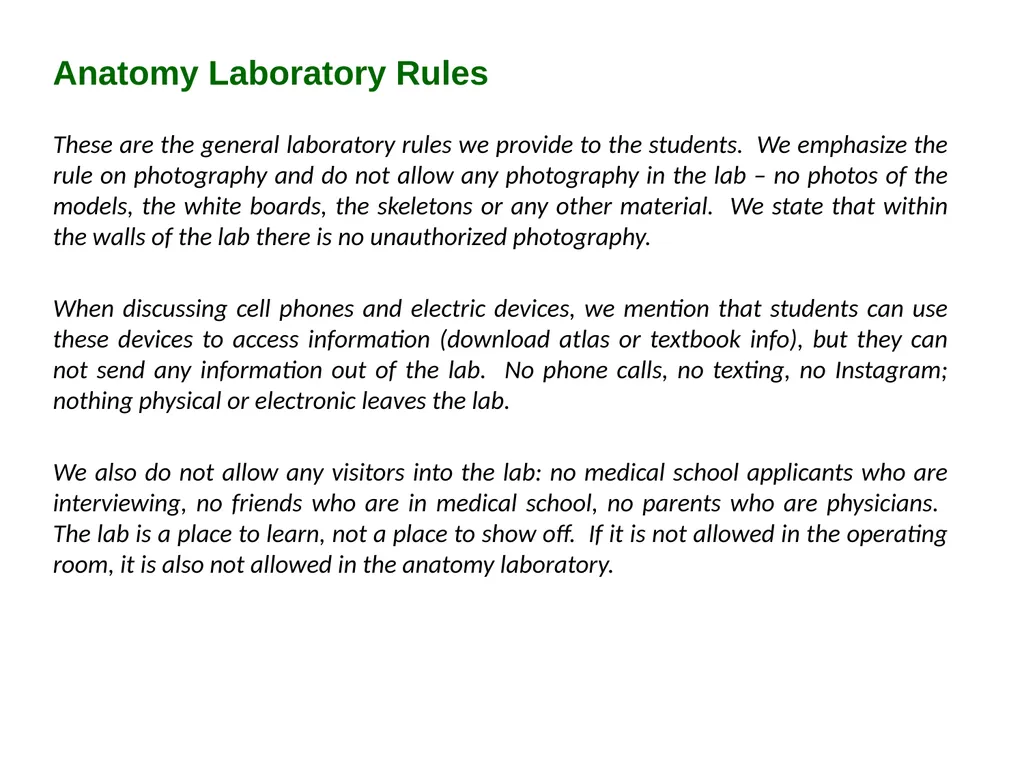
Anatomy Laboratory Rules These are the general laboratory rules we provide to the students. We emphasize the rule on photography and do not allow any photography in the lab – no photos of the models, the white boards, the skeletons or any other material. We state that within the walls of the lab there is no unauthorized photography.
When discussing cell phones and electric devices, we mention that students can use these devices to access information (download atlas or textbook info), but they can not send any information out of the lab. No phone calls, no texting, no Instagram; nothing physical or electronic leaves the lab.
We also do not allow any visitors into the lab: no medical school applicants who are interviewing, no friends who are in medical school, no parents who are physicians. The lab is a place to learn, not a place to show off. If it is not allowed in the operating room, it is also not allowed in the anatomy laboratory.<br>
03
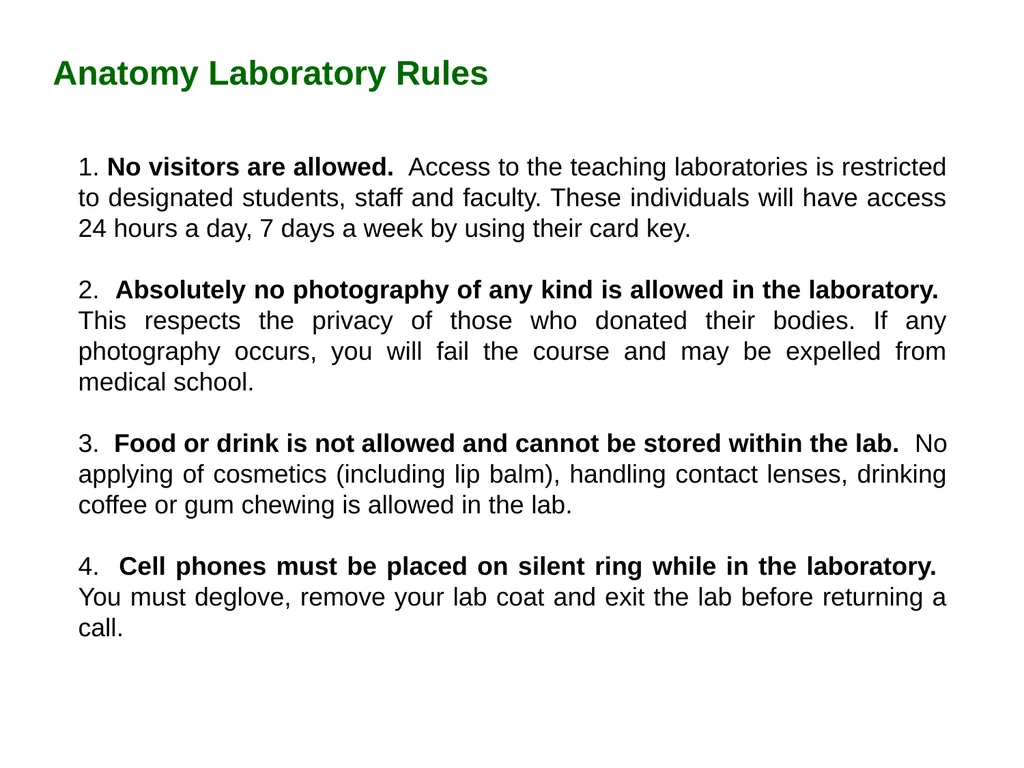
Anatomy Laboratory Rules 1. No visitors are allowed. Access to the teaching laboratories is restricted to designated students, staff and faculty. These individuals will have access 24 hours a day, 7 days a week by using their card key.
2. Absolutely no photography of any kind is allowed in the laboratory. This respects the privacy of those who donated their bodies. If any photography occurs, you will fail the course and may be expelled from medical school.
3. Food or drink is not allowed and cannot be stored within the lab. No applying of cosmetics (including lip balm), handling contact lenses, drinking coffee or gum chewing is allowed in the lab.
4. Cell phones must be placed on silent ring while in the laboratory. You must deglove, remove your lab coat and exit the lab before returning a call.<br>
04
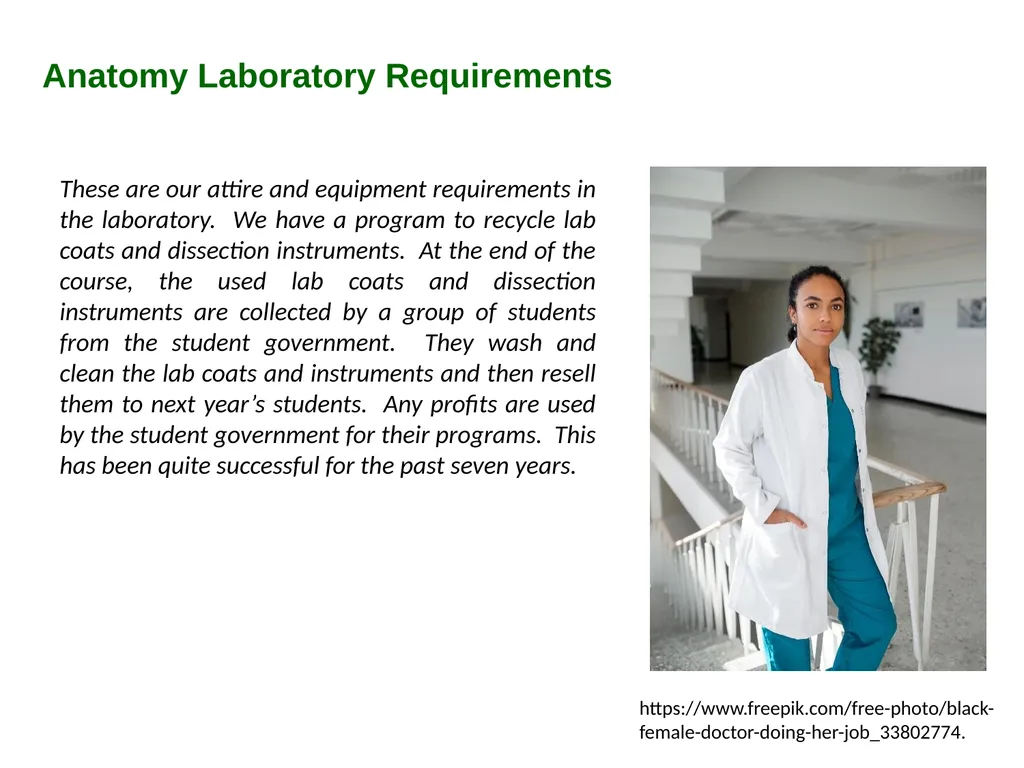
Anatomy Laboratory Requirements These are our attire and equipment requirements in the laboratory. We have a program to recycle lab coats and dissection instruments. At the end of the course, the used lab coats and dissection instruments are collected by a group of students from the student government. They wash and clean the lab coats and instruments and then resell them to next year’s students. Any profits are used by the student government for their programs. This has been quite successful for the past seven years. https://www.freepik.com/free-photo/black-female-doctor-doing-her-job_33802774.<br>
05
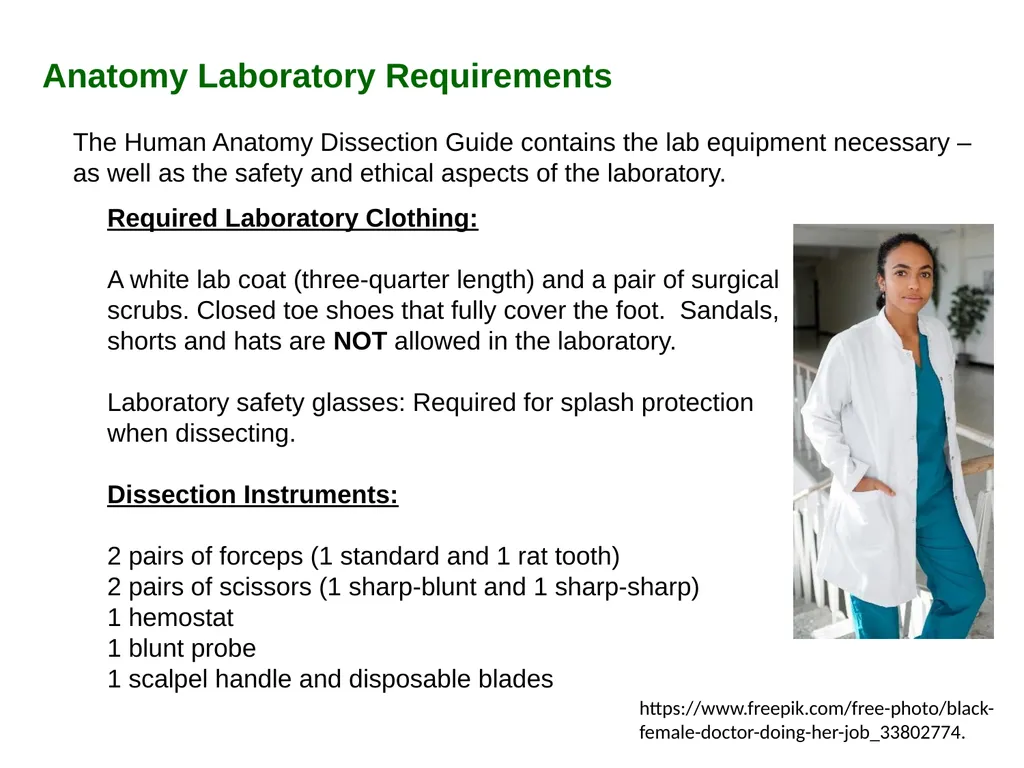
Anatomy Laboratory Requirements Required Laboratory Clothing:
A white lab coat (three-quarter length) and a pair of surgical
scrubs. Closed toe shoes that fully cover the foot. Sandals,
shorts and hats are NOT allowed in the laboratory.
Laboratory safety glasses: Required for splash protection
when dissecting.
Dissection Instruments:
2 pairs of forceps (1 standard and 1 rat tooth)
2 pairs of scissors (1 sharp-blunt and 1 sharp-sharp)
1 hemostat
1 blunt probe
1 scalpel handle and disposable blades The Human Anatomy Dissection Guide contains the lab equipment necessary – as well as the safety and ethical aspects of the laboratory. https://www.freepik.com/free-photo/black-female-doctor-doing-her-job_33802774.<br>
06
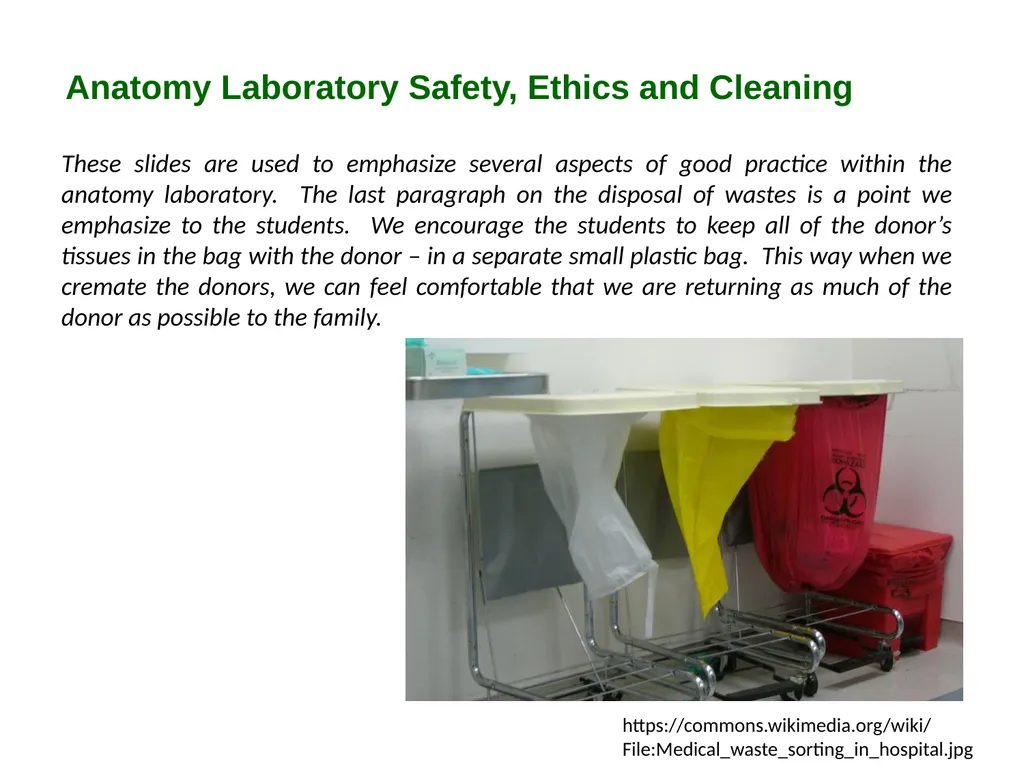
Anatomy Laboratory Safety, Ethics and Cleaning These slides are used to emphasize several aspects of good practice within the anatomy laboratory. The last paragraph on the disposal of wastes is a point we emphasize to the students. We encourage the students to keep all of the donor’s tissues in the bag with the donor – in a separate small plastic bag. This way when we cremate the donors, we can feel comfortable that we are returning as much of the donor as possible to the family. https://commons.wikimedia.org/wiki/File:Medical_waste_sorting_in_hospital.jpg<br>
07
Anatomy Laboratory Safety Safety Aspects:
All injuries in the laboratory must be reported immediately to the faculty, staff or lab directors.
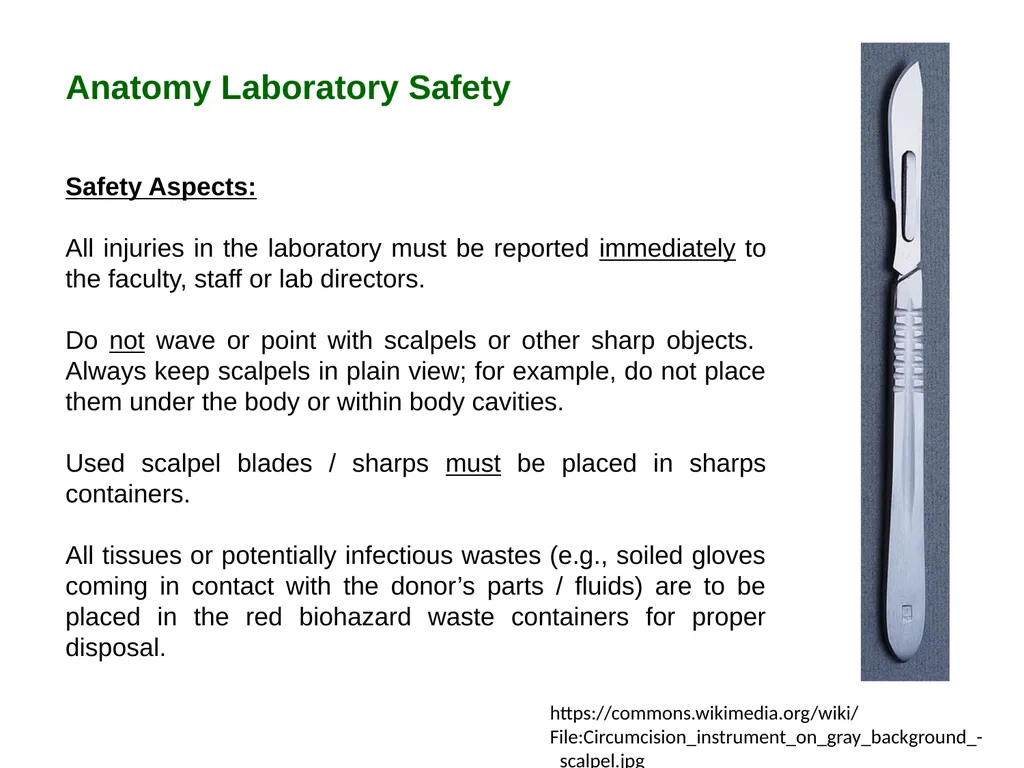
Do not wave or point with scalpels or other sharp objects. Always keep scalpels in plain view; for example, do not place them under the body or within body cavities.
Used scalpel blades / sharps must be placed in sharps containers.
All tissues or potentially infectious wastes (e.g., soiled gloves coming in contact with the donor’s parts / fluids) are to be placed in the red biohazard waste containers for proper disposal. https://commons.wikimedia.org/wiki/File:Circumcision_instrument_on_gray_background_-_scalpel.jpg<br>
08
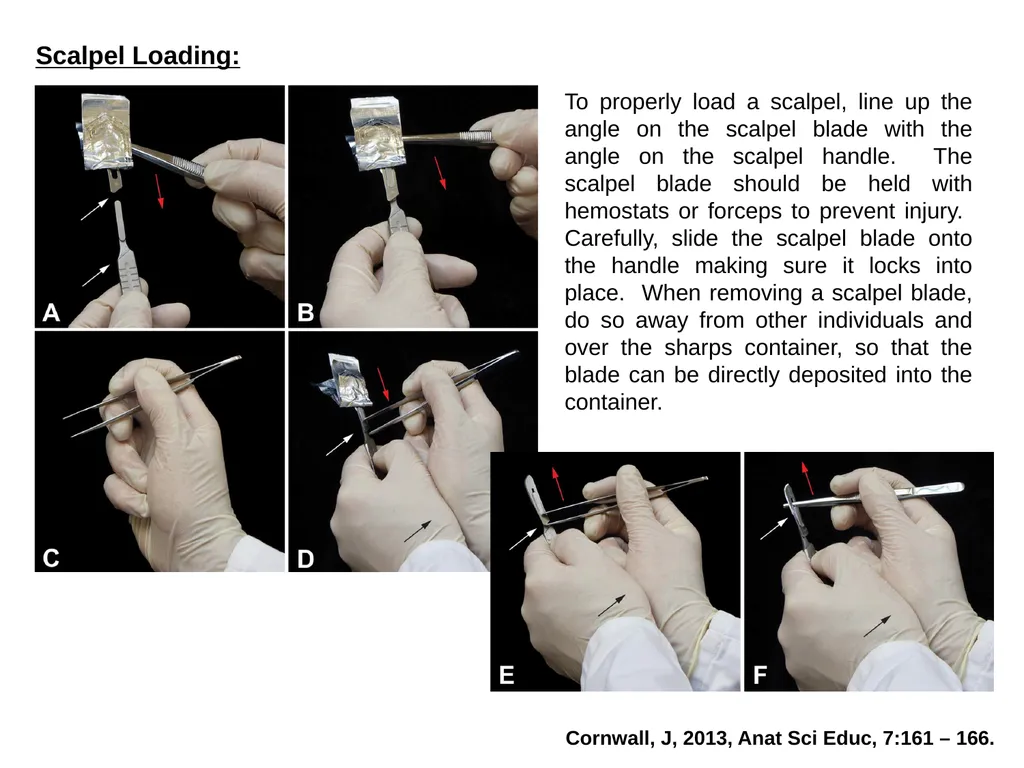
Scalpel Loading: Cornwall, J, 2013, Anat Sci Educ, 7:161 – 166. To properly load a scalpel, line up the angle on the scalpel blade with the angle on the scalpel handle. The scalpel blade should be held with hemostats or forceps to prevent injury. Carefully, slide the scalpel blade onto the handle making sure it locks into place. When removing a scalpel blade, do so away from other individuals and over the sharps container, so that the blade can be directly deposited into the container.<br>
09
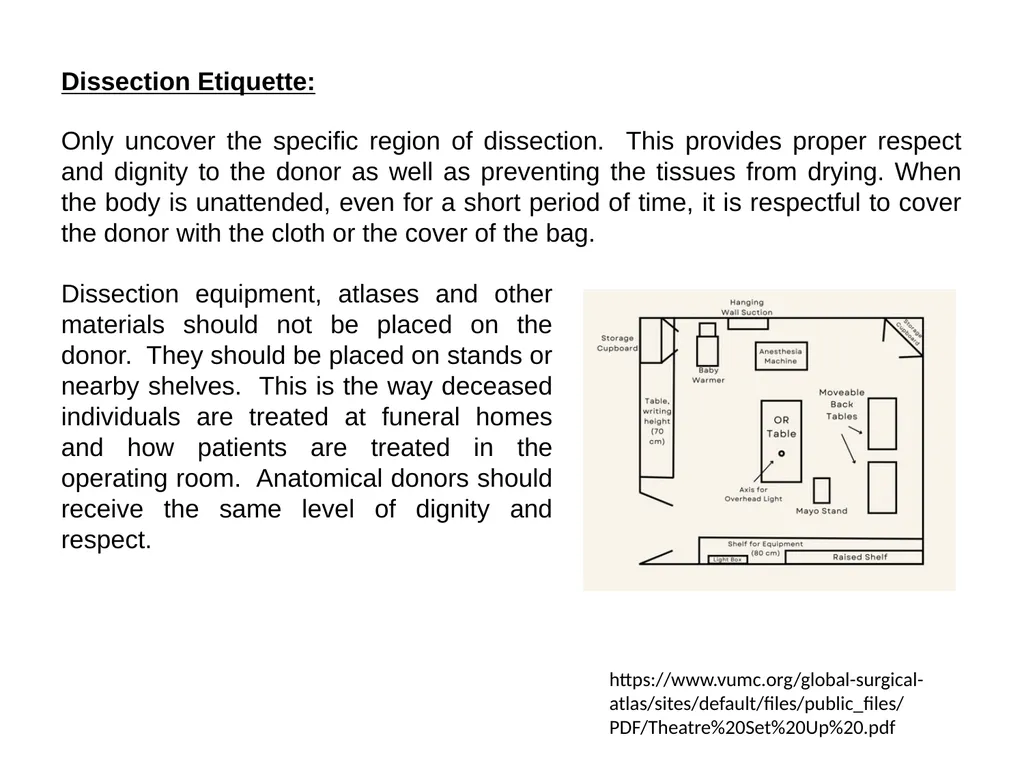
Dissection Etiquette: Only uncover the specific region of dissection. This provides proper respect and dignity to the donor as well as preventing the tissues from drying. When the body is unattended, even for a short period of time, it is respectful to cover the donor with the cloth or the cover of the bag. https://www.vumc.org/global-surgical-atlas/sites/default/files/public_files/PDF/Theatre%20Set%20Up%20.pdf Dissection equipment, atlases and other materials should not be placed on the donor. They should be placed on stands or nearby shelves. This is the way deceased individuals are treated at funeral homes and how patients are treated in the operating room. Anatomical donors should receive the same level of dignity and respect.<br>
10
Anatomy Laboratory Ethics Ethical Aspects:
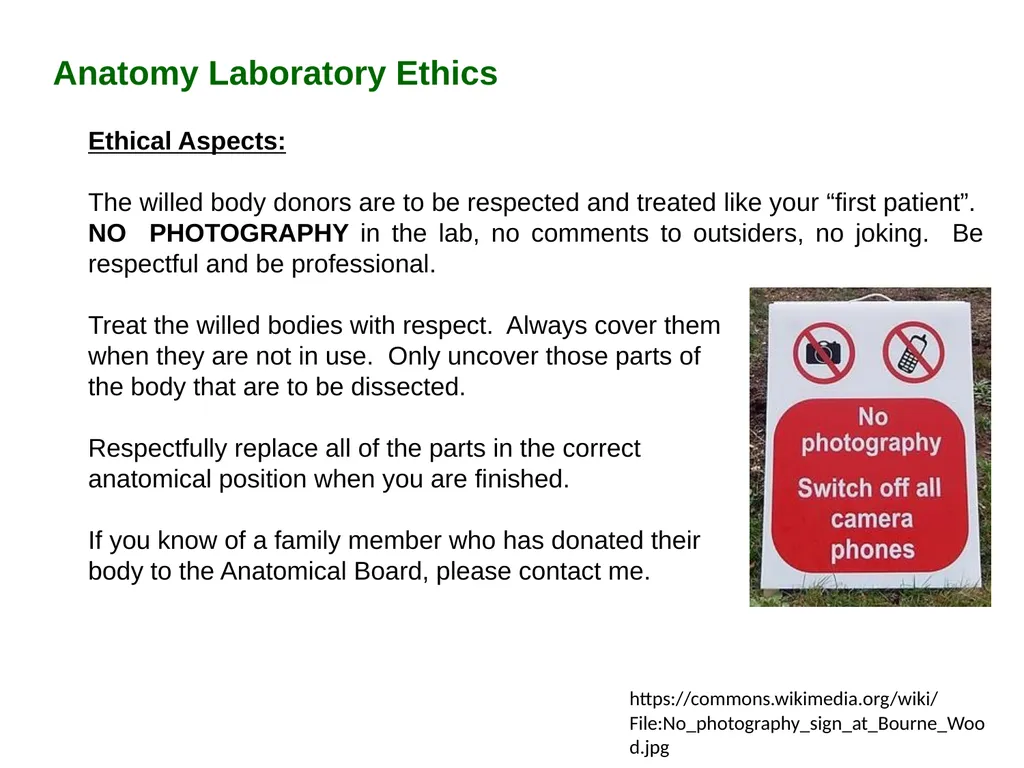
The willed body donors are to be respected and treated like your “first patient”. NO PHOTOGRAPHY in the lab, no comments to outsiders, no joking. Be respectful and be professional.
Treat the willed bodies with respect. Always cover them
when they are not in use. Only uncover those parts of
the body that are to be dissected.
Respectfully replace all of the parts in the correct
anatomical position when you are finished.
If you know of a family member who has donated their
body to the Anatomical Board, please contact me. https://commons.wikimedia.org/wiki/File:No_photography_sign_at_Bourne_Wood.jpg<br>
11
Anatomy Laboratory Cleaning Housekeeping Aspects:
Willed body care following each session:
1. Respectfully replace all of the parts in the correct anatomical position.
2. Place all skin flaps back over their respective part of the body.
3. Apply a small amount of wetting solution at the end of each session.
4. Cover the donor with the cloth and close the zippered bag.
Clean and decontaminate instruments and affected areas with
disinfectants found in the lab.
Clean the sink areas after each lab session. Leave the lab as
clean as you found it.<br>
12
Helpful Hints
The point about the difficulty of the practical exam is emphasized and tales of extremely difficult questions appearing on exams after unprofessional behavior in the laboratory are passed down from class to class. The students make sure the laboratory and the donors are in proper order prior to each practical exam. Two percent of the student’s overall grade is based on their behavior in the laboratory.
Notice throughout these slides that the bodies are referred to as “donors” not “cadavers” or “corpses”. We do not use these terms and the students pick up on this distinction. It is one more way we can honor and respect the donors. We remind the students to only uncover that part of the donor’s body that they are dissecting and to put the donors back together after each dissection. https://pixabay.com/illustrations/life-humanity-civilization-1426252/<br>
13
Helpful Hints
During dissection, a copy of the Dissection Manual and at least one copy of an atlas should be at each station. With these two guides, the dissection process will be more efficient. You can watch the dissection videos prior to the dissection to have an understanding of how to perform each dissection.
Keep the lab clean and organized – the difficulty of each practical exam will be reflected in the cleanliness of the lab and your professional behavior.
Treat the willed body donors with respect. Always cover them when they are not in use; put them back together when you are finished.
Learn as much from the donors as you can.
You have the unique privilege to be able to
examine real human tissue. Compare the
normal and the abnormal variability in all of
the donors. https://pixabay.com/illustrations/life-humanity-civilization-1426252/<br>
14
References Bertman, SL, 2007, One Breath Apart: Facing Dissection, Ward Street Studio, Newton, MA, 96 pp.
Champney TH, S Hildebrandt, DG Jones and A Winkelmann, 2019, BODIES R US: ethical views on the commercialization of the dead in medical education and research, Anat Sci Educ, 12:317-325.
Champney TH, 2019, A bioethos for bodies: respecting a priceless resource, Anat Sci Educ, 12:432-434.
Hayes, B, 2008, The Anatomist: A True Story of Gray’s Anatomy, Ballantine Books, New York.
Jones, DG, and MI Whitaker, 2009, Speaking for the Dead: The Human Body in Biology and Medicine, Ashgate Pubs, Surrey, England, 296 pp.
Ethics in Anatomy Education, 2019, Special Issue of Anatomical Sciences Education, 12:329-453.
Roach, M, 2003, Stiff: The Curious Lives Of Human Cadavers, W.W. Norton and Company Inc., New York.<br>