
Biotech Skills Lab: Protein Expression and


Description: Biotech Skills Lab: Protein Expression and Purification 1.0 924 In this activity you will use two of the most important methods in biotechnology: protein expression and protein purification! Overview of todays lab Protein expression
Related Topics
Download Presentation
"Biotech Skills Lab: Protein Expression and" is the property of its rightful owner. Permission is granted to download and print the materials on this website for personal, non-commercial use only, and to display it on your personal computer provided you do not modify the materials and that you retain all copyright notices contained in the materials. By downloading content from our website, you accept the terms of this agreement.
Presentation Transcript
slide1. Biotech Skills Lab:
Protein Expression and Purification 1.0 9/24<br>
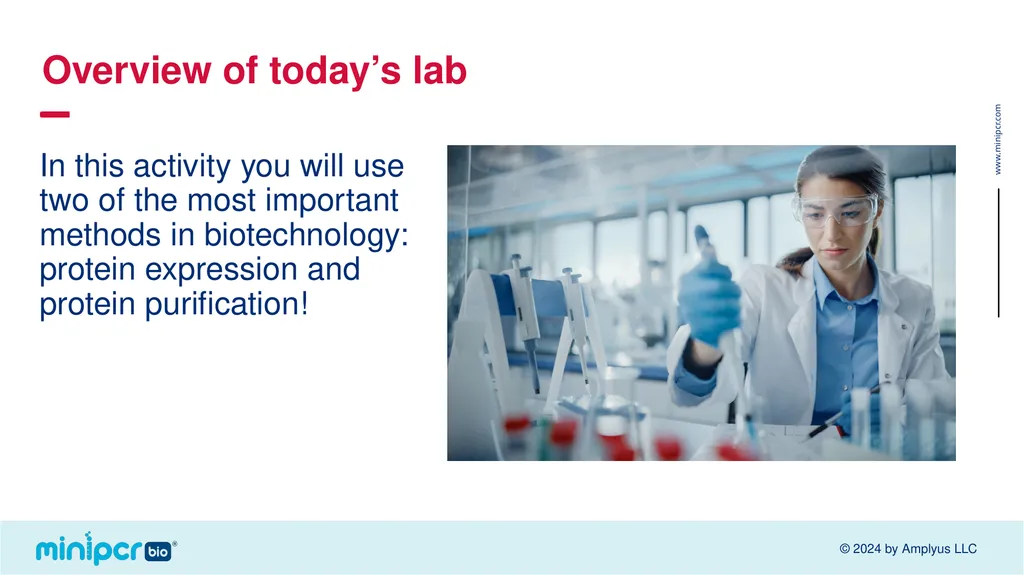
slide2. In this activity you will use two of the most important methods in biotechnology: protein expression and protein purification! Overview of today’s lab<br>
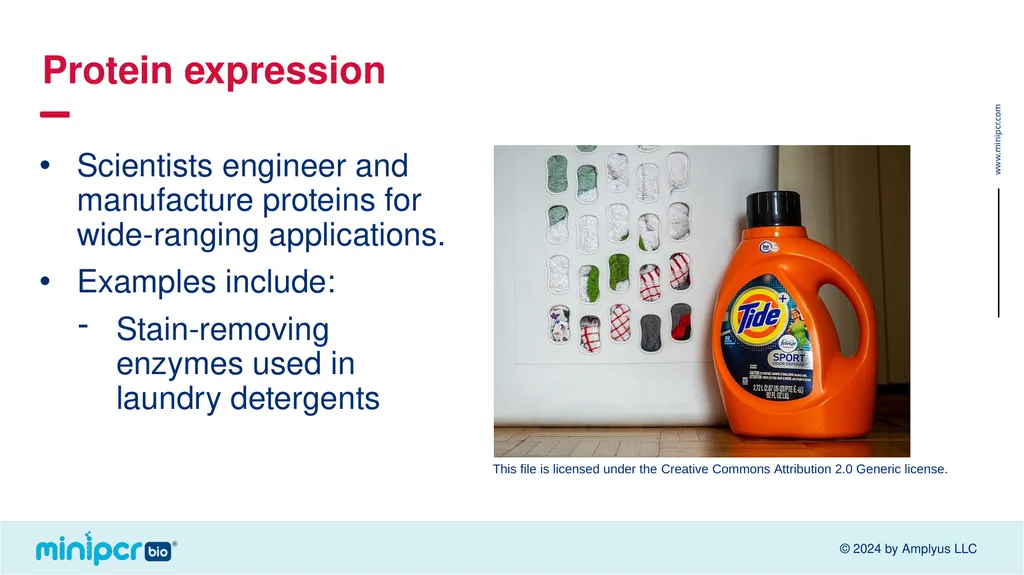
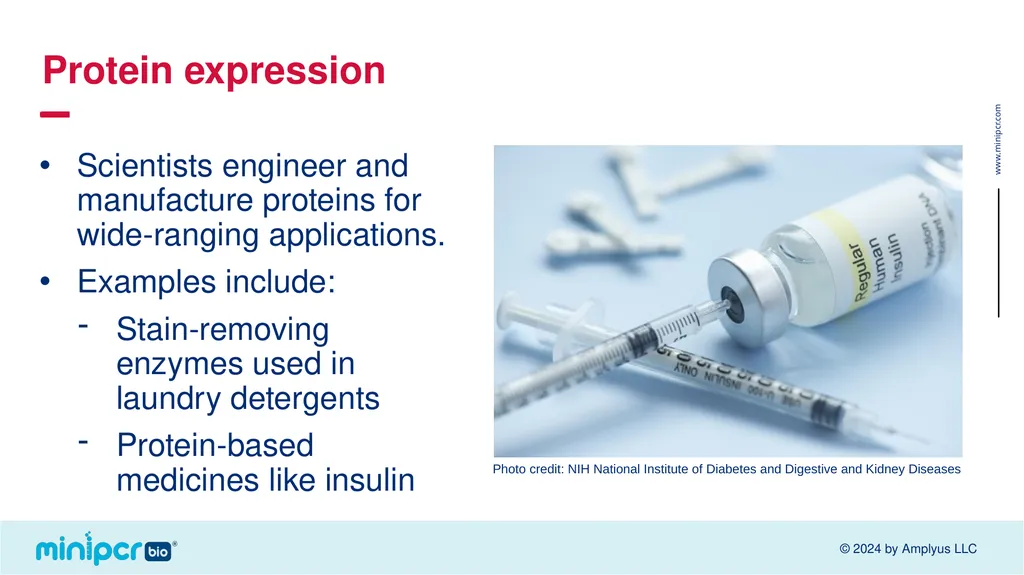
slide3. Protein expression Scientists engineer and manufacture proteins for wide-ranging applications.
Examples include:
Stain-removing enzymes used in laundry detergents<br>
slide4. Protein expression Scientists engineer and manufacture proteins for wide-ranging applications.
Examples include:
Stain-removing enzymes used in laundry detergents
Protein-based medicines like insulin<br>
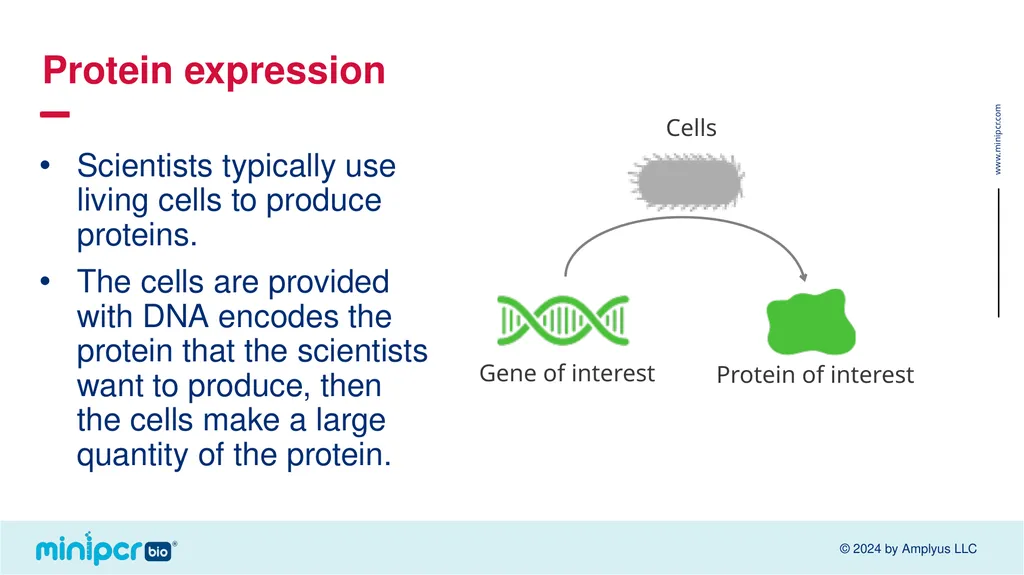
slide5. Protein expression Scientists typically use living cells to produce proteins.
The cells are provided with DNA encodes the protein that the scientists want to produce, then the cells make a large quantity of the protein. Cells<br>
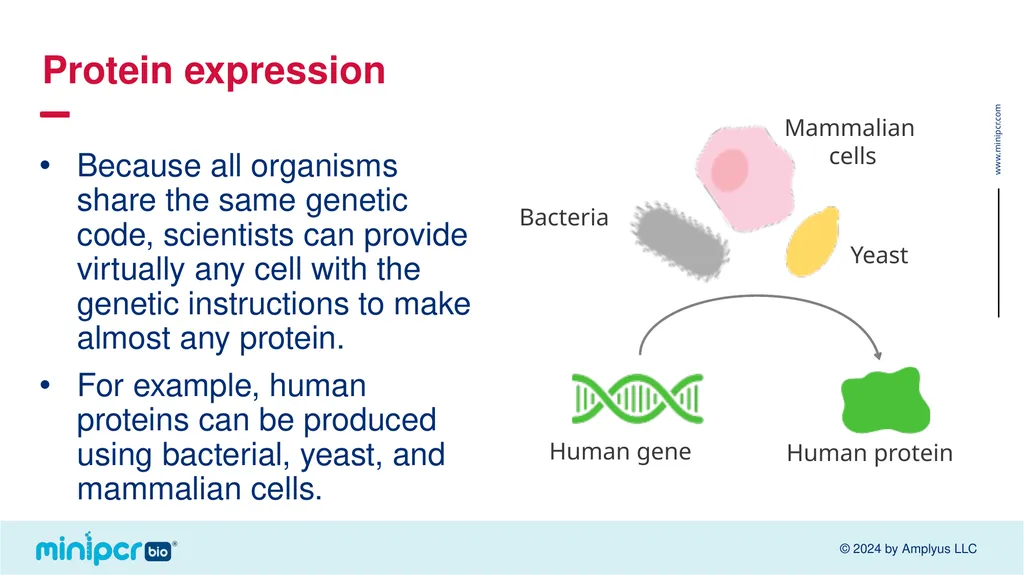
slide6. Protein expression Because all organisms share the same genetic code, scientists can provide virtually any cell with the genetic instructions to make almost any protein.
For example, human proteins can be produced using bacterial, yeast, and mammalian cells.<br>
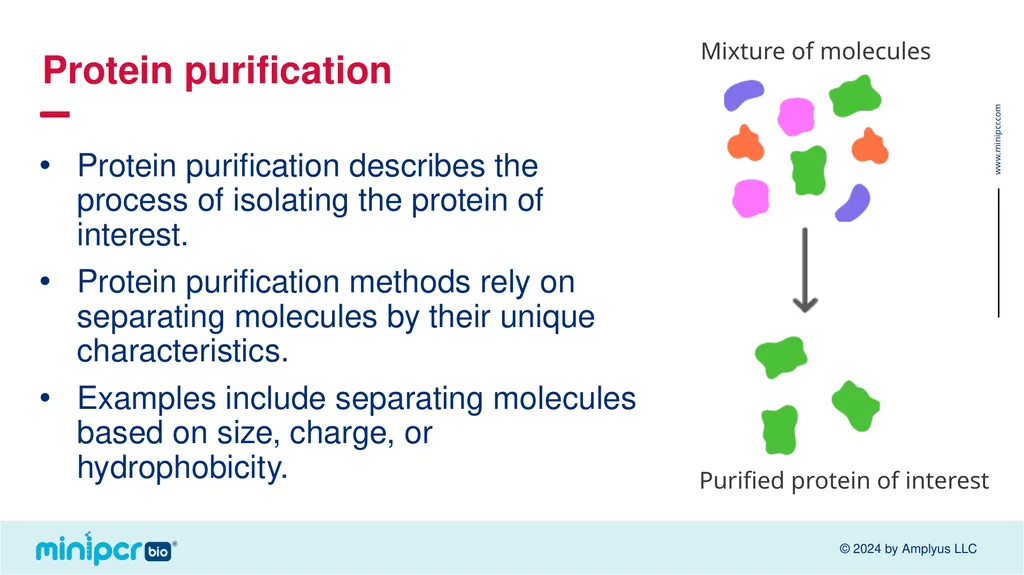
slide7. Protein purification Protein purification describes the process of isolating the protein of interest.
Protein purification methods rely on separating molecules by their unique characteristics.
Examples include separating molecules based on size, charge, or hydrophobicity. Mixture of molecules Purified protein of interest<br>
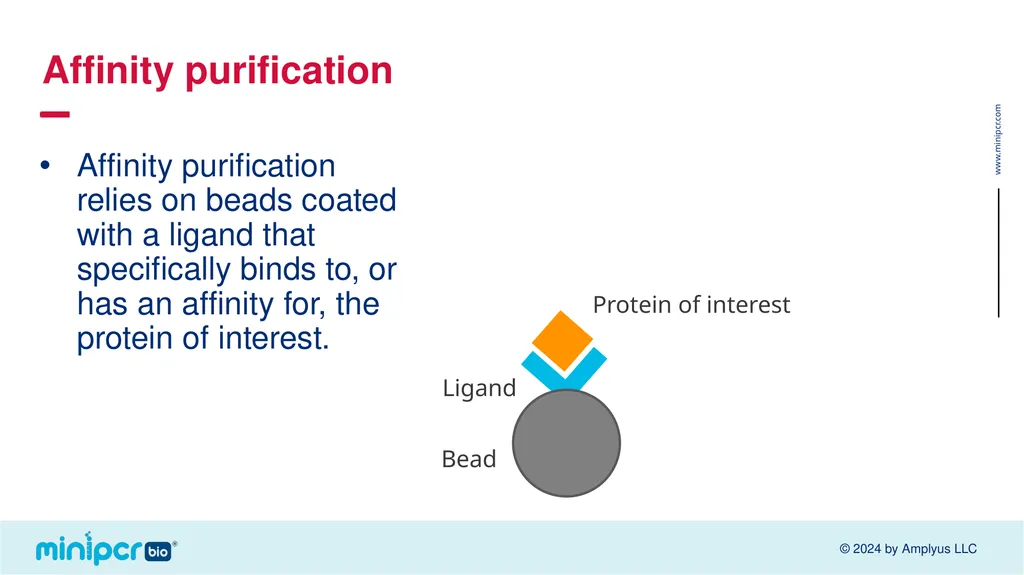
slide8. Affinity purification relies on beads coated with a ligand that specifically binds to, or has an affinity for, the protein of interest. Affinity purification Bead Ligand Protein of interest<br>
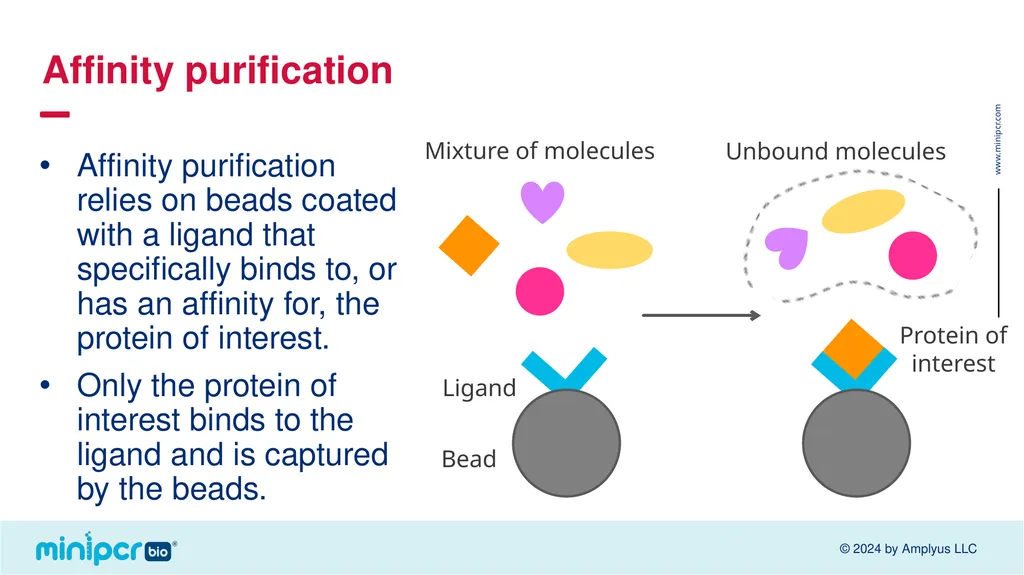
slide9. Affinity purification relies on beads coated with a ligand that specifically binds to, or has an affinity for, the protein of interest.
Only the protein of interest binds to the ligand and is captured by the beads. Affinity purification Bead Ligand Mixture of molecules<br>
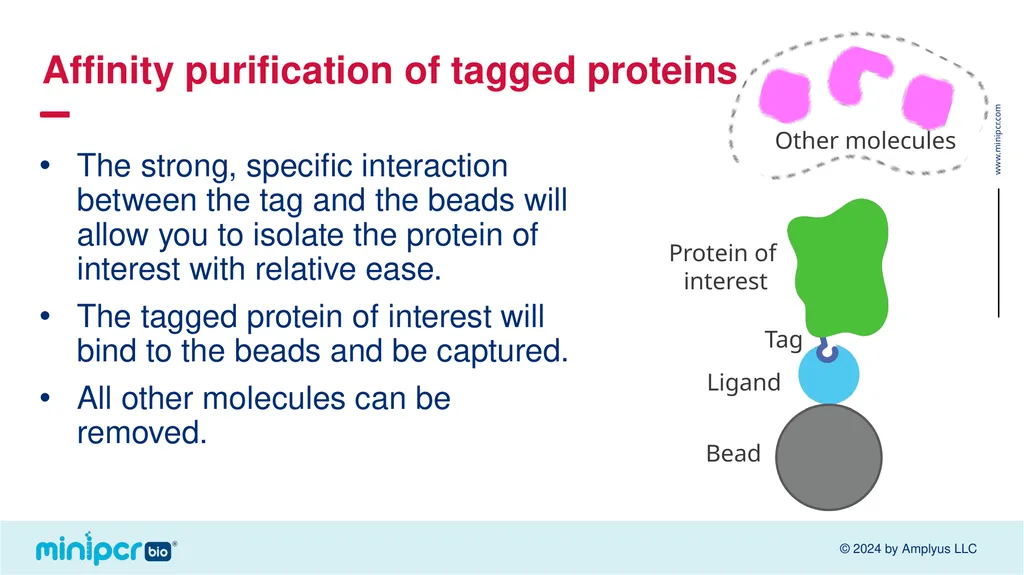
slide10. The protein of interest you will purify includes a short tag made of a few amino acids.
Scientists engineered the tag to bind with high affinity to the ligand present on the beads you will use. Affinity purification of tagged proteins Bead Ligand<br>
slide11. The strong, specific interaction between the tag and the beads will allow you to isolate the protein of interest with relative ease.
The tagged protein of interest will bind to the beads and be captured.
All other molecules can be removed. Affinity purification of tagged proteins Bead Ligand<br>
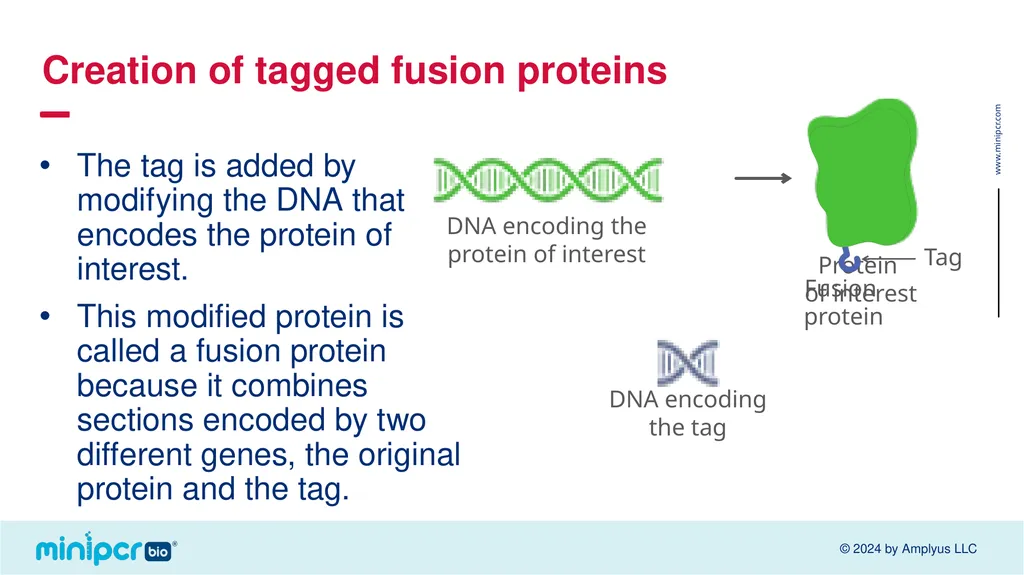
slide12. The tag is added by modifying the DNA that encodes the protein of interest.
This modified protein is called a fusion protein because it combines sections encoded by two different genes, the original protein and the tag. Creation of tagged fusion proteins DNA encoding the protein of interest Protein
of interest DNA encoding
the tag Fusion
protein<br>
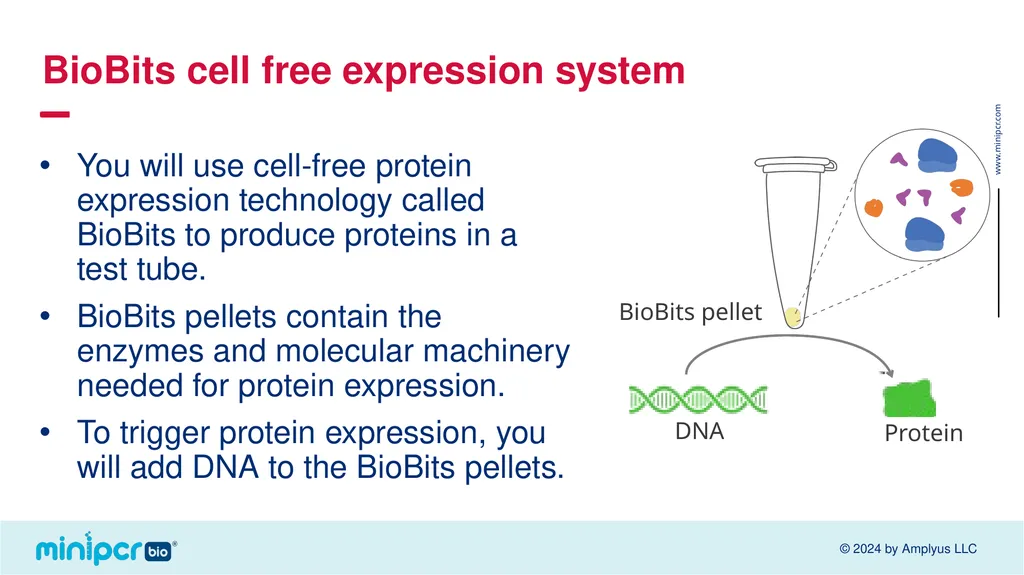
slide13. You will use cell-free protein expression technology called BioBits to produce proteins in a test tube.
BioBits pellets contain the enzymes and molecular machinery needed for protein expression.
To trigger protein expression, you will add DNA to the BioBits pellets. BioBits cell free expression system BioBits pellet<br>
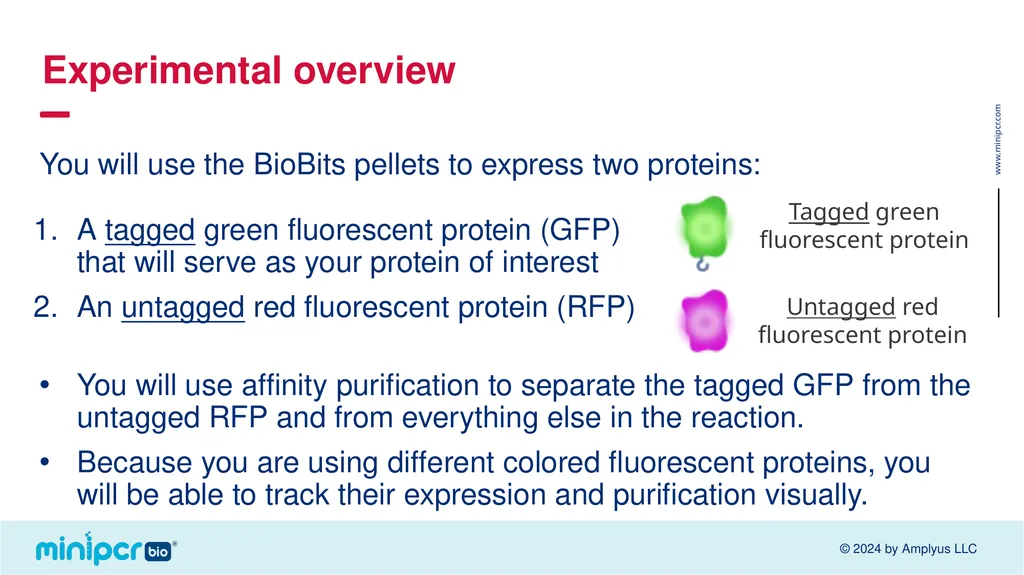
slide14. Experimental overview You will use the BioBits pellets to express two proteins: You will use affinity purification to separate the tagged GFP from the untagged RFP and from everything else in the reaction.
Because you are using different colored fluorescent proteins, you will be able to track their expression and purification visually. A tagged green fluorescent protein (GFP) that will serve as your protein of interest
An untagged red fluorescent protein (RFP)<br>
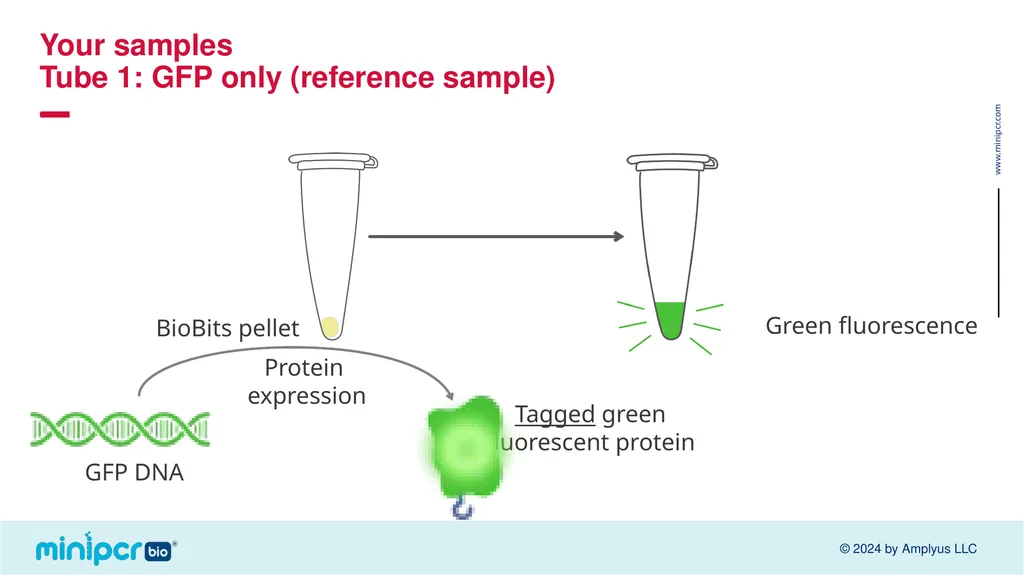
slide15. Your samples Tube 1: GFP only (reference sample) BioBits pellet Protein
expression<br>
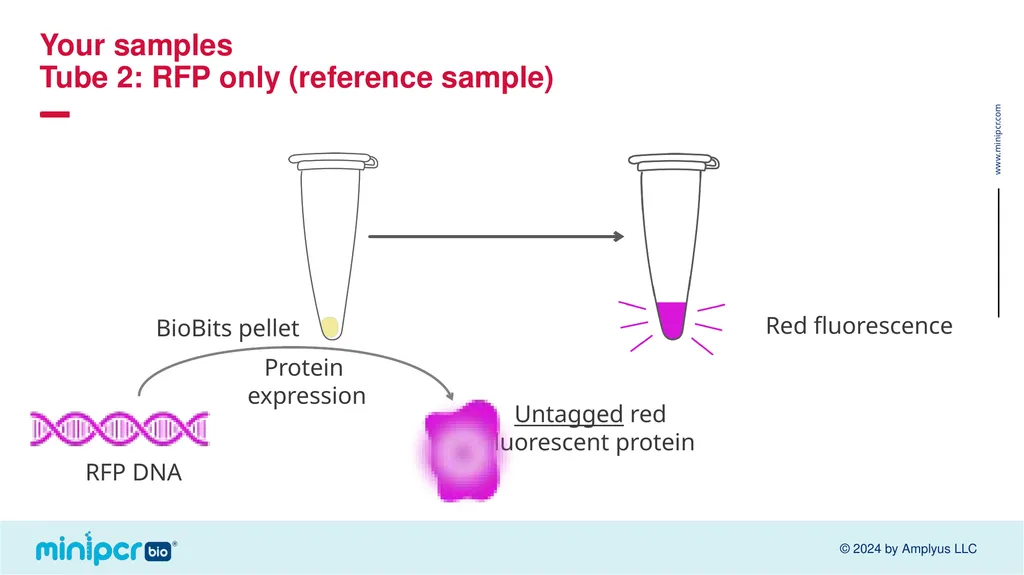
slide16. Your samples Tube 2: RFP only (reference sample) BioBits pellet Protein
expression<br>
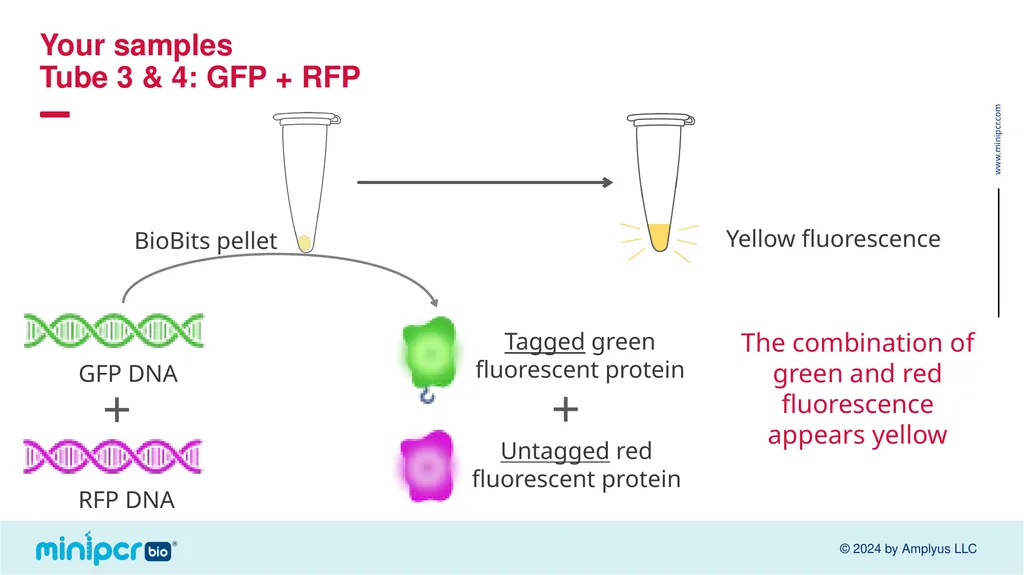
slide17. Your samples Tube 3 & 4: GFP + RFP BioBits pellet The combination of green and red fluorescence appears yellow<br>
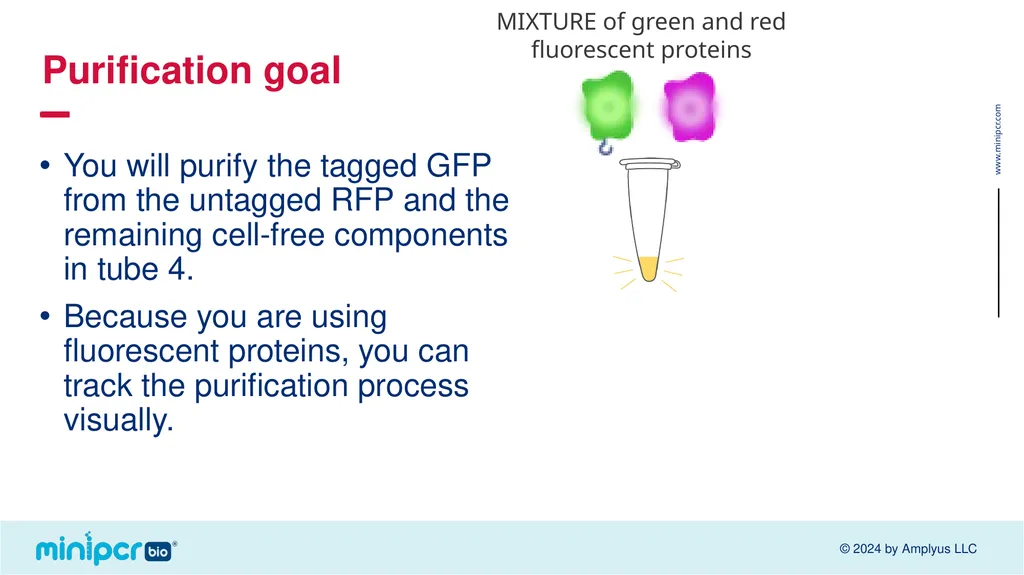
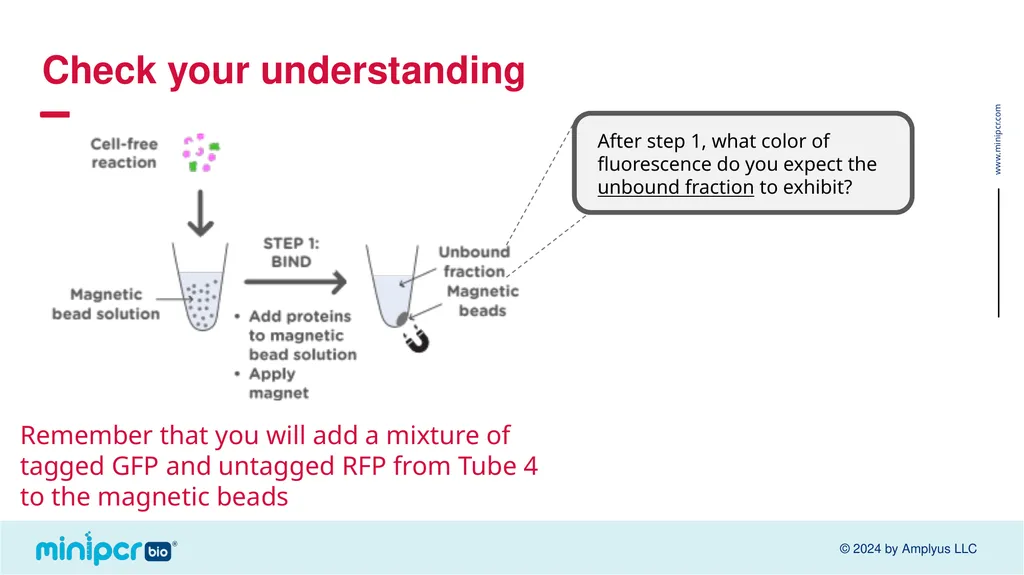
slide18. You will purify the tagged GFP from the untagged RFP and the remaining cell-free components in tube 4.
Because you are using fluorescent proteins, you can track the purification process visually. Purification goal MIXTURE of green and red fluorescent proteins<br>
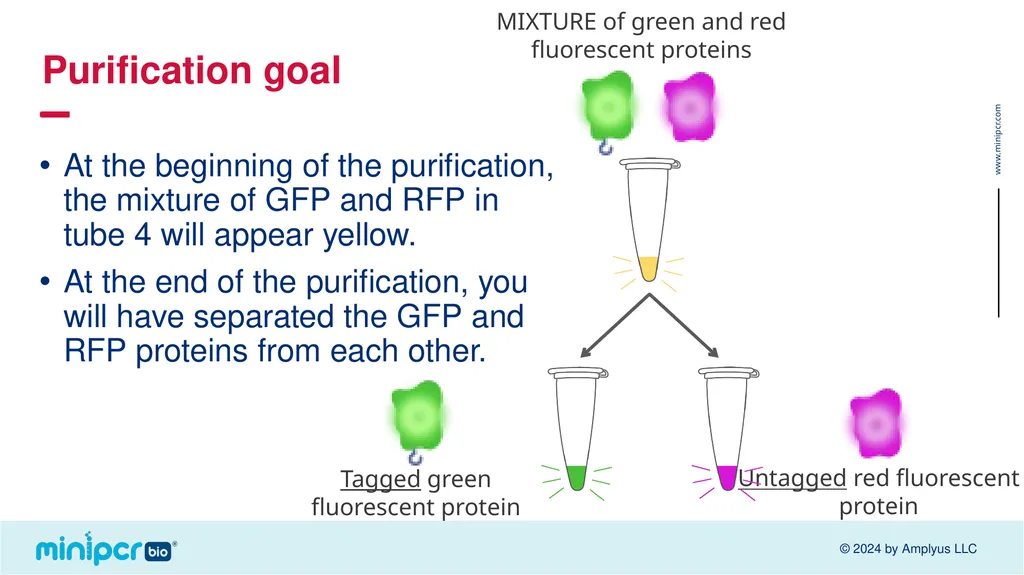
slide19. At the beginning of the purification, the mixture of GFP and RFP in tube 4 will appear yellow.
At the end of the purification, you will have separated the GFP and RFP proteins from each other. Purification goal MIXTURE of green and red fluorescent proteins<br>
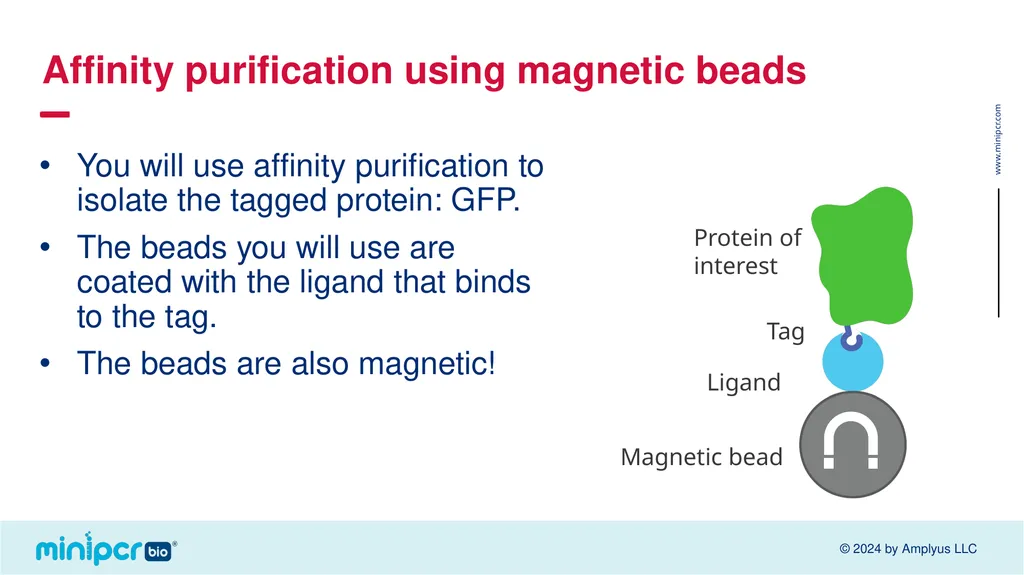
slide20. You will use affinity purification to isolate the tagged protein: GFP.
The beads you will use are coated with the ligand that binds to the tag.
The beads are also magnetic! Affinity purification using magnetic beads Ligand Tag Protein of
interest<br>
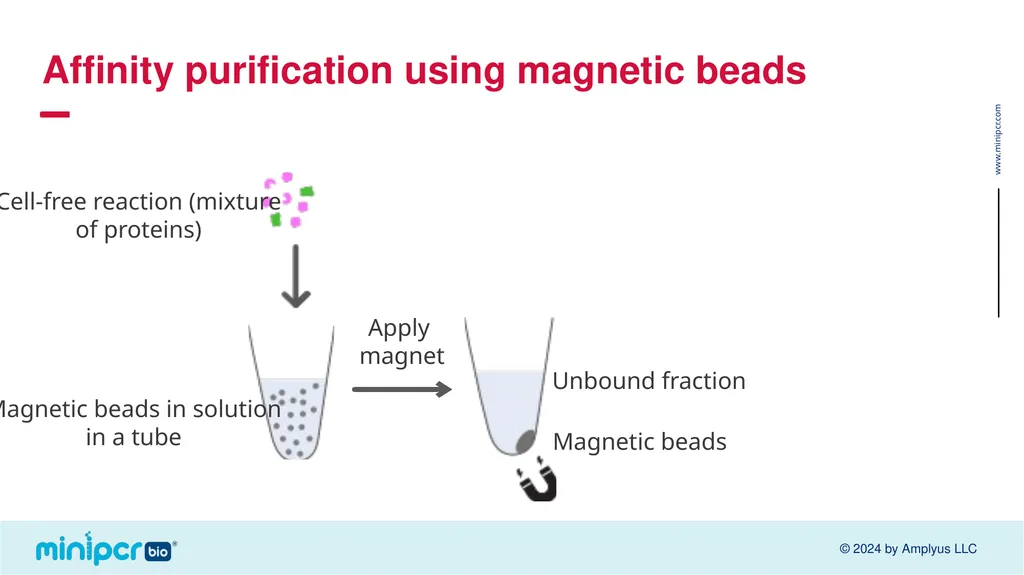
slide21. Affinity purification using magnetic beads Magnetic beads in solution in a tube Cell-free reaction (mixture of proteins)<br>
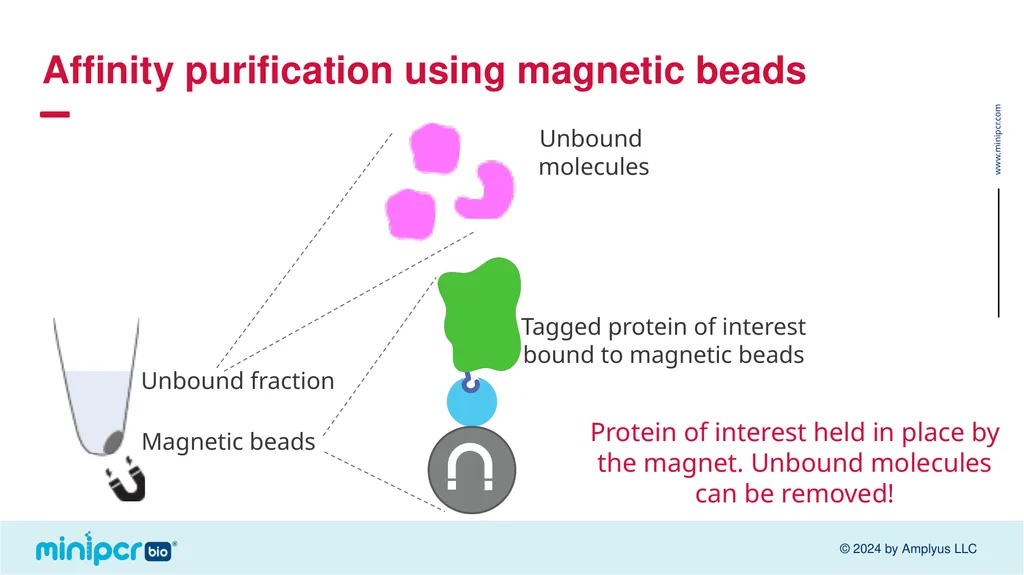
slide22. Affinity purification using magnetic beads Protein of interest held in place by the magnet. Unbound molecules can be removed! Magnetic beads Unbound fraction<br>
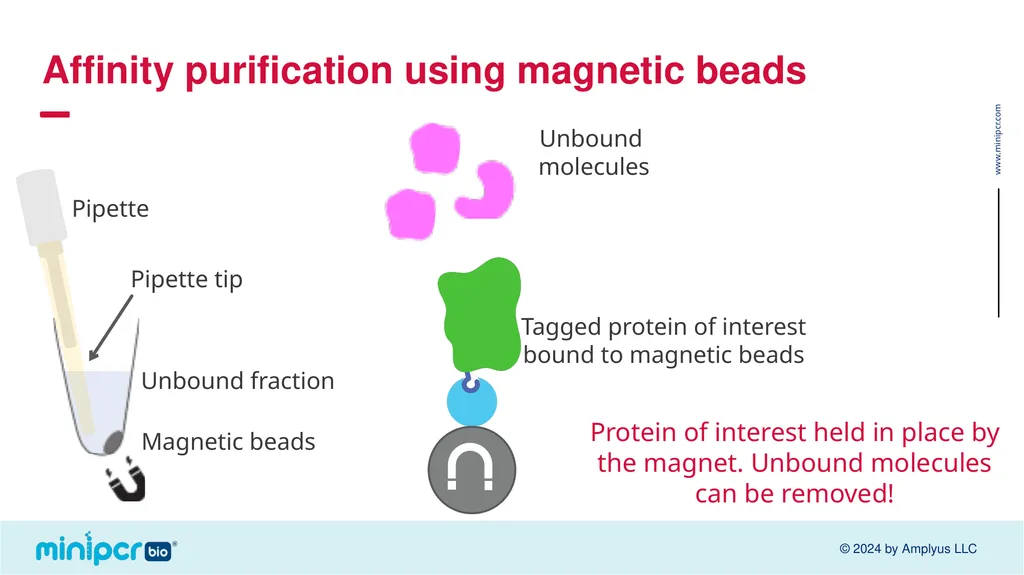
slide23. Affinity purification using magnetic beads Magnetic beads Unbound fraction Protein of interest held in place by the magnet. Unbound molecules can be removed! Pipette Pipette tip<br>
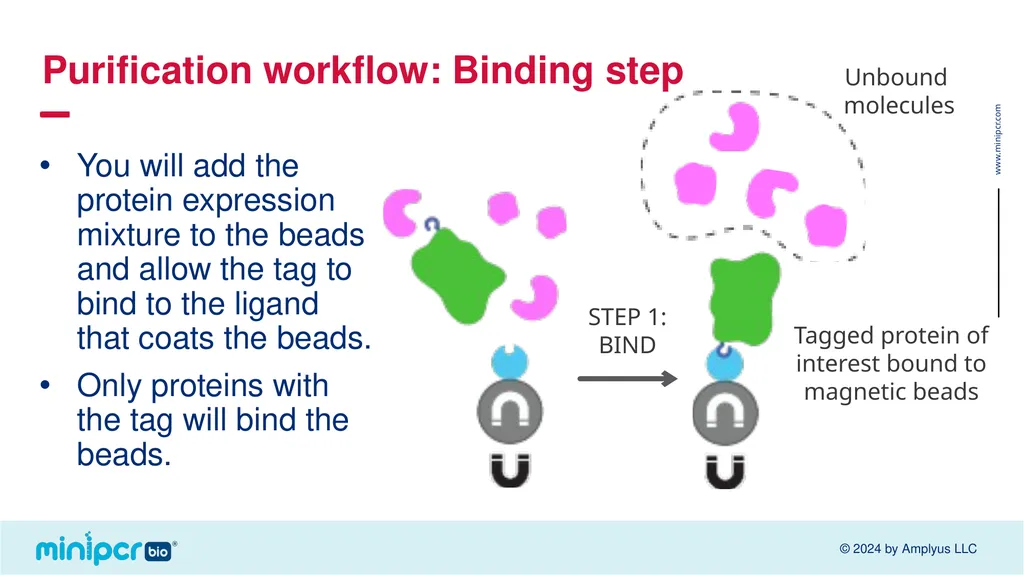
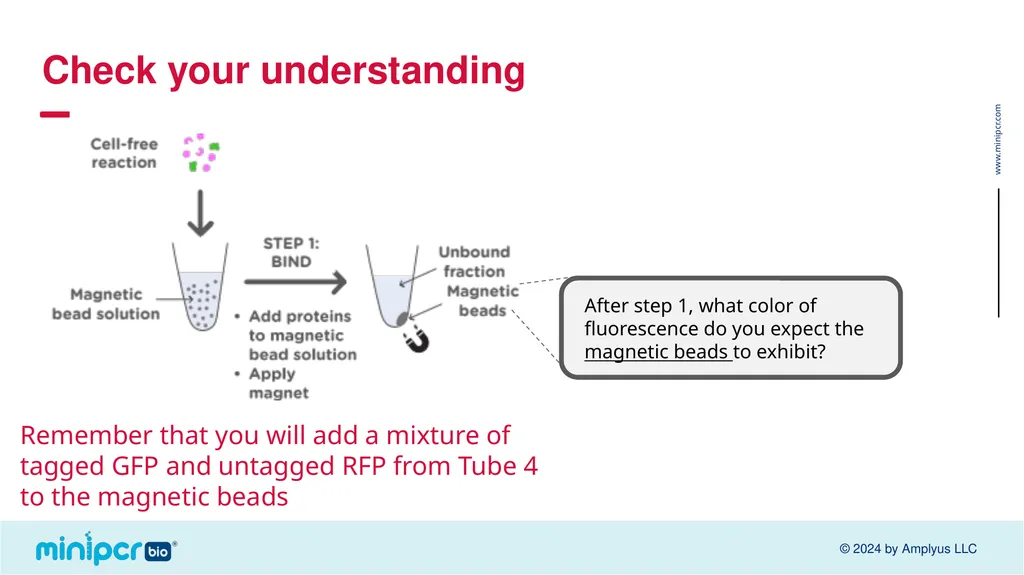
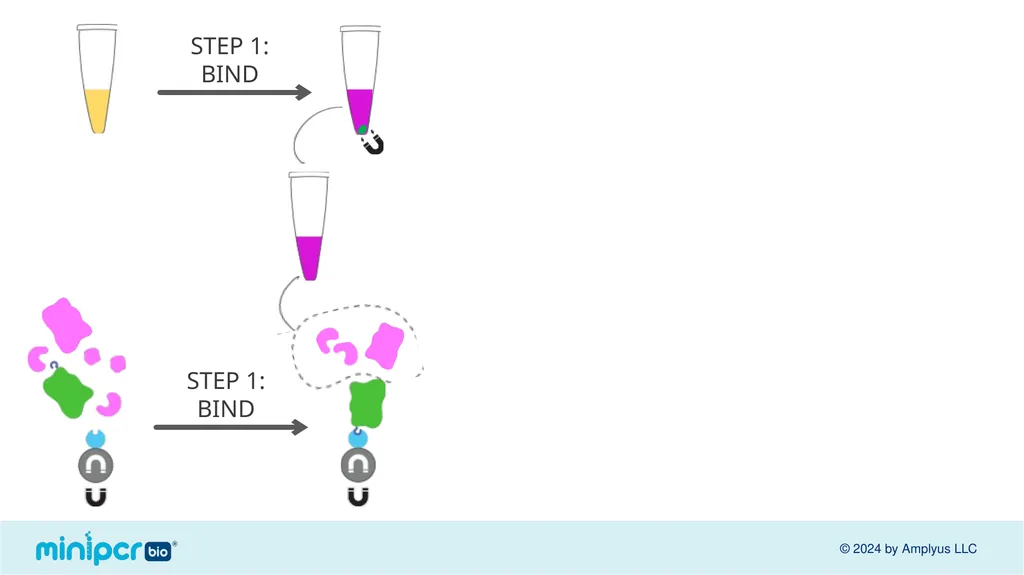
slide24. You will add the protein expression mixture to the beads and allow the tag to bind to the ligand that coats the beads.
Only proteins with the tag will bind the beads. Purification workflow: Binding step Tagged protein of interest bound to magnetic beads<br>
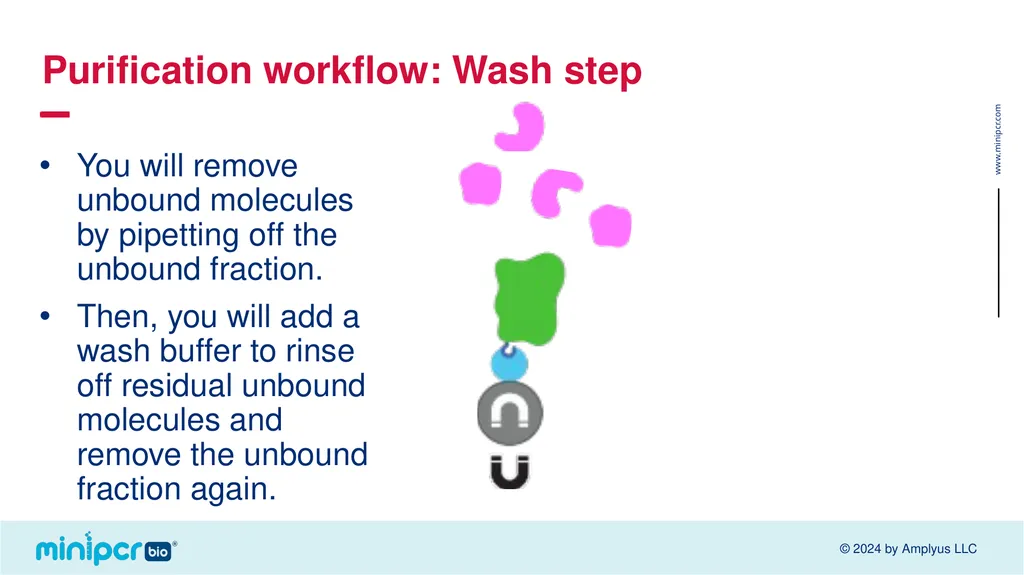
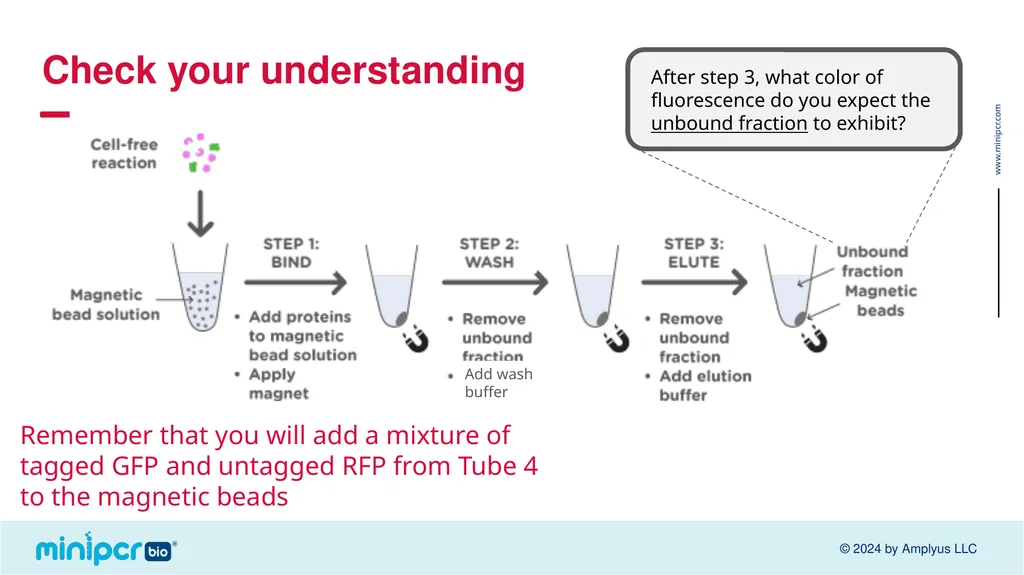
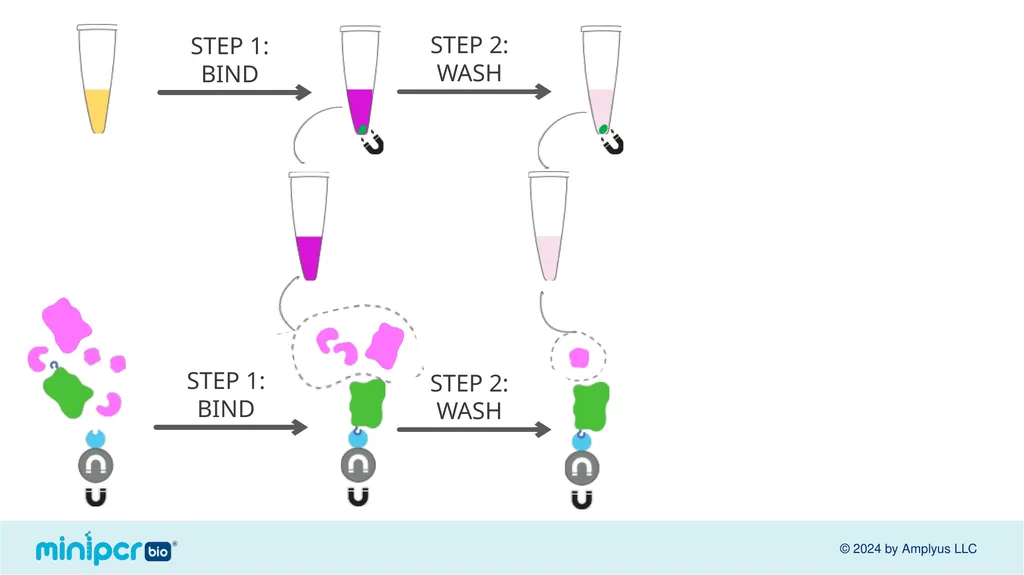
slide25. You will remove unbound molecules by pipetting off the unbound fraction.
Then, you will add a wash buffer to rinse off residual unbound molecules and remove the unbound fraction again. Purification workflow: Wash step<br>
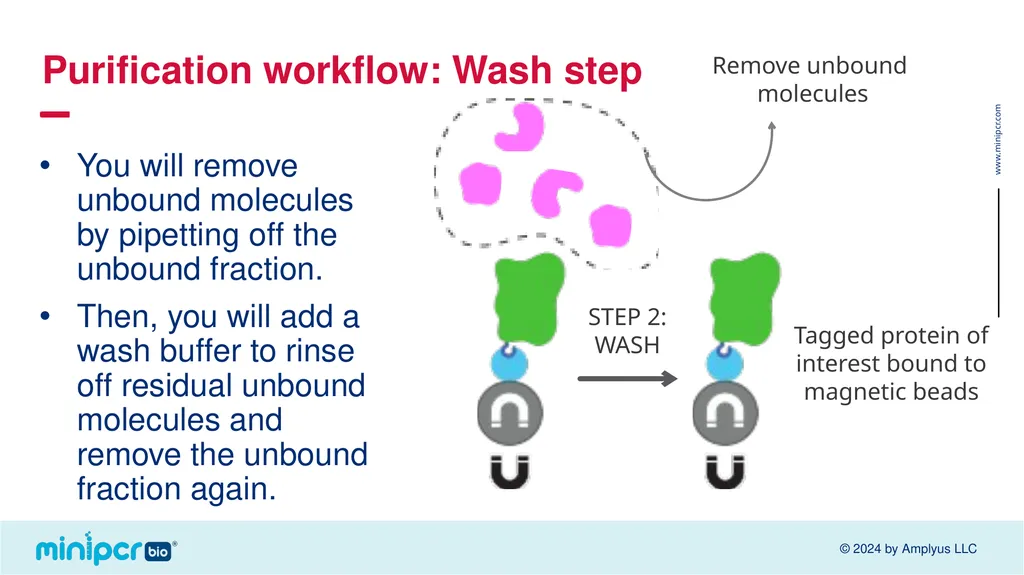
slide26. You will remove unbound molecules by pipetting off the unbound fraction.
Then, you will add a wash buffer to rinse off residual unbound molecules and remove the unbound fraction again. Purification workflow: Wash step Tagged protein of interest bound to magnetic beads Remove unbound
molecules<br>
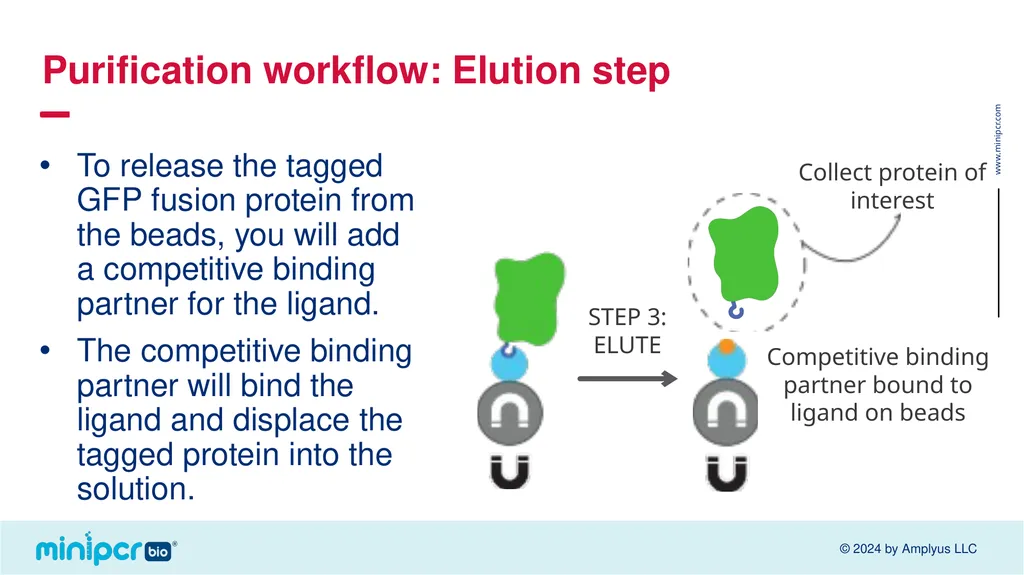
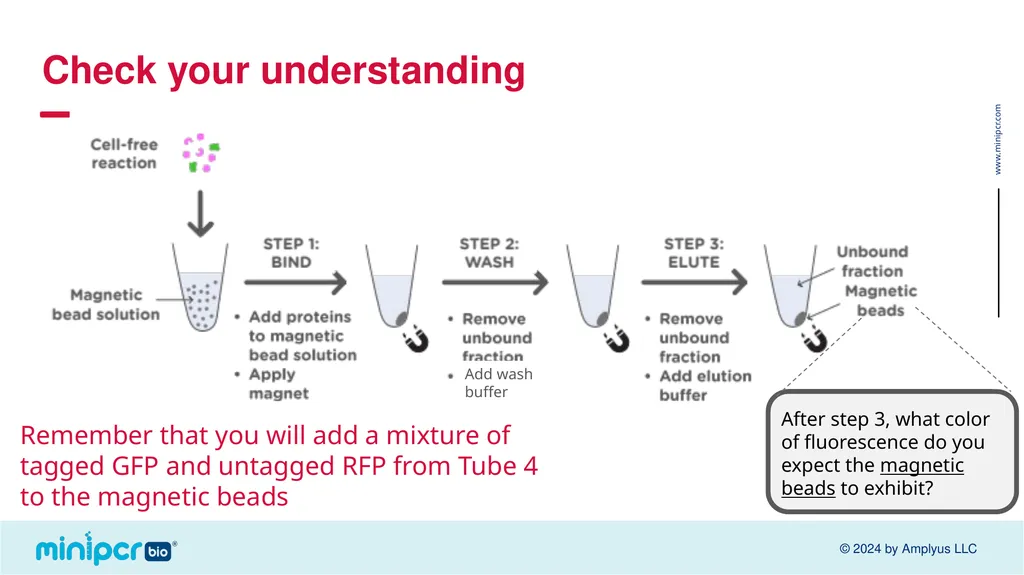
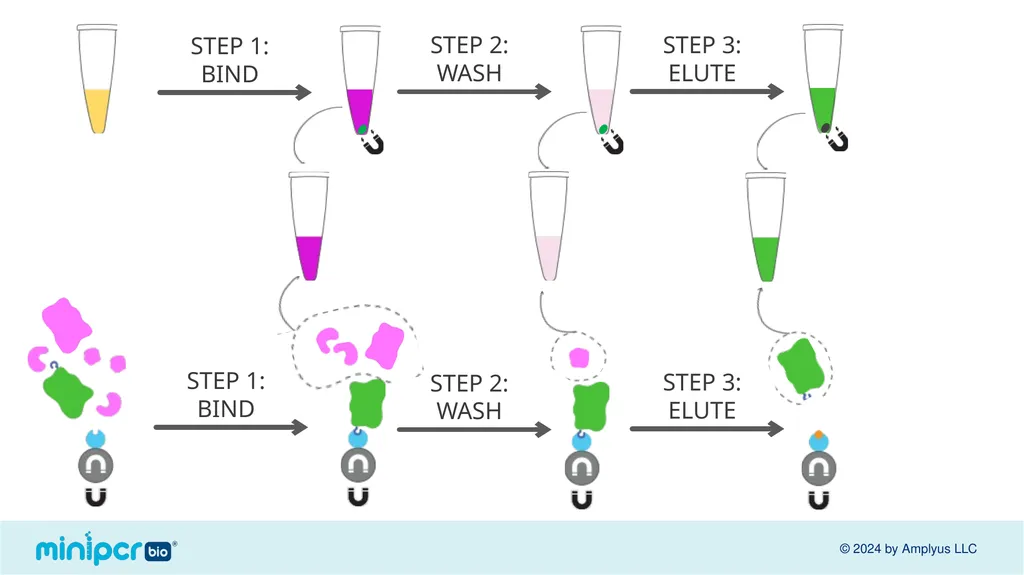
slide27. To release the tagged GFP fusion protein from the beads, you will add a competitive binding partner for the ligand.
The competitive binding partner will bind the ligand and displace the tagged protein into the solution. Purification workflow: Elution step<br>
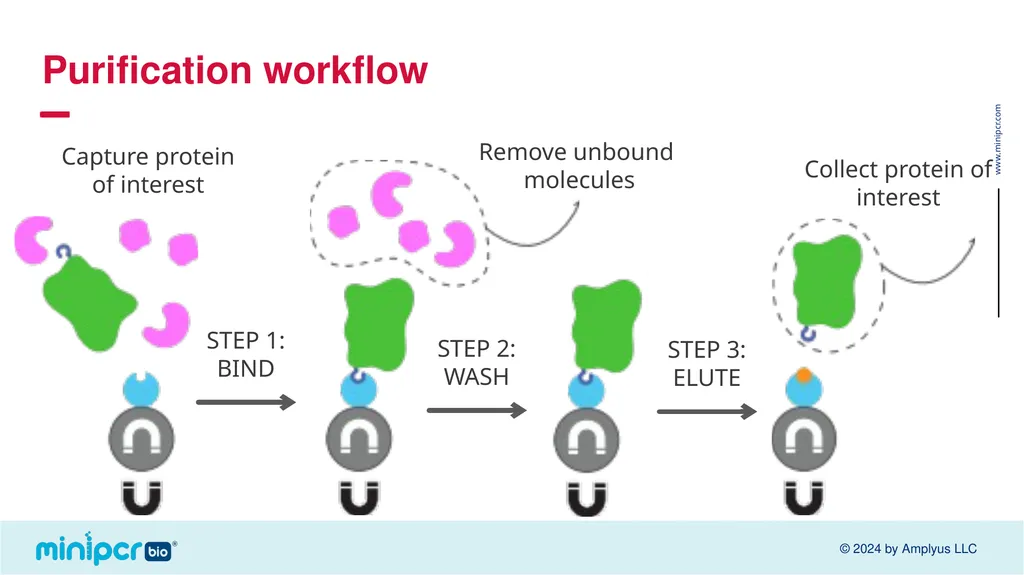
slide28. Purification workflow Remove unbound
molecules Collect protein of interest Capture protein of interest<br>
slide29. Check your understanding Remember that you will add a mixture of tagged GFP and untagged RFP from Tube 4 to the magnetic beads<br>
slide30. Check your understanding Remember that you will add a mixture of tagged GFP and untagged RFP from Tube 4 to the magnetic beads<br>
slide31. Check your understanding Remember that you will add a mixture of tagged GFP and untagged RFP from Tube 4 to the magnetic beads<br>
slide32. Check your understanding Remember that you will add a mixture of tagged GFP and untagged RFP from Tube 4 to the magnetic beads<br>
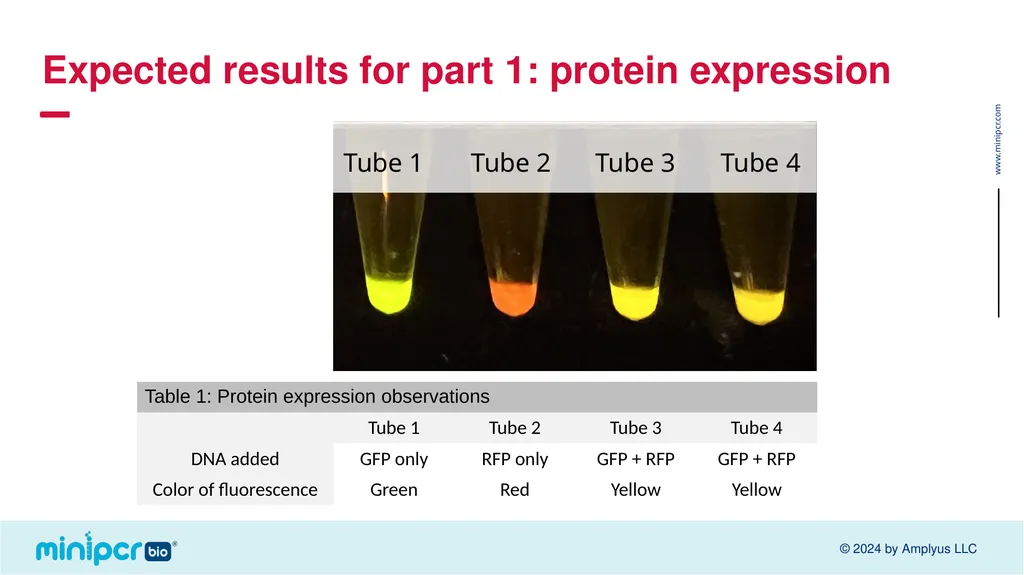
slide34. Expected results for part 1: protein expression<br>
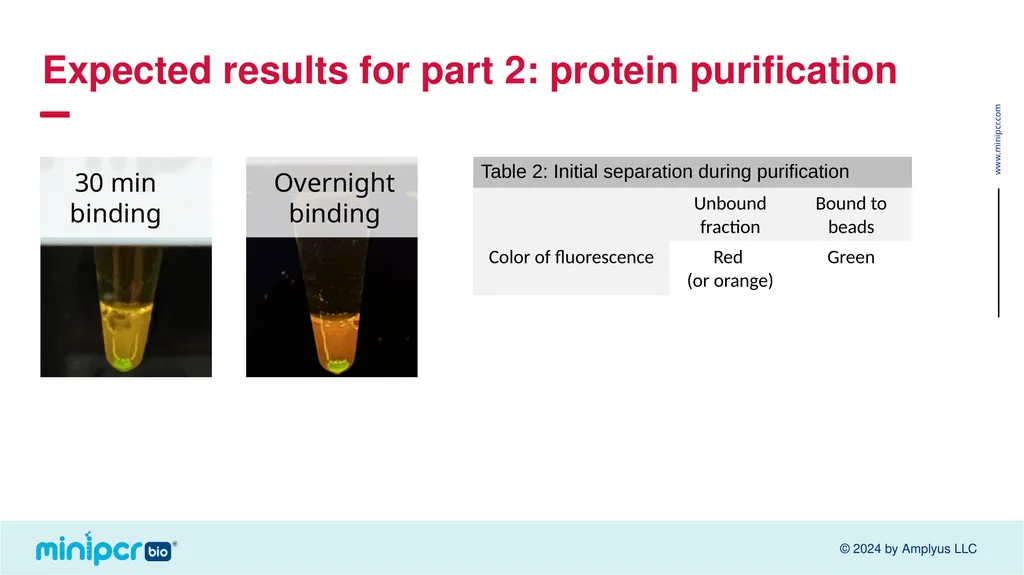
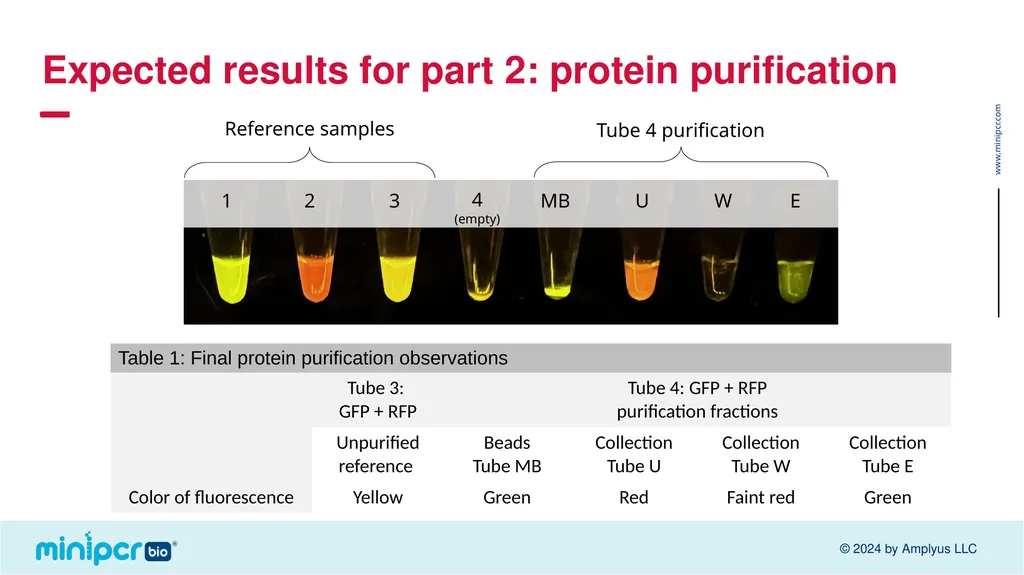
slide35. Expected results for part 2: protein purification 30 min binding Overnight binding<br>
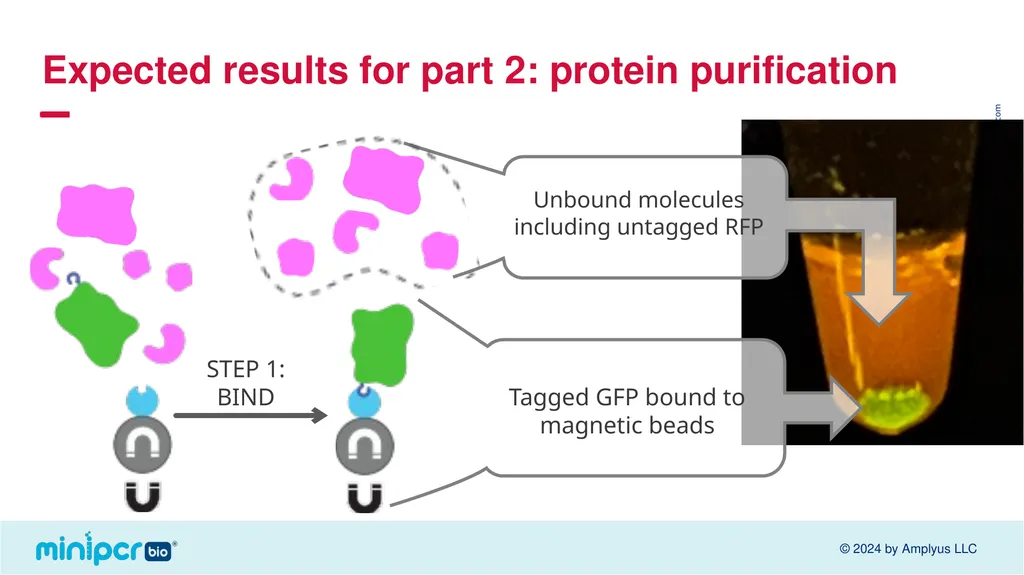
slide36. Expected results for part 2: protein purification STEP 1:
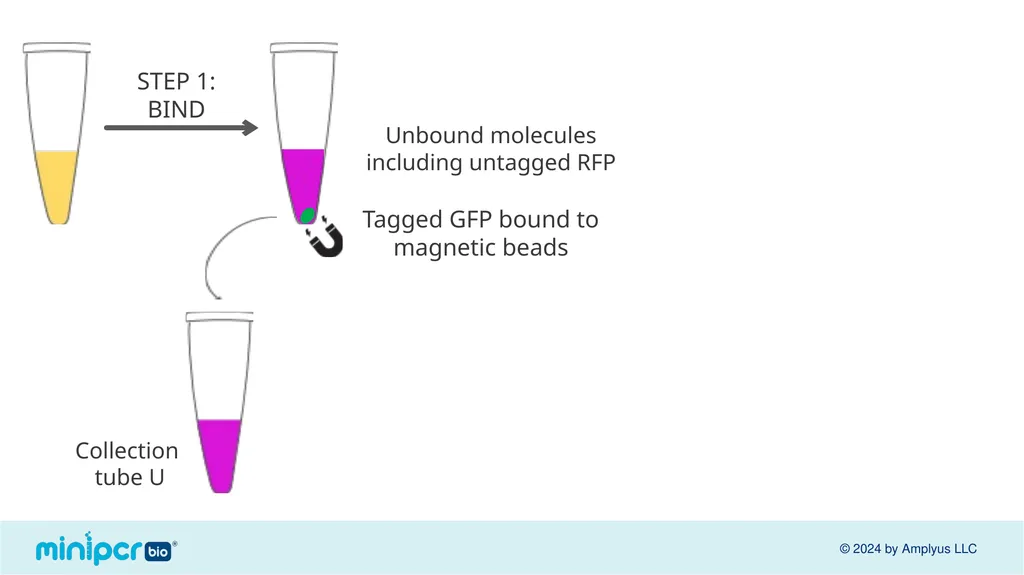
BIND Tagged GFP bound to magnetic beads Unbound molecules including untagged RFP<br>
slide37. Expected results for part 2: protein purification<br>
slide38. Tagged GFP bound to magnetic beads Unbound molecules including untagged RFP Collection
tube U<br>
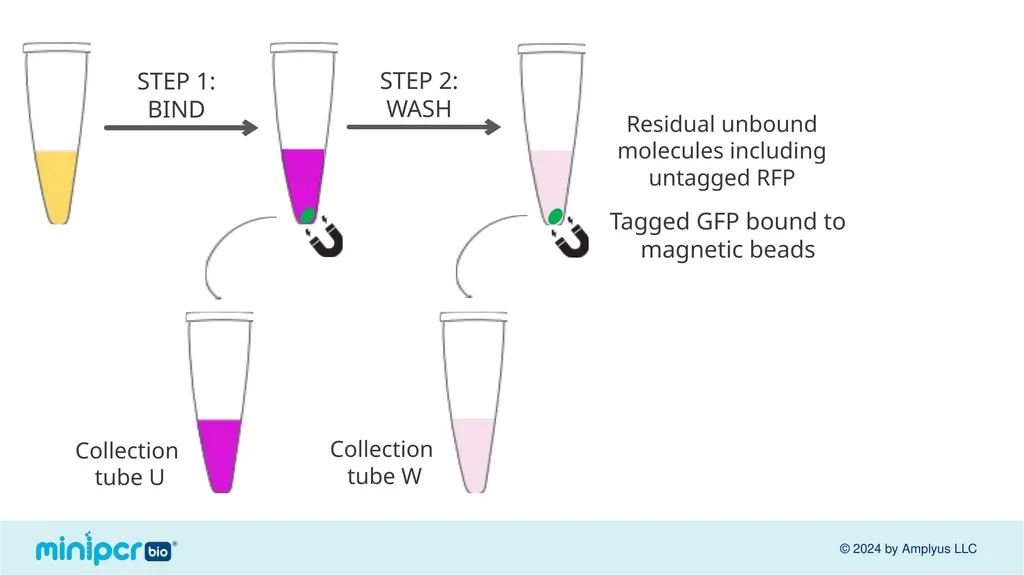
slide39. Tagged GFP bound to magnetic beads Residual unbound molecules including untagged RFP Collection
tube U Collection
tube W<br>
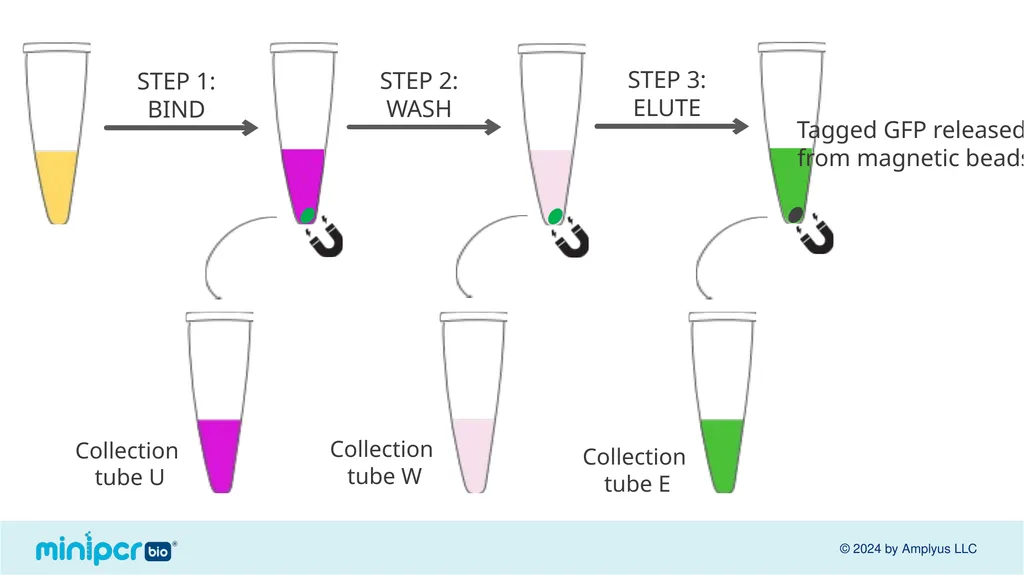
slide40. Collection
tube U Collection
tube W Collection
tube E Tagged GFP released from magnetic beads<br>
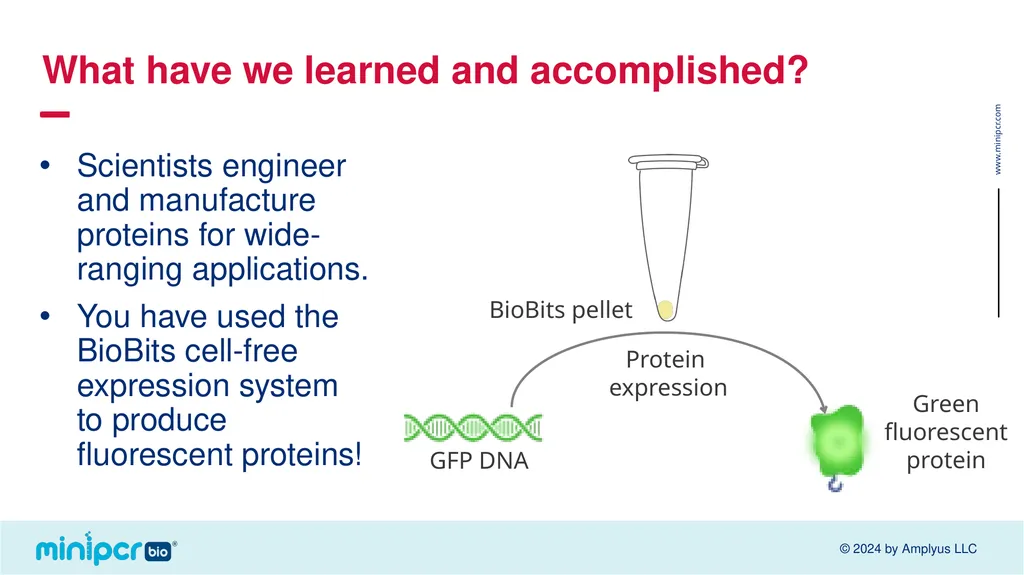
slide44. Scientists engineer and manufacture proteins for wide-ranging applications.
You have used the BioBits cell-free expression system to produce fluorescent proteins! What have we learned and accomplished? BioBits pellet Green fluorescent protein Protein
expression<br>
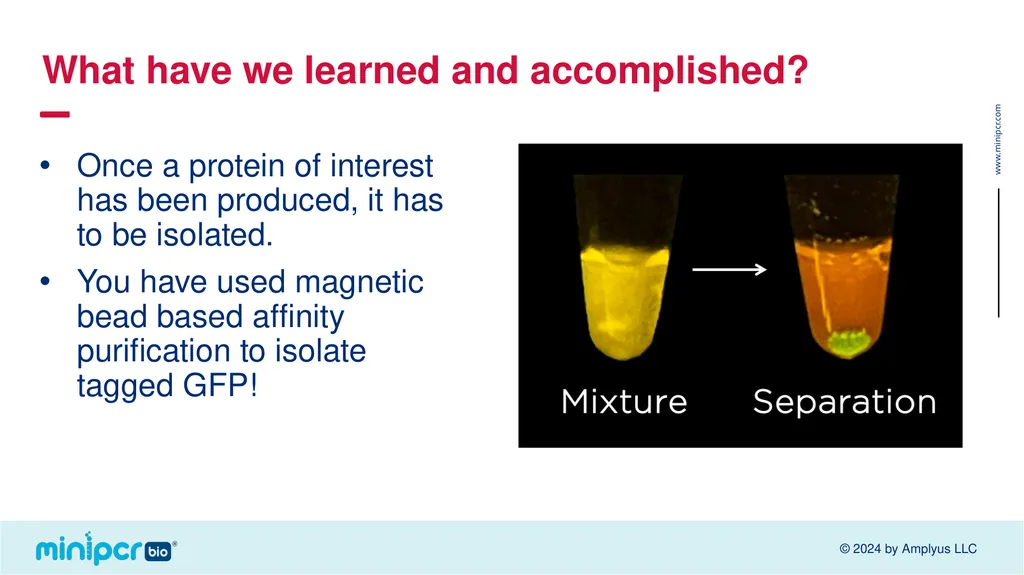
slide45. Once a protein of interest has been produced, it has to be isolated.
You have used magnetic bead based affinity purification to isolate tagged GFP! What have we learned and accomplished?<br>
slide2. In this activity you will use two of the most important methods in biotechnology: protein expression and protein purification! Overview of today’s lab<br>
slide3. Protein expression Scientists engineer and manufacture proteins for wide-ranging applications.
Examples include:
Stain-removing enzymes used in laundry detergents<br>
slide4. Protein expression Scientists engineer and manufacture proteins for wide-ranging applications.
Examples include:
Stain-removing enzymes used in laundry detergents
Protein-based medicines like insulin<br>
slide5. Protein expression Scientists typically use living cells to produce proteins.
The cells are provided with DNA encodes the protein that the scientists want to produce, then the cells make a large quantity of the protein. Cells<br>
slide6. Protein expression Because all organisms share the same genetic code, scientists can provide virtually any cell with the genetic instructions to make almost any protein.
For example, human proteins can be produced using bacterial, yeast, and mammalian cells.<br>
slide7. Protein purification Protein purification describes the process of isolating the protein of interest.
Protein purification methods rely on separating molecules by their unique characteristics.
Examples include separating molecules based on size, charge, or hydrophobicity. Mixture of molecules Purified protein of interest<br>
slide8. Affinity purification relies on beads coated with a ligand that specifically binds to, or has an affinity for, the protein of interest. Affinity purification Bead Ligand Protein of interest<br>
slide9. Affinity purification relies on beads coated with a ligand that specifically binds to, or has an affinity for, the protein of interest.
Only the protein of interest binds to the ligand and is captured by the beads. Affinity purification Bead Ligand Mixture of molecules<br>
slide10. The protein of interest you will purify includes a short tag made of a few amino acids.
Scientists engineered the tag to bind with high affinity to the ligand present on the beads you will use. Affinity purification of tagged proteins Bead Ligand<br>
slide11. The strong, specific interaction between the tag and the beads will allow you to isolate the protein of interest with relative ease.
The tagged protein of interest will bind to the beads and be captured.
All other molecules can be removed. Affinity purification of tagged proteins Bead Ligand<br>
slide12. The tag is added by modifying the DNA that encodes the protein of interest.
This modified protein is called a fusion protein because it combines sections encoded by two different genes, the original protein and the tag. Creation of tagged fusion proteins DNA encoding the protein of interest Protein
of interest DNA encoding
the tag Fusion
protein<br>
slide13. You will use cell-free protein expression technology called BioBits to produce proteins in a test tube.
BioBits pellets contain the enzymes and molecular machinery needed for protein expression.
To trigger protein expression, you will add DNA to the BioBits pellets. BioBits cell free expression system BioBits pellet<br>
slide14. Experimental overview You will use the BioBits pellets to express two proteins: You will use affinity purification to separate the tagged GFP from the untagged RFP and from everything else in the reaction.
Because you are using different colored fluorescent proteins, you will be able to track their expression and purification visually. A tagged green fluorescent protein (GFP) that will serve as your protein of interest
An untagged red fluorescent protein (RFP)<br>
slide15. Your samples Tube 1: GFP only (reference sample) BioBits pellet Protein
expression<br>
slide16. Your samples Tube 2: RFP only (reference sample) BioBits pellet Protein
expression<br>
slide17. Your samples Tube 3 & 4: GFP + RFP BioBits pellet The combination of green and red fluorescence appears yellow<br>
slide18. You will purify the tagged GFP from the untagged RFP and the remaining cell-free components in tube 4.
Because you are using fluorescent proteins, you can track the purification process visually. Purification goal MIXTURE of green and red fluorescent proteins<br>
slide19. At the beginning of the purification, the mixture of GFP and RFP in tube 4 will appear yellow.
At the end of the purification, you will have separated the GFP and RFP proteins from each other. Purification goal MIXTURE of green and red fluorescent proteins<br>
slide20. You will use affinity purification to isolate the tagged protein: GFP.
The beads you will use are coated with the ligand that binds to the tag.
The beads are also magnetic! Affinity purification using magnetic beads Ligand Tag Protein of
interest<br>
slide21. Affinity purification using magnetic beads Magnetic beads in solution in a tube Cell-free reaction (mixture of proteins)<br>
slide22. Affinity purification using magnetic beads Protein of interest held in place by the magnet. Unbound molecules can be removed! Magnetic beads Unbound fraction<br>
slide23. Affinity purification using magnetic beads Magnetic beads Unbound fraction Protein of interest held in place by the magnet. Unbound molecules can be removed! Pipette Pipette tip<br>
slide24. You will add the protein expression mixture to the beads and allow the tag to bind to the ligand that coats the beads.
Only proteins with the tag will bind the beads. Purification workflow: Binding step Tagged protein of interest bound to magnetic beads<br>
slide25. You will remove unbound molecules by pipetting off the unbound fraction.
Then, you will add a wash buffer to rinse off residual unbound molecules and remove the unbound fraction again. Purification workflow: Wash step<br>
slide26. You will remove unbound molecules by pipetting off the unbound fraction.
Then, you will add a wash buffer to rinse off residual unbound molecules and remove the unbound fraction again. Purification workflow: Wash step Tagged protein of interest bound to magnetic beads Remove unbound
molecules<br>
slide27. To release the tagged GFP fusion protein from the beads, you will add a competitive binding partner for the ligand.
The competitive binding partner will bind the ligand and displace the tagged protein into the solution. Purification workflow: Elution step<br>
slide28. Purification workflow Remove unbound
molecules Collect protein of interest Capture protein of interest<br>
slide29. Check your understanding Remember that you will add a mixture of tagged GFP and untagged RFP from Tube 4 to the magnetic beads<br>
slide30. Check your understanding Remember that you will add a mixture of tagged GFP and untagged RFP from Tube 4 to the magnetic beads<br>
slide31. Check your understanding Remember that you will add a mixture of tagged GFP and untagged RFP from Tube 4 to the magnetic beads<br>
slide32. Check your understanding Remember that you will add a mixture of tagged GFP and untagged RFP from Tube 4 to the magnetic beads<br>
slide34. Expected results for part 1: protein expression<br>
slide35. Expected results for part 2: protein purification 30 min binding Overnight binding<br>
slide36. Expected results for part 2: protein purification STEP 1:
BIND Tagged GFP bound to magnetic beads Unbound molecules including untagged RFP<br>
slide37. Expected results for part 2: protein purification<br>
slide38. Tagged GFP bound to magnetic beads Unbound molecules including untagged RFP Collection
tube U<br>
slide39. Tagged GFP bound to magnetic beads Residual unbound molecules including untagged RFP Collection
tube U Collection
tube W<br>
slide40. Collection
tube U Collection
tube W Collection
tube E Tagged GFP released from magnetic beads<br>
slide44. Scientists engineer and manufacture proteins for wide-ranging applications.
You have used the BioBits cell-free expression system to produce fluorescent proteins! What have we learned and accomplished? BioBits pellet Green fluorescent protein Protein
expression<br>
slide45. Once a protein of interest has been produced, it has to be isolated.
You have used magnetic bead based affinity purification to isolate tagged GFP! What have we learned and accomplished?<br>