04
Learning Outcomes How to write Learning outcomes:
We typically write 3-7 learning outcomes
We begin with a verb (one of Bloom’s)
Limit the length of each learning outcome to about 400 characters
Exclude special characters (e.g., accents, umlats, ampersands, etc.)
Exclude special formatting (e.g., dashes, numbering, etc.) To Design, Develop, and Evaluate Quality Blended Learning<br>
05
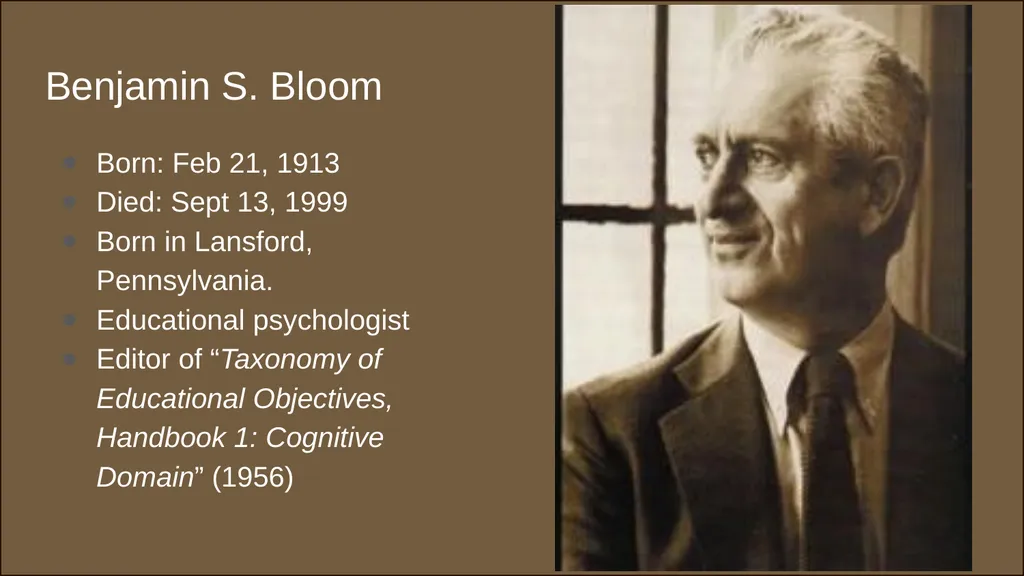
Benjamin S. Bloom Born: Feb 21, 1913
Died: Sept 13, 1999
Born in Lansford, Pennsylvania.
Educational psychologist
Editor of “Taxonomy of Educational Objectives, Handbook 1: Cognitive Domain” (1956)<br>
06
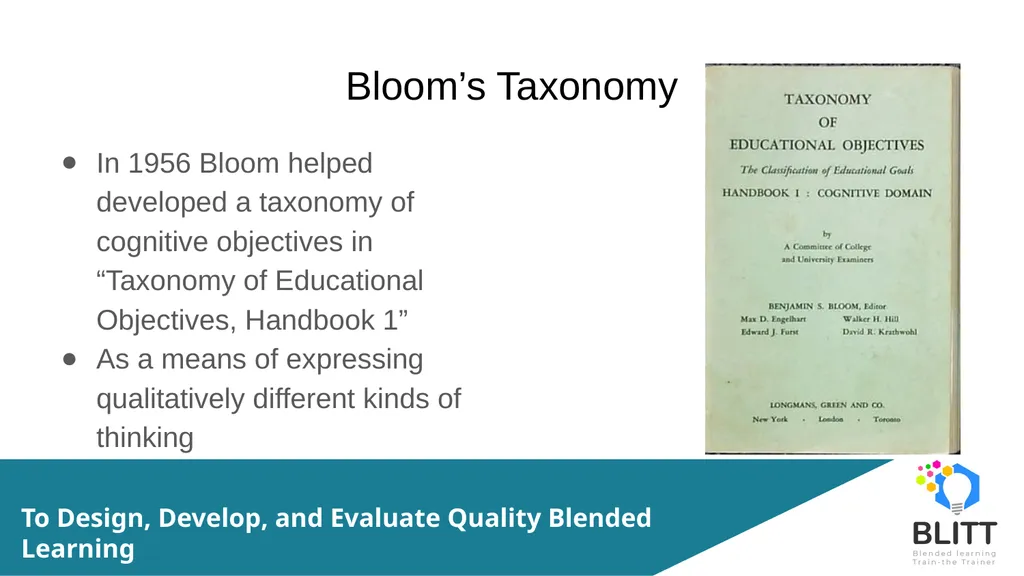
Bloom’s Taxonomy In 1956 Bloom helped developed a taxonomy of cognitive objectives in “Taxonomy of Educational Objectives, Handbook 1”
As a means of expressing qualitatively different kinds of thinking To Design, Develop, and Evaluate Quality Blended Learning<br>
07
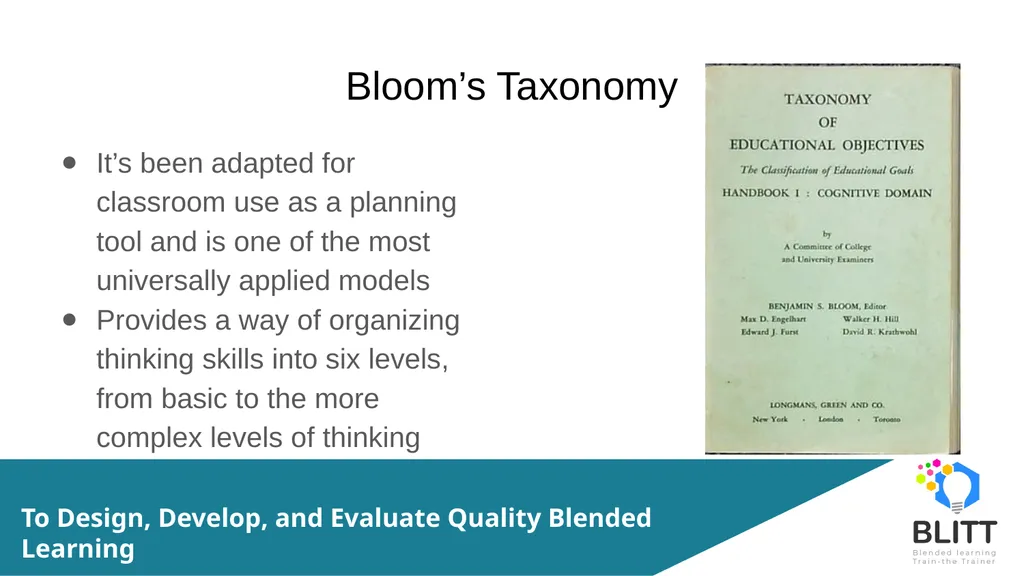
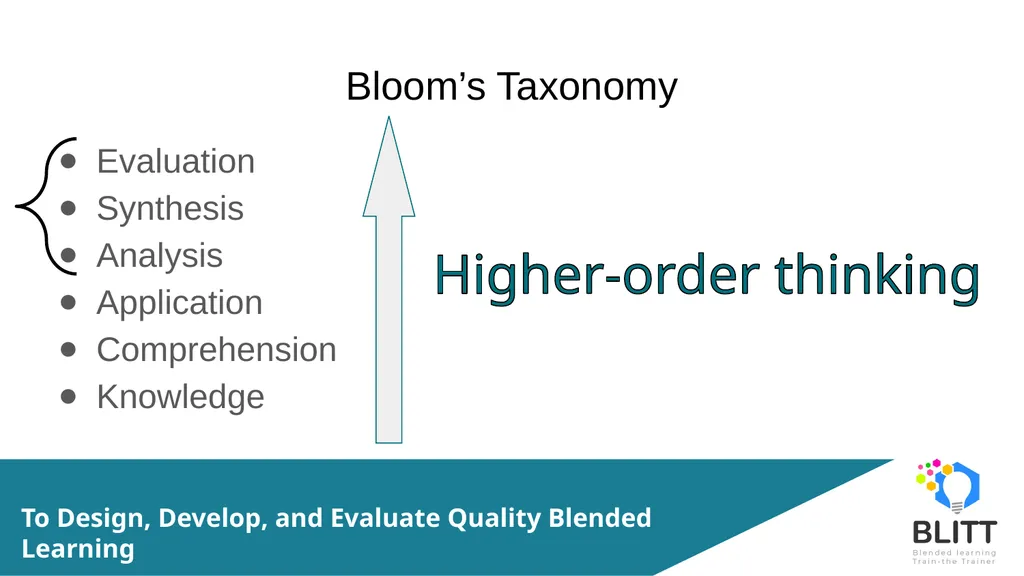
Bloom’s Taxonomy It’s been adapted for classroom use as a planning tool and is one of the most universally applied models
Provides a way of organizing thinking skills into six levels, from basic to the more complex levels of thinking To Design, Develop, and Evaluate Quality Blended Learning<br>
08
Bloom’s Taxonomy Evaluation
Synthesis
Analysis
Application
Comprehension
Knowledge To Design, Develop, and Evaluate Quality Blended Learning Higher-order thinking<br>
09
Bloom’s Taxonomy Evaluation: compare and discriminate between ideas, assess value of theories, presentations make choices based on reasoned argument, verify value of evidence, recognize subjectivity To Design, Develop, and Evaluate Quality Blended Learning<br>
10
Bloom’s Taxonomy Synthesis: use old ideas to create new ones, generalize from given facts, relate knowledge from several areas, predict, draw conclusions To Design, Develop, and Evaluate Quality Blended Learning<br>
11
Bloom’s Taxonomy Analysis: seeing patterns, organization of parts, recognition of hidden meanings, identification of components To Design, Develop, and Evaluate Quality Blended Learning<br>
12
Bloom’s Taxonomy Application: use information use methods, concepts, theories in new situations, solve problems using required skills or knowledge To Design, Develop, and Evaluate Quality Blended Learning<br>
13
Bloom’s Taxonomy Comprehension: understanding information, grasp meaning, translate knowledge into new context To Design, Develop, and Evaluate Quality Blended Learning<br>
14
Bloom’s Taxonomy Knowledge: observation and recall of information, knowledge of dates, events, places knowledge of major ideas To Design, Develop, and Evaluate Quality Blended Learning<br>
15
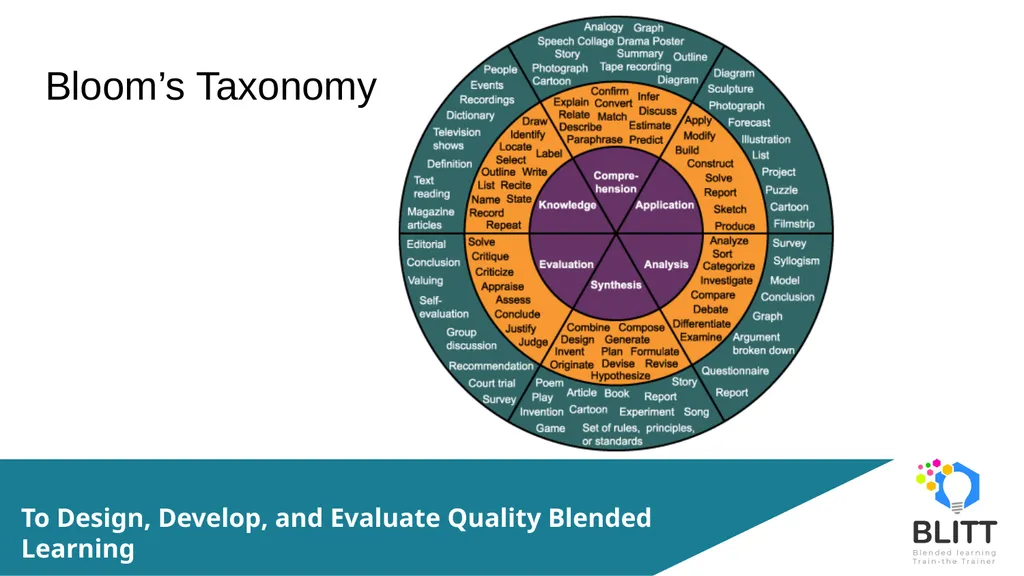
Bloom’s Taxonomy To Design, Develop, and Evaluate Quality Blended Learning<br>
16
Bloom’s Taxonomy Evaluation: appraise, argue, assess, attach, choose, compare, defend estimate, judge, predict, rate, score, select, support, value To Design, Develop, and Evaluate Quality Blended Learning<br>
17
Bloom’s Taxonomy Synthesis: arrange, assemble, collect, compose, construct, create, design, develop, formulate, manage, organize, plan, prepare To Design, Develop, and Evaluate Quality Blended Learning<br>
18
Bloom’s Taxonomy Analysis: analyze, appraise, calculate, categorize, compare, contrast, criticize, differentiate, discriminate, distinguish, examine To Design, Develop, and Evaluate Quality Blended Learning<br>
19
Bloom’s Taxonomy Application: apply, choose, demonstrate, dramatize, employ, illustrate, interpret, operate, practice, schedule, sketch, solve, use To Design, Develop, and Evaluate Quality Blended Learning<br>
20
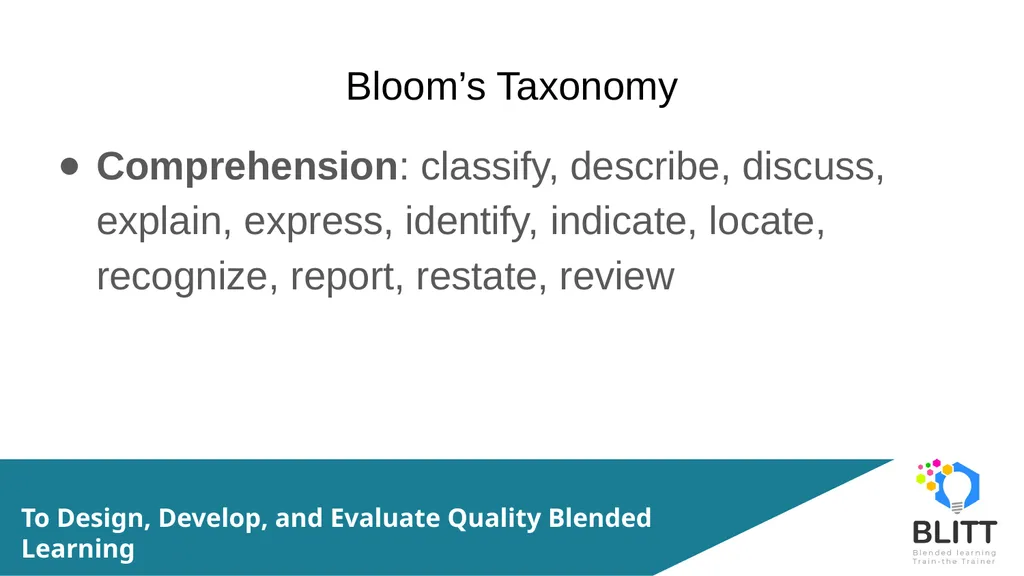
Bloom’s Taxonomy Comprehension: classify, describe, discuss, explain, express, identify, indicate, locate, recognize, report, restate, review To Design, Develop, and Evaluate Quality Blended Learning<br>
21
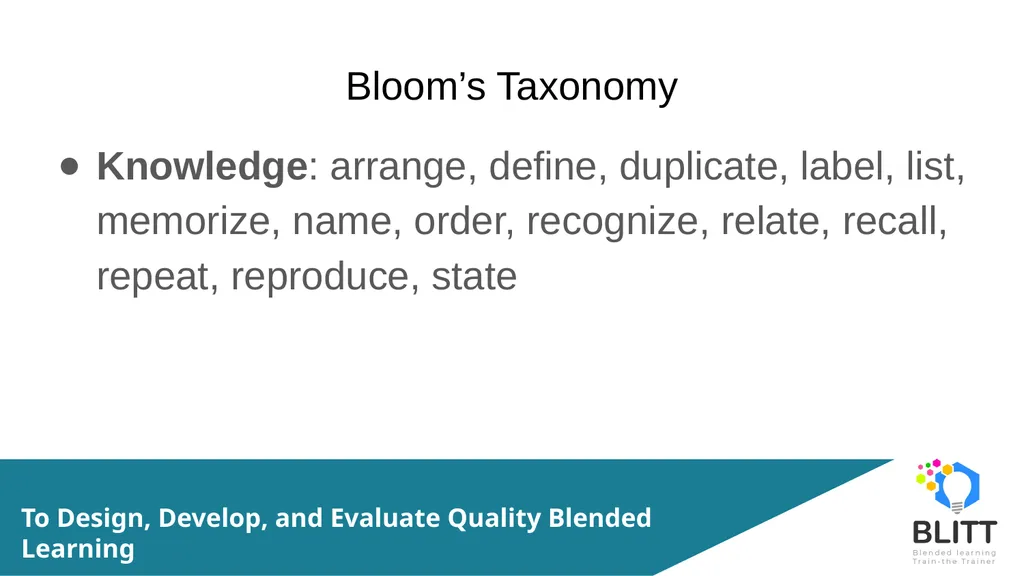
Bloom’s Taxonomy Knowledge: arrange, define, duplicate, label, list, memorize, name, order, recognize, relate, recall, repeat, reproduce, state To Design, Develop, and Evaluate Quality Blended Learning<br>