Blooms Taxonomy and Revised Blooms Taxonomy System Presented by Hemanta Baro Asst. Professor Dept. of English Salbari College, Salbari Blooms Taxonomy Blooms taxonomy is a hierarchical framework used to classify educational learning
"Bloom’s Taxonomy and Revised Bloom’s Taxonomy" is the property of its rightful owner. Permission is granted to
download and print the materials on this website for personal, non-commercial use only, and to display it
on your personal computer provided you do not modify the materials and that you retain all copyright
notices contained in the materials. By downloading content from our website, you accept the terms of this
agreement.
Presentation Transcript
01
Bloom’s Taxonomy and Revised Bloom’s Taxonomy System Presented by
Hemanta Baro
Asst. Professor
Dept. of English
Salbari College, Salbari<br>
02
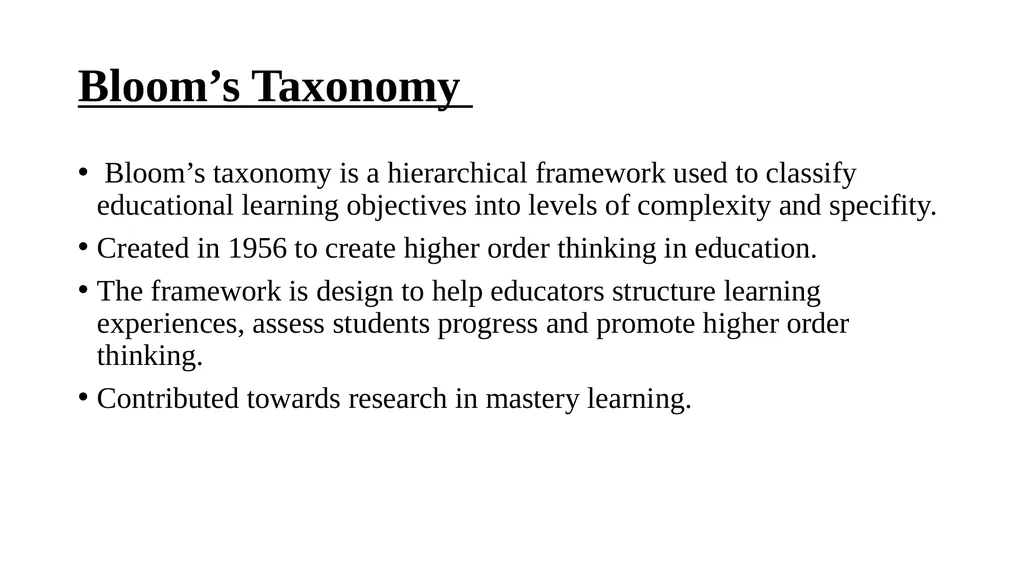
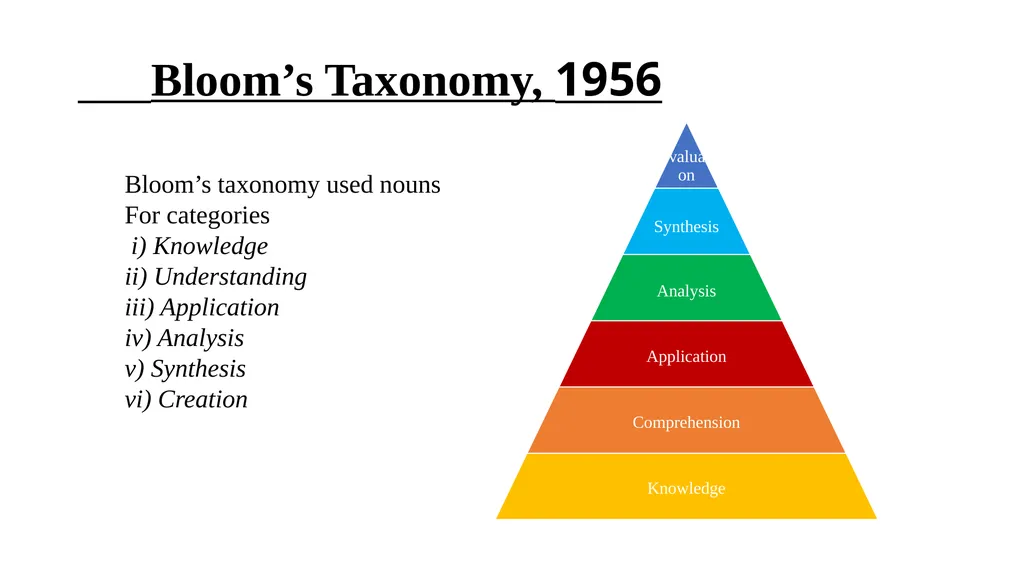
Bloom’s Taxonomy Bloom’s taxonomy is a hierarchical framework used to classify educational learning objectives into levels of complexity and specifity.
Created in 1956 to create higher order thinking in education.
The framework is design to help educators structure learning experiences, assess students progress and promote higher order thinking.
Contributed towards research in mastery learning.<br>
03
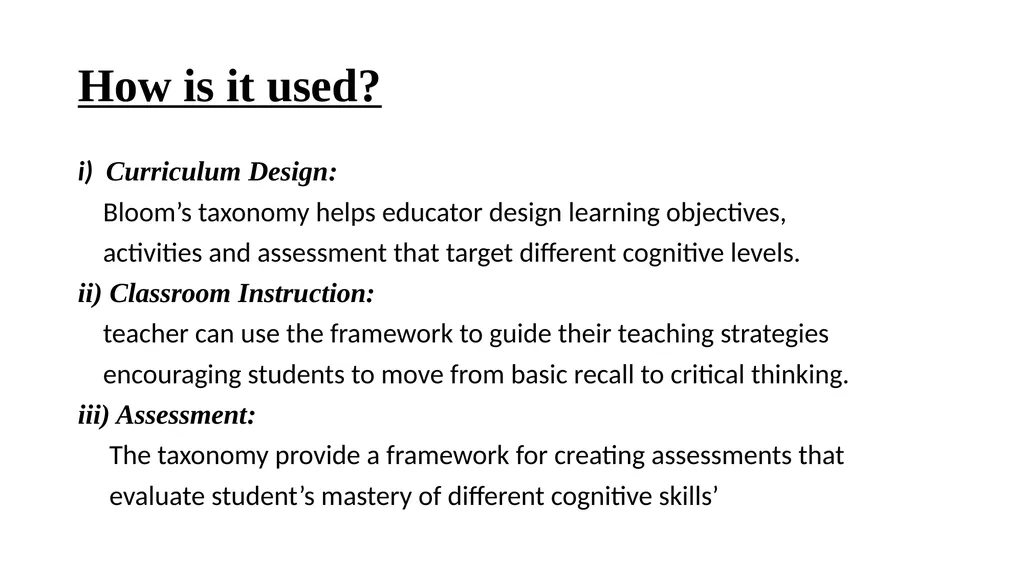
How is it used? i) Curriculum Design:
Bloom’s taxonomy helps educator design learning objectives,
activities and assessment that target different cognitive levels.
ii) Classroom Instruction:
teacher can use the framework to guide their teaching strategies
encouraging students to move from basic recall to critical thinking.
iii) Assessment:
The taxonomy provide a framework for creating assessments that
evaluate student’s mastery of different cognitive skills’<br>
3 Domains/ 3 Hs 1. Cognitive (knowledge-based/Head)
(This domain focuses on mental skills and knowledge acquisition.)
2. Affective (emotion-based/Heart)
(This domain deals with emotions, attitudes and values.)
3. Psychomotor (action-based/Hand)
(This domain focuses on physical skills and coordination.)<br>
06
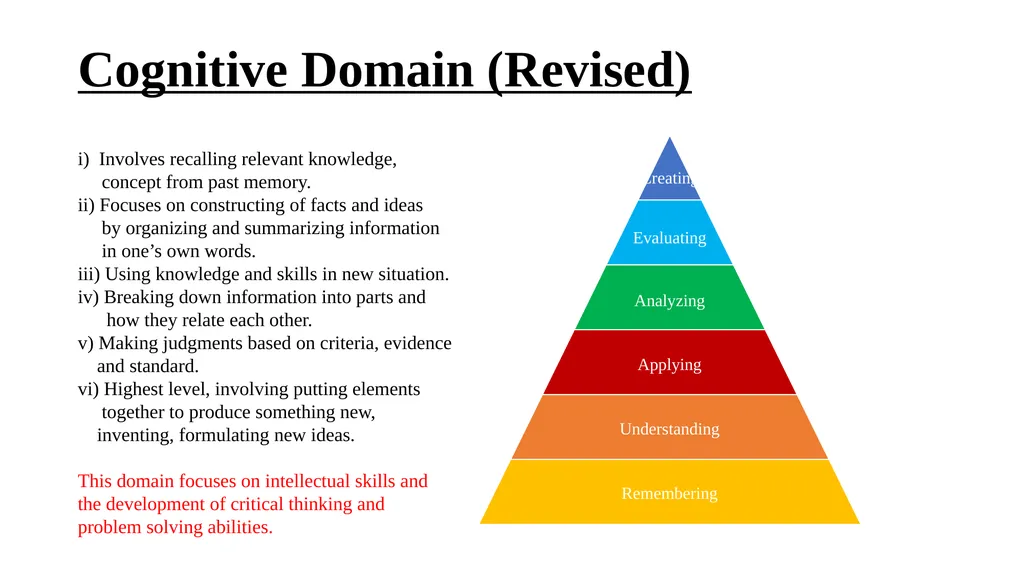
Cognitive Domain (Revised) i) Involves recalling relevant knowledge,
concept from past memory.
ii) Focuses on constructing of facts and ideas
by organizing and summarizing information
in one’s own words.
iii) Using knowledge and skills in new situation.
iv) Breaking down information into parts and
how they relate each other.
v) Making judgments based on criteria, evidence
and standard.
vi) Highest level, involving putting elements
together to produce something new,
inventing, formulating new ideas.
This domain focuses on intellectual skills and
the development of critical thinking and
problem solving abilities.<br>
07
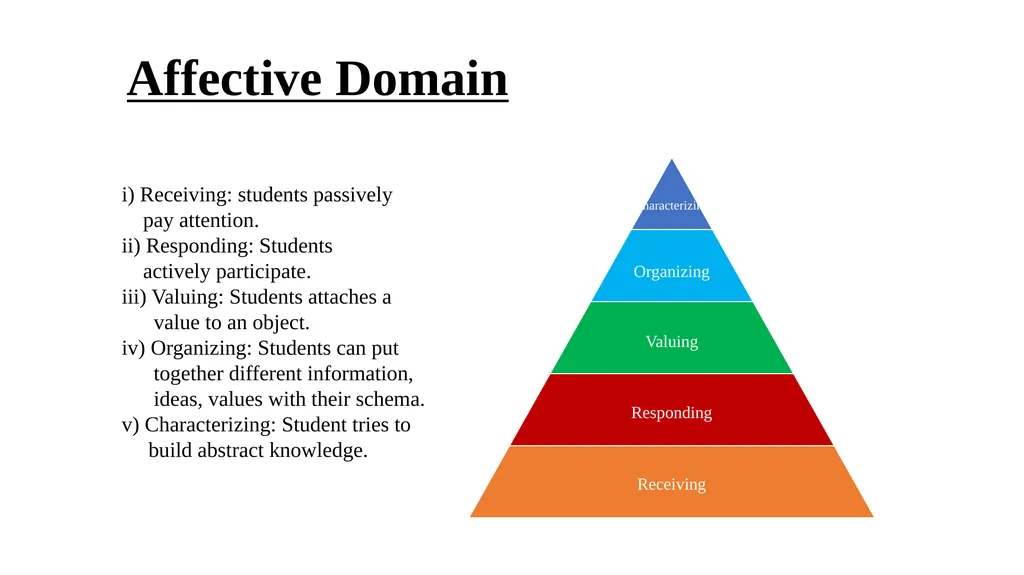
Affective Domain i) Receiving: students passively
pay attention.
ii) Responding: Students
actively participate.
iii) Valuing: Students attaches a
value to an object.
iv) Organizing: Students can put
together different information,
ideas, values with their schema.
v) Characterizing: Student tries to
build abstract knowledge.<br>
08
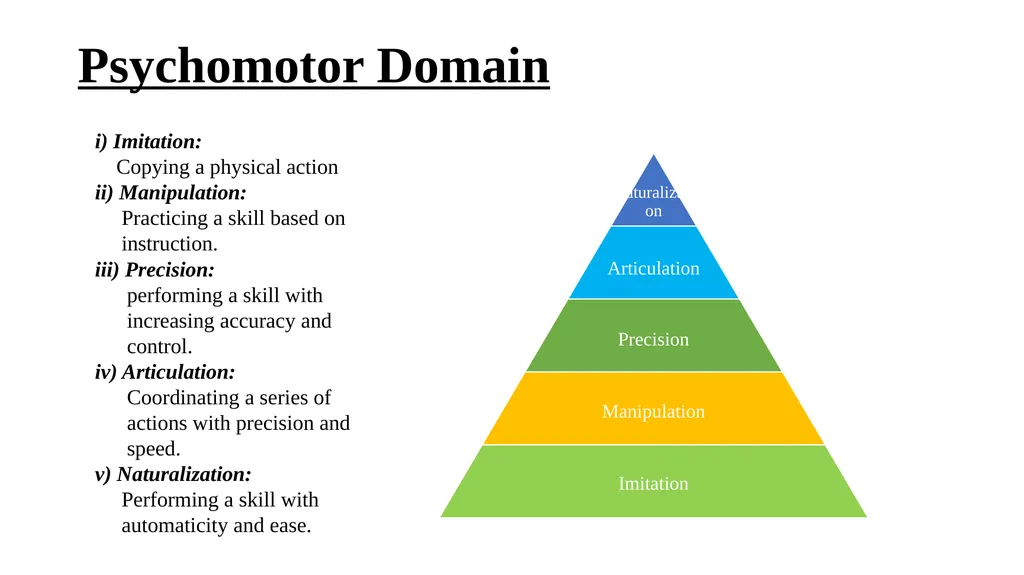
Psychomotor Domain i) Imitation:
Copying a physical action
ii) Manipulation:
Practicing a skill based on
instruction.
iii) Precision:
performing a skill with
increasing accuracy and
control.
iv) Articulation:
Coordinating a series of
actions with precision and
speed.
v) Naturalization:
Performing a skill with
automaticity and ease.<br>