Bounded depth circuits cannot sample good codes
Description: Bounded depth circuits cannot sample good codes Shachar Lovett (IAS) Joint with Emanuele Viola (Northeastern) Lower bounds Classic lower bounds: functions Bounded families of circuits cannot compute (or approximate) some explicit function
Related Topics
Download Presentation
"Bounded depth circuits cannot sample good codes" is the property of its rightful owner. Permission is granted to download and print the materials on this website for personal, non-commercial use only, and to display it on your personal computer provided you do not modify the materials and that you retain all copyright notices contained in the materials. By downloading content from our website, you accept the terms of this agreement.
Presentation Transcript
slide1. Bounded depth circuits cannot sample good codes Shachar Lovett (IAS)
Joint with Emanuele Viola (Northeastern)<br>
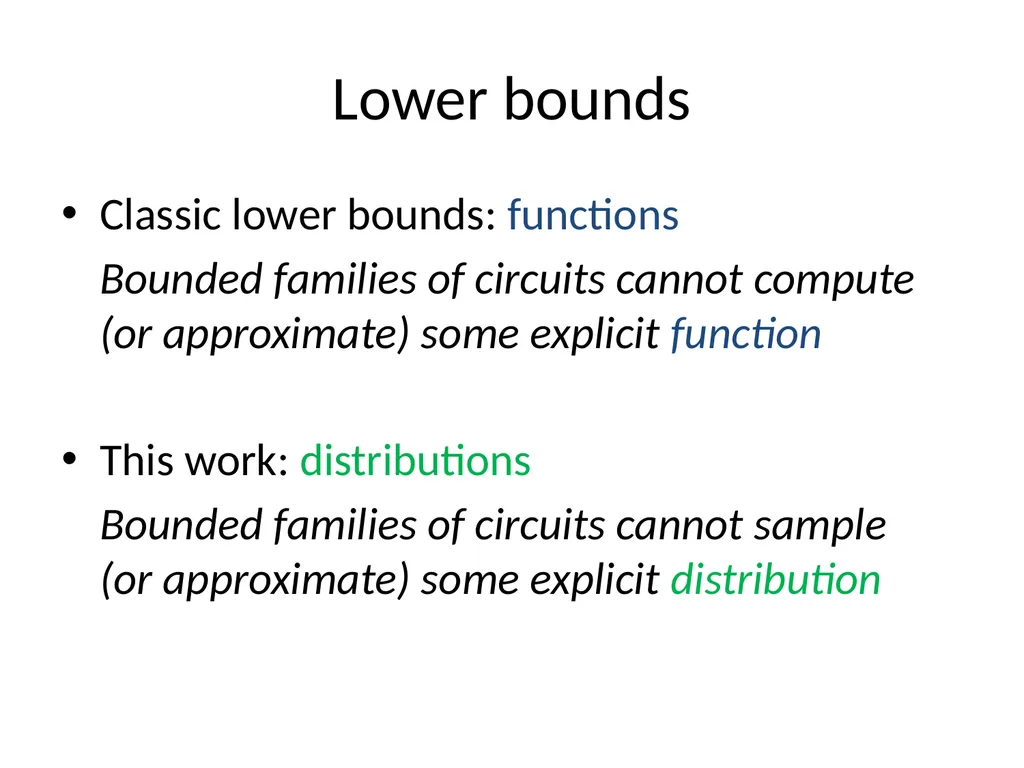
slide2. Lower bounds Classic lower bounds: functions
Bounded families of circuits cannot compute (or approximate) some explicit function
This work: distributions
Bounded families of circuits cannot sample (or approximate) some explicit distribution<br>
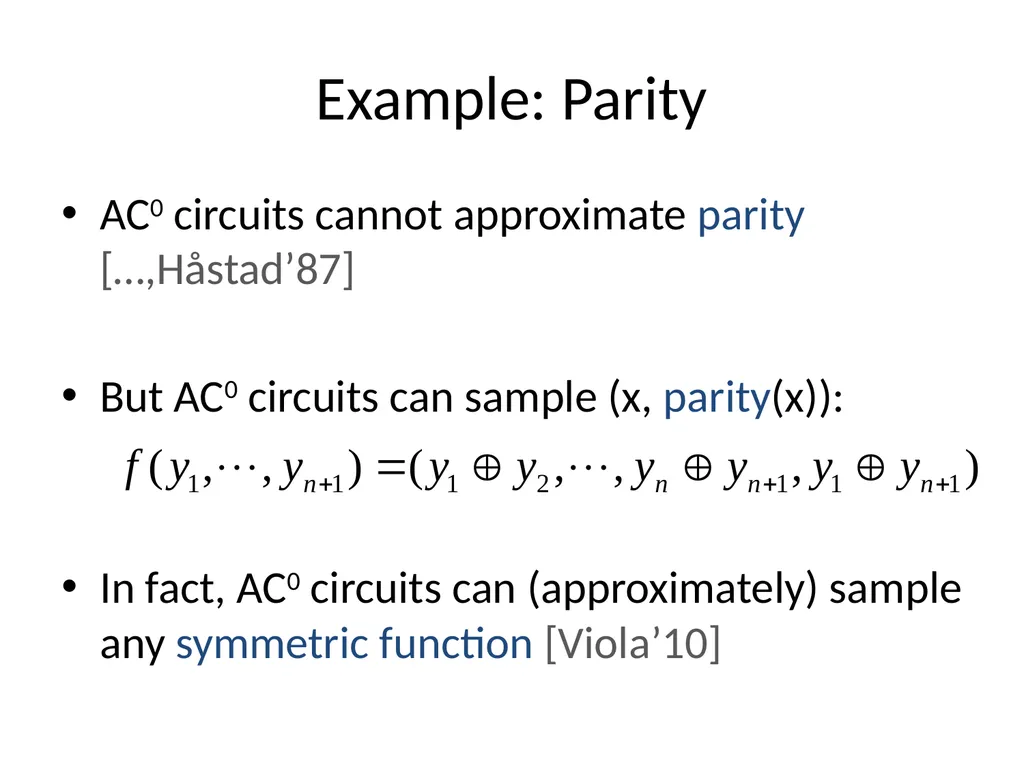
slide3. Example: Parity AC0 circuits cannot approximate parity […,Håstad’87]
But AC0 circuits can sample (x, parity(x)):
In fact, AC0 circuits can (approximately) sample any symmetric function [Viola’10]<br>
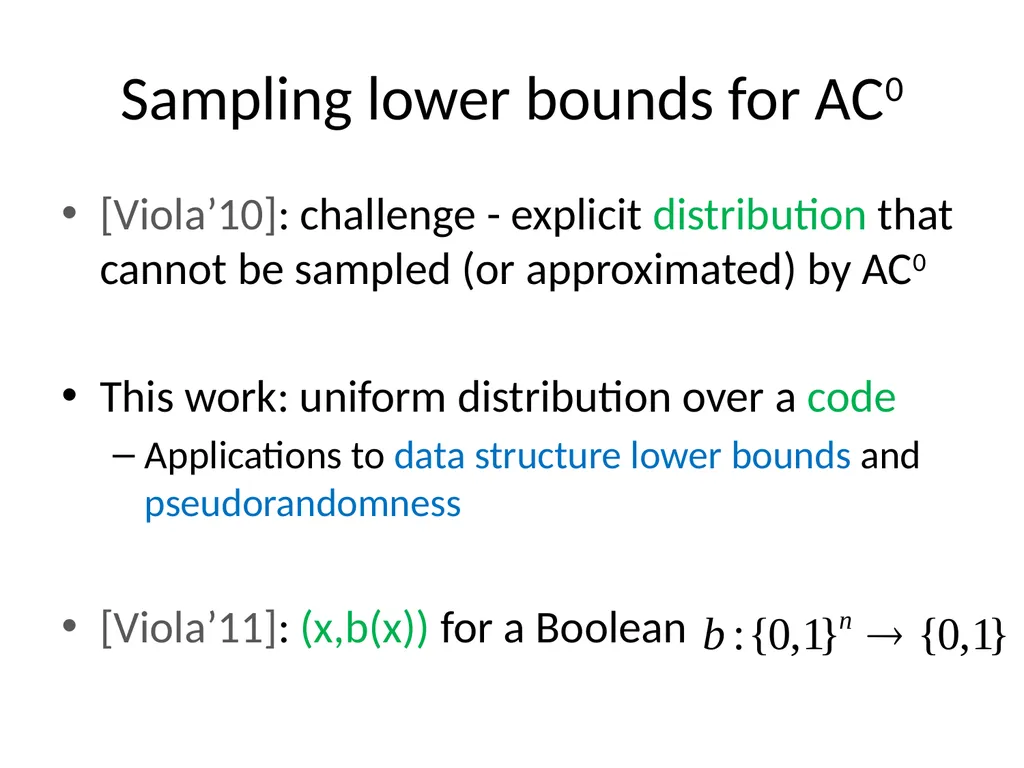
slide4. Sampling lower bounds for AC0 [Viola’10]: challenge - explicit distribution that cannot be sampled (or approximated) by AC0
This work: uniform distribution over a code
Applications to data structure lower bounds and pseudorandomness
[Viola’11]: (x,b(x)) for a Boolean<br>
slide5. Talk overview Describe result
Applications
Proof<br>
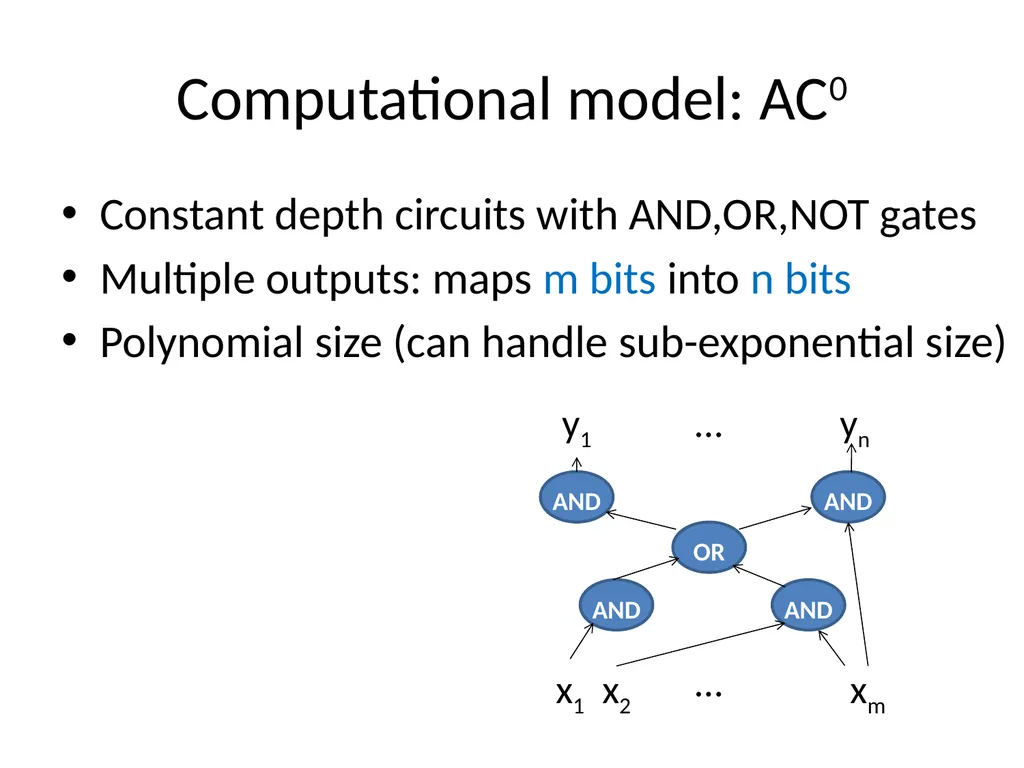
slide6. Computational model: AC0 Constant depth circuits with AND,OR,NOT gates
Multiple outputs: maps m bits into n bits
Polynomial size (can handle sub-exponential size)<br>
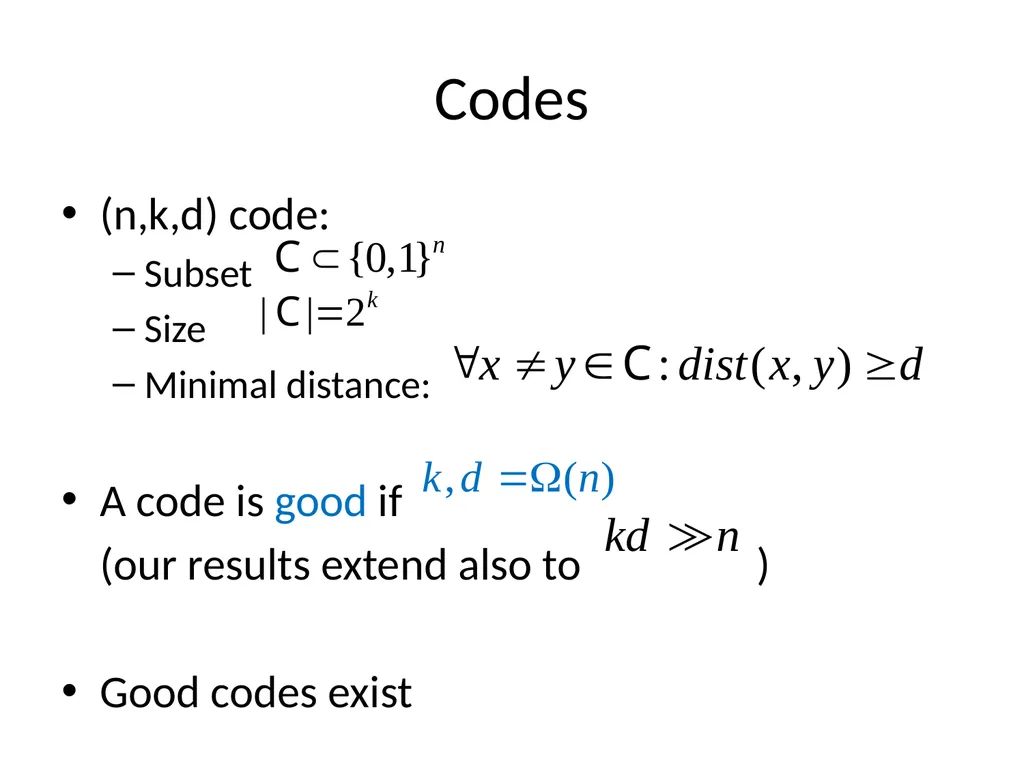
slide7. Codes (n,k,d) code:
Subset
Size
Minimal distance:
A code is good if
(our results extend also to )
Good codes exist<br>
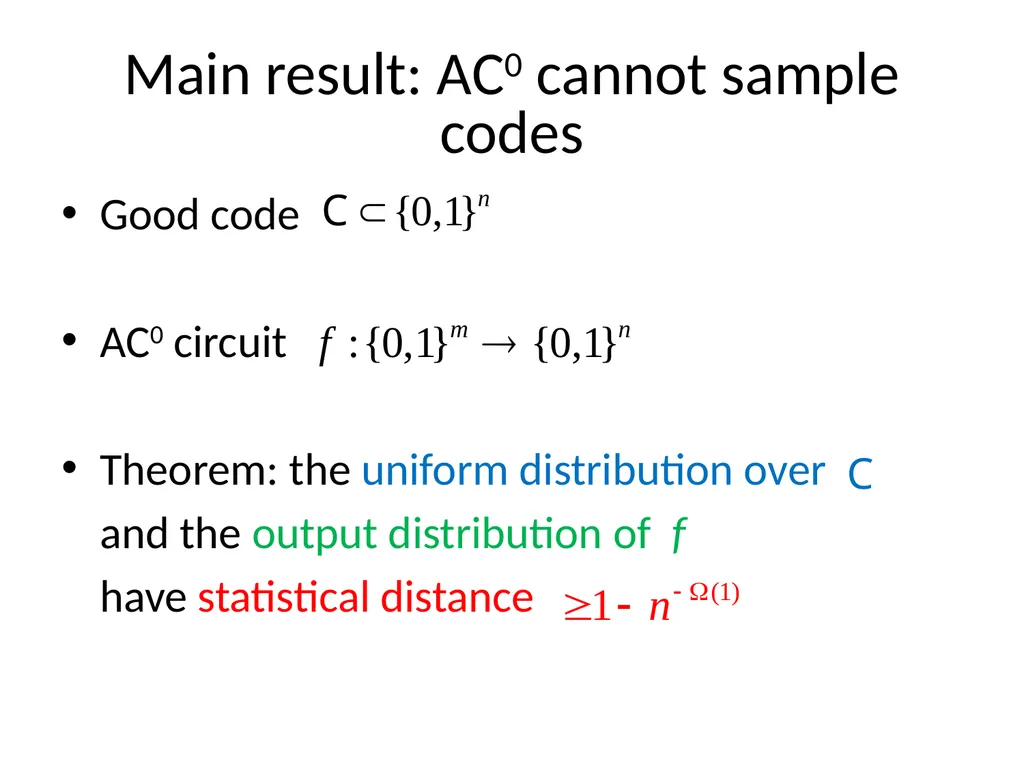
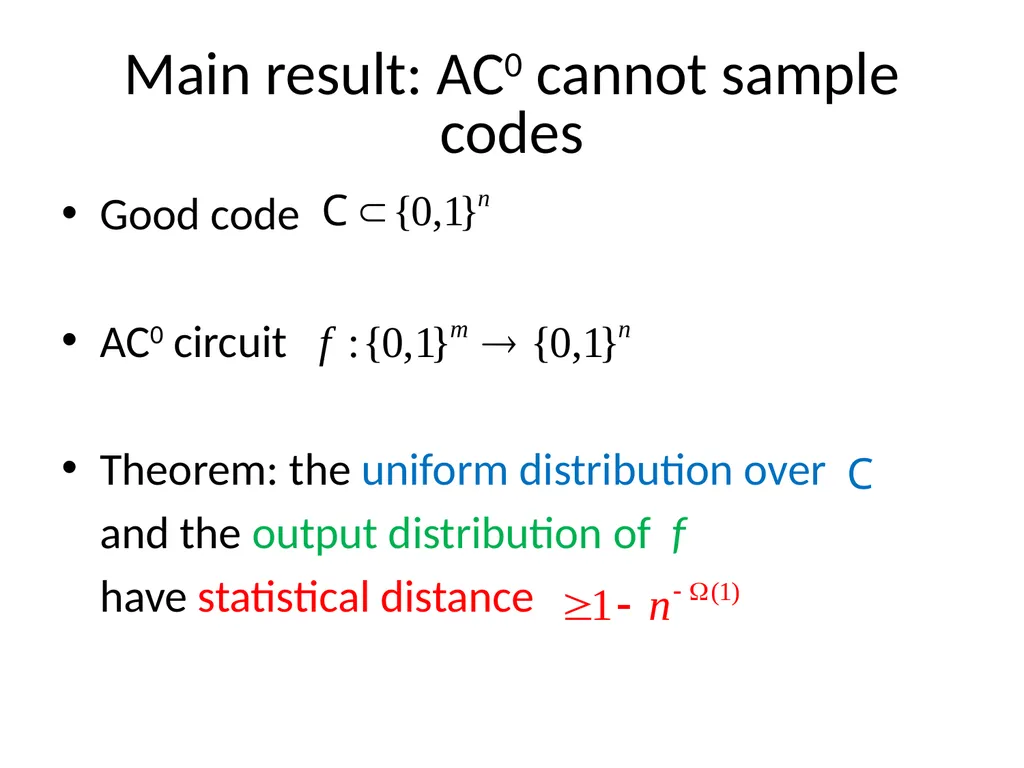
slide8. Main result: AC0 cannot sample codes Good code
AC0 circuit
Theorem: the uniform distribution over
and the output distribution of f
have statistical distance<br>
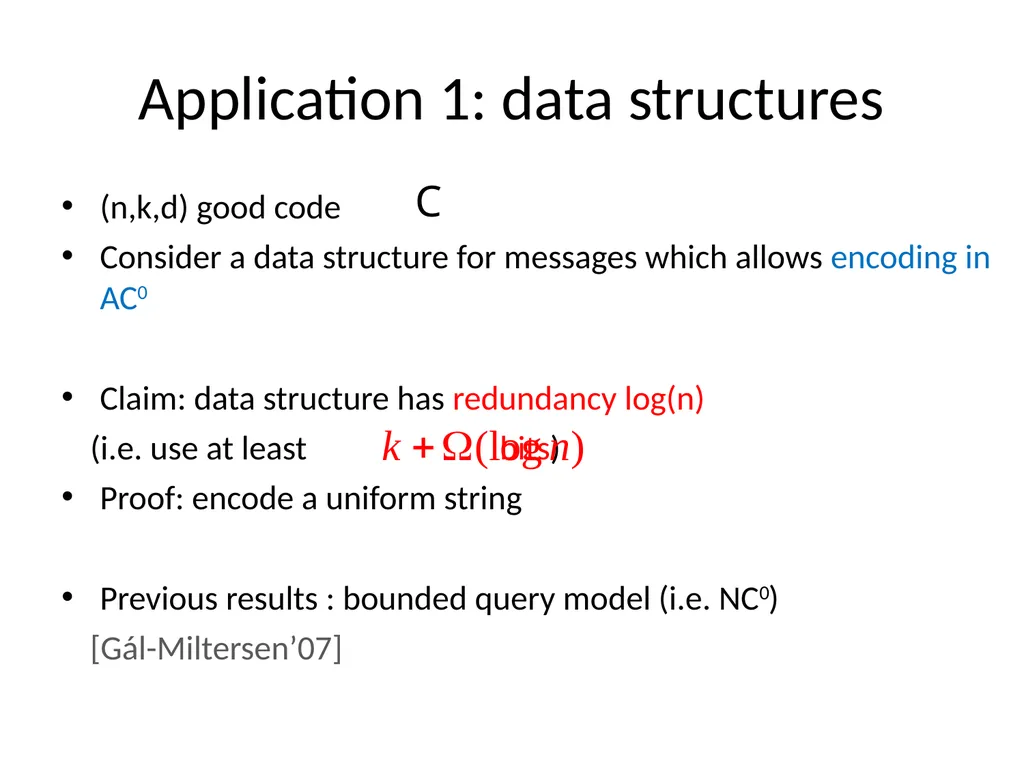
slide9. Application 1: data structures (n,k,d) good code
Consider a data structure for messages which allows encoding in AC0
Claim: data structure has redundancy log(n)
(i.e. use at least bits)
Proof: encode a uniform string
Previous results : bounded query model (i.e. NC0)
[Gál-Miltersen’07]<br>
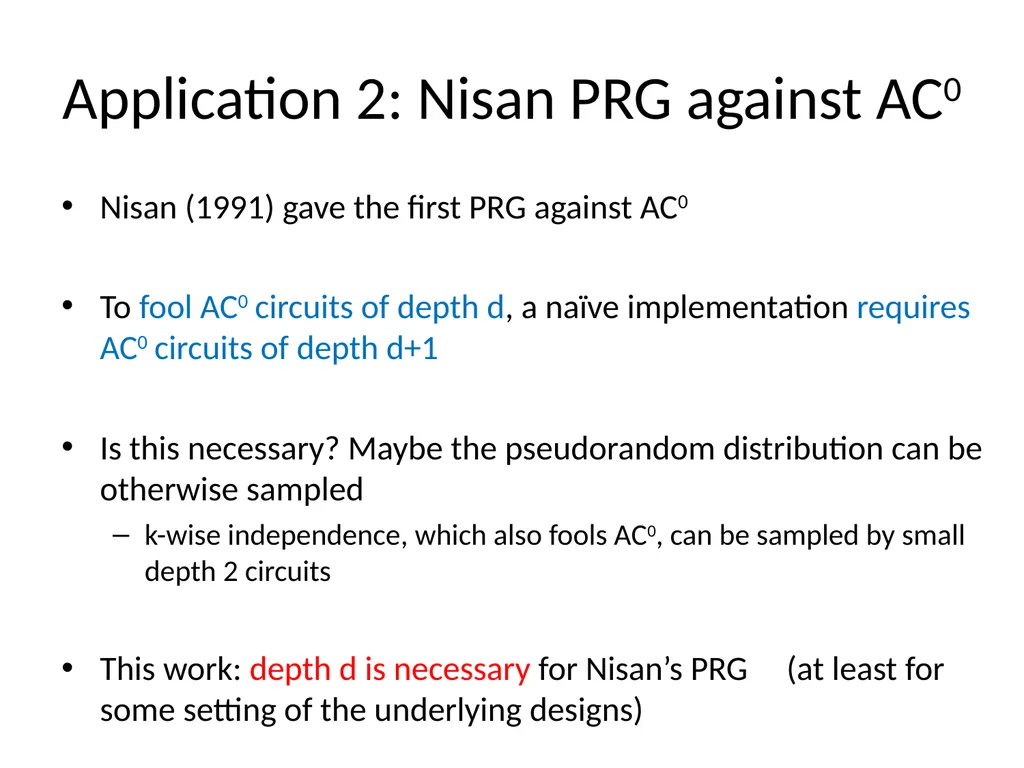
slide10. Application 2: Nisan PRG against AC0 Nisan (1991) gave the first PRG against AC0
To fool AC0 circuits of depth d, a naïve implementation requires AC0 circuits of depth d+1
Is this necessary? Maybe the pseudorandom distribution can be otherwise sampled
k-wise independence, which also fools AC0, can be sampled by small depth 2 circuits
This work: depth d is necessary for Nisan’s PRG (at least for some setting of the underlying designs)<br>
slide11. Main result: AC0 cannot sample codes Good code
AC0 circuit
Theorem: the uniform distribution over
and the output distribution of f
have statistical distance<br>
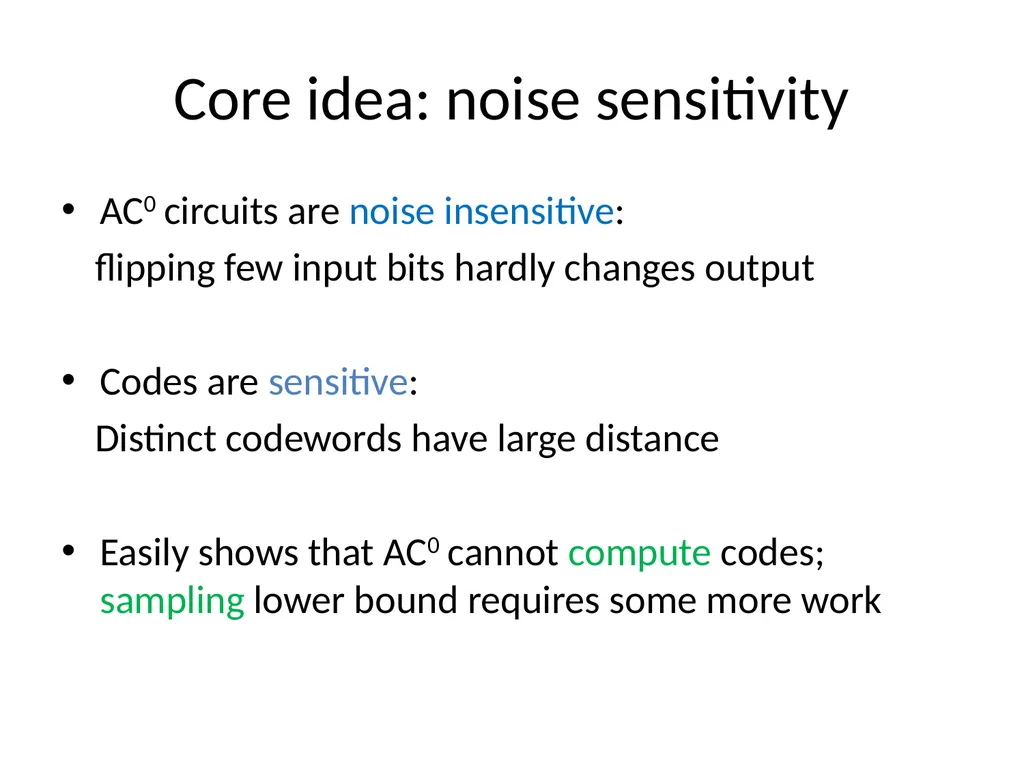
slide12. Core idea: noise sensitivity AC0 circuits are noise insensitive:
flipping few input bits hardly changes output
Codes are sensitive:
Distinct codewords have large distance
Easily shows that AC0 cannot compute codes; sampling lower bound requires some more work<br>
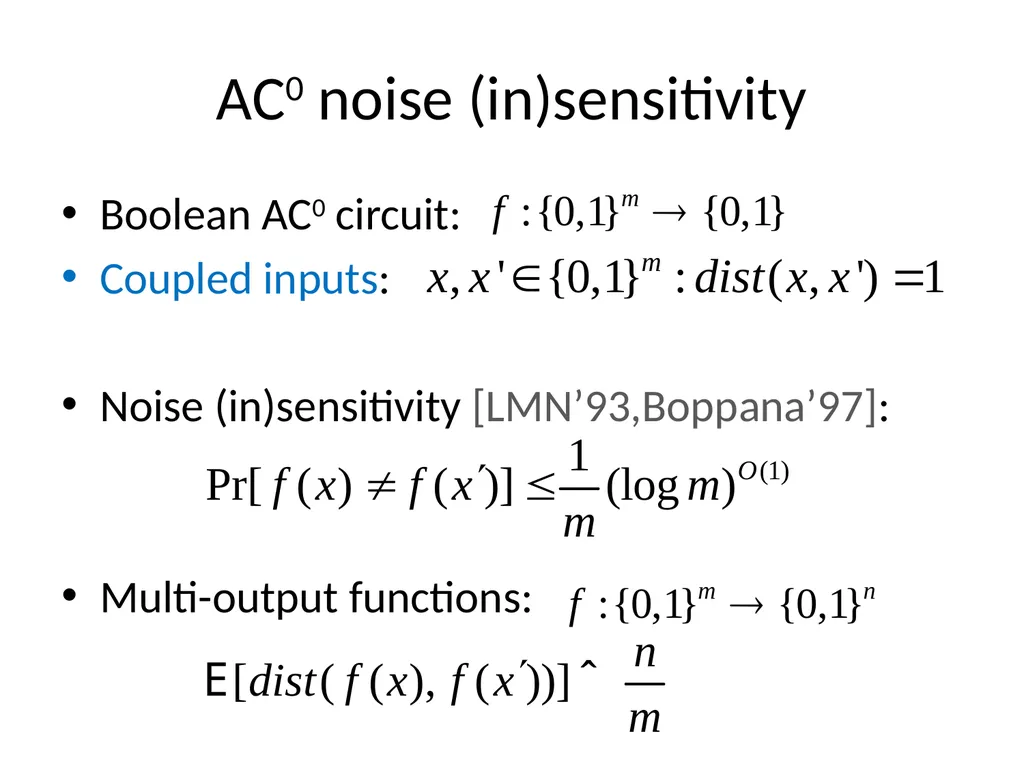
slide13. AC0 noise (in)sensitivity Boolean AC0 circuit:
Coupled inputs:
Noise (in)sensitivity [LMN’93,Boppana’97]:
Multi-output functions:<br>
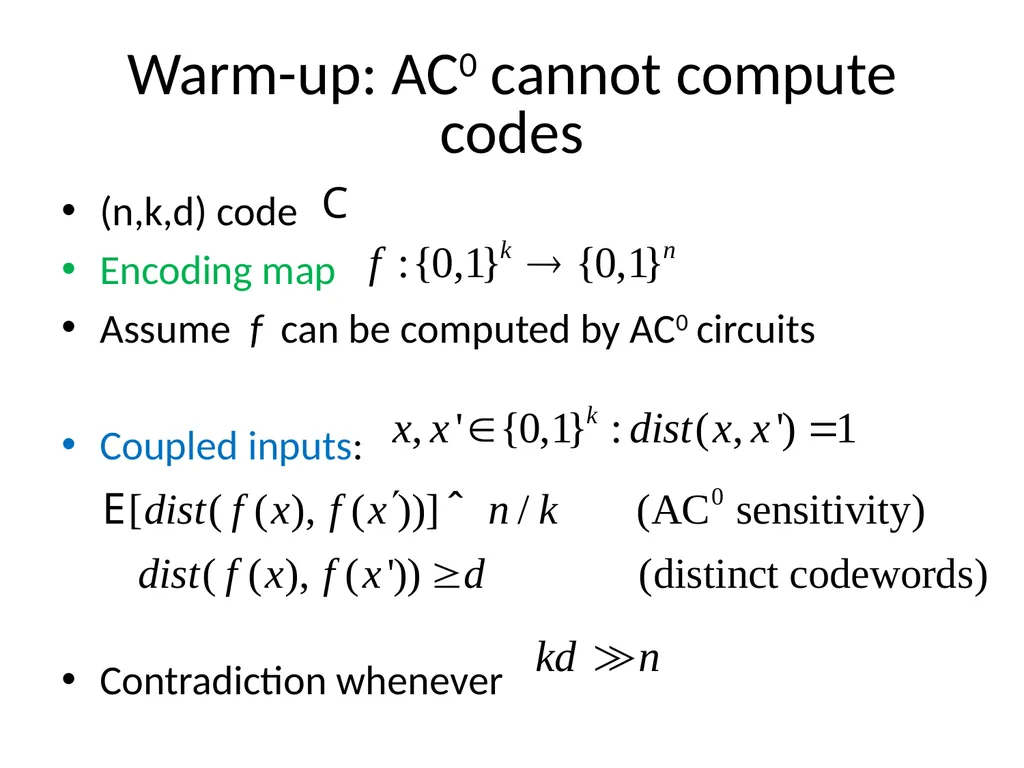
slide14. Warm-up: AC0 cannot compute codes (n,k,d) code
Encoding map
Assume f can be computed by AC0 circuits
Coupled inputs:
Contradiction whenever<br>
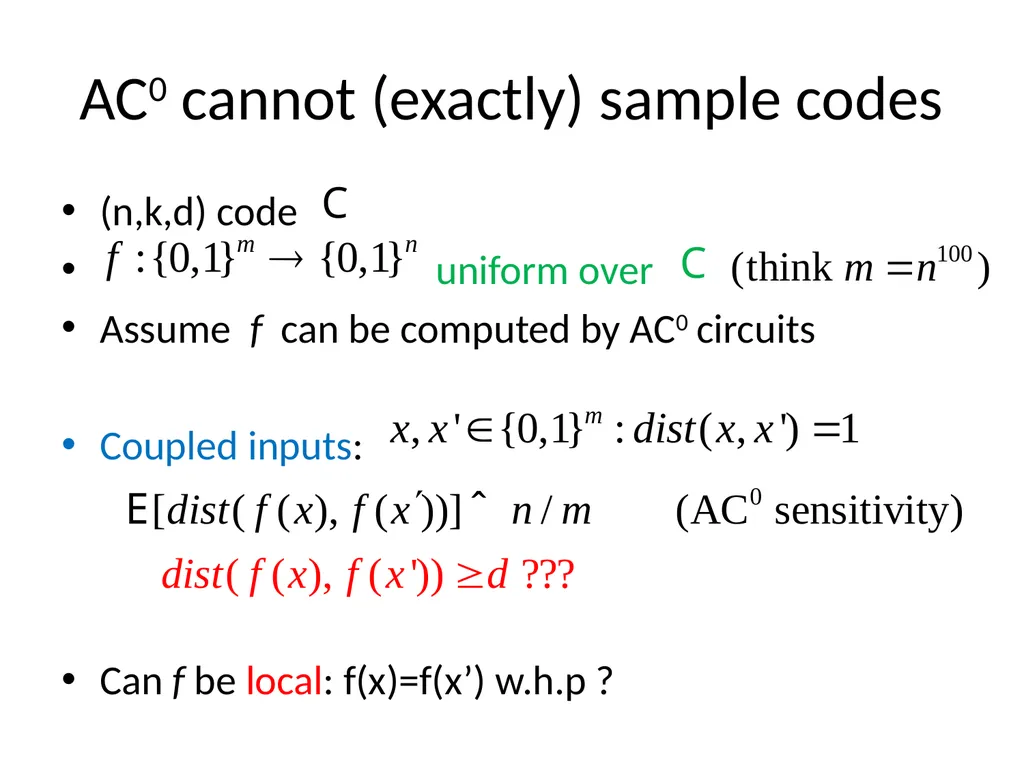
slide15. AC0 cannot (exactly) sample codes (n,k,d) code
uniform over
Assume f can be computed by AC0 circuits
Coupled inputs:
Can f be local: f(x)=f(x’) w.h.p ?<br>
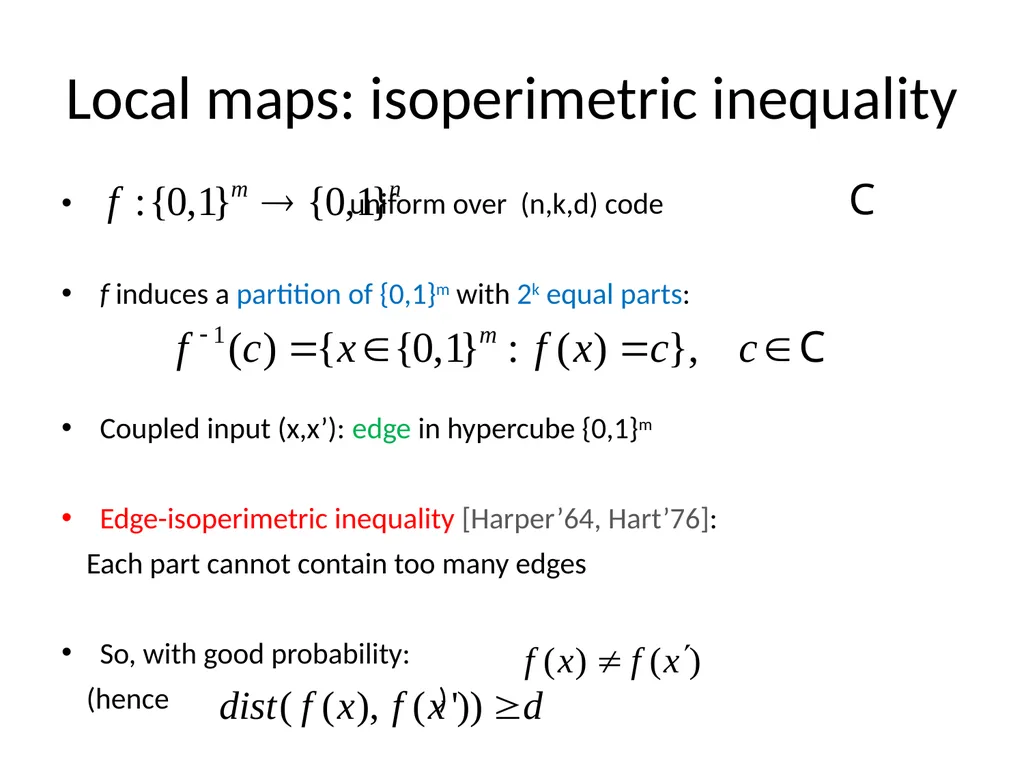
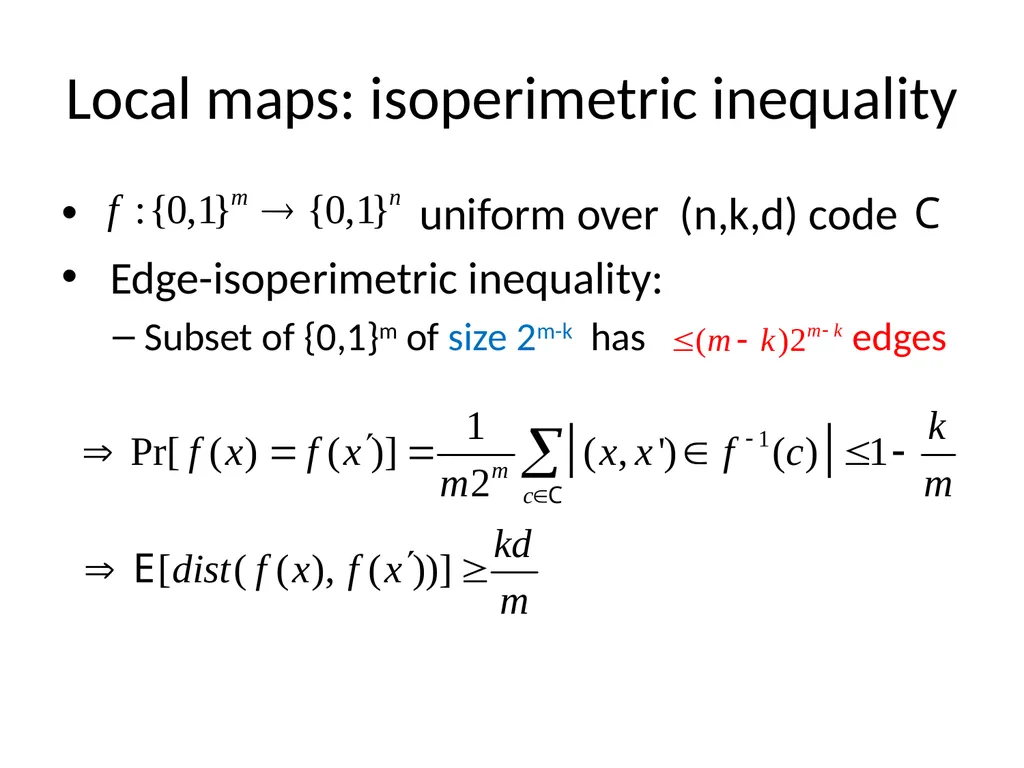
slide16. Local maps: isoperimetric inequality uniform over (n,k,d) code
f induces a partition of {0,1}m with 2k equal parts:
Coupled input (x,x’): edge in hypercube {0,1}m
Edge-isoperimetric inequality [Harper’64, Hart’76]:
Each part cannot contain too many edges
So, with good probability:
(hence )<br>
slide17. Local maps: isoperimetric inequality uniform over (n,k,d) code
Edge-isoperimetric inequality:
Subset of {0,1}m of size 2m-k has edges<br>
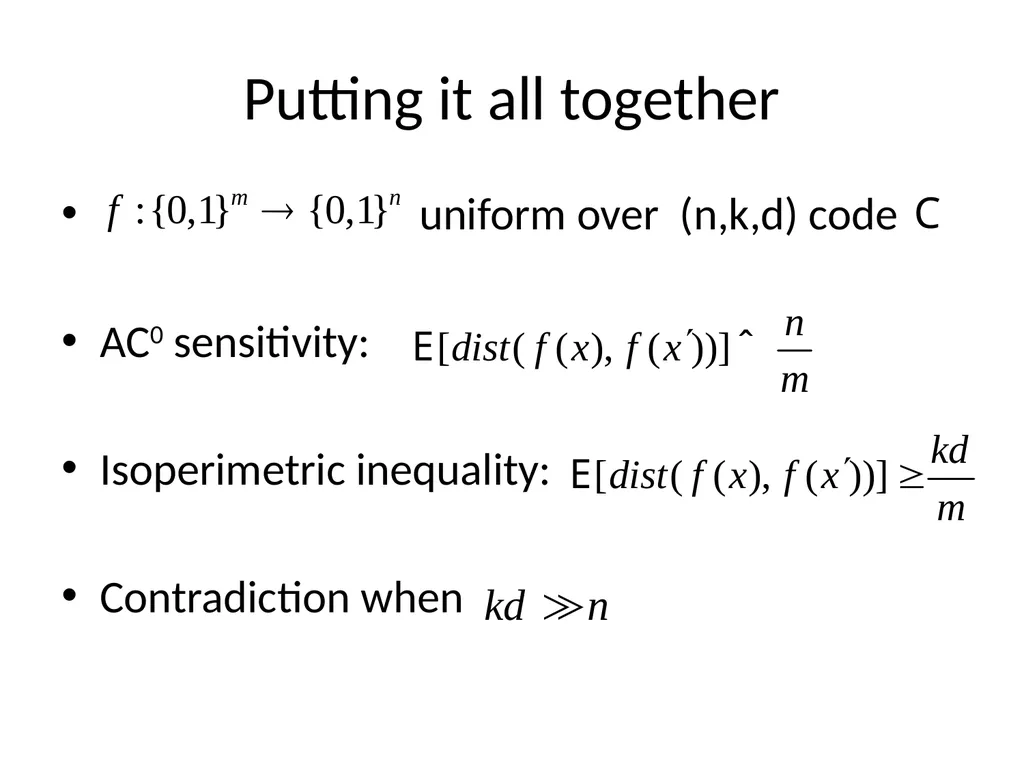
slide18. Putting it all together uniform over (n,k,d) code
AC0 sensitivity:
Isoperimetric inequality:
Contradiction when<br>
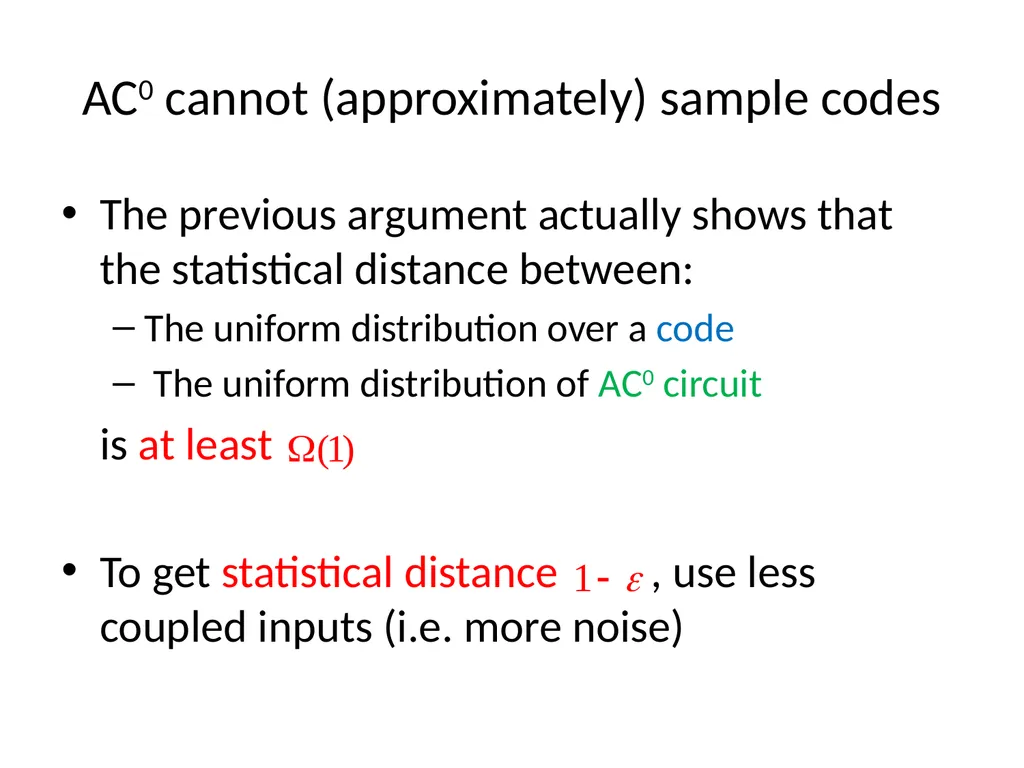
slide19. AC0 cannot (approximately) sample codes The previous argument actually shows that the statistical distance between:
The uniform distribution over a code
The uniform distribution of AC0 circuit
is at least
To get statistical distance , use less coupled inputs (i.e. more noise)<br>

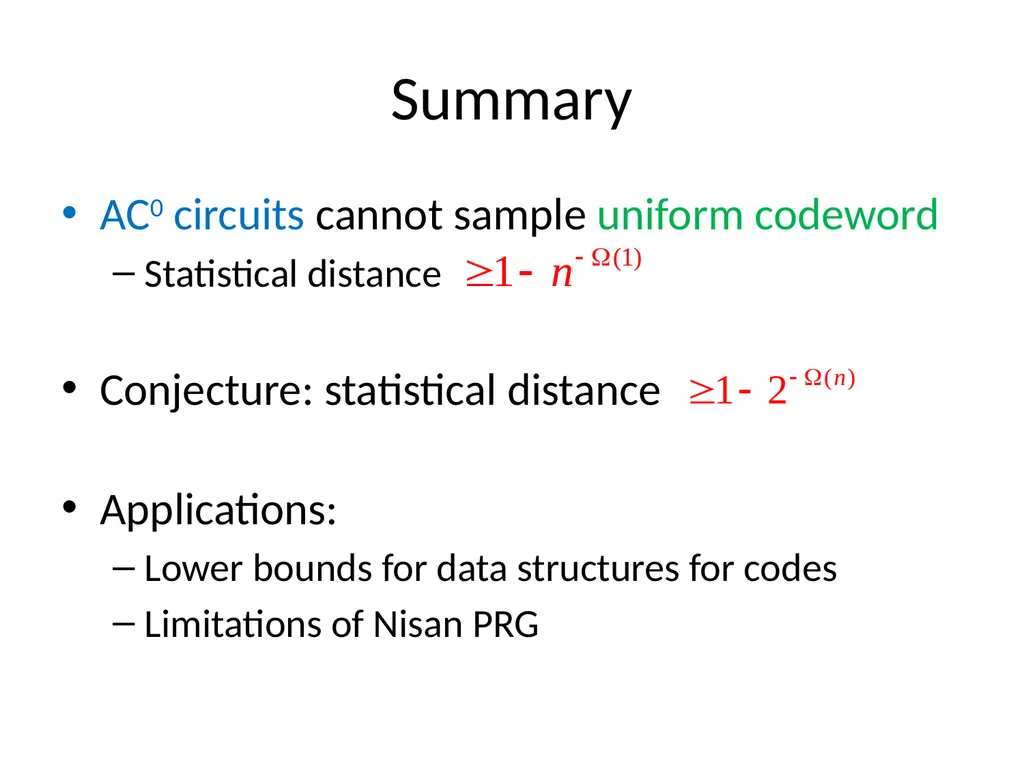
slide20. Summary AC0 circuits cannot sample uniform codeword
Statistical distance
Conjecture: statistical distance
Applications:
Lower bounds for data structures for codes
Limitations of Nisan PRG<br>
slide21. Open problems Sampling lower bounds – relatively unexplored area
New lower bounds?
New applications? THANK YOU!<br>
Joint with Emanuele Viola (Northeastern)<br>
slide2. Lower bounds Classic lower bounds: functions
Bounded families of circuits cannot compute (or approximate) some explicit function
This work: distributions
Bounded families of circuits cannot sample (or approximate) some explicit distribution<br>
slide3. Example: Parity AC0 circuits cannot approximate parity […,Håstad’87]
But AC0 circuits can sample (x, parity(x)):
In fact, AC0 circuits can (approximately) sample any symmetric function [Viola’10]<br>
slide4. Sampling lower bounds for AC0 [Viola’10]: challenge - explicit distribution that cannot be sampled (or approximated) by AC0
This work: uniform distribution over a code
Applications to data structure lower bounds and pseudorandomness
[Viola’11]: (x,b(x)) for a Boolean<br>
slide5. Talk overview Describe result
Applications
Proof<br>
slide6. Computational model: AC0 Constant depth circuits with AND,OR,NOT gates
Multiple outputs: maps m bits into n bits
Polynomial size (can handle sub-exponential size)<br>
slide7. Codes (n,k,d) code:
Subset
Size
Minimal distance:
A code is good if
(our results extend also to )
Good codes exist<br>
slide8. Main result: AC0 cannot sample codes Good code
AC0 circuit
Theorem: the uniform distribution over
and the output distribution of f
have statistical distance<br>
slide9. Application 1: data structures (n,k,d) good code
Consider a data structure for messages which allows encoding in AC0
Claim: data structure has redundancy log(n)
(i.e. use at least bits)
Proof: encode a uniform string
Previous results : bounded query model (i.e. NC0)
[Gál-Miltersen’07]<br>
slide10. Application 2: Nisan PRG against AC0 Nisan (1991) gave the first PRG against AC0
To fool AC0 circuits of depth d, a naïve implementation requires AC0 circuits of depth d+1
Is this necessary? Maybe the pseudorandom distribution can be otherwise sampled
k-wise independence, which also fools AC0, can be sampled by small depth 2 circuits
This work: depth d is necessary for Nisan’s PRG (at least for some setting of the underlying designs)<br>
slide11. Main result: AC0 cannot sample codes Good code
AC0 circuit
Theorem: the uniform distribution over
and the output distribution of f
have statistical distance<br>
slide12. Core idea: noise sensitivity AC0 circuits are noise insensitive:
flipping few input bits hardly changes output
Codes are sensitive:
Distinct codewords have large distance
Easily shows that AC0 cannot compute codes; sampling lower bound requires some more work<br>
slide13. AC0 noise (in)sensitivity Boolean AC0 circuit:
Coupled inputs:
Noise (in)sensitivity [LMN’93,Boppana’97]:
Multi-output functions:<br>
slide14. Warm-up: AC0 cannot compute codes (n,k,d) code
Encoding map
Assume f can be computed by AC0 circuits
Coupled inputs:
Contradiction whenever<br>
slide15. AC0 cannot (exactly) sample codes (n,k,d) code
uniform over
Assume f can be computed by AC0 circuits
Coupled inputs:
Can f be local: f(x)=f(x’) w.h.p ?<br>
slide16. Local maps: isoperimetric inequality uniform over (n,k,d) code
f induces a partition of {0,1}m with 2k equal parts:
Coupled input (x,x’): edge in hypercube {0,1}m
Edge-isoperimetric inequality [Harper’64, Hart’76]:
Each part cannot contain too many edges
So, with good probability:
(hence )<br>
slide17. Local maps: isoperimetric inequality uniform over (n,k,d) code
Edge-isoperimetric inequality:
Subset of {0,1}m of size 2m-k has edges<br>
slide18. Putting it all together uniform over (n,k,d) code
AC0 sensitivity:
Isoperimetric inequality:
Contradiction when<br>
slide19. AC0 cannot (approximately) sample codes The previous argument actually shows that the statistical distance between:
The uniform distribution over a code
The uniform distribution of AC0 circuit
is at least
To get statistical distance , use less coupled inputs (i.e. more noise)<br>
slide20. Summary AC0 circuits cannot sample uniform codeword
Statistical distance
Conjecture: statistical distance
Applications:
Lower bounds for data structures for codes
Limitations of Nisan PRG<br>
slide21. Open problems Sampling lower bounds – relatively unexplored area
New lower bounds?
New applications? THANK YOU!<br>