Breaking Down Medical Language for Better

Published  . 0 views
↓ Download
Breaking Down Medical Language for Better
1 / 1
Breaking Down Medical Language for Better - slide 1 of 14 Breaking Down Medical Language for Better - slide 2 of 14 Breaking Down Medical Language for Better - slide 3 of 14 Breaking Down Medical Language for Better - slide 4 of 14 Breaking Down Medical Language for Better - slide 5 of 14 Breaking Down Medical Language for Better - slide 6 of 14 Breaking Down Medical Language for Better - slide 7 of 14 Breaking Down Medical Language for Better - slide 8 of 14 Breaking Down Medical Language for Better - slide 9 of 14 Breaking Down Medical Language for Better - slide 10 of 14 Breaking Down Medical Language for Better - slide 11 of 14 Breaking Down Medical Language for Better - slide 12 of 14 Breaking Down Medical Language for Better - slide 13 of 14 Breaking Down Medical Language for Better - slide 14 of 14
Description: Breaking Down Medical Language for Better Understanding Presented by:ASSIST.LECT. Noor Alaa aBDULRAZZIQ Understanding Prefixes, Roots, and Suffixes in Medical Terminology Introduction to Medical Terminology Medical Terminology: is the

Related Topics

Download Presentation

"Breaking Down Medical Language for Better" is the property of its rightful owner. Permission is granted to download and print the materials on this website for personal, non-commercial use only, and to display it on your personal computer provided you do not modify the materials and that you retain all copyright notices contained in the materials. By downloading content from our website, you accept the terms of this agreement.

Presentation Transcript

slide1. Breaking Down Medical Language for Better Understanding

Presented by:ASSIST.LECT. Noor Alaa aBDULRAZZIQ Understanding Prefixes, Roots, and Suffixes in Medical Terminology<br>
slide2. Introduction to Medical Terminology Medical Terminology: is the specialized language used by healthcare professionals to describe the human body, its functions, diseases, procedures, and treatments accurately and efficiently. It consists of specific words and phrases derived mainly from Greek and Latin roots, prefixes, and suffixes. These elements are combined in various ways to form terms that convey complex medical concepts clearly and concisely.

Medical terminology is essential for effective communication in the healthcare field, as it reduces ambiguity, allows for quick information sharing, and facilitates understanding across different languages and cultures in medical settings.<br>
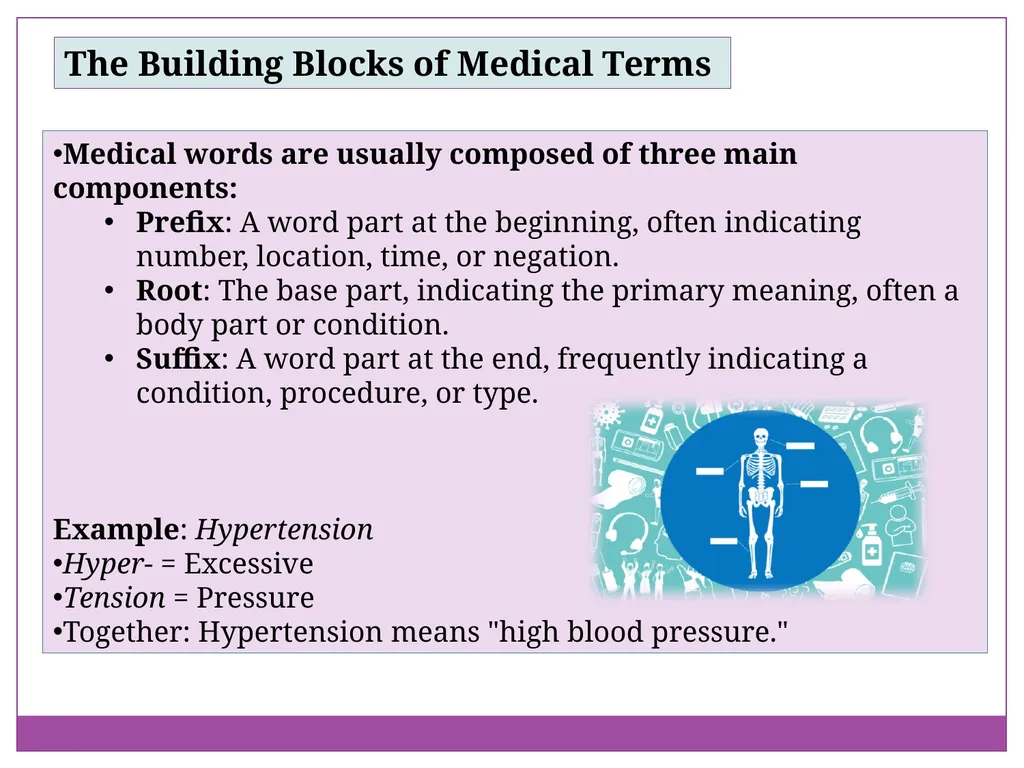
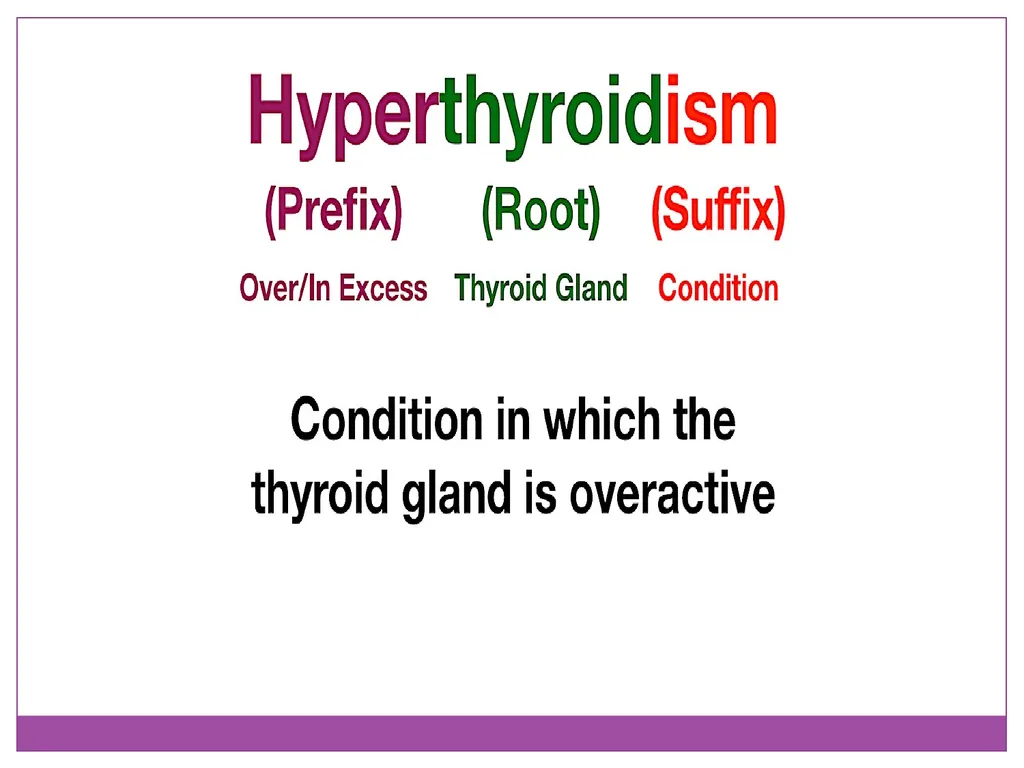
slide3. The Building Blocks of Medical Terms Medical words are usually composed of three main components:
Prefix: A word part at the beginning, often indicating number, location, time, or negation.
Root: The base part, indicating the primary meaning, often a body part or condition.
Suffix: A word part at the end, frequently indicating a condition, procedure, or type.

Example: Hypertension
Hyper- = Excessive
Tension = Pressure
Together: Hypertension means "high blood pressure."<br>
slide5. Prefixes in Medical Terminology Definition and Importance

Prefix: Modifies the meaning of the root by adding context—often location, time, quantity, or state.

Importance: Recognizing prefixes helps identify the context or severity of a condition.<br>
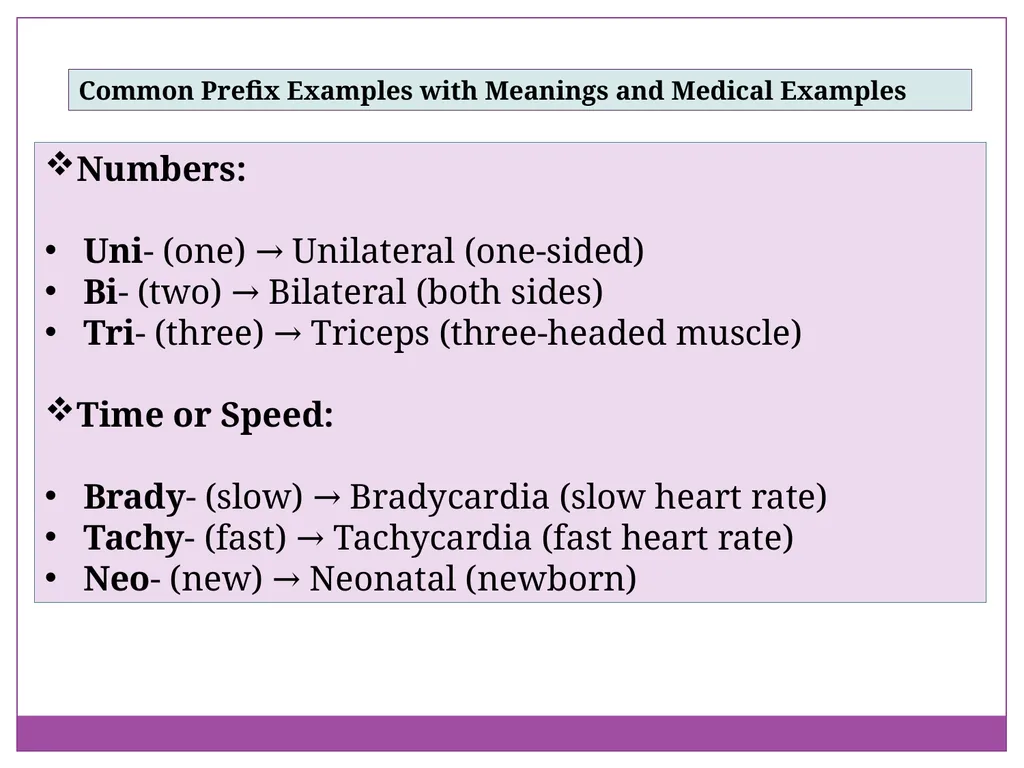
slide6. Common Prefix Examples with Meanings and Medical Examples Numbers:

Uni- (one) → Unilateral (one-sided)
Bi- (two) → Bilateral (both sides)
Tri- (three) → Triceps (three-headed muscle)

Time or Speed:

Brady- (slow) → Bradycardia (slow heart rate)
Tachy- (fast) → Tachycardia (fast heart rate)
Neo- (new) → Neonatal (newborn)<br>
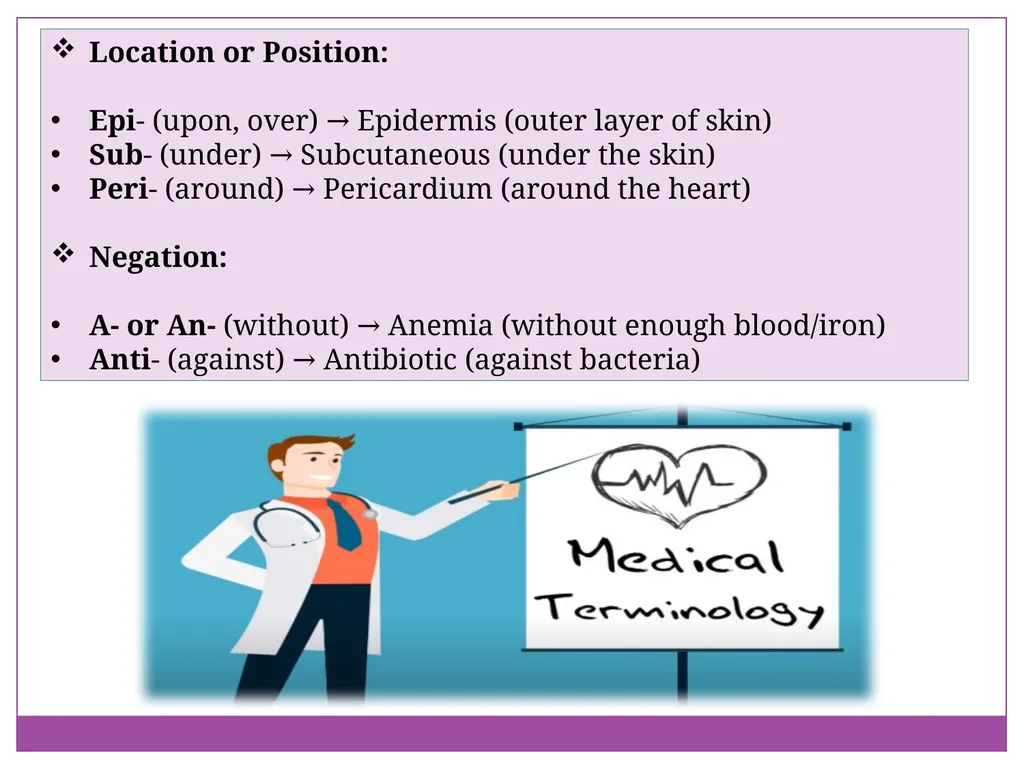
slide7. Location or Position:

Epi- (upon, over) → Epidermis (outer layer of skin)
Sub- (under) → Subcutaneous (under the skin)
Peri- (around) → Pericardium (around the heart)

Negation:

A- or An- (without) → Anemia (without enough blood/iron)
Anti- (against) → Antibiotic (against bacteria)<br>
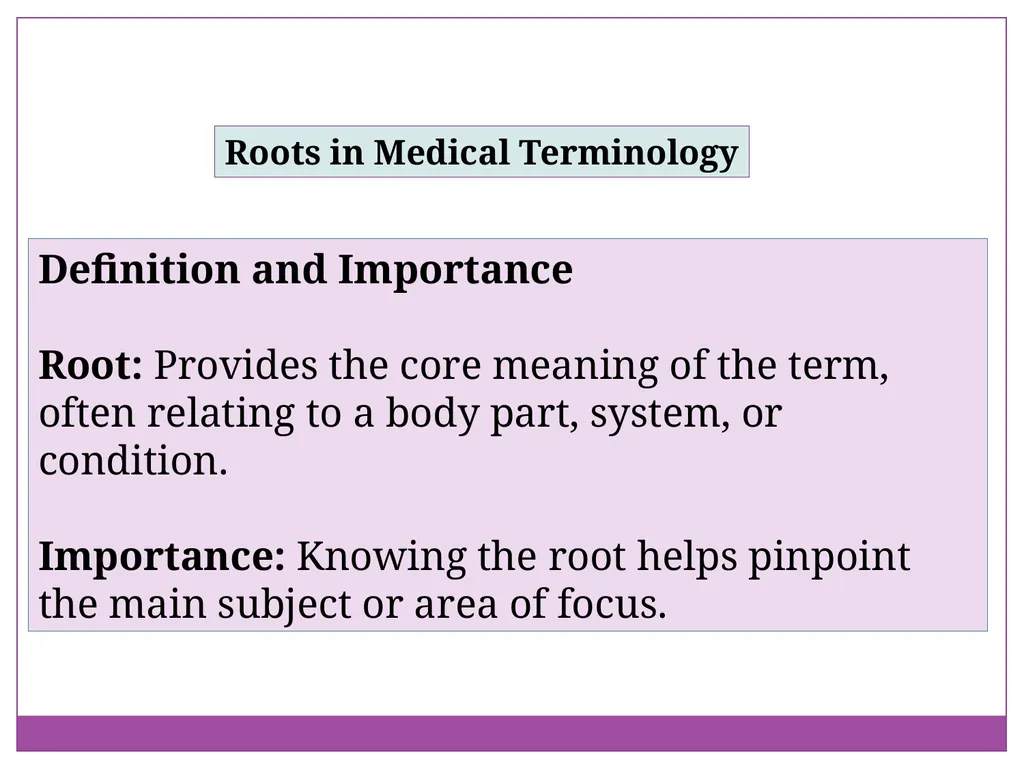
slide8. Roots in Medical Terminology Definition and Importance

Root: Provides the core meaning of the term, often relating to a body part, system, or condition.

Importance: Knowing the root helps pinpoint the main subject or area of focus.<br>
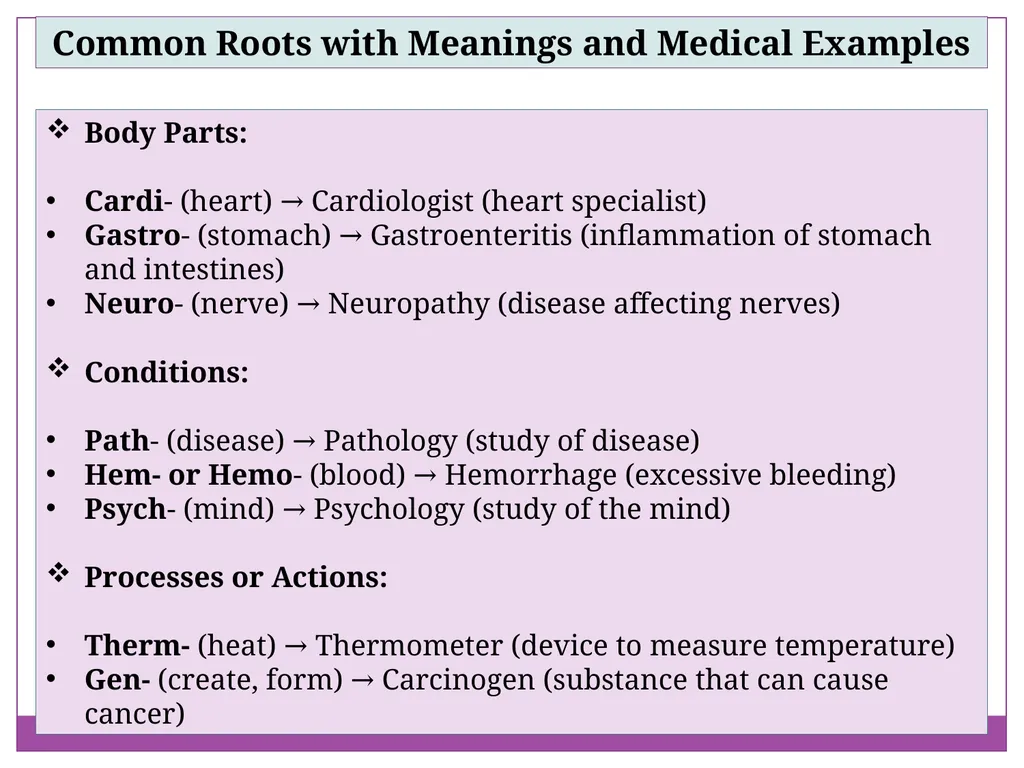
slide9. Common Roots with Meanings and Medical Examples Body Parts:

Cardi- (heart) → Cardiologist (heart specialist)
Gastro- (stomach) → Gastroenteritis (inflammation of stomach and intestines)
Neuro- (nerve) → Neuropathy (disease affecting nerves)

Conditions:

Path- (disease) → Pathology (study of disease)
Hem- or Hemo- (blood) → Hemorrhage (excessive bleeding)
Psych- (mind) → Psychology (study of the mind)

Processes or Actions:

Therm- (heat) → Thermometer (device to measure temperature)
Gen- (create, form) → Carcinogen (substance that can cause cancer)<br>
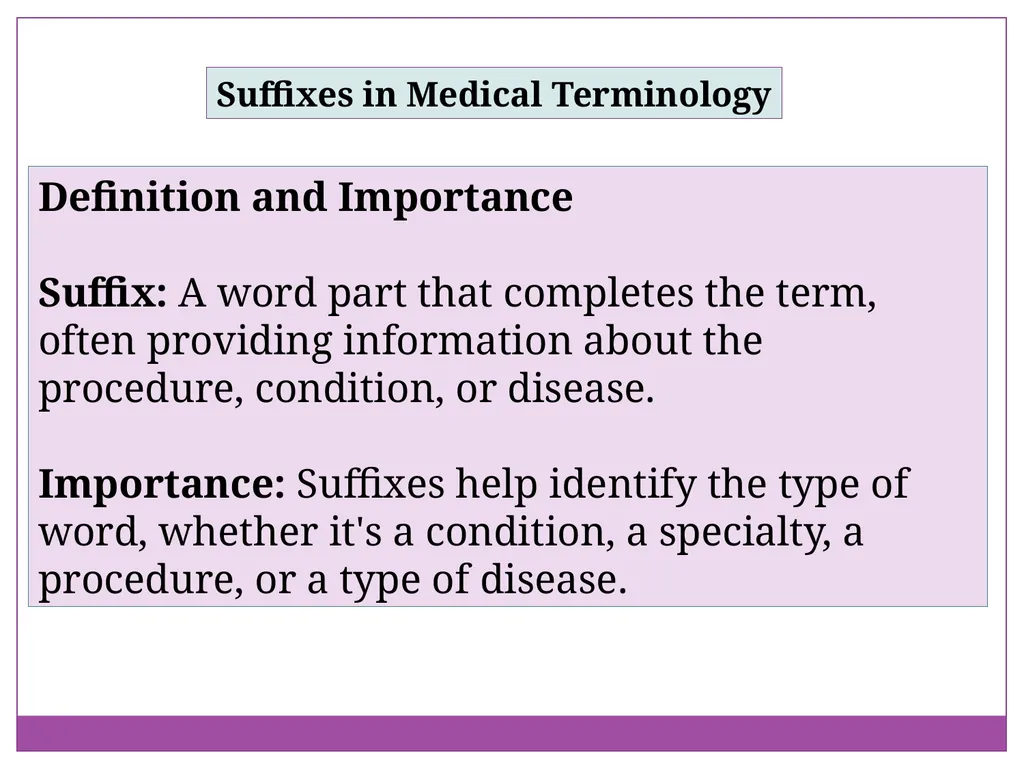
slide10. Suffixes in Medical Terminology Definition and Importance

Suffix: A word part that completes the term, often providing information about the procedure, condition, or disease.

Importance: Suffixes help identify the type of word, whether it's a condition, a specialty, a procedure, or a type of disease.<br>
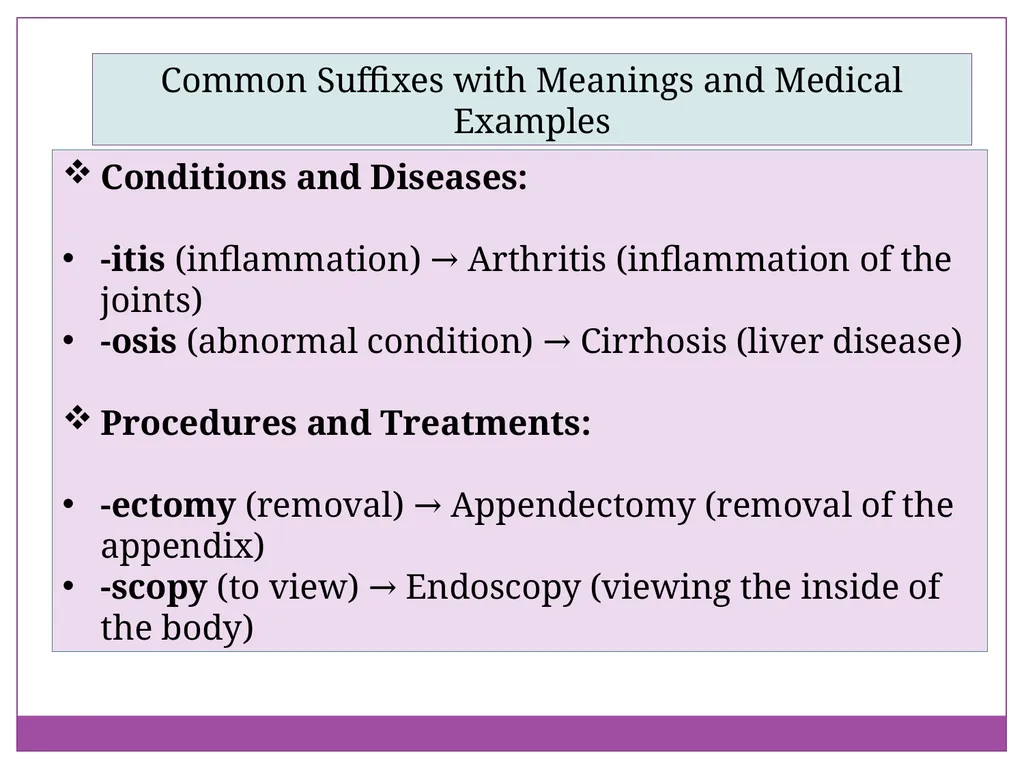
slide11. Common Suffixes with Meanings and Medical Examples Conditions and Diseases:

-itis (inflammation) → Arthritis (inflammation of the joints)
-osis (abnormal condition) → Cirrhosis (liver disease)

Procedures and Treatments:

-ectomy (removal) → Appendectomy (removal of the appendix)
-scopy (to view) → Endoscopy (viewing the inside of the body)<br>
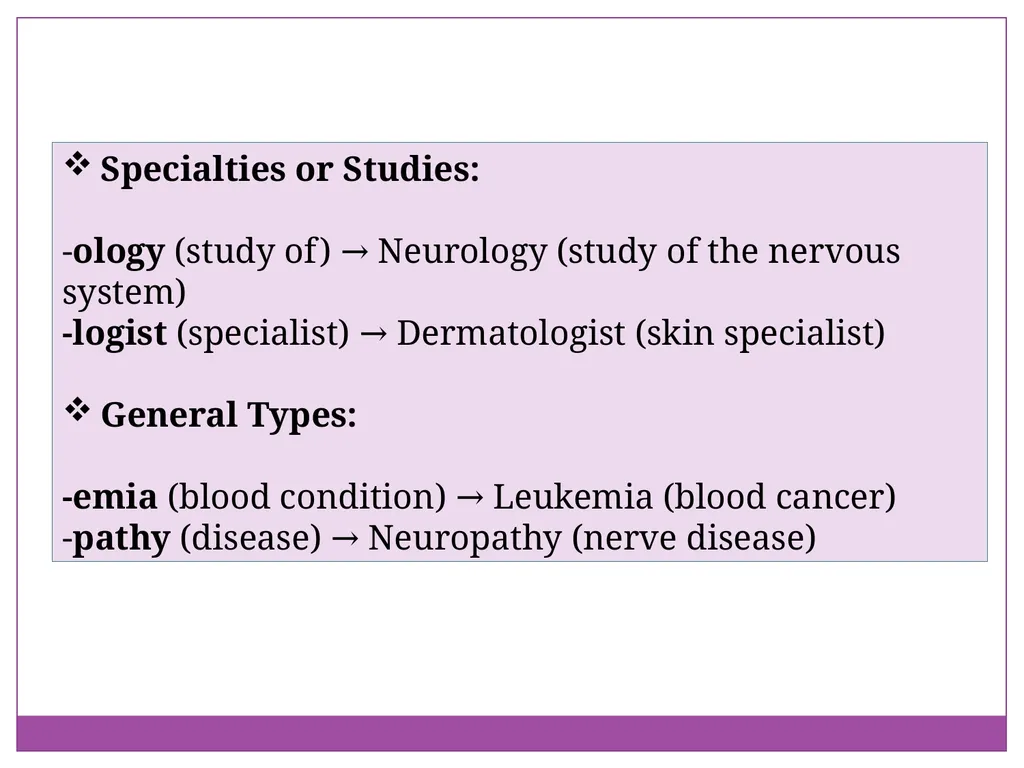
slide12. Specialties or Studies:

-ology (study of) → Neurology (study of the nervous system)
-logist (specialist) → Dermatologist (skin specialist)

General Types:

-emia (blood condition) → Leukemia (blood cancer)
-pathy (disease) → Neuropathy (nerve disease)<br>
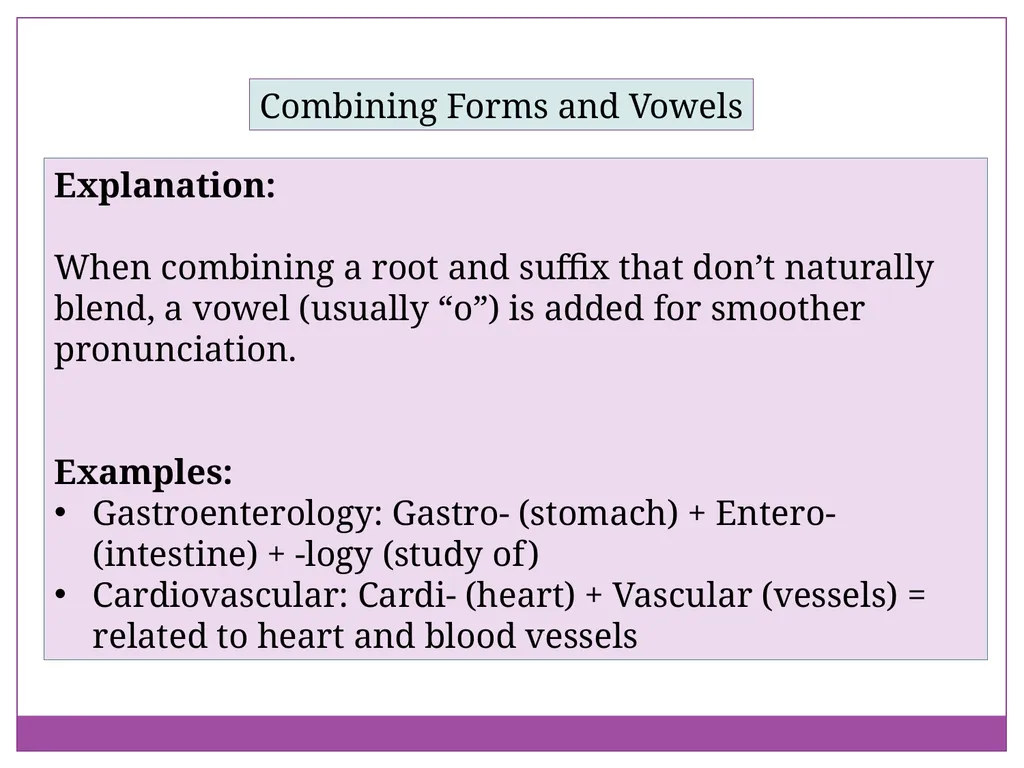
slide13. Combining Forms and Vowels Explanation:

When combining a root and suffix that don’t naturally blend, a vowel (usually “o”) is added for smoother pronunciation.

Examples:
Gastroenterology: Gastro- (stomach) + Entero- (intestine) + -logy (study of)
Cardiovascular: Cardi- (heart) + Vascular (vessels) = related to heart and blood vessels<br>