
Breastfeeding: Overcoming difficulties Goal and










Description: Breastfeeding: Overcoming difficulties Goal and learning outcomes The situation Preventing difficulties Common breastfeeding problems Maternal illness and newborn conditions Summary Clinical practice Quality improvement References and
Related Topics
Download Presentation
"Breastfeeding: Overcoming difficulties Goal and" is the property of its rightful owner. Permission is granted to download and print the materials on this website for personal, non-commercial use only, and to display it on your personal computer provided you do not modify the materials and that you retain all copyright notices contained in the materials. By downloading content from our website, you accept the terms of this agreement.
Presentation Transcript
slide1. Breastfeeding:
Overcoming difficulties<br>
slide2. Goal and learning outcomes
The situation
Preventing difficulties
Common breastfeeding problems
Maternal illness and newborn conditions
Summary
Clinical practice
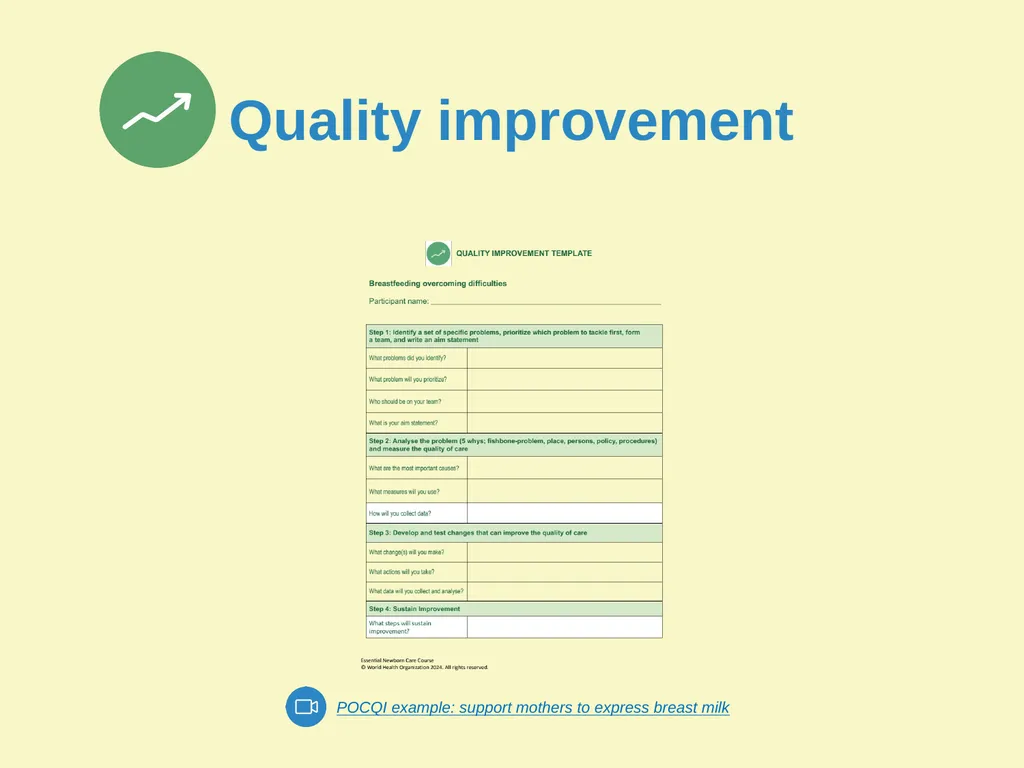
Quality improvement
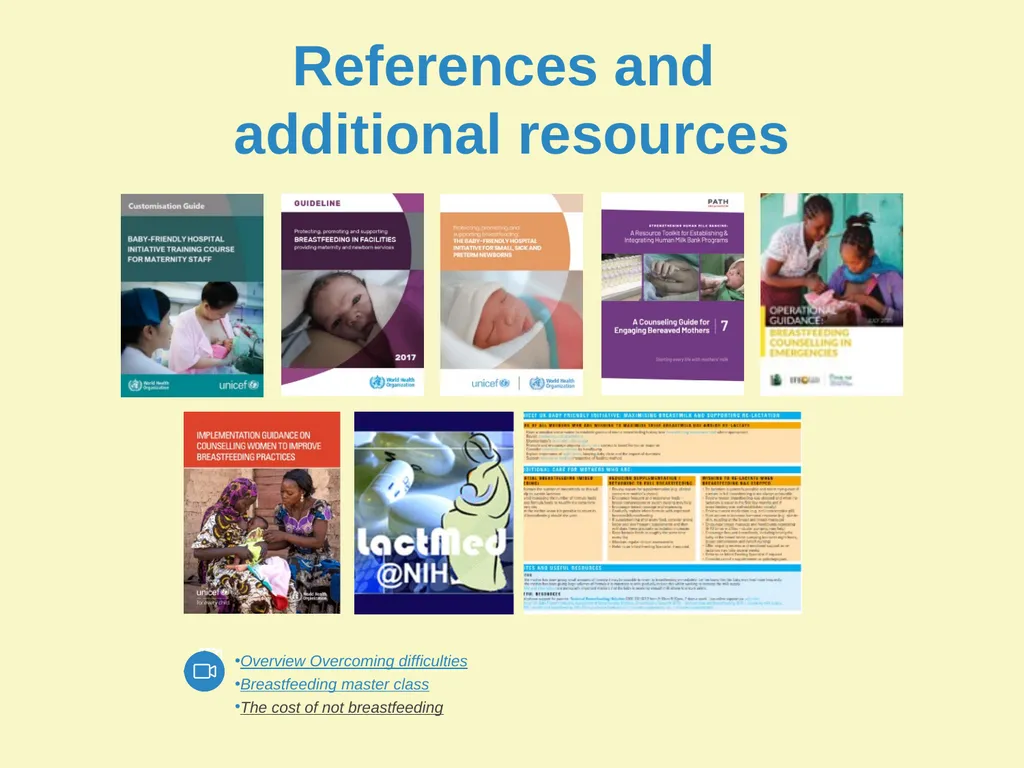
References and additional resources Content<br>
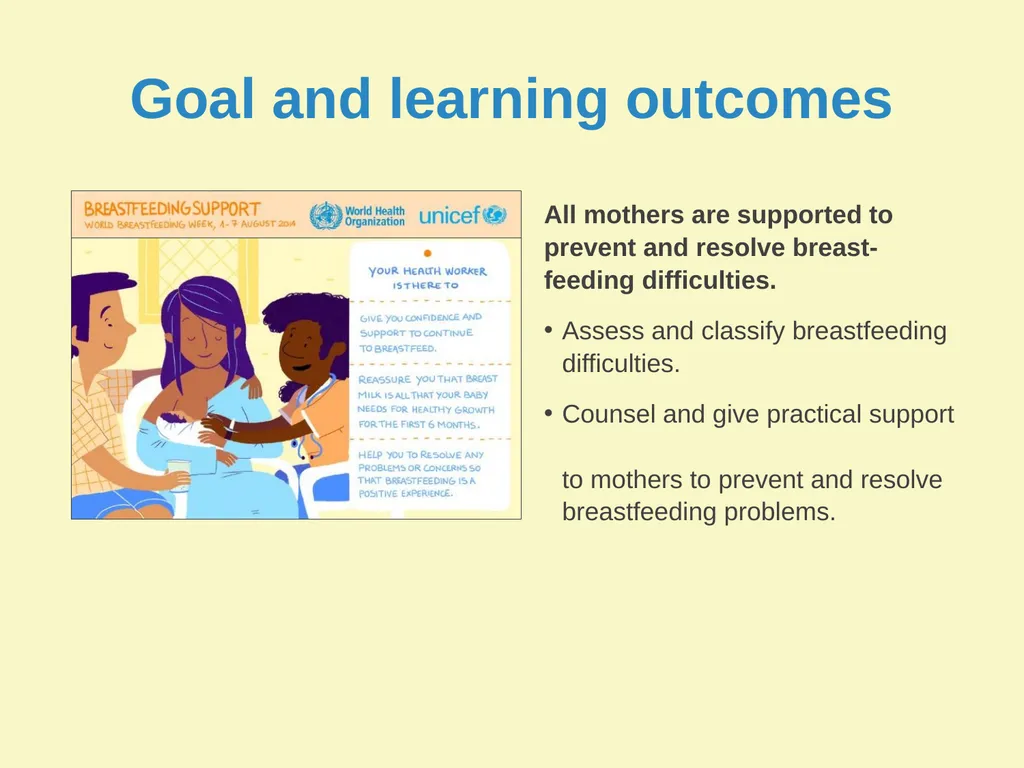
slide3. Goal and learning outcomes All mothers are supported to prevent and resolve breast- feeding difficulties.
Assess and classify breastfeeding difficulties.
Counsel and give practical support to mothers to prevent and resolve breastfeeding problems.<br>
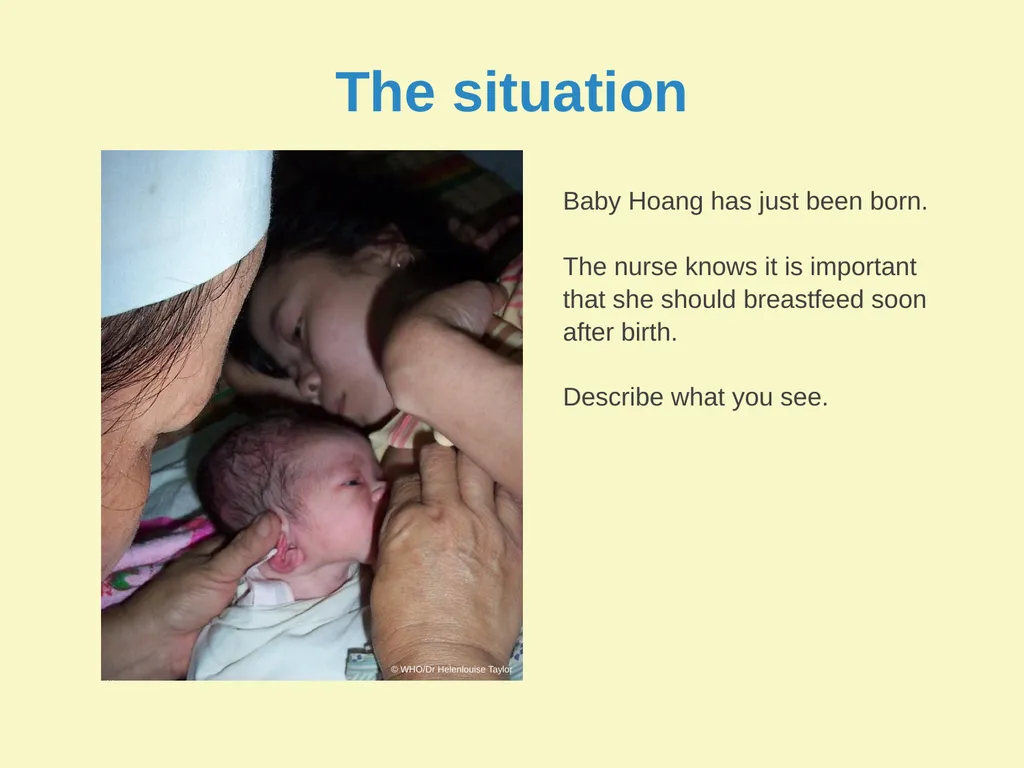
slide4. The situation © WHO/Dr Helenlouise Taylor Baby Hoang has just been born.
The nurse knows it is important that she should breastfeed soon after birth.
Describe what you see.<br>
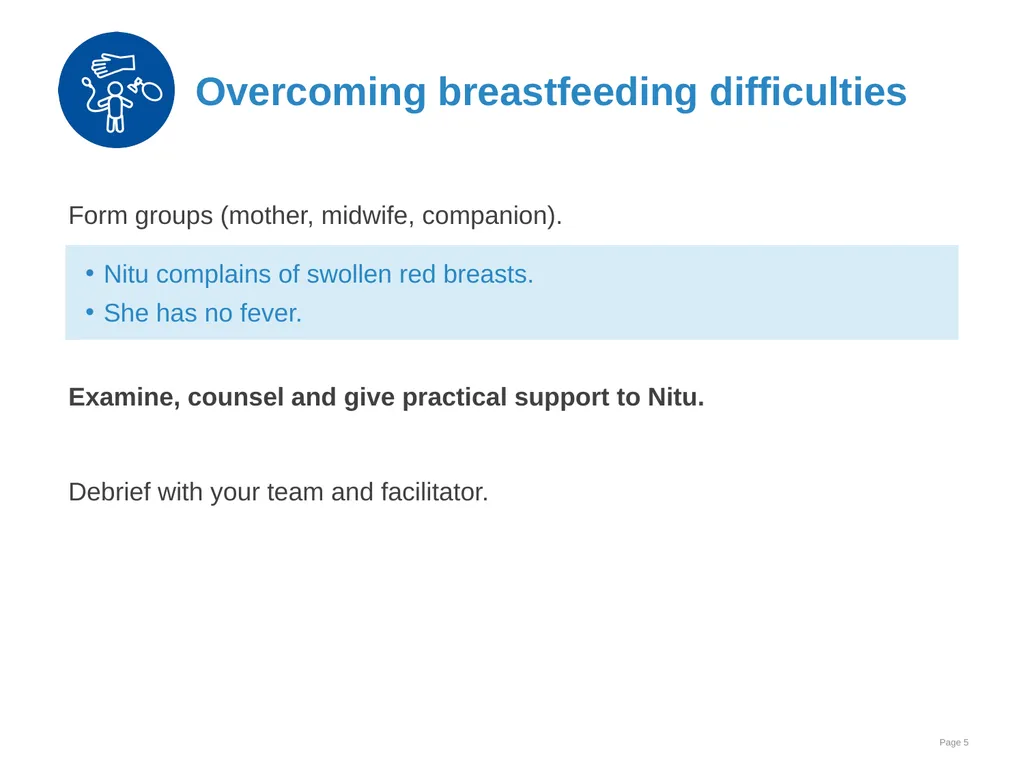
slide5. Overcoming breastfeeding difficulties Form groups (mother, midwife, companion).
Examine, counsel and give practical support to Nitu.
Debrief with your team and facilitator. Nitu complains of swollen red breasts.
She has no fever.<br>
slide6. Preventing difficulties<br>
slide7. What concerns do mothers have about breastfeeding?<br>
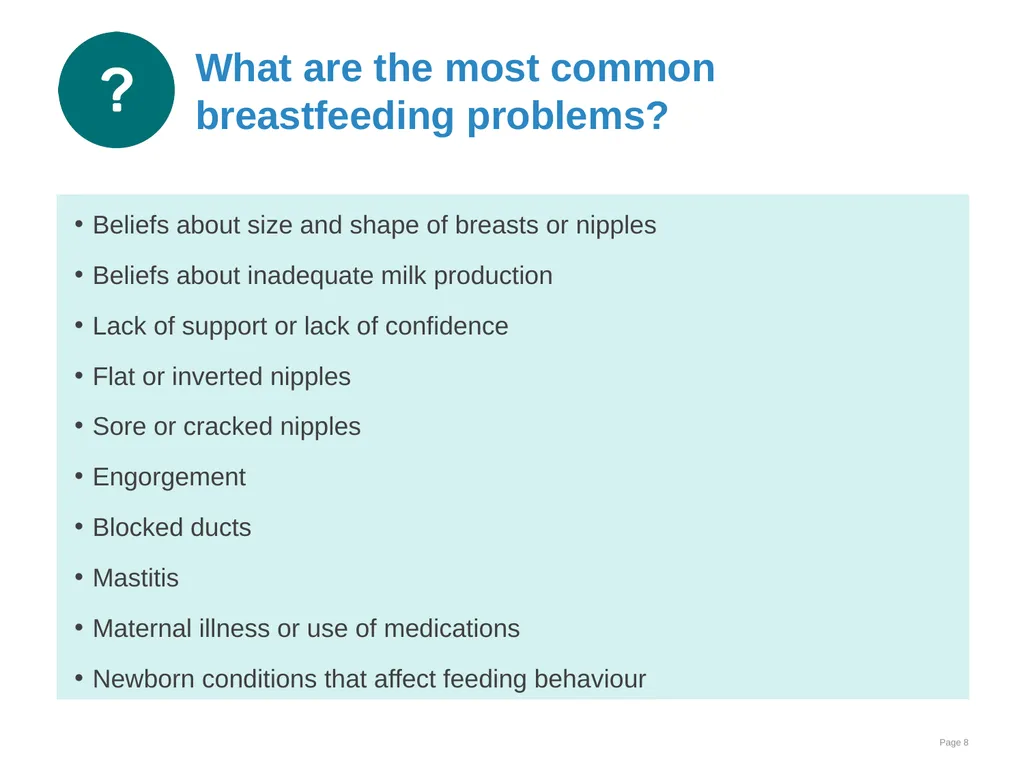
slide8. What are the most common breastfeeding problems? Beliefs about size and shape of breasts or nipples
Beliefs about inadequate milk production
Lack of support or lack of confidence
Flat or inverted nipples
Sore or cracked nipples
Engorgement
Blocked ducts
Mastitis
Maternal illness or use of medications
Newborn conditions that affect feeding behaviour<br>
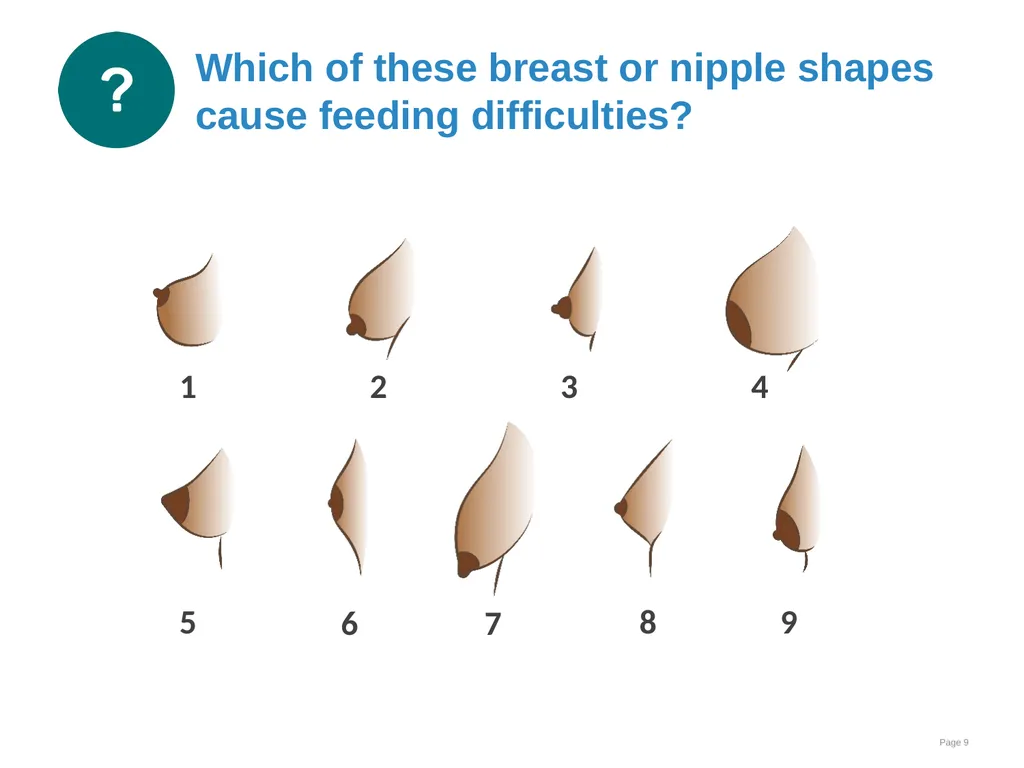
slide9. Which of these breast or nipple shapes cause feeding difficulties?<br>
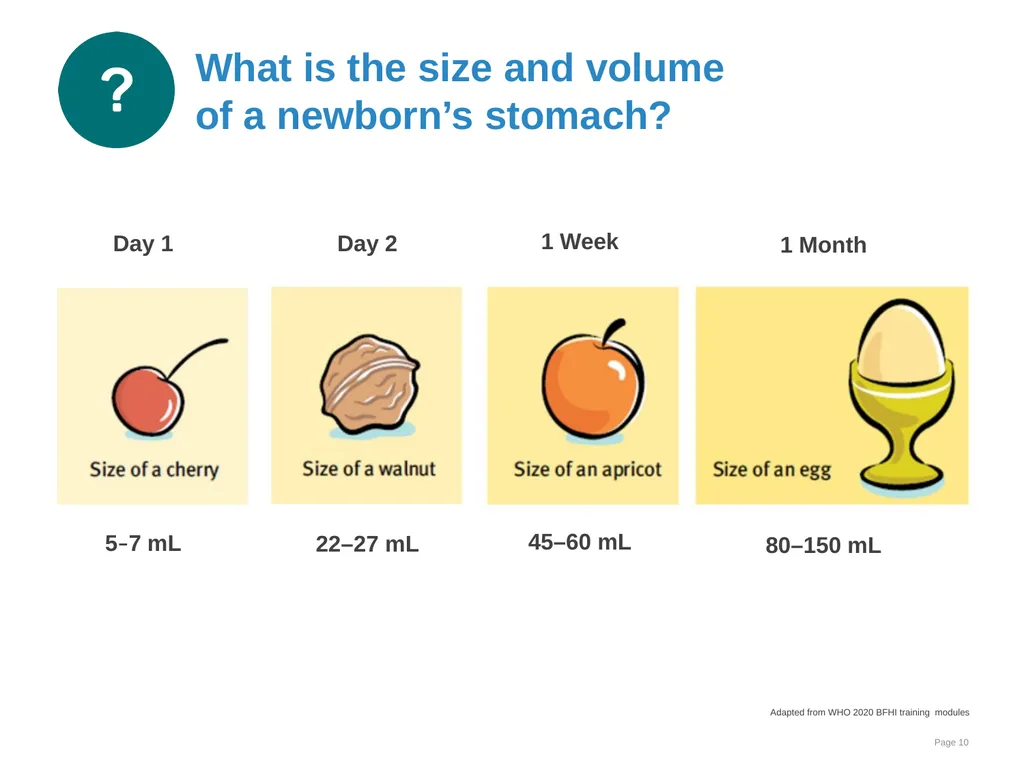
slide10. What is the size and volume of a newborn’s stomach?<br>
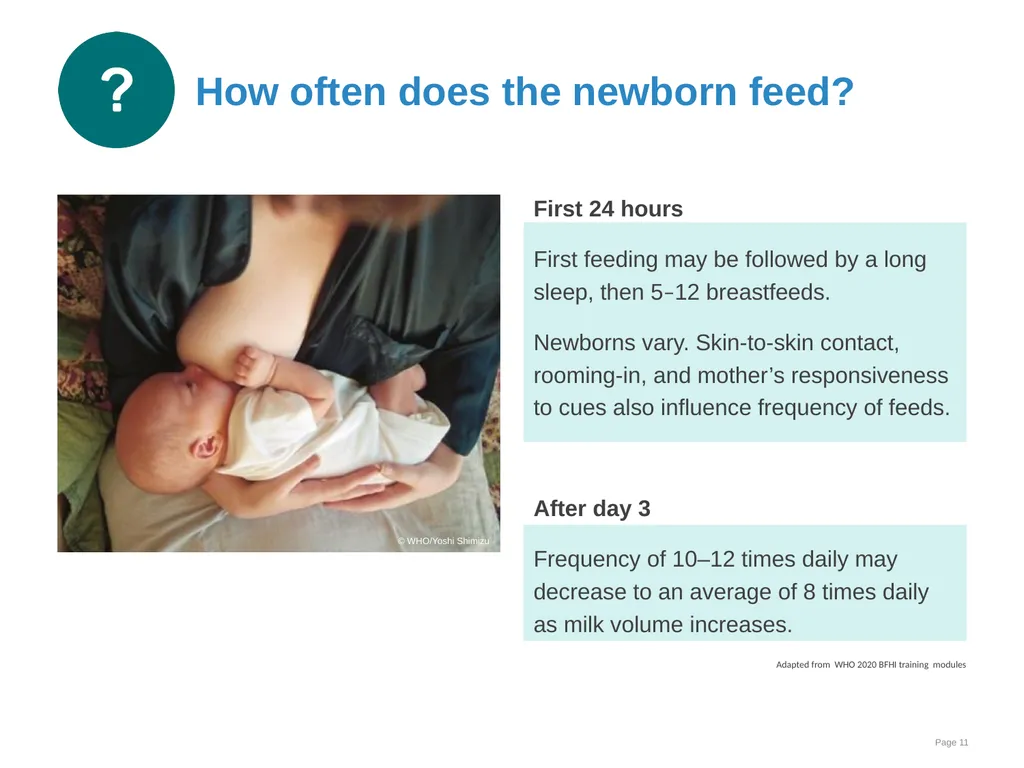
slide11. How often does the newborn feed? First 24 hours
First feeding may be followed by a long sleep, then 5–12 breastfeeds.
Newborns vary. Skin-to-skin contact, rooming-in, and mother’s responsiveness to cues also influence frequency of feeds.
After day 3
Frequency of 10–12 times daily may decrease to an average of 8 times daily as milk volume increases. © WHO/Yoshi Shimizu Adapted from WHO 2020 BFHI training modules<br>
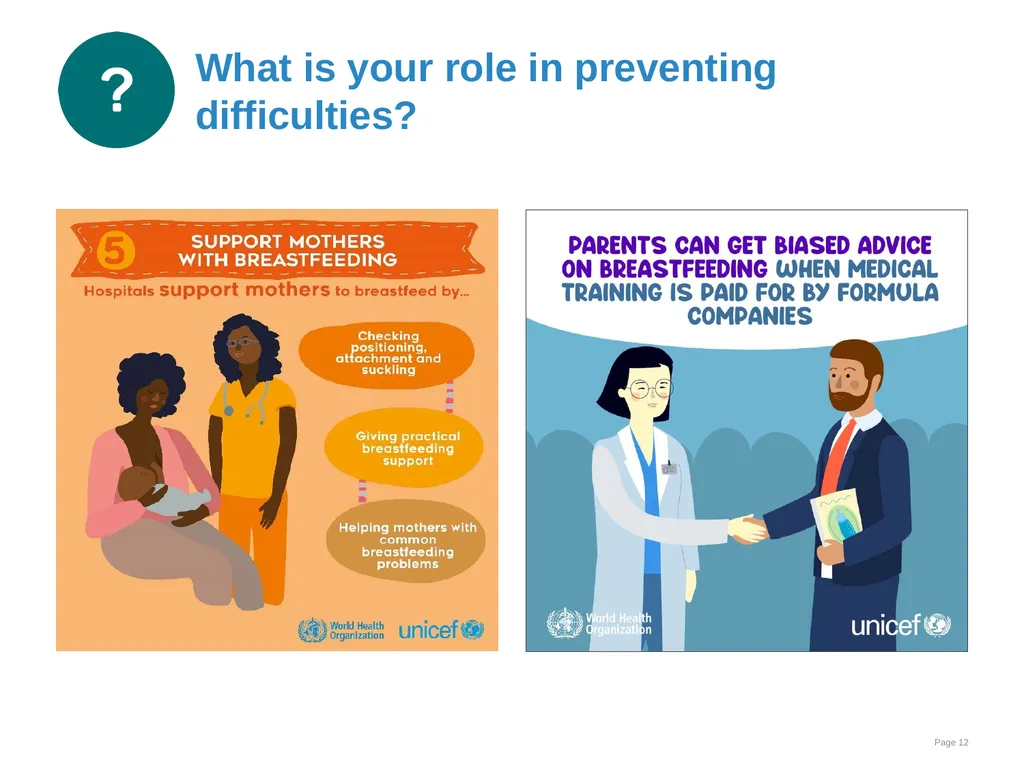
slide12. What is your role in preventing difficulties?<br>
slide13. How can breastfeeding counselling prevent difficulties? Find the guideline on pages 32–37, then go to page 5.<br>
slide14. Recommendation Breastfeeding counselling should anticipate and address important challenges and contexts for breastfeeding, in addition to establishing skills, competencies and confidence among mothers.
Reasons
Benefits of breastfeeding counselling for primiparous women:
Promote exclusive breastfeeding
Reduce the using of artificial teats and bottles
Some women would like to have more information about:
What to expect
How to deal with common feeding problems<br>
slide15. Recommendation A minimum of six breastfeeding counselling contacts take place:
Before birth (antenatal period)
During and immediately after birth (perinatal period up to the first 2–3 days after birth)
At 1–2 weeks after birth (neonatal period)
In the first 3–4 months (early infancy)
At 6 months (at the start of complementary feeding)
After 6 months (late infancy and early childhood).
Additional contacts as necessary for
Primiparous women, adolescent women, after caesarean section, multiple pregnancies, women who plan to return to school or work, women who are obese<br>
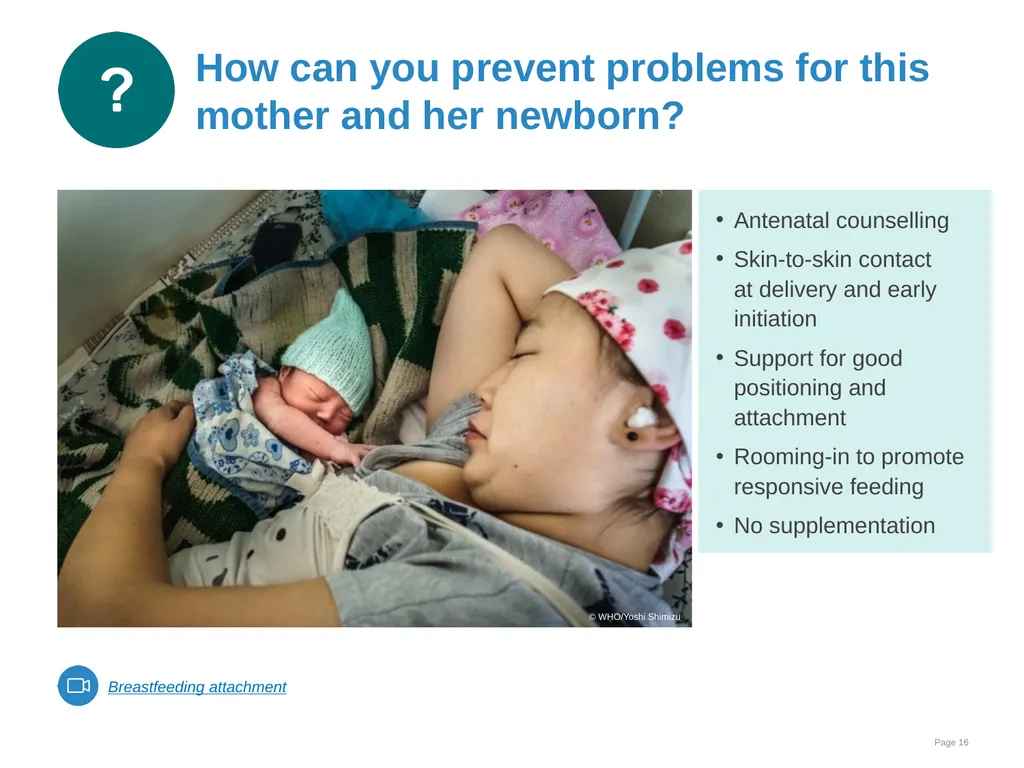
slide16. How can you prevent problems for this mother and her newborn? © WHO/Yoshi Shimizu Antenatal counselling
Skin-to-skin contact at delivery and early initiation
Support for good positioning and attachment
Rooming-in to promote responsive feeding
No supplementation<br>
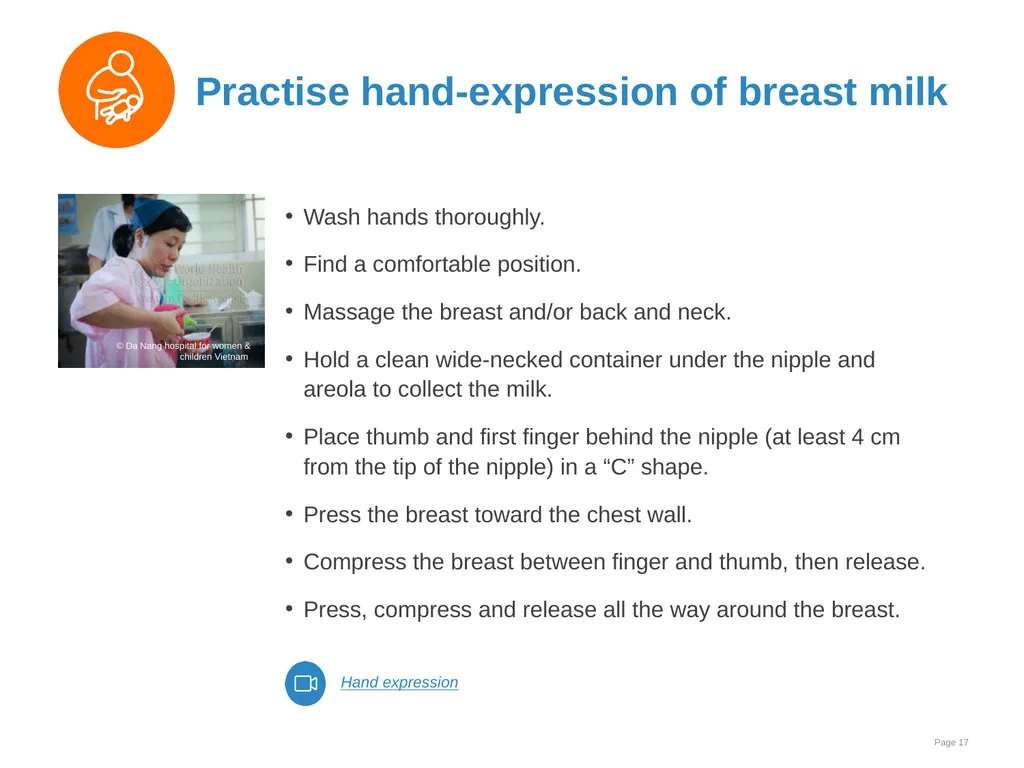
slide17. Practise hand-expression of breast milk Wash hands thoroughly.
Find a comfortable position.
Massage the breast and/or back and neck.
Hold a clean wide-necked container under the nipple and areola to collect the milk.
Place thumb and first finger behind the nipple (at least 4 cm from the tip of the nipple) in a “C” shape.
Press the breast toward the chest wall.
Compress the breast between finger and thumb, then release.
Press, compress and release all the way around the breast. © Da Nang hospital for women & children Vietnam<br>
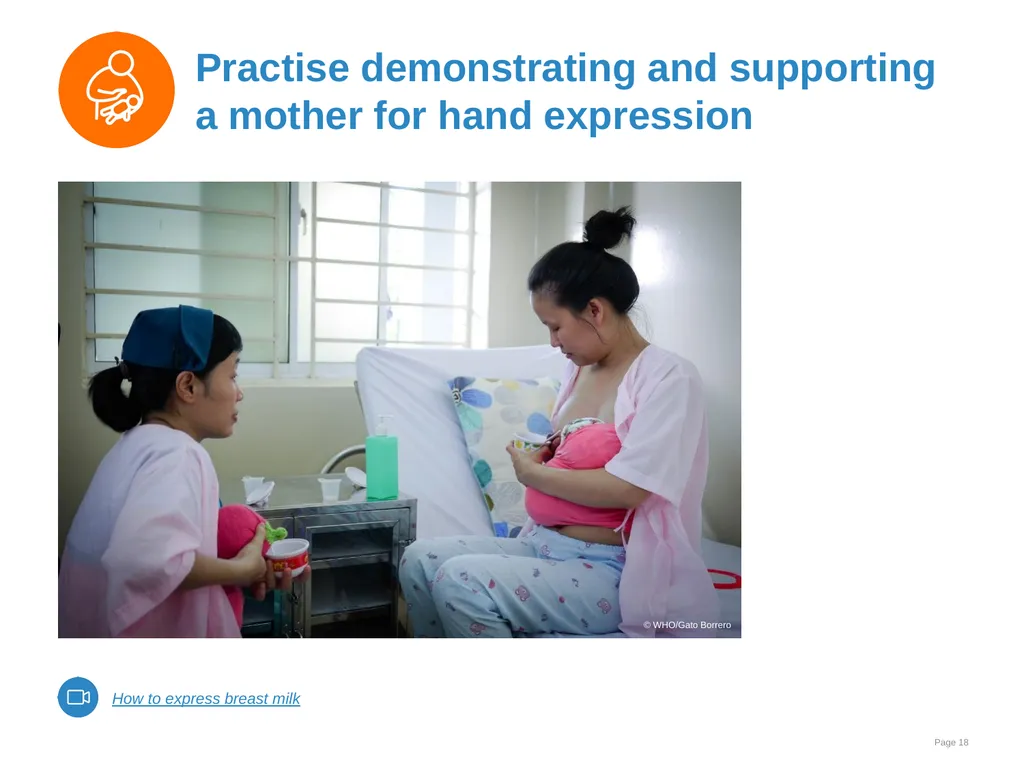
slide18. Practise demonstrating and supporting a mother for hand expression<br>
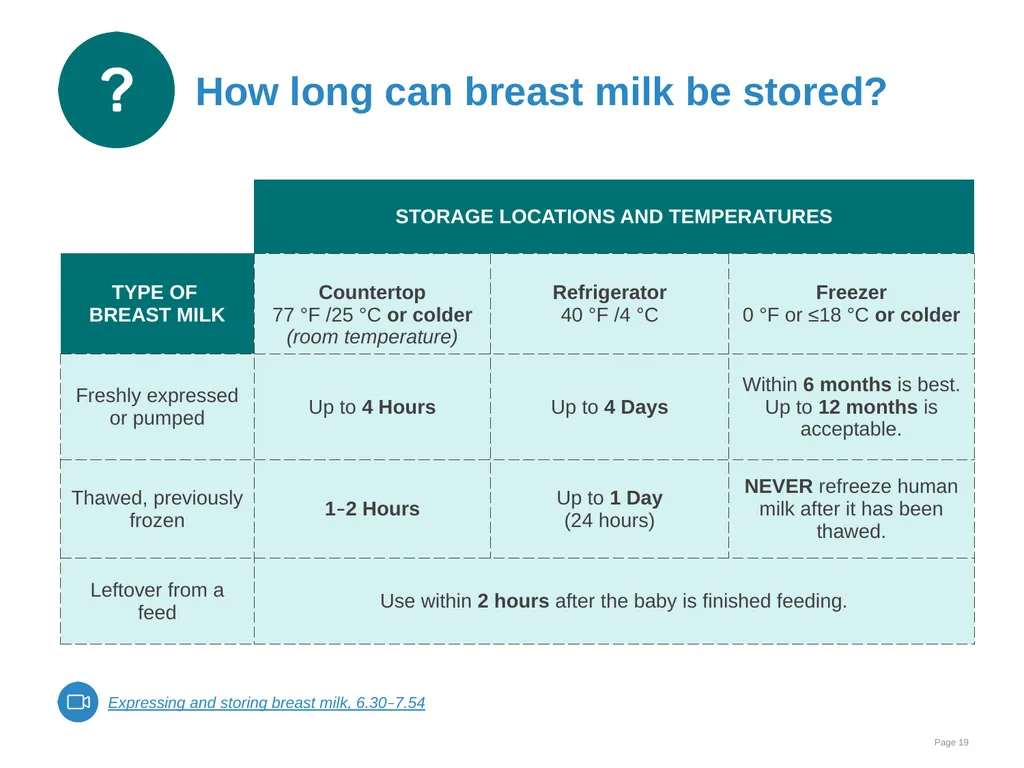
slide19. How long can breast milk be stored? Is this good technique?<br>
slide20. Common breastfeeding problems<br>
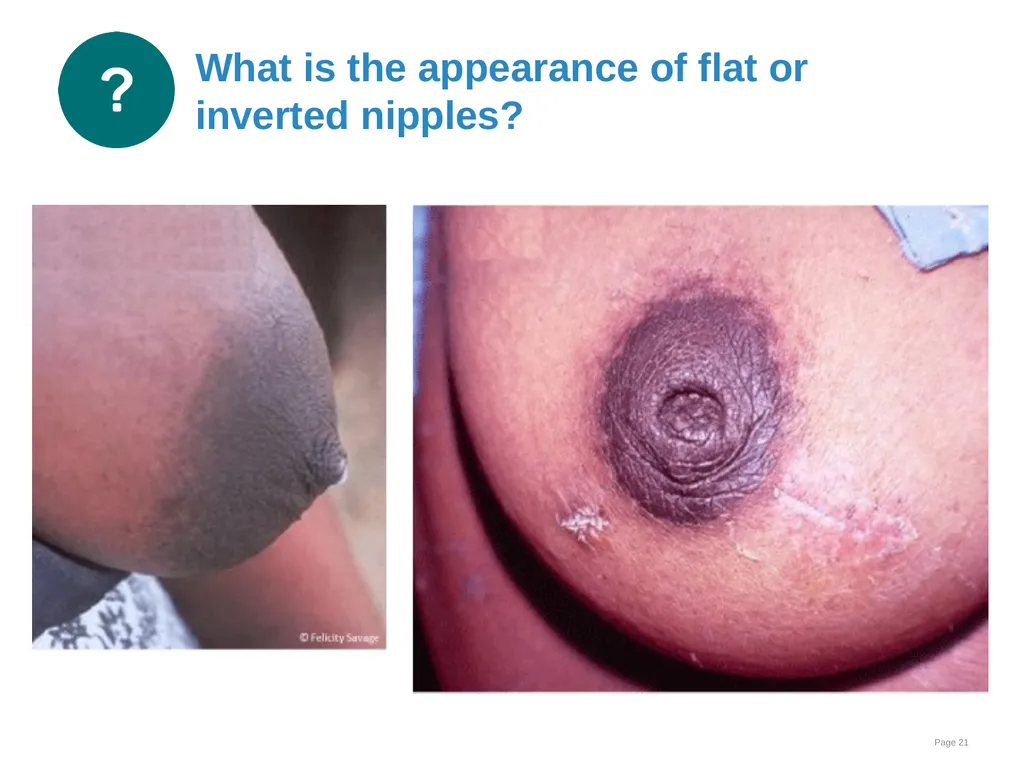
slide21. What is the appearance of flat or inverted nipples?<br>
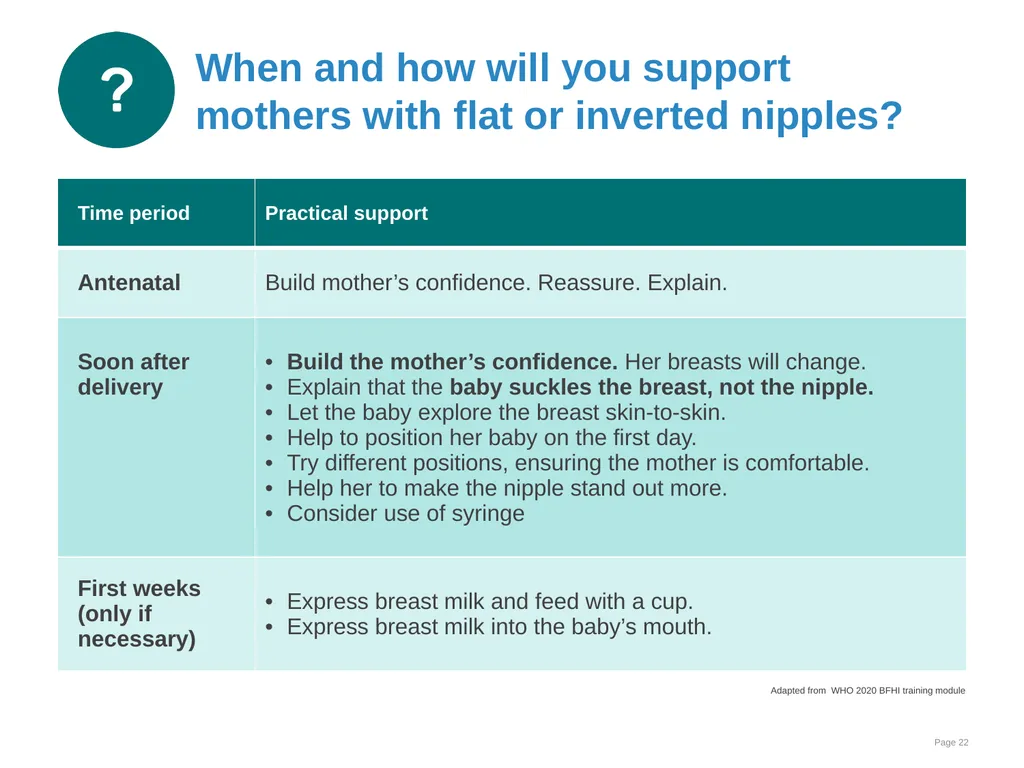
slide22. When and how will you support mothers with flat or inverted nipples? Adapted from WHO 2020 BFHI training module<br>
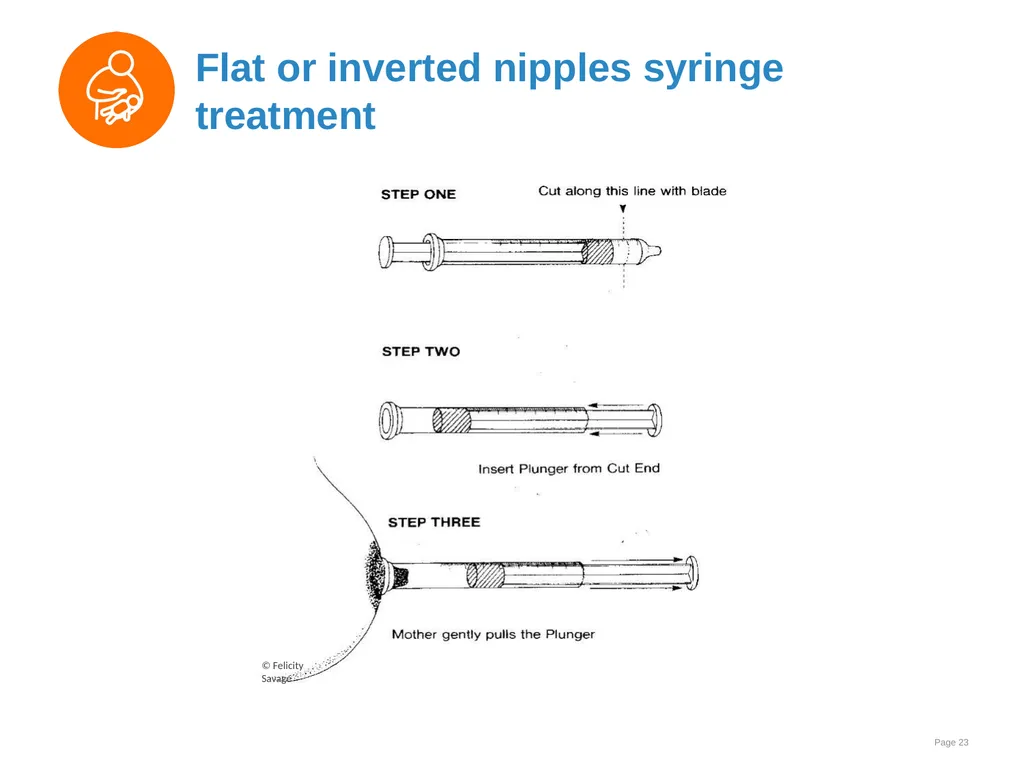
slide23. Flat or inverted nipples syringe treatment © Felicity Savage<br>
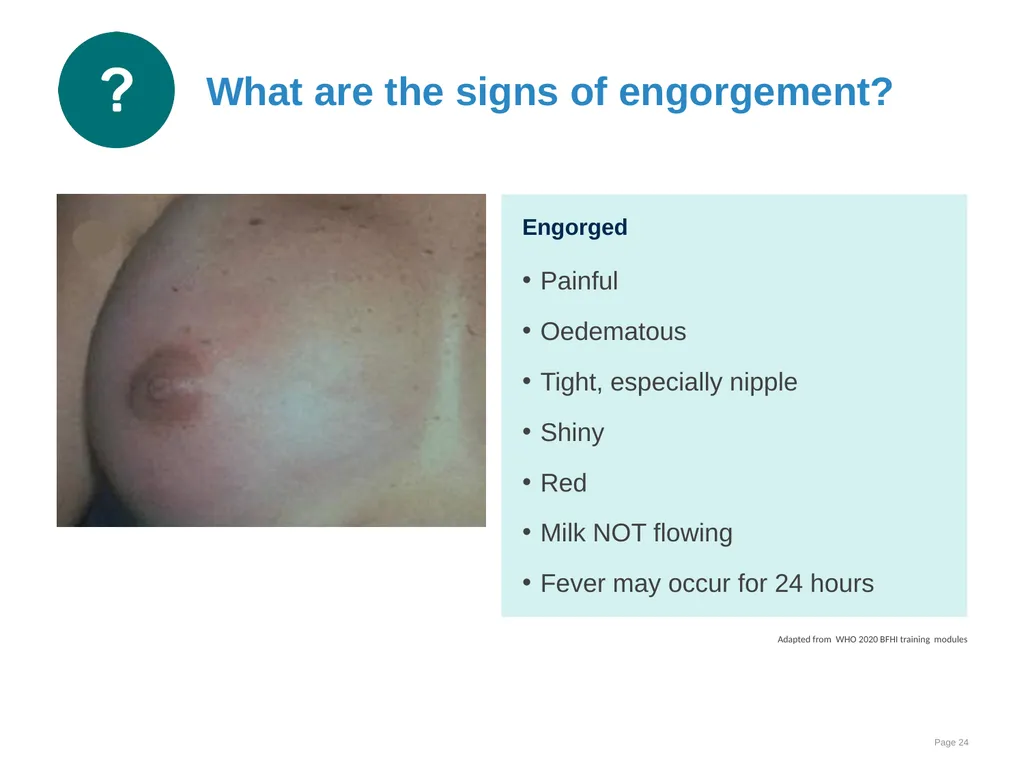
slide24. What are the signs of engorgement? Engorged
Painful
Oedematous
Tight, especially nipple
Shiny
Red
Milk NOT flowing
Fever may occur for 24 hours © UNICEF/UNI51384/Press 2 Adapted from WHO 2020 BFHI training modules<br>
slide25. What are the signs of milk volume increasing normally? Full Breast
Hot
Heavy
Hard
Milk flowing
No fever © UNICEF/UNI51384/Press 1 Adapted from WHO 2020 BFHI training modules<br>
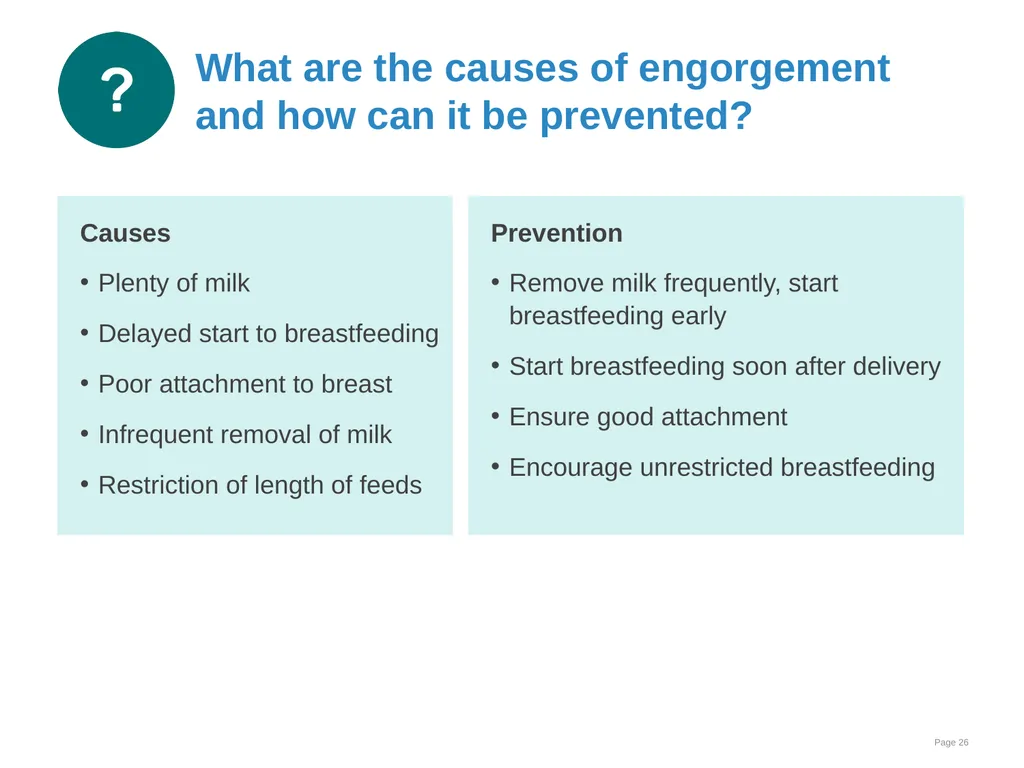
slide26. What are the causes of engorgement and how can it be prevented? Causes
Plenty of milk
Delayed start to breastfeeding
Poor attachment to breast
Infrequent removal of milk
Restriction of length of feeds Prevention
Remove milk frequently, start breastfeeding early
Start breastfeeding soon after delivery
Ensure good attachment
Encourage unrestricted breastfeeding<br>
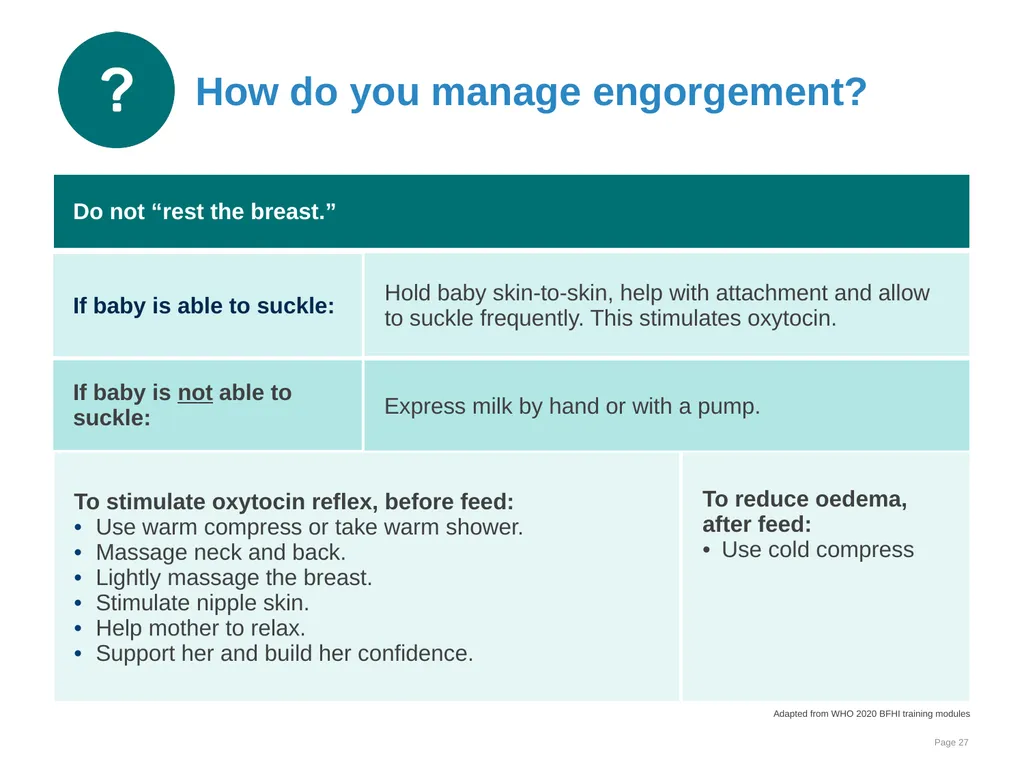
slide27. How do you manage engorgement? Adapted from WHO 2020 BFHI training modules<br>
slide28. What are the signs of blocked ducts and ?<br>
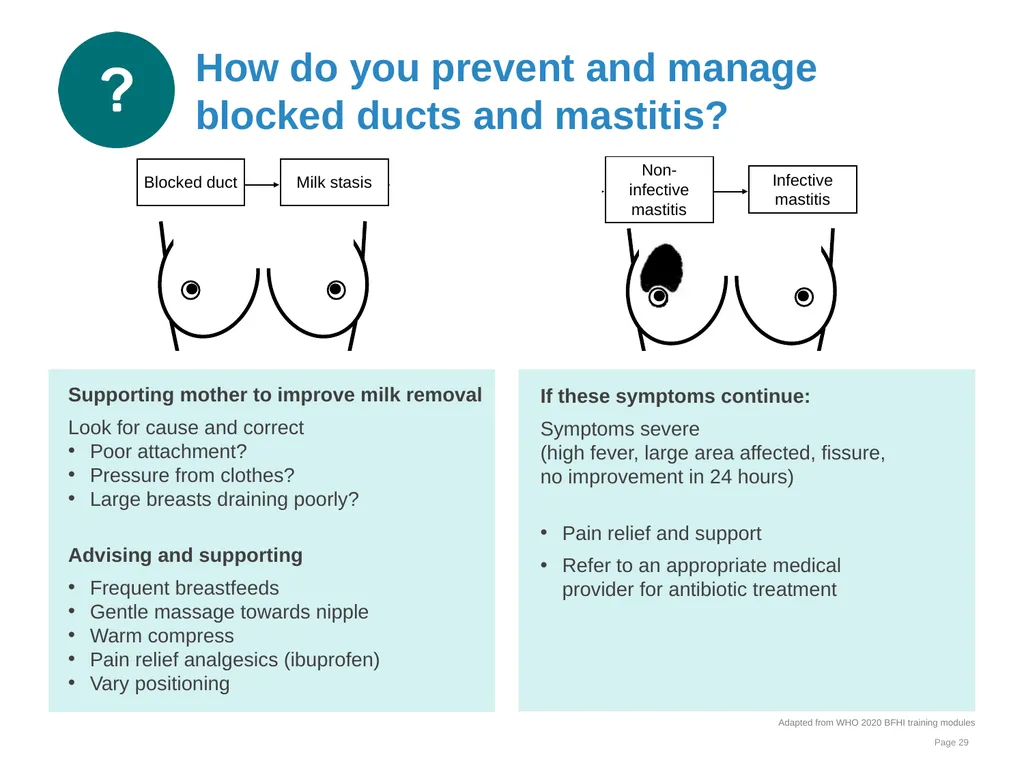
slide29. How do you prevent and manage blocked ducts and mastitis? Supporting mother to improve milk removal
Look for cause and correct
Poor attachment?
Pressure from clothes?
Large breasts draining poorly?
Advising and supporting
Frequent breastfeeds
Gentle massage towards nipple
Warm compress
Pain relief analgesics (ibuprofen)
Vary positioning If these symptoms continue:
Symptoms severe (high fever, large area affected, fissure, no improvement in 24 hours)
Pain relief and support
Refer to an appropriate medical provider for antibiotic treatment Adapted from WHO 2020 BFHI training modules<br>
slide30. What are newborn signs of inadequate milk intake? Clinical evidence of dehydration
Dry mucous membranes, poor skin turgor, sunken fontanelle not improved after assessment and management of breastfeeding
Weight loss
Low urine output
Delayed bowel movements, delayed transition in stools from meconium to transitional Adapted from WHO 2020 BFHI training modules<br>
slide31. What are the factors underlying not enough milk? Breastfeeding factors
Delayed initiation
No or little skin-to-skin contact
Milk “coming in” delayed due to:
Complications of delivery
Maternal illness
Diabetes
Poor attachment and ineffective suckling
Feeding at fixed times
Short or infrequent feeds
Supplementary feeding
No night-time feeding © WHO/Yoshi Shimizu Behavioural factors
Lack of support from health workers or family
Lack of confidence
Worry and stress
Dislike of breast- feeding
Tiredness
Lack of bonding
Rejection of newborn<br>
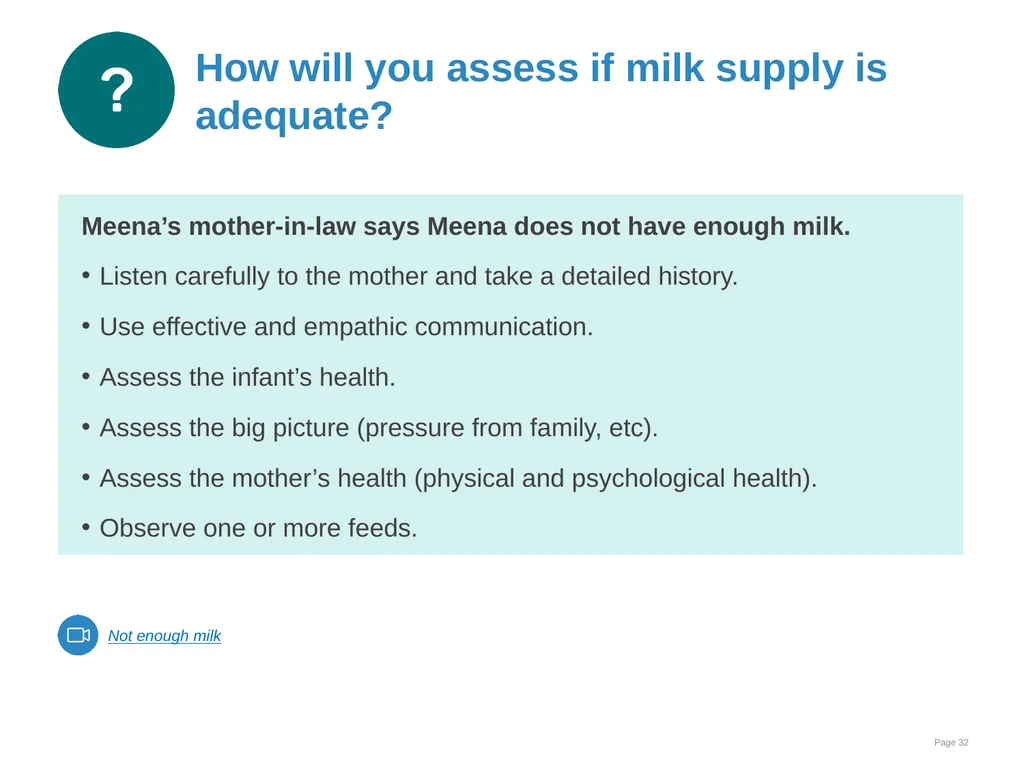
slide32. How will you assess if milk supply is adequate? Meena’s mother-in-law says Meena does not have enough milk.
Listen carefully to the mother and take a detailed history.
Use effective and empathic communication.
Assess the infant’s health.
Assess the big picture (pressure from family, etc).
Assess the mother’s health (physical and psychological health).
Observe one or more feeds.<br>
slide33. What are the signs of sore nipples? © UNICEF C107-32 © Felicity Savage © Felicity Savage © Chloe Fisher<br>
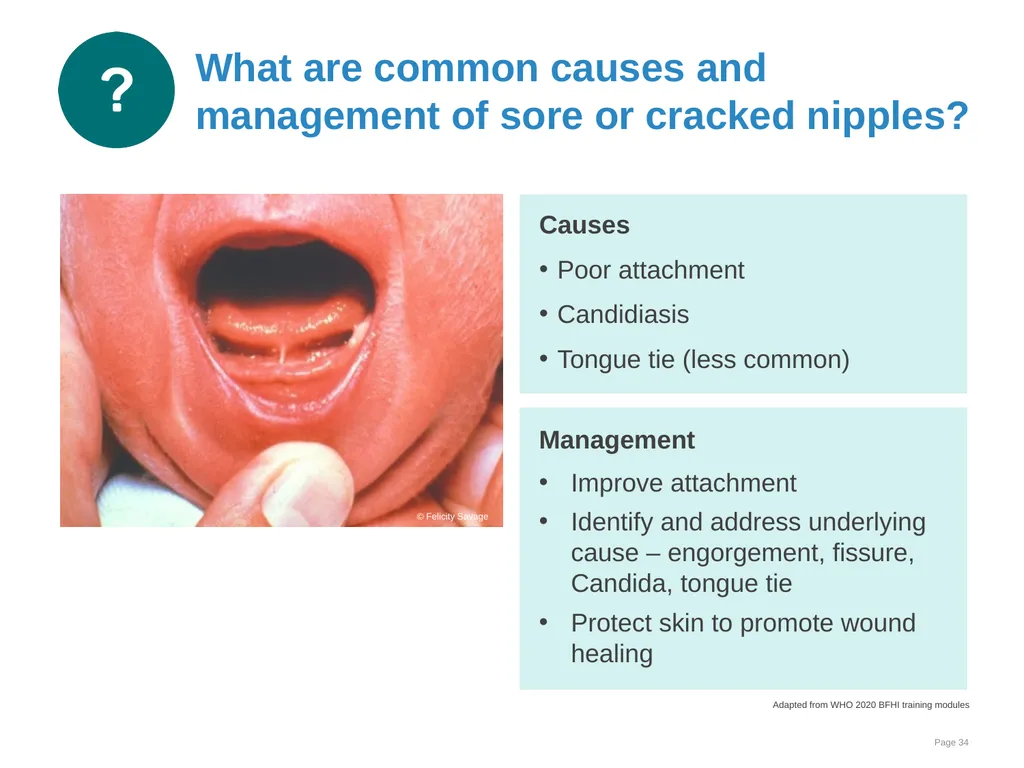
slide34. What are common causes and management of sore or cracked nipples? Causes
Poor attachment
Candidiasis
Tongue tie (less common) © Felicity Savage Adapted from WHO 2020 BFHI training modules Management
Improve attachment
Identify and address underlying cause – engorgement, fissure, Candida, tongue tie
Protect skin to promote wound healing<br>
slide35. Maternal illness and newborn conditions<br>
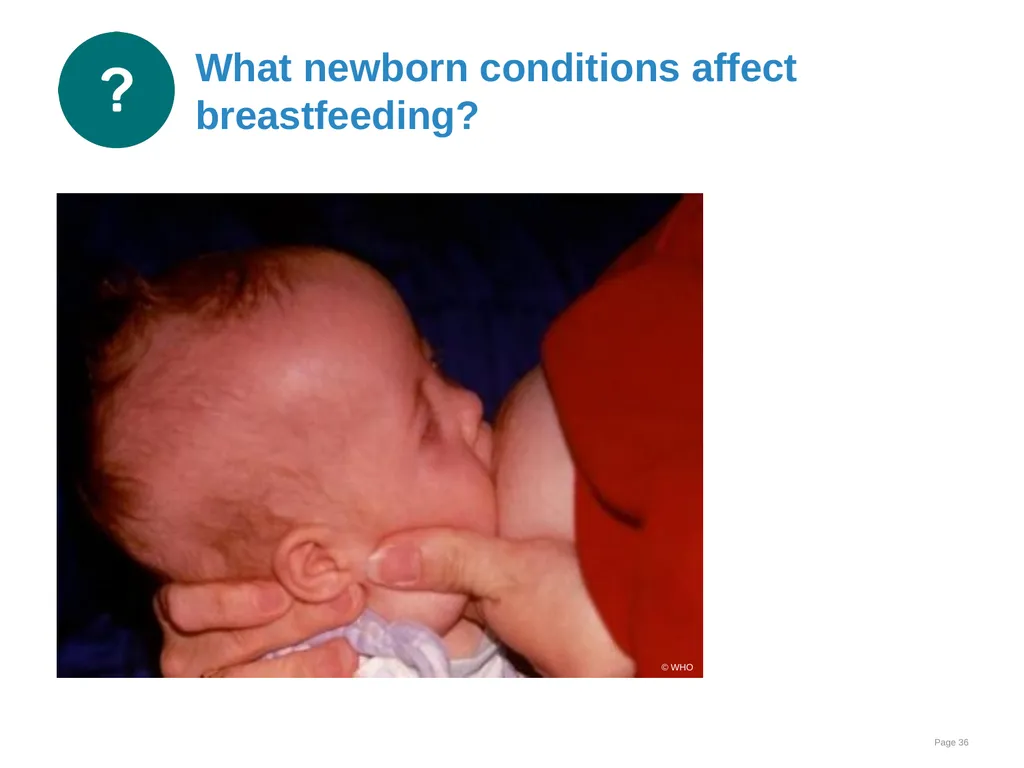
slide36. What newborn conditions affect breastfeeding? © WHO<br>
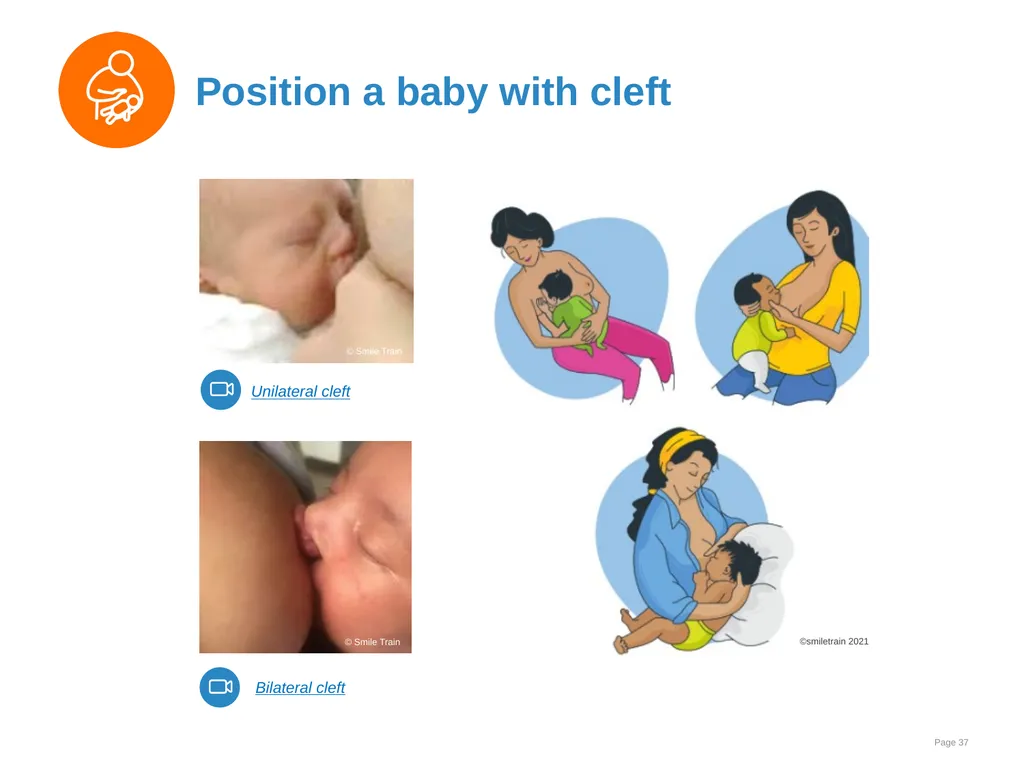
slide37. Position a baby with cleft<br>
slide38. Should mothers taking medications stop breastfeeding? Adapted from WHO 2020 BFHI training modules<br>
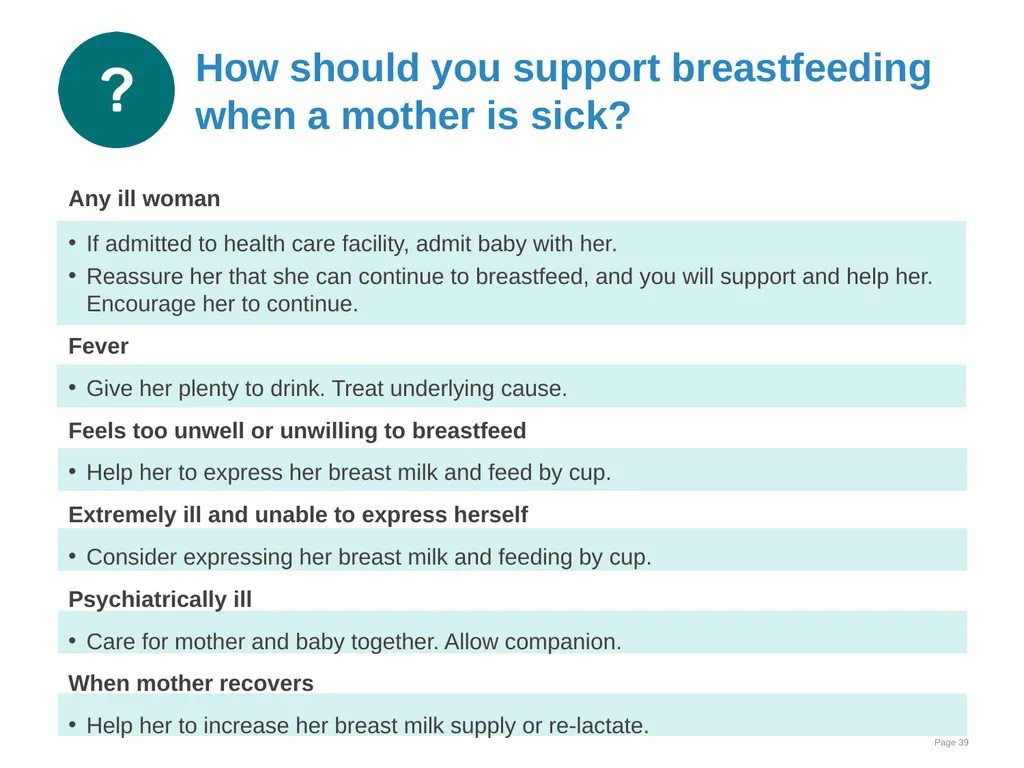
slide39. How should you support breastfeeding when a mother is sick? Any ill woman
If admitted to health care facility, admit baby with her.
Reassure her that she can continue to breastfeed, and you will support and help her. Encourage her to continue.
Fever
Give her plenty to drink. Treat underlying cause.
Feels too unwell or unwilling to breastfeed
Help her to express her breast milk and feed by cup.
Extremely ill and unable to express herself
Consider expressing her breast milk and feeding by cup.
Psychiatrically ill
Care for mother and baby together. Allow companion.
When mother recovers
Help her to increase her breast milk supply or re-lactate.<br>
slide40. How should you support a mother to restart breastfeeding? Take a breastfeeding history and review reasons for supplementation.
Revisit positioning, attachment and responsive feeding.
Encourage ongoing skin-to-skin contact to boost hormonal response.
Monitor baby’s stool and urine output.
Consider breast milk expression by hand or pump.
Explain importance of night feeds, keeping baby close and the impact of dummies/pacifiers.
Counsel regarding variable time needed (easier in the first few months and if breastfeeding was well-established initially).<br>
slide41. Overcoming breastfeeding difficulties Form groups (mother, midwife, companion).
Examine, counsel and give practical support to Nitu.
Debrief with your team and facilitator. Nitu complains of swollen red breasts.
She has no fever.<br>
slide42. Summary In this module, you have:
Assessed mothers and newborns for breastfeeding difficulties and special situations.
Demonstrated giving practical support to a mother to resolve difficulties.<br>
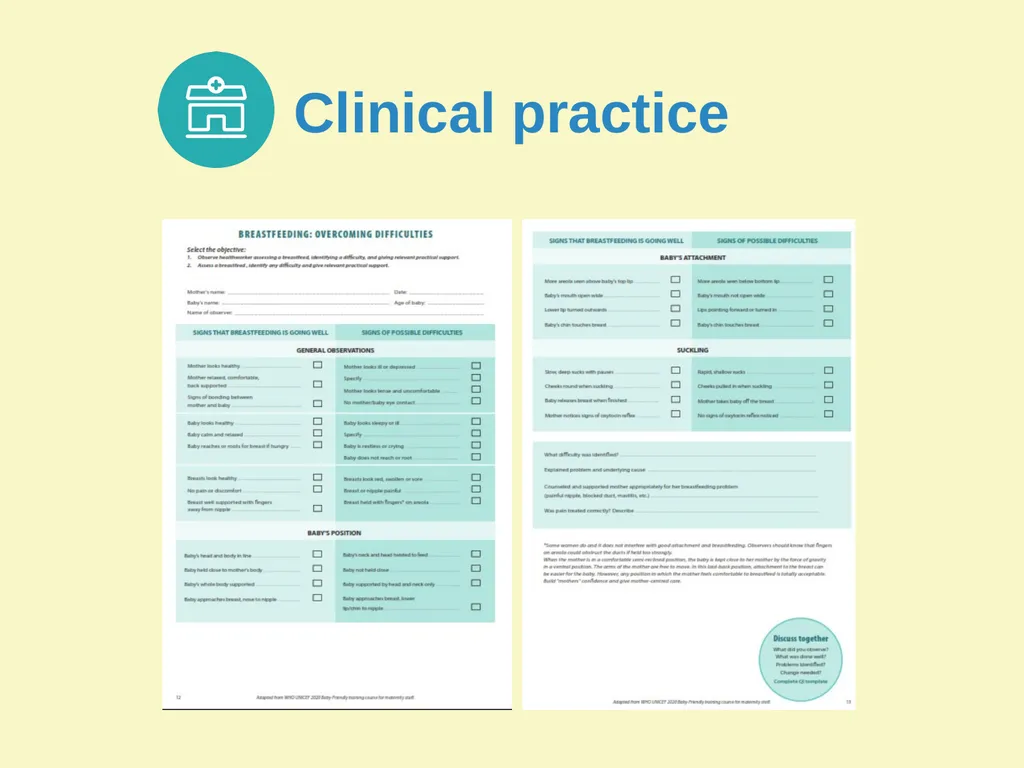
slide43. Clinical practice<br>
slide44. Quality improvement<br>
slide45. References and additional resources<br>
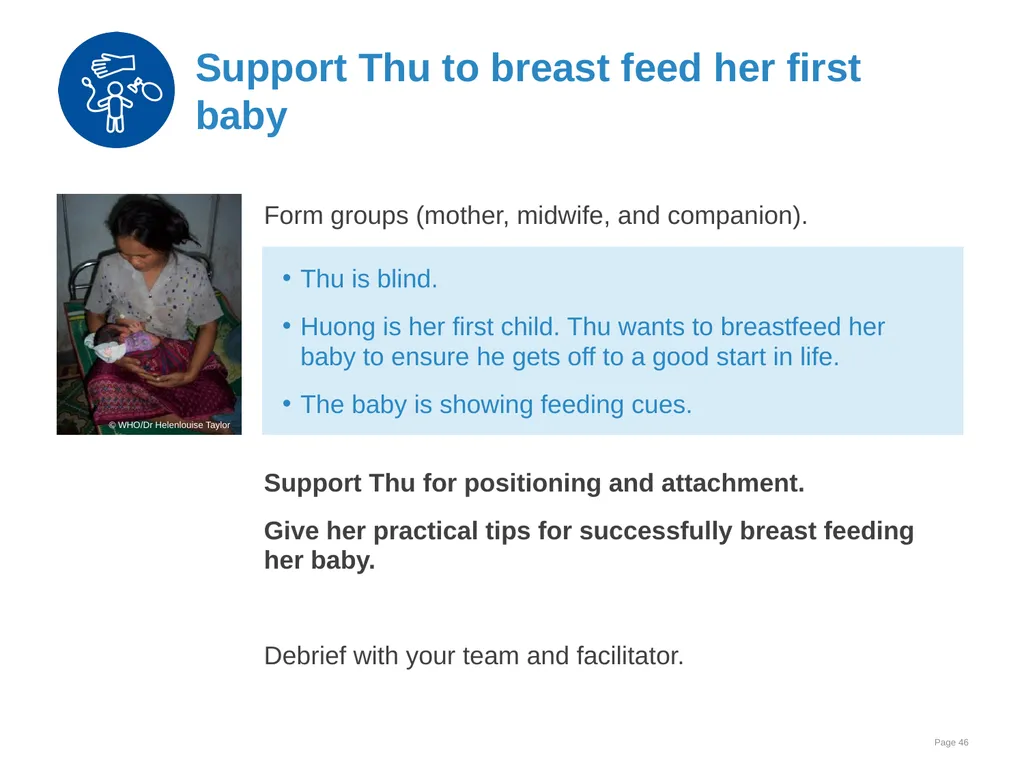
slide46. Support Thu to breast feed her first baby Form groups (mother, midwife, and companion).
Support Thu for positioning and attachment.
Give her practical tips for successfully breast feeding her baby.
Debrief with your team and facilitator. Thu is blind.
Huong is her first child. Thu wants to breastfeed her baby to ensure he gets off to a good start in life.
The baby is showing feeding cues. © WHO/Dr Helenlouise Taylor<br>
slide47. Breastfeeding after caesarean section Form groups (mother, companion, neonatal nurse).
Support Bobby’s mother to express her breast milk.
Counsel her on breastfeeding after caesarean section.
Debrief with your team and facilitator. Bobby was born 2 hours ago by caesarean section.
He weighs 2000 g and is under a radiant warmer.
He has not yet breastfed and now is too sleepy to feed.
He has no other problems and examination was normal.<br>
slide48. Overcoming breastfeeding difficulties Form groups (mother, midwife, companion).
Counsel and give practical support to Meena.
Examine, counsel and give practical support to Nitu.
Support and counsel Grace.
Debrief with your team and facilitator. Meena has cracked nipples.
She is in discomfort. Nitu complains of swollen red breasts.
She has no fever. Grace has stopped breastfeeding and has no milk.<br>
slide49. Re-lactation Form groups (mother, midwife and companion).
Counsel and give practical support to Tatiana.
Debrief with your team and facilitator. Tatiana delivered her first born a healthy baby boy, Igor 6 days ago. She chose to bottle-feed and was discharged home after 24 hours.
Water supplies are irregular so she has decided to breastfeed her baby to protect his health. She arrives asking for your support.
Tatiana was not breast fed by her mother, and her sister bottle fed her baby.<br>
slide50. Miriam wants to donate her breastmilk Form groups (mother, neonatal-nurse, and companion).
Communicate with Miriam about breastmilk options with compassion and sensitivity.
Teach her how to express and store her breast milk safely.
Debrief with your team and facilitator. Mariam lost her baby Nat early this morning,
Resuscitation was not successful.
She wants to donate her milk in memory of Nat.<br>
slide51. Suppress breastmilk production after stillbirth Form groups (mother, midwife and companion).
Counsel and give practical support to Donna.
Debrief with your team and facilitator. Donna delivered a baby boy by spontaneous vaginal delivery at 28 weeks gestation 2 hours ago. He was a stillbirth.
She wants to suppress her milk production as she finds the idea of producing milk distressing.<br>
slide2. Goal and learning outcomes
The situation
Preventing difficulties
Common breastfeeding problems
Maternal illness and newborn conditions
Summary
Clinical practice
Quality improvement
References and additional resources Content<br>
slide3. Goal and learning outcomes All mothers are supported to prevent and resolve breast- feeding difficulties.
Assess and classify breastfeeding difficulties.
Counsel and give practical support to mothers to prevent and resolve breastfeeding problems.<br>
slide4. The situation © WHO/Dr Helenlouise Taylor Baby Hoang has just been born.
The nurse knows it is important that she should breastfeed soon after birth.
Describe what you see.<br>
slide5. Overcoming breastfeeding difficulties Form groups (mother, midwife, companion).
Examine, counsel and give practical support to Nitu.
Debrief with your team and facilitator. Nitu complains of swollen red breasts.
She has no fever.<br>
slide6. Preventing difficulties<br>
slide7. What concerns do mothers have about breastfeeding?<br>
slide8. What are the most common breastfeeding problems? Beliefs about size and shape of breasts or nipples
Beliefs about inadequate milk production
Lack of support or lack of confidence
Flat or inverted nipples
Sore or cracked nipples
Engorgement
Blocked ducts
Mastitis
Maternal illness or use of medications
Newborn conditions that affect feeding behaviour<br>
slide9. Which of these breast or nipple shapes cause feeding difficulties?<br>
slide10. What is the size and volume of a newborn’s stomach?<br>
slide11. How often does the newborn feed? First 24 hours
First feeding may be followed by a long sleep, then 5–12 breastfeeds.
Newborns vary. Skin-to-skin contact, rooming-in, and mother’s responsiveness to cues also influence frequency of feeds.
After day 3
Frequency of 10–12 times daily may decrease to an average of 8 times daily as milk volume increases. © WHO/Yoshi Shimizu Adapted from WHO 2020 BFHI training modules<br>
slide12. What is your role in preventing difficulties?<br>
slide13. How can breastfeeding counselling prevent difficulties? Find the guideline on pages 32–37, then go to page 5.<br>
slide14. Recommendation Breastfeeding counselling should anticipate and address important challenges and contexts for breastfeeding, in addition to establishing skills, competencies and confidence among mothers.
Reasons
Benefits of breastfeeding counselling for primiparous women:
Promote exclusive breastfeeding
Reduce the using of artificial teats and bottles
Some women would like to have more information about:
What to expect
How to deal with common feeding problems<br>
slide15. Recommendation A minimum of six breastfeeding counselling contacts take place:
Before birth (antenatal period)
During and immediately after birth (perinatal period up to the first 2–3 days after birth)
At 1–2 weeks after birth (neonatal period)
In the first 3–4 months (early infancy)
At 6 months (at the start of complementary feeding)
After 6 months (late infancy and early childhood).
Additional contacts as necessary for
Primiparous women, adolescent women, after caesarean section, multiple pregnancies, women who plan to return to school or work, women who are obese<br>
slide16. How can you prevent problems for this mother and her newborn? © WHO/Yoshi Shimizu Antenatal counselling
Skin-to-skin contact at delivery and early initiation
Support for good positioning and attachment
Rooming-in to promote responsive feeding
No supplementation<br>
slide17. Practise hand-expression of breast milk Wash hands thoroughly.
Find a comfortable position.
Massage the breast and/or back and neck.
Hold a clean wide-necked container under the nipple and areola to collect the milk.
Place thumb and first finger behind the nipple (at least 4 cm from the tip of the nipple) in a “C” shape.
Press the breast toward the chest wall.
Compress the breast between finger and thumb, then release.
Press, compress and release all the way around the breast. © Da Nang hospital for women & children Vietnam<br>
slide18. Practise demonstrating and supporting a mother for hand expression<br>
slide19. How long can breast milk be stored? Is this good technique?<br>
slide20. Common breastfeeding problems<br>
slide21. What is the appearance of flat or inverted nipples?<br>
slide22. When and how will you support mothers with flat or inverted nipples? Adapted from WHO 2020 BFHI training module<br>
slide23. Flat or inverted nipples syringe treatment © Felicity Savage<br>
slide24. What are the signs of engorgement? Engorged
Painful
Oedematous
Tight, especially nipple
Shiny
Red
Milk NOT flowing
Fever may occur for 24 hours © UNICEF/UNI51384/Press 2 Adapted from WHO 2020 BFHI training modules<br>
slide25. What are the signs of milk volume increasing normally? Full Breast
Hot
Heavy
Hard
Milk flowing
No fever © UNICEF/UNI51384/Press 1 Adapted from WHO 2020 BFHI training modules<br>
slide26. What are the causes of engorgement and how can it be prevented? Causes
Plenty of milk
Delayed start to breastfeeding
Poor attachment to breast
Infrequent removal of milk
Restriction of length of feeds Prevention
Remove milk frequently, start breastfeeding early
Start breastfeeding soon after delivery
Ensure good attachment
Encourage unrestricted breastfeeding<br>
slide27. How do you manage engorgement? Adapted from WHO 2020 BFHI training modules<br>
slide28. What are the signs of blocked ducts and ?<br>
slide29. How do you prevent and manage blocked ducts and mastitis? Supporting mother to improve milk removal
Look for cause and correct
Poor attachment?
Pressure from clothes?
Large breasts draining poorly?
Advising and supporting
Frequent breastfeeds
Gentle massage towards nipple
Warm compress
Pain relief analgesics (ibuprofen)
Vary positioning If these symptoms continue:
Symptoms severe (high fever, large area affected, fissure, no improvement in 24 hours)
Pain relief and support
Refer to an appropriate medical provider for antibiotic treatment Adapted from WHO 2020 BFHI training modules<br>
slide30. What are newborn signs of inadequate milk intake? Clinical evidence of dehydration
Dry mucous membranes, poor skin turgor, sunken fontanelle not improved after assessment and management of breastfeeding
Weight loss
Low urine output
Delayed bowel movements, delayed transition in stools from meconium to transitional Adapted from WHO 2020 BFHI training modules<br>
slide31. What are the factors underlying not enough milk? Breastfeeding factors
Delayed initiation
No or little skin-to-skin contact
Milk “coming in” delayed due to:
Complications of delivery
Maternal illness
Diabetes
Poor attachment and ineffective suckling
Feeding at fixed times
Short or infrequent feeds
Supplementary feeding
No night-time feeding © WHO/Yoshi Shimizu Behavioural factors
Lack of support from health workers or family
Lack of confidence
Worry and stress
Dislike of breast- feeding
Tiredness
Lack of bonding
Rejection of newborn<br>
slide32. How will you assess if milk supply is adequate? Meena’s mother-in-law says Meena does not have enough milk.
Listen carefully to the mother and take a detailed history.
Use effective and empathic communication.
Assess the infant’s health.
Assess the big picture (pressure from family, etc).
Assess the mother’s health (physical and psychological health).
Observe one or more feeds.<br>
slide33. What are the signs of sore nipples? © UNICEF C107-32 © Felicity Savage © Felicity Savage © Chloe Fisher<br>
slide34. What are common causes and management of sore or cracked nipples? Causes
Poor attachment
Candidiasis
Tongue tie (less common) © Felicity Savage Adapted from WHO 2020 BFHI training modules Management
Improve attachment
Identify and address underlying cause – engorgement, fissure, Candida, tongue tie
Protect skin to promote wound healing<br>
slide35. Maternal illness and newborn conditions<br>
slide36. What newborn conditions affect breastfeeding? © WHO<br>
slide37. Position a baby with cleft<br>
slide38. Should mothers taking medications stop breastfeeding? Adapted from WHO 2020 BFHI training modules<br>
slide39. How should you support breastfeeding when a mother is sick? Any ill woman
If admitted to health care facility, admit baby with her.
Reassure her that she can continue to breastfeed, and you will support and help her. Encourage her to continue.
Fever
Give her plenty to drink. Treat underlying cause.
Feels too unwell or unwilling to breastfeed
Help her to express her breast milk and feed by cup.
Extremely ill and unable to express herself
Consider expressing her breast milk and feeding by cup.
Psychiatrically ill
Care for mother and baby together. Allow companion.
When mother recovers
Help her to increase her breast milk supply or re-lactate.<br>
slide40. How should you support a mother to restart breastfeeding? Take a breastfeeding history and review reasons for supplementation.
Revisit positioning, attachment and responsive feeding.
Encourage ongoing skin-to-skin contact to boost hormonal response.
Monitor baby’s stool and urine output.
Consider breast milk expression by hand or pump.
Explain importance of night feeds, keeping baby close and the impact of dummies/pacifiers.
Counsel regarding variable time needed (easier in the first few months and if breastfeeding was well-established initially).<br>
slide41. Overcoming breastfeeding difficulties Form groups (mother, midwife, companion).
Examine, counsel and give practical support to Nitu.
Debrief with your team and facilitator. Nitu complains of swollen red breasts.
She has no fever.<br>
slide42. Summary In this module, you have:
Assessed mothers and newborns for breastfeeding difficulties and special situations.
Demonstrated giving practical support to a mother to resolve difficulties.<br>
slide43. Clinical practice<br>
slide44. Quality improvement<br>
slide45. References and additional resources<br>
slide46. Support Thu to breast feed her first baby Form groups (mother, midwife, and companion).
Support Thu for positioning and attachment.
Give her practical tips for successfully breast feeding her baby.
Debrief with your team and facilitator. Thu is blind.
Huong is her first child. Thu wants to breastfeed her baby to ensure he gets off to a good start in life.
The baby is showing feeding cues. © WHO/Dr Helenlouise Taylor<br>
slide47. Breastfeeding after caesarean section Form groups (mother, companion, neonatal nurse).
Support Bobby’s mother to express her breast milk.
Counsel her on breastfeeding after caesarean section.
Debrief with your team and facilitator. Bobby was born 2 hours ago by caesarean section.
He weighs 2000 g and is under a radiant warmer.
He has not yet breastfed and now is too sleepy to feed.
He has no other problems and examination was normal.<br>
slide48. Overcoming breastfeeding difficulties Form groups (mother, midwife, companion).
Counsel and give practical support to Meena.
Examine, counsel and give practical support to Nitu.
Support and counsel Grace.
Debrief with your team and facilitator. Meena has cracked nipples.
She is in discomfort. Nitu complains of swollen red breasts.
She has no fever. Grace has stopped breastfeeding and has no milk.<br>
slide49. Re-lactation Form groups (mother, midwife and companion).
Counsel and give practical support to Tatiana.
Debrief with your team and facilitator. Tatiana delivered her first born a healthy baby boy, Igor 6 days ago. She chose to bottle-feed and was discharged home after 24 hours.
Water supplies are irregular so she has decided to breastfeed her baby to protect his health. She arrives asking for your support.
Tatiana was not breast fed by her mother, and her sister bottle fed her baby.<br>
slide50. Miriam wants to donate her breastmilk Form groups (mother, neonatal-nurse, and companion).
Communicate with Miriam about breastmilk options with compassion and sensitivity.
Teach her how to express and store her breast milk safely.
Debrief with your team and facilitator. Mariam lost her baby Nat early this morning,
Resuscitation was not successful.
She wants to donate her milk in memory of Nat.<br>
slide51. Suppress breastmilk production after stillbirth Form groups (mother, midwife and companion).
Counsel and give practical support to Donna.
Debrief with your team and facilitator. Donna delivered a baby boy by spontaneous vaginal delivery at 28 weeks gestation 2 hours ago. He was a stillbirth.
She wants to suppress her milk production as she finds the idea of producing milk distressing.<br>