Building Services Sea water Air Conditioning Ar. Vivek Painuli Sea Water Air Conditioning This is a form of air cooling for process and comfort space cooling which uses a large body of naturally cold water as a heat sink. It uses water at 4
"Building Services Sea water Air Conditioning Ar." is the property of its rightful owner. Permission is granted to
download and print the materials on this website for personal, non-commercial use only, and to display it
on your personal computer provided you do not modify the materials and that you retain all copyright
notices contained in the materials. By downloading content from our website, you accept the terms of this
agreement.
Presentation Transcript
01
Building Services
Sea water Air Conditioning Ar. Vivek Painuli<br>
02
Sea Water Air Conditioning This is a form of air cooling for process and comfort space cooling which uses a large body of naturally cold water as a heat sink.
It uses water at 4 to 10 degrees Celsius drawn from deep areas within lakes, oceans, aquifers or rivers, which is pumped through the one side of a heat exchanger. On the other side of the heat exchanger, cooled water is produced.<br>
03
BASIC CONCEPT This is a form of air cooling for process and comfort space cooling which uses a large body of naturally cold water as a heat sink.
It uses water at 4 to 10 degrees Celsius drawn from deep areas within lakes, oceans, aquifers or rivers, which is pumped through the one side of a heat exchanger. On the other side of the heat exchanger, cooled water is produced.<br>
04
Advantages Deep water source cooling is very energy efficient, requiring only 1/10 of the average energy required by conventional cooler systems.
Consequently, its running costs can also be expected to be much lower. Disadvantages Deep water source cooling requires a large and deep water quantity in the surroundings.
To obtain water in the 3 to 6 °C (37 to 43 °F) range, a depth of 50 m (160 ft) to 70 m (230 ft) is generally required, depending on the local conditions.<br>
05
Curaçao International Airport Curaçao International Airport , also known as Hato International Airport, is the primary airport for the island of Curaçao. The airport is located on the north coast of Curaçao, 12 kilometres (7.5 mi) from the capital Willemstad. Curaçao International Airport has the third longest commercial runway in the Caribbean region after Rafael Hernández Airport in Puerto Rico and Pointe-à-Pitre International Airport in Guadeloupe.<br>
06
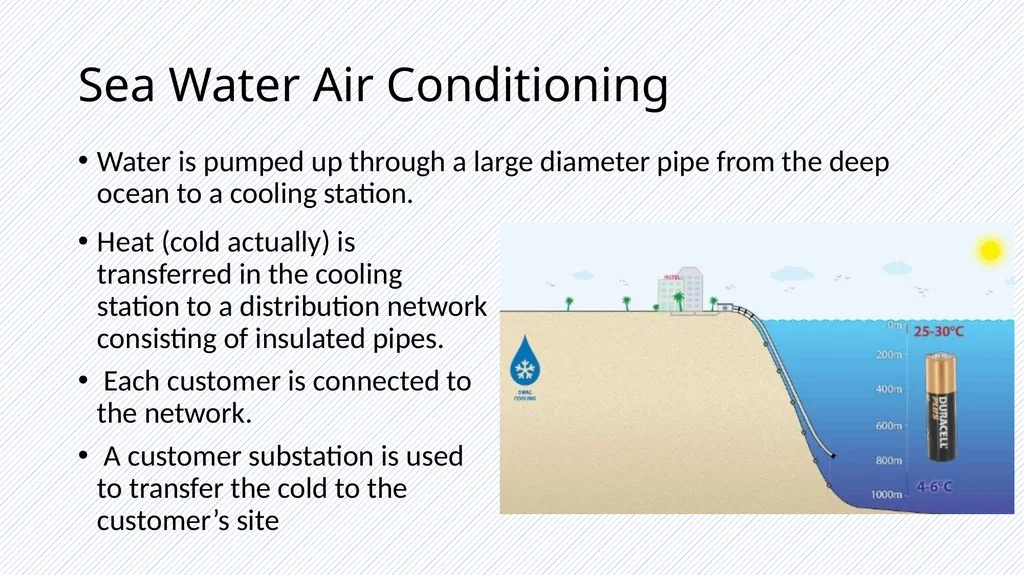
Sea Water Air Conditioning Heat (cold actually) is transferred in the cooling station to a distribution network consisting of insulated pipes.
Each customer is connected to the network.
A customer substation is used to transfer the cold to the customer’s site Water is pumped up through a large diameter pipe from the deep ocean to a cooling station.<br>
07
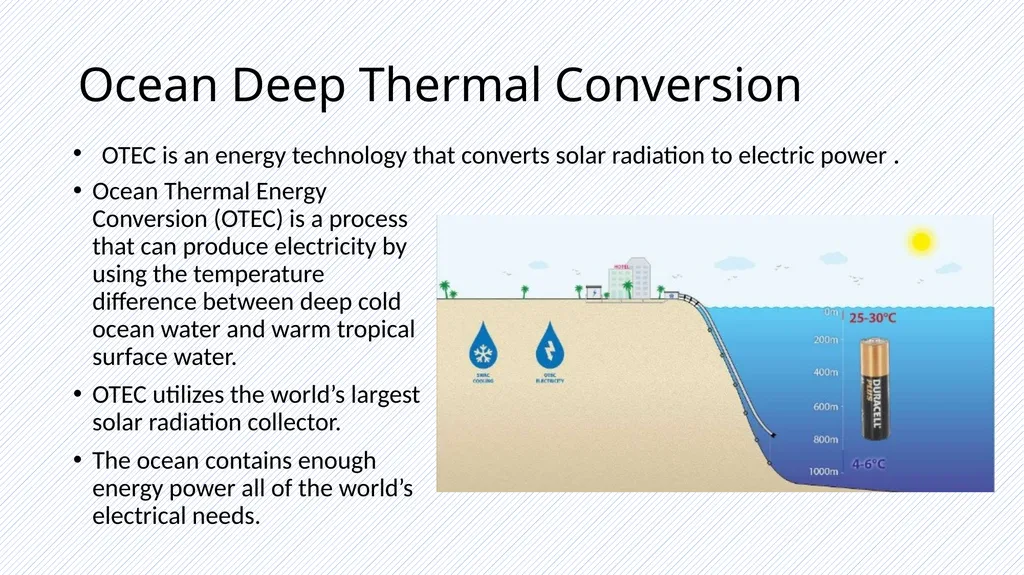
Ocean Deep Thermal Conversion Ocean Thermal Energy Conversion (OTEC) is a process that can produce electricity by using the temperature difference between deep cold ocean water and warm tropical surface water.
OTEC utilizes the world’s largest solar radiation collector.
The ocean contains enough energy power all of the world’s electrical needs. OTEC is an energy technology that converts solar radiation to electric power .<br>
08
Sea Water Desalination Desalination process helps remove minerals from sea water to make it consumable.
75% of the Earth’s surface is covered by water,
97.5% of that water is oceans.
Only 1% is available for drinking.
1.5 billion people lack ready access to drinking water Desalination is particularly relevant in dry countries which traditionally have relied on collecting rainfall behind dams for water.<br>
09
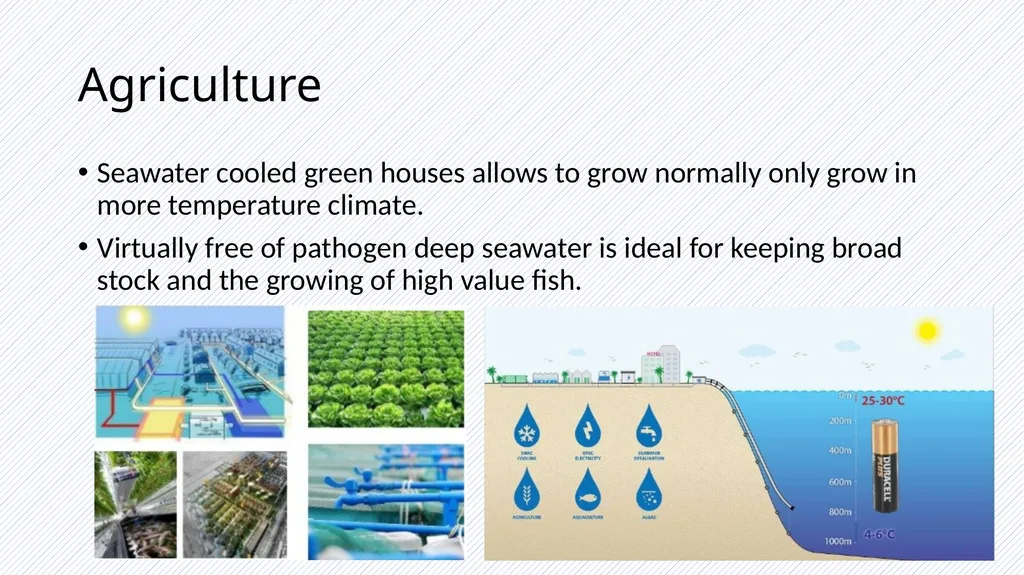
Agriculture Seawater cooled green houses allows to grow normally only grow in more temperature climate.
Virtually free of pathogen deep seawater is ideal for keeping broad stock and the growing of high value fish.<br>