
BUILDING SUSTAINABLE OER ECOSYSTEM Mohan B Menon
A
Published · 28 slides · 0 views

1 / 1
Description
BUILDING SUSTAINABLE OER ECOSYSTEM Mohan B Menon 20 June 2025 Open Educational Resources and Open Education Open Educational Resources (OER) are freely accessible, openly licensed teaching, learning, and research materials. They can include
Related Topics
Share
Embed code
Download this presentation From Below
"BUILDING SUSTAINABLE OER ECOSYSTEM Mohan B Menon" is the property of its rightful owner. Permission is granted to download and print the materials on this website for personal, non-commercial use only, and to display it on your personal computer provided you do not modify the materials and that you retain all copyright notices contained in the materials. By downloading content from our website, you accept the terms of this agreement.
Presentation Transcript
01
BUILDING SUSTAINABLE OER ECOSYSTEM Mohan B Menon
20 June 2025<br>
20 June 2025<br>
02
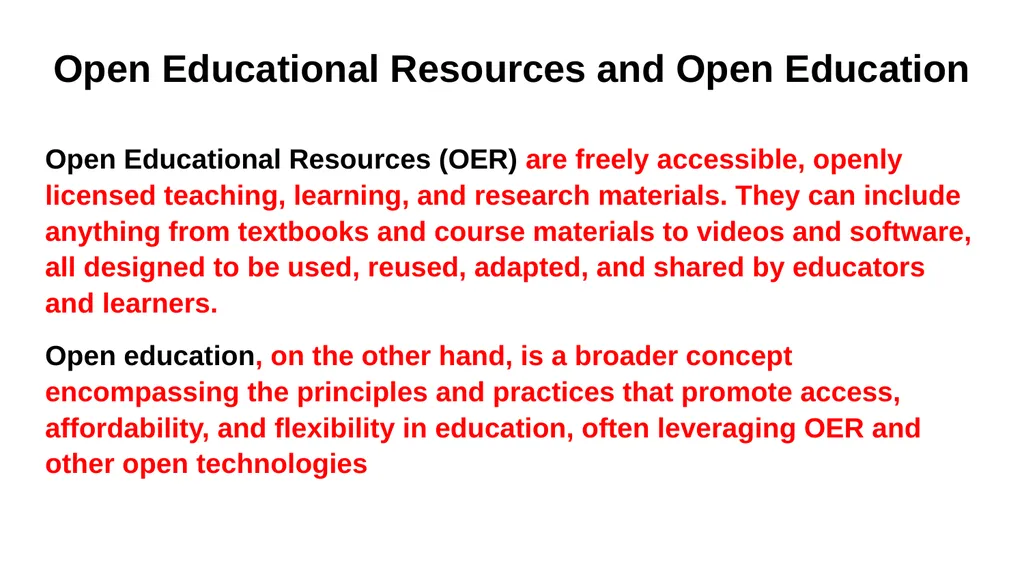
Open Educational Resources and Open Education Open Educational Resources (OER) are freely accessible, openly licensed teaching, learning, and research materials. They can include anything from textbooks and course materials to videos and software, all designed to be used, reused, adapted, and shared by educators and learners.
Open education, on the other hand, is a broader concept encompassing the principles and practices that promote access, affordability, and flexibility in education, often leveraging OER and other open technologies<br>
Open education, on the other hand, is a broader concept encompassing the principles and practices that promote access, affordability, and flexibility in education, often leveraging OER and other open technologies<br>
03
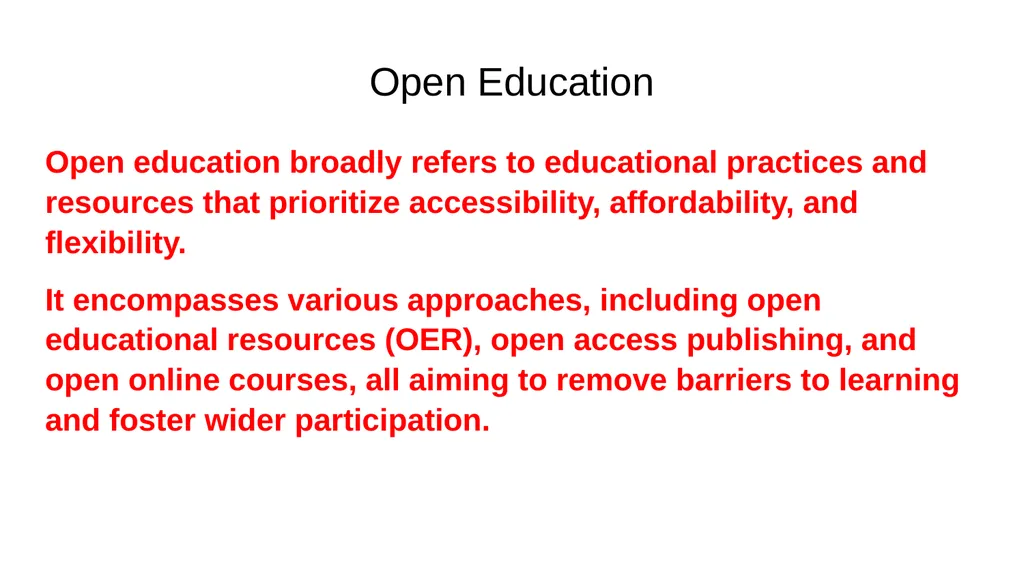
Open Education Open education broadly refers to educational practices and resources that prioritize accessibility, affordability, and flexibility.
It encompasses various approaches, including open educational resources (OER), open access publishing, and open online courses, all aiming to remove barriers to learning and foster wider participation.<br>
It encompasses various approaches, including open educational resources (OER), open access publishing, and open online courses, all aiming to remove barriers to learning and foster wider participation.<br>
04
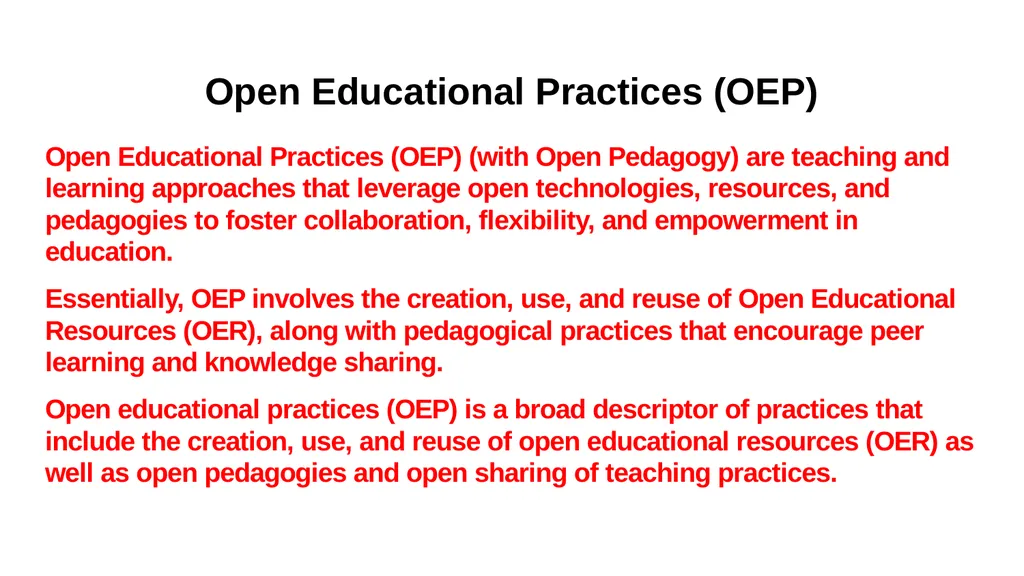
Open Educational Practices (OEP) Open Educational Practices (OEP) (with Open Pedagogy) are teaching and learning approaches that leverage open technologies, resources, and pedagogies to foster collaboration, flexibility, and empowerment in education.
Essentially, OEP involves the creation, use, and reuse of Open Educational Resources (OER), along with pedagogical practices that encourage peer learning and knowledge sharing.
Open educational practices (OEP) is a broad descriptor of practices that include the creation, use, and reuse of open educational resources (OER) as well as open pedagogies and open sharing of teaching practices.<br>
Essentially, OEP involves the creation, use, and reuse of Open Educational Resources (OER), along with pedagogical practices that encourage peer learning and knowledge sharing.
Open educational practices (OEP) is a broad descriptor of practices that include the creation, use, and reuse of open educational resources (OER) as well as open pedagogies and open sharing of teaching practices.<br>
05
OPEN PEDAGOGY Open pedagogy is characterized by several key attributes that distinguish it from traditional teaching methods.
These attributes emphasize student engagement, collaboration, and the use of open educational resources (OER).<br>
These attributes emphasize student engagement, collaboration, and the use of open educational resources (OER).<br>
06
Attributes of Open Pedagogy<br>
07
Integrating Fragmented Open Educational Resources Integrating a fragmented Open Educational Resources (OER) ecosystem involves connecting isolated resources, platforms, and communities to create a more cohesive and accessible system.
This can be achieved by improving discoverability, promoting collaboration, and establishing shared standards and practices.
Ultimately, the goal is to ensure that OER is readily available, usable, and impactful for all learners and educators<br>
This can be achieved by improving discoverability, promoting collaboration, and establishing shared standards and practices.
Ultimately, the goal is to ensure that OER is readily available, usable, and impactful for all learners and educators<br>
08
Sustainable OER Ecosystem: The Case for OER Stewardship OER stewards actively contribute to efforts, whether financially or via in-kind contributions, to advance the awareness, improvement, and distribution of OER.
At the center of the CARE Framework are a wide variety of stakeholders — OER creators and users, working as individuals and as part of organizations, in traditional and non-traditional educational settings — seeking to act as good stewards of the values of a sustainable OER movement.
Locating stakeholders at the center of the CARE Framework serves to remind us first and foremost of the broader social context and purpose of the OER movement.<br>
At the center of the CARE Framework are a wide variety of stakeholders — OER creators and users, working as individuals and as part of organizations, in traditional and non-traditional educational settings — seeking to act as good stewards of the values of a sustainable OER movement.
Locating stakeholders at the center of the CARE Framework serves to remind us first and foremost of the broader social context and purpose of the OER movement.<br>
09
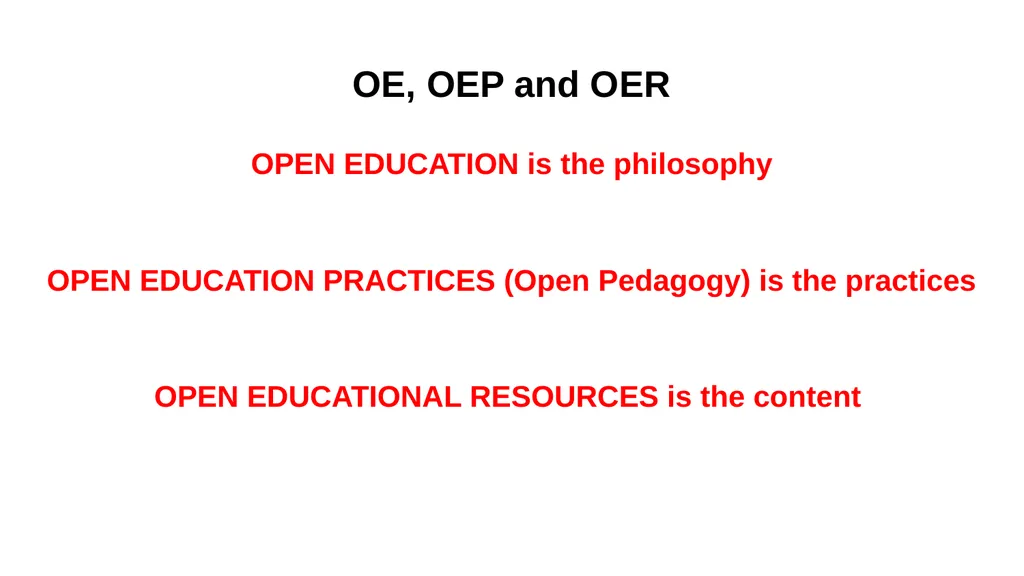
OE, OEP and OER OPEN EDUCATION is the philosophy
OPEN EDUCATION PRACTICES (Open Pedagogy) is the practices
OPEN EDUCATIONAL RESOURCES is the content<br>
OPEN EDUCATION PRACTICES (Open Pedagogy) is the practices
OPEN EDUCATIONAL RESOURCES is the content<br>
10
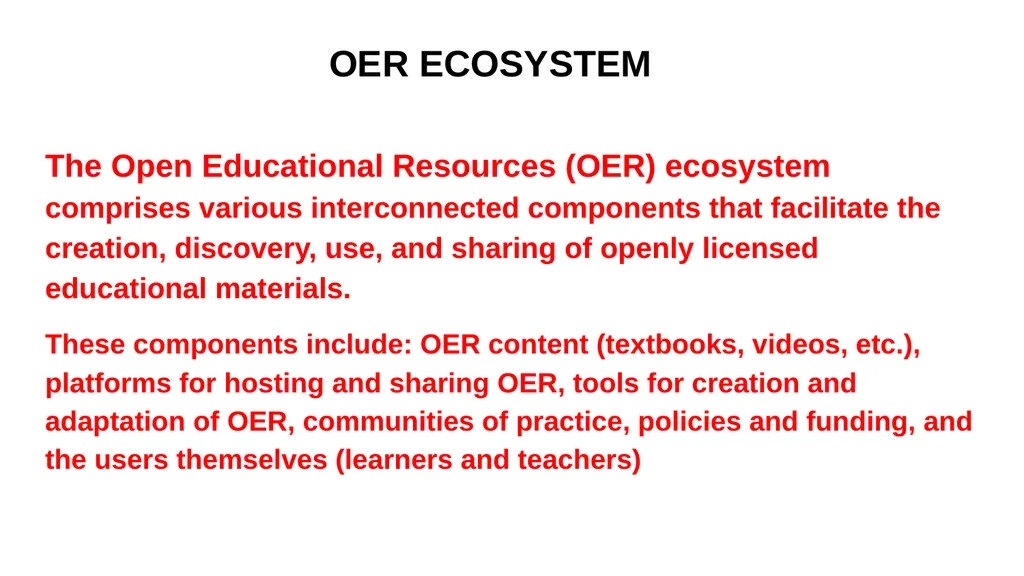
OER ECOSYSTEM The Open Educational Resources (OER) ecosystem comprises various interconnected components that facilitate the creation, discovery, use, and sharing of openly licensed educational materials.
These components include: OER content (textbooks, videos, etc.), platforms for hosting and sharing OER, tools for creation and adaptation of OER, communities of practice, policies and funding, and the users themselves (learners and teachers)<br>
These components include: OER content (textbooks, videos, etc.), platforms for hosting and sharing OER, tools for creation and adaptation of OER, communities of practice, policies and funding, and the users themselves (learners and teachers)<br>
11
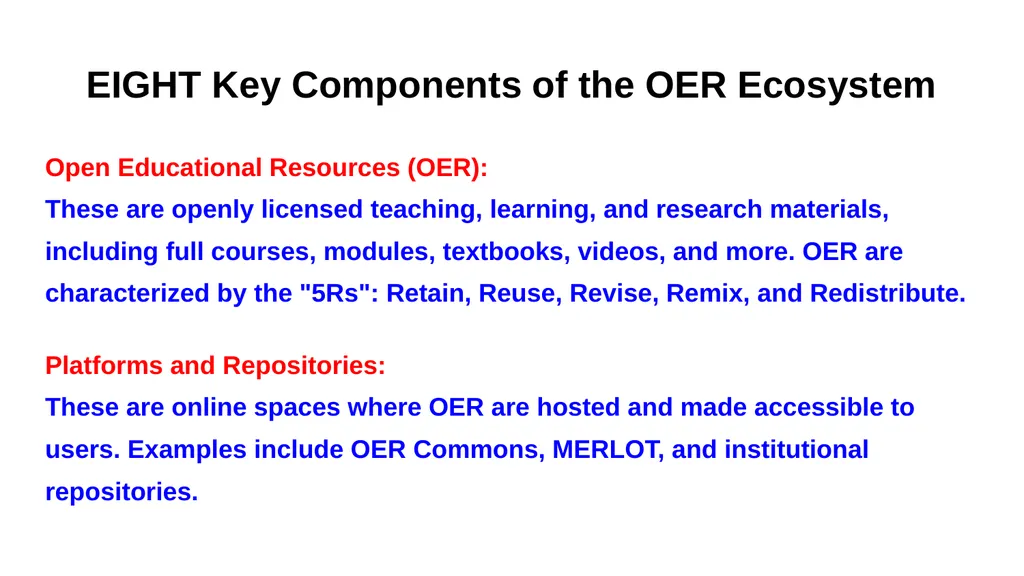
EIGHT Key Components of the OER Ecosystem Open Educational Resources (OER):
These are openly licensed teaching, learning, and research materials, including full courses, modules, textbooks, videos, and more. OER are characterized by the "5Rs": Retain, Reuse, Revise, Remix, and Redistribute.
Platforms and Repositories: These are online spaces where OER are hosted and made accessible to users. Examples include OER Commons, MERLOT, and institutional repositories.<br>
Platforms and Repositories: These are online spaces where OER are hosted and made accessible to users. Examples include OER Commons, MERLOT, and institutional repositories.<br>
12
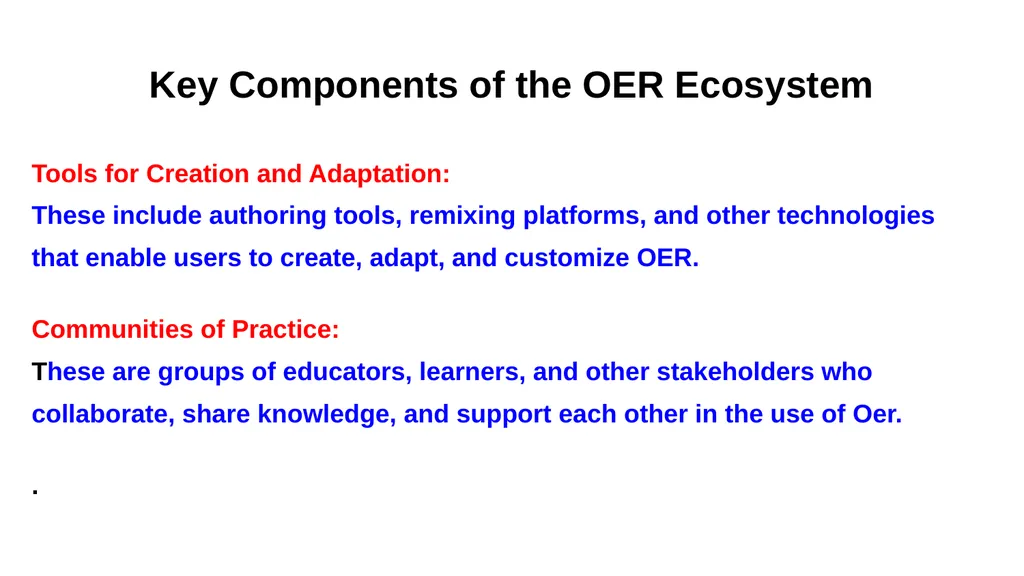
Key Components of the OER Ecosystem Tools for Creation and Adaptation:
These include authoring tools, remixing platforms, and other technologies that enable users to create, adapt, and customize OER.
Communities of Practice: These are groups of educators, learners, and other stakeholders who collaborate, share knowledge, and support each other in the use of Oer.
.<br>
Communities of Practice: These are groups of educators, learners, and other stakeholders who collaborate, share knowledge, and support each other in the use of Oer.
.<br>
13
Key Components of the OER Ecosystem Policies and Funding:
Policies and funding mechanisms play a crucial role in supporting the creation, adoption, and sustainability of the OER ecosystem.
Users (Learners and Educators): The ultimate users of OER, who benefit from access to high-quality, openly licensed educational materials.<br>
Users (Learners and Educators): The ultimate users of OER, who benefit from access to high-quality, openly licensed educational materials.<br>
14
Key Components of the OER Ecosystem Licensing:
Open licenses, such as Creative Commons licenses, are essential for defining the permissions and restrictions associated with OER.
Technology Infrastructure: The underlying technology that supports the creation, storage, and delivery of OER.<br>
Technology Infrastructure: The underlying technology that supports the creation, storage, and delivery of OER.<br>
15
OER stewards People serving as OER stewards pursue a wide variety of strategies and tactics relevant to their specific context to improve access to education and opportunity over time.
Yet, what all good OER stewards should have in common is a commitment to practices that serve to demonstrate their duty of care to the broader OER movement<br>
Yet, what all good OER stewards should have in common is a commitment to practices that serve to demonstrate their duty of care to the broader OER movement<br>
16
Addressing Fragmentation in OER Access OERs have the potential to make education more affordable and accessible, especially in underserved regions.
They are often scattered across isolated platforms without a central indexing system, making it difficult for educators and students to find relevant resources.
Language and cultural differences further limit their accessibility, while most platforms lack intelligent recommendation systems to personalise learning.
This fragmentation prevents educators from collaborating on curricula and hinders access to relevant educational content for diverse learners.<br>
They are often scattered across isolated platforms without a central indexing system, making it difficult for educators and students to find relevant resources.
Language and cultural differences further limit their accessibility, while most platforms lack intelligent recommendation systems to personalise learning.
This fragmentation prevents educators from collaborating on curricula and hinders access to relevant educational content for diverse learners.<br>
17
Revolutionising Education with a Connected OER Ecosystem- Role of AI Reshaping how OERs are accessed and used, ensuring educational resources are available to learners everywhere.
Towards AI-driven systems connecting scattered educational materials to students and educators based on their unique needs.<br>
Towards AI-driven systems connecting scattered educational materials to students and educators based on their unique needs.<br>
18
Can AI-powered systems replace teaching? 1. *Human touch and empathy*: Teachers provide emotional support, empathy, and understanding, which are essential for students' social and emotional development.
2. *Complex decision-making*: Teachers make nuanced decisions about student learning, taking into account individual needs, context, and subtle cues.
3. *Creativity and critical thinking*: Teachers foster creativity, critical thinking, and problem-solving skills, which are difficult to replicate with AI alone.
4. *Human interaction and discussion*: Teachers facilitate discussions, debates, and interactions that promote deeper understanding and social skills.<br>
2. *Complex decision-making*: Teachers make nuanced decisions about student learning, taking into account individual needs, context, and subtle cues.
3. *Creativity and critical thinking*: Teachers foster creativity, critical thinking, and problem-solving skills, which are difficult to replicate with AI alone.
4. *Human interaction and discussion*: Teachers facilitate discussions, debates, and interactions that promote deeper understanding and social skills.<br>
19
Can AI-powered systems augment and support teaching? AI can, however, enhance teaching by:
1. *Automating administrative tasks*: AI can help with grading, data analysis, and other administrative tasks.
2. *Personalizing learning*: AI can tailor content and pace to individual students' needs.
3. *Providing real-time feedback*: AI can offer immediate feedback and assessment.<br>
1. *Automating administrative tasks*: AI can help with grading, data analysis, and other administrative tasks.
2. *Personalizing learning*: AI can tailor content and pace to individual students' needs.
3. *Providing real-time feedback*: AI can offer immediate feedback and assessment.<br>
20
AI to facilitate OER Ecosystem Artificial Intelligence (AI) is increasingly being integrated into Open Educational Resources (OER) ecosystems to enhance the learning experience.
The integration of AI in OER ecosystems has the potential to increase accessibility, improve learning outcomes, and reduce educational costs.<br>
The integration of AI in OER ecosystems has the potential to increase accessibility, improve learning outcomes, and reduce educational costs.<br>
21
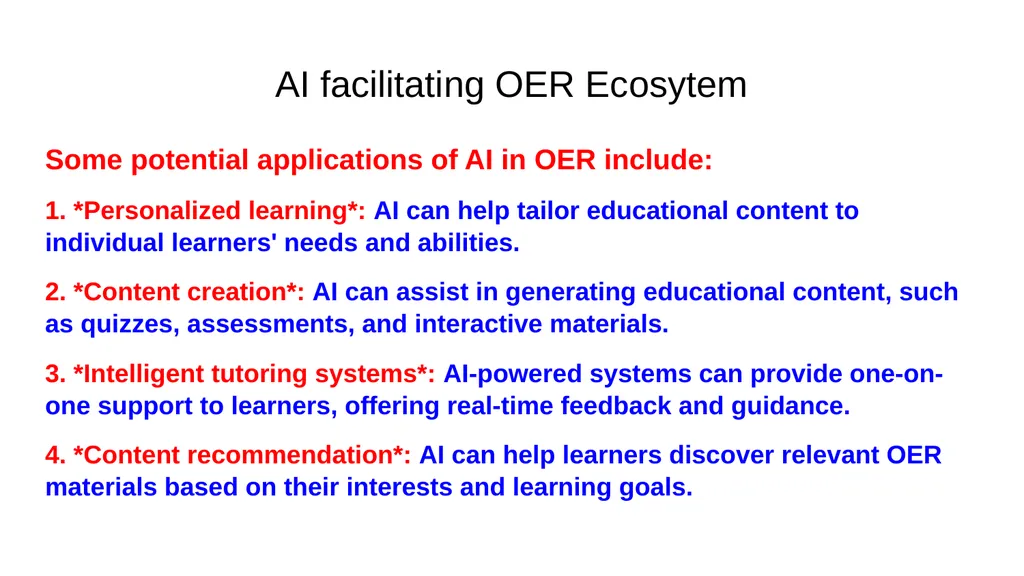
AI facilitating OER Ecosytem Some potential applications of AI in OER include:
1. *Personalized learning*: AI can help tailor educational content to individual learners' needs and abilities.
2. *Content creation*: AI can assist in generating educational content, such as quizzes, assessments, and interactive materials.
3. *Intelligent tutoring systems*: AI-powered systems can provide one-on-one support to learners, offering real-time feedback and guidance.
4. *Content recommendation*: AI can help learners discover relevant OER materials based on their interests and learning goals.<br>
1. *Personalized learning*: AI can help tailor educational content to individual learners' needs and abilities.
2. *Content creation*: AI can assist in generating educational content, such as quizzes, assessments, and interactive materials.
3. *Intelligent tutoring systems*: AI-powered systems can provide one-on-one support to learners, offering real-time feedback and guidance.
4. *Content recommendation*: AI can help learners discover relevant OER materials based on their interests and learning goals.<br>
22
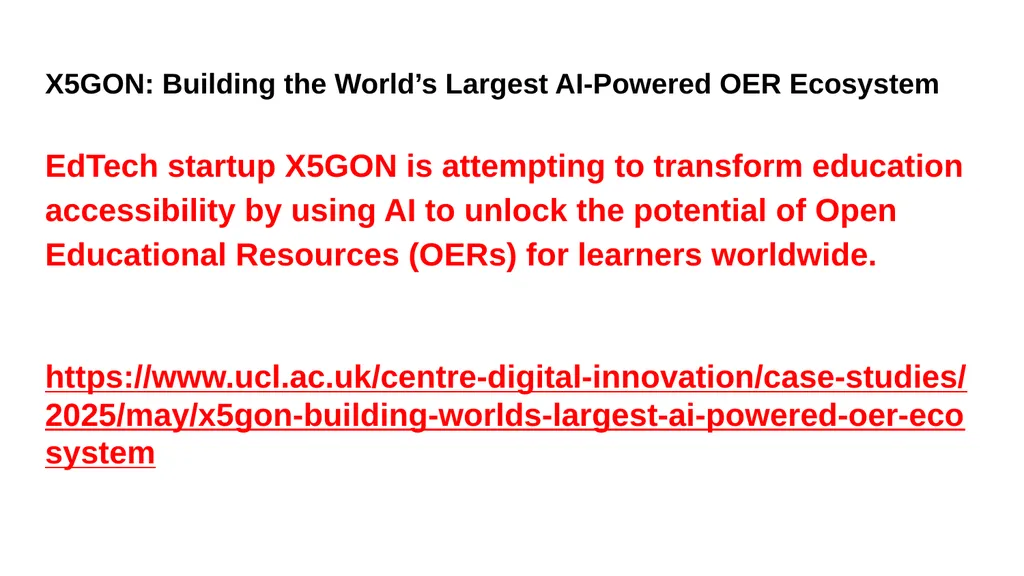
X5GON: Building the World’s Largest AI-Powered OER Ecosystem EdTech startup X5GON is attempting to transform education accessibility by using AI to unlock the potential of Open Educational Resources (OERs) for learners worldwide.
https://www.ucl.ac.uk/centre-digital-innovation/case-studies/2025/may/x5gon-building-worlds-largest-ai-powered-oer-ecosystem<br>
https://www.ucl.ac.uk/centre-digital-innovation/case-studies/2025/may/x5gon-building-worlds-largest-ai-powered-oer-ecosystem<br>
23
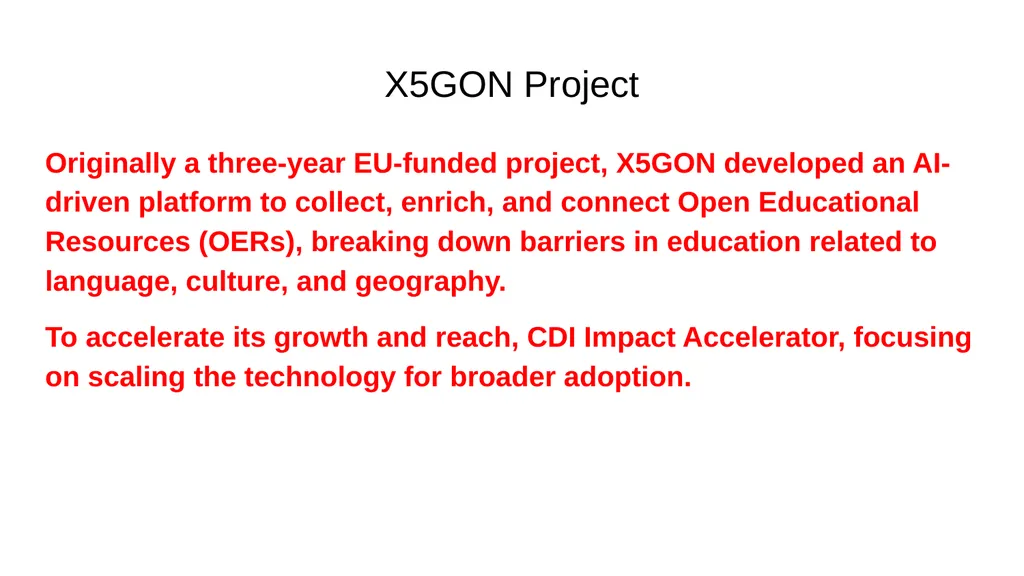
X5GON Project Originally a three-year EU-funded project, X5GON developed an AI-driven platform to collect, enrich, and connect Open Educational Resources (OERs), breaking down barriers in education related to language, culture, and geography.
To accelerate its growth and reach, CDI Impact Accelerator, focusing on scaling the technology for broader adoption.<br>
To accelerate its growth and reach, CDI Impact Accelerator, focusing on scaling the technology for broader adoption.<br>
24
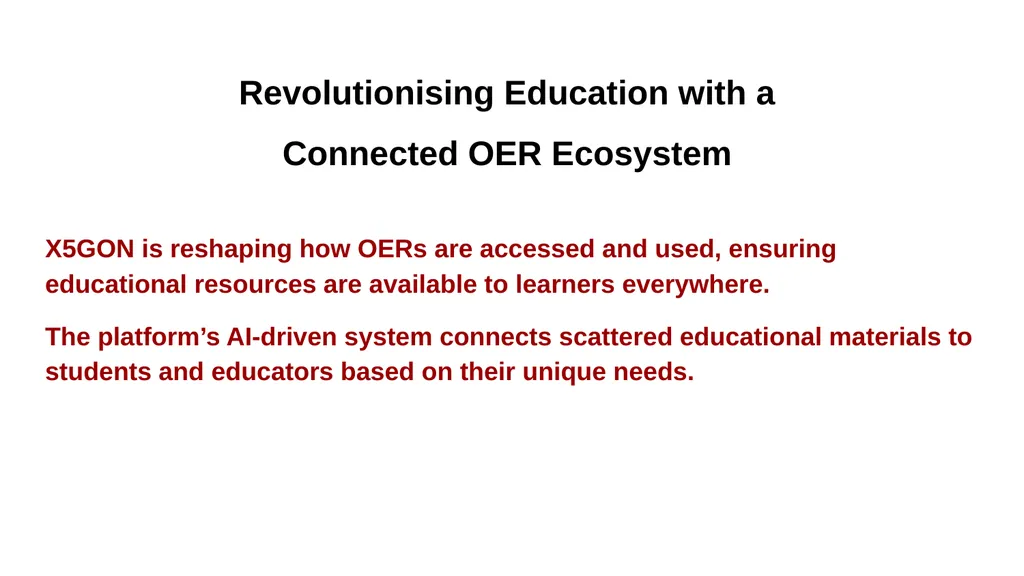
X5GON is reshaping how OERs are accessed and used, ensuring educational resources are available to learners everywhere.
The platform’s AI-driven system connects scattered educational materials to students and educators based on their unique needs. Revolutionising Education with a
Connected OER Ecosystem<br>
The platform’s AI-driven system connects scattered educational materials to students and educators based on their unique needs. Revolutionising Education with a
Connected OER Ecosystem<br>
25
Macro and Micro-level stewardship in open education refers to the different scales at which open educational practices (OEP) are managed and supported.
Macro-level stewardship involves national or international policies, strategies, resources and infrastructure related to open education.
Micro-level stewardship focuses on the implementation of OEP within individual institutions courses, classrooms, or by individual educators. OER ECOSYSTEM- Macro and Micro Level Stewardship<br>
Macro-level stewardship involves national or international policies, strategies, resources and infrastructure related to open education.
Micro-level stewardship focuses on the implementation of OEP within individual institutions courses, classrooms, or by individual educators. OER ECOSYSTEM- Macro and Micro Level Stewardship<br>
26
OER ECOSYSTEM- Macro Level Stewardship Macro-level stewardship for open pedagogy involves large-scale initiatives that promote and support open educational practices across institutions and systems.
This includes policy development, funding allocation, and infrastructure creation to enable widespread adoption of open pedagogy.
Effective stewardship ensures that open pedagogy is integrated into educational frameworks, fostering student-centered learning, increased access, and collaborative knowledge creation.<br>
This includes policy development, funding allocation, and infrastructure creation to enable widespread adoption of open pedagogy.
Effective stewardship ensures that open pedagogy is integrated into educational frameworks, fostering student-centered learning, increased access, and collaborative knowledge creation.<br>
27
OER ECOSYSTEM- Micro Level Stewardship Micro-level stewardship in open pedagogy focuses on the individual actions and decisions within a learning environment that promote openness, collaboration, and student agency.
It involves specific practices and considerations at the individual course or assignment level that align with the broader principles of open pedagogy<br>
It involves specific practices and considerations at the individual course or assignment level that align with the broader principles of open pedagogy<br>
28
THANKS Mohan Menon
mohanbmenon@gmail.com
CC BY SA<br>
mohanbmenon@gmail.com
CC BY SA<br>