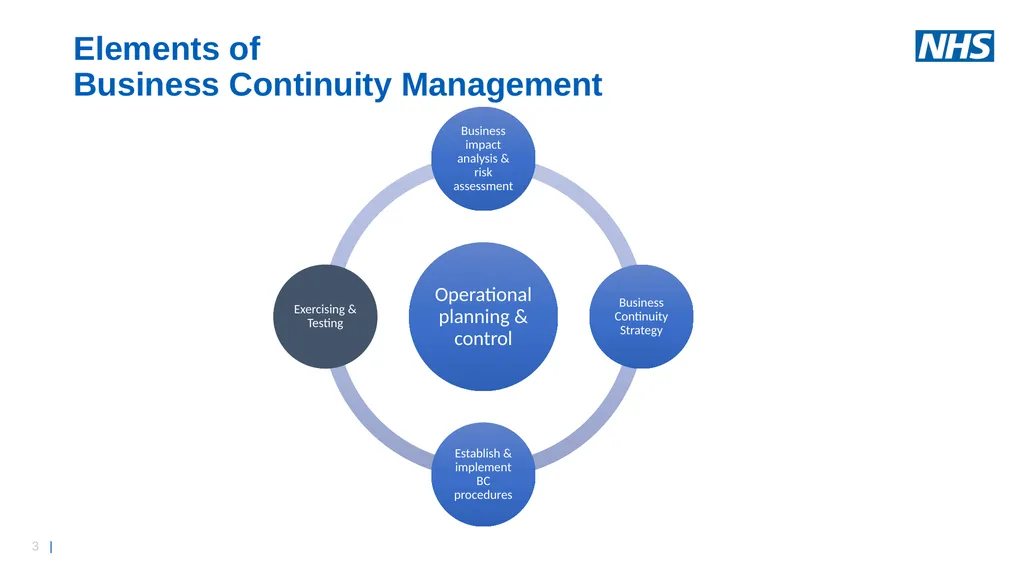
Business Continuity Exercise Information (Unobtainable) and Information Systems (Unavailable) NHS England Emergency Preparedness, Resilience and Response (EPRR) Content Business Continuity Management Cycle Exercise Aim Objectives Ground
"Business Continuity Exercise – Information" is the property of its rightful owner. Permission is granted to
download and print the materials on this website for personal, non-commercial use only, and to display it
on your personal computer provided you do not modify the materials and that you retain all copyright
notices contained in the materials. By downloading content from our website, you accept the terms of this
agreement.
Presentation Transcript
01
Business Continuity Exercise – Information (Unobtainable) and Information Systems (Unavailable) NHS England – Emergency Preparedness, Resilience and Response (EPRR)<br>
Aim To provide delegates with an opportunity to evaluate and enhance the operational effectiveness of the business continuity plans (inputs & outputs) and provide learning opportunities.<br>
05
Objectives To facilitate learning opportunities
To enable delegates to identify the strengths and weaknesses of the business continuity plans
To assess the interoperability of the business continuity plans and use subsequent learning to outline further enhancements<br>
06
Ground Rules Please nominate a scribe.
The exercise should be viewed as an opportunity to rehearse the responses in the plan and to identify problems - and potentially make mistakes - in a safe environment.
Any comments, problems, issues or other contributions made should be captured in helping improve the plan.<br>
07
Exercise Background Any organisation is susceptible and could lose access to information assets (digital or non digital). Equally, information systems may be unavailable for numerous reasons, e.g. network failures, (localised or national infrastructure), flooding or fire.
NHS Digital are the national provider of information, data and IT systems within the health and social care sector and interface with telecommunications providers. Localised IT departments representatives liaise directly with NHS Digital during IT outages or telecommunications failures.<br>
08
Inject One At 09:00 Hrs members of staff have noticed the telephone and IT systems are unresponsive.
Upon further investigation it appears that due to excavation work being undertaken outside your premises the contractors have severed the primary and secondary network cables.<br>
09
Considerations What are the immediate actions required?
Who should be informed and why?
What are the next steps, evaluate the options?<br>
10
Inject Two At 12:00 Hrs NHS Digital advise that they have liaised with the telecommunications provider and it could take up to 24 hours to rectify the fault and restore services, although partial service maybe available with 12 hours.<br>
11
Considerations What are the primary concerns and actions required
Who will undertake the leadership roles
Who will you liaise with and why
What are the next steps, evaluate the options.<br>
12
Inject Three At 16:00 Hrs NHS Digital advise that services will be restored by 16:00 hrs the next day.<br>
13
Considerations What are the next steps, evaluate the options
What are the prioritised activities
Who are your interested parties
What are your interdependencies (inputs & outputs) and how will the impact be managed
What is the key element of your plan for managing the recovery.<br>
14
Review Scenarios tested:
Horizon scanning to risks
Understanding of plan activation procedures and communication
Review of what is within the plans to help identify:
leadership, interdependencies, and mitigation
Recovery of services<br>
15
Feedback ISO22313 What actions did we capture as a result of this exercise?
What do we see as the next steps?<br>