
Business Continuity Planning Overview 1 The Need
MS
Published · 24 slides · 0 views
1 / 1
Description
Business Continuity Planning Overview 1 The Need For Business Continuity Planning Scenario 1 It is early September, only one day after the University experienced direct hits from a series of devastating tornados. Emergency response teams
Related Topics
Share
Embed code
Download this presentation From Below
"Business Continuity Planning Overview 1 The Need" is the property of its rightful owner. Permission is granted to download and print the materials on this website for personal, non-commercial use only, and to display it on your personal computer provided you do not modify the materials and that you retain all copyright notices contained in the materials. By downloading content from our website, you accept the terms of this agreement.
Presentation Transcript
01
Business Continuity Planning
Overview 1<br>
02
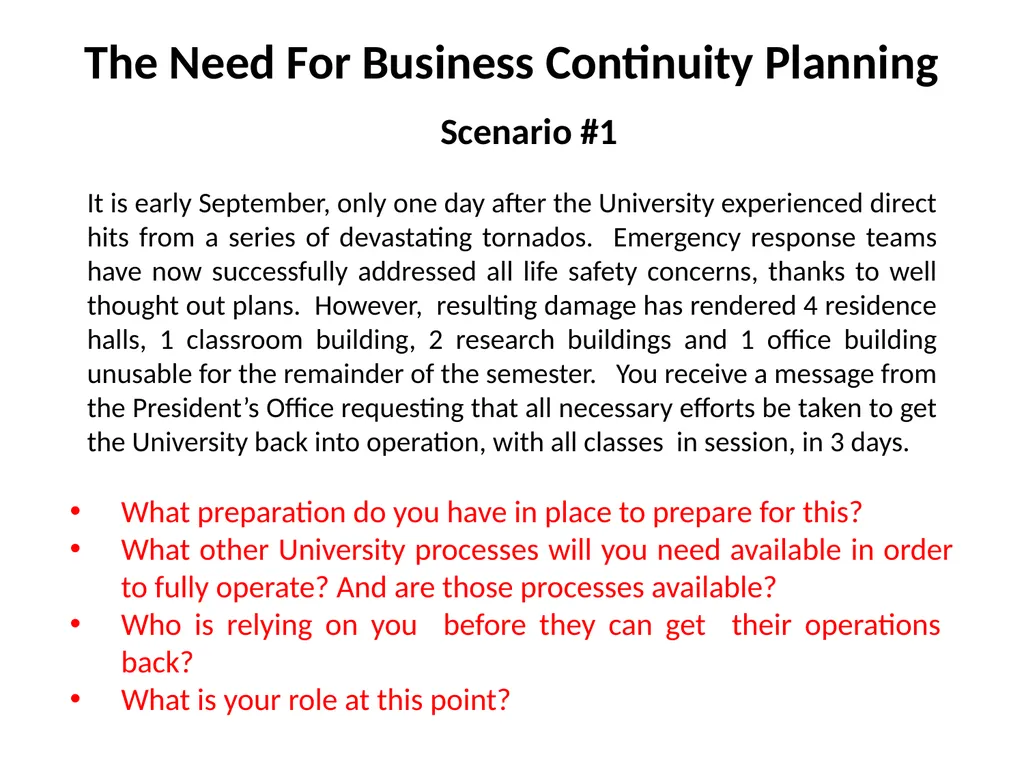
The Need For Business Continuity Planning Scenario #1 It is early September, only one day after the University experienced direct hits from a series of devastating tornados. Emergency response teams have now successfully addressed all life safety concerns, thanks to well thought out plans. However, resulting damage has rendered 4 residence halls, 1 classroom building, 2 research buildings and 1 office building unusable for the remainder of the semester. You receive a message from the President’s Office requesting that all necessary efforts be taken to get the University back into operation, with all classes in session, in 3 days. What preparation do you have in place to prepare for this?
What other University processes will you need available in order to fully operate? And are those processes available?
Who is relying on you before they can get their operations back?
What is your role at this point?<br>
What other University processes will you need available in order to fully operate? And are those processes available?
Who is relying on you before they can get their operations back?
What is your role at this point?<br>
03
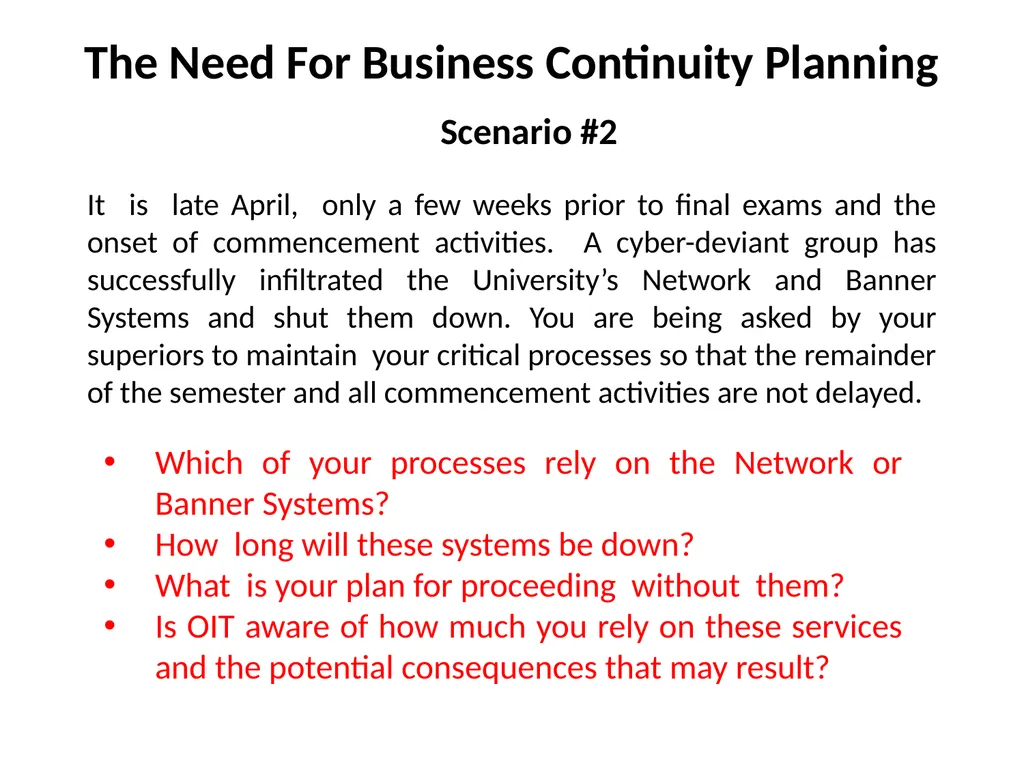
The Need For Business Continuity Planning Scenario #2 It is late April, only a few weeks prior to final exams and the onset of commencement activities. A cyber-deviant group has successfully infiltrated the University’s Network and Banner Systems and shut them down. You are being asked by your superiors to maintain your critical processes so that the remainder of the semester and all commencement activities are not delayed. Which of your processes rely on the Network or Banner Systems?
How long will these systems be down?
What is your plan for proceeding without them?
Is OIT aware of how much you rely on these services and the potential consequences that may result?<br>
How long will these systems be down?
What is your plan for proceeding without them?
Is OIT aware of how much you rely on these services and the potential consequences that may result?<br>
04
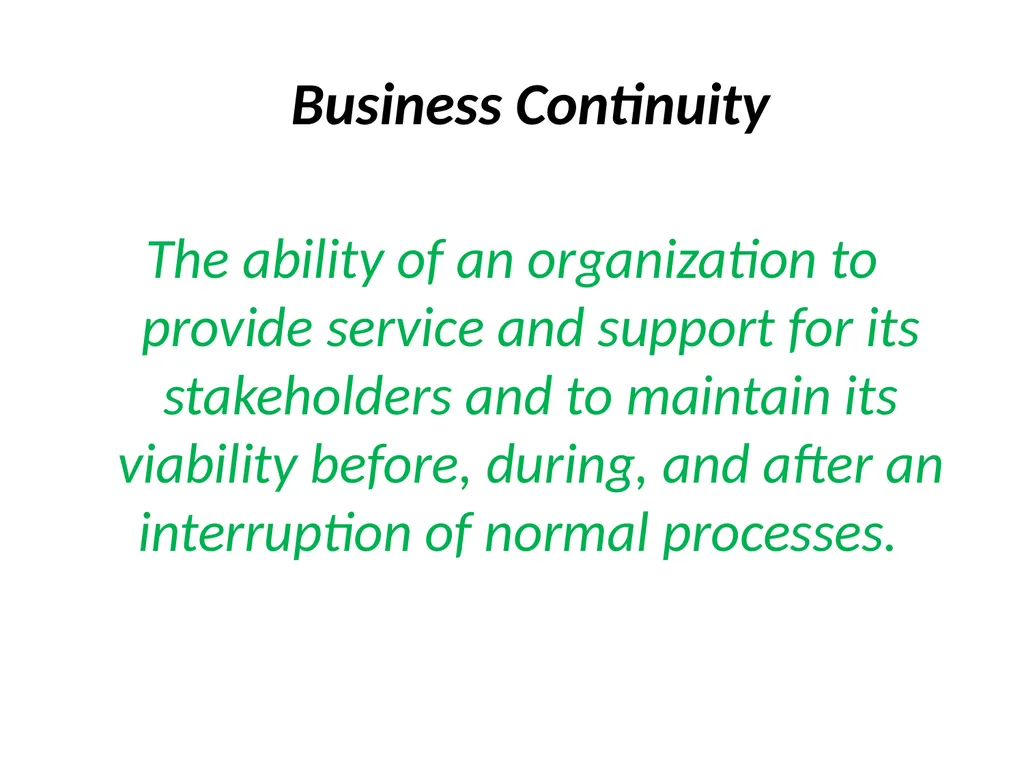
Business Continuity The ability of an organization to provide service and support for its stakeholders and to maintain its viability before, during, and after an interruption of normal processes.<br>
05
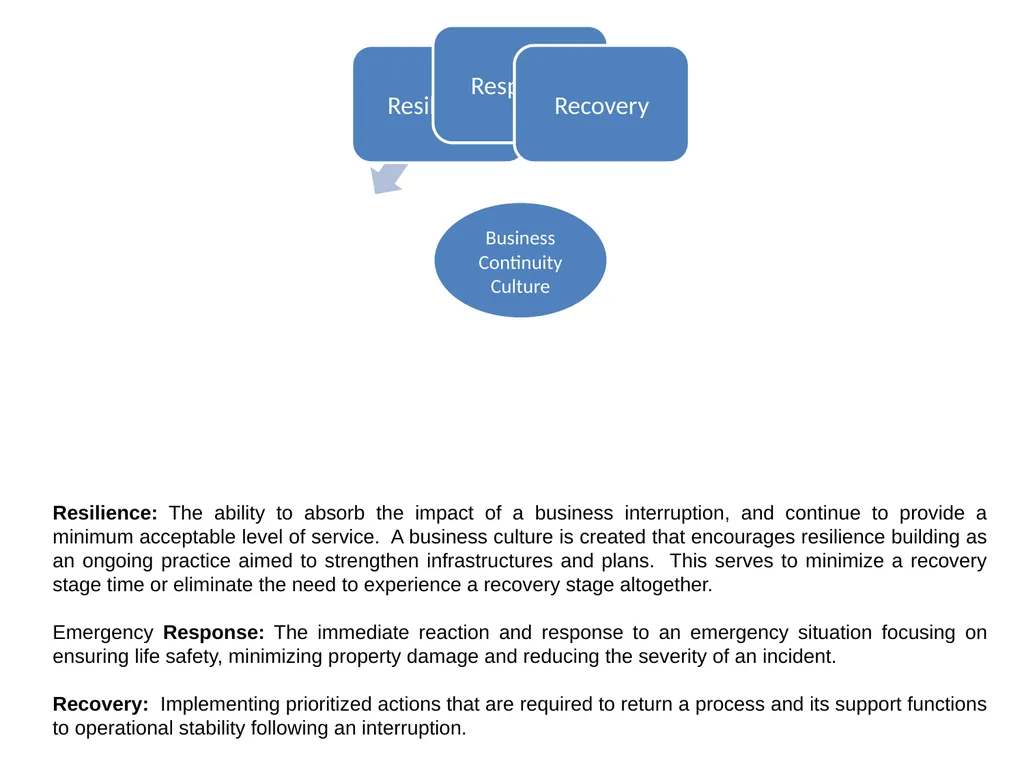
Resilience: The ability to absorb the impact of a business interruption, and continue to provide a minimum acceptable level of service. A business culture is created that encourages resilience building as an ongoing practice aimed to strengthen infrastructures and plans. This serves to minimize a recovery stage time or eliminate the need to experience a recovery stage altogether.
Emergency Response: The immediate reaction and response to an emergency situation focusing on ensuring life safety, minimizing property damage and reducing the severity of an incident.
Recovery: Implementing prioritized actions that are required to return a process and its support functions to operational stability following an interruption.<br>
Emergency Response: The immediate reaction and response to an emergency situation focusing on ensuring life safety, minimizing property damage and reducing the severity of an incident.
Recovery: Implementing prioritized actions that are required to return a process and its support functions to operational stability following an interruption.<br>
06
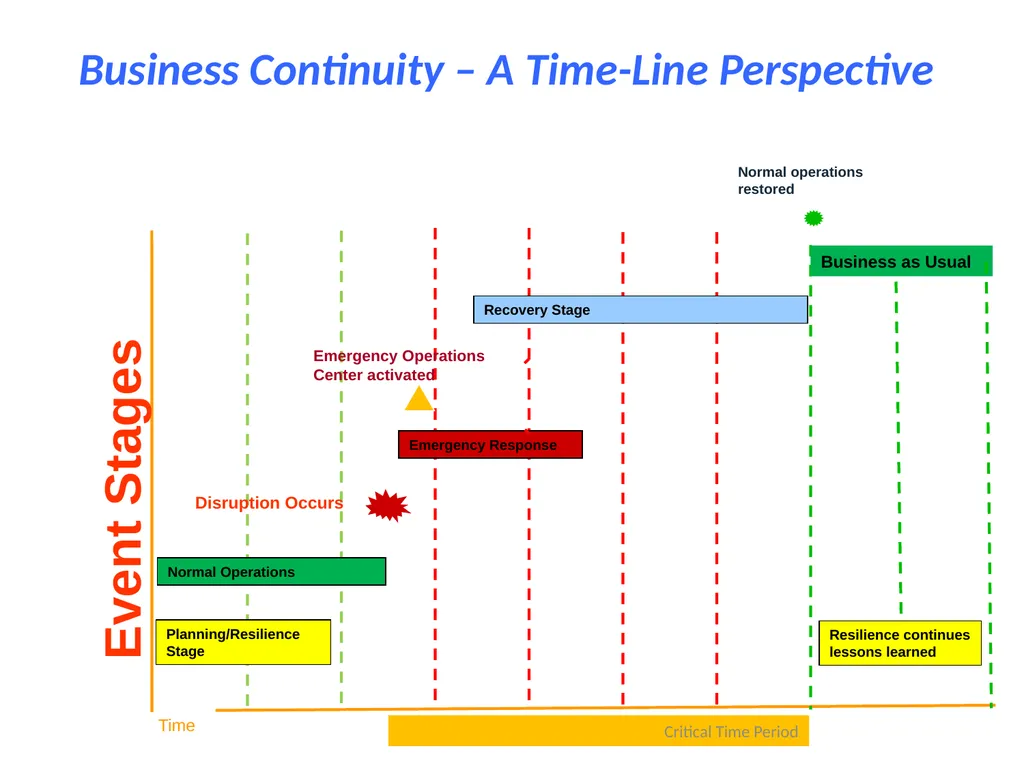
Business Continuity – A Time-Line Perspective Critical Time Period Time Normal operations restored Business as Usual Event Stages Resilience continues
lessons learned<br>
lessons learned<br>
07
UNIVERSITY OF NOTRE DAME
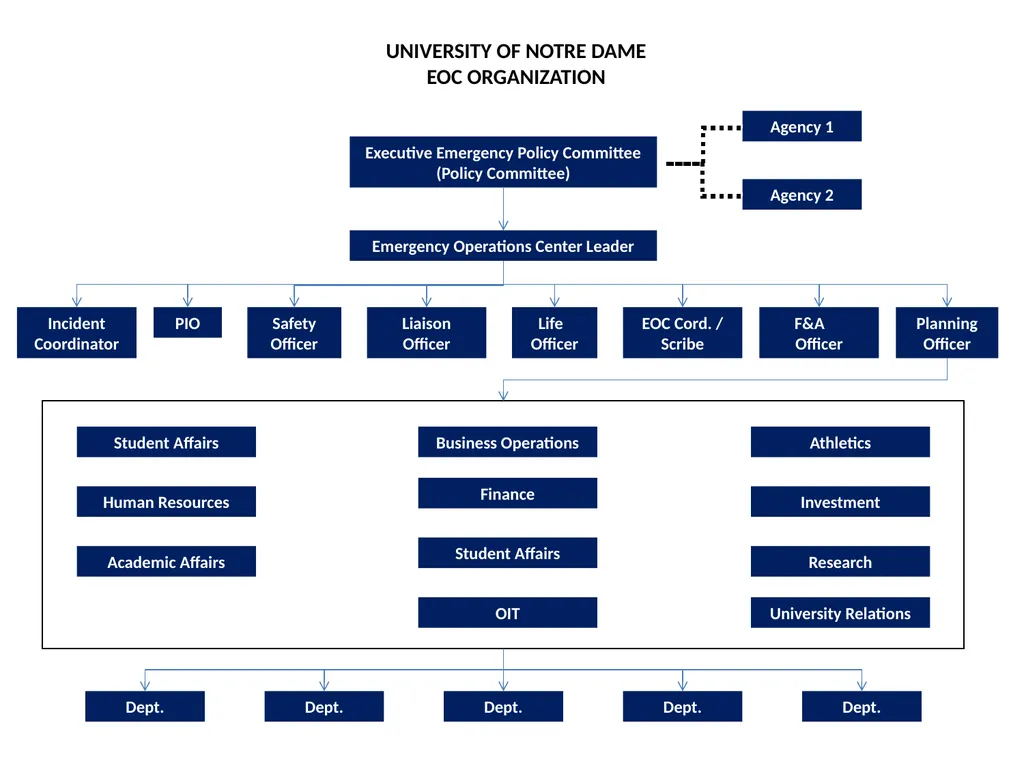
EOC ORGANIZATION Executive Emergency Policy Committee (Policy Committee) Emergency Operations Center Leader Liaison Officer Safety Officer Incident Coordinator PIO Life Officer Planning Officer Student Affairs Human Resources Academic Affairs Research Investment Athletics Student Affairs OIT Finance Business Operations Dept. Dept. Dept. Dept. Dept. Agency 2 Agency 1 EOC Cord. / Scribe University Relations F&A Officer<br>
08
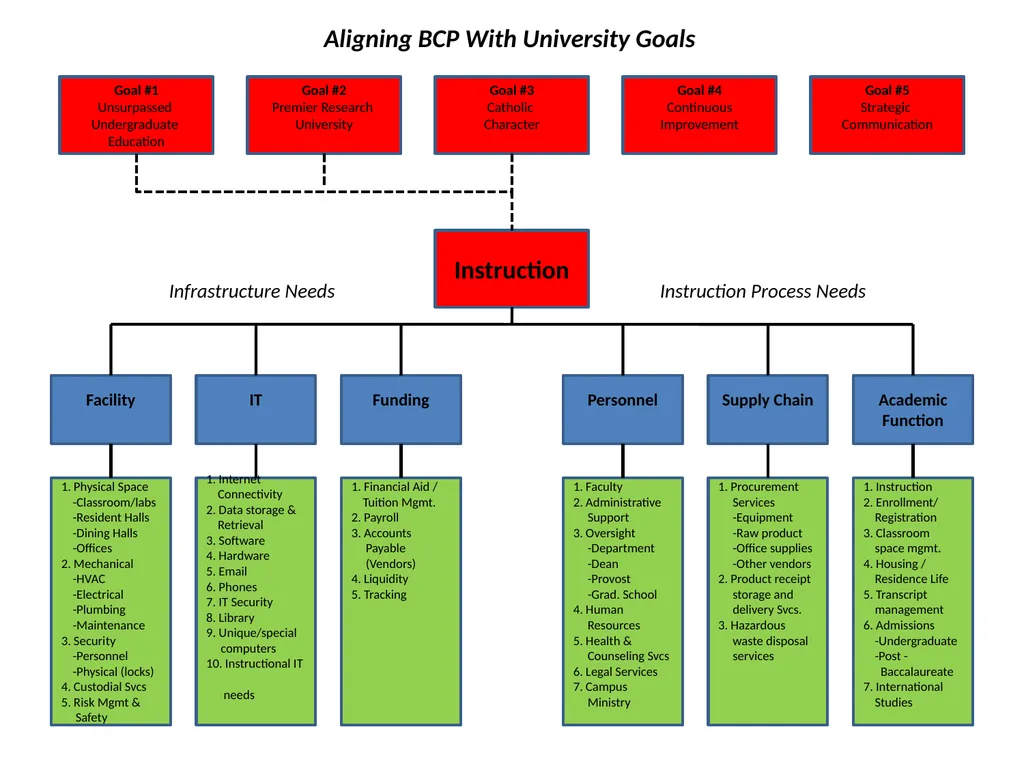
Goal #1
Unsurpassed
Undergraduate
Education Goal #2
Premier Research
University Goal #3
Catholic
Character Goal #4
Continuous Improvement Goal #5
Strategic
Communication Instruction Facility IT Funding Personnel Supply Chain Academic
Function 1. Physical Space
-Classroom/labs
-Resident Halls
-Dining Halls
-Offices
2. Mechanical
-HVAC
-Electrical
-Plumbing
-Maintenance
3. Security
-Personnel
-Physical (locks)
4. Custodial Svcs
5. Risk Mgmt &
Safety 1. Internet
Connectivity
2. Data storage &
Retrieval
3. Software
4. Hardware
5. Email
6. Phones
7. IT Security
8. Library
9. Unique/special
computers
10. Instructional IT
needs 1. Financial Aid /
Tuition Mgmt.
2. Payroll
3. Accounts
Payable
(Vendors)
4. Liquidity
5. Tracking 1. Faculty
2. Administrative
Support
3. Oversight
-Department
-Dean
-Provost
-Grad. School
4. Human
Resources
5. Health &
Counseling Svcs
6. Legal Services
7. Campus
Ministry 1. Procurement
Services
-Equipment
-Raw product
-Office supplies
-Other vendors
2. Product receipt
storage and
delivery Svcs.
3. Hazardous
waste disposal
services 1. Instruction
2. Enrollment/
Registration
3. Classroom
space mgmt.
4. Housing /
Residence Life
5. Transcript
management
6. Admissions
-Undergraduate
-Post -
Baccalaureate
7. International
Studies Infrastructure Needs Instruction Process Needs Aligning BCP With University Goals<br>
Unsurpassed
Undergraduate
Education Goal #2
Premier Research
University Goal #3
Catholic
Character Goal #4
Continuous Improvement Goal #5
Strategic
Communication Instruction Facility IT Funding Personnel Supply Chain Academic
Function 1. Physical Space
-Classroom/labs
-Resident Halls
-Dining Halls
-Offices
2. Mechanical
-HVAC
-Electrical
-Plumbing
-Maintenance
3. Security
-Personnel
-Physical (locks)
4. Custodial Svcs
5. Risk Mgmt &
Safety 1. Internet
Connectivity
2. Data storage &
Retrieval
3. Software
4. Hardware
5. Email
6. Phones
7. IT Security
8. Library
9. Unique/special
computers
10. Instructional IT
needs 1. Financial Aid /
Tuition Mgmt.
2. Payroll
3. Accounts
Payable
(Vendors)
4. Liquidity
5. Tracking 1. Faculty
2. Administrative
Support
3. Oversight
-Department
-Dean
-Provost
-Grad. School
4. Human
Resources
5. Health &
Counseling Svcs
6. Legal Services
7. Campus
Ministry 1. Procurement
Services
-Equipment
-Raw product
-Office supplies
-Other vendors
2. Product receipt
storage and
delivery Svcs.
3. Hazardous
waste disposal
services 1. Instruction
2. Enrollment/
Registration
3. Classroom
space mgmt.
4. Housing /
Residence Life
5. Transcript
management
6. Admissions
-Undergraduate
-Post -
Baccalaureate
7. International
Studies Infrastructure Needs Instruction Process Needs Aligning BCP With University Goals<br>
09
Goal #1
Unsurpassed
Undergraduate
Education Goal #2
Premier Research
University Goal #3
Catholic
Character Goal #4
Continuous Improvement Goal #5
Strategic
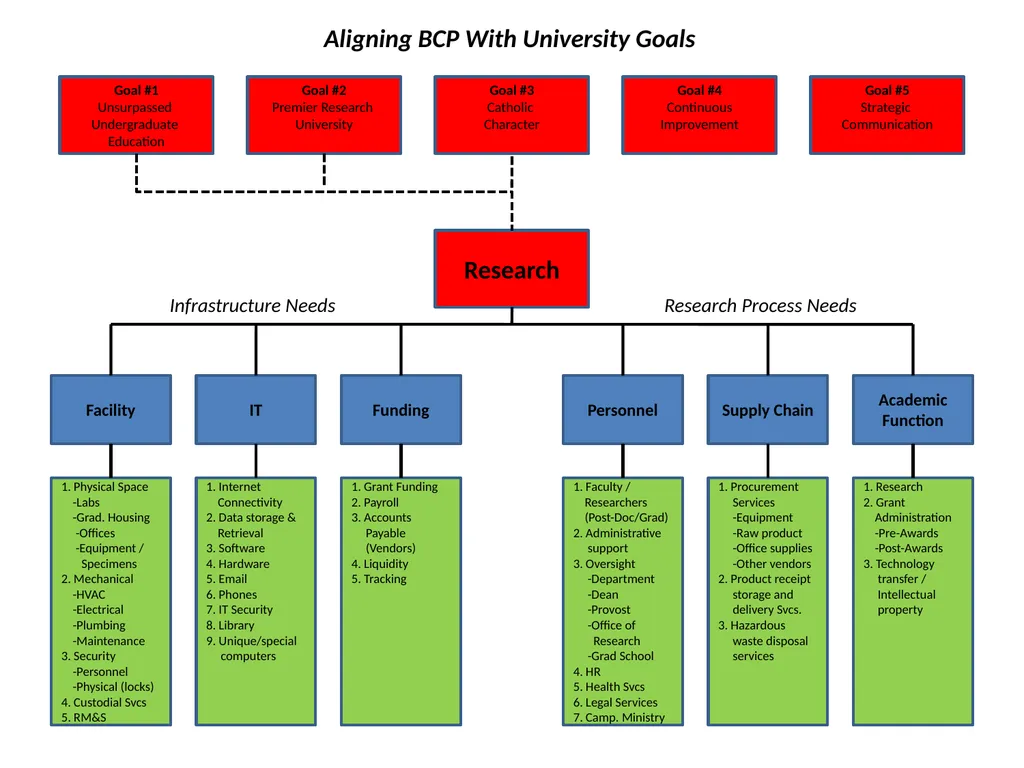
Communication Research Facility IT Funding Personnel Supply Chain Academic
Function 1. Physical Space
-Labs
-Grad. Housing
-Offices
-Equipment /
Specimens
2. Mechanical
-HVAC
-Electrical
-Plumbing
-Maintenance
3. Security
-Personnel
-Physical (locks)
4. Custodial Svcs
5. RM&S 1. Internet
Connectivity
2. Data storage &
Retrieval
3. Software
4. Hardware
5. Email
6. Phones
7. IT Security
8. Library
9. Unique/special
computers 1. Grant Funding
2. Payroll
3. Accounts
Payable
(Vendors)
4. Liquidity
5. Tracking 1. Faculty /
Researchers
(Post-Doc/Grad)
2. Administrative
support
3. Oversight
-Department
-Dean
-Provost
-Office of
Research
-Grad School
4. HR
5. Health Svcs
6. Legal Services
7. Camp. Ministry 1. Procurement
Services
-Equipment
-Raw product
-Office supplies
-Other vendors
2. Product receipt
storage and
delivery Svcs.
3. Hazardous
waste disposal
services 1. Research
2. Grant
Administration
-Pre-Awards
-Post-Awards
3. Technology
transfer /
Intellectual
property Infrastructure Needs Research Process Needs Aligning BCP With University Goals<br>
Unsurpassed
Undergraduate
Education Goal #2
Premier Research
University Goal #3
Catholic
Character Goal #4
Continuous Improvement Goal #5
Strategic
Communication Research Facility IT Funding Personnel Supply Chain Academic
Function 1. Physical Space
-Labs
-Grad. Housing
-Offices
-Equipment /
Specimens
2. Mechanical
-HVAC
-Electrical
-Plumbing
-Maintenance
3. Security
-Personnel
-Physical (locks)
4. Custodial Svcs
5. RM&S 1. Internet
Connectivity
2. Data storage &
Retrieval
3. Software
4. Hardware
5. Email
6. Phones
7. IT Security
8. Library
9. Unique/special
computers 1. Grant Funding
2. Payroll
3. Accounts
Payable
(Vendors)
4. Liquidity
5. Tracking 1. Faculty /
Researchers
(Post-Doc/Grad)
2. Administrative
support
3. Oversight
-Department
-Dean
-Provost
-Office of
Research
-Grad School
4. HR
5. Health Svcs
6. Legal Services
7. Camp. Ministry 1. Procurement
Services
-Equipment
-Raw product
-Office supplies
-Other vendors
2. Product receipt
storage and
delivery Svcs.
3. Hazardous
waste disposal
services 1. Research
2. Grant
Administration
-Pre-Awards
-Post-Awards
3. Technology
transfer /
Intellectual
property Infrastructure Needs Research Process Needs Aligning BCP With University Goals<br>
10
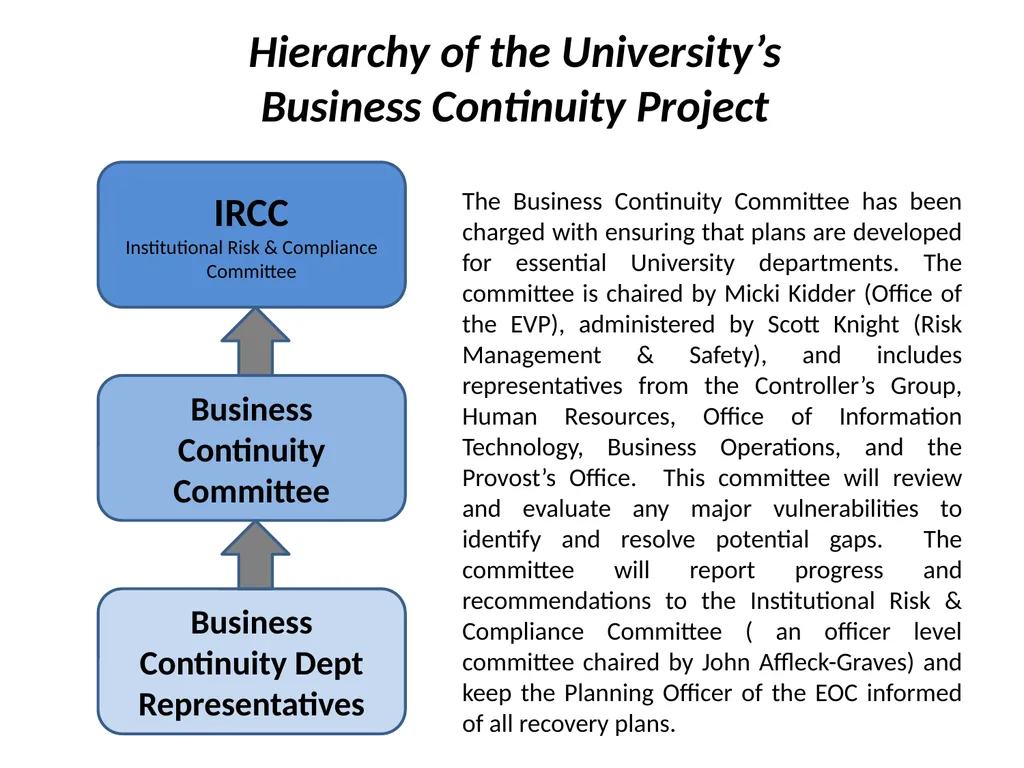
Hierarchy of the University’s
Business Continuity Project IRCC
Institutional Risk & Compliance Committee Business Continuity Committee Business Continuity Dept Representatives The Business Continuity Committee has been charged with ensuring that plans are developed for essential University departments. The committee is chaired by Micki Kidder (Office of the EVP), administered by Scott Knight (Risk Management & Safety), and includes representatives from the Controller’s Group, Human Resources, Office of Information Technology, Business Operations, and the Provost’s Office. This committee will review and evaluate any major vulnerabilities to identify and resolve potential gaps. The committee will report progress and recommendations to the Institutional Risk & Compliance Committee ( an officer level committee chaired by John Affleck-Graves) and keep the Planning Officer of the EOC informed of all recovery plans.<br>
Business Continuity Project IRCC
Institutional Risk & Compliance Committee Business Continuity Committee Business Continuity Dept Representatives The Business Continuity Committee has been charged with ensuring that plans are developed for essential University departments. The committee is chaired by Micki Kidder (Office of the EVP), administered by Scott Knight (Risk Management & Safety), and includes representatives from the Controller’s Group, Human Resources, Office of Information Technology, Business Operations, and the Provost’s Office. This committee will review and evaluate any major vulnerabilities to identify and resolve potential gaps. The committee will report progress and recommendations to the Institutional Risk & Compliance Committee ( an officer level committee chaired by John Affleck-Graves) and keep the Planning Officer of the EOC informed of all recovery plans.<br>
11
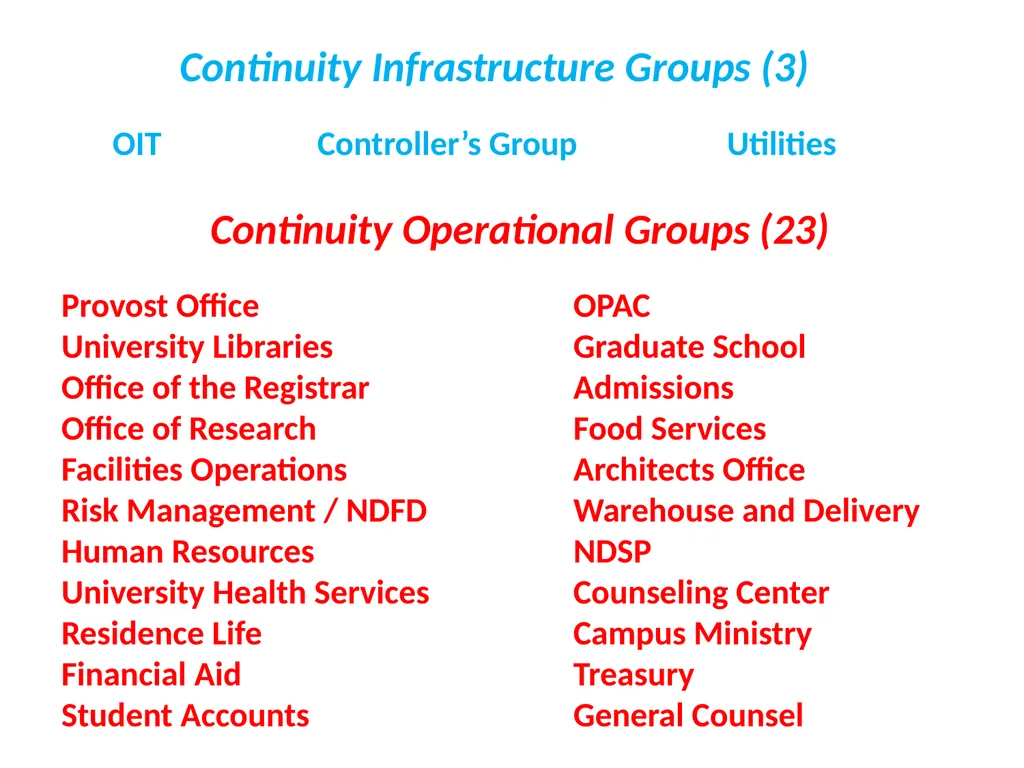
Continuity Infrastructure Groups (3)
OIT Controller’s Group Utilities Continuity Operational Groups (23)
Provost Office OPAC
University Libraries Graduate School
Office of the Registrar Admissions
Office of Research Food Services
Facilities Operations Architects Office
Risk Management / NDFD Warehouse and Delivery
Human Resources NDSP
University Health Services Counseling Center
Residence Life Campus Ministry
Financial Aid Treasury
Student Accounts General Counsel<br>
OIT Controller’s Group Utilities Continuity Operational Groups (23)
Provost Office OPAC
University Libraries Graduate School
Office of the Registrar Admissions
Office of Research Food Services
Facilities Operations Architects Office
Risk Management / NDFD Warehouse and Delivery
Human Resources NDSP
University Health Services Counseling Center
Residence Life Campus Ministry
Financial Aid Treasury
Student Accounts General Counsel<br>
12
Planning Stage
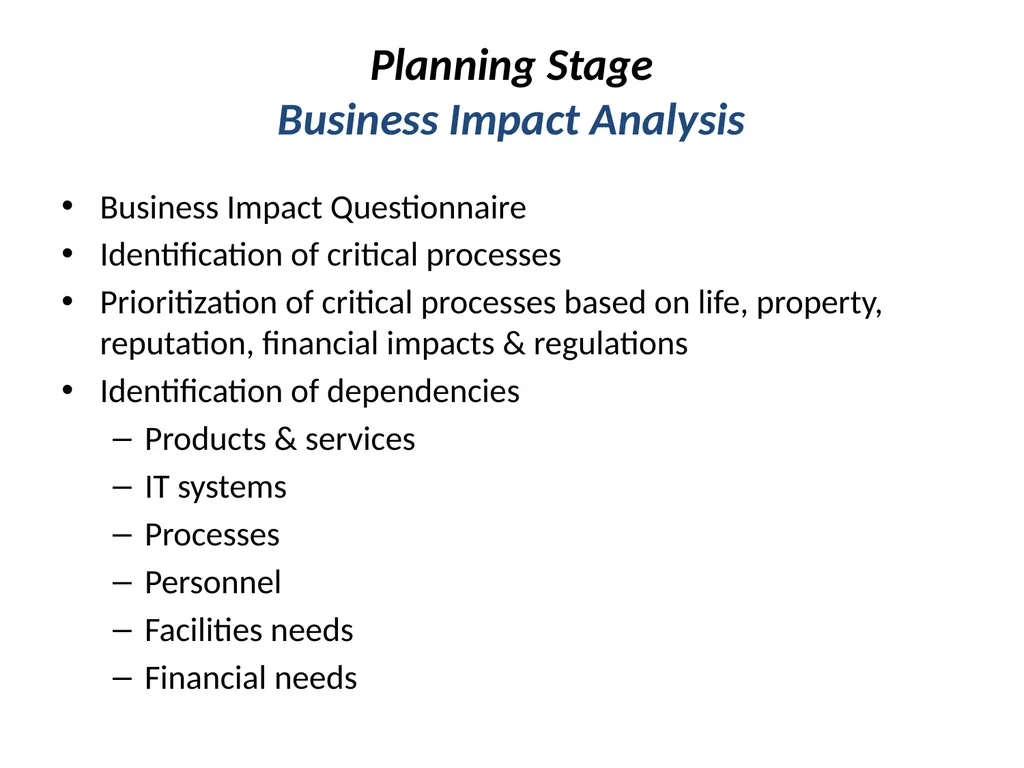
Business Impact Analysis Business Impact Questionnaire
Identification of critical processes
Prioritization of critical processes based on life, property, reputation, financial impacts & regulations
Identification of dependencies
Products & services
IT systems
Processes
Personnel
Facilities needs
Financial needs<br>
Identification of critical processes
Prioritization of critical processes based on life, property, reputation, financial impacts & regulations
Identification of dependencies
Products & services
IT systems
Processes
Personnel
Facilities needs
Financial needs<br>
13
Planning Stage
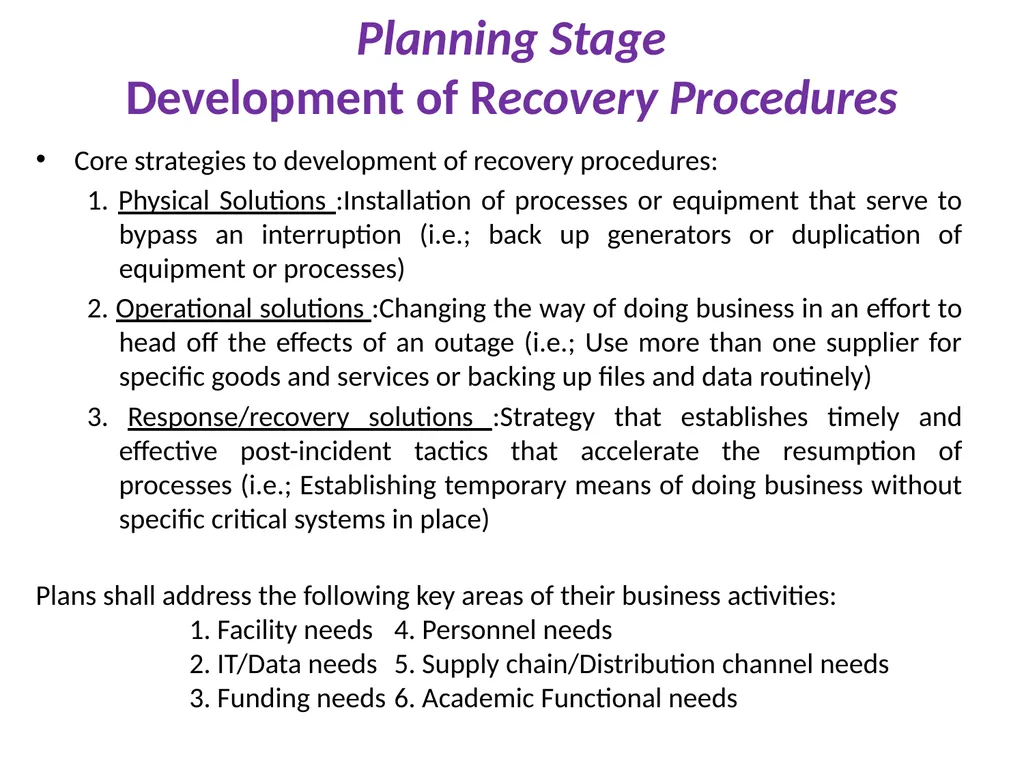
Development of Recovery Procedures Core strategies to development of recovery procedures:
1. Physical Solutions :Installation of processes or equipment that serve to bypass an interruption (i.e.; back up generators or duplication of equipment or processes)
2. Operational solutions :Changing the way of doing business in an effort to head off the effects of an outage (i.e.; Use more than one supplier for specific goods and services or backing up files and data routinely)
3. Response/recovery solutions :Strategy that establishes timely and effective post-incident tactics that accelerate the resumption of processes (i.e.; Establishing temporary means of doing business without specific critical systems in place) Plans shall address the following key areas of their business activities:
1. Facility needs 4. Personnel needs
2. IT/Data needs 5. Supply chain/Distribution channel needs
3. Funding needs 6. Academic Functional needs<br>
1. Physical Solutions :Installation of processes or equipment that serve to bypass an interruption (i.e.; back up generators or duplication of equipment or processes)
2. Operational solutions :Changing the way of doing business in an effort to head off the effects of an outage (i.e.; Use more than one supplier for specific goods and services or backing up files and data routinely)
3. Response/recovery solutions :Strategy that establishes timely and effective post-incident tactics that accelerate the resumption of processes (i.e.; Establishing temporary means of doing business without specific critical systems in place) Plans shall address the following key areas of their business activities:
1. Facility needs 4. Personnel needs
2. IT/Data needs 5. Supply chain/Distribution channel needs
3. Funding needs 6. Academic Functional needs<br>
14
Planning Stage
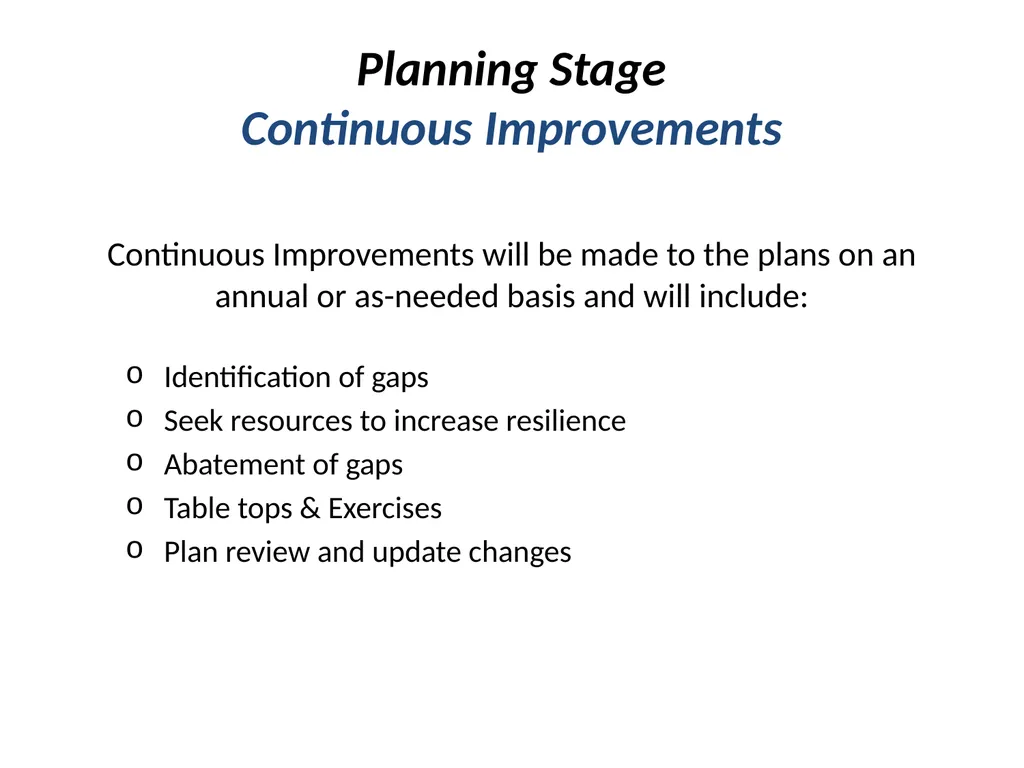
Continuous Improvements Continuous Improvements will be made to the plans on an annual or as-needed basis and will include:
Identification of gaps
Seek resources to increase resilience
Abatement of gaps
Table tops & Exercises
Plan review and update changes<br>
Identification of gaps
Seek resources to increase resilience
Abatement of gaps
Table tops & Exercises
Plan review and update changes<br>
15
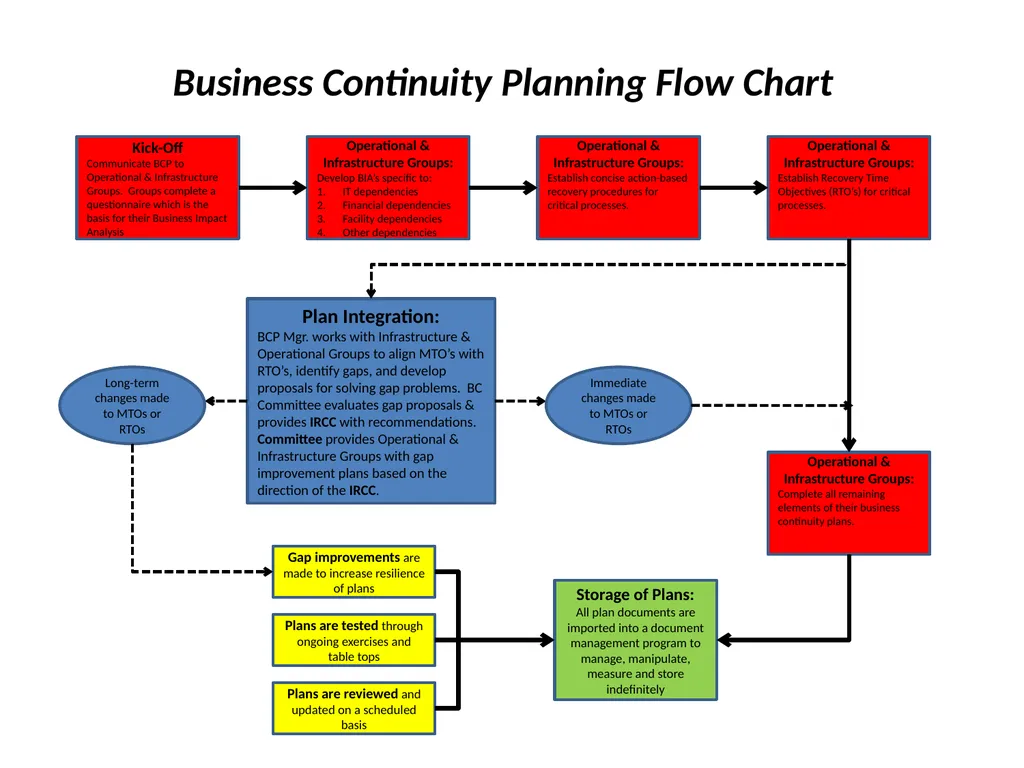
Kick-Off
Communicate BCP to Operational & Infrastructure Groups. Groups complete a questionnaire which is the basis for their Business Impact Analysis Operational & Infrastructure Groups:
Develop BIA’s specific to:
IT dependencies
Financial dependencies
Facility dependencies
Other dependencies Operational & Infrastructure Groups:
Establish concise action-based recovery procedures for critical processes. Operational & Infrastructure Groups:
Establish Recovery Time Objectives (RTO’s) for critical processes. Operational & Infrastructure Groups:
Complete all remaining elements of their business continuity plans. Storage of Plans:
All plan documents are imported into a document management program to manage, manipulate, measure and store indefinitely Plan Integration:
BCP Mgr. works with Infrastructure & Operational Groups to align MTO’s with RTO’s, identify gaps, and develop proposals for solving gap problems. BC Committee evaluates gap proposals & provides IRCC with recommendations. Committee provides Operational & Infrastructure Groups with gap improvement plans based on the direction of the IRCC. Gap improvements are made to increase resilience of plans Plans are tested through ongoing exercises and table tops Plans are reviewed and updated on a scheduled basis Immediate changes made to MTOs or RTOs Long-term changes made to MTOs or RTOs Business Continuity Planning Flow Chart<br>
Communicate BCP to Operational & Infrastructure Groups. Groups complete a questionnaire which is the basis for their Business Impact Analysis Operational & Infrastructure Groups:
Develop BIA’s specific to:
IT dependencies
Financial dependencies
Facility dependencies
Other dependencies Operational & Infrastructure Groups:
Establish concise action-based recovery procedures for critical processes. Operational & Infrastructure Groups:
Establish Recovery Time Objectives (RTO’s) for critical processes. Operational & Infrastructure Groups:
Complete all remaining elements of their business continuity plans. Storage of Plans:
All plan documents are imported into a document management program to manage, manipulate, measure and store indefinitely Plan Integration:
BCP Mgr. works with Infrastructure & Operational Groups to align MTO’s with RTO’s, identify gaps, and develop proposals for solving gap problems. BC Committee evaluates gap proposals & provides IRCC with recommendations. Committee provides Operational & Infrastructure Groups with gap improvement plans based on the direction of the IRCC. Gap improvements are made to increase resilience of plans Plans are tested through ongoing exercises and table tops Plans are reviewed and updated on a scheduled basis Immediate changes made to MTOs or RTOs Long-term changes made to MTOs or RTOs Business Continuity Planning Flow Chart<br>
16
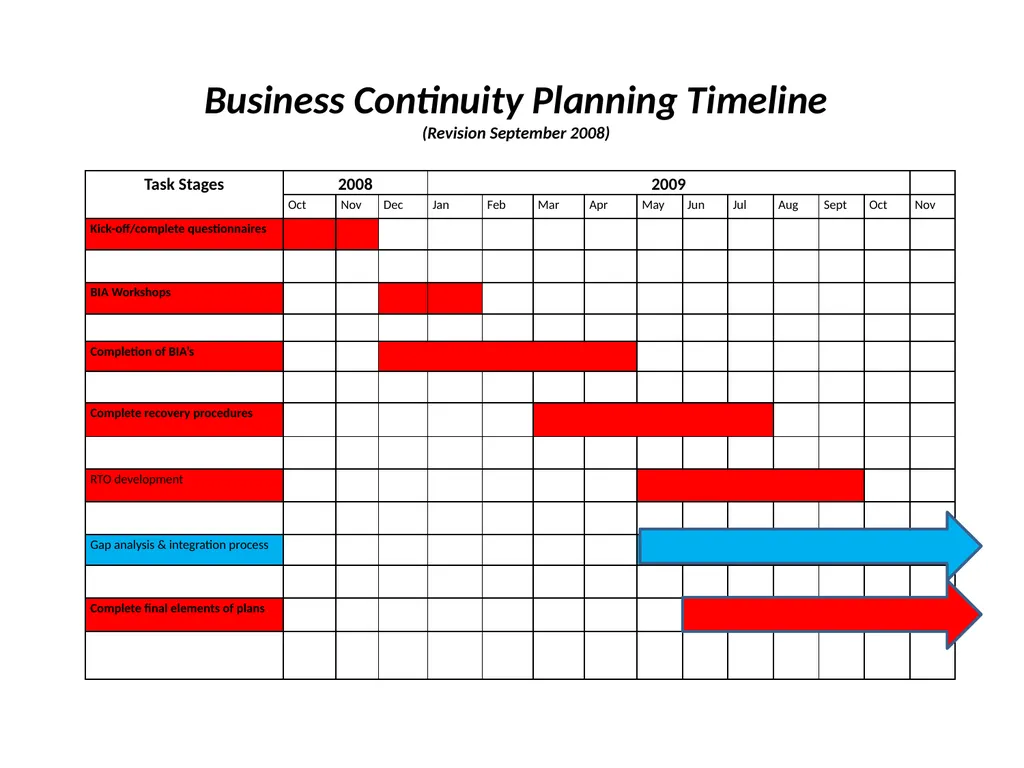
Business Continuity Planning Timeline
(Revision September 2008)<br>
(Revision September 2008)<br>
17
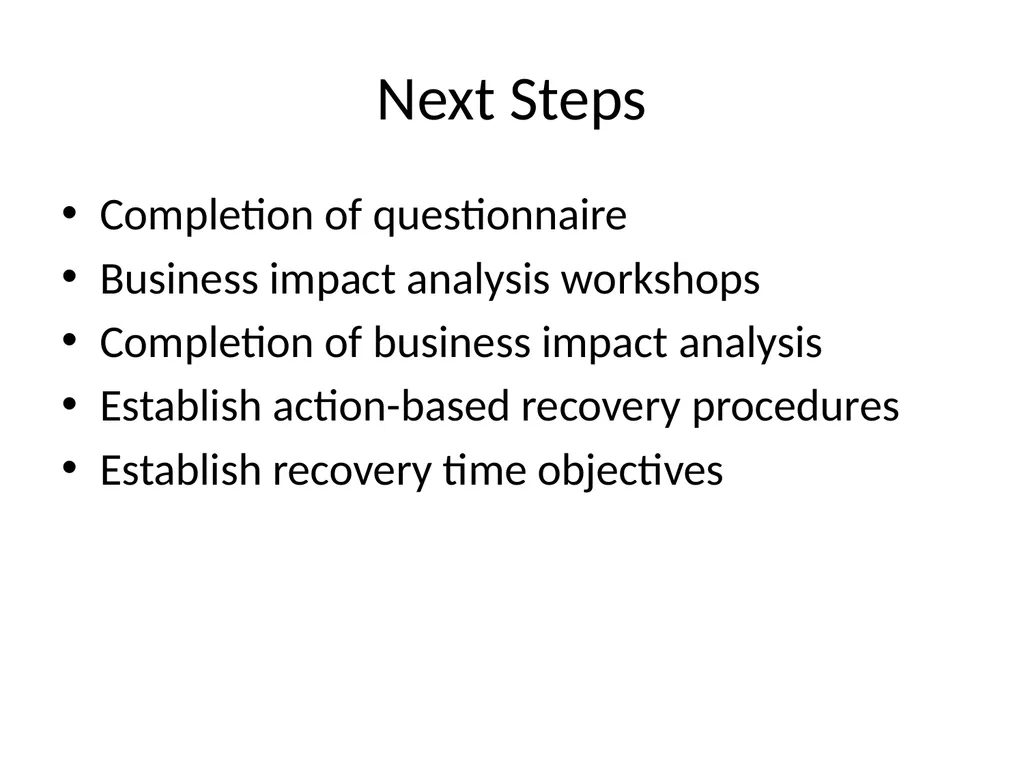
Next Steps Completion of questionnaire
Business impact analysis workshops
Completion of business impact analysis
Establish action-based recovery procedures
Establish recovery time objectives<br>
Business impact analysis workshops
Completion of business impact analysis
Establish action-based recovery procedures
Establish recovery time objectives<br>
18
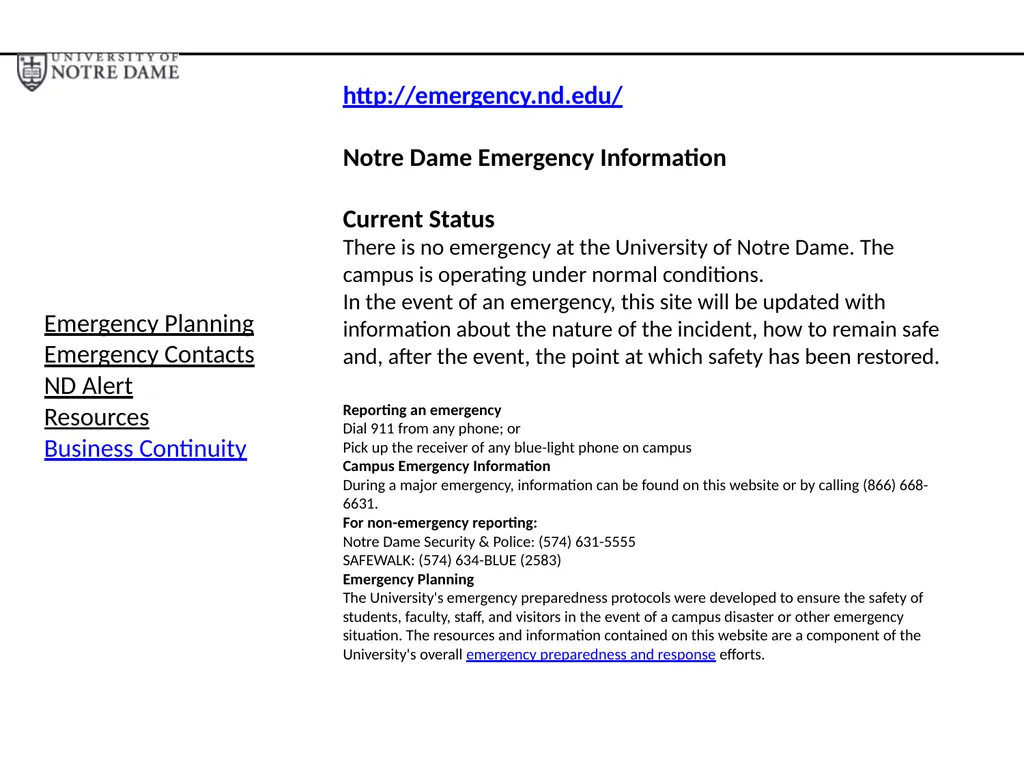
http://emergency.nd.edu/
Notre Dame Emergency Information
Current Status
There is no emergency at the University of Notre Dame. The campus is operating under normal conditions.
In the event of an emergency, this site will be updated with information about the nature of the incident, how to remain safe and, after the event, the point at which safety has been restored.
Reporting an emergency
Dial 911 from any phone; or
Pick up the receiver of any blue-light phone on campus
Campus Emergency Information
During a major emergency, information can be found on this website or by calling (866) 668-6631.
For non-emergency reporting:
Notre Dame Security & Police: (574) 631-5555
SAFEWALK: (574) 634-BLUE (2583)
Emergency Planning
The University's emergency preparedness protocols were developed to ensure the safety of students, faculty, staff, and visitors in the event of a campus disaster or other emergency situation. The resources and information contained on this website are a component of the University's overall emergency preparedness and response efforts. Emergency Planning
Emergency Contacts
ND Alert
Resources
Business Continuity<br>
Notre Dame Emergency Information
Current Status
There is no emergency at the University of Notre Dame. The campus is operating under normal conditions.
In the event of an emergency, this site will be updated with information about the nature of the incident, how to remain safe and, after the event, the point at which safety has been restored.
Reporting an emergency
Dial 911 from any phone; or
Pick up the receiver of any blue-light phone on campus
Campus Emergency Information
During a major emergency, information can be found on this website or by calling (866) 668-6631.
For non-emergency reporting:
Notre Dame Security & Police: (574) 631-5555
SAFEWALK: (574) 634-BLUE (2583)
Emergency Planning
The University's emergency preparedness protocols were developed to ensure the safety of students, faculty, staff, and visitors in the event of a campus disaster or other emergency situation. The resources and information contained on this website are a component of the University's overall emergency preparedness and response efforts. Emergency Planning
Emergency Contacts
ND Alert
Resources
Business Continuity<br>
19
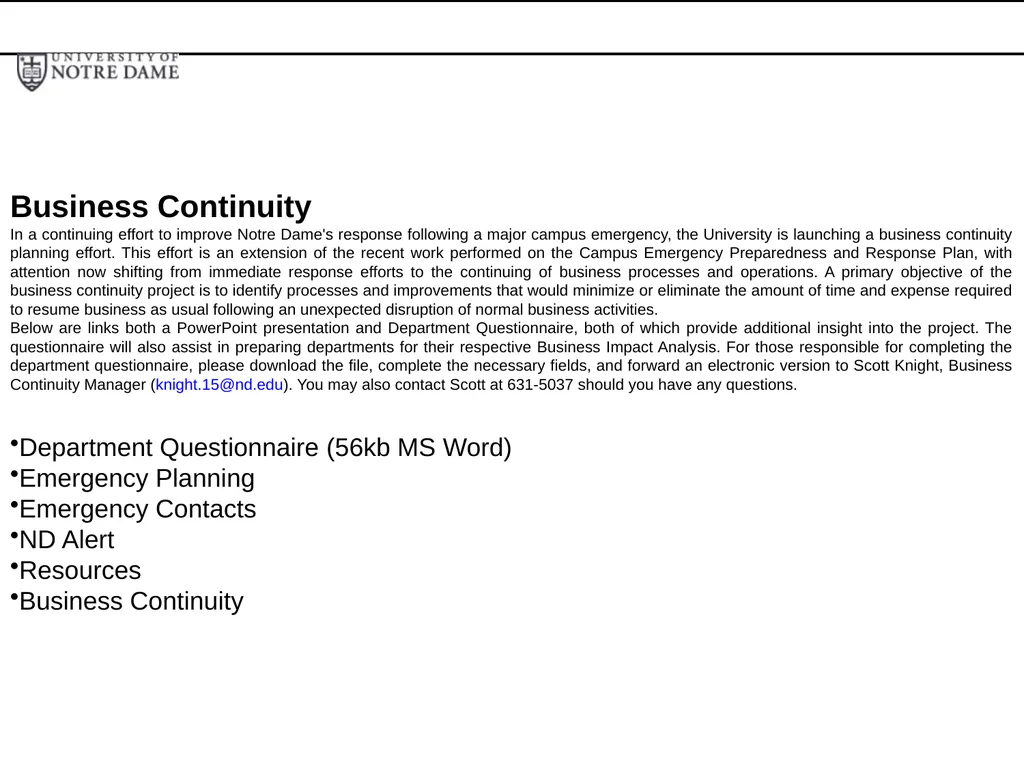
Business Continuity
In a continuing effort to improve Notre Dame's response following a major campus emergency, the University is launching a business continuity planning effort. This effort is an extension of the recent work performed on the Campus Emergency Preparedness and Response Plan, with attention now shifting from immediate response efforts to the continuing of business processes and operations. A primary objective of the business continuity project is to identify processes and improvements that would minimize or eliminate the amount of time and expense required to resume business as usual following an unexpected disruption of normal business activities.
Below are links both a PowerPoint presentation and Department Questionnaire, both of which provide additional insight into the project. The questionnaire will also assist in preparing departments for their respective Business Impact Analysis. For those responsible for completing the department questionnaire, please download the file, complete the necessary fields, and forward an electronic version to Scott Knight, Business Continuity Manager (knight.15@nd.edu). You may also contact Scott at 631-5037 should you have any questions.
Department Questionnaire (56kb MS Word)
Emergency Planning
Emergency Contacts
ND Alert
Resources
Business Continuity<br>
In a continuing effort to improve Notre Dame's response following a major campus emergency, the University is launching a business continuity planning effort. This effort is an extension of the recent work performed on the Campus Emergency Preparedness and Response Plan, with attention now shifting from immediate response efforts to the continuing of business processes and operations. A primary objective of the business continuity project is to identify processes and improvements that would minimize or eliminate the amount of time and expense required to resume business as usual following an unexpected disruption of normal business activities.
Below are links both a PowerPoint presentation and Department Questionnaire, both of which provide additional insight into the project. The questionnaire will also assist in preparing departments for their respective Business Impact Analysis. For those responsible for completing the department questionnaire, please download the file, complete the necessary fields, and forward an electronic version to Scott Knight, Business Continuity Manager (knight.15@nd.edu). You may also contact Scott at 631-5037 should you have any questions.
Department Questionnaire (56kb MS Word)
Emergency Planning
Emergency Contacts
ND Alert
Resources
Business Continuity<br>
20
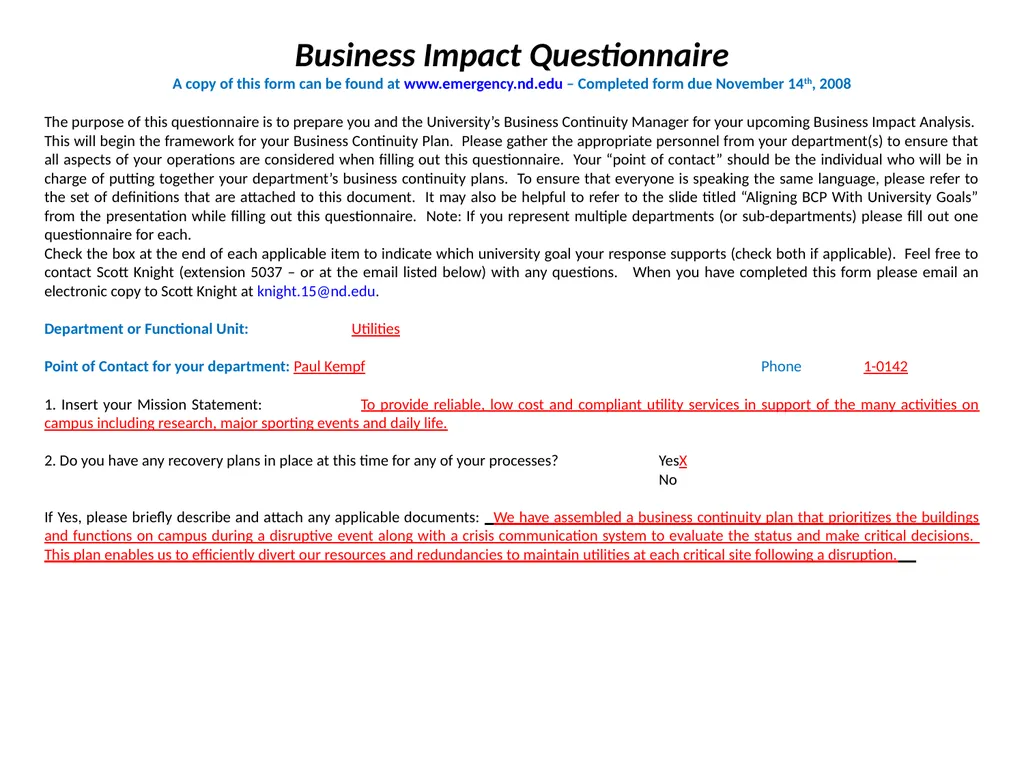
Business Impact Questionnaire
A copy of this form can be found at www.emergency.nd.edu – Completed form due November 14th, 2008
The purpose of this questionnaire is to prepare you and the University’s Business Continuity Manager for your upcoming Business Impact Analysis. This will begin the framework for your Business Continuity Plan. Please gather the appropriate personnel from your department(s) to ensure that all aspects of your operations are considered when filling out this questionnaire. Your “point of contact” should be the individual who will be in charge of putting together your department’s business continuity plans. To ensure that everyone is speaking the same language, please refer to the set of definitions that are attached to this document. It may also be helpful to refer to the slide titled “Aligning BCP With University Goals” from the presentation while filling out this questionnaire. Note: If you represent multiple departments (or sub-departments) please fill out one questionnaire for each.
Check the box at the end of each applicable item to indicate which university goal your response supports (check both if applicable). Feel free to contact Scott Knight (extension 5037 – or at the email listed below) with any questions. When you have completed this form please email an electronic copy to Scott Knight at knight.15@nd.edu.
Department or Functional Unit: Utilities
Point of Contact for your department: Paul Kempf Phone 1-0142
1. Insert your Mission Statement: To provide reliable, low cost and compliant utility services in support of the many activities on campus including research, major sporting events and daily life.
2. Do you have any recovery plans in place at this time for any of your processes? YesX
No
If Yes, please briefly describe and attach any applicable documents: We have assembled a business continuity plan that prioritizes the buildings and functions on campus during a disruptive event along with a crisis communication system to evaluate the status and make critical decisions. This plan enables us to efficiently divert our resources and redundancies to maintain utilities at each critical site following a disruption.<br>
A copy of this form can be found at www.emergency.nd.edu – Completed form due November 14th, 2008
The purpose of this questionnaire is to prepare you and the University’s Business Continuity Manager for your upcoming Business Impact Analysis. This will begin the framework for your Business Continuity Plan. Please gather the appropriate personnel from your department(s) to ensure that all aspects of your operations are considered when filling out this questionnaire. Your “point of contact” should be the individual who will be in charge of putting together your department’s business continuity plans. To ensure that everyone is speaking the same language, please refer to the set of definitions that are attached to this document. It may also be helpful to refer to the slide titled “Aligning BCP With University Goals” from the presentation while filling out this questionnaire. Note: If you represent multiple departments (or sub-departments) please fill out one questionnaire for each.
Check the box at the end of each applicable item to indicate which university goal your response supports (check both if applicable). Feel free to contact Scott Knight (extension 5037 – or at the email listed below) with any questions. When you have completed this form please email an electronic copy to Scott Knight at knight.15@nd.edu.
Department or Functional Unit: Utilities
Point of Contact for your department: Paul Kempf Phone 1-0142
1. Insert your Mission Statement: To provide reliable, low cost and compliant utility services in support of the many activities on campus including research, major sporting events and daily life.
2. Do you have any recovery plans in place at this time for any of your processes? YesX
No
If Yes, please briefly describe and attach any applicable documents: We have assembled a business continuity plan that prioritizes the buildings and functions on campus during a disruptive event along with a crisis communication system to evaluate the status and make critical decisions. This plan enables us to efficiently divert our resources and redundancies to maintain utilities at each critical site following a disruption.<br>
21
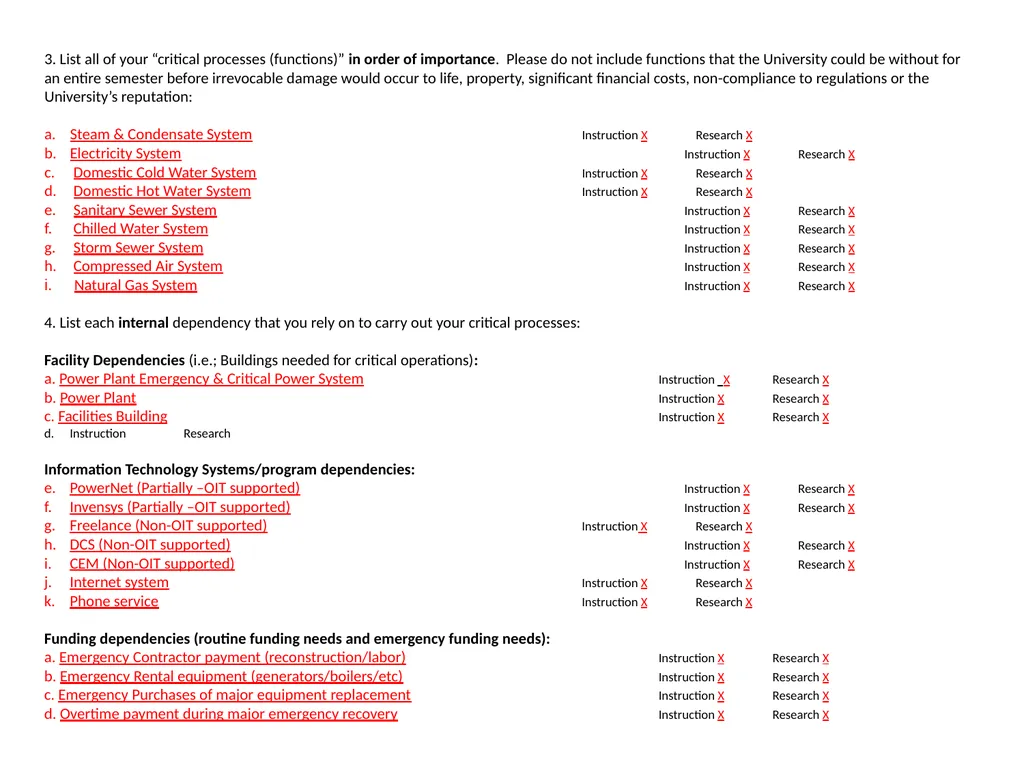
3. List all of your “critical processes (functions)” in order of importance. Please do not include functions that the University could be without for an entire semester before irrevocable damage would occur to life, property, significant financial costs, non-compliance to regulations or the University’s reputation:
Steam & Condensate System Instruction X Research X
Electricity System Instruction X Research X
Domestic Cold Water System Instruction X Research X
Domestic Hot Water System Instruction X Research X
Sanitary Sewer System Instruction X Research X
Chilled Water System Instruction X Research X
Storm Sewer System Instruction X Research X
Compressed Air System Instruction X Research X
Natural Gas System Instruction X Research X 4. List each internal dependency that you rely on to carry out your critical processes:
Facility Dependencies (i.e.; Buildings needed for critical operations):
a. Power Plant Emergency & Critical Power System Instruction X Research X
b. Power Plant Instruction X Research X
c. Facilities Building Instruction X Research X
Instruction Research
Information Technology Systems/program dependencies:
PowerNet (Partially –OIT supported) Instruction X Research X
Invensys (Partially –OIT supported) Instruction X Research X
Freelance (Non-OIT supported) Instruction X Research X
DCS (Non-OIT supported) Instruction X Research X
CEM (Non-OIT supported) Instruction X Research X
Internet system Instruction X Research X
Phone service Instruction X Research X
Funding dependencies (routine funding needs and emergency funding needs):
a. Emergency Contractor payment (reconstruction/labor) Instruction X Research X
b. Emergency Rental equipment (generators/boilers/etc) Instruction X Research X
c. Emergency Purchases of major equipment replacement Instruction X Research X
d. Overtime payment during major emergency recovery Instruction X Research X<br>
Steam & Condensate System Instruction X Research X
Electricity System Instruction X Research X
Domestic Cold Water System Instruction X Research X
Domestic Hot Water System Instruction X Research X
Sanitary Sewer System Instruction X Research X
Chilled Water System Instruction X Research X
Storm Sewer System Instruction X Research X
Compressed Air System Instruction X Research X
Natural Gas System Instruction X Research X 4. List each internal dependency that you rely on to carry out your critical processes:
Facility Dependencies (i.e.; Buildings needed for critical operations):
a. Power Plant Emergency & Critical Power System Instruction X Research X
b. Power Plant Instruction X Research X
c. Facilities Building Instruction X Research X
Instruction Research
Information Technology Systems/program dependencies:
PowerNet (Partially –OIT supported) Instruction X Research X
Invensys (Partially –OIT supported) Instruction X Research X
Freelance (Non-OIT supported) Instruction X Research X
DCS (Non-OIT supported) Instruction X Research X
CEM (Non-OIT supported) Instruction X Research X
Internet system Instruction X Research X
Phone service Instruction X Research X
Funding dependencies (routine funding needs and emergency funding needs):
a. Emergency Contractor payment (reconstruction/labor) Instruction X Research X
b. Emergency Rental equipment (generators/boilers/etc) Instruction X Research X
c. Emergency Purchases of major equipment replacement Instruction X Research X
d. Overtime payment during major emergency recovery Instruction X Research X<br>
22
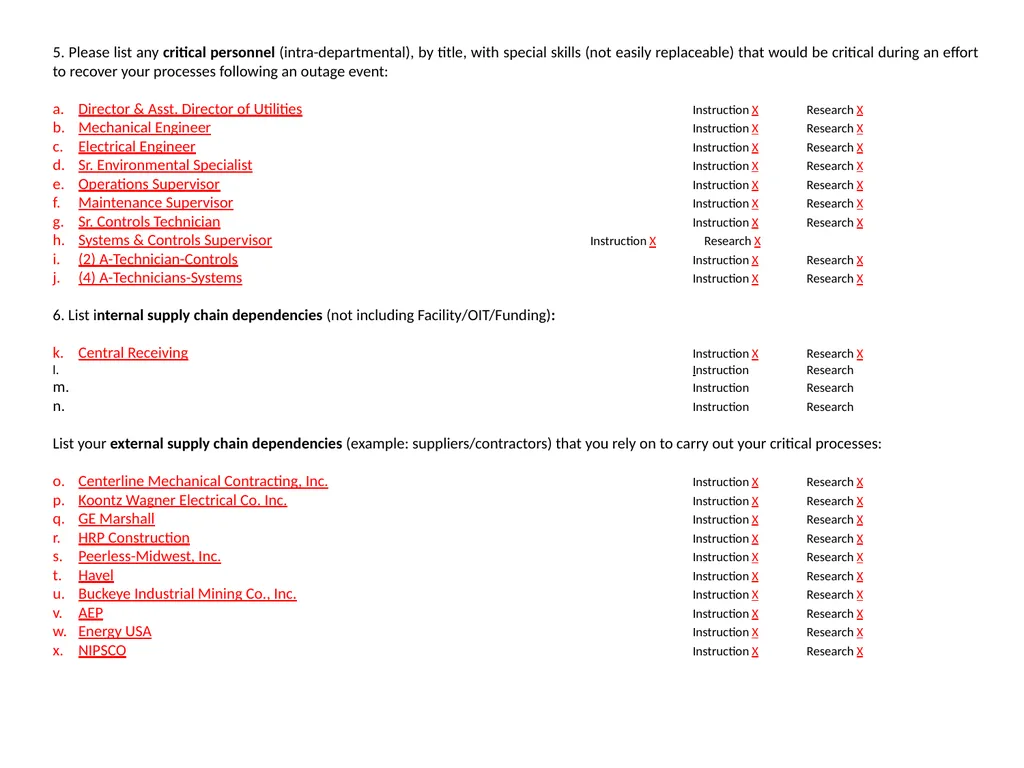
5. Please list any critical personnel (intra-departmental), by title, with special skills (not easily replaceable) that would be critical during an effort to recover your processes following an outage event:
Director & Asst. Director of Utilities Instruction X Research X
Mechanical Engineer Instruction X Research X
Electrical Engineer Instruction X Research X
Sr. Environmental Specialist Instruction X Research X
Operations Supervisor Instruction X Research X
Maintenance Supervisor Instruction X Research X
Sr. Controls Technician Instruction X Research X
Systems & Controls Supervisor Instruction X Research X
(2) A-Technician-Controls Instruction X Research X
(4) A-Technicians-Systems Instruction X Research X
6. List internal supply chain dependencies (not including Facility/OIT/Funding):
Central Receiving Instruction X Research X
Instruction Research
Instruction Research
Instruction Research
List your external supply chain dependencies (example: suppliers/contractors) that you rely on to carry out your critical processes:
Centerline Mechanical Contracting, Inc. Instruction X Research X
Koontz Wagner Electrical Co. Inc. Instruction X Research X
GE Marshall Instruction X Research X
HRP Construction Instruction X Research X
Peerless-Midwest, Inc. Instruction X Research X
Havel Instruction X Research X
Buckeye Industrial Mining Co., Inc. Instruction X Research X
AEP Instruction X Research X
Energy USA Instruction X Research X
NIPSCO Instruction X Research X<br>
Director & Asst. Director of Utilities Instruction X Research X
Mechanical Engineer Instruction X Research X
Electrical Engineer Instruction X Research X
Sr. Environmental Specialist Instruction X Research X
Operations Supervisor Instruction X Research X
Maintenance Supervisor Instruction X Research X
Sr. Controls Technician Instruction X Research X
Systems & Controls Supervisor Instruction X Research X
(2) A-Technician-Controls Instruction X Research X
(4) A-Technicians-Systems Instruction X Research X
6. List internal supply chain dependencies (not including Facility/OIT/Funding):
Central Receiving Instruction X Research X
Instruction Research
Instruction Research
Instruction Research
List your external supply chain dependencies (example: suppliers/contractors) that you rely on to carry out your critical processes:
Centerline Mechanical Contracting, Inc. Instruction X Research X
Koontz Wagner Electrical Co. Inc. Instruction X Research X
GE Marshall Instruction X Research X
HRP Construction Instruction X Research X
Peerless-Midwest, Inc. Instruction X Research X
Havel Instruction X Research X
Buckeye Industrial Mining Co., Inc. Instruction X Research X
AEP Instruction X Research X
Energy USA Instruction X Research X
NIPSCO Instruction X Research X<br>
23
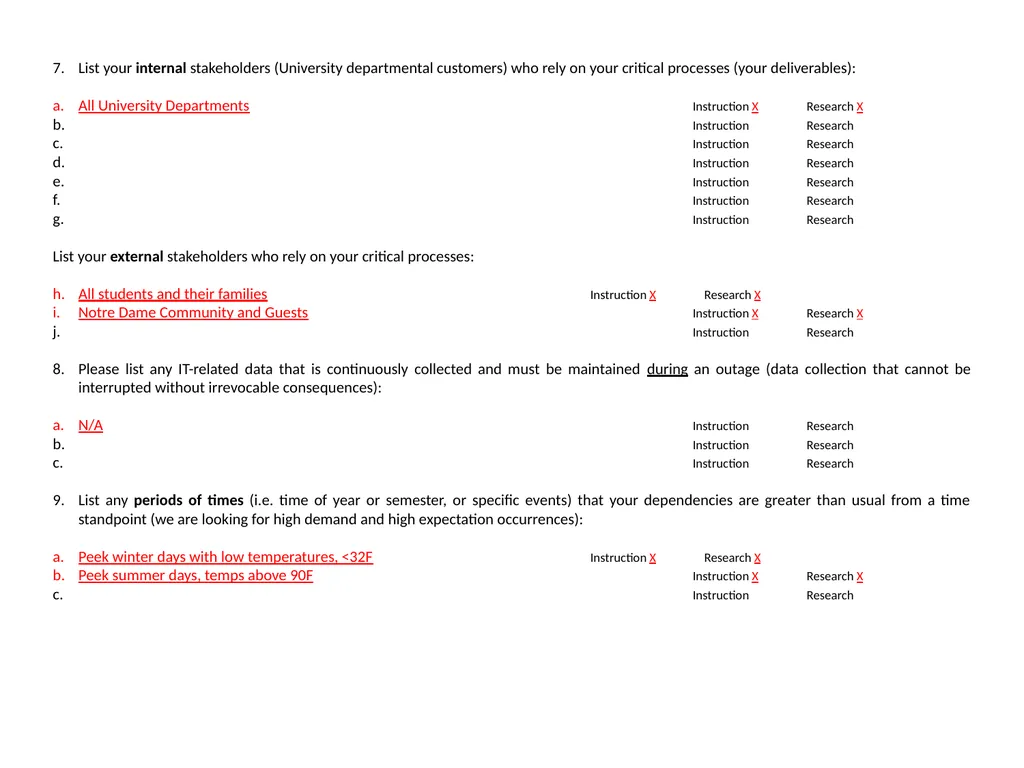
List your internal stakeholders (University departmental customers) who rely on your critical processes (your deliverables):
All University Departments Instruction X Research X
Instruction Research
Instruction Research
Instruction Research
Instruction Research
Instruction Research
Instruction Research
List your external stakeholders who rely on your critical processes:
All students and their families Instruction X Research X
Notre Dame Community and Guests Instruction X Research X
Instruction Research
Please list any IT-related data that is continuously collected and must be maintained during an outage (data collection that cannot be interrupted without irrevocable consequences):
N/A Instruction Research
Instruction Research
Instruction Research
List any periods of times (i.e. time of year or semester, or specific events) that your dependencies are greater than usual from a time standpoint (we are looking for high demand and high expectation occurrences):
Peek winter days with low temperatures, <32F Instruction X Research X
Peek summer days, temps above 90F Instruction X Research X
Instruction Research<br>
All University Departments Instruction X Research X
Instruction Research
Instruction Research
Instruction Research
Instruction Research
Instruction Research
Instruction Research
List your external stakeholders who rely on your critical processes:
All students and their families Instruction X Research X
Notre Dame Community and Guests Instruction X Research X
Instruction Research
Please list any IT-related data that is continuously collected and must be maintained during an outage (data collection that cannot be interrupted without irrevocable consequences):
N/A Instruction Research
Instruction Research
Instruction Research
List any periods of times (i.e. time of year or semester, or specific events) that your dependencies are greater than usual from a time standpoint (we are looking for high demand and high expectation occurrences):
Peek winter days with low temperatures, <32F Instruction X Research X
Peek summer days, temps above 90F Instruction X Research X
Instruction Research<br>
24
Applicable Terminology
Business Continuity: The ability of an organization to provide service and support for its customers and to maintain its viability before, during, and after an interruption of normal processes.
Business Continuity Plan: Process of developing and documenting arrangements and procedures that enable the institution to respond to an event that lasts for an unacceptable period of time and return to performing its critical functions after an interruption.
Business Impact Analysis: A process designed to prioritize business functions by assessing the potential quantitative (financial) and Qualitative (non-financial) impact that might result if the University was to experience a business interruption.
Critical Processes/ Functions: The critical operational and/or business support functions that could not be interrupted or unavailable for more than a mandated or pre-determined timeframe without significantly jeopardizing the University’s ability to provide research and instruction.
Dependency: The reliance or interaction of one activity or process upon another.
Event: Any occurrence that may lead to a business continuity incident.
Impact: The effect, acceptable or unacceptable, of an event on the University.
Loss: Unrecoverable resources that are redirected or removed as a result of an event.
Outage: The interruption of automated processing systems, infrastructure, support services, or essential business operations, which may result, in the University’s inability to provide services for some period of time.
Prioritization: The ordering of critical processes and their dependencies established during the Business Impact Analysis phase. The business continuity plans will be implemented in the order necessary at the time of the event.
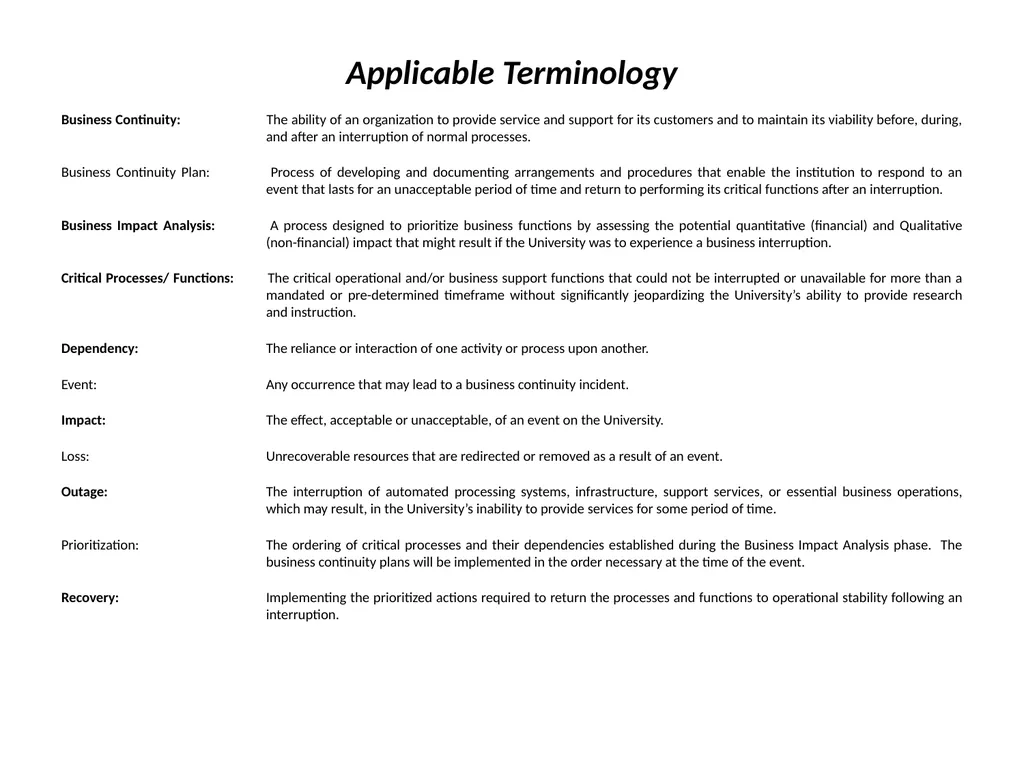
Recovery: Implementing the prioritized actions required to return the processes and functions to operational stability following an interruption.<br>
Business Continuity: The ability of an organization to provide service and support for its customers and to maintain its viability before, during, and after an interruption of normal processes.
Business Continuity Plan: Process of developing and documenting arrangements and procedures that enable the institution to respond to an event that lasts for an unacceptable period of time and return to performing its critical functions after an interruption.
Business Impact Analysis: A process designed to prioritize business functions by assessing the potential quantitative (financial) and Qualitative (non-financial) impact that might result if the University was to experience a business interruption.
Critical Processes/ Functions: The critical operational and/or business support functions that could not be interrupted or unavailable for more than a mandated or pre-determined timeframe without significantly jeopardizing the University’s ability to provide research and instruction.
Dependency: The reliance or interaction of one activity or process upon another.
Event: Any occurrence that may lead to a business continuity incident.
Impact: The effect, acceptable or unacceptable, of an event on the University.
Loss: Unrecoverable resources that are redirected or removed as a result of an event.
Outage: The interruption of automated processing systems, infrastructure, support services, or essential business operations, which may result, in the University’s inability to provide services for some period of time.
Prioritization: The ordering of critical processes and their dependencies established during the Business Impact Analysis phase. The business continuity plans will be implemented in the order necessary at the time of the event.
Recovery: Implementing the prioritized actions required to return the processes and functions to operational stability following an interruption.<br>