
Business Data Analytics and CRM— Customer
AS
Published · 36 slides · 0 views
1 / 1
Description
Business Data Analytics and CRM Customer Relationship Management 10 CYCU Prof. CK Farn mailto: ckfarngmail.com http:www.mgt.ncu.edu.twckfarncycu 2025.05 Rev CYCY Prof CK Farn 1 Agenda CRM: Customer Relationship Management Sales
Related Topics
Share
Embed code
Download this presentation From Below
"Business Data Analytics and CRM— Customer" is the property of its rightful owner. Permission is granted to download and print the materials on this website for personal, non-commercial use only, and to display it on your personal computer provided you do not modify the materials and that you retain all copyright notices contained in the materials. By downloading content from our website, you accept the terms of this agreement.
Presentation Transcript
01
Business Data Analytics and CRM—
Customer Relationship Management 10 CYCU
Prof. CK Farn
mailto: ckfarn@gmail.com
http://www.mgt.ncu.edu.tw/~ckfarn/cycu
2025.05 Rev CYCY— Prof CK Farn 1<br>
Prof. CK Farn
mailto: ckfarn@gmail.com
http://www.mgt.ncu.edu.tw/~ckfarn/cycu
2025.05 Rev CYCY— Prof CK Farn 1<br>
02
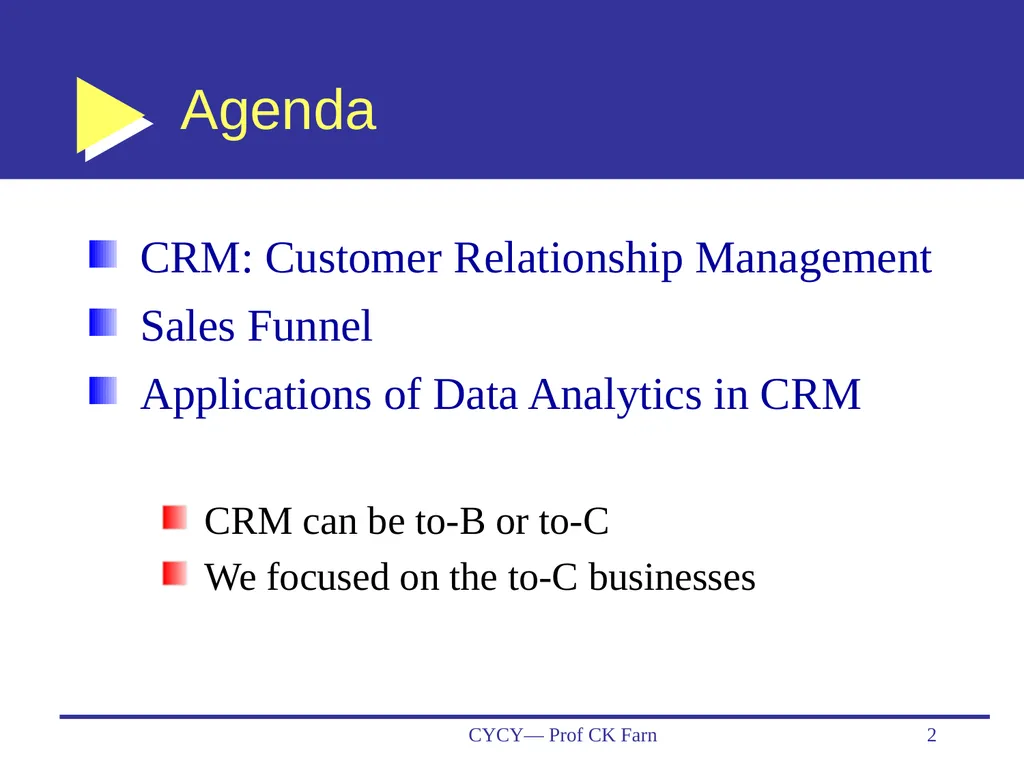
Agenda CRM: Customer Relationship Management
Sales Funnel
Applications of Data Analytics in CRM
CRM can be to-B or to-C
We focused on the to-C businesses CYCY— Prof CK Farn 2<br>
Sales Funnel
Applications of Data Analytics in CRM
CRM can be to-B or to-C
We focused on the to-C businesses CYCY— Prof CK Farn 2<br>
03
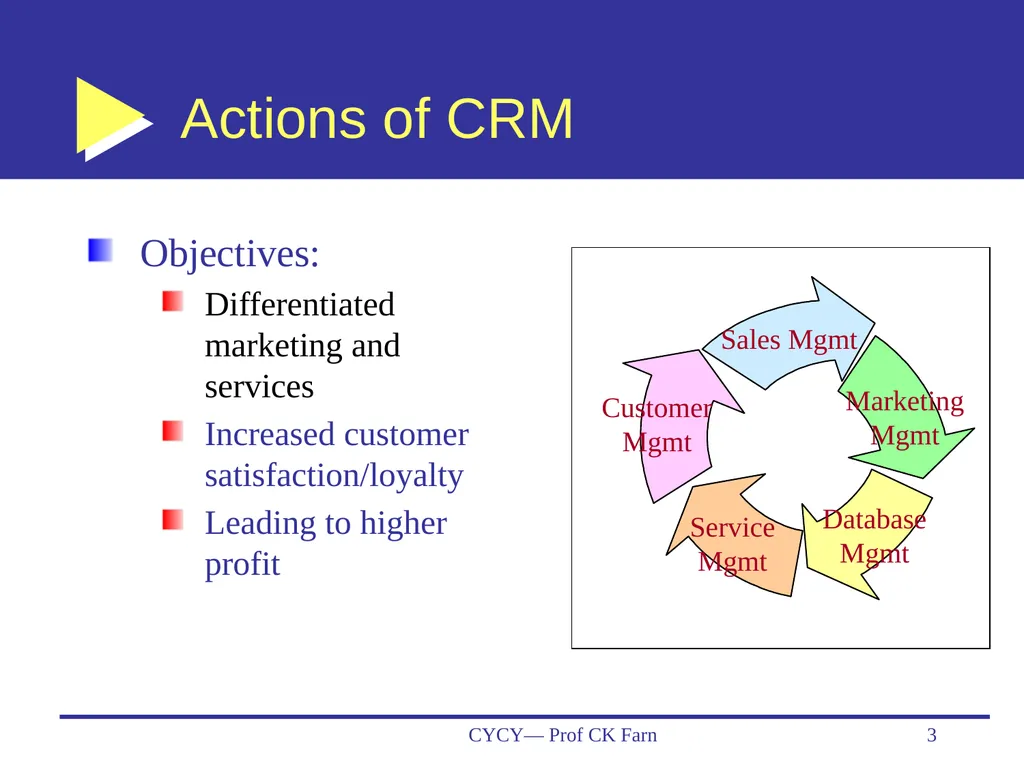
CYCY— Prof CK Farn 3 Actions of CRM Objectives:
Differentiated marketing and services
Increased customer satisfaction/loyalty
Leading to higher profit Sales Mgmt Database
Mgmt Marketing Mgmt Service Mgmt Customer
Mgmt<br>
Differentiated marketing and services
Increased customer satisfaction/loyalty
Leading to higher profit Sales Mgmt Database
Mgmt Marketing Mgmt Service Mgmt Customer
Mgmt<br>
04
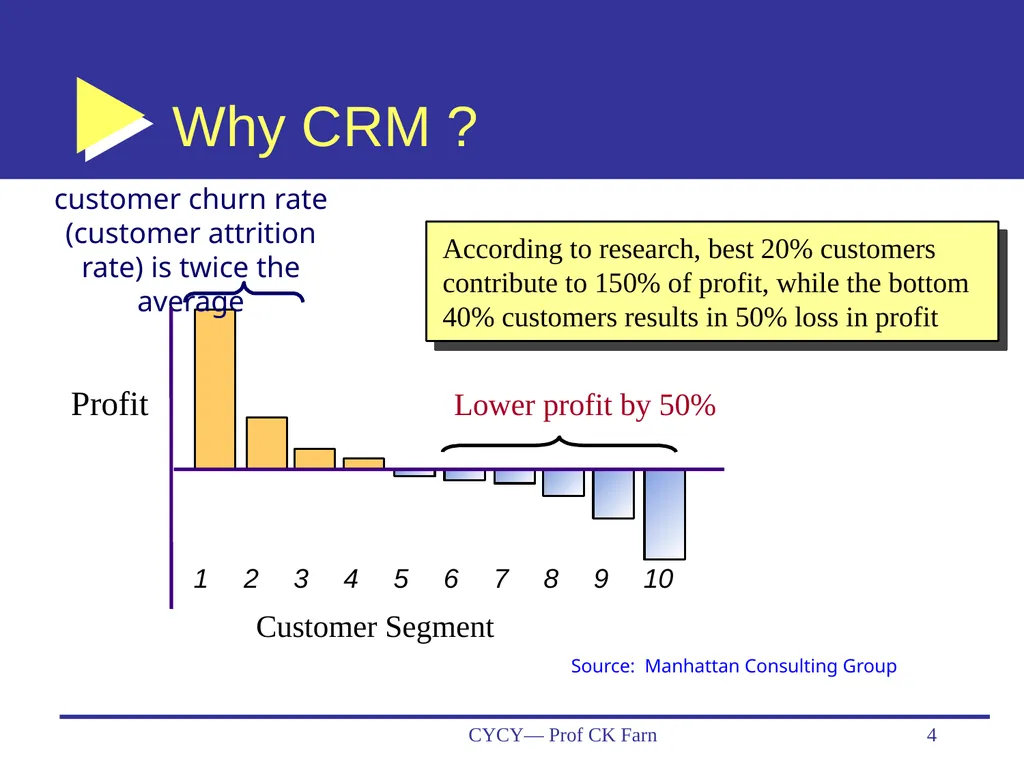
CYCY— Prof CK Farn 4 Customer Segment customer churn rate (customer attrition rate) is twice the average Lower profit by 50% Source: Manhattan Consulting Group Why CRM ? Profit<br>
05
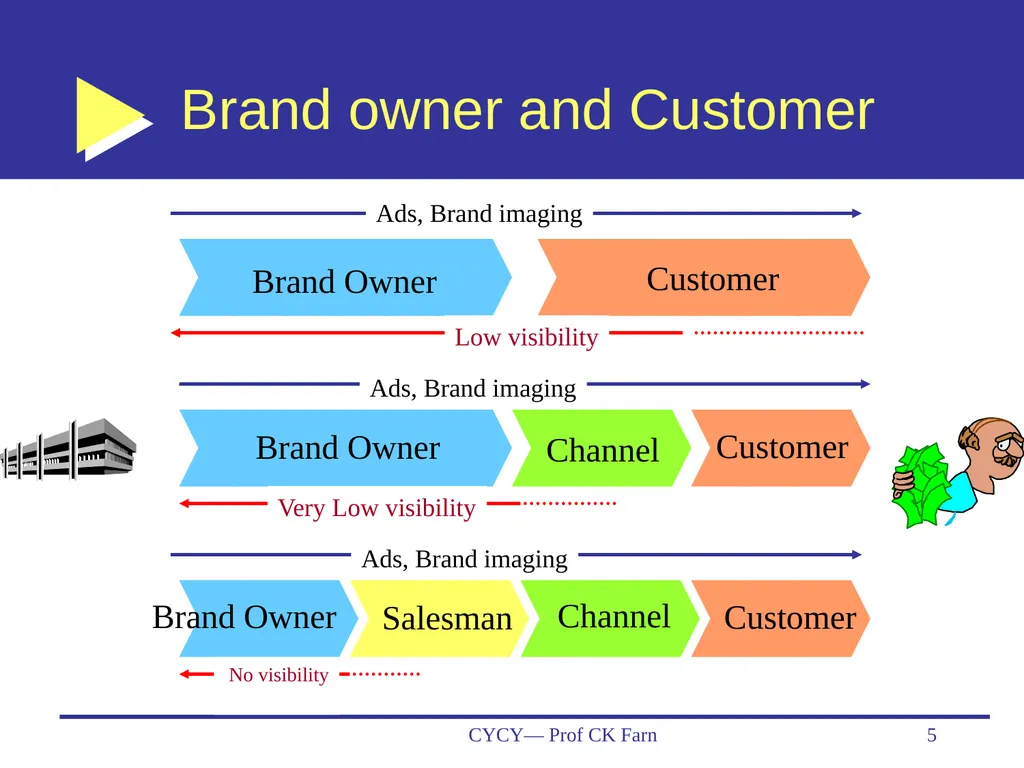
CYCY— Prof CK Farn 5 Brand owner and Customer Brand Owner Brand Owner Brand Owner Customer Customer Customer Channel Channel Salesman<br>
06
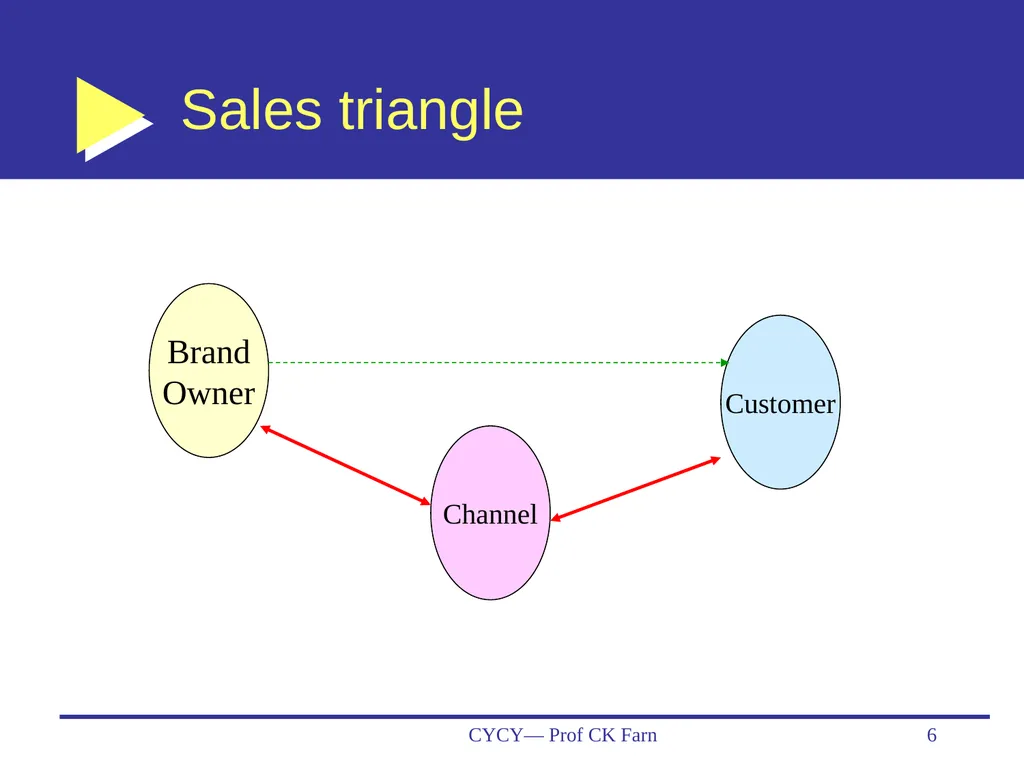
CYCY— Prof CK Farn 6 Sales triangle<br>
07
CYCY— Prof CK Farn 7 Do you know your customers?<br>
08
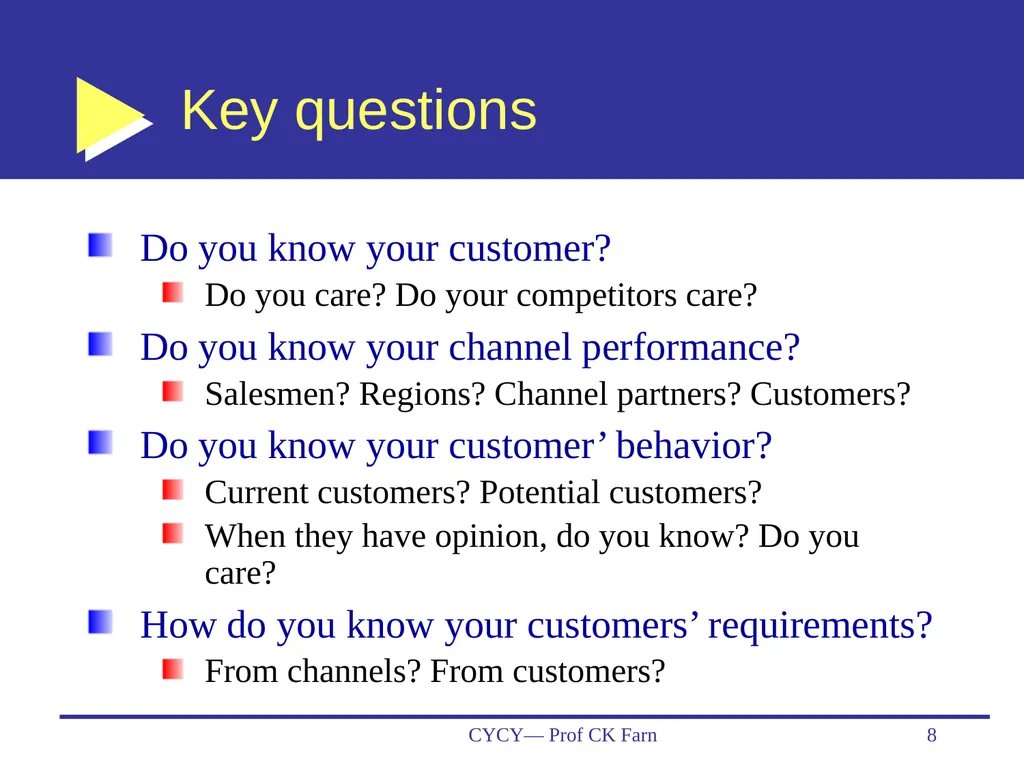
CYCY— Prof CK Farn 8 Key questions Do you know your customer?
Do you care? Do your competitors care?
Do you know your channel performance?
Salesmen? Regions? Channel partners? Customers?
Do you know your customer’ behavior?
Current customers? Potential customers?
When they have opinion, do you know? Do you care?
How do you know your customers’ requirements?
From channels? From customers?<br>
Do you care? Do your competitors care?
Do you know your channel performance?
Salesmen? Regions? Channel partners? Customers?
Do you know your customer’ behavior?
Current customers? Potential customers?
When they have opinion, do you know? Do you care?
How do you know your customers’ requirements?
From channels? From customers?<br>
09
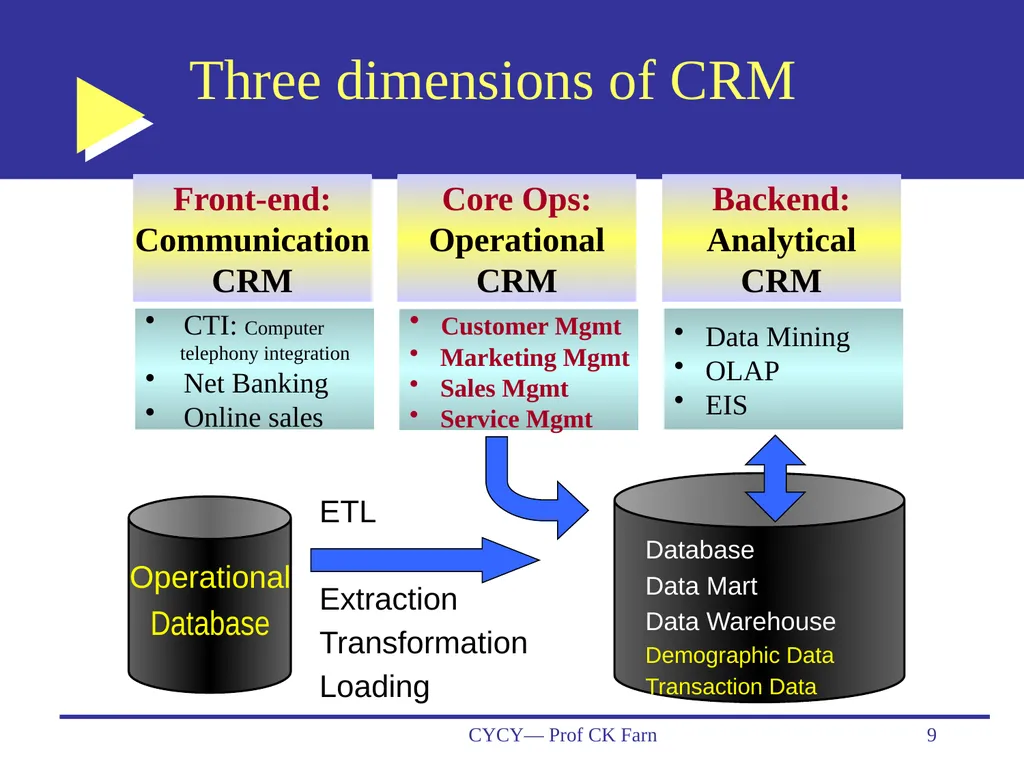
CYCY— Prof CK Farn 9 Three dimensions of CRM<br>
10
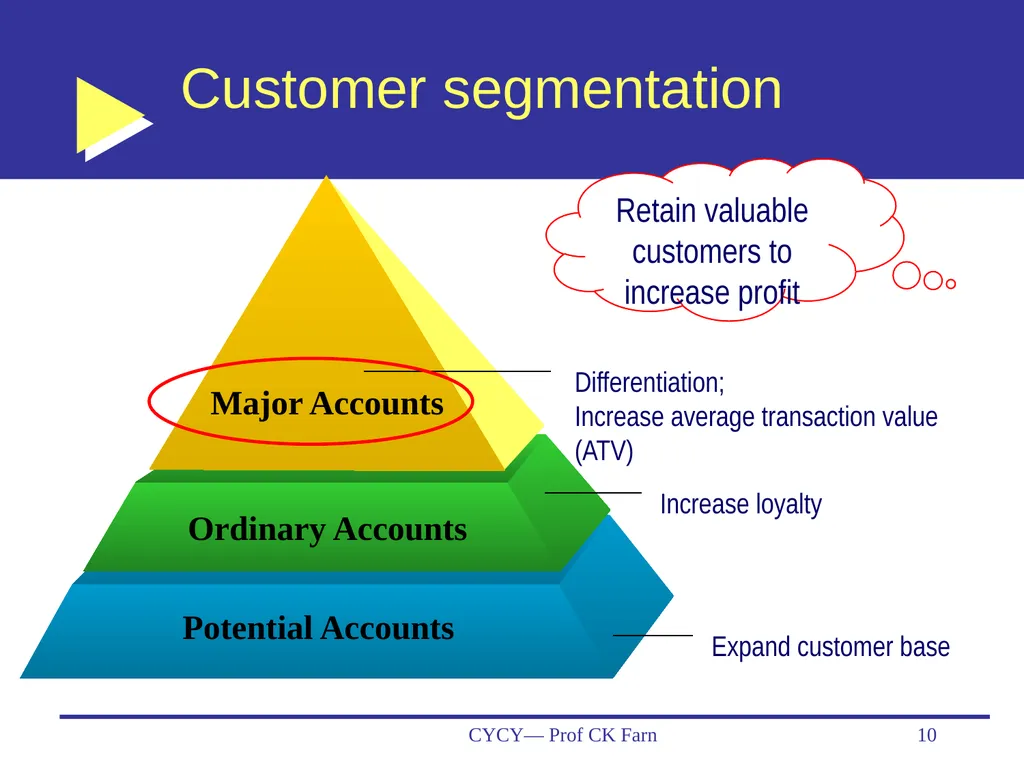
CYCY— Prof CK Farn 10 Customer segmentation Expand customer base Increase loyalty Differentiation;
Increase average transaction value (ATV) Retain valuable customers to increase profit<br>
Increase average transaction value (ATV) Retain valuable customers to increase profit<br>
11
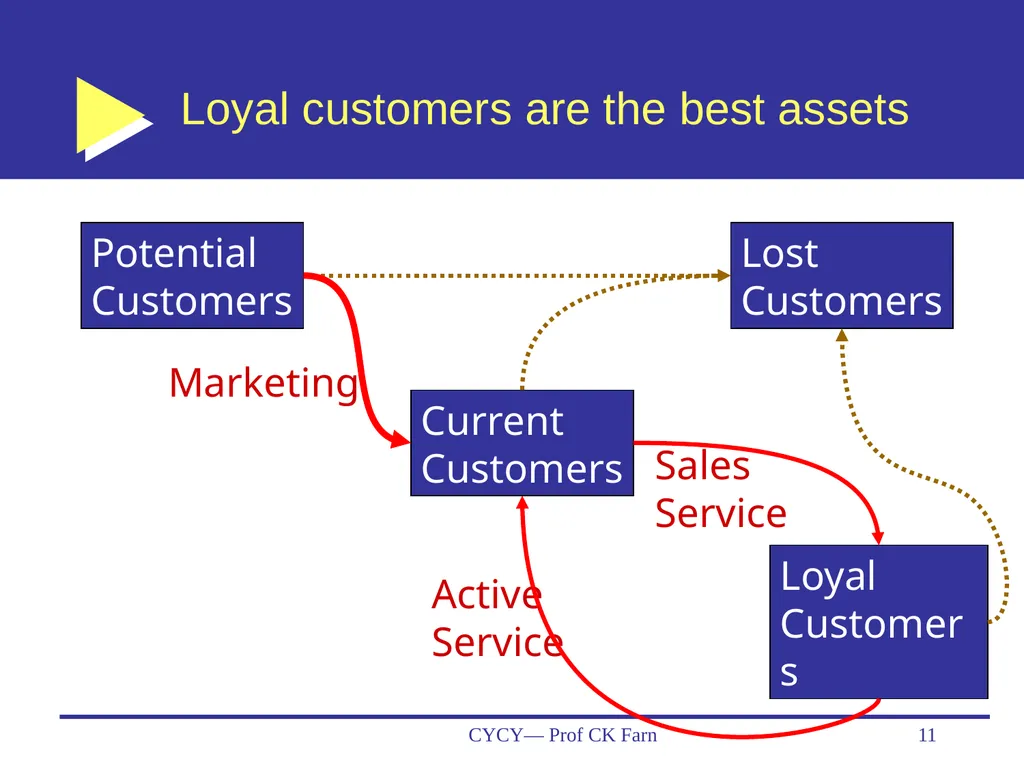
CYCY— Prof CK Farn 11 Loyal customers are the best assets Potential
Customers Current
Customers Loyal
Customers Lost
Customers Sales Service Marketing Active
Service<br>
Customers Current
Customers Loyal
Customers Lost
Customers Sales Service Marketing Active
Service<br>
12
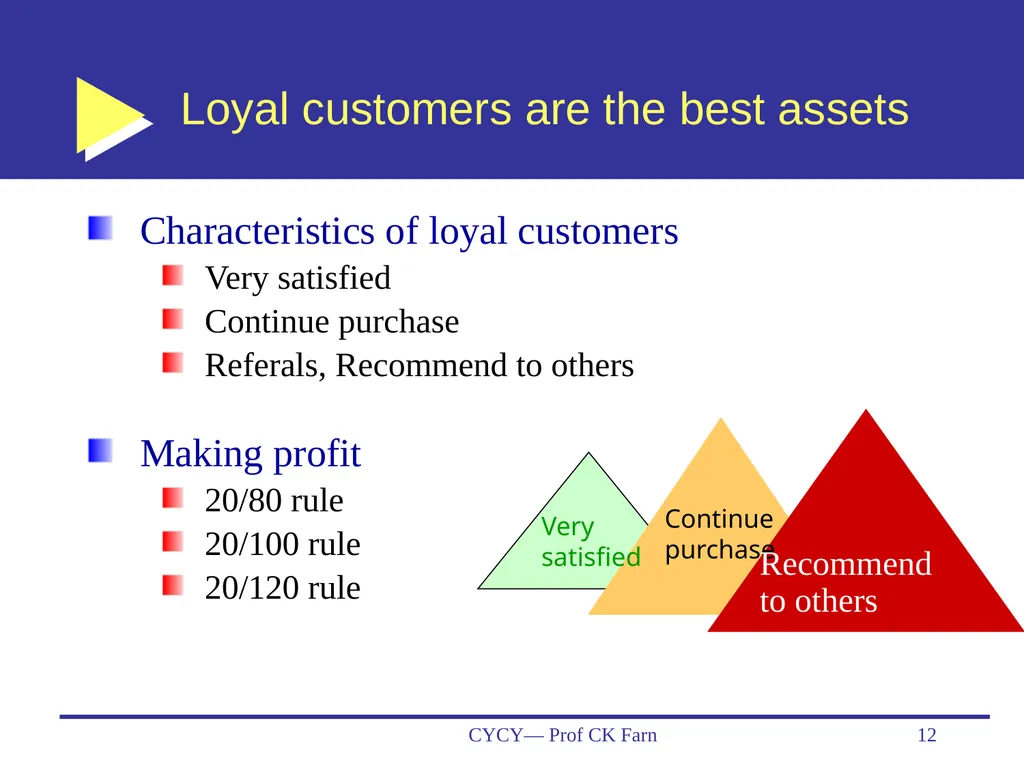
CYCY— Prof CK Farn 12 Loyal customers are the best assets Characteristics of loyal customers
Very satisfied
Continue purchase
Referals, Recommend to others
Making profit
20/80 rule
20/100 rule
20/120 rule Very
satisfied Continue
purchase Recommend
to others<br>
Very satisfied
Continue purchase
Referals, Recommend to others
Making profit
20/80 rule
20/100 rule
20/120 rule Very
satisfied Continue
purchase Recommend
to others<br>
13
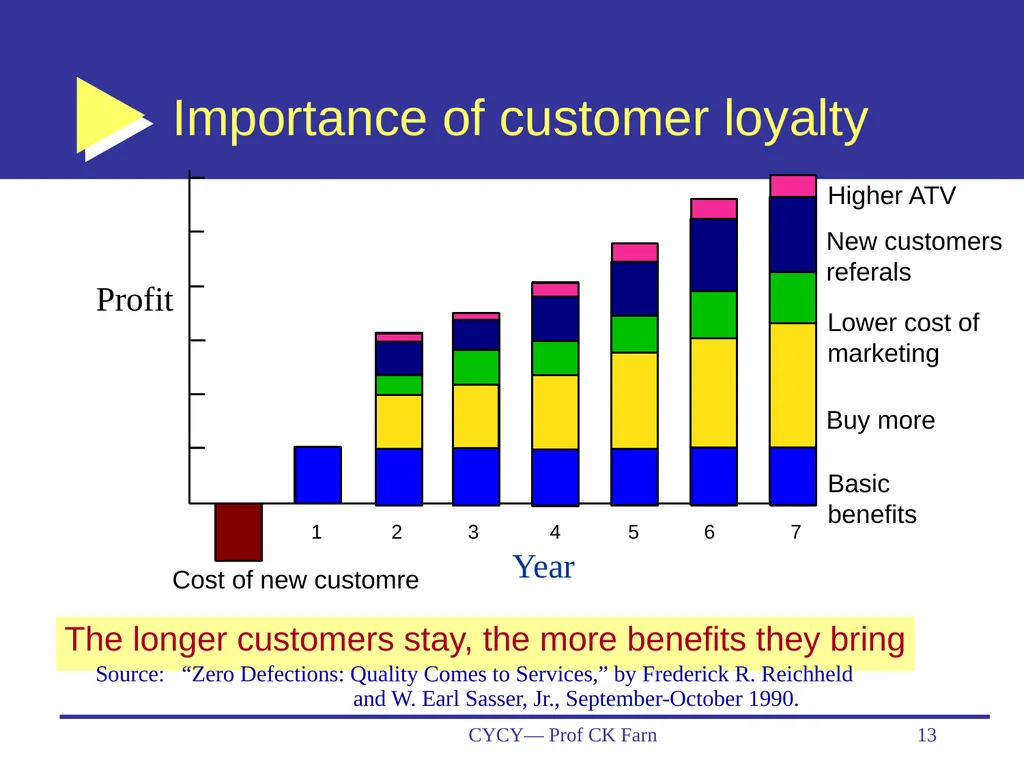
CYCY— Prof CK Farn 13 Cost of new customre Higher ATV New customers
referals Lower cost of marketing Buy more The longer customers stay, the more benefits they bring Basic benefits Importance of customer loyalty Source: “Zero Defections: Quality Comes to Services,” by Frederick R. Reichheld and W. Earl Sasser, Jr., September-October 1990. Profit<br>
referals Lower cost of marketing Buy more The longer customers stay, the more benefits they bring Basic benefits Importance of customer loyalty Source: “Zero Defections: Quality Comes to Services,” by Frederick R. Reichheld and W. Earl Sasser, Jr., September-October 1990. Profit<br>
14
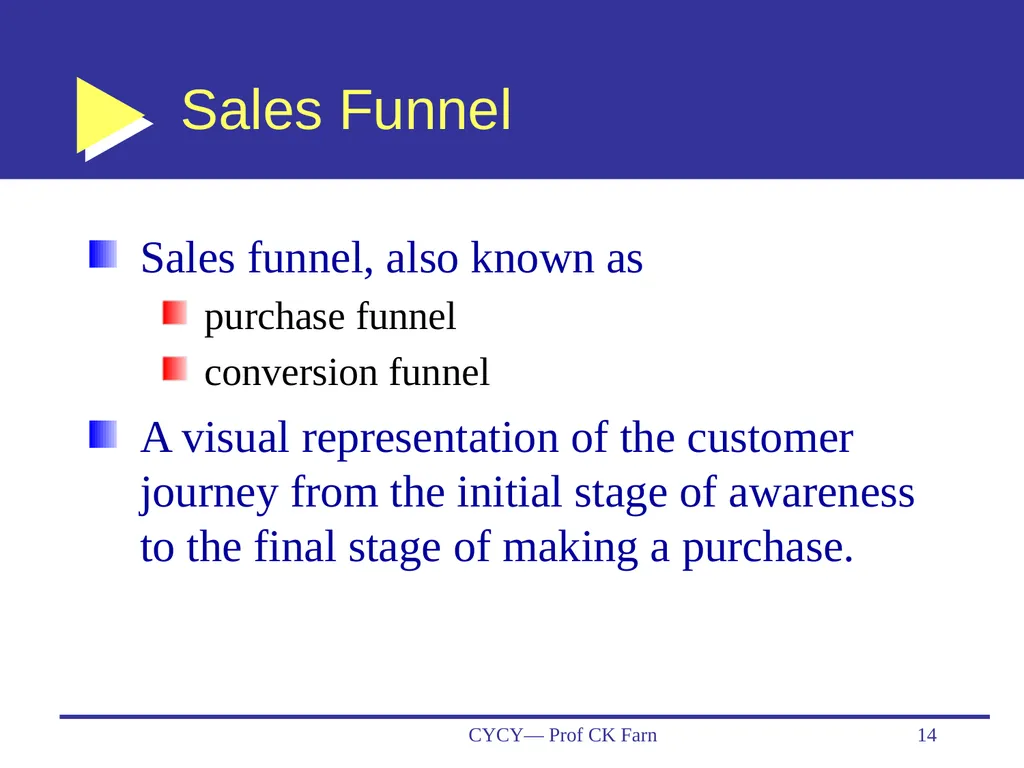
Sales Funnel Sales funnel, also known as
purchase funnel
conversion funnel
A visual representation of the customer journey from the initial stage of awareness to the final stage of making a purchase. CYCY— Prof CK Farn 14<br>
purchase funnel
conversion funnel
A visual representation of the customer journey from the initial stage of awareness to the final stage of making a purchase. CYCY— Prof CK Farn 14<br>
15
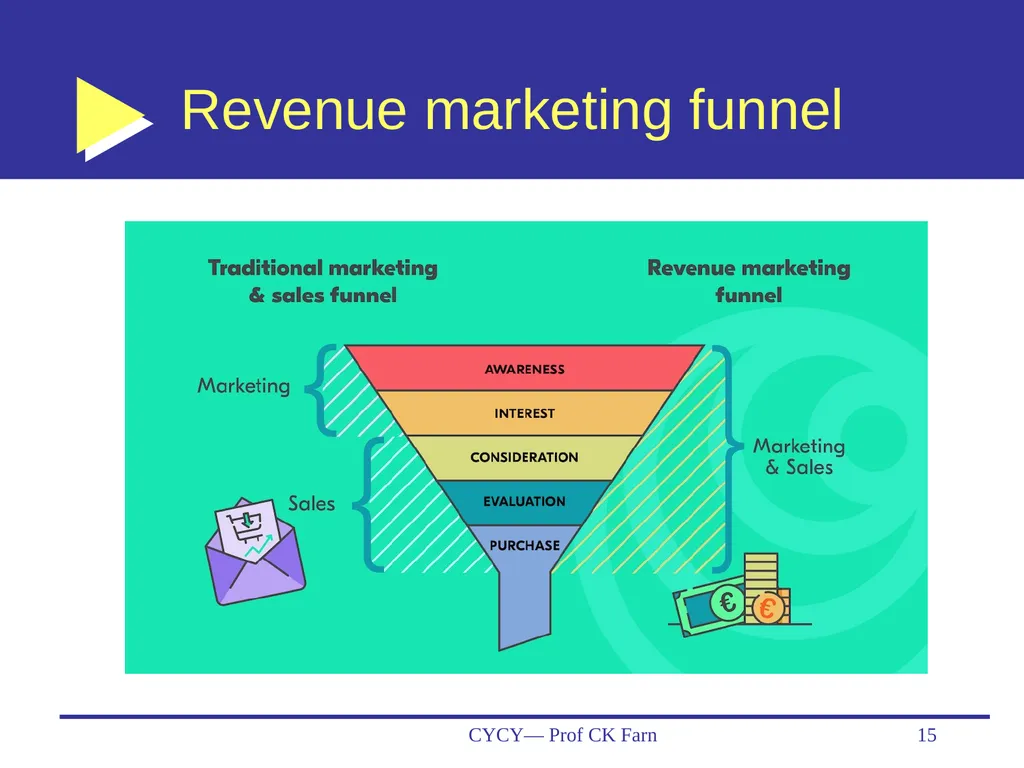
Revenue marketing funnel CYCY— Prof CK Farn 15<br>
16
Stages 1 Awareness
Potential customers become aware of your brand, product, or service
may discover your business through various channels such as advertisements, social media, search engines, or word-of-mouth referrals.
Interest
prospects have shown some interest in your offering and are actively seeking more information
may visit your website, read blog posts, watch videos, or download resources to learn more about your product or service. CYCY— Prof CK Farn 16<br>
Potential customers become aware of your brand, product, or service
may discover your business through various channels such as advertisements, social media, search engines, or word-of-mouth referrals.
Interest
prospects have shown some interest in your offering and are actively seeking more information
may visit your website, read blog posts, watch videos, or download resources to learn more about your product or service. CYCY— Prof CK Farn 16<br>
17
Stages 2 Consideration
Evaluating different options and comparing them
considering whether your product or service meets their needs and offers value
read reviews, compare features, or request demos or consultations
Decision
Made the decision to purchase
may take actions like adding items to their shopping cart, subscribing to a service, or signing a contract
Action
Completes the desired action, such as making a purchase, subscribing to a service, or signing a contract CYCY— Prof CK Farn 17<br>
Evaluating different options and comparing them
considering whether your product or service meets their needs and offers value
read reviews, compare features, or request demos or consultations
Decision
Made the decision to purchase
may take actions like adding items to their shopping cart, subscribing to a service, or signing a contract
Action
Completes the desired action, such as making a purchase, subscribing to a service, or signing a contract CYCY— Prof CK Farn 17<br>
18
Dropping off Not all leads who enter the sales funnel will make it to the bottom and become customers
may drop off at various stages due to lack of interest, unsuitability, or other factors
optimizing a sales funnel is to maximize the number of leads that convert into paying customers and minimize the drop-off rate at each stage CYCY— Prof CK Farn 18<br>
may drop off at various stages due to lack of interest, unsuitability, or other factors
optimizing a sales funnel is to maximize the number of leads that convert into paying customers and minimize the drop-off rate at each stage CYCY— Prof CK Farn 18<br>
19
Conversion rate The conversion rate is the proportion of visitors to a website who take action to go beyond a casual content view or website visit, like purchase.
Conversion rate = Number of actions / Number of visits
Important performance metrix in eCommerce
For example: you have a landing page that brought in 5000 visitors and 1237 of them took the desired action
your conversion rate would be 24.74% (1237/5000) x 100
https://acquire.io/blog/what-is-conversion-rate CYCY— Prof CK Farn 19<br>
Conversion rate = Number of actions / Number of visits
Important performance metrix in eCommerce
For example: you have a landing page that brought in 5000 visitors and 1237 of them took the desired action
your conversion rate would be 24.74% (1237/5000) x 100
https://acquire.io/blog/what-is-conversion-rate CYCY— Prof CK Farn 19<br>
20
Use of data analytics in funnel Data-driven decision-making is highly relevant to the sales funnel
allows businesses to make informed choices based on concrete data and insights rather than relying on assumptions or guesswork
analyzing data at each stage of the sales funnel, businesses can gain valuable insights into customer behavior, preferences, and trends, which can guide their decision-making process and improve the effectiveness of their sales and marketing efforts. CYCY— Prof CK Farn 20<br>
allows businesses to make informed choices based on concrete data and insights rather than relying on assumptions or guesswork
analyzing data at each stage of the sales funnel, businesses can gain valuable insights into customer behavior, preferences, and trends, which can guide their decision-making process and improve the effectiveness of their sales and marketing efforts. CYCY— Prof CK Farn 20<br>
21
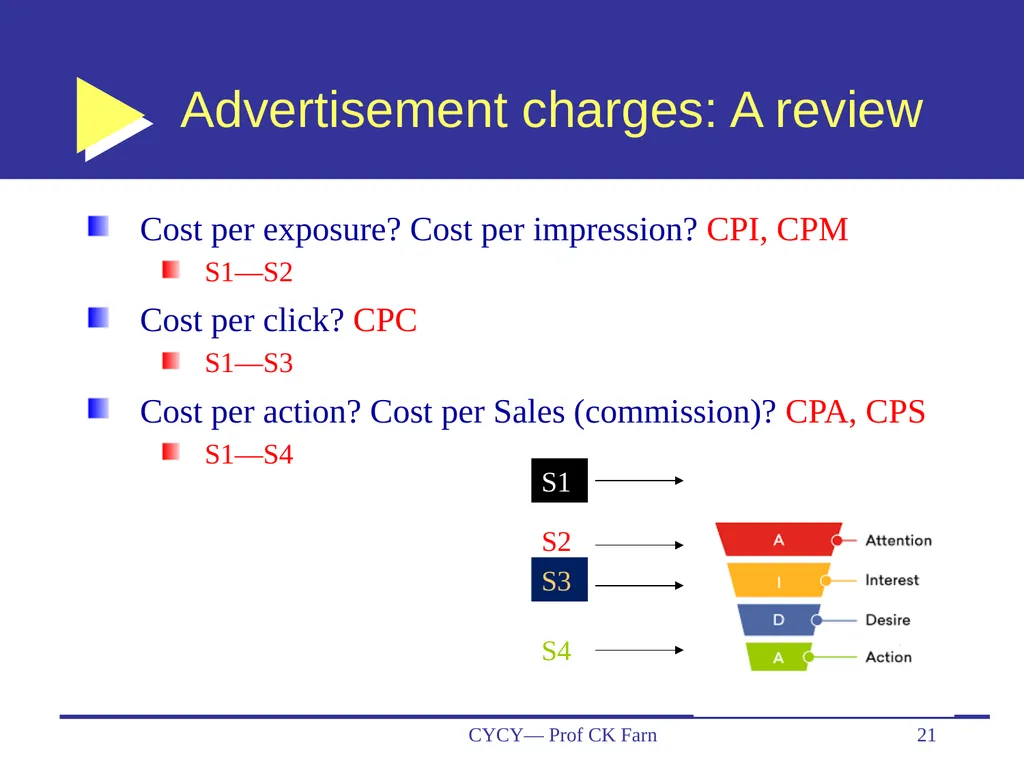
Advertisement charges: A review Cost per exposure? Cost per impression? CPI, CPM
S1—S2
Cost per click? CPC
S1—S3
Cost per action? Cost per Sales (commission)? CPA, CPS
S1—S4 CYCY— Prof CK Farn 21 S1 S2 S3 S4<br>
S1—S2
Cost per click? CPC
S1—S3
Cost per action? Cost per Sales (commission)? CPA, CPS
S1—S4 CYCY— Prof CK Farn 21 S1 S2 S3 S4<br>
22
Marketing funnel expalined https://www.youtube.com/watch?v=UE-E5DFeF3o
The Marketing Funnel Explained: What Is It & How To Write One
https://www.youtube.com/watch?v=Xx75loJvFhg CYCY— Prof CK Farn 22 https://www.yieldify.com/blog/ecommerce-sales-funnel/<br>
The Marketing Funnel Explained: What Is It & How To Write One
https://www.youtube.com/watch?v=Xx75loJvFhg CYCY— Prof CK Farn 22 https://www.yieldify.com/blog/ecommerce-sales-funnel/<br>
23
Use of data-driven decision-making with the sales funnel 1 Tracking and measuring
at each stage of the sales funnel, tracking metrics such as website traffic, conversion rates, click-through rates, engagement levels, lead quality, and customer acquisition costs
businesses can identify areas of improvement, track the performance of marketing campaigns, and make data-backed decisions to optimize their sales funnel
Identifying bottlenecks
help identify bottlenecks or areas of friction within the sales funnel where potential customers are dropping off or losing interest
businesses can pinpoint the stages where conversions are low or where prospects are disengaging
enables businesses to take corrective actions, refine their marketing strategies, and optimize the funnel to increase conversions and improve overall performance CYCY— Prof CK Farn 23<br>
at each stage of the sales funnel, tracking metrics such as website traffic, conversion rates, click-through rates, engagement levels, lead quality, and customer acquisition costs
businesses can identify areas of improvement, track the performance of marketing campaigns, and make data-backed decisions to optimize their sales funnel
Identifying bottlenecks
help identify bottlenecks or areas of friction within the sales funnel where potential customers are dropping off or losing interest
businesses can pinpoint the stages where conversions are low or where prospects are disengaging
enables businesses to take corrective actions, refine their marketing strategies, and optimize the funnel to increase conversions and improve overall performance CYCY— Prof CK Farn 23<br>
24
Use of data-driven decision-making with the sales funnel 2 Personalization and targeting
allows businesses to segment their audience and personalize their marketing messages based on customer preferences and behaviors
businesses can create targeted campaigns, deliver relevant content, and tailor offers to specific customer segments
helps to attract and retain customers throughout the sales funnel by providing a more personalized and engaging experience
Testing and optimization
encourages businesses to run experiments and conduct A/B testing to optimize their sales funnel
By testing different variations of landing pages, calls to action, pricing strategies, or marketing messages, businesses can gather data on which approaches are most effective in driving conversions
this iterative process of testing and optimization helps refine the sales funnel and maximize its performance CYCY— Prof CK Farn 24<br>
allows businesses to segment their audience and personalize their marketing messages based on customer preferences and behaviors
businesses can create targeted campaigns, deliver relevant content, and tailor offers to specific customer segments
helps to attract and retain customers throughout the sales funnel by providing a more personalized and engaging experience
Testing and optimization
encourages businesses to run experiments and conduct A/B testing to optimize their sales funnel
By testing different variations of landing pages, calls to action, pricing strategies, or marketing messages, businesses can gather data on which approaches are most effective in driving conversions
this iterative process of testing and optimization helps refine the sales funnel and maximize its performance CYCY— Prof CK Farn 24<br>
25
Use of data-driven decision-making with the sales funnel 3 Forecasting and planning
provides businesses with the ability to forecast future sales and plan their resources accordingly
by analyzing historical data and trends, businesses can make informed projections about sales volumes, revenue, and customer acquisition rates
enables them to allocate resources, set realistic targets, and make strategic decisions to achieve their sales goals. CYCY— Prof CK Farn 25<br>
provides businesses with the ability to forecast future sales and plan their resources accordingly
by analyzing historical data and trends, businesses can make informed projections about sales volumes, revenue, and customer acquisition rates
enables them to allocate resources, set realistic targets, and make strategic decisions to achieve their sales goals. CYCY— Prof CK Farn 25<br>
26
Conversion rate: renewed With more data analytics, we now have many conversion rates, across each funnel stages
The conversion rate measures the percentage of leads or prospects who successfully complete those desired actions or move from one stage to the next
https://www.mosaic.tech/financial-metrics/sales-funnel-conversion-rate CYCY— Prof CK Farn 26<br>
The conversion rate measures the percentage of leads or prospects who successfully complete those desired actions or move from one stage to the next
https://www.mosaic.tech/financial-metrics/sales-funnel-conversion-rate CYCY— Prof CK Farn 26<br>
27
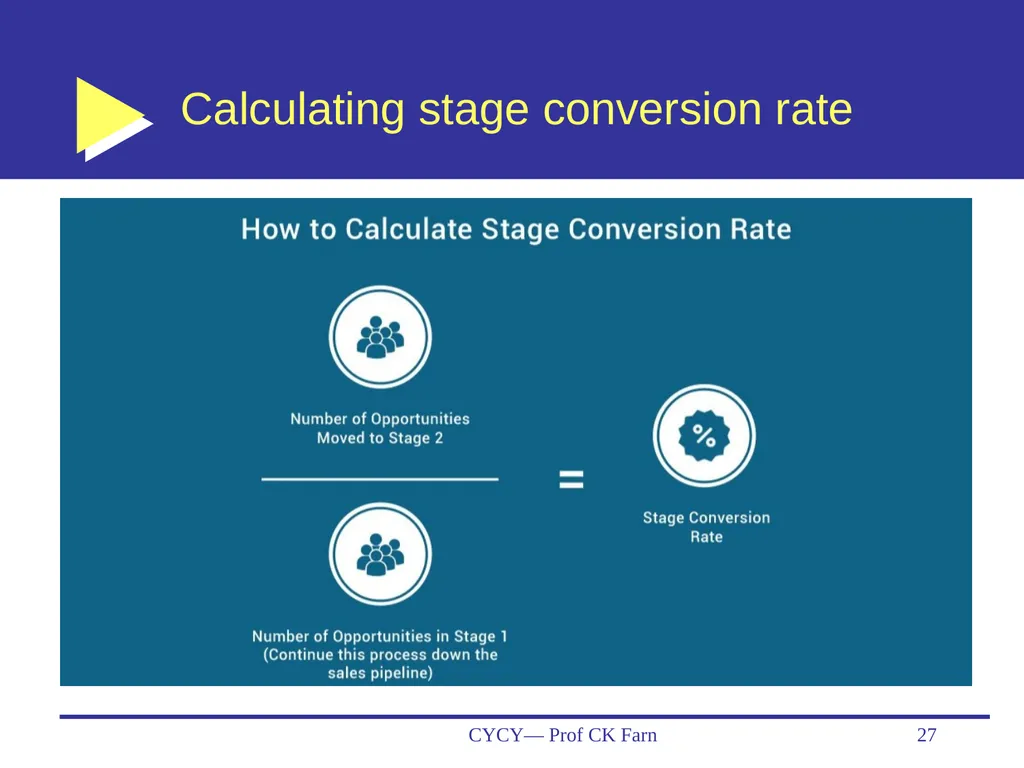
Calculating stage conversion rate CYCY— Prof CK Farn 27<br>
28
Stage conversion rate measures the percentage of opportunities or deals that move from one stage to the next
if a rep had 100 opportunities that moved to Stage 1 in the sales process, and 75 of those moved to Stage 2, then the Stage Conversion Rate for Stage 1 to Stage 2 would be 75%.
provide amazing feedback on the health of the process, and where the bottlenecks are CYCY— Prof CK Farn 28<br>
if a rep had 100 opportunities that moved to Stage 1 in the sales process, and 75 of those moved to Stage 2, then the Stage Conversion Rate for Stage 1 to Stage 2 would be 75%.
provide amazing feedback on the health of the process, and where the bottlenecks are CYCY— Prof CK Farn 28<br>
29
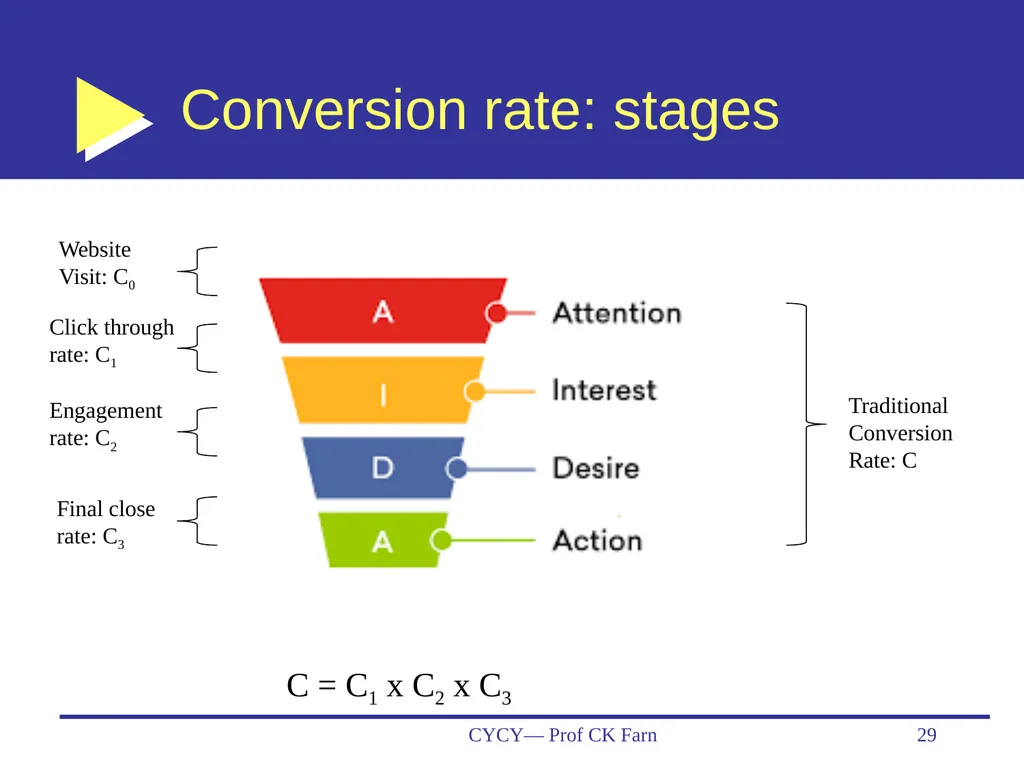
Conversion rate: stages CYCY— Prof CK Farn 29 Traditional Conversion Rate: C Website Visit: C0 Click through rate: C1 Engagement rate: C2 Final close rate: C3 C = C1 x C2 x C3<br>
30
Marketing Funnel for eC How to Turn Browsers into Buyers with Lessons From 100,000+ Campaigns: The New Ecommerce Conversion Funnel
https://www.convertflow.com/blog/ecommerce-conversion-funnel
What is a conversion funnel? The complete guide
https://www.fullstory.com/conversion-funnels/ CYCY— Prof CK Farn 30<br>
https://www.convertflow.com/blog/ecommerce-conversion-funnel
What is a conversion funnel? The complete guide
https://www.fullstory.com/conversion-funnels/ CYCY— Prof CK Farn 30<br>
31
Awareness stage conversion rate Measure how many people who are initially exposed to your brand or product become aware of it
can be measured through metrics such as website visits, social media engagements, or the number of inquiries generated from marketing efforts
The conversion rate here would be the percentage of people who move from being unaware to becoming aware of your business CYCY— Prof CK Farn 31<br>
can be measured through metrics such as website visits, social media engagements, or the number of inquiries generated from marketing efforts
The conversion rate here would be the percentage of people who move from being unaware to becoming aware of your business CYCY— Prof CK Farn 31<br>
32
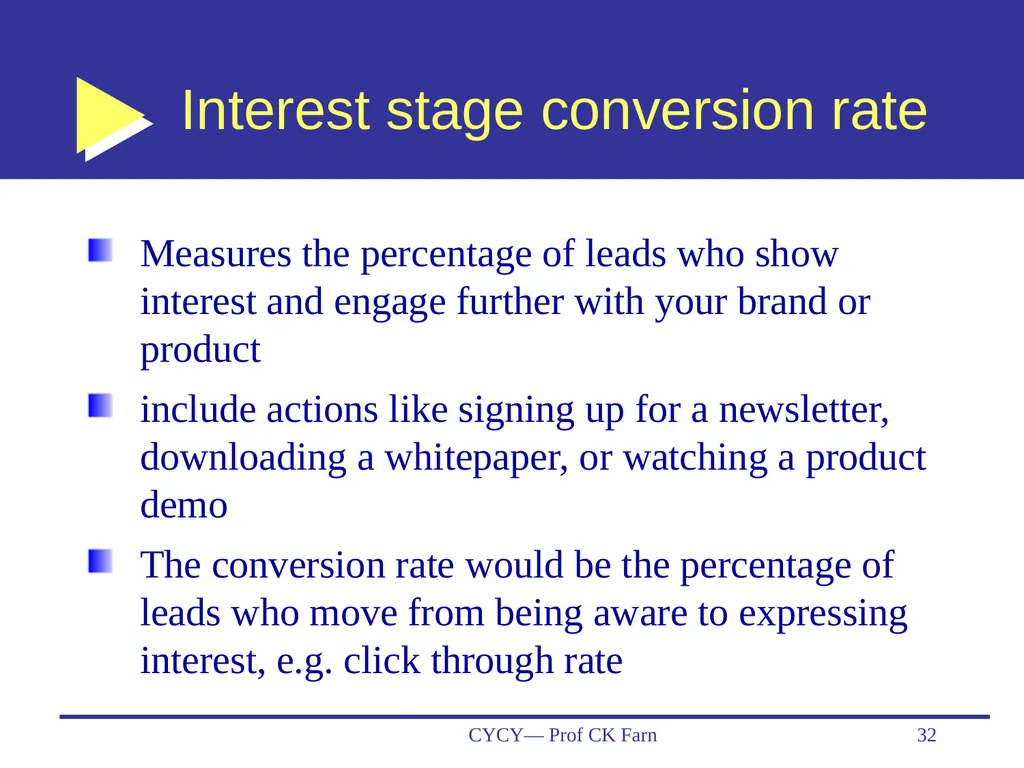
Interest stage conversion rate Measures the percentage of leads who show interest and engage further with your brand or product
include actions like signing up for a newsletter, downloading a whitepaper, or watching a product demo
The conversion rate would be the percentage of leads who move from being aware to expressing interest, e.g. click through rate CYCY— Prof CK Farn 32<br>
include actions like signing up for a newsletter, downloading a whitepaper, or watching a product demo
The conversion rate would be the percentage of leads who move from being aware to expressing interest, e.g. click through rate CYCY— Prof CK Farn 32<br>
33
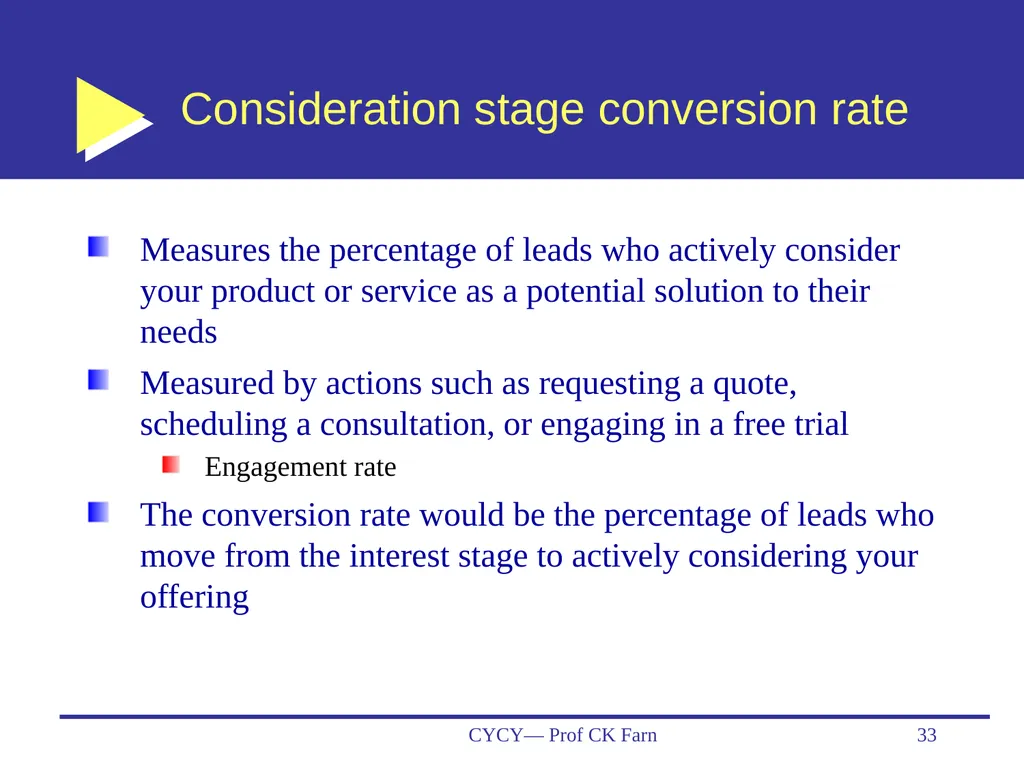
Consideration stage conversion rate Measures the percentage of leads who actively consider your product or service as a potential solution to their needs
Measured by actions such as requesting a quote, scheduling a consultation, or engaging in a free trial
Engagement rate
The conversion rate would be the percentage of leads who move from the interest stage to actively considering your offering CYCY— Prof CK Farn 33<br>
Measured by actions such as requesting a quote, scheduling a consultation, or engaging in a free trial
Engagement rate
The conversion rate would be the percentage of leads who move from the interest stage to actively considering your offering CYCY— Prof CK Farn 33<br>
34
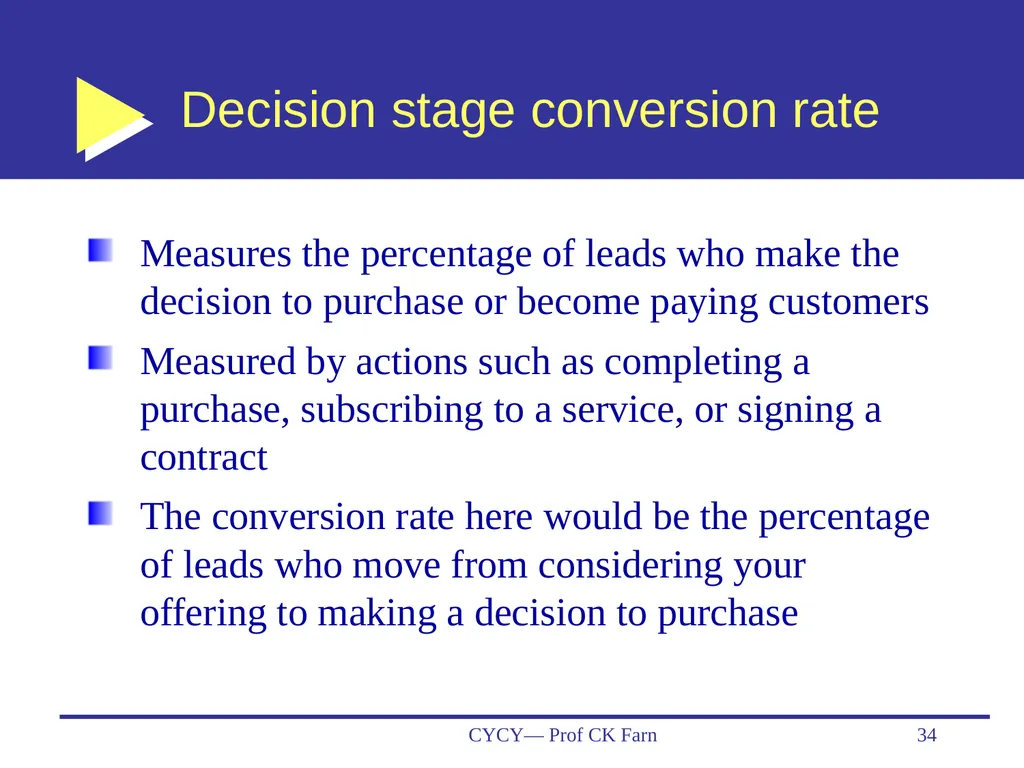
Decision stage conversion rate Measures the percentage of leads who make the decision to purchase or become paying customers
Measured by actions such as completing a purchase, subscribing to a service, or signing a contract
The conversion rate here would be the percentage of leads who move from considering your offering to making a decision to purchase CYCY— Prof CK Farn 34<br>
Measured by actions such as completing a purchase, subscribing to a service, or signing a contract
The conversion rate here would be the percentage of leads who move from considering your offering to making a decision to purchase CYCY— Prof CK Farn 34<br>
35
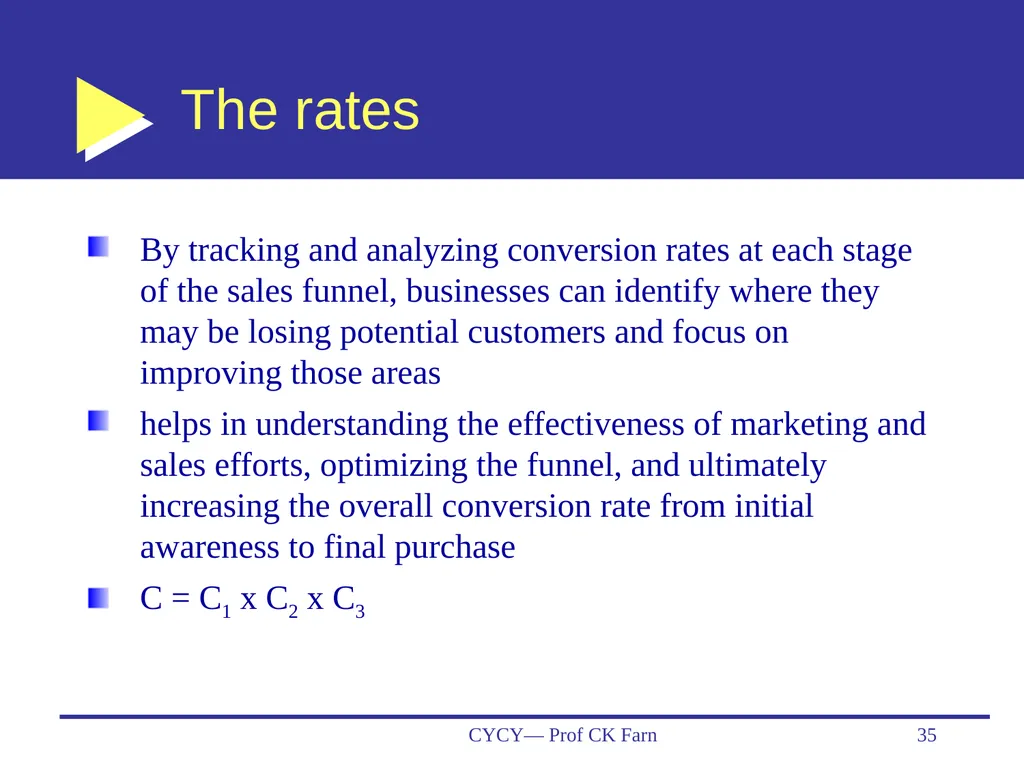
The rates By tracking and analyzing conversion rates at each stage of the sales funnel, businesses can identify where they may be losing potential customers and focus on improving those areas
helps in understanding the effectiveness of marketing and sales efforts, optimizing the funnel, and ultimately increasing the overall conversion rate from initial awareness to final purchase
C = C1 x C2 x C3 CYCY— Prof CK Farn 35<br>
helps in understanding the effectiveness of marketing and sales efforts, optimizing the funnel, and ultimately increasing the overall conversion rate from initial awareness to final purchase
C = C1 x C2 x C3 CYCY— Prof CK Farn 35<br>
36
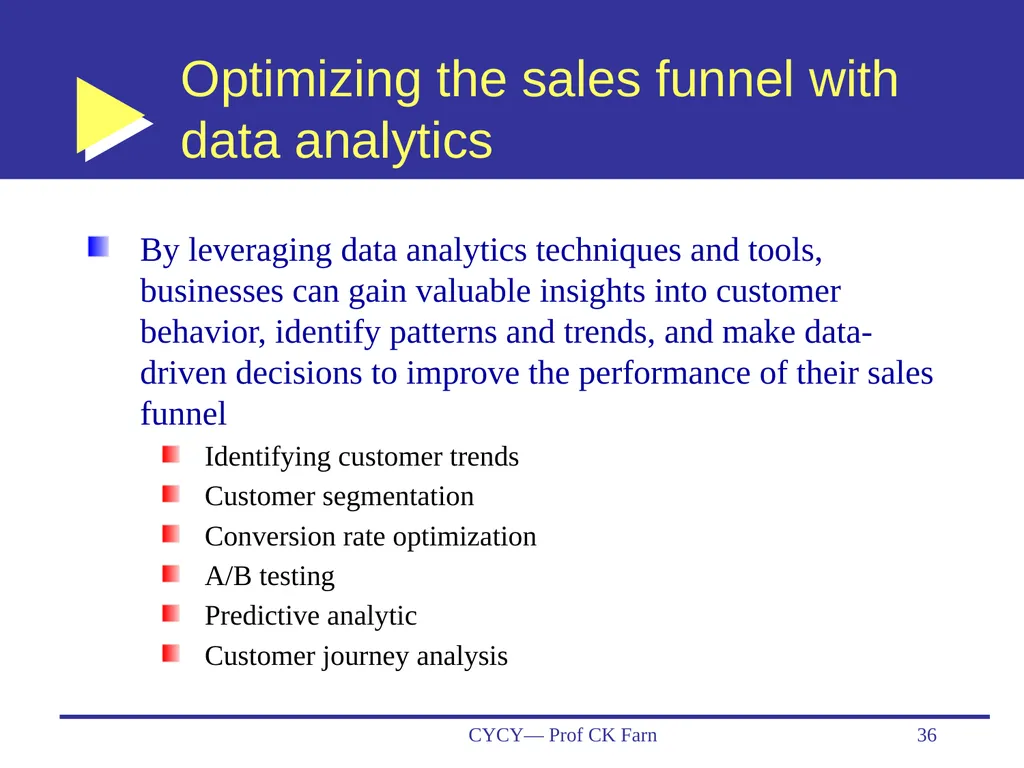
Optimizing the sales funnel with data analytics By leveraging data analytics techniques and tools, businesses can gain valuable insights into customer behavior, identify patterns and trends, and make data-driven decisions to improve the performance of their sales funnel
Identifying customer trends
Customer segmentation
Conversion rate optimization
A/B testing
Predictive analytic
Customer journey analysis CYCY— Prof CK Farn 36<br>
Identifying customer trends
Customer segmentation
Conversion rate optimization
A/B testing
Predictive analytic
Customer journey analysis CYCY— Prof CK Farn 36<br>