BUSINESS ENVIRONMENT CHAPTER 1 BUSINESS Definition of Business Business activities are all those human activities which are directed towards the production and procuring of wealth. - Prof. Haney CHARACTERISTICS OF BUSINESS Deals in goods
Related Topics
Share
Embed code
Download this presentation From Below
"BUSINESS ENVIRONMENT CHAPTER 1 BUSINESS Definition" is the property of its rightful owner. Permission is granted to
download and print the materials on this website for personal, non-commercial use only, and to display it
on your personal computer provided you do not modify the materials and that you retain all copyright
notices contained in the materials. By downloading content from our website, you accept the terms of this
agreement.
Presentation Transcript
01
BUSINESS
ENVIRONMENT<br>
02
CHAPTER 1 BUSINESS<br>
03
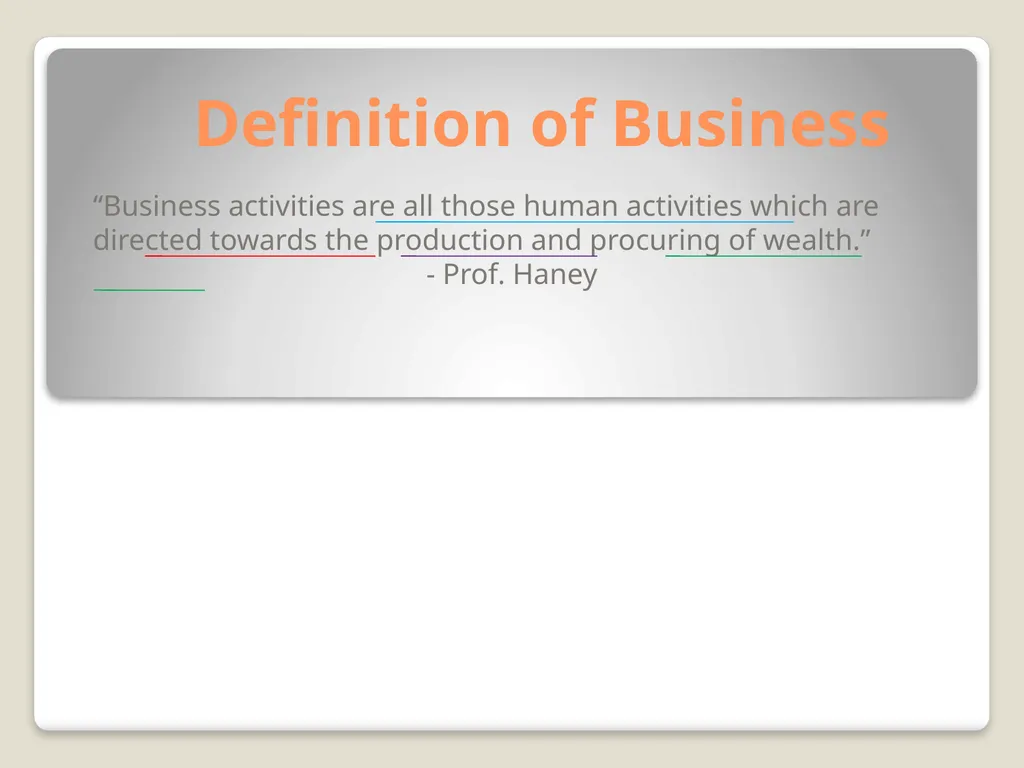
Definition of Business “Business activities are all those human activities which are directed towards the production and procuring of wealth.”
- Prof. Haney<br>
04
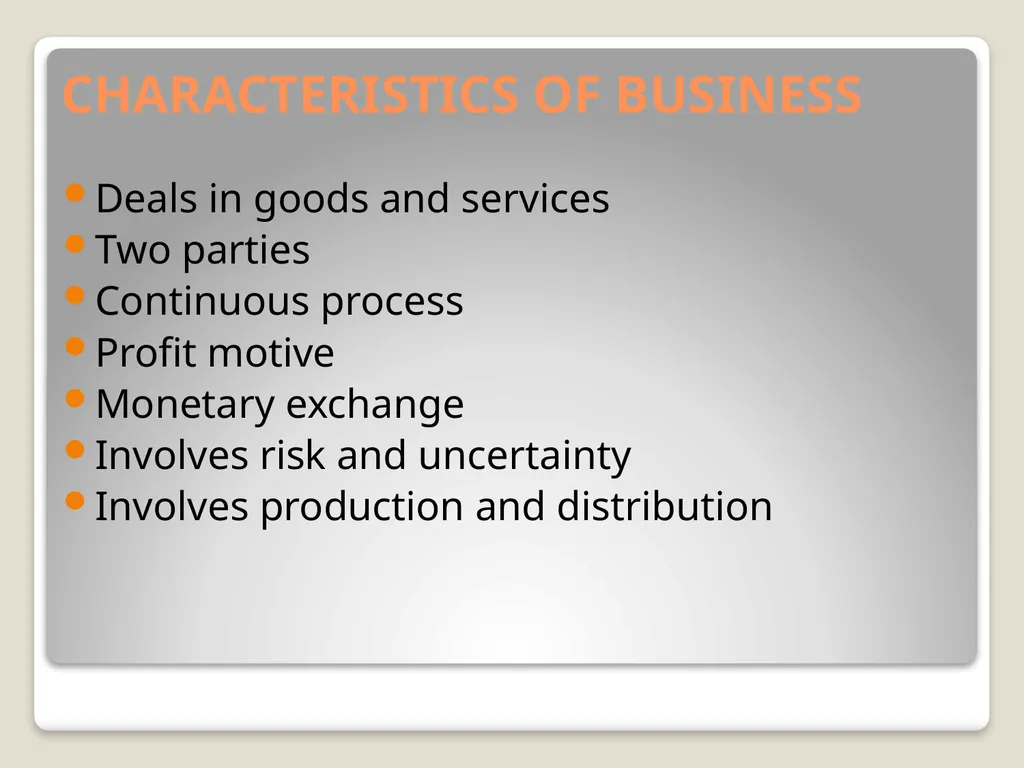
CHARACTERISTICS OF BUSINESS Deals in goods and services
Two parties
Continuous process
Profit motive
Monetary exchange
Involves risk and uncertainty
Involves production and distribution<br>
05
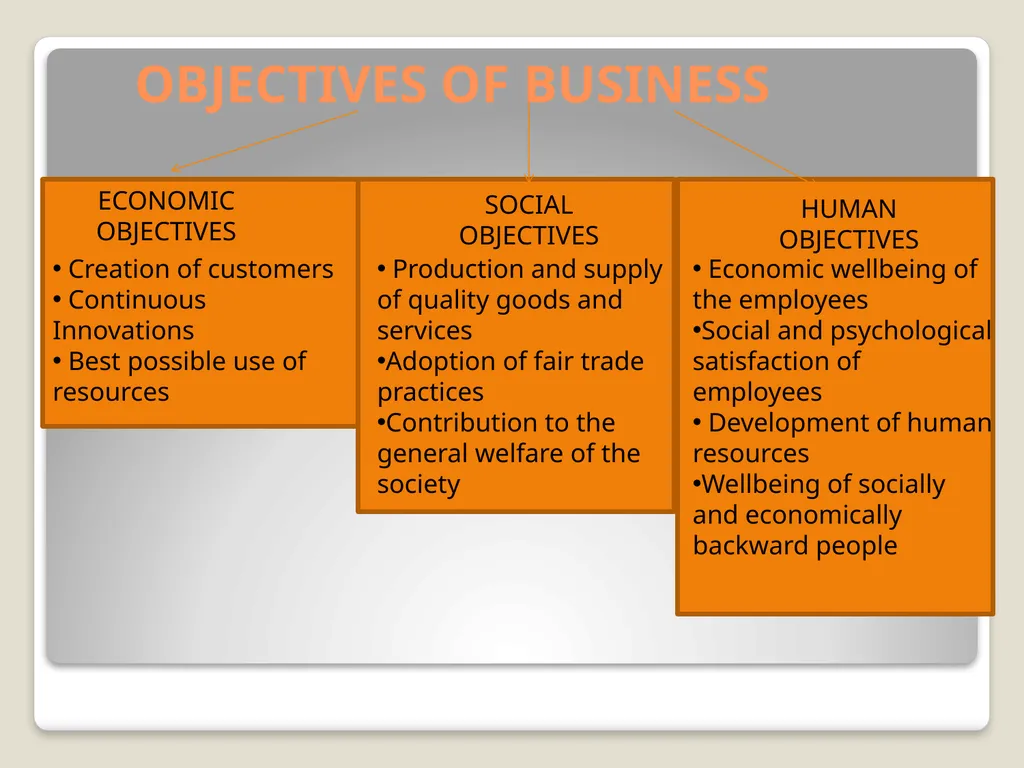
OBJECTIVES OF BUSINESS ECONOMIC
OBJECTIVES SOCIAL
OBJECTIVES HUMAN OBJECTIVES Creation of customers
Continuous
Innovations
Best possible use of resources Production and supply of quality goods and services
Adoption of fair trade practices
Contribution to the general welfare of the society Economic wellbeing of the employees
Social and psychological satisfaction of employees
Development of human resources
Wellbeing of socially and economically backward people<br>
06
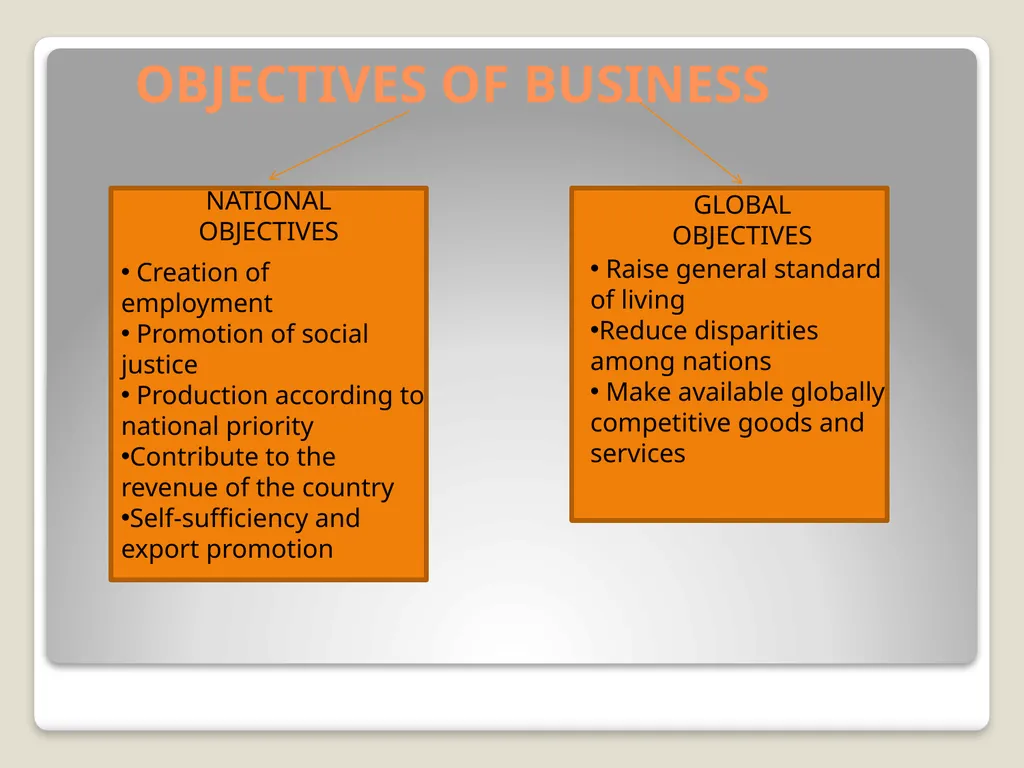
OBJECTIVES OF BUSINESS NATIONAL OBJECTIVES GLOBAL
OBJECTIVES Creation of employment
Promotion of social justice
Production according to national priority
Contribute to the revenue of the country
Self-sufficiency and export promotion Raise general standard of living
Reduce disparities among nations
Make available globally competitive goods and services<br>
07
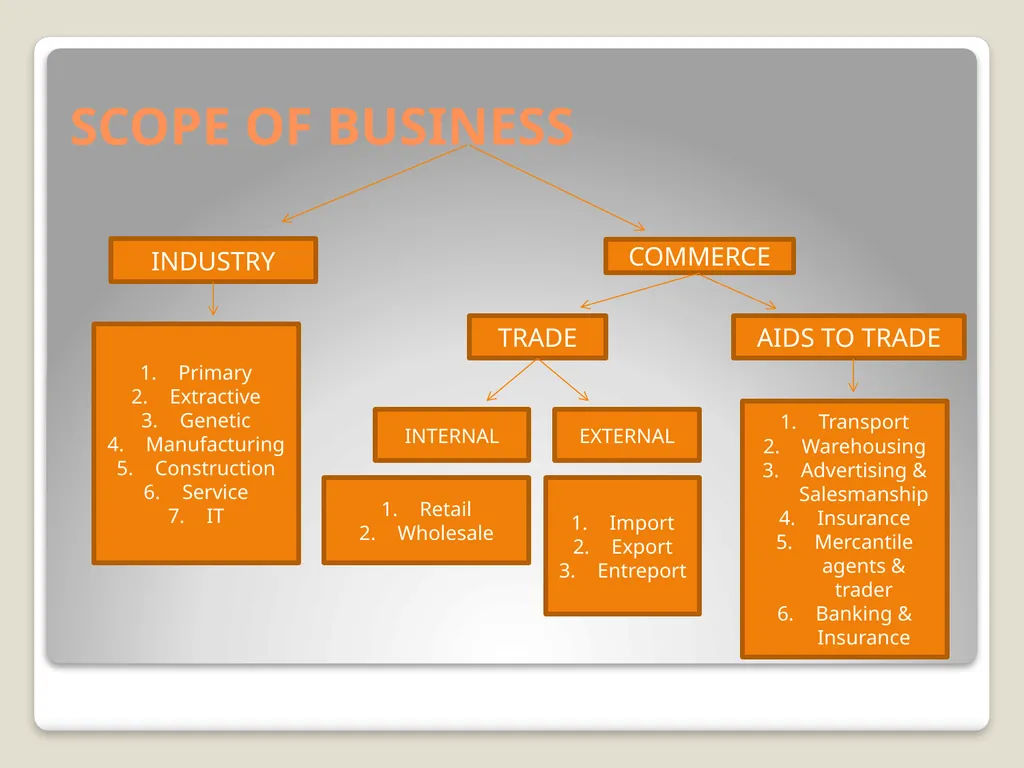
SCOPE OF BUSINESS INDUSTRY COMMERCE Primary
Extractive
Genetic
Manufacturing
Construction
Service
IT TRADE AIDS TO TRADE INTERNAL EXTERNAL Retail
Wholesale Import
Export
Entreport Transport
Warehousing
Advertising & Salesmanship
Insurance
Mercantile agents & trader
Banking & Insurance<br>
08
BUSINESS ENVIRONMENT<br>
09
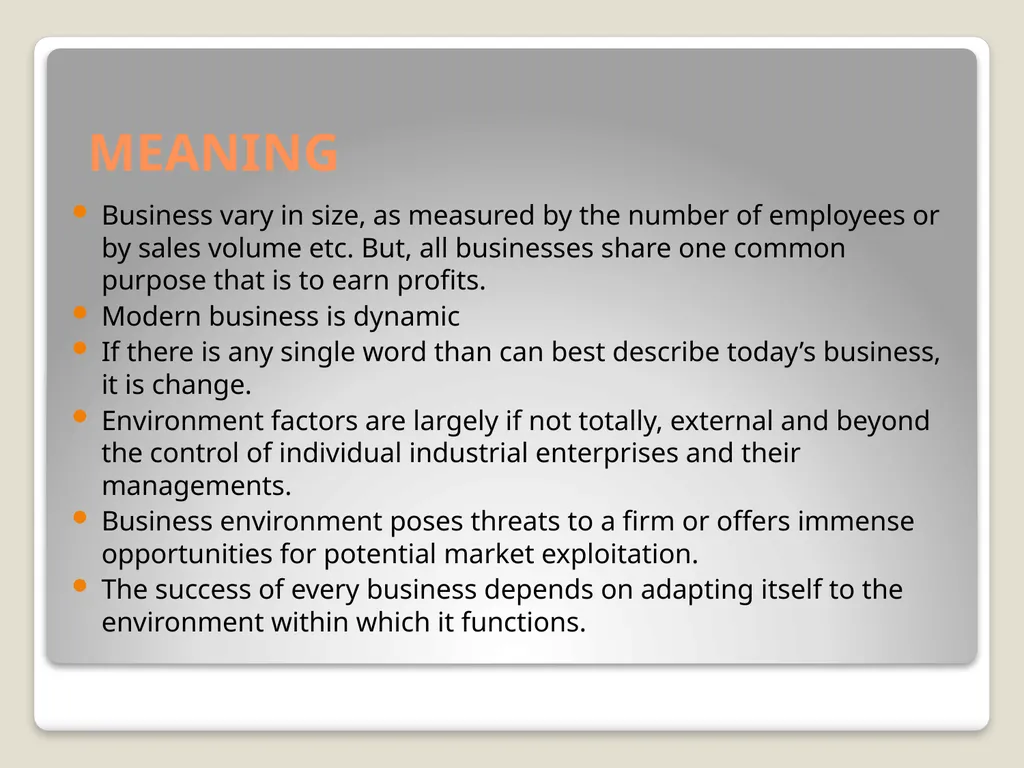
MEANING Business vary in size, as measured by the number of employees or by sales volume etc. But, all businesses share one common purpose that is to earn profits.
Modern business is dynamic
If there is any single word than can best describe today’s business, it is change.
Environment factors are largely if not totally, external and beyond the control of individual industrial enterprises and their managements.
Business environment poses threats to a firm or offers immense opportunities for potential market exploitation.
The success of every business depends on adapting itself to the environment within which it functions.<br>
10
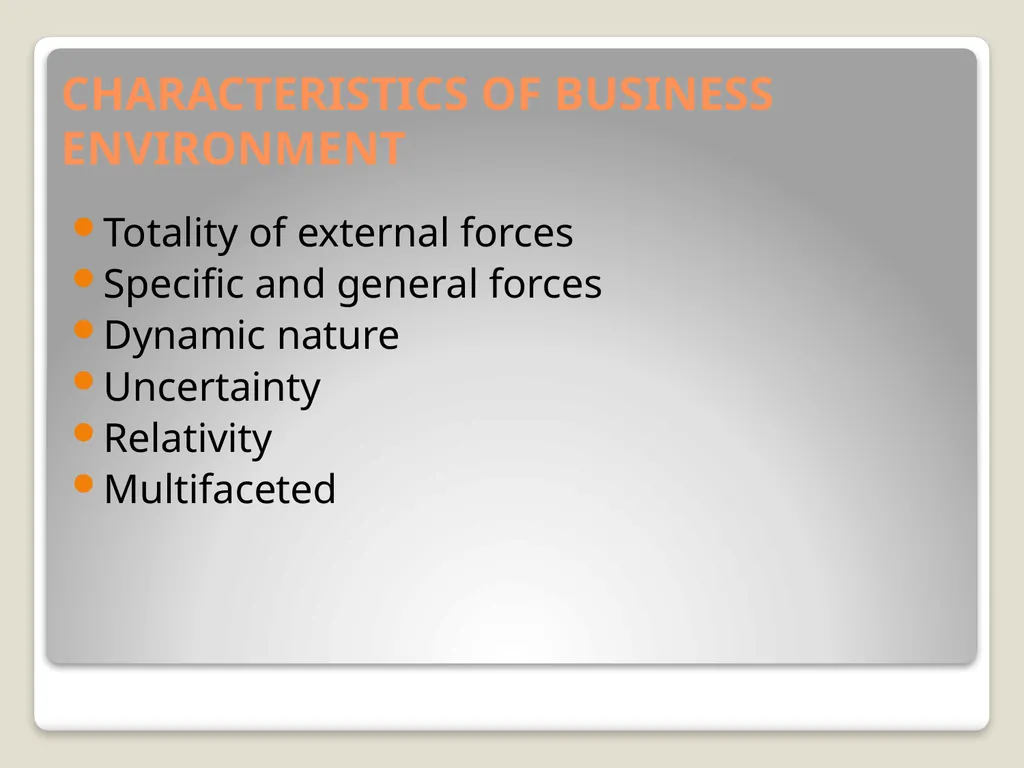
CHARACTERISTICS OF BUSINESS ENVIRONMENT Totality of external forces
Specific and general forces
Dynamic nature
Uncertainty
Relativity
Multifaceted<br>
11
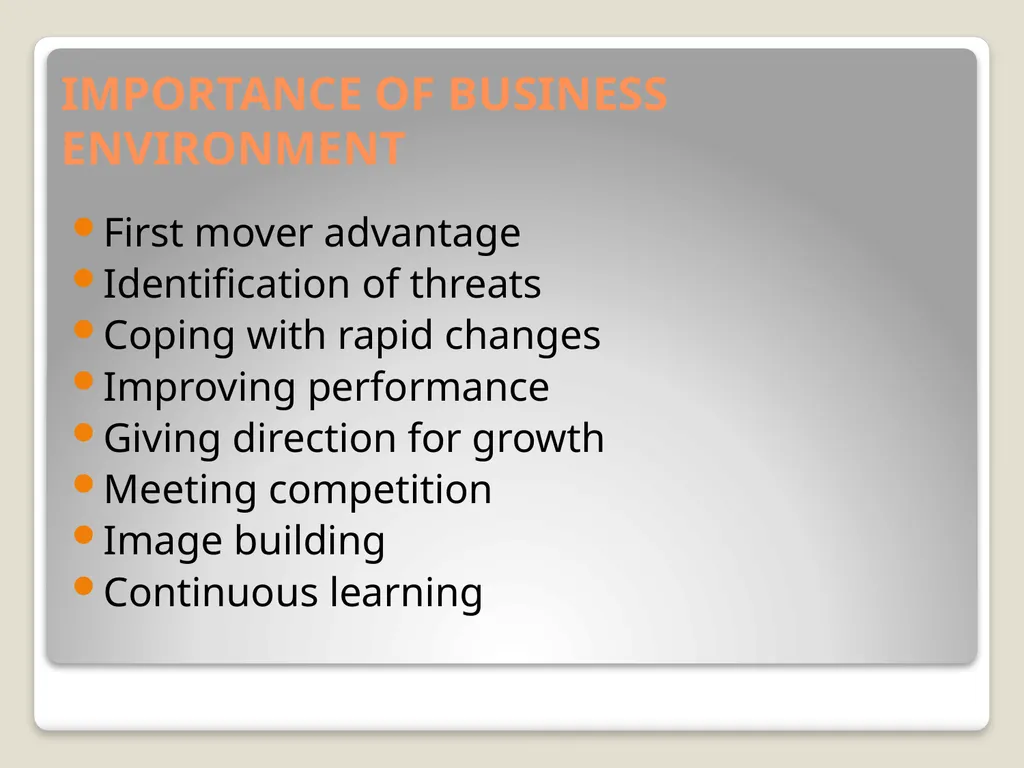
IMPORTANCE OF BUSINESS ENVIRONMENT First mover advantage
Identification of threats
Coping with rapid changes
Improving performance
Giving direction for growth
Meeting competition
Image building
Continuous learning<br>
12
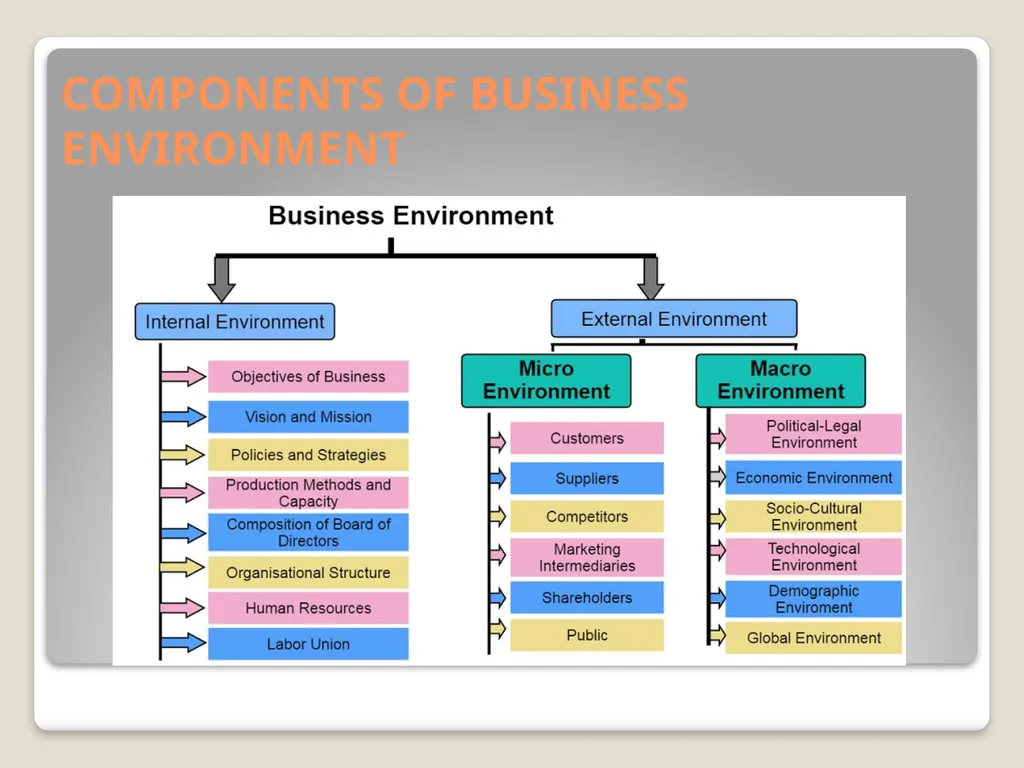
COMPONENTS OF BUSINESS ENVIRONMENT<br>
13
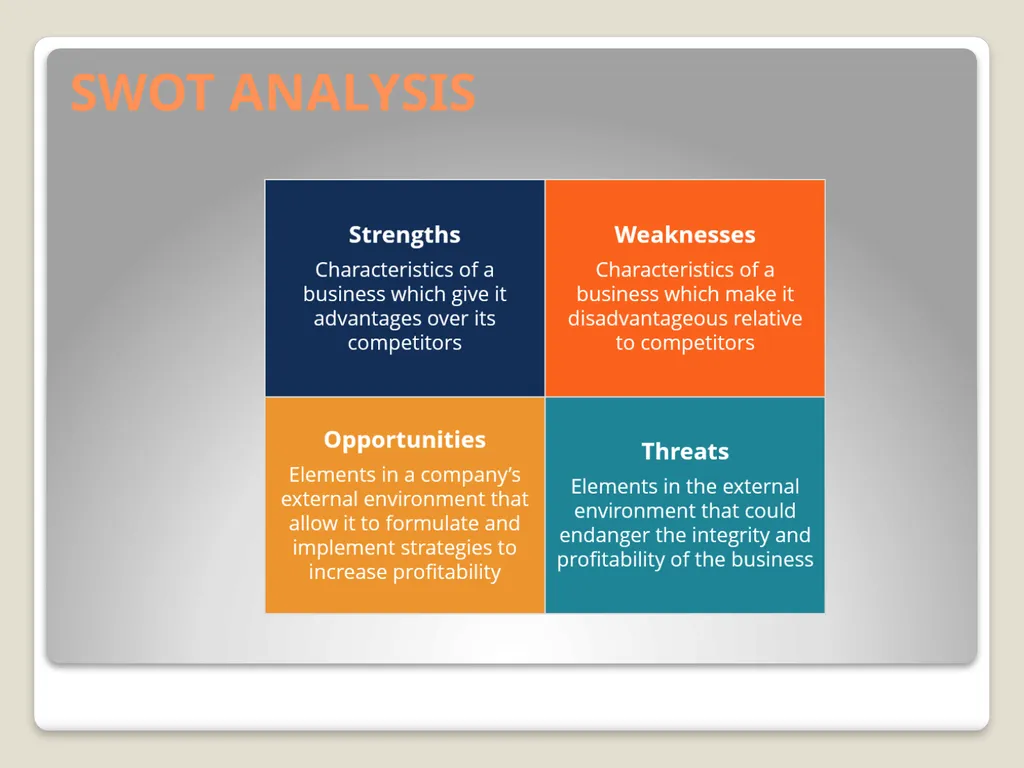
SWOT ANALYSIS<br>
14
A SWOT Analysis is one of the most commonly used tools to assess the internal and external environments of a company and is part of a company’s strategic planning process.
In addition, a SWOT analysis can be done for a product, place, industry, or person.
A SWOT analysis helps with both strategic planning and decision-making, as it introduces opportunities to the company as a forward-looking bridge to generating strategic alternatives.
It s important to point out that strengths and weaknesses are current or backward-looking, and opportunities and threats are forward-looking. By performing a SWOT analysis, we will be able to build a bridge between what the company has accomplished to date and the strategic alternatives that are going to be generated.<br>
15
Internal factors are the strengths and weaknesses of the company. Strengths are the characteristics that give the business its competitive advantage, while weaknesses are characteristics that a company needs to overcome in order to improve its performance.
Examples of internal factors include:
Company culture
Company image
Operational capacity
Brand awareness
Market share
Financial resources
Key staff<br>
16
External factors are the opportunities and threats to the company. Opportunities are elements that the company sees in the external environment that it could pursue in the future to generate value. Threats are elements in the external environment that could prevent the company from achieving its goal or its mission or creating value.
Changes in the external environment may be due to:
Societal changes
Customers
Competitors
Economic environment
Suppliers
Partners<br>
17
Conducting a SWOT Analysis
Strengths:
Consider strengths from an internal and consumer perspective.
What advantages does your company have?
What unique resources that you have that others do not?
What is your company’s Unique Selling Proposition?
What positive consumer perception does your company have?
What low-cost resources do you have access to that others do not?
Weaknesses:
Consider weaknesses from an internal and consumer perspective.
What does your company not do well?
What weaknesses do consumers see in your company?
What factors contribute to a weaker brand image?<br>
18
Conducting a SWOT Analysis
Opportunities:
Consider opportunities from an external perspective.
What good opportunities are available in the marketplace?
What are some trends that your company can capitalize on?
Are there any changes in technology or markets that your company can take advantage of?
Are there any changes in lifestyle, social patterns, etc., that your company can take advantage of?
Threats:
Consider threats from an external perspective.
What obstacles does your company face?
What are your competitors doing better than you?
Is a change in technology threatening the position of your company?
What threats do your weaknesses put you at risk of?
Do changes in lifestyle, social patterns, etc., pose a threat to your company?<br>
19
Example of a SWOT Analysis
Strengths:
McDonald’s serves customers in more countries than any other competitor in the fast-food industry
Significant economies of scale
Wide audience reach
McDonald’s exercises market power over suppliers and competitors
The most recognized brand in the fast-food industry
Competitive price
Weaknesses:
High employee turnover
Negative publicity (The perception of McDonald’s as an unhealthy food choice)
Not much variation in seasonal products
Quality inconsistency due to franchised operations
Focus on fast food and not healthier options for consumers<br>
20
Example of a SWOT Analysis
Opportunities:
Being responsive to social changes to healthier options
Business expansion to new parts of the world
Allergen-free options and gluten-free food
Corporate social responsibility
Threats:
More health-conscious customers
Threat from competitors in different countries
Threat of an economic downturn
Social change to a more balanced meal<br>