Business System Unit-1 Business Definition: Business is a regular process of earning a profit by satisfying consumers needs through the manufacturing of goods, reselling of products, providing services or carrying out all three together.
Related Topics
Share
Embed code
Download this presentation From Below
"Business System Unit-1 Business Definition:" is the property of its rightful owner. Permission is granted to
download and print the materials on this website for personal, non-commercial use only, and to display it
on your personal computer provided you do not modify the materials and that you retain all copyright
notices contained in the materials. By downloading content from our website, you accept the terms of this
agreement.
Presentation Transcript
01
Business System Unit-1<br>
02
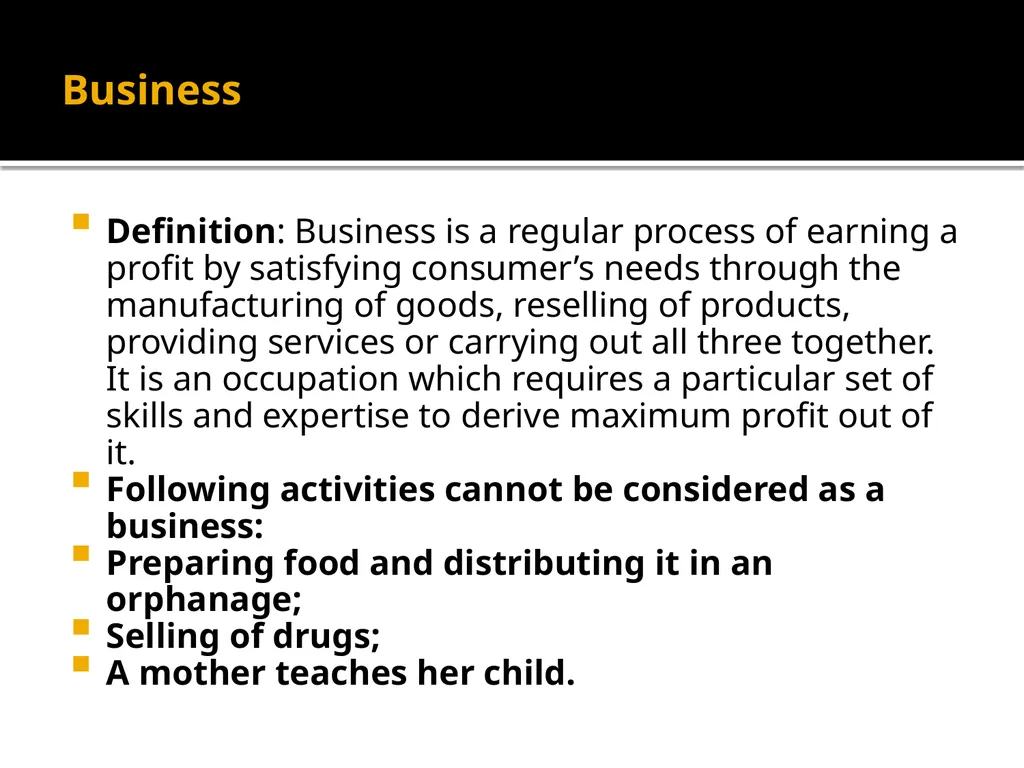
Business Definition: Business is a regular process of earning a profit by satisfying consumer’s needs through the manufacturing of goods, reselling of products, providing services or carrying out all three together. It is an occupation which requires a particular set of skills and expertise to derive maximum profit out of it.
Following activities cannot be considered as a business:
Preparing food and distributing it in an orphanage;
Selling of drugs;
A mother teaches her child.<br>
03
Nature of Business Business is derived from ‘busy-ness,’ i.e. keeping oneself occupied with one or the other work, but it is much more than just being busy.
To have a better understanding of what a business is, we must go through the following points:<br>
04
Nature of Business<br>
05
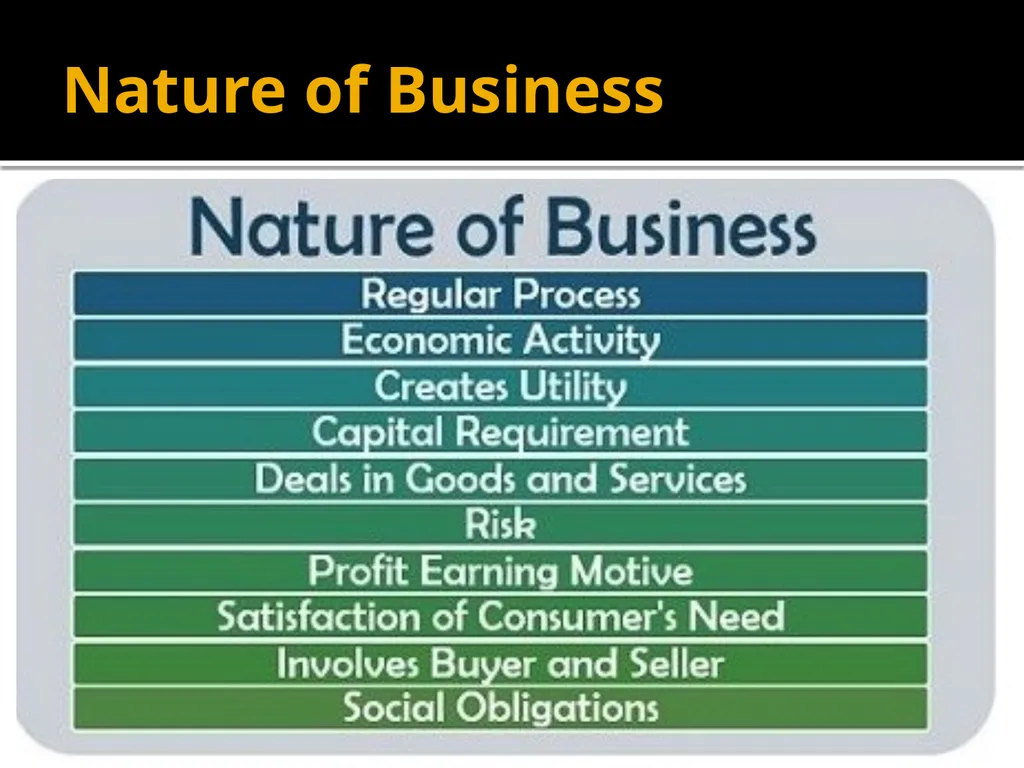
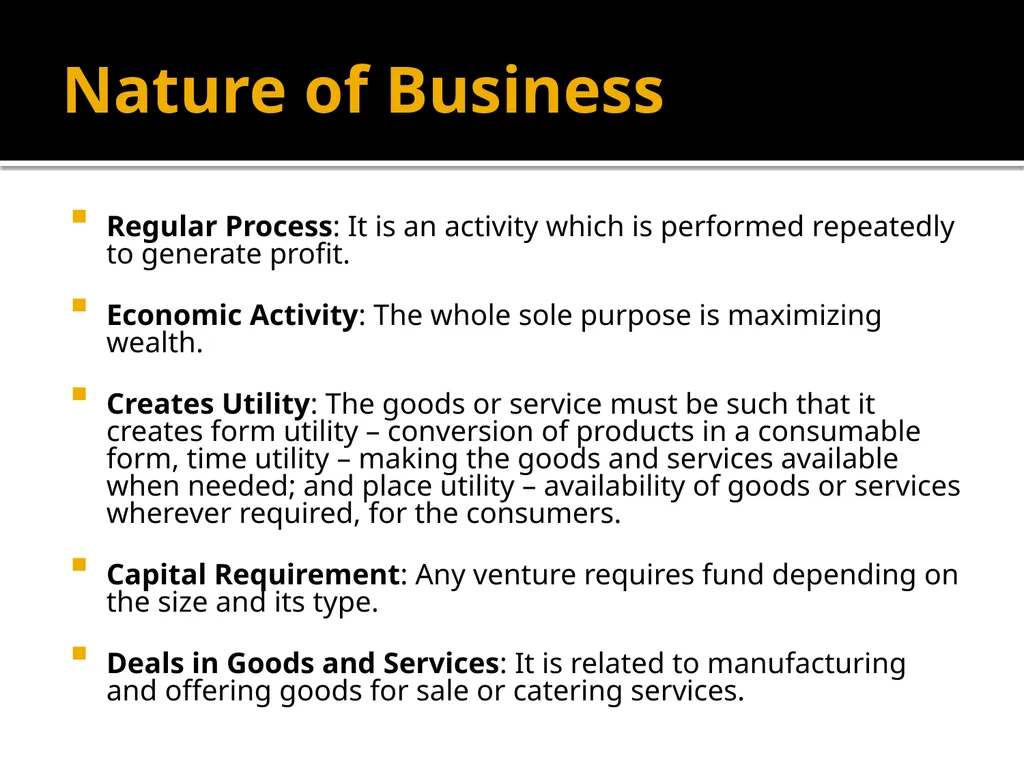
Nature of Business Regular Process: It is an activity which is performed repeatedly to generate profit.
Economic Activity: The whole sole purpose is maximizing wealth.
Creates Utility: The goods or service must be such that it creates form utility – conversion of products in a consumable form, time utility – making the goods and services available when needed; and place utility – availability of goods or services wherever required, for the consumers.
Capital Requirement: Any venture requires fund depending on the size and its type.
Deals in Goods and Services: It is related to manufacturing and offering goods for sale or catering services.<br>
06
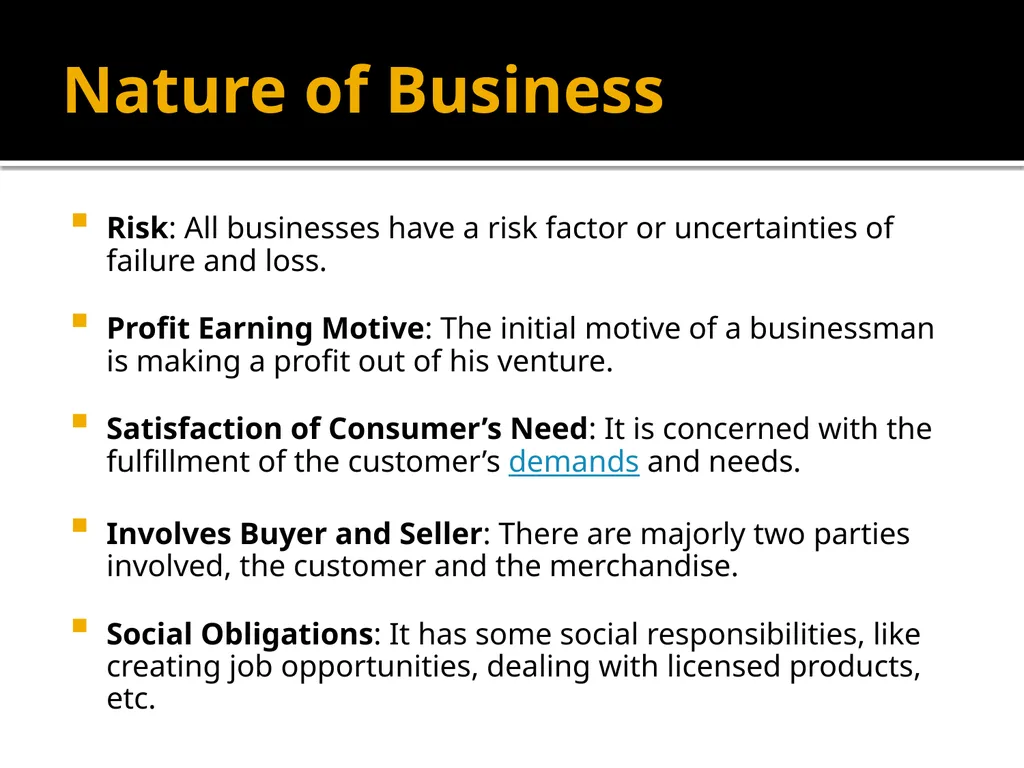
Nature of Business Risk: All businesses have a risk factor or uncertainties of failure and loss.
Profit Earning Motive: The initial motive of a businessman is making a profit out of his venture.
Satisfaction of Consumer’s Need: It is concerned with the fulfillment of the customer’s demands and needs.
Involves Buyer and Seller: There are majorly two parties involved, the customer and the merchandise.
Social Obligations: It has some social responsibilities, like creating job opportunities, dealing with licensed products, etc.<br>
07
Types of Business The previous instance has made it clear that business involves goods or services or both. A person has first to select the kind of business line he wants to operate.
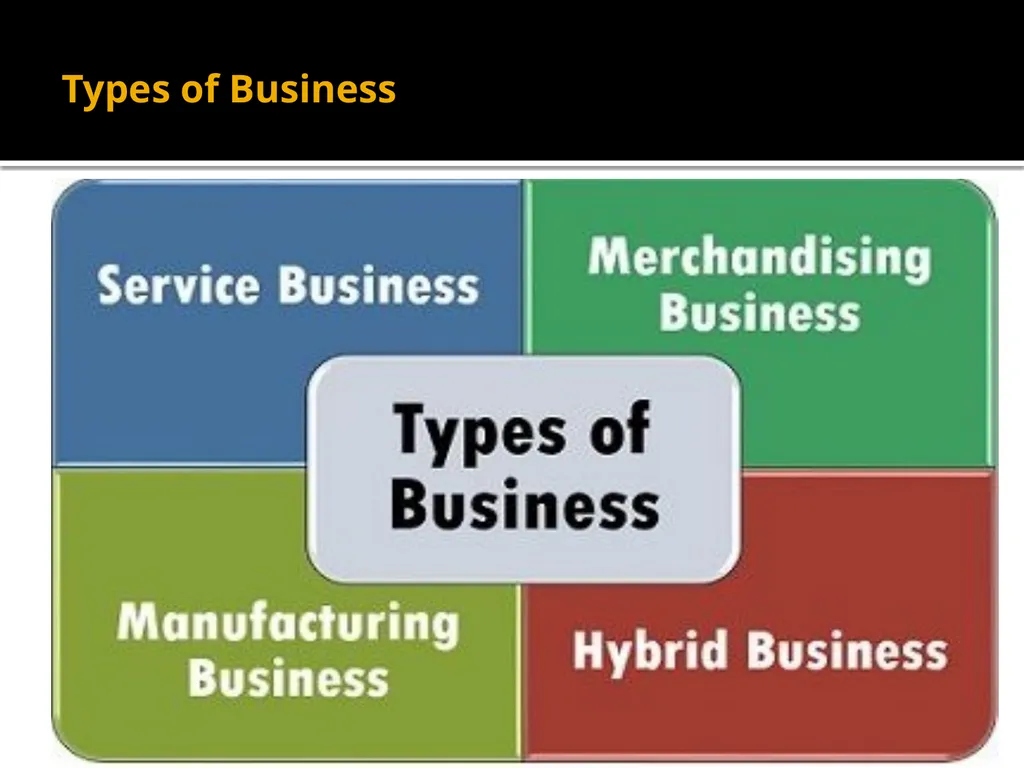
Thus, a business can be broadly classified as into the following types:<br>
08
Types of Business<br>
09
Types of Business Service: An activity performed to earn money through customer satisfaction is known as a service. It involves professional skills and expertise. E.g. A professional teacher earns money by taking tuition class<br>
10
Types of Business Merchandising: Merchandising means procurement of goods from manufacturers or wholesalers, at a low price and selling it at a higher price to make a profit. It is also known as a retail business. E.g. A florist selling flowers<br>
11
Types of Business Manufacturing: Making profit through production or creation of goods from raw material in such a way that it derives some utility to the consumer is known as a manufacturing business. E.g. Processing of sugarcane in a sugar mill to get fine sugar<br>
12
Types of Business Hybrid: A business which involves all the three activities, i.e. manufacturing of goods, merchandising of products and delivering service falls under the hybrid category. E.g. A furniture seller, who manufactures furniture, buys old furniture and sells it at a higher price after repairing and also provides services for polishing old furniture.<br>
13
Importance of Business Business is a self-employment opportunity for a person to become self-independent and master of his ideas. It is not only beneficial to the owner but also makes an impact on society.
To get a detailed understanding of the importance of trading activities to the owner and the society, let us go through the following points:<br>
14
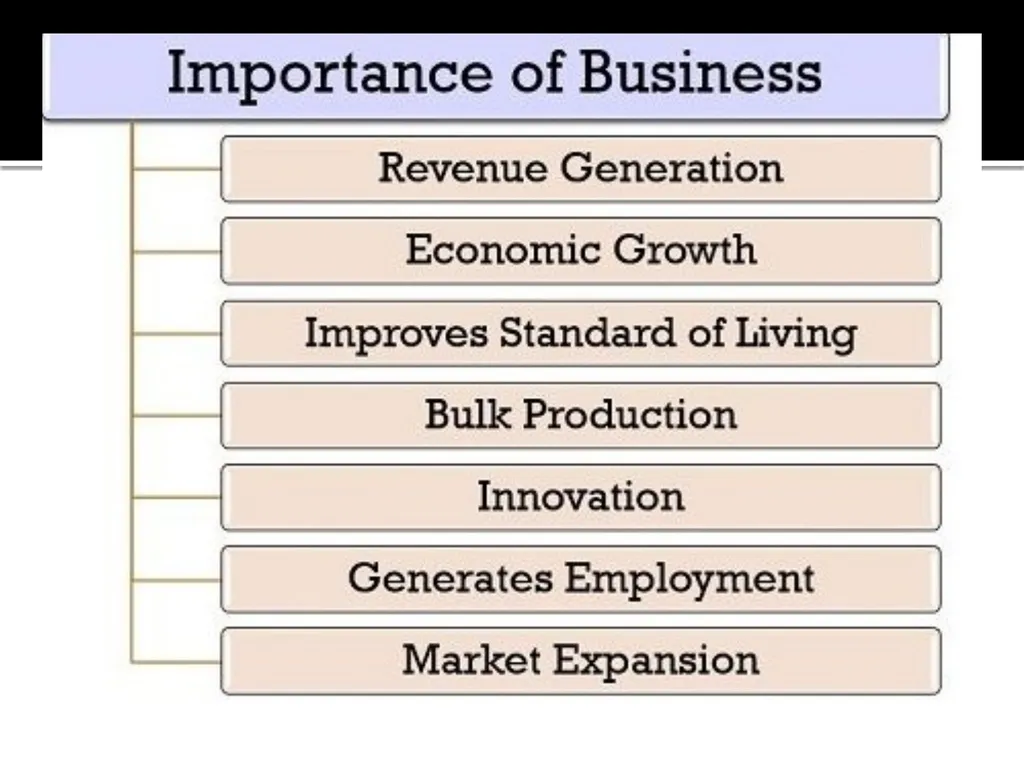
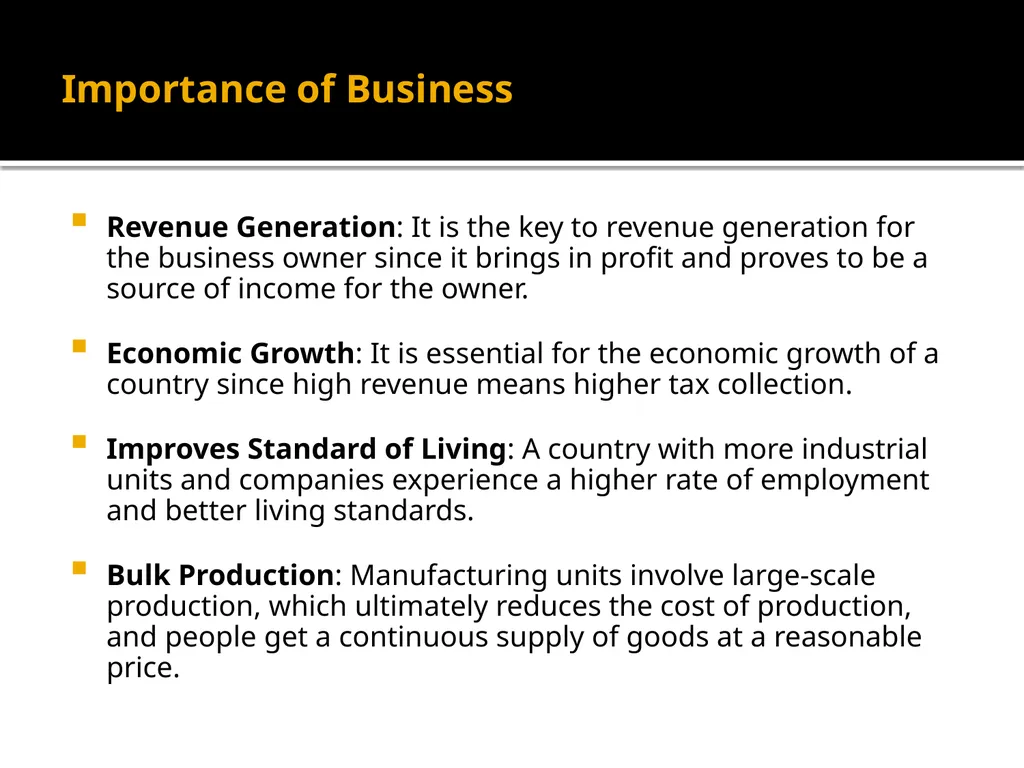
Importance of Business Revenue Generation: It is the key to revenue generation for the business owner since it brings in profit and proves to be a source of income for the owner.
Economic Growth: It is essential for the economic growth of a country since high revenue means higher tax collection.
Improves Standard of Living: A country with more industrial units and companies experience a higher rate of employment and better living standards.
Bulk Production: Manufacturing units involve large-scale production, which ultimately reduces the cost of production, and people get a continuous supply of goods at a reasonable price.<br>
15
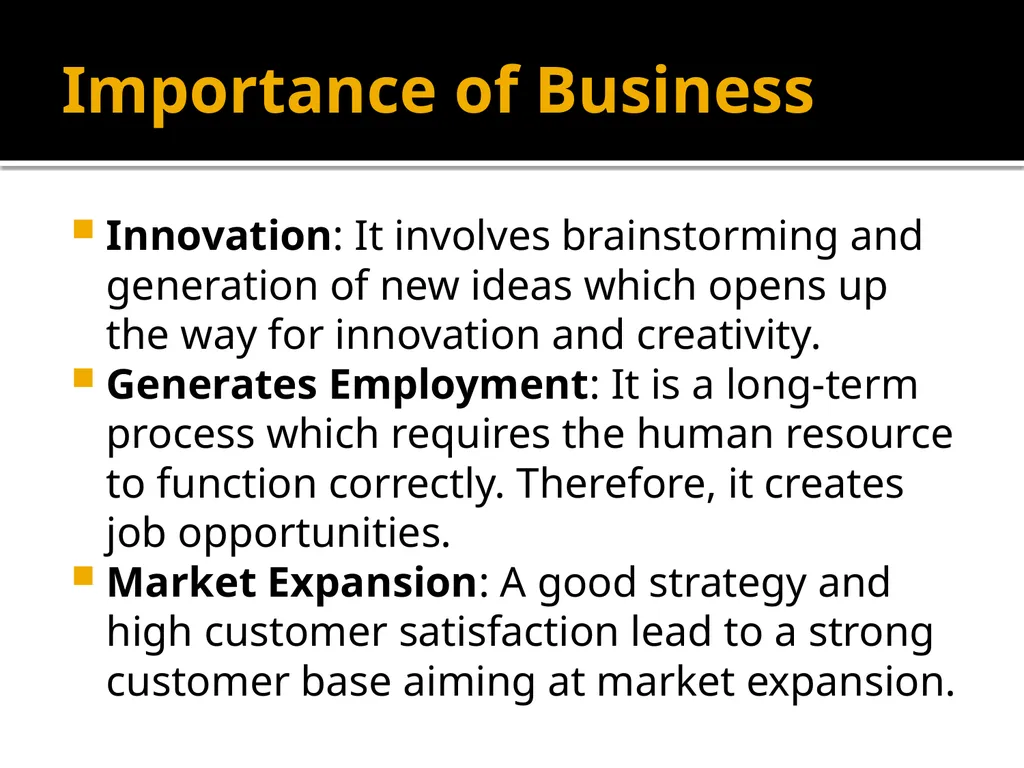
Importance of Business Innovation: It involves brainstorming and generation of new ideas which opens up the way for innovation and creativity.
Generates Employment: It is a long-term process which requires the human resource to function correctly. Therefore, it creates job opportunities.
Market Expansion: A good strategy and high customer satisfaction lead to a strong customer base aiming at market expansion.<br>
16
q<br>
17
.<br>
18
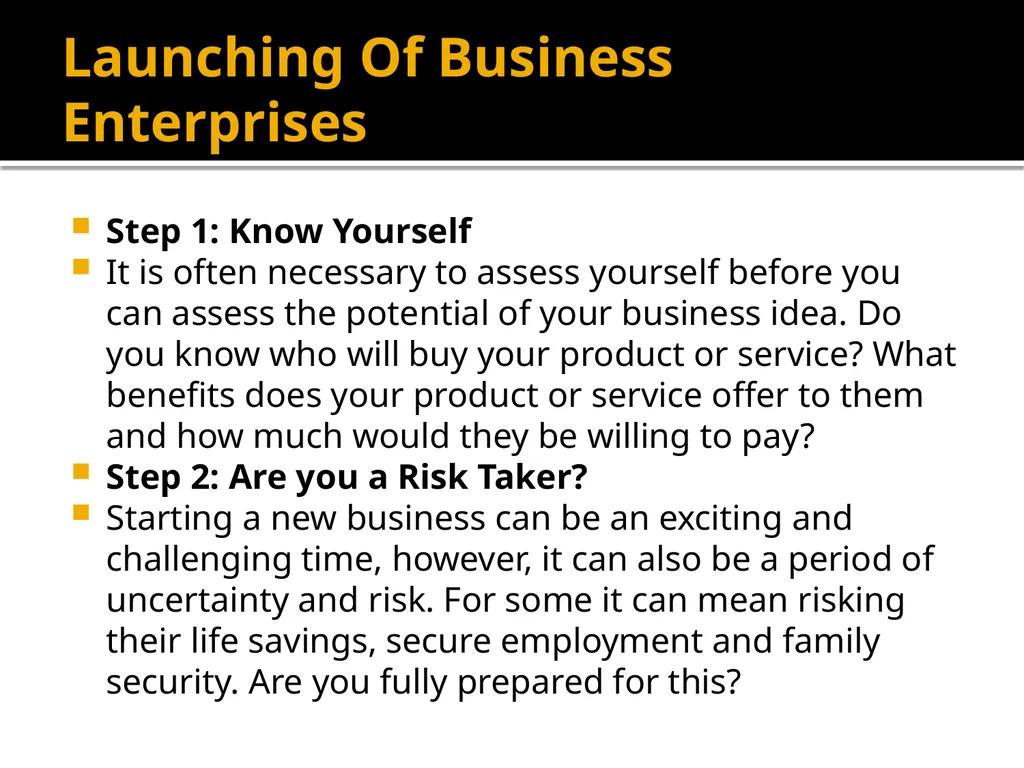
Launching Of Business Enterprises Step 1: Know Yourself
It is often necessary to assess yourself before you can assess the potential of your business idea. Do you know who will buy your product or service? What benefits does your product or service offer to them and how much would they be willing to pay?
Step 2: Are you a Risk Taker?
Starting a new business can be an exciting and challenging time, however, it can also be a period of uncertainty and risk. For some it can mean risking their life savings, secure employment and family security. Are you fully prepared for this?<br>
19
Launching Of Business Enterprises Step 3: Market Research
Market research is essential in helping you to identify your target market and getting to know your potential customers. Conducting market research will also help you to identify who your competitors are and how to compete effectively in a given market. Research is also effective in assessing demand for a new product or service.
Step 4: Examine Your Business Requirements
Consider the best location for the business
Identify your basic equipment requirement and costs
Will you need to employ more staff?
Identify your Insurance requirements<br>
20
Launching Of Business Enterprises Step 5: Calculate Investment Requirements
Identify all start-up costs associated with the business
Identify ways of financing your business venture
Seek financial support and benefit from direct referral to Government Supports
Become aware of all financial supports we offer
Step 6: Developing your Marketing Strategy
Marketing your enterprise is a fundamental aspect of starting up
Research the most cost-effective methods of marketing your business
Write your Marketing Plan<br>
21
Launching Of Business Enterprises Step 7: Developing Your Sales Plan
Having assessed your business idea, estimate your selling price
How will you promote the enterprise?
Who/where is your target market (local/national/international)?
What channels of distribution will be used?
Determine the break-even point
Step 8: Decide on an appropriate legal business structure
It is important to research the types of business ownership to help you make the best decisions for your business. You can choose whether you want a:
Sole trader
Partnership
Limited Company<br>
22
Launching Of Business Enterprises Step 9: Be aware of legal obligations that will affect your business
Register your business name with the Companies Registration Office (CRO).
You will need to understand your tax obligations and register as self-employed with your local revenue office.
You will need to be aware of your statutory obligations such as trading licenses, planning permission, insurance, health & safety, patents
Step 10: Write your Business Plan
Business Planning is fundamental to success in business. It is the key to making things happen and reaching goals. A business plan can be used as an operating tool that will help you to make important decisions and manage your business effectively, the business plan also has a number of other uses.<br>