
Calming Overwhelming Emotions: Strategies to Help
AM
Published · 36 slides · 0 views

1 / 1
Description
Calming Overwhelming Emotions: Strategies to Help Students Become Self-Regulated Learners What is self regulation? The ability to respond to the ongoing demands of experience with the range of emotions in a manner that is socially
Related Topics
Share
Embed code
Download this presentation From Below
"Calming Overwhelming Emotions: Strategies to Help" is the property of its rightful owner. Permission is granted to download and print the materials on this website for personal, non-commercial use only, and to display it on your personal computer provided you do not modify the materials and that you retain all copyright notices contained in the materials. By downloading content from our website, you accept the terms of this agreement.
Presentation Transcript
01
Calming Overwhelming Emotions: Strategies to Help Students Become Self-Regulated Learners<br>
02
What is self regulation? “The ability to respond to the ongoing demands of experience with the range of emotions in a manner that is socially tolerable and sufficiently flexible to permit spontaneous reactions as well as the ability to delay spontaneous reactions as needed” (Cole, Michel, Teti, 1994, p. 76).
“An individual’s ability to modify an emotional state so as to promote adaptive, goal-oriented behaviors.” (Shaw, Stringaris, Nigg, & Leibenluft, 2014)<br>
“An individual’s ability to modify an emotional state so as to promote adaptive, goal-oriented behaviors.” (Shaw, Stringaris, Nigg, & Leibenluft, 2014)<br>
03
What is Self-Regulation? Different aspects of it
Focused attention
Managing difficult and uncomfortable emotions
Delaying gratification
Some developmental tasks requiring emotion regulation:
Tolerating frustration and tolerating being alone for reasonable periods
Engaging others, developing friendships
Recognizing danger, coping with anxiety and fear
Defending oneself within bounds of acceptable behavior
Developing interest and motivation in learning<br>
Focused attention
Managing difficult and uncomfortable emotions
Delaying gratification
Some developmental tasks requiring emotion regulation:
Tolerating frustration and tolerating being alone for reasonable periods
Engaging others, developing friendships
Recognizing danger, coping with anxiety and fear
Defending oneself within bounds of acceptable behavior
Developing interest and motivation in learning<br>
04
Understanding Self-Regulation Ability to manage emotions, impulses and behavior
Suggests flexibility and adaptability
Dependent on environmental and contextual supports
Biology, Genetics, & Temperament
Self-regulation skills that develop over time
Motivation to self-regulate
Caregiver support by modeling, teaching, and coaching
Environmental context<br>
Suggests flexibility and adaptability
Dependent on environmental and contextual supports
Biology, Genetics, & Temperament
Self-regulation skills that develop over time
Motivation to self-regulate
Caregiver support by modeling, teaching, and coaching
Environmental context<br>
05
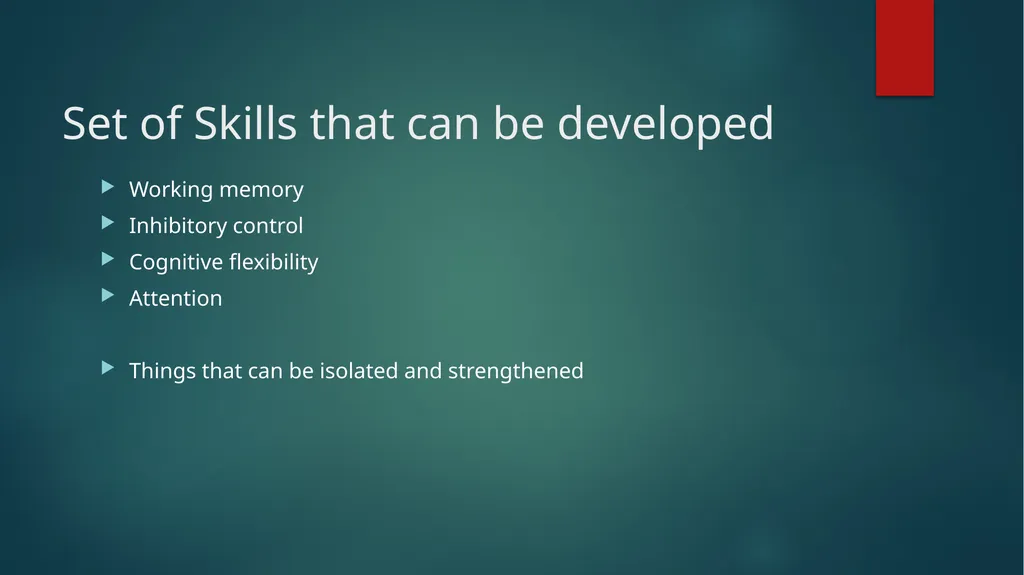
Set of Skills that can be developed Working memory
Inhibitory control
Cognitive flexibility
Attention
Things that can be isolated and strengthened<br>
Inhibitory control
Cognitive flexibility
Attention
Things that can be isolated and strengthened<br>
06
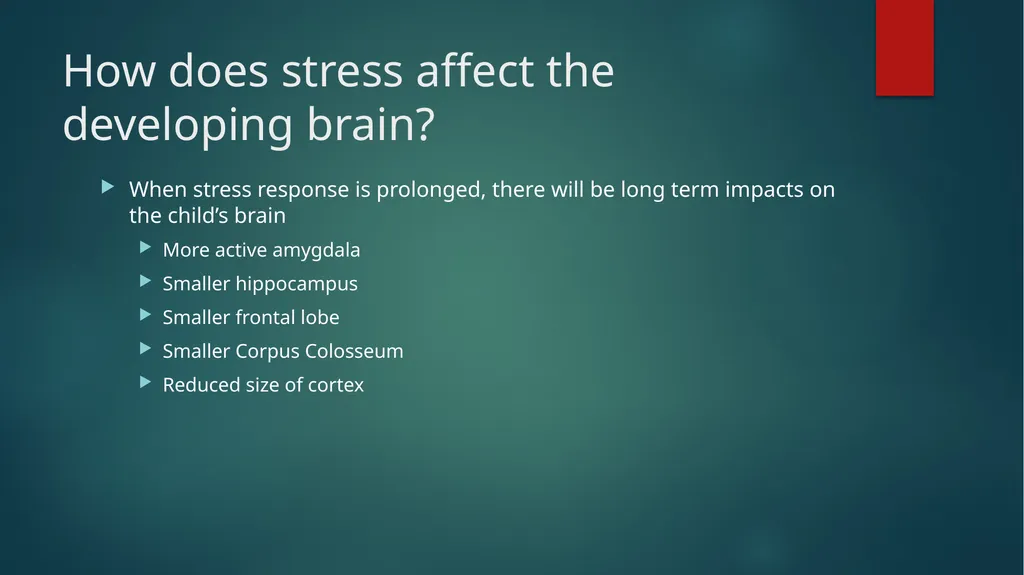
How does stress affect the developing brain? When stress response is prolonged, there will be long term impacts on the child’s brain
More active amygdala
Smaller hippocampus
Smaller frontal lobe
Smaller Corpus Colosseum
Reduced size of cortex<br>
More active amygdala
Smaller hippocampus
Smaller frontal lobe
Smaller Corpus Colosseum
Reduced size of cortex<br>
07
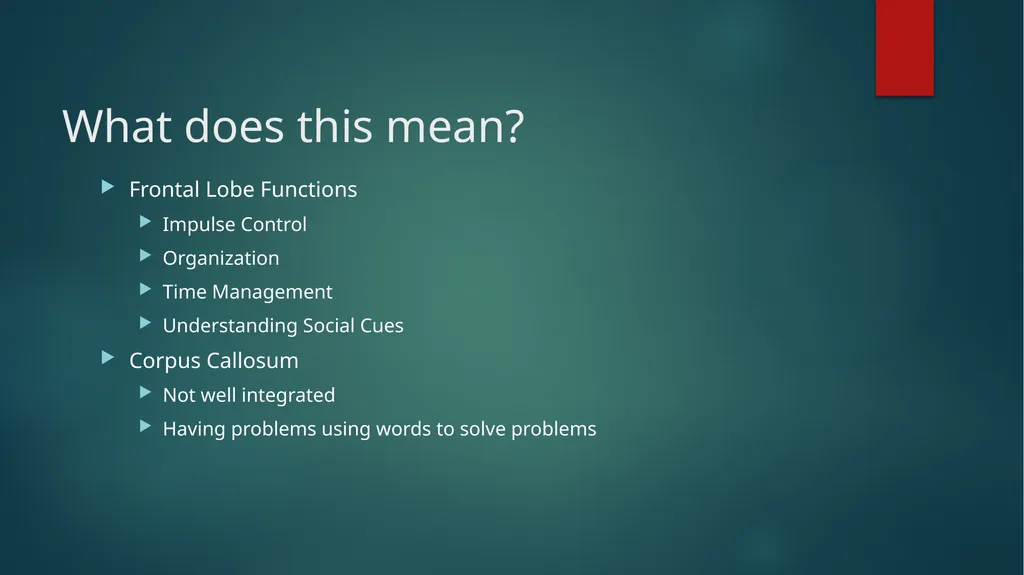
What does this mean? Frontal Lobe Functions
Impulse Control
Organization
Time Management
Understanding Social Cues
Corpus Callosum
Not well integrated
Having problems using words to solve problems<br>
Impulse Control
Organization
Time Management
Understanding Social Cues
Corpus Callosum
Not well integrated
Having problems using words to solve problems<br>
08
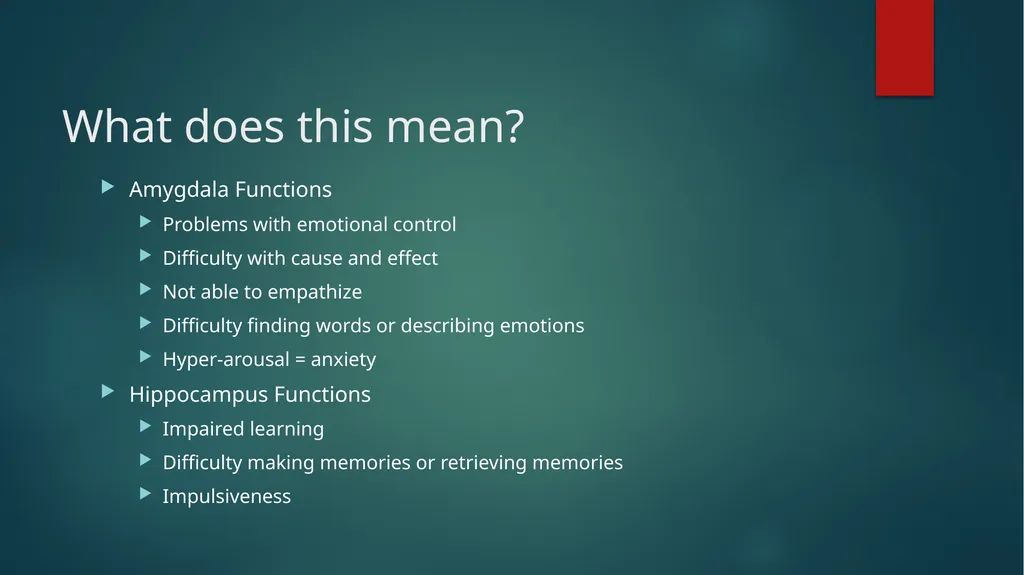
What does this mean? Amygdala Functions
Problems with emotional control
Difficulty with cause and effect
Not able to empathize
Difficulty finding words or describing emotions
Hyper-arousal = anxiety
Hippocampus Functions
Impaired learning
Difficulty making memories or retrieving memories
Impulsiveness<br>
Problems with emotional control
Difficulty with cause and effect
Not able to empathize
Difficulty finding words or describing emotions
Hyper-arousal = anxiety
Hippocampus Functions
Impaired learning
Difficulty making memories or retrieving memories
Impulsiveness<br>
09
Resulting in problems at school School age children experience changes in brain regions that normally would help:
Manage fears, anxieties or aggression
Sustain attention
Control impulses
Manage physical responses to danger<br>
Manage fears, anxieties or aggression
Sustain attention
Control impulses
Manage physical responses to danger<br>
10
Implicit Memories Often Direct Behavior Pre-verbal experiences
Stored in implicit memory
Activated by experiences
Emotional response to current events filtered by past events
Such as:
Reactions to authority
Power Struggles
Attention Seeking Behavior<br>
Stored in implicit memory
Activated by experiences
Emotional response to current events filtered by past events
Such as:
Reactions to authority
Power Struggles
Attention Seeking Behavior<br>
11
For example: At six months old get bitten by dog on the hand
At 2 years old get bitten again by dog on hand
When see a dog:
Feeling of fear
Feeling of pain in my hand
Barking sound
And feeling that want to run<br>
At 2 years old get bitten again by dog on hand
When see a dog:
Feeling of fear
Feeling of pain in my hand
Barking sound
And feeling that want to run<br>
12
How do we learn to self-regulate It is something that we can learn
Co-regulation
Baby hears loud noise
By looking at mom’s face, draws attention away from the noise
Also has a soothing quality because Mom does not show signs of stress
Need for self-soothing behaviors such as thumb sucking
Reduce distress and frustration
Re-focus attention<br>
Co-regulation
Baby hears loud noise
By looking at mom’s face, draws attention away from the noise
Also has a soothing quality because Mom does not show signs of stress
Need for self-soothing behaviors such as thumb sucking
Reduce distress and frustration
Re-focus attention<br>
13
How do we learn to self-regulate Speaking in calm tones
Modeling self-calming strategies
Talking children through strategies when they are upset
Use of words to express emotions
Modeling conflict resolution skills
Learning selective attention
Perspective taking<br>
Modeling self-calming strategies
Talking children through strategies when they are upset
Use of words to express emotions
Modeling conflict resolution skills
Learning selective attention
Perspective taking<br>
14
Developing self-regulation Develops over time from birth to young adulthood
Early childhood & adolescence are times where self-regulation skills peak due to changes in brain architecture
Skills can be strengthened and taught from caregivers
Repeated practice in supportive context
Develops in context of social relationships
Dependent on “co-regulation” by parents or other adults<br>
Early childhood & adolescence are times where self-regulation skills peak due to changes in brain architecture
Skills can be strengthened and taught from caregivers
Repeated practice in supportive context
Develops in context of social relationships
Dependent on “co-regulation” by parents or other adults<br>
15
Process Regulating Emotions Identification of internal emotions
Understanding different feeling states
Applying appropriate labels (“Happy” or “Sad”)
Express emotions safely and regulate internal experience
Impaired ability to self-soothe
Dissociation
Numbing of experiences
Avoiding uncomfortable or overwhelming emotions
Feeling uneasy<br>
Understanding different feeling states
Applying appropriate labels (“Happy” or “Sad”)
Express emotions safely and regulate internal experience
Impaired ability to self-soothe
Dissociation
Numbing of experiences
Avoiding uncomfortable or overwhelming emotions
Feeling uneasy<br>
16
If unable to regulate emotions… Develop emotional instability
Quick responses to minor stressors
Extremely rapid escalation of emotional response<br>
Quick responses to minor stressors
Extremely rapid escalation of emotional response<br>
17
Managing Stress Manageable stress builds coping skills
Prolonged stress and adversity can disrupt the development of self-regulation
Overwhelm child’s skills or supports
Negatively impact development
Creates long-term changes in neurobiology
Situations such as:
Poverty
Trauma
Homelessness<br>
Prolonged stress and adversity can disrupt the development of self-regulation
Overwhelm child’s skills or supports
Negatively impact development
Creates long-term changes in neurobiology
Situations such as:
Poverty
Trauma
Homelessness<br>
18
Individual responses to stress Individuals vary in responses to adverse experiences
Genetics and Environment
Protective factors
Coping skills
Experiencing repeated stressors may make it difficult to self-regulate when faced with stress later
Neurobiological changes<br>
Genetics and Environment
Protective factors
Coping skills
Experiencing repeated stressors may make it difficult to self-regulate when faced with stress later
Neurobiological changes<br>
19
Responses to stress Internalized responses
Depression
Anxiety
Dissociation
Externalizing
Impulsivity
Disruptive behaviors
Aggression<br>
Depression
Anxiety
Dissociation
Externalizing
Impulsivity
Disruptive behaviors
Aggression<br>
20
Understanding dissociation Coping mechanism to deal with trauma
Allows separation from experiences
Normal response to overwhelming circumstances
Spacing out
Driving on autopilot
Getting lost in a book or movie
Being in the zone
Ability to shift focus
Can become an automatic response to stress<br>
Allows separation from experiences
Normal response to overwhelming circumstances
Spacing out
Driving on autopilot
Getting lost in a book or movie
Being in the zone
Ability to shift focus
Can become an automatic response to stress<br>
21
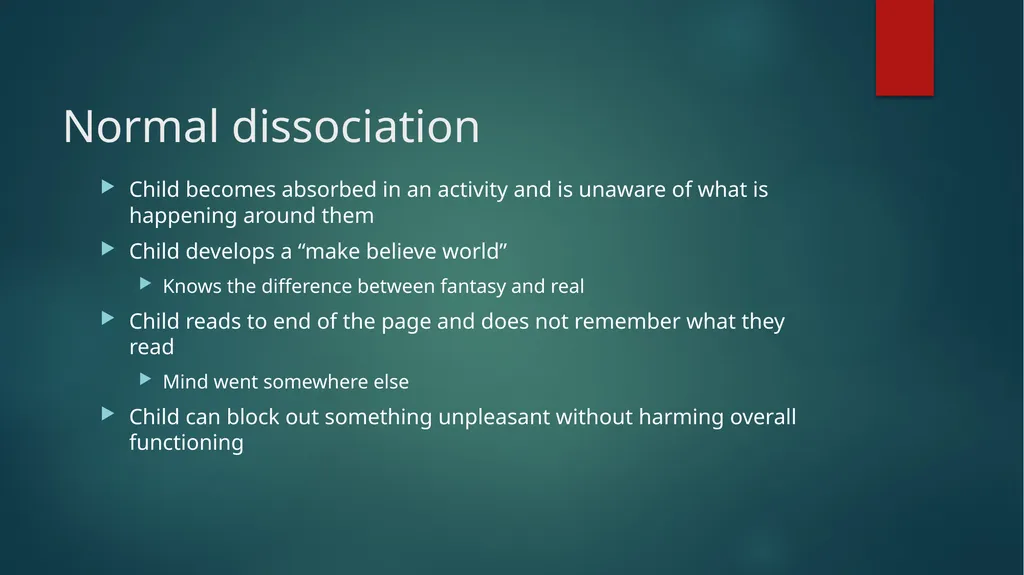
Normal dissociation Child becomes absorbed in an activity and is unaware of what is happening around them
Child develops a “make believe world”
Knows the difference between fantasy and real
Child reads to end of the page and does not remember what they read
Mind went somewhere else
Child can block out something unpleasant without harming overall functioning<br>
Child develops a “make believe world”
Knows the difference between fantasy and real
Child reads to end of the page and does not remember what they read
Mind went somewhere else
Child can block out something unpleasant without harming overall functioning<br>
22
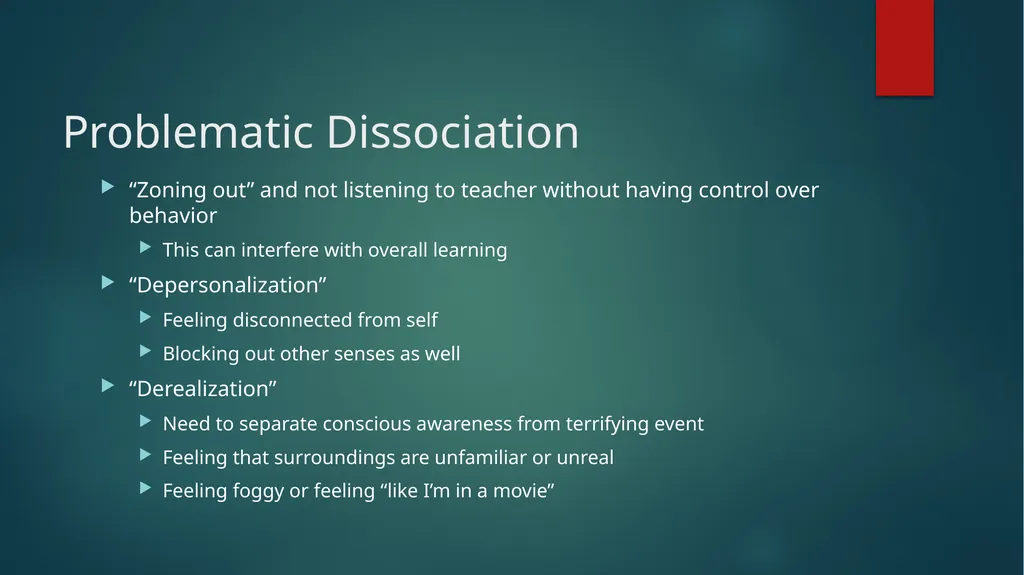
Problematic Dissociation “Zoning out” and not listening to teacher without having control over behavior
This can interfere with overall learning
“Depersonalization”
Feeling disconnected from self
Blocking out other senses as well
“Derealization”
Need to separate conscious awareness from terrifying event
Feeling that surroundings are unfamiliar or unreal
Feeling foggy or feeling “like I’m in a movie”<br>
This can interfere with overall learning
“Depersonalization”
Feeling disconnected from self
Blocking out other senses as well
“Derealization”
Need to separate conscious awareness from terrifying event
Feeling that surroundings are unfamiliar or unreal
Feeling foggy or feeling “like I’m in a movie”<br>
23
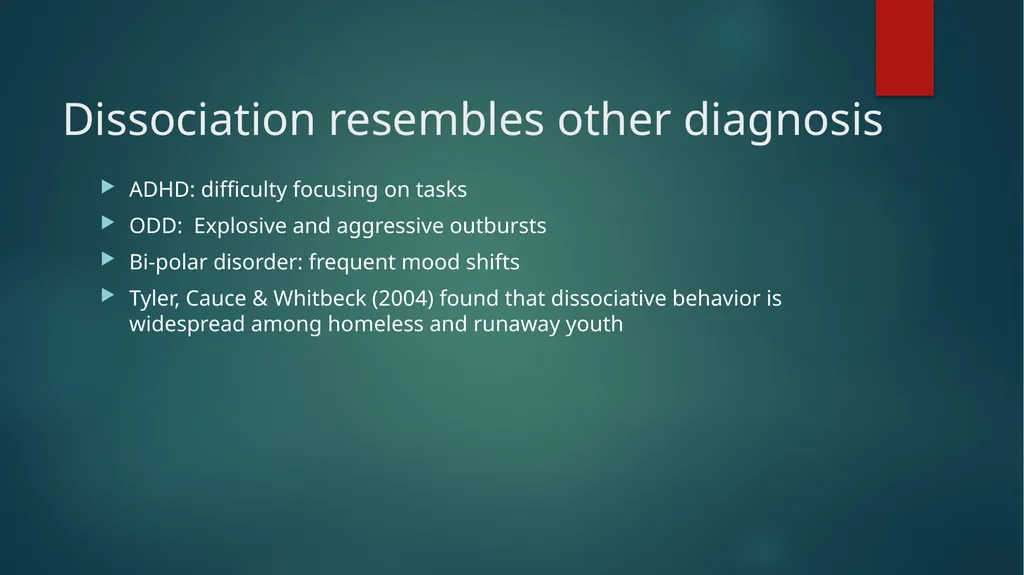
Dissociation resembles other diagnosis ADHD: difficulty focusing on tasks
ODD: Explosive and aggressive outbursts
Bi-polar disorder: frequent mood shifts
Tyler, Cauce & Whitbeck (2004) found that dissociative behavior is widespread among homeless and runaway youth<br>
ODD: Explosive and aggressive outbursts
Bi-polar disorder: frequent mood shifts
Tyler, Cauce & Whitbeck (2004) found that dissociative behavior is widespread among homeless and runaway youth<br>
24
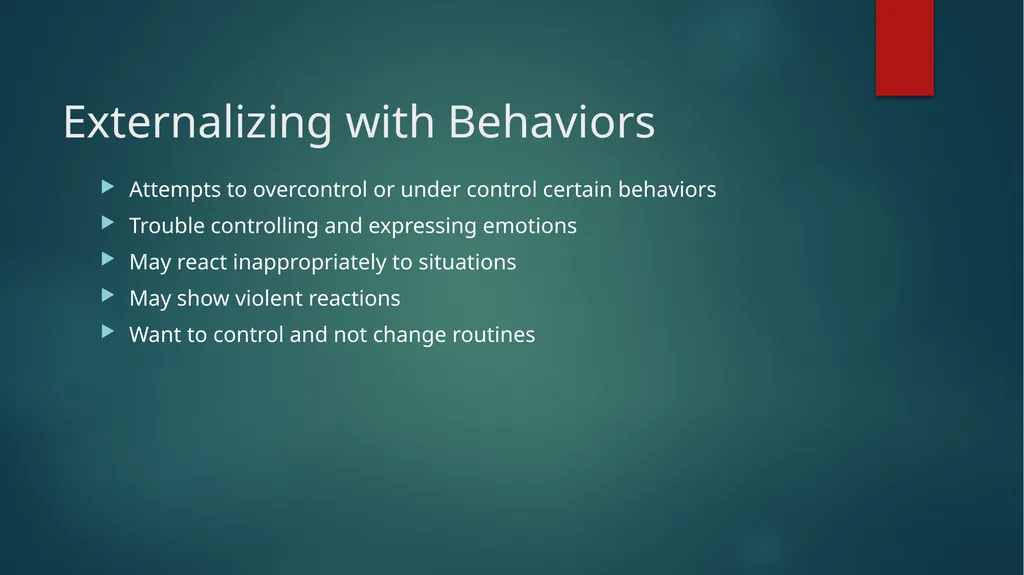
Externalizing with Behaviors Attempts to overcontrol or under control certain behaviors
Trouble controlling and expressing emotions
May react inappropriately to situations
May show violent reactions
Want to control and not change routines<br>
Trouble controlling and expressing emotions
May react inappropriately to situations
May show violent reactions
Want to control and not change routines<br>
25
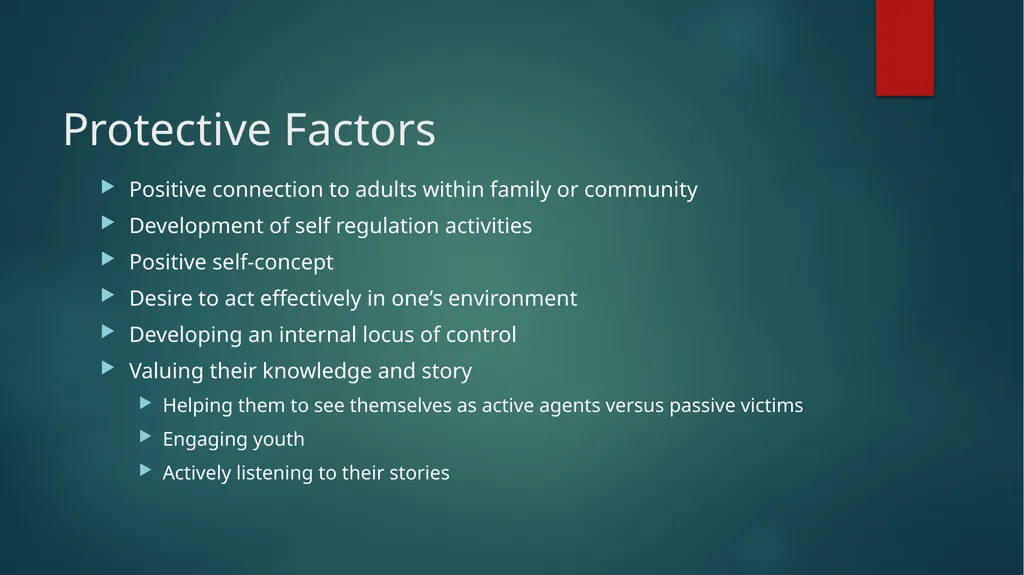
Protective Factors Positive connection to adults within family or community
Development of self regulation activities
Positive self-concept
Desire to act effectively in one’s environment
Developing an internal locus of control
Valuing their knowledge and story
Helping them to see themselves as active agents versus passive victims
Engaging youth
Actively listening to their stories<br>
Development of self regulation activities
Positive self-concept
Desire to act effectively in one’s environment
Developing an internal locus of control
Valuing their knowledge and story
Helping them to see themselves as active agents versus passive victims
Engaging youth
Actively listening to their stories<br>
26
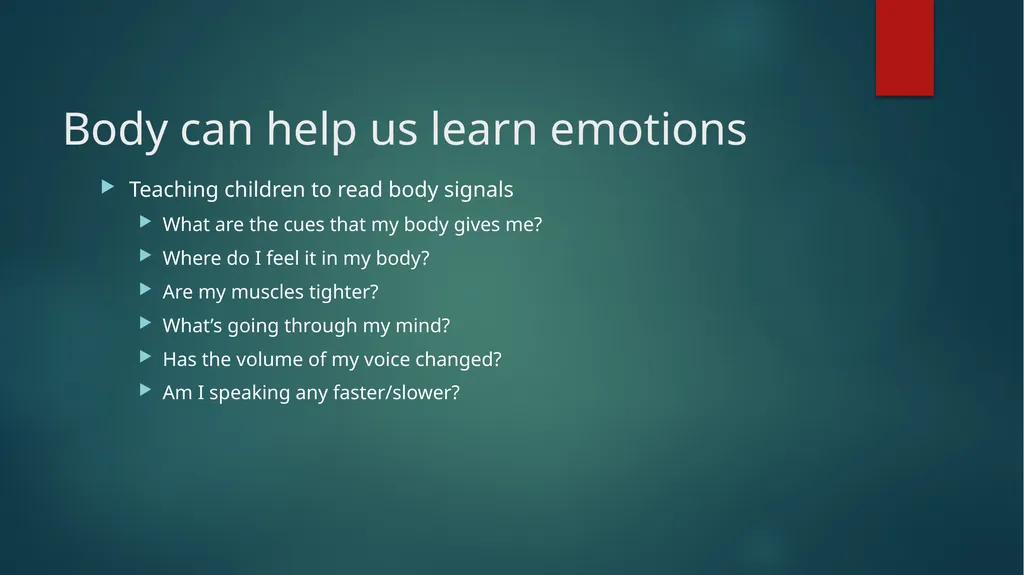
Body can help us learn emotions Teaching children to read body signals
What are the cues that my body gives me?
Where do I feel it in my body?
Are my muscles tighter?
What’s going through my mind?
Has the volume of my voice changed?
Am I speaking any faster/slower?<br>
What are the cues that my body gives me?
Where do I feel it in my body?
Are my muscles tighter?
What’s going through my mind?
Has the volume of my voice changed?
Am I speaking any faster/slower?<br>
27
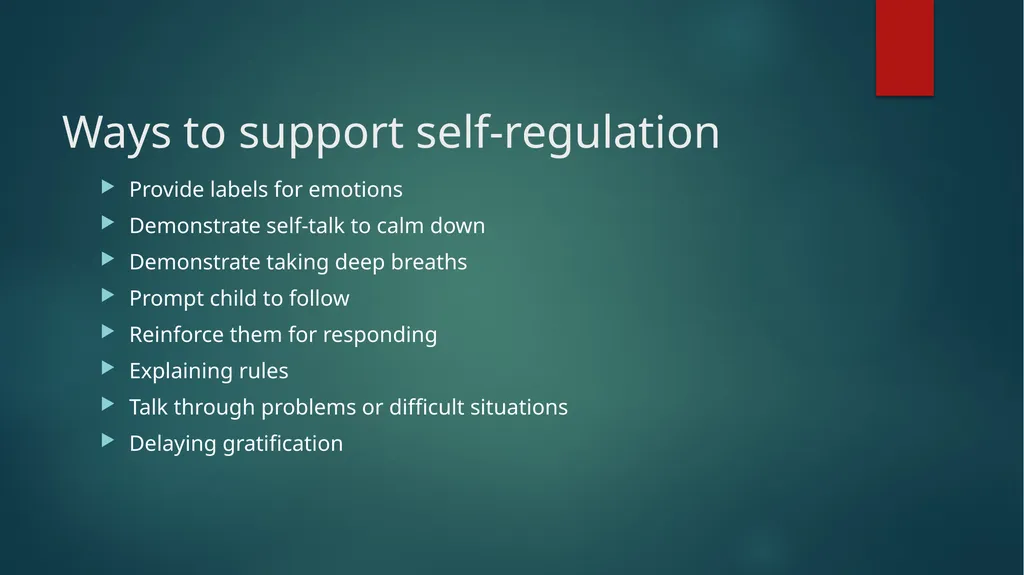
Ways to support self-regulation Provide labels for emotions
Demonstrate self-talk to calm down
Demonstrate taking deep breaths
Prompt child to follow
Reinforce them for responding
Explaining rules
Talk through problems or difficult situations
Delaying gratification<br>
Demonstrate self-talk to calm down
Demonstrate taking deep breaths
Prompt child to follow
Reinforce them for responding
Explaining rules
Talk through problems or difficult situations
Delaying gratification<br>
28
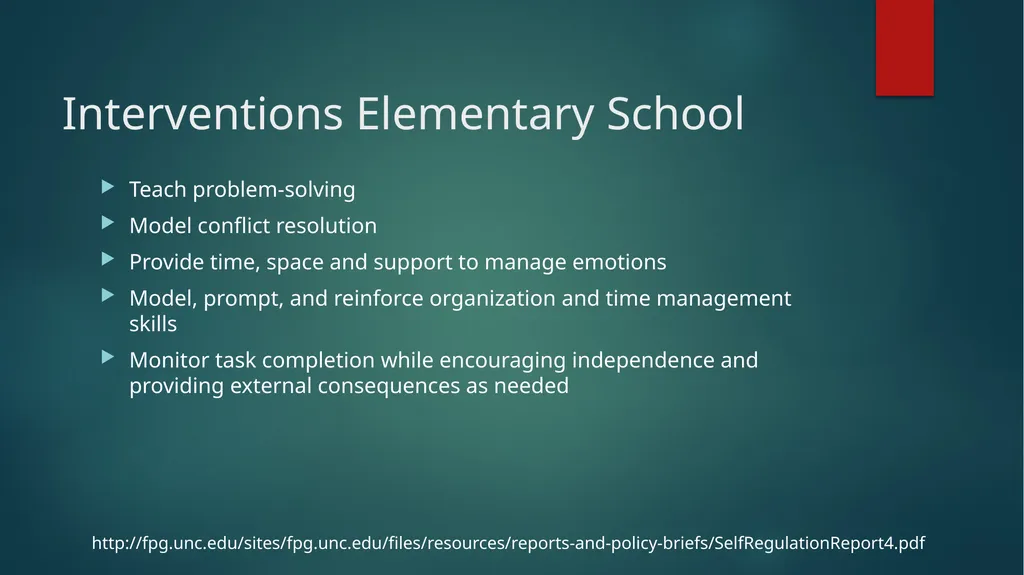
Interventions Elementary School Teach problem-solving
Model conflict resolution
Provide time, space and support to manage emotions
Model, prompt, and reinforce organization and time management skills
Monitor task completion while encouraging independence and providing external consequences as needed http://fpg.unc.edu/sites/fpg.unc.edu/files/resources/reports-and-policy-briefs/SelfRegulationReport4.pdf<br>
Model conflict resolution
Provide time, space and support to manage emotions
Model, prompt, and reinforce organization and time management skills
Monitor task completion while encouraging independence and providing external consequences as needed http://fpg.unc.edu/sites/fpg.unc.edu/files/resources/reports-and-policy-briefs/SelfRegulationReport4.pdf<br>
29
Strategies for Middle School Monitor and reinforce task completion
Coach organization skills
Teach planning and prioritization
Collaboratively problem solve social and academic issues
Coach healthy stress management
Encourage decision-making when less emotional
Reduce emotional intensity of interactions and situations exceeding coping skills http://fpg.unc.edu/sites/fpg.unc.edu/files/resources/reports-and-policy-briefs/SelfRegulationReport4.pdf<br>
Coach organization skills
Teach planning and prioritization
Collaboratively problem solve social and academic issues
Coach healthy stress management
Encourage decision-making when less emotional
Reduce emotional intensity of interactions and situations exceeding coping skills http://fpg.unc.edu/sites/fpg.unc.edu/files/resources/reports-and-policy-briefs/SelfRegulationReport4.pdf<br>
30
Learning to focus Help them focus on finishing a portion of the project rather than the entire thing
Teach strategies to help them attain the goal
Set aside time (15 minutes) to work without distraction
Self-reflect on what worked and what didn’t work
What contributed to successes
What could do differently next time<br>
Teach strategies to help them attain the goal
Set aside time (15 minutes) to work without distraction
Self-reflect on what worked and what didn’t work
What contributed to successes
What could do differently next time<br>
31
Mindfulness Paying attention in specific way
Being in the present
Helps with emotional regulation capacity
Helps to bring one’s thoughts and feelings to the present moment
Focusing and directing attention to specific areas
Taps into connections between mind and body<br>
Being in the present
Helps with emotional regulation capacity
Helps to bring one’s thoughts and feelings to the present moment
Focusing and directing attention to specific areas
Taps into connections between mind and body<br>
32
How can mindfulness help? Enhance focus
Reduce attention problems
Improve wellbeing
Increase social skills
Reduce anxiety or distress
Reduce impulsivity and reactivity
Bring greater calmness and awareness
Improve cognitive performance<br>
Reduce attention problems
Improve wellbeing
Increase social skills
Reduce anxiety or distress
Reduce impulsivity and reactivity
Bring greater calmness and awareness
Improve cognitive performance<br>
33
Mindfulness for children Emotional Mind: recognize emotions that are present
Reasonable Mind: recognize thinking errors
Wise mind: Understand the ebb and flow of negative/positive thinking<br>
Reasonable Mind: recognize thinking errors
Wise mind: Understand the ebb and flow of negative/positive thinking<br>
34
Some Mindful activities… Superman pose
Wonder Woman pose
Activate your Spidey senses
Creating a mindful jar with glitter
Blowing bubbles or Mindful Breath
Use of a tool such as a chime or bell
Listen until you can no longer hear it
Focus your attention on breathing
Check your weather report
Describe feelings in a particular moment<br>
Wonder Woman pose
Activate your Spidey senses
Creating a mindful jar with glitter
Blowing bubbles or Mindful Breath
Use of a tool such as a chime or bell
Listen until you can no longer hear it
Focus your attention on breathing
Check your weather report
Describe feelings in a particular moment<br>
35
Neuroplasticity The brain is constantly rewiring itself
Neurons that wire together fire together
Constantly making new patterns<br>
Neurons that wire together fire together
Constantly making new patterns<br>
36
References Ackerman, C. (2017). Mindfulness activities for children and teens: 25 Fun exercises for kids. Retrieved from https://positivepsychologyprogram.com/mindfulness-for-children-kids-activities/
Barnes, A.J., Lafavor, T.L., Cutuli, J.J., Zhang, L., Oberg, C.N., & Masten, A.S. (2017). Health and self-regulation among school-aged children experiencing family homelessness. Children: 4:70.
Cole, P.M., Michel, M.K., & Teti, L.O. (1994). The development of emotion regulation and dysregulation: A clinical perspective. The Development of emotion regulation: Biological and Behavioral Considerations. Monograph of the Society for Research in Child Development: 59, 2/3: 73-100.
Cook, A., Spinazzola, J., Ford, J., Lanktree, C., Blaustein, M., Cloitre, M., … van der Kolk, B. (2005). Complex trauma in children and adolescents. Psychiatric Annals: 35: 390-398.
Herbers, J.E., Cutuli, J.J., Monn, A.R., Narayan, A.J., & Masten, A. (2014). Trauma, adversity and parent-child relationships among children experiencing homelessness. Journal of Abnormal Psychology: 42: 1167-1174.
MacDonald, S. (2014). Managing risk: Self-regulation among homeless youth. Child Adolescent Social Work Jornal, 31: 497-520.
Shaw, P., Stringaris, A., Nigg, J., Leibenluft, E., Emotion dysregulation in attention deficit hyperactivity disorder. American Journal of Psychiatry, 171:3. March 2014.
Tyler, K.A., Cauce, A.M., & Whitbeck, L. (2004). Family risk factors and prevalence of dissociative symptoms among homeless and runaway youth. Child Abuse & Neglect: 28: 355-366.<br>
Barnes, A.J., Lafavor, T.L., Cutuli, J.J., Zhang, L., Oberg, C.N., & Masten, A.S. (2017). Health and self-regulation among school-aged children experiencing family homelessness. Children: 4:70.
Cole, P.M., Michel, M.K., & Teti, L.O. (1994). The development of emotion regulation and dysregulation: A clinical perspective. The Development of emotion regulation: Biological and Behavioral Considerations. Monograph of the Society for Research in Child Development: 59, 2/3: 73-100.
Cook, A., Spinazzola, J., Ford, J., Lanktree, C., Blaustein, M., Cloitre, M., … van der Kolk, B. (2005). Complex trauma in children and adolescents. Psychiatric Annals: 35: 390-398.
Herbers, J.E., Cutuli, J.J., Monn, A.R., Narayan, A.J., & Masten, A. (2014). Trauma, adversity and parent-child relationships among children experiencing homelessness. Journal of Abnormal Psychology: 42: 1167-1174.
MacDonald, S. (2014). Managing risk: Self-regulation among homeless youth. Child Adolescent Social Work Jornal, 31: 497-520.
Shaw, P., Stringaris, A., Nigg, J., Leibenluft, E., Emotion dysregulation in attention deficit hyperactivity disorder. American Journal of Psychiatry, 171:3. March 2014.
Tyler, K.A., Cauce, A.M., & Whitbeck, L. (2004). Family risk factors and prevalence of dissociative symptoms among homeless and runaway youth. Child Abuse & Neglect: 28: 355-366.<br>