
Can “Breaking News” be Trusted?: The Linguistic
LO
Published · 29 slides · 0 views

1 / 1
Description
Can Breaking News be Trusted?: The Linguistic Analysis of the Emotional Impact of Breaking News Headlines Jovanka Lazarevska-Stanchevska - UKIM Irina Petrovska - UKLO Introductory Note The paper will analyze breaking news headlines
Related Topics
Share
Embed code
Download this presentation From Below
"Can “Breaking News” be Trusted?: The Linguistic" is the property of its rightful owner. Permission is granted to download and print the materials on this website for personal, non-commercial use only, and to display it on your personal computer provided you do not modify the materials and that you retain all copyright notices contained in the materials. By downloading content from our website, you accept the terms of this agreement.
Presentation Transcript
01
Can “Breaking News” be Trusted?:
The Linguistic Analysis of the Emotional Impact of Breaking News Headlines Jovanka Lazarevska-Stanchevska - UKIM
Irina Petrovska - UKLO<br>
Irina Petrovska - UKLO<br>
02
Introductory Note The paper will analyze breaking news headlines regarding corona virus spread – the new wave and its influence over people’s lives, especially people’s emotions.
Also, the idea is to conduct a survey with participants in order to find out whether they trust breaking news headlines, what their emotional reactions are when reading them and what linguistic constructions or vocabulary trigger their emotions.<br>
Also, the idea is to conduct a survey with participants in order to find out whether they trust breaking news headlines, what their emotional reactions are when reading them and what linguistic constructions or vocabulary trigger their emotions.<br>
03
Motivation – Why Emotions? The appearance and spread of Corona virus has changed our lifestyle, our perspective and our emotions.
Emotions are an important issue in journalism for both journalists and audience. Journalists rely on emotions. Thus, Corona times are a perfect ground for manipulating with emotions when creating and sharing news.
(“… there’s nothing new about the idea of emotion in news journalism… Sensational journalism that sought to stir your fear, wonder and excitement about what is happening in the world. Making a drama of a crisis has always been part of mass media…”)
https://blogs.lse.ac.uk/polis/2015/09/10/how-journalism-is-turning-emotional-and-what-that-might-mean-for-news/<br>
Emotions are an important issue in journalism for both journalists and audience. Journalists rely on emotions. Thus, Corona times are a perfect ground for manipulating with emotions when creating and sharing news.
(“… there’s nothing new about the idea of emotion in news journalism… Sensational journalism that sought to stir your fear, wonder and excitement about what is happening in the world. Making a drama of a crisis has always been part of mass media…”)
https://blogs.lse.ac.uk/polis/2015/09/10/how-journalism-is-turning-emotional-and-what-that-might-mean-for-news/<br>
04
Emotions during Corona The whole context has been rather unpleasant.
firstly, it was the outburst of the disease
secondly, it was the rapid spread of the disease
thirdly, it was the unpredictability of individuals’ disease outcomes
fourthly it was the uncertainty of the pandemic end(ing), and
finally the development of vaccines and the fact that they are not as efficient as they were expected to be
All these abovementioned factors constitute the framework and the shared social background that occupy people’s everyday lives and serve as a base for generating all types of news in media.<br>
firstly, it was the outburst of the disease
secondly, it was the rapid spread of the disease
thirdly, it was the unpredictability of individuals’ disease outcomes
fourthly it was the uncertainty of the pandemic end(ing), and
finally the development of vaccines and the fact that they are not as efficient as they were expected to be
All these abovementioned factors constitute the framework and the shared social background that occupy people’s everyday lives and serve as a base for generating all types of news in media.<br>
05
Emotion - Definition The reason why emotions are part of the examination is because they are frequently accompanied by language expression.
According to Oxford English Dictionary (2005) emotion is a strong feeling derived from one’s circumstances, mood or relations with others.
According to APA emotions are conscious mental reactions (such as anger or fear) subjectively experienced as strong feelings usually directed toward a specific object and typically accompanied by physiological and behavioral changes in the body. (Definition is adapted from Merriam-Webster)
https://www.apa.org/topics/emotions<br>
According to Oxford English Dictionary (2005) emotion is a strong feeling derived from one’s circumstances, mood or relations with others.
According to APA emotions are conscious mental reactions (such as anger or fear) subjectively experienced as strong feelings usually directed toward a specific object and typically accompanied by physiological and behavioral changes in the body. (Definition is adapted from Merriam-Webster)
https://www.apa.org/topics/emotions<br>
06
Aim of the Research The paper analyzes breaking news headlines taking into account the later stage of Corona virus spread; i.e. the period after a year and a half since the outbreak of the disease.
Taking into consideration the on-going reality with the pandemic and journalism principles:
the first aim of this paper is to find out if audience finds breaking news headlines as: trustworthy / untrustworthy / misleading.
the second aim is to figure out emotions evoked in audience when reading/hearing breaking news headlines.
the third aim is to identify the linguistic expressions that evoke emotions; especially to identify and analyze the vocabulary which evokes emotions, such as fear, anxiety, indifference or joy on the part of the audience.<br>
Taking into consideration the on-going reality with the pandemic and journalism principles:
the first aim of this paper is to find out if audience finds breaking news headlines as: trustworthy / untrustworthy / misleading.
the second aim is to figure out emotions evoked in audience when reading/hearing breaking news headlines.
the third aim is to identify the linguistic expressions that evoke emotions; especially to identify and analyze the vocabulary which evokes emotions, such as fear, anxiety, indifference or joy on the part of the audience.<br>
07
Methodology of Research The analysis is based on more than 75 headlines about corona virus from BBC, CNN, DW (English), France 24 (English) and Al Jazeeira collected in the period of May/June 2021 to April 2022 (Twitter accounts).
Headlines were analyzed and classified according to their common topic and thus classified into the following sets:
A. Spread of coronavirus
B. Vaccination – reactions
C. Social context during Corona pandemics<br>
Headlines were analyzed and classified according to their common topic and thus classified into the following sets:
A. Spread of coronavirus
B. Vaccination – reactions
C. Social context during Corona pandemics<br>
08
Survey Content The first question examines audience trust in media. When designing our survey, we do not ask audience directly "Do you trust breaking news?" but we present the evaluated headlines together with a rating system on how trustworthy they seem to them:
trustworthy b) untrustworthy c) misleading
The source of the news is also usually important for the evaluation of trustworthiness and therefore the survey questions do not reveal the source of the headlines and thus the survey is less biased and answers are more reliable.<br>
trustworthy b) untrustworthy c) misleading
The source of the news is also usually important for the evaluation of trustworthiness and therefore the survey questions do not reveal the source of the headlines and thus the survey is less biased and answers are more reliable.<br>
09
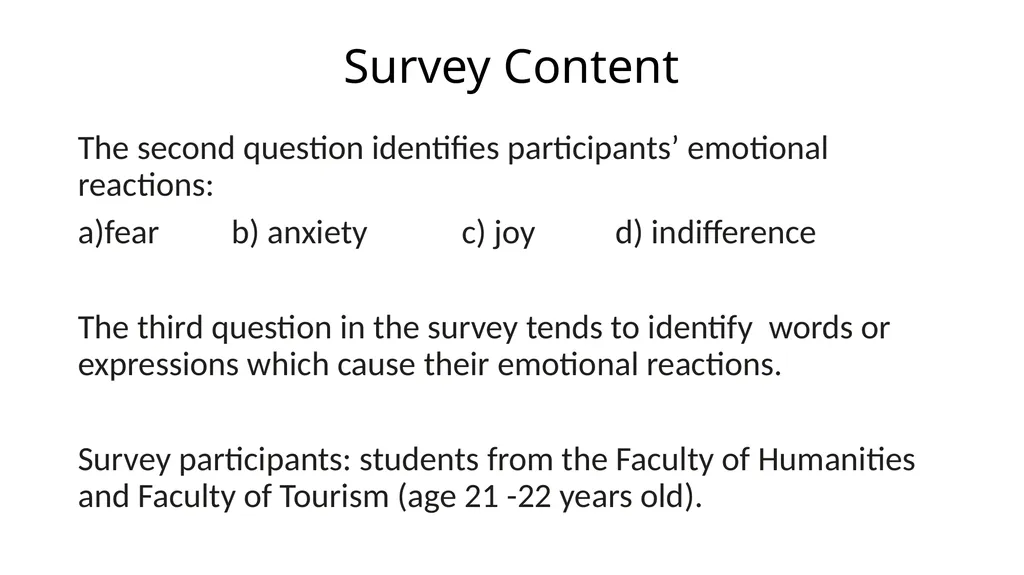
Survey Content The second question identifies participants’ emotional reactions:
a)fear b) anxiety c) joy d) indifference
The third question in the survey tends to identify words or expressions which cause their emotional reactions.
Survey participants: students from the Faculty of Humanities and Faculty of Tourism (age 21 -22 years old).<br>
a)fear b) anxiety c) joy d) indifference
The third question in the survey tends to identify words or expressions which cause their emotional reactions.
Survey participants: students from the Faculty of Humanities and Faculty of Tourism (age 21 -22 years old).<br>
10
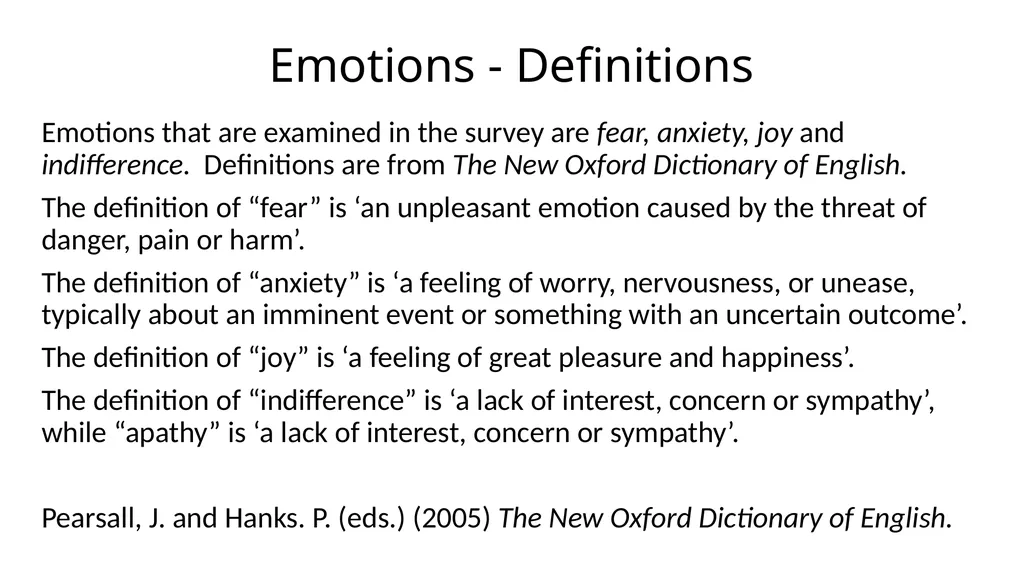
Emotions - Definitions Emotions that are examined in the survey are fear, anxiety, joy and indifference. Definitions are from The New Oxford Dictionary of English.
The definition of “fear” is ‘an unpleasant emotion caused by the threat of danger, pain or harm’.
The definition of “anxiety” is ‘a feeling of worry, nervousness, or unease, typically about an imminent event or something with an uncertain outcome’.
The definition of “joy” is ‘a feeling of great pleasure and happiness’.
The definition of “indifference” is ‘a lack of interest, concern or sympathy’, while “apathy” is ‘a lack of interest, concern or sympathy’.
Pearsall, J. and Hanks. P. (eds.) (2005) The New Oxford Dictionary of English.<br>
The definition of “fear” is ‘an unpleasant emotion caused by the threat of danger, pain or harm’.
The definition of “anxiety” is ‘a feeling of worry, nervousness, or unease, typically about an imminent event or something with an uncertain outcome’.
The definition of “joy” is ‘a feeling of great pleasure and happiness’.
The definition of “indifference” is ‘a lack of interest, concern or sympathy’, while “apathy” is ‘a lack of interest, concern or sympathy’.
Pearsall, J. and Hanks. P. (eds.) (2005) The New Oxford Dictionary of English.<br>
11
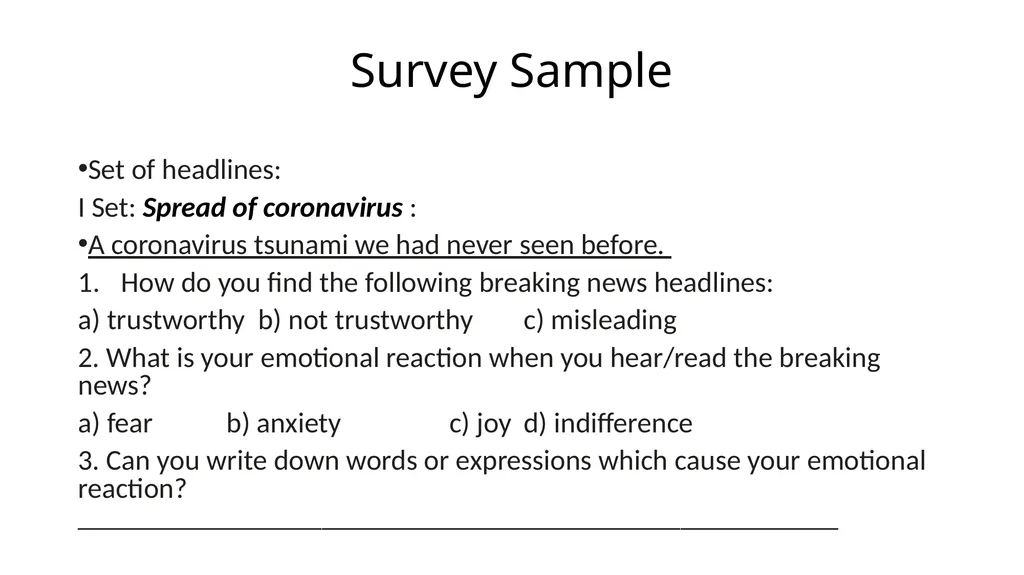
Survey Sample Set of headlines:
I Set: Spread of coronavirus :
A coronavirus tsunami we had never seen before.
How do you find the following breaking news headlines:
a) trustworthy b) not trustworthy c) misleading
2. What is your emotional reaction when you hear/read the breaking news?
a) fear b) anxiety c) joy d) indifference
3. Can you write down words or expressions which cause your emotional reaction?_____________________________________________________<br>
I Set: Spread of coronavirus :
A coronavirus tsunami we had never seen before.
How do you find the following breaking news headlines:
a) trustworthy b) not trustworthy c) misleading
2. What is your emotional reaction when you hear/read the breaking news?
a) fear b) anxiety c) joy d) indifference
3. Can you write down words or expressions which cause your emotional reaction?_____________________________________________________<br>
12
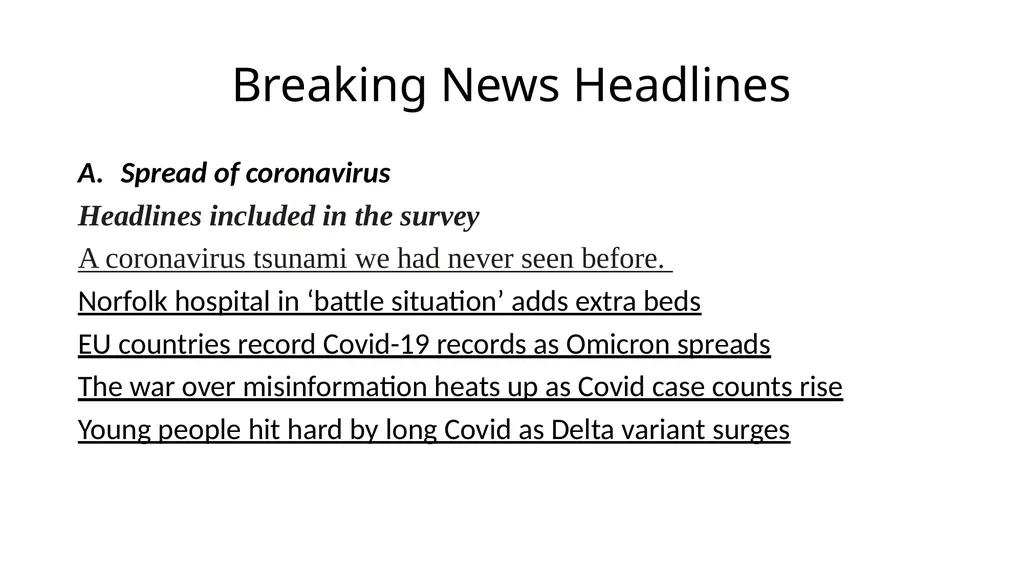
Breaking News Headlines Spread of coronavirus
Headlines included in the survey
A coronavirus tsunami we had never seen before.
Norfolk hospital in ‘battle situation’ adds extra beds
EU countries record Covid-19 records as Omicron spreads
The war over misinformation heats up as Covid case counts rise
Young people hit hard by long Covid as Delta variant surges<br>
Headlines included in the survey
A coronavirus tsunami we had never seen before.
Norfolk hospital in ‘battle situation’ adds extra beds
EU countries record Covid-19 records as Omicron spreads
The war over misinformation heats up as Covid case counts rise
Young people hit hard by long Covid as Delta variant surges<br>
13
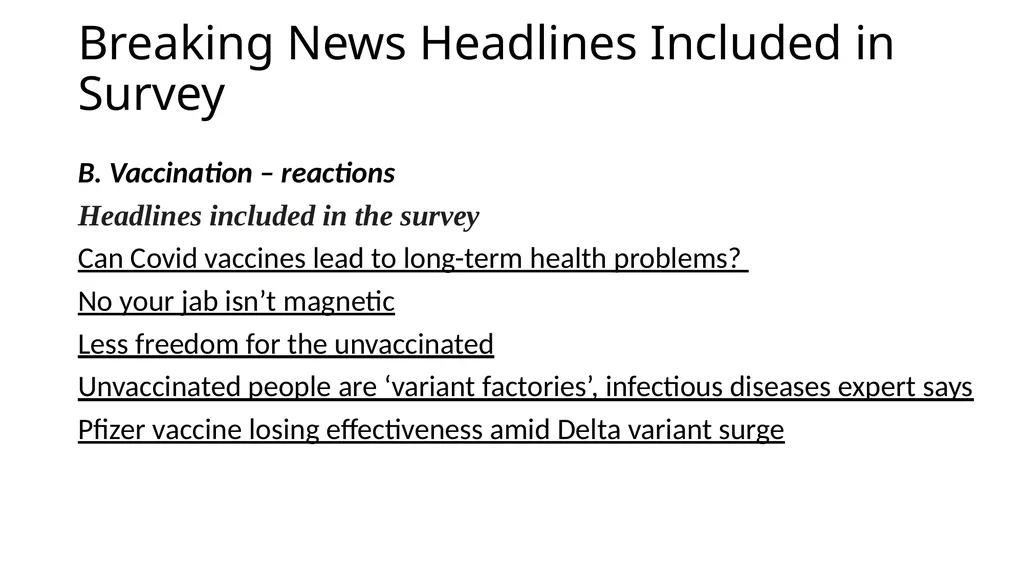
Breaking News Headlines Included in Survey B. Vaccination – reactions
Headlines included in the survey
Can Covid vaccines lead to long-term health problems?
No your jab isn’t magnetic
Less freedom for the unvaccinated
Unvaccinated people are ‘variant factories’, infectious diseases expert says
Pfizer vaccine losing effectiveness amid Delta variant surge<br>
Headlines included in the survey
Can Covid vaccines lead to long-term health problems?
No your jab isn’t magnetic
Less freedom for the unvaccinated
Unvaccinated people are ‘variant factories’, infectious diseases expert says
Pfizer vaccine losing effectiveness amid Delta variant surge<br>
14
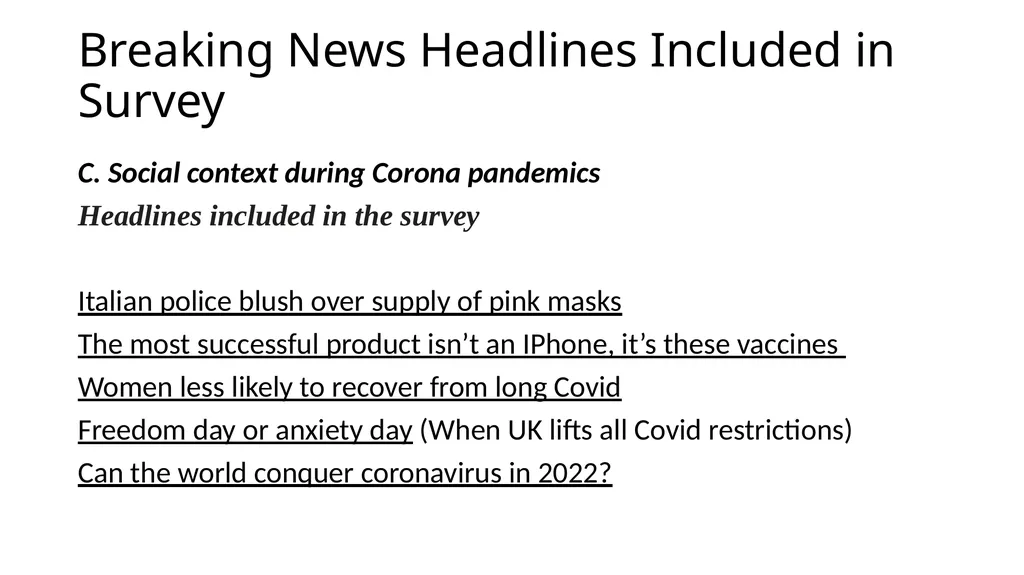
Breaking News Headlines Included in Survey C. Social context during Corona pandemics
Headlines included in the survey
Italian police blush over supply of pink masks
The most successful product isn’t an IPhone, it’s these vaccines
Women less likely to recover from long Covid
Freedom day or anxiety day (When UK lifts all Covid restrictions)
Can the world conquer coronavirus in 2022?<br>
Headlines included in the survey
Italian police blush over supply of pink masks
The most successful product isn’t an IPhone, it’s these vaccines
Women less likely to recover from long Covid
Freedom day or anxiety day (When UK lifts all Covid restrictions)
Can the world conquer coronavirus in 2022?<br>
15
Analyses Analyses of results will be conducted:
in terms of trustfulness
in terms of emotions evoked by the breaking news headlines
in terms of linguistic expressions that cause emotions such as:
linguistic analyses of lexical elements, their meanings and extensions of original meanings through metaphors and metonymy, hyperboles, naming and reference.<br>
in terms of trustfulness
in terms of emotions evoked by the breaking news headlines
in terms of linguistic expressions that cause emotions such as:
linguistic analyses of lexical elements, their meanings and extensions of original meanings through metaphors and metonymy, hyperboles, naming and reference.<br>
16
Analyses - Trustfulness Analyses of results conducted:
in terms of trustfulness<br>
in terms of trustfulness<br>
17
Analysis - Trustfulness In terms of trustfulness:
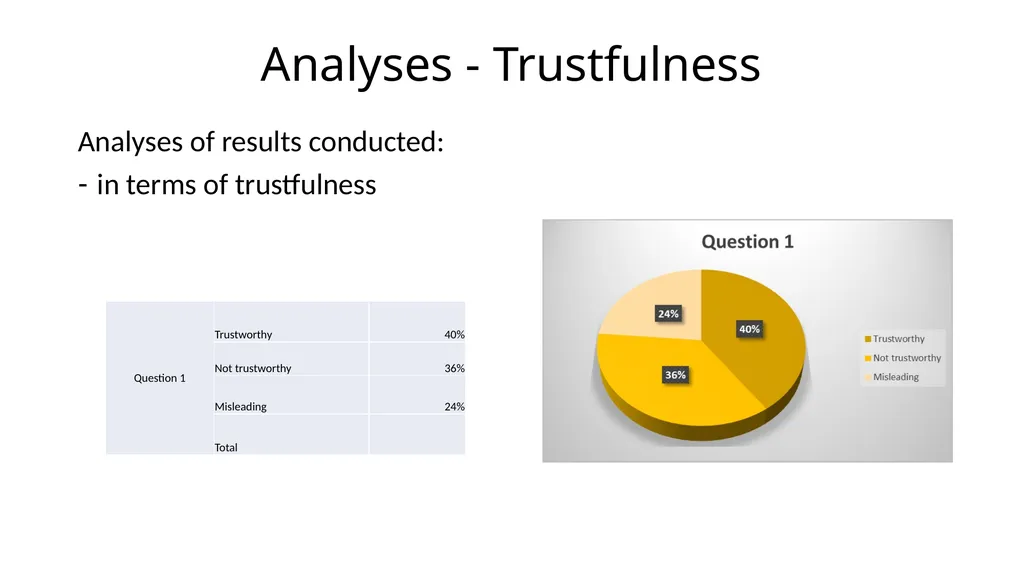
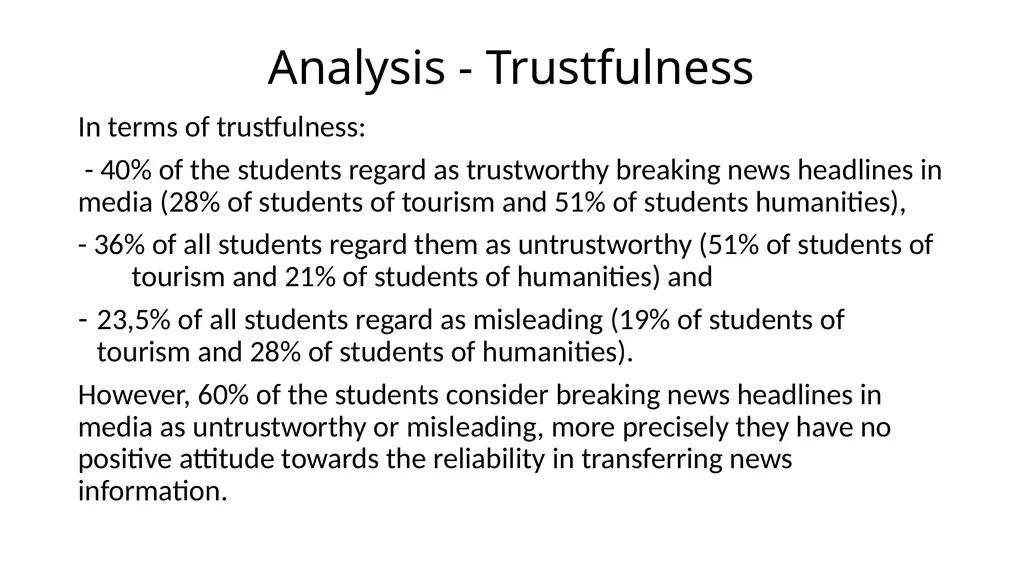
- 40% of the students regard as trustworthy breaking news headlines in media (28% of students of tourism and 51% of students humanities),
- 36% of all students regard them as untrustworthy (51% of students of tourism and 21% of students of humanities) and
23,5% of all students regard as misleading (19% of students of tourism and 28% of students of humanities).
However, 60% of the students consider breaking news headlines in media as untrustworthy or misleading, more precisely they have no positive attitude towards the reliability in transferring news information.<br>
- 40% of the students regard as trustworthy breaking news headlines in media (28% of students of tourism and 51% of students humanities),
- 36% of all students regard them as untrustworthy (51% of students of tourism and 21% of students of humanities) and
23,5% of all students regard as misleading (19% of students of tourism and 28% of students of humanities).
However, 60% of the students consider breaking news headlines in media as untrustworthy or misleading, more precisely they have no positive attitude towards the reliability in transferring news information.<br>
18
Analyses - Emotions Analyses of results conducted:
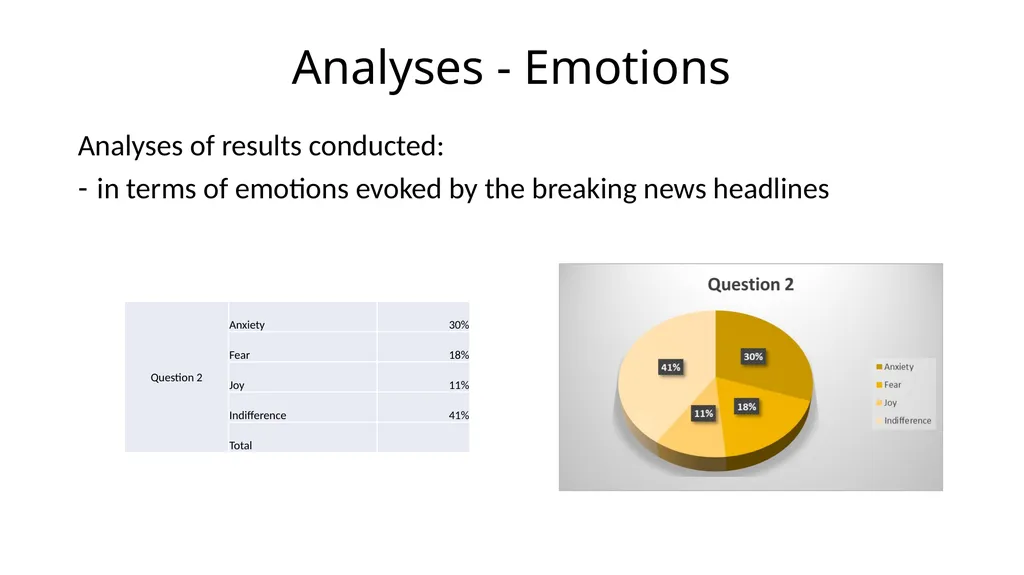
in terms of emotions evoked by the breaking news headlines<br>
in terms of emotions evoked by the breaking news headlines<br>
19
Analysis - Emotions Results from the survey of the emotions and the emotional effects the breaking news headlines have on students show that:
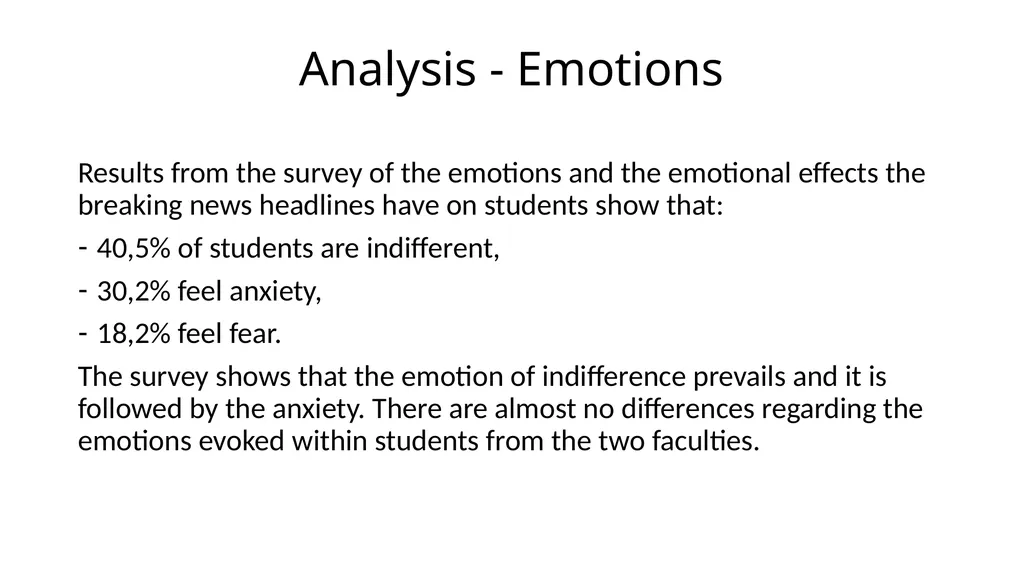
40,5% of students are indifferent,
30,2% feel anxiety,
18,2% feel fear.
The survey shows that the emotion of indifference prevails and it is followed by the anxiety. There are almost no differences regarding the emotions evoked within students from the two faculties.<br>
40,5% of students are indifferent,
30,2% feel anxiety,
18,2% feel fear.
The survey shows that the emotion of indifference prevails and it is followed by the anxiety. There are almost no differences regarding the emotions evoked within students from the two faculties.<br>
20
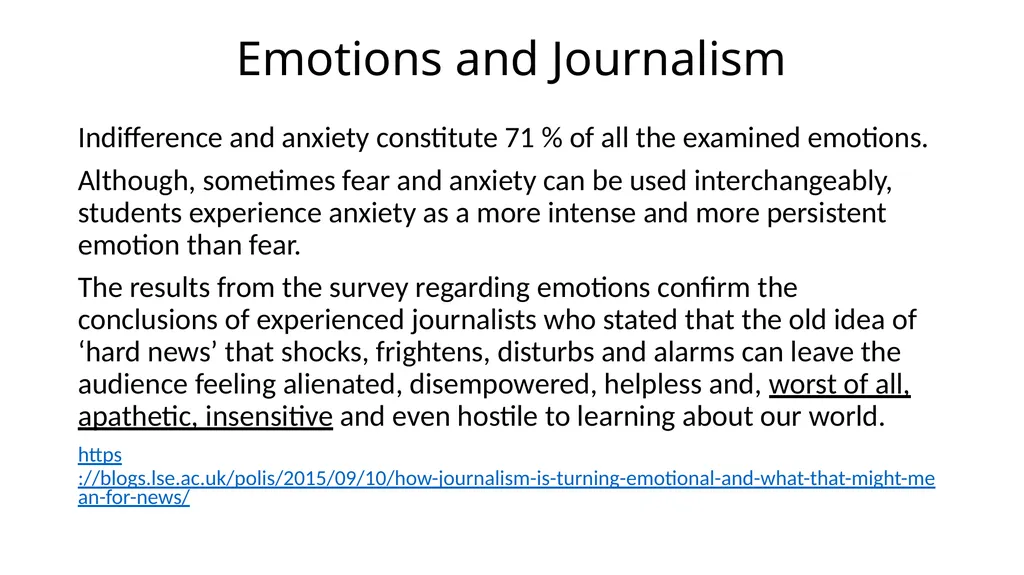
Emotions and Journalism Indifference and anxiety constitute 71 % of all the examined emotions.
Although, sometimes fear and anxiety can be used interchangeably, students experience anxiety as a more intense and more persistent emotion than fear.
The results from the survey regarding emotions confirm the conclusions of experienced journalists who stated that the old idea of ‘hard news’ that shocks, frightens, disturbs and alarms can leave the audience feeling alienated, disempowered, helpless and, worst of all, apathetic, insensitive and even hostile to learning about our world.
https://blogs.lse.ac.uk/polis/2015/09/10/how-journalism-is-turning-emotional-and-what-that-might-mean-for-news/<br>
Although, sometimes fear and anxiety can be used interchangeably, students experience anxiety as a more intense and more persistent emotion than fear.
The results from the survey regarding emotions confirm the conclusions of experienced journalists who stated that the old idea of ‘hard news’ that shocks, frightens, disturbs and alarms can leave the audience feeling alienated, disempowered, helpless and, worst of all, apathetic, insensitive and even hostile to learning about our world.
https://blogs.lse.ac.uk/polis/2015/09/10/how-journalism-is-turning-emotional-and-what-that-might-mean-for-news/<br>
21
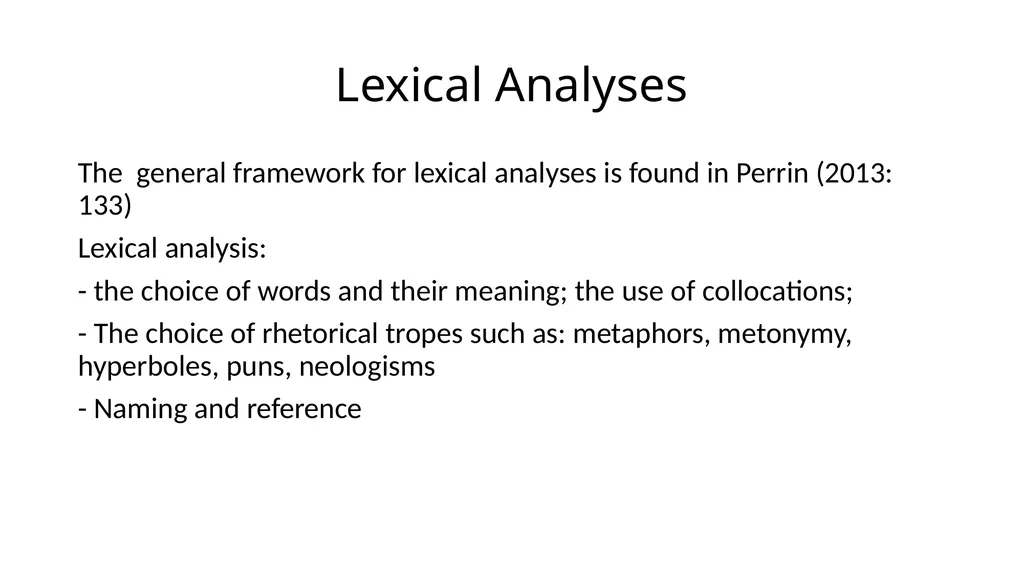
Lexical Analyses The general framework for lexical analyses is found in Perrin (2013: 133)
Lexical analysis:
- the choice of words and their meaning; the use of collocations;
- The choice of rhetorical tropes such as: metaphors, metonymy, hyperboles, puns, neologisms
- Naming and reference<br>
Lexical analysis:
- the choice of words and their meaning; the use of collocations;
- The choice of rhetorical tropes such as: metaphors, metonymy, hyperboles, puns, neologisms
- Naming and reference<br>
22
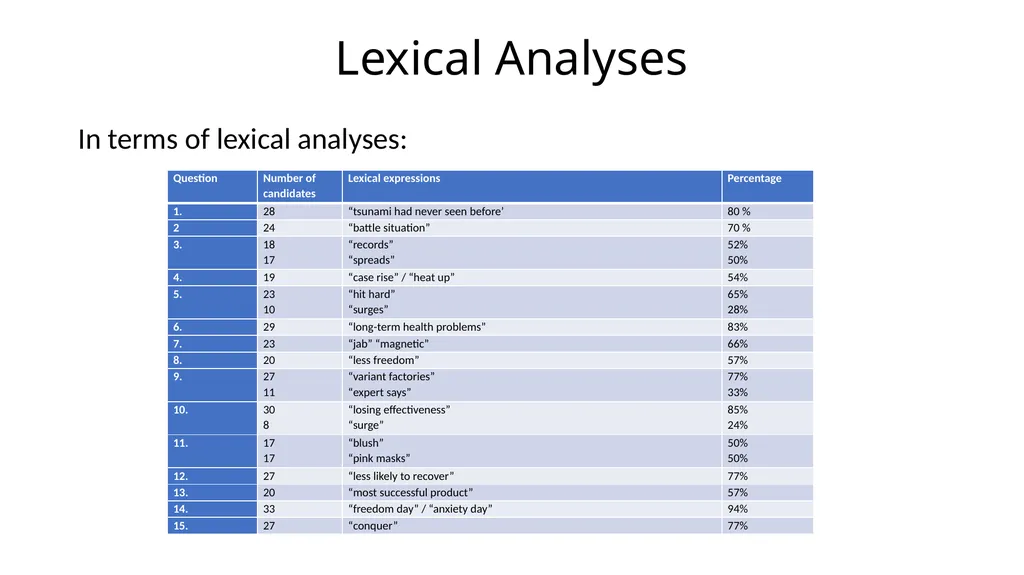
Lexical Analyses In terms of lexical analyses:<br>
23
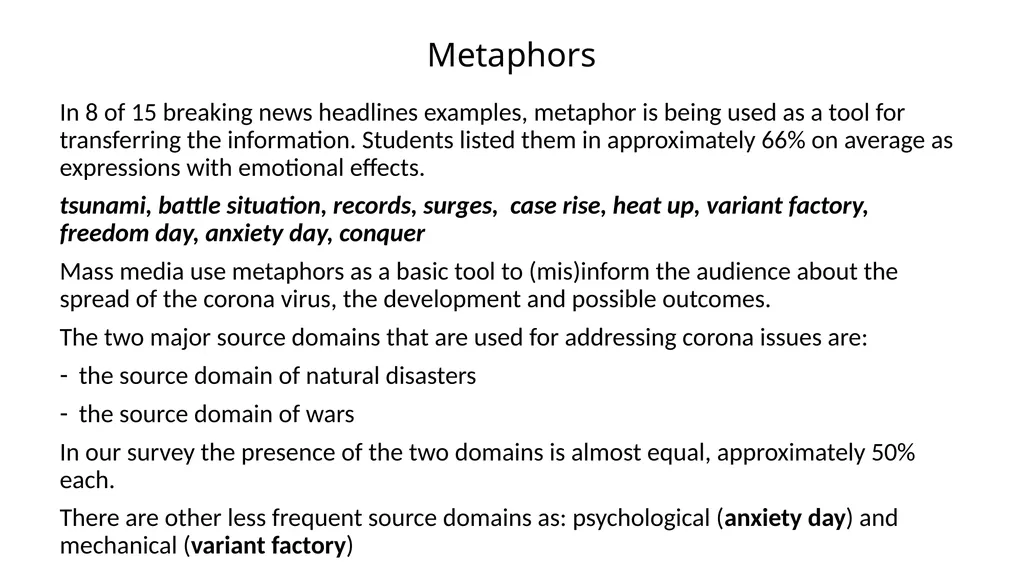
Metaphors In 8 of 15 breaking news headlines examples, metaphor is being used as a tool for transferring the information. Students listed them in approximately 66% on average as expressions with emotional effects.
tsunami, battle situation, records, surges, case rise, heat up, variant factory, freedom day, anxiety day, conquer
Mass media use metaphors as a basic tool to (mis)inform the audience about the spread of the corona virus, the development and possible outcomes.
The two major source domains that are used for addressing corona issues are:
the source domain of natural disasters
the source domain of wars
In our survey the presence of the two domains is almost equal, approximately 50% each.
There are other less frequent source domains as: psychological (anxiety day) and mechanical (variant factory)<br>
tsunami, battle situation, records, surges, case rise, heat up, variant factory, freedom day, anxiety day, conquer
Mass media use metaphors as a basic tool to (mis)inform the audience about the spread of the corona virus, the development and possible outcomes.
The two major source domains that are used for addressing corona issues are:
the source domain of natural disasters
the source domain of wars
In our survey the presence of the two domains is almost equal, approximately 50% each.
There are other less frequent source domains as: psychological (anxiety day) and mechanical (variant factory)<br>
24
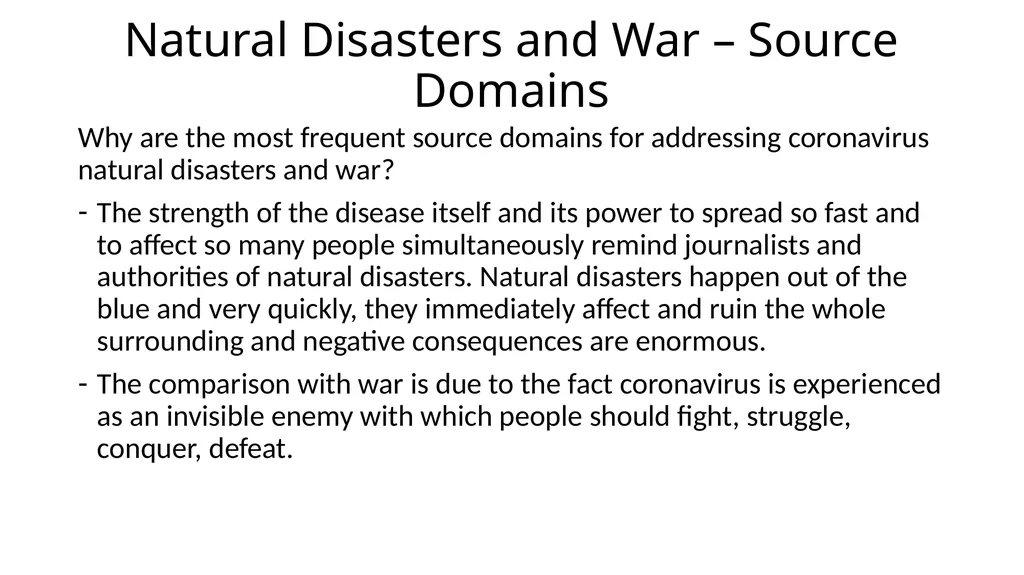
Natural Disasters and War – Source Domains Why are the most frequent source domains for addressing coronavirus natural disasters and war?
The strength of the disease itself and its power to spread so fast and to affect so many people simultaneously remind journalists and authorities of natural disasters. Natural disasters happen out of the blue and very quickly, they immediately affect and ruin the whole surrounding and negative consequences are enormous.
The comparison with war is due to the fact coronavirus is experienced as an invisible enemy with which people should fight, struggle, conquer, defeat.<br>
The strength of the disease itself and its power to spread so fast and to affect so many people simultaneously remind journalists and authorities of natural disasters. Natural disasters happen out of the blue and very quickly, they immediately affect and ruin the whole surrounding and negative consequences are enormous.
The comparison with war is due to the fact coronavirus is experienced as an invisible enemy with which people should fight, struggle, conquer, defeat.<br>
25
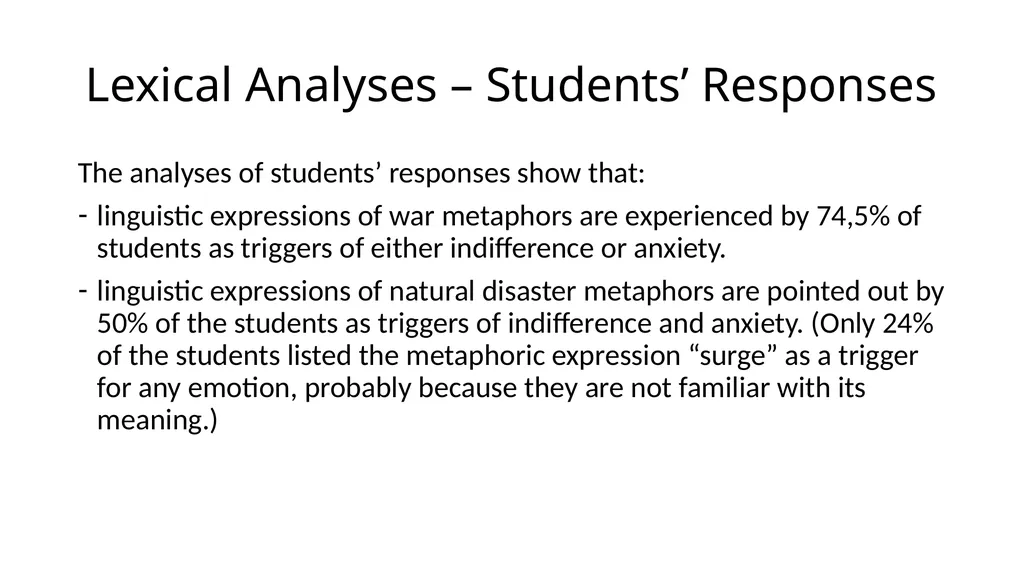
Lexical Analyses – Students’ Responses The analyses of students’ responses show that:
linguistic expressions of war metaphors are experienced by 74,5% of students as triggers of either indifference or anxiety.
linguistic expressions of natural disaster metaphors are pointed out by 50% of the students as triggers of indifference and anxiety. (Only 24% of the students listed the metaphoric expression “surge” as a trigger for any emotion, probably because they are not familiar with its meaning.)<br>
linguistic expressions of war metaphors are experienced by 74,5% of students as triggers of either indifference or anxiety.
linguistic expressions of natural disaster metaphors are pointed out by 50% of the students as triggers of indifference and anxiety. (Only 24% of the students listed the metaphoric expression “surge” as a trigger for any emotion, probably because they are not familiar with its meaning.)<br>
26
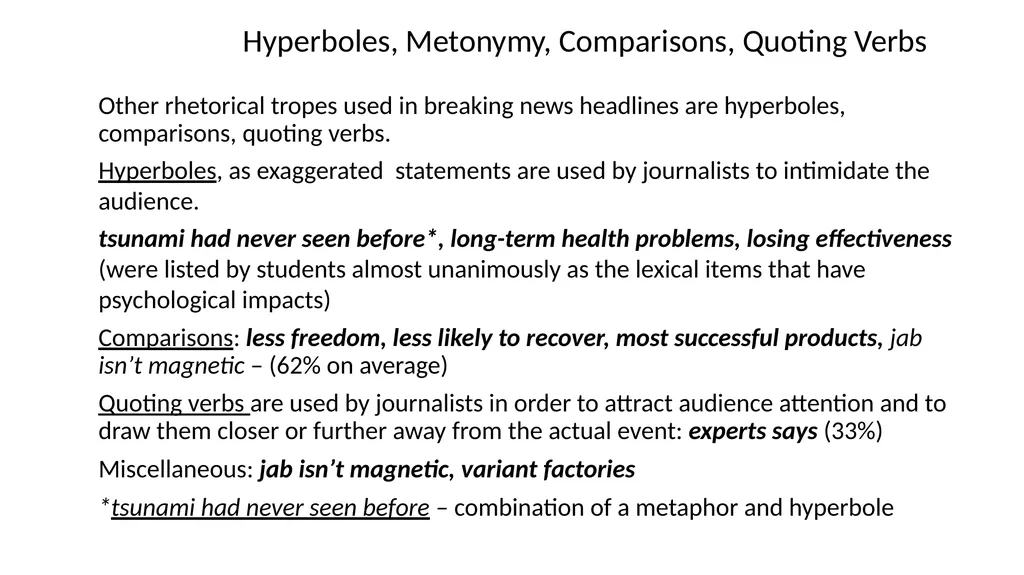
Hyperboles, Metonymy, Comparisons, Quoting Verbs Other rhetorical tropes used in breaking news headlines are hyperboles, comparisons, quoting verbs.
Hyperboles, as exaggerated statements are used by journalists to intimidate the audience.
tsunami had never seen before*, long-term health problems, losing effectiveness (were listed by students almost unanimously as the lexical items that have psychological impacts)
Comparisons: less freedom, less likely to recover, most successful products, jab isn’t magnetic – (62% on average)
Quoting verbs are used by journalists in order to attract audience attention and to draw them closer or further away from the actual event: experts says (33%)
Miscellaneous: jab isn’t magnetic, variant factories
*tsunami had never seen before – combination of a metaphor and hyperbole<br>
Hyperboles, as exaggerated statements are used by journalists to intimidate the audience.
tsunami had never seen before*, long-term health problems, losing effectiveness (were listed by students almost unanimously as the lexical items that have psychological impacts)
Comparisons: less freedom, less likely to recover, most successful products, jab isn’t magnetic – (62% on average)
Quoting verbs are used by journalists in order to attract audience attention and to draw them closer or further away from the actual event: experts says (33%)
Miscellaneous: jab isn’t magnetic, variant factories
*tsunami had never seen before – combination of a metaphor and hyperbole<br>
27
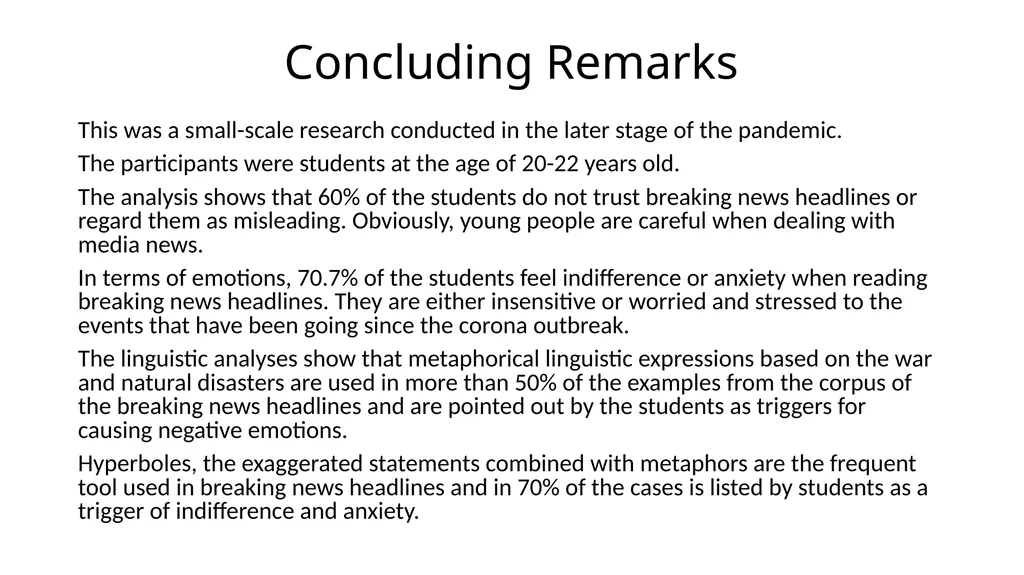
Concluding Remarks This was a small-scale research conducted in the later stage of the pandemic.
The participants were students at the age of 20-22 years old.
The analysis shows that 60% of the students do not trust breaking news headlines or regard them as misleading. Obviously, young people are careful when dealing with media news.
In terms of emotions, 70.7% of the students feel indifference or anxiety when reading breaking news headlines. They are either insensitive or worried and stressed to the events that have been going since the corona outbreak.
The linguistic analyses show that metaphorical linguistic expressions based on the war and natural disasters are used in more than 50% of the examples from the corpus of the breaking news headlines and are pointed out by the students as triggers for causing negative emotions.
Hyperboles, the exaggerated statements combined with metaphors are the frequent tool used in breaking news headlines and in 70% of the cases is listed by students as a trigger of indifference and anxiety.<br>
The participants were students at the age of 20-22 years old.
The analysis shows that 60% of the students do not trust breaking news headlines or regard them as misleading. Obviously, young people are careful when dealing with media news.
In terms of emotions, 70.7% of the students feel indifference or anxiety when reading breaking news headlines. They are either insensitive or worried and stressed to the events that have been going since the corona outbreak.
The linguistic analyses show that metaphorical linguistic expressions based on the war and natural disasters are used in more than 50% of the examples from the corpus of the breaking news headlines and are pointed out by the students as triggers for causing negative emotions.
Hyperboles, the exaggerated statements combined with metaphors are the frequent tool used in breaking news headlines and in 70% of the cases is listed by students as a trigger of indifference and anxiety.<br>
28
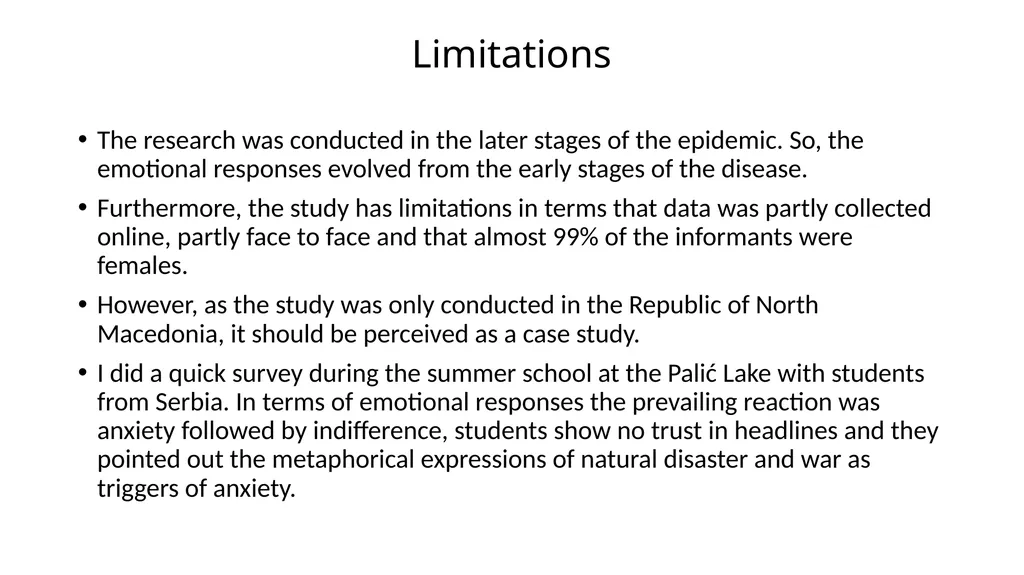
Limitations The research was conducted in the later stages of the epidemic. So, the emotional responses evolved from the early stages of the disease.
Furthermore, the study has limitations in terms that data was partly collected online, partly face to face and that almost 99% of the informants were females.
However, as the study was only conducted in the Republic of North Macedonia, it should be perceived as a case study.
I did a quick survey during the summer school at the Palić Lake with students from Serbia. In terms of emotional responses the prevailing reaction was anxiety followed by indifference, students show no trust in headlines and they pointed out the metaphorical expressions of natural disaster and war as triggers of anxiety.<br>
Furthermore, the study has limitations in terms that data was partly collected online, partly face to face and that almost 99% of the informants were females.
However, as the study was only conducted in the Republic of North Macedonia, it should be perceived as a case study.
I did a quick survey during the summer school at the Palić Lake with students from Serbia. In terms of emotional responses the prevailing reaction was anxiety followed by indifference, students show no trust in headlines and they pointed out the metaphorical expressions of natural disaster and war as triggers of anxiety.<br>
29
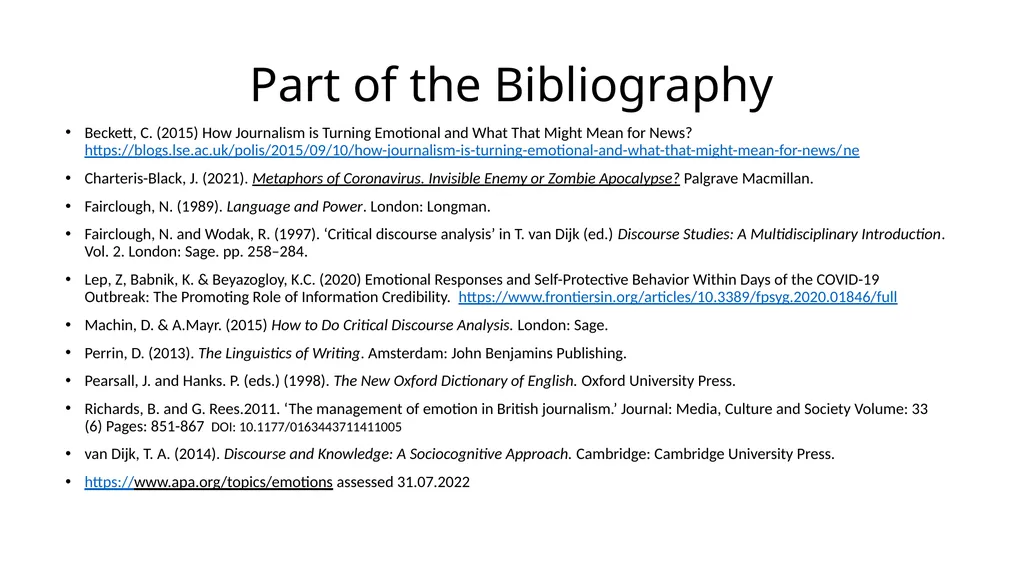
Part of the Bibliography Beckett, C. (2015) How Journalism is Turning Emotional and What That Might Mean for News? https://blogs.lse.ac.uk/polis/2015/09/10/how-journalism-is-turning-emotional-and-what-that-might-mean-for-news/ne
Charteris-Black, J. (2021). Metaphors of Coronavirus. Invisible Enemy or Zombie Apocalypse? Palgrave Macmillan.
Fairclough, N. (1989). Language and Power. London: Longman.
Fairclough, N. and Wodak, R. (1997). ‘Critical discourse analysis’ in T. van Dijk (ed.) Discourse Studies: A Multidisciplinary Introduction. Vol. 2. London: Sage. pp. 258–284.
Lep, Z, Babnik, K. & Beyazogloy, K.C. (2020) Emotional Responses and Self-Protective Behavior Within Days of the COVID-19 Outbreak: The Promoting Role of Information Credibility. https://www.frontiersin.org/articles/10.3389/fpsyg.2020.01846/full
Machin, D. & A.Mayr. (2015) How to Do Critical Discourse Analysis. London: Sage.
Perrin, D. (2013). The Linguistics of Writing. Amsterdam: John Benjamins Publishing.
Pearsall, J. and Hanks. P. (eds.) (1998). The New Oxford Dictionary of English. Oxford University Press.
Richards, B. and G. Rees.2011. ‘The management of emotion in British journalism.’ Journal: Media, Culture and Society Volume: 33 (6) Pages: 851-867 DOI: 10.1177/0163443711411005
van Dijk, T. A. (2014). Discourse and Knowledge: A Sociocognitive Approach. Cambridge: Cambridge University Press.
https://www.apa.org/topics/emotions assessed 31.07.2022<br>
Charteris-Black, J. (2021). Metaphors of Coronavirus. Invisible Enemy or Zombie Apocalypse? Palgrave Macmillan.
Fairclough, N. (1989). Language and Power. London: Longman.
Fairclough, N. and Wodak, R. (1997). ‘Critical discourse analysis’ in T. van Dijk (ed.) Discourse Studies: A Multidisciplinary Introduction. Vol. 2. London: Sage. pp. 258–284.
Lep, Z, Babnik, K. & Beyazogloy, K.C. (2020) Emotional Responses and Self-Protective Behavior Within Days of the COVID-19 Outbreak: The Promoting Role of Information Credibility. https://www.frontiersin.org/articles/10.3389/fpsyg.2020.01846/full
Machin, D. & A.Mayr. (2015) How to Do Critical Discourse Analysis. London: Sage.
Perrin, D. (2013). The Linguistics of Writing. Amsterdam: John Benjamins Publishing.
Pearsall, J. and Hanks. P. (eds.) (1998). The New Oxford Dictionary of English. Oxford University Press.
Richards, B. and G. Rees.2011. ‘The management of emotion in British journalism.’ Journal: Media, Culture and Society Volume: 33 (6) Pages: 851-867 DOI: 10.1177/0163443711411005
van Dijk, T. A. (2014). Discourse and Knowledge: A Sociocognitive Approach. Cambridge: Cambridge University Press.
https://www.apa.org/topics/emotions assessed 31.07.2022<br>