
Capacity building and peer learning for investment
DP
Published · 10 slides · 0 views

1 / 1
Description
Capacity building and peer learning for investment promotion and economic development Powered by ANIMA under EBSO MED Emmanuel Noutary, General Delegate ANIMA Investment Network EBSO MED ACADEMY The Economic Development Masterclasses The
Related Topics
Share
Embed code
Download this presentation From Below
"Capacity building and peer learning for investment" is the property of its rightful owner. Permission is granted to download and print the materials on this website for personal, non-commercial use only, and to display it on your personal computer provided you do not modify the materials and that you retain all copyright notices contained in the materials. By downloading content from our website, you accept the terms of this agreement.
Presentation Transcript
01
Capacity building and
peer learning
for investment promotion and economic development
Powered by ANIMA under EBSO MED
Emmanuel Noutary, General Delegate
ANIMA Investment Network<br>
02
EBSO MED ACADEMY
The Economic Development Masterclasses<br>
03
The Economic Development Masterclasses Objectives
Improve the capacity of executives from economic development organisations in investment promotion and project management
Create a network of high potential executives from these organisations to build sustainable relationships among them
Support trainees (fellows) in developing a project for improving the services and strategy of their organization
Implementing partners
ANIMA Investment Network coordination with expertise from academy, investment promotion experts, Business France, Enterprise Greece, Enterprise Greece, CEI Piemonte (Italy), Promos (Italy), and host countries<br>
Improve the capacity of executives from economic development organisations in investment promotion and project management
Create a network of high potential executives from these organisations to build sustainable relationships among them
Support trainees (fellows) in developing a project for improving the services and strategy of their organization
Implementing partners
ANIMA Investment Network coordination with expertise from academy, investment promotion experts, Business France, Enterprise Greece, Enterprise Greece, CEI Piemonte (Italy), Promos (Italy), and host countries<br>
04
The Economic Development Masterclasses Target audience
C-Level executives of economic development organisations based in the Mediterranean countries
Selected based on their profile, motivation and on the commitment of their organization
Format
Curriculum of 4 seminars taking place across the EU-MED countries, including benchmarking visits in each location
18 min. fellows per curricula + guests (10 max)
Lecturers from peer organisations, experts and academy
Impact
Fellows awarded a university certificate by developing a project for their organization (new service, strategy, organization, etc.)
Conditions
100% travel, accomodation, logistics and expertise covered by organisers
Cost sharing fees apply to fellows and host organisations<br>
C-Level executives of economic development organisations based in the Mediterranean countries
Selected based on their profile, motivation and on the commitment of their organization
Format
Curriculum of 4 seminars taking place across the EU-MED countries, including benchmarking visits in each location
18 min. fellows per curricula + guests (10 max)
Lecturers from peer organisations, experts and academy
Impact
Fellows awarded a university certificate by developing a project for their organization (new service, strategy, organization, etc.)
Conditions
100% travel, accomodation, logistics and expertise covered by organisers
Cost sharing fees apply to fellows and host organisations<br>
05
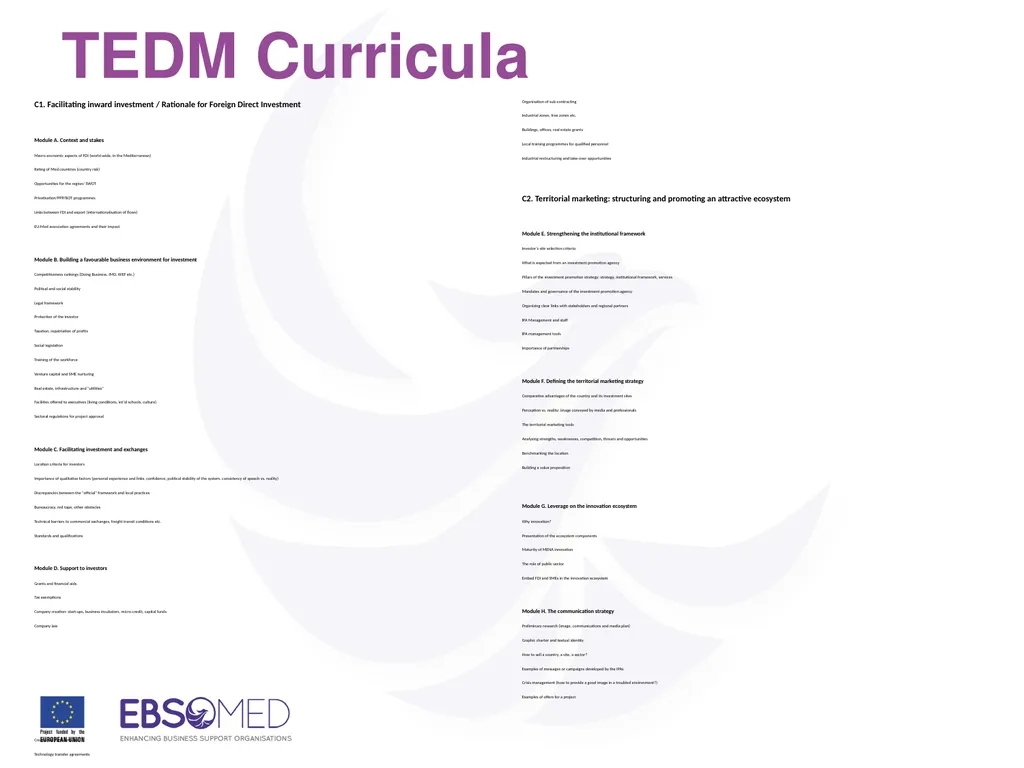
TEDM Curricula C1. Facilitating inward investment / Rationale for Foreign Direct Investment
Module A. Context and stakes
Macro-economic aspects of FDI (world-wide, in the Mediterranean)
Rating of Med countries (country risk)
Opportunities for the region/ SWOT
Privatisation/PPP/BOT programmes
Links between FDI and export (internationalisation of flows)
EU-Med association agreements and their impact
Module B. Building a favourable business environment for investment
Competitiveness rankings (Doing Business, IMD, WEF etc.)
Political and social stability
Legal framework
Protection of the investor
Taxation, repatriation of profits
Social legislation
Training of the workforce
Venture capital and SME nurturing
Real estate, infrastructure and "utilities"
Facilities offered to executives (living conditions, int’al schools, culture)
Sectoral regulations for project approval
Module C. Facilitating investment and exchanges
Location criteria for investors
Importance of qualitative factors (personal experience and links, confidence, political stability of the system, consistency of speech vs. reality)
Discrepancies between the "official" framework and local practices
Bureaucracy, red tape, other obstacles
Technical barriers to commercial exchanges, freight transit conditions etc.
Standards and qualifications
Module D. Support to investors
Grants and financial aids
Tax exemptions
Company creation: start-ups, business incubators, micro-credit, capital funds
Company law
Creation of joint-ventures
Technology transfer agreements
Organisation of sub-contracting
Industrial zones, free zones etc.
Buildings, offices, real estate grants
Local training programmes for qualified personnel
Industrial restructuring and take-over opportunities
C2. Territorial marketing: structuring and promoting an attractive ecosystem
Module E. Strengthening the institutional framework
Investor’s site selection criteria
What is expected from an investment promotion agency
Pillars of the investment promotion strategy: strategy, institutional framework, services
Mandates and governance of the investment promotion agency
Organizing clear links with stakeholders and regional partners
IPA Management and staff
IPA management tools
Importance of partnerships
Module F. Defining the territorial marketing strategy
Comparative advantages of the country and its investment sites
Perception vs. reality: image conveyed by media and professionals
The territorial marketing tools
Analysing strengths, weaknesses, competition, threats and opportunities
Benchmarking the location
Building a value proposition
Module G. Leverage on the innovation ecosystem
Why innovation?
Presentation of the ecosystem components
Maturity of MENA innovation
The role of public sector
Embed FDI and SMEs in the innovation ecosystem
Module H. The communication strategy
Preliminary research (image, communications and media plan)
Graphic charter and textual identity
How to sell a country, a site, a sector?
Examples of messages or campaigns developed by the IPAs
Crisis management (how to provide a good image in a troubled environment?)
Examples of offers for a project<br>
Module A. Context and stakes
Macro-economic aspects of FDI (world-wide, in the Mediterranean)
Rating of Med countries (country risk)
Opportunities for the region/ SWOT
Privatisation/PPP/BOT programmes
Links between FDI and export (internationalisation of flows)
EU-Med association agreements and their impact
Module B. Building a favourable business environment for investment
Competitiveness rankings (Doing Business, IMD, WEF etc.)
Political and social stability
Legal framework
Protection of the investor
Taxation, repatriation of profits
Social legislation
Training of the workforce
Venture capital and SME nurturing
Real estate, infrastructure and "utilities"
Facilities offered to executives (living conditions, int’al schools, culture)
Sectoral regulations for project approval
Module C. Facilitating investment and exchanges
Location criteria for investors
Importance of qualitative factors (personal experience and links, confidence, political stability of the system, consistency of speech vs. reality)
Discrepancies between the "official" framework and local practices
Bureaucracy, red tape, other obstacles
Technical barriers to commercial exchanges, freight transit conditions etc.
Standards and qualifications
Module D. Support to investors
Grants and financial aids
Tax exemptions
Company creation: start-ups, business incubators, micro-credit, capital funds
Company law
Creation of joint-ventures
Technology transfer agreements
Organisation of sub-contracting
Industrial zones, free zones etc.
Buildings, offices, real estate grants
Local training programmes for qualified personnel
Industrial restructuring and take-over opportunities
C2. Territorial marketing: structuring and promoting an attractive ecosystem
Module E. Strengthening the institutional framework
Investor’s site selection criteria
What is expected from an investment promotion agency
Pillars of the investment promotion strategy: strategy, institutional framework, services
Mandates and governance of the investment promotion agency
Organizing clear links with stakeholders and regional partners
IPA Management and staff
IPA management tools
Importance of partnerships
Module F. Defining the territorial marketing strategy
Comparative advantages of the country and its investment sites
Perception vs. reality: image conveyed by media and professionals
The territorial marketing tools
Analysing strengths, weaknesses, competition, threats and opportunities
Benchmarking the location
Building a value proposition
Module G. Leverage on the innovation ecosystem
Why innovation?
Presentation of the ecosystem components
Maturity of MENA innovation
The role of public sector
Embed FDI and SMEs in the innovation ecosystem
Module H. The communication strategy
Preliminary research (image, communications and media plan)
Graphic charter and textual identity
How to sell a country, a site, a sector?
Examples of messages or campaigns developed by the IPAs
Crisis management (how to provide a good image in a troubled environment?)
Examples of offers for a project<br>
06
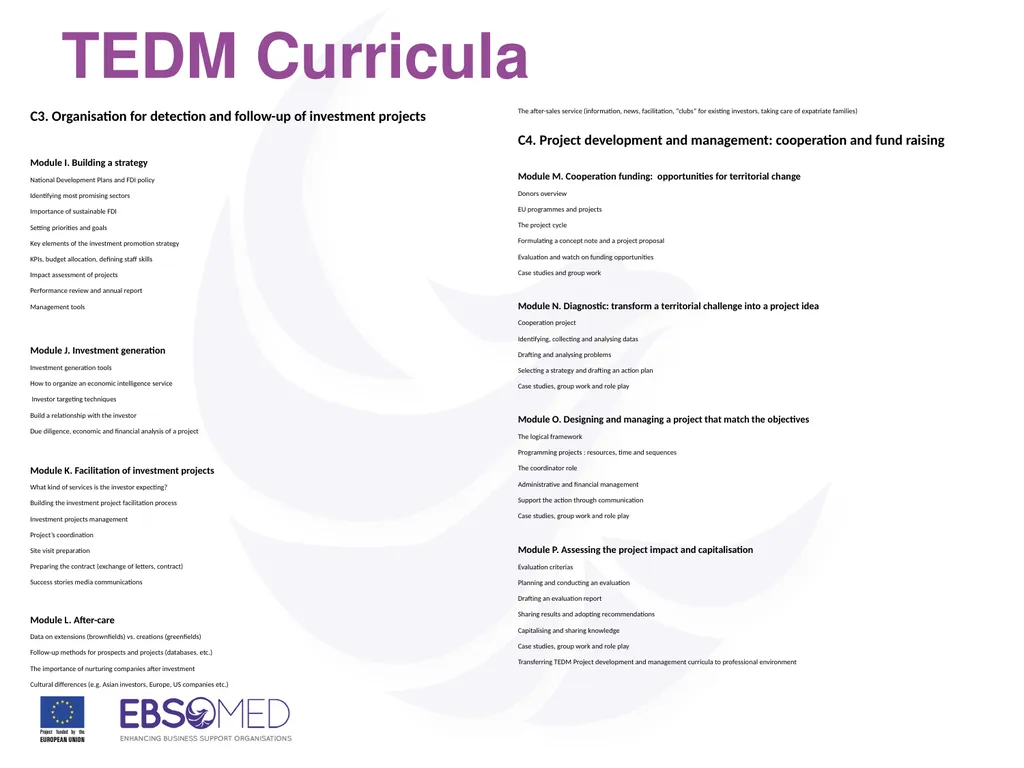
TEDM Curricula C3. Organisation for detection and follow-up of investment projects
Module I. Building a strategy
National Development Plans and FDI policy
Identifying most promising sectors
Importance of sustainable FDI
Setting priorities and goals
Key elements of the investment promotion strategy
KPIs, budget allocation, defining staff skills
Impact assessment of projects
Performance review and annual report
Management tools
Module J. Investment generation
Investment generation tools
How to organize an economic intelligence service
Investor targeting techniques
Build a relationship with the investor
Due diligence, economic and financial analysis of a project
Module K. Facilitation of investment projects
What kind of services is the investor expecting?
Building the investment project facilitation process
Investment projects management
Project’s coordination
Site visit preparation
Preparing the contract (exchange of letters, contract)
Success stories media communications
Module L. After-care
Data on extensions (brownfields) vs. creations (greenfields)
Follow-up methods for prospects and projects (databases, etc.)
The importance of nurturing companies after investment
Cultural differences (e.g. Asian investors, Europe, US companies etc.)
The after-sales service (information, news, facilitation, “clubs” for existing investors, taking care of expatriate families)
C4. Project development and management: cooperation and fund raising
Module M. Cooperation funding: opportunities for territorial change
Donors overview
EU programmes and projects
The project cycle
Formulating a concept note and a project proposal
Evaluation and watch on funding opportunities
Case studies and group work
Module N. Diagnostic: transform a territorial challenge into a project idea
Cooperation project
Identifying, collecting and analysing datas
Drafting and analysing problems
Selecting a strategy and drafting an action plan
Case studies, group work and role play
Module O. Designing and managing a project that match the objectives
The logical framework
Programming projects : resources, time and sequences
The coordinator role
Administrative and financial management
Support the action through communication
Case studies, group work and role play
Module P. Assessing the project impact and capitalisation
Evaluation criterias
Planning and conducting an evaluation
Drafting an evaluation report
Sharing results and adopting recommendations
Capitalising and sharing knowledge
Case studies, group work and role play
Transferring TEDM Project development and management curricula to professional environment<br>
Module I. Building a strategy
National Development Plans and FDI policy
Identifying most promising sectors
Importance of sustainable FDI
Setting priorities and goals
Key elements of the investment promotion strategy
KPIs, budget allocation, defining staff skills
Impact assessment of projects
Performance review and annual report
Management tools
Module J. Investment generation
Investment generation tools
How to organize an economic intelligence service
Investor targeting techniques
Build a relationship with the investor
Due diligence, economic and financial analysis of a project
Module K. Facilitation of investment projects
What kind of services is the investor expecting?
Building the investment project facilitation process
Investment projects management
Project’s coordination
Site visit preparation
Preparing the contract (exchange of letters, contract)
Success stories media communications
Module L. After-care
Data on extensions (brownfields) vs. creations (greenfields)
Follow-up methods for prospects and projects (databases, etc.)
The importance of nurturing companies after investment
Cultural differences (e.g. Asian investors, Europe, US companies etc.)
The after-sales service (information, news, facilitation, “clubs” for existing investors, taking care of expatriate families)
C4. Project development and management: cooperation and fund raising
Module M. Cooperation funding: opportunities for territorial change
Donors overview
EU programmes and projects
The project cycle
Formulating a concept note and a project proposal
Evaluation and watch on funding opportunities
Case studies and group work
Module N. Diagnostic: transform a territorial challenge into a project idea
Cooperation project
Identifying, collecting and analysing datas
Drafting and analysing problems
Selecting a strategy and drafting an action plan
Case studies, group work and role play
Module O. Designing and managing a project that match the objectives
The logical framework
Programming projects : resources, time and sequences
The coordinator role
Administrative and financial management
Support the action through communication
Case studies, group work and role play
Module P. Assessing the project impact and capitalisation
Evaluation criterias
Planning and conducting an evaluation
Drafting an evaluation report
Sharing results and adopting recommendations
Capitalising and sharing knowledge
Case studies, group work and role play
Transferring TEDM Project development and management curricula to professional environment<br>
07
EBSO MED MANAGEMENT EXCHANGE AND TECHNICAL ASSISTANCE
Peer learning programme<br>
08
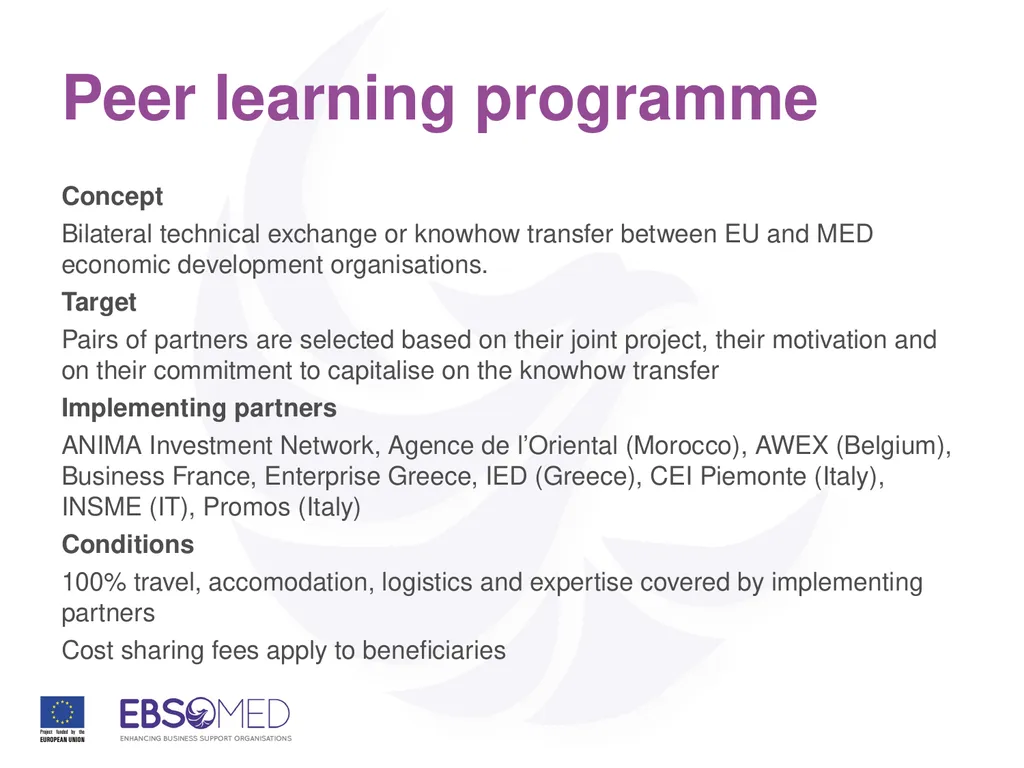
Peer learning programme Concept
Bilateral technical exchange or knowhow transfer between EU and MED economic development organisations.
Target
Pairs of partners are selected based on their joint project, their motivation and on their commitment to capitalise on the knowhow transfer
Implementing partners
ANIMA Investment Network, Agence de l’Oriental (Morocco), AWEX (Belgium), Business France, Enterprise Greece, IED (Greece), CEI Piemonte (Italy), INSME (IT), Promos (Italy)
Conditions
100% travel, accomodation, logistics and expertise covered by implementing partners
Cost sharing fees apply to beneficiaries<br>
Bilateral technical exchange or knowhow transfer between EU and MED economic development organisations.
Target
Pairs of partners are selected based on their joint project, their motivation and on their commitment to capitalise on the knowhow transfer
Implementing partners
ANIMA Investment Network, Agence de l’Oriental (Morocco), AWEX (Belgium), Business France, Enterprise Greece, IED (Greece), CEI Piemonte (Italy), INSME (IT), Promos (Italy)
Conditions
100% travel, accomodation, logistics and expertise covered by implementing partners
Cost sharing fees apply to beneficiaries<br>
09
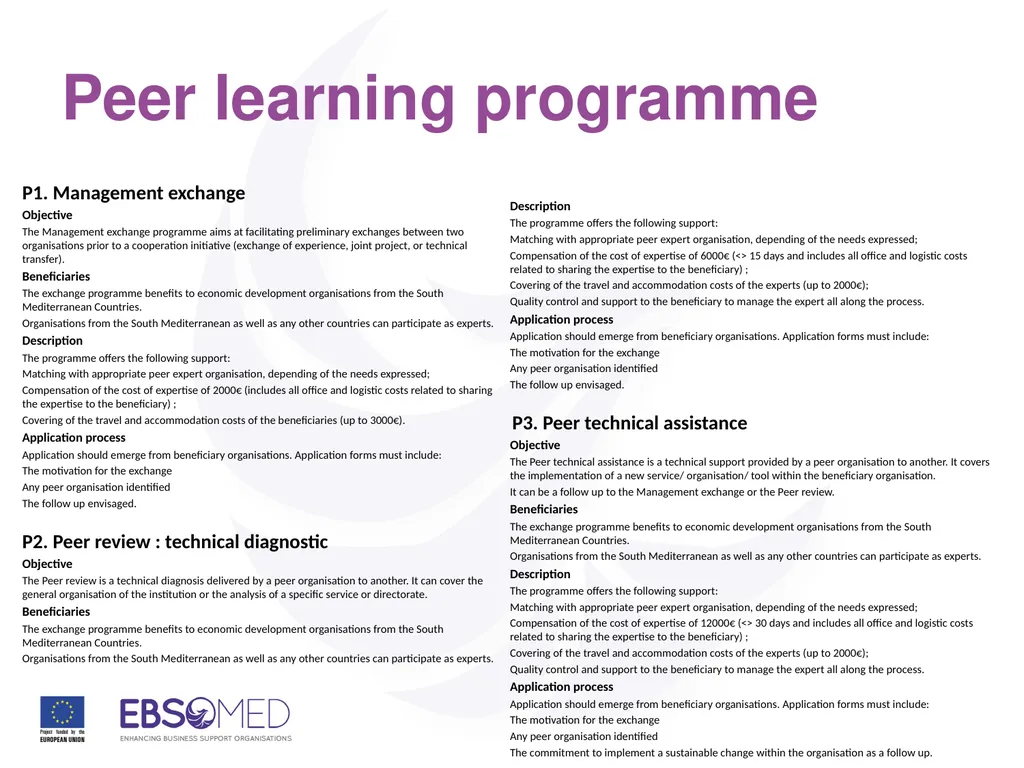
Peer learning programme P1. Management exchange
Objective
The Management exchange programme aims at facilitating preliminary exchanges between two organisations prior to a cooperation initiative (exchange of experience, joint project, or technical transfer).
Beneficiaries
The exchange programme benefits to economic development organisations from the South Mediterranean Countries.
Organisations from the South Mediterranean as well as any other countries can participate as experts.
Description
The programme offers the following support:
Matching with appropriate peer expert organisation, depending of the needs expressed;
Compensation of the cost of expertise of 2000€ (includes all office and logistic costs related to sharing the expertise to the beneficiary) ;
Covering of the travel and accommodation costs of the beneficiaries (up to 3000€).
Application process
Application should emerge from beneficiary organisations. Application forms must include:
The motivation for the exchange
Any peer organisation identified
The follow up envisaged.
P2. Peer review : technical diagnostic
Objective
The Peer review is a technical diagnosis delivered by a peer organisation to another. It can cover the general organisation of the institution or the analysis of a specific service or directorate.
Beneficiaries
The exchange programme benefits to economic development organisations from the South Mediterranean Countries.
Organisations from the South Mediterranean as well as any other countries can participate as experts.
Description
The programme offers the following support:
Matching with appropriate peer expert organisation, depending of the needs expressed;
Compensation of the cost of expertise of 6000€ (<> 15 days and includes all office and logistic costs related to sharing the expertise to the beneficiary) ;
Covering of the travel and accommodation costs of the experts (up to 2000€);
Quality control and support to the beneficiary to manage the expert all along the process.
Application process
Application should emerge from beneficiary organisations. Application forms must include:
The motivation for the exchange
Any peer organisation identified
The follow up envisaged.
P3. Peer technical assistance
Objective
The Peer technical assistance is a technical support provided by a peer organisation to another. It covers the implementation of a new service/ organisation/ tool within the beneficiary organisation.
It can be a follow up to the Management exchange or the Peer review.
Beneficiaries
The exchange programme benefits to economic development organisations from the South Mediterranean Countries.
Organisations from the South Mediterranean as well as any other countries can participate as experts.
Description
The programme offers the following support:
Matching with appropriate peer expert organisation, depending of the needs expressed;
Compensation of the cost of expertise of 12000€ (<> 30 days and includes all office and logistic costs related to sharing the expertise to the beneficiary) ;
Covering of the travel and accommodation costs of the experts (up to 2000€);
Quality control and support to the beneficiary to manage the expert all along the process.
Application process
Application should emerge from beneficiary organisations. Application forms must include:
The motivation for the exchange
Any peer organisation identified
The commitment to implement a sustainable change within the organisation as a follow up.<br>
Objective
The Management exchange programme aims at facilitating preliminary exchanges between two organisations prior to a cooperation initiative (exchange of experience, joint project, or technical transfer).
Beneficiaries
The exchange programme benefits to economic development organisations from the South Mediterranean Countries.
Organisations from the South Mediterranean as well as any other countries can participate as experts.
Description
The programme offers the following support:
Matching with appropriate peer expert organisation, depending of the needs expressed;
Compensation of the cost of expertise of 2000€ (includes all office and logistic costs related to sharing the expertise to the beneficiary) ;
Covering of the travel and accommodation costs of the beneficiaries (up to 3000€).
Application process
Application should emerge from beneficiary organisations. Application forms must include:
The motivation for the exchange
Any peer organisation identified
The follow up envisaged.
P2. Peer review : technical diagnostic
Objective
The Peer review is a technical diagnosis delivered by a peer organisation to another. It can cover the general organisation of the institution or the analysis of a specific service or directorate.
Beneficiaries
The exchange programme benefits to economic development organisations from the South Mediterranean Countries.
Organisations from the South Mediterranean as well as any other countries can participate as experts.
Description
The programme offers the following support:
Matching with appropriate peer expert organisation, depending of the needs expressed;
Compensation of the cost of expertise of 6000€ (<> 15 days and includes all office and logistic costs related to sharing the expertise to the beneficiary) ;
Covering of the travel and accommodation costs of the experts (up to 2000€);
Quality control and support to the beneficiary to manage the expert all along the process.
Application process
Application should emerge from beneficiary organisations. Application forms must include:
The motivation for the exchange
Any peer organisation identified
The follow up envisaged.
P3. Peer technical assistance
Objective
The Peer technical assistance is a technical support provided by a peer organisation to another. It covers the implementation of a new service/ organisation/ tool within the beneficiary organisation.
It can be a follow up to the Management exchange or the Peer review.
Beneficiaries
The exchange programme benefits to economic development organisations from the South Mediterranean Countries.
Organisations from the South Mediterranean as well as any other countries can participate as experts.
Description
The programme offers the following support:
Matching with appropriate peer expert organisation, depending of the needs expressed;
Compensation of the cost of expertise of 12000€ (<> 30 days and includes all office and logistic costs related to sharing the expertise to the beneficiary) ;
Covering of the travel and accommodation costs of the experts (up to 2000€);
Quality control and support to the beneficiary to manage the expert all along the process.
Application process
Application should emerge from beneficiary organisations. Application forms must include:
The motivation for the exchange
Any peer organisation identified
The commitment to implement a sustainable change within the organisation as a follow up.<br>
10
Thank you<br>