
Capacity building What is needed to form and





Description: Capacity building What is needed to form and manage a LAG? Role of animation and cooperation activities the main areas of training INGA KAWAŁEK Chairperson of POMERANIA LEADER NETWORK in Poland CEO in Local Action Group Partnerstwo Dorzecze
Related Topics
Download Presentation
"Capacity building What is needed to form and" is the property of its rightful owner. Permission is granted to download and print the materials on this website for personal, non-commercial use only, and to display it on your personal computer provided you do not modify the materials and that you retain all copyright notices contained in the materials. By downloading content from our website, you accept the terms of this agreement.
Presentation Transcript
slide1. Capacity building What is needed to form and manage a LAG?
Role of animation and cooperation activities
the main areas of training INGA KAWAŁEK
Chairperson of POMERANIA LEADER NETWORK in Poland
CEO in Local Action Group Partnerstwo Dorzecze Słupi in 2005-2019<br>
slide2. Polish Rural Forum and Leader approach Polish Rural Forum establishment – first agreement of Polish organisations acting for rural development – December 2002 (initiated by people involved in Agrolinia Programme implementation)
The organisation influenced the most the Leader approach development in Poland through implementing a project: „Preparation of rural communities to LEADER-type activities”<br>
slide3. The main reasons for the project The need to identify and suport partnership initiatives in Poland
Positive experiences in Leader in EU
The ability to apply for funds<br>
slide4. PROJECT ACTIVITIES July-August 2003 – specification of the criteria and selection of trainers
October 2003 – first trainers’ training – beginning of the discussion abut polish LAGs and methods of reasearch
10 trainers recruited in a competition
preparation of experts (10 people)
training in Poland – working on the animator training programme
research on partnerhip groups
study trips to Irland and Germany
Local partnership animators’ training (2004-2005 - 100 people)
Information campaign (regional seminars, local banks)<br>
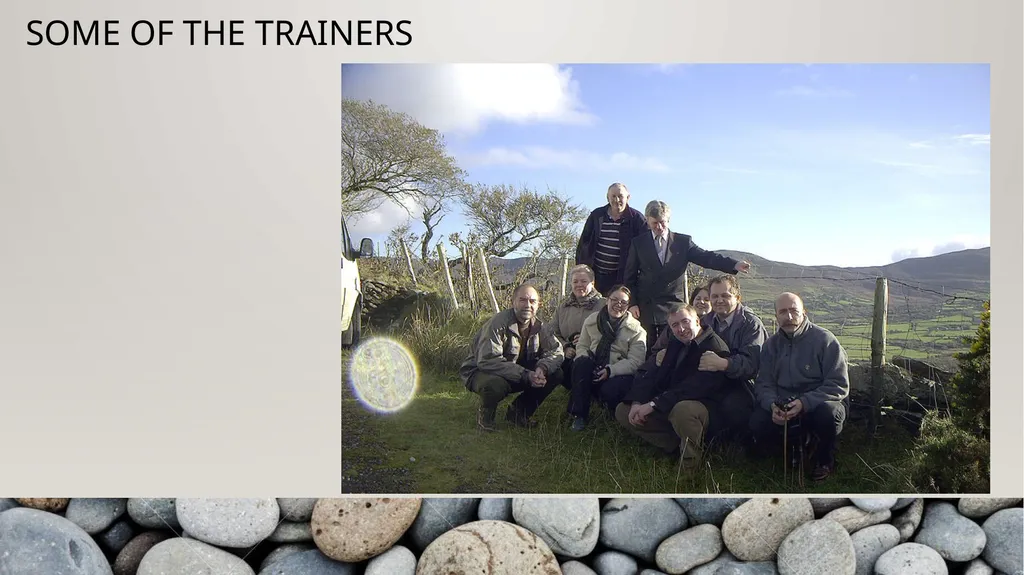
slide5. SOME of THE trAiners<br>
slide6. PROJECT ATIVITIES – STUDY TRIP TO IRELAND Analysis of LAGs – considered to be the best in Europe
Making contacts with managing and implementing authorities and researchers responsible for rural development
Understanding the difference between LEADER and other instruments for rural and regional development<br>
slide7. PROJECT ATIVITIES – STUDY TRIP TO GERMANY Learing of a „different LEADER” – inscribed in the strong local selfgovernment administration system
Exploring other institutions supporting Leader (National observatory in Frankfurt, Leader Education Centre in Bawaria)
Learning of the model coexistence of LEADER program and Village Renewal Program in Bawaria<br>
slide8. PROJECT AcTIVITIES – research on partnership groups in poland July 2003 – gathering info on existing partnerships in Poland
September 2003 – preparation of the interview scenario
October – November 2003 – first 8 interviews
January 2004 – improving the research method and conducting next interviews
February 2004 – comparative analysis of Polish and European partnerhips<br>
slide9. PROJECT ATIVITIES – trainers’ workshops Organizing information and materials gathered during study trips
Preparation of the position regarding the Polish model of functioning of the Local Action Group (LAG) and the rules for implementing LEADER in the Sectoral Operational Program
The concept of the project to disseminate knowledge about LEADER and "animate" local partnerships<br>
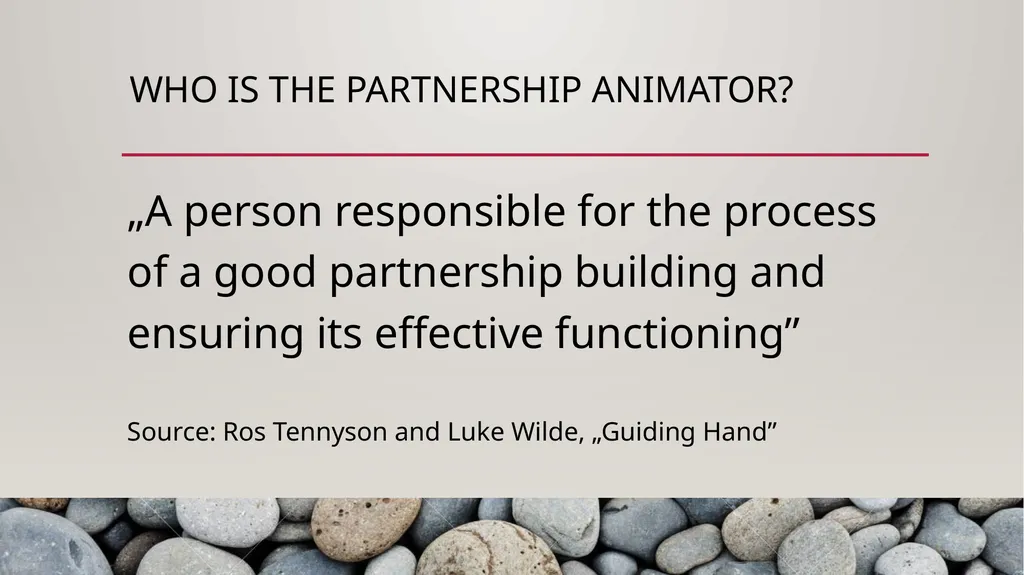
slide10. Who is the partnership animator? „A person responsible for the process of a good partnership building and ensuring its effective functioning”
Source: Ros Tennyson and Luke Wilde, „Guiding Hand”<br>
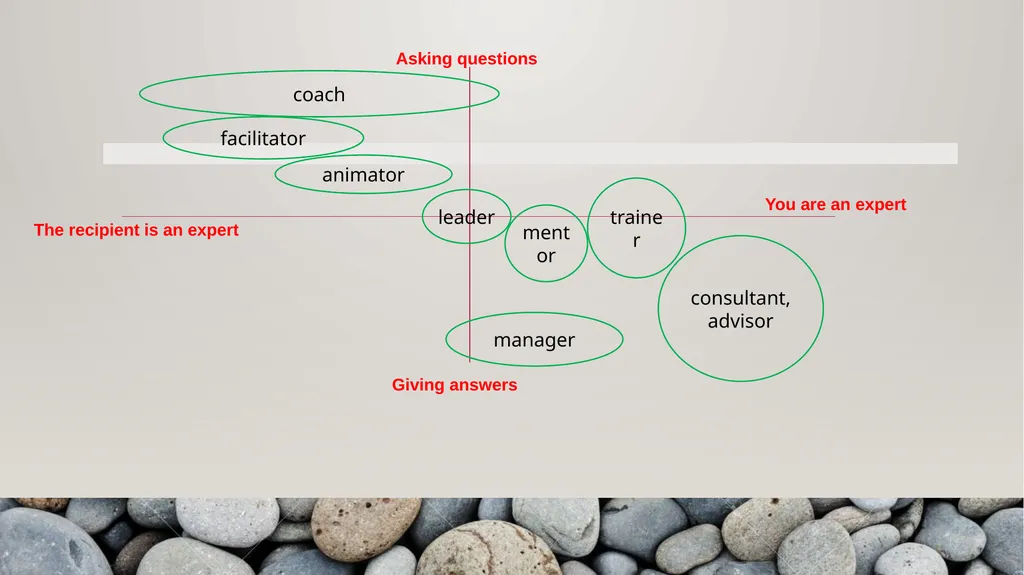
slide11. The recipient is an expert<br>
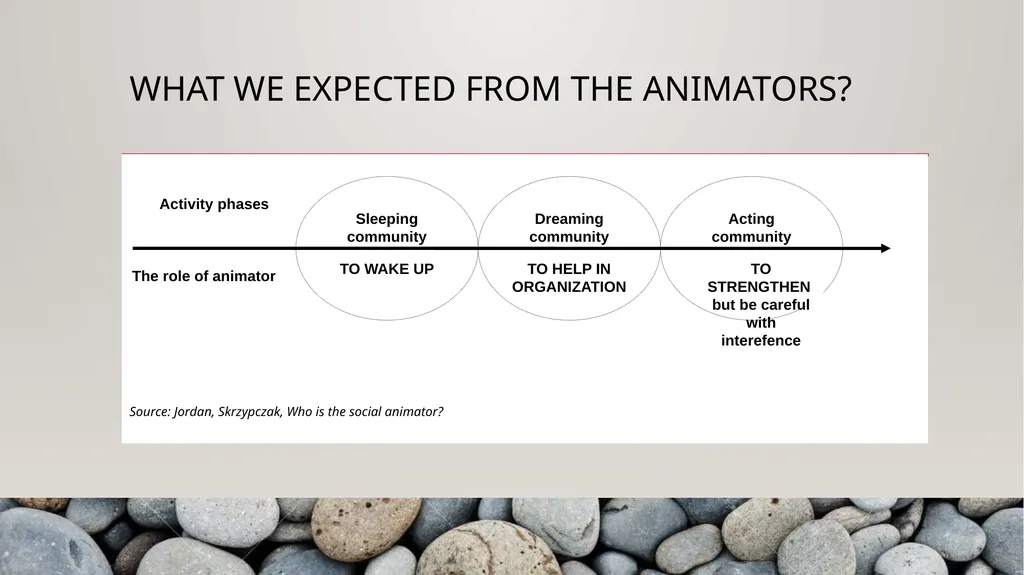
slide12. What we expected from the animatorS? Source: Jordan, Skrzypczak, Who is the social animator?<br>
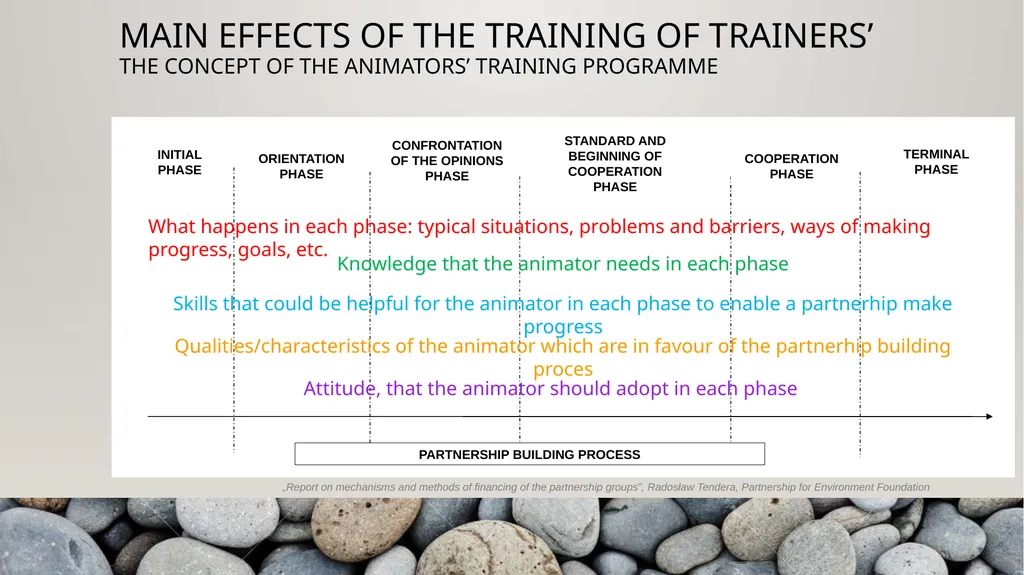
slide13. Main effects of the training oF trainers’ the concept of the animators’ training programme „Report on mechanisms and methods of financing of the partnership groups”, Radosław Tendera, Partnership for Environment Foundation What happens in each phase: typical situations, problems and barriers, ways of making progress, goals, etc. Knowledge that the animator needs in each phase Skills that could be helpful for the animator in each phase to enable a partnerhip make progress Attitude, that the animator should adopt in each phase Qualities/characteristics of the animator which are in favour of the partnerhip building proces<br>
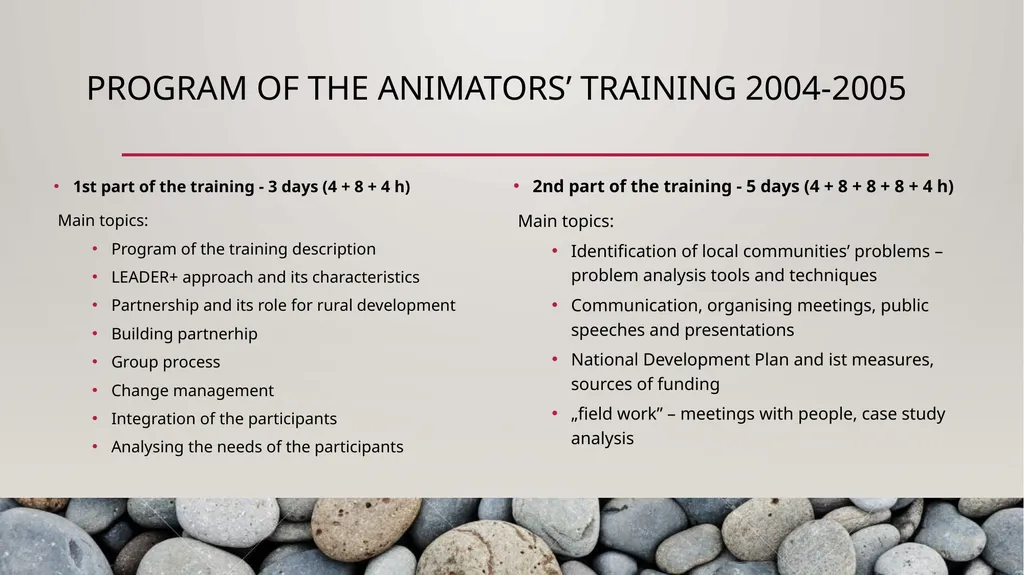
slide14. Program of the animators’ training 2004-2005 1st part of the training - 3 days (4 + 8 + 4 h)
Main topics:
Program of the training description
LEADER+ approach and its characteristics
Partnership and its role for rural development
Building partnerhip
Group process
Change management
Integration of the participants
Analysing the needs of the participants 2nd part of the training - 5 days (4 + 8 + 8 + 8 + 4 h)
Main topics:
Identification of local communities’ problems – problem analysis tools and techniques
Communication, organising meetings, public speeches and presentations
National Development Plan and ist measures, sources of funding
„field work” – meetings with people, case study analysis<br>
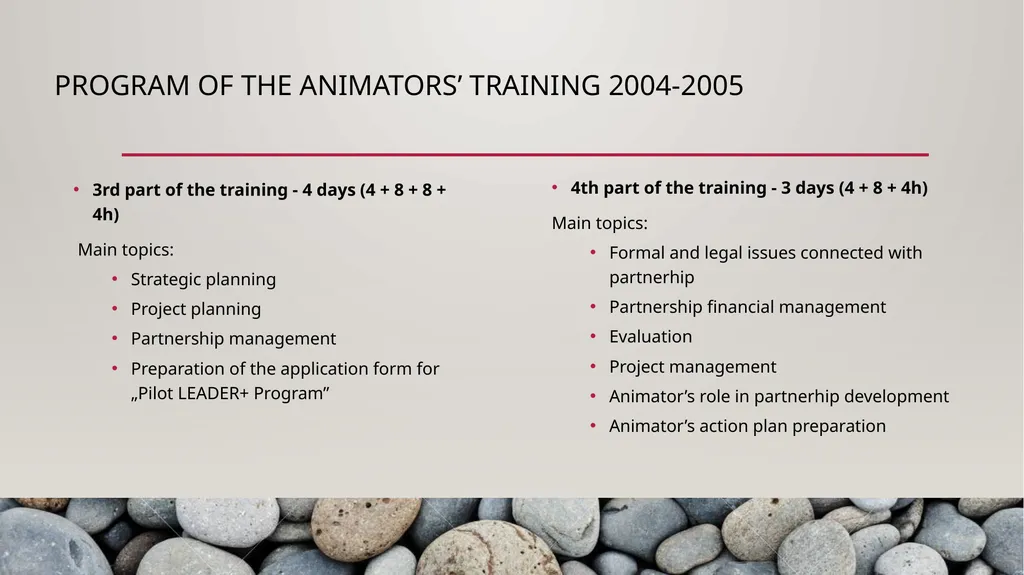
slide15. Program of the animators’ training 2004-2005 3rd part of the training - 4 days (4 + 8 + 8 + 4h)
Main topics:
Strategic planning
Project planning
Partnership management
Preparation of the application form for „Pilot LEADER+ Program” 4th part of the training - 3 days (4 + 8 + 4h)
Main topics:
Formal and legal issues connected with partnerhip
Partnership financial management
Evaluation
Project management
Animator’s role in partnerhip development
Animator’s action plan preparation<br>
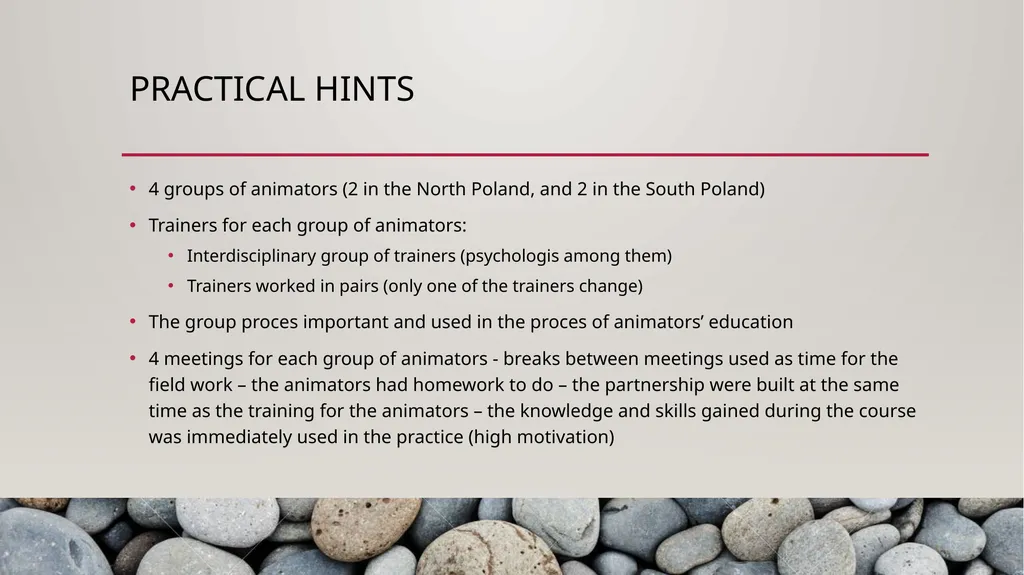
slide16. Practical hints 4 groups of animators (2 in the North Poland, and 2 in the South Poland)
Trainers for each group of animators:
Interdisciplinary group of trainers (psychologis among them)
Trainers worked in pairs (only one of the trainers change)
The group proces important and used in the proces of animators’ education
4 meetings for each group of animators - breaks between meetings used as time for the field work – the animators had homework to do – the partnership were built at the same time as the training for the animators – the knowledge and skills gained during the course was immediately used in the practice (high motivation)<br>
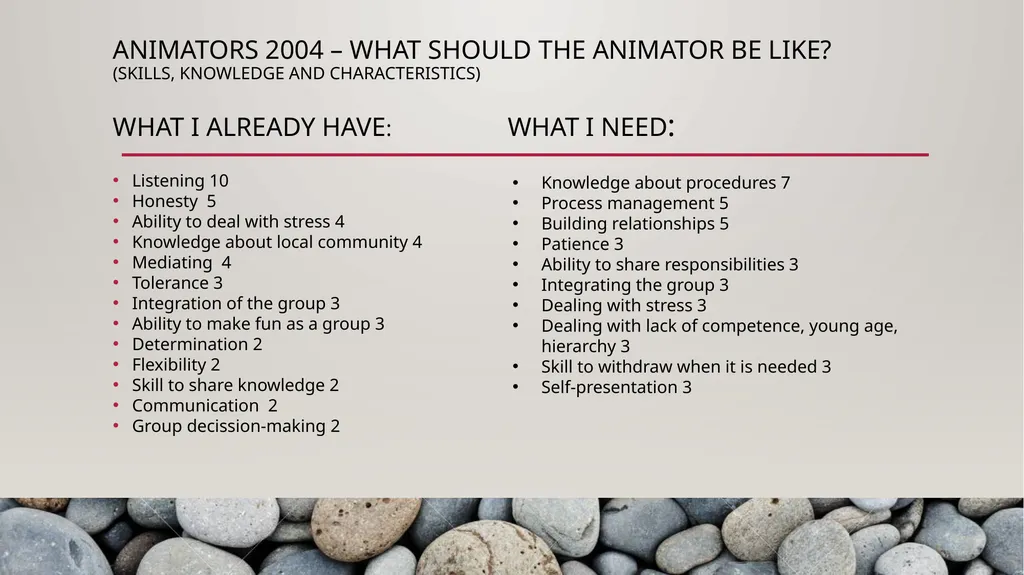
slide17. Animators 2004 – WHAT should the animator be like? (skills, knowledge and characteristics) What I already have: What I need: Listening 10
Honesty 5
Ability to deal with stress 4
Knowledge about local community 4
Mediating 4
Tolerance 3
Integration of the group 3
Ability to make fun as a group 3
Determination 2
Flexibility 2
Skill to share knowledge 2
Communication 2
Group decission-making 2 Knowledge about procedures 7
Process management 5
Building relationships 5
Patience 3
Ability to share responsibilities 3
Integrating the group 3
Dealing with stress 3
Dealing with lack of competence, young age, hierarchy 3
Skill to withdraw when it is needed 3
Self-presentation 3<br>
slide18. Which elements of the animators’ training are the most useful for animating the partnerhip? Workshop techniques
Methods of working with groups
LEADER idea as a whole concept
Discussion … between participants of the training
Partnership buliding workshop
Psychological exercises<br>
slide19. Animators’ refelections 2009 „Leader is a good chance for all of us who work for rural development, through Leader we learn to do real partnership, cooperation, gives the ability to know many wonderful and commited local leaders, Leader teches us humility, shows it is better to solve problems together. At the same time we are disappointed with lots of beaurocracy, to strict rules and many limitations, delays in payments, ineligibility of innovative actions”.<br>
slide20. Animators’ refelections 2009 „Participation in animators’ training was something very important in my professional life. It was crutial for sucessfull implementation of many activities I could do as partnerhip animator. And even if I don’t work with partnerships any more I remember that time as very interesting and inspiring. I still use much of the knowledge and skills I gained during the training”.<br>
slide21. ANIMATIORS’ role in future LAGs Most of the animators became: LAGs employees (project coordinators, animators, strategy managers, advisers, etc.)
LAG managers
Coordinators of regional LAGs network …. and after they have changed their jobs, some of them became:
local government officials
members of municipal councils
meyors
head of the commune association
director of a national park<br>
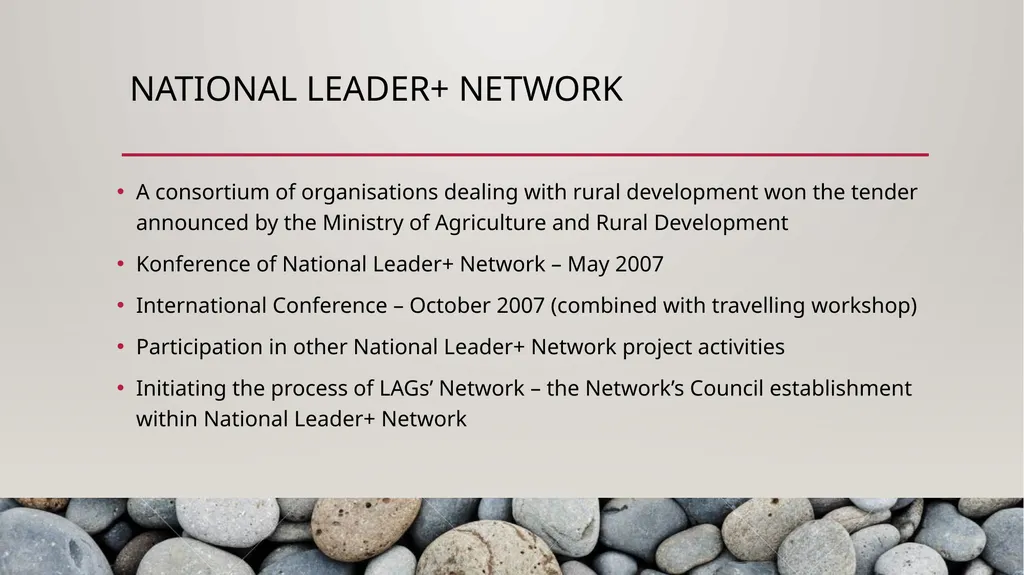
slide22. National Leader+ Network A consortium of organisations dealing with rural development won the tender announced by the Ministry of Agriculture and Rural Development
Konference of National Leader+ Network – May 2007
International Conference – October 2007 (combined with travelling workshop)
Participation in other National Leader+ Network project activities
Initiating the process of LAGs’ Network – the Network’s Council establishment within National Leader+ Network<br>
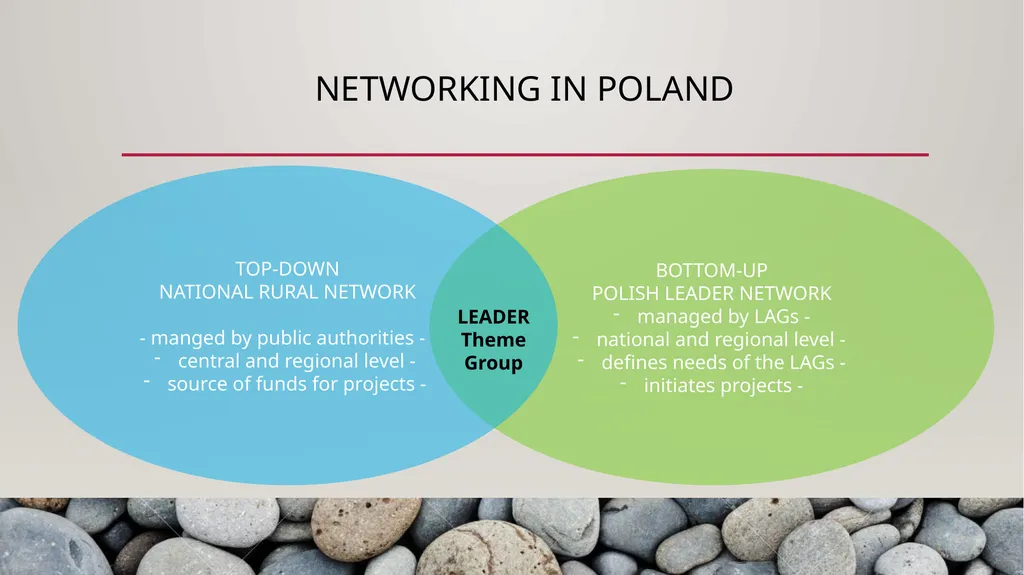
slide23. NETWORKING in POLAND BOTTOM-UP
POLISH LEADER NETWORK
managed by LAGs -
national and regional level -
defines needs of the LAGs -
initiates projects - TOP-DOWN
NATIONAL RURAL NETWORK
- manged by public authorities -
central and regional level -
source of funds for projects - LEADER Theme Group<br>
slide24. Projects in favor of the LAGs’ Development LAGs gatherings - national level events - conference, seminars, workshops, etc. - all people important for the LEADER approach
International events in Poland – in search of cooperation opportunities (speed dating)
Projects for regional LAGs networks (meetings, seminars, websites, training, study trips, promotion campaigns, etc.)
Publications (case studies, LDS tutorial, etc.)
International study visits
LAGs participation in interational event
FB LAGs group
Trainings for LAGS - on LDS development, evaluation, LAG Animators’ Academy, etc.<br>
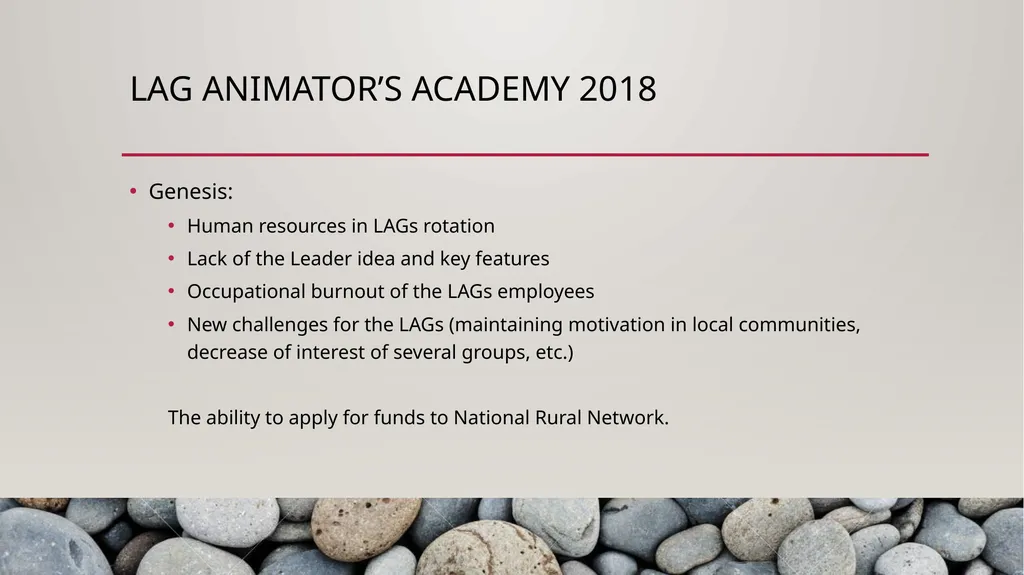
slide25. LAG Animator’s academy 2018 Genesis:
Human resources in LAGs rotation
Lack of the Leader idea and key features
Occupational burnout of the LAGs employees
New challenges for the LAGs (maintaining motivation in local communities, decrease of interest of several groups, etc.)
The ability to apply for funds to National Rural Network.<br>
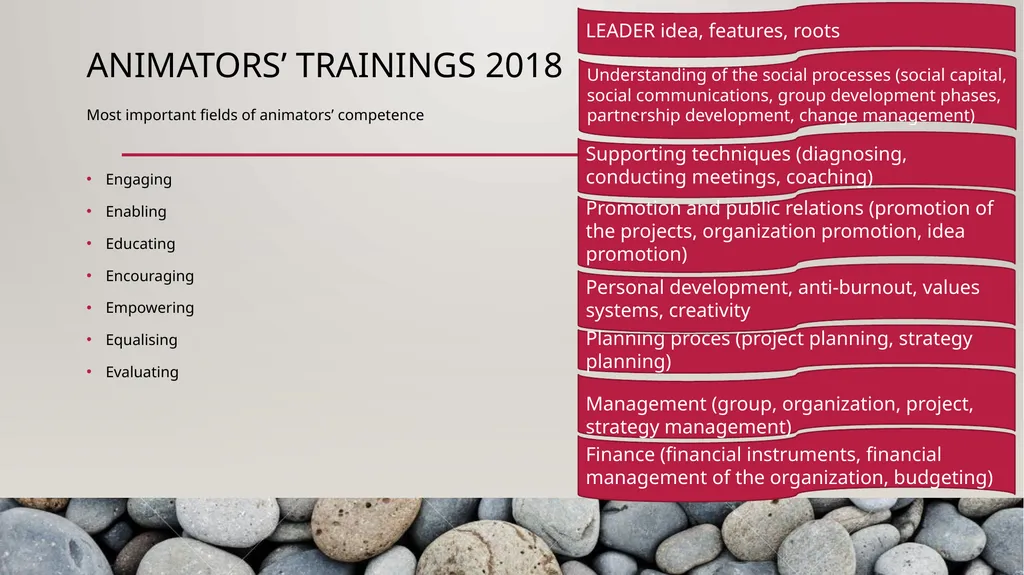
slide26. Animators’ trainings 2018 Most important fields of animators’ competence
Engaging
Enabling
Educating
Encouraging
Empowering
Equalising
Evaluating LEADER idea, features, roots Supporting techniques (diagnosing, conducting meetings, coaching) Understanding of the social processes (social capital, social communications, group development phases, partnership development, change management) Promotion and public relations (promotion of the projects, organization promotion, idea promotion) Planning proces (project planning, strategy planning) Personal development, anti-burnout, values systems, creativity Management (group, organization, project, strategy management) Finance (financial instruments, financial management of the organization, budgeting)<br>
slide27. PROJECT ACTIVITIES Workshops – 3 meetings (3 days each) – April – June 2018 – 4 groups of animators (60 animators trained)
Study trips and seminars in Poland – September 2018
Individual tutoring for the animators
Competition for the animators (report on the actions taken by the animators in his or her local environment during the project implementation)
Summary coference – October 2018<br>
slide28. Spiral growth?
Sometimes something happens intensly, but we cannot see it (using the metaphore – it’s at the back of the tower of blocks) Local community development is not a simple timeline<br>
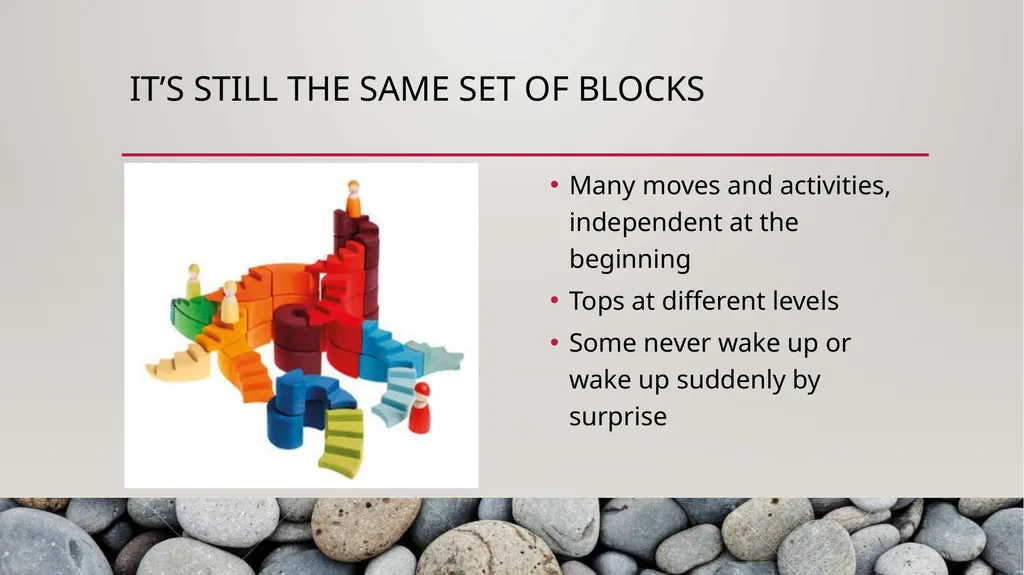
slide29. It’s still the same set of blocks Many moves and activities, independent at the beginning
Tops at different levels
Some never wake up or wake up suddenly by surprise<br>
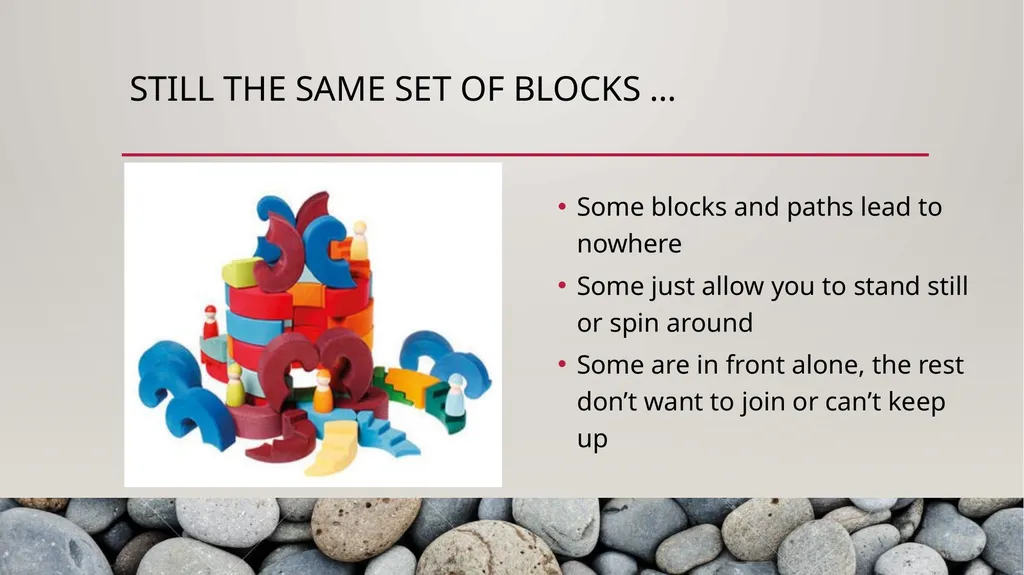
slide30. Some blocks and paths lead to nowhere
Some just allow you to stand still or spin around
Some are in front alone, the rest don’t want to join or can’t keep up still the same set of blocks …<br>
slide31. Spiral growth? Yes, byt not only one
Numerous uplifts (leaders) – there are some splits between them (differences, tensions)
Different competence of the animator is needed at the top activity, and different in the splits, etc. Maybe a different set of blocks is better?<br>
slide32. LEADER as a set of blocks… LEADER IS:
Equipotential – the same potentials may lead to different results
Equifinal – different potentials may lead to the same results
It is important to deliver a good quality set of blocks to local communities (the Leader system, people, the skills, supporting projects, tools, competence, etc…)<br>
slide33. Thank you For further questions please don’t hesitate to contact me:
inga.kawalek@gmail.com<br>
Role of animation and cooperation activities
the main areas of training INGA KAWAŁEK
Chairperson of POMERANIA LEADER NETWORK in Poland
CEO in Local Action Group Partnerstwo Dorzecze Słupi in 2005-2019<br>
slide2. Polish Rural Forum and Leader approach Polish Rural Forum establishment – first agreement of Polish organisations acting for rural development – December 2002 (initiated by people involved in Agrolinia Programme implementation)
The organisation influenced the most the Leader approach development in Poland through implementing a project: „Preparation of rural communities to LEADER-type activities”<br>
slide3. The main reasons for the project The need to identify and suport partnership initiatives in Poland
Positive experiences in Leader in EU
The ability to apply for funds<br>
slide4. PROJECT ACTIVITIES July-August 2003 – specification of the criteria and selection of trainers
October 2003 – first trainers’ training – beginning of the discussion abut polish LAGs and methods of reasearch
10 trainers recruited in a competition
preparation of experts (10 people)
training in Poland – working on the animator training programme
research on partnerhip groups
study trips to Irland and Germany
Local partnership animators’ training (2004-2005 - 100 people)
Information campaign (regional seminars, local banks)<br>
slide5. SOME of THE trAiners<br>
slide6. PROJECT ATIVITIES – STUDY TRIP TO IRELAND Analysis of LAGs – considered to be the best in Europe
Making contacts with managing and implementing authorities and researchers responsible for rural development
Understanding the difference between LEADER and other instruments for rural and regional development<br>
slide7. PROJECT ATIVITIES – STUDY TRIP TO GERMANY Learing of a „different LEADER” – inscribed in the strong local selfgovernment administration system
Exploring other institutions supporting Leader (National observatory in Frankfurt, Leader Education Centre in Bawaria)
Learning of the model coexistence of LEADER program and Village Renewal Program in Bawaria<br>
slide8. PROJECT AcTIVITIES – research on partnership groups in poland July 2003 – gathering info on existing partnerships in Poland
September 2003 – preparation of the interview scenario
October – November 2003 – first 8 interviews
January 2004 – improving the research method and conducting next interviews
February 2004 – comparative analysis of Polish and European partnerhips<br>
slide9. PROJECT ATIVITIES – trainers’ workshops Organizing information and materials gathered during study trips
Preparation of the position regarding the Polish model of functioning of the Local Action Group (LAG) and the rules for implementing LEADER in the Sectoral Operational Program
The concept of the project to disseminate knowledge about LEADER and "animate" local partnerships<br>
slide10. Who is the partnership animator? „A person responsible for the process of a good partnership building and ensuring its effective functioning”
Source: Ros Tennyson and Luke Wilde, „Guiding Hand”<br>
slide11. The recipient is an expert<br>
slide12. What we expected from the animatorS? Source: Jordan, Skrzypczak, Who is the social animator?<br>
slide13. Main effects of the training oF trainers’ the concept of the animators’ training programme „Report on mechanisms and methods of financing of the partnership groups”, Radosław Tendera, Partnership for Environment Foundation What happens in each phase: typical situations, problems and barriers, ways of making progress, goals, etc. Knowledge that the animator needs in each phase Skills that could be helpful for the animator in each phase to enable a partnerhip make progress Attitude, that the animator should adopt in each phase Qualities/characteristics of the animator which are in favour of the partnerhip building proces<br>
slide14. Program of the animators’ training 2004-2005 1st part of the training - 3 days (4 + 8 + 4 h)
Main topics:
Program of the training description
LEADER+ approach and its characteristics
Partnership and its role for rural development
Building partnerhip
Group process
Change management
Integration of the participants
Analysing the needs of the participants 2nd part of the training - 5 days (4 + 8 + 8 + 8 + 4 h)
Main topics:
Identification of local communities’ problems – problem analysis tools and techniques
Communication, organising meetings, public speeches and presentations
National Development Plan and ist measures, sources of funding
„field work” – meetings with people, case study analysis<br>
slide15. Program of the animators’ training 2004-2005 3rd part of the training - 4 days (4 + 8 + 8 + 4h)
Main topics:
Strategic planning
Project planning
Partnership management
Preparation of the application form for „Pilot LEADER+ Program” 4th part of the training - 3 days (4 + 8 + 4h)
Main topics:
Formal and legal issues connected with partnerhip
Partnership financial management
Evaluation
Project management
Animator’s role in partnerhip development
Animator’s action plan preparation<br>
slide16. Practical hints 4 groups of animators (2 in the North Poland, and 2 in the South Poland)
Trainers for each group of animators:
Interdisciplinary group of trainers (psychologis among them)
Trainers worked in pairs (only one of the trainers change)
The group proces important and used in the proces of animators’ education
4 meetings for each group of animators - breaks between meetings used as time for the field work – the animators had homework to do – the partnership were built at the same time as the training for the animators – the knowledge and skills gained during the course was immediately used in the practice (high motivation)<br>
slide17. Animators 2004 – WHAT should the animator be like? (skills, knowledge and characteristics) What I already have: What I need: Listening 10
Honesty 5
Ability to deal with stress 4
Knowledge about local community 4
Mediating 4
Tolerance 3
Integration of the group 3
Ability to make fun as a group 3
Determination 2
Flexibility 2
Skill to share knowledge 2
Communication 2
Group decission-making 2 Knowledge about procedures 7
Process management 5
Building relationships 5
Patience 3
Ability to share responsibilities 3
Integrating the group 3
Dealing with stress 3
Dealing with lack of competence, young age, hierarchy 3
Skill to withdraw when it is needed 3
Self-presentation 3<br>
slide18. Which elements of the animators’ training are the most useful for animating the partnerhip? Workshop techniques
Methods of working with groups
LEADER idea as a whole concept
Discussion … between participants of the training
Partnership buliding workshop
Psychological exercises<br>
slide19. Animators’ refelections 2009 „Leader is a good chance for all of us who work for rural development, through Leader we learn to do real partnership, cooperation, gives the ability to know many wonderful and commited local leaders, Leader teches us humility, shows it is better to solve problems together. At the same time we are disappointed with lots of beaurocracy, to strict rules and many limitations, delays in payments, ineligibility of innovative actions”.<br>
slide20. Animators’ refelections 2009 „Participation in animators’ training was something very important in my professional life. It was crutial for sucessfull implementation of many activities I could do as partnerhip animator. And even if I don’t work with partnerships any more I remember that time as very interesting and inspiring. I still use much of the knowledge and skills I gained during the training”.<br>
slide21. ANIMATIORS’ role in future LAGs Most of the animators became: LAGs employees (project coordinators, animators, strategy managers, advisers, etc.)
LAG managers
Coordinators of regional LAGs network …. and after they have changed their jobs, some of them became:
local government officials
members of municipal councils
meyors
head of the commune association
director of a national park<br>
slide22. National Leader+ Network A consortium of organisations dealing with rural development won the tender announced by the Ministry of Agriculture and Rural Development
Konference of National Leader+ Network – May 2007
International Conference – October 2007 (combined with travelling workshop)
Participation in other National Leader+ Network project activities
Initiating the process of LAGs’ Network – the Network’s Council establishment within National Leader+ Network<br>
slide23. NETWORKING in POLAND BOTTOM-UP
POLISH LEADER NETWORK
managed by LAGs -
national and regional level -
defines needs of the LAGs -
initiates projects - TOP-DOWN
NATIONAL RURAL NETWORK
- manged by public authorities -
central and regional level -
source of funds for projects - LEADER Theme Group<br>
slide24. Projects in favor of the LAGs’ Development LAGs gatherings - national level events - conference, seminars, workshops, etc. - all people important for the LEADER approach
International events in Poland – in search of cooperation opportunities (speed dating)
Projects for regional LAGs networks (meetings, seminars, websites, training, study trips, promotion campaigns, etc.)
Publications (case studies, LDS tutorial, etc.)
International study visits
LAGs participation in interational event
FB LAGs group
Trainings for LAGS - on LDS development, evaluation, LAG Animators’ Academy, etc.<br>
slide25. LAG Animator’s academy 2018 Genesis:
Human resources in LAGs rotation
Lack of the Leader idea and key features
Occupational burnout of the LAGs employees
New challenges for the LAGs (maintaining motivation in local communities, decrease of interest of several groups, etc.)
The ability to apply for funds to National Rural Network.<br>
slide26. Animators’ trainings 2018 Most important fields of animators’ competence
Engaging
Enabling
Educating
Encouraging
Empowering
Equalising
Evaluating LEADER idea, features, roots Supporting techniques (diagnosing, conducting meetings, coaching) Understanding of the social processes (social capital, social communications, group development phases, partnership development, change management) Promotion and public relations (promotion of the projects, organization promotion, idea promotion) Planning proces (project planning, strategy planning) Personal development, anti-burnout, values systems, creativity Management (group, organization, project, strategy management) Finance (financial instruments, financial management of the organization, budgeting)<br>
slide27. PROJECT ACTIVITIES Workshops – 3 meetings (3 days each) – April – June 2018 – 4 groups of animators (60 animators trained)
Study trips and seminars in Poland – September 2018
Individual tutoring for the animators
Competition for the animators (report on the actions taken by the animators in his or her local environment during the project implementation)
Summary coference – October 2018<br>
slide28. Spiral growth?
Sometimes something happens intensly, but we cannot see it (using the metaphore – it’s at the back of the tower of blocks) Local community development is not a simple timeline<br>
slide29. It’s still the same set of blocks Many moves and activities, independent at the beginning
Tops at different levels
Some never wake up or wake up suddenly by surprise<br>
slide30. Some blocks and paths lead to nowhere
Some just allow you to stand still or spin around
Some are in front alone, the rest don’t want to join or can’t keep up still the same set of blocks …<br>
slide31. Spiral growth? Yes, byt not only one
Numerous uplifts (leaders) – there are some splits between them (differences, tensions)
Different competence of the animator is needed at the top activity, and different in the splits, etc. Maybe a different set of blocks is better?<br>
slide32. LEADER as a set of blocks… LEADER IS:
Equipotential – the same potentials may lead to different results
Equifinal – different potentials may lead to the same results
It is important to deliver a good quality set of blocks to local communities (the Leader system, people, the skills, supporting projects, tools, competence, etc…)<br>
slide33. Thank you For further questions please don’t hesitate to contact me:
inga.kawalek@gmail.com<br>