
Capital Management 2018/19 Capital v Resource and
GB
Published · 66 slides · 0 views

1 / 1

Description
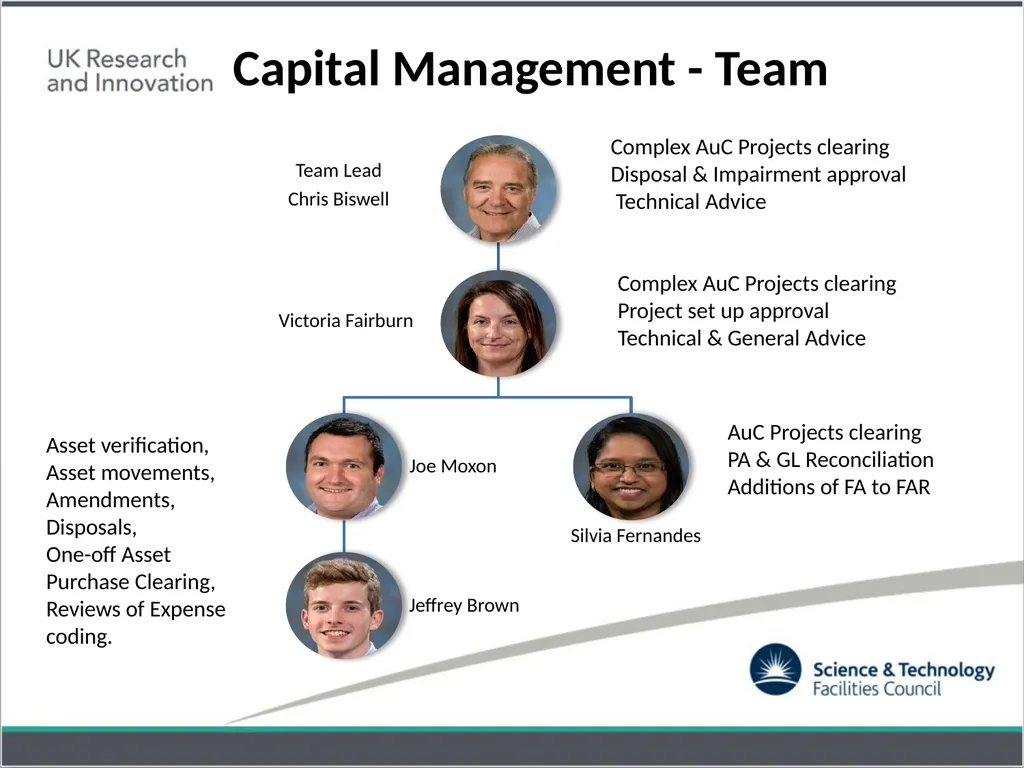
Capital Management 201819 Capital v Resource and the Creation of Fixed Assets Capital Management Team STFC Finance September 2018 Capital Management - Team Team Lead Chris Biswell Victoria Fairburn Joe Moxon Jeffrey Brown Silvia Fernandes
Related Topics
Share
Embed code
Download this presentation From Below
"Capital Management 2018/19 Capital v Resource and" is the property of its rightful owner. Permission is granted to download and print the materials on this website for personal, non-commercial use only, and to display it on your personal computer provided you do not modify the materials and that you retain all copyright notices contained in the materials. By downloading content from our website, you accept the terms of this agreement.
Presentation Transcript
01
Capital Management 2018/19 Capital v Resource and the Creation of Fixed Assets Capital Management Team
STFC Finance
September 2018<br>
STFC Finance
September 2018<br>
02
Capital Management - Team Team Lead
Chris Biswell Victoria Fairburn Joe Moxon Jeffrey Brown Silvia Fernandes Asset verification, Asset movements,
Amendments, Disposals,
One-off Asset
Purchase Clearing, Reviews of Expense
coding. Complex AuC Projects clearing
Project set up approval
Technical & General Advice AuC Projects clearing
PA & GL Reconciliation
Additions of FA to FAR Complex AuC Projects clearing
Disposal & Impairment approval
Technical Advice<br>
Chris Biswell Victoria Fairburn Joe Moxon Jeffrey Brown Silvia Fernandes Asset verification, Asset movements,
Amendments, Disposals,
One-off Asset
Purchase Clearing, Reviews of Expense
coding. Complex AuC Projects clearing
Project set up approval
Technical & General Advice AuC Projects clearing
PA & GL Reconciliation
Additions of FA to FAR Complex AuC Projects clearing
Disposal & Impairment approval
Technical Advice<br>
03
Contents Capital Management Improvement programme
Where to find more information, including NCA Policies
Roles & Responsibilities
Capital Spend
Standalone Assets & Assets under Construction (Projects)
Annual Accounts and Intangibles
Asset Verification
Impairment and Revaluation
Asset Disposals
Summary<br>
Where to find more information, including NCA Policies
Roles & Responsibilities
Capital Spend
Standalone Assets & Assets under Construction (Projects)
Annual Accounts and Intangibles
Asset Verification
Impairment and Revaluation
Asset Disposals
Summary<br>
04
Capital Management Improvement Programme Now in the second year
AUC Backlog caused by poor project set up
Things are improving due to additional Resource and Education
New Asset validation exercise
Thank you for all your assistance!<br>
AUC Backlog caused by poor project set up
Things are improving due to additional Resource and Education
New Asset validation exercise
Thank you for all your assistance!<br>
05
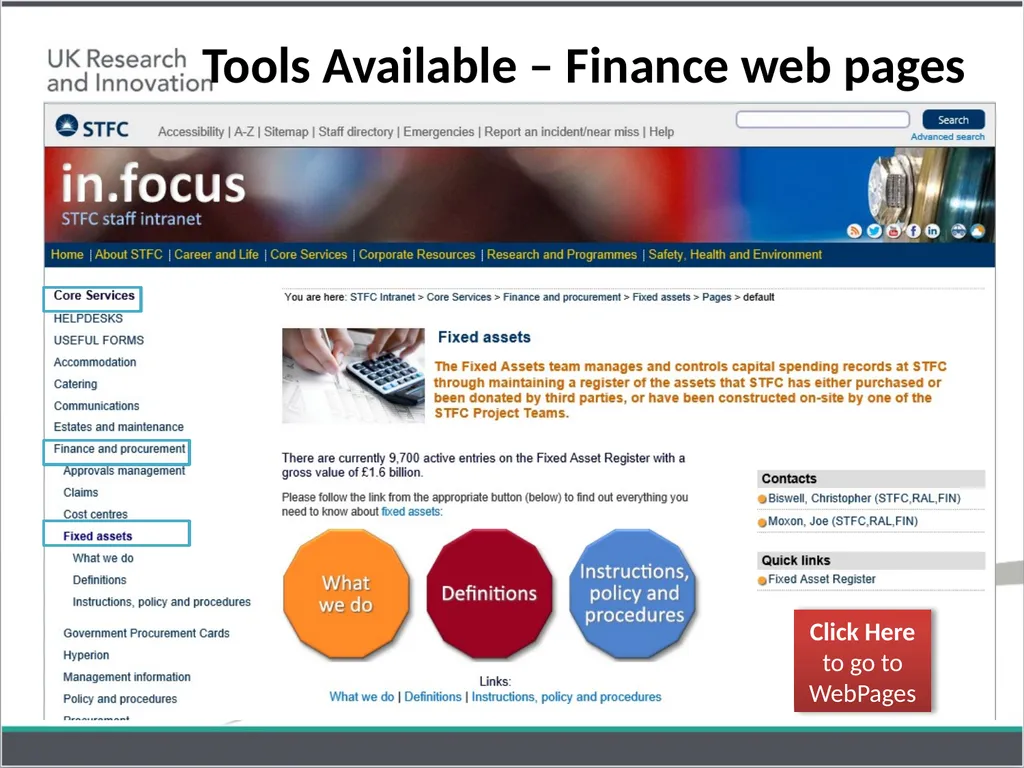
Tools Available – Finance web pages Click Here to go to WebPages<br>
06
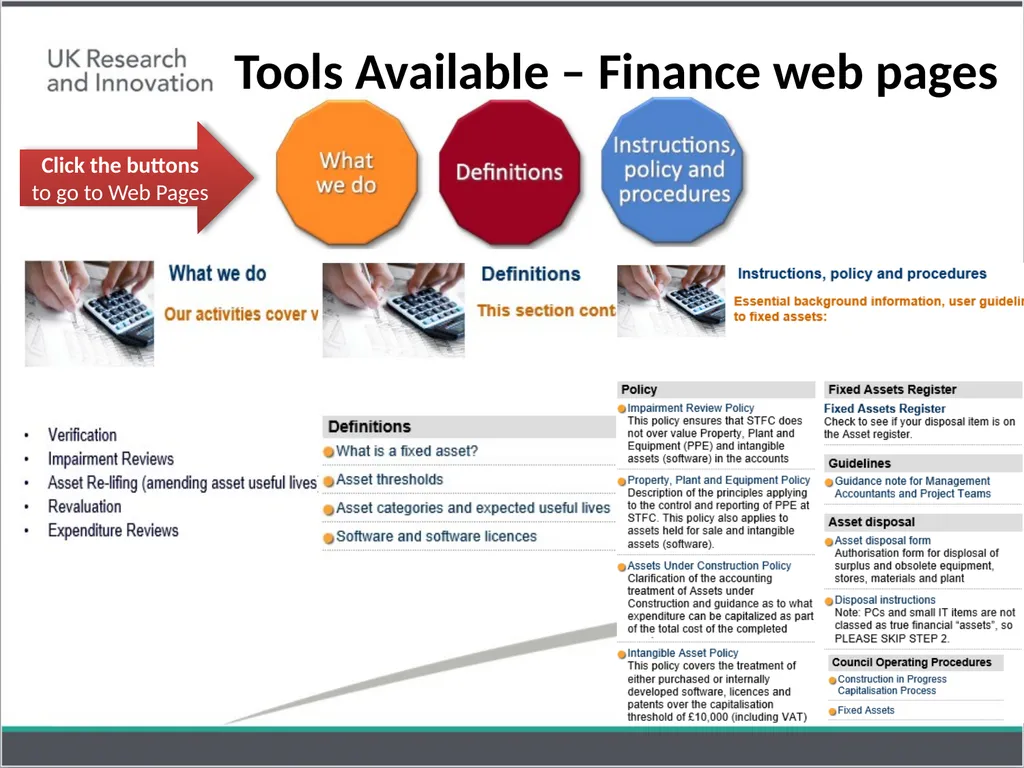
Tools Available – Finance web pages Click the buttons
to go to Web Pages<br>
to go to Web Pages<br>
07
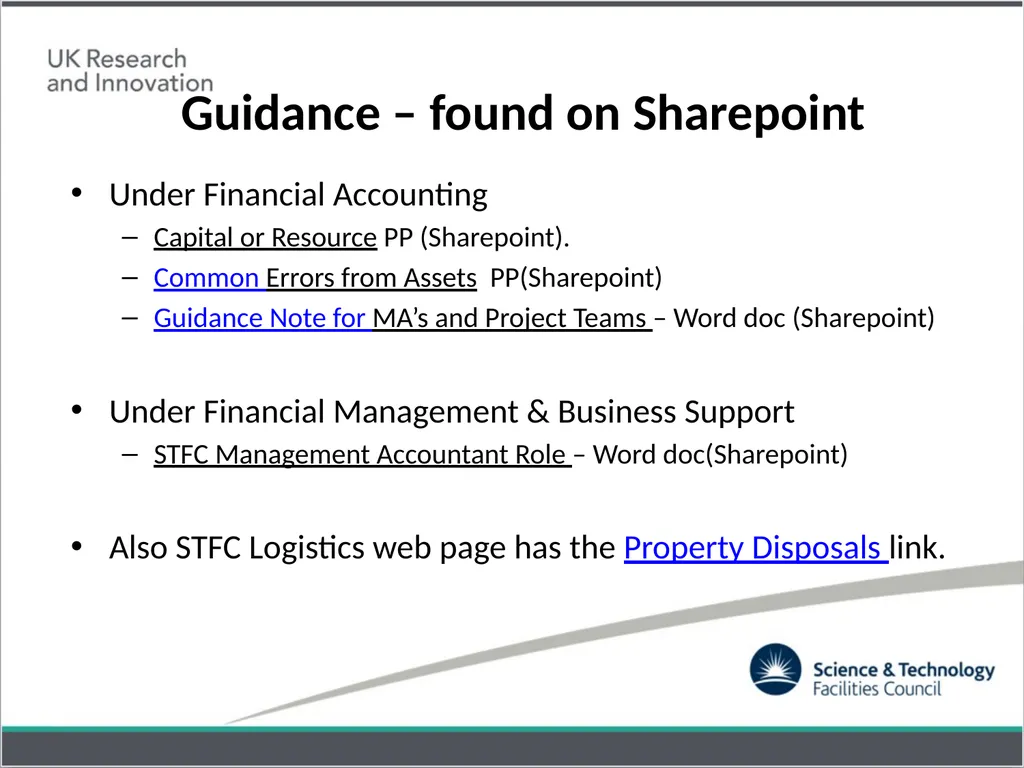
Guidance – found on Sharepoint Under Financial Accounting
Capital or Resource PP (Sharepoint).
Common Errors from Assets PP(Sharepoint)
Guidance Note for MA’s and Project Teams – Word doc (Sharepoint)
Under Financial Management & Business Support
STFC Management Accountant Role – Word doc(Sharepoint)
Also STFC Logistics web page has the Property Disposals link.<br>
Capital or Resource PP (Sharepoint).
Common Errors from Assets PP(Sharepoint)
Guidance Note for MA’s and Project Teams – Word doc (Sharepoint)
Under Financial Management & Business Support
STFC Management Accountant Role – Word doc(Sharepoint)
Also STFC Logistics web page has the Property Disposals link.<br>
08
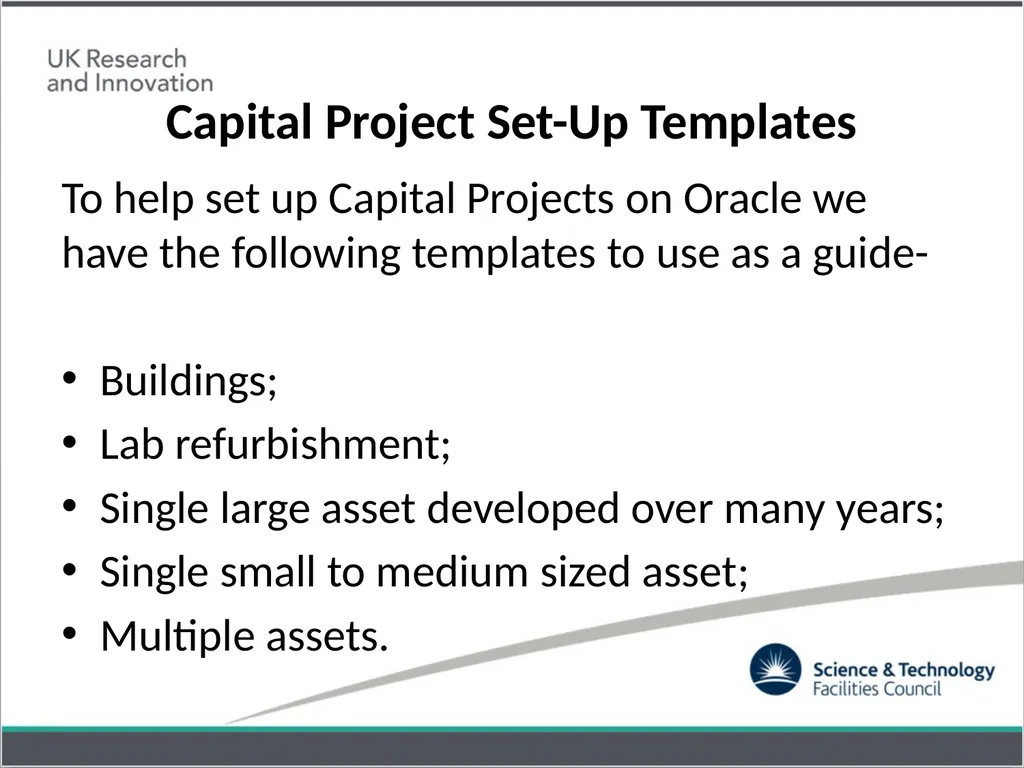
Capital Project Set-Up Templates To help set up Capital Projects on Oracle we have the following templates to use as a guide-
Buildings;
Lab refurbishment;
Single large asset developed over many years;
Single small to medium sized asset;
Multiple assets.<br>
Buildings;
Lab refurbishment;
Single large asset developed over many years;
Single small to medium sized asset;
Multiple assets.<br>
09
Roles and Responsibilities
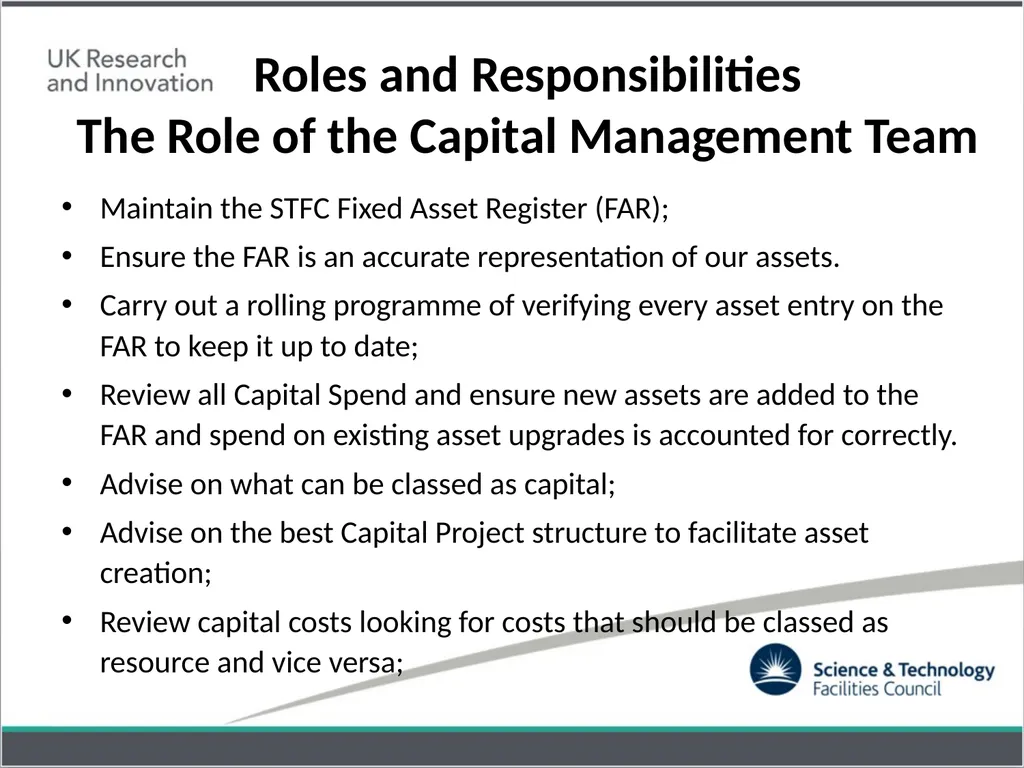
The Role of the Capital Management Team Maintain the STFC Fixed Asset Register (FAR);
Ensure the FAR is an accurate representation of our assets.
Carry out a rolling programme of verifying every asset entry on the FAR to keep it up to date;
Review all Capital Spend and ensure new assets are added to the FAR and spend on existing asset upgrades is accounted for correctly.
Advise on what can be classed as capital;
Advise on the best Capital Project structure to facilitate asset creation;
Review capital costs looking for costs that should be classed as resource and vice versa;<br>
Ensure the FAR is an accurate representation of our assets.
Carry out a rolling programme of verifying every asset entry on the FAR to keep it up to date;
Review all Capital Spend and ensure new assets are added to the FAR and spend on existing asset upgrades is accounted for correctly.
Advise on what can be classed as capital;
Advise on the best Capital Project structure to facilitate asset creation;
Review capital costs looking for costs that should be classed as resource and vice versa;<br>
10
Roles and Responsibilities
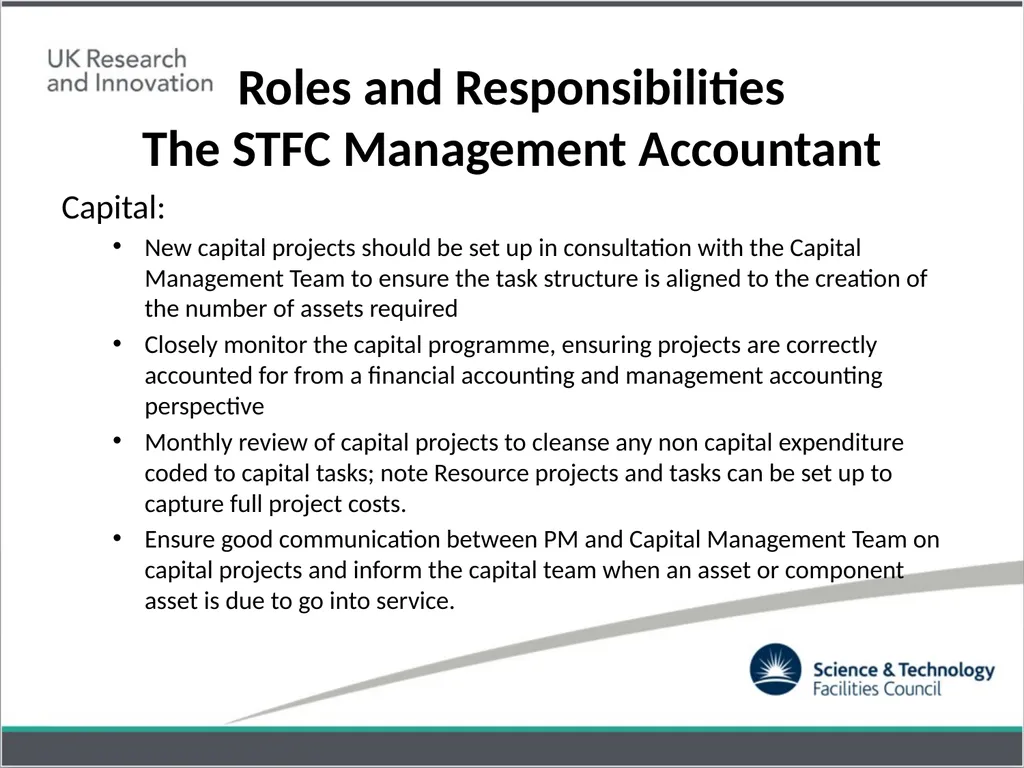
The STFC Management Accountant Capital:
New capital projects should be set up in consultation with the Capital Management Team to ensure the task structure is aligned to the creation of the number of assets required
Closely monitor the capital programme, ensuring projects are correctly accounted for from a financial accounting and management accounting perspective
Monthly review of capital projects to cleanse any non capital expenditure coded to capital tasks; note Resource projects and tasks can be set up to capture full project costs.
Ensure good communication between PM and Capital Management Team on capital projects and inform the capital team when an asset or component asset is due to go into service.<br>
New capital projects should be set up in consultation with the Capital Management Team to ensure the task structure is aligned to the creation of the number of assets required
Closely monitor the capital programme, ensuring projects are correctly accounted for from a financial accounting and management accounting perspective
Monthly review of capital projects to cleanse any non capital expenditure coded to capital tasks; note Resource projects and tasks can be set up to capture full project costs.
Ensure good communication between PM and Capital Management Team on capital projects and inform the capital team when an asset or component asset is due to go into service.<br>
11
Roles and Responsibilities
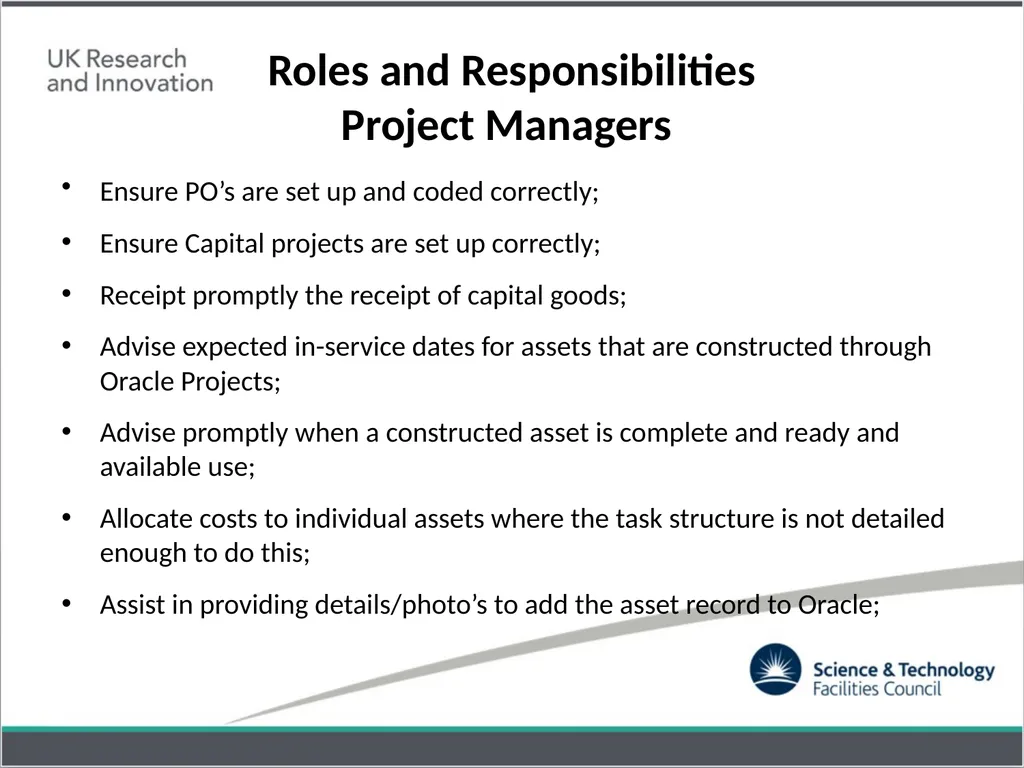
Project Managers Ensure PO’s are set up and coded correctly;
Ensure Capital projects are set up correctly;
Receipt promptly the receipt of capital goods;
Advise expected in-service dates for assets that are constructed through Oracle Projects;
Advise promptly when a constructed asset is complete and ready and available use;
Allocate costs to individual assets where the task structure is not detailed enough to do this;
Assist in providing details/photo’s to add the asset record to Oracle;<br>
Ensure Capital projects are set up correctly;
Receipt promptly the receipt of capital goods;
Advise expected in-service dates for assets that are constructed through Oracle Projects;
Advise promptly when a constructed asset is complete and ready and available use;
Allocate costs to individual assets where the task structure is not detailed enough to do this;
Assist in providing details/photo’s to add the asset record to Oracle;<br>
12
Roles and Responsibilities
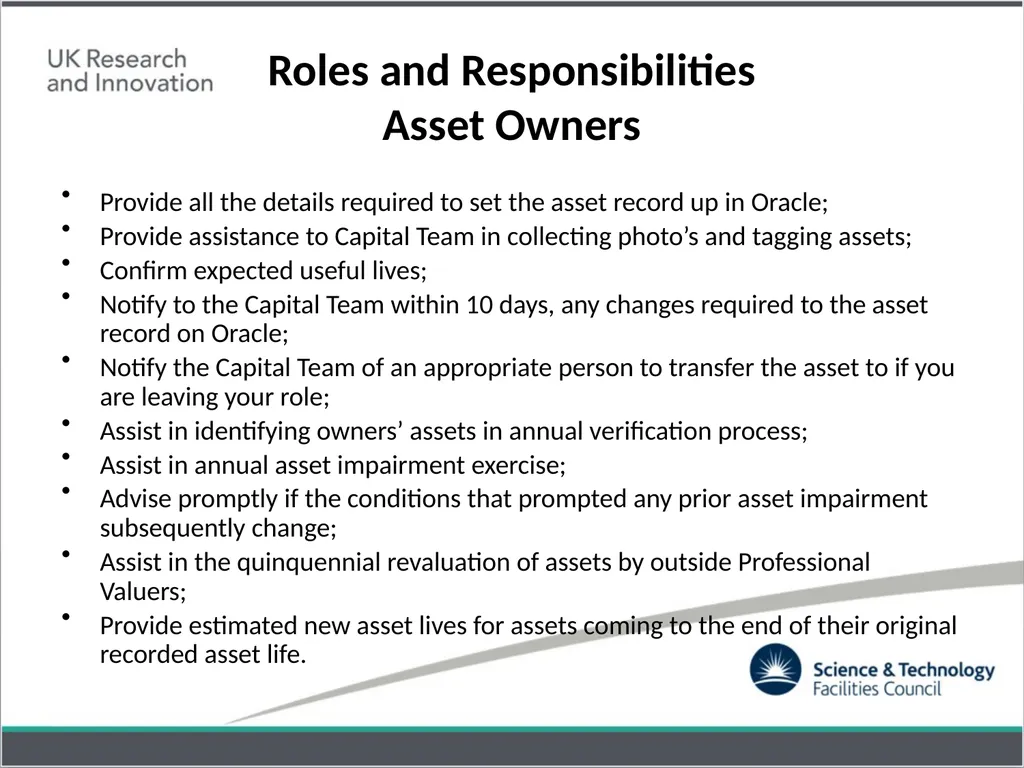
Asset Owners Provide all the details required to set the asset record up in Oracle;
Provide assistance to Capital Team in collecting photo’s and tagging assets;
Confirm expected useful lives;
Notify to the Capital Team within 10 days, any changes required to the asset record on Oracle;
Notify the Capital Team of an appropriate person to transfer the asset to if you are leaving your role;
Assist in identifying owners’ assets in annual verification process;
Assist in annual asset impairment exercise;
Advise promptly if the conditions that prompted any prior asset impairment subsequently change;
Assist in the quinquennial revaluation of assets by outside Professional Valuers;
Provide estimated new asset lives for assets coming to the end of their original recorded asset life.<br>
Provide assistance to Capital Team in collecting photo’s and tagging assets;
Confirm expected useful lives;
Notify to the Capital Team within 10 days, any changes required to the asset record on Oracle;
Notify the Capital Team of an appropriate person to transfer the asset to if you are leaving your role;
Assist in identifying owners’ assets in annual verification process;
Assist in annual asset impairment exercise;
Advise promptly if the conditions that prompted any prior asset impairment subsequently change;
Assist in the quinquennial revaluation of assets by outside Professional Valuers;
Provide estimated new asset lives for assets coming to the end of their original recorded asset life.<br>
13
Capital Spend - Background We receive our ‘Capital’ Allocation from BEIS – but not all capital spend gets treated the same;
Financial Accounting Standards determine what is ‘Capital’;
STFC policies are used to interpret the greyer areas;
Our aim is to be pragmatic and maximise capital spend;
But there will be costs that can not be classed as capital;
We are audited by both the NAO and Internal Audit to ensure we comply with current practices, standards, and policies.<br>
Financial Accounting Standards determine what is ‘Capital’;
STFC policies are used to interpret the greyer areas;
Our aim is to be pragmatic and maximise capital spend;
But there will be costs that can not be classed as capital;
We are audited by both the NAO and Internal Audit to ensure we comply with current practices, standards, and policies.<br>
14
Capital Capital Spend- Money that is spent on investments to create growth
Fixed Assets- Long term assets that we own
Resource- Day to day spending
Capital Grant- Funds given to procure assets to be controlled by an external organisation<br>
Fixed Assets- Long term assets that we own
Resource- Day to day spending
Capital Grant- Funds given to procure assets to be controlled by an external organisation<br>
15
Characteristics of a Fixed Asset Capital spend:
Tangible assets – a physical substance;
Intangible assets – non-physical in nature (e.g. software & software licenses - purchased or generated in-house).
All of the Following must apply:
Intention is to complete and use the asset for the production or supply of goods or services;
Technically feasible to complete the asset;
Used on a continuing basis in the entities activities, and for >1yr;
Must give rights to probable future economic benefits;
Costs should be measured reliably and be >£10k;
£10k = £8,333 plus non-recoverable VAT;
Asset must be owned by STFC.<br>
Tangible assets – a physical substance;
Intangible assets – non-physical in nature (e.g. software & software licenses - purchased or generated in-house).
All of the Following must apply:
Intention is to complete and use the asset for the production or supply of goods or services;
Technically feasible to complete the asset;
Used on a continuing basis in the entities activities, and for >1yr;
Must give rights to probable future economic benefits;
Costs should be measured reliably and be >£10k;
£10k = £8,333 plus non-recoverable VAT;
Asset must be owned by STFC.<br>
16
Capital Grants – GL Account Code 1004 Funding given to external entities for the purpose of capital investment – the asset(s) is owned by the third party and not by STFC.
What it says in the contract is important – if STFC retains ownership then the asset goes on our FAR.
Do not post the Grants to ‘capital expenditure’ if an STFC asset is not going to be created – post to GL account code 1004.<br>
What it says in the contract is important – if STFC retains ownership then the asset goes on our FAR.
Do not post the Grants to ‘capital expenditure’ if an STFC asset is not going to be created – post to GL account code 1004.<br>
17
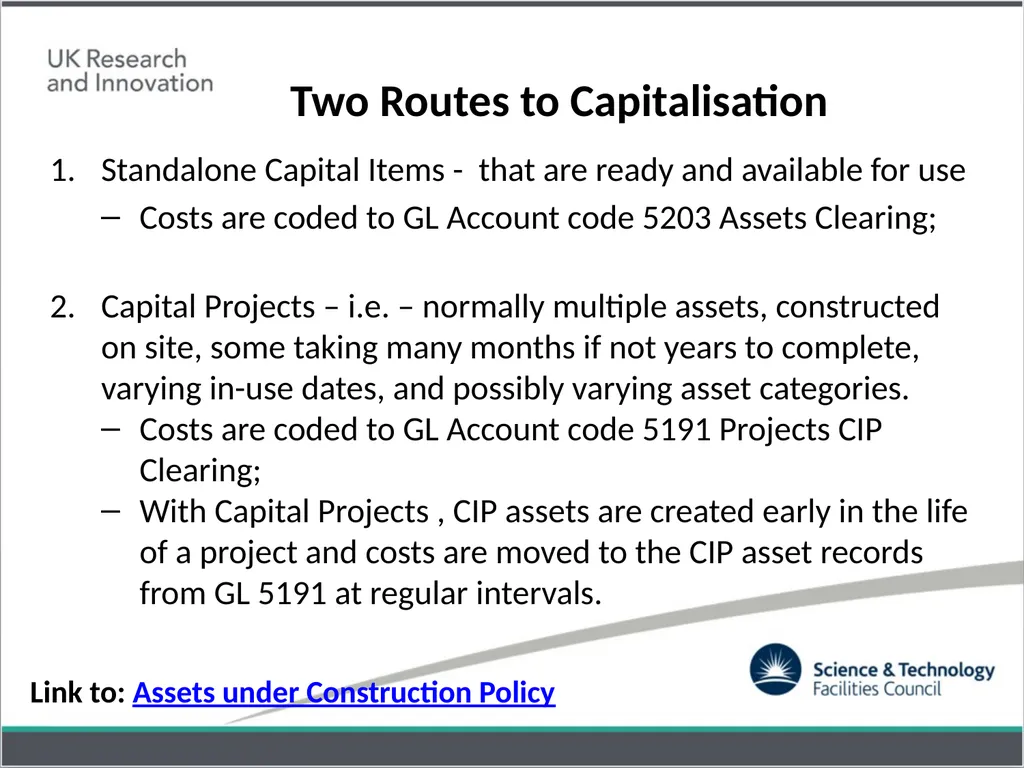
Two Routes to Capitalisation Standalone Capital Items - that are ready and available for use
Costs are coded to GL Account code 5203 Assets Clearing;
Capital Projects – i.e. – normally multiple assets, constructed on site, some taking many months if not years to complete, varying in-use dates, and possibly varying asset categories.
Costs are coded to GL Account code 5191 Projects CIP Clearing;
With Capital Projects , CIP assets are created early in the life of a project and costs are moved to the CIP asset records from GL 5191 at regular intervals. Link to: Assets under Construction Policy<br>
Costs are coded to GL Account code 5203 Assets Clearing;
Capital Projects – i.e. – normally multiple assets, constructed on site, some taking many months if not years to complete, varying in-use dates, and possibly varying asset categories.
Costs are coded to GL Account code 5191 Projects CIP Clearing;
With Capital Projects , CIP assets are created early in the life of a project and costs are moved to the CIP asset records from GL 5191 at regular intervals. Link to: Assets under Construction Policy<br>
18
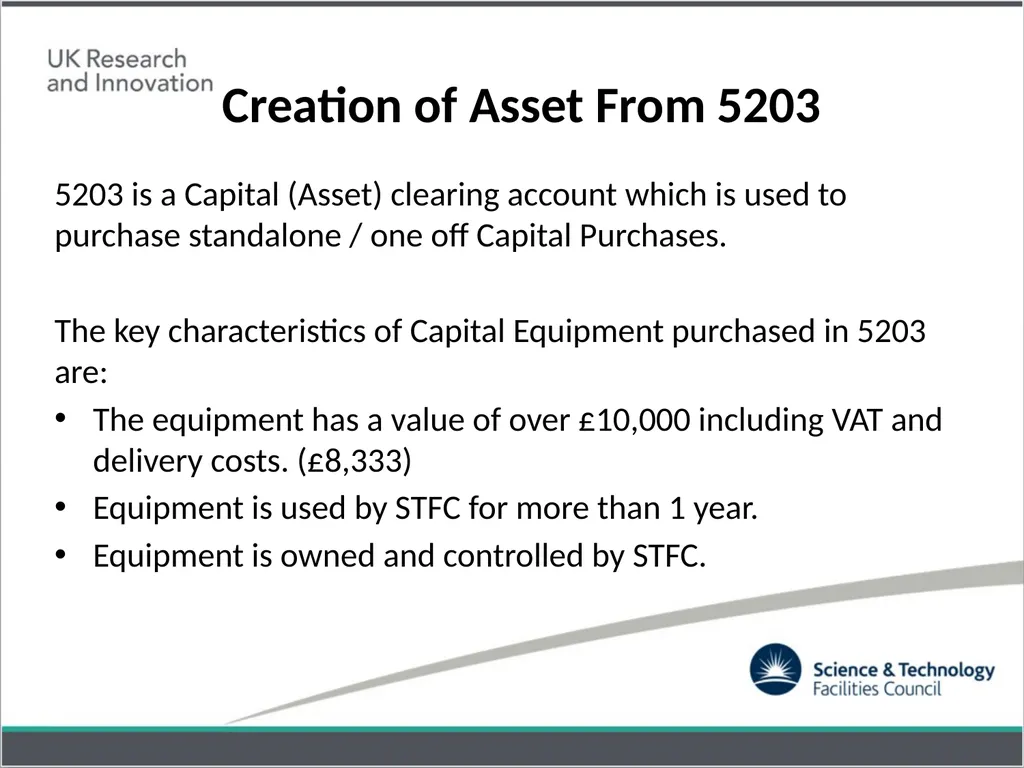
Creation of Asset From 5203 5203 is a Capital (Asset) clearing account which is used to purchase standalone / one off Capital Purchases.
The key characteristics of Capital Equipment purchased in 5203 are:
The equipment has a value of over £10,000 including VAT and delivery costs. (£8,333)
Equipment is used by STFC for more than 1 year.
Equipment is owned and controlled by STFC.<br>
The key characteristics of Capital Equipment purchased in 5203 are:
The equipment has a value of over £10,000 including VAT and delivery costs. (£8,333)
Equipment is used by STFC for more than 1 year.
Equipment is owned and controlled by STFC.<br>
19
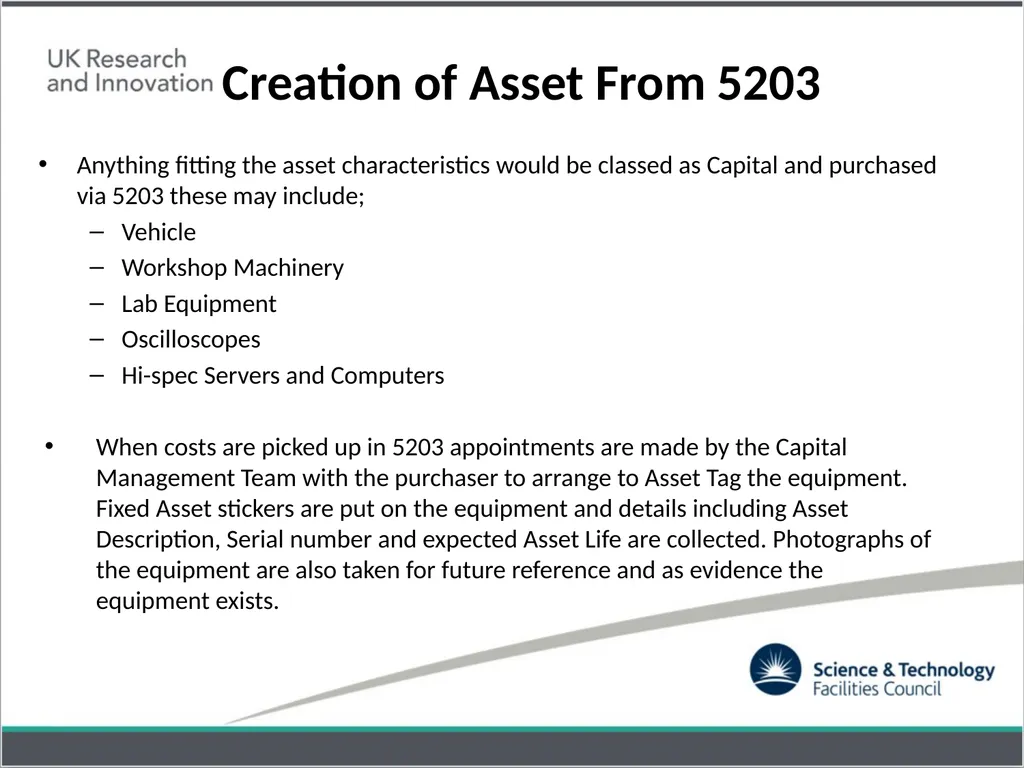
Creation of Asset From 5203 Anything fitting the asset characteristics would be classed as Capital and purchased via 5203 these may include;
Vehicle
Workshop Machinery
Lab Equipment
Oscilloscopes
Hi-spec Servers and Computers
When costs are picked up in 5203 appointments are made by the Capital Management Team with the purchaser to arrange to Asset Tag the equipment. Fixed Asset stickers are put on the equipment and details including Asset Description, Serial number and expected Asset Life are collected. Photographs of the equipment are also taken for future reference and as evidence the equipment exists.<br>
Vehicle
Workshop Machinery
Lab Equipment
Oscilloscopes
Hi-spec Servers and Computers
When costs are picked up in 5203 appointments are made by the Capital Management Team with the purchaser to arrange to Asset Tag the equipment. Fixed Asset stickers are put on the equipment and details including Asset Description, Serial number and expected Asset Life are collected. Photographs of the equipment are also taken for future reference and as evidence the equipment exists.<br>
20
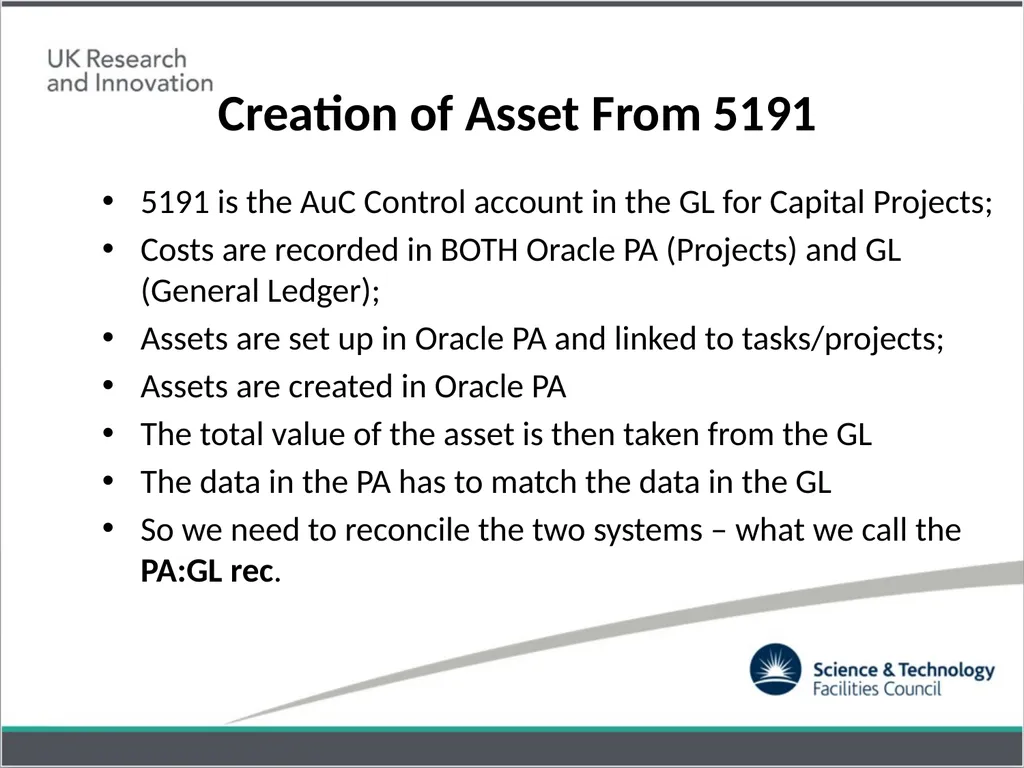
Creation of Asset From 5191 5191 is the AuC Control account in the GL for Capital Projects;
Costs are recorded in BOTH Oracle PA (Projects) and GL (General Ledger);
Assets are set up in Oracle PA and linked to tasks/projects;
Assets are created in Oracle PA
The total value of the asset is then taken from the GL
The data in the PA has to match the data in the GL
So we need to reconcile the two systems – what we call the PA:GL rec.<br>
Costs are recorded in BOTH Oracle PA (Projects) and GL (General Ledger);
Assets are set up in Oracle PA and linked to tasks/projects;
Assets are created in Oracle PA
The total value of the asset is then taken from the GL
The data in the PA has to match the data in the GL
So we need to reconcile the two systems – what we call the PA:GL rec.<br>
21
Capital Project Setup Until recently Project set-up had been driven by work-cost structures – with tasks for assembly, labour, bought-in goods and services etc…;
This type of project set-up bears no relation to the actual assets being created by the activities recorded;
Projects need to be set up with the creation of assets being a key focus from the beginning, otherwise many hours will need to be spent later on allocating costs to assets.
Oracle Fixed Assets creates ONE asset per task.
Make sure the set up is correct before you raise a PO.<br>
This type of project set-up bears no relation to the actual assets being created by the activities recorded;
Projects need to be set up with the creation of assets being a key focus from the beginning, otherwise many hours will need to be spent later on allocating costs to assets.
Oracle Fixed Assets creates ONE asset per task.
Make sure the set up is correct before you raise a PO.<br>
22
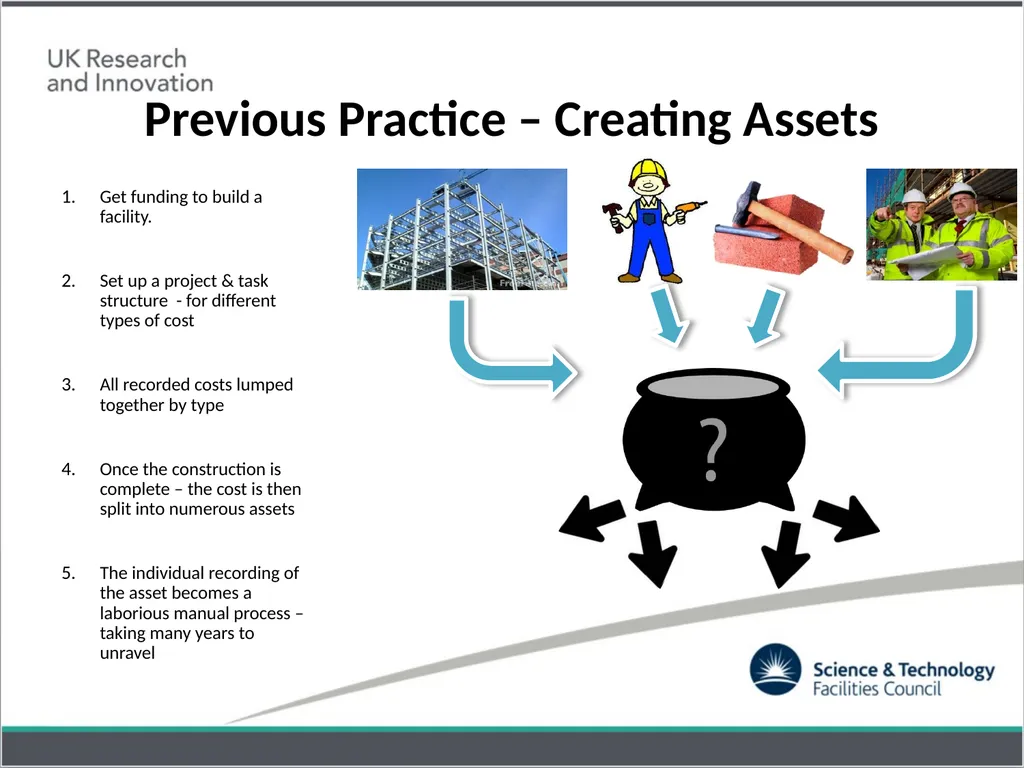
Previous Practice – Creating Assets Get funding to build a facility.
Set up a project & task structure - for different types of cost
All recorded costs lumped together by type
Once the construction is complete – the cost is then split into numerous assets
The individual recording of the asset becomes a laborious manual process – taking many years to unravel<br>
Set up a project & task structure - for different types of cost
All recorded costs lumped together by type
Once the construction is complete – the cost is then split into numerous assets
The individual recording of the asset becomes a laborious manual process – taking many years to unravel<br>
23
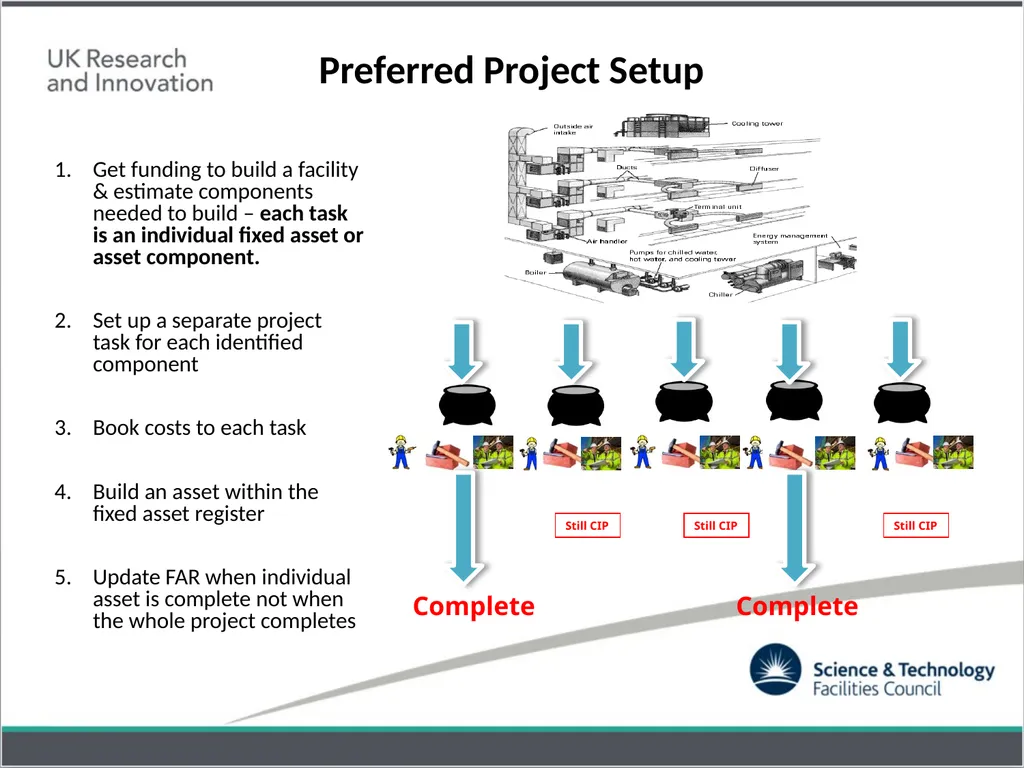
Preferred Project Setup Get funding to build a facility & estimate components needed to build – each task is an individual fixed asset or asset component.
Set up a separate project task for each identified component
Book costs to each task
Build an asset within the fixed asset register
Update FAR when individual asset is complete not when the whole project completes Complete Complete Still CIP Still CIP Still CIP<br>
Set up a separate project task for each identified component
Book costs to each task
Build an asset within the fixed asset register
Update FAR when individual asset is complete not when the whole project completes Complete Complete Still CIP Still CIP Still CIP<br>
24
Component Accounting Larger assets may have components that do not have identical useful lives, they may wear out or depreciate at different rates, or have a higher risk of impairment/obsolescence than others;
Components may also have different asset classes (e.g. Building, PM, IT) and so incur different standard depreciation rates;
Accounting Standards dictate that each component should be identified and treated separately for depreciation purposes;
When a component is replaced or restored, the old component is retired in the FAR to avoid double counting, and the new component capitalised;
This ensures that subsequent (replacement) expenditure can be classed as capital rather than expense.<br>
Components may also have different asset classes (e.g. Building, PM, IT) and so incur different standard depreciation rates;
Accounting Standards dictate that each component should be identified and treated separately for depreciation purposes;
When a component is replaced or restored, the old component is retired in the FAR to avoid double counting, and the new component capitalised;
This ensures that subsequent (replacement) expenditure can be classed as capital rather than expense.<br>
25
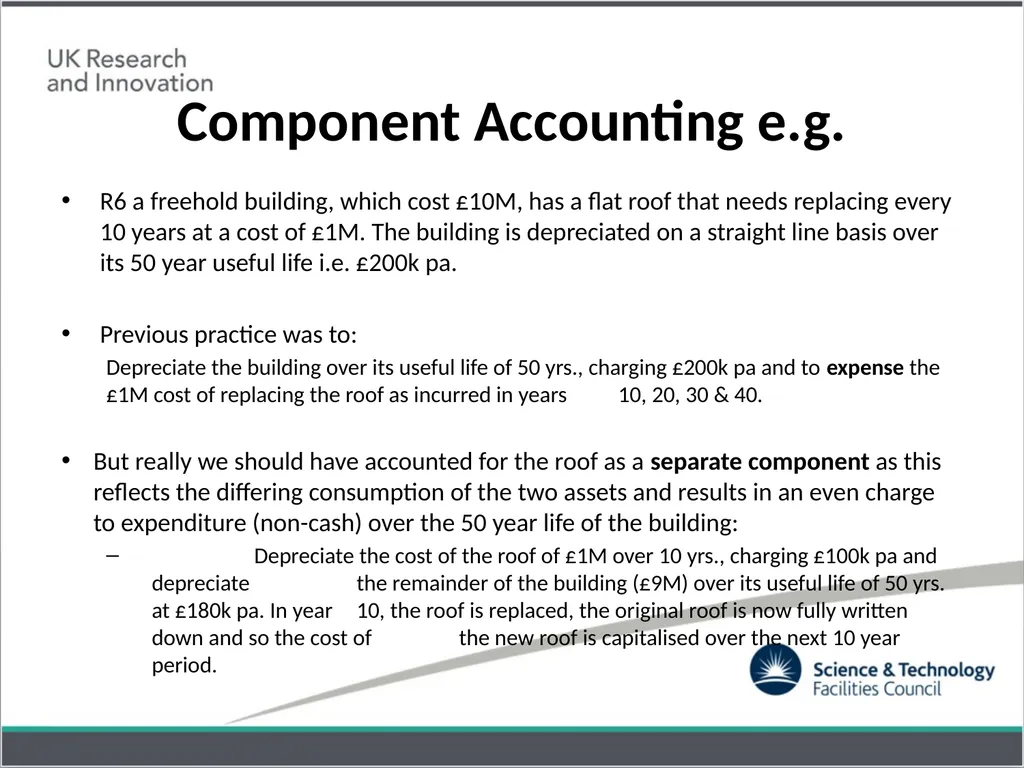
Component Accounting e.g. R6 a freehold building, which cost £10M, has a flat roof that needs replacing every 10 years at a cost of £1M. The building is depreciated on a straight line basis over its 50 year useful life i.e. £200k pa.
Previous practice was to:
Depreciate the building over its useful life of 50 yrs., charging £200k pa and to expense the £1M cost of replacing the roof as incurred in years 10, 20, 30 & 40.
But really we should have accounted for the roof as a separate component as this reflects the differing consumption of the two assets and results in an even charge to expenditure (non-cash) over the 50 year life of the building:
Depreciate the cost of the roof of £1M over 10 yrs., charging £100k pa and depreciate the remainder of the building (£9M) over its useful life of 50 yrs. at £180k pa. In year 10, the roof is replaced, the original roof is now fully written down and so the cost of the new roof is capitalised over the next 10 year period.<br>
Previous practice was to:
Depreciate the building over its useful life of 50 yrs., charging £200k pa and to expense the £1M cost of replacing the roof as incurred in years 10, 20, 30 & 40.
But really we should have accounted for the roof as a separate component as this reflects the differing consumption of the two assets and results in an even charge to expenditure (non-cash) over the 50 year life of the building:
Depreciate the cost of the roof of £1M over 10 yrs., charging £100k pa and depreciate the remainder of the building (£9M) over its useful life of 50 yrs. at £180k pa. In year 10, the roof is replaced, the original roof is now fully written down and so the cost of the new roof is capitalised over the next 10 year period.<br>
26
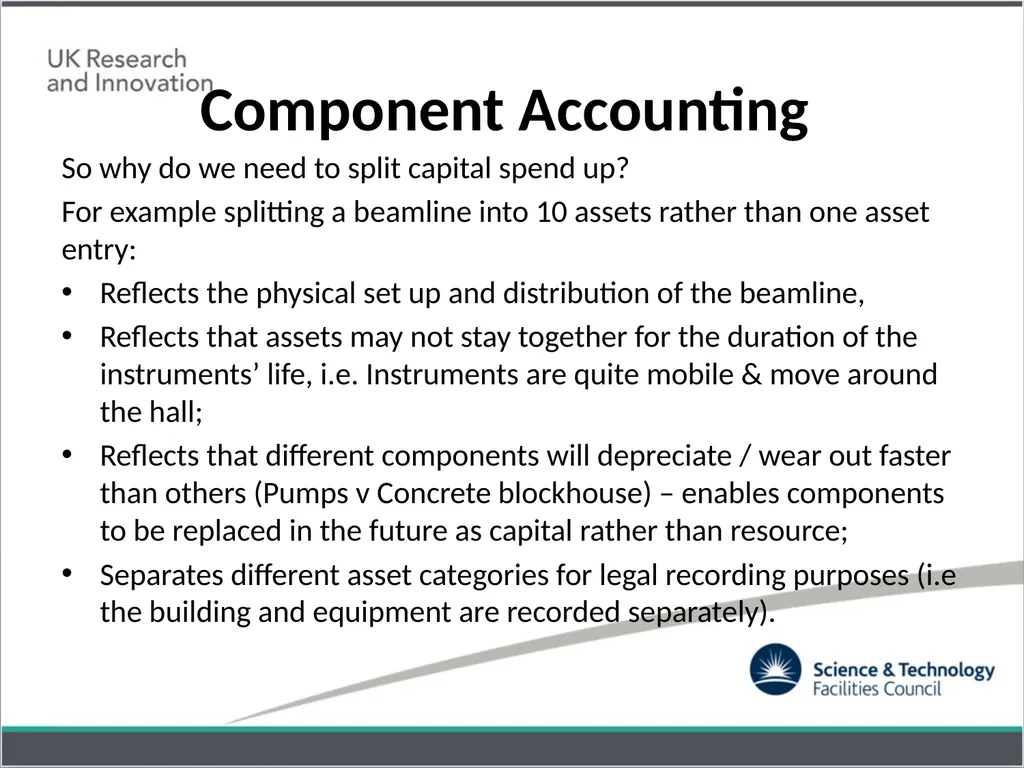
Component Accounting So why do we need to split capital spend up?
For example splitting a beamline into 10 assets rather than one asset entry:
Reflects the physical set up and distribution of the beamline,
Reflects that assets may not stay together for the duration of the instruments’ life, i.e. Instruments are quite mobile & move around the hall;
Reflects that different components will depreciate / wear out faster than others (Pumps v Concrete blockhouse) – enables components to be replaced in the future as capital rather than resource;
Separates different asset categories for legal recording purposes (i.e the building and equipment are recorded separately).<br>
For example splitting a beamline into 10 assets rather than one asset entry:
Reflects the physical set up and distribution of the beamline,
Reflects that assets may not stay together for the duration of the instruments’ life, i.e. Instruments are quite mobile & move around the hall;
Reflects that different components will depreciate / wear out faster than others (Pumps v Concrete blockhouse) – enables components to be replaced in the future as capital rather than resource;
Separates different asset categories for legal recording purposes (i.e the building and equipment are recorded separately).<br>
27
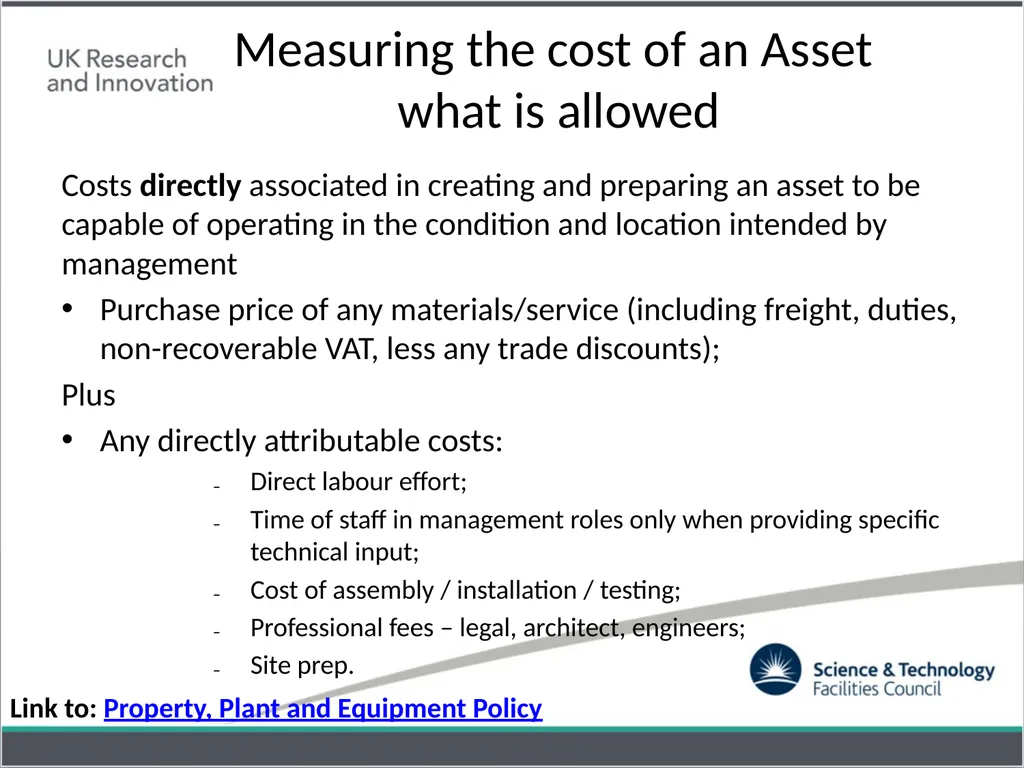
Measuring the cost of an Asset
what is allowed Costs directly associated in creating and preparing an asset to be capable of operating in the condition and location intended by management
Purchase price of any materials/service (including freight, duties, non-recoverable VAT, less any trade discounts);
Plus
Any directly attributable costs:
Direct labour effort;
Time of staff in management roles only when providing specific technical input;
Cost of assembly / installation / testing;
Professional fees – legal, architect, engineers;
Site prep. Link to: Property, Plant and Equipment Policy<br>
Purchase price of any materials/service (including freight, duties, non-recoverable VAT, less any trade discounts);
Plus
Any directly attributable costs:
Direct labour effort;
Time of staff in management roles only when providing specific technical input;
Cost of assembly / installation / testing;
Professional fees – legal, architect, engineers;
Site prep. Link to: Property, Plant and Equipment Policy<br>
28
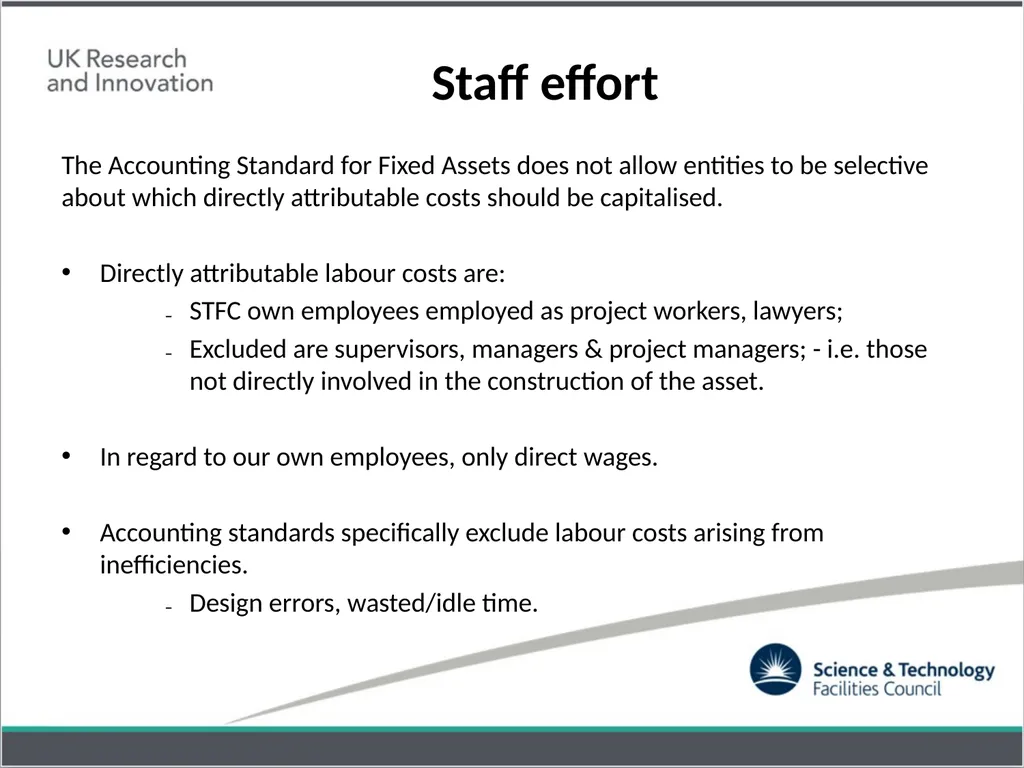
Staff effort The Accounting Standard for Fixed Assets does not allow entities to be selective about which directly attributable costs should be capitalised.
Directly attributable labour costs are:
STFC own employees employed as project workers, lawyers;
Excluded are supervisors, managers & project managers; - i.e. those not directly involved in the construction of the asset.
In regard to our own employees, only direct wages.
Accounting standards specifically exclude labour costs arising from inefficiencies.
Design errors, wasted/idle time.<br>
Directly attributable labour costs are:
STFC own employees employed as project workers, lawyers;
Excluded are supervisors, managers & project managers; - i.e. those not directly involved in the construction of the asset.
In regard to our own employees, only direct wages.
Accounting standards specifically exclude labour costs arising from inefficiencies.
Design errors, wasted/idle time.<br>
29
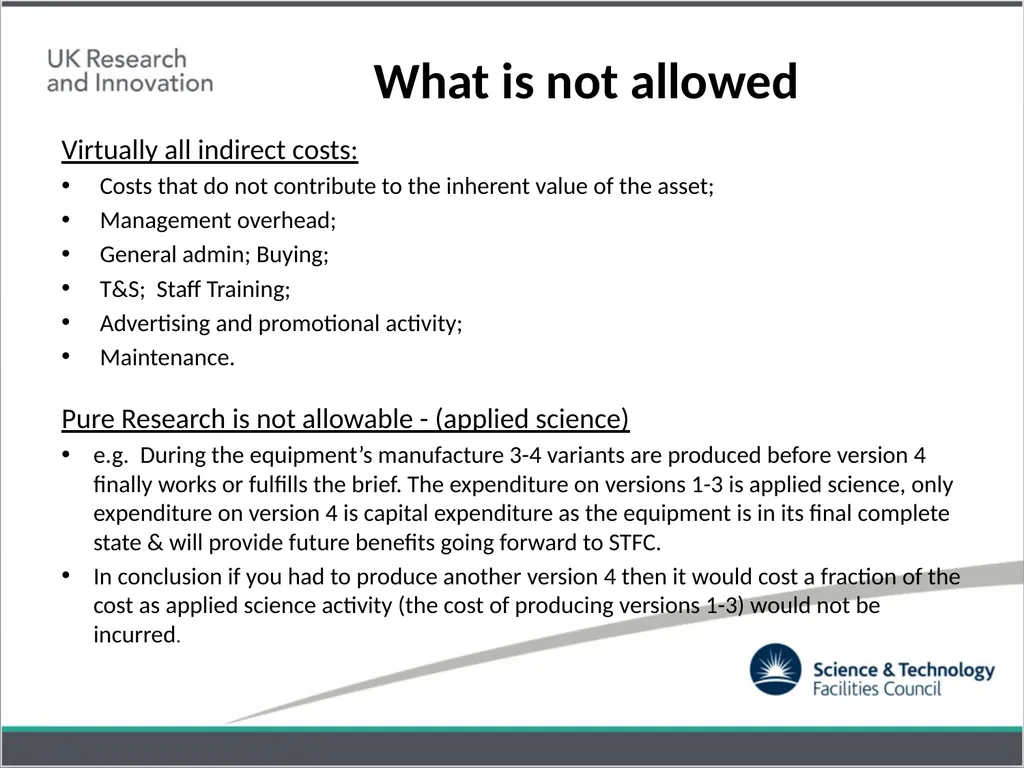
What is not allowed Virtually all indirect costs:
Costs that do not contribute to the inherent value of the asset;
Management overhead;
General admin; Buying;
T&S; Staff Training;
Advertising and promotional activity;
Maintenance.
Pure Research is not allowable - (applied science)
e.g. During the equipment’s manufacture 3-4 variants are produced before version 4 finally works or fulfills the brief. The expenditure on versions 1-3 is applied science, only expenditure on version 4 is capital expenditure as the equipment is in its final complete state & will provide future benefits going forward to STFC.
In conclusion if you had to produce another version 4 then it would cost a fraction of the cost as applied science activity (the cost of producing versions 1-3) would not be incurred.<br>
Costs that do not contribute to the inherent value of the asset;
Management overhead;
General admin; Buying;
T&S; Staff Training;
Advertising and promotional activity;
Maintenance.
Pure Research is not allowable - (applied science)
e.g. During the equipment’s manufacture 3-4 variants are produced before version 4 finally works or fulfills the brief. The expenditure on versions 1-3 is applied science, only expenditure on version 4 is capital expenditure as the equipment is in its final complete state & will provide future benefits going forward to STFC.
In conclusion if you had to produce another version 4 then it would cost a fraction of the cost as applied science activity (the cost of producing versions 1-3) would not be incurred.<br>
30
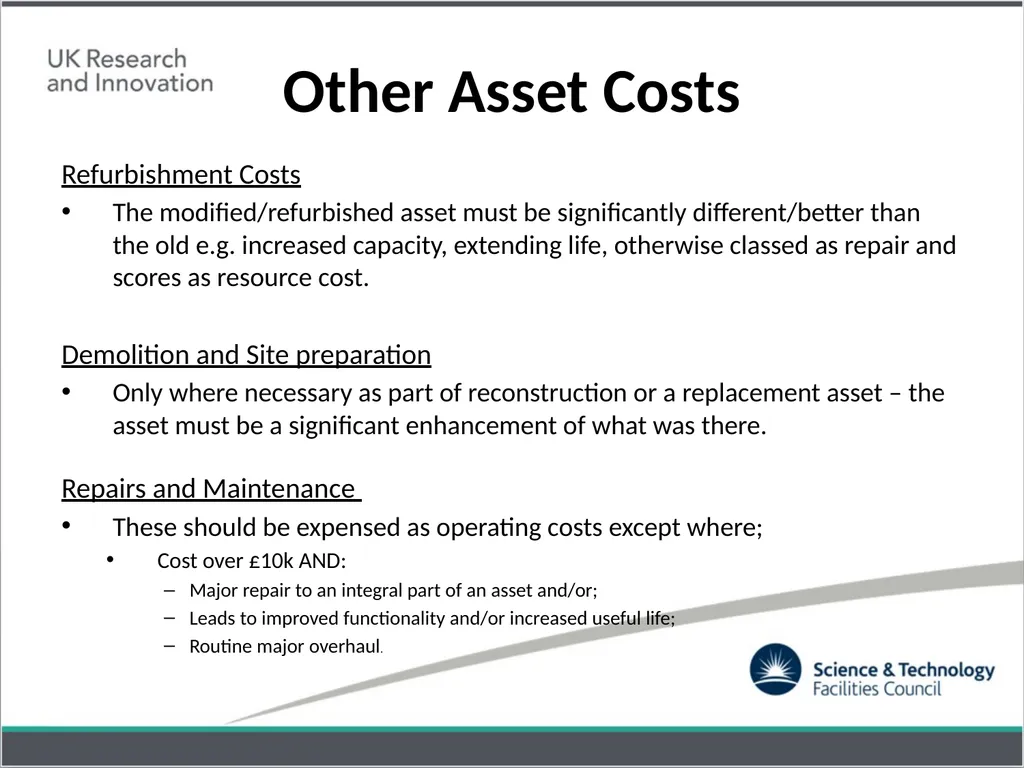
Other Asset Costs Refurbishment Costs
The modified/refurbished asset must be significantly different/better than the old e.g. increased capacity, extending life, otherwise classed as repair and scores as resource cost.
Demolition and Site preparation
Only where necessary as part of reconstruction or a replacement asset – the asset must be a significant enhancement of what was there.
Repairs and Maintenance
These should be expensed as operating costs except where;
Cost over £10k AND:
Major repair to an integral part of an asset and/or;
Leads to improved functionality and/or increased useful life;
Routine major overhaul.<br>
The modified/refurbished asset must be significantly different/better than the old e.g. increased capacity, extending life, otherwise classed as repair and scores as resource cost.
Demolition and Site preparation
Only where necessary as part of reconstruction or a replacement asset – the asset must be a significant enhancement of what was there.
Repairs and Maintenance
These should be expensed as operating costs except where;
Cost over £10k AND:
Major repair to an integral part of an asset and/or;
Leads to improved functionality and/or increased useful life;
Routine major overhaul.<br>
31
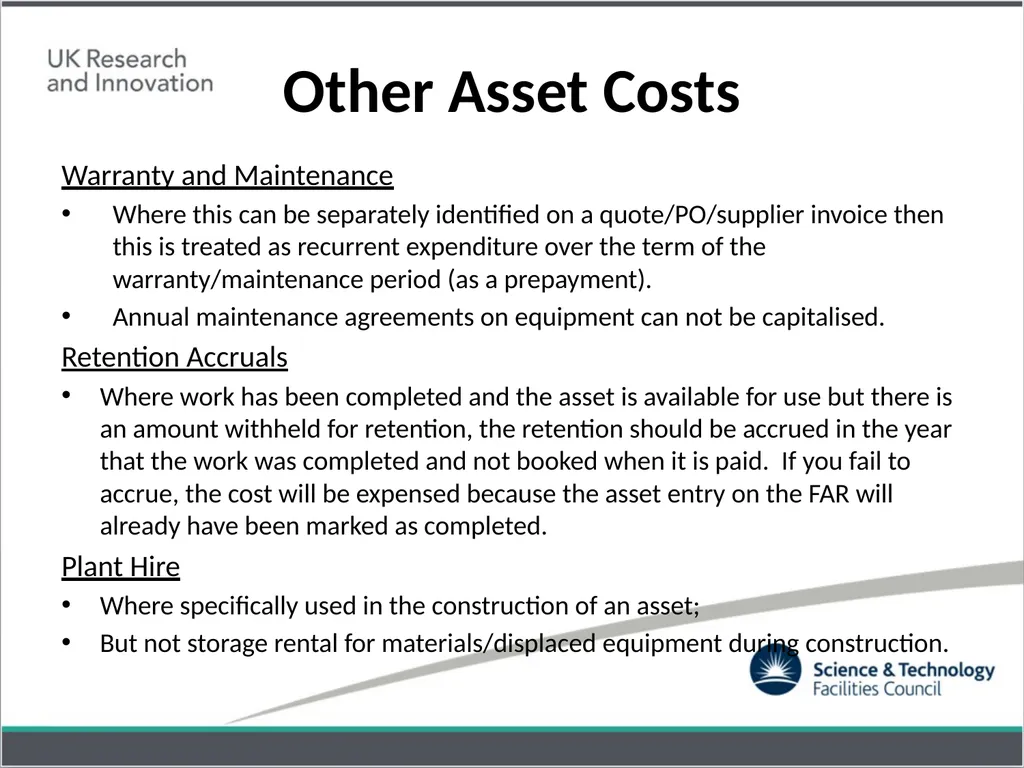
Other Asset Costs Warranty and Maintenance
Where this can be separately identified on a quote/PO/supplier invoice then this is treated as recurrent expenditure over the term of the warranty/maintenance period (as a prepayment).
Annual maintenance agreements on equipment can not be capitalised.
Retention Accruals
Where work has been completed and the asset is available for use but there is an amount withheld for retention, the retention should be accrued in the year that the work was completed and not booked when it is paid. If you fail to accrue, the cost will be expensed because the asset entry on the FAR will already have been marked as completed.
Plant Hire
Where specifically used in the construction of an asset;
But not storage rental for materials/displaced equipment during construction.<br>
Where this can be separately identified on a quote/PO/supplier invoice then this is treated as recurrent expenditure over the term of the warranty/maintenance period (as a prepayment).
Annual maintenance agreements on equipment can not be capitalised.
Retention Accruals
Where work has been completed and the asset is available for use but there is an amount withheld for retention, the retention should be accrued in the year that the work was completed and not booked when it is paid. If you fail to accrue, the cost will be expensed because the asset entry on the FAR will already have been marked as completed.
Plant Hire
Where specifically used in the construction of an asset;
But not storage rental for materials/displaced equipment during construction.<br>
32
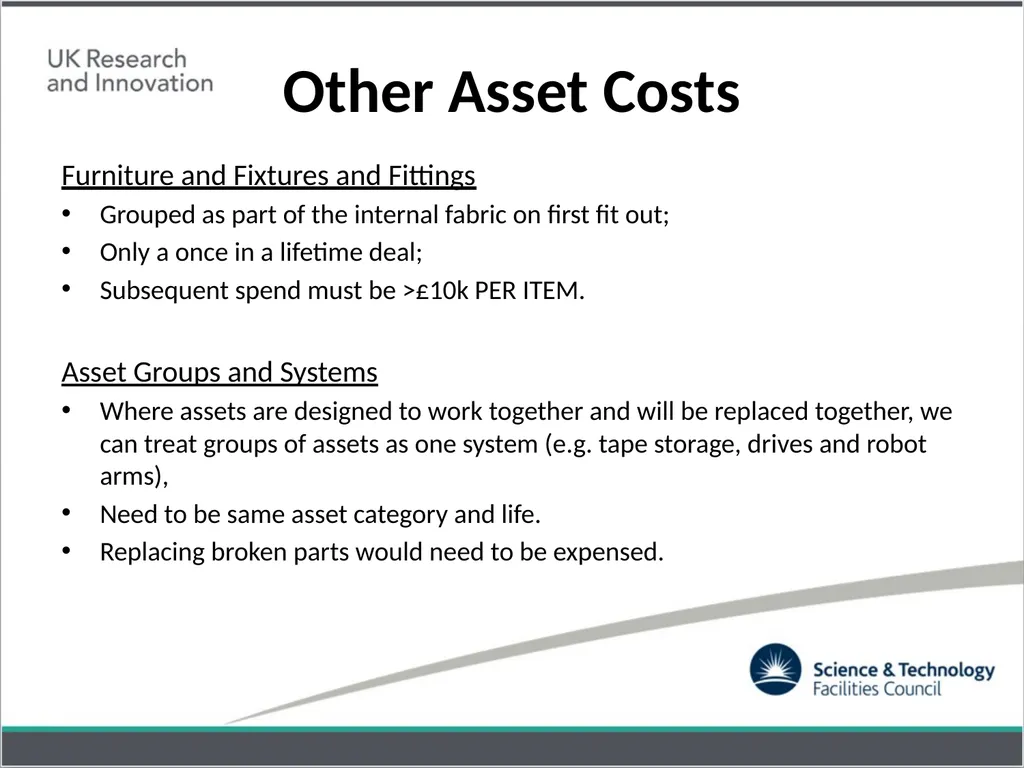
Other Asset Costs Furniture and Fixtures and Fittings
Grouped as part of the internal fabric on first fit out;
Only a once in a lifetime deal;
Subsequent spend must be >£10k PER ITEM.
Asset Groups and Systems
Where assets are designed to work together and will be replaced together, we can treat groups of assets as one system (e.g. tape storage, drives and robot arms),
Need to be same asset category and life.
Replacing broken parts would need to be expensed.<br>
Grouped as part of the internal fabric on first fit out;
Only a once in a lifetime deal;
Subsequent spend must be >£10k PER ITEM.
Asset Groups and Systems
Where assets are designed to work together and will be replaced together, we can treat groups of assets as one system (e.g. tape storage, drives and robot arms),
Need to be same asset category and life.
Replacing broken parts would need to be expensed.<br>
33
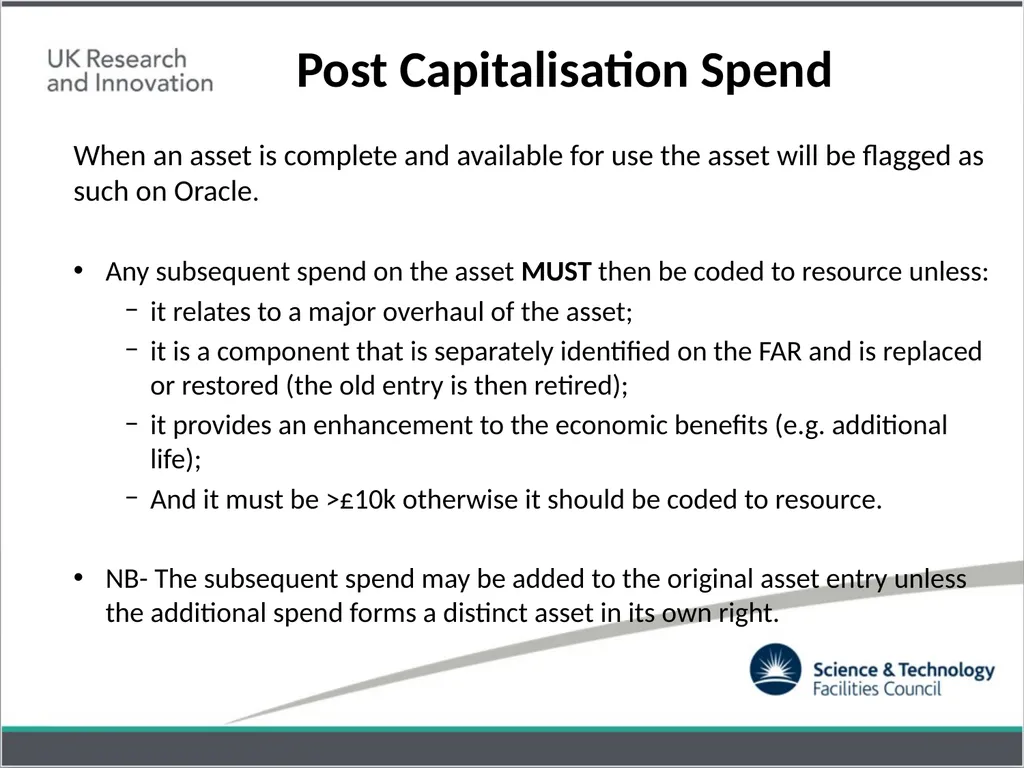
Post Capitalisation Spend When an asset is complete and available for use the asset will be flagged as such on Oracle.
Any subsequent spend on the asset MUST then be coded to resource unless:
it relates to a major overhaul of the asset;
it is a component that is separately identified on the FAR and is replaced or restored (the old entry is then retired);
it provides an enhancement to the economic benefits (e.g. additional life);
And it must be >£10k otherwise it should be coded to resource.
NB- The subsequent spend may be added to the original asset entry unless the additional spend forms a distinct asset in its own right.<br>
Any subsequent spend on the asset MUST then be coded to resource unless:
it relates to a major overhaul of the asset;
it is a component that is separately identified on the FAR and is replaced or restored (the old entry is then retired);
it provides an enhancement to the economic benefits (e.g. additional life);
And it must be >£10k otherwise it should be coded to resource.
NB- The subsequent spend may be added to the original asset entry unless the additional spend forms a distinct asset in its own right.<br>
34
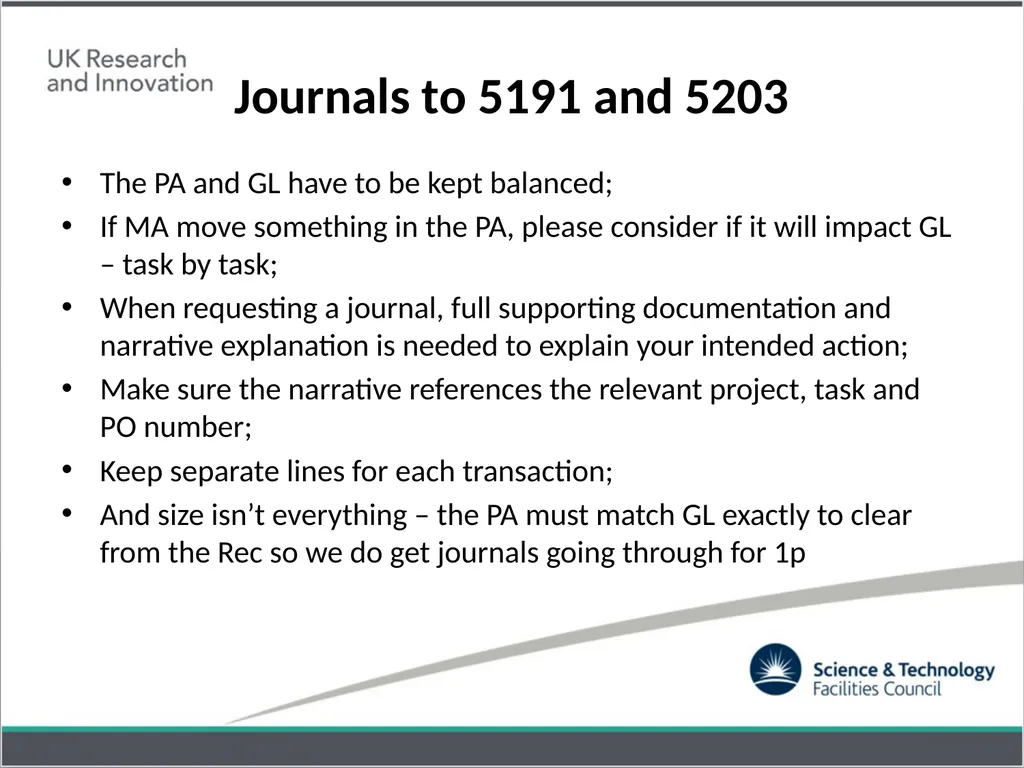
Journals to 5191 and 5203 The PA and GL have to be kept balanced;
If MA move something in the PA, please consider if it will impact GL – task by task;
When requesting a journal, full supporting documentation and narrative explanation is needed to explain your intended action;
Make sure the narrative references the relevant project, task and PO number;
Keep separate lines for each transaction;
And size isn’t everything – the PA must match GL exactly to clear from the Rec so we do get journals going through for 1p<br>
If MA move something in the PA, please consider if it will impact GL – task by task;
When requesting a journal, full supporting documentation and narrative explanation is needed to explain your intended action;
Make sure the narrative references the relevant project, task and PO number;
Keep separate lines for each transaction;
And size isn’t everything – the PA must match GL exactly to clear from the Rec so we do get journals going through for 1p<br>
35
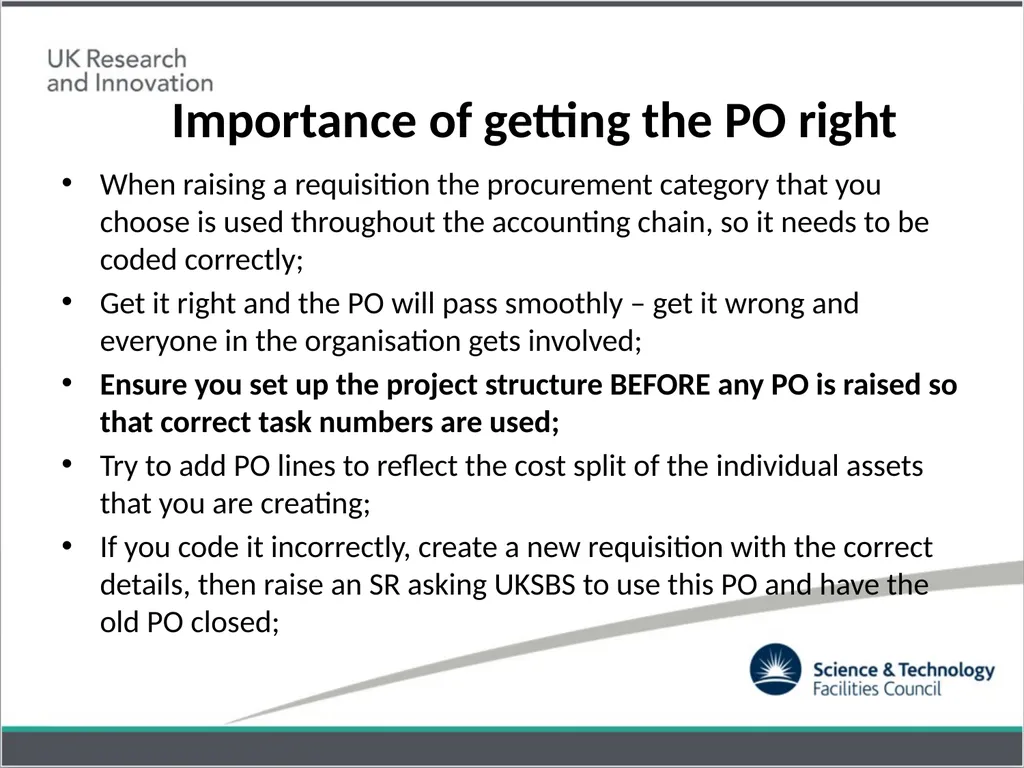
When raising a requisition the procurement category that you choose is used throughout the accounting chain, so it needs to be coded correctly;
Get it right and the PO will pass smoothly – get it wrong and everyone in the organisation gets involved;
Ensure you set up the project structure BEFORE any PO is raised so that correct task numbers are used;
Try to add PO lines to reflect the cost split of the individual assets that you are creating;
If you code it incorrectly, create a new requisition with the correct details, then raise an SR asking UKSBS to use this PO and have the old PO closed; Importance of getting the PO right<br>
Get it right and the PO will pass smoothly – get it wrong and everyone in the organisation gets involved;
Ensure you set up the project structure BEFORE any PO is raised so that correct task numbers are used;
Try to add PO lines to reflect the cost split of the individual assets that you are creating;
If you code it incorrectly, create a new requisition with the correct details, then raise an SR asking UKSBS to use this PO and have the old PO closed; Importance of getting the PO right<br>
36
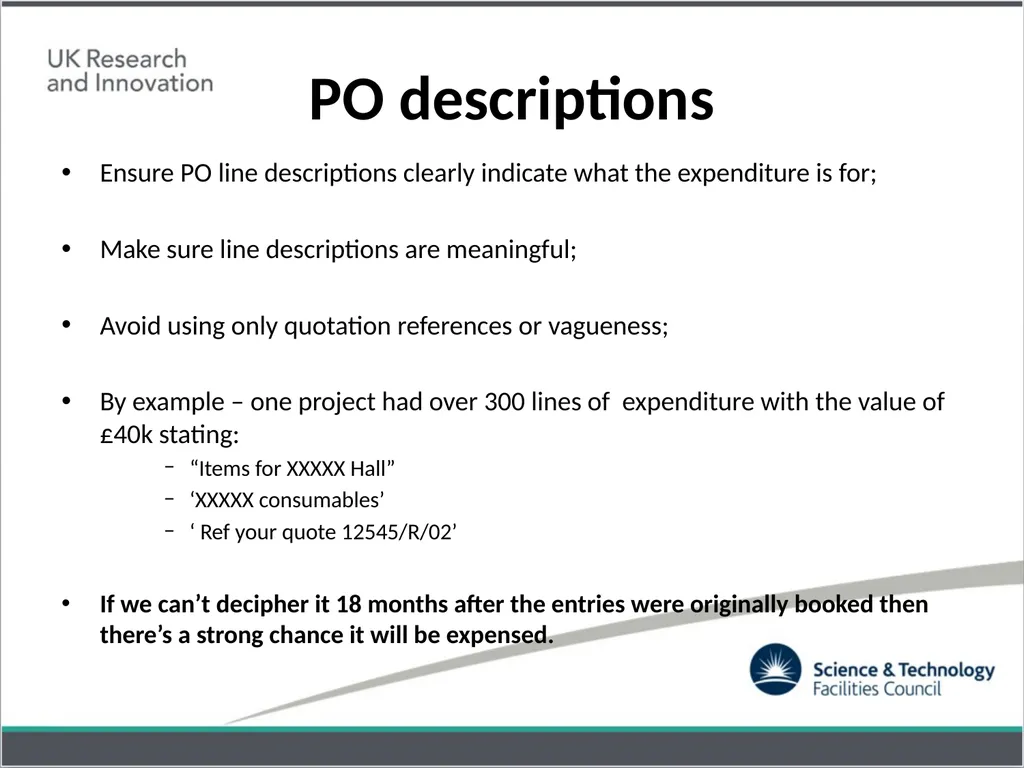
PO descriptions Ensure PO line descriptions clearly indicate what the expenditure is for;
Make sure line descriptions are meaningful;
Avoid using only quotation references or vagueness;
By example – one project had over 300 lines of expenditure with the value of £40k stating:
“Items for XXXXX Hall”
‘XXXXX consumables’
‘ Ref your quote 12545/R/02’
If we can’t decipher it 18 months after the entries were originally booked then there’s a strong chance it will be expensed.<br>
Make sure line descriptions are meaningful;
Avoid using only quotation references or vagueness;
By example – one project had over 300 lines of expenditure with the value of £40k stating:
“Items for XXXXX Hall”
‘XXXXX consumables’
‘ Ref your quote 12545/R/02’
If we can’t decipher it 18 months after the entries were originally booked then there’s a strong chance it will be expensed.<br>
37
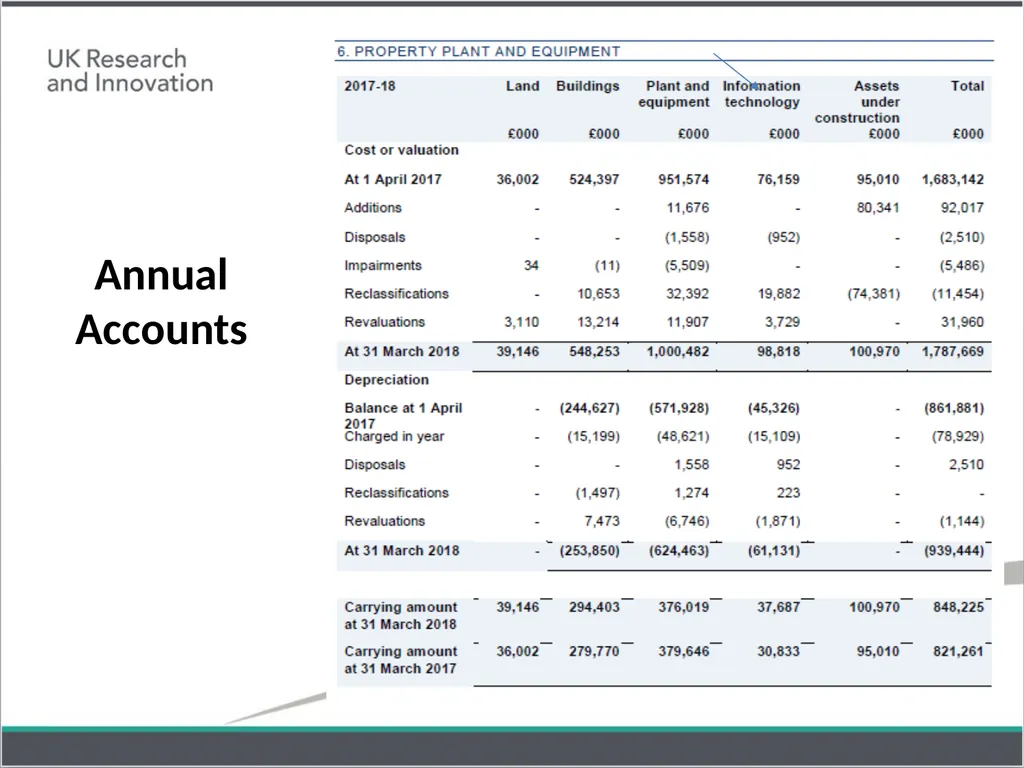
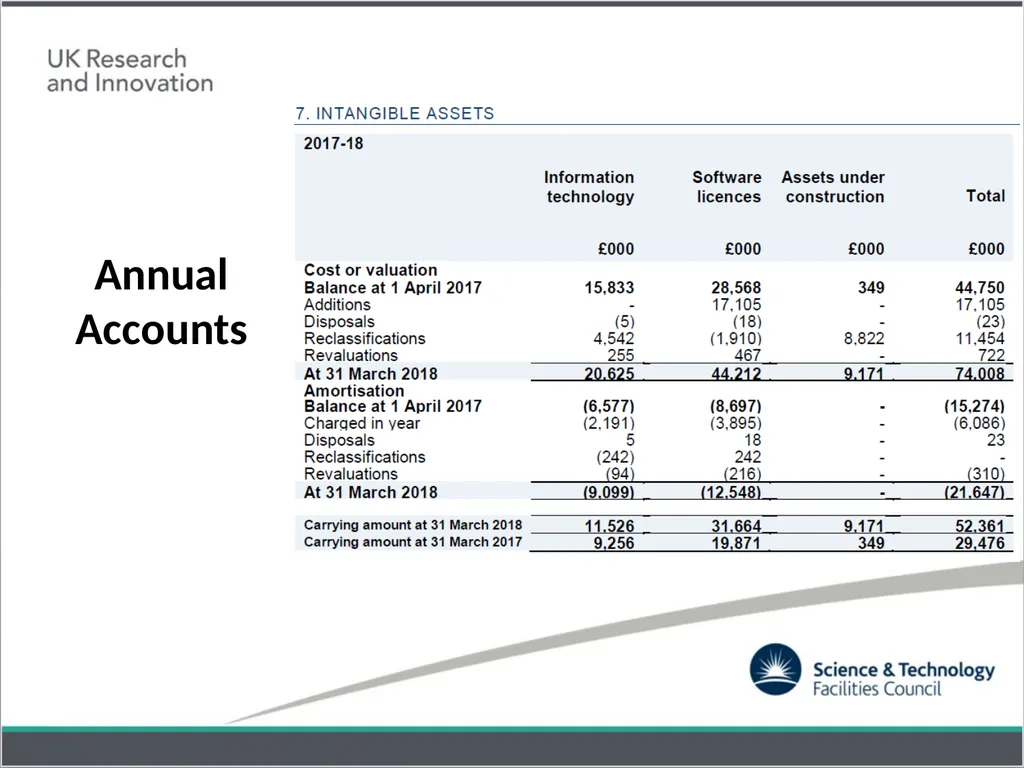
Annual Accounts<br>
38
Annual Accounts<br>
39
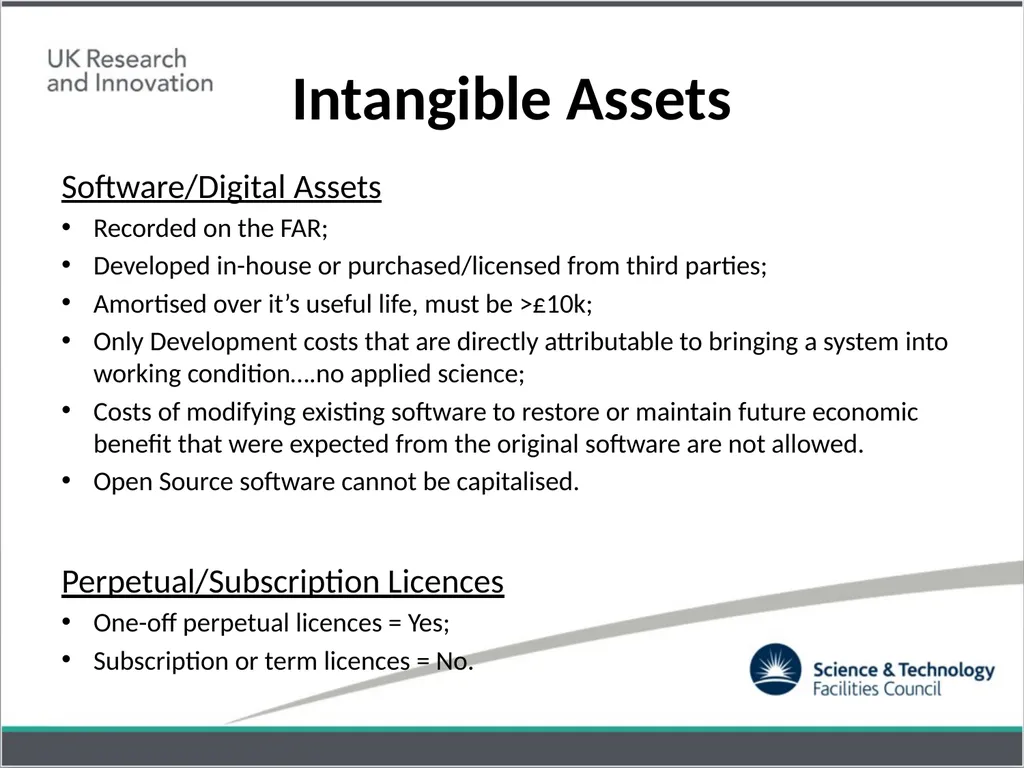
Intangible Assets Software/Digital Assets
Recorded on the FAR;
Developed in-house or purchased/licensed from third parties;
Amortised over it’s useful life, must be >£10k;
Only Development costs that are directly attributable to bringing a system into working condition….no applied science;
Costs of modifying existing software to restore or maintain future economic benefit that were expected from the original software are not allowed.
Open Source software cannot be capitalised.
Perpetual/Subscription Licences
One-off perpetual licences = Yes;
Subscription or term licences = No.<br>
Recorded on the FAR;
Developed in-house or purchased/licensed from third parties;
Amortised over it’s useful life, must be >£10k;
Only Development costs that are directly attributable to bringing a system into working condition….no applied science;
Costs of modifying existing software to restore or maintain future economic benefit that were expected from the original software are not allowed.
Open Source software cannot be capitalised.
Perpetual/Subscription Licences
One-off perpetual licences = Yes;
Subscription or term licences = No.<br>
40
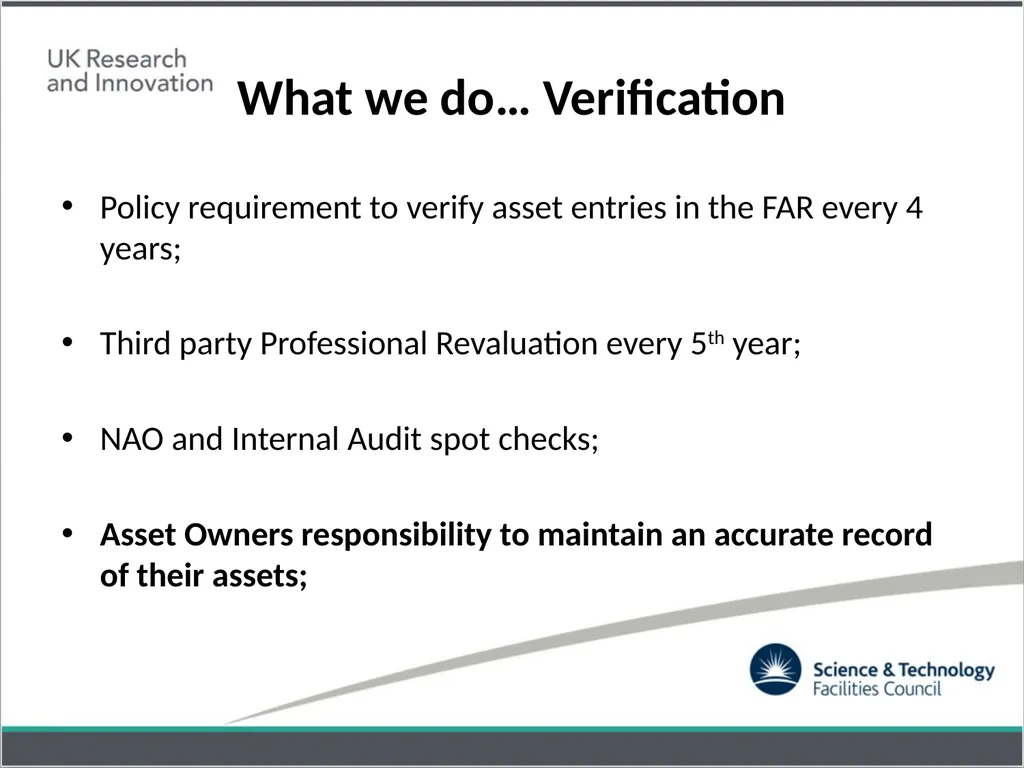
What we do… Verification Policy requirement to verify asset entries in the FAR every 4 years;
Third party Professional Revaluation every 5th year;
NAO and Internal Audit spot checks;
Asset Owners responsibility to maintain an accurate record of their assets;<br>
Third party Professional Revaluation every 5th year;
NAO and Internal Audit spot checks;
Asset Owners responsibility to maintain an accurate record of their assets;<br>
41
Asset Owner Self-Validation Exercise New Self-validation exercise for Asset Owners to review their complete Asset List.
Asset Owner should confirm that all Assets are in good working order and that all the information held is correct.
Any incorrect information is updated in the FAR.<br>
Asset Owner should confirm that all Assets are in good working order and that all the information held is correct.
Any incorrect information is updated in the FAR.<br>
42
Asset Lives Asset Owners responsibility to provide a fair estimate of how long an asset will continue to be in use for (or otherwise);
Send out requests when assets are nearing the end of their stated useful life;
Asset record changed to reflect this action.<br>
Send out requests when assets are nearing the end of their stated useful life;
Asset record changed to reflect this action.<br>
43
Impairment Review Assets should be held at their recoverable (fair) value;
Rolling programme of reviewing asset values every 3 years;
Professional Revaluation exercise every 5th year;
Where the asset value is lower than its book value on the FAR then the asset should be “impaired”;
Asset Owners responsibility to notify where the conditions of possible asset impairment exist.<br>
Rolling programme of reviewing asset values every 3 years;
Professional Revaluation exercise every 5th year;
Where the asset value is lower than its book value on the FAR then the asset should be “impaired”;
Asset Owners responsibility to notify where the conditions of possible asset impairment exist.<br>
44
When to Impair Evidence of physical damage,
Changes in legal or environmental factors e.g. equipment contaminated by radiation,
Technological change or obsolescence,
Changes in the manner or duration of use e.g. the mothballing of an instrument prior to the end of its useful life because of a lack of funding,
The purpose for which the asset or construction of an asset is no longer carried out and there is no alternative use for the asset.<br>
Changes in legal or environmental factors e.g. equipment contaminated by radiation,
Technological change or obsolescence,
Changes in the manner or duration of use e.g. the mothballing of an instrument prior to the end of its useful life because of a lack of funding,
The purpose for which the asset or construction of an asset is no longer carried out and there is no alternative use for the asset.<br>
45
Other things to consider Impairment can be reversed/part reversed;
Or impaired further;
Any impairments need the approval of Head of Finance;
A reduction in the useful life of an asset is a form of impairment.<br>
Or impaired further;
Any impairments need the approval of Head of Finance;
A reduction in the useful life of an asset is a form of impairment.<br>
46
What we do…Revaluation Under International Accounting Standards we hold our Fixed Assets at a revalued amount, not the original cost;
Annual indexation of asset values is carried out on certain classes of assets;
Third party Professional Revaluation every 5th year;
Asset Owner’s co-operation is appreciated in the Professional revaluation exercise.<br>
Annual indexation of asset values is carried out on certain classes of assets;
Third party Professional Revaluation every 5th year;
Asset Owner’s co-operation is appreciated in the Professional revaluation exercise.<br>
47
Disposal of Fixed Asset Prompt Notification from Asset Owner;
Asset disposal form;
Line Manager approval;
STFCFIXEDASSETS@stfc.ac.uk
If Asset has zero value and Line Managers approval to scrap asset has been given, then it can be disposed of via Logistics once Capital Management Team have approved disposal.<br>
Asset disposal form;
Line Manager approval;
STFCFIXEDASSETS@stfc.ac.uk
If Asset has zero value and Line Managers approval to scrap asset has been given, then it can be disposed of via Logistics once Capital Management Team have approved disposal.<br>
48
Disposing of Asset with Value Approved by Head of Finance or UKRI and BEIS.
Review budgetary impact with Management Accountant.
Request disposal.
Business case Signed off by Head of department (depending on value),
Was the asset given a realistic life,
Once Asset life reduced and Line Managers approval to scrap given then asset can be disposed of via Logistics once Capital Management Team have approved disposal.
If Asset is damaged beyond economical repair or is no longer fit for purpose and become obsolete then the value should be impaired to zero before disposal.<br>
Review budgetary impact with Management Accountant.
Request disposal.
Business case Signed off by Head of department (depending on value),
Was the asset given a realistic life,
Once Asset life reduced and Line Managers approval to scrap given then asset can be disposed of via Logistics once Capital Management Team have approved disposal.
If Asset is damaged beyond economical repair or is no longer fit for purpose and become obsolete then the value should be impaired to zero before disposal.<br>
49
Loan of Fixed Asset If an Asset is going to be loaned to another organisation the following action should be taken:
Inform Capital Management Team;
Capital Management Team to verify asset;
Asset Owner should contact Legal and Commercial Team to arrange for a Loan Agreement to be drawn up;
Once contract in place Asset can be loaned, a copy of the Loan Agreement needs to be sent to the Capital Management Team and the Asset Register is updated to give details of where the equipment is loaned to.
Asset Owner should inform Capital Management Team when equipment has left site and is in the custody of the organisation equipment is loaned to.
Each year the Asset Owner will be required to confirm that the Asset is in good working order with no damage, photographs may be requested.
Once loan period is complete and equipment returned to STFC Asset Owner should inform Capital Management Team who will updated the Asset Register.<br>
Inform Capital Management Team;
Capital Management Team to verify asset;
Asset Owner should contact Legal and Commercial Team to arrange for a Loan Agreement to be drawn up;
Once contract in place Asset can be loaned, a copy of the Loan Agreement needs to be sent to the Capital Management Team and the Asset Register is updated to give details of where the equipment is loaned to.
Asset Owner should inform Capital Management Team when equipment has left site and is in the custody of the organisation equipment is loaned to.
Each year the Asset Owner will be required to confirm that the Asset is in good working order with no damage, photographs may be requested.
Once loan period is complete and equipment returned to STFC Asset Owner should inform Capital Management Team who will updated the Asset Register.<br>
50
The Budgetary Impact of Disposals Disposals of assets have a budgetary impact on Resource, Capital and Non-cash budgets and so the course of action to be followed needs careful consideration and approval where the value is material.
Where an asset has a NBV and there will be a significant Gain or Loss on disposal, the Impact will need to be considered by the department and a case should be submitted to STFC Head of Finance.
Please discuss possible large disposals with your Management Accountant at a very early stage in the planning.
There is a guidance note available in the FA intranet page.<br>
Where an asset has a NBV and there will be a significant Gain or Loss on disposal, the Impact will need to be considered by the department and a case should be submitted to STFC Head of Finance.
Please discuss possible large disposals with your Management Accountant at a very early stage in the planning.
There is a guidance note available in the FA intranet page.<br>
51
Other Disposal considerations Delegated authority,
Use of Asset parts elsewhere;
Asset Transfers,
Receiving a donated asset >£10k.
When replacing an asset, the old asset need to be retired from the FAR.
Sale / Trade in,
Proceeds of sale.<br>
Use of Asset parts elsewhere;
Asset Transfers,
Receiving a donated asset >£10k.
When replacing an asset, the old asset need to be retired from the FAR.
Sale / Trade in,
Proceeds of sale.<br>
52
Summary Capital spend does not always mean it will be a ‘Fixed Asset’;
>£10,000 Inc VAT
Importance of PO coding;
Importance of Project / Task structures;
Narratives on Journals, PO’s, GPC;
We expect data to be cleansed of non-capital costs;
Maintaining capacity = Resource;
Increasing capacity = Capital;<br>
>£10,000 Inc VAT
Importance of PO coding;
Importance of Project / Task structures;
Narratives on Journals, PO’s, GPC;
We expect data to be cleansed of non-capital costs;
Maintaining capacity = Resource;
Increasing capacity = Capital;<br>
53
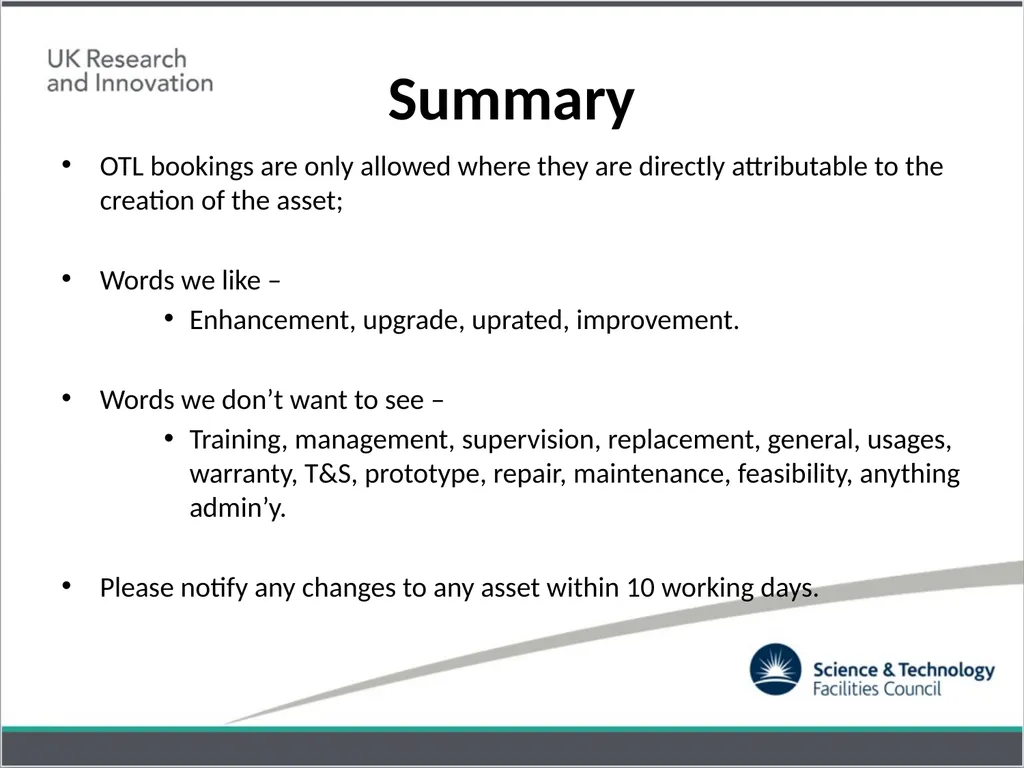
Summary OTL bookings are only allowed where they are directly attributable to the creation of the asset;
Words we like –
Enhancement, upgrade, uprated, improvement.
Words we don’t want to see –
Training, management, supervision, replacement, general, usages, warranty, T&S, prototype, repair, maintenance, feasibility, anything admin’y.
Please notify any changes to any asset within 10 working days.<br>
Words we like –
Enhancement, upgrade, uprated, improvement.
Words we don’t want to see –
Training, management, supervision, replacement, general, usages, warranty, T&S, prototype, repair, maintenance, feasibility, anything admin’y.
Please notify any changes to any asset within 10 working days.<br>
54
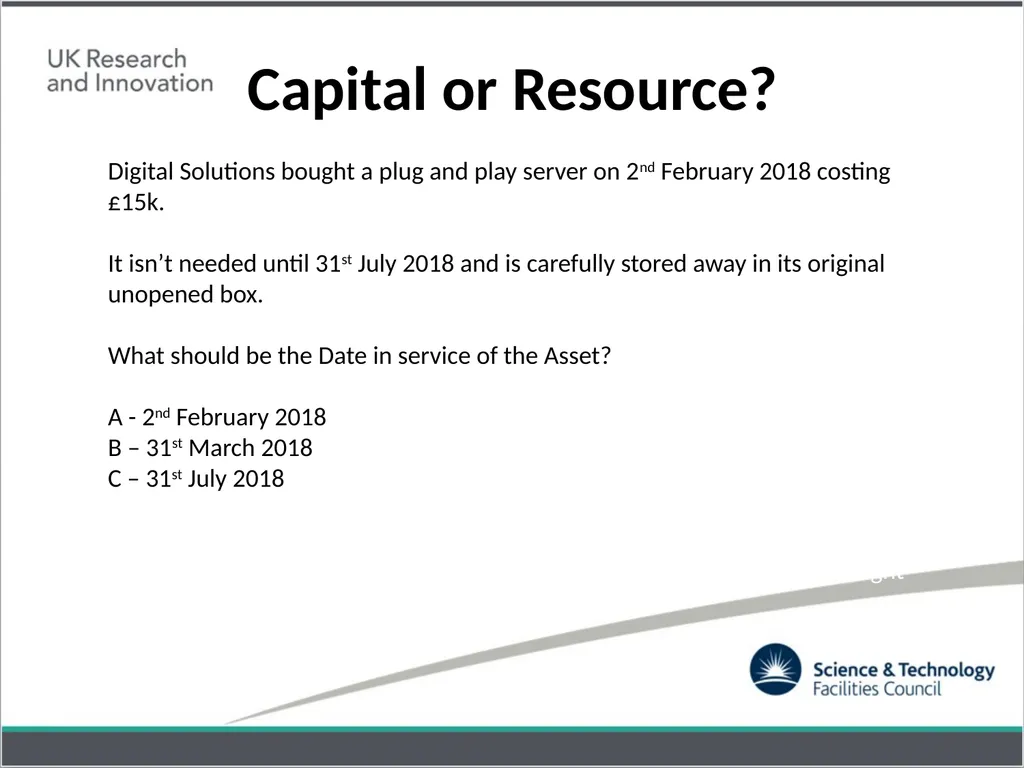
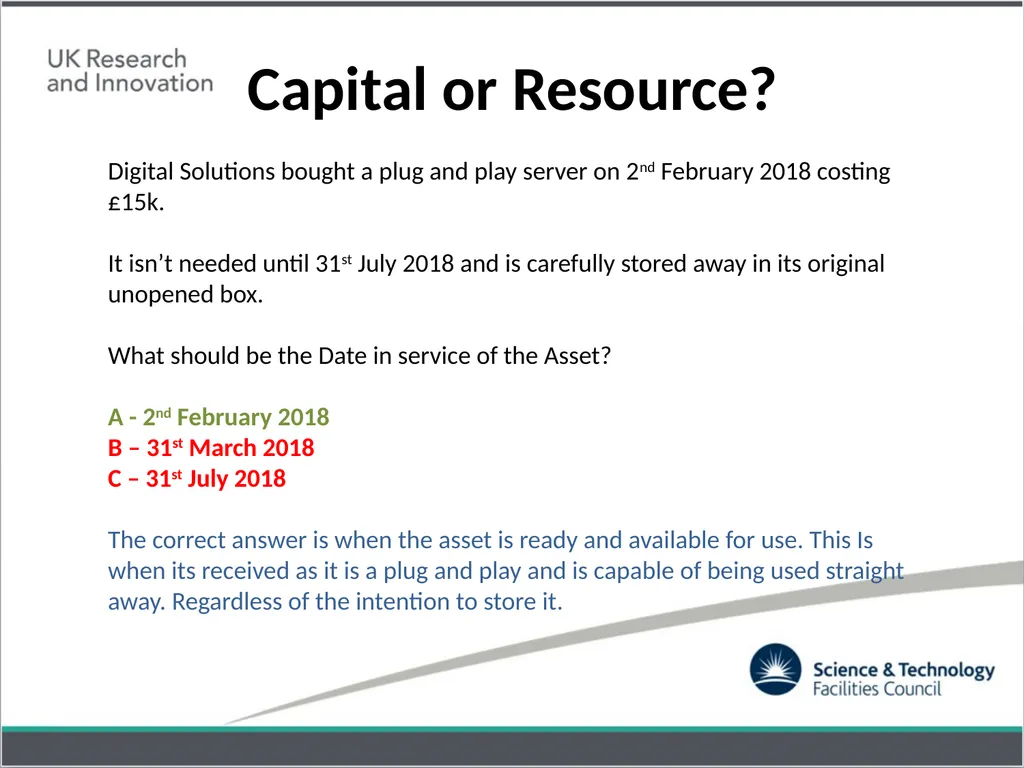
Capital or Resource? Digital Solutions bought a plug and play server on 2nd February 2018 costing £15k.
It isn’t needed until 31st July 2018 and is carefully stored away in its original unopened box.
What should be the Date in service of the Asset?
A - 2nd February 2018
B – 31st March 2018
C – 31st July 2018
The correct answer is when the asset is ready and available for use. This Is when its received as it is a plug and play and is capable of being used straight away. Regardless of the intention to store it.<br>
It isn’t needed until 31st July 2018 and is carefully stored away in its original unopened box.
What should be the Date in service of the Asset?
A - 2nd February 2018
B – 31st March 2018
C – 31st July 2018
The correct answer is when the asset is ready and available for use. This Is when its received as it is a plug and play and is capable of being used straight away. Regardless of the intention to store it.<br>
55
Capital or Resource? Digital Solutions bought a plug and play server on 2nd February 2018 costing £15k.
It isn’t needed until 31st July 2018 and is carefully stored away in its original unopened box.
What should be the Date in service of the Asset?
A - 2nd February 2018
B – 31st March 2018
C – 31st July 2018
The correct answer is when the asset is ready and available for use. This Is when its received as it is a plug and play and is capable of being used straight away. Regardless of the intention to store it.<br>
It isn’t needed until 31st July 2018 and is carefully stored away in its original unopened box.
What should be the Date in service of the Asset?
A - 2nd February 2018
B – 31st March 2018
C – 31st July 2018
The correct answer is when the asset is ready and available for use. This Is when its received as it is a plug and play and is capable of being used straight away. Regardless of the intention to store it.<br>
56
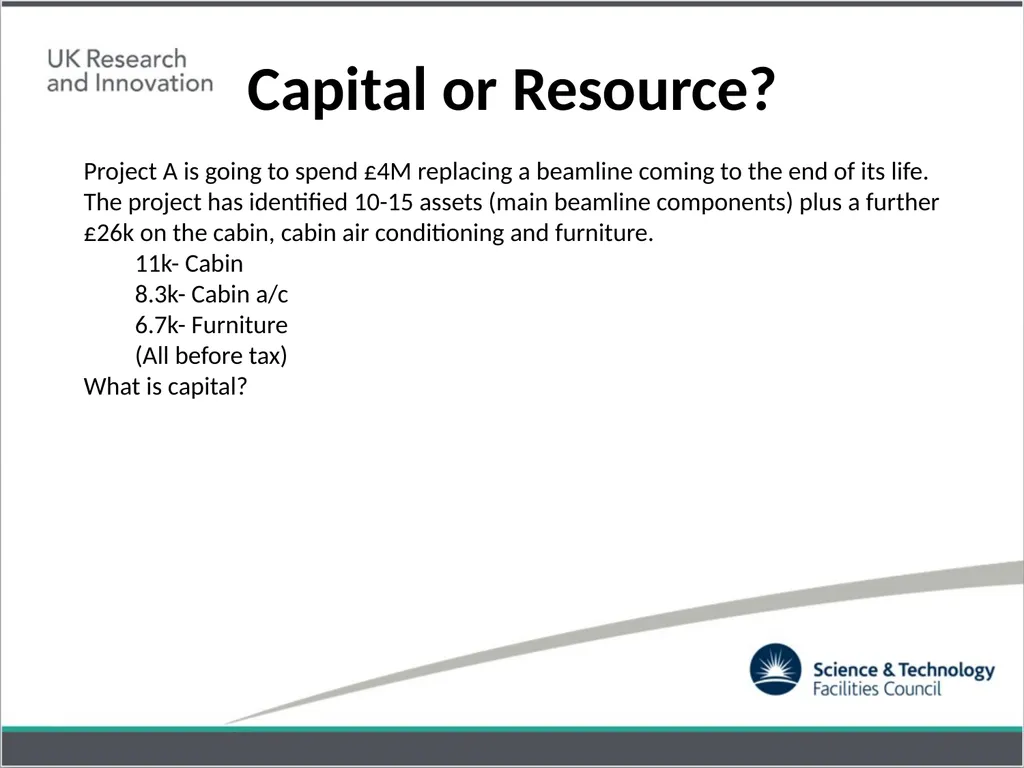
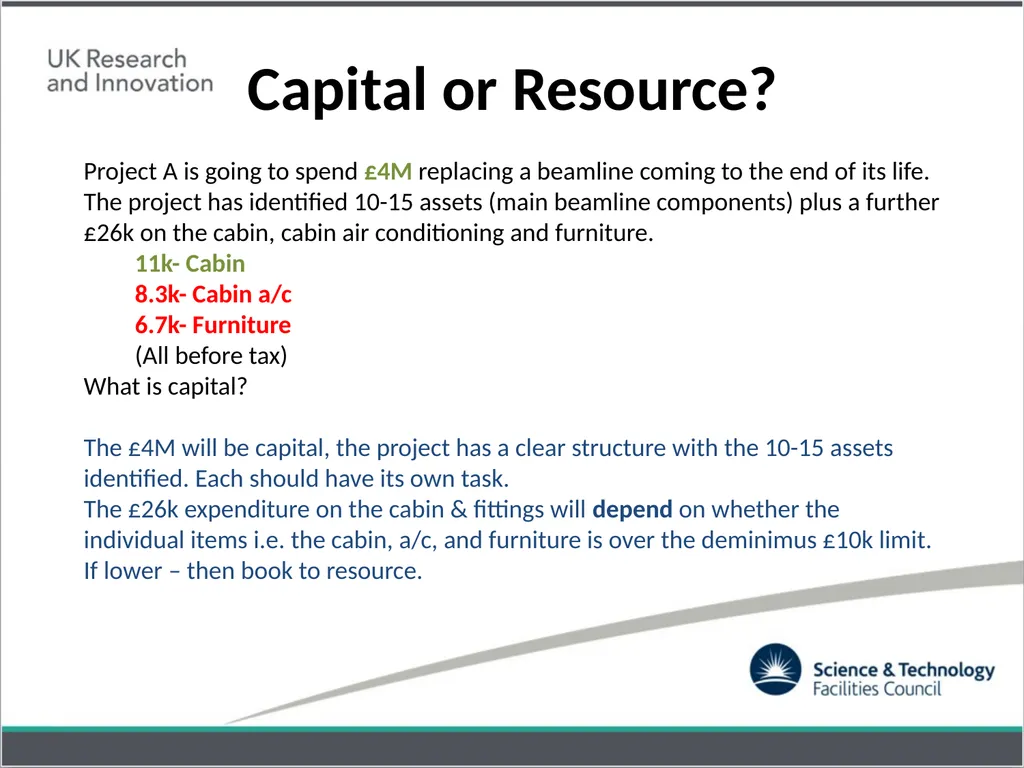
Capital or Resource? Project A is going to spend £4M replacing a beamline coming to the end of its life.
The project has identified 10-15 assets (main beamline components) plus a further £26k on the cabin, cabin air conditioning and furniture.
11k- Cabin
8.3k- Cabin a/c
6.7k- Furniture
(All before tax)
What is capital?
The £4M will be capital, the project has a clear structure with the 10-15 assets identified. Each should have its own task.
The £26k expenditure on the cabin & fittings will depend on whether the individual items i.e. the cabin, a/c, and furniture is over the deminimus £10k limit. If lower – then book to resource.<br>
The project has identified 10-15 assets (main beamline components) plus a further £26k on the cabin, cabin air conditioning and furniture.
11k- Cabin
8.3k- Cabin a/c
6.7k- Furniture
(All before tax)
What is capital?
The £4M will be capital, the project has a clear structure with the 10-15 assets identified. Each should have its own task.
The £26k expenditure on the cabin & fittings will depend on whether the individual items i.e. the cabin, a/c, and furniture is over the deminimus £10k limit. If lower – then book to resource.<br>
57
Capital or Resource? Project A is going to spend £4M replacing a beamline coming to the end of its life.
The project has identified 10-15 assets (main beamline components) plus a further £26k on the cabin, cabin air conditioning and furniture.
11k- Cabin
8.3k- Cabin a/c
6.7k- Furniture
(All before tax)
What is capital?
The £4M will be capital, the project has a clear structure with the 10-15 assets identified. Each should have its own task.
The £26k expenditure on the cabin & fittings will depend on whether the individual items i.e. the cabin, a/c, and furniture is over the deminimus £10k limit. If lower – then book to resource.<br>
The project has identified 10-15 assets (main beamline components) plus a further £26k on the cabin, cabin air conditioning and furniture.
11k- Cabin
8.3k- Cabin a/c
6.7k- Furniture
(All before tax)
What is capital?
The £4M will be capital, the project has a clear structure with the 10-15 assets identified. Each should have its own task.
The £26k expenditure on the cabin & fittings will depend on whether the individual items i.e. the cabin, a/c, and furniture is over the deminimus £10k limit. If lower – then book to resource.<br>
58
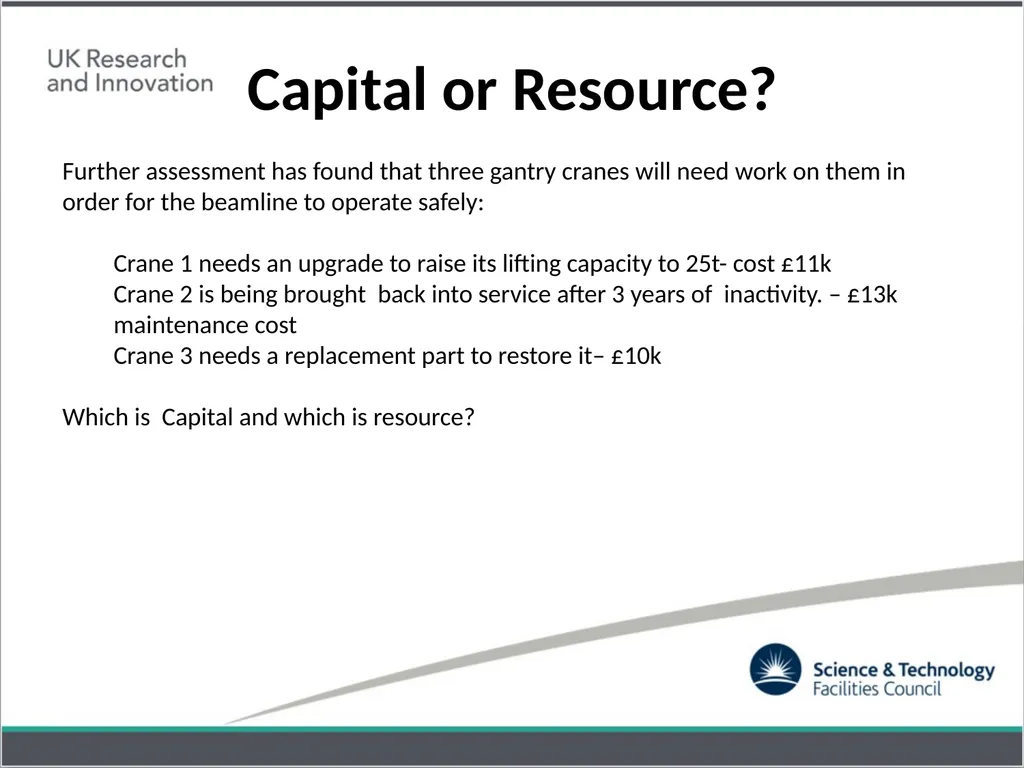
Capital or Resource? Further assessment has found that three gantry cranes will need work on them in order for the beamline to operate safely:
Crane 1 needs an upgrade to raise its lifting capacity to 25t- cost £11k
Crane 2 is being brought back into service after 3 years of inactivity. – £13k maintenance cost
Crane 3 needs a replacement part to restore it– £10k
Which is Capital and which is resource?
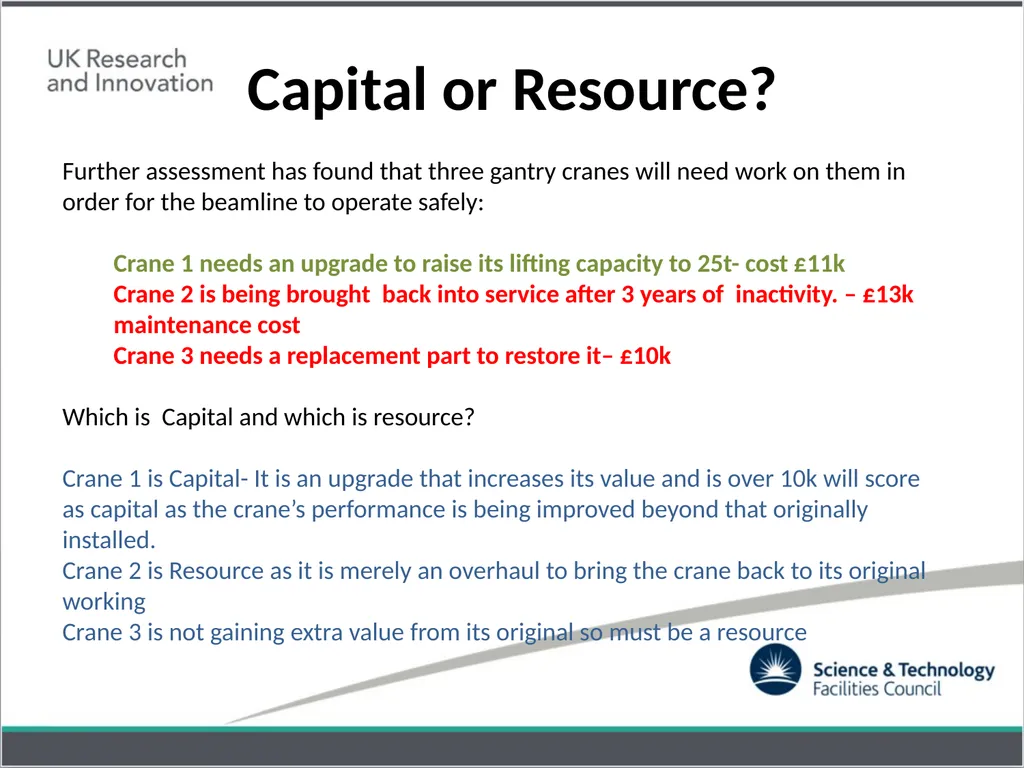
Crane 1 is Capital- It is an upgrade that increases its value and is over 10k will score as capital as the crane’s performance is being improved beyond that originally installed.
Crane 2 is Resource as it is merely an overhaul to bring the crane back to its o
riginal working
Crane 3 is not gaining extra value from its
original so must be a resource<br>
Crane 1 needs an upgrade to raise its lifting capacity to 25t- cost £11k
Crane 2 is being brought back into service after 3 years of inactivity. – £13k maintenance cost
Crane 3 needs a replacement part to restore it– £10k
Which is Capital and which is resource?
Crane 1 is Capital- It is an upgrade that increases its value and is over 10k will score as capital as the crane’s performance is being improved beyond that originally installed.
Crane 2 is Resource as it is merely an overhaul to bring the crane back to its o
riginal working
Crane 3 is not gaining extra value from its
original so must be a resource<br>
59
Capital or Resource? Further assessment has found that three gantry cranes will need work on them in order for the beamline to operate safely:
Crane 1 needs an upgrade to raise its lifting capacity to 25t- cost £11k
Crane 2 is being brought back into service after 3 years of inactivity. – £13k maintenance cost
Crane 3 needs a replacement part to restore it– £10k
Which is Capital and which is resource?
Crane 1 is Capital- It is an upgrade that increases its value and is over 10k will score as capital as the crane’s performance is being improved beyond that originally installed.
Crane 2 is Resource as it is merely an overhaul to bring the crane back to its original working
Crane 3 is not gaining extra value from its original so must be a resource<br>
Crane 1 needs an upgrade to raise its lifting capacity to 25t- cost £11k
Crane 2 is being brought back into service after 3 years of inactivity. – £13k maintenance cost
Crane 3 needs a replacement part to restore it– £10k
Which is Capital and which is resource?
Crane 1 is Capital- It is an upgrade that increases its value and is over 10k will score as capital as the crane’s performance is being improved beyond that originally installed.
Crane 2 is Resource as it is merely an overhaul to bring the crane back to its original working
Crane 3 is not gaining extra value from its original so must be a resource<br>
60
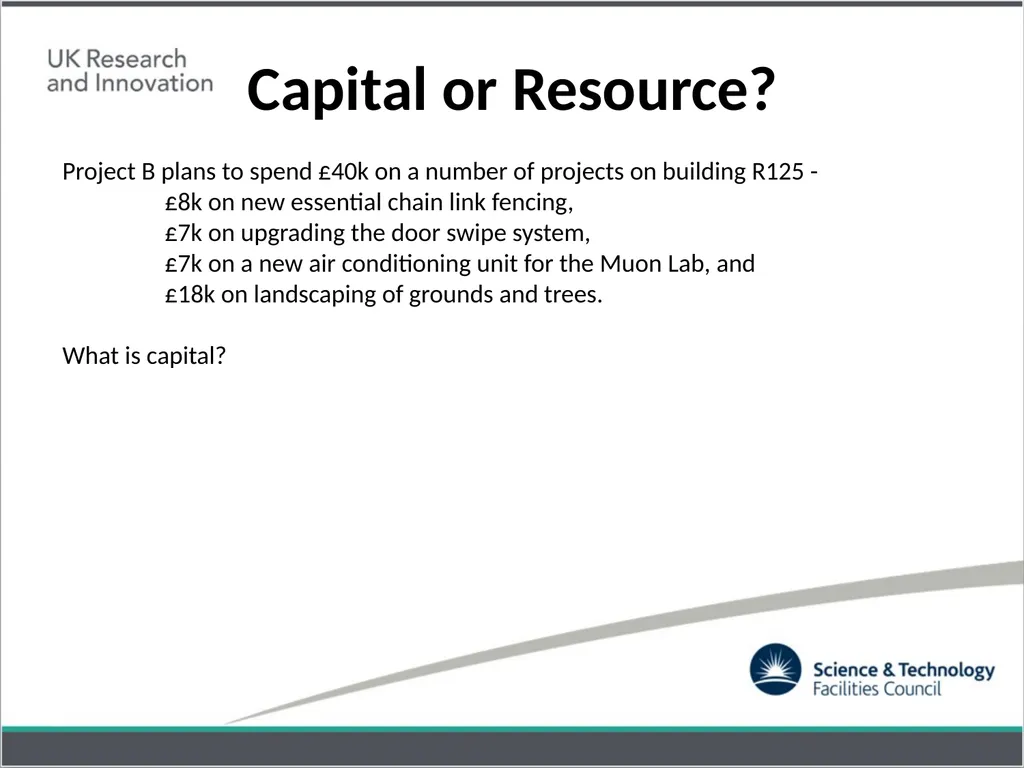
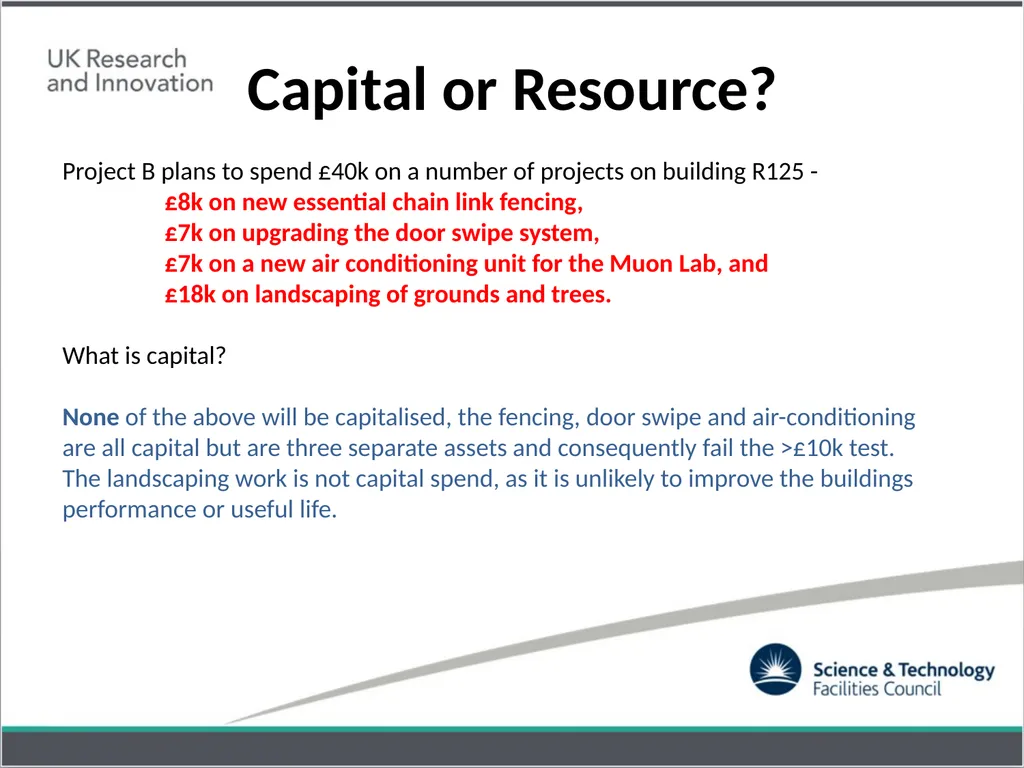
Capital or Resource? Project B plans to spend £40k on a number of projects on building R125 -
£8k on new essential chain link fencing,
£7k on upgrading the door swipe system,
£7k on a new air conditioning unit for the Muon Lab, and
£18k on landscaping of grounds and trees.
What is capital?
None of the above will be capitalised, the fencing, door swipe and air-conditioning are all capital but are three separate assets and consequently fail the >£10k test.
The landscaping work is not capital spend, as it is unlikely to improve the buildings performance or useful life.<br>
£8k on new essential chain link fencing,
£7k on upgrading the door swipe system,
£7k on a new air conditioning unit for the Muon Lab, and
£18k on landscaping of grounds and trees.
What is capital?
None of the above will be capitalised, the fencing, door swipe and air-conditioning are all capital but are three separate assets and consequently fail the >£10k test.
The landscaping work is not capital spend, as it is unlikely to improve the buildings performance or useful life.<br>
61
Capital or Resource? Project B plans to spend £40k on a number of projects on building R125 -
£8k on new essential chain link fencing,
£7k on upgrading the door swipe system,
£7k on a new air conditioning unit for the Muon Lab, and
£18k on landscaping of grounds and trees.
What is capital?
None of the above will be capitalised, the fencing, door swipe and air-conditioning are all capital but are three separate assets and consequently fail the >£10k test.
The landscaping work is not capital spend, as it is unlikely to improve the buildings performance or useful life.<br>
£8k on new essential chain link fencing,
£7k on upgrading the door swipe system,
£7k on a new air conditioning unit for the Muon Lab, and
£18k on landscaping of grounds and trees.
What is capital?
None of the above will be capitalised, the fencing, door swipe and air-conditioning are all capital but are three separate assets and consequently fail the >£10k test.
The landscaping work is not capital spend, as it is unlikely to improve the buildings performance or useful life.<br>
62
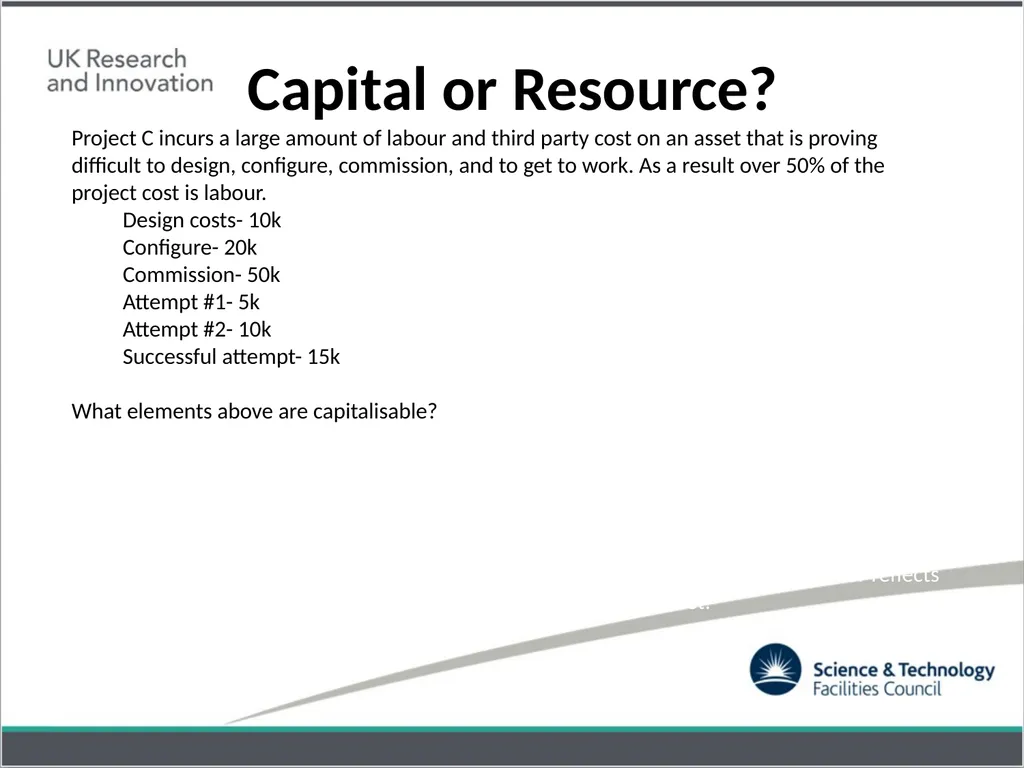
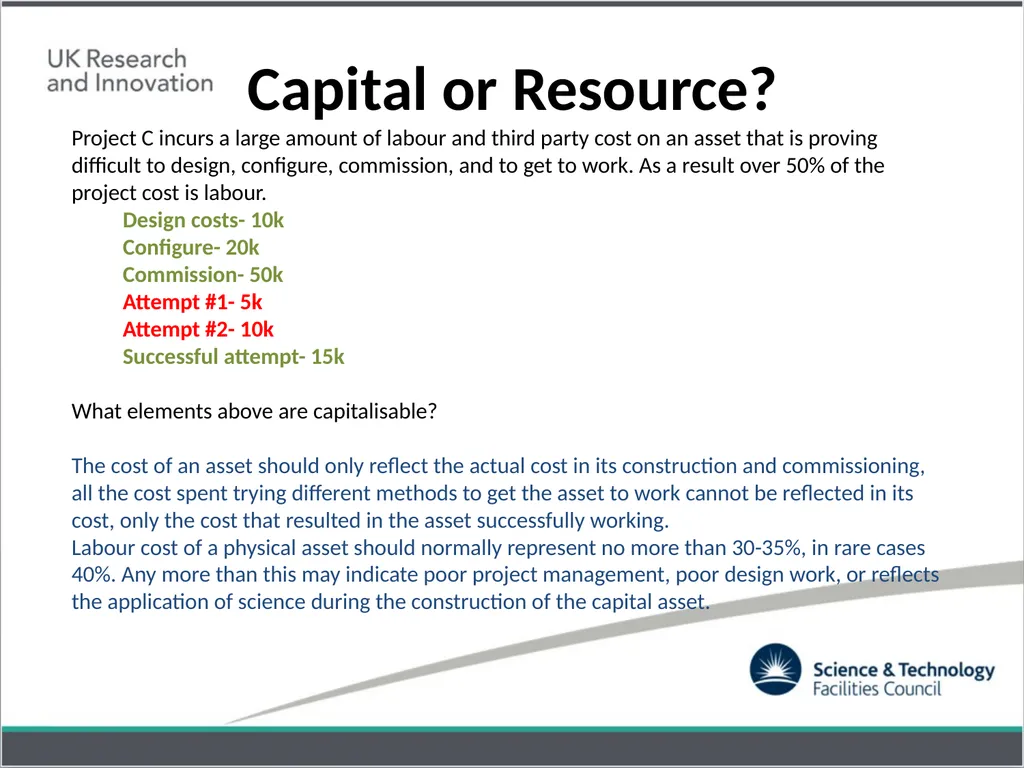
Capital or Resource? Project C incurs a large amount of labour and third party cost on an asset that is proving difficult to design, configure, commission, and to get to work. As a result over 50% of the project cost is labour.
Design costs- 10k
Configure- 20k
Commission- 50k
Attempt #1- 5k
Attempt #2- 10k
Successful attempt- 15k
What elements above are capitalisable?
The cost of an asset should only reflect the actual cost in its construction and commissioning, all the cost spent trying different methods to get the asset to work cannot be reflected in its cost, only the cost that resulted in the asset successfully working.
Labour cost of a physical asset should normally represent no more than 30-35%, in rare cases 40%. Any more than this may indicate poor project management, poor design work, or reflects the application of science during the construction of the capital asset.<br>
Design costs- 10k
Configure- 20k
Commission- 50k
Attempt #1- 5k
Attempt #2- 10k
Successful attempt- 15k
What elements above are capitalisable?
The cost of an asset should only reflect the actual cost in its construction and commissioning, all the cost spent trying different methods to get the asset to work cannot be reflected in its cost, only the cost that resulted in the asset successfully working.
Labour cost of a physical asset should normally represent no more than 30-35%, in rare cases 40%. Any more than this may indicate poor project management, poor design work, or reflects the application of science during the construction of the capital asset.<br>
63
Capital or Resource? Project C incurs a large amount of labour and third party cost on an asset that is proving difficult to design, configure, commission, and to get to work. As a result over 50% of the project cost is labour.
Design costs- 10k
Configure- 20k
Commission- 50k
Attempt #1- 5k
Attempt #2- 10k
Successful attempt- 15k
What elements above are capitalisable?
The cost of an asset should only reflect the actual cost in its construction and commissioning, all the cost spent trying different methods to get the asset to work cannot be reflected in its cost, only the cost that resulted in the asset successfully working.
Labour cost of a physical asset should normally represent no more than 30-35%, in rare cases 40%. Any more than this may indicate poor project management, poor design work, or reflects the application of science during the construction of the capital asset.<br>
Design costs- 10k
Configure- 20k
Commission- 50k
Attempt #1- 5k
Attempt #2- 10k
Successful attempt- 15k
What elements above are capitalisable?
The cost of an asset should only reflect the actual cost in its construction and commissioning, all the cost spent trying different methods to get the asset to work cannot be reflected in its cost, only the cost that resulted in the asset successfully working.
Labour cost of a physical asset should normally represent no more than 30-35%, in rare cases 40%. Any more than this may indicate poor project management, poor design work, or reflects the application of science during the construction of the capital asset.<br>
64
Questions<br>
65
Call email or just pop in to see us The Capital Management Team are a friendly bunch, and we are always happy to help with any queries.
We encourage you to ask for assistance from you Management Accountant, Business Partner or any of the Capital Management Team if clarification is needed.
Based at RAL (R1 Upper Ground North) we cover all STFC locations.<br>
We encourage you to ask for assistance from you Management Accountant, Business Partner or any of the Capital Management Team if clarification is needed.
Based at RAL (R1 Upper Ground North) we cover all STFC locations.<br>
66
Thank you for attending. If you would like to provide us any feedback please email the STFCFIXEDASSETS@stfc.ac.uk inbox.<br>