Carbohydrates and their functional properties in food products Carbohydrates in food Many foods contain some carbohydrates, but the amounts of sugars, starch and fibre differ. Sugars are naturally present in foods such as milk, fruits,
"Carbohydrates and their functional properties in" is the property of its rightful owner. Permission is granted to
download and print the materials on this website for personal, non-commercial use only, and to display it
on your personal computer provided you do not modify the materials and that you retain all copyright
notices contained in the materials. By downloading content from our website, you accept the terms of this
agreement.
Presentation Transcript
01
Carbohydrates and their functional properties in food products<br>
02
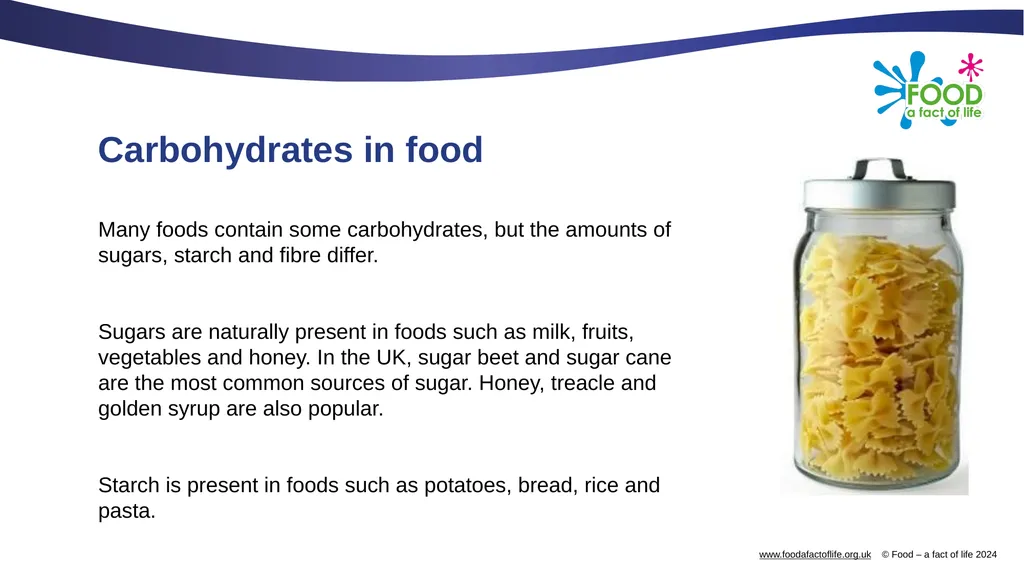
Carbohydrates in food Many foods contain some carbohydrates, but the amounts of sugars, starch and fibre differ. Sugars are naturally present in foods such as milk, fruits, vegetables and honey. In the UK, sugar beet and sugar cane are the most common sources of sugar. Honey, treacle and golden syrup are also popular. Starch is present in foods such as potatoes, bread, rice and pasta.<br>
03
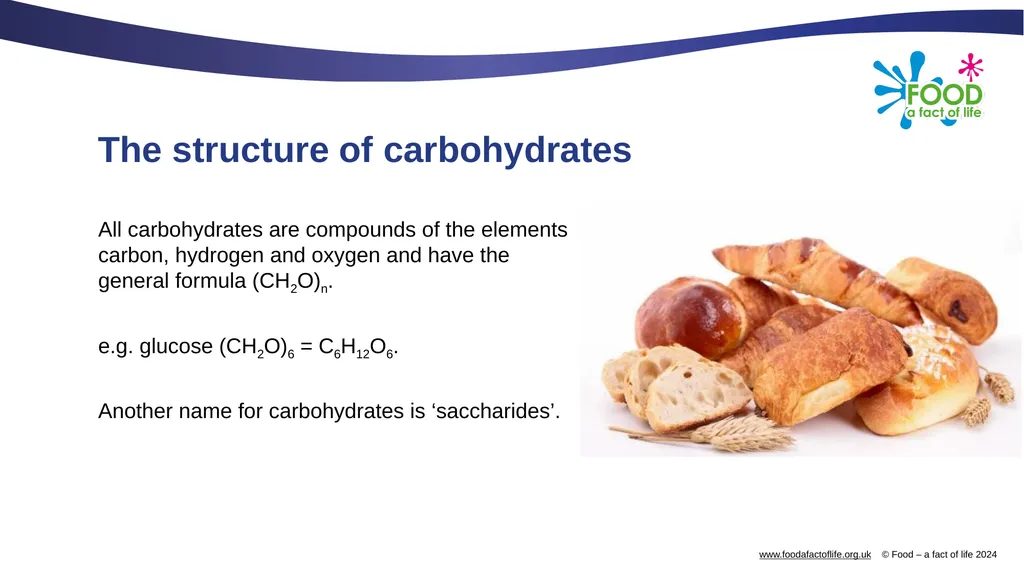
The structure of carbohydrates All carbohydrates are compounds of the elements carbon, hydrogen and oxygen and have the general formula (CH2O)n.
e.g. glucose (CH2O)6 = C6H12O6.
Another name for carbohydrates is ‘saccharides’.<br>
04
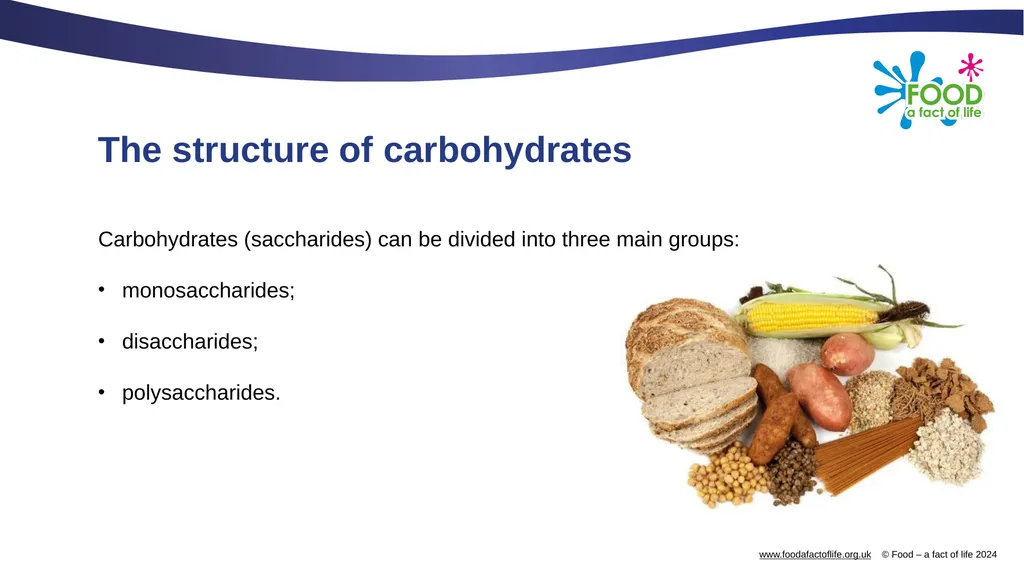
The structure of carbohydrates Carbohydrates (saccharides) can be divided into three main groups:
monosaccharides;
disaccharides;
polysaccharides.<br>
05
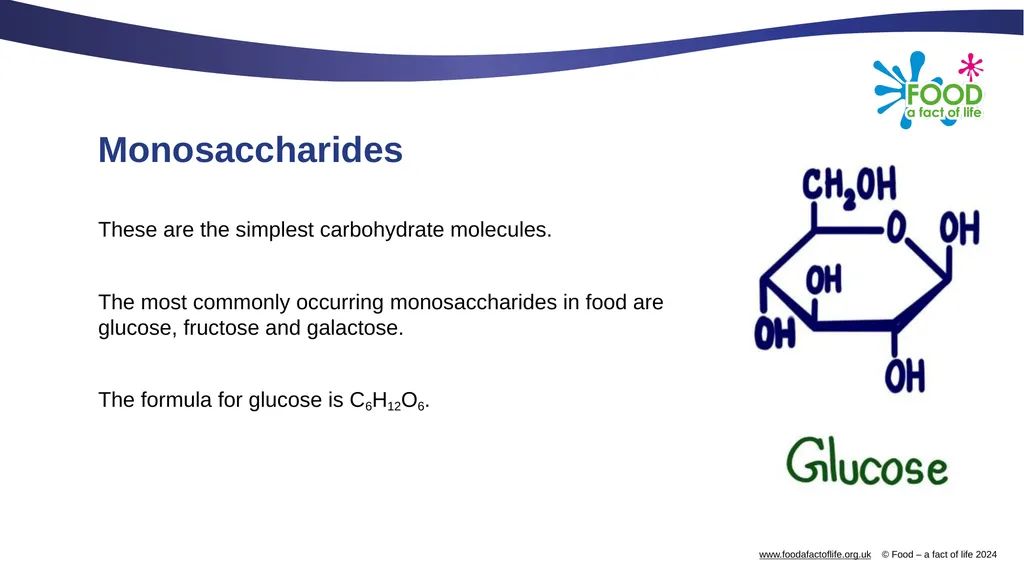
Monosaccharides These are the simplest carbohydrate molecules.
The most commonly occurring monosaccharides in food are glucose, fructose and galactose.
The formula for glucose is C6H12O6.<br>
06
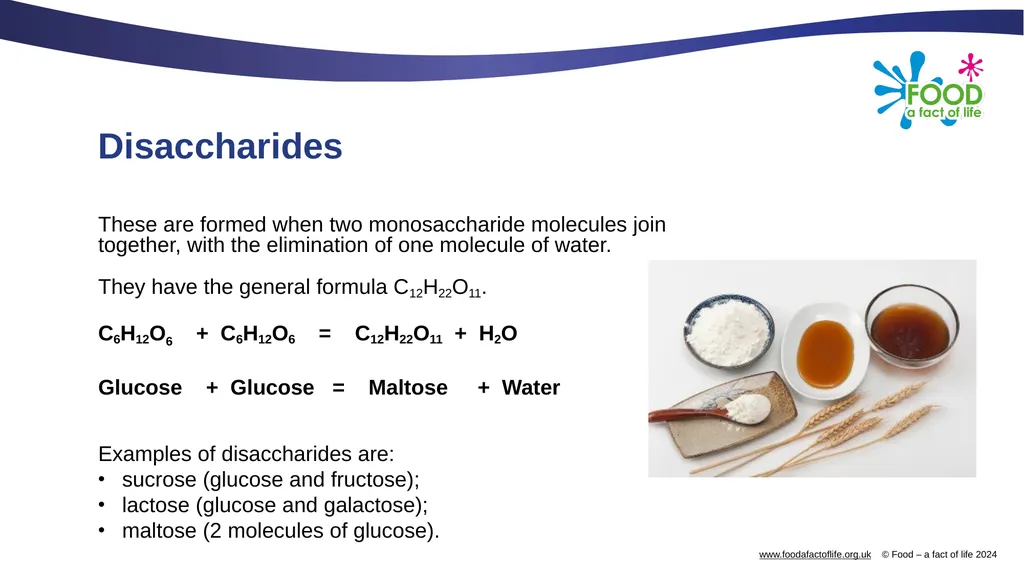
Disaccharides These are formed when two monosaccharide molecules join together, with the elimination of one molecule of water.
They have the general formula C12H22O11.
C6H12O6 + C6H12O6 = C12H22O11 + H2O
Glucose + Glucose = Maltose + Water
Examples of disaccharides are:
sucrose (glucose and fructose);
lactose (glucose and galactose);
maltose (2 molecules of glucose).<br>
07
Polysaccharides Polysaccharides are made up of many monosaccharide molecules joined together.
They have the general formula (C6H10O5)n where ‘n’ is a large number.
Examples of polysaccharides include:
starch;
glycogen;
cellulose;
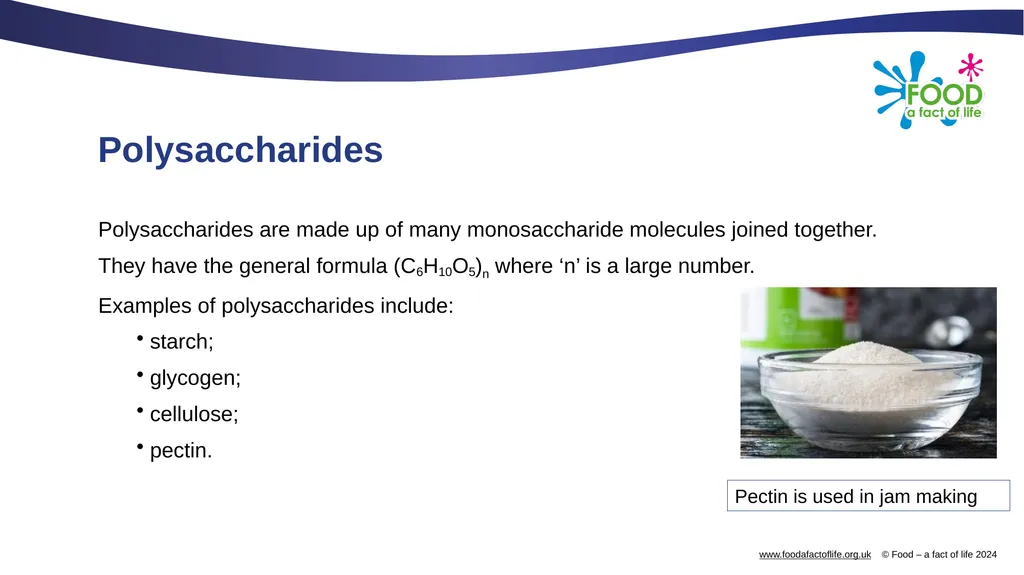
pectin. Pectin is used in jam making<br>
08
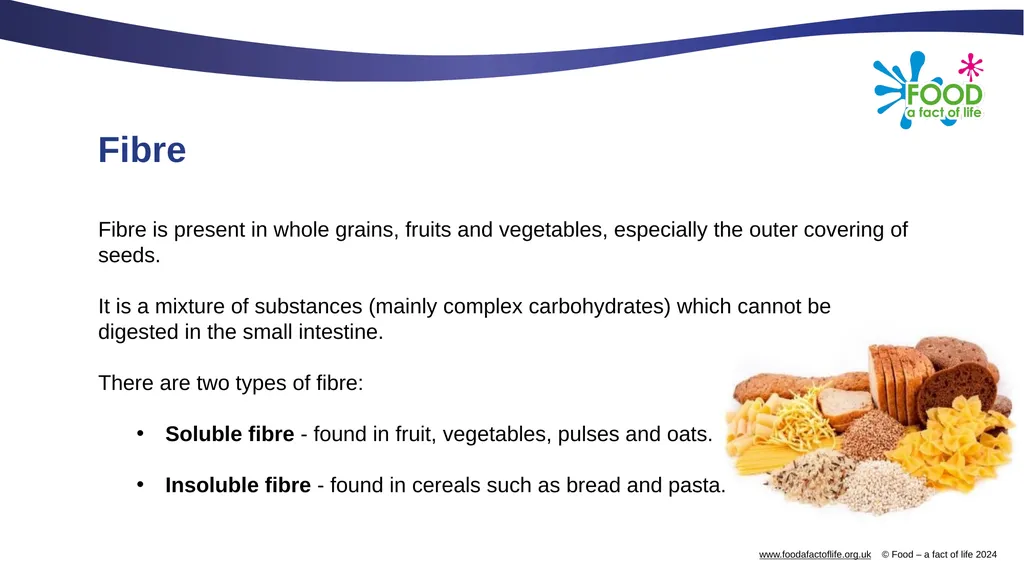
Fibre Fibre is present in whole grains, fruits and vegetables, especially the outer covering of seeds.
It is a mixture of substances (mainly complex carbohydrates) which cannot be digested in the small intestine.
There are two types of fibre:
Soluble fibre - found in fruit, vegetables, pulses and oats.
Insoluble fibre - found in cereals such as bread and pasta.<br>
09
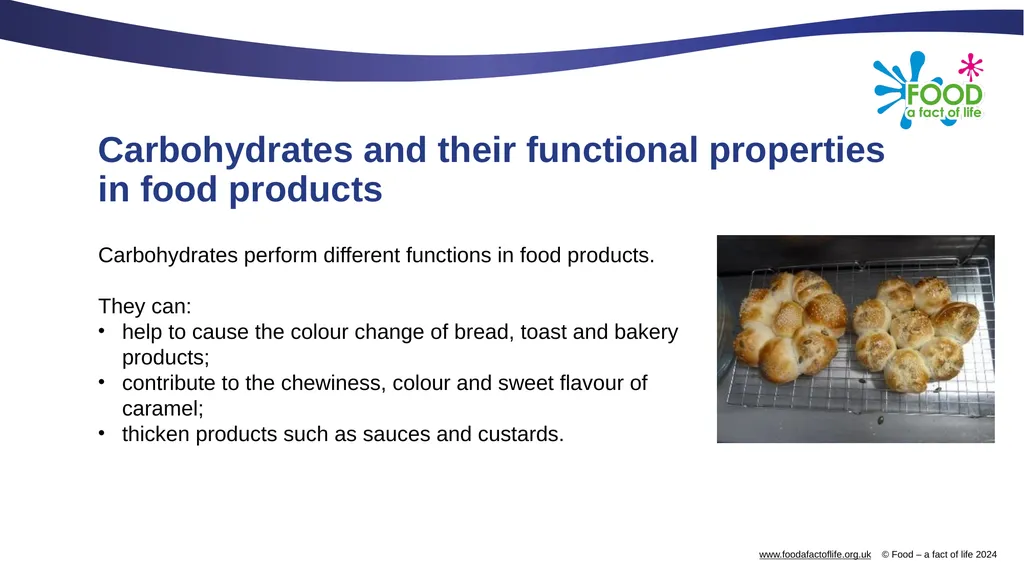
Carbohydrates and their functional properties in food products Carbohydrates perform different functions in food products.
They can:
help to cause the colour change of bread, toast and bakery products;
contribute to the chewiness, colour and sweet flavour of caramel;
thicken products such as sauces and custards.<br>
10
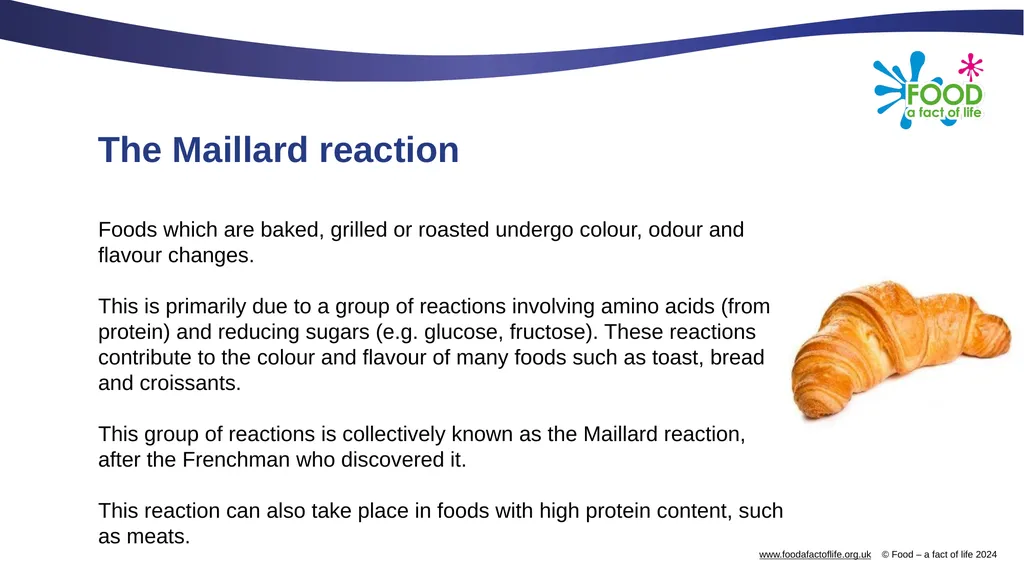
The Maillard reaction Foods which are baked, grilled or roasted undergo colour, odour and flavour changes. This is primarily due to a group of reactions involving amino acids (from protein) and reducing sugars (e.g. glucose, fructose). These reactions contribute to the colour and flavour of many foods such as toast, bread and croissants. This group of reactions is collectively known as the Maillard reaction, after the Frenchman who discovered it. This reaction can also take place in foods with high protein content, such as meats.<br>
11
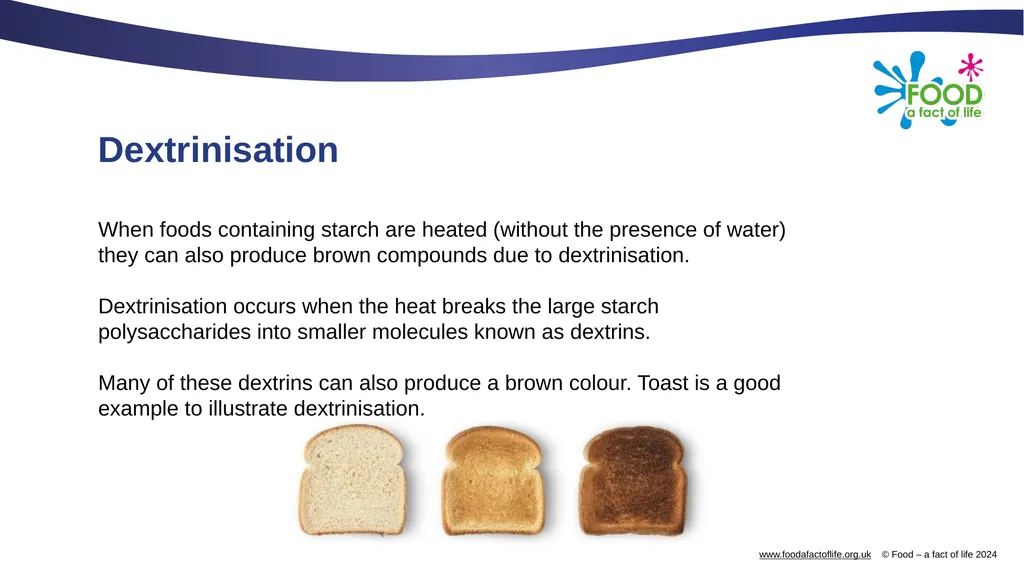
Dextrinisation When foods containing starch are heated (without the presence of water) they can also produce brown compounds due to dextrinisation. Dextrinisation occurs when the heat breaks the large starch polysaccharides into smaller molecules known as dextrins. Many of these dextrins can also produce a brown colour. Toast is a good example to illustrate dextrinisation.<br>
12
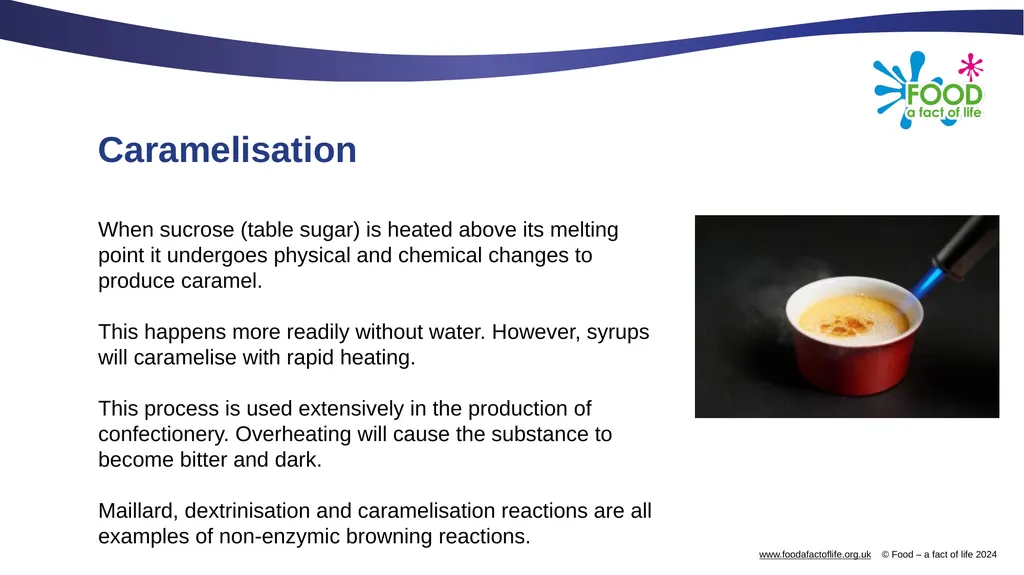
Caramelisation When sucrose (table sugar) is heated above its melting point it undergoes physical and chemical changes to produce caramel. This happens more readily without water. However, syrups will caramelise with rapid heating. This process is used extensively in the production of confectionery. Overheating will cause the substance to become bitter and dark. Maillard, dextrinisation and caramelisation reactions are all examples of non-enzymic browning reactions.<br>
13
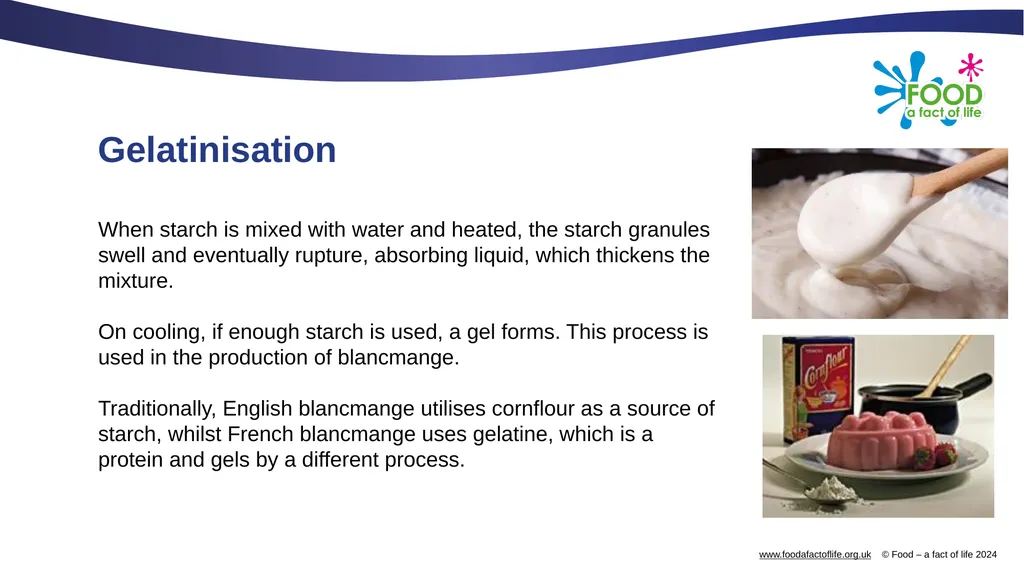
Gelatinisation When starch is mixed with water and heated, the starch granules swell and eventually rupture, absorbing liquid, which thickens the mixture. On cooling, if enough starch is used, a gel forms. This process is used in the production of blancmange. Traditionally, English blancmange utilises cornflour as a source of starch, whilst French blancmange uses gelatine, which is a protein and gels by a different process.<br>
14
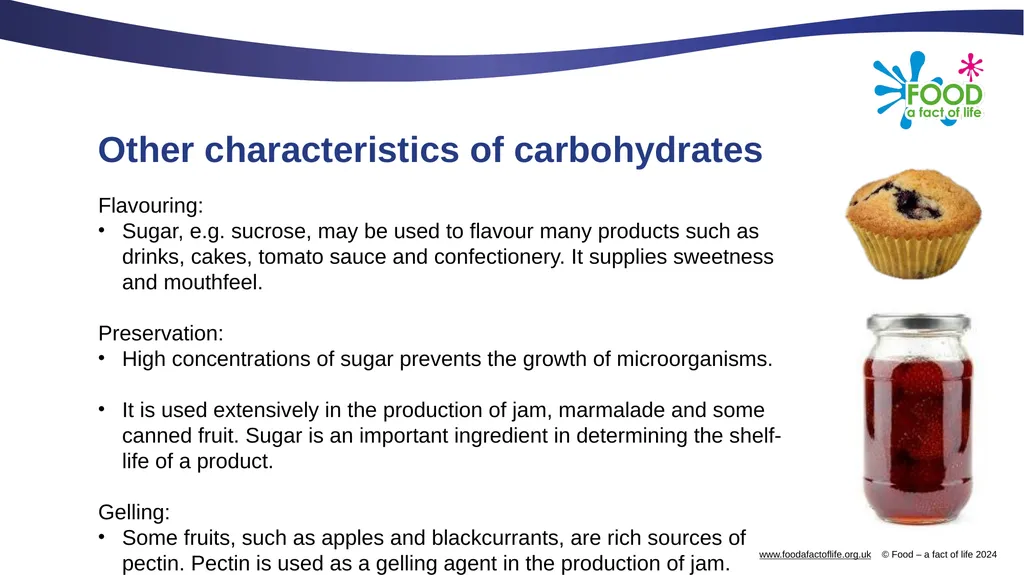
Other characteristics of carbohydrates Flavouring:
Sugar, e.g. sucrose, may be used to flavour many products such as drinks, cakes, tomato sauce and confectionery. It supplies sweetness and mouthfeel.
Preservation:
High concentrations of sugar prevents the growth of microorganisms.
It is used extensively in the production of jam, marmalade and some canned fruit. Sugar is an important ingredient in determining the shelf-life of a product.
Gelling:
Some fruits, such as apples and blackcurrants, are rich sources of pectin. Pectin is used as a gelling agent in the production of jam.<br>
15
Carbohydrates and their functional properties in food products For further information, go to:
www.foodafactoflife.org.uk This resource meets the Guidelines for producers and users of school education resources about food.<br>