Carthaginian Stereotypes in Plautus Poenulus A presentation by Ludovica Montagna, Charli Kelly, Nishat Uddin and Euan Lorant Historical Context The play was produced between 189 and 187 BCE 201 BCE end of the Hannibalic War (Second Punic
"Carthaginian Stereotypes in Plautus’ Poenulus A" is the property of its rightful owner. Permission is granted to
download and print the materials on this website for personal, non-commercial use only, and to display it
on your personal computer provided you do not modify the materials and that you retain all copyright
notices contained in the materials. By downloading content from our website, you accept the terms of this
agreement.
Presentation Transcript
01
Carthaginian Stereotypes in Plautus’ Poenulus A presentation by Ludovica Montagna, Charli Kelly, Nishat Uddin and Euan Lorant<br>
02
Historical Context The play was produced between 189 and 187 BCE
201 BCE end of the Hannibalic War (Second Punic War)
Audience’s reaction foreseen and planned: Poen. 50-1 ‘sed nisi molestum est, nomen dare uobis uolo comoediai; sin odio est…’ : ‘But if you don’t object, I want to give you the name of the comedy; if it does annoy you…’<br>
03
Punica Fides: what, when and why ? Gruen’s Rethinking the Other in Antiquity, 2011 From Homer to Herodotus
Middle Republic to Sallust
Appropriating and manipulating Carthage’s image
Erecting an oppositional ‘moral’ model to highlight Roman integrity<br>
04
Negative Carthaginian Stereotypes Plautus’ portrayal of his main character compels the reader to consider Rome’s relationship with Carthage
Powerful images of xenophobia and ethnocentrism
“Hanno is not an individual, but the embodiment of a stereotyped group. He appears to be an object of fun, not of sympathy.” G. F. Franko – The Characterisation of Hanno in Plautus’ Poenulus<br>
05
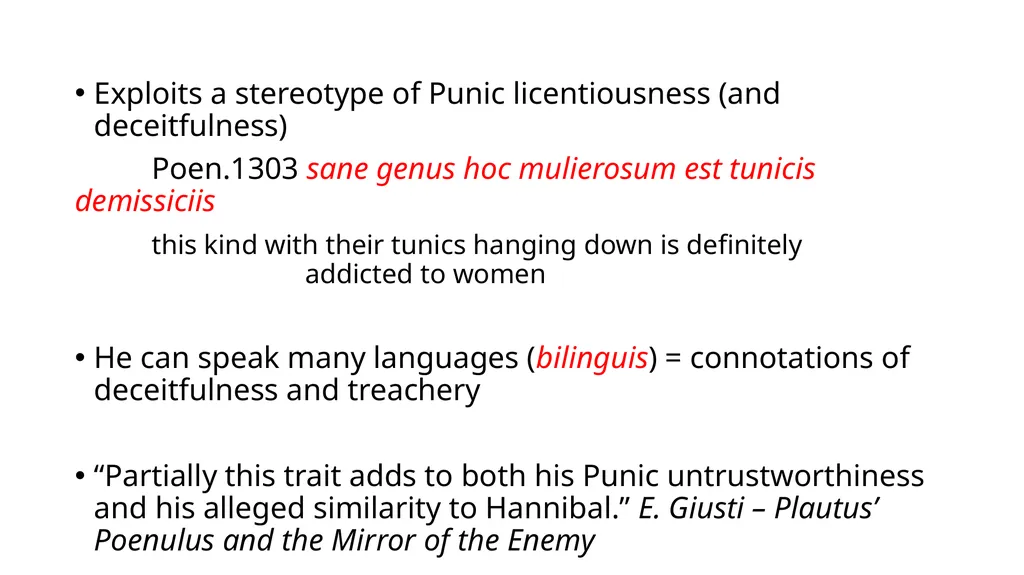
Exploits a stereotype of Punic licentiousness (and deceitfulness)
Poen.1303 sane genus hoc mulierosum est tunicis demissiciis
this kind with their tunics hanging down is definitely addicted to women
He can speak many languages (bilinguis) = connotations of deceitfulness and treachery
“Partially this trait adds to both his Punic untrustworthiness and his alleged similarity to Hannibal.” E. Giusti – Plautus’ Poenulus and the Mirror of the Enemy<br>
06
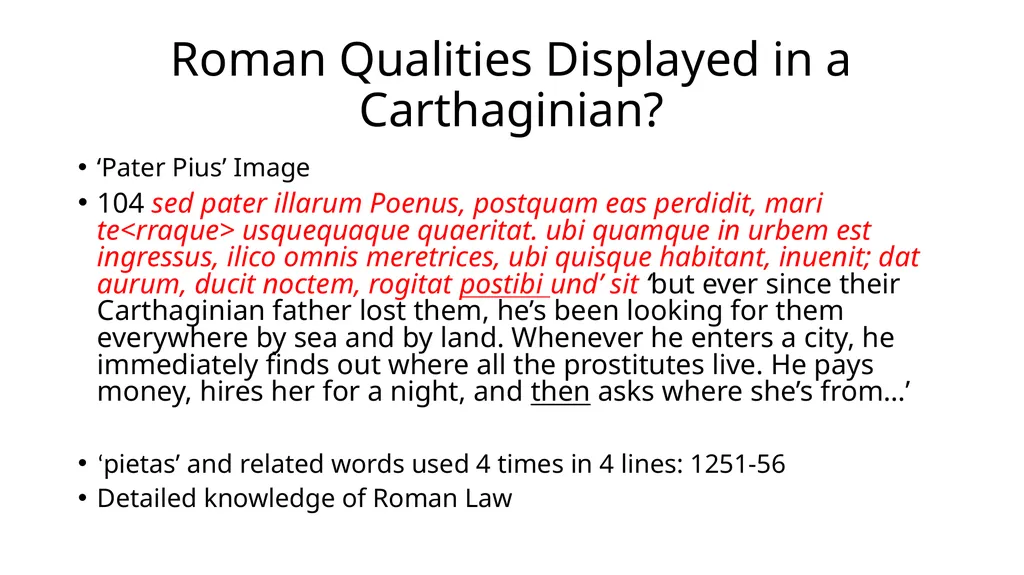
Roman Qualities Displayed in a Carthaginian? ‘Pater Pius’ Image
104 sed pater illarum Poenus, postquam eas perdidit, mari te<rraque> usquequaque quaeritat. ubi quamque in urbem est ingressus, ilico omnis meretrices, ubi quisque habitant, inuenit; dat aurum, ducit noctem, rogitat postibi und’ sit ‘but ever since their Carthaginian father lost them, he’s been looking for them everywhere by sea and by land. Whenever he enters a city, he immediately finds out where all the prostitutes live. He pays money, hires her for a night, and then asks where she’s from…’
‘pietas’ and related words used 4 times in 4 lines: 1251-56
Detailed knowledge of Roman Law<br>
07
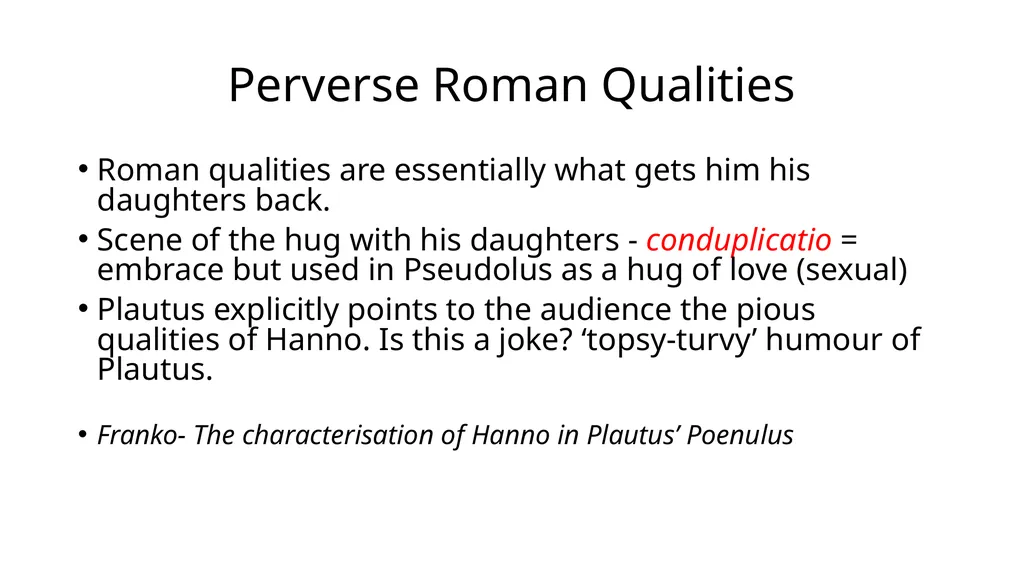
Perverse Roman Qualities Roman qualities are essentially what gets him his daughters back.
Scene of the hug with his daughters - conduplicatio = embrace but used in Pseudolus as a hug of love (sexual)
Plautus explicitly points to the audience the pious qualities of Hanno. Is this a joke? ‘topsy-turvy’ humour of Plautus.
Franko- The characterisation of Hanno in Plautus’ Poenulus<br>