
Case Scenarios for Customizing Your Training These
PM
Published · 57 slides · 0 views
1 / 1





Description
Case Scenarios for Customizing Your Training These materials provide NSC authorized instructors with industry-specific case scenarios to help reinforce learning throughout the content delivered. Case Scenarios Customize your first aid
Related Topics
Share
Embed code
Download this presentation From Below
"Case Scenarios for Customizing Your Training These" is the property of its rightful owner. Permission is granted to download and print the materials on this website for personal, non-commercial use only, and to display it on your personal computer provided you do not modify the materials and that you retain all copyright notices contained in the materials. By downloading content from our website, you accept the terms of this agreement.
Presentation Transcript
01
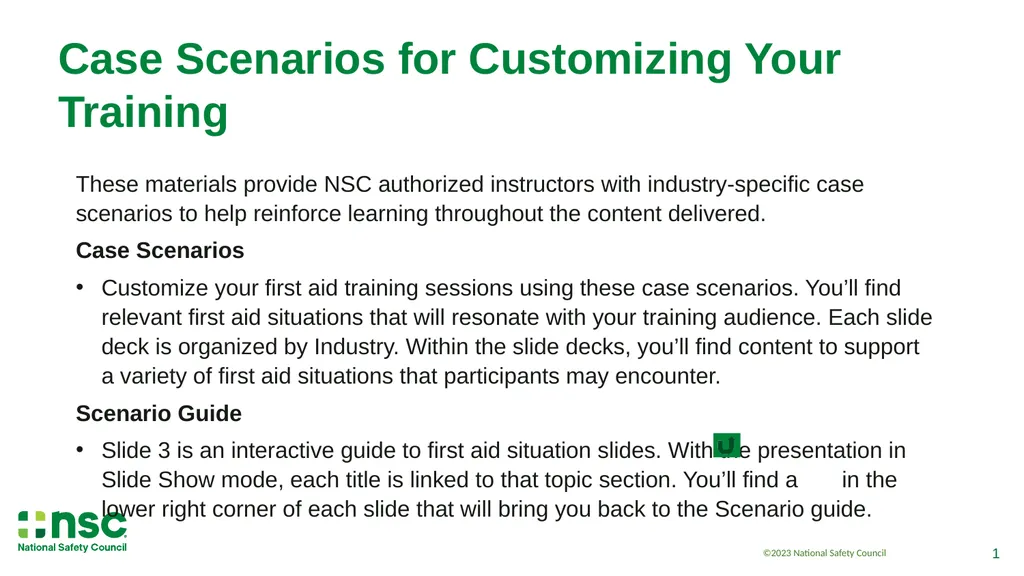
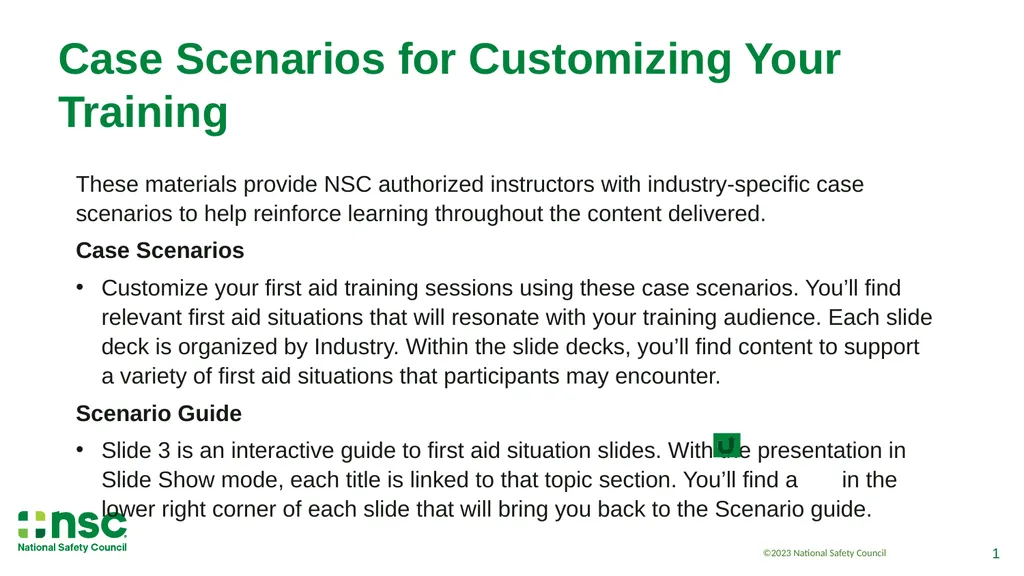
Case Scenarios for Customizing Your Training These materials provide NSC authorized instructors with industry-specific case scenarios to help reinforce learning throughout the content delivered.
Case Scenarios
Customize your first aid training sessions using these case scenarios. You’ll find relevant first aid situations that will resonate with your training audience. Each slide deck is organized by Industry. Within the slide decks, you’ll find content to support a variety of first aid situations that participants may encounter.
Scenario Guide
Slide 3 is an interactive guide to first aid situation slides. With the presentation in Slide Show mode, each title is linked to that topic section. You’ll find a in the lower right corner of each slide that will bring you back to the Scenario guide.<br>
Case Scenarios
Customize your first aid training sessions using these case scenarios. You’ll find relevant first aid situations that will resonate with your training audience. Each slide deck is organized by Industry. Within the slide decks, you’ll find content to support a variety of first aid situations that participants may encounter.
Scenario Guide
Slide 3 is an interactive guide to first aid situation slides. With the presentation in Slide Show mode, each title is linked to that topic section. You’ll find a in the lower right corner of each slide that will bring you back to the Scenario guide.<br>
02
FA/CPR/AED Case Scenarios
MANUFACTURING Use to customize your First Aid Training
for your audience<br>
for your audience<br>
03
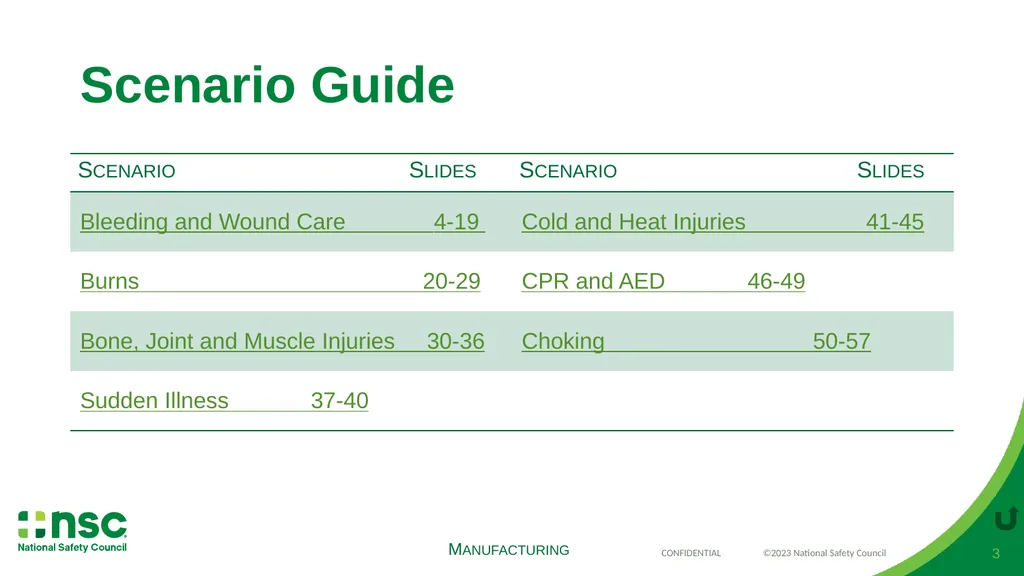
Scenario Guide<br>
04
Bleeding and Wound Care Scenarios Manufacturing<br>
05
Bleeding and Wound Care
Scenario 1 A temporary machine operator was cleaning the rollers of a glue spreading machine in a facility that produces aluminum products used in room additions. The employee was cleaning the running rollers with a rag in his right hand while trying to turn the power off with his left hand. The rag inadvertently got caught and pulled his right arm between the moving rollers that had 3-inch wide openings.
You have been called to the scene to render first aid.
What would you do before providing first aid?
How would you provide care?<br>
You have been called to the scene to render first aid.
What would you do before providing first aid?
How would you provide care?<br>
06
Bleeding and Wound Care
Scenario 1 Answer 1 What would you do before providing first aid?
Make the scene safe or designate another employee to make the scene safe. This would include powering off the machine.
Check the victim for responsiveness.
Direct one of the employees to call 9-1-1 and get the first aid kit.
Check the victim for any life-threatening condition first and care for it.<br>
Make the scene safe or designate another employee to make the scene safe. This would include powering off the machine.
Check the victim for responsiveness.
Direct one of the employees to call 9-1-1 and get the first aid kit.
Check the victim for any life-threatening condition first and care for it.<br>
07
2. How would you provide care?
If the person’s arm is still stuck in the equipment, treat the victim for shock with positioning and warmth while the arm is stuck.
If the arm becomes freed from the equipment, focus on bleeding control and shock treatment:
Since there are no open wounds, suspect internal bleeding. Apply ice to his right arm to reduce internal blood flow and swelling.
Treat for shock with positioning and warmth.
Monitor his breathing and be prepared to give basic life support. Bleeding and Wound Care Scenario 1 Answer 2<br>
If the person’s arm is still stuck in the equipment, treat the victim for shock with positioning and warmth while the arm is stuck.
If the arm becomes freed from the equipment, focus on bleeding control and shock treatment:
Since there are no open wounds, suspect internal bleeding. Apply ice to his right arm to reduce internal blood flow and swelling.
Treat for shock with positioning and warmth.
Monitor his breathing and be prepared to give basic life support. Bleeding and Wound Care Scenario 1 Answer 2<br>
08
Bleeding and Wound Care
Scenario 2 A long-time employee of General Manufacturing, LLC was in the process of deburring a plastic component with a utility knife when a small piece of plastic flew between her face and the bottom of her safety glasses, penetrating her left eye.
You have been called to render first aid.
What would you do before providing first aid?
How would you provide care?<br>
You have been called to render first aid.
What would you do before providing first aid?
How would you provide care?<br>
09
Bleeding and Wound Care
Scenario 2 Answer 1 What would you do before providing first aid?
Make sure the scene is safe to enter.
Call or have someone call 9-1-1.
Ask for consent to provide care.<br>
Make sure the scene is safe to enter.
Call or have someone call 9-1-1.
Ask for consent to provide care.<br>
10
2. How would you provide care?
Put on medical exam gloves.
Direct the employee to stay still.
Stabilize the plastic piece in place with dressings or bulky cloth.
Cover both eyes and remain with the employee until EMS arrives. Bleeding and Wound Care Scenario 2 Answer 2<br>
Put on medical exam gloves.
Direct the employee to stay still.
Stabilize the plastic piece in place with dressings or bulky cloth.
Cover both eyes and remain with the employee until EMS arrives. Bleeding and Wound Care Scenario 2 Answer 2<br>
11
Bleeding and Wound Care
Scenario 3 You have been called to render first aid to an employee who was injured on the job. The employee was clearing a machine jam. He had disabled the guard interlock and was working on the machine live. His shirt became caught in a roller, and he was pulled into the machine.
When you arrive on the scene, he is free of the machine and is responsive and breathing normally. He has several cuts to his abdomen, but not so deep as to expose internal organs.
What would you do before providing first aid?
How would you provide care?<br>
When you arrive on the scene, he is free of the machine and is responsive and breathing normally. He has several cuts to his abdomen, but not so deep as to expose internal organs.
What would you do before providing first aid?
How would you provide care?<br>
12
Bleeding and Wound Care
Scenario 3 Answer 1 What would you do before providing first aid?
If the scene has not been made safe, direct someone to do so.
Direct someone to bring the first aid kit if you did not bring it with you.
Direct someone to call 9-1-1 if it has not already been called.
Put on medical exam gloves.<br>
If the scene has not been made safe, direct someone to do so.
Direct someone to bring the first aid kit if you did not bring it with you.
Direct someone to call 9-1-1 if it has not already been called.
Put on medical exam gloves.<br>
13
2. How would you provide care?
Stop the bleeding with direct pressure on a dressing over the wound.
Re-evaluate the bleeding. If direct pressure does not control the bleeding and you have a hemostatic dressing, remove dressings already used and apply the hemostatic dressing directly on the wound using direct pressure.
If a hemostatic dressing is not available, continue to apply direct pressure. If blood soaks through the first dressing, place additional dressings on top of the blood-soaked dressing and keep applying pressure.
Bandage his wounds.
Treat for shock with positioning and warmth. Bleeding and Wound Care Scenario 3 Answer 2<br>
Stop the bleeding with direct pressure on a dressing over the wound.
Re-evaluate the bleeding. If direct pressure does not control the bleeding and you have a hemostatic dressing, remove dressings already used and apply the hemostatic dressing directly on the wound using direct pressure.
If a hemostatic dressing is not available, continue to apply direct pressure. If blood soaks through the first dressing, place additional dressings on top of the blood-soaked dressing and keep applying pressure.
Bandage his wounds.
Treat for shock with positioning and warmth. Bleeding and Wound Care Scenario 3 Answer 2<br>
14
Bleeding and Wound Care
Scenario 4 You are employed as a set-up technician by a company that manufactures precision, custom plastic parts for various customers worldwide. You work in Row B of the production area. Your friend, Mike, another set-up technician, works in Row C of the production area.
Mike was setting up a tool/die into a plastic injection molding machine. The tool/die weighs about 2,000 pounds and measures 12 inches x 19.625 inches x 13.875 inches. The injection molding machine has a clamping pressure of 170 tons. When the tool/die moved, it crushed 3 fingers of Mike’s left hand against the tie bar of the machine.
You are trained in first aid and are called to render assistance. When you arrive in Row C, you see that Mike’s 3 fingers have several cuts and he is complaining of pain in his hand.
What would you do before providing first aid?
How would you provide care?<br>
Mike was setting up a tool/die into a plastic injection molding machine. The tool/die weighs about 2,000 pounds and measures 12 inches x 19.625 inches x 13.875 inches. The injection molding machine has a clamping pressure of 170 tons. When the tool/die moved, it crushed 3 fingers of Mike’s left hand against the tie bar of the machine.
You are trained in first aid and are called to render assistance. When you arrive in Row C, you see that Mike’s 3 fingers have several cuts and he is complaining of pain in his hand.
What would you do before providing first aid?
How would you provide care?<br>
15
Bleeding and Wound Care
Scenario 4 Answer 1 What would you do before providing first aid?
Send someone to obtain the first aid kit.
Secure or have someone secure the scene so it is safe.
Put on medical exam gloves.<br>
Send someone to obtain the first aid kit.
Secure or have someone secure the scene so it is safe.
Put on medical exam gloves.<br>
16
Bleeding and Wound Care
Scenario 4 Answer 2 How would you provide care?
Stop the bleeding with direct pressure on a dressing over the wound.
Re-evaluate the bleeding. If direct pressure does not control the bleeding and you have a hemostatic dressing, remove dressings already used and apply the hemostatic dressing directly on the wound using direct pressure.
If a hemostatic dressing is not available, continue to apply direct pressure. If blood soaks through the first dressing, place additional dressings on top of the blood-soaked dressing and keep applying pressure.
Bandage the wounds.
Get him to medical attention.<br>
Stop the bleeding with direct pressure on a dressing over the wound.
Re-evaluate the bleeding. If direct pressure does not control the bleeding and you have a hemostatic dressing, remove dressings already used and apply the hemostatic dressing directly on the wound using direct pressure.
If a hemostatic dressing is not available, continue to apply direct pressure. If blood soaks through the first dressing, place additional dressings on top of the blood-soaked dressing and keep applying pressure.
Bandage the wounds.
Get him to medical attention.<br>
17
Bleeding and Wound Care
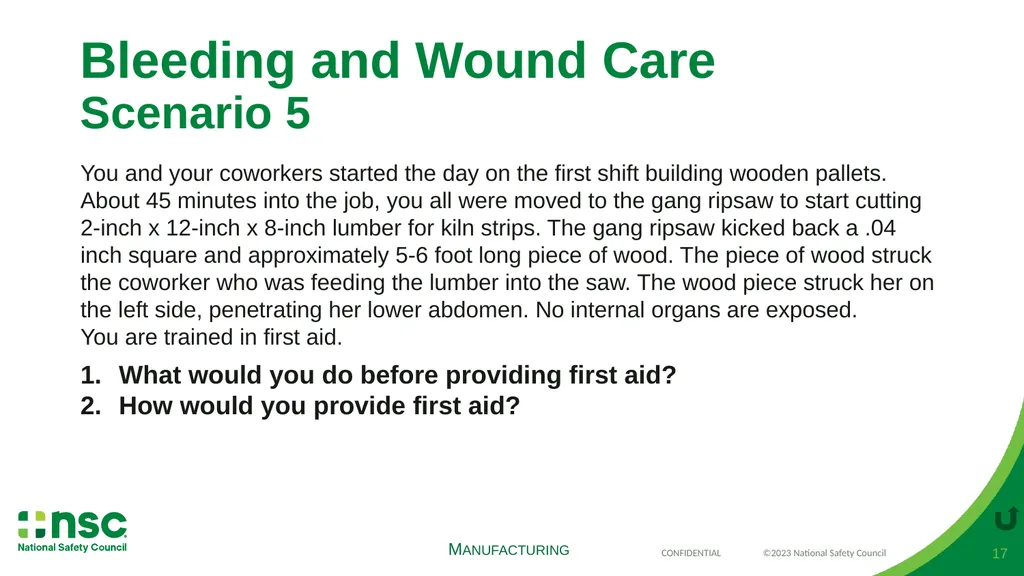
Scenario 5 You and your coworkers started the day on the first shift building wooden pallets. About 45 minutes into the job, you all were moved to the gang ripsaw to start cutting 2-inch x 12-inch x 8-inch lumber for kiln strips. The gang ripsaw kicked back a .04 inch square and approximately 5-6 foot long piece of wood. The piece of wood struck the coworker who was feeding the lumber into the saw. The wood piece struck her on the left side, penetrating her lower abdomen. No internal organs are exposed.
You are trained in first aid.
What would you do before providing first aid?
How would you provide first aid?<br>
You are trained in first aid.
What would you do before providing first aid?
How would you provide first aid?<br>
18
Bleeding and Wound Care
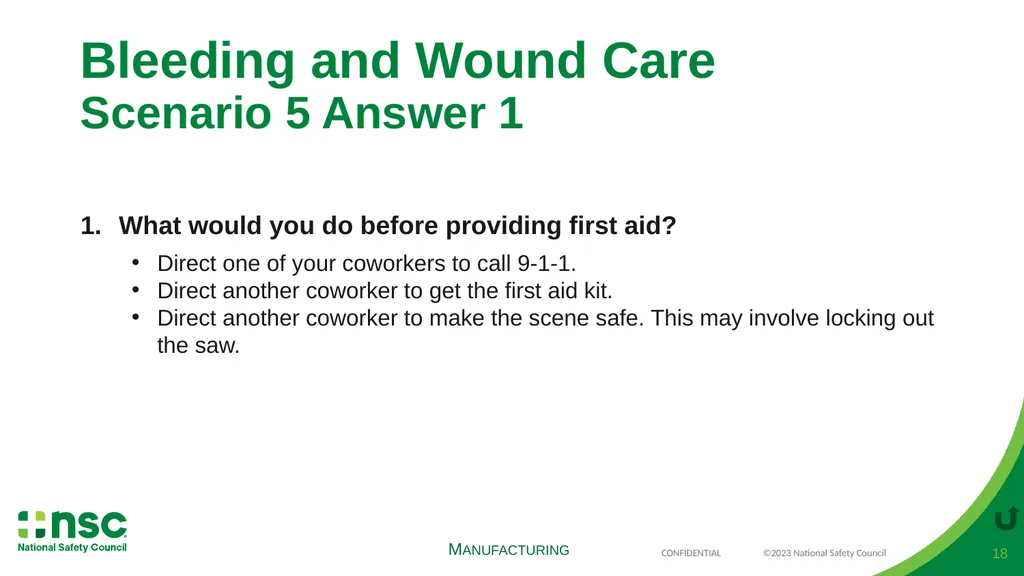
Scenario 5 Answer 1 What would you do before providing first aid?
Direct one of your coworkers to call 9-1-1.
Direct another coworker to get the first aid kit.
Direct another coworker to make the scene safe. This may involve locking out the saw.<br>
Direct one of your coworkers to call 9-1-1.
Direct another coworker to get the first aid kit.
Direct another coworker to make the scene safe. This may involve locking out the saw.<br>
19
Bleeding and Wound Care
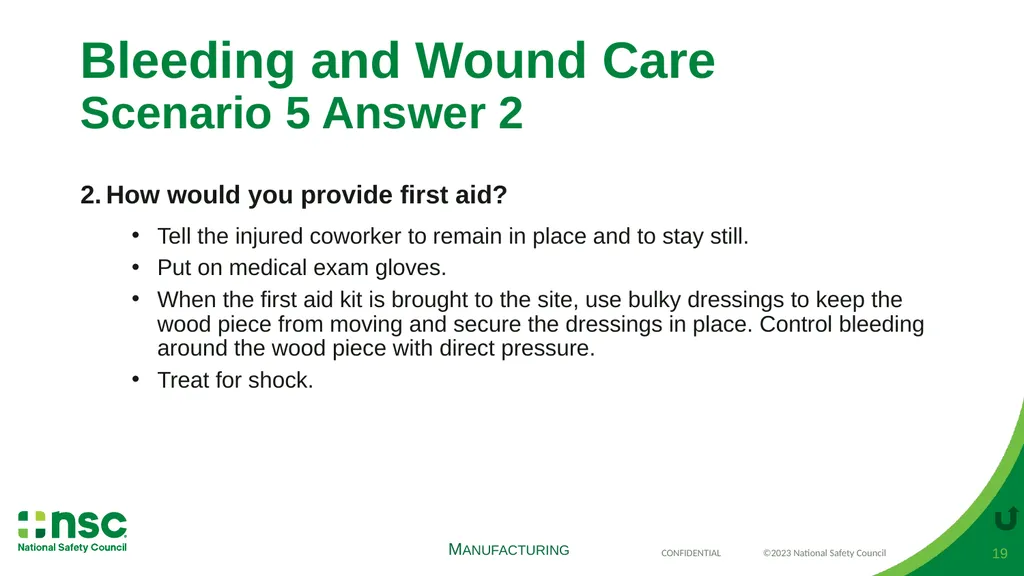
Scenario 5 Answer 2 How would you provide first aid?
Tell the injured coworker to remain in place and to stay still.
Put on medical exam gloves.
When the first aid kit is brought to the site, use bulky dressings to keep the wood piece from moving and secure the dressings in place. Control bleeding around the wood piece with direct pressure.
Treat for shock.<br>
Tell the injured coworker to remain in place and to stay still.
Put on medical exam gloves.
When the first aid kit is brought to the site, use bulky dressings to keep the wood piece from moving and secure the dressings in place. Control bleeding around the wood piece with direct pressure.
Treat for shock.<br>
20
Burns
Scenarios Manufacturing<br>
21
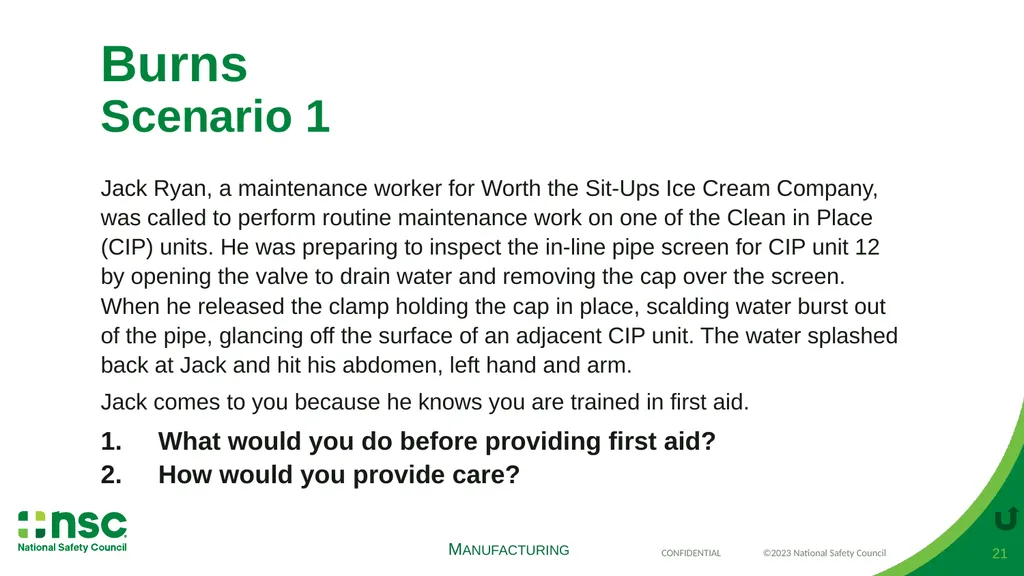
Jack Ryan, a maintenance worker for Worth the Sit-Ups Ice Cream Company, was called to perform routine maintenance work on one of the Clean in Place (CIP) units. He was preparing to inspect the in-line pipe screen for CIP unit 12 by opening the valve to drain water and removing the cap over the screen. When he released the clamp holding the cap in place, scalding water burst out of the pipe, glancing off the surface of an adjacent CIP unit. The water splashed back at Jack and hit his abdomen, left hand and arm.
Jack comes to you because he knows you are trained in first aid.
What would you do before providing first aid?
How would you provide care? Burns Scenario 1<br>
Jack comes to you because he knows you are trained in first aid.
What would you do before providing first aid?
How would you provide care? Burns Scenario 1<br>
22
1. What would you do before providing first aid?
Designate another employee to make the scene around CIP unit 12 safe. This may include locking out the CIP and mopping up water.
Call or have someone call 9-1-1.
Put on medical exam gloves. Burns Scenario 1 Answer 1<br>
Designate another employee to make the scene around CIP unit 12 safe. This may include locking out the CIP and mopping up water.
Call or have someone call 9-1-1.
Put on medical exam gloves. Burns Scenario 1 Answer 1<br>
23
1. How would you provide care?
Quickly get Jack to a source of running water. Apply cool running water to the burn areas.
Treat Jack for shock. Burns Scenario 1 Answer 2<br>
Quickly get Jack to a source of running water. Apply cool running water to the burn areas.
Treat Jack for shock. Burns Scenario 1 Answer 2<br>
24
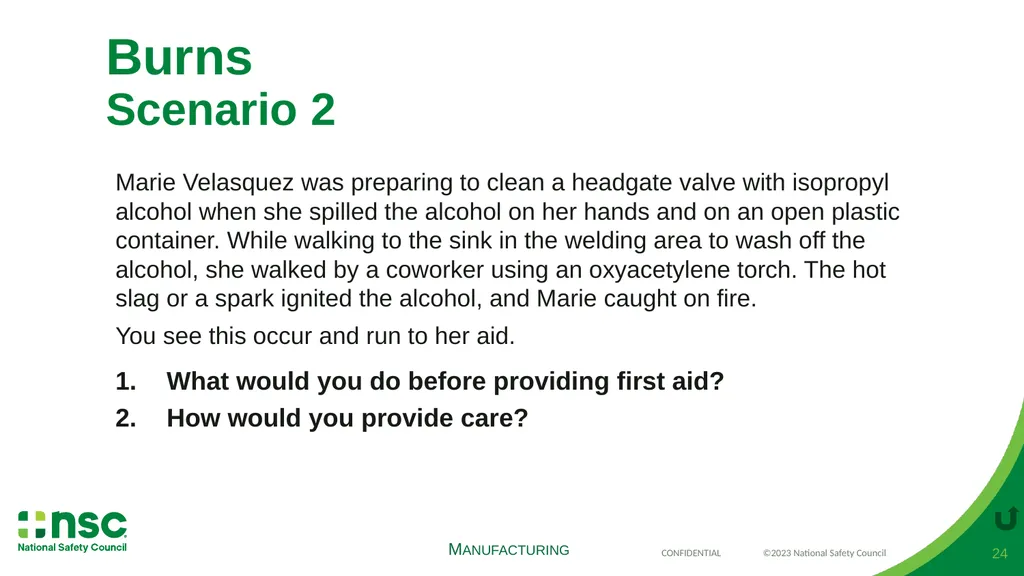
Marie Velasquez was preparing to clean a headgate valve with isopropyl alcohol when she spilled the alcohol on her hands and on an open plastic container. While walking to the sink in the welding area to wash off the alcohol, she walked by a coworker using an oxyacetylene torch. The hot slag or a spark ignited the alcohol, and Marie caught on fire.
You see this occur and run to her aid.
What would you do before providing first aid?
How would you provide care? Burns Scenario 2<br>
You see this occur and run to her aid.
What would you do before providing first aid?
How would you provide care? Burns Scenario 2<br>
25
1. What would you do before providing first aid?
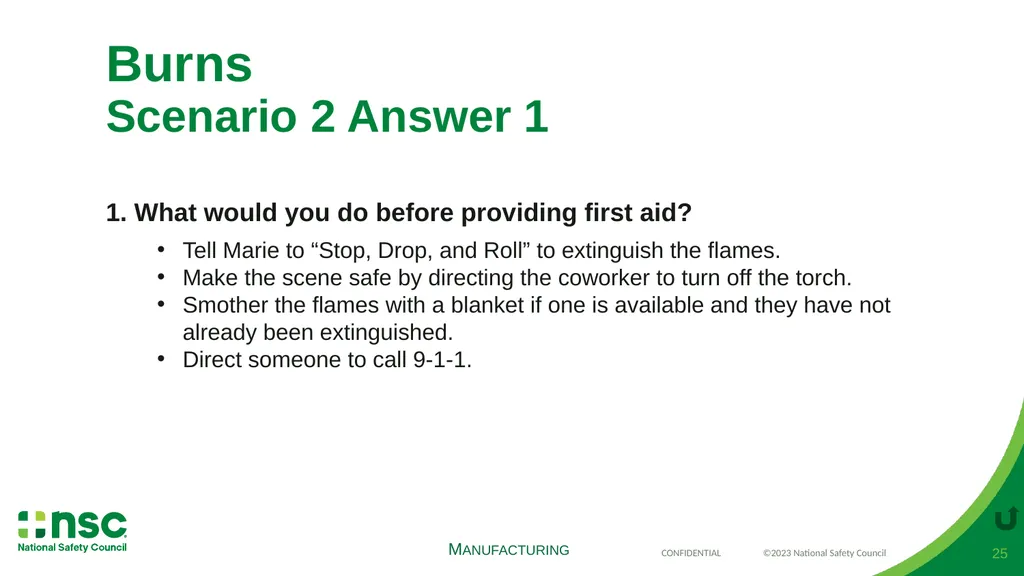
Tell Marie to “Stop, Drop, and Roll” to extinguish the flames.
Make the scene safe by directing the coworker to turn off the torch.
Smother the flames with a blanket if one is available and they have not already been extinguished.
Direct someone to call 9-1-1. Burns Scenario 2 Answer 1<br>
Tell Marie to “Stop, Drop, and Roll” to extinguish the flames.
Make the scene safe by directing the coworker to turn off the torch.
Smother the flames with a blanket if one is available and they have not already been extinguished.
Direct someone to call 9-1-1. Burns Scenario 2 Answer 1<br>
26
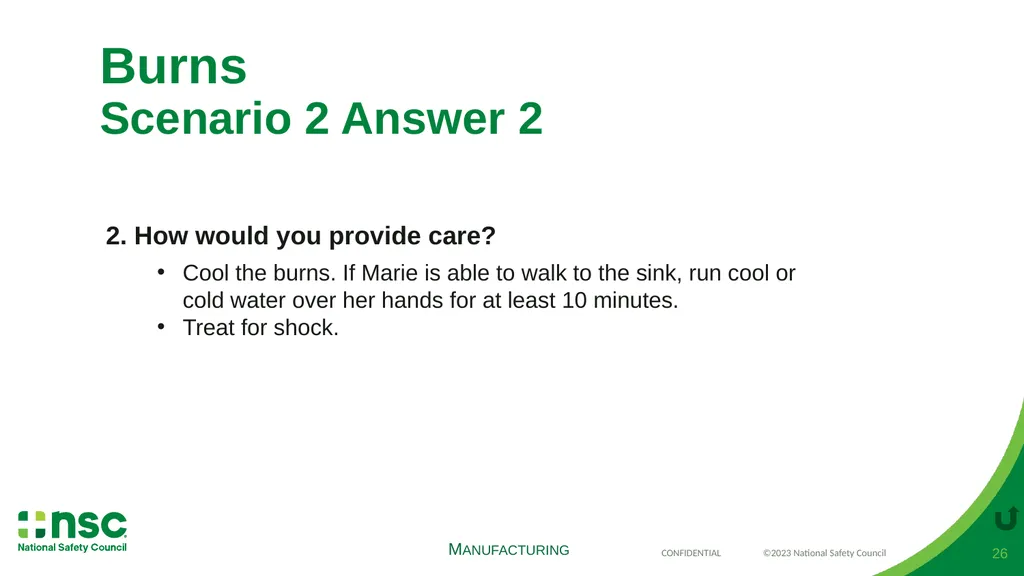
2. How would you provide care?
Cool the burns. If Marie is able to walk to the sink, run cool or cold water over her hands for at least 10 minutes.
Treat for shock. Burns Scenario 2 Answer 2<br>
Cool the burns. If Marie is able to walk to the sink, run cool or cold water over her hands for at least 10 minutes.
Treat for shock. Burns Scenario 2 Answer 2<br>
27
One of your coworkers in the shipping and receiving area was unpacking 2.5 liter bottles of reagent grade 98 sulfuric acid, and transferring the bottles of the acid onto a delivery transport cart. He lost his grip on one of the bottles of acid and dropped it. He then slipped and fell into the acid and broken glass.
You are trained in first aid. You see the incident occur and go over to help.
What would you do before providing first aid?
How would you provide care? Burns Scenario 3<br>
You are trained in first aid. You see the incident occur and go over to help.
What would you do before providing first aid?
How would you provide care? Burns Scenario 3<br>
28
What would you do before providing first aid?
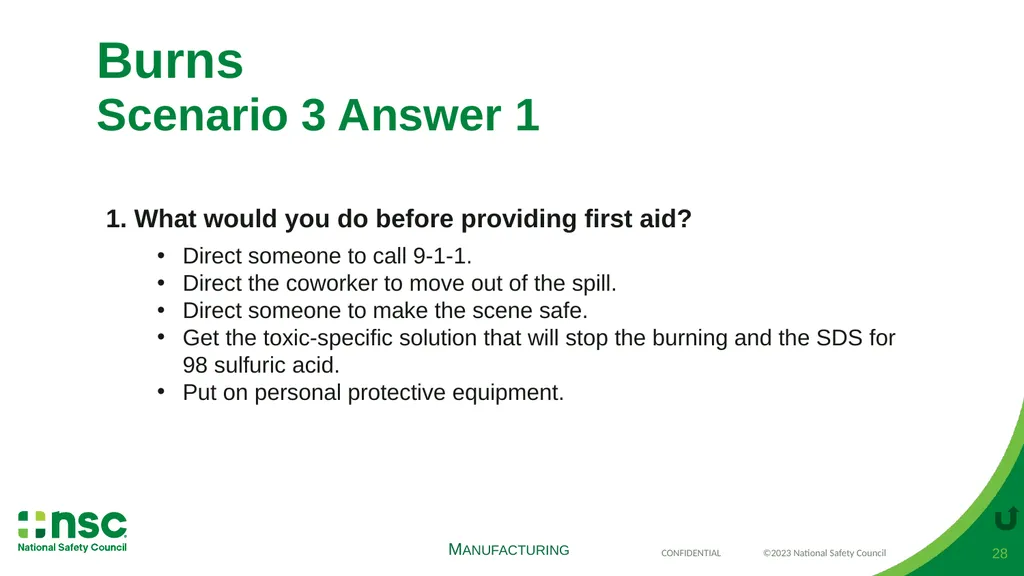
Direct someone to call 9-1-1.
Direct the coworker to move out of the spill.
Direct someone to make the scene safe.
Get the toxic-specific solution that will stop the burning and the SDS for 98 sulfuric acid.
Put on personal protective equipment. Burns Scenario 3 Answer 1<br>
Direct someone to call 9-1-1.
Direct the coworker to move out of the spill.
Direct someone to make the scene safe.
Get the toxic-specific solution that will stop the burning and the SDS for 98 sulfuric acid.
Put on personal protective equipment. Burns Scenario 3 Answer 1<br>
29
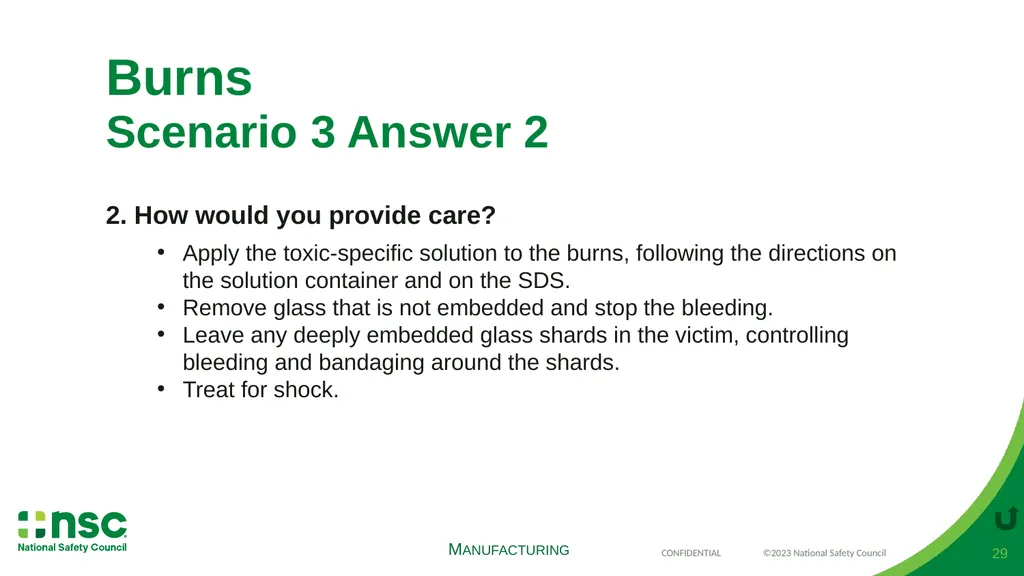
2. How would you provide care?
Apply the toxic-specific solution to the burns, following the directions on the solution container and on the SDS.
Remove glass that is not embedded and stop the bleeding.
Leave any deeply embedded glass shards in the victim, controlling bleeding and bandaging around the shards.
Treat for shock. Burns Scenario 3 Answer 2<br>
Apply the toxic-specific solution to the burns, following the directions on the solution container and on the SDS.
Remove glass that is not embedded and stop the bleeding.
Leave any deeply embedded glass shards in the victim, controlling bleeding and bandaging around the shards.
Treat for shock. Burns Scenario 3 Answer 2<br>
30
Bone, Joint and Muscle Injuries Scenarios Manufacturing<br>
31
Three employees of the ABC Manufacturing Company were dismantling a vertical storage carousel to move it to another building. After removing 18 of the 39 rotating shelving units, the storage carousel became unbalanced. All 3 employees tried to balance the remaining shelving units by sitting on them. When one of the employees activated the carousel, the shelving units rotated and all 3 employees were thrown to the floor.
A witness summoned the medical emergency response team to the scene. You are the first of the response team to arrive. As you approach, you see that all 3 employees are responsive. They are complaining of pain in their shoulders and arms.
What would you do before providing first aid?
How would you provide care? Bone, Joint and Muscle Injuries Scenario 1<br>
A witness summoned the medical emergency response team to the scene. You are the first of the response team to arrive. As you approach, you see that all 3 employees are responsive. They are complaining of pain in their shoulders and arms.
What would you do before providing first aid?
How would you provide care? Bone, Joint and Muscle Injuries Scenario 1<br>
32
What would you do before providing first aid?
Call 9-1-1.
Make the scene safe to enter. This may include locking out the carousel. Bone, Joint and Muscle Injuries Scenario 1 Answer 1<br>
Call 9-1-1.
Make the scene safe to enter. This may include locking out the carousel. Bone, Joint and Muscle Injuries Scenario 1 Answer 1<br>
33
How would you provide care?
Tell all 3 employees to remain in place so that they can be examined for injuries.
Conduct a physical examination on each of the 3 employees, focusing on the areas they are complaining about, and treat accordingly.
If you note deformity in any of the extremities:
If you expect EMS to arrive in less than 30 minutes, allow the employee involved to self-splint the injured side with their uninjured arm.
If EMS will be delayed, use a rigid splint to immobilize arm injuries, and apply a sling for arm and shoulder injuries.
Be prepared to treat for shock. Bone, Joint and Muscle Injuries Scenario 1 Answer 2<br>
Tell all 3 employees to remain in place so that they can be examined for injuries.
Conduct a physical examination on each of the 3 employees, focusing on the areas they are complaining about, and treat accordingly.
If you note deformity in any of the extremities:
If you expect EMS to arrive in less than 30 minutes, allow the employee involved to self-splint the injured side with their uninjured arm.
If EMS will be delayed, use a rigid splint to immobilize arm injuries, and apply a sling for arm and shoulder injuries.
Be prepared to treat for shock. Bone, Joint and Muscle Injuries Scenario 1 Answer 2<br>
34
Jordan Walsh, a horizontal engine lathe operator, was measuring a hole in a part being machined when her knee struck the brake. This engaged the lathe and caused the part to turn. This, in turn, caused her arm to become caught.
You are trained in first aid. When you arrive at the scene, Jordan is responsive and breathing, and her arm is no longer caught in the lathe. You observe several lacerations on her arms and one of her arms is severely deformed.
What would you do before providing first aid?
How would you provide first aid? Bone, Joint and Muscle Injuries Scenario 2<br>
You are trained in first aid. When you arrive at the scene, Jordan is responsive and breathing, and her arm is no longer caught in the lathe. You observe several lacerations on her arms and one of her arms is severely deformed.
What would you do before providing first aid?
How would you provide first aid? Bone, Joint and Muscle Injuries Scenario 2<br>
35
What would you do before providing first aid?
Call or have a coworker call 9-1-1.
Direct a coworker to make the scene safe. This may include locking out the lathe.
Direct another coworker to bring the first aid kit. Bone, Joint and Muscle Injuries Scenario 2 Answer 1<br>
Call or have a coworker call 9-1-1.
Direct a coworker to make the scene safe. This may include locking out the lathe.
Direct another coworker to bring the first aid kit. Bone, Joint and Muscle Injuries Scenario 2 Answer 1<br>
36
How would you provide first aid?
Put on medical exam gloves.
Do a head-to-toe exam to determine if there are other injuries. Avoid touching the deformed area of the arm.
Control bleeding with direct pressure on the arm that is not deformed. For the deformed arm, tell Jordan to keep it still. EMS will likely splint it when they arrive.
Treat for shock. Bone, Joint and Muscle Injuries Scenario 2 Answer 2<br>
Put on medical exam gloves.
Do a head-to-toe exam to determine if there are other injuries. Avoid touching the deformed area of the arm.
Control bleeding with direct pressure on the arm that is not deformed. For the deformed arm, tell Jordan to keep it still. EMS will likely splint it when they arrive.
Treat for shock. Bone, Joint and Muscle Injuries Scenario 2 Answer 2<br>
37
Sudden Illness
Scenarios Manufacturing<br>
38
Emil Johnson drives a tractor-trailer for Goodwin Manufacturing Company. Emil is loading some equipment onto a flatbed trailer at a satellite building, a half mile east of the main plant. You are the foreman of the satellite building, and you come onto the dock area to help him. After about 15 minutes, Emil begins wheezing, and he is having difficulty breathing. When you ask him if he is okay, he tells you that he has asthma.
You know that a grain handling facility is located on the south end of the satellite building site and suspect that grain dust in the air may be causing Emil to have an asthma attack.
What would you do before providing first aid?
How would you provide care? Sudden Illness Scenario 1<br>
You know that a grain handling facility is located on the south end of the satellite building site and suspect that grain dust in the air may be causing Emil to have an asthma attack.
What would you do before providing first aid?
How would you provide care? Sudden Illness Scenario 1<br>
39
What would you do before providing first aid?
Move Emil inside the building, out of the outside air. Sudden Illness Scenario 1 Answer 1<br>
Move Emil inside the building, out of the outside air. Sudden Illness Scenario 1 Answer 1<br>
40
Sudden Illness
Scenario 1 Answer 2 How would you provide care?
Have Emil sit in a position for easiest breathing.
Ask him if he has an inhaler. If so, get the inhaler and help him to use it. If not, call 9-1-1.
Retrieve Emil’s inhaler and help him use it.
Remove the cap.
Shake the inhaler several times.
Connect the spacer if he uses one.
Allow him to use the inhaler (1 or 2 puffs, as prescribed). Remind him to hold his breath with the medication for about 10 seconds.
If breathing difficulty persists after use of the inhaler, call 9-1-1.<br>
Have Emil sit in a position for easiest breathing.
Ask him if he has an inhaler. If so, get the inhaler and help him to use it. If not, call 9-1-1.
Retrieve Emil’s inhaler and help him use it.
Remove the cap.
Shake the inhaler several times.
Connect the spacer if he uses one.
Allow him to use the inhaler (1 or 2 puffs, as prescribed). Remind him to hold his breath with the medication for about 10 seconds.
If breathing difficulty persists after use of the inhaler, call 9-1-1.<br>
41
Cold and Heat Injuries
Scenarios Manufacturing<br>
42
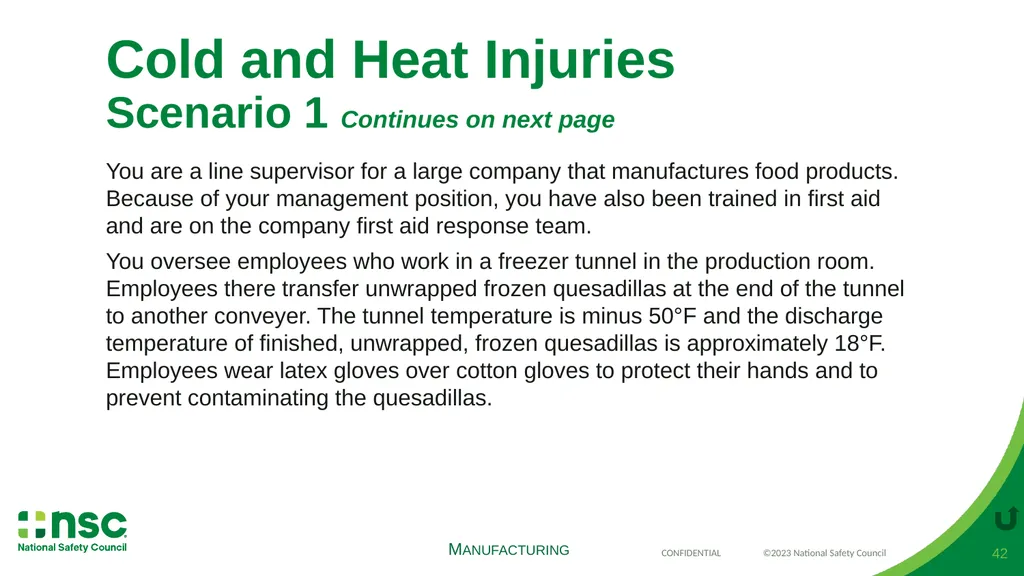
You are a line supervisor for a large company that manufactures food products. Because of your management position, you have also been trained in first aid and are on the company first aid response team.
You oversee employees who work in a freezer tunnel in the production room. Employees there transfer unwrapped frozen quesadillas at the end of the tunnel to another conveyer. The tunnel temperature is minus 50°F and the discharge temperature of finished, unwrapped, frozen quesadillas is approximately 18°F. Employees wear latex gloves over cotton gloves to protect their hands and to prevent contaminating the quesadillas. Cold and Heat Injuries Scenario 1 Continues on next page<br>
You oversee employees who work in a freezer tunnel in the production room. Employees there transfer unwrapped frozen quesadillas at the end of the tunnel to another conveyer. The tunnel temperature is minus 50°F and the discharge temperature of finished, unwrapped, frozen quesadillas is approximately 18°F. Employees wear latex gloves over cotton gloves to protect their hands and to prevent contaminating the quesadillas. Cold and Heat Injuries Scenario 1 Continues on next page<br>
43
One of your employees comes to you on her break. She asks you to look at her left hand, especially the middle finger, because the finger feels exceptionally cold. You ask her what occurred on the line to cause this, and she says she thinks her middle finger touches the hard, cold surface at the end of the tunnel when she picks up the quesadillas. You examine the finger and see that it looks white and waxy.
What would you do before providing first aid?
How would you provide care? Cold and Heat Injuries Scenario 1 Continued<br>
What would you do before providing first aid?
How would you provide care? Cold and Heat Injuries Scenario 1 Continued<br>
44
What would you do before providing first aid?
Have her sit down in an area out of the cold while you get the first aid kit.
Put on medical exam gloves. Cold and Heat Injuries Scenario 1 Answer 1<br>
Have her sit down in an area out of the cold while you get the first aid kit.
Put on medical exam gloves. Cold and Heat Injuries Scenario 1 Answer 1<br>
45
How would you provide care?
Protect the area between the fingers with dry gauze.
Wrap the hand loosely in gauze to protect the area, and then elevate it.
Obtain outside medical assistance from an urgent care center or the closest emergency department. Cold and Heat Injuries Scenario 1 Answer 2<br>
Protect the area between the fingers with dry gauze.
Wrap the hand loosely in gauze to protect the area, and then elevate it.
Obtain outside medical assistance from an urgent care center or the closest emergency department. Cold and Heat Injuries Scenario 1 Answer 2<br>
46
CPR and AED
Scenarios Manufacturing<br>
47
CPR and AED
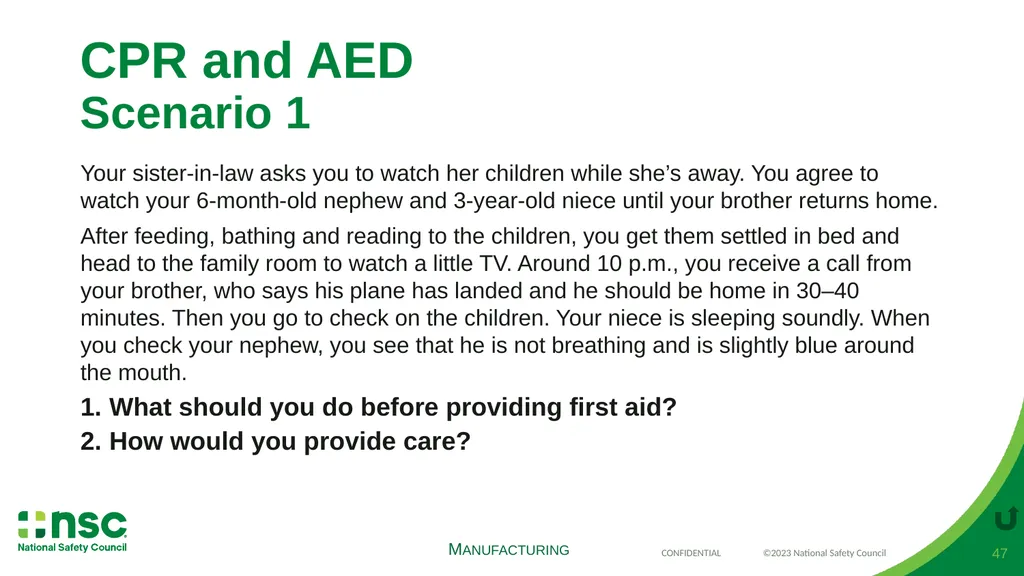
Scenario 1 Your sister-in-law asks you to watch her children while she’s away. You agree to watch your 6-month-old nephew and 3-year-old niece until your brother returns home.
After feeding, bathing and reading to the children, you get them settled in bed and head to the family room to watch a little TV. Around 10 p.m., you receive a call from your brother, who says his plane has landed and he should be home in 30–40 minutes. Then you go to check on the children. Your niece is sleeping soundly. When you check your nephew, you see that he is not breathing and is slightly blue around the mouth.
What should you do before providing first aid?
How would you provide care?<br>
After feeding, bathing and reading to the children, you get them settled in bed and head to the family room to watch a little TV. Around 10 p.m., you receive a call from your brother, who says his plane has landed and he should be home in 30–40 minutes. Then you go to check on the children. Your niece is sleeping soundly. When you check your nephew, you see that he is not breathing and is slightly blue around the mouth.
What should you do before providing first aid?
How would you provide care?<br>
48
CPR and AED
Scenario 1 Answer 1 What should you do before providing first aid?
Remove the infant from the crib and put him on a firm, flat surface.<br>
Remove the infant from the crib and put him on a firm, flat surface.<br>
49
CPR and AED
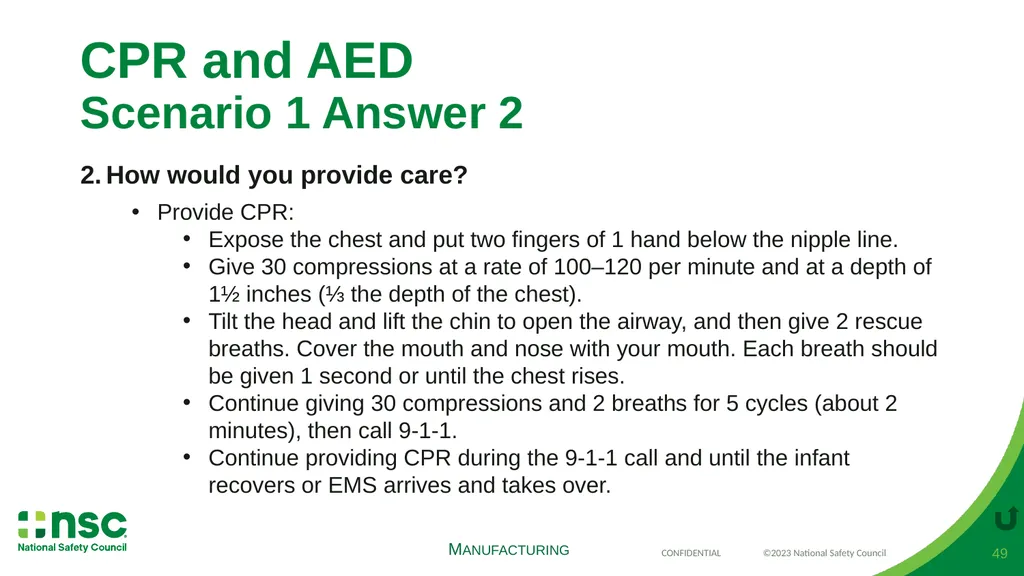
Scenario 1 Answer 2 How would you provide care?
Provide CPR:
Expose the chest and put two fingers of 1 hand below the nipple line.
Give 30 compressions at a rate of 100–120 per minute and at a depth of 1½ inches (⅓ the depth of the chest).
Tilt the head and lift the chin to open the airway, and then give 2 rescue breaths. Cover the mouth and nose with your mouth. Each breath should be given 1 second or until the chest rises.
Continue giving 30 compressions and 2 breaths for 5 cycles (about 2 minutes), then call 9-1-1.
Continue providing CPR during the 9-1-1 call and until the infant recovers or EMS arrives and takes over.<br>
Provide CPR:
Expose the chest and put two fingers of 1 hand below the nipple line.
Give 30 compressions at a rate of 100–120 per minute and at a depth of 1½ inches (⅓ the depth of the chest).
Tilt the head and lift the chin to open the airway, and then give 2 rescue breaths. Cover the mouth and nose with your mouth. Each breath should be given 1 second or until the chest rises.
Continue giving 30 compressions and 2 breaths for 5 cycles (about 2 minutes), then call 9-1-1.
Continue providing CPR during the 9-1-1 call and until the infant recovers or EMS arrives and takes over.<br>
50
Choking
Scenarios Manufacturing<br>
51
On the last working day of every month, the owner of J & K Manufacturing brings in lunch and a large cake to celebrate employee birthdays that fell during the month. Today is “birthday lunch day,” and the staff is in the cafeteria, enjoying pizza and salad.
One of your team members who has been eating rather quickly begins to cough. As her coughing continues, she stands up to go to the restroom. You know first aid and suspect that she may need help.
What would you do before providing first aid?
How would you provide care?
If he becomes unresponsive, how would you provide care? Choking Scenario 1<br>
One of your team members who has been eating rather quickly begins to cough. As her coughing continues, she stands up to go to the restroom. You know first aid and suspect that she may need help.
What would you do before providing first aid?
How would you provide care?
If he becomes unresponsive, how would you provide care? Choking Scenario 1<br>
52
What would you do before providing first aid?
Approach her and ask if she is choking. Choking Scenario 1 Answer 1<br>
Approach her and ask if she is choking. Choking Scenario 1 Answer 1<br>
53
Choking
Scenario 1 Answer 2 How would you provide care?
If she can speak, encourage continued coughing to clear the object.
If she cannot speak and is not coughing, ask if you can help. Direct someone to call 9-1-1 and then give abdominal thrusts.
Stand behind her with one leg forward between her legs.
Reach around her abdomen and locate her navel with a finger from 1 hand.
Make a fist with the other hand and place the thumb side of the fist against her abdomen, just above the navel.
Grasp your fist with your other hand and thrust inward and upward into his abdomen with quick thrusts.
Continue thrusts until she expels the object or becomes unresponsive.<br>
If she can speak, encourage continued coughing to clear the object.
If she cannot speak and is not coughing, ask if you can help. Direct someone to call 9-1-1 and then give abdominal thrusts.
Stand behind her with one leg forward between her legs.
Reach around her abdomen and locate her navel with a finger from 1 hand.
Make a fist with the other hand and place the thumb side of the fist against her abdomen, just above the navel.
Grasp your fist with your other hand and thrust inward and upward into his abdomen with quick thrusts.
Continue thrusts until she expels the object or becomes unresponsive.<br>
54
If he becomes unresponsive, how would you provide care?
Direct someone to call 9-1-1 if not already called.
Lower him to the ground, expose her chest, and start CPR with 30 chest compressions.
Look inside the mouth each time you open the airway to give breaths, and remove any object seen. Choking Scenario 1 Answer 3<br>
Direct someone to call 9-1-1 if not already called.
Lower him to the ground, expose her chest, and start CPR with 30 chest compressions.
Look inside the mouth each time you open the airway to give breaths, and remove any object seen. Choking Scenario 1 Answer 3<br>
55
Joe and his 5-year-old son Josh went to the shop foreman’s office to pick up his paycheck. While Joe and his boss chatted, Josh went to get a treat from the candy jar on the foreman’s desk.
As Joe gets ready to leave the office, he calls out for Josh. As Josh runs toward his dad with a mouth full of candy, he begins coughing. Suddenly, Josh stops coughing and looks panicked.
You know first aid and happen to be in the room.
What would you do before providing first aid?
How would you provide care? Choking Scenario 2<br>
As Joe gets ready to leave the office, he calls out for Josh. As Josh runs toward his dad with a mouth full of candy, he begins coughing. Suddenly, Josh stops coughing and looks panicked.
You know first aid and happen to be in the room.
What would you do before providing first aid?
How would you provide care? Choking Scenario 2<br>
56
What would you do before providing first aid?
Ask him if he can speak. Choking Scenario 2 Answer 1<br>
Ask him if he can speak. Choking Scenario 2 Answer 1<br>
57
Choking
Scenario 2 Answer 2 How would you provide care?
If the child cannot speak, give abdominal thrusts:
Kneel or stand behind him and reach around his abdomen.
Locate his navel with a finger from 1 hand.
Make a fist with the other hand and place the thumb side of the fist against his abdomen, just above the navel.
Grasp your fist with your other hand and thrust inward and upward into his abdomen with quick thrusts.
Continue thrusts until he expels the object or becomes unresponsive.
If he becomes unresponsive, direct the boss to call 9-1-1.
Give CPR. Lower him to the ground, expose his chest, place the heel of 1 hand on the center of his chest and start CPR with 30 chest compressions. Look inside the mouth each time you open the airway to give breaths, and remove any object seen.<br>
If the child cannot speak, give abdominal thrusts:
Kneel or stand behind him and reach around his abdomen.
Locate his navel with a finger from 1 hand.
Make a fist with the other hand and place the thumb side of the fist against his abdomen, just above the navel.
Grasp your fist with your other hand and thrust inward and upward into his abdomen with quick thrusts.
Continue thrusts until he expels the object or becomes unresponsive.
If he becomes unresponsive, direct the boss to call 9-1-1.
Give CPR. Lower him to the ground, expose his chest, place the heel of 1 hand on the center of his chest and start CPR with 30 chest compressions. Look inside the mouth each time you open the airway to give breaths, and remove any object seen.<br>