
Case Scenarios for Customizing Your Training These
DP
Published · 60 slides · 0 views
1 / 1








Description
Case Scenarios for Customizing Your Training These materials provide NSC authorized instructors with industry-specific case scenarios to help reinforce learning throughout the content delivered. Case Scenarios Customize your first aid
Related Topics
Share
Embed code
Download this presentation From Below
"Case Scenarios for Customizing Your Training These" is the property of its rightful owner. Permission is granted to download and print the materials on this website for personal, non-commercial use only, and to display it on your personal computer provided you do not modify the materials and that you retain all copyright notices contained in the materials. By downloading content from our website, you accept the terms of this agreement.
Presentation Transcript
01
Case Scenarios for Customizing Your Training These materials provide NSC authorized instructors with industry-specific case scenarios to help reinforce learning throughout the content delivered.
Case Scenarios
Customize your first aid training sessions using case scenarios. You’ll find relevant first aid situations that will resonate with your training audience. Each slide deck is organized by Industry. Within the slide decks, you’ll find content to support a variety of first aid situations that participants may encounter.
Scenario Guide
Slide 3 is an interactive guide to first aid situation slides. With the presentation in Slide Show mode, each title is linked to that topic section. You’ll find a in the lower right corner of each slide that will bring you back to the Scenario guide.<br>
Case Scenarios
Customize your first aid training sessions using case scenarios. You’ll find relevant first aid situations that will resonate with your training audience. Each slide deck is organized by Industry. Within the slide decks, you’ll find content to support a variety of first aid situations that participants may encounter.
Scenario Guide
Slide 3 is an interactive guide to first aid situation slides. With the presentation in Slide Show mode, each title is linked to that topic section. You’ll find a in the lower right corner of each slide that will bring you back to the Scenario guide.<br>
02
FA/CPR/AED Case Scenarios
ELECTRICAL UTILITY Use to customize your First Aid Training
for your audience<br>
for your audience<br>
03
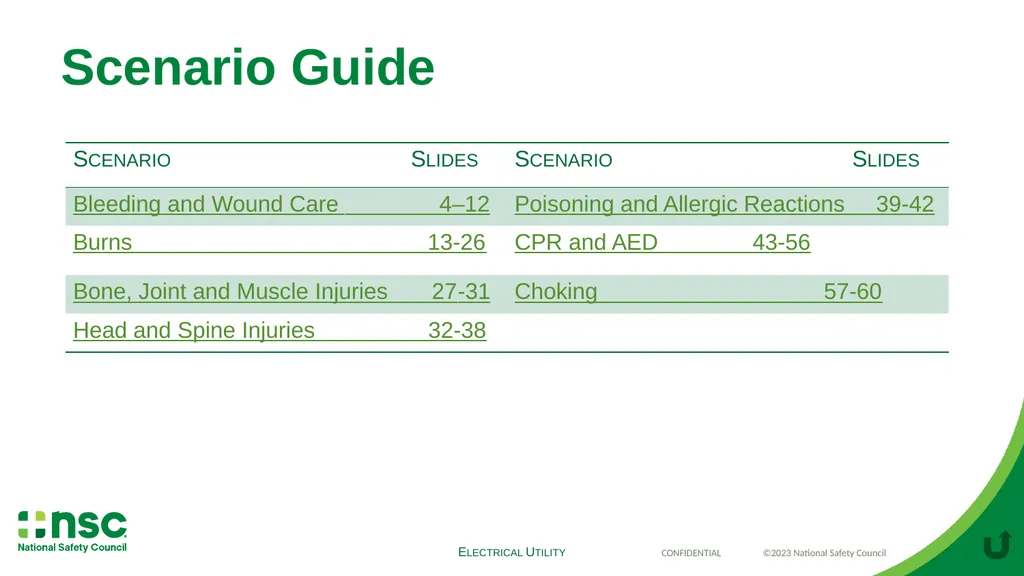
Scenario Guide<br>
04
Bleeding and Wound Care Scenarios Electrical Utility<br>
05
Bleeding and Wound Care
Scenario 1 An electrician opened a breaker access door and reached into the equipment. The breaker operated, unexpectedly pinching the electrician’s hand. As a result, the tips of 3 fingers on the right hand were amputated. While working at the job site, you are asked to render first aid. You retrieve your first aid kit. The victim is responsive.
What would you do before providing first aid?
How would you provide care?
What would you do after the worker has been transported by EMS?<br>
What would you do before providing first aid?
How would you provide care?
What would you do after the worker has been transported by EMS?<br>
06
Bleeding and Wound Care
Scenario 1 Answer 1 What would you do before providing first aid?
Make sure the scene is safe.
Make sure 9-1-1 has been called.
Put on medical exam gloves.<br>
Make sure the scene is safe.
Make sure 9-1-1 has been called.
Put on medical exam gloves.<br>
07
Bleeding and Wound Care
Scenario 1 Answer 2 How would you provide care?
Stop the bleeding with direct pressure.
Dress and bandage the fingers.
Pick up and wrap each of the partially amputated fingers with a dry, sterile dressing. Put them in a plastic, zip lock bag and seal it.
Place the plastic bag inside another bag or container with ice. Be careful not to let the parts touch ice directly or be surrounded with ice.
Give the severed finger tips to emergency personnel who transport the worker.<br>
Stop the bleeding with direct pressure.
Dress and bandage the fingers.
Pick up and wrap each of the partially amputated fingers with a dry, sterile dressing. Put them in a plastic, zip lock bag and seal it.
Place the plastic bag inside another bag or container with ice. Be careful not to let the parts touch ice directly or be surrounded with ice.
Give the severed finger tips to emergency personnel who transport the worker.<br>
08
What would you do after the worker has been transported by EMS?
Arrange for the blood on the equipment, floor area, etc., to be cleaned up properly, either with a spill kit or with a 10% bleach solution.
Report the incident to your supervisor. Bleeding and Wound Care Scenario 1 Answer 3<br>
Arrange for the blood on the equipment, floor area, etc., to be cleaned up properly, either with a spill kit or with a 10% bleach solution.
Report the incident to your supervisor. Bleeding and Wound Care Scenario 1 Answer 3<br>
09
Bleeding and Wound Care
Scenario 2 You are a power line worker and part of a 4-employee crew. The crew is assembling the tools and equipment needed to replace a transformer on a utility pole.
The crew foreman checked the equipment in the back of his 1-ton digger-derrick, got in, and started backing up to the warehouse where one of the crew was gathering materials for the job. As the foreman neared the warehouse he felt a bump under the truck. Not knowing what it was, he got out and found the employee under the truck.
You heard the bump and the employee’s screams and arrived at the incident site before the foreman got out of the truck. You notice that the victim has a laceration to the left upper leg and crushing injuries to the pelvis and lower abdomen.
What would you do before providing first aid?
How would you provide care?<br>
The crew foreman checked the equipment in the back of his 1-ton digger-derrick, got in, and started backing up to the warehouse where one of the crew was gathering materials for the job. As the foreman neared the warehouse he felt a bump under the truck. Not knowing what it was, he got out and found the employee under the truck.
You heard the bump and the employee’s screams and arrived at the incident site before the foreman got out of the truck. You notice that the victim has a laceration to the left upper leg and crushing injuries to the pelvis and lower abdomen.
What would you do before providing first aid?
How would you provide care?<br>
10
Bleeding and Wound Care
Scenario 2 Answer 1 What would you do before providing first aid?
Direct one of the crew to call 9-1-1 and get the first aid kit.
Make sure the scene is safe. Direct the foreman to secure the vehicle.
Put on medical exam gloves.<br>
Direct one of the crew to call 9-1-1 and get the first aid kit.
Make sure the scene is safe. Direct the foreman to secure the vehicle.
Put on medical exam gloves.<br>
11
How would you provide care?
Do not move the victim and direct them to remain still.
First check the victim for any life threats and care for them. If no threats to life are present, to the extent possible, do a head-to-toe assessment, looking for deformities, open wounds, tenderness and swelling.
Apply direct pressure to a dressing over the wound to control bleeding.
Re-evaluate the bleeding. If direct pressure does not control the bleeding and you have a hemostatic dressing, remove dressings already used and apply the hemostatic dressing directly on the wound using direct pressure. Bleeding and Wound Care Scenario 2 Answer 2 Continues on next page<br>
Do not move the victim and direct them to remain still.
First check the victim for any life threats and care for them. If no threats to life are present, to the extent possible, do a head-to-toe assessment, looking for deformities, open wounds, tenderness and swelling.
Apply direct pressure to a dressing over the wound to control bleeding.
Re-evaluate the bleeding. If direct pressure does not control the bleeding and you have a hemostatic dressing, remove dressings already used and apply the hemostatic dressing directly on the wound using direct pressure. Bleeding and Wound Care Scenario 2 Answer 2 Continues on next page<br>
12
If a hemostatic dressing is not available, continue to apply direct pressure. If blood soaks through the first dressing, place additional dressings on top of the blood-soaked dressing and keep applying pressure.
If needed, apply a pressure bandage.
Treat for shock by covering the victim with a blanket.
Monitor breathing and be prepared to give basic life support. Bleeding and Wound Care Scenario 2 Answer 2 Continued<br>
If needed, apply a pressure bandage.
Treat for shock by covering the victim with a blanket.
Monitor breathing and be prepared to give basic life support. Bleeding and Wound Care Scenario 2 Answer 2 Continued<br>
13
Burns
Scenarios Electrical Utility<br>
14
A distribution line crew is replacing a damaged insulator on a wood pole. The pole supports a three-phase 12-kV line. A lineworker on the crew removed the 12-kV conductor from the damaged insulator. As she raised the phase conductor from the insulator, it contacted an adjacent phase conductor, causing an electrical arc. The ensuing electric arc burned the lineworker, and she is yelling for you to lower her to the ground.
You are on the crew and are trained in first aid.
What would you do before providing first aid?
How would you provide care? Burns Scenario 1<br>
You are on the crew and are trained in first aid.
What would you do before providing first aid?
How would you provide care? Burns Scenario 1<br>
15
What would you do before providing first aid?
Make the scene safe and slowly bring the bucket down so the worker’s injuries can be assessed.
Call or have another crew member call 9-1-1.
Put on medical exam gloves. Burns Scenario 1 Answer 1<br>
Make the scene safe and slowly bring the bucket down so the worker’s injuries can be assessed.
Call or have another crew member call 9-1-1.
Put on medical exam gloves. Burns Scenario 1 Answer 1<br>
16
How would you provide care?
If the lineworker remains responsive and breathing:
Monitor her breathing and be prepared to provide CPR if breathing stops.
Monitor for shock and treat accordingly.
Immediately cool the burn with running cool or cold potable water, such as tap water, for at least 10 minutes.
Cover with a non-stick gauze and bandage lightly.
If the lineworker becomes unresponsive and is breathing normally:
Put her in the recovery position and monitor her until EMS arrives.
Monitor her breathing and be prepared to provide CPR if breathing stops.
Monitor for shock and treat accordingly. Burns Scenario 1 Answer 2<br>
If the lineworker remains responsive and breathing:
Monitor her breathing and be prepared to provide CPR if breathing stops.
Monitor for shock and treat accordingly.
Immediately cool the burn with running cool or cold potable water, such as tap water, for at least 10 minutes.
Cover with a non-stick gauze and bandage lightly.
If the lineworker becomes unresponsive and is breathing normally:
Put her in the recovery position and monitor her until EMS arrives.
Monitor her breathing and be prepared to provide CPR if breathing stops.
Monitor for shock and treat accordingly. Burns Scenario 1 Answer 2<br>
17
John Ford, an employee of the City Water & Power Company, was working in an underground electrical vault to remove a temporary electrical conductor from an energized electrical line. After John removed the temporary conductor, he replaced the protective plastic cover over the bundle of conductors and began to secure the cover to the bundle. While he was securing the cover, his left middle finger, right palm and right forearm inadvertently made contact between the energized conductor and a ground source. As a result, he received serious burns to his finger, palm and forearm. All of these areas appear black and charred.
You are part of the crew working in this area and are trained in first aid.
What would you do before providing first aid?
How would you provide care? Burns Scenario 2<br>
You are part of the crew working in this area and are trained in first aid.
What would you do before providing first aid?
How would you provide care? Burns Scenario 2<br>
18
What would you do before providing first aid?
Make sure the scene is safe.
Call or have another crew member call 9-1-1.
Put on medical exam gloves. Burns Scenario 2 Answer 1<br>
Make sure the scene is safe.
Call or have another crew member call 9-1-1.
Put on medical exam gloves. Burns Scenario 2 Answer 1<br>
19
How would you provide care?
Check for responsiveness and normal breathing.
If John is responsive and breathing normally:
Immediately cool the burn with running cool or cold potable water, such as tap water, for at least 10 minutes.
Cover with non-stick gauze and bandage lightly.
Monitor his breathing and be prepared to provide CPR if breathing stops.
Monitor for shock and treat accordingly. Burns Scenario 2 Answer 2 Continues on next page<br>
Check for responsiveness and normal breathing.
If John is responsive and breathing normally:
Immediately cool the burn with running cool or cold potable water, such as tap water, for at least 10 minutes.
Cover with non-stick gauze and bandage lightly.
Monitor his breathing and be prepared to provide CPR if breathing stops.
Monitor for shock and treat accordingly. Burns Scenario 2 Answer 2 Continues on next page<br>
20
If John is unresponsive and breathing:
Immediately cool the burn with running cool or cold potable water, such as tap water, for at least 10 minutes.
Cover with non-stick gauze and bandage lightly.
Monitor his breathing and be prepared to provide CPR if breathing stops.
Monitor for shock and treat accordingly.
If John is unresponsive and not breathing normally:
Provide conventional CPR beginning with chest compressions. Provide CPR until an AED arrives and is ready to use.
When the AED is ready to use, apply the pads and follow the prompts.
Continue providing CPR and using the AED until EMS arrives and takes over. Burns Scenario 2 Answer 2 Continued<br>
Immediately cool the burn with running cool or cold potable water, such as tap water, for at least 10 minutes.
Cover with non-stick gauze and bandage lightly.
Monitor his breathing and be prepared to provide CPR if breathing stops.
Monitor for shock and treat accordingly.
If John is unresponsive and not breathing normally:
Provide conventional CPR beginning with chest compressions. Provide CPR until an AED arrives and is ready to use.
When the AED is ready to use, apply the pads and follow the prompts.
Continue providing CPR and using the AED until EMS arrives and takes over. Burns Scenario 2 Answer 2 Continued<br>
21
Ben and Jose, utility workers, were washing down the ash hoppers for a boiler. In the past, cold water had been used. This time, for the first time, Jose was using hot water (140 °F) at a higher pressure. While moving the nozzle, he closed the valve. The hose fitting separated at the nozzle and the hose whipped around, spraying hot water. Ben, who had been working on the other side using cold water, happened to come around to the side where Jose was working and was sprayed. Ben was burned on approximately 10% of his body. Jose also was struck by the scalding water but was not badly injured.
What would you do before providing first aid?
How would you provide care? Burns Scenario 3<br>
What would you do before providing first aid?
How would you provide care? Burns Scenario 3<br>
22
What would you do before providing first aid?
Make sure 9-1-1 has been called.
Make sure the scene is safe. Have someone turn off the water supply at the source.
Put on medical exam gloves. Burns Scenario 3 Answer 1<br>
Make sure 9-1-1 has been called.
Make sure the scene is safe. Have someone turn off the water supply at the source.
Put on medical exam gloves. Burns Scenario 3 Answer 1<br>
23
How would you provide care?
Immediately cool their burns with running cool or cold potable water, such as tap water, for at least 10 minutes (or an emergency shower if available) until the area is free from pain or until EMS arrives and takes over. Ben is the priority here, as he has burns over 10% of his body, but Jose should also be cared for, perhaps at another emergency shower or sink location.
Remove any constricting items (clothing, jewelry).
Put nonstick dressings over the burns to protect them. Keep the dressings loose. Do not tape them to the skin.
Watch for signs of shock and treat accordingly. Burns Scenario 3 Answer 2<br>
Immediately cool their burns with running cool or cold potable water, such as tap water, for at least 10 minutes (or an emergency shower if available) until the area is free from pain or until EMS arrives and takes over. Ben is the priority here, as he has burns over 10% of his body, but Jose should also be cared for, perhaps at another emergency shower or sink location.
Remove any constricting items (clothing, jewelry).
Put nonstick dressings over the burns to protect them. Keep the dressings loose. Do not tape them to the skin.
Watch for signs of shock and treat accordingly. Burns Scenario 3 Answer 2<br>
24
Your coworker, an operator, is making rounds when she begins to investigate an unusual sound by the boiler. She arrives at the location in question when suddenly a steam line blows out. In an effort to get away, she jumps through a ladder opening nearby and falls to the next lower level. A few seconds later, you happen upon the scene and realize what has happened.
What would you do before providing first aid?
How would you provide care? Burns Scenario 4<br>
What would you do before providing first aid?
How would you provide care? Burns Scenario 4<br>
25
What would you do before providing first aid?
Check the scene for safety before approaching.
Call the control room (they will call 9-1-1).*
Send an All Call to the plant about the emergency.*
Consider whether the unit has to be shut down.
Call the Emergency Response Team (ERT), if needed, to get to the operator.*
*Corporate, on-site emergency response procedures vary from company to company. Insert your company’s emergency response procedures if they differ from these steps. Burns Scenario 4 Answer 1<br>
Check the scene for safety before approaching.
Call the control room (they will call 9-1-1).*
Send an All Call to the plant about the emergency.*
Consider whether the unit has to be shut down.
Call the Emergency Response Team (ERT), if needed, to get to the operator.*
*Corporate, on-site emergency response procedures vary from company to company. Insert your company’s emergency response procedures if they differ from these steps. Burns Scenario 4 Answer 1<br>
26
How would you provide care?
Address burns and other injuries you find:
Immediately cool the burns with cool, damp cloths if cool or cold running potable water is not available.
Apply nonstick dressings loosely over the burns. Do not tape the dressings to the skin.
Consider that because the operator jumped, she may have other major injuries such as a spinal injury, and treat accordingly. Burns Scenario 4 Answer 2<br>
Address burns and other injuries you find:
Immediately cool the burns with cool, damp cloths if cool or cold running potable water is not available.
Apply nonstick dressings loosely over the burns. Do not tape the dressings to the skin.
Consider that because the operator jumped, she may have other major injuries such as a spinal injury, and treat accordingly. Burns Scenario 4 Answer 2<br>
27
Bone, Joint and Muscle Injuries Scenarios Electrical Utility<br>
28
Dave, an electric utility employee, was climbing a utility pole to connect a new service line. He wore personal protective equipment as he climbed. Dave was approximately 15 feet off the ground or about halfway up the pole. While taking a step, his gaffs cut out from the pole. He then slid down the pole, striking the ground. As you approach the scene, you can see that Dave is belted to the pole and is in extreme pain. He is shouting, “My leg is broken!”
What would you do before providing first aid?
How would you provide care? Bone, Joint and Muscle Injuries Scenario 1<br>
What would you do before providing first aid?
How would you provide care? Bone, Joint and Muscle Injuries Scenario 1<br>
29
What would you do before providing first aid?
Make sure 9-1-1 has been called.
Make sure the scene is safe to enter.
Put on medical exam gloves.
Remove Dave’s climbing belt so he can be detached from the pole. Bone, Joint and Muscle Injuries Scenario 1 Answer 1<br>
Make sure 9-1-1 has been called.
Make sure the scene is safe to enter.
Put on medical exam gloves.
Remove Dave’s climbing belt so he can be detached from the pole. Bone, Joint and Muscle Injuries Scenario 1 Answer 1<br>
30
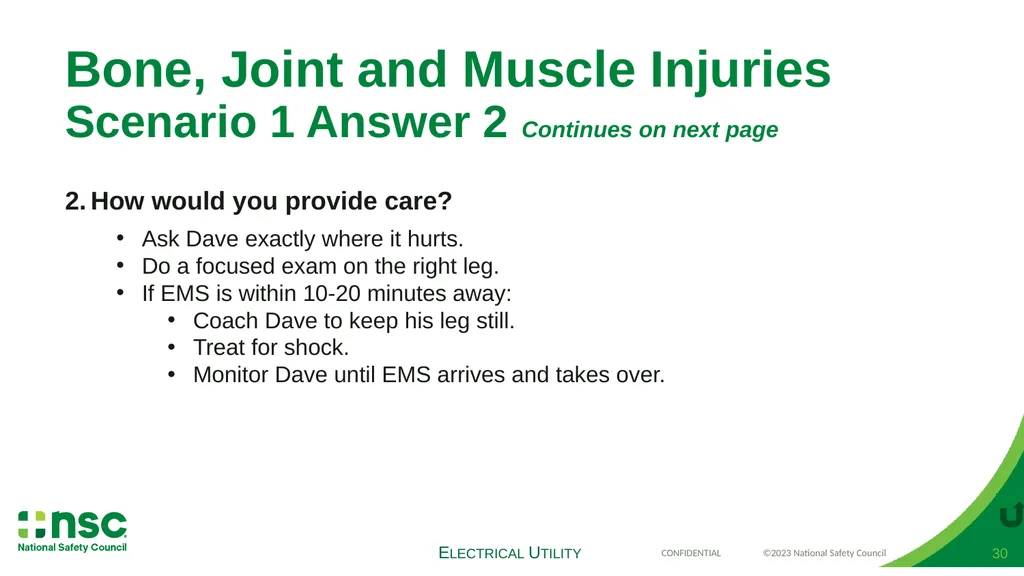
How would you provide care?
Ask Dave exactly where it hurts.
Do a focused exam on the right leg.
If EMS is within 10-20 minutes away:
Coach Dave to keep his leg still.
Treat for shock.
Monitor Dave until EMS arrives and takes over. Bone, Joint and Muscle Injuries Scenario 1 Answer 2 Continues on next page<br>
Ask Dave exactly where it hurts.
Do a focused exam on the right leg.
If EMS is within 10-20 minutes away:
Coach Dave to keep his leg still.
Treat for shock.
Monitor Dave until EMS arrives and takes over. Bone, Joint and Muscle Injuries Scenario 1 Answer 2 Continues on next page<br>
31
If EMS is more than 20 minutes away:
Splint Dave’s right leg in the position found using any rigid materials at hand (tree branches, cardboard, rolled magazines, etc.).
Be sure to pad the splint and fill in where there are hollows.
Treat for shock.
Monitor Dave until EMS arrives and takes over. Bone, Joint and Muscle Injuries Scenario 1 Answer 2 Continued<br>
Splint Dave’s right leg in the position found using any rigid materials at hand (tree branches, cardboard, rolled magazines, etc.).
Be sure to pad the splint and fill in where there are hollows.
Treat for shock.
Monitor Dave until EMS arrives and takes over. Bone, Joint and Muscle Injuries Scenario 1 Answer 2 Continued<br>
32
Head and Spine Injuries Scenarios Electrical Utility<br>
33
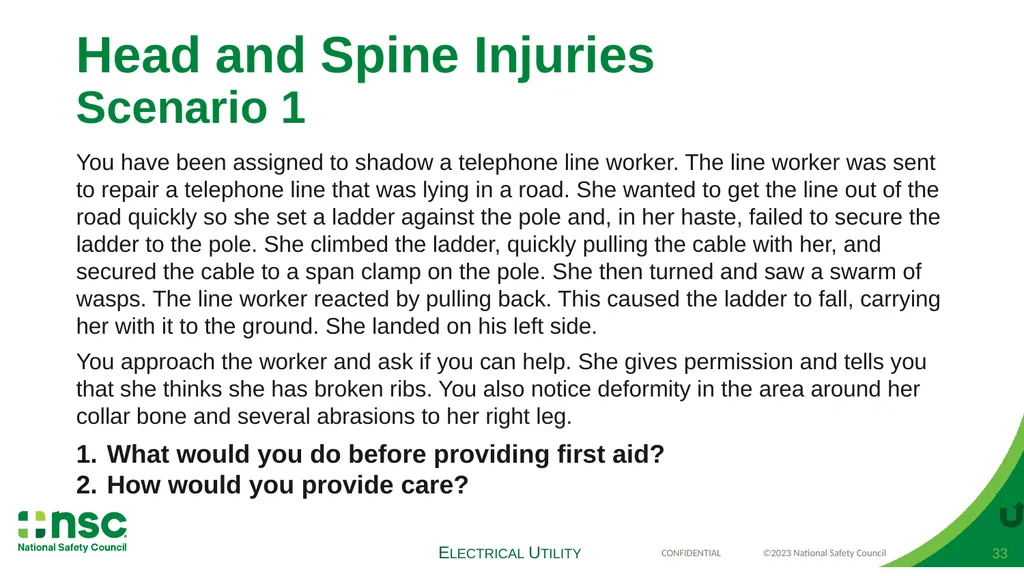
You have been assigned to shadow a telephone line worker. The line worker was sent to repair a telephone line that was lying in a road. She wanted to get the line out of the road quickly so she set a ladder against the pole and, in her haste, failed to secure the ladder to the pole. She climbed the ladder, quickly pulling the cable with her, and secured the cable to a span clamp on the pole. She then turned and saw a swarm of wasps. The line worker reacted by pulling back. This caused the ladder to fall, carrying her with it to the ground. She landed on his left side.
You approach the worker and ask if you can help. She gives permission and tells you that she thinks she has broken ribs. You also notice deformity in the area around her collar bone and several abrasions to her right leg.
What would you do before providing first aid?
How would you provide care? Head and Spine Injuries Scenario 1<br>
You approach the worker and ask if you can help. She gives permission and tells you that she thinks she has broken ribs. You also notice deformity in the area around her collar bone and several abrasions to her right leg.
What would you do before providing first aid?
How would you provide care? Head and Spine Injuries Scenario 1<br>
34
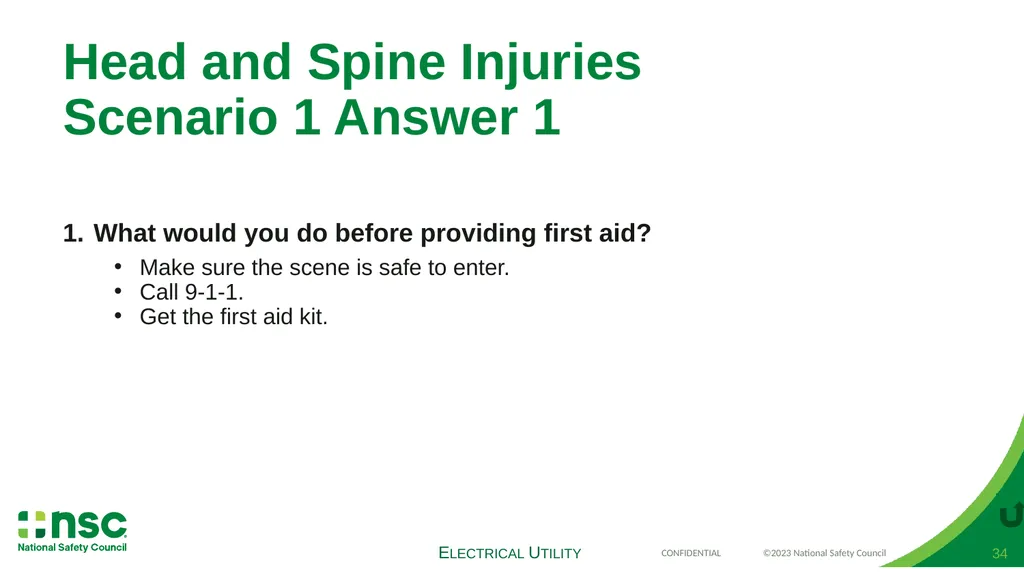
What would you do before providing first aid?
Make sure the scene is safe to enter.
Call 9-1-1.
Get the first aid kit. Head and Spine Injuries Scenario 1 Answer 1<br>
Make sure the scene is safe to enter.
Call 9-1-1.
Get the first aid kit. Head and Spine Injuries Scenario 1 Answer 1<br>
35
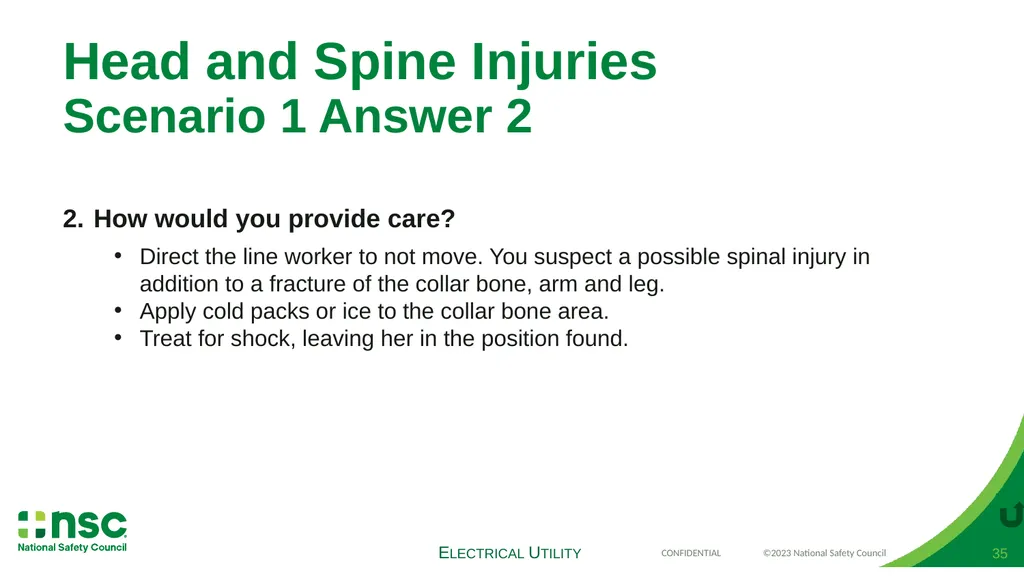
How would you provide care?
Direct the line worker to not move. You suspect a possible spinal injury in addition to a fracture of the collar bone, arm and leg.
Apply cold packs or ice to the collar bone area.
Treat for shock, leaving her in the position found. Head and Spine Injuries Scenario 1 Answer 2<br>
Direct the line worker to not move. You suspect a possible spinal injury in addition to a fracture of the collar bone, arm and leg.
Apply cold packs or ice to the collar bone area.
Treat for shock, leaving her in the position found. Head and Spine Injuries Scenario 1 Answer 2<br>
36
You are working in the garage at your company. You see one of your coworkers walking toward the break room. He slips on a greasy spot on the floor, falls and strikes his head, resulting in a 7-inch laceration. When you get to him, you find that he is in a pool of blood and is unresponsive but breathing.
What would you do before providing first aid?
How would you provide care? Head and Spine Injuries Scenario 2<br>
What would you do before providing first aid?
How would you provide care? Head and Spine Injuries Scenario 2<br>
37
What would you do before providing first aid?
Make sure 9-1-1 has been called.
Make sure the scene is safe to enter. You may have to direct others to get maintenance to clean the slippery area.
Put on medical exam gloves. Head and Spine Injuries Scenario 2 Answer 2<br>
Make sure 9-1-1 has been called.
Make sure the scene is safe to enter. You may have to direct others to get maintenance to clean the slippery area.
Put on medical exam gloves. Head and Spine Injuries Scenario 2 Answer 2<br>
38
Head and Spine Injuries
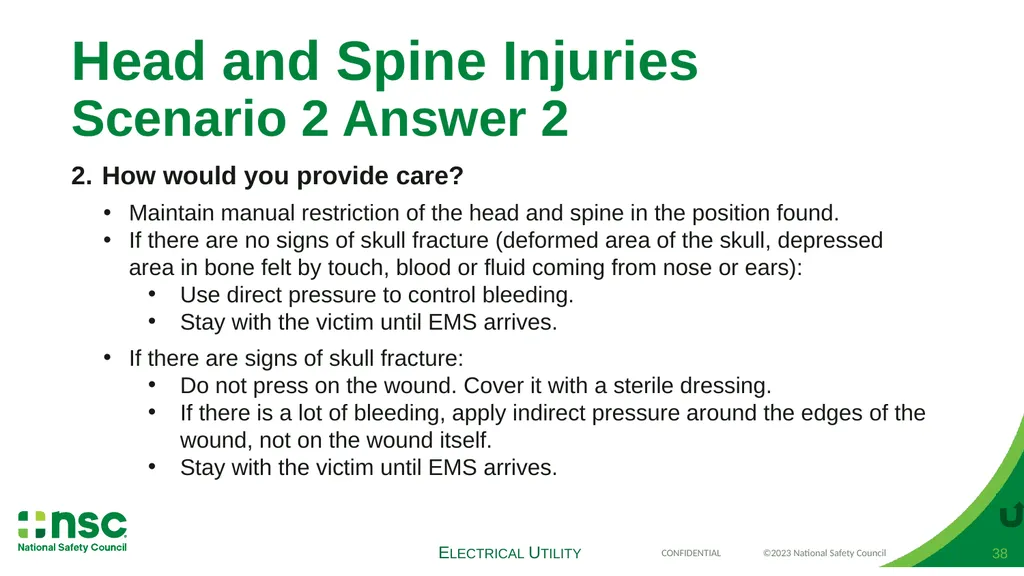
Scenario 2 Answer 2 How would you provide care?
Maintain manual restriction of the head and spine in the position found.
If there are no signs of skull fracture (deformed area of the skull, depressed area in bone felt by touch, blood or fluid coming from nose or ears):
Use direct pressure to control bleeding.
Stay with the victim until EMS arrives.
If there are signs of skull fracture:
Do not press on the wound. Cover it with a sterile dressing.
If there is a lot of bleeding, apply indirect pressure around the edges of the wound, not on the wound itself.
Stay with the victim until EMS arrives.<br>
Maintain manual restriction of the head and spine in the position found.
If there are no signs of skull fracture (deformed area of the skull, depressed area in bone felt by touch, blood or fluid coming from nose or ears):
Use direct pressure to control bleeding.
Stay with the victim until EMS arrives.
If there are signs of skull fracture:
Do not press on the wound. Cover it with a sterile dressing.
If there is a lot of bleeding, apply indirect pressure around the edges of the wound, not on the wound itself.
Stay with the victim until EMS arrives.<br>
39
Poisoning and Allergic Reactions Scenarios Electrical Utility<br>
40
You are on the transmission crew that has been called to a remote location to climb a hard-to-reach structure. The structure is in a marshy area, so your crew must use a Marsh Master to access it. As you pass under several trees to access the right-of-way, a snake on a branch above you suddenly strikes one of your coworkers in the arm.
What would you do before providing first aid?
How would you provide care? Poisoning & Allergic Reactions Scenario 1<br>
What would you do before providing first aid?
How would you provide care? Poisoning & Allergic Reactions Scenario 1<br>
41
What would you do before providing first aid?
Make sure the scene is safe to enter, such that the snake or any other snakes in the area cannot strike other workers.
Have a coworker use your emergency communication device to summon 9-1-1.
Put on medical exam gloves. Poisoning & Allergic Reactions Scenario 1 Answer 1<br>
Make sure the scene is safe to enter, such that the snake or any other snakes in the area cannot strike other workers.
Have a coworker use your emergency communication device to summon 9-1-1.
Put on medical exam gloves. Poisoning & Allergic Reactions Scenario 1 Answer 1<br>
42
How would you provide care?
Have the victim lie down and stay calm. (Do not move the victim unless absolutely necessary.)
Keep the bite area immobile and below the level of the heart.
Wash the bite wound with large amounts of water, with or without soap.
Wrap the extremity with a snug elastic bandage. Wrap away from the body toward the end of the limb.
Remove jewelry or tight clothing before swelling begins.
Note the snake’s appearance so you can describe it to EMS. Use a snake identification handbook, if available, as a resource.
Monitor the victim’s breathing and be ready to give CPR if needed. Poisoning & Allergic Reactions Scenario 1 Answer 2<br>
Have the victim lie down and stay calm. (Do not move the victim unless absolutely necessary.)
Keep the bite area immobile and below the level of the heart.
Wash the bite wound with large amounts of water, with or without soap.
Wrap the extremity with a snug elastic bandage. Wrap away from the body toward the end of the limb.
Remove jewelry or tight clothing before swelling begins.
Note the snake’s appearance so you can describe it to EMS. Use a snake identification handbook, if available, as a resource.
Monitor the victim’s breathing and be ready to give CPR if needed. Poisoning & Allergic Reactions Scenario 1 Answer 2<br>
43
CPR and AED
Scenarios Electrical Utility<br>
44
Your sister-in-law asks you to watch her children while she’s away. You agree to watch your 6-month-old nephew and 3-year-old niece until your brother returns home.
After feeding, bathing and reading to the children, you get them settled in bed and head to the family room to watch a little TV. Around 10 p.m., you receive a call from your brother, who says his plane has landed and he should be home in 30–40 minutes. Then you go to check on the children. Your niece is sleeping soundly. When you check your nephew, you see that he is not breathing and is slightly blue around the mouth.
What should you do before providing first aid?
How would you provide care? CPR and AED Scenario 2<br>
After feeding, bathing and reading to the children, you get them settled in bed and head to the family room to watch a little TV. Around 10 p.m., you receive a call from your brother, who says his plane has landed and he should be home in 30–40 minutes. Then you go to check on the children. Your niece is sleeping soundly. When you check your nephew, you see that he is not breathing and is slightly blue around the mouth.
What should you do before providing first aid?
How would you provide care? CPR and AED Scenario 2<br>
45
What should you do before providing first aid?
Remove the infant from the crib and put him on a firm, flat surface. CPR and AED Scenario 2 Answer 1<br>
Remove the infant from the crib and put him on a firm, flat surface. CPR and AED Scenario 2 Answer 1<br>
46
How would you provide care?
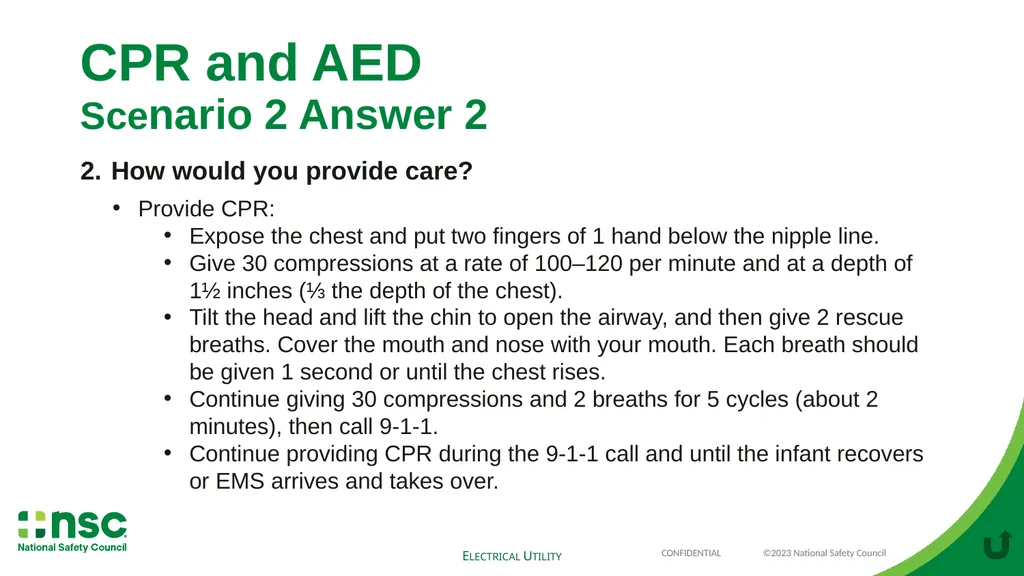
Provide CPR:
Expose the chest and put two fingers of 1 hand below the nipple line.
Give 30 compressions at a rate of 100–120 per minute and at a depth of 1½ inches (⅓ the depth of the chest).
Tilt the head and lift the chin to open the airway, and then give 2 rescue breaths. Cover the mouth and nose with your mouth. Each breath should be given 1 second or until the chest rises.
Continue giving 30 compressions and 2 breaths for 5 cycles (about 2 minutes), then call 9-1-1.
Continue providing CPR during the 9-1-1 call and until the infant recovers or EMS arrives and takes over. CPR and AED Scenario 2 Answer 2<br>
Provide CPR:
Expose the chest and put two fingers of 1 hand below the nipple line.
Give 30 compressions at a rate of 100–120 per minute and at a depth of 1½ inches (⅓ the depth of the chest).
Tilt the head and lift the chin to open the airway, and then give 2 rescue breaths. Cover the mouth and nose with your mouth. Each breath should be given 1 second or until the chest rises.
Continue giving 30 compressions and 2 breaths for 5 cycles (about 2 minutes), then call 9-1-1.
Continue providing CPR during the 9-1-1 call and until the infant recovers or EMS arrives and takes over. CPR and AED Scenario 2 Answer 2<br>
47
John Ford, an employee of the City Water & Power Company, was working in an underground electrical vault to remove a temporary electrical conductor from an energized electrical line. After John removed the temporary conductor, he replaced the protective plastic cover over the bundle of conductors and began to secure the cover to the bundle. While he was securing the cover, his left middle finger, right palm, and right forearm inadvertently made contact between the energized conductor and a ground source. As a result, he was thrown to the ground. He is unresponsive and not breathing.
You are part of the crew working in this area and are trained in first aid.
What should you do before providing first aid?
How would you provide care? CPR and AED Scenario 2<br>
You are part of the crew working in this area and are trained in first aid.
What should you do before providing first aid?
How would you provide care? CPR and AED Scenario 2<br>
48
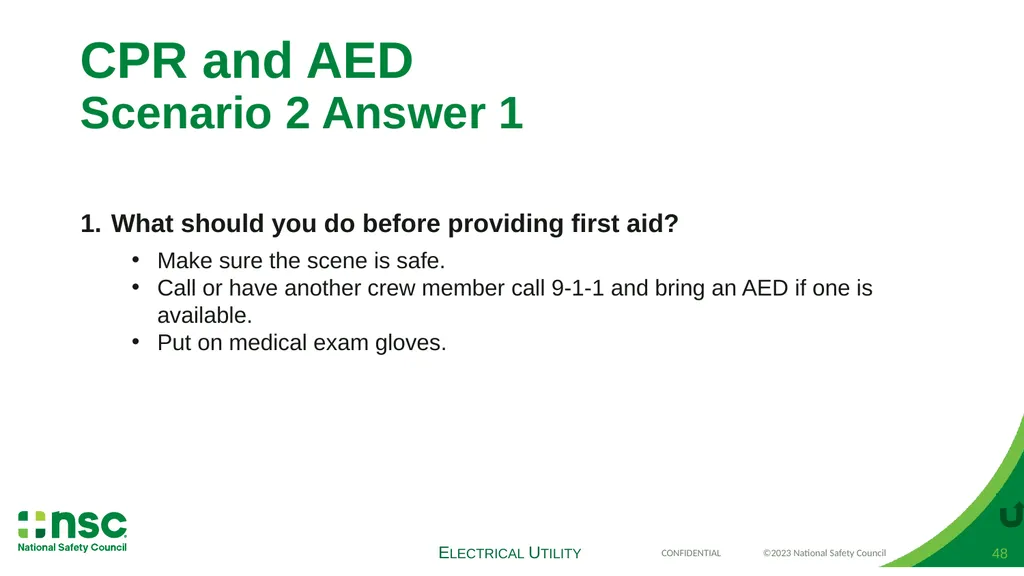
What should you do before providing first aid?
Make sure the scene is safe.
Call or have another crew member call 9-1-1 and bring an AED if one is available.
Put on medical exam gloves. CPR and AED Scenario 2 Answer 1<br>
Make sure the scene is safe.
Call or have another crew member call 9-1-1 and bring an AED if one is available.
Put on medical exam gloves. CPR and AED Scenario 2 Answer 1<br>
49
CPR and AED
Scenario 2 Answer How would you provide care?
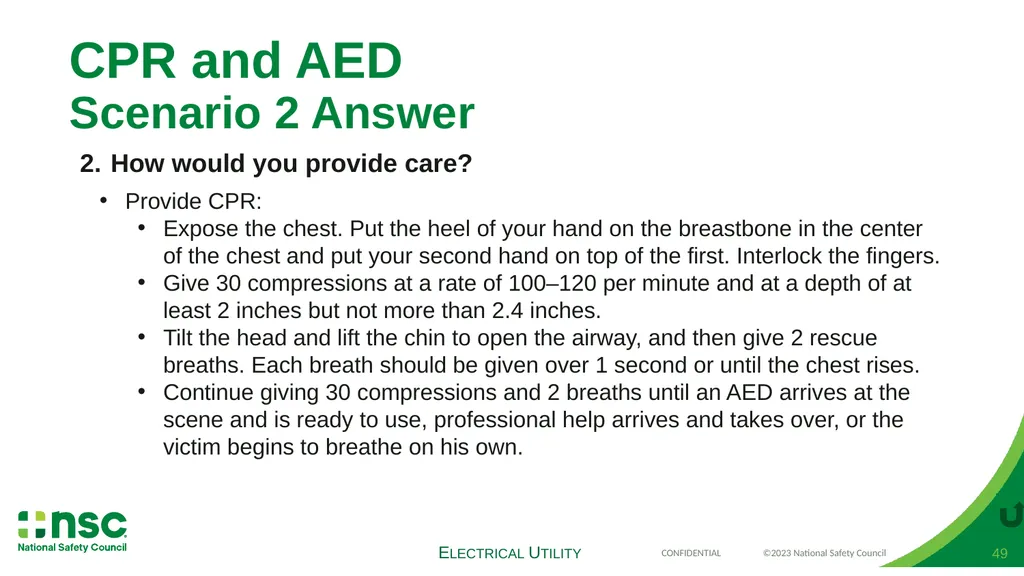
Provide CPR:
Expose the chest. Put the heel of your hand on the breastbone in the center of the chest and put your second hand on top of the first. Interlock the fingers.
Give 30 compressions at a rate of 100–120 per minute and at a depth of at least 2 inches but not more than 2.4 inches.
Tilt the head and lift the chin to open the airway, and then give 2 rescue breaths. Each breath should be given over 1 second or until the chest rises.
Continue giving 30 compressions and 2 breaths until an AED arrives at the scene and is ready to use, professional help arrives and takes over, or the victim begins to breathe on his own.<br>
Provide CPR:
Expose the chest. Put the heel of your hand on the breastbone in the center of the chest and put your second hand on top of the first. Interlock the fingers.
Give 30 compressions at a rate of 100–120 per minute and at a depth of at least 2 inches but not more than 2.4 inches.
Tilt the head and lift the chin to open the airway, and then give 2 rescue breaths. Each breath should be given over 1 second or until the chest rises.
Continue giving 30 compressions and 2 breaths until an AED arrives at the scene and is ready to use, professional help arrives and takes over, or the victim begins to breathe on his own.<br>
50
Another crew member returns with an AED. She tells you that EMS is on the way.
How would you provide care? CPR and AED Scenario 2 Part 2<br>
How would you provide care? CPR and AED Scenario 2 Part 2<br>
51
CPR and AED
Scenario 2 Part 2 Answer 1 How would you provide care?
Direct crew members to watch for EMS and guide them to the victim.
Place the AED by the victim’s shoulder and turn it on.
Quickly dry or shave the pad placement area on the chest if necessary.
Apply the adult pads to the victim’s chest. If needed, plug the cables into the AED.
Stand clear during rhythm analysis.
Follow the prompts to take one of three actions: press the shock button; stay clear while the AED automatically delivers a shock; or do not shock but immediately give CPR.<br>
Direct crew members to watch for EMS and guide them to the victim.
Place the AED by the victim’s shoulder and turn it on.
Quickly dry or shave the pad placement area on the chest if necessary.
Apply the adult pads to the victim’s chest. If needed, plug the cables into the AED.
Stand clear during rhythm analysis.
Follow the prompts to take one of three actions: press the shock button; stay clear while the AED automatically delivers a shock; or do not shock but immediately give CPR.<br>
52
A distribution line crew is replacing a damaged insulator on a wood pole. The pole supports a three-phase 12-kV line. A line worker on the crew removed the 12-kV conductor from the damaged insulator. As she raised the phase conductor from the insulator, it contacted an adjacent phase conductor, causing an electrical arc. The ensuing electric arc caused the lineman to fall into the bucket. She is unresponsive and not breathing.
What would you do before providing first aid?
How would you provide care? CPR and AED Scenario 3<br>
What would you do before providing first aid?
How would you provide care? CPR and AED Scenario 3<br>
53
What would you do before providing first aid?
Make the scene safe and slowly bring the bucket down.
Call or have another crew member call 9-1-1.
Put on medical exam gloves. CPR and AED Scenario 3 Answer 1<br>
Make the scene safe and slowly bring the bucket down.
Call or have another crew member call 9-1-1.
Put on medical exam gloves. CPR and AED Scenario 3 Answer 1<br>
54
CPR and AED
Scenario 3 Answer How would you provide care?
Provide CPR:
Expose the chest. Put the heel of your hand on the breastbone in the center of the chest and put your second hand on top of the first. Interlock the fingers.
Give 30 compressions at a rate of 100–120 per minute and at a depth of at least 2 inches but not more than 2.4 inches.
Tilt the head and lift the chin to open the airway, and then give 2 rescue breaths. Each breath should be given over 1 second or until the chest rises.
Continue giving 30 compressions and 2 breaths until an AED arrives at the scene and is ready to use, professional help arrives and takes over, or the victim begins to breathe on her own.<br>
Provide CPR:
Expose the chest. Put the heel of your hand on the breastbone in the center of the chest and put your second hand on top of the first. Interlock the fingers.
Give 30 compressions at a rate of 100–120 per minute and at a depth of at least 2 inches but not more than 2.4 inches.
Tilt the head and lift the chin to open the airway, and then give 2 rescue breaths. Each breath should be given over 1 second or until the chest rises.
Continue giving 30 compressions and 2 breaths until an AED arrives at the scene and is ready to use, professional help arrives and takes over, or the victim begins to breathe on her own.<br>
55
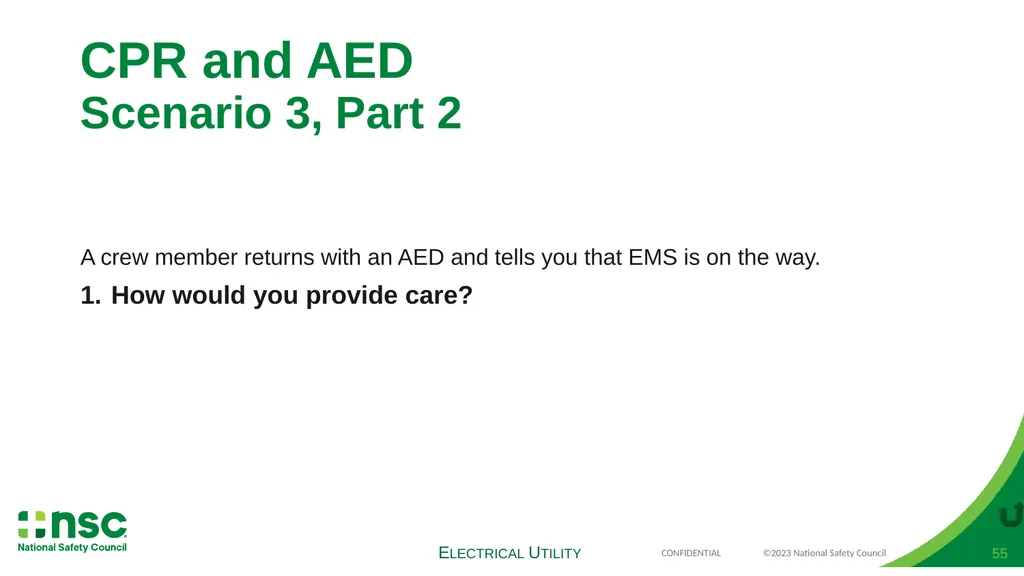
A crew member returns with an AED and tells you that EMS is on the way.
How would you provide care? CPR and AED Scenario 3, Part 2<br>
How would you provide care? CPR and AED Scenario 3, Part 2<br>
56
CPR and AED
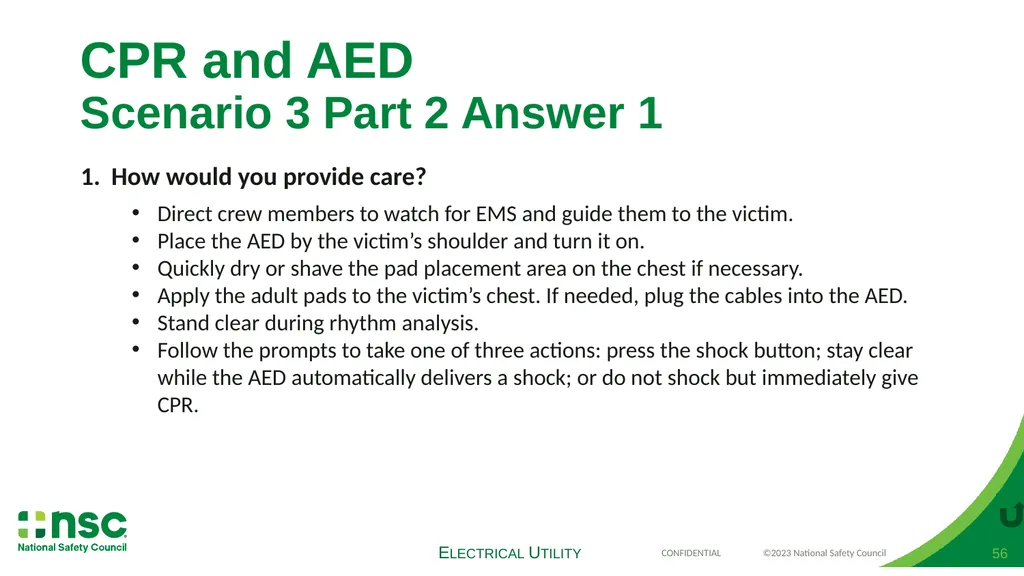
Scenario 3 Part 2 Answer 1 How would you provide care?
Direct crew members to watch for EMS and guide them to the victim.
Place the AED by the victim’s shoulder and turn it on.
Quickly dry or shave the pad placement area on the chest if necessary.
Apply the adult pads to the victim’s chest. If needed, plug the cables into the AED.
Stand clear during rhythm analysis.
Follow the prompts to take one of three actions: press the shock button; stay clear while the AED automatically delivers a shock; or do not shock but immediately give CPR.<br>
Direct crew members to watch for EMS and guide them to the victim.
Place the AED by the victim’s shoulder and turn it on.
Quickly dry or shave the pad placement area on the chest if necessary.
Apply the adult pads to the victim’s chest. If needed, plug the cables into the AED.
Stand clear during rhythm analysis.
Follow the prompts to take one of three actions: press the shock button; stay clear while the AED automatically delivers a shock; or do not shock but immediately give CPR.<br>
57
Choking
Scenarios Electrical Utility<br>
58
Joe and his 5-year-old son Josh went to the work site to pick up his paycheck. While Joe and his boss chatted, Josh went to get a treat from the candy jar on the manager’s desk.
As Joe gets ready to leave the office, he calls out for Josh. As Josh runs toward his dad with a mouth full of candy, he begins coughing. Suddenly, Josh stops coughing and looks panicked.
You know first aid and happen to be in the room.
What would you do before providing first aid?
How would you provide care? Choking Scenario 1<br>
As Joe gets ready to leave the office, he calls out for Josh. As Josh runs toward his dad with a mouth full of candy, he begins coughing. Suddenly, Josh stops coughing and looks panicked.
You know first aid and happen to be in the room.
What would you do before providing first aid?
How would you provide care? Choking Scenario 1<br>
59
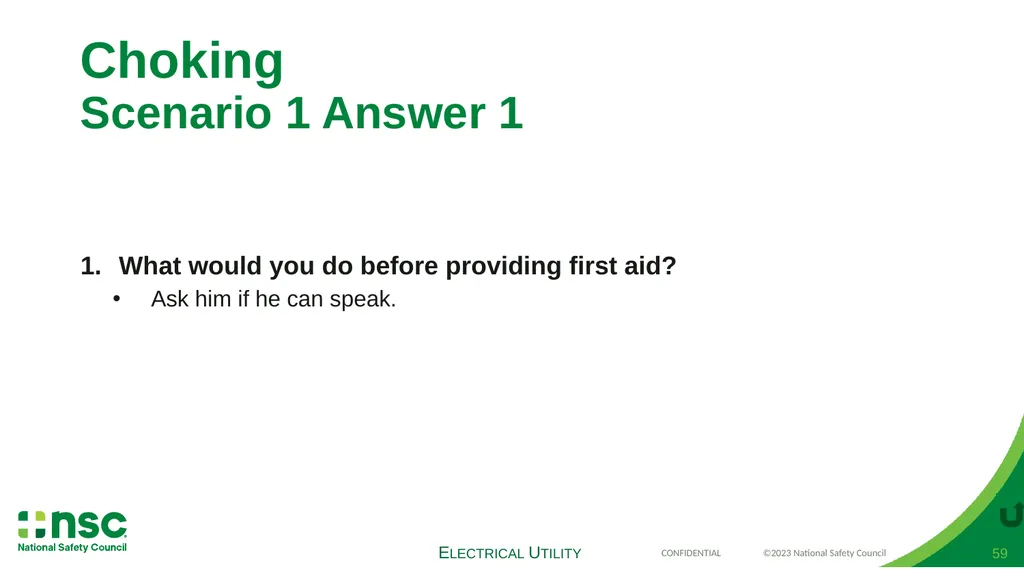
What would you do before providing first aid?
Ask him if he can speak. Choking Scenario 1 Answer 1<br>
Ask him if he can speak. Choking Scenario 1 Answer 1<br>
60
How would you provide care?
If the child cannot speak, give abdominal thrusts:
Kneel or stand behind him and reach around his abdomen.
Locate his navel with a finger from 1 hand.
Make a fist with the other hand and place the thumb side of the fist against his abdomen, just above the navel.
Grasp your fist with your other hand and thrust inward and upward into his abdomen with quick thrusts.
Continue thrusts until he expels the object or becomes unresponsive.
If he becomes unresponsive, direct the boss to call 9-1-1.
Give CPR. Lower him to the ground, expose his chest, place the heel of 1 hand on the center of his chest and start CPR with 30 chest compressions. Look inside the mouth each time you open the airway to give breaths, and remove any object seen. Choking Scenario 1 Answer 2<br>
If the child cannot speak, give abdominal thrusts:
Kneel or stand behind him and reach around his abdomen.
Locate his navel with a finger from 1 hand.
Make a fist with the other hand and place the thumb side of the fist against his abdomen, just above the navel.
Grasp your fist with your other hand and thrust inward and upward into his abdomen with quick thrusts.
Continue thrusts until he expels the object or becomes unresponsive.
If he becomes unresponsive, direct the boss to call 9-1-1.
Give CPR. Lower him to the ground, expose his chest, place the heel of 1 hand on the center of his chest and start CPR with 30 chest compressions. Look inside the mouth each time you open the airway to give breaths, and remove any object seen. Choking Scenario 1 Answer 2<br>