
Catalyst Active Site Design by Atomic Layer
CB
Published · 1 slides · 0 views
1 / 1
Description
Catalyst Active Site Design by Atomic Layer Deposition for Advanced Chemical Manufacturing IEDO Arrelaine A. Dameron, Forge Nano DE-EE0009411 Budget Period 2 Abstract and Alignment with Office Mission OFFICE OF ENERGY EFFICIENCY
Related Topics
Share
Embed code
Download this presentation From Below
"Catalyst Active Site Design by Atomic Layer" is the property of its rightful owner. Permission is granted to download and print the materials on this website for personal, non-commercial use only, and to display it on your personal computer provided you do not modify the materials and that you retain all copyright notices contained in the materials. By downloading content from our website, you accept the terms of this agreement.
Presentation Transcript
01
Catalyst Active Site Design by Atomic Layer Deposition for Advanced Chemical Manufacturing
IEDO
Arrelaine A. Dameron, Forge Nano
DE-EE0009411 | Budget Period 2 Abstract and Alignment with Office Mission OFFICE OF ENERGY EFFICIENCY & RENEWABLE ENERGY U.S. DEPARTMENT OF ENERGY Background Conclusions Challenges and Impact Heterogeneous catalysts are deactivated over time, losing activity and selectivity. The main reasons for catalyst deactivation are: 1) poisoning, 2) fouling (e.g. coke formation), and 3) thermal degradation (e.g. sintering). These three issues can all be overcome by using an overcoating technology to produce more robust catalysts with increased resilient active sites. Project Outline Innovation: ALD Overcoated Catalyst Optimization for Alkane Dehydrogenation
Project Lead: Arrelaine A. Dameron, Ph.D.
Project Partners: Idaho National Laboratory, Oregon State University, Honeywell UOP
Timeline: June 2021-March 2025
Budget: Federal Funds: $ 4,000,000 , Cost Share: $ 1,000,000
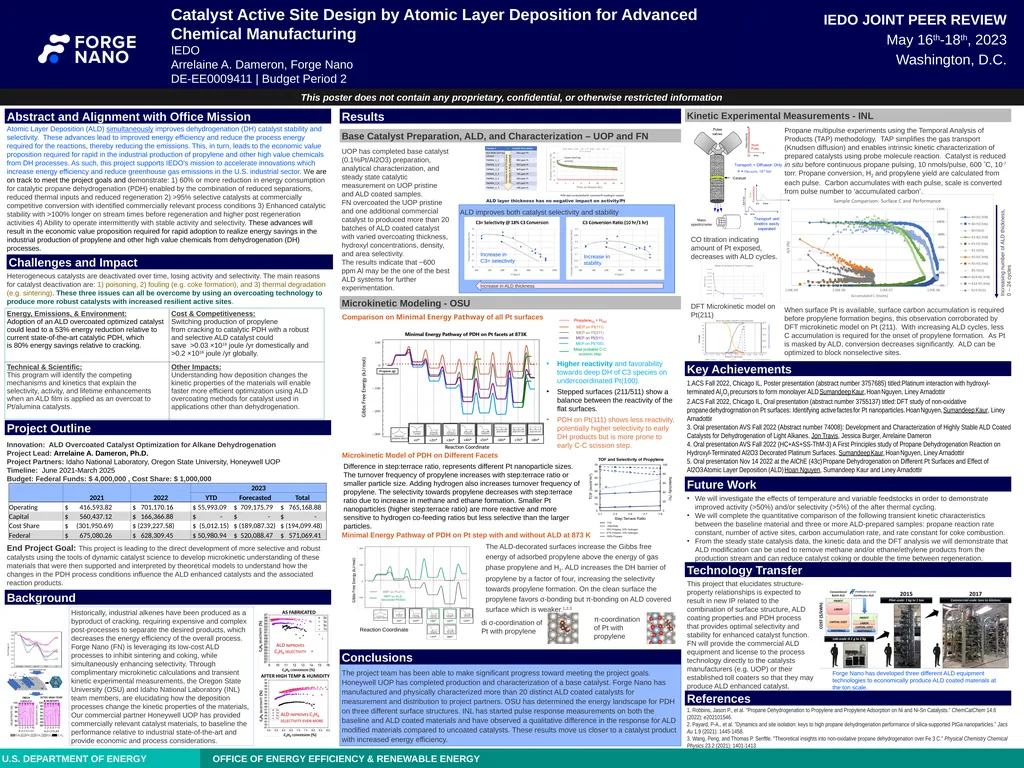
End Project Goal: This project is leading to the direct development of more selective and robust catalysts using the tools of dynamic catalyst science to develop microkinetic understanding of these materials that were then supported and interpreted by theoretical models to understand how the changes in the PDH process conditions influence the ALD enhanced catalysts and the associated reaction products. Historically, industrial alkenes have been produced as a byproduct of cracking, requiring expensive and complex post-processes to separate the desired products, which decreases the energy efficiency of the overall process. Forge Nano (FN) is leveraging its low-cost ALD processes to inhibit sintering and coking, while simultaneously enhancing selectivity. Through complimentary microkinetic calculations and transient kinetic experimental measurements, the Oregon State University (OSU) and Idaho National Laboratory (INL) team members, are elucidating how the deposition processes change the kinetic properties of the materials, Our commercial partner Honeywell UOP has provided commercially relevant catalyst materials, to baseline the performance relative to industrial state-of-the-art and provide economic and process considerations. Results UOP has completed base catalyst (0.1%Pt/Al2O3) preparation, analytical characterization, and steady state catalytic measurement on UOP pristine and ALD coated samples.
FN overcoated the UOP pristine and one additional commercial catalyst to produced more than 20 batches of ALD coated catalyst with varied overcoating thickness, hydroxyl concentrations, density, and area selectivity.
The results indicate that ~600 ppm Al may be the one of the best ALD systems for further experimentation. Key Achievements ACS Fall 2022, Chicago IL, Poster presentation (abstract number 3757685) titled:Platinum interaction with hydroxyl-terminated Al2O3 precursors to form monolayer ALD Sumandeep Kaur, Hoan Nguyen, Liney Arnadottir
ACS Fall 2022, Chicago IL, Oral presentation (abstract number 3755137) titled: DFT study of non-oxidative propane dehydrogrnation on Pt surfaces: Identifying active factes for Pt nanoparticles. Hoan Nguyen, Sumandeep Kaur, Liney Arnadottir
Oral presentation AVS Fall 2022 (Abstract number 74008): Development and Characterization of Highly Stable ALD Coated Catalysts for Dehydrogenation of Light Alkanes. Jon Travis, Jessica Burger, Arrelaine Dameron
Oral presentation AVS Fall 2022 (HC+AS+SS-ThM-3) A First Principles study of Propane Dehydrogenation Reaction on Hydroxyl-Terminated Al2O3 Decorated Platinum Surfaces. Sumandeep Kaur, Hoan Nguyen, Liney Arnadottir
Oral presentation Nov 14 2022 at the AIChE (43c) Propane Dehydrogenation on Different Pt Surfaces and Effect of Al2O3 Atomic Layer Deposition (ALD) Hoan Nguyen, Sumandeep Kaur and Liney Arnadottir References 1. Robbins, Jason P., et al. "Propane Dehydrogenation to Propylene and Propylene Adsorption on Ni and Ni‐Sn Catalysts." ChemCatChem 14.6 (2022): e202101546.
2. Payard, P-A., et al. "Dynamics and site isolation: keys to high propane dehydrogenation performance of silica-supported PtGa nanoparticles." Jacs Au 1.9 (2021): 1445-1458.
3. Wang, Peng, and Thomas P. Senftle. "Theoretical insights into non-oxidative propane dehydrogenation over Fe 3 C." Physical Chemistry Chemical Physics 23.2 (2021): 1401-1413 Future Work Technology Transfer This project that elucidates structure-property relationships is expected to result in new IP related to the combination of surface structure, ALD coating properties and PDH process that provides optimal selectivity and stability for enhanced catalyst function. FN will provide the commercial ALD equipment and license to the process technology directly to the catalysts manufacturers (e.g. UOP) or their established toll coaters so that they may produce ALD enhanced catalyst. IEDO JOINT PEER REVIEW
May 16th-18th, 2023
Washington, D.C. This poster does not contain any proprietary, confidential, or otherwise restricted information Base Catalyst Preparation, ALD, and Characterization – UOP and FN Atomic Layer Deposition (ALD) simultaneously improves dehydrogenation (DH) catalyst stability and selectivity. These advances lead to improved energy efficiency and reduce the process energy required for the reactions, thereby reducing the emissions. This, in turn, leads to the economic value proposition required for rapid in the industrial production of propylene and other high value chemicals from DH processes. As such, this project supports IEDO's mission to accelerate innovations which increase energy efficiency and reduce greenhouse gas emissions in the U.S. industrial sector. We are on track to meet the project goals and demonstrate: 1) 60% or more reduction in energy consumption for catalytic propane dehydrogenation (PDH) enabled by the combination of reduced separations, reduced thermal inputs and reduced regeneration 2) >95% selective catalysts at commercially competitive conversion with identified commercially relevant process conditions 3) Enhanced catalytic stability with >100% longer on stream times before regeneration and higher post regeneration activities 4) Ability to operate intermittently with stable activity and selectivity. These advances will result in the economic value proposition required for rapid adoption to realize energy savings in the industrial production of propylene and other high value chemicals from dehydrogenation (DH) processes. The project team has been able to make significant progress toward meeting the project goals. Honeywell UOP has completed production and characterization of a base catalyst. Forge Nano has manufactured and physically characterized more than 20 distinct ALD coated catalysts for measurement and distribution to project partners. OSU has determined the energy landscape for PDH on three different surface structures. INL has started pulse response measurements on both the baseline and ALD coated materials and have observed a qualitative difference in the response for ALD modified materials compared to uncoated catalysts. These results move us closer to a catalyst product with increased energy efficiency. We will investigate the effects of temperature and variable feedstocks in order to demonstrate improved activity (>50%) and/or selectivity (>5%) of the after thermal cycling.
We will complete the quantitative comparison of the following transient kinetic characteristics between the baseline material and three or more ALD-prepared samples: propane reaction rate constant, number of active sites, carbon accumulation rate, and rate constant for coke combustion.
From the steady state catalysis data, the kinetic data and the DFT analysis we will demonstrate that ALD modification can be used to remove methane and/or ethane/ethylene products from the production stream and can reduce catalyst coking or double the time between regeneration. Forge Nano has developed three different ALD equipment technologies to economically produce ALD coated materials at the ton scale.<br>