
CBE Risk Assessment Induction Training v.0.1
CS
Published · 30 slides · 0 views
1 / 1
Description
CBE Risk Assessment Induction Training v.0.1 C.Kavanagh September 2023 1 This Photo by Unknown Author is licensed under CC BY v.0.1 C.Kavanagh September 2023 Introduction 2 What are Risk Assessments? What are Hazards and how can you control
Related Topics
Share
Embed code
Download this presentation From Below
"CBE Risk Assessment Induction Training v.0.1" is the property of its rightful owner. Permission is granted to download and print the materials on this website for personal, non-commercial use only, and to display it on your personal computer provided you do not modify the materials and that you retain all copyright notices contained in the materials. By downloading content from our website, you accept the terms of this agreement.
Presentation Transcript
01
CBE Risk Assessment Induction Training v.0.1 C.Kavanagh September 2023 1 This Photo by Unknown Author is licensed under CC BY<br>
02
v.0.1 C.Kavanagh September 2023 Introduction 2 What are Risk Assessments? What are Hazards and how can you control Risks?
Importance of Risk Assessments
Types of Risk Assessment
Writing Risk Assessments
Existing Risk Assessment review process
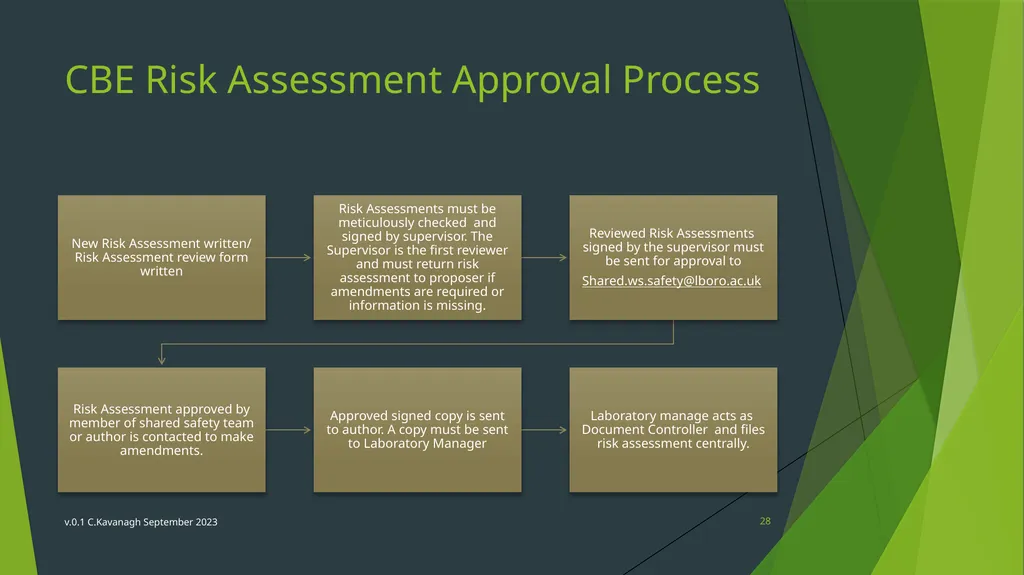
Approval of Risk Assessments Process
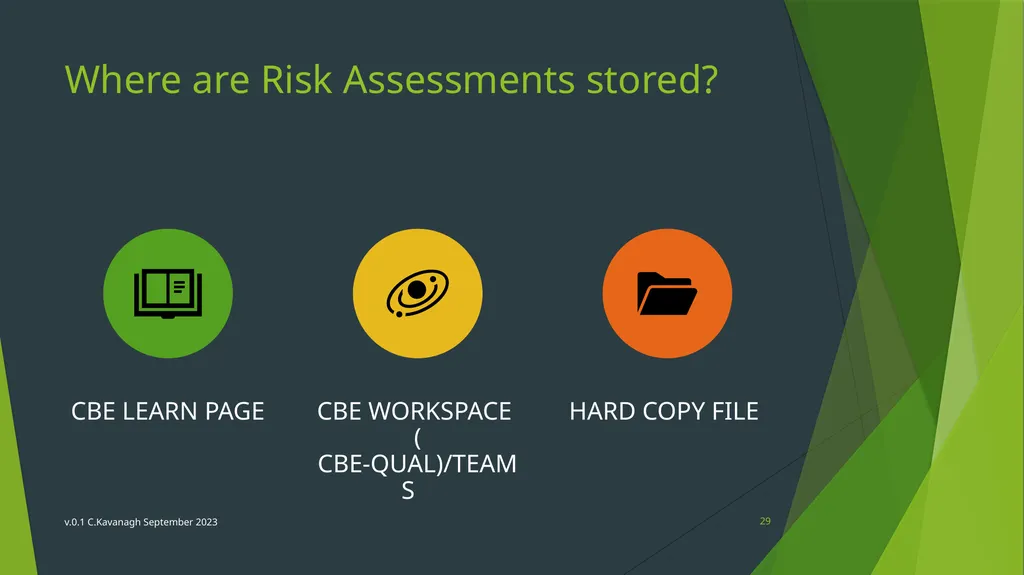
Where can I find Risk Assessments?
More information on Risk Assessments<br>
Importance of Risk Assessments
Types of Risk Assessment
Writing Risk Assessments
Existing Risk Assessment review process
Approval of Risk Assessments Process
Where can I find Risk Assessments?
More information on Risk Assessments<br>
03
v.0.1 C.Kavanagh September 2023 What are Risk Assessments? 3 A risk assessment is simply a careful examination of what, in your work, could cause harm to people, so that you can weigh up whether you have taken enough precautions or, whether you should do more to prevent harm. Workers and others have a right to be protected from harm caused by a failure to take reasonable control measures ( Health and Safety Office)<br>
04
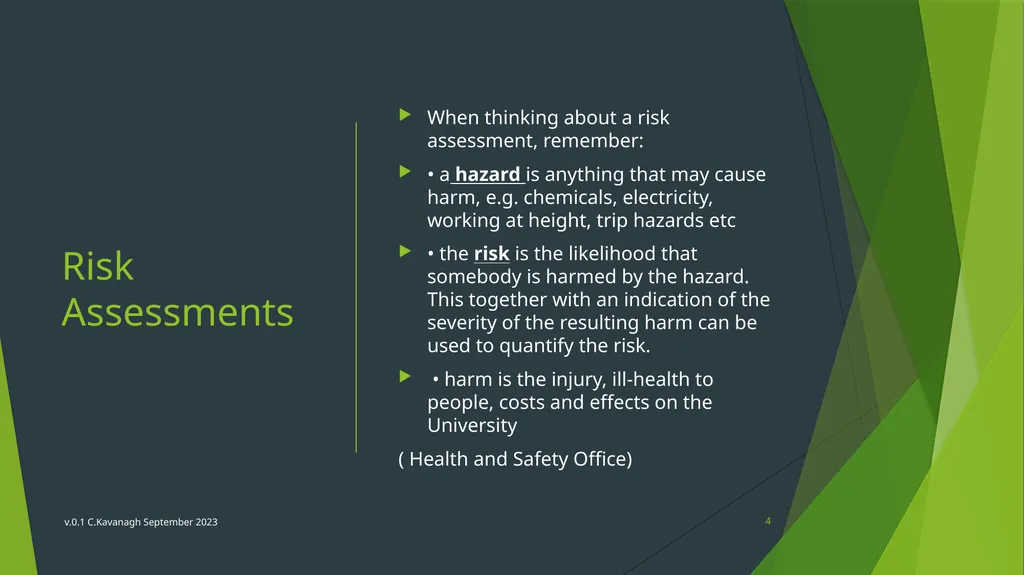
v.0.1 C.Kavanagh September 2023 Risk Assessments 4 When thinking about a risk assessment, remember:
• a hazard is anything that may cause harm, e.g. chemicals, electricity, working at height, trip hazards etc
• the risk is the likelihood that somebody is harmed by the hazard. This together with an indication of the severity of the resulting harm can be used to quantify the risk.
• harm is the injury, ill-health to people, costs and effects on the University
( Health and Safety Office)<br>
05
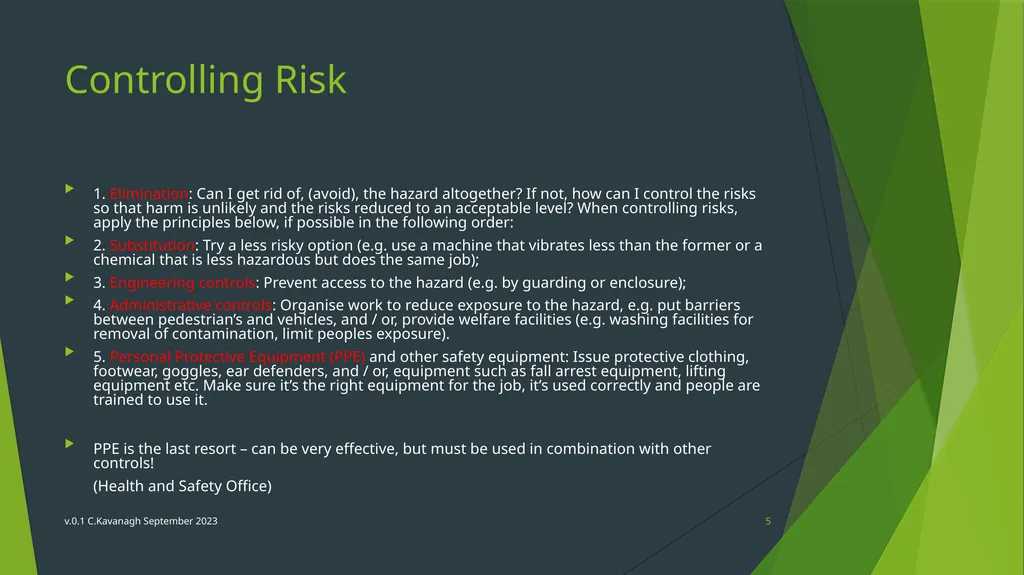
Controlling Risk 1. Elimination: Can I get rid of, (avoid), the hazard altogether? If not, how can I control the risks so that harm is unlikely and the risks reduced to an acceptable level? When controlling risks, apply the principles below, if possible in the following order:
2. Substitution: Try a less risky option (e.g. use a machine that vibrates less than the former or a chemical that is less hazardous but does the same job);
3. Engineering controls: Prevent access to the hazard (e.g. by guarding or enclosure);
4. Administrative controls: Organise work to reduce exposure to the hazard, e.g. put barriers between pedestrian’s and vehicles, and / or, provide welfare facilities (e.g. washing facilities for removal of contamination, limit peoples exposure).
5. Personal Protective Equipment (PPE) and other safety equipment: Issue protective clothing, footwear, goggles, ear defenders, and / or, equipment such as fall arrest equipment, lifting equipment etc. Make sure it’s the right equipment for the job, it’s used correctly and people are trained to use it.
PPE is the last resort – can be very effective, but must be used in combination with other controls!
(Health and Safety Office) v.0.1 C.Kavanagh September 2023 5<br>
06
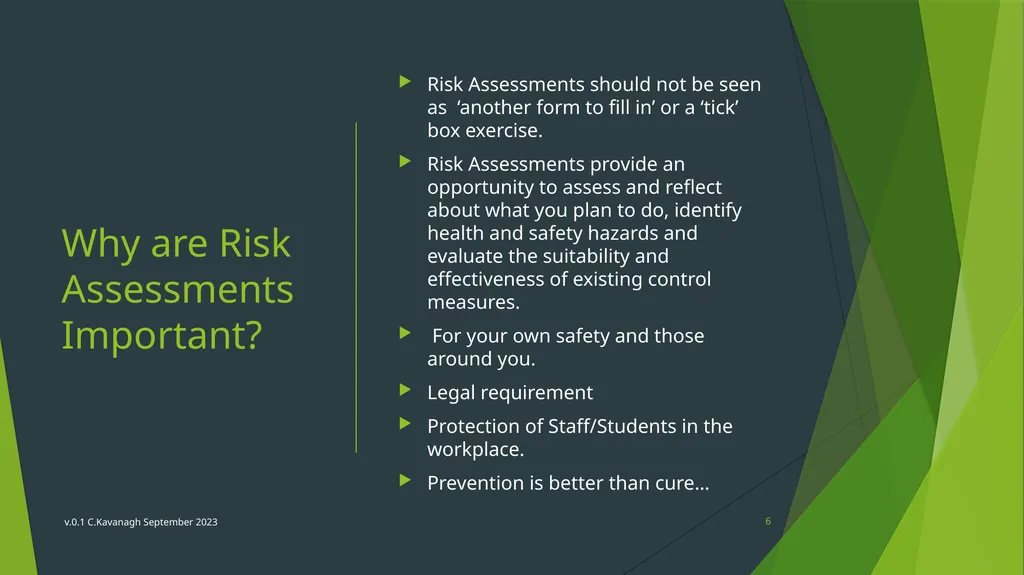
v.0.1 C.Kavanagh September 2023 Why are Risk Assessments Important? 6 Risk Assessments should not be seen as ‘another form to fill in’ or a ‘tick’ box exercise.
Risk Assessments provide an opportunity to assess and reflect about what you plan to do, identify health and safety hazards and evaluate the suitability and effectiveness of existing control measures.
For your own safety and those around you.
Legal requirement
Protection of Staff/Students in the workplace.
Prevention is better than cure…<br>
07
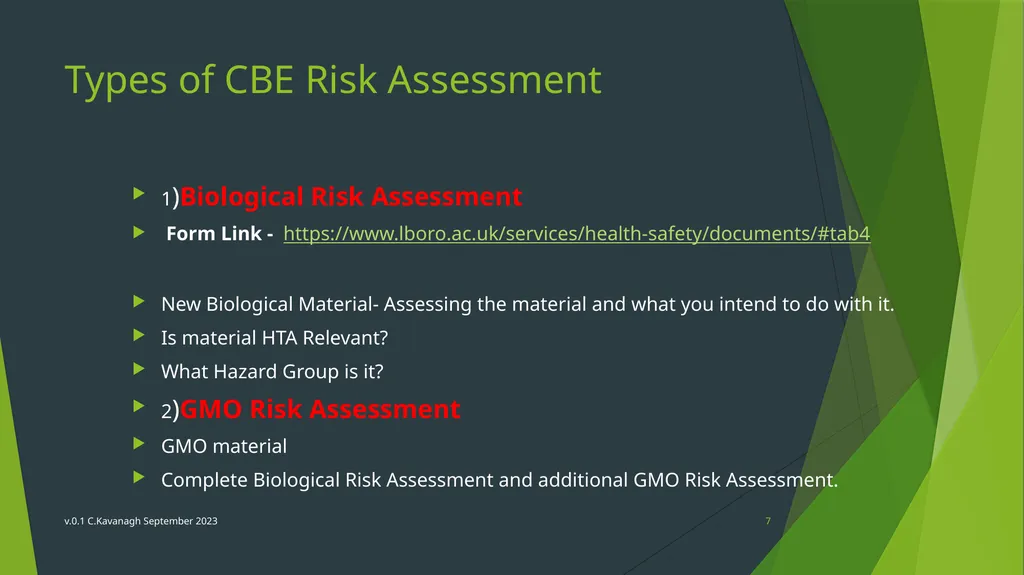
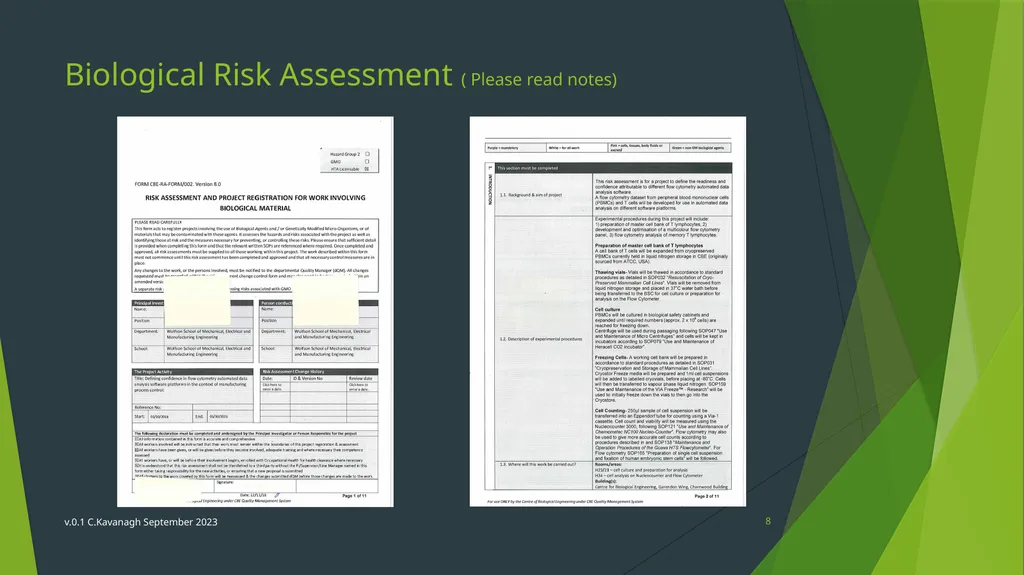
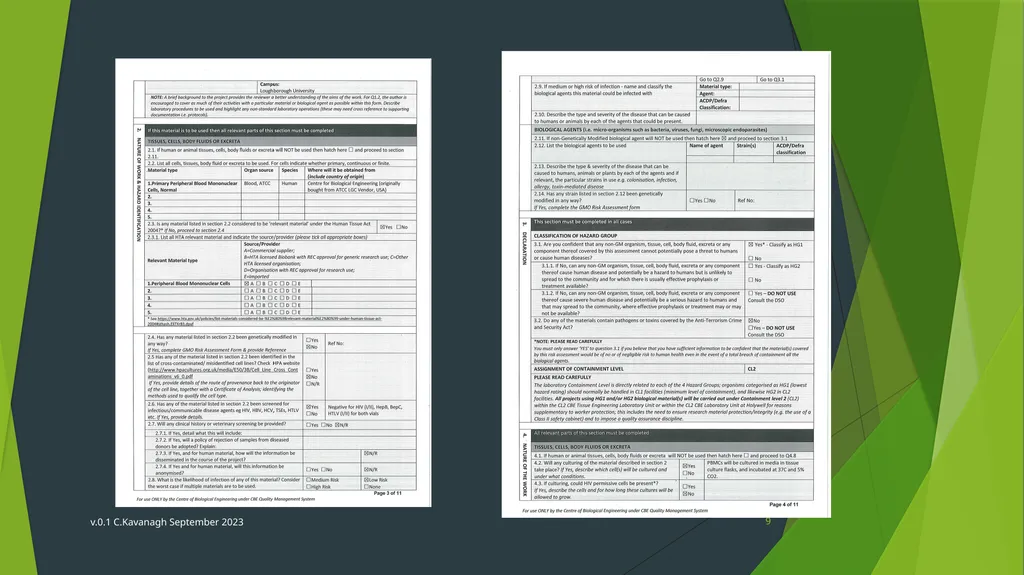
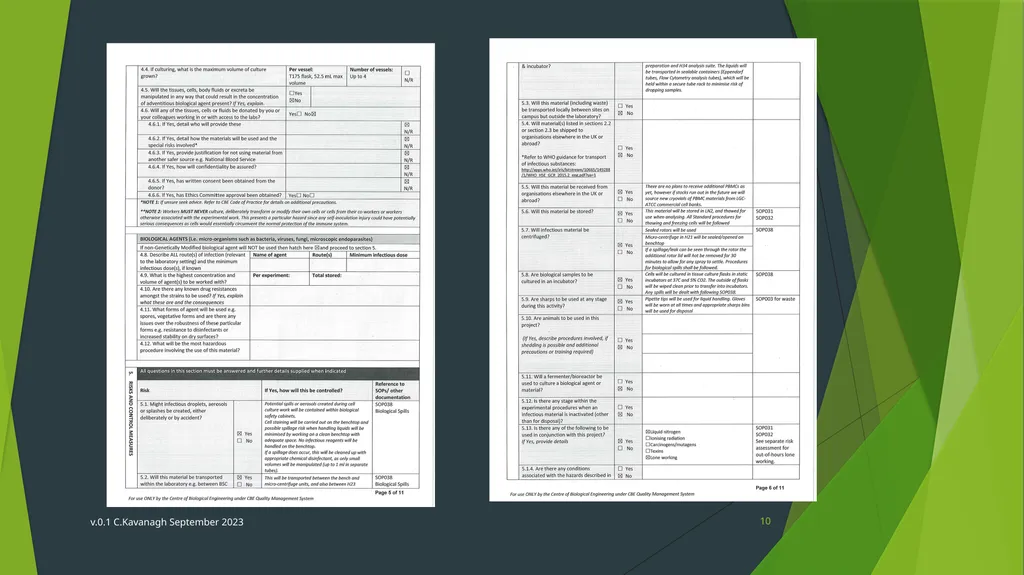
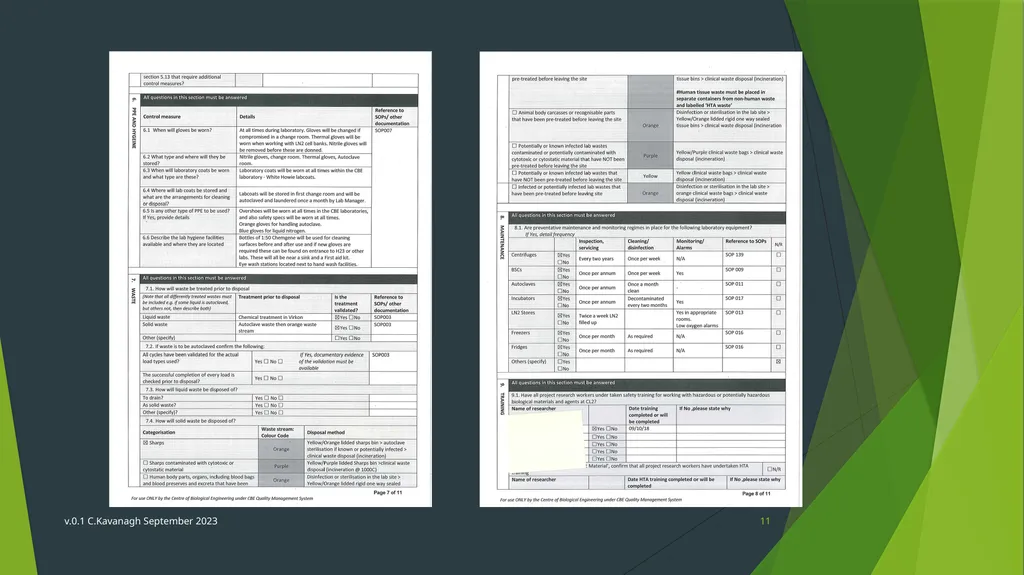
Types of CBE Risk Assessment 1)Biological Risk Assessment
Form Link - https://www.lboro.ac.uk/services/health-safety/documents/#tab4
New Biological Material- Assessing the material and what you intend to do with it.
Is material HTA Relevant?
What Hazard Group is it?
2)GMO Risk Assessment
GMO material
Complete Biological Risk Assessment and additional GMO Risk Assessment. v.0.1 C.Kavanagh September 2023 7<br>
08
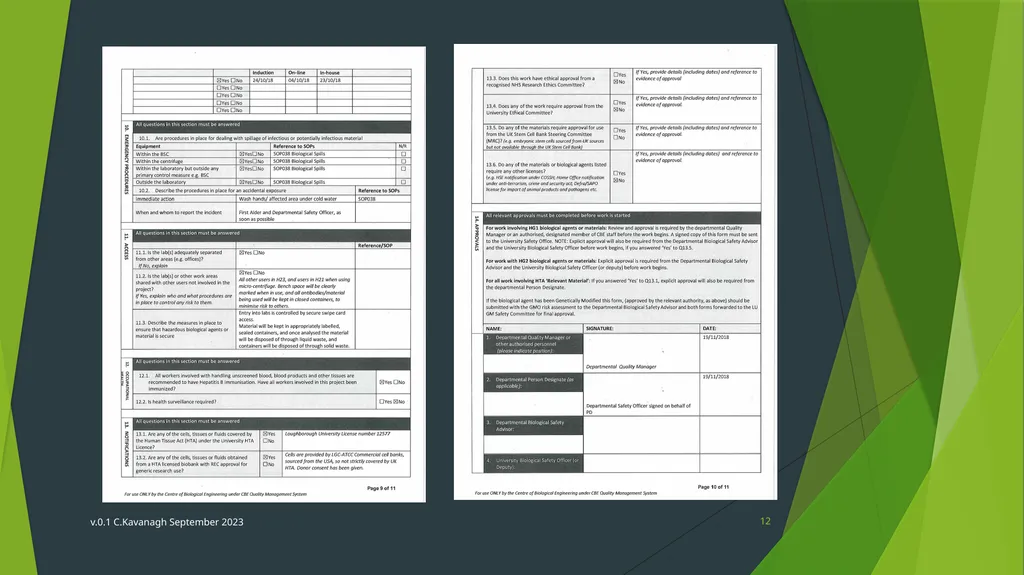
Biological Risk Assessment ( Please read notes) v.0.1 C.Kavanagh September 2023 8<br>
09
v.0.1 C.Kavanagh September 2023 9<br>
10
v.0.1 C.Kavanagh September 2023 10<br>
11
v.0.1 C.Kavanagh September 2023 11<br>
12
v.0.1 C.Kavanagh September 2023 12<br>
13
Types of Risk Assessment 3)Safety Risk Assessment
( Process, Method Statement and COSHH)
On this form you complete/tick the relevant sections as appropriate
Form Link - https://www.lboro.ac.uk/services/health-safety/forms/
You are assessing what you are actually doing in your process/experiment ( that may or may not involve a chemical(s)) . All chemicals involved with the process must be listed. You must also reference non hazardous chemicals. It is important to assess the process and chemical together as a chemical assessed on its own will not take into account the hazards e.g if your heating it ( as may be required as part of experiment) v.0.1 C.Kavanagh September 2023 13<br>
14
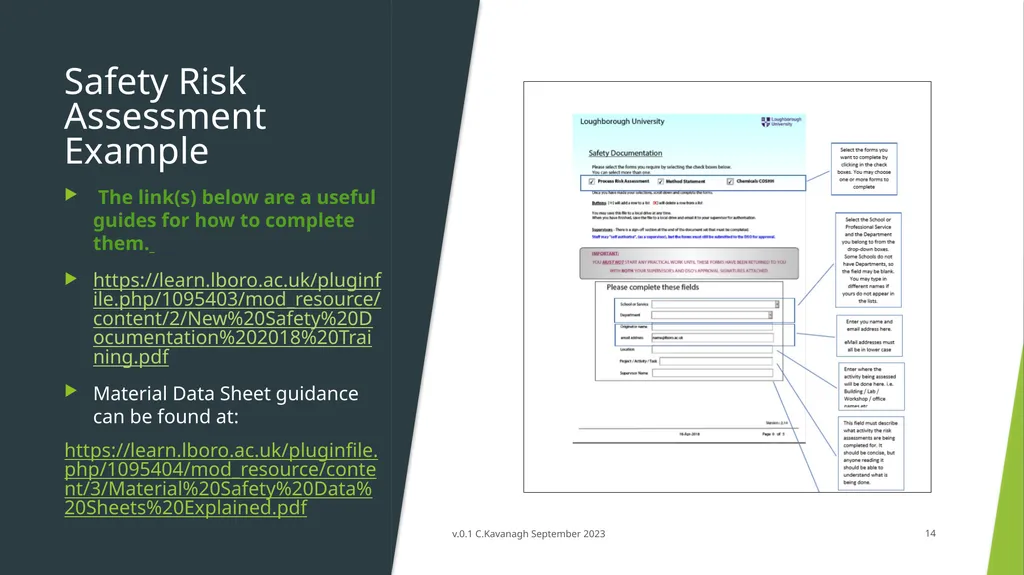
Safety Risk Assessment Example The link(s) below are a useful guides for how to complete them.
https://learn.lboro.ac.uk/pluginfile.php/1095403/mod_resource/content/2/New%20Safety%20Documentation%202018%20Training.pdf
Material Data Sheet guidance can be found at:
https://learn.lboro.ac.uk/pluginfile.php/1095404/mod_resource/content/3/Material%20Safety%20Data%20Sheets%20Explained.pdf v.0.1 C.Kavanagh September 2023 14<br>
15
Types of Risk Assessment v.0.1 C.Kavanagh September 2023 15 4)Lone Working out of hours Risk Assessment
Use the general process risk assessment template
Consider:
Have myself and supervisor signed it?
Have I clearly stated what I will be doing indicating times?
Have I considered all the additional risks of working alone?
Have I got an emergency contact?. Do they know?
Have I added the location where I will be working?
Have I got the lone working app?<br>
16
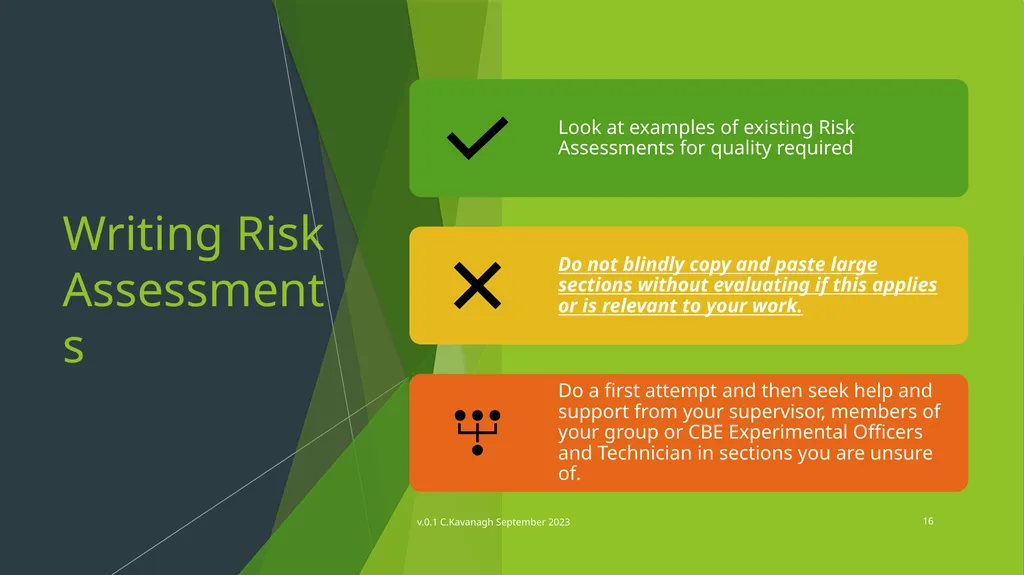
Writing Risk Assessments v.0.1 C.Kavanagh September 2023 16<br>
17
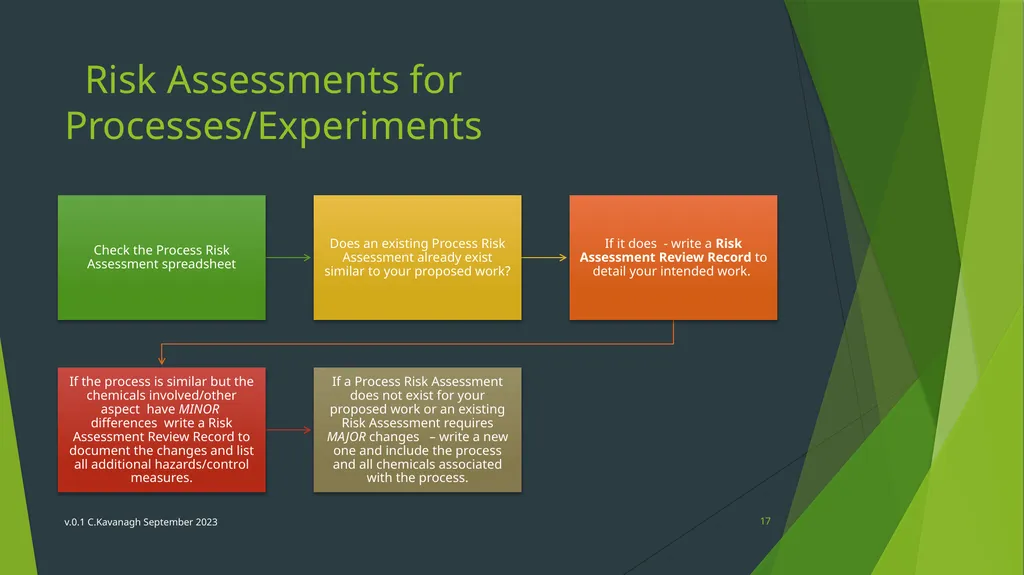
Risk Assessments for Processes/Experiments v.0.1 C.Kavanagh September 2023 17<br>
18
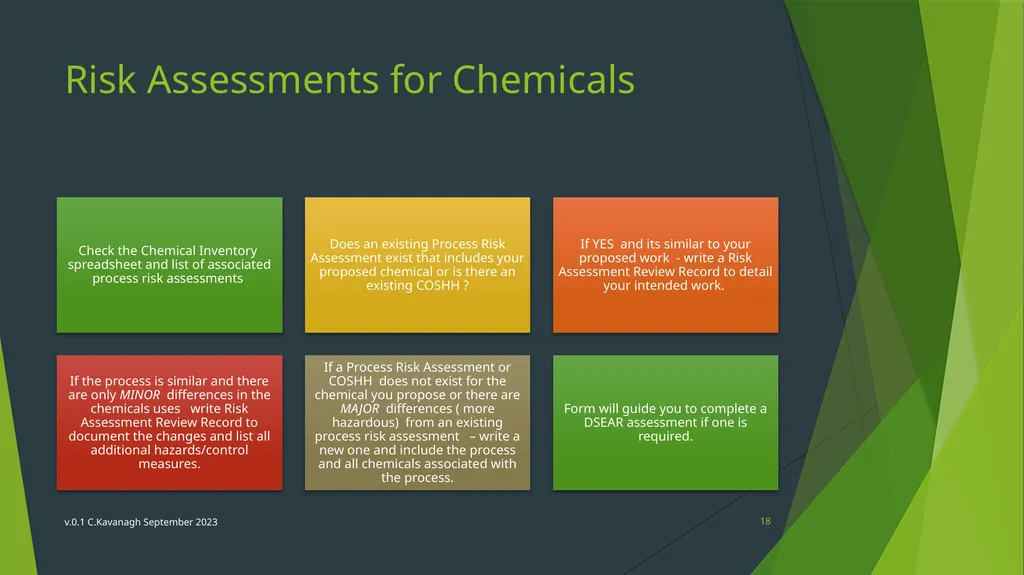
Risk Assessments for Chemicals v.0.1 C.Kavanagh September 2023 18<br>
19
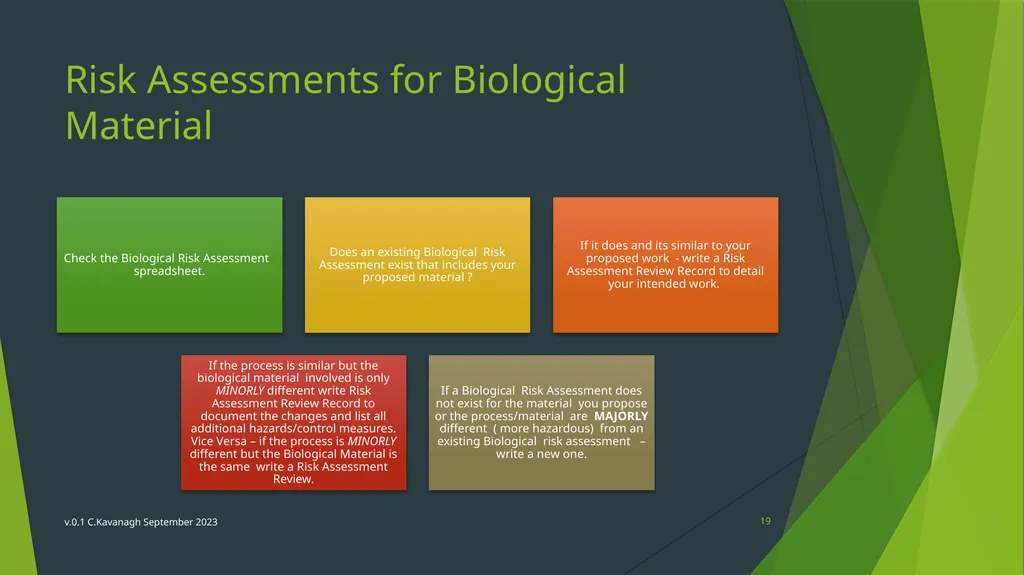
Risk Assessments for Biological Material v.0.1 C.Kavanagh September 2023 19<br>
20
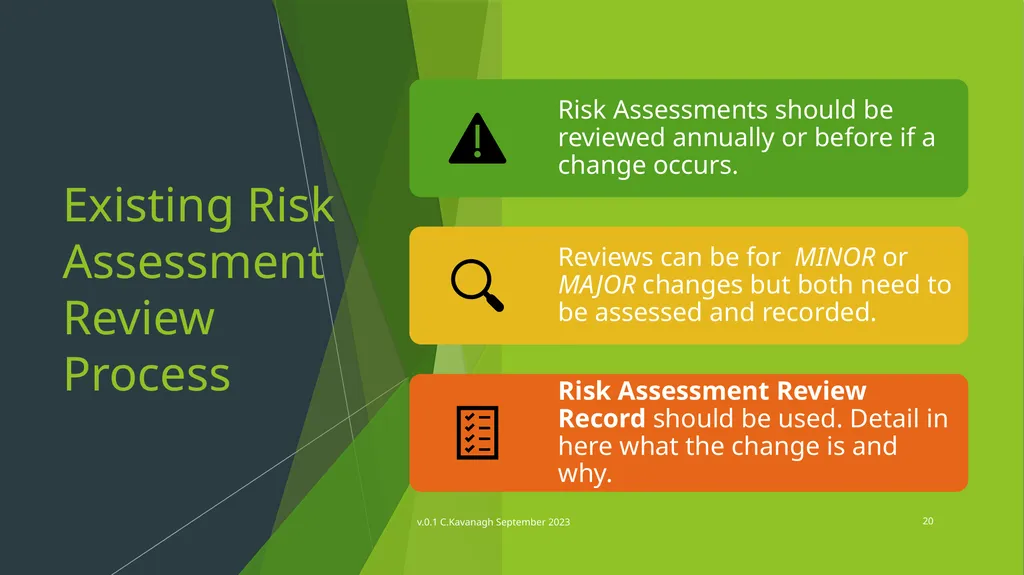
Existing Risk Assessment Review Process v.0.1 C.Kavanagh September 2023 20<br>
21
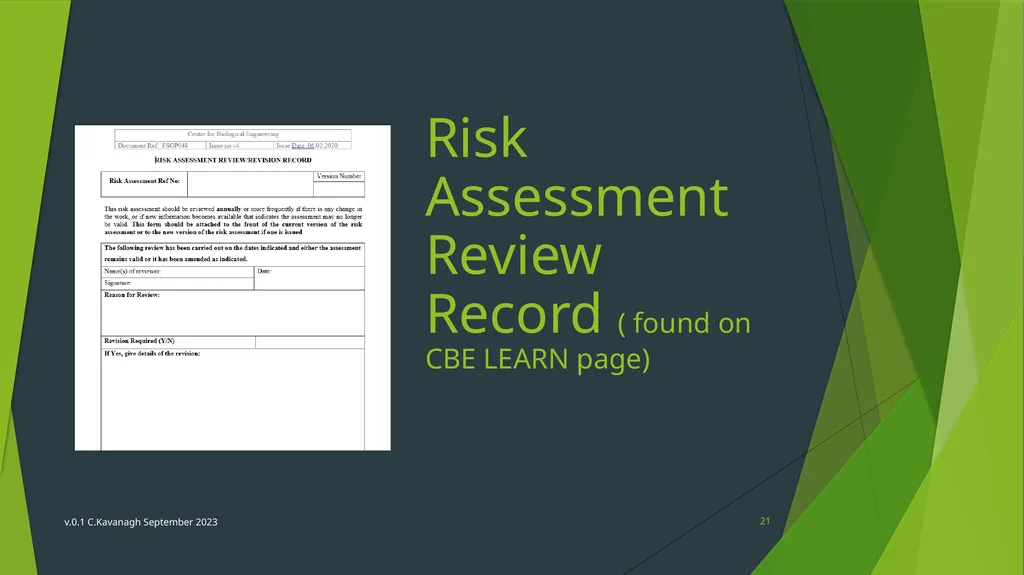
Risk Assessment Review Record ( found on CBE LEARN page) v.0.1 C.Kavanagh September 2023 21<br>
22
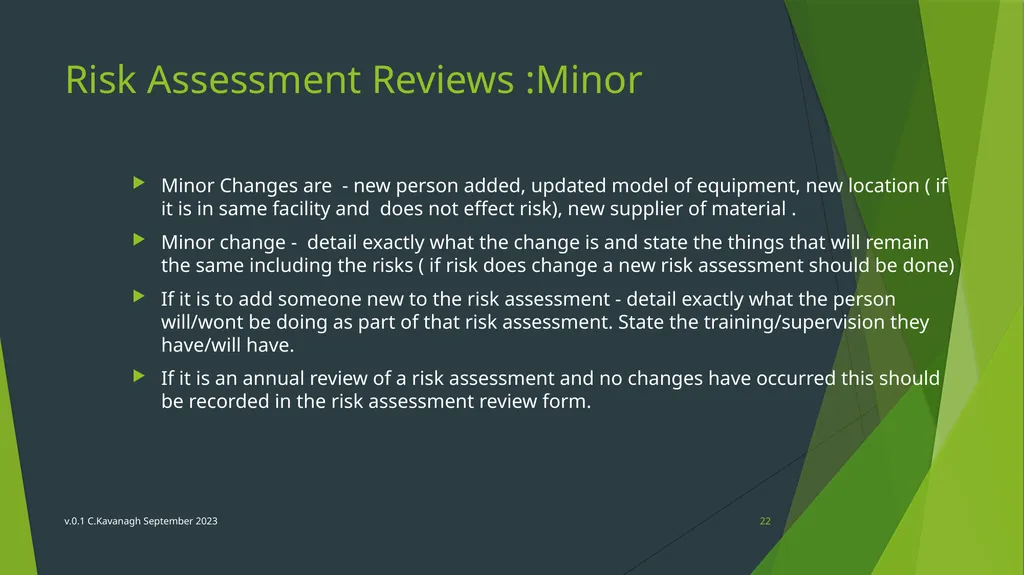
Risk Assessment Reviews :Minor Minor Changes are - new person added, updated model of equipment, new location ( if it is in same facility and does not effect risk), new supplier of material .
Minor change - detail exactly what the change is and state the things that will remain the same including the risks ( if risk does change a new risk assessment should be done)
If it is to add someone new to the risk assessment - detail exactly what the person will/wont be doing as part of that risk assessment. State the training/supervision they have/will have.
If it is an annual review of a risk assessment and no changes have occurred this should be recorded in the risk assessment review form. v.0.1 C.Kavanagh September 2023 22<br>
23
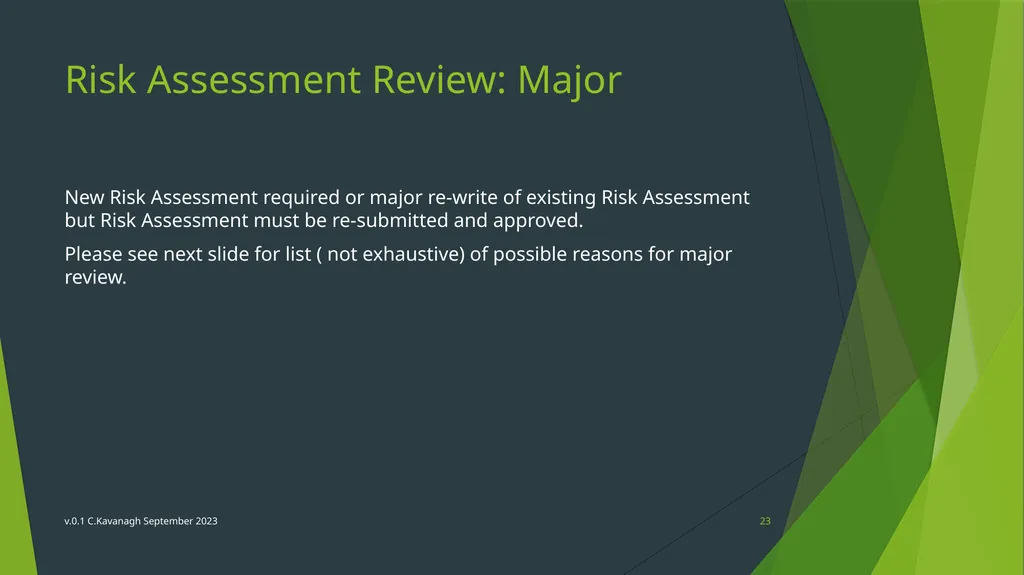
Risk Assessment Review: Major New Risk Assessment required or major re-write of existing Risk Assessment but Risk Assessment must be re-submitted and approved.
Please see next slide for list ( not exhaustive) of possible reasons for major review. v.0.1 C.Kavanagh September 2023 23<br>
Please see next slide for list ( not exhaustive) of possible reasons for major review. v.0.1 C.Kavanagh September 2023 23<br>
24
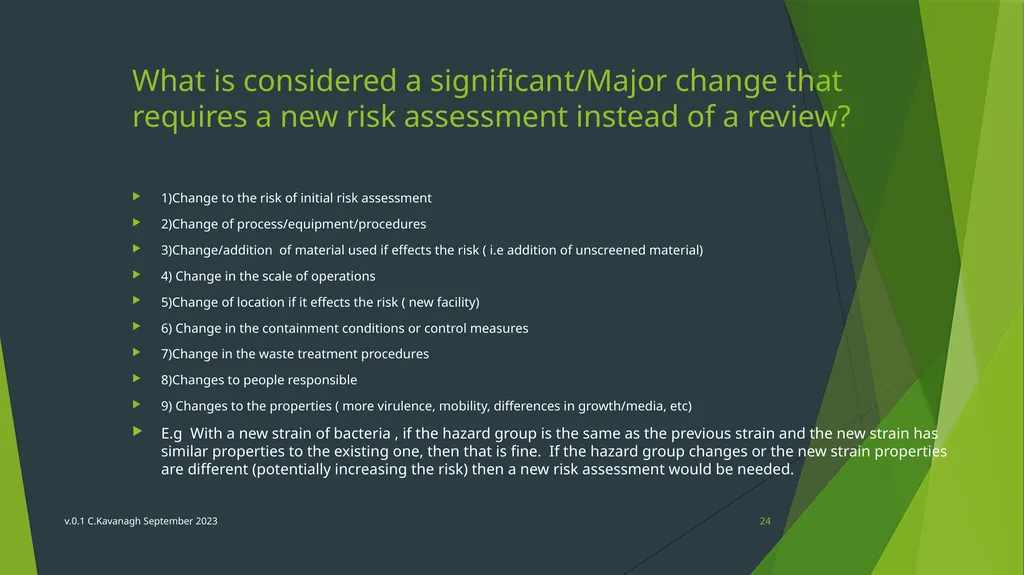
What is considered a significant/Major change that requires a new risk assessment instead of a review? 1)Change to the risk of initial risk assessment
2)Change of process/equipment/procedures
3)Change/addition of material used if effects the risk ( i.e addition of unscreened material)
4) Change in the scale of operations
5)Change of location if it effects the risk ( new facility)
6) Change in the containment conditions or control measures
7)Change in the waste treatment procedures
8)Changes to people responsible
9) Changes to the properties ( more virulence, mobility, differences in growth/media, etc)
E.g With a new strain of bacteria , if the hazard group is the same as the previous strain and the new strain has similar properties to the existing one, then that is fine. If the hazard group changes or the new strain properties are different (potentially increasing the risk) then a new risk assessment would be needed. v.0.1 C.Kavanagh September 2023 24<br>
25
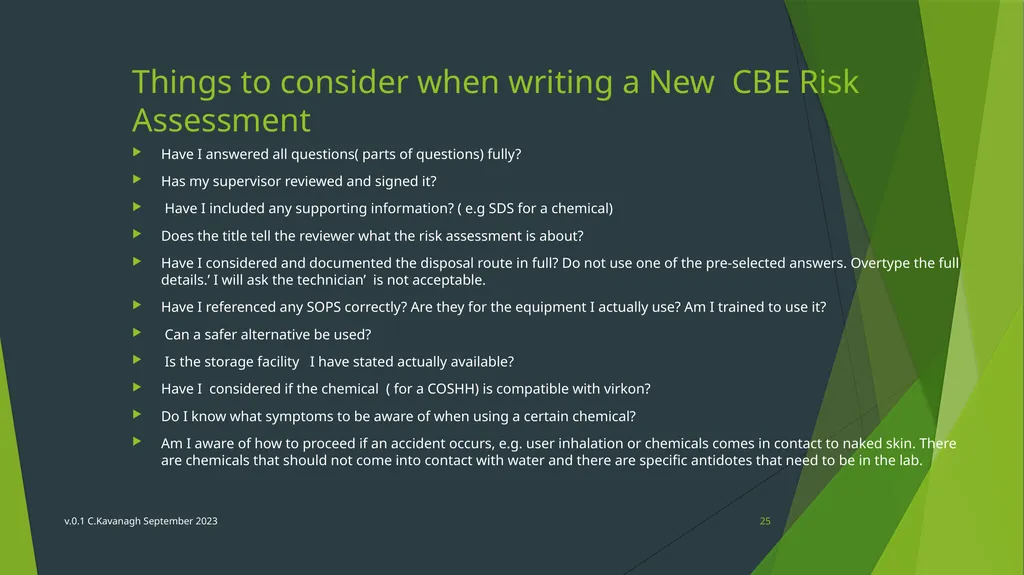
Things to consider when writing a New CBE Risk Assessment Have I answered all questions( parts of questions) fully?
Has my supervisor reviewed and signed it?
Have I included any supporting information? ( e.g SDS for a chemical)
Does the title tell the reviewer what the risk assessment is about?
Have I considered and documented the disposal route in full? Do not use one of the pre-selected answers. Overtype the full details.’ I will ask the technician’ is not acceptable.
Have I referenced any SOPS correctly? Are they for the equipment I actually use? Am I trained to use it?
Can a safer alternative be used?
Is the storage facility I have stated actually available?
Have I considered if the chemical ( for a COSHH) is compatible with virkon?
Do I know what symptoms to be aware of when using a certain chemical?
Am I aware of how to proceed if an accident occurs, e.g. user inhalation or chemicals comes in contact to naked skin. There are chemicals that should not come into contact with water and there are specific antidotes that need to be in the lab. v.0.1 C.Kavanagh September 2023 25<br>
26
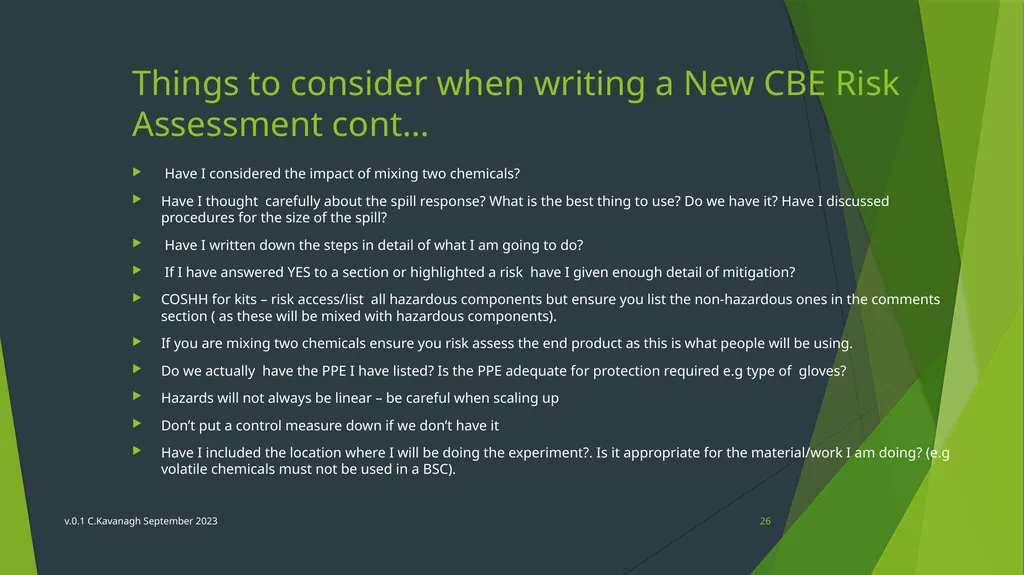
Things to consider when writing a New CBE Risk Assessment cont… Have I considered the impact of mixing two chemicals?
Have I thought carefully about the spill response? What is the best thing to use? Do we have it? Have I discussed procedures for the size of the spill?
Have I written down the steps in detail of what I am going to do?
If I have answered YES to a section or highlighted a risk have I given enough detail of mitigation?
COSHH for kits – risk access/list all hazardous components but ensure you list the non-hazardous ones in the comments section ( as these will be mixed with hazardous components).
If you are mixing two chemicals ensure you risk assess the end product as this is what people will be using.
Do we actually have the PPE I have listed? Is the PPE adequate for protection required e.g type of gloves?
Hazards will not always be linear – be careful when scaling up
Don’t put a control measure down if we don’t have it
Have I included the location where I will be doing the experiment?. Is it appropriate for the material/work I am doing? (e.g volatile chemicals must not be used in a BSC). v.0.1 C.Kavanagh September 2023 26<br>
27
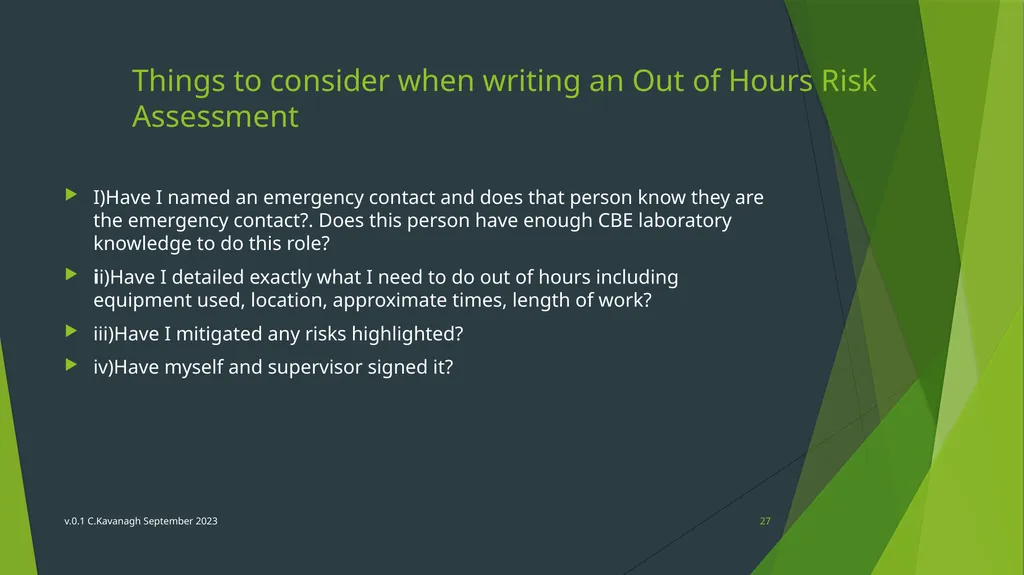
Things to consider when writing an Out of Hours Risk Assessment I)Have I named an emergency contact and does that person know they are the emergency contact?. Does this person have enough CBE laboratory knowledge to do this role?
ii)Have I detailed exactly what I need to do out of hours including equipment used, location, approximate times, length of work?
iii)Have I mitigated any risks highlighted?
iv)Have myself and supervisor signed it? v.0.1 C.Kavanagh September 2023 27<br>
ii)Have I detailed exactly what I need to do out of hours including equipment used, location, approximate times, length of work?
iii)Have I mitigated any risks highlighted?
iv)Have myself and supervisor signed it? v.0.1 C.Kavanagh September 2023 27<br>
28
CBE Risk Assessment Approval Process v.0.1 C.Kavanagh September 2023 28<br>
29
Where are Risk Assessments stored? v.0.1 C.Kavanagh September 2023 29<br>
30
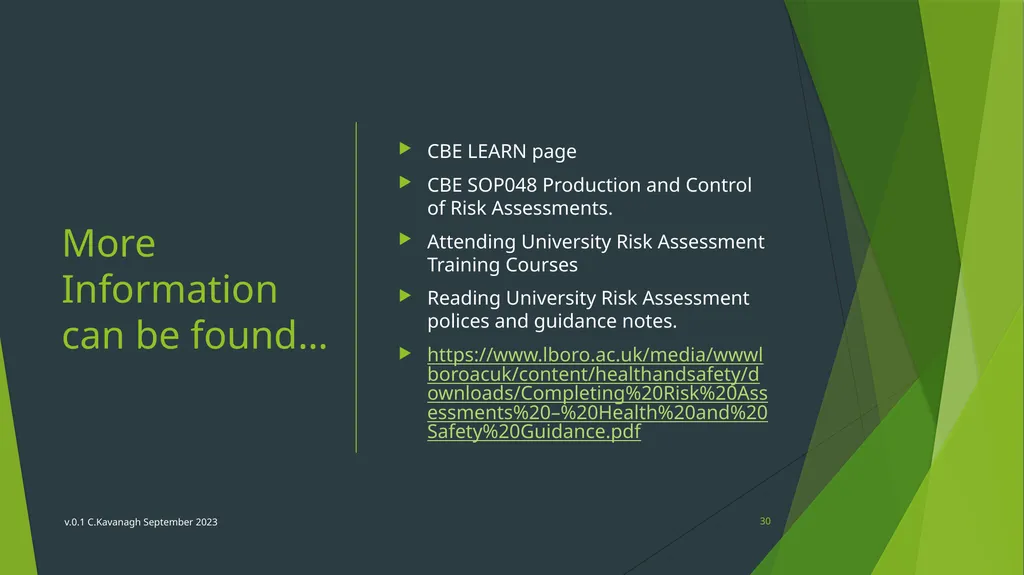
v.0.1 C.Kavanagh September 2023 More Information can be found… 30 CBE LEARN page
CBE SOP048 Production and Control of Risk Assessments.
Attending University Risk Assessment Training Courses
Reading University Risk Assessment polices and guidance notes.
https://www.lboro.ac.uk/media/wwwlboroacuk/content/healthandsafety/downloads/Completing%20Risk%20Assessments%20–%20Health%20and%20Safety%20Guidance.pdf<br>