
CCAC Training Module on: the Ethical Use and Care
FD
Published · 52 slides · 0 views
1 / 1
Description
CCAC Training Module on: the Ethical Use and Care of Farm Animals in Science www.ccac.ca Relevance of this Training Module This training module is relevant to all farm animal users, including those working with: dairy and beef cattle sheep
Related Topics
Share
Embed code
Download this presentation From Below
"CCAC Training Module on: the Ethical Use and Care" is the property of its rightful owner. Permission is granted to download and print the materials on this website for personal, non-commercial use only, and to display it on your personal computer provided you do not modify the materials and that you retain all copyright notices contained in the materials. By downloading content from our website, you accept the terms of this agreement.
Presentation Transcript
01
CCAC Training Module on:
the Ethical Use and Care of Farm Animals
in Science www.ccac.ca<br>
02
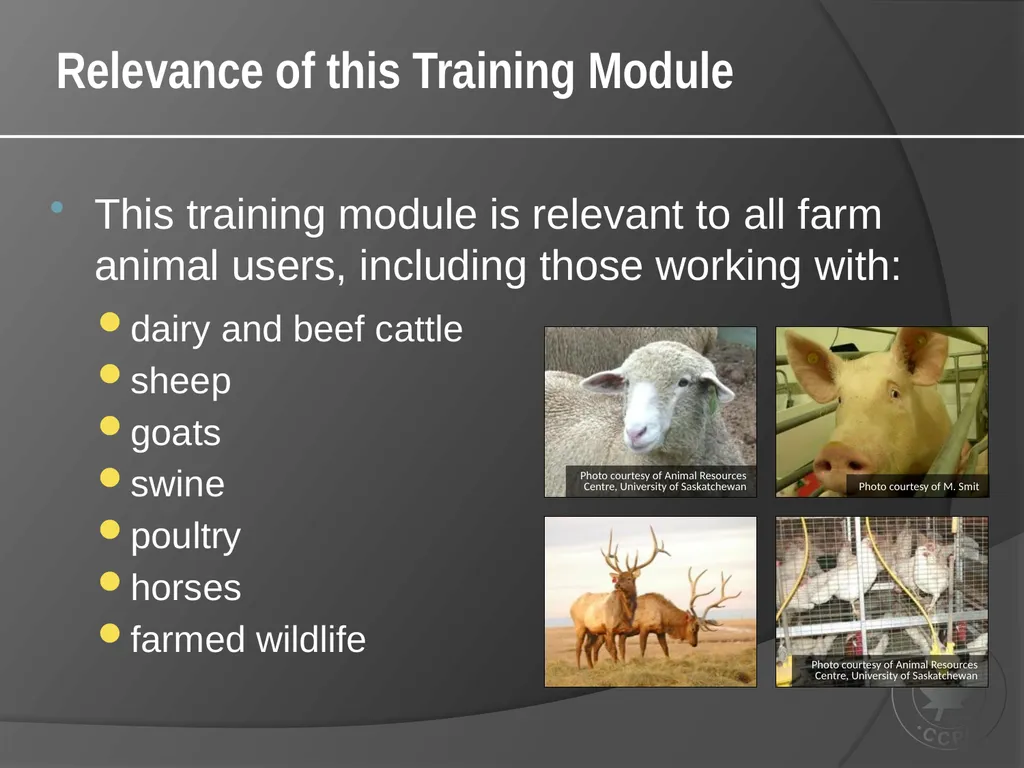
Relevance of this Training Module This training module is relevant to all farm animal users, including those working with:
dairy and beef cattle
sheep
goats
swine
poultry
horses
farmed wildlife<br>
dairy and beef cattle
sheep
goats
swine
poultry
horses
farmed wildlife<br>
03
Training Module Goals Introduce investigators, teachers, animal care personnel and students to the care, housing, and handling requirements of farm animals used in science
Present an overview of animal care practices that help ensure good welfare and discuss potential welfare challenges associated with the use and care of farm animals in science
Provide investigators with references and resources relating to the use of farm animals in science<br>
Present an overview of animal care practices that help ensure good welfare and discuss potential welfare challenges associated with the use and care of farm animals in science
Provide investigators with references and resources relating to the use of farm animals in science<br>
04
Training Module Outline Introduction to farm animal welfare
what is a farm animal?
understanding animal welfare
regulations and standards
Overview of factors affecting farm animal welfare
provision of fundamental needs (feed, water, environment and housing)
acquisition (sourcing, transportation, identification, ensuring good health status)
routine handling and specialized procedures
termination of scientific use<br>
what is a farm animal?
understanding animal welfare
regulations and standards
Overview of factors affecting farm animal welfare
provision of fundamental needs (feed, water, environment and housing)
acquisition (sourcing, transportation, identification, ensuring good health status)
routine handling and specialized procedures
termination of scientific use<br>
05
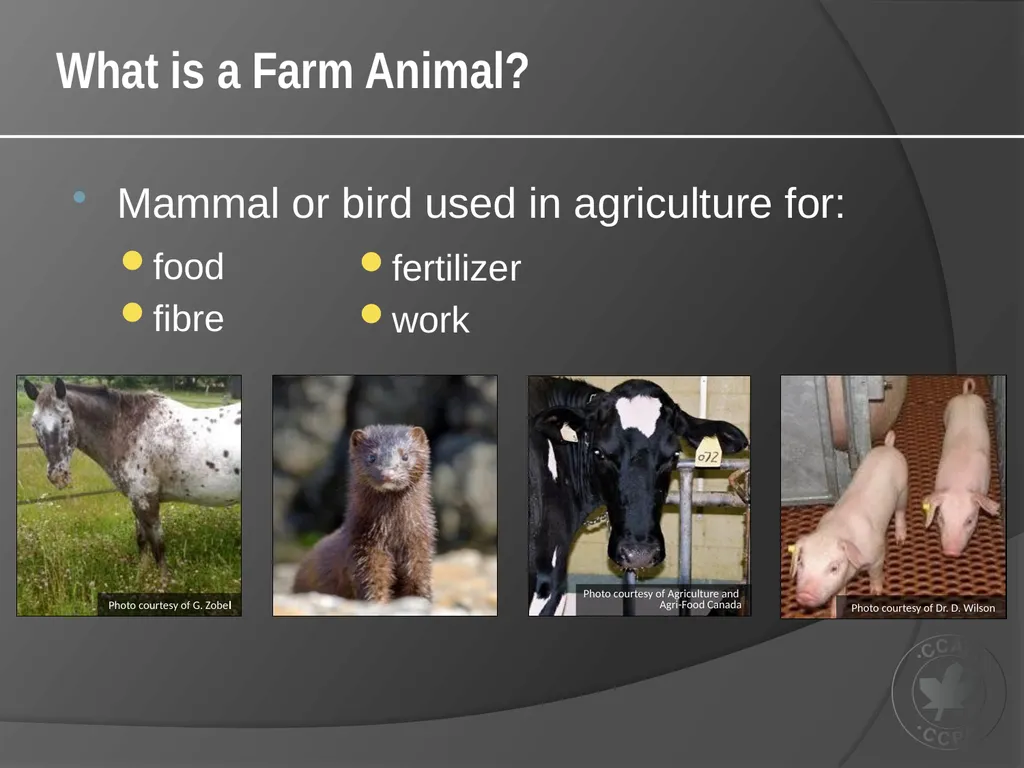
What is a Farm Animal? Mammal or bird used in agriculture for:
food
fibre fertilizer
work<br>
food
fibre fertilizer
work<br>
06
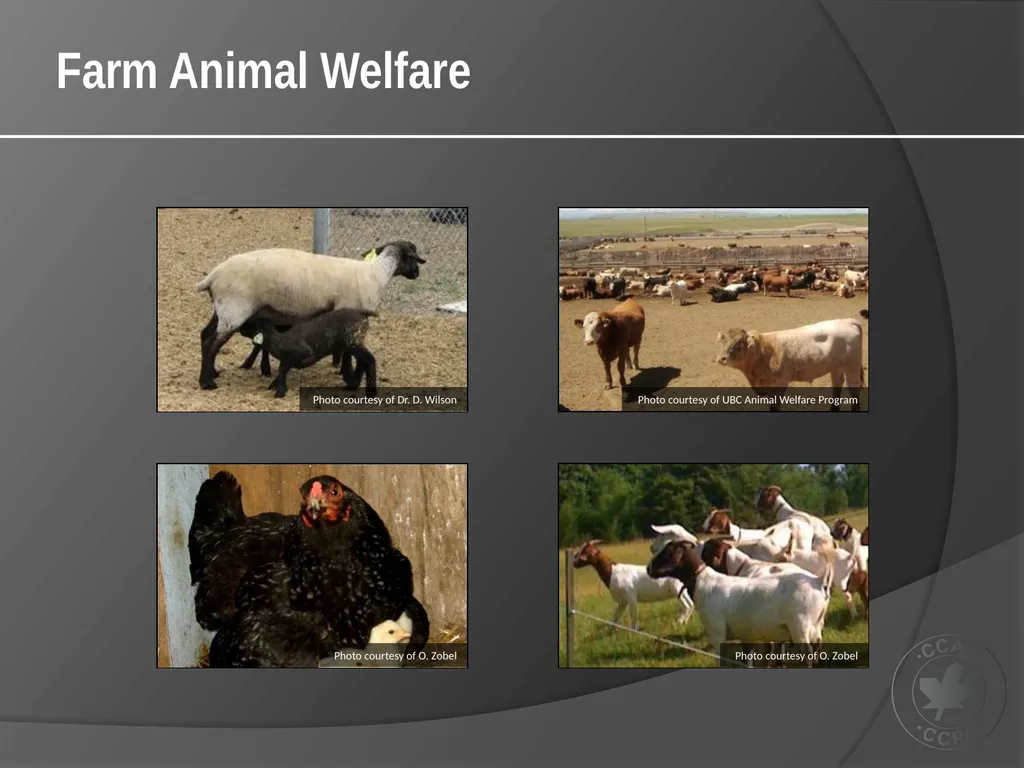
Farm Animal Welfare Photo courtesy of Dr. D. Wilson Photo courtesy of O. Zobel Photo courtesy of UBC Animal Welfare Program Photo courtesy of O. Zobel<br>
07
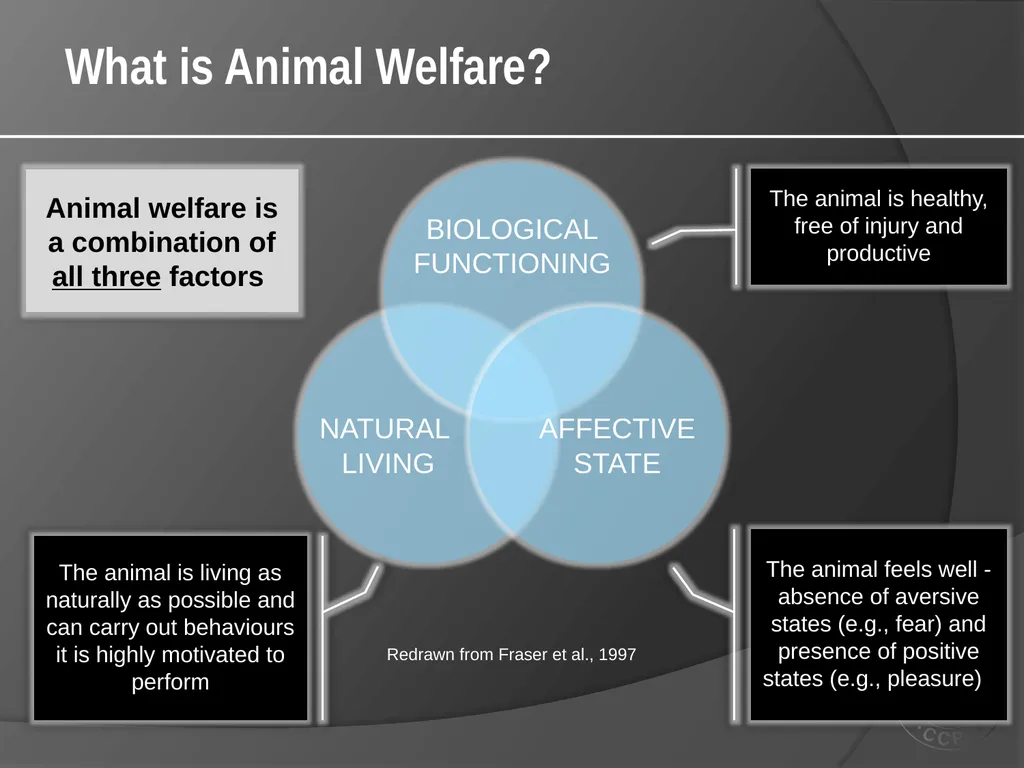
What is Animal Welfare? The animal is living as naturally as possible and can carry out behaviours it is highly motivated to perform The animal feels well - absence of aversive states (e.g., fear) and presence of positive states (e.g., pleasure) The animal is healthy, free of injury and productive Animal welfare is a combination of all three factors Redrawn from Fraser et al., 1997<br>
08
Regulations & Guidelines
Concerning Farm Animals Federal
Transport: Health of Animals Regulations (Part XII)
Humane Handling and Slaughter: Meat Inspection Act (Sections 61-80)
Suffering: Criminal Code of Canada (Section 444-446)
New Drugs: Health Canada (Veterinary Drugs Directorate)
New Vaccines: Canadian Food Inspection Agency (CFIA) (Veterinary Biologics Section)
Provincial and territorial
Non-governmental organizations and voluntary standards
Recommended Codes of Practice: National Farm Animal Care Council (NFACC)
Canadian Veterinary Medical Association (CVMA)
Canadian Federation of Humane Societies (CFHS)<br>
Transport: Health of Animals Regulations (Part XII)
Humane Handling and Slaughter: Meat Inspection Act (Sections 61-80)
Suffering: Criminal Code of Canada (Section 444-446)
New Drugs: Health Canada (Veterinary Drugs Directorate)
New Vaccines: Canadian Food Inspection Agency (CFIA) (Veterinary Biologics Section)
Provincial and territorial
Non-governmental organizations and voluntary standards
Recommended Codes of Practice: National Farm Animal Care Council (NFACC)
Canadian Veterinary Medical Association (CVMA)
Canadian Federation of Humane Societies (CFHS)<br>
09
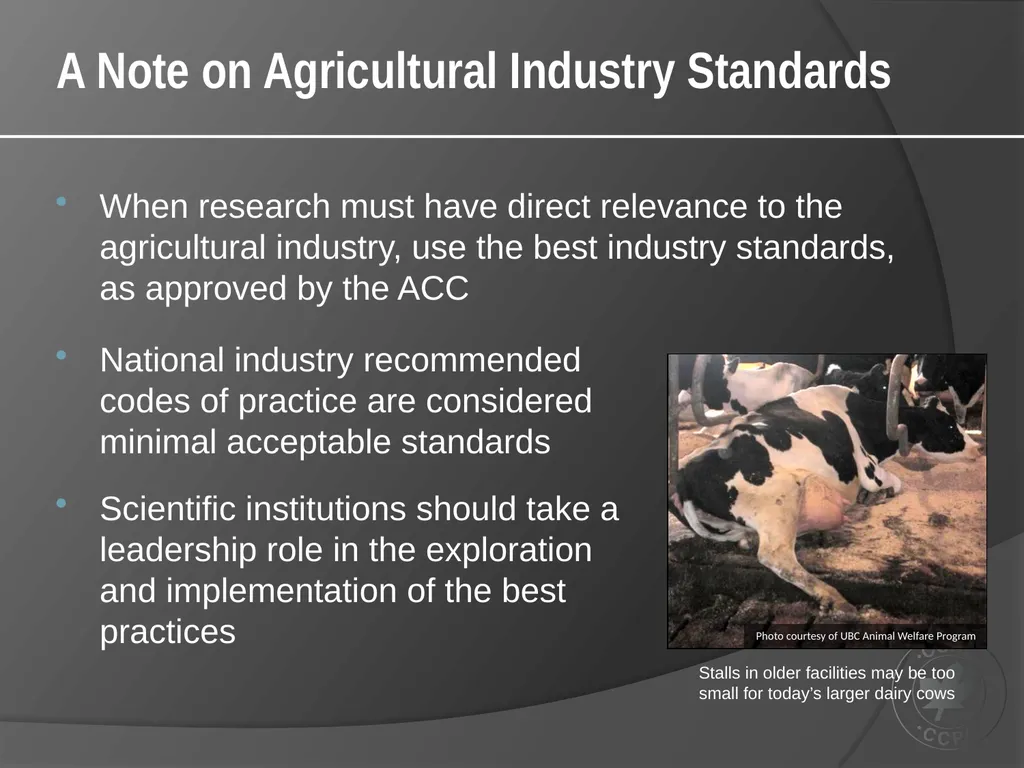
A Note on Agricultural Industry Standards When research must have direct relevance to the agricultural industry, use the best industry standards, as approved by the ACC Stalls in older facilities may be too small for today’s larger dairy cows National industry recommended codes of practice are considered minimal acceptable standards
Scientific institutions should take a leadership role in the exploration and implementation of the best practices<br>
Scientific institutions should take a leadership role in the exploration and implementation of the best practices<br>
10
Standard Operating Procedures (SOPs) Approved SOPs outline correct methodology for performing routine and common practices and procedures
following SOPs helps ensure good animal welfare and human safety
All animal care personnel should be familiar with and know the location of facility-specific SOPs pertaining to:
routine and specialized husbandry, care and handling
routine assessment of health and welfare of groups and individual animals
minimizing disease and managing disease outbreaks
safe handling and usage of drugs and other chemicals<br>
following SOPs helps ensure good animal welfare and human safety
All animal care personnel should be familiar with and know the location of facility-specific SOPs pertaining to:
routine and specialized husbandry, care and handling
routine assessment of health and welfare of groups and individual animals
minimizing disease and managing disease outbreaks
safe handling and usage of drugs and other chemicals<br>
11
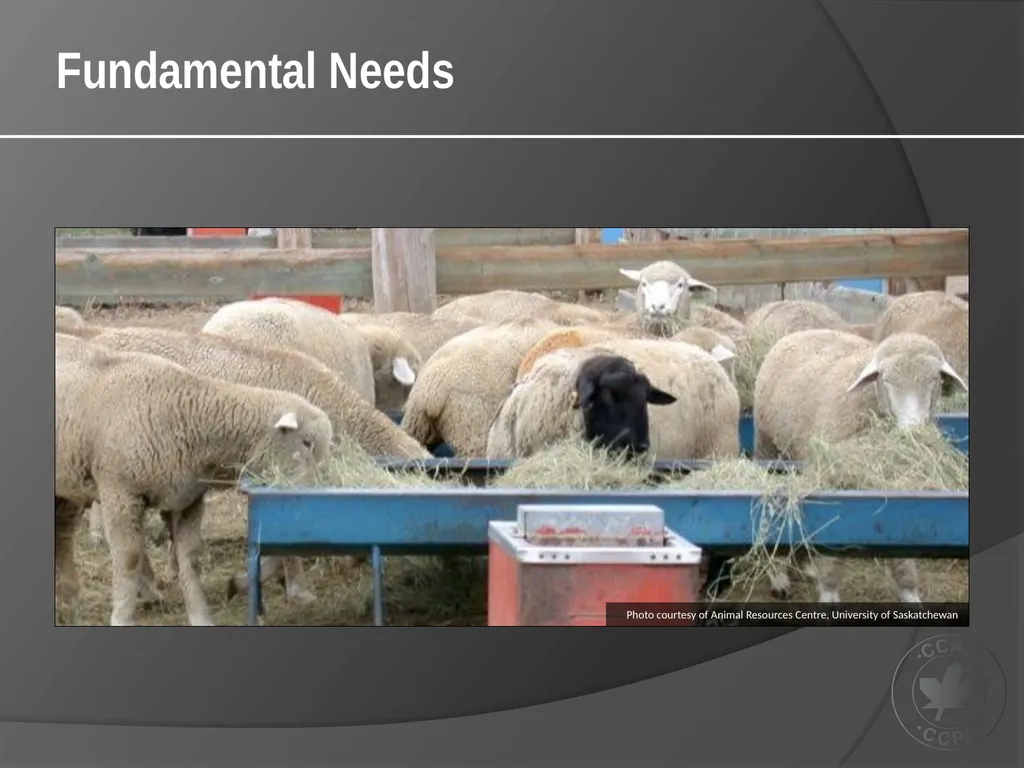
Fundamental Needs<br>
12
Feed and Water Feed
palatable and nutritionally adequate
sufficient quantities and frequencies of deliveries to minimize hunger and competition
Water
fresh, potable, ice-free, available 24 h/d and supplied at sufficient pressure to meet animals’ drinking rates
National Research Council (NRC) guidelines provide species-specific nutritional requirements<br>
palatable and nutritionally adequate
sufficient quantities and frequencies of deliveries to minimize hunger and competition
Water
fresh, potable, ice-free, available 24 h/d and supplied at sufficient pressure to meet animals’ drinking rates
National Research Council (NRC) guidelines provide species-specific nutritional requirements<br>
13
The Farm Animal Environment:
Why does it Matter? Investigators typically do not have a direct input into the facilities in which they work – why should they care about how animals are housed? Housing directly influences the welfare, security and behaviour of animals and humans, which potentially impacts research outcomes.<br>
14
Housing Requirements Safe and clean shelter, resistant to the
elements
Water and feed (see slide 12)
Good air quality
Access to outdoors, if possible
Space for feeding, moving, sleeping, and appropriate contact with other animals
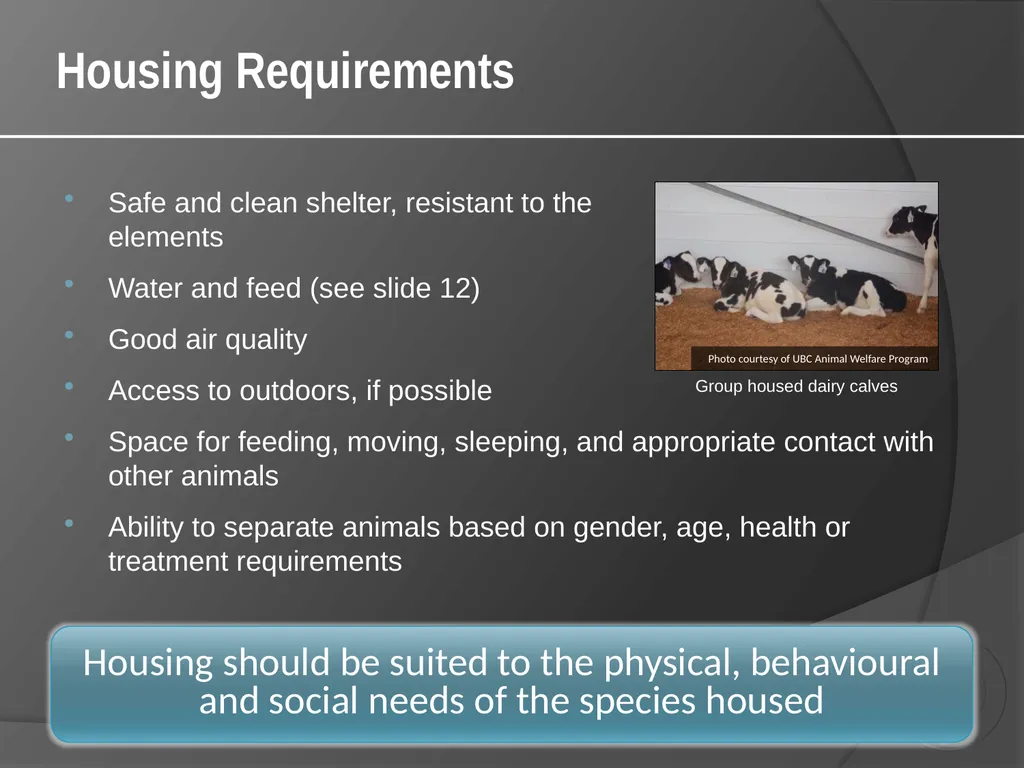
Ability to separate animals based on gender, age, health or treatment requirements Housing should be suited to the physical, behavioural and social needs of the species housed Group housed dairy calves<br>
Water and feed (see slide 12)
Good air quality
Access to outdoors, if possible
Space for feeding, moving, sleeping, and appropriate contact with other animals
Ability to separate animals based on gender, age, health or treatment requirements Housing should be suited to the physical, behavioural and social needs of the species housed Group housed dairy calves<br>
15
Housing Factors Potentially Affecting Welfare Type of housing
(indoor versus outdoor)
Space allocation
Flooring and footing
Lying areas and bedding
Manure handling systems
Thermal and non-thermal (air quality) conditions and ventilation systems
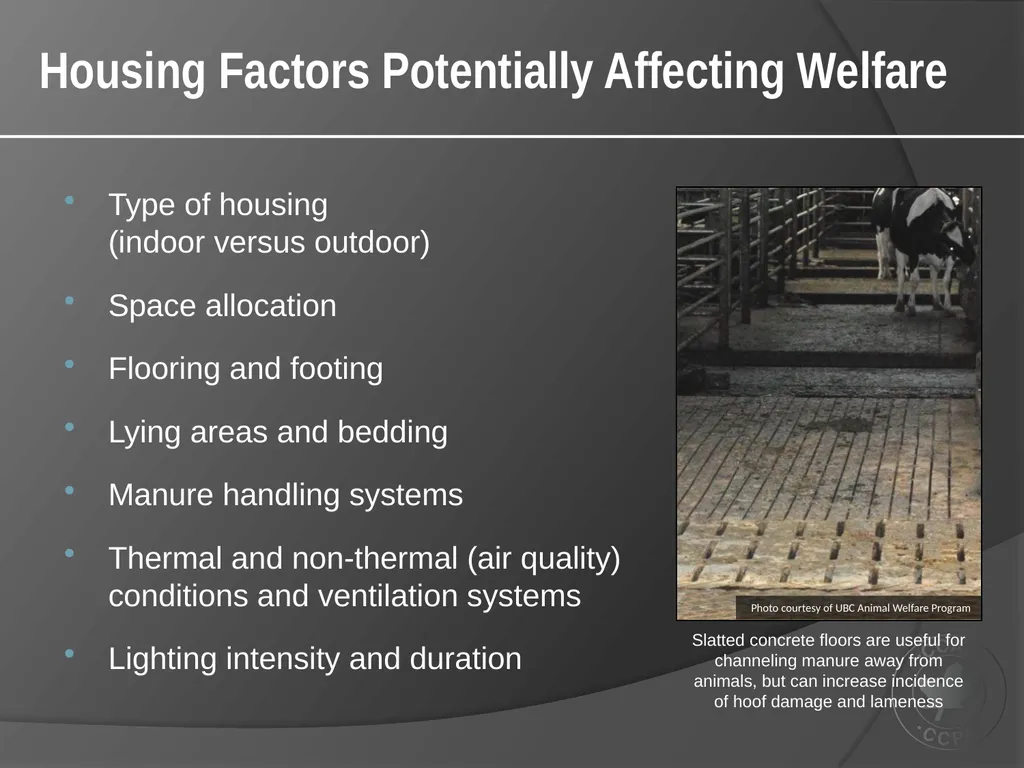
Lighting intensity and duration Slatted concrete floors are useful for channeling manure away from animals, but can increase incidence of hoof damage and lameness<br>
Space allocation
Flooring and footing
Lying areas and bedding
Manure handling systems
Thermal and non-thermal (air quality) conditions and ventilation systems
Lighting intensity and duration Slatted concrete floors are useful for channeling manure away from animals, but can increase incidence of hoof damage and lameness<br>
16
Animal Welfare Effects of Facility Maintenance Issues Become familiar with animal care and emergency SOPs
Vital systems (e.g., mechanical ventilation, water and feed delivery)
need daily monitoring
report problems immediately
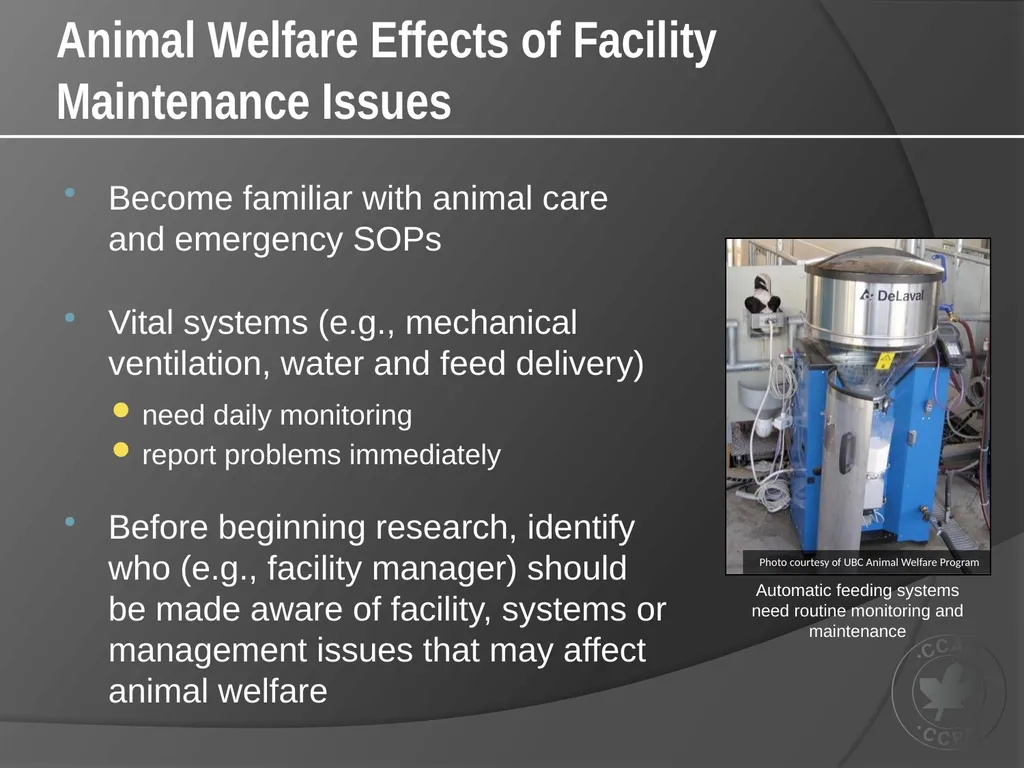
Before beginning research, identify who (e.g., facility manager) should be made aware of facility, systems or management issues that may affect animal welfare Automatic feeding systems need routine monitoring and maintenance<br>
Vital systems (e.g., mechanical ventilation, water and feed delivery)
need daily monitoring
report problems immediately
Before beginning research, identify who (e.g., facility manager) should be made aware of facility, systems or management issues that may affect animal welfare Automatic feeding systems need routine monitoring and maintenance<br>
17
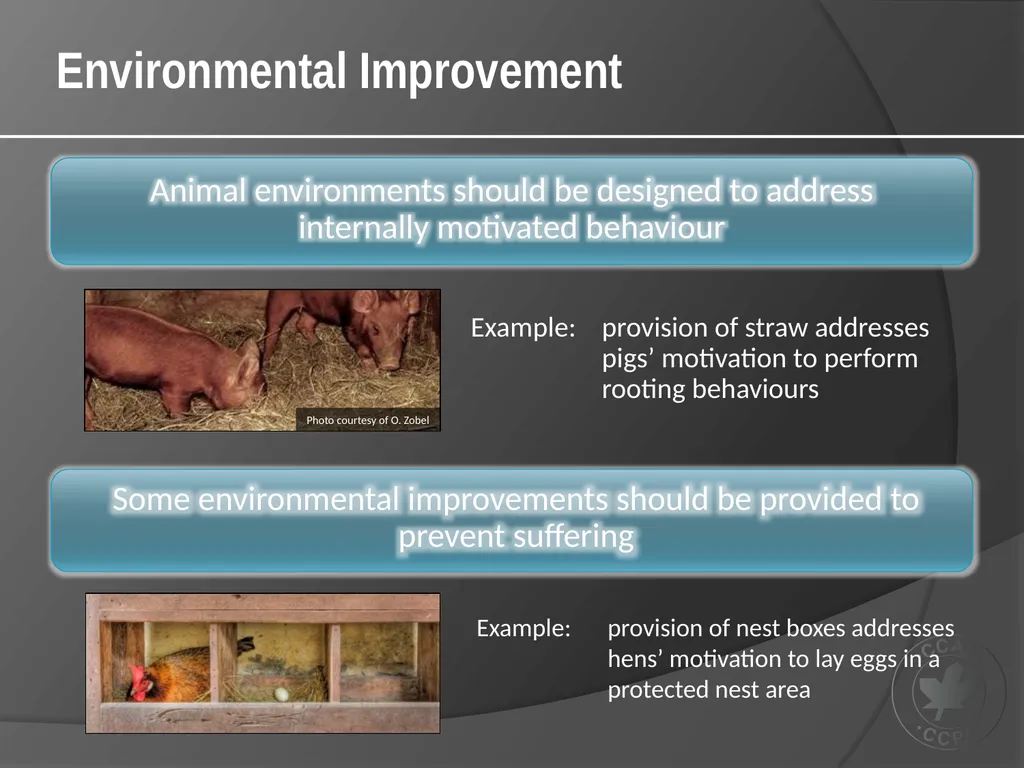
Example: provision of straw addresses pigs’ motivation to perform rooting behaviours Example: provision of nest boxes addresses hens’ motivation to lay eggs in a protected nest area Animal environments should be designed to address internally motivated behaviour Some environmental improvements should be provided to prevent suffering Environmental Improvement<br>
18
Improving Farm Animal Environments Provide:
Appropriate hygiene level
Appropriate grouping (size and animal compatibility)
Comfortable lying and walking surfaces
Opportunity for social contact
Opportunity to express normal behaviours
Means to minimize stress during weaning
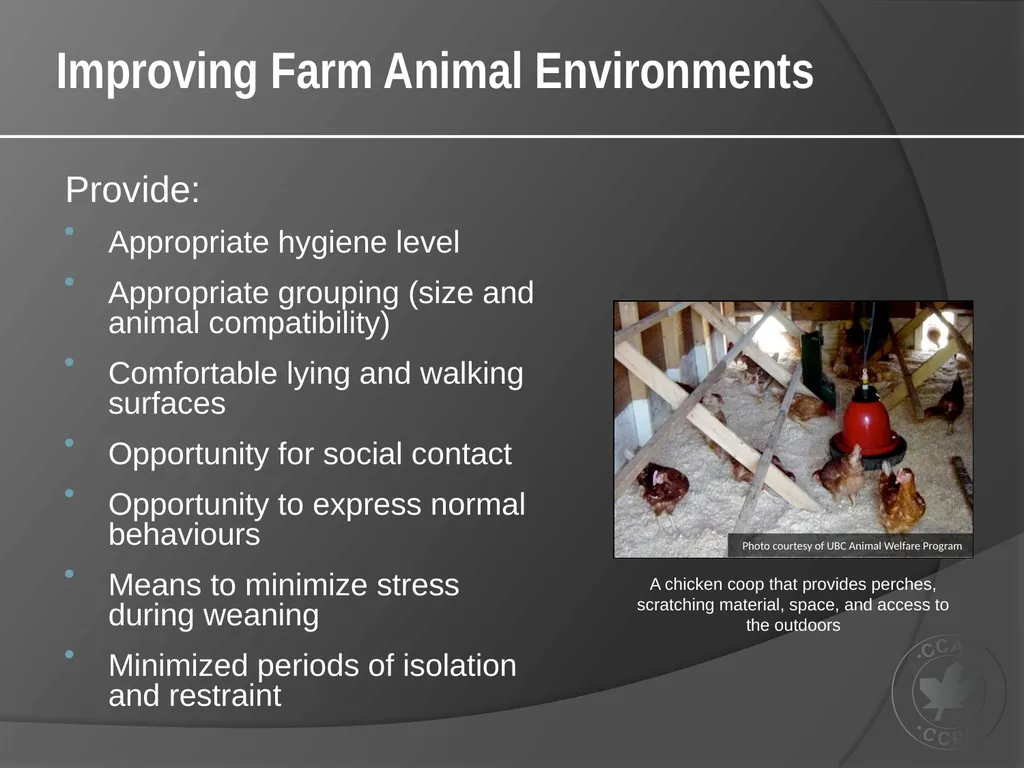
Minimized periods of isolation and restraint A chicken coop that provides perches, scratching material, space, and access to the outdoors<br>
Appropriate hygiene level
Appropriate grouping (size and animal compatibility)
Comfortable lying and walking surfaces
Opportunity for social contact
Opportunity to express normal behaviours
Means to minimize stress during weaning
Minimized periods of isolation and restraint A chicken coop that provides perches, scratching material, space, and access to the outdoors<br>
19
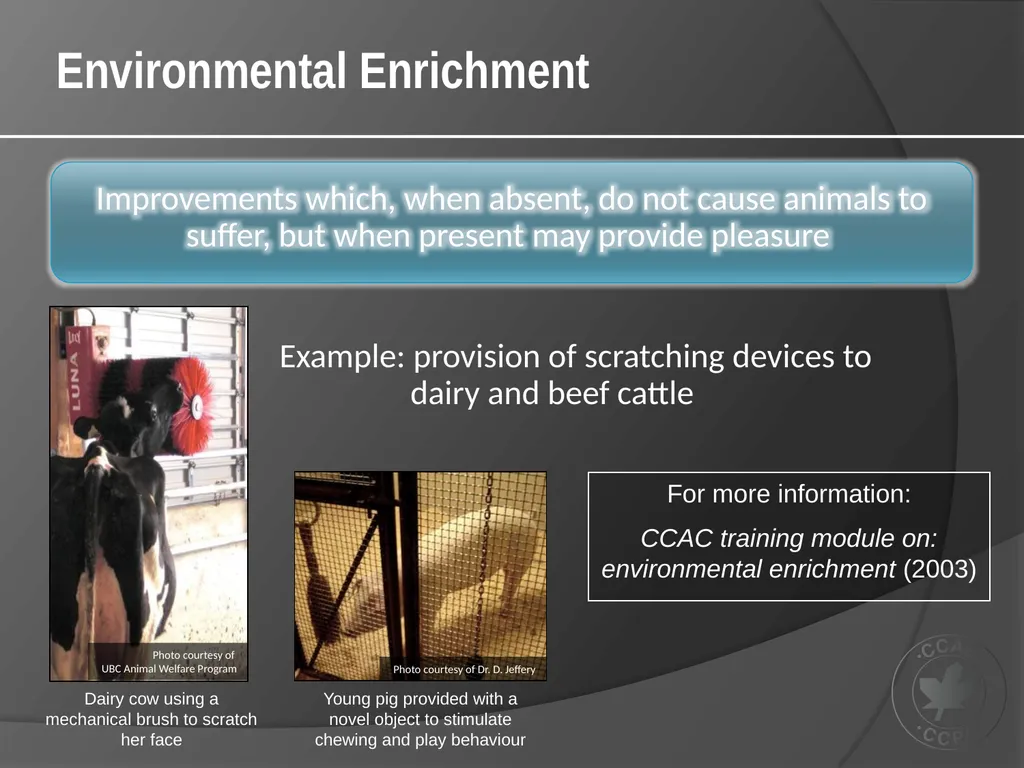
Example: provision of scratching devices to dairy and beef cattle Improvements which, when absent, do not cause animals to suffer, but when present may provide pleasure Environmental Enrichment Dairy cow using a mechanical brush to scratch her face For more information:
CCAC training module on: environmental enrichment (2003) Young pig provided with a novel object to stimulate chewing and play behaviour<br>
CCAC training module on: environmental enrichment (2003) Young pig provided with a novel object to stimulate chewing and play behaviour<br>
20
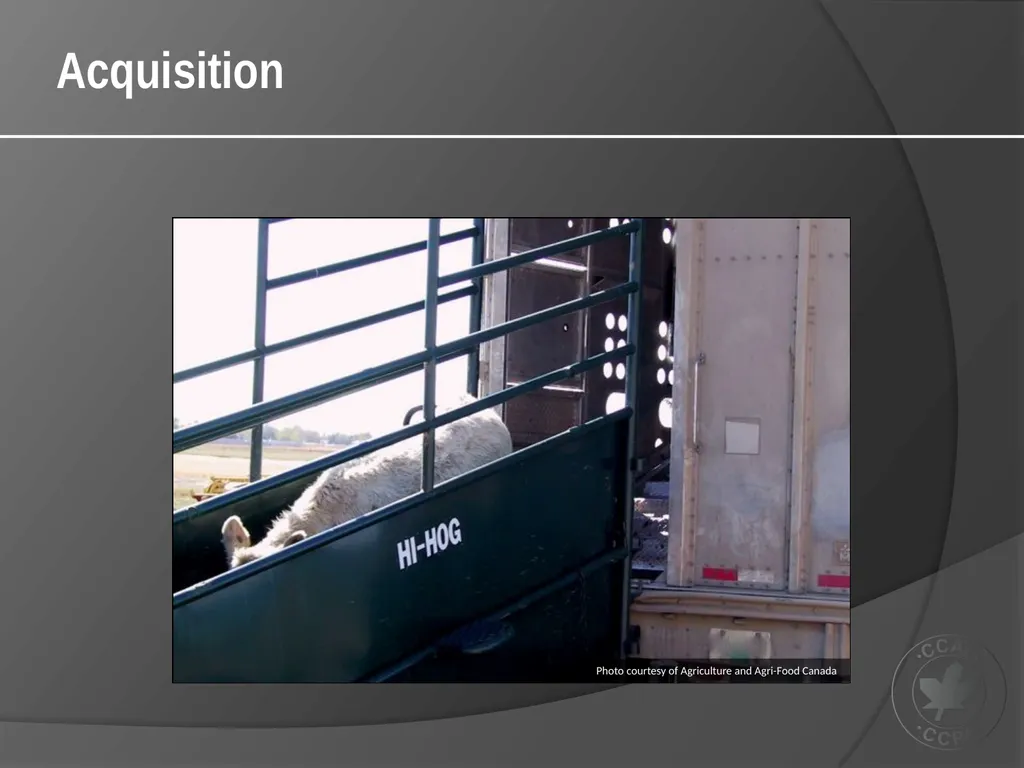
Acquisition<br>
21
Importance of Proper Acquisition Source animals from reputable sources with good health management
records of husbandry and any treatment (e.g., vaccines)
Prevent disease outbreaks – verify health status by quarantining upon arrival
Consider the effect of genotype on welfare
selection for maximum production in agricultural industry may have negative welfare consequences<br>
records of husbandry and any treatment (e.g., vaccines)
Prevent disease outbreaks – verify health status by quarantining upon arrival
Consider the effect of genotype on welfare
selection for maximum production in agricultural industry may have negative welfare consequences<br>
22
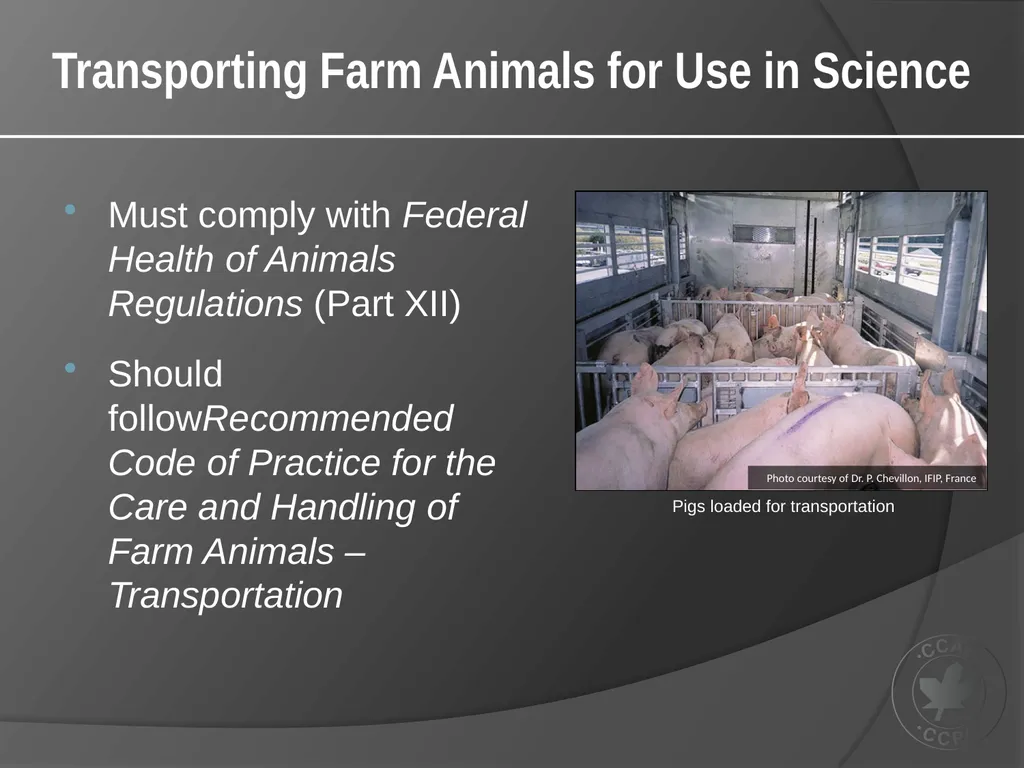
Transporting Farm Animals for Use in Science Must comply with Federal Health of Animals Regulations (Part XII)
Should followRecommended Code of Practice for the Care and Handling of Farm Animals – Transportation Pigs loaded for transportation<br>
Should followRecommended Code of Practice for the Care and Handling of Farm Animals – Transportation Pigs loaded for transportation<br>
23
Importance of Proper Identification and Animal Record Keeping Identification according to federal (CFIA) and provincial systems
Physical identification (e.g., ear tagging) done by trained individuals to avoid injury (e.g., nerve damage)
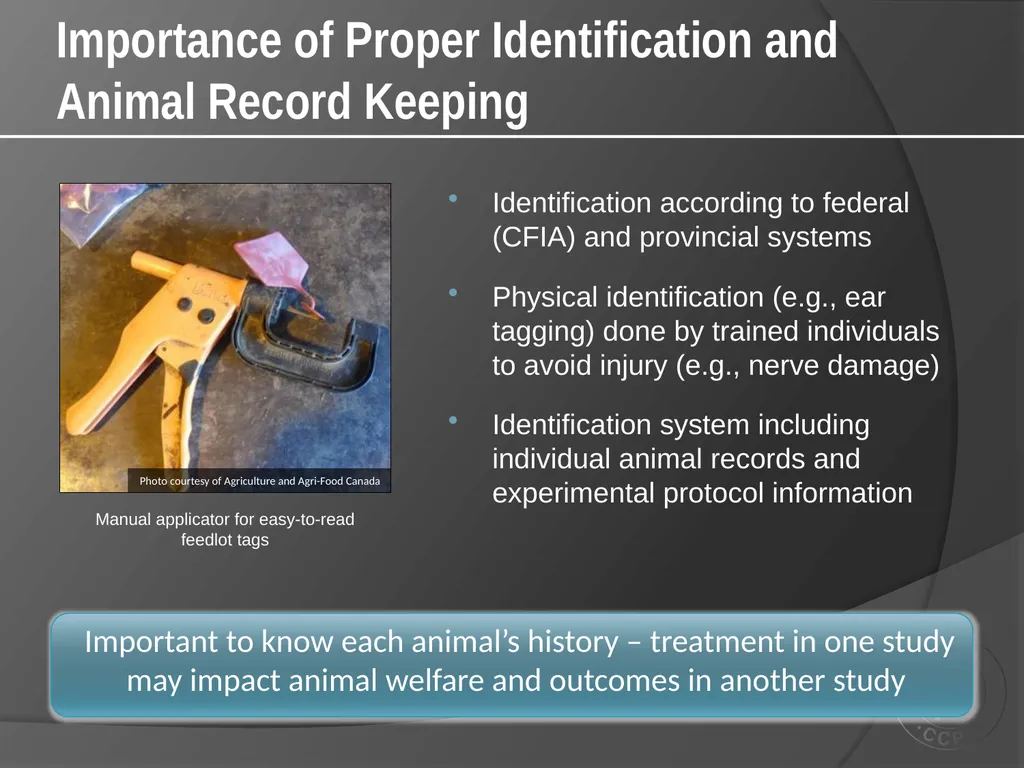
Identification system including individual animal records and experimental protocol information Important to know each animal’s history – treatment in one study may impact animal welfare and outcomes in another study Manual applicator for easy-to-read feedlot tags<br>
Physical identification (e.g., ear tagging) done by trained individuals to avoid injury (e.g., nerve damage)
Identification system including individual animal records and experimental protocol information Important to know each animal’s history – treatment in one study may impact animal welfare and outcomes in another study Manual applicator for easy-to-read feedlot tags<br>
24
Importance of Acclimation Combination of acclimation and quarantine, if possible
Length of acclimation period based on species, handling experience, age, previous environment, feed intake, etc.
Special consideration for transitions (outdoor indoor)
physiological changes
dietary changes
familiarization with new type of environment
mixing and socialization Before using animals in any scientific application, acclimation to experimental conditions is required<br>
Length of acclimation period based on species, handling experience, age, previous environment, feed intake, etc.
Special consideration for transitions (outdoor indoor)
physiological changes
dietary changes
familiarization with new type of environment
mixing and socialization Before using animals in any scientific application, acclimation to experimental conditions is required<br>
25
Quarantine: Essential for Maintaining Good Health and Welfare Quick detection and response to health problems in new or sick animals
protection of the health of other animals in the facility
Monitoring at least twice daily
feed and water intake
physical appearance
behaviour If questionable, record body temperature Introduce animals to the rest of the herd/flock only after good health status is established<br>
protection of the health of other animals in the facility
Monitoring at least twice daily
feed and water intake
physical appearance
behaviour If questionable, record body temperature Introduce animals to the rest of the herd/flock only after good health status is established<br>
26
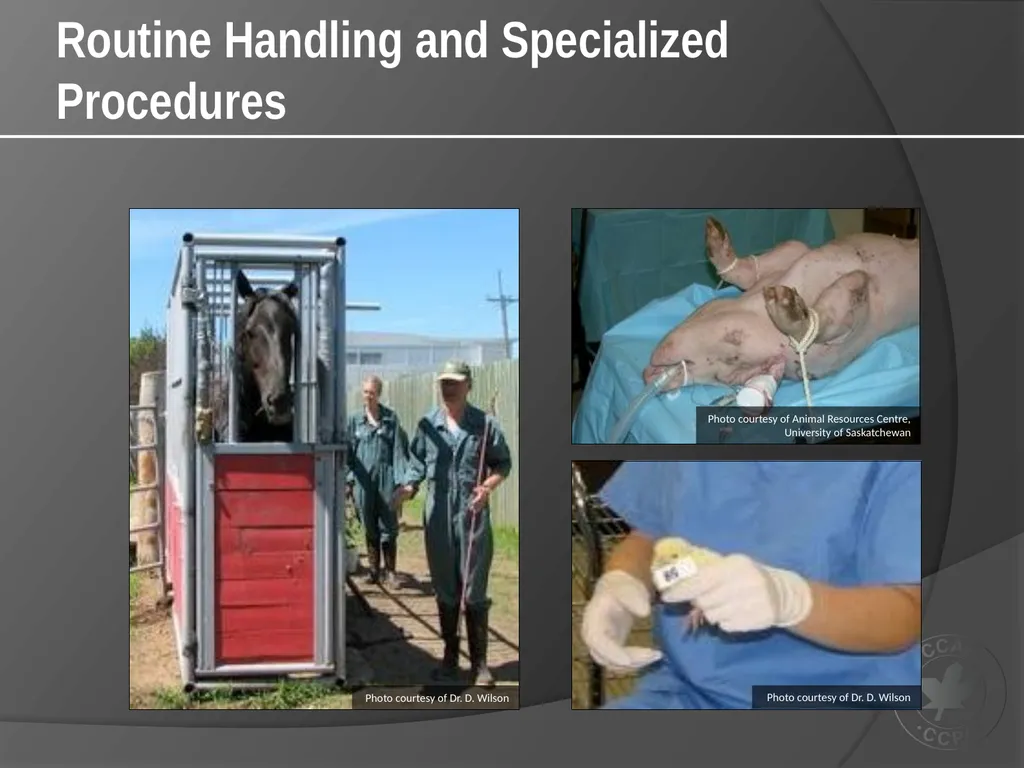
Routine Handling and Specialized Procedures<br>
27
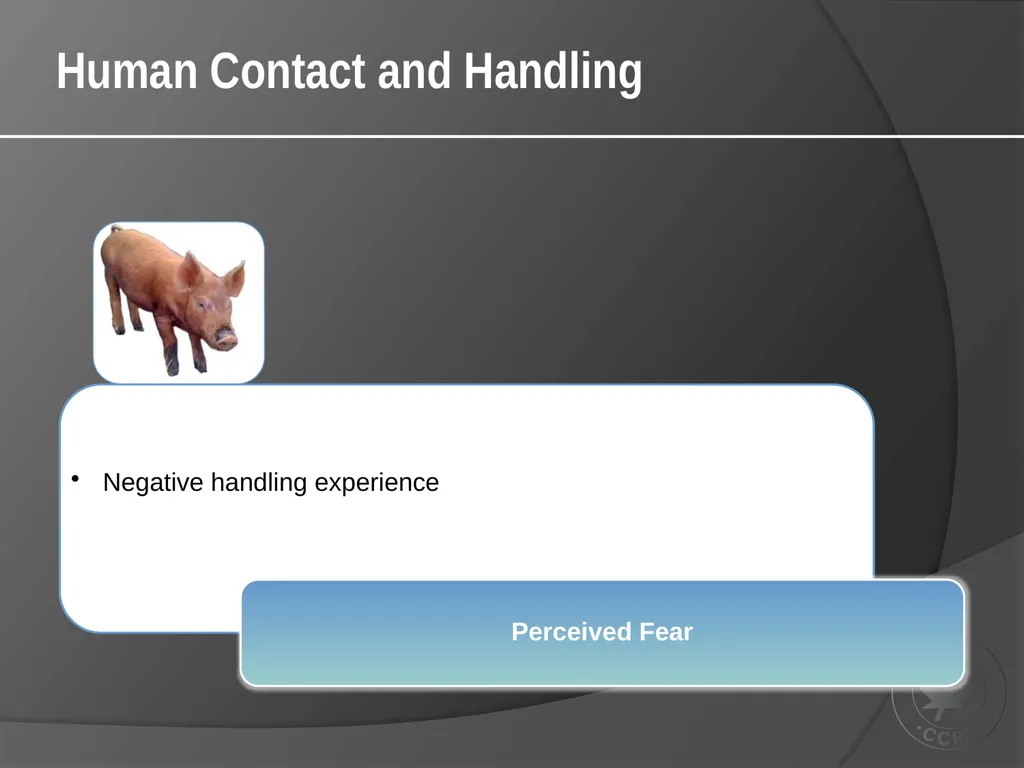
Human Contact and Handling<br>
28
Effective, Low-Stress Handling Skill set acquired through animal behaviour training and supervised experience
proper techniques for avoiding fearful response to handling, lifting, moving and herding
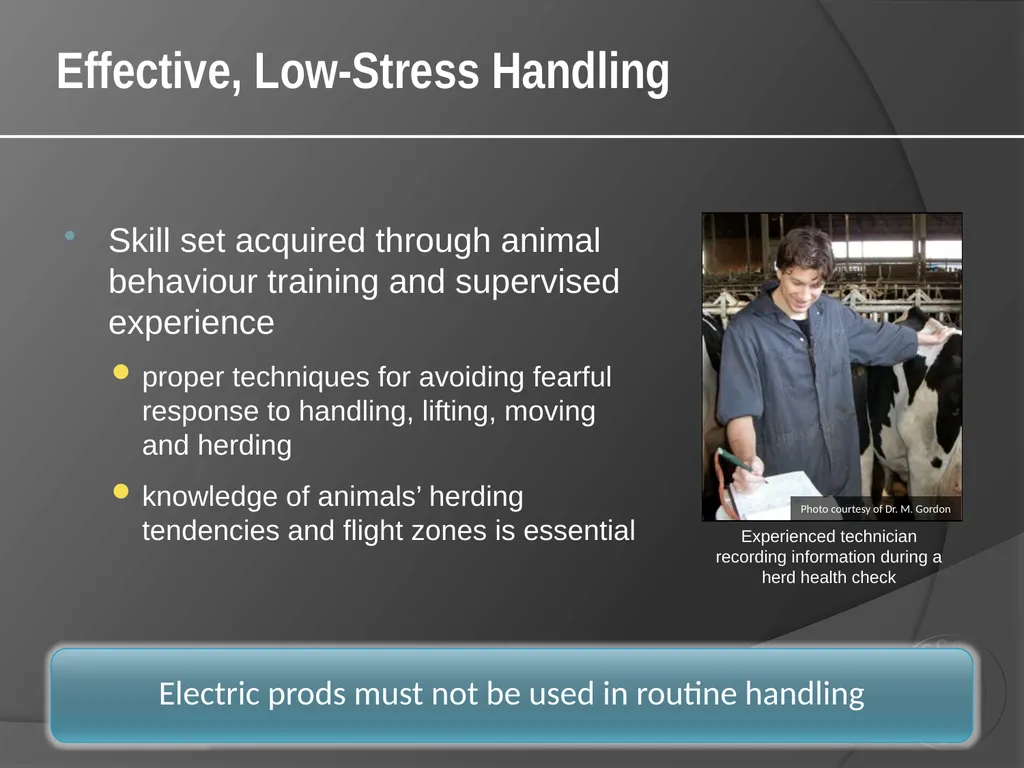
knowledge of animals’ herding tendencies and flight zones is essential Electric prods must not be used in routine handling Experienced technician recording information during a herd health check<br>
proper techniques for avoiding fearful response to handling, lifting, moving and herding
knowledge of animals’ herding tendencies and flight zones is essential Electric prods must not be used in routine handling Experienced technician recording information during a herd health check<br>
29
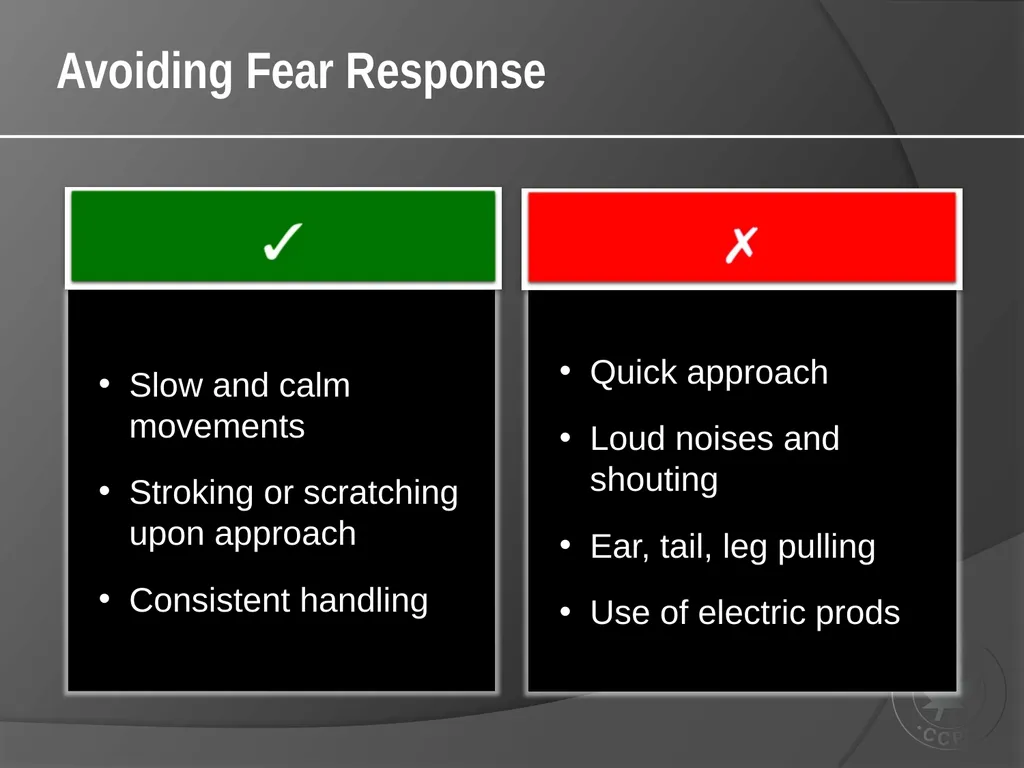
Avoiding Fear Response<br>
30
On-Farm Human Safety Working with animals: fifth highest cause of on-farm, human fatalities in the past decade
Most common activities being performed when fatalities occurred:
herding
feeding and watering
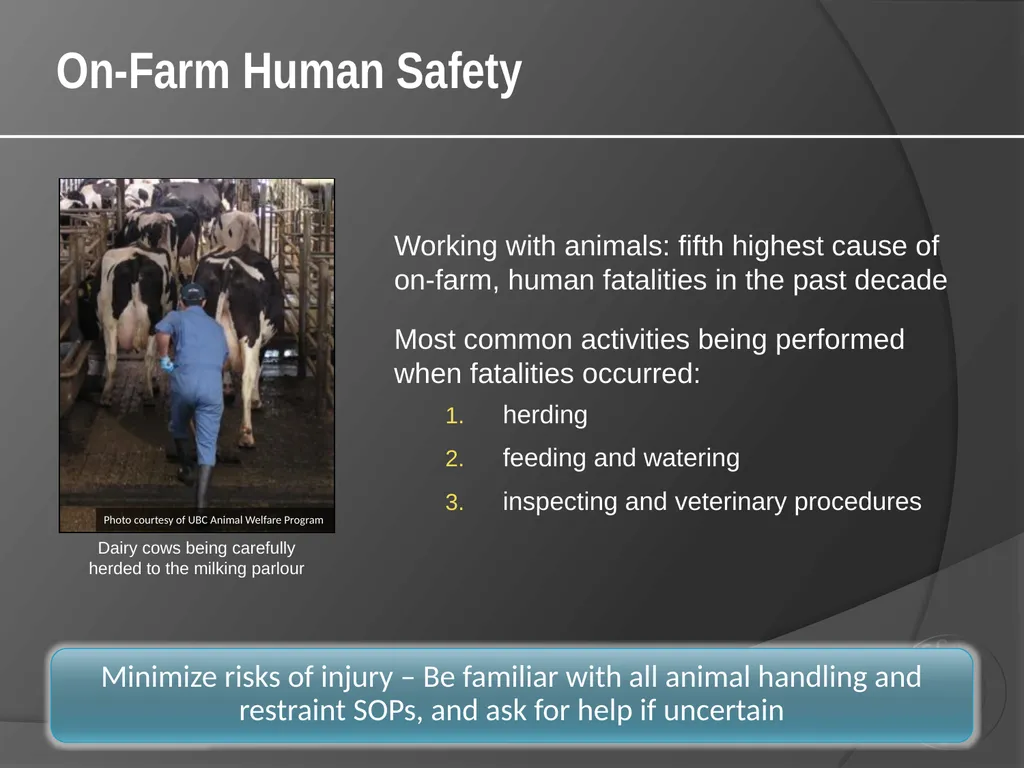
inspecting and veterinary procedures Minimize risks of injury – Be familiar with all animal handling and restraint SOPs, and ask for help if uncertain Dairy cows being carefully herded to the milking parlour<br>
Most common activities being performed when fatalities occurred:
herding
feeding and watering
inspecting and veterinary procedures Minimize risks of injury – Be familiar with all animal handling and restraint SOPs, and ask for help if uncertain Dairy cows being carefully herded to the milking parlour<br>
31
Restraining Farm Animals Farm animals should be handled and restrained with species-specific equipment
Restraint devices
should be appropriate for intended procedure
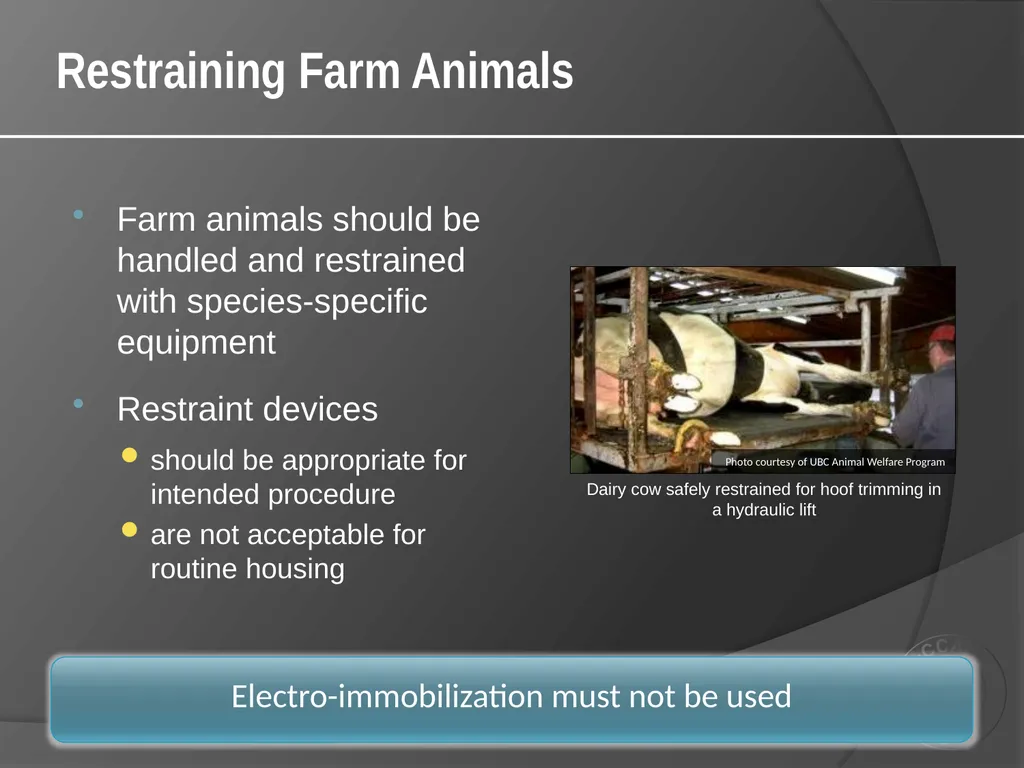
are not acceptable for routine housing Electro-immobilization must not be used Dairy cow safely restrained for hoof trimming in a hydraulic lift<br>
Restraint devices
should be appropriate for intended procedure
are not acceptable for routine housing Electro-immobilization must not be used Dairy cow safely restrained for hoof trimming in a hydraulic lift<br>
32
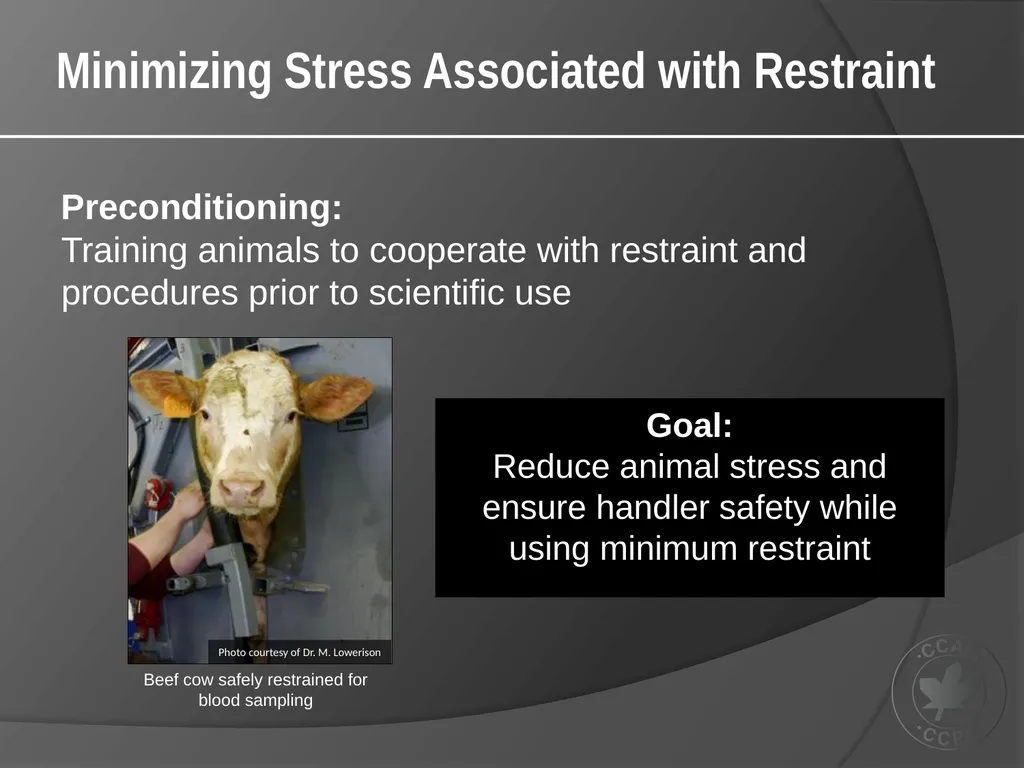
Minimizing Stress Associated with Restraint Goal:
Reduce animal stress and ensure handler safety while using minimum restraint Preconditioning:
Training animals to cooperate with restraint and procedures prior to scientific use Beef cow safely restrained for blood sampling<br>
33
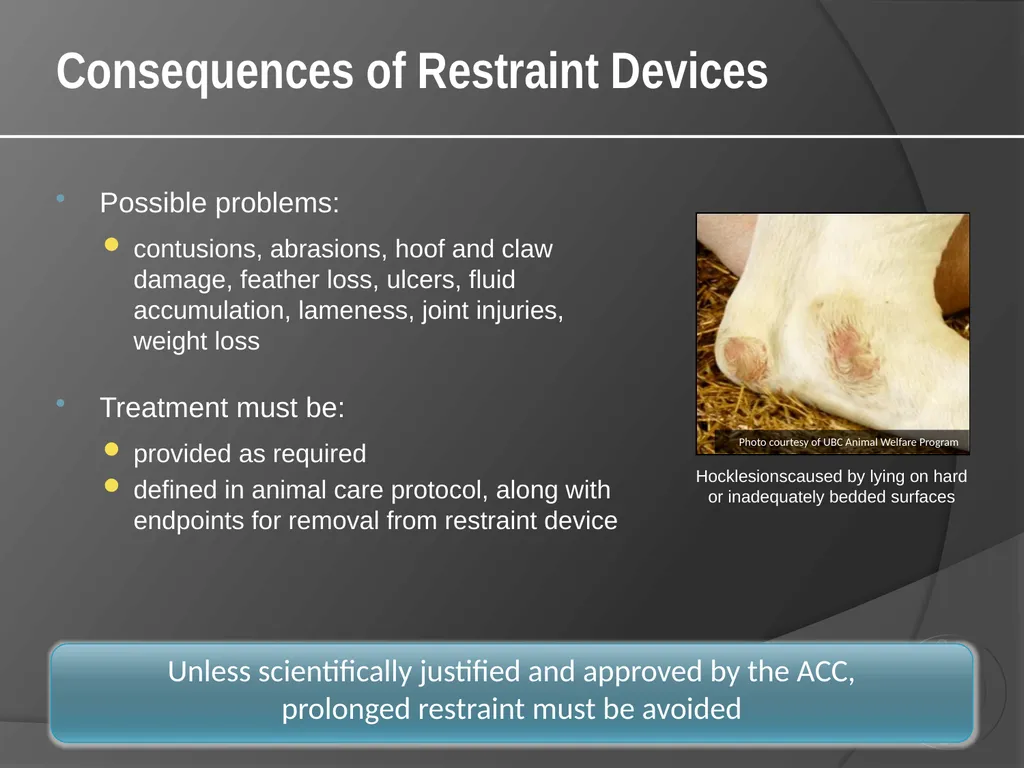
Consequences of Restraint Devices Possible problems:
contusions, abrasions, hoof and claw damage, feather loss, ulcers, fluid accumulation, lameness, joint injuries, weight loss
Treatment must be:
provided as required
defined in animal care protocol, along with endpoints for removal from restraint device Unless scientifically justified and approved by the ACC, prolonged restraint must be avoided Hocklesionscaused by lying on hard or inadequately bedded surfaces<br>
contusions, abrasions, hoof and claw damage, feather loss, ulcers, fluid accumulation, lameness, joint injuries, weight loss
Treatment must be:
provided as required
defined in animal care protocol, along with endpoints for removal from restraint device Unless scientifically justified and approved by the ACC, prolonged restraint must be avoided Hocklesionscaused by lying on hard or inadequately bedded surfaces<br>
34
Routine Invasive Procedures and their Effect on Welfare Unless justified by the research
goals, commercial agricultural
practices cannot be used if procedures are:
painful or distressing
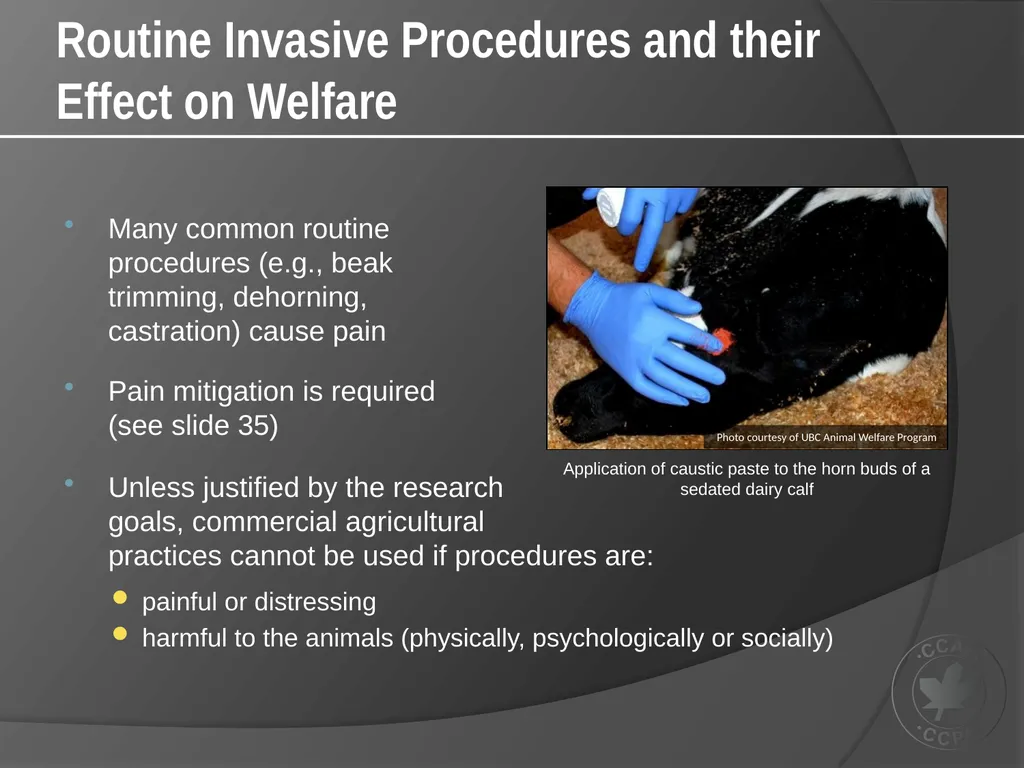
harmful to the animals (physically, psychologically or socially) Application of caustic paste to the horn buds of a sedated dairy calf Many common routine procedures (e.g., beak trimming, dehorning, castration) cause pain
Pain mitigation is required (see slide 35)<br>
painful or distressing
harmful to the animals (physically, psychologically or socially) Application of caustic paste to the horn buds of a sedated dairy calf Many common routine procedures (e.g., beak trimming, dehorning, castration) cause pain
Pain mitigation is required (see slide 35)<br>
35
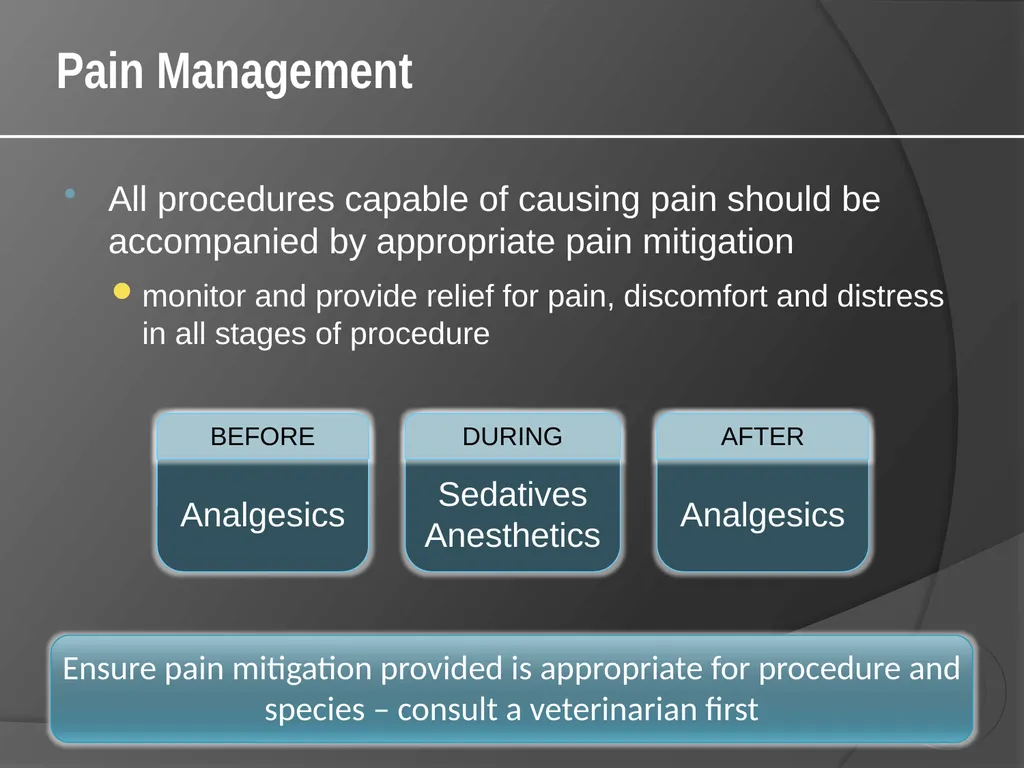
Pain Management All procedures capable of causing pain should be accompanied by appropriate pain mitigation
monitor and provide relief for pain, discomfort and distress in all stages of procedure Ensure pain mitigation provided is appropriate for procedure and species – consult a veterinarian first<br>
monitor and provide relief for pain, discomfort and distress in all stages of procedure Ensure pain mitigation provided is appropriate for procedure and species – consult a veterinarian first<br>
36
Specialized Procedures Choosing least invasive procedures reduces:
pain and distress
Preconditioning animals to restraint and procedure minimizes:
distress for animal
interference in scientific results
Consideration should be given to reducing:
animal use
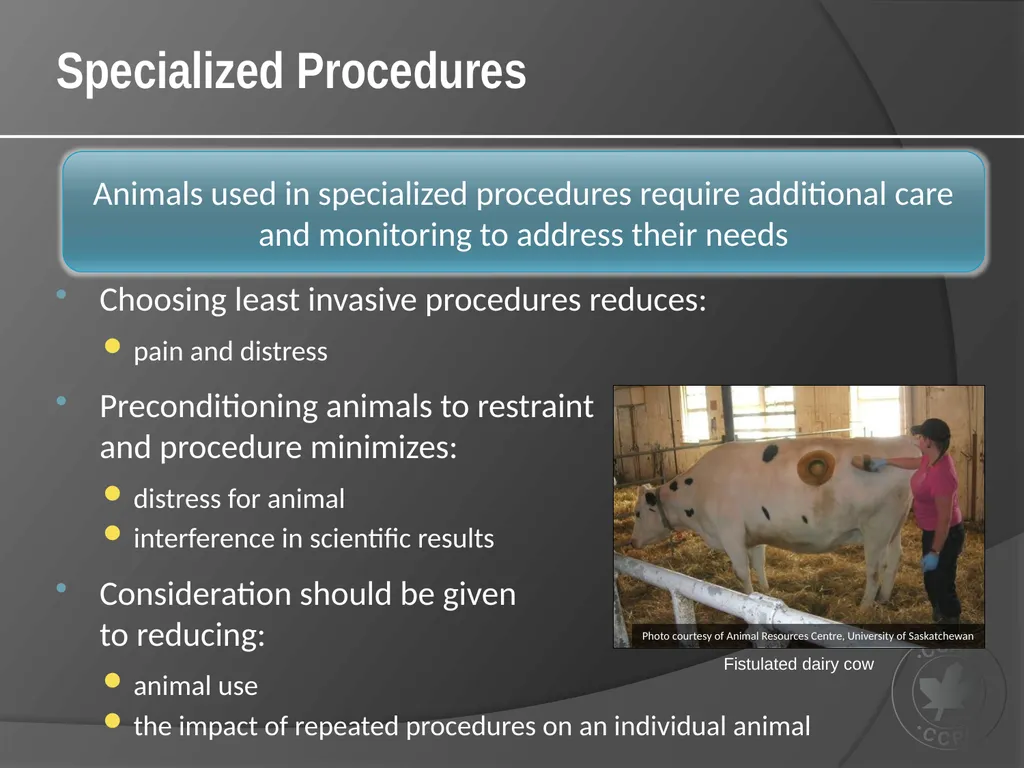
the impact of repeated procedures on an individual animal Photo courtesy of Animal Resources Centre, University of Saskatchewan Fistulated dairy cow Animals used in specialized procedures require additional care and monitoring to address their needs<br>
pain and distress
Preconditioning animals to restraint and procedure minimizes:
distress for animal
interference in scientific results
Consideration should be given to reducing:
animal use
the impact of repeated procedures on an individual animal Photo courtesy of Animal Resources Centre, University of Saskatchewan Fistulated dairy cow Animals used in specialized procedures require additional care and monitoring to address their needs<br>
37
Metabolism Crates May be required in nutrition and physiological studies
May restrict movement but must:
allow animals to rise, rest and maintain a comfortable posture
prevent injury Ewe in an enclosed metabolism crate Important to precondition animals to minimize isolation effects
Consider alternatives when available<br>
May restrict movement but must:
allow animals to rise, rest and maintain a comfortable posture
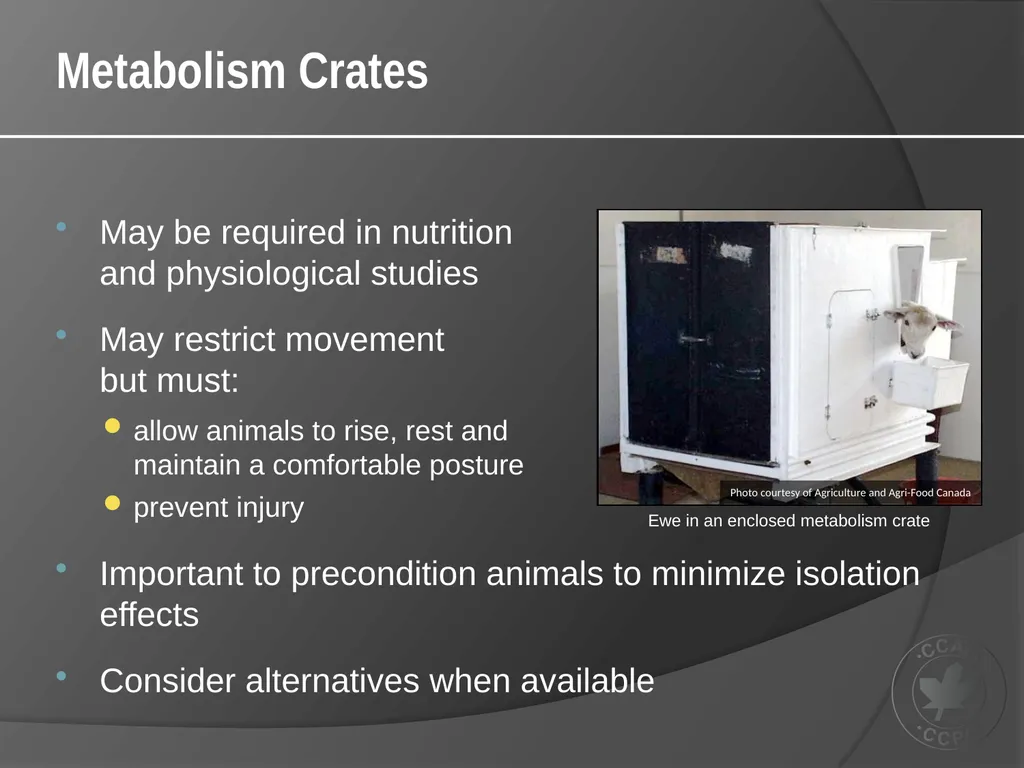
prevent injury Ewe in an enclosed metabolism crate Important to precondition animals to minimize isolation effects
Consider alternatives when available<br>
38
Meeting Farm Animal Needs in
Metabolism Crates Thermal requirements differ for farm animals in crates
Crates approved for short-term use only
maximum 7 consecutive days (then 24 hour exercise period) for a total of no more than 2 months
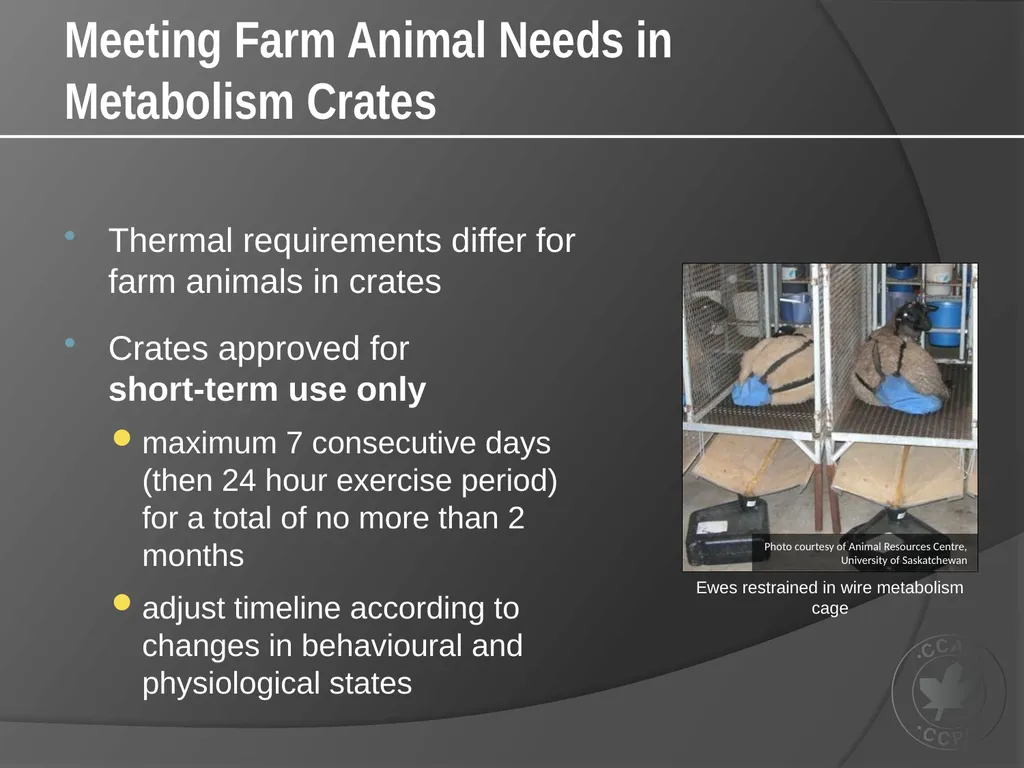
adjust timeline according to changes in behavioural and physiological states Ewes restrained in wire metabolism cage<br>
Crates approved for short-term use only
maximum 7 consecutive days (then 24 hour exercise period) for a total of no more than 2 months
adjust timeline according to changes in behavioural and physiological states Ewes restrained in wire metabolism cage<br>
39
Minimizing the Welfare Effects of Blood & Tissue Sampling Sampling and associated restraint procedures may be distressing for animals
Ways of minimizing distress:
consider remote sampling
precondition animals
use anesthetic when appropriate Sampling should only be performed by well trained individuals<br>
Ways of minimizing distress:
consider remote sampling
precondition animals
use anesthetic when appropriate Sampling should only be performed by well trained individuals<br>
40
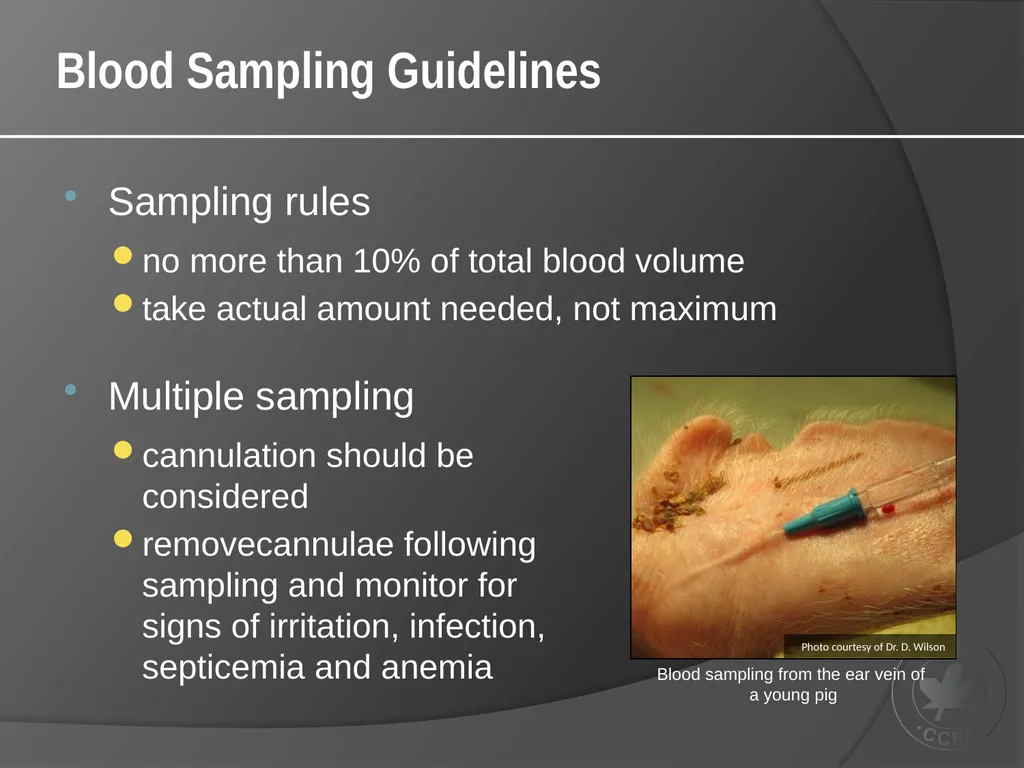
Blood Sampling Guidelines Sampling rules
no more than 10% of total blood volume
take actual amount needed, not maximum Blood sampling from the ear vein of
a young pig Multiple sampling
cannulation should be considered
removecannulae following sampling and monitor for signs of irritation, infection, septicemia and anemia<br>
no more than 10% of total blood volume
take actual amount needed, not maximum Blood sampling from the ear vein of
a young pig Multiple sampling
cannulation should be considered
removecannulae following sampling and monitor for signs of irritation, infection, septicemia and anemia<br>
41
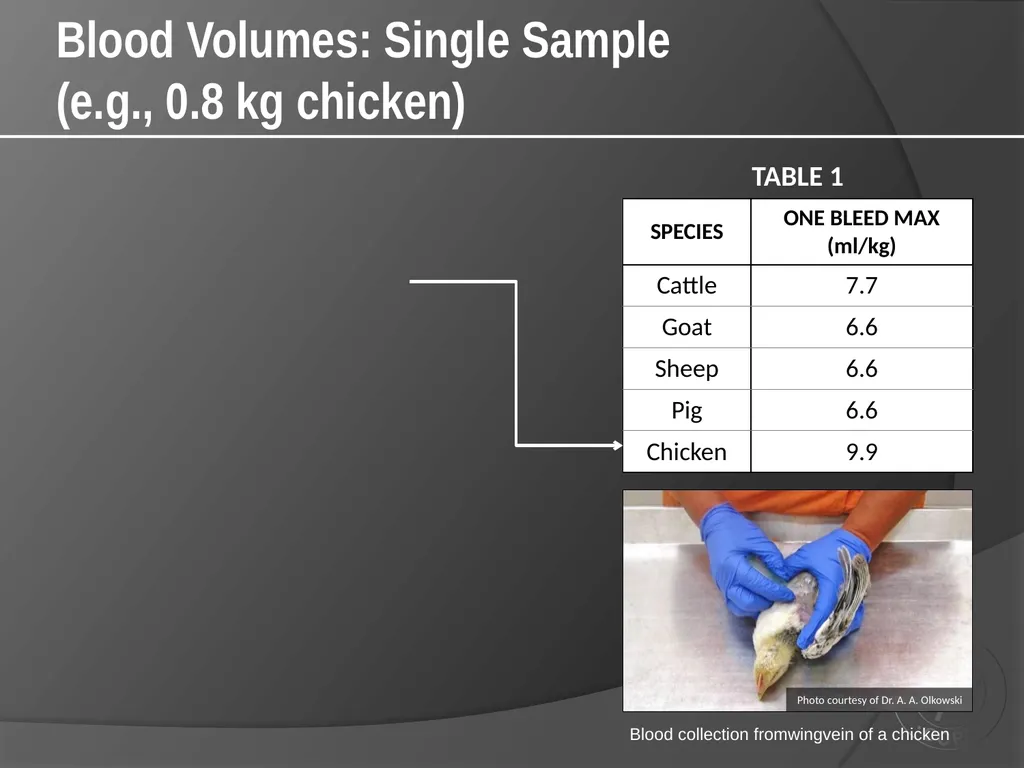
Blood Volumes: Single Sample
(e.g., 0.8 kg chicken) Blood collection fromwingvein of a chicken Photo courtesy of Dr. A. A. Olkowski<br>
42
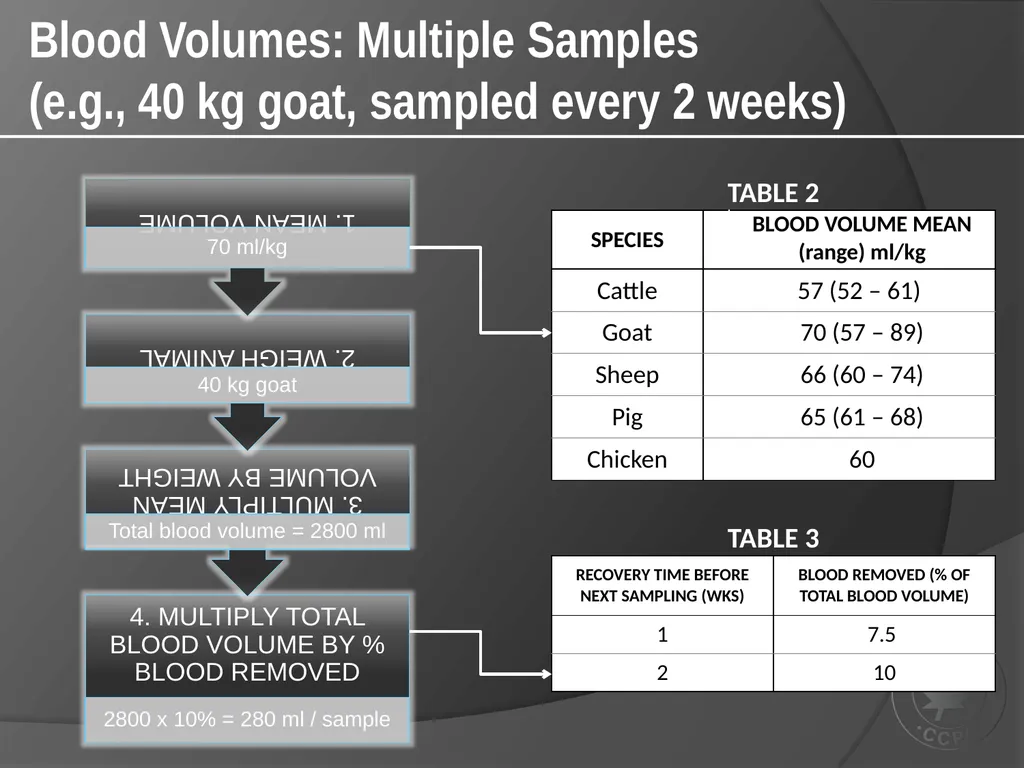
Blood Volumes: Multiple Samples
(e.g., 40 kg goat, sampled every 2 weeks)<br>
43
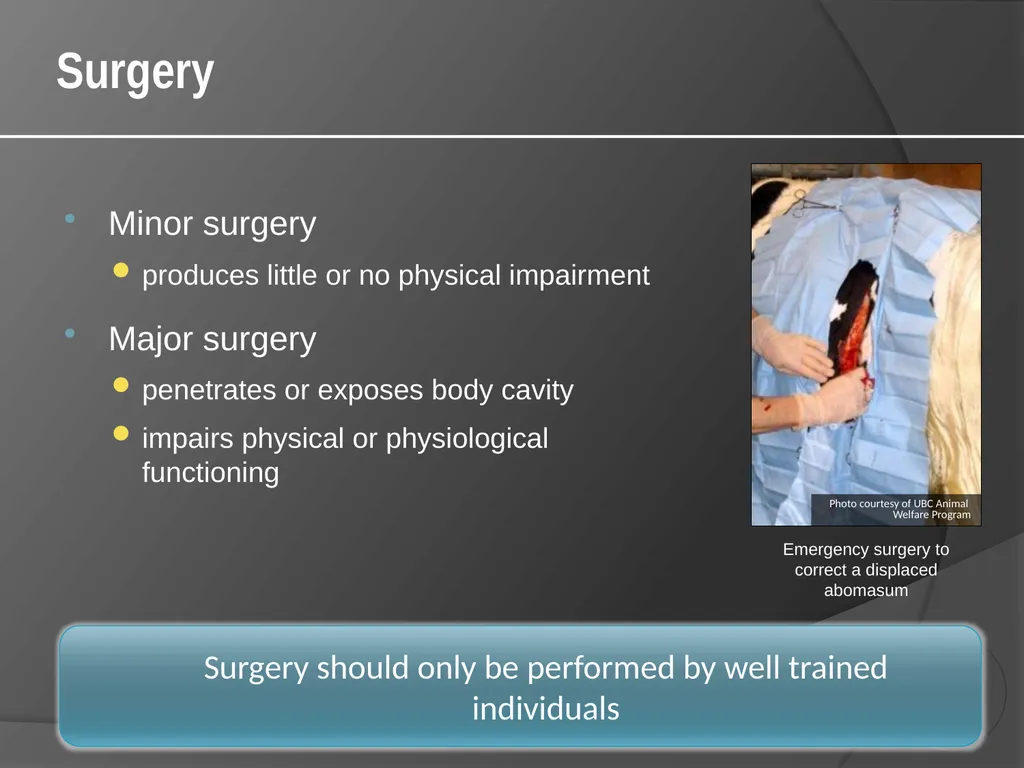
Surgery Minor surgery
produces little or no physical impairment
Major surgery
penetrates or exposes body cavity
impairs physical or physiological functioning Emergency surgery to correct a displaced abomasum Surgery should only be performed by well trained individuals<br>
produces little or no physical impairment
Major surgery
penetrates or exposes body cavity
impairs physical or physiological functioning Emergency surgery to correct a displaced abomasum Surgery should only be performed by well trained individuals<br>
44
Requirements for Major &
Non-Survival Surgeries Major survival surgery and long, non-survival surgery :
facilities intended for surgery
standard aseptic surgical procedures
Short, non-survival surgery
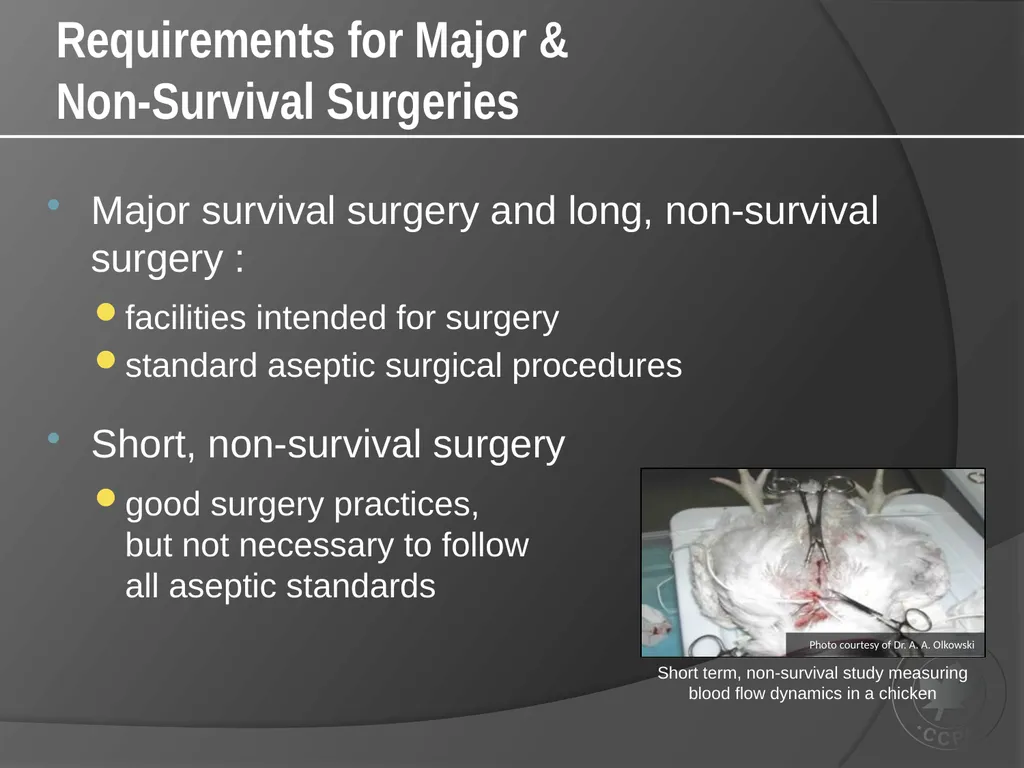
good surgery practices, but not necessary to follow all aseptic standards Short term, non-survival study measuring blood flow dynamics in a chicken<br>
facilities intended for surgery
standard aseptic surgical procedures
Short, non-survival surgery
good surgery practices, but not necessary to follow all aseptic standards Short term, non-survival study measuring blood flow dynamics in a chicken<br>
45
Requirements for Minor &
Therapeutic Surgeries Minor surgery
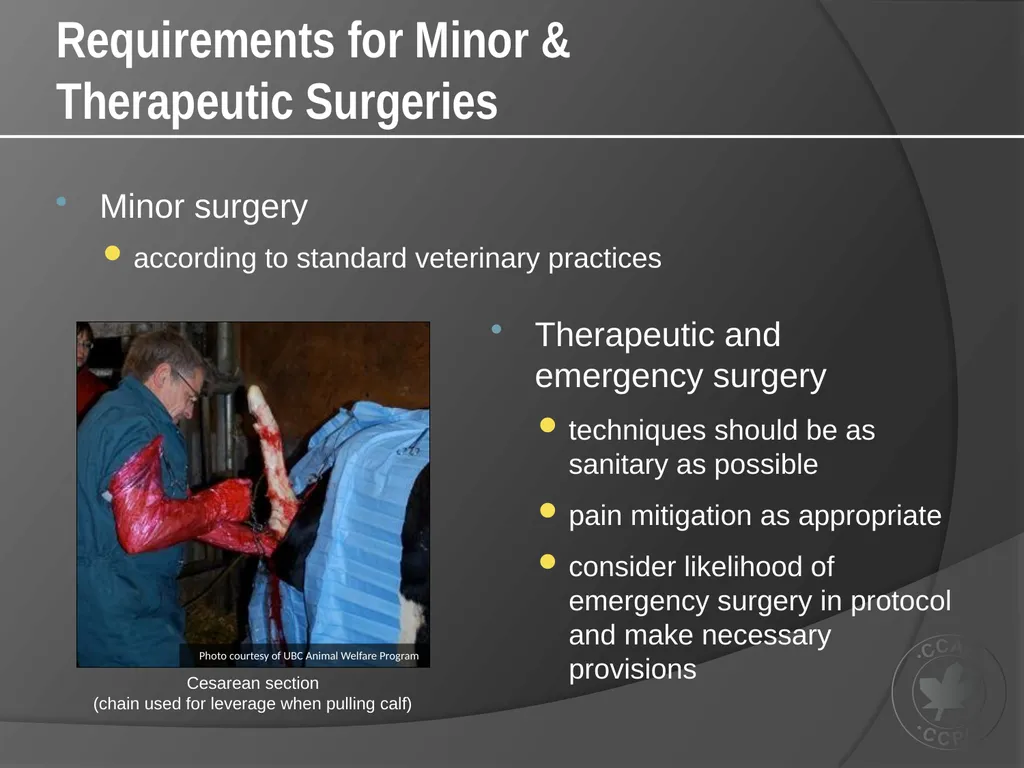
according to standard veterinary practices Cesarean section (chain used for leverage when pulling calf) Therapeutic and emergency surgery
techniques should be as sanitary as possible
pain mitigation as appropriate
consider likelihood of emergency surgery in protocol and make necessary provisions<br>
according to standard veterinary practices Cesarean section (chain used for leverage when pulling calf) Therapeutic and emergency surgery
techniques should be as sanitary as possible
pain mitigation as appropriate
consider likelihood of emergency surgery in protocol and make necessary provisions<br>
46
Fistulation / Catheterization Consider various approaches, types and materials available during experimental planning
Special considerations
personnel trained to understand special care requirements and catheter endpoints
for safety of personnel and animals, employ restraint devices during catheterization and sampling
implanted telemetry devices to ensure clear identification of animals for post-op and long-term monitoring<br>
Special considerations
personnel trained to understand special care requirements and catheter endpoints
for safety of personnel and animals, employ restraint devices during catheterization and sampling
implanted telemetry devices to ensure clear identification of animals for post-op and long-term monitoring<br>
47
Termination of Scientific Use of the
Farm Animal<br>
48
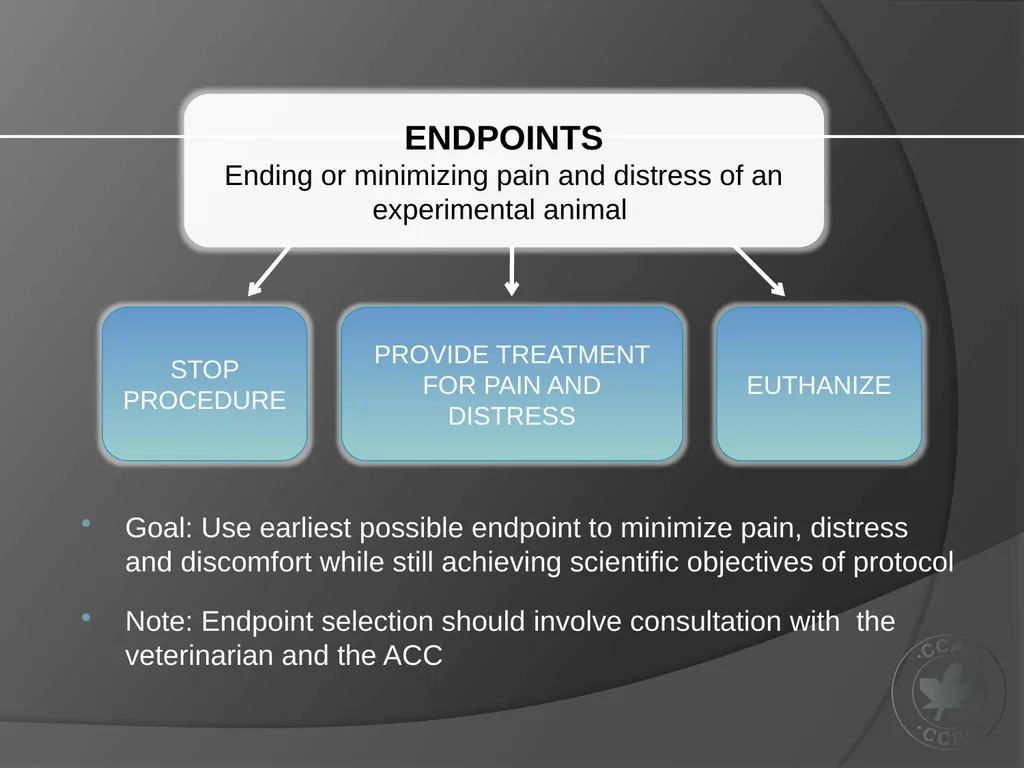
Goal: Use earliest possible endpoint to minimize pain, distress and discomfort while still achieving scientific objectives of protocol
Note: Endpoint selection should involve consultation with the veterinarian and the ACC Endpoints
Ending or minimizing pain and distress of an experimental animal Stop procedure euthanize Provide treatment for pain and distress<br>
Note: Endpoint selection should involve consultation with the veterinarian and the ACC Endpoints
Ending or minimizing pain and distress of an experimental animal Stop procedure euthanize Provide treatment for pain and distress<br>
49
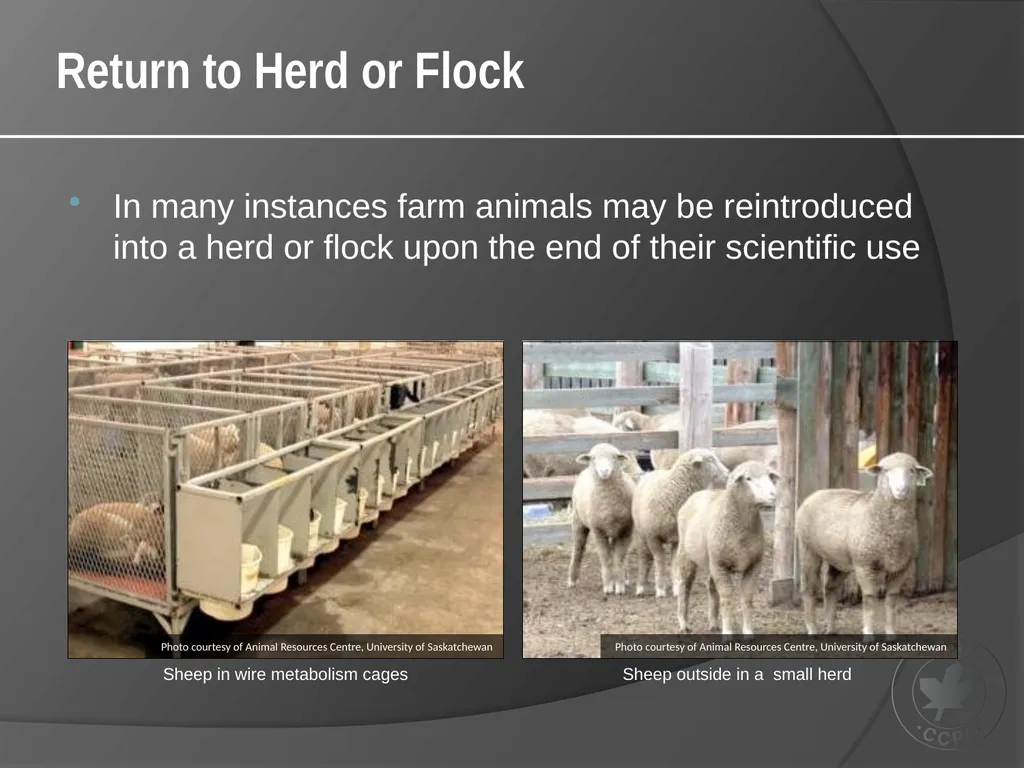
Return to Herd or Flock Photo courtesy of Animal Resources Centre, University of Saskatchewan Sheep in wire metabolism cages Sheep outside in a small herd In many instances farm animals may be reintroduced into a herd or flock upon the end of their scientific use<br>
50
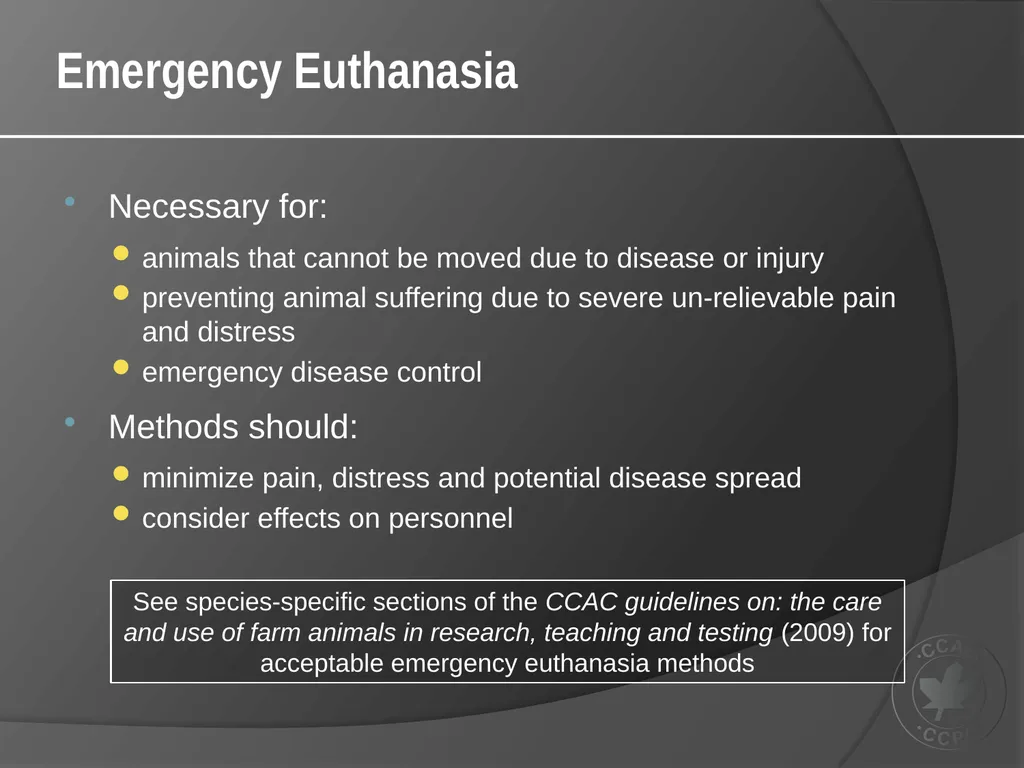
Emergency Euthanasia Necessary for:
animals that cannot be moved due to disease or injury
preventing animal suffering due to severe un-relievable pain and distress
emergency disease control
Methods should:
minimize pain, distress and potential disease spread
consider effects on personnel See species-specific sections of the CCAC guidelines on: the care and use of farm animals in research, teaching and testing (2009) for acceptable emergency euthanasia methods<br>
animals that cannot be moved due to disease or injury
preventing animal suffering due to severe un-relievable pain and distress
emergency disease control
Methods should:
minimize pain, distress and potential disease spread
consider effects on personnel See species-specific sections of the CCAC guidelines on: the care and use of farm animals in research, teaching and testing (2009) for acceptable emergency euthanasia methods<br>
51
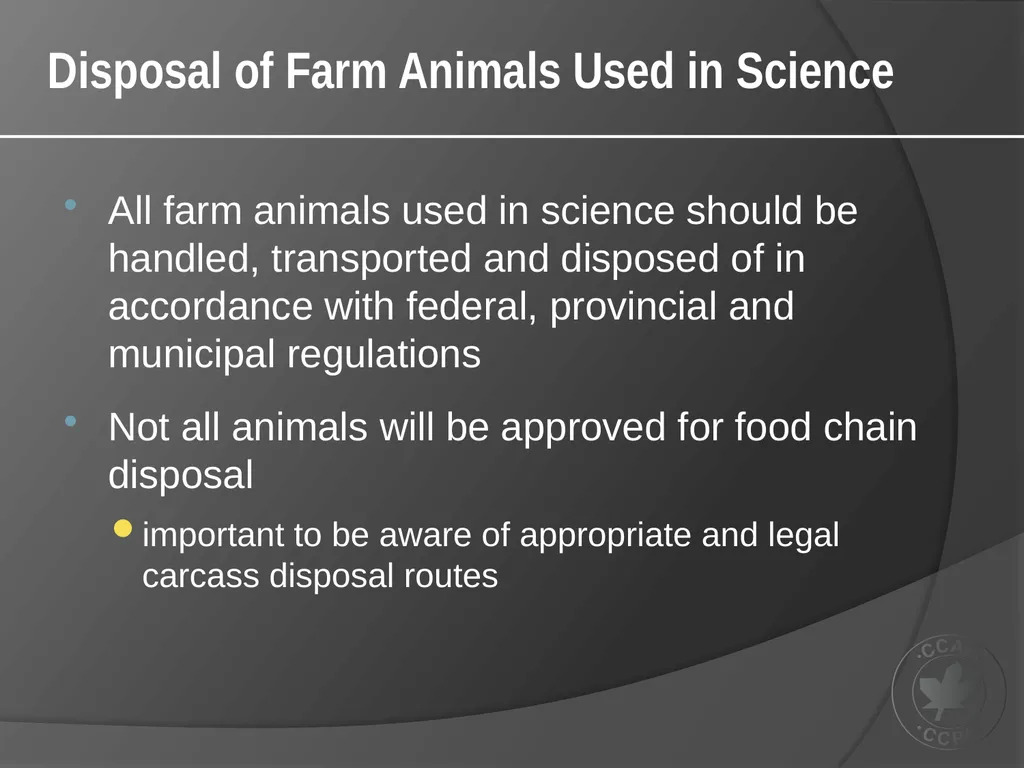
Disposal of Farm Animals Used in Science All farm animals used in science should be handled, transported and disposed of in accordance with federal, provincial and municipal regulations
Not all animals will be approved for food chain disposal
important to be aware of appropriate and legal carcass disposal routes<br>
Not all animals will be approved for food chain disposal
important to be aware of appropriate and legal carcass disposal routes<br>
52
Summary Care, housing, handling practices and specialized procedures all influence farm animal welfare
Good welfare requires a balance of three components:
biological functioning
natural living
affective states
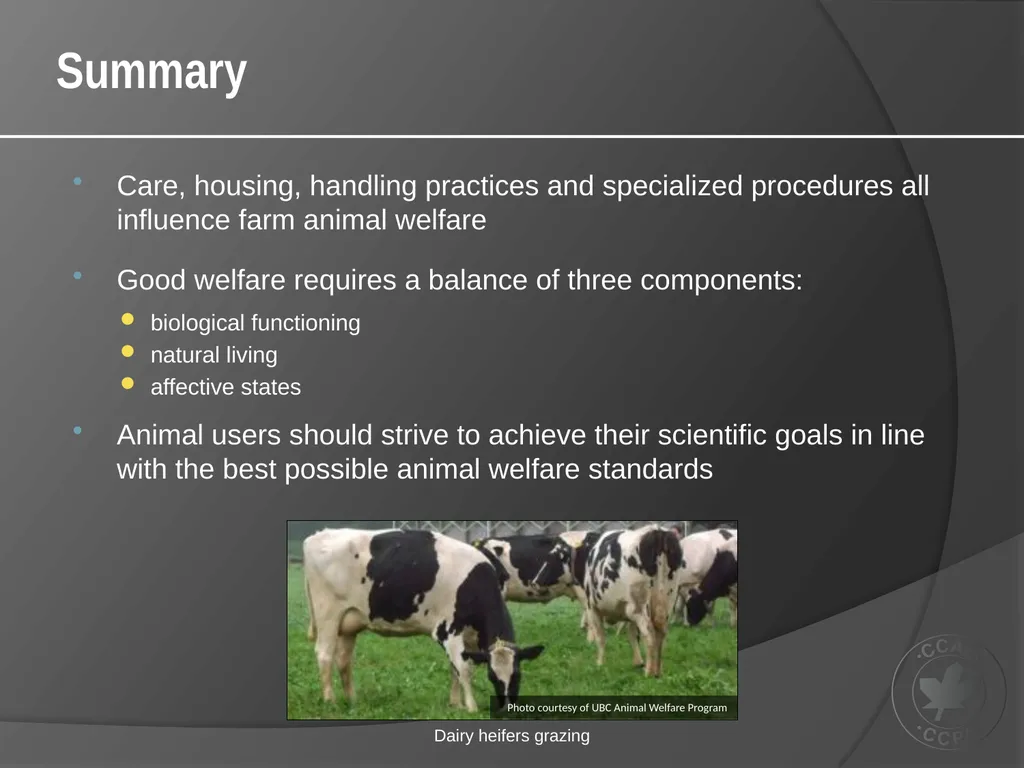
Animal users should strive to achieve their scientific goals in line with the best possible animal welfare standards Dairy heifers grazing<br>
Good welfare requires a balance of three components:
biological functioning
natural living
affective states
Animal users should strive to achieve their scientific goals in line with the best possible animal welfare standards Dairy heifers grazing<br>