CECV Accreditation Policy and Teacher Accreditation Platform In recognition of Aboriginal and Torres Strait Islander peoples spiritual and cultural connection to Country, we acknowledge the traditional custodians of the lands on which we
"CECV Accreditation Policy and Teacher" is the property of its rightful owner. Permission is granted to
download and print the materials on this website for personal, non-commercial use only, and to display it
on your personal computer provided you do not modify the materials and that you retain all copyright
notices contained in the materials. By downloading content from our website, you accept the terms of this
agreement.
Presentation Transcript
01
CECV Accreditation Policy and Teacher Accreditation Platform<br>
02
In recognition of Aboriginal and Torres Strait Islander people’s spiritual and cultural connection to Country, we acknowledge the traditional custodians of the lands on which we meet and educate our children.
We recognise the continued care of the lands and waterways passed from generation to generation, wisdom that is shared, and life that is celebrated in harmony with the natural environment.
We honour the Elders past and present who have laid the foundations, traditions, and culture for emerging Aboriginal and Torres Strait Islander peoples and we commit to working together for reconciliation and justice. Acknowledgment of Country Bunjil the Spirit Creator Archie, Year 3 Sacred Heart School, Sandringham<br>
03
HORIZONS OF HOPE PRAYER As we gather today, we pray in solidarity
with all who work in our Catholic schools,
that we might become communities which truly …
- honour the sacred dignity of each person -
- search for truth -
- embrace difference and diversity -
- build a culture of learning together -
- engage with the deep questions of life -
- honour equitable access and opportunity for all -
- commit to achieving the highest standards possible -
and
- make a difference in the world -
Amen<br>
04
Leaders and teachers in Catholic schools are central in ensuring that students experience an education which is truly Catholic in its understanding and intent.
Our Catholic faith calls us to embrace the contemporary world with a Catholic imagination, and a particular hope-filled view of the human person and all of creation. Catholic educators invite students to make sense of their world and their lives within a faith community that is faithful to the mission of Jesus. (Horizons of Hope, Vision & Mission, p9)
If that is the case, leaders and teachers need ongoing formation through professional learning in Catholic thought and practice. Why do we have an accreditation policy?<br>
05
The accreditation process aims to:
support leaders and teachers who are entering or continuing their service in Catholic education to develop their knowledge and appreciation of the Catholic faith and tradition
enable leaders and teachers to place their ministry in the specific Catholic context of our schools.<br>
06
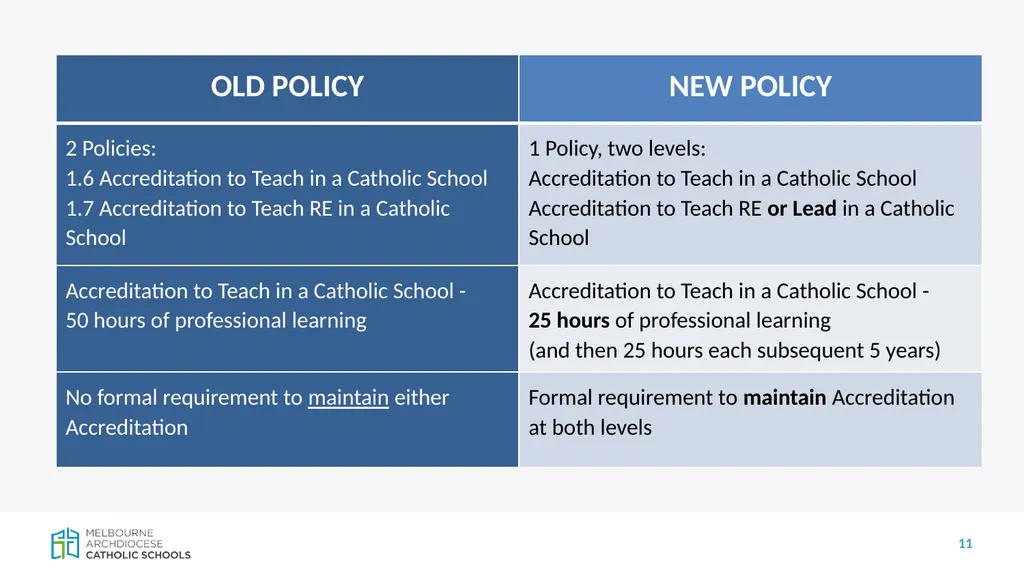
There are two levels of accreditation in recognition of the different roles that leaders and teachers undertake:
Accreditation to Teach in a Catholic School
Accreditation to Teach Religious Education or Lead in a Catholic School
Each level must firstly be GAINED, as with the previous policy, but then must be MAINTAINED. Levels of Accreditation<br>
07
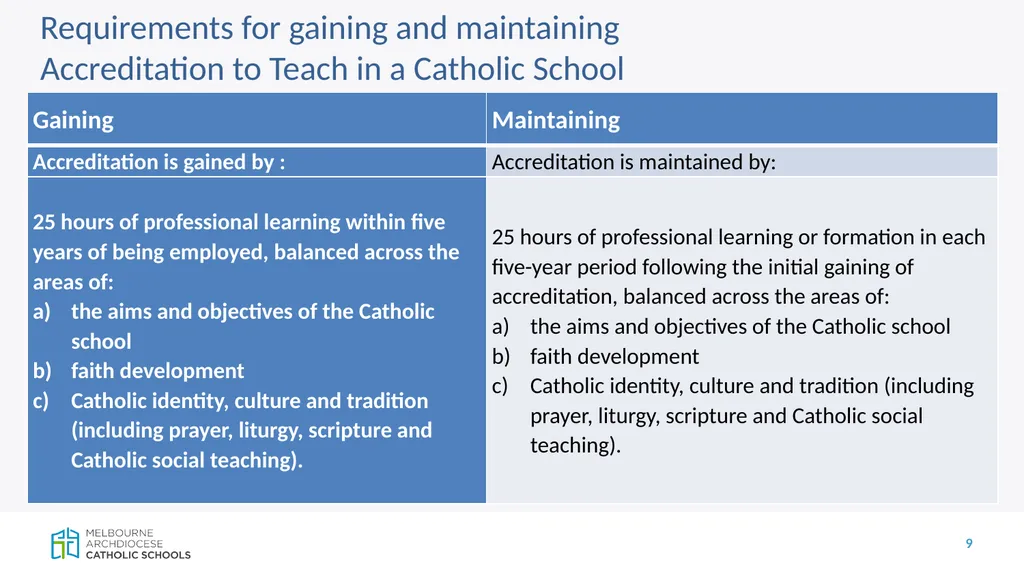
All teachers are required to gain and maintain Accreditation to Teach in a Catholic School.
Leaders and teachers entering Catholic education without being accredited to teach in a Catholic school are granted a five-year period from the commencement of employment to secure their accreditation. Requirements<br>
08
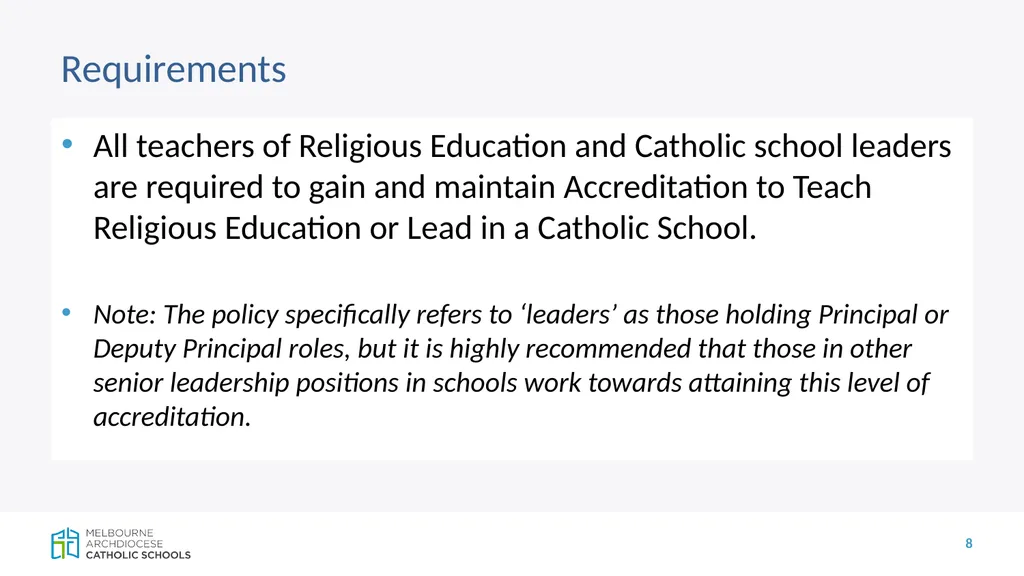
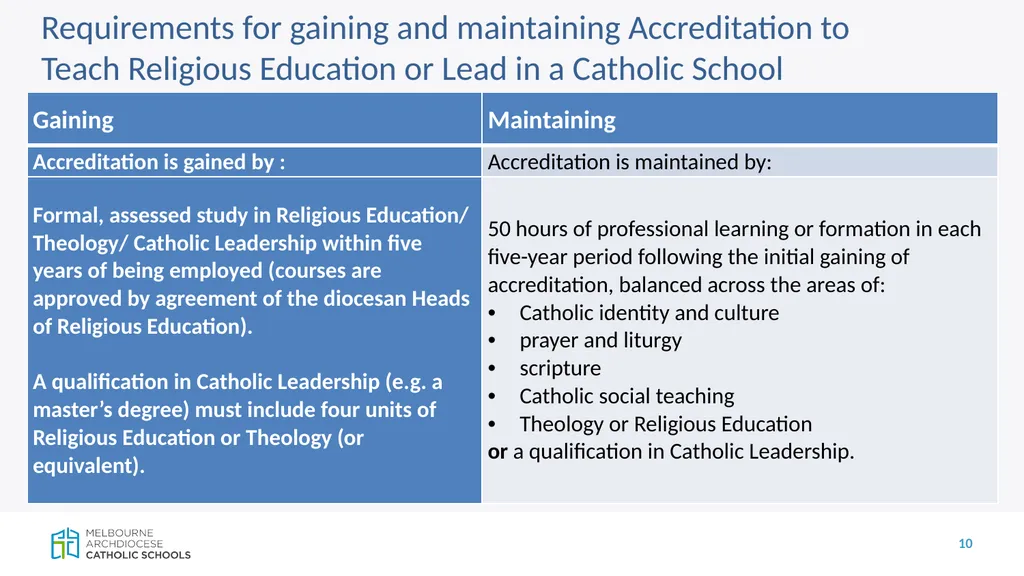
All teachers of Religious Education and Catholic school leaders are required to gain and maintain Accreditation to Teach Religious Education or Lead in a Catholic School.
Note: The policy specifically refers to ‘leaders’ as those holding Principal or Deputy Principal roles, but it is highly recommended that those in other senior leadership positions in schools work towards attaining this level of accreditation. Requirements<br>
09
Requirements for gaining and maintaining
Accreditation to Teach in a Catholic School<br>
10
Requirements for gaining and maintaining Accreditation to
Teach Religious Education or Lead in a Catholic School<br>
11
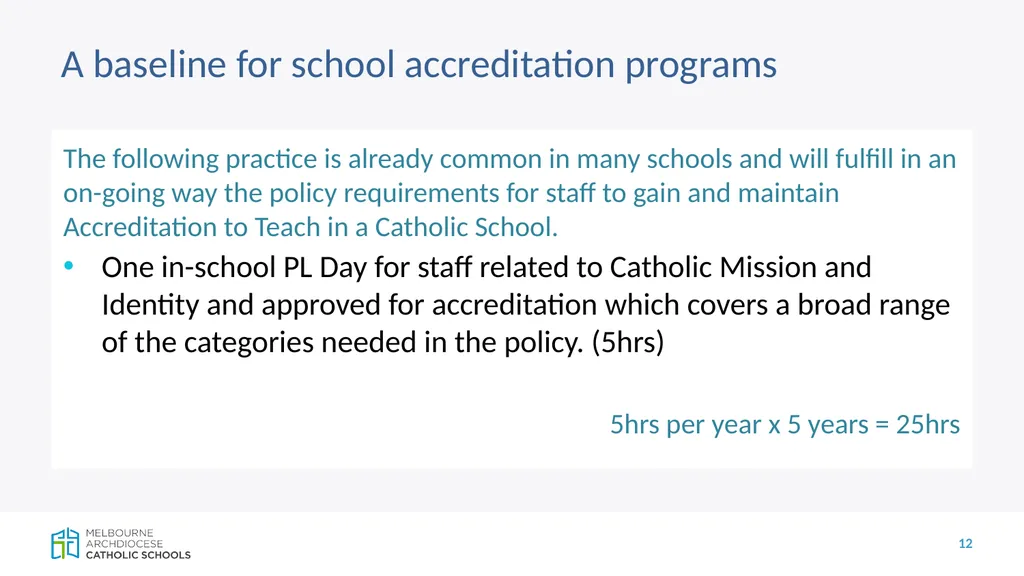
The following practice is already common in many schools and will fulfill in an on-going way the policy requirements for staff to gain and maintain Accreditation to Teach in a Catholic School.
One in-school PL Day for staff related to Catholic Mission and Identity and approved for accreditation which covers a broad range of the categories needed in the policy. (5hrs)
5hrs per year x 5 years = 25hrs A baseline for school accreditation programs<br>
12
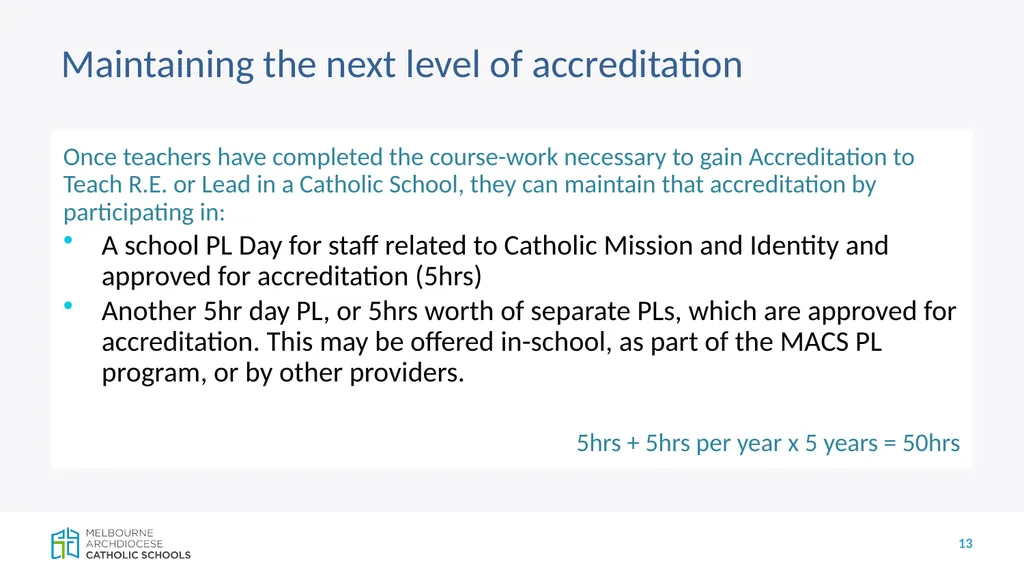
Once teachers have completed the course-work necessary to gain Accreditation to Teach R.E. or Lead in a Catholic School, they can maintain that accreditation by participating in:
A school PL Day for staff related to Catholic Mission and Identity and approved for accreditation (5hrs)
Another 5hr day PL, or 5hrs worth of separate PLs, which are approved for accreditation. This may be offered in-school, as part of the MACS PL program, or by other providers.
5hrs + 5hrs per year x 5 years = 50hrs Maintaining the next level of accreditation<br>
13
The online Teacher Accreditation Platform (TAP) has been developed to assist schools to implement the CECV teacher accreditation policy. TEACHER ACCREDITATION PLATFORM<br>
14
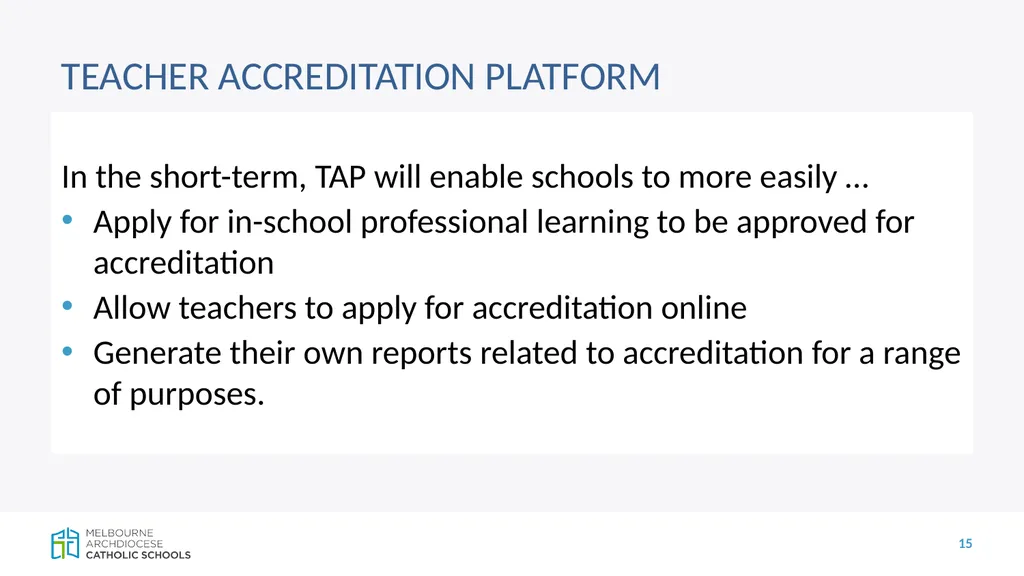
In the short-term, TAP will enable schools to more easily …
Apply for in-school professional learning to be approved for accreditation
Allow teachers to apply for accreditation online
Generate their own reports related to accreditation for a range of purposes. TEACHER ACCREDITATION PLATFORM<br>
15
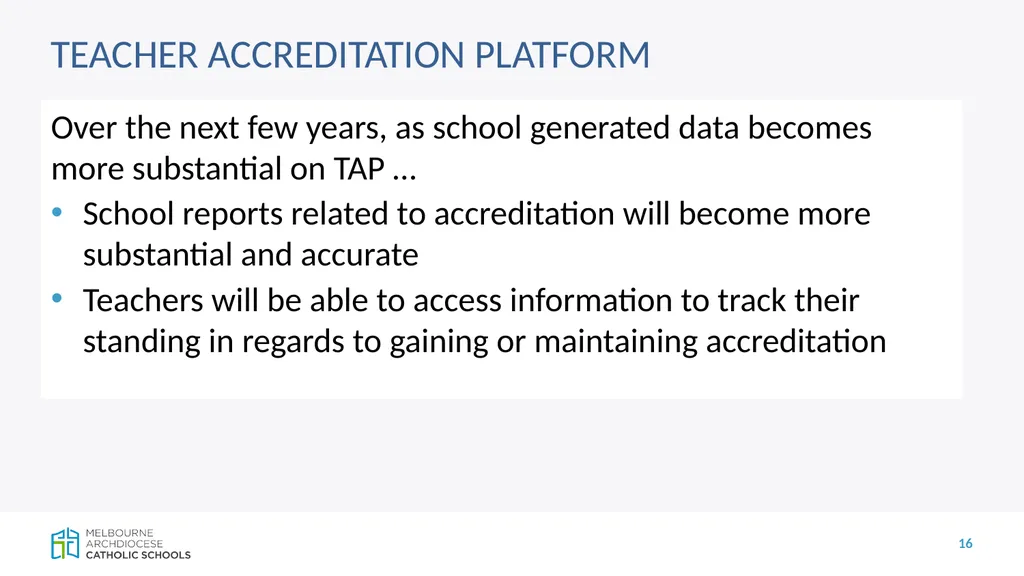
Over the next few years, as school generated data becomes more substantial on TAP …
School reports related to accreditation will become more substantial and accurate
Teachers will be able to access information to track their standing in regards to gaining or maintaining accreditation TEACHER ACCREDITATION PLATFORM<br>
16
It recommended that each school designates a staff member/s to become ‘expert’ in how to use the site and to coordinate their present school accreditation process and records with the requirements of the site.
Principals may need to give administrative access to the staff members involved. Management of TAP at school level<br>
17
A range of resources have been prepared to assist schools and external providers to understand and work with the platform.
These include how-to videos, manuals and FAQ resources.
Resources are available on CEVN. Resources related to TAP<br>