CH EN 5253 Process Design II Lecture 09
Description: CH EN 5253 Process Design II Lecture 09 Separations: Distillation Columns and Trains January 27, 2020 Books Product and Process Design Principles: Synthesis, Analysis and Evaluation by J. D Seader, and Warren D. Seider and Daniel R. Lewin,
Related Topics
Download Presentation
"CH EN 5253 Process Design II Lecture 09" is the property of its rightful owner. Permission is granted to download and print the materials on this website for personal, non-commercial use only, and to display it on your personal computer provided you do not modify the materials and that you retain all copyright notices contained in the materials. By downloading content from our website, you accept the terms of this agreement.
Presentation Transcript
slide1. CH EN 5253Process Design II Lecture 09
Separations: Distillation Columns and Trains January 27, 2020<br>
slide2. Books Product and Process Design Principles: Synthesis, Analysis and Evaluation
by J. D Seader, and Warren D. Seider and Daniel R. Lewin,
Chapter 9 2<br>
slide3. Distillation<br>
slide4. Distillation Column Internal 4<br>
slide5. Plate Types Bubble Cap Tray Sieve Tray<br>
slide6. Packed Towers Random Packing
Structured Packing Note: Importance of Distributor plate<br>
slide7. Equilibrium Equation Relative Volatility
Equilibrium Line α=KL/KH<br>
slide8. Operating and Feed Lines Rectifying Section
R = reflux ratio
V = vapor flow rate
Stripping Section
VB = Boil-up ratio
Feed Line<br>
slide9. Minimum Reflux Ratio<br>
slide10. McCabe-Thiele<br>
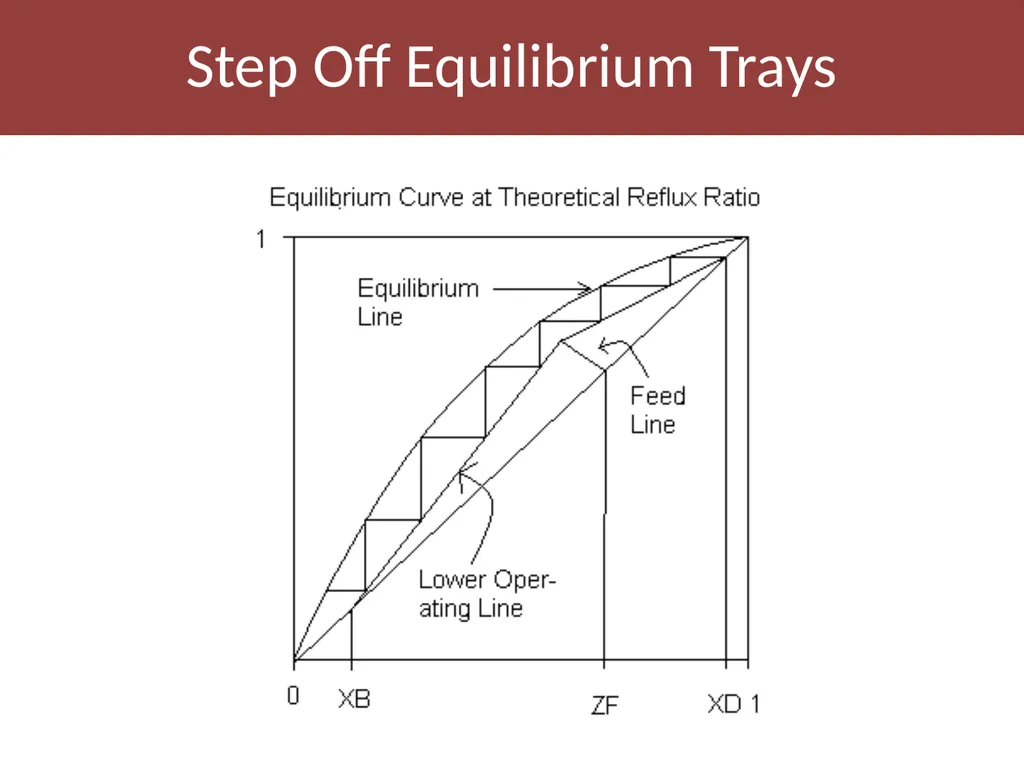
slide11. Step Off Equilibrium Trays<br>
slide12. Short cut to Selecting a Column Design Minimum Cost for Distillation Column will occur when you have a
Minimum of Total Vapor Flow Rate for column
Occurs at
R = 1.2 Rmin @ N/Nmin= 2
Nmin= log[(dLK/bLK)(bHK/dHK)]/log[αLK,HK]
Rmin ≈ (F/D)/(α-1)
V = D(R+1)
V = Vapor Flow Rate
D = Distillate Flow Rate (Production Rate)
R = Reflux Ratio<br>
slide13. How To Determine the Column Pressure Cooling Water Available at 90°F
Distillate Can be cooled to 120°F min.
Calculate the Bubble Pt. Pressure of Distillate Composition at 120°F
equals Distillate pressure
Bottoms pressure = Distillate pressure + 10 psia ΔP
Compute the Bubble Pt. Temp for an estimate of the Bottoms Composition at Distillate Pressure
Give Bottoms temperature
Not Near Critical Point for mixture<br>
slide14. Design Issues Packing vs Trays
Column Diameter from flooding consideration
Relations in Ch 17 of Towler (Design I)
Column Height
Relatiopns in Ch 17 of Towler
N=Nmin/ε (or 2 Nmin/ ε)
Column Height = N*Htray
Tray Height = typically 1 ft (or larger)
Packed Height = Neq*HETP (or 2 Neq*HETP)
HETP(height equivalent of theoretical plate)
HETPrandom = 1.5 ft/in*Dp Rule of thumb
Tray Efficiency, ε = f(viscosityliquid * αLK,HK)
Pressure Drop
Tray, ΔP=ρLg hL-wier N
Packed, ΔP=Packed bed (weeping)<br>
slide15. Column Operating Window Plate design must ensure good contacting between phases
Coning: vapor bypasses liquid
Weeping: liquid drains through to tray below
Usually design to operate near (~ 70 to 80% of) flooding limits so as to allow for turn-down Liquid rate Vapor rate<br>
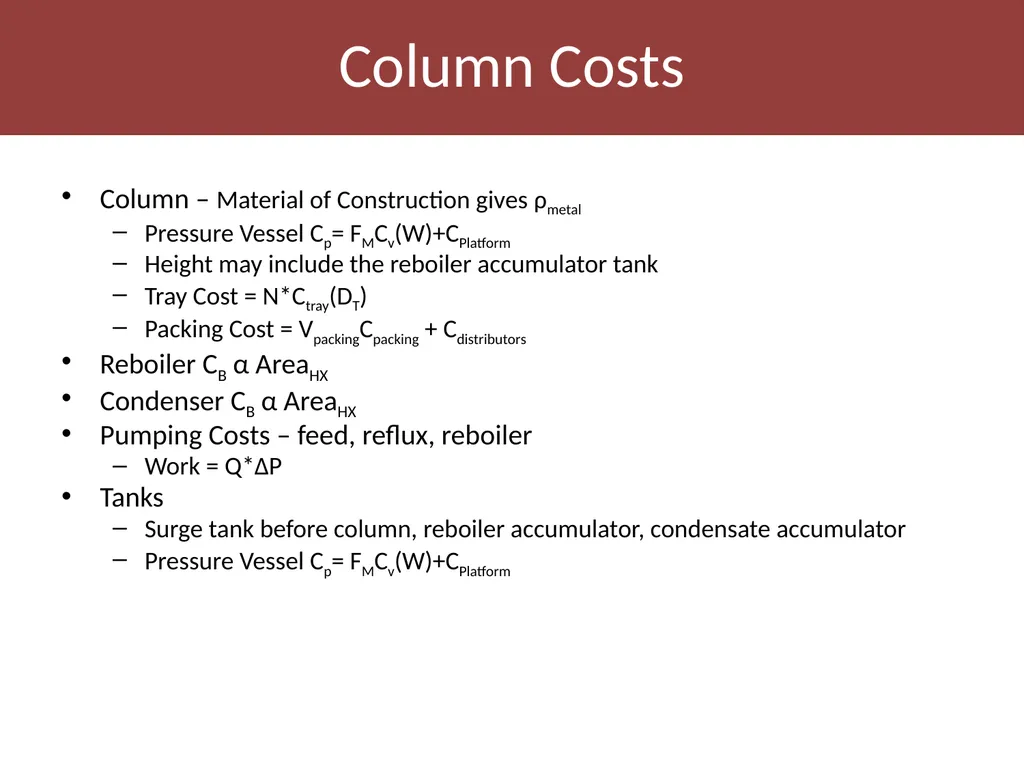
slide16. Column Costs Column – Material of Construction gives ρmetal
Pressure Vessel Cp= FMCv(W)+CPlatform
Height may include the reboiler accumulator tank
Tray Cost = N*Ctray(DT)
Packing Cost = VpackingCpacking + Cdistributors
Reboiler CB α AreaHX
Condenser CB α AreaHX
Pumping Costs – feed, reflux, reboiler
Work = Q*ΔP
Tanks
Surge tank before column, reboiler accumulator, condensate accumulator
Pressure Vessel Cp= FMCv(W)+CPlatform<br>
slide17. Use of Separation Units<br>
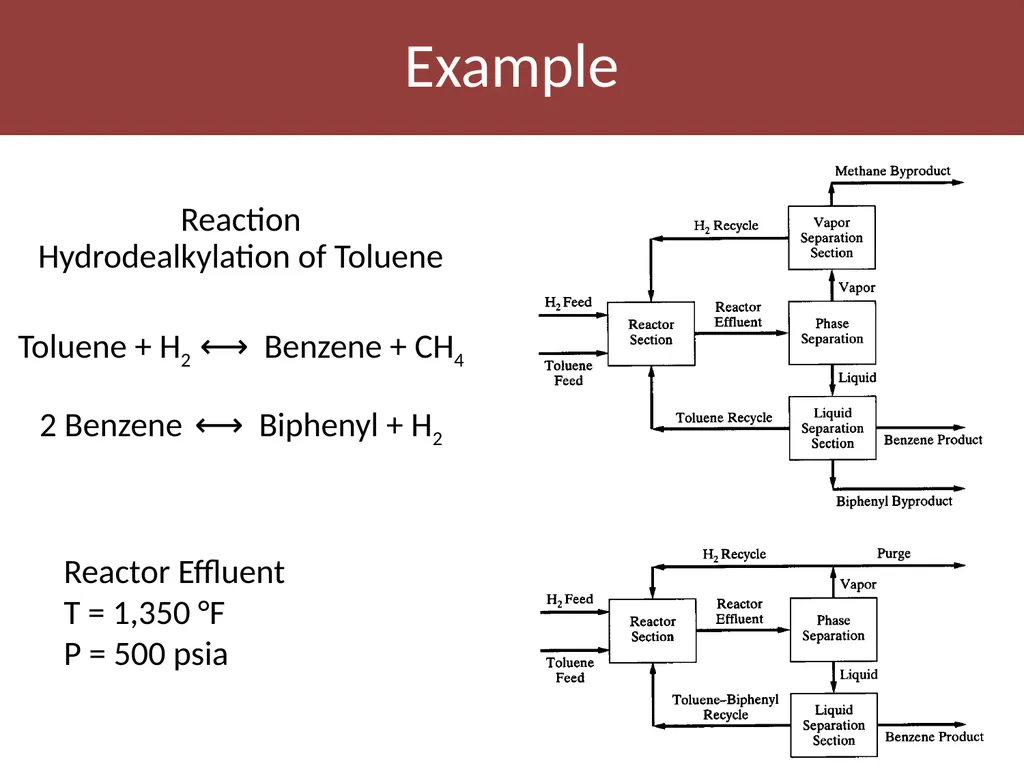
slide18. ReactionHydrodealkylation of TolueneToluene + H2 ⟷ Benzene + CH42 Benzene ⟷ Biphenyl + H2 Reactor Effluent
T = 1,350 °F
P = 500 psia Example<br>
slide19. Reactor Effluent Reaction Conditions
T = 1,350 °F
P = 500 psia<br>
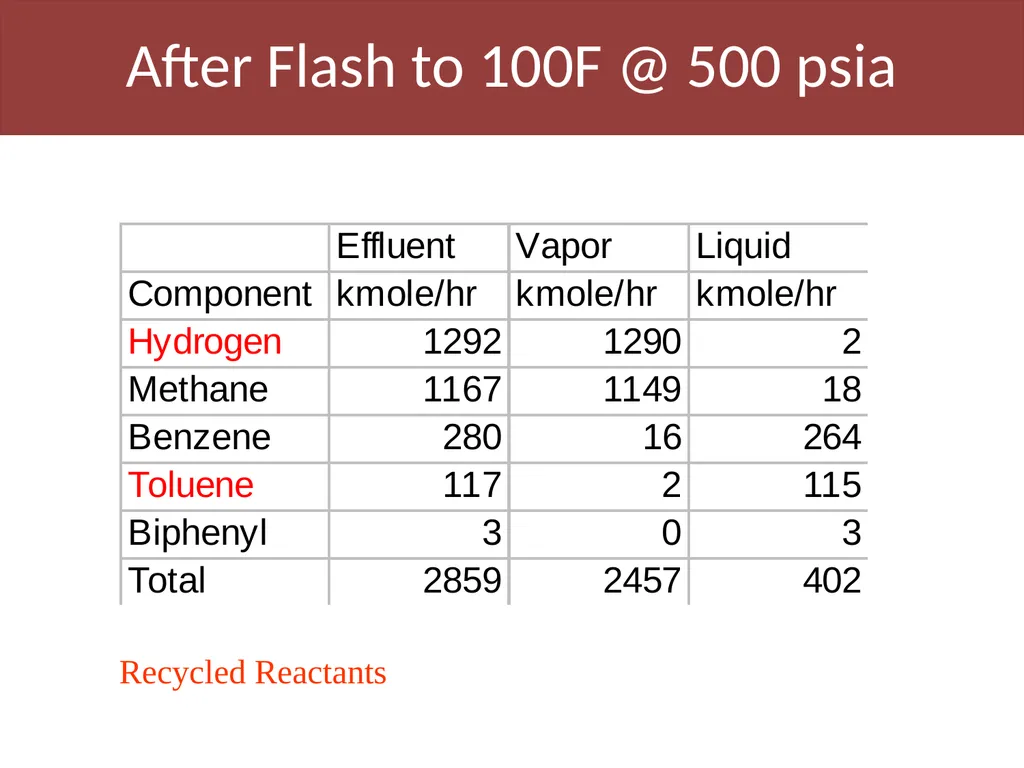
slide20. After Flash to 100F @ 500 psia Recycled Reactants<br>
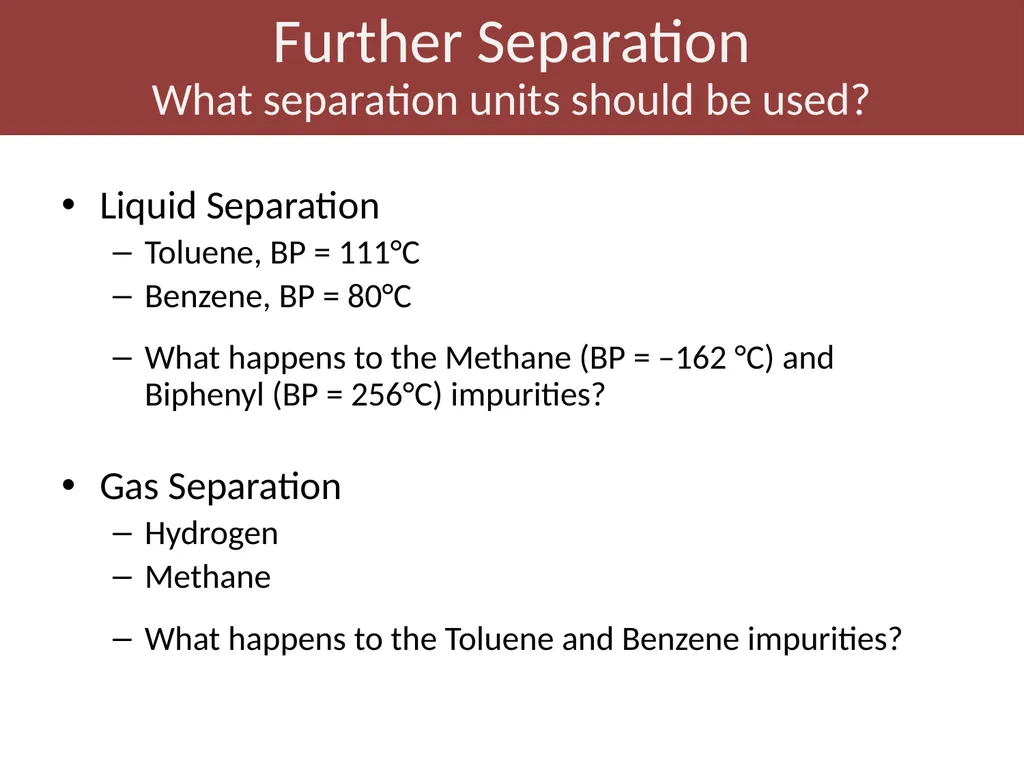
slide21. Further SeparationWhat separation units should be used? Liquid Separation
Toluene, BP = 111°C
Benzene, BP = 80°C
What happens to the Methane (BP = –162 °C) and Biphenyl (BP = 256°C) impurities?
Gas Separation
Hydrogen
Methane
What happens to the Toluene and Benzene impurities?<br>
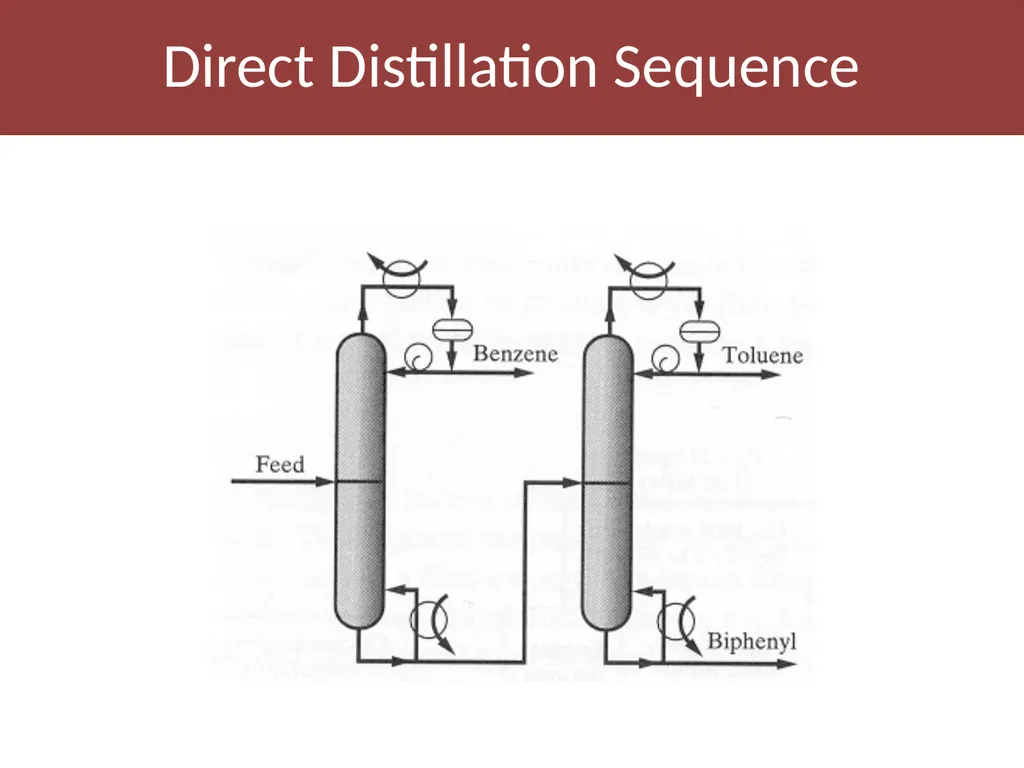
slide22. Direct Distillation Sequence<br>
slide23. Column Sequences Number of Columns
Nc = P – 1
P = Number of Products
No. of Possible Column Sequences
Ns = [2(P–1)]! / [P!(P–1)!]
P = Number of Products
P = 3, Nc = 2, Ns = 2
P = 4, Nc = 3, Ns = 5
P = 5, Nc = 4, Ns = 14
P = 6, Nc = 5, Ns = 42
P = 7, Nc = 6, Ns = 132 Number of possible column sequences becomes very large very quickly!<br>
slide24. Example P = Number of Products = 4 ( A, B, C, D)
Number of Columns
Nc = P – 1= 4-1=3
No. of Possible Column Sequences
Ns = [2(P–1)]! / [P!(P–1)!]
= [2(4–1)]! / [4!(4–1)!] )
= [2X3]! / [4!X3!]
= 6! / [4!X3!]
= 720 / [24X6]
= 720 / 144
= 5 24<br>
slide25. Example 5 Possible Column Sequences 25<br>
slide26. Example How do I evaluate which is the best sequence of separation columns?( 1 Problem in HW #4) 26<br>
slide27. Example Marginal Vapor Rate Method 27<br>
slide28. Marginal Vapor Rate Marginal Annualized Cost Marginal Vapor Rate
Marginal Annualized Cost proportional to
Reboiler Duty (Operating Cost)
Reboiler Area (Capital Cost)
Condenser Duty (Operating Cost)
Condenser Area (Capital Cost)
Diameter of Column (Capital Cost)
Vapor Rate is proportional to all of the above ~<br>
slide29. Selecting Multiple Column Separation Trains Minimum Cost for Separation Train will occur when you have a minimum of Total Vapor Flow Rate for all columns
R = 1.2 Rmin
V = D(R+1)
V = Vapor Flow Rate
D = Distillate Flow Rate
R = Recycle Ratio<br>
slide30. After Quench to 100F @ 500 psia Recycled Reactants<br>
slide31. R assumed to be similar for all columns and R > 1 Simplified Marginal Vapor Flow Analysis(First two columns only) D=<br>
slide32. Separation Train Heuristics Remove thermally unstable, corrosive, or chemically reactive components early in the sequence.
Remove final products one by one as distillates (the direct sequence).
Sequence separation points to remove, early in the sequence, those components of greatest molar percentage in the feed.
Sequence separation points in the order of decreasing relative volatility so that the most difficult splits are made in the absence of the other components.
Sequence separation points to leave last those separations that give the highest-purity products.
Sequence separation points that favor near equimolar amounts of distillate and bottoms in each column.<br>

Separations: Distillation Columns and Trains January 27, 2020<br>
slide2. Books Product and Process Design Principles: Synthesis, Analysis and Evaluation
by J. D Seader, and Warren D. Seider and Daniel R. Lewin,
Chapter 9 2<br>
slide3. Distillation<br>
slide4. Distillation Column Internal 4<br>
slide5. Plate Types Bubble Cap Tray Sieve Tray<br>
slide6. Packed Towers Random Packing
Structured Packing Note: Importance of Distributor plate<br>
slide7. Equilibrium Equation Relative Volatility
Equilibrium Line α=KL/KH<br>
slide8. Operating and Feed Lines Rectifying Section
R = reflux ratio
V = vapor flow rate
Stripping Section
VB = Boil-up ratio
Feed Line<br>
slide9. Minimum Reflux Ratio<br>
slide10. McCabe-Thiele<br>
slide11. Step Off Equilibrium Trays<br>
slide12. Short cut to Selecting a Column Design Minimum Cost for Distillation Column will occur when you have a
Minimum of Total Vapor Flow Rate for column
Occurs at
R = 1.2 Rmin @ N/Nmin= 2
Nmin= log[(dLK/bLK)(bHK/dHK)]/log[αLK,HK]
Rmin ≈ (F/D)/(α-1)
V = D(R+1)
V = Vapor Flow Rate
D = Distillate Flow Rate (Production Rate)
R = Reflux Ratio<br>
slide13. How To Determine the Column Pressure Cooling Water Available at 90°F
Distillate Can be cooled to 120°F min.
Calculate the Bubble Pt. Pressure of Distillate Composition at 120°F
equals Distillate pressure
Bottoms pressure = Distillate pressure + 10 psia ΔP
Compute the Bubble Pt. Temp for an estimate of the Bottoms Composition at Distillate Pressure
Give Bottoms temperature
Not Near Critical Point for mixture<br>
slide14. Design Issues Packing vs Trays
Column Diameter from flooding consideration
Relations in Ch 17 of Towler (Design I)
Column Height
Relatiopns in Ch 17 of Towler
N=Nmin/ε (or 2 Nmin/ ε)
Column Height = N*Htray
Tray Height = typically 1 ft (or larger)
Packed Height = Neq*HETP (or 2 Neq*HETP)
HETP(height equivalent of theoretical plate)
HETPrandom = 1.5 ft/in*Dp Rule of thumb
Tray Efficiency, ε = f(viscosityliquid * αLK,HK)
Pressure Drop
Tray, ΔP=ρLg hL-wier N
Packed, ΔP=Packed bed (weeping)<br>
slide15. Column Operating Window Plate design must ensure good contacting between phases
Coning: vapor bypasses liquid
Weeping: liquid drains through to tray below
Usually design to operate near (~ 70 to 80% of) flooding limits so as to allow for turn-down Liquid rate Vapor rate<br>
slide16. Column Costs Column – Material of Construction gives ρmetal
Pressure Vessel Cp= FMCv(W)+CPlatform
Height may include the reboiler accumulator tank
Tray Cost = N*Ctray(DT)
Packing Cost = VpackingCpacking + Cdistributors
Reboiler CB α AreaHX
Condenser CB α AreaHX
Pumping Costs – feed, reflux, reboiler
Work = Q*ΔP
Tanks
Surge tank before column, reboiler accumulator, condensate accumulator
Pressure Vessel Cp= FMCv(W)+CPlatform<br>
slide17. Use of Separation Units<br>
slide18. ReactionHydrodealkylation of TolueneToluene + H2 ⟷ Benzene + CH42 Benzene ⟷ Biphenyl + H2 Reactor Effluent
T = 1,350 °F
P = 500 psia Example<br>
slide19. Reactor Effluent Reaction Conditions
T = 1,350 °F
P = 500 psia<br>
slide20. After Flash to 100F @ 500 psia Recycled Reactants<br>
slide21. Further SeparationWhat separation units should be used? Liquid Separation
Toluene, BP = 111°C
Benzene, BP = 80°C
What happens to the Methane (BP = –162 °C) and Biphenyl (BP = 256°C) impurities?
Gas Separation
Hydrogen
Methane
What happens to the Toluene and Benzene impurities?<br>
slide22. Direct Distillation Sequence<br>
slide23. Column Sequences Number of Columns
Nc = P – 1
P = Number of Products
No. of Possible Column Sequences
Ns = [2(P–1)]! / [P!(P–1)!]
P = Number of Products
P = 3, Nc = 2, Ns = 2
P = 4, Nc = 3, Ns = 5
P = 5, Nc = 4, Ns = 14
P = 6, Nc = 5, Ns = 42
P = 7, Nc = 6, Ns = 132 Number of possible column sequences becomes very large very quickly!<br>
slide24. Example P = Number of Products = 4 ( A, B, C, D)
Number of Columns
Nc = P – 1= 4-1=3
No. of Possible Column Sequences
Ns = [2(P–1)]! / [P!(P–1)!]
= [2(4–1)]! / [4!(4–1)!] )
= [2X3]! / [4!X3!]
= 6! / [4!X3!]
= 720 / [24X6]
= 720 / 144
= 5 24<br>
slide25. Example 5 Possible Column Sequences 25<br>
slide26. Example How do I evaluate which is the best sequence of separation columns?( 1 Problem in HW #4) 26<br>
slide27. Example Marginal Vapor Rate Method 27<br>
slide28. Marginal Vapor Rate Marginal Annualized Cost Marginal Vapor Rate
Marginal Annualized Cost proportional to
Reboiler Duty (Operating Cost)
Reboiler Area (Capital Cost)
Condenser Duty (Operating Cost)
Condenser Area (Capital Cost)
Diameter of Column (Capital Cost)
Vapor Rate is proportional to all of the above ~<br>
slide29. Selecting Multiple Column Separation Trains Minimum Cost for Separation Train will occur when you have a minimum of Total Vapor Flow Rate for all columns
R = 1.2 Rmin
V = D(R+1)
V = Vapor Flow Rate
D = Distillate Flow Rate
R = Recycle Ratio<br>
slide30. After Quench to 100F @ 500 psia Recycled Reactants<br>
slide31. R assumed to be similar for all columns and R > 1 Simplified Marginal Vapor Flow Analysis(First two columns only) D=<br>
slide32. Separation Train Heuristics Remove thermally unstable, corrosive, or chemically reactive components early in the sequence.
Remove final products one by one as distillates (the direct sequence).
Sequence separation points to remove, early in the sequence, those components of greatest molar percentage in the feed.
Sequence separation points in the order of decreasing relative volatility so that the most difficult splits are made in the absence of the other components.
Sequence separation points to leave last those separations that give the highest-purity products.
Sequence separation points that favor near equimolar amounts of distillate and bottoms in each column.<br>