
Chapter 1 Introduction to the Fire Officer Fire
SN
Published · 65 slides · 0 views
1 / 1
Description
Chapter 1 Introduction to the Fire Officer Fire Officer I Objectives Identify the requirements of a Fire Officer I. Describe the roles and responsibilities of the Fire Officer I. Describe the fire service in the United States. Fire Officer
Related Topics
Share
Embed code
Download this presentation From Below
"Chapter 1 Introduction to the Fire Officer Fire" is the property of its rightful owner. Permission is granted to download and print the materials on this website for personal, non-commercial use only, and to display it on your personal computer provided you do not modify the materials and that you retain all copyright notices contained in the materials. By downloading content from our website, you accept the terms of this agreement.
Presentation Transcript
01
Chapter 1 Introduction to the Fire Officer<br>
02
Fire Officer I Objectives Identify the requirements of a Fire Officer I.
Describe the roles and responsibilities of the Fire Officer I.
Describe the fire service in the United States.<br>
Describe the roles and responsibilities of the Fire Officer I.
Describe the fire service in the United States.<br>
03
Fire Officer I Objectives Describe the functions of management.
Discuss the roles and regulations, policies, and standard operating procedures.<br>
Discuss the roles and regulations, policies, and standard operating procedures.<br>
04
Fire Officer II Objectives Identify the requirements for Fire Officer II.
Describe the roles and responsibilities of the Fire Officer II.
Describe working with other organizations.
Describe additional challenges for the fire captain.<br>
Describe the roles and responsibilities of the Fire Officer II.
Describe working with other organizations.
Describe additional challenges for the fire captain.<br>
05
Introduction Standard for Fire Officer Professional Qualifications, NFPA 1021:
Four levels of Fire Officer: I, II, III, and IV
Progressive sequence<br>
Four levels of Fire Officer: I, II, III, and IV
Progressive sequence<br>
06
Fire Officer Responsibilities Being a leader and supervisor
Managing a budget for the station
Understanding the response district
Knowing operational procedures
Being able to manage an incident<br>
Managing a budget for the station
Understanding the response district
Knowing operational procedures
Being able to manage an incident<br>
07
Fire Officer Responsibilities Understanding:
Fire prevention methods
Fire and building codes and ordinances
Records management system<br>
Fire prevention methods
Fire and building codes and ordinances
Records management system<br>
08
Requirements of Fire Officer I Supervises:
A single fire suppression unit
A small administrative group within a fire department
Achieves goals by working through subordinates
Prioritizes multiple demands<br>
A single fire suppression unit
A small administrative group within a fire department
Achieves goals by working through subordinates
Prioritizes multiple demands<br>
09
Requirements of Fire Officer I Administrative duties:
Keeping records
Managing projects
Preparing budget requests
Initiating and completing station maintenance requisitions
Conducting preliminary investigations<br>
Keeping records
Managing projects
Preparing budget requests
Initiating and completing station maintenance requisitions
Conducting preliminary investigations<br>
10
Requirements of Fire Officer I Supervisory duties:
Making work assignments
Ensuring health and safety procedures are followed<br>
Making work assignments
Ensuring health and safety procedures are followed<br>
11
Requirements of Fire Officer I Nonemergency duties:
Developing preincident plans
Providing company-level training
Delivering public education programs
Responding to community inquiries<br>
Developing preincident plans
Providing company-level training
Delivering public education programs
Responding to community inquiries<br>
12
Requirements of Fire Officer I Emergency duties:
Supervising a group of fire fighters
Functioning as the initial arriving officer at the emergency scene
Performing scene size-up
Establishing Incident Management System
Developing and implementing an incident action plan<br>
Supervising a group of fire fighters
Functioning as the initial arriving officer at the emergency scene
Performing scene size-up
Establishing Incident Management System
Developing and implementing an incident action plan<br>
13
Requirements of Fire Officer I Emergency duties (cont’d):
Deploying resources
Maintaining personnel accountability
Conducting the preliminary investigation
Securing the scene to preserve evidence
Conducting postincident analysis<br>
Deploying resources
Maintaining personnel accountability
Conducting the preliminary investigation
Securing the scene to preserve evidence
Conducting postincident analysis<br>
14
Requirements of Fire Officer I Candidates are also required to meet Fire Fighter II requirements.
Term used by International Association of Fire Chiefs: Supervising Fire Officer<br>
Term used by International Association of Fire Chiefs: Supervising Fire Officer<br>
15
Roles and Responsibilities of Fire Officer I Supervises and directs a single unit
Instructs members on procedures
Responds to alarms
Assumes command of emergency scenes
Administers emergency medical first aid<br>
Instructs members on procedures
Responds to alarms
Assumes command of emergency scenes
Administers emergency medical first aid<br>
16
Roles and Responsibilities of Fire Officer I Oversees apparatus maintenance
Receives direction and instruction from the fire captain and battalion chief
Provides training on apparatus operations
Evaluates performance
Reads and applies procedures<br>
Receives direction and instruction from the fire captain and battalion chief
Provides training on apparatus operations
Evaluates performance
Reads and applies procedures<br>
17
Roles and Responsibilities of Fire Officer I Completes or maintains records
Prepares necessary reports
Performs preincident planning activities
Conducts occupancy inspections
Determines fire cause and origin
Conducts public education programs
Assists in fire safety inspections<br>
Prepares necessary reports
Performs preincident planning activities
Conducts occupancy inspections
Determines fire cause and origin
Conducts public education programs
Assists in fire safety inspections<br>
18
Roles and Responsibilities of Fire Officer I Participates in and oversees equipment inspection and testing
Works directly in firefighting activities
Takes action on maintenance needs of equipment, buildings, and grounds
Supervises and performs maintenance and cleaning work<br>
Works directly in firefighting activities
Takes action on maintenance needs of equipment, buildings, and grounds
Supervises and performs maintenance and cleaning work<br>
19
Fire Service in the United States Originated as communities of citizens who responded to fires
Today, there are different approaches:
Volunteer departments without pay
Volunteer departments paid by response
Combination career and volunteer or paid-on-call personnel
Career departments<br>
Today, there are different approaches:
Volunteer departments without pay
Volunteer departments paid by response
Combination career and volunteer or paid-on-call personnel
Career departments<br>
20
History of the Fire Service 24 BC: Roman emperor Augustus Caesar created the Familia Publica.
60 AD: The emperor Nero established the Corps of Vigiles.<br>
60 AD: The emperor Nero established the Corps of Vigiles.<br>
21
History of the Fire Service 1607: The first documented fire in North America was in Jamestown, Virginia.
1630: Boston established the first fire regulations in North America.
1735: The first organized volunteer fire company was established.<br>
1630: Boston established the first fire regulations in North America.
1735: The first organized volunteer fire company was established.<br>
22
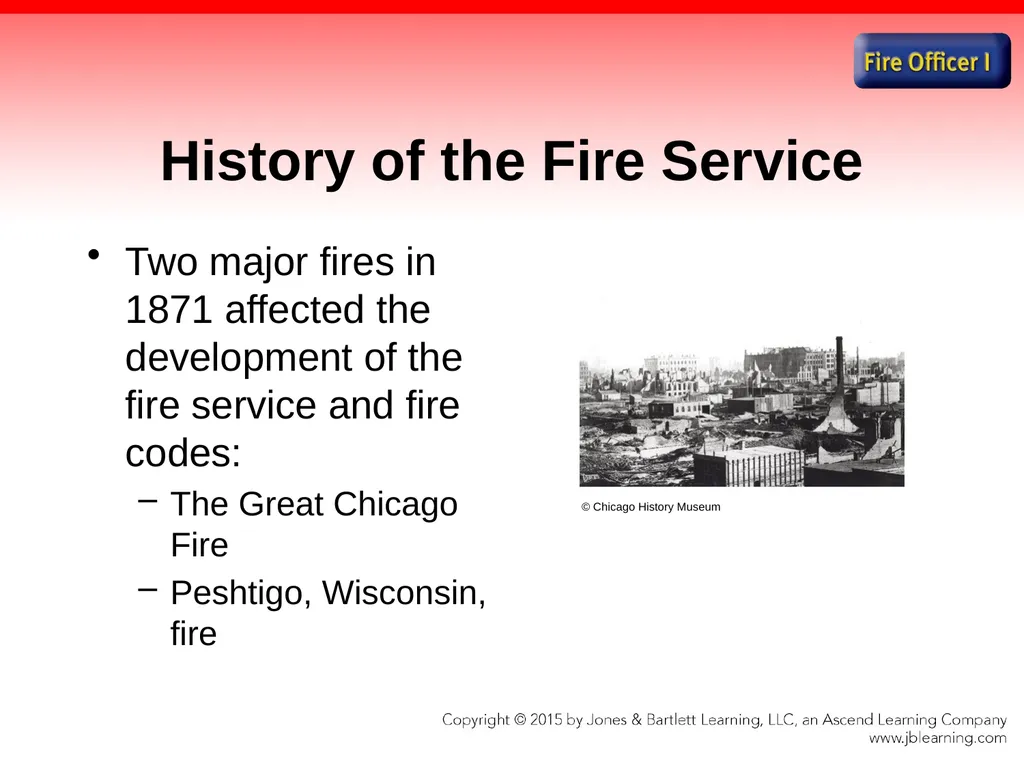
History of the Fire Service Two major fires in 1871 affected the development of the fire service and fire codes:
The Great Chicago Fire
Peshtigo, Wisconsin, fire © Chicago History Museum<br>
The Great Chicago Fire
Peshtigo, Wisconsin, fire © Chicago History Museum<br>
23
Fire Equipment A progression:
Buckets
Hand-powered pumpers
Steam-powered pumpers
Machine-powered pumpers
Modern fire apparatus
Development of municipal water systems<br>
Buckets
Hand-powered pumpers
Steam-powered pumpers
Machine-powered pumpers
Modern fire apparatus
Development of municipal water systems<br>
24
Communications Progression:
Fire warden or night watchman
Public call boxes
More immediate and effective communications systems<br>
Fire warden or night watchman
Public call boxes
More immediate and effective communications systems<br>
25
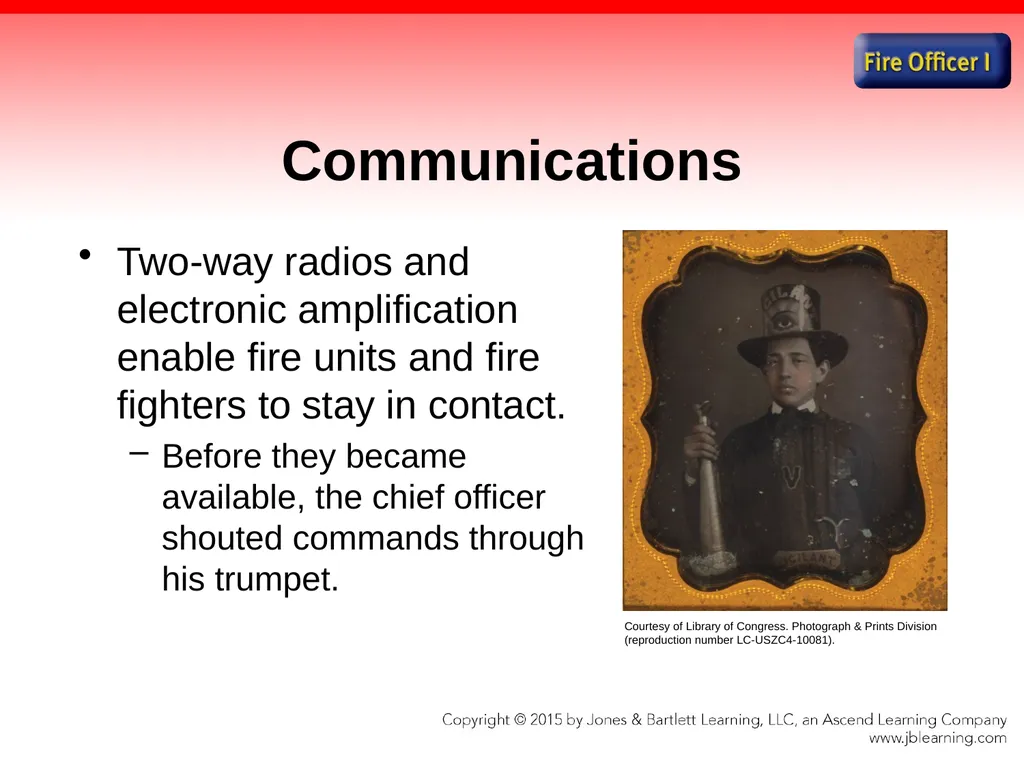
Communications Two-way radios and electronic amplification enable fire units and fire fighters to stay in contact.
Before they became available, the chief officer shouted commands through his trumpet. Courtesy of Library of Congress. Photograph & Prints Division (reproduction number LC-USZC4-10081).<br>
Before they became available, the chief officer shouted commands through his trumpet. Courtesy of Library of Congress. Photograph & Prints Division (reproduction number LC-USZC4-10081).<br>
26
Building Codes Few building codes existed in Colonial times.
Building codes govern construction materials and frequently require built-in fire prevention and safety measures.
Today, model codes are written by national organizations.<br>
Building codes govern construction materials and frequently require built-in fire prevention and safety measures.
Today, model codes are written by national organizations.<br>
27
Paying for Fire Service Many early volunteer departments were funded by donations or subscriptions.
Many still rely on this funding model.<br>
Many still rely on this funding model.<br>
28
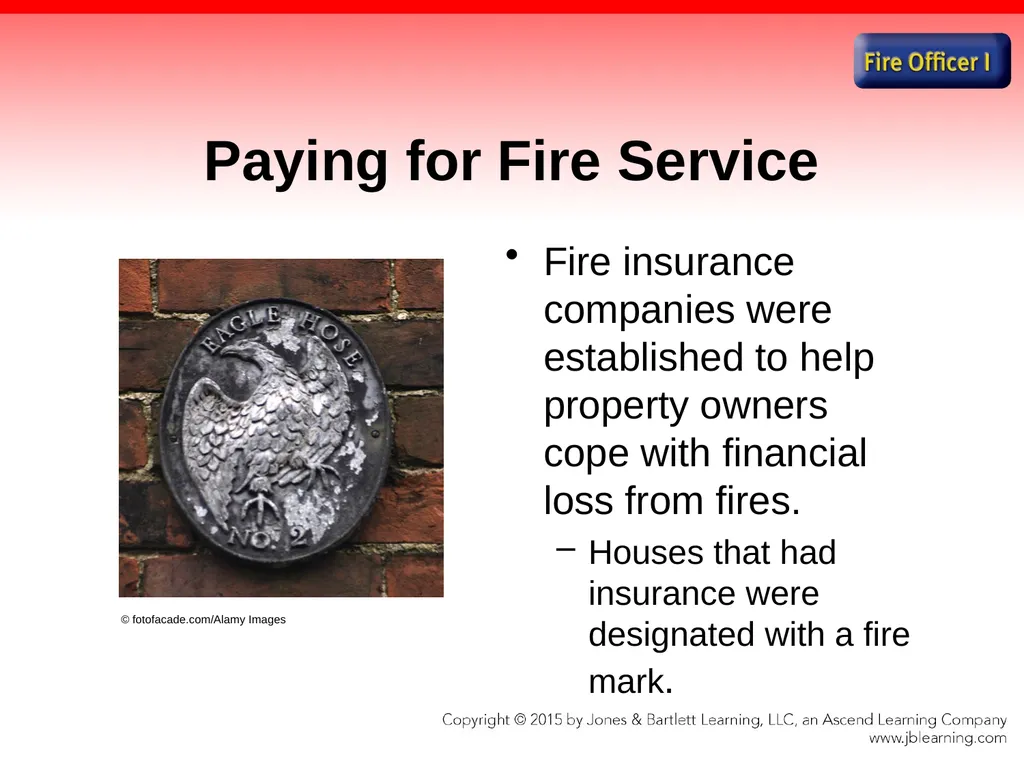
Paying for Fire Service © fotofacade.com/Alamy Images Fire insurance companies were established to help property owners cope with financial loss from fires.
Houses that had insurance were designated with a fire mark.<br>
Houses that had insurance were designated with a fire mark.<br>
29
Training and Education The first fire fighters simply required strength and endurance.
With more complex equipment, formal training and good judgment became more important.<br>
With more complex equipment, formal training and good judgment became more important.<br>
30
Training and Education Sophisticated technical equipment:
Large vehicles
Radios
Thermal imaging cameras
Self-contained breathing apparatus
The most important resource on the fire scene remains the fire fighter.<br>
Large vehicles
Radios
Thermal imaging cameras
Self-contained breathing apparatus
The most important resource on the fire scene remains the fire fighter.<br>
31
Fire Department Organization Fire service draws authority from:
Town
City
County
Township
Special fire district
The fire chief is accountable to the governing body.<br>
Town
City
County
Township
Special fire district
The fire chief is accountable to the governing body.<br>
32
Chain of Command Creates structure for:
Managing the department
Directing fire-ground operations<br>
Managing the department
Directing fire-ground operations<br>
33
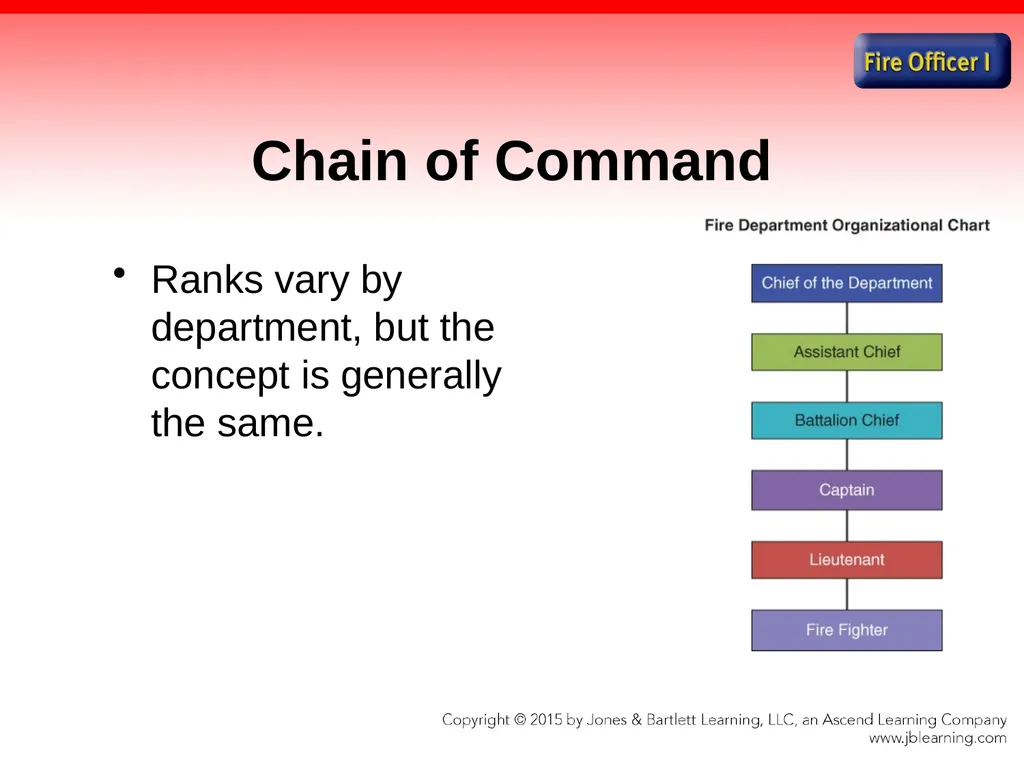
Chain of Command Ranks vary by department, but the concept is generally the same.<br>
34
Basic Principles of Organization Paramilitary style of leadership
Structured based on four principles:
Unity of command
Span of control
Division of labor
Discipline<br>
Structured based on four principles:
Unity of command
Span of control
Division of labor
Discipline<br>
35
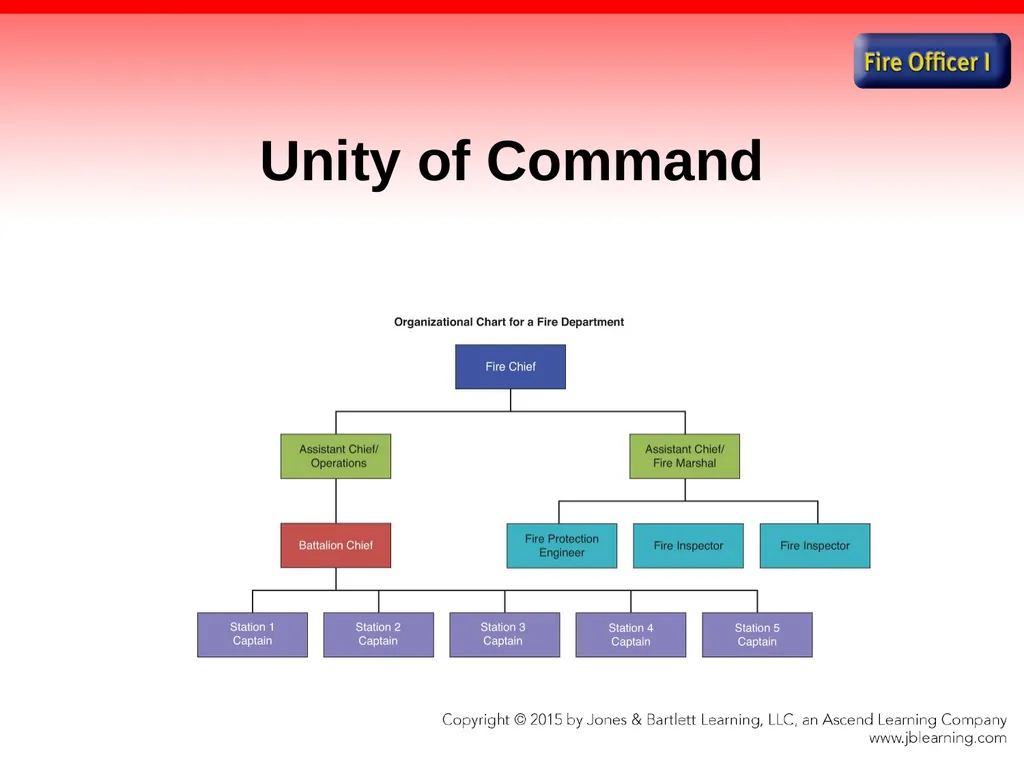
Unity of Command Each fire fighter answers to one supervisor.
Each supervisor answers to one boss.
A direct route of responsibility leads from the chief to the fire fighter.<br>
Each supervisor answers to one boss.
A direct route of responsibility leads from the chief to the fire fighter.<br>
36
Unity of Command<br>
37
Span of Control Maximum number of personnel or activities one individual can control:
Usually three to seven<br>
Usually three to seven<br>
38
Division of Labor Way of organizing an incident
Breaks down the overall strategy into smaller tasks
Prevents duplication of job assignments<br>
Breaks down the overall strategy into smaller tasks
Prevents duplication of job assignments<br>
39
Discipline Discipline includes:
Orders from superior officers
Standard operating procedures
Suggested operating guidelines
Policies
Can be positive or corrective<br>
Orders from superior officers
Standard operating procedures
Suggested operating guidelines
Policies
Can be positive or corrective<br>
40
Other Views of Organization By function
By geography
By staffing<br>
By geography
By staffing<br>
41
The Functions of Management Planning
Developing a scheme, program, or method to accomplish an objective
Organizing
Putting resources together into an orderly, functional, structured whole<br>
Developing a scheme, program, or method to accomplish an objective
Organizing
Putting resources together into an orderly, functional, structured whole<br>
42
The Functions of Management Leading
Guiding or directing a course of action
Controlling
Restraining, regulating, governing, counteracting, or overpowering<br>
Guiding or directing a course of action
Controlling
Restraining, regulating, governing, counteracting, or overpowering<br>
43
Rules and Regulations Developed by government or government-authorized organizations
No room for latitude or discretion
Example: Wearing a seat belt when riding in a vehicle<br>
No room for latitude or discretion
Example: Wearing a seat belt when riding in a vehicle<br>
44
Policies Provide guidelines for present and future actions
Often require judgment on the best course of action within the policy
Example: Maintaining station sidewalk safety in winter<br>
Often require judgment on the best course of action within the policy
Example: Maintaining station sidewalk safety in winter<br>
45
Standard Operating Procedures (SOPs) Written organizational directives that establish routine methods to follow for designated operations or actions
Developed within the fire department
Example: Process for vertical ventilation<br>
Developed within the fire department
Example: Process for vertical ventilation<br>
46
Ethics Most of the time, fire officers make ethical, “right” decisions.
When unethical choices are made, there are negative consequences for the individual and the organization.<br>
When unethical choices are made, there are negative consequences for the individual and the organization.<br>
47
Ethics To make ethical choices and decisions:
Have a code of ethics.
Select employees who share values.
Ensure top management exhibits ethical behavior.
Have clear job goals.
Have performance appraisals.
Implement an ethics training program.<br>
Have a code of ethics.
Select employees who share values.
Ensure top management exhibits ethical behavior.
Have clear job goals.
Have performance appraisals.
Implement an ethics training program.<br>
48
Ethics Three questions to ask about a decision:
What would my family and friends say if they knew?
Would I mind if the paper ran it as a headline story?
How does it make me feel about myself?<br>
What would my family and friends say if they knew?
Would I mind if the paper ran it as a headline story?
How does it make me feel about myself?<br>
49
Requirements for Fire Officer II Must meet Fire Officer I requirements
Administrative duties:
Evaluating subordinates’ job performance
Correcting unacceptable performance of subordinates
Completing performance appraisals
Developing budgets
Preparing news releases and other reports<br>
Administrative duties:
Evaluating subordinates’ job performance
Correcting unacceptable performance of subordinates
Completing performance appraisals
Developing budgets
Preparing news releases and other reports<br>
50
Requirements for Fire Officer II Nonemergency duties:
Conducting inspections
Reviewing reports
Preventing accident, injury, or exposure
Developing preincident plans
Developing policies and procedures
Analyzing data and implementing corrective actions<br>
Conducting inspections
Reviewing reports
Preventing accident, injury, or exposure
Developing preincident plans
Developing policies and procedures
Analyzing data and implementing corrective actions<br>
51
Requirements for Fire Officer II Emergency duties:
Supervising multiunit operations
Developing a plan to deploy resources and mitigate the incident
Determining area of origin and fire cause
Performing postincident analysis of a multicompany operation<br>
Supervising multiunit operations
Developing a plan to deploy resources and mitigate the incident
Determining area of origin and fire cause
Performing postincident analysis of a multicompany operation<br>
52
Requirements for Fire Officer II Term used by International Association of Fire Chiefs: Managing Fire Officer<br>
53
Additional Roles and Responsibilities for Fire Officer II Supervises and directs multiunit station
Completes performance appraisals
Creates professional development plan
Leads water rescue, hazardous materials, other special teams
Ensures safe and proper use of equipment<br>
Completes performance appraisals
Creates professional development plan
Leads water rescue, hazardous materials, other special teams
Ensures safe and proper use of equipment<br>
54
Additional Roles and Responsibilities for Fire Officer II Participates in policy formulation, evaluation, and implementation
Participates in budget formulation
Develops emergency incident multiunit operational plans
Prepares reports on causes for local service demand<br>
Participates in budget formulation
Develops emergency incident multiunit operational plans
Prepares reports on causes for local service demand<br>
55
Working with Other Organizations Fire departments often interact with other organizations:
Emergency medical services providers
Law enforcement officials<br>
Emergency medical services providers
Law enforcement officials<br>
56
Challenges for the Captain Supervision and motivation
Rigid command is essential during emergencies.
In nonemergency situations, departments use employee empowerment.<br>
Rigid command is essential during emergencies.
In nonemergency situations, departments use employee empowerment.<br>
57
Challenges for the Captain Challenges increase in nonfire incidents.
EMS calls are now the most frequent activity undertaken by the fire service.
Activated alarms are the second most common activity.
Investigating odors, hazardous conditions, or other service call is the third most common activity.<br>
EMS calls are now the most frequent activity undertaken by the fire service.
Activated alarms are the second most common activity.
Investigating odors, hazardous conditions, or other service call is the third most common activity.<br>
58
Challenges for the Captain Deterioration of the built environment
Flashover and structural collapse are primary causes of death in fire.
Buildings may be old and/or not have modern renovations.<br>
Flashover and structural collapse are primary causes of death in fire.
Buildings may be old and/or not have modern renovations.<br>
59
Challenges for the Captain Related duties
The fire department is providing a wider variety of services.
Fire officers must understand the roles played by other agencies.
Fire officers must be aware of and remain vigilant for threats.<br>
The fire department is providing a wider variety of services.
Fire officers must understand the roles played by other agencies.
Fire officers must be aware of and remain vigilant for threats.<br>
60
Challenges for the Captain Cultural diversity
It is now common to find both men and women, and a blend of races, in the fire service.
Integration is still not complete; fire officers of the future must continue to work on this issue.<br>
It is now common to find both men and women, and a blend of races, in the fire service.
Integration is still not complete; fire officers of the future must continue to work on this issue.<br>
61
Summary The qualification standards for fire officers are documented in NFPA 1021.
At the Fire Officer I level, the emphasis is placed on accomplishing goals and objectives through subordinates.
The officer has to apply policies, procedures, and rules to subordinates.<br>
At the Fire Officer I level, the emphasis is placed on accomplishing goals and objectives through subordinates.
The officer has to apply policies, procedures, and rules to subordinates.<br>
62
Summary The U.S. fire service originated as communities of citizens.
Building codes prevent, limit, and contain fires.
Formalized training is important.
The chain of command creates a structure for the fire department.<br>
Building codes prevent, limit, and contain fires.
Formalized training is important.
The chain of command creates a structure for the fire department.<br>
63
Summary The fire department uses a paramilitary style of leadership.
There are several different ways to look at the organization of a fire department.
Four functions of managing: planning, organizing, leading, and controlling.
Fire officers must know department’s regulations, policies, and SOPs.<br>
There are several different ways to look at the organization of a fire department.
Four functions of managing: planning, organizing, leading, and controlling.
Fire officers must know department’s regulations, policies, and SOPs.<br>
64
Summary Ethical choices are based on values.
Duties of the Fire Officer II include evaluating job performance, correcting performance, and completing performance appraisals.
To fulfill its mission, the fire department must often interact with organizations.<br>
Duties of the Fire Officer II include evaluating job performance, correcting performance, and completing performance appraisals.
To fulfill its mission, the fire department must often interact with organizations.<br>
65
Summary Rigid command and control is essential when operating at emergency scenes.
Firefighting is one of the activities least frequently performed by fire companies.
The fire officer must match each individual’s strengths with the organization’s needs.<br>
Firefighting is one of the activities least frequently performed by fire companies.
The fire officer must match each individual’s strengths with the organization’s needs.<br>