
CHAPTER 10 Forcible Entry Knowledge Objectives
TD
Published · 96 slides · 0 views
1 / 1
Description
CHAPTER 10 Forcible Entry Knowledge Objectives Describe the situations and circumstances that require forcible entry into a structure. List the general safety rules to follow when utilizing forcible entry tools. List the general carrying
Related Topics
Share
Embed code
Download this presentation From Below
"CHAPTER 10 Forcible Entry Knowledge Objectives" is the property of its rightful owner. Permission is granted to download and print the materials on this website for personal, non-commercial use only, and to display it on your personal computer provided you do not modify the materials and that you retain all copyright notices contained in the materials. By downloading content from our website, you accept the terms of this agreement.
Presentation Transcript
01
CHAPTER 10 Forcible Entry<br>
02
Knowledge Objectives Describe the situations and circumstances that require forcible entry into a structure.
List the general safety rules to follow when utilizing forcible entry tools.
List the general carrying tips when utilizing forcible entry tools.
List the general maintenance tips when utilizing forcible entry tools.
List the types of tools used in forcible entry.<br>
List the general safety rules to follow when utilizing forcible entry tools.
List the general carrying tips when utilizing forcible entry tools.
List the general maintenance tips when utilizing forcible entry tools.
List the types of tools used in forcible entry.<br>
03
Knowledge Objectives List the rotating tools used in forcible entry.
Describe the tasks that rotating tools are used for in forcible entry.
List the striking tools used in forcible entry.
Describe the tasks that striking tools are used for in forcible entry.
List the prying and spreading tools used in forcible entry.
Describe the tasks that prying and spreading hand tools are used for in forcible entry.<br>
Describe the tasks that rotating tools are used for in forcible entry.
List the striking tools used in forcible entry.
Describe the tasks that striking tools are used for in forcible entry.
List the prying and spreading tools used in forcible entry.
Describe the tasks that prying and spreading hand tools are used for in forcible entry.<br>
04
Knowledge Objectives List the cutting tools used in forcible entry.
Describe the tasks that cutting tools are used for in forcible entry.
List the pushing and pulling tools used in forcible entry.
Describe the tasks that pushing and pulling tools are used for in forcible entry.
List the special-use and lock tools used in forcible entry.<br>
Describe the tasks that cutting tools are used for in forcible entry.
List the pushing and pulling tools used in forcible entry.
Describe the tasks that pushing and pulling tools are used for in forcible entry.
List the special-use and lock tools used in forcible entry.<br>
05
Knowledge Objectives Describe the tasks that special-use and lock tools are used for in forcible entry.
Describe the basic components of a door.
Explain the differences between a solid-core and a hollow-core door.
Describe the basic classifications of doors by opening type.
Explain how the door classification affects forcible entry operations.<br>
Describe the basic components of a door.
Explain the differences between a solid-core and a hollow-core door.
Describe the basic classifications of doors by opening type.
Explain how the door classification affects forcible entry operations.<br>
06
Knowledge Objectives Describe the basic configurations of window construction.
Describe the common styles of window frames.
Explain how the style of window frame affects forcible entry operations.
Describe the major components of a door lock.
Describe the major components of a padlock.
Describe the four major types of locks.<br>
Describe the common styles of window frames.
Explain how the style of window frame affects forcible entry operations.
Describe the major components of a door lock.
Describe the major components of a padlock.
Describe the four major types of locks.<br>
07
Knowledge Objectives Explain how the type of lock affects forcible entry operations.
Describe the tools used to force entry through locks.
Describe how to force entry through doors with drop bars.
Describe how to force entry through security gates and windows.<br>
Describe the tools used to force entry through locks.
Describe how to force entry through doors with drop bars.
Describe how to force entry through security gates and windows.<br>
08
Knowledge Objectives Explain the differences between load-bearing and non-load-bearing walls.
Describe the materials used in exterior and interior walls.
Describe the materials used in floors.
List the basic steps and considerations in forcible entry operations.<br>
Describe the materials used in exterior and interior walls.
Describe the materials used in floors.
List the basic steps and considerations in forcible entry operations.<br>
09
Skills Objectives Force entry into an inward-opening door.
Force entry into an outward-opening door.
Open an overhead garage door using the triangle method.
Open an overhead garage door using the hinge method.
Force entry through a wooden double-hung window.
Force entry through a casement window.<br>
Force entry into an outward-opening door.
Open an overhead garage door using the triangle method.
Open an overhead garage door using the hinge method.
Force entry through a wooden double-hung window.
Force entry through a casement window.<br>
10
Skills Objectives Force entry through a projected window.
Force entry using a K tool.
Force entry using an A tool.
Force entry by unscrewing a lock.
Breach a wall frame.
Breach a masonry wall.
Breach a metal wall.
Breach a floor.<br>
Force entry using a K tool.
Force entry using an A tool.
Force entry by unscrewing a lock.
Breach a wall frame.
Breach a masonry wall.
Breach a metal wall.
Breach a floor.<br>
11
Introduction Forcible entry
Method to gain access when normal means of entry cannot be used
Requires strength, knowledge, proper techniques, and skill
Fire fighters must consider different methods and select the most appropriate one.
Use amount of force appropriate to situation.<br>
Method to gain access when normal means of entry cannot be used
Requires strength, knowledge, proper techniques, and skill
Fire fighters must consider different methods and select the most appropriate one.
Use amount of force appropriate to situation.<br>
12
Introduction Fire fighters must never leave the premises in a condition that would allow unauthorized entry.
Consider type of construction, entry points, securing devices, and best tools and equipment for the situation.
Keep up with how new styles of windows, doors, locks, and security devices operate.<br>
Consider type of construction, entry points, securing devices, and best tools and equipment for the situation.
Keep up with how new styles of windows, doors, locks, and security devices operate.<br>
13
Forcible Entry Situations Required at emergency incidents where time is a critical factor
Company officer selects:
Point of entry
Method to be used
Coordination of entry
“Try before you pry!”
Check for unlocked entry points.
Be sure you are at the correct address.
Look for alternative entry points.<br>
Company officer selects:
Point of entry
Method to be used
Coordination of entry
“Try before you pry!”
Check for unlocked entry points.
Be sure you are at the correct address.
Look for alternative entry points.<br>
14
Forcible Entry Situations If forcible entry is required, consider:
Seriousness of the situation
Nature of the call
Type of occupancy and construction
Type of door or window
Type of lock<br>
Seriousness of the situation
Nature of the call
Type of occupancy and construction
Type of door or window
Type of lock<br>
15
Forcible Entry Tools Fire fighters must know:
Which tools are available
Uses and limitations of each tool
How to select the right tool
How to operate each tool
How to carry each tool
How to inspect and maintain each tool<br>
Which tools are available
Uses and limitations of each tool
How to select the right tool
How to operate each tool
How to carry each tool
How to inspect and maintain each tool<br>
16
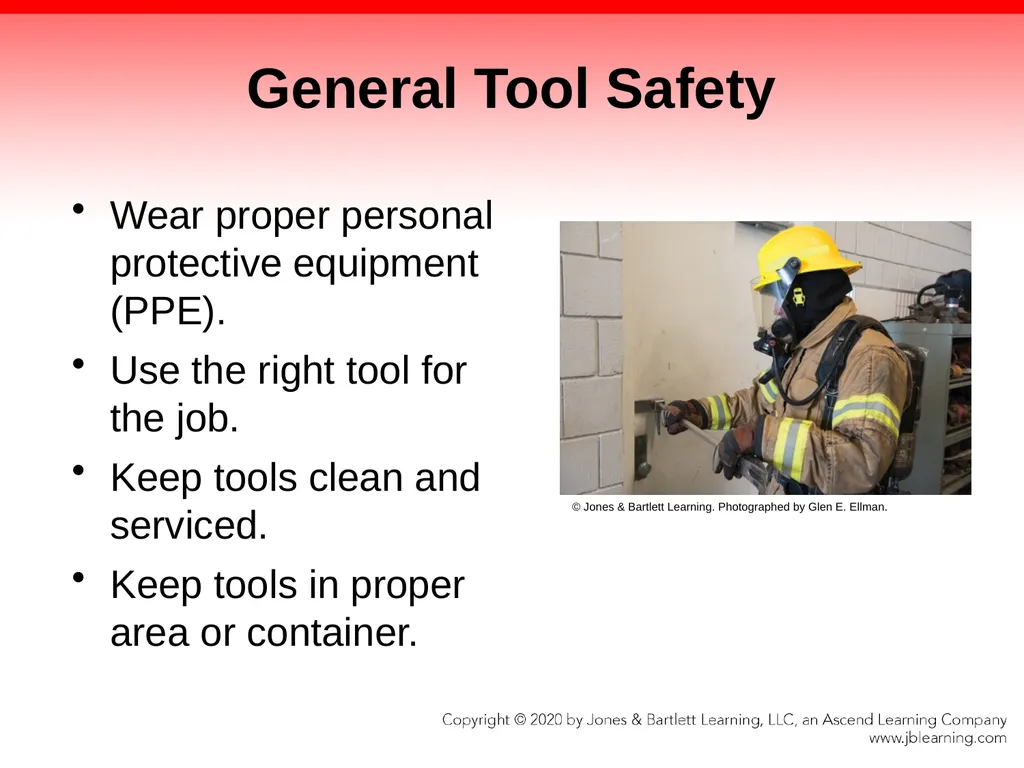
General Tool Safety Wear proper personal protective equipment (PPE).
Use the right tool for the job.
Keep tools clean and serviced.
Keep tools in proper area or container. © Jones & Bartlett Learning. Photographed by Glen E. Ellman.<br>
Use the right tool for the job.
Keep tools clean and serviced.
Keep tools in proper area or container. © Jones & Bartlett Learning. Photographed by Glen E. Ellman.<br>
17
General Carrying Tips Request assistance with heavy tools.
Use your legs to lift heavy tools.
Keep sharp edges away from your body.
Cover or shield them with a gloved hand.
Carry long tools pointing down.
Be aware of overhead obstructions and wires.<br>
Use your legs to lift heavy tools.
Keep sharp edges away from your body.
Cover or shield them with a gloved hand.
Carry long tools pointing down.
Be aware of overhead obstructions and wires.<br>
18
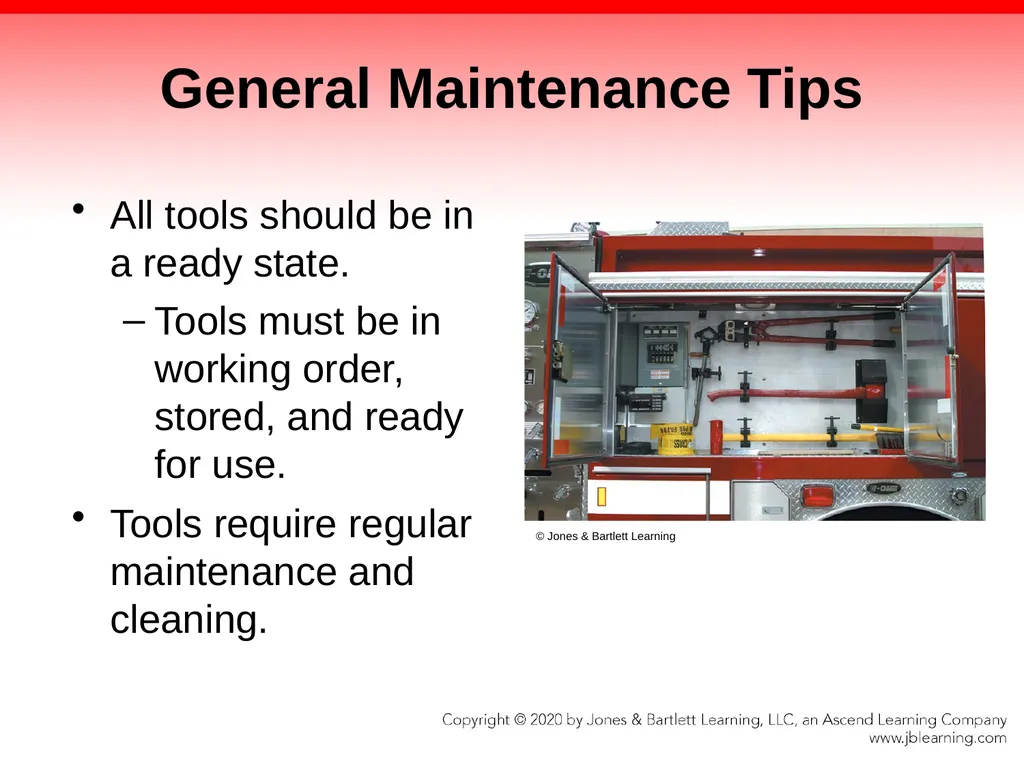
General Maintenance Tips All tools should be in a ready state.
Tools must be in working order, stored, and ready for use.
Tools require regular maintenance and cleaning. © Jones & Bartlett Learning<br>
Tools must be in working order, stored, and ready for use.
Tools require regular maintenance and cleaning. © Jones & Bartlett Learning<br>
19
Types of Forcible Entry Tools Rotating tools
Striking tools
Prying/spreading hand tools
Cutting tools
Pushing/pulling tools
Multiple-function tools
Special-use/lock tools<br>
Striking tools
Prying/spreading hand tools
Cutting tools
Pushing/pulling tools
Multiple-function tools
Special-use/lock tools<br>
20
Rotating Tools Apply a rotational force to make something turn
Includes screwdrivers, wrenches, and pliers
Power tools include rotating power saws<br>
Includes screwdrivers, wrenches, and pliers
Power tools include rotating power saws<br>
21
Striking Tools Used to generate an impact force directly on an object or another tool
Generally hand tools powered by humans
Head usually made of hardened steel
Flat-head axe has cutting blade and flat striking surface.
Battering ram is used to force doors and breach walls.
Sledgehammer can be used alone or with other tools.<br>
Generally hand tools powered by humans
Head usually made of hardened steel
Flat-head axe has cutting blade and flat striking surface.
Battering ram is used to force doors and breach walls.
Sledgehammer can be used alone or with other tools.<br>
22
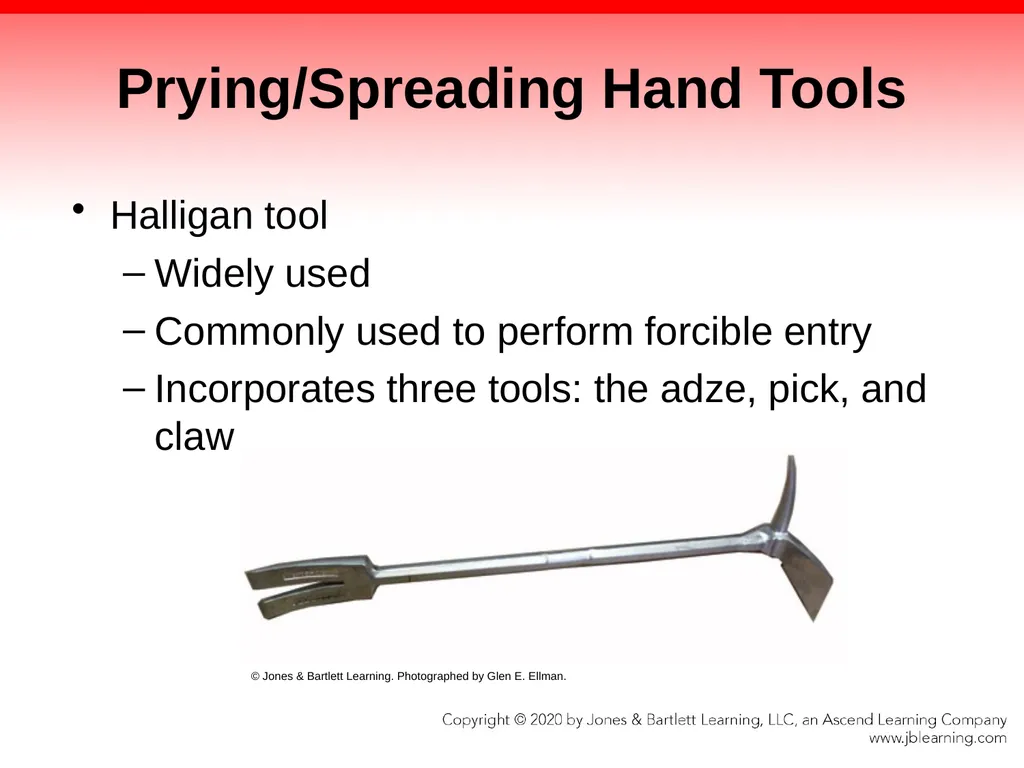
Prying/Spreading Hand Tools Halligan tool
Widely used
Commonly used to perform forcible entry
Incorporates three tools: the adze, pick, and claw © Jones & Bartlett Learning. Photographed by Glen E. Ellman.<br>
Widely used
Commonly used to perform forcible entry
Incorporates three tools: the adze, pick, and claw © Jones & Bartlett Learning. Photographed by Glen E. Ellman.<br>
23
Prying/Spreading Hand Tools Pry bar/Hux bar/crowbar
Made from hardened steel
Variety of shapes and sizes
Commonly used to force doors and windows, remove nails, or separate building materials
Various shapes allow fire fighters to exert different amounts of leverage<br>
Made from hardened steel
Variety of shapes and sizes
Commonly used to force doors and windows, remove nails, or separate building materials
Various shapes allow fire fighters to exert different amounts of leverage<br>
24
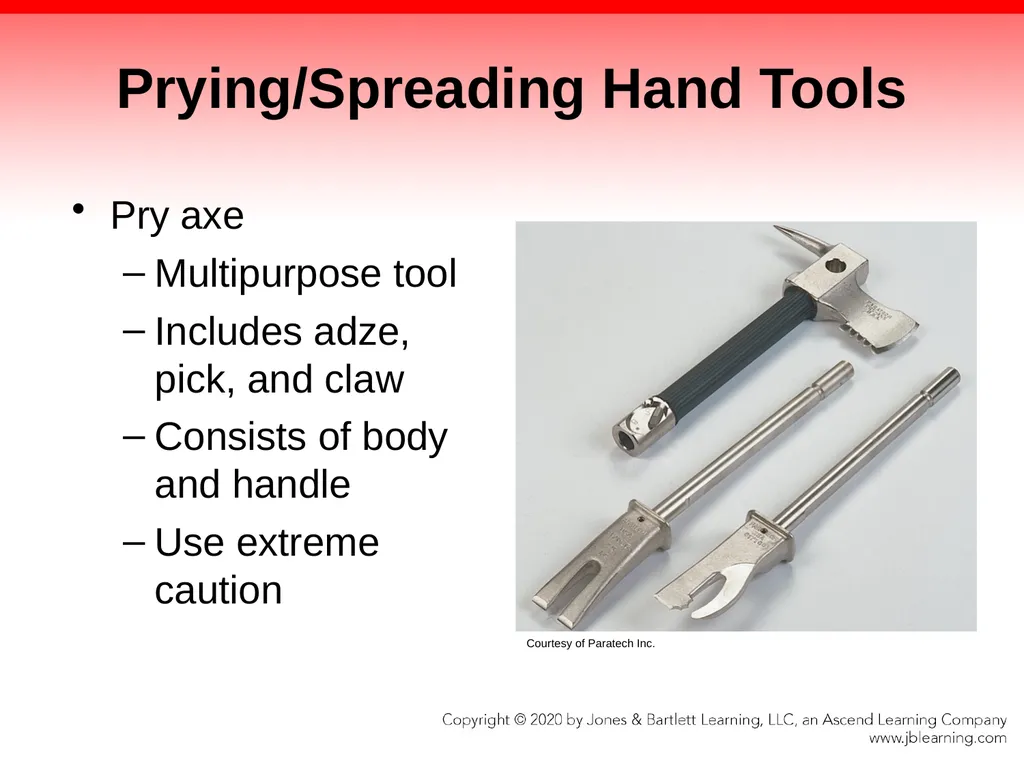
Prying/Spreading Hand Tools Pry axe
Multipurpose tool
Includes adze, pick, and claw
Consists of body and handle
Use extreme caution Courtesy of Paratech Inc.<br>
Multipurpose tool
Includes adze, pick, and claw
Consists of body and handle
Use extreme caution Courtesy of Paratech Inc.<br>
25
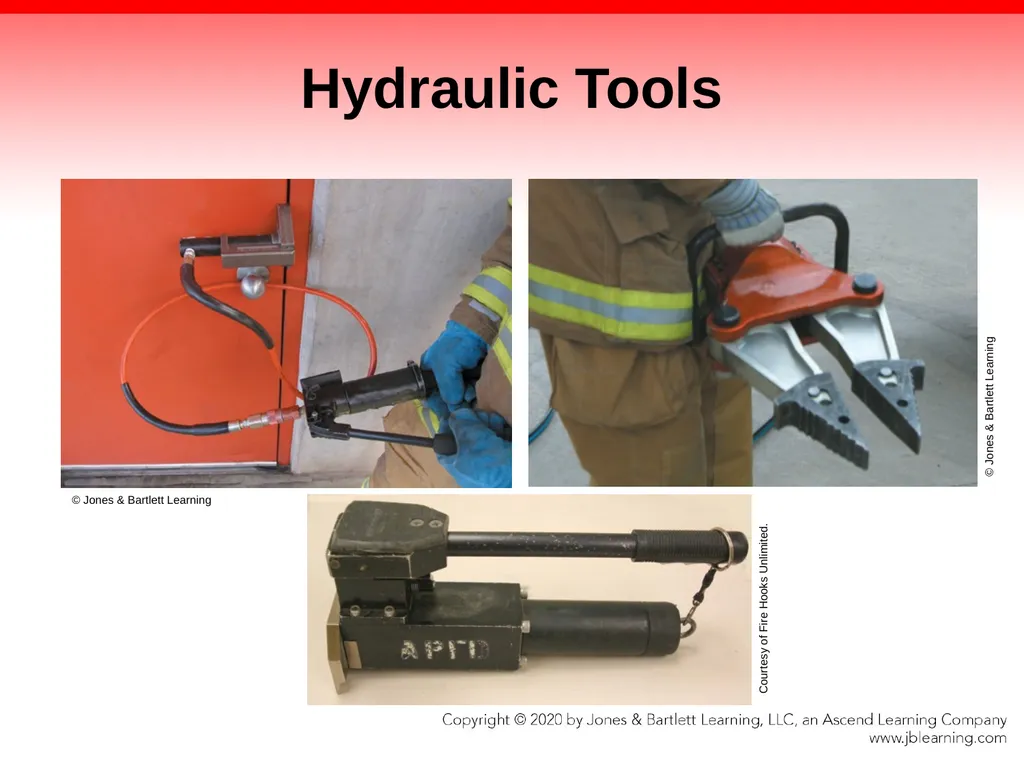
Hydraulic Tools © Jones & Bartlett Learning Courtesy of Fire Hooks Unlimited. © Jones & Bartlett Learning<br>
26
Cutting Tools Primarily used for cutting doors, roofs, walls, and floors
Hand-operated and power cutting tools
Power tools can be powered by batteries, electricity, gasoline, or hydraulics.<br>
Hand-operated and power cutting tools
Power tools can be powered by batteries, electricity, gasoline, or hydraulics.<br>
27
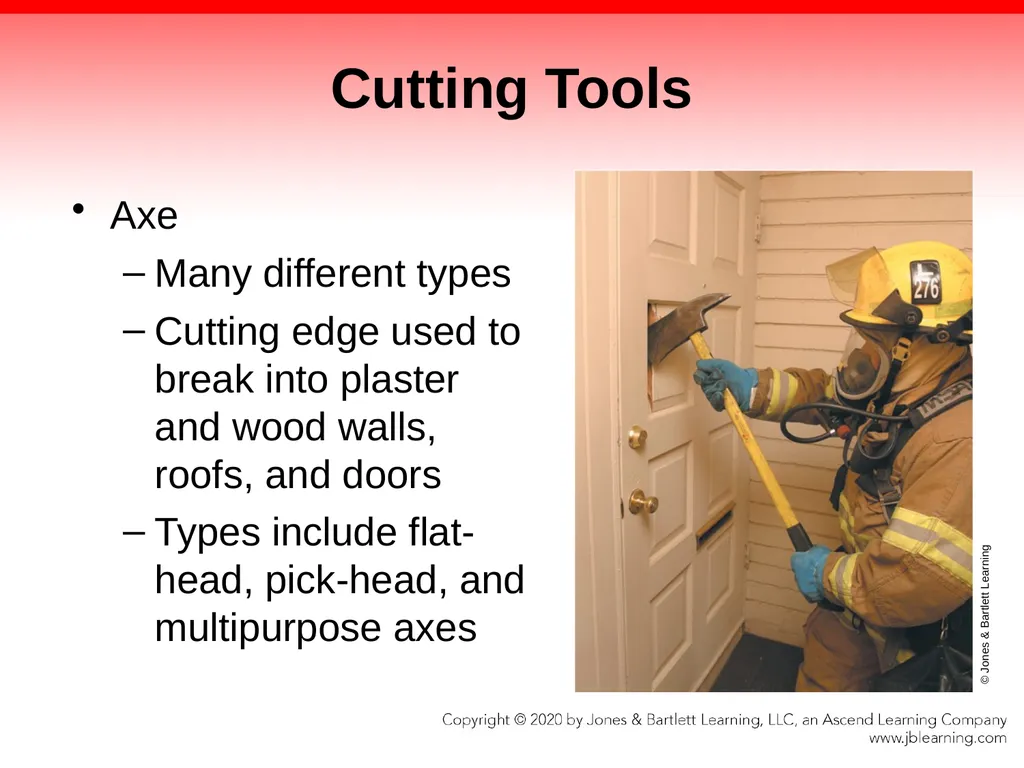
Cutting Tools Axe
Many different types
Cutting edge used to break into plaster and wood walls, roofs, and doors
Types include flat-head, pick-head, and multipurpose axes © Jones & Bartlett Learning<br>
Many different types
Cutting edge used to break into plaster and wood walls, roofs, and doors
Types include flat-head, pick-head, and multipurpose axes © Jones & Bartlett Learning<br>
28
Cutting Tools Bolt cutters
Used to cut components, such as bolts, padlocks, chains, and chain-link fences
Available in several different sizes
The longer the handle, the greater the cutting force
May not be able to cut into some heavy-duty padlocks made of case-hardened<br>
Used to cut components, such as bolts, padlocks, chains, and chain-link fences
Available in several different sizes
The longer the handle, the greater the cutting force
May not be able to cut into some heavy-duty padlocks made of case-hardened<br>
29
Cutting Tools Rotary saw
Powered by electric motors/gasoline engines
Important to match the appropriate blade or disk to the material
Reciprocating saw
Powered by electric or battery motor that pulls a saw blade back and forth
Most commonly used to cut metal during extrication from a motor vehicle<br>
Powered by electric motors/gasoline engines
Important to match the appropriate blade or disk to the material
Reciprocating saw
Powered by electric or battery motor that pulls a saw blade back and forth
Most commonly used to cut metal during extrication from a motor vehicle<br>
30
Cutting Tools Circular saw
Gasoline powered
Light, powerful, and easy to use
Blades can be changed quickly.
Carbide-tipped blades
Metal-cutting blades
Masonry-cutting blades
Blades with missing labels should be discarded.<br>
Gasoline powered
Light, powerful, and easy to use
Blades can be changed quickly.
Carbide-tipped blades
Metal-cutting blades
Masonry-cutting blades
Blades with missing labels should be discarded.<br>
31
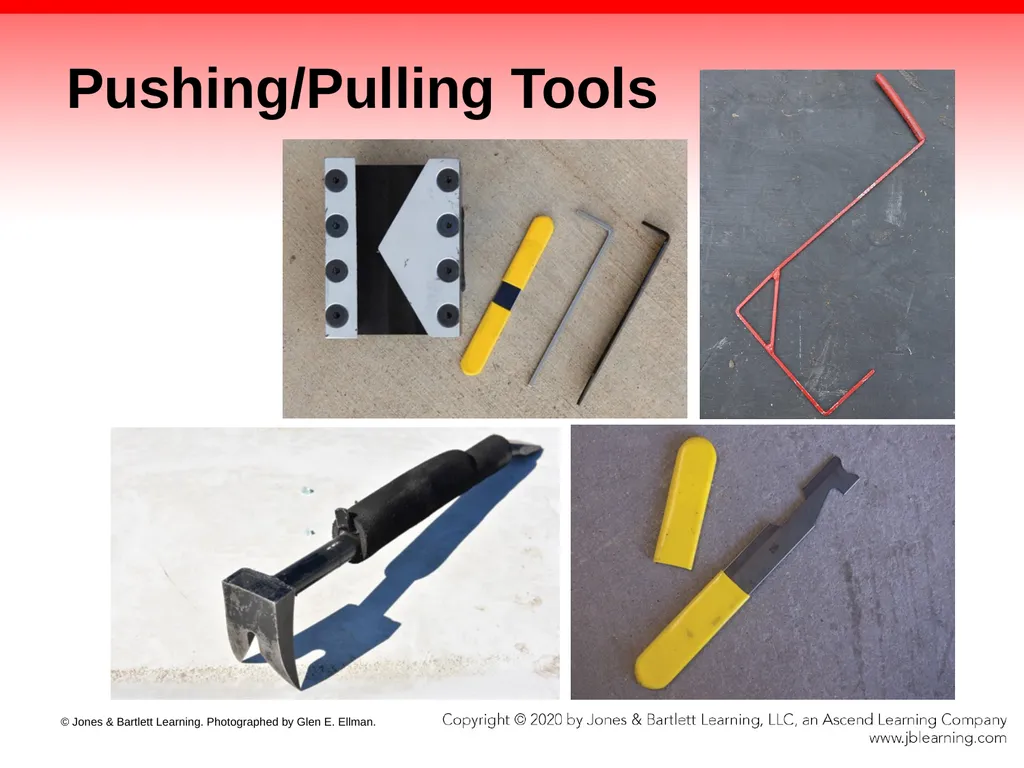
Pushing/Pulling Tools Tools extend the reach and increase the power of the fire fighter.
K tool is designed to remove a lock cylinder, protecting the door.
A tool is similar to the K tool, except the pry bar is built into the cutting part of the tool.
J tool will fit between double doors that have push or panic bars.
Shove knife is a pulling tool used to trip the latch on outward-swinging doors.<br>
K tool is designed to remove a lock cylinder, protecting the door.
A tool is similar to the K tool, except the pry bar is built into the cutting part of the tool.
J tool will fit between double doors that have push or panic bars.
Shove knife is a pulling tool used to trip the latch on outward-swinging doors.<br>
32
Pushing/Pulling Tools © Jones & Bartlett Learning. Photographed by Glen E. Ellman.<br>
33
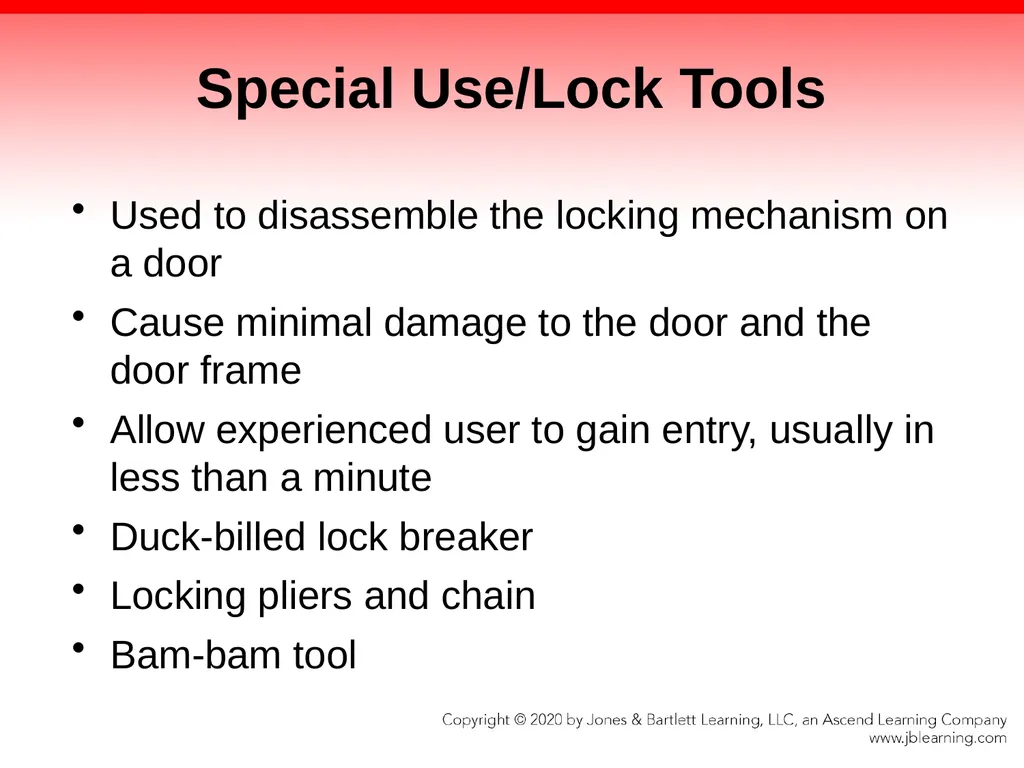
Special Use/Lock Tools Used to disassemble the locking mechanism on a door
Cause minimal damage to the door and the door frame
Allow experienced user to gain entry, usually in less than a minute
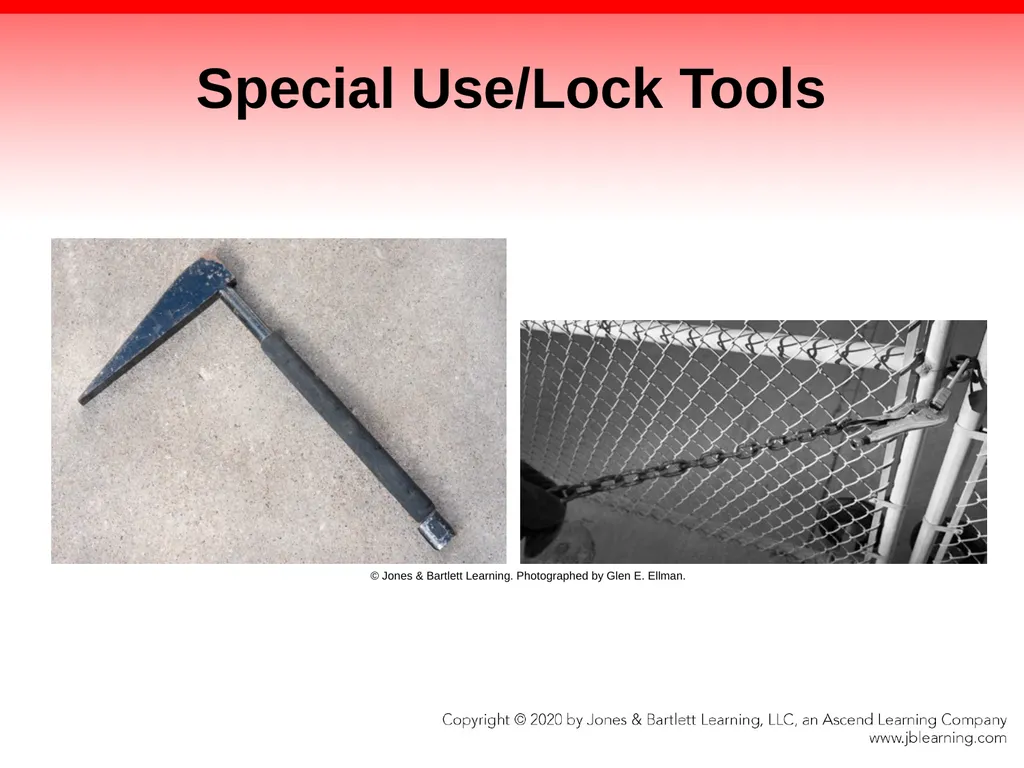
Duck-billed lock breaker
Locking pliers and chain
Bam-bam tool<br>
Cause minimal damage to the door and the door frame
Allow experienced user to gain entry, usually in less than a minute
Duck-billed lock breaker
Locking pliers and chain
Bam-bam tool<br>
34
Special Use/Lock Tools © Jones & Bartlett Learning. Photographed by Glen E. Ellman.<br>
35
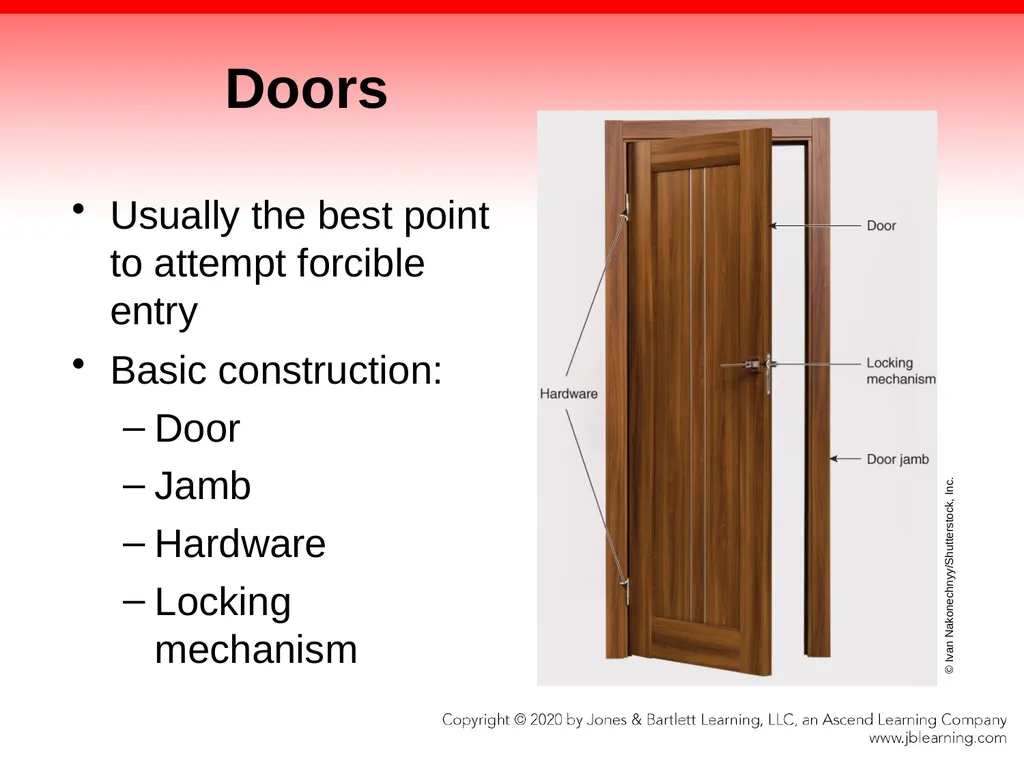
Doors Usually the best point to attempt forcible entry
Basic construction:
Door
Jamb
Hardware
Locking mechanism © Ivan Nakonechnyy/Shutterstock, Inc.<br>
Basic construction:
Door
Jamb
Hardware
Locking mechanism © Ivan Nakonechnyy/Shutterstock, Inc.<br>
36
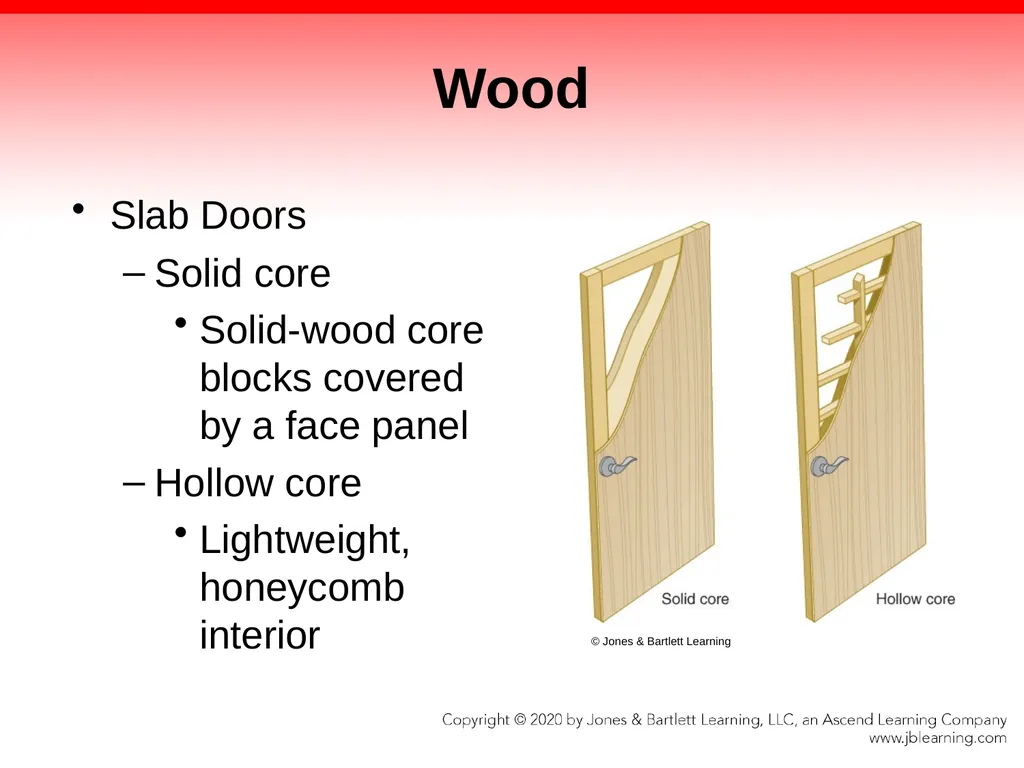
Wood Slab Doors
Solid core
Solid-wood core blocks covered by a face panel
Hollow core
Lightweight, honeycomb interior © Jones & Bartlett Learning<br>
Solid core
Solid-wood core blocks covered by a face panel
Hollow core
Lightweight, honeycomb interior © Jones & Bartlett Learning<br>
37
Wood Ledge Doors
Wood doors with horizontal bracing
Found on warehouses, sheds, and barns
Panel Doors
Solid-wood doors made from solid planks to form a rigid frame with solid-wood panels set into the frame
Resist fire longer than hollow-core slab doors and are easier to breach than solid-core slab doors<br>
Wood doors with horizontal bracing
Found on warehouses, sheds, and barns
Panel Doors
Solid-wood doors made from solid planks to form a rigid frame with solid-wood panels set into the frame
Resist fire longer than hollow-core slab doors and are easier to breach than solid-core slab doors<br>
38
Metal May be required in Type I residential and commercial high-rise buildings.
More durable and fire resistant than metal
Hollow-core metal doors
Have a metal framework interior so they are lightweight
Solid-core metal doors
Have a foam or wood interior to reduce weight without affecting strength<br>
More durable and fire resistant than metal
Hollow-core metal doors
Have a metal framework interior so they are lightweight
Solid-core metal doors
Have a foam or wood interior to reduce weight without affecting strength<br>
39
Glass Generally steel frame with tempered glass or tempered glass only with no frame
Easy to force
Produces a large amount of broken glass<br>
Easy to force
Produces a large amount of broken glass<br>
40
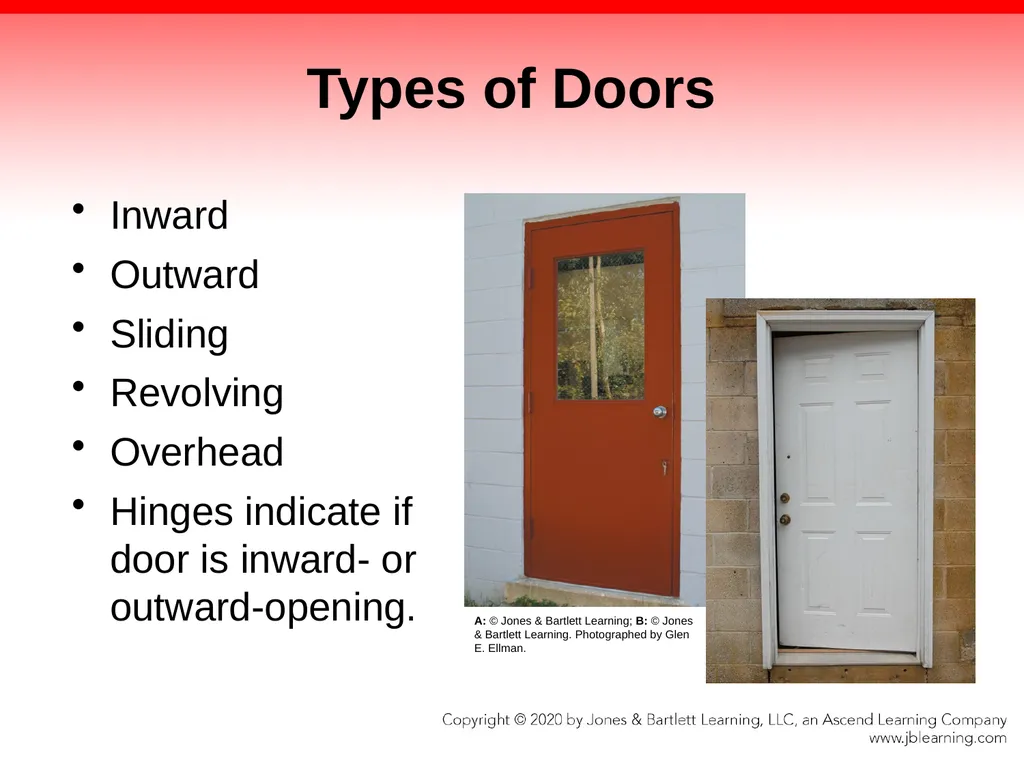
Types of Doors Inward
Outward
Sliding
Revolving
Overhead
Hinges indicate if door is inward- or outward-opening. A: © Jones & Bartlett Learning; B: © Jones & Bartlett Learning. Photographed by Glen E. Ellman.<br>
Outward
Sliding
Revolving
Overhead
Hinges indicate if door is inward- or outward-opening. A: © Jones & Bartlett Learning; B: © Jones & Bartlett Learning. Photographed by Glen E. Ellman.<br>
41
Door Frames Two styles of wood-framed doors:
Stopped door frames
Rabbited door frames
Metal-framed doors are more difficult to force open.<br>
Stopped door frames
Rabbited door frames
Metal-framed doors are more difficult to force open.<br>
42
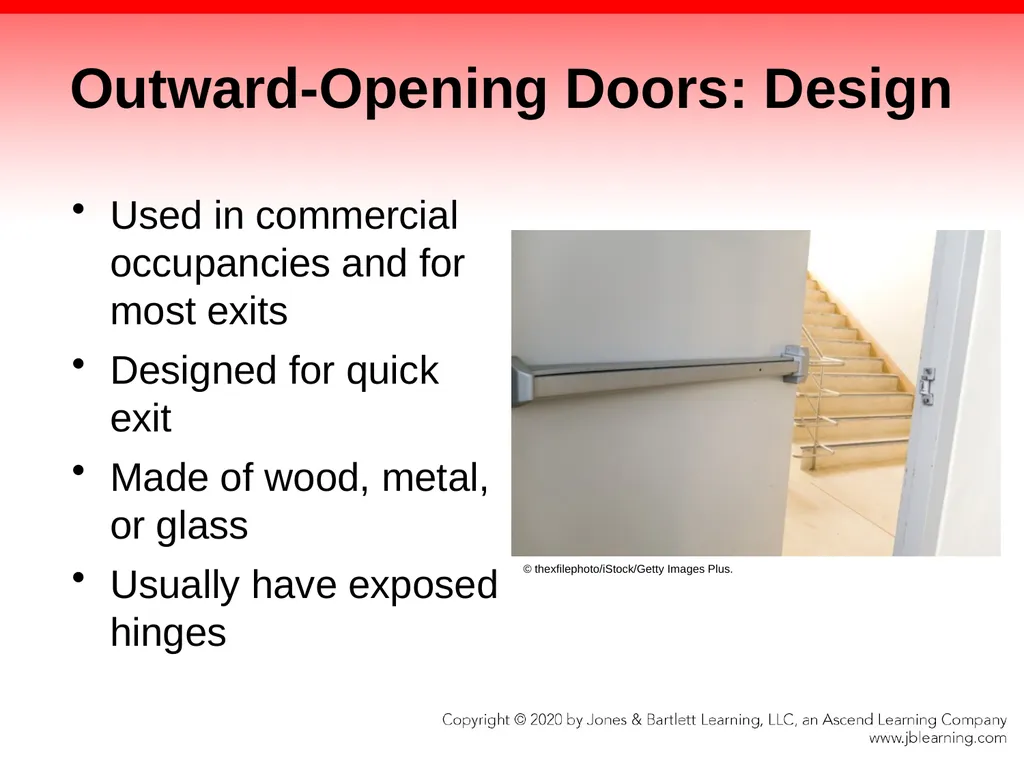
Outward-Opening Doors: Design Used in commercial occupancies and for most exits
Designed for quick exit
Made of wood, metal, or glass
Usually have exposed hinges © thexfilephoto/iStock/Getty Images Plus.<br>
Designed for quick exit
Made of wood, metal, or glass
Usually have exposed hinges © thexfilephoto/iStock/Getty Images Plus.<br>
43
Outward-Opening Doors Forcing entry
First check to see whether hinges can be disassembled or hinge pins removed.
If not, place adze end of prying tool into the door frame.
Use striking tool to drive adze end into jamb.
Leverage the tool to force the door outward away from the jamb.<br>
First check to see whether hinges can be disassembled or hinge pins removed.
If not, place adze end of prying tool into the door frame.
Use striking tool to drive adze end into jamb.
Leverage the tool to force the door outward away from the jamb.<br>
44
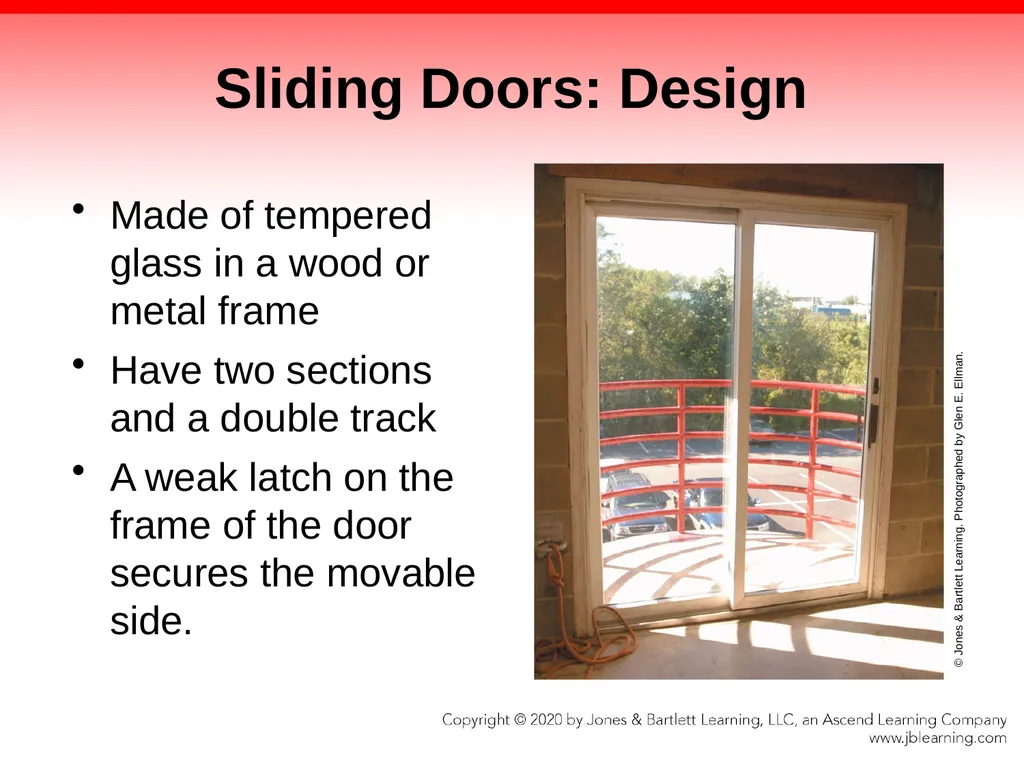
Sliding Doors: Design Made of tempered glass in a wood or metal frame
Have two sections and a double track
A weak latch on the frame of the door secures the movable side. © Jones & Bartlett Learning. Photographed by Glen E. Ellman.<br>
Have two sections and a double track
A weak latch on the frame of the door secures the movable side. © Jones & Bartlett Learning. Photographed by Glen E. Ellman.<br>
45
Sliding Doors Forcing entry
Check whether a security rod is in the track.
If not present, use a pry bar to lever door away from locking mechanism.
If necessary, break the glass.
If a rod is present in the track, try to find another place to force entry.<br>
Check whether a security rod is in the track.
If not present, use a pry bar to lever door away from locking mechanism.
If necessary, break the glass.
If a rod is present in the track, try to find another place to force entry.<br>
46
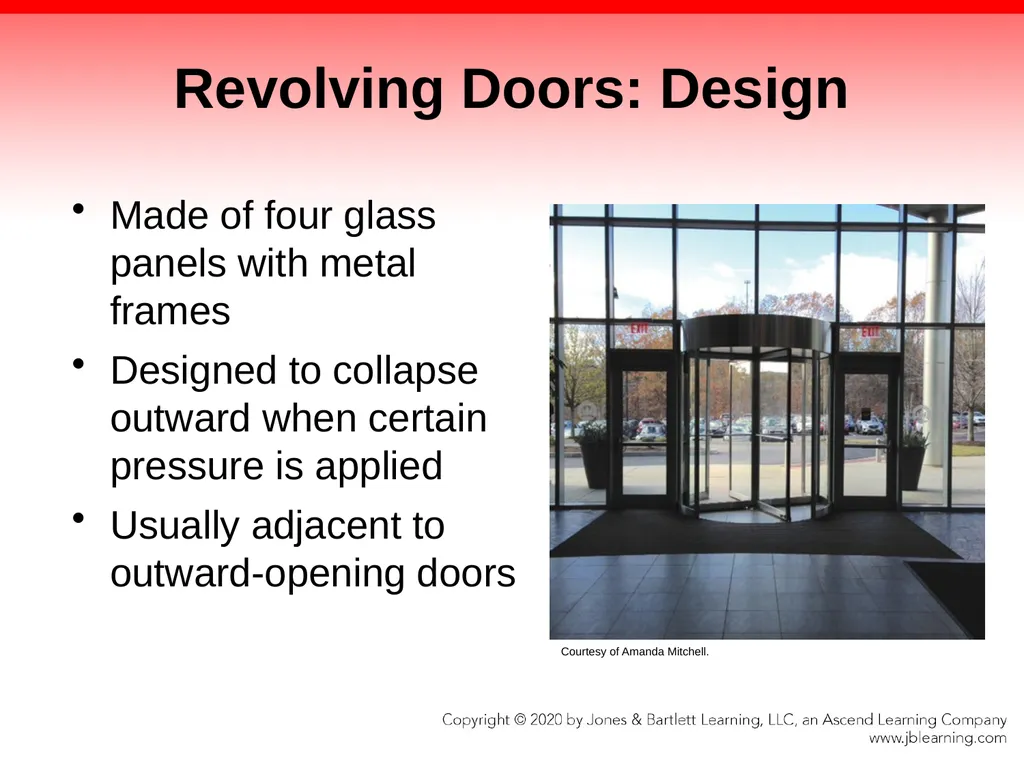
Revolving Doors: Design Made of four glass panels with metal frames
Designed to collapse outward when certain pressure is applied
Usually adjacent to outward-opening doors Courtesy of Amanda Mitchell.<br>
Designed to collapse outward when certain pressure is applied
Usually adjacent to outward-opening doors Courtesy of Amanda Mitchell.<br>
47
Revolving Doors Forcing entry
Should be avoided whenever possible
Will not produce opening that is large enough to allow many people to exit
Can be done by attacking the locking mechanism directly or by breaking the glass<br>
Should be avoided whenever possible
Will not produce opening that is large enough to allow many people to exit
Can be done by attacking the locking mechanism directly or by breaking the glass<br>
48
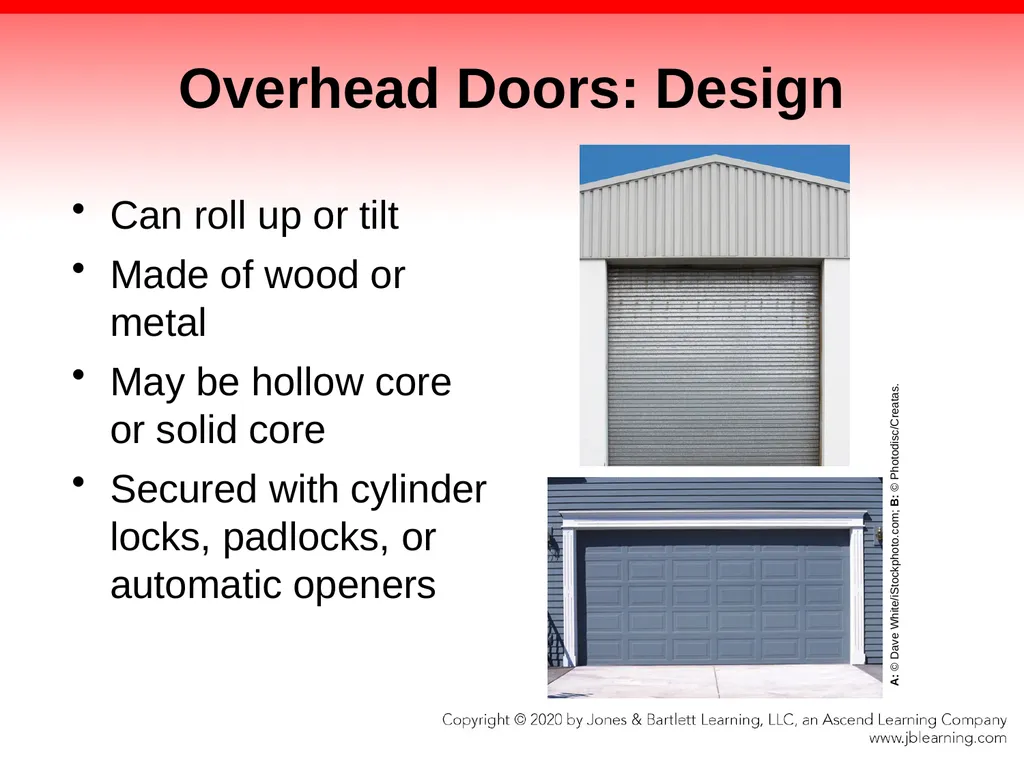
Overhead Doors: Design Can roll up or tilt
Made of wood or metal
May be hollow core or solid core
Secured with cylinder locks, padlocks, or automatic openers A: © Dave White/iStockphoto.com; B: © Photodisc/Creatas.<br>
Made of wood or metal
May be hollow core or solid core
Secured with cylinder locks, padlocks, or automatic openers A: © Dave White/iStockphoto.com; B: © Photodisc/Creatas.<br>
49
Overhead Doors Forcing entry
Break out a panel or window and manually operate lock from within.
Always securely prop door open to prevent door from closing.
Use emergency release cord for safety.
If a security roll-up door, cut triangle-shape entry.
Hinge cut makes a large opening.<br>
Break out a panel or window and manually operate lock from within.
Always securely prop door open to prevent door from closing.
Use emergency release cord for safety.
If a security roll-up door, cut triangle-shape entry.
Hinge cut makes a large opening.<br>
50
Windows Windows are often easier to force than doors.
Window frames are made of wood, metal, vinyl, or a combination of these materials.
Will often match door construction
Try to open the window normally before using any force.<br>
Window frames are made of wood, metal, vinyl, or a combination of these materials.
Will often match door construction
Try to open the window normally before using any force.<br>
51
Safety Ensure the area is clear of other personnel.
Although breaking the glass is the easiest way to force entry, it is also dangerous.
Always stand to the windward side, with your hands higher than the breaking point.
Place the tip of the tool in the corner of the window.
Completely clear glass from the frame.
Coordinate breaking a window with fire attack.<br>
Although breaking the glass is the easiest way to force entry, it is also dangerous.
Always stand to the windward side, with your hands higher than the breaking point.
Place the tip of the tool in the corner of the window.
Completely clear glass from the frame.
Coordinate breaking a window with fire attack.<br>
52
Glass Construction Regular glass
Double- or triple-pane glass
Plate glass
Laminated glass
Tempered glass
Plexiglass and Lexan may also be used.
Window may contain one or more panes of glass.<br>
Double- or triple-pane glass
Plate glass
Laminated glass
Tempered glass
Plexiglass and Lexan may also be used.
Window may contain one or more panes of glass.<br>
53
Regular or Annealed Glass Commonly used because it is inexpensive
Larger pieces called plate glass
Easily broken with a pike pole
Watch out for shards.
Can penetrate helmets, boots, and other protective gear<br>
Larger pieces called plate glass
Easily broken with a pike pole
Watch out for shards.
Can penetrate helmets, boots, and other protective gear<br>
54
Double- and Triple-Pane Glass Used in many homes because it improves home insulation
Can be expensive to replace
Uses two panes with an air or inert gas pocket between them
Two panes need to be broken separately.
Watch out for shards.<br>
Can be expensive to replace
Uses two panes with an air or inert gas pocket between them
Two panes need to be broken separately.
Watch out for shards.<br>
55
Plate Glass Commercial plate glass is stronger, thicker glass used in large window openings.
Being replaced with tempered glass in modern construction
Can easily be broken with a Halligan tool or pike pole
Watch out for large shards.<br>
Being replaced with tempered glass in modern construction
Can easily be broken with a Halligan tool or pike pole
Watch out for large shards.<br>
56
Laminated Glass Also known as safety glass
Molded sheet of plastic between two sheets of glass
Commonly used in vehicle windshields<br>
Molded sheet of plastic between two sheets of glass
Commonly used in vehicle windshields<br>
57
Tempered Glass Specially heat-treated
Four times stronger than regular glass
Common in side and rear vehicle windows and commercial or sliding doors
Breaks into small pellets without sharp edges<br>
Four times stronger than regular glass
Common in side and rear vehicle windows and commercial or sliding doors
Breaks into small pellets without sharp edges<br>
58
Wired Glass Tempered glass with wire reinforcement
Often used in fire-rated doors
Difficult to break or force<br>
Often used in fire-rated doors
Difficult to break or force<br>
59
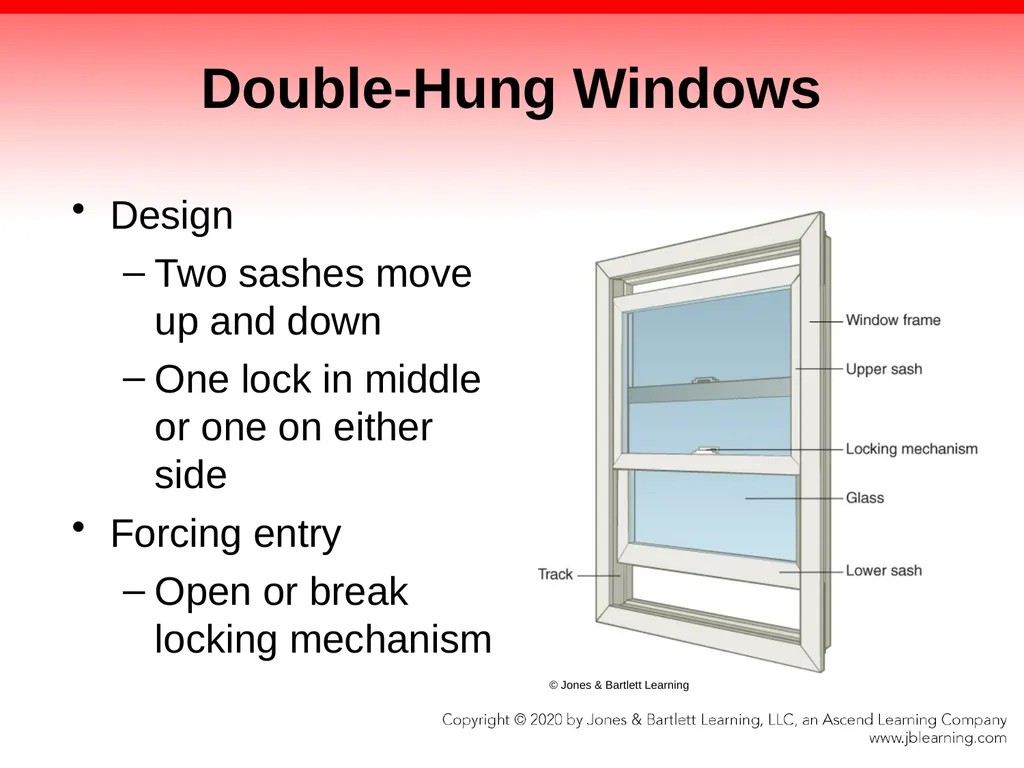
Double-Hung Windows Design
Two sashes move up and down
One lock in middle or one on either side
Forcing entry
Open or break locking mechanism © Jones & Bartlett Learning<br>
Two sashes move up and down
One lock in middle or one on either side
Forcing entry
Open or break locking mechanism © Jones & Bartlett Learning<br>
60
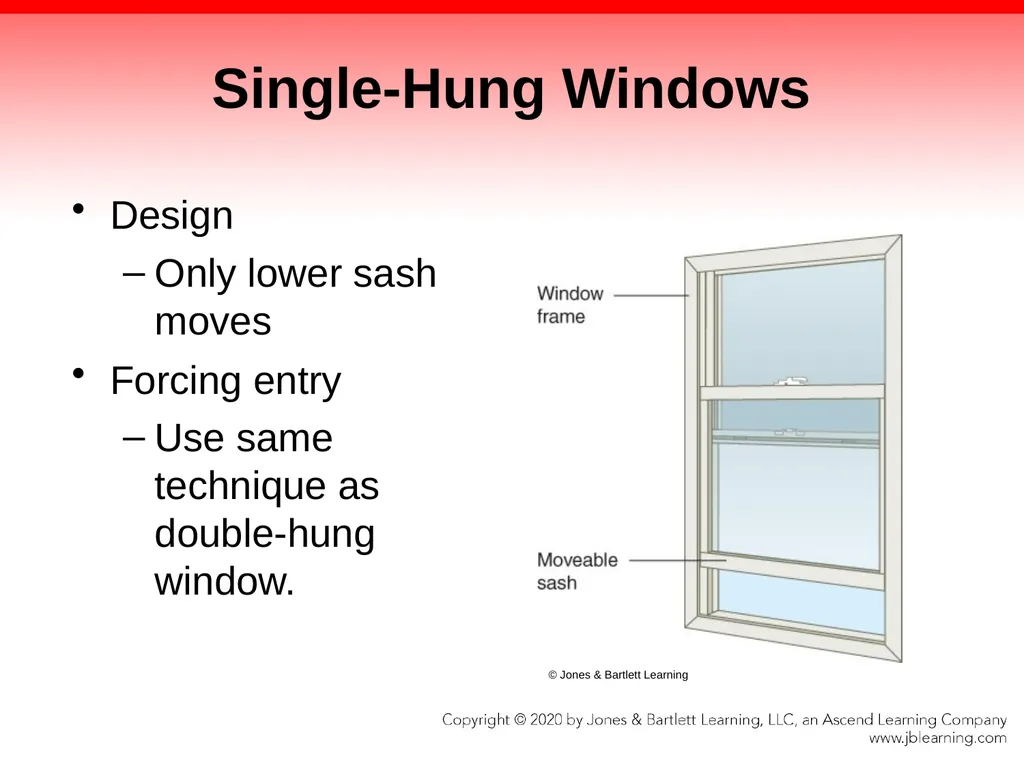
Single-Hung Windows Design
Only lower sash moves
Forcing entry
Use same technique as double-hung window. © Jones & Bartlett Learning<br>
Only lower sash moves
Forcing entry
Use same technique as double-hung window. © Jones & Bartlett Learning<br>
61
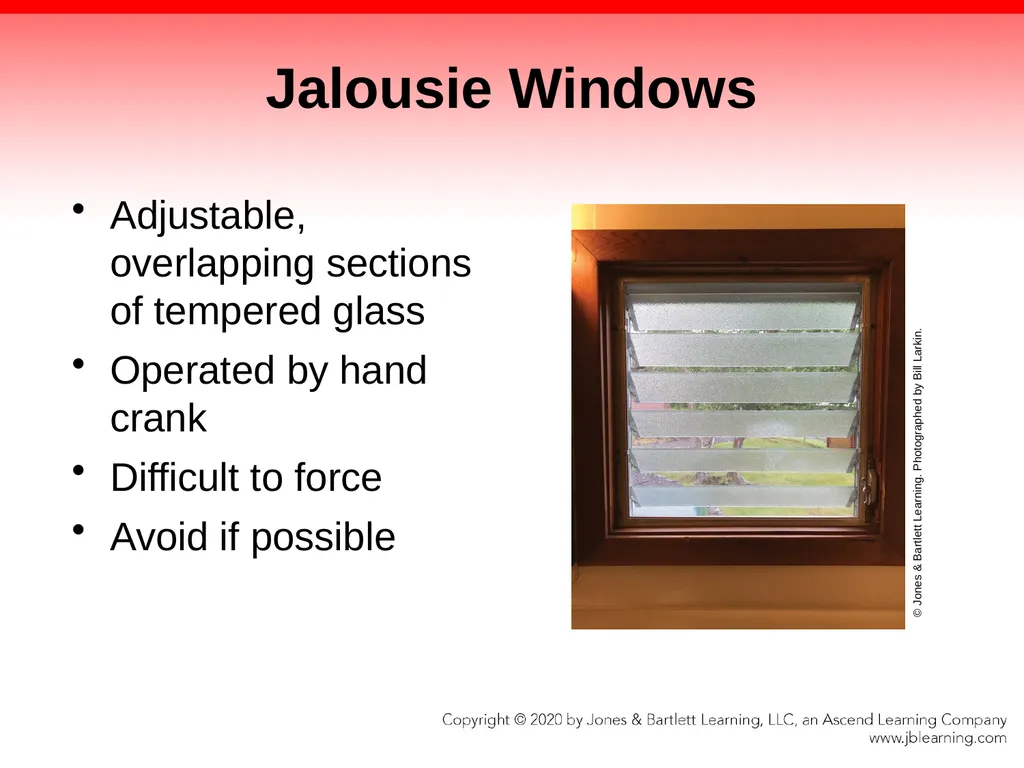
Jalousie Windows Adjustable, overlapping sections of tempered glass
Operated by hand crank
Difficult to force
Avoid if possible © Jones & Bartlett Learning. Photographed by Bill Larkin.<br>
Operated by hand crank
Difficult to force
Avoid if possible © Jones & Bartlett Learning. Photographed by Bill Larkin.<br>
62
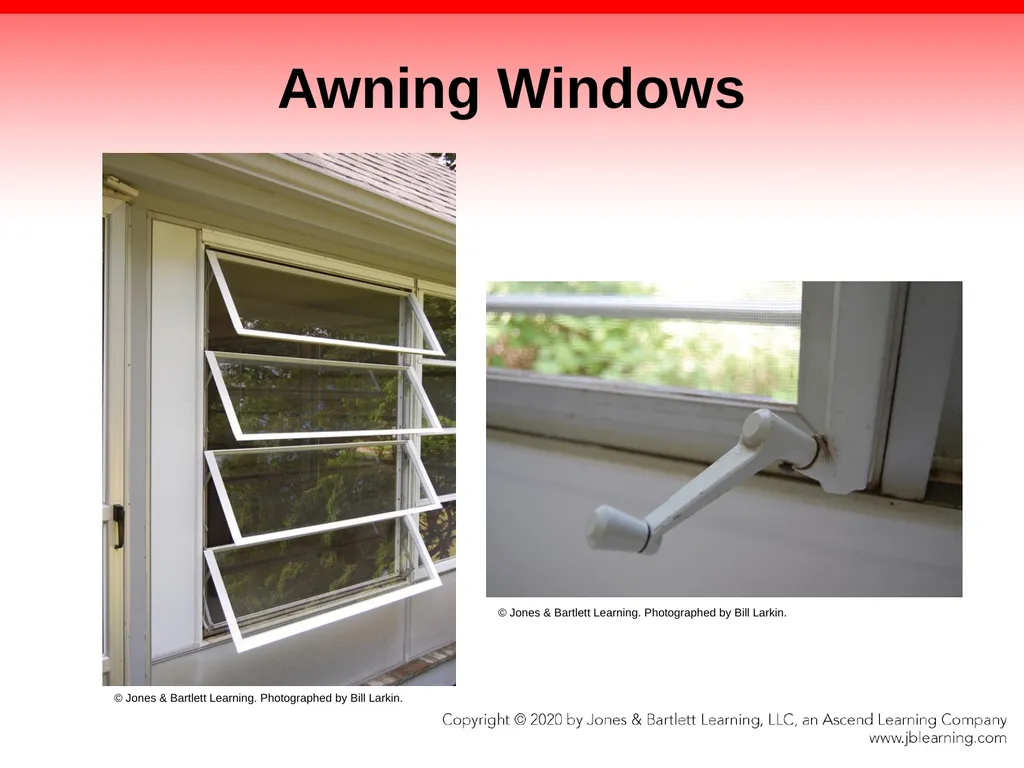
Awning Windows Similar to jalousie windows, except have larger glass panels rather than many small ones
Operated by hand crank
Found in residential, commercial, and industrial settings
Residential awning windows may be framed in wood, vinyl, or metal.
Commercial and industrial windows are usually metal framed and often use a lock and notched bar instead of a crank to hold the window open.<br>
Operated by hand crank
Found in residential, commercial, and industrial settings
Residential awning windows may be framed in wood, vinyl, or metal.
Commercial and industrial windows are usually metal framed and often use a lock and notched bar instead of a crank to hold the window open.<br>
63
Awning Windows © Jones & Bartlett Learning. Photographed by Bill Larkin. © Jones & Bartlett Learning. Photographed by Bill Larkin.<br>
64
Awning Windows: Forcing Entry Break or force open the lower panel and operate the crank.
Or break out all the panels
May be easier to access (enter or exit) than a jalousie window, depending on the size of the panels<br>
Or break out all the panels
May be easier to access (enter or exit) than a jalousie window, depending on the size of the panels<br>
65
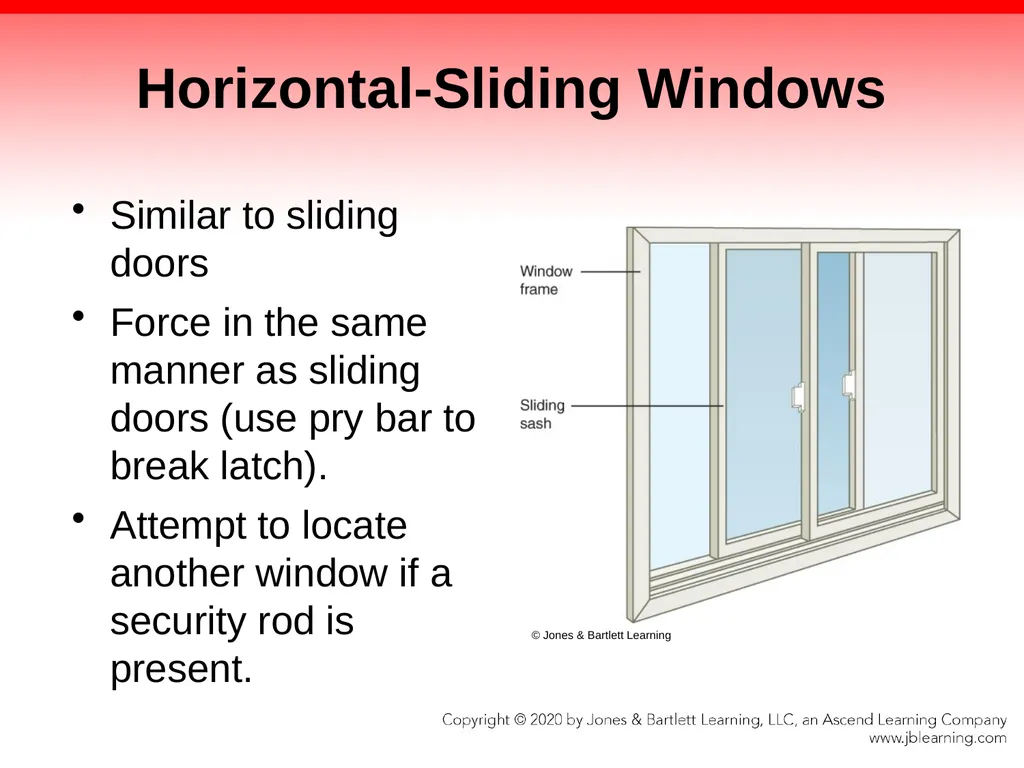
Horizontal-Sliding Windows Similar to sliding doors
Force in the same manner as sliding doors (use pry bar to break latch).
Attempt to locate another window if a security rod is present. © Jones & Bartlett Learning<br>
Force in the same manner as sliding doors (use pry bar to break latch).
Attempt to locate another window if a security rod is present. © Jones & Bartlett Learning<br>
66
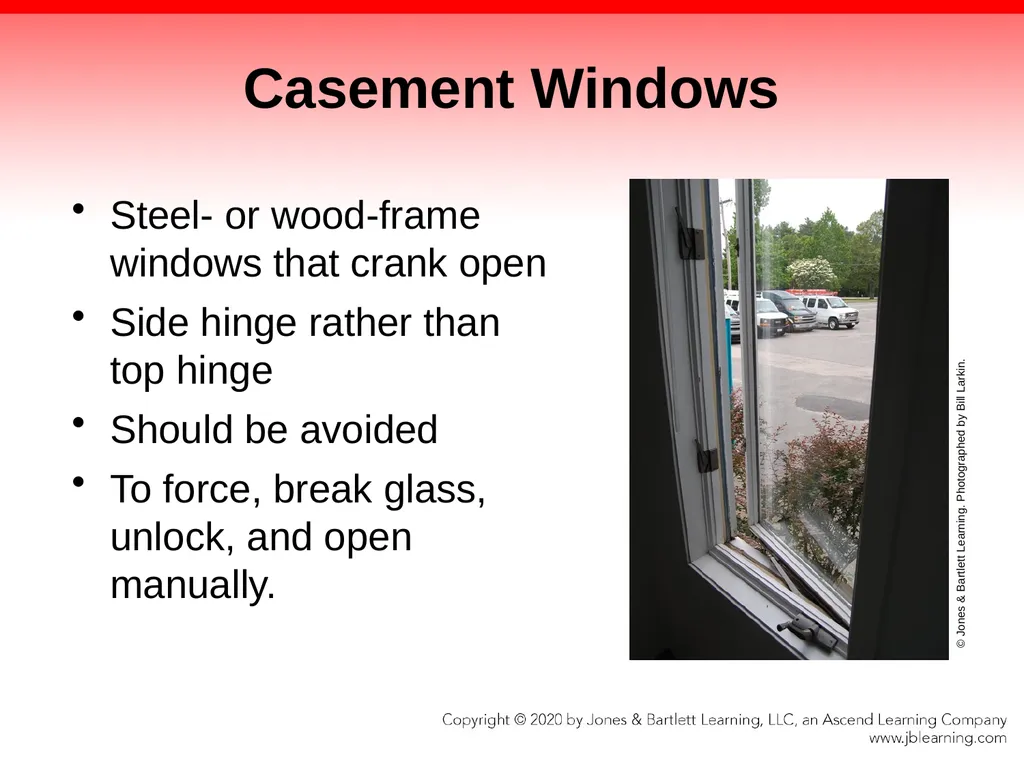
Casement Windows Steel- or wood-frame windows that crank open
Side hinge rather than top hinge
Should be avoided
To force, break glass, unlock, and open manually. © Jones & Bartlett Learning. Photographed by Bill Larkin.<br>
Side hinge rather than top hinge
Should be avoided
To force, break glass, unlock, and open manually. © Jones & Bartlett Learning. Photographed by Bill Larkin.<br>
67
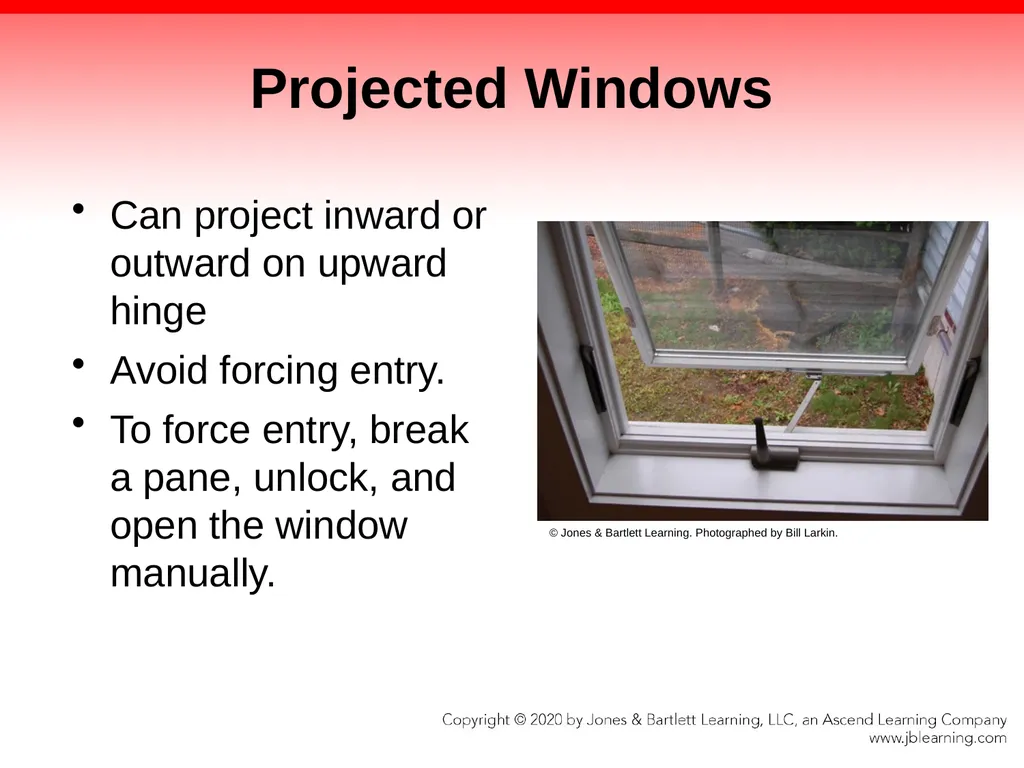
Projected Windows Can project inward or outward on upward hinge
Avoid forcing entry.
To force entry, break a pane, unlock, and open the window manually. © Jones & Bartlett Learning. Photographed by Bill Larkin.<br>
Avoid forcing entry.
To force entry, break a pane, unlock, and open the window manually. © Jones & Bartlett Learning. Photographed by Bill Larkin.<br>
68
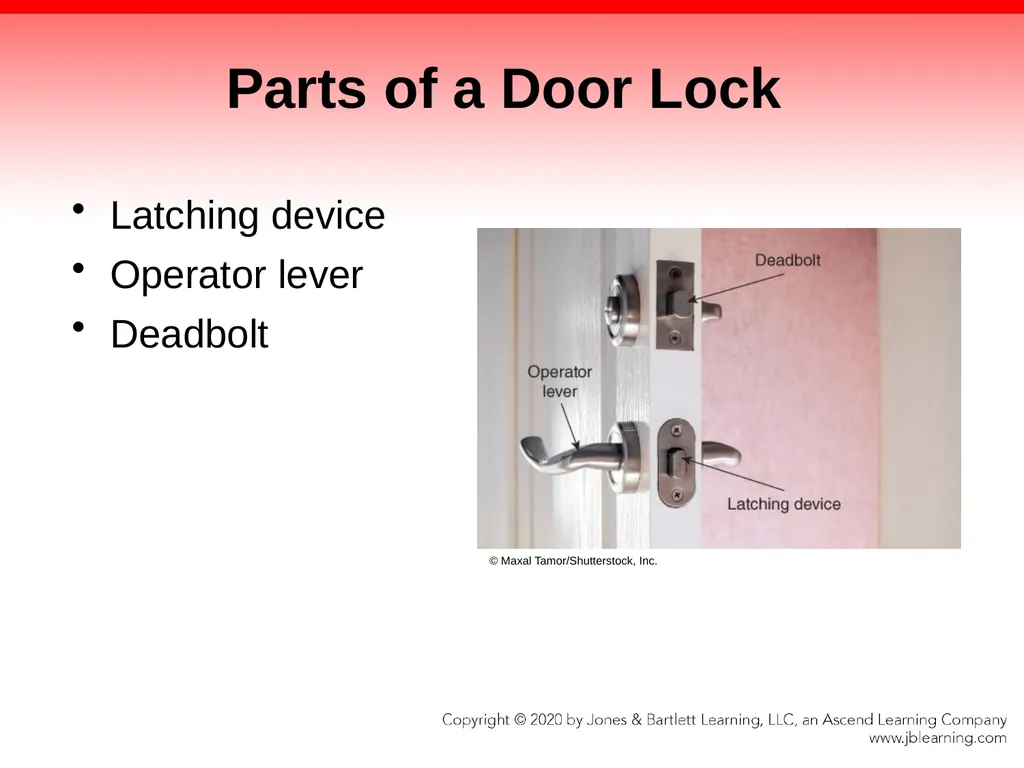
Parts of a Door Lock Latching device
Operator lever
Deadbolt © Maxal Tamor/Shutterstock, Inc.<br>
Operator lever
Deadbolt © Maxal Tamor/Shutterstock, Inc.<br>
69
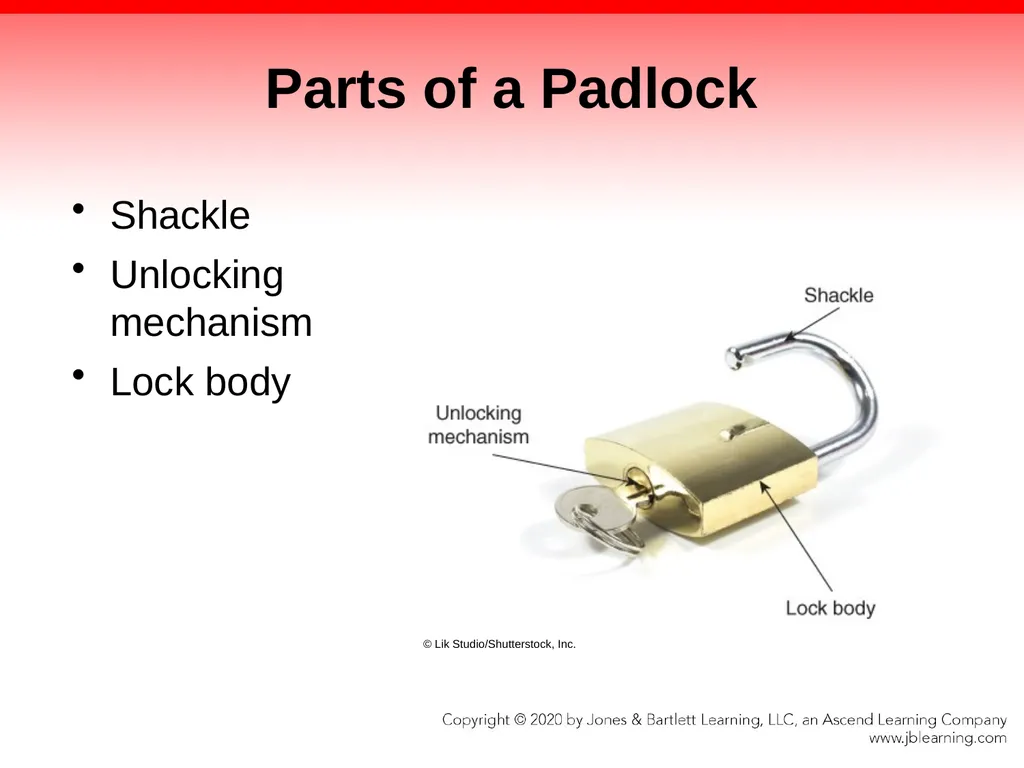
Parts of a Padlock Shackle
Unlocking mechanism
Lock body © Lik Studio/Shutterstock, Inc.<br>
Unlocking mechanism
Lock body © Lik Studio/Shutterstock, Inc.<br>
70
Safety Keep cutting tools sharp for best results.
Be careful to avoid getting cut and pinching or crushing fingers or hands
Use proper PPE, including gloves, eye, and face protection.<br>
Be careful to avoid getting cut and pinching or crushing fingers or hands
Use proper PPE, including gloves, eye, and face protection.<br>
71
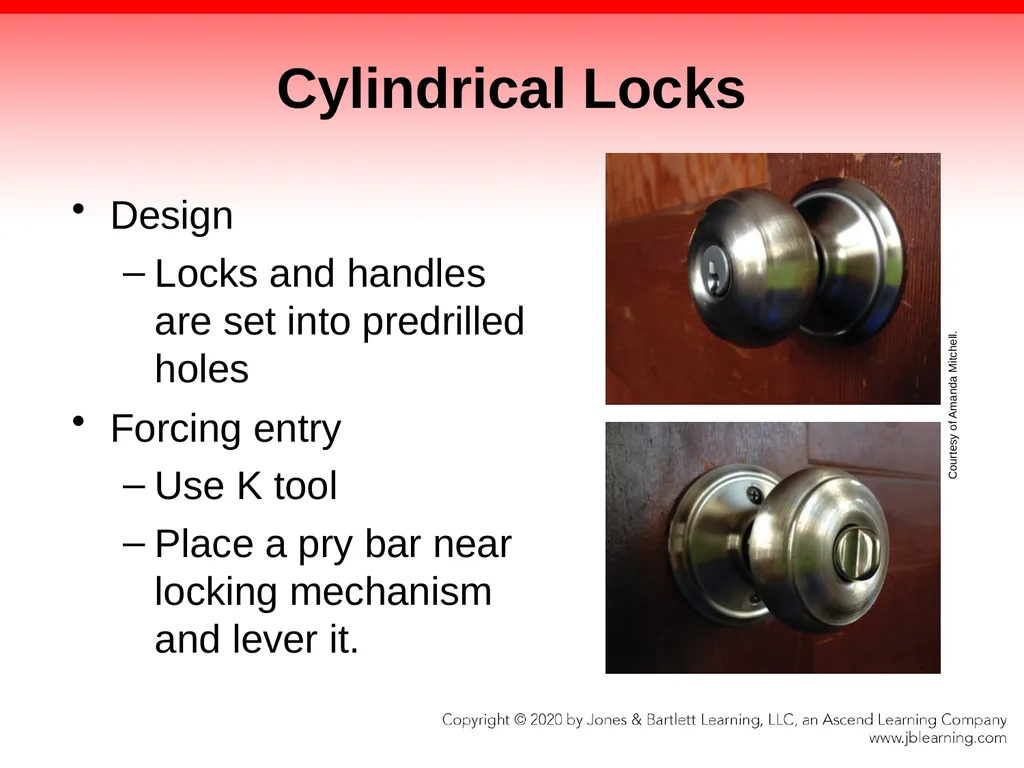
Cylindrical Locks Design
Locks and handles are set into predrilled holes
Forcing entry
Use K tool
Place a pry bar near locking mechanism and lever it. Courtesy of Amanda Mitchell.<br>
Locks and handles are set into predrilled holes
Forcing entry
Use K tool
Place a pry bar near locking mechanism and lever it. Courtesy of Amanda Mitchell.<br>
72
Padlocks One of the most common locks fire fighters will encounter
Regular- and heavy-duty
Come with various unlocking devices
Keyways
Combination wheels
Combination dials
Operating the unlocking mechanism opens one side of the lock to release the shackle and allow entry.<br>
Regular- and heavy-duty
Come with various unlocking devices
Keyways
Combination wheels
Combination dials
Operating the unlocking mechanism opens one side of the lock to release the shackle and allow entry.<br>
73
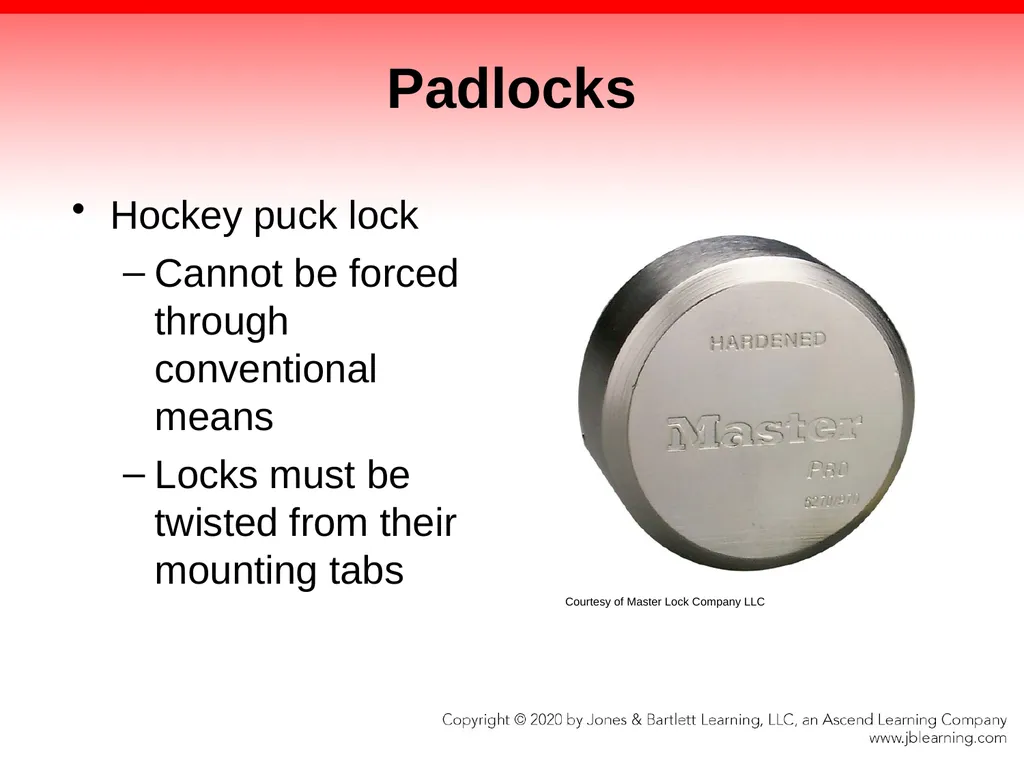
Padlocks Hockey puck lock
Cannot be forced through conventional means
Locks must be twisted from their mounting tabs Courtesy of Master Lock Company LLC<br>
Cannot be forced through conventional means
Locks must be twisted from their mounting tabs Courtesy of Master Lock Company LLC<br>
74
Padlocks Forcing entry
Cut the shackle or hasp.
Breaking the shackle is the best method.
If padlock is made of case-hardened steel, many conventional methods will be ineffective.
Common tools used to force entry include bolt cutters, duck-billed lock breakers, the bam-bam tool, and locking pliers and chain.<br>
Cut the shackle or hasp.
Breaking the shackle is the best method.
If padlock is made of case-hardened steel, many conventional methods will be ineffective.
Common tools used to force entry include bolt cutters, duck-billed lock breakers, the bam-bam tool, and locking pliers and chain.<br>
75
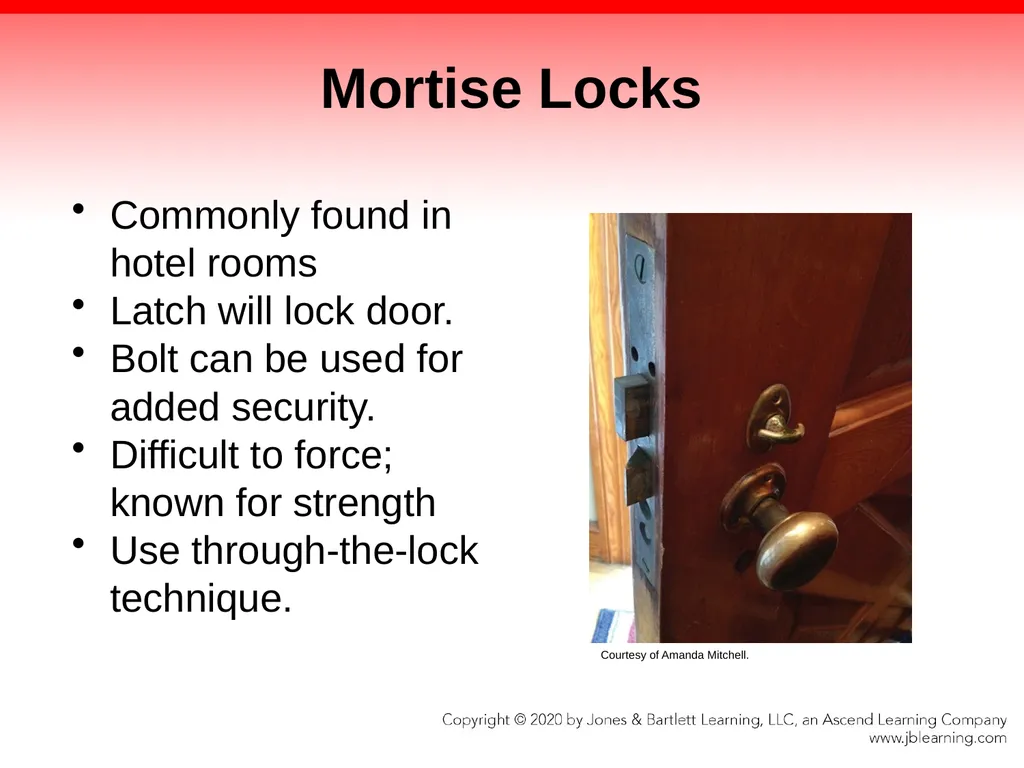
Mortise Locks Commonly found in hotel rooms
Latch will lock door.
Bolt can be used for added security.
Difficult to force; known for strength
Use through-the-lock technique. Courtesy of Amanda Mitchell.<br>
Latch will lock door.
Bolt can be used for added security.
Difficult to force; known for strength
Use through-the-lock technique. Courtesy of Amanda Mitchell.<br>
76
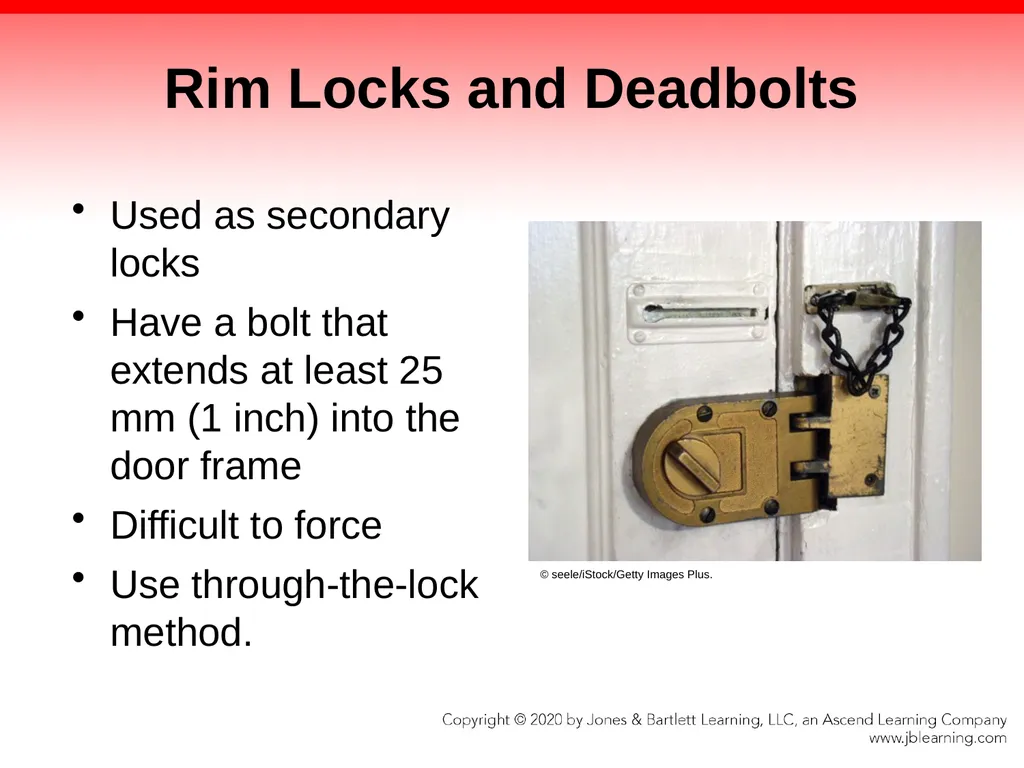
Rim Locks and Deadbolts Used as secondary locks
Have a bolt that extends at least 25 mm (1 inch) into the door frame
Difficult to force
Use through-the-lock method. © seele/iStock/Getty Images Plus.<br>
Have a bolt that extends at least 25 mm (1 inch) into the door frame
Difficult to force
Use through-the-lock method. © seele/iStock/Getty Images Plus.<br>
77
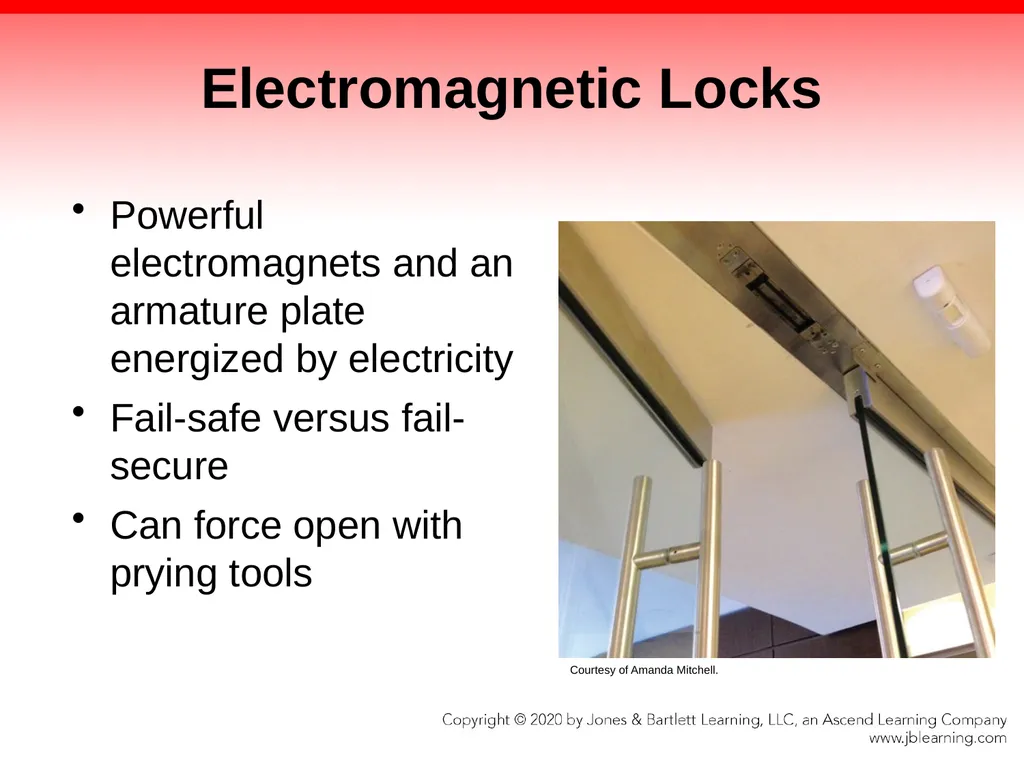
Electromagnetic Locks Powerful electromagnets and an armature plate energized by electricity
Fail-safe versus fail- secure
Can force open with prying tools Courtesy of Amanda Mitchell.<br>
Fail-safe versus fail- secure
Can force open with prying tools Courtesy of Amanda Mitchell.<br>
78
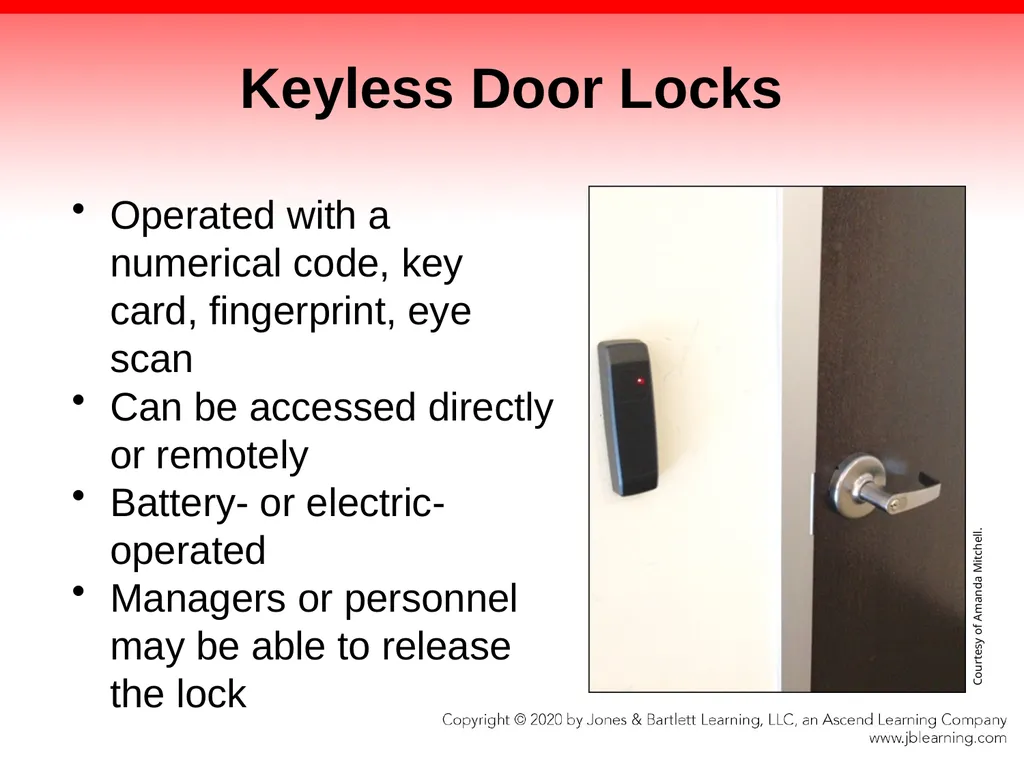
Keyless Door Locks Operated with a numerical code, key card, fingerprint, eye scan
Can be accessed directly or remotely
Battery- or electric- operated
Managers or personnel may be able to release the lock Courtesy of Amanda Mitchell.<br>
Can be accessed directly or remotely
Battery- or electric- operated
Managers or personnel may be able to release the lock Courtesy of Amanda Mitchell.<br>
79
Forcing Entry Through Doors with Drop Bars Many commercial buildings have rear single or double doors that are usually constructed of metal and may have no window or a very small one.
A dropdown bar is placed in the brackets and extends beyond the sides of the door frame.
Gaining entry through these doors requires you to disable these devices.
One of the simplest techniques is to cut the heads off the carriage bolts and drive these bolts back through the door.<br>
A dropdown bar is placed in the brackets and extends beyond the sides of the door frame.
Gaining entry through these doors requires you to disable these devices.
One of the simplest techniques is to cut the heads off the carriage bolts and drive these bolts back through the door.<br>
80
Forcing Entry Through Security Gates and Windows Usually equipped with a lock or a locking mechanism
Designed to keep criminals out but can make it difficult for fire fighters to gain access
Check for a lock box.
Know how to rapidly force entry.
Some gateways may be siren-activated.
Remove the lock or cut the gate and bars.
Plan your cuts to minimize them.<br>
Designed to keep criminals out but can make it difficult for fire fighters to gain access
Check for a lock box.
Know how to rapidly force entry.
Some gateways may be siren-activated.
Remove the lock or cut the gate and bars.
Plan your cuts to minimize them.<br>
81
Forcing Entry Through Security Gates and Windows Breaching security bars on a window
Remove the lock cylinder if present.
If not, cut through the bars using a circular saw or hydraulic cutter.
You may be able to pry them from the window with a hydraulic spreader.
Look for the types of security gates and bars present in your community.
Talk with the installers of these products.<br>
Remove the lock cylinder if present.
If not, cut through the bars using a circular saw or hydraulic cutter.
You may be able to pry them from the window with a hydraulic spreader.
Look for the types of security gates and bars present in your community.
Talk with the installers of these products.<br>
82
Breaching Walls and Floors Breach only as a last resort.
First consider whether wall is load-bearing.
Could cause collapse if breached
Nonbearing walls can be removed safely.<br>
First consider whether wall is load-bearing.
Could cause collapse if breached
Nonbearing walls can be removed safely.<br>
83
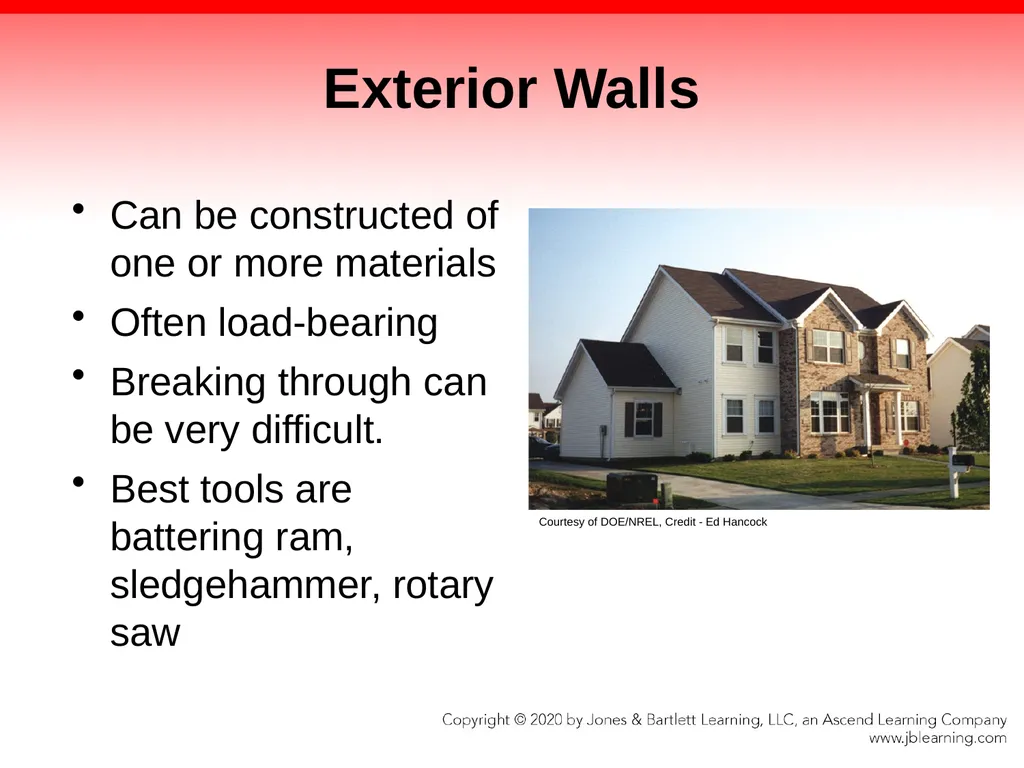
Exterior Walls Can be constructed of one or more materials
Often load-bearing
Breaking through can be very difficult.
Best tools are battering ram, sledgehammer, rotary saw Courtesy of DOE/NREL, Credit - Ed Hancock<br>
Often load-bearing
Breaking through can be very difficult.
Best tools are battering ram, sledgehammer, rotary saw Courtesy of DOE/NREL, Credit - Ed Hancock<br>
84
Interior Walls Usually constructed of wood or metal studs covered by plaster, gypsum, or sheetrock
Newer residential construction may contain laminate sheetrock, which is extremely difficult to penetrate.
Commercial buildings may have concrete block interior walls.<br>
Newer residential construction may contain laminate sheetrock, which is extremely difficult to penetrate.
Commercial buildings may have concrete block interior walls.<br>
85
Interior Walls Breaching an interior wall can be dangerous.
Many walls contain electrical wiring, plumbing, cable wires, and telephone wires.
May also be load-bearing; extreme caution should be taken if any studs are removed.
After determining type of wall, locate a stud away from any electrical outlets or switches.
Tap on wall; the area between studs will sound hollow.<br>
Many walls contain electrical wiring, plumbing, cable wires, and telephone wires.
May also be load-bearing; extreme caution should be taken if any studs are removed.
After determining type of wall, locate a stud away from any electrical outlets or switches.
Tap on wall; the area between studs will sound hollow.<br>
86
Interior Walls Make a small hole to check for obstructions.
If area is clear, expand to reveal studs.
Breach as close as possible to the studs because this makes a large opening and cutting is easier.
Enlarge the opening by removing at least one stud to enable escape if possible.<br>
If area is clear, expand to reveal studs.
Breach as close as possible to the studs because this makes a large opening and cutting is easier.
Enlarge the opening by removing at least one stud to enable escape if possible.<br>
87
Floors Most floors are wood or poured concrete.
Both can be difficult to breach.
Important information can observed from below.
This is truly a last resort.
Use a rotary saw with appropriate blade.
Chainsaw might be a better choice for a wood floor.<br>
Both can be difficult to breach.
Important information can observed from below.
This is truly a last resort.
Use a rotary saw with appropriate blade.
Chainsaw might be a better choice for a wood floor.<br>
88
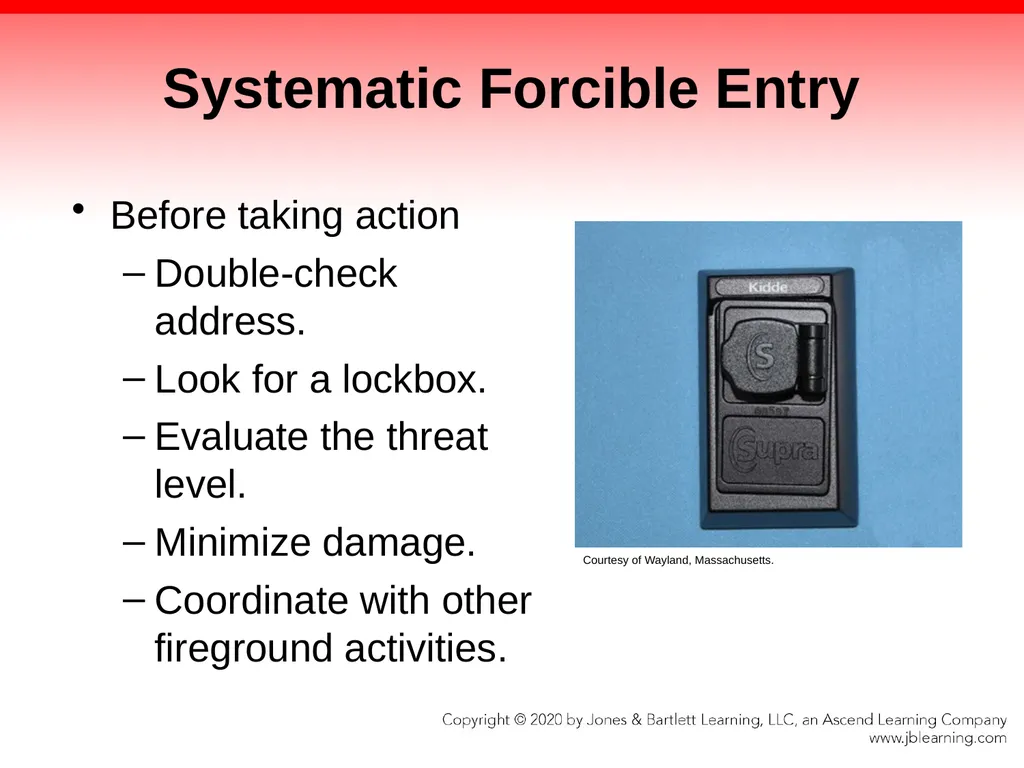
Systematic Forcible Entry Before taking action
Double-check address.
Look for a lockbox.
Evaluate the threat level.
Minimize damage.
Coordinate with other fireground activities. Courtesy of Wayland, Massachusetts.<br>
Double-check address.
Look for a lockbox.
Evaluate the threat level.
Minimize damage.
Coordinate with other fireground activities. Courtesy of Wayland, Massachusetts.<br>
89
Summary Forcible entry is required at emergency incidents where time is a critical factor. Company officers usually select both the point of entry and the method to be used.
Before beginning forcible entry operations, remember to “try before you pry.”
It is important to wear the appropriate PPE when conducting forcible entry.<br>
Before beginning forcible entry operations, remember to “try before you pry.”
It is important to wear the appropriate PPE when conducting forcible entry.<br>
90
Summary Tools should be kept clean, properly serviced according to the manufacturer’s guidelines, and ready for use at all times.
Most tools fit into these functional categories:
Rotating tools
Striking tools
Prying/spreading tools
Cutting tools
Pushing/pulling tools
Lock tools and specialty tools<br>
Most tools fit into these functional categories:
Rotating tools
Striking tools
Prying/spreading tools
Cutting tools
Pushing/pulling tools
Lock tools and specialty tools<br>
91
Summary Every door contains four major components:
Door—the entryway itself
Jamb—the upright or vertical sides of a window or door frame onto which a door is secured
Hardware—the handles, hinges, and other components
Locking mechanism
Doors are generally constructed of wood, metal, or glass.<br>
Door—the entryway itself
Jamb—the upright or vertical sides of a window or door frame onto which a door is secured
Hardware—the handles, hinges, and other components
Locking mechanism
Doors are generally constructed of wood, metal, or glass.<br>
92
Summary Doors are classified by how they open:
Inward
Outward
Sliding
Revolving
Overhead
Window construction includes glazed glass, regular or annealed glass, double- or triple-pane glass, plate glass, laminated glass, and tempered glass.<br>
Inward
Outward
Sliding
Revolving
Overhead
Window construction includes glazed glass, regular or annealed glass, double- or triple-pane glass, plate glass, laminated glass, and tempered glass.<br>
93
Summary Window frame designs include the following types:
Double-hung windows
Single-hung windows
Jalousie windows
Awning windows
Horizontal-sliding windows
Casement windows
Projected windows<br>
Double-hung windows
Single-hung windows
Jalousie windows
Awning windows
Horizontal-sliding windows
Casement windows
Projected windows<br>
94
Summary Locks range in sophistication from simple push-button locks to complex computer-operated locks.
There are three major parts of a door lock: latching device, operator lever, and deadbolt.
Most padlocks, like most door locks, have similar parts: shackle, unlocking mechanism, and lock body.<br>
There are three major parts of a door lock: latching device, operator lever, and deadbolt.
Most padlocks, like most door locks, have similar parts: shackle, unlocking mechanism, and lock body.<br>
95
Summary Locks can be classified into four major categories:
Cylindrical locks
Padlocks
Mortise locks
Rim locks
Electromagnetic and keyless door locks operate without a traditional metal key.<br>
Cylindrical locks
Padlocks
Mortise locks
Rim locks
Electromagnetic and keyless door locks operate without a traditional metal key.<br>
96
Summary On occasion, breaching a wall or floor may be necessary. Before breaching a wall, first consider whether the wall is load-bearing. Removing or damaging this type of wall could cause the building or wall to collapse.
The steps in systematic forcible entry are as follows: think, look for a lockbox, evaluate the situation, and make entry with the least amount of damage possible.<br>
The steps in systematic forcible entry are as follows: think, look for a lockbox, evaluate the situation, and make entry with the least amount of damage possible.<br>