Objectives MBO MBE Objectives Objectives may be defined as final result of an organization tries to achieve in a specific time period. Moreover, the objectives are a future oriented and results in state of affairs. It helps in providing
"Objectives MBO & MBE Objectives Objectives may be" is the property of its rightful owner. Permission is granted to
download and print the materials on this website for personal, non-commercial use only, and to display it
on your personal computer provided you do not modify the materials and that you retain all copyright
notices contained in the materials. By downloading content from our website, you accept the terms of this
agreement.
Presentation Transcript
01
Objectives MBO & MBE<br>
02
Objectives Objectives may be defined as final result of an organization tries to achieve in a specific time period. Moreover, the objectives are a future oriented and results in state of affairs. It helps in providing to make an organization in its attention and effort, basically focused on a certain way.<br>
03
Advantages of objectives An objective defines the purpose of an organisation
It helps in planning
It helps in decision making
It helps in co-ordination
It helps in motivation<br>
04
Management By Objectives [MBO]<br>
05
Introduction The first original work on MBO can be found in Peter Drucker’s book, The Practice of Management, published in 1954.
MBO is a process which ideally begins at the top of the organization with the establishment of specific organizational objectives.
Then, at second level of the organization, managers working with their bosses, establish objectives for their departments that are consistent with the organization’s objectives.
This procedure is repeated down to the lowest level managers in the organization.
The value of MBO is that it communicates the mission, goals and objectives of the organization to the lower levels.
The lower level managers work out their plans and targets in consultation with their subordinates.
These are then sent to higher levels for consideration.
MBO, thus, allows employees to participate in planning and control of their own work
This involvement of employees increases their motivation and commitment to their work.<br>
06
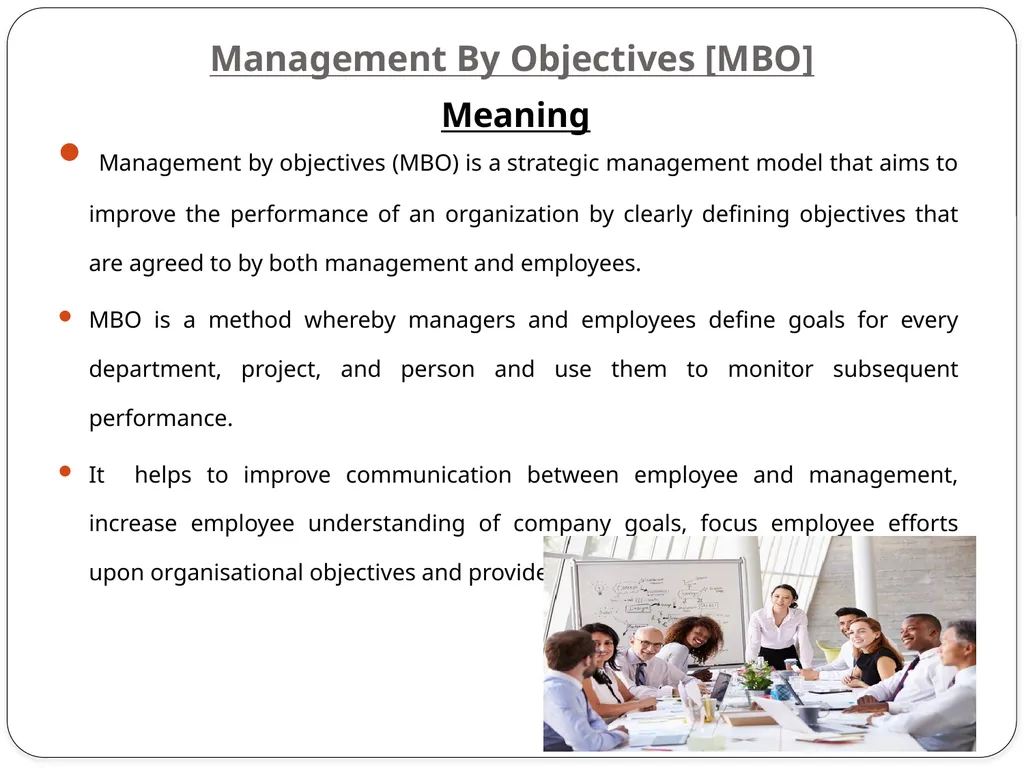
Management By Objectives [MBO] Management by objectives (MBO) is a strategic management model that aims to improve the performance of an organization by clearly defining objectives that are agreed to by both management and employees.
MBO is a method whereby managers and employees define goals for every department, project, and person and use them to monitor subsequent performance.
It helps to improve communication between employee and management, increase employee understanding of company goals, focus employee efforts upon organisational objectives and provide link between pay and performance. Meaning<br>
07
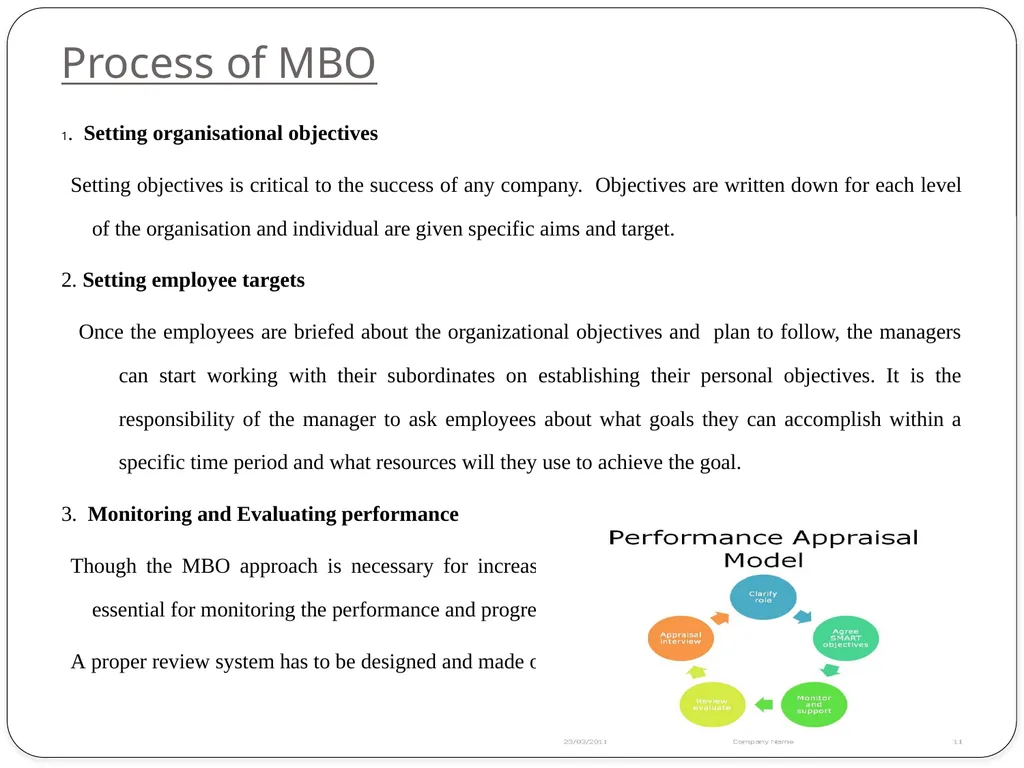
Process of MBO 1. Setting organisational objectives
Setting objectives is critical to the success of any company. Objectives are written down for each level of the organisation and individual are given specific aims and target.
2. Setting employee targets
Once the employees are briefed about the organizational objectives and plan to follow, the managers can start working with their subordinates on establishing their personal objectives. It is the responsibility of the manager to ask employees about what goals they can accomplish within a specific time period and what resources will they use to achieve the goal.
3. Monitoring and Evaluating performance
Though the MBO approach is necessary for increasing the effectiveness of managers, it is equally essential for monitoring the performance and progress of each employee in the organization.
A proper review system has to be designed and made operational.<br>
08
4. Providing feed back
The most essential step is the continuous feedback on the results and objectives, as it enables the employees to track and make corrections to their actions.
It is done by formal evaluation meeting in which superior and subordinates discuss progress towards objectives.
6. Performance based incentive
The performance of employees at all levels of management are assessed and evaluated and based on the same, performance incentives are given to employees.
These incentives can be:
Positive Incentive : Rewards, Bonus, promotions
Negative Incentives : Fines & penalties, warnings, reprimand<br>
09
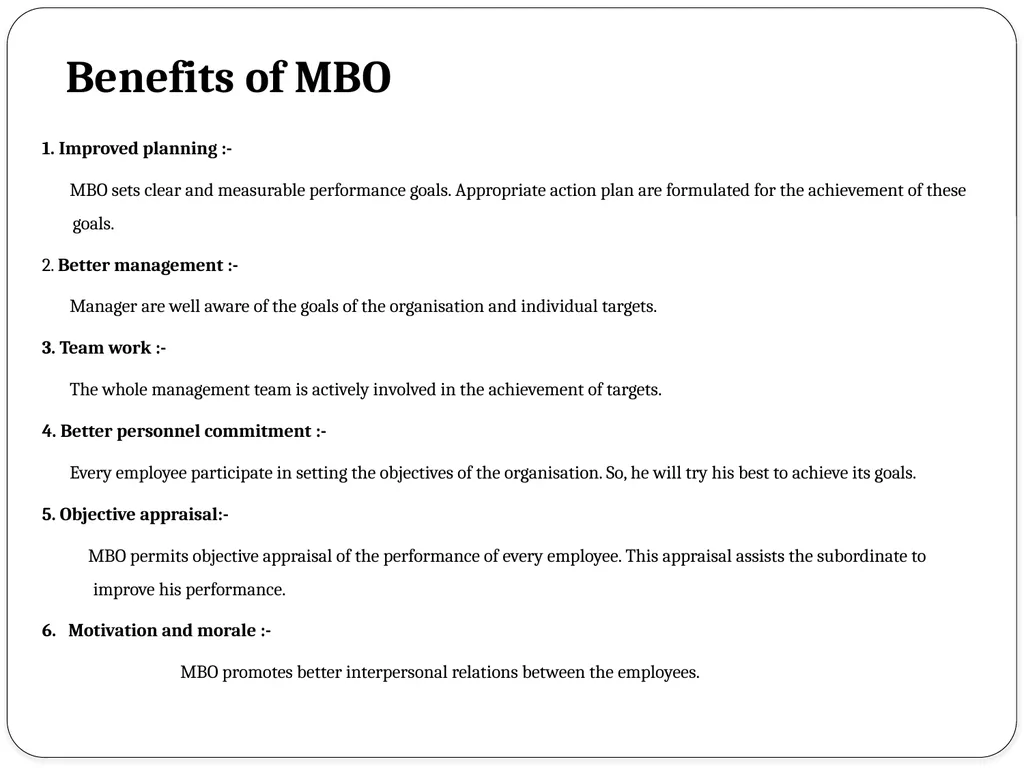
Benefits of MBO 1. Improved planning :-
MBO sets clear and measurable performance goals. Appropriate action plan are formulated for the achievement of these goals.
2. Better management :-
Manager are well aware of the goals of the organisation and individual targets.
3. Team work :-
The whole management team is actively involved in the achievement of targets.
4. Better personnel commitment :-
Every employee participate in setting the objectives of the organisation. So, he will try his best to achieve its goals.
5. Objective appraisal:-
MBO permits objective appraisal of the performance of every employee. This appraisal assists the subordinate to improve his performance.
6. Motivation and morale :-
MBO promotes better interpersonal relations between the employees.<br>
10
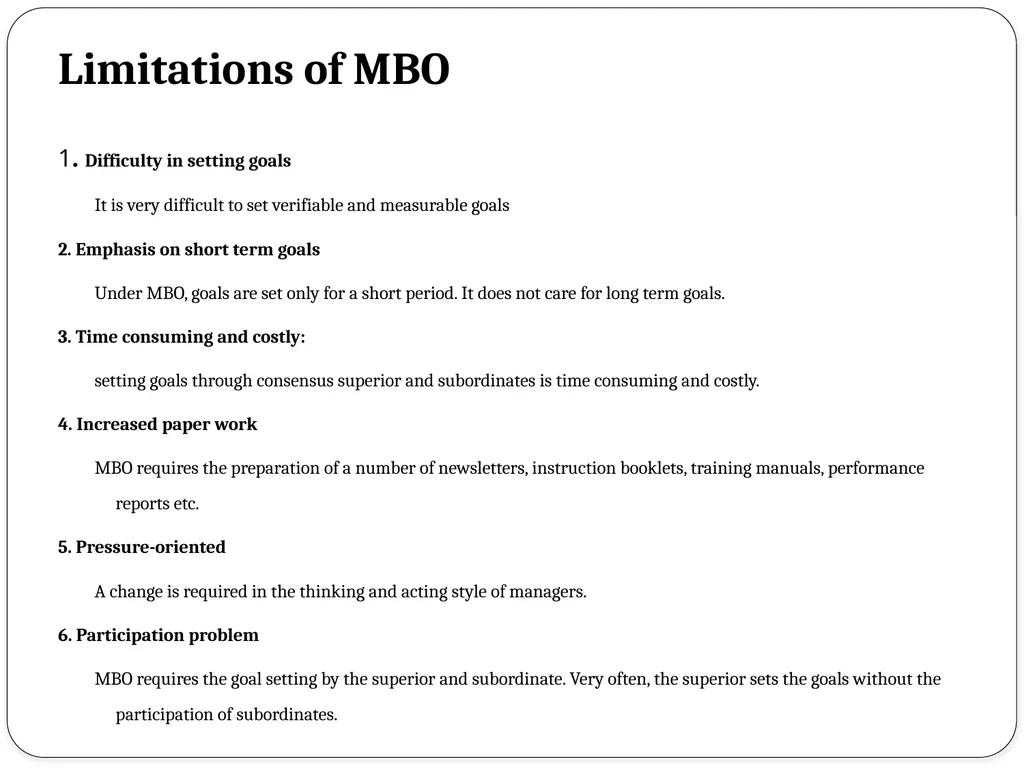
Limitations of MBO 1. Difficulty in setting goals
It is very difficult to set verifiable and measurable goals
2. Emphasis on short term goals
Under MBO, goals are set only for a short period. It does not care for long term goals.
3. Time consuming and costly:
setting goals through consensus superior and subordinates is time consuming and costly.
4. Increased paper work
MBO requires the preparation of a number of newsletters, instruction booklets, training manuals, performance reports etc.
5. Pressure-oriented
A change is required in the thinking and acting style of managers.
6. Participation problem
MBO requires the goal setting by the superior and subordinate. Very often, the superior sets the goals without the participation of subordinates.<br>
11
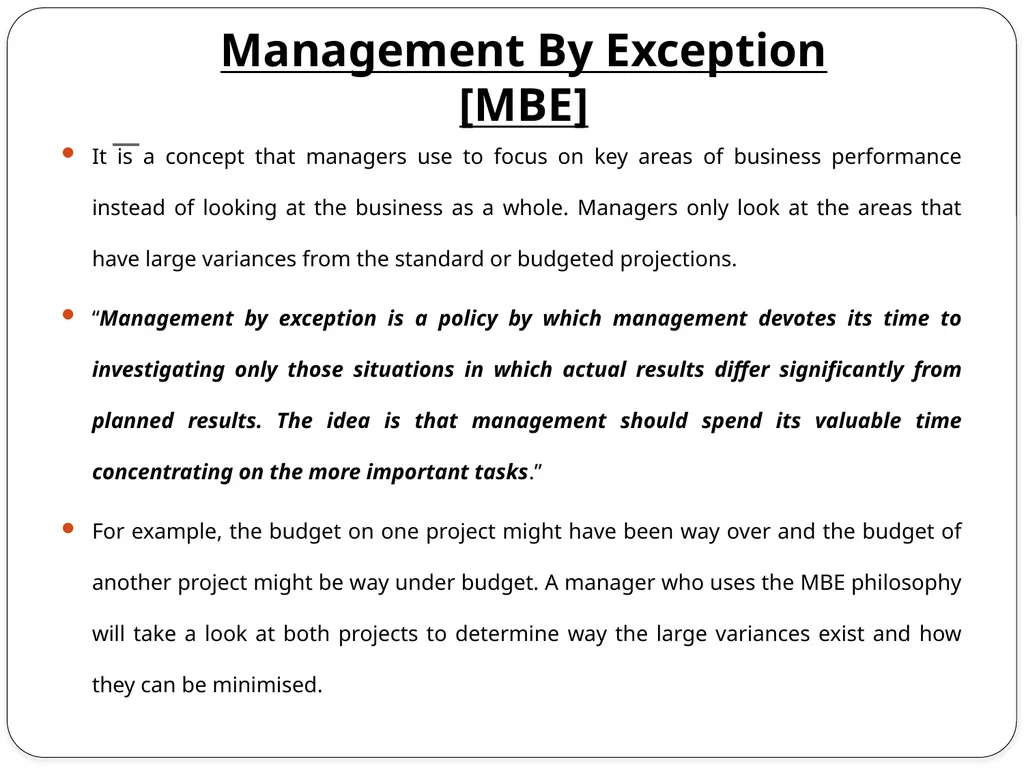
It is a concept that managers use to focus on key areas of business performance instead of looking at the business as a whole. Managers only look at the areas that have large variances from the standard or budgeted projections.
“Management by exception is a policy by which management devotes its time to investigating only those situations in which actual results differ significantly from planned results. The idea is that management should spend its valuable time concentrating on the more important tasks.”
For example, the budget on one project might have been way over and the budget of another project might be way under budget. A manager who uses the MBE philosophy will take a look at both projects to determine way the large variances exist and how they can be minimised. Management By Exception [MBE]<br>
12
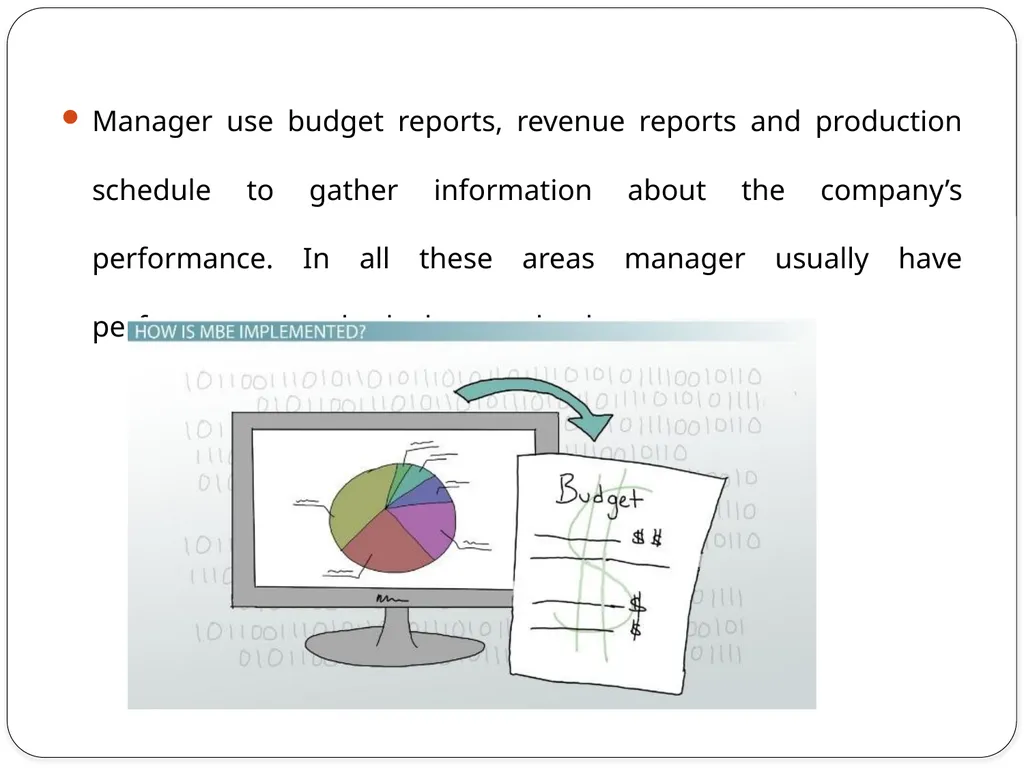
Manager use budget reports, revenue reports and production schedule to gather information about the company’s performance. In all these areas manager usually have performance standards that need to be met<br>
13
Type of exception
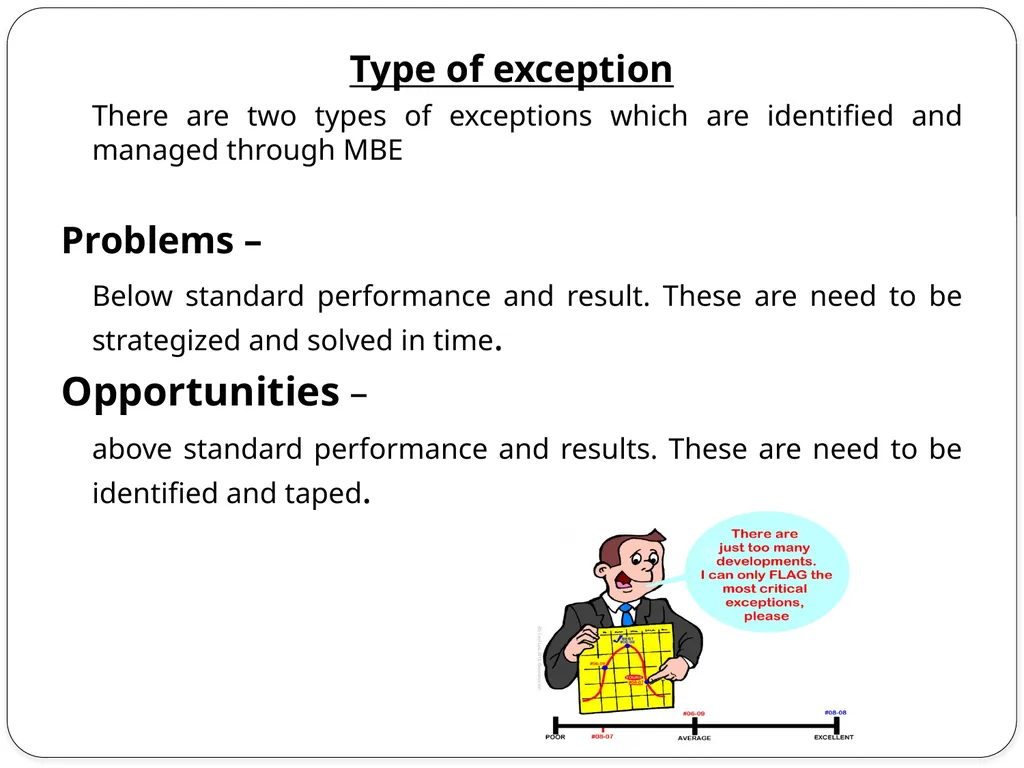
There are two types of exceptions which are identified and managed through MBE
Problems –
Below standard performance and result. These are need to be strategized and solved in time.
Opportunities –
above standard performance and results. These are need to be identified and taped.<br>
14
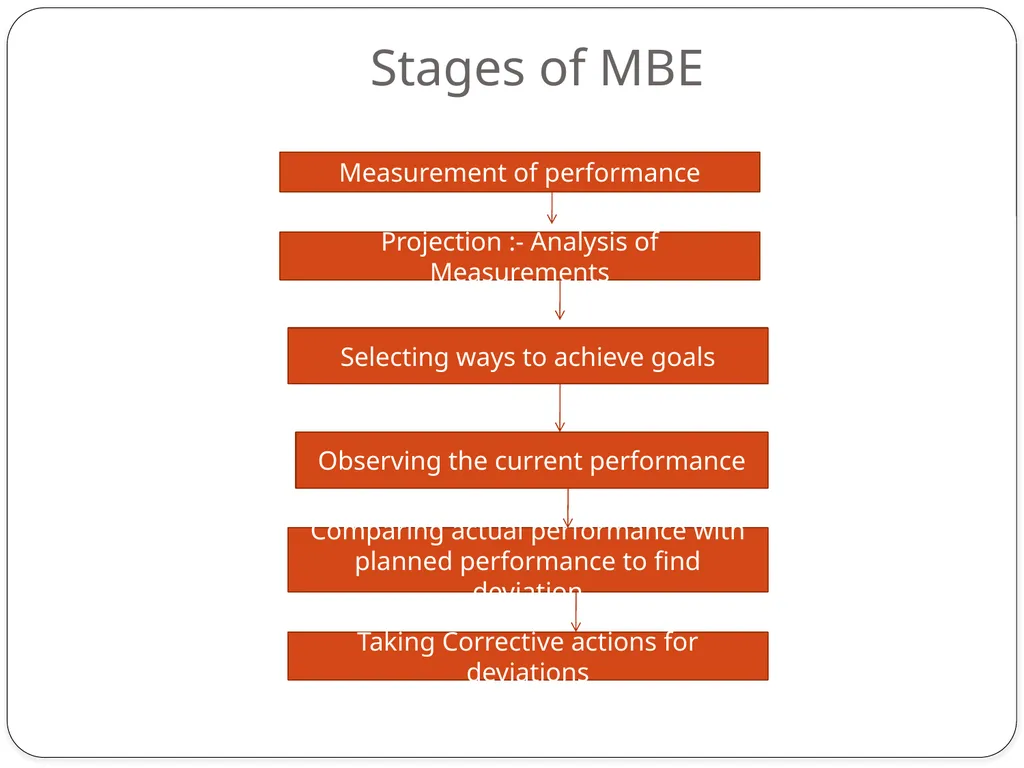
Stages of MBE Measurement of performance Projection :- Analysis of Measurements Selecting ways to achieve goals Observing the current performance Comparing actual performance with planned performance to find deviation Taking Corrective actions for deviations<br>