
Chapter 11 : Project Risk Management Information

Description: Chapter 11 : Project Risk Management Information Technology Project Management, Eighth Edition Note: See the text itself for full citations. Learning Objectives, Part 1 Understand risk and the importance of good project risk management
Related Topics
Download Presentation
"Chapter 11 : Project Risk Management Information" is the property of its rightful owner. Permission is granted to download and print the materials on this website for personal, non-commercial use only, and to display it on your personal computer provided you do not modify the materials and that you retain all copyright notices contained in the materials. By downloading content from our website, you accept the terms of this agreement.
Presentation Transcript
slide1. Chapter 11 :
Project Risk Management Information Technology Project Management, Eighth Edition Note: See the text itself for full citations.<br>
slide2. Learning Objectives, Part 1 Understand risk and the importance of good project risk management
Discuss the elements of planning risk management and the contents of a risk management plan
List common sources of risks on information technology (IT) projects
Describe the process of identifying risks and create a risk register
Discuss qualitative risk analysis and explain how to calculate risk factors, create probability/impact matrixes, and apply the Top Ten Risk Item Tracking technique to rank risks Information Technology Project Management, Eighth Edition 2<br>
slide3. Learning Objectives, Part 2 Explain quantitative risk analysis and how to apply decision trees, simulation, and sensitivity analysis to quantify risks
Provide examples of using different risk response planning strategies to address both negative and positive risks
Discuss how to control risks
Describe how software can assist in project risk management Information Technology Project Management, Eighth Edition 3<br>
slide4. The Importance of Project Risk Management Project risk management is the art and science of identifying, analyzing, and responding to risk throughout the life of a project and in the best interests of meeting project objectives
Risk management is often overlooked in projects, but it can help improve project success by helping select good projects, determining project scope, and developing realistic estimates Information Technology Project Management, Eighth Edition 4<br>
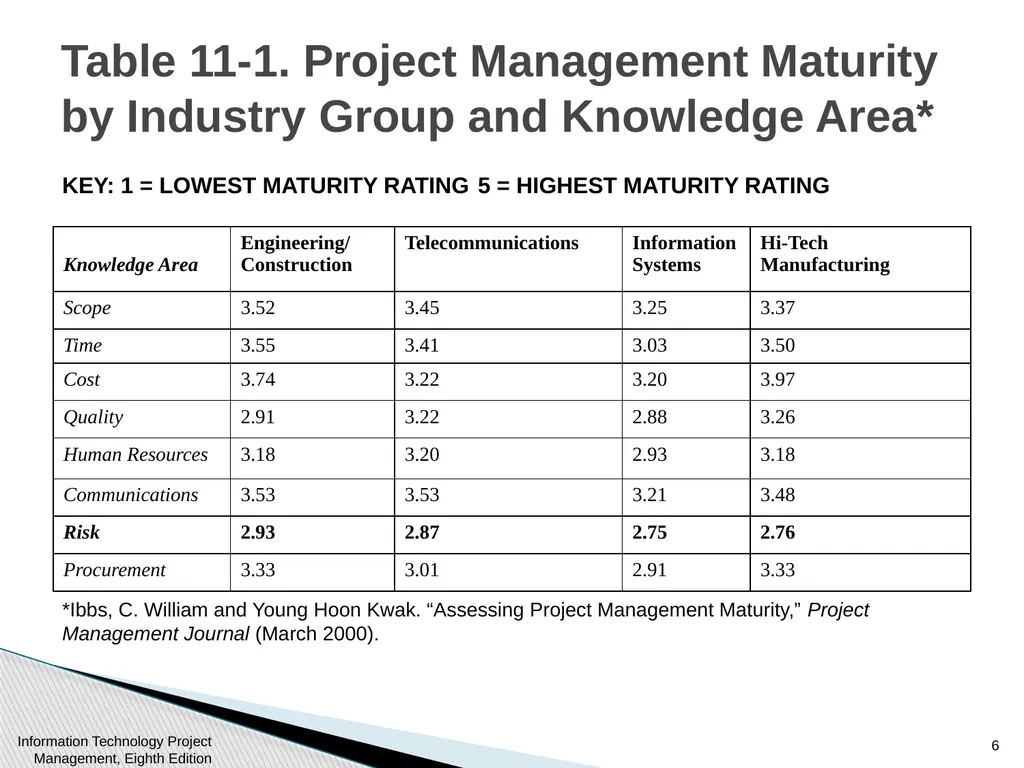
slide5. Research Shows Need to Improve Project Risk Management Study by Ibbs and Kwak shows risk has the lowest maturity rating of all knowledge areas
A similar survey was completed with software development companies in Mauritius, South Africa in 2003, and risk management also had the lowest maturity
KLCI study shows the benefits of following good software risk management practices Information Technology Project Management, Eighth Edition 5<br>
slide6. Table 11-1. Project Management Maturity by Industry Group and Knowledge Area* KEY: 1 = LOWEST MATURITY RATING 5 = HIGHEST MATURITY RATING *Ibbs, C. William and Young Hoon Kwak. “Assessing Project Management Maturity,” Project Management Journal (March 2000). Information Technology Project Management, Eighth Edition 6<br>
slide7. Figure 11-1. Benefits from Software Risk Management Practices* *Source: Kulik and Weber, KLCI Research Group Information Technology Project Management, Eighth Edition 7<br>
slide8. Global Issues Many people around the world suffered from financial losses as various financial markets dropped in the fall of 2008, even after the $700 billion bailout bill was passed by the U.S. Congress
According to a global survey of 316 financial services executives, over 70 percent of respondents believed that the losses stemming from the credit crisis were largely due to failures to address risk management issues
Worldwide banking and insurance sectors will spend about $78.6 billion on risk information technologies and services in 2015, growing to $96.3 billion by 2018 Information Technology Project Management, Eighth Edition 8<br>
slide9. Negative Risk A dictionary definition of risk is “the possibility of loss or injury”
Negative risk involves understanding potential problems that might occur in the project and how they might impede project success
Negative risk management is like a form of insurance; it is an investment Information Technology Project Management, Eighth Edition 9<br>
slide10. Risk Can Be Positive Positive risks are risks that result in good things happening; sometimes called opportunities
A general definition of project risk is an uncertainty that can have a negative or positive effect on meeting project objectives
The goal of project risk management is to minimize potential negative risks while maximizing potential positive risks Information Technology Project Management, Eighth Edition 10<br>
slide11. Best Practice Some organizations make the mistake of only addressing tactical and negative risks when performing project risk management
David Hillson, (www.risk-doctor.com) suggests overcoming this problem by widening the scope of risk management to encompass both strategic risks and upside opportunities, which he refers to as integrated risk management
In a 2014 paper Hillson described the importance of good working relationships, especially between the project sponsor and project manager Information Technology Project Management, Eighth Edition 11<br>
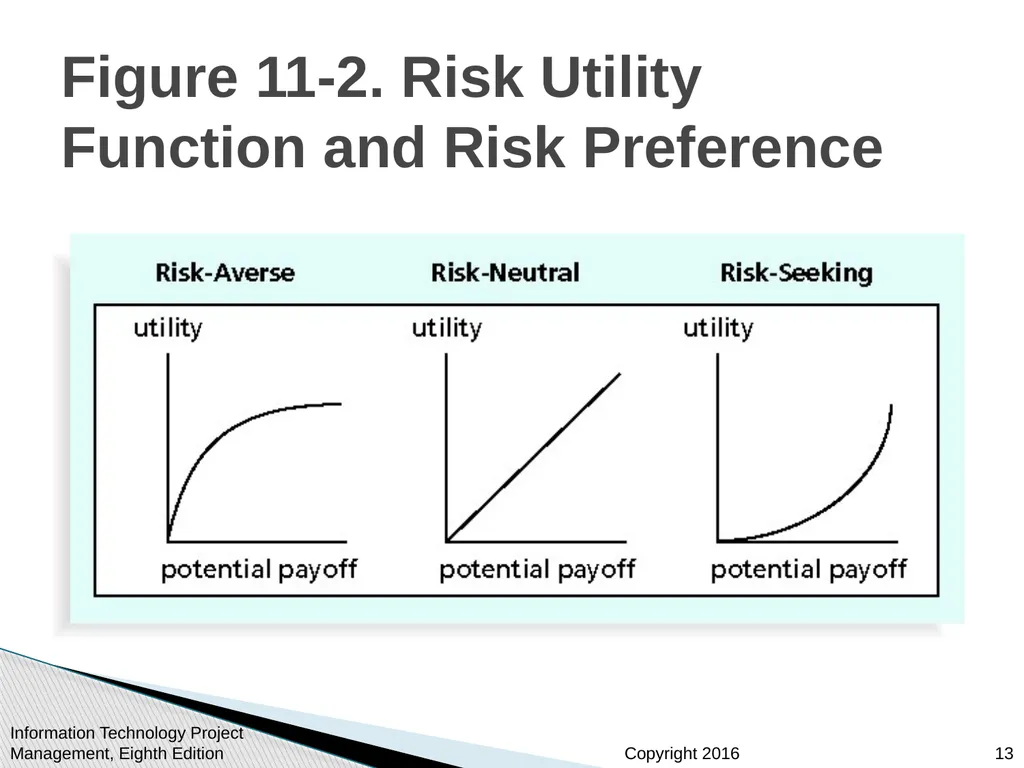
slide12. Risk Utility Risk utility or risk tolerance is the amount of satisfaction or pleasure received from a potential payoff
Utility rises at a decreasing rate for people who are risk-averse
Those who are risk-seeking have a higher tolerance for risk and their satisfaction increases when more payoff is at stake
The risk-neutral approach achieves a balance between risk and payoff Information Technology Project Management, Eighth Edition 12<br>
slide13. Figure 11-2. Risk Utility Function and Risk Preference Information Technology Project Management, Eighth Edition 13<br>
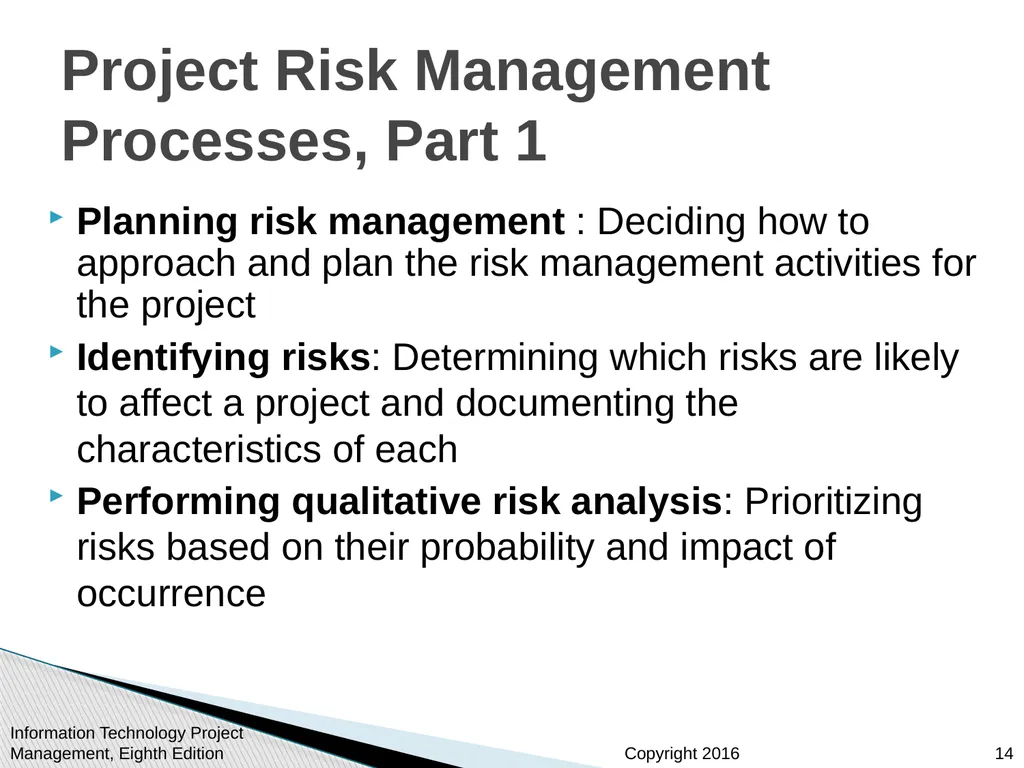
slide14. Project Risk Management Processes, Part 1 Planning risk management : Deciding how to approach and plan the risk management activities for the project
Identifying risks: Determining which risks are likely to affect a project and documenting the characteristics of each
Performing qualitative risk analysis: Prioritizing risks based on their probability and impact of occurrence Information Technology Project Management, Eighth Edition 14<br>
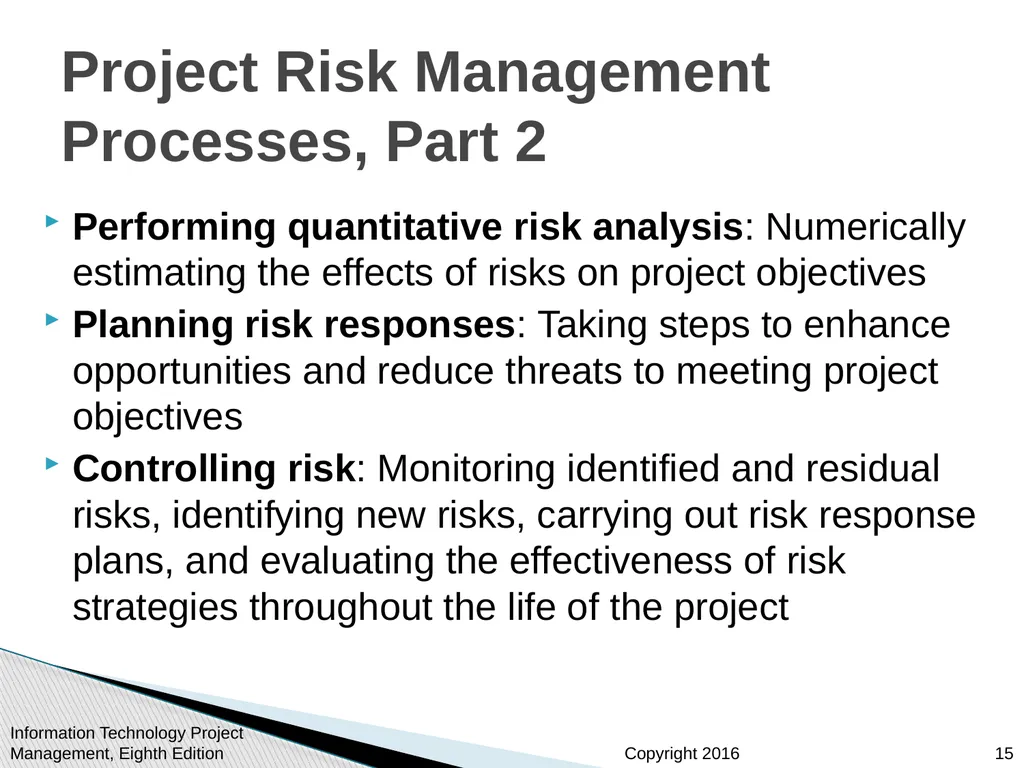
slide15. Project Risk Management Processes, Part 2 Performing quantitative risk analysis: Numerically estimating the effects of risks on project objectives
Planning risk responses: Taking steps to enhance opportunities and reduce threats to meeting project objectives
Controlling risk: Monitoring identified and residual risks, identifying new risks, carrying out risk response plans, and evaluating the effectiveness of risk strategies throughout the life of the project Information Technology Project Management, Eighth Edition 15<br>
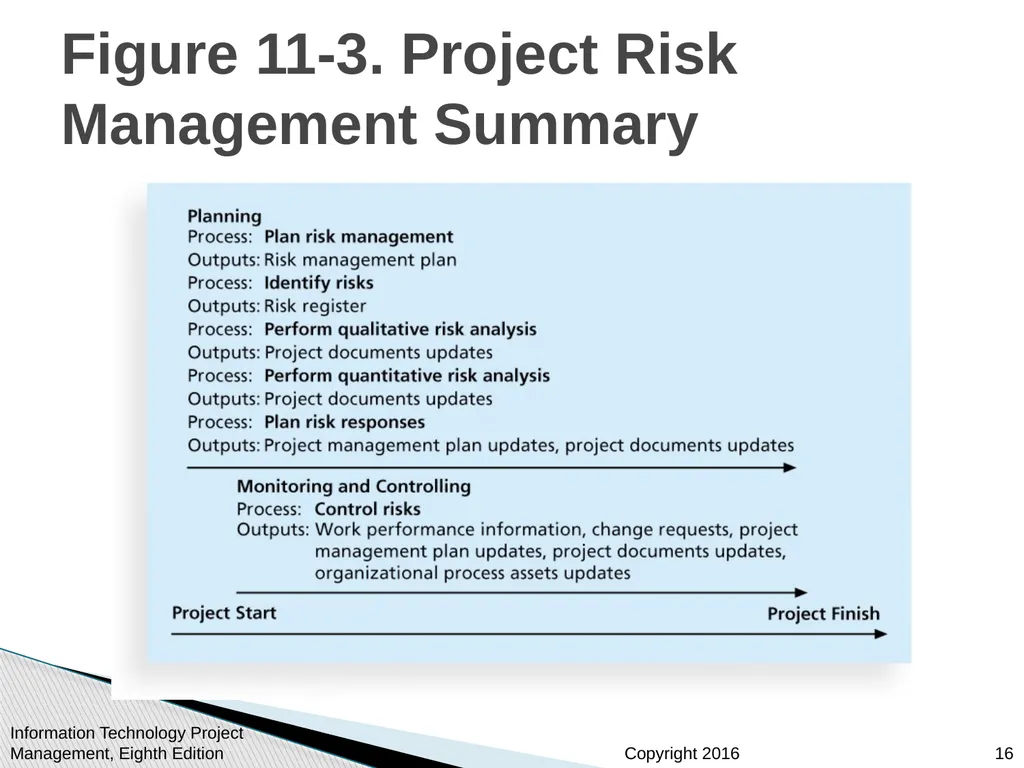
slide16. Figure 11-3. Project Risk Management Summary Planning
Process: Plan risk management
Outputs: Risk, management plan
Process: Identify risks
Outputs: Risk register
Process: Perform qualitative risk analysis
Outputs: Project documents updates
Process: Perform quantitative risk analysis
Outputs: Project documents updates
Process: Plan risk responses
Outputs: Project management plan updates, project documents updates
project documents updates
Monitoring and Controlling
Process: Control risks
Outputs: Work performance information, change requests, projects managements plan updates, project documents updates, organizational process assets updates. Information Technology Project Management, Eighth Edition 16<br>
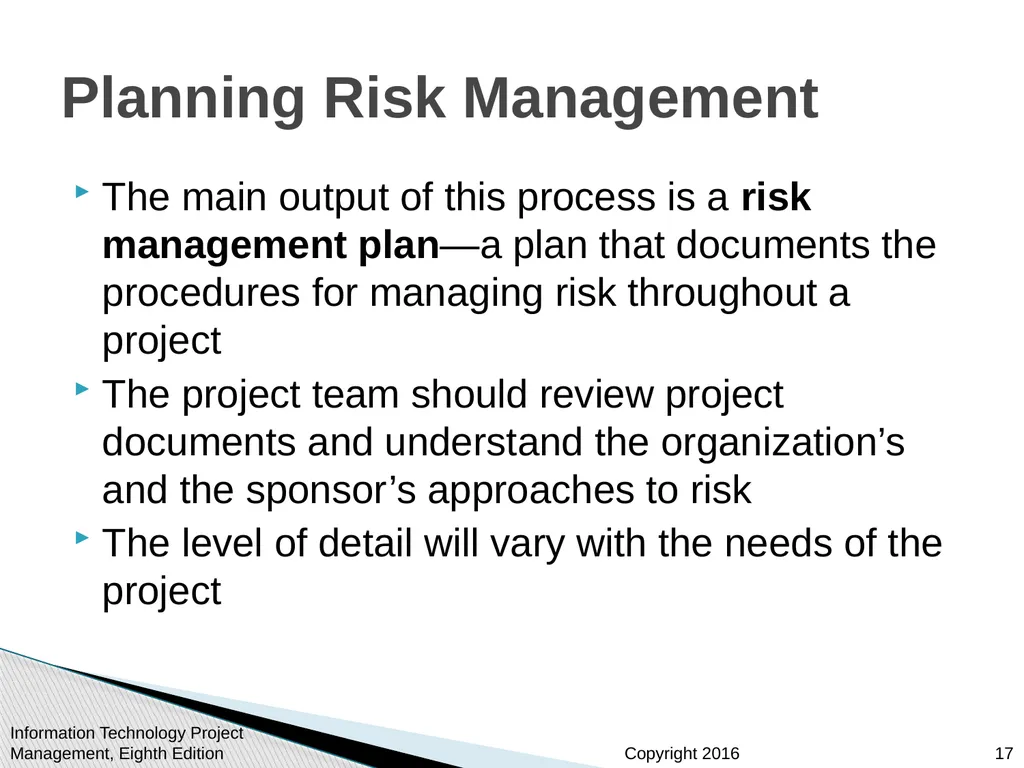
slide17. Planning Risk Management The main output of this process is a risk management plan—a plan that documents the procedures for managing risk throughout a project
The project team should review project documents and understand the organization’s and the sponsor’s approaches to risk
The level of detail will vary with the needs of the project Information Technology Project Management, Eighth Edition 17<br>
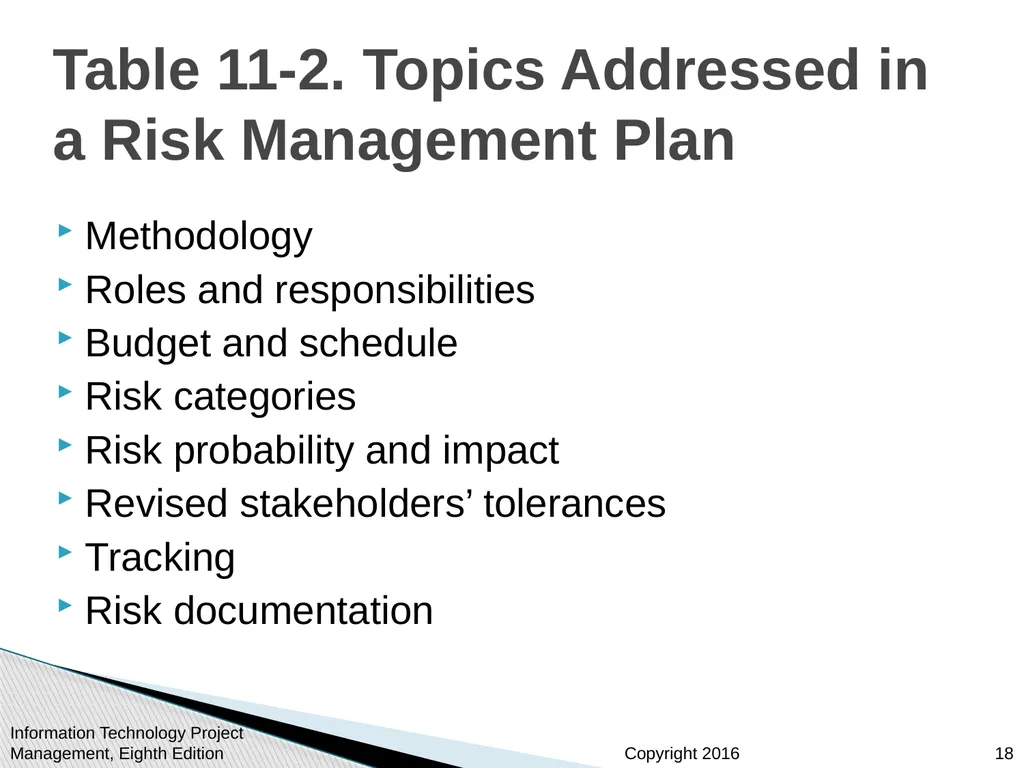
slide18. Table 11-2. Topics Addressed in a Risk Management Plan Methodology
Roles and responsibilities
Budget and schedule
Risk categories
Risk probability and impact
Revised stakeholders’ tolerances
Tracking
Risk documentation Information Technology Project Management, Eighth Edition 18<br>
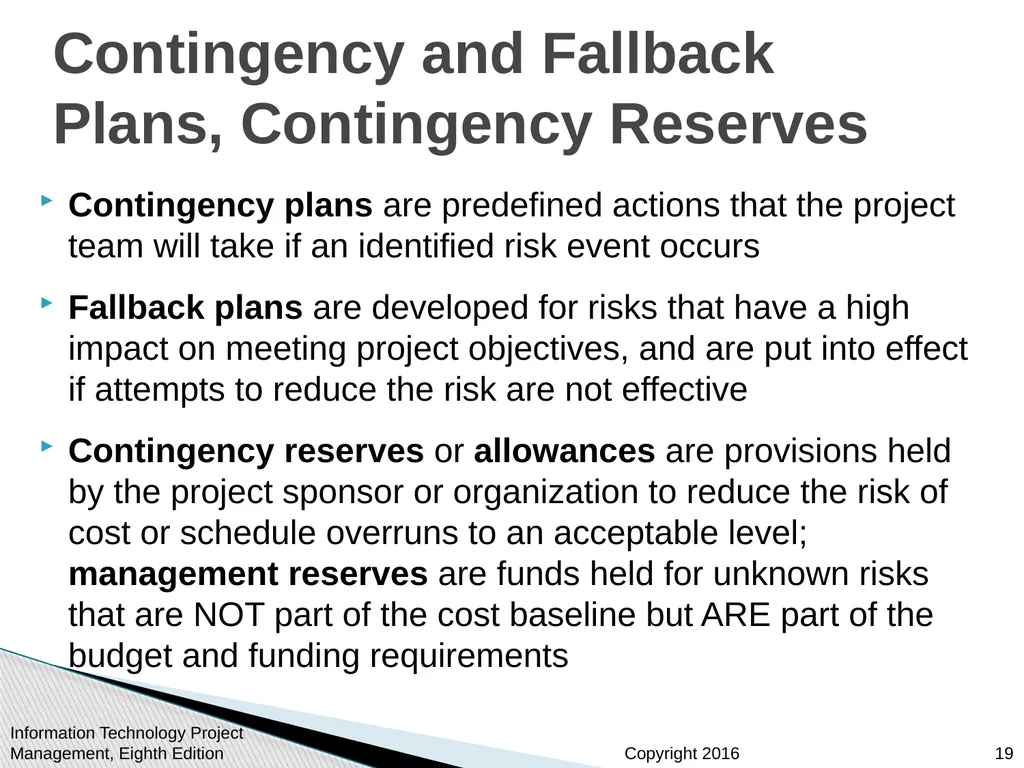
slide19. Contingency and Fallback Plans, Contingency Reserves Contingency plans are predefined actions that the project team will take if an identified risk event occurs
Fallback plans are developed for risks that have a high impact on meeting project objectives, and are put into effect if attempts to reduce the risk are not effective
Contingency reserves or allowances are provisions held by the project sponsor or organization to reduce the risk of cost or schedule overruns to an acceptable level; management reserves are funds held for unknown risks that are NOT part of the cost baseline but ARE part of the budget and funding requirements Information Technology Project Management, Eighth Edition 19<br>
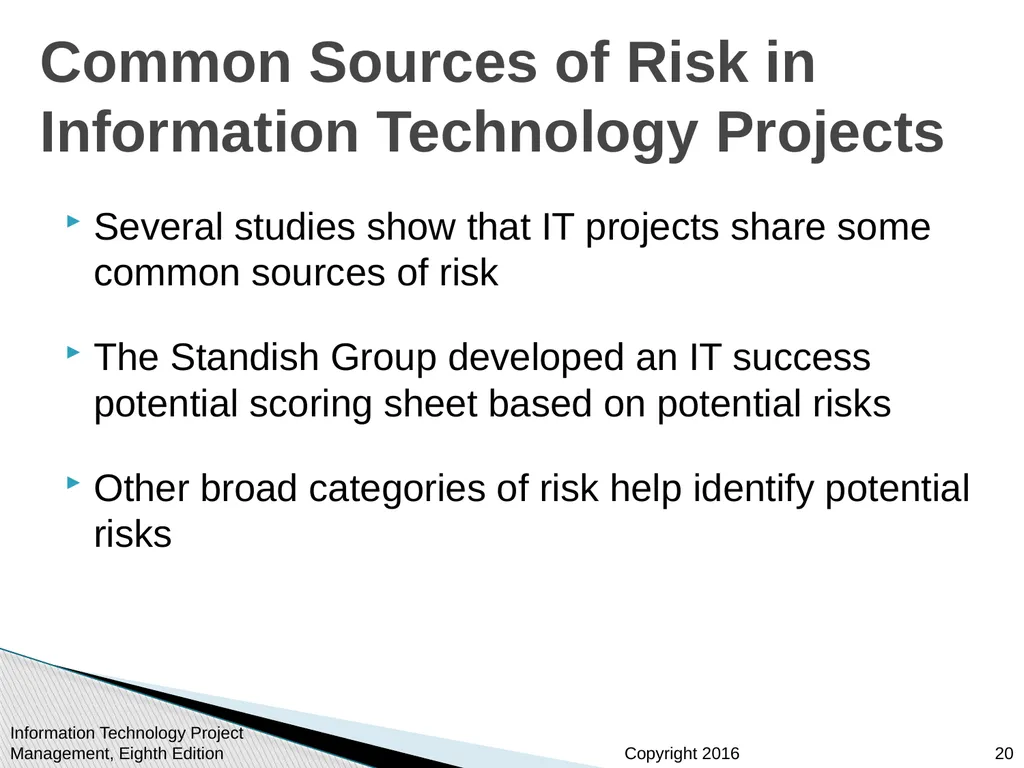
slide20. Common Sources of Risk in Information Technology Projects Several studies show that IT projects share some common sources of risk
The Standish Group developed an IT success potential scoring sheet based on potential risks
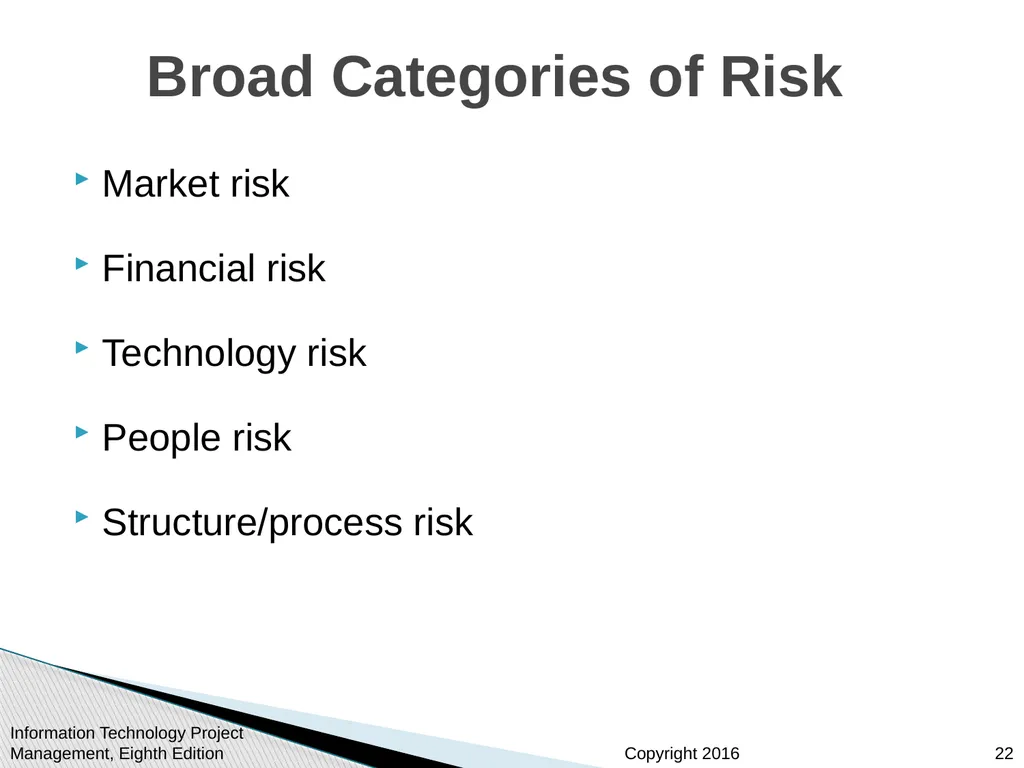
Other broad categories of risk help identify potential risks Information Technology Project Management, Eighth Edition 20<br>
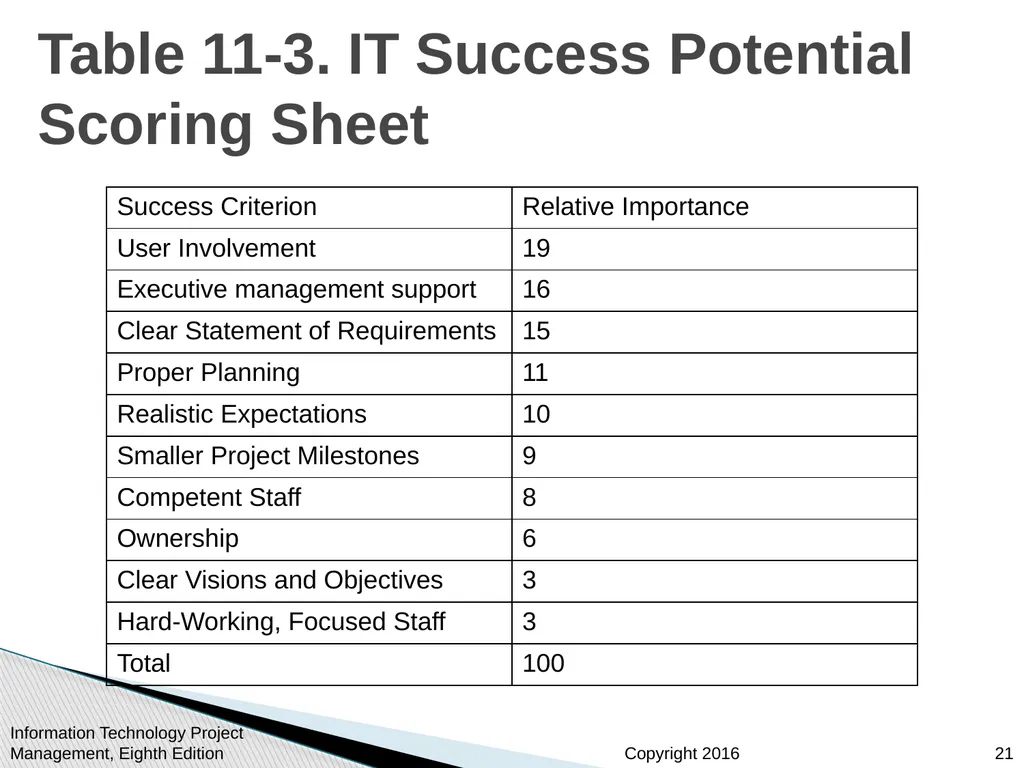
slide21. Table 11-3. IT Success Potential Scoring Sheet Information Technology Project Management, Eighth Edition 21<br>
slide22. Broad Categories of Risk Market risk
Financial risk
Technology risk
People risk
Structure/process risk Information Technology Project Management, Eighth Edition 22<br>
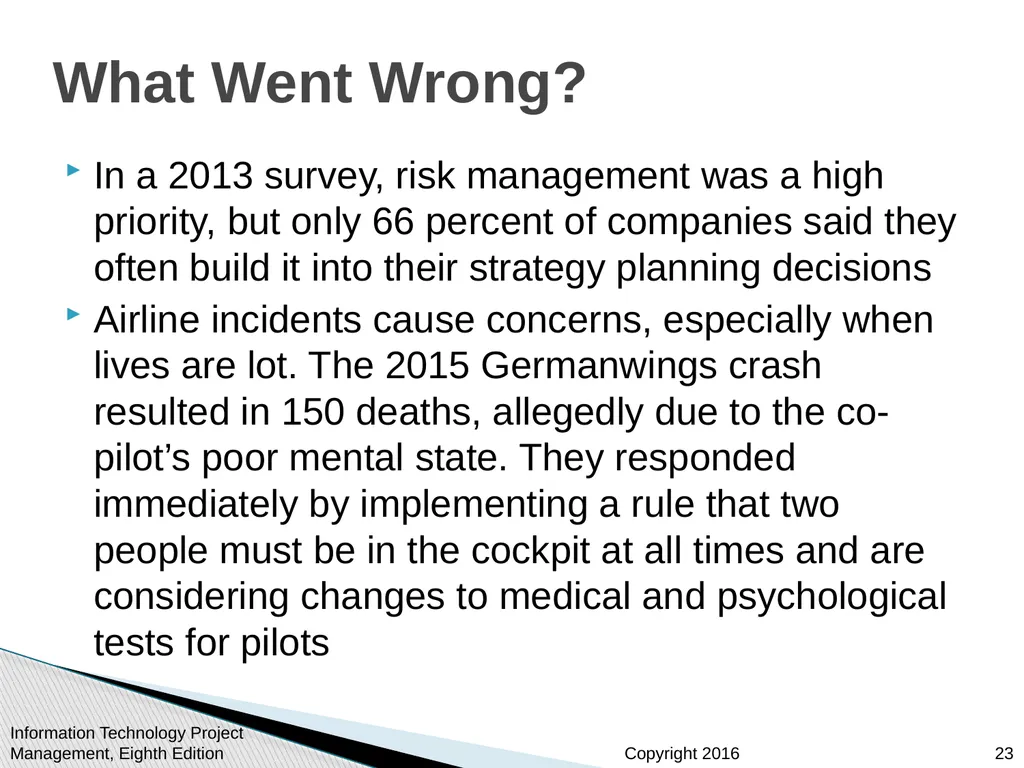
slide23. What Went Wrong? In a 2013 survey, risk management was a high priority, but only 66 percent of companies said they often build it into their strategy planning decisions
Airline incidents cause concerns, especially when lives are lot. The 2015 Germanwings crash resulted in 150 deaths, allegedly due to the co-pilot’s poor mental state. They responded immediately by implementing a rule that two people must be in the cockpit at all times and are considering changes to medical and psychological tests for pilots Information Technology Project Management, Eighth Edition 23<br>
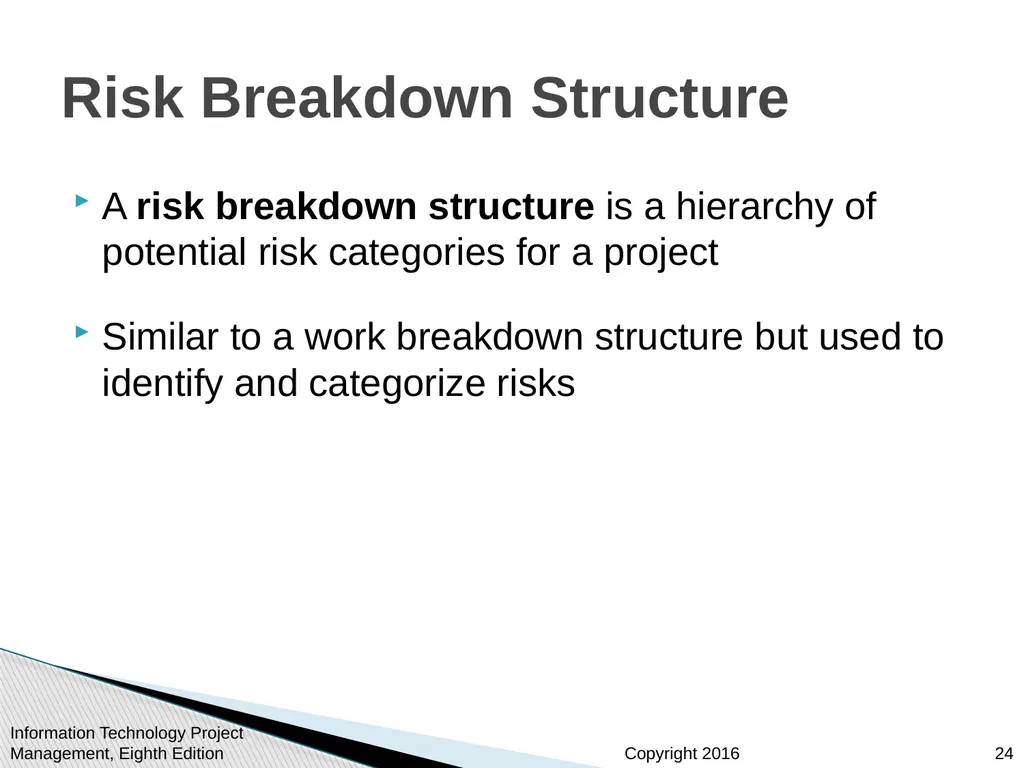
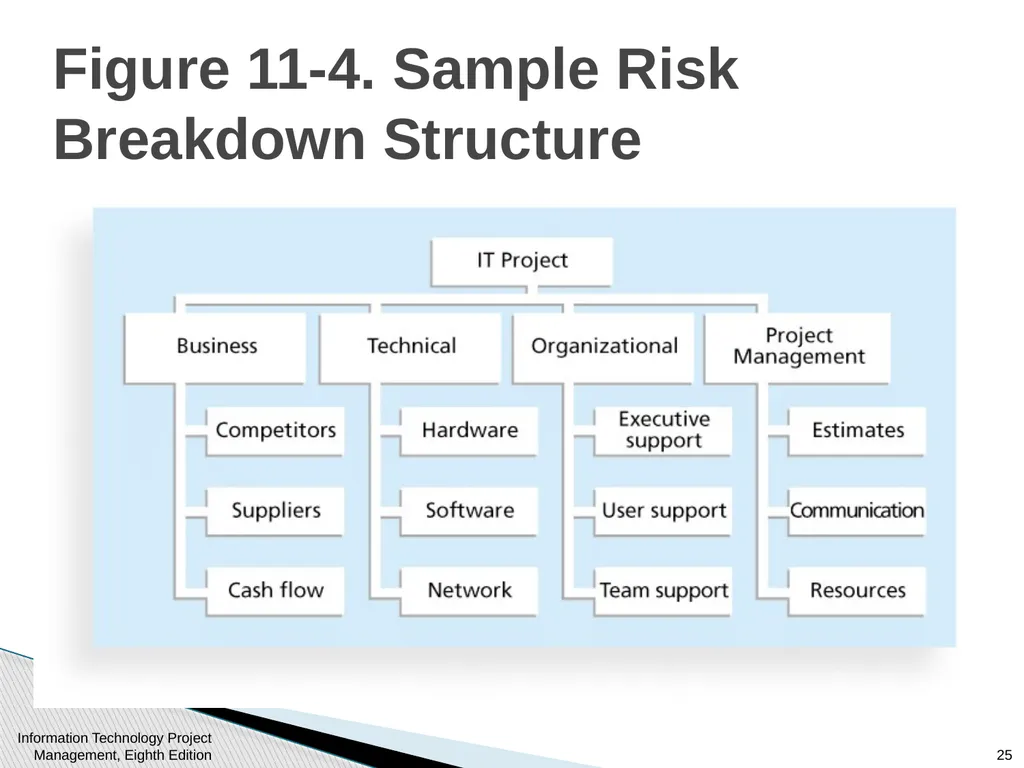
slide24. Risk Breakdown Structure A risk breakdown structure is a hierarchy of potential risk categories for a project
Similar to a work breakdown structure but used to identify and categorize risks Information Technology Project Management, Eighth Edition 24<br>
slide25. Figure 11-4. Sample Risk Breakdown Structure Information Technology Project Management, Eighth Edition 25<br>
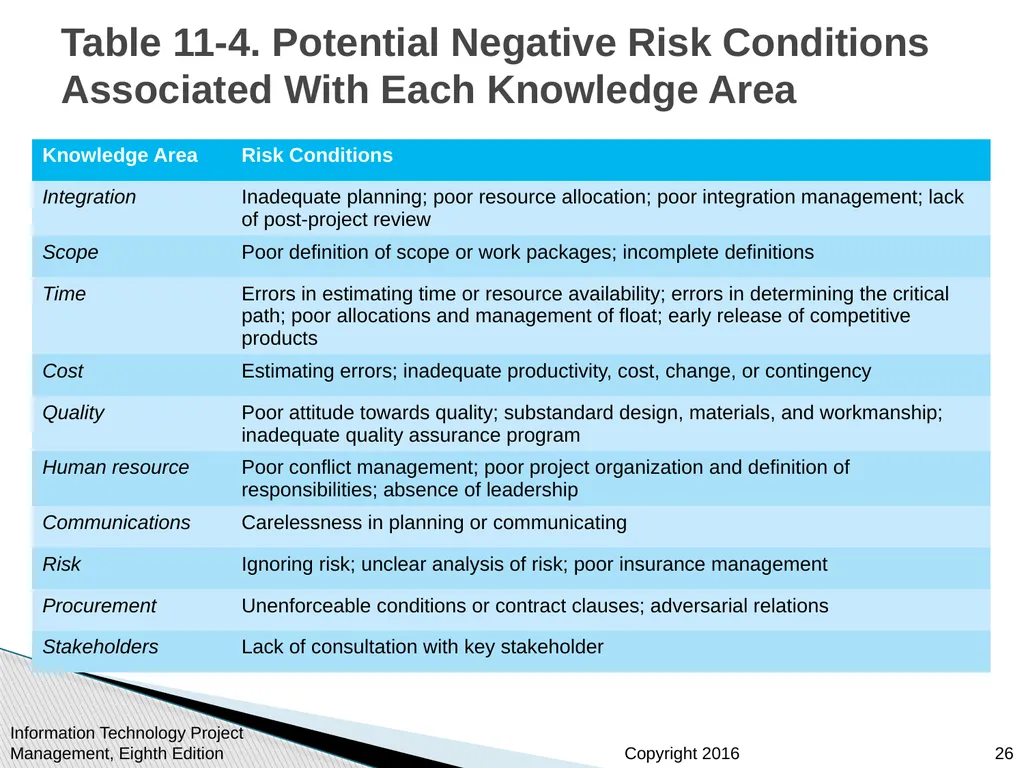
slide26. Table 11-4. Potential Negative Risk Conditions Associated With Each Knowledge Area Information Technology Project Management, Eighth Edition 26<br>
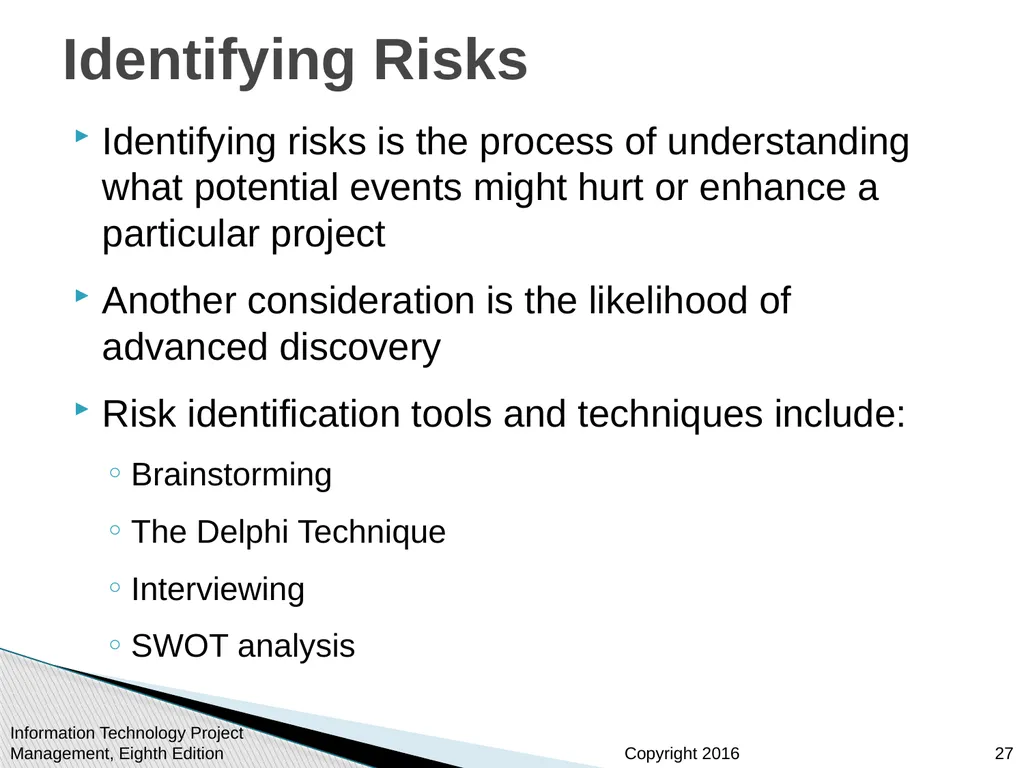
slide27. Identifying Risks Identifying risks is the process of understanding what potential events might hurt or enhance a particular project
Another consideration is the likelihood of advanced discovery
Risk identification tools and techniques include:
Brainstorming
The Delphi Technique
Interviewing
SWOT analysis Information Technology Project Management, Eighth Edition 27<br>
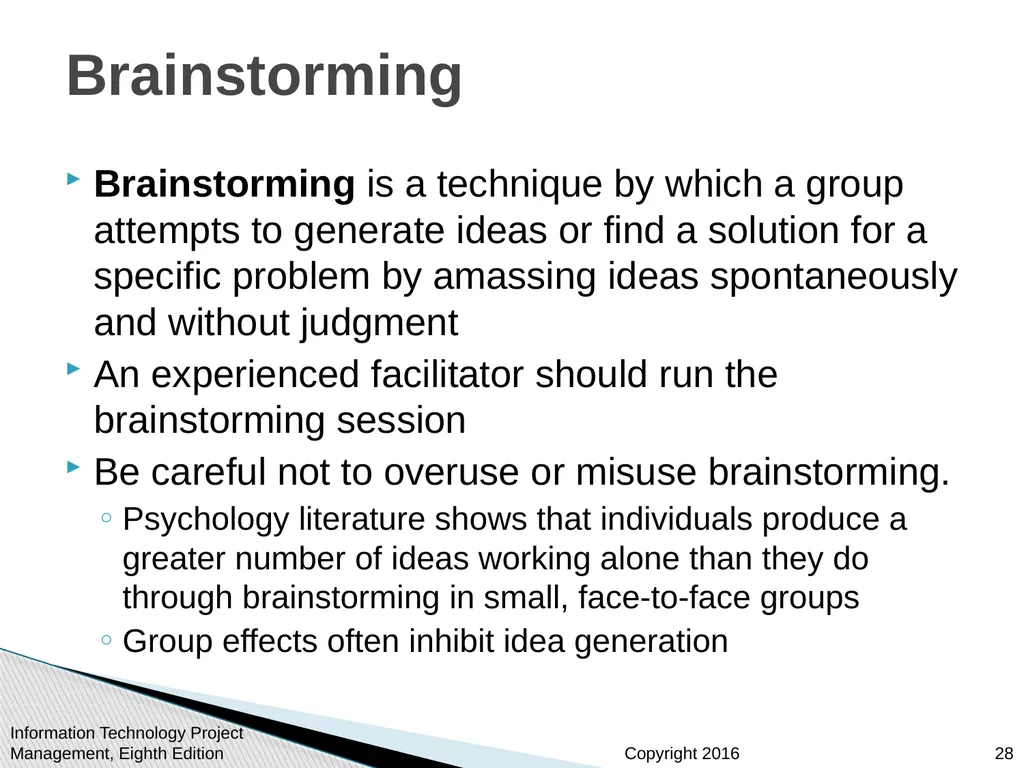
slide28. Brainstorming Brainstorming is a technique by which a group attempts to generate ideas or find a solution for a specific problem by amassing ideas spontaneously and without judgment
An experienced facilitator should run the brainstorming session
Be careful not to overuse or misuse brainstorming.
Psychology literature shows that individuals produce a greater number of ideas working alone than they do through brainstorming in small, face-to-face groups
Group effects often inhibit idea generation Information Technology Project Management, Eighth Edition 28<br>
slide29. Delphi Technique The Delphi Technique is used to derive a consensus among a panel of experts who make predictions about future developments
Provides independent and anonymous input regarding future events
Uses repeated rounds of questioning and written responses and avoids the biasing effects possible in oral methods, such as brainstorming Information Technology Project Management, Eighth Edition 29<br>
slide30. Interviewing Interviewing is a fact-finding technique for collecting information in face-to-face, phone, e-mail, or instant-messaging discussions
Interviewing people with similar project experience is an important tool for identifying potential risks Information Technology Project Management, Eighth Edition 30<br>
slide31. SWOT Analysis SWOT analysis (strengths, weaknesses, opportunities, and threats) can also be used during risk identification
Helps identify the broad negative and positive risks that apply to a project Information Technology Project Management, Eighth Edition 31<br>
slide32. Risk Register The main output of the risk identification process is a list of identified risks and other information needed to begin creating a risk register
A risk register is:
A document that contains the results of various risk management processes and that is often displayed in a table or spreadsheet format
A tool for documenting potential risk events and related information
Risk events refer to specific, uncertain events that may occur to the detriment or enhancement of the project Information Technology Project Management, Eighth Edition 32<br>
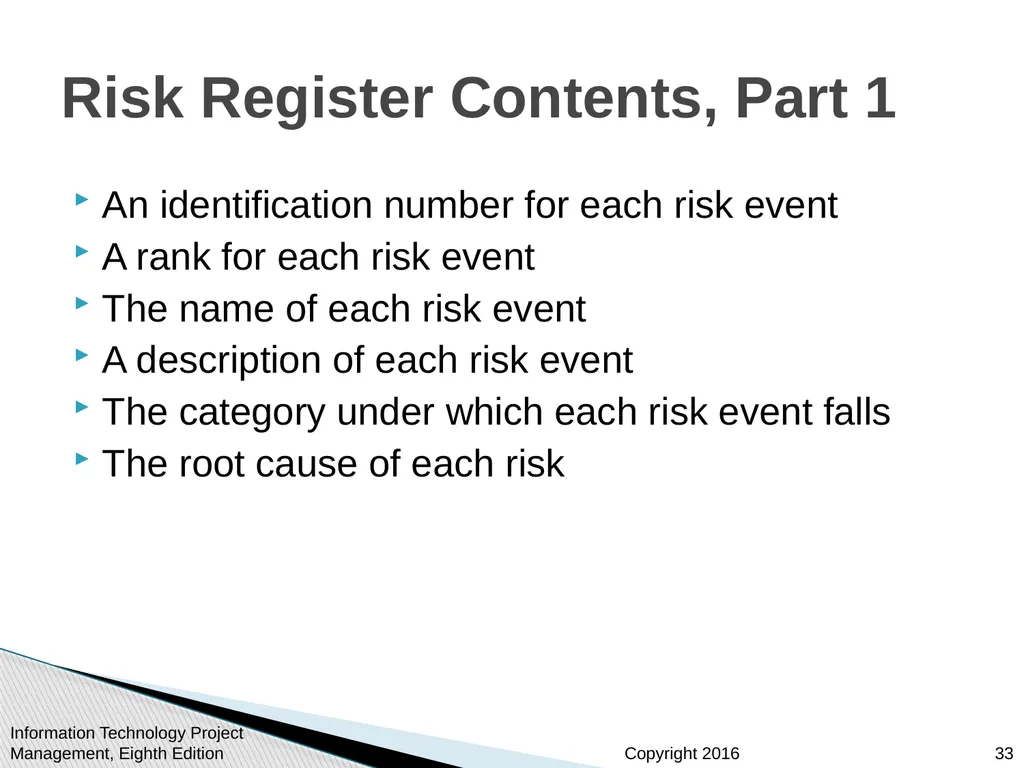
slide33. Risk Register Contents, Part 1 An identification number for each risk event
A rank for each risk event
The name of each risk event
A description of each risk event
The category under which each risk event falls
The root cause of each risk Information Technology Project Management, Eighth Edition 33<br>
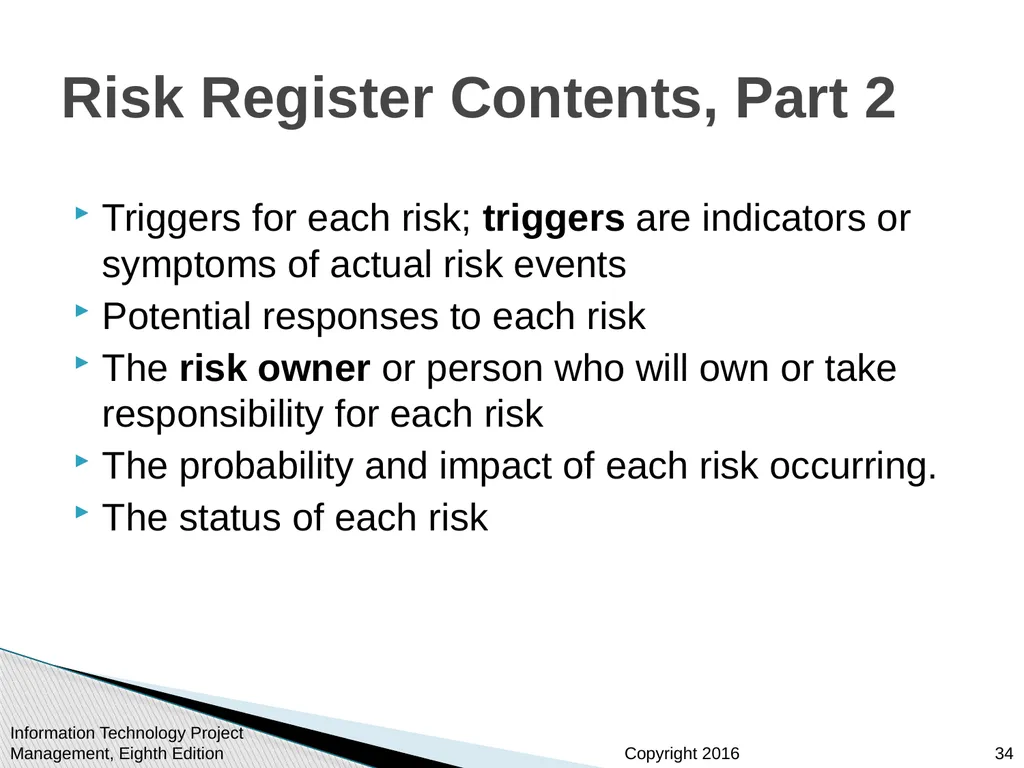
slide34. Risk Register Contents, Part 2 Triggers for each risk; triggers are indicators or symptoms of actual risk events
Potential responses to each risk
The risk owner or person who will own or take responsibility for each risk
The probability and impact of each risk occurring.
The status of each risk Information Technology Project Management, Eighth Edition 34<br>
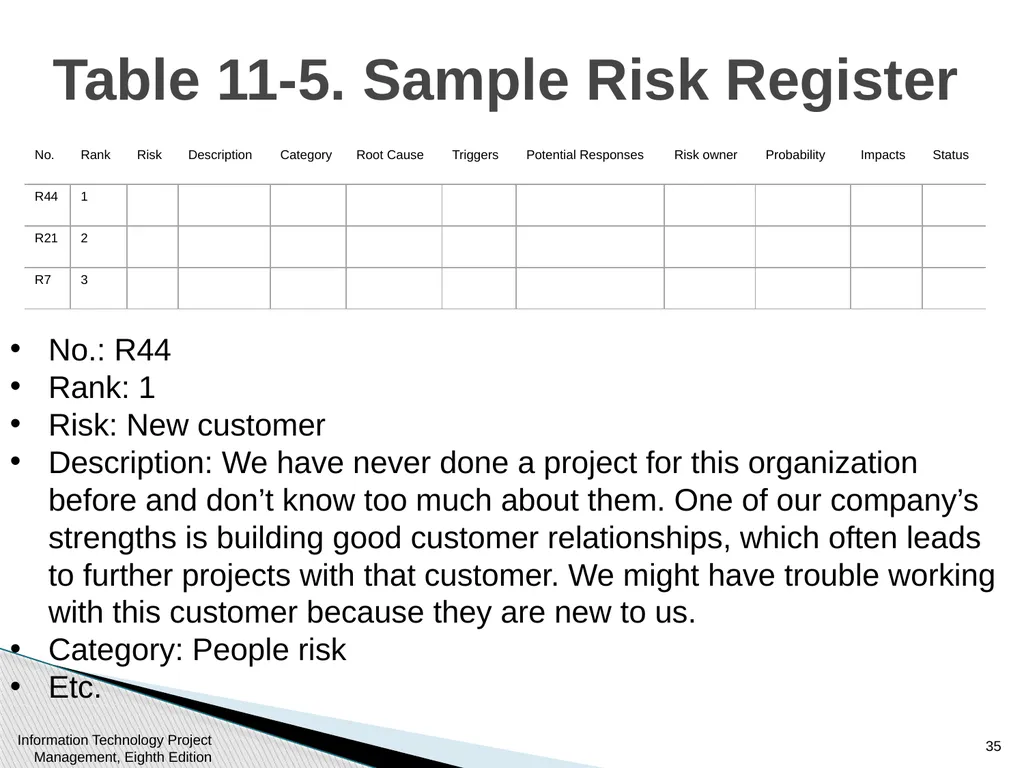
slide35. Table 11-5. Sample Risk Register No.: R44
Rank: 1
Risk: New customer
Description: We have never done a project for this organization before and don’t know too much about them. One of our company’s strengths is building good customer relationships, which often leads to further projects with that customer. We might have trouble working with this customer because they are new to us.
Category: People risk
Etc. Information Technology Project Management, Eighth Edition 35<br>
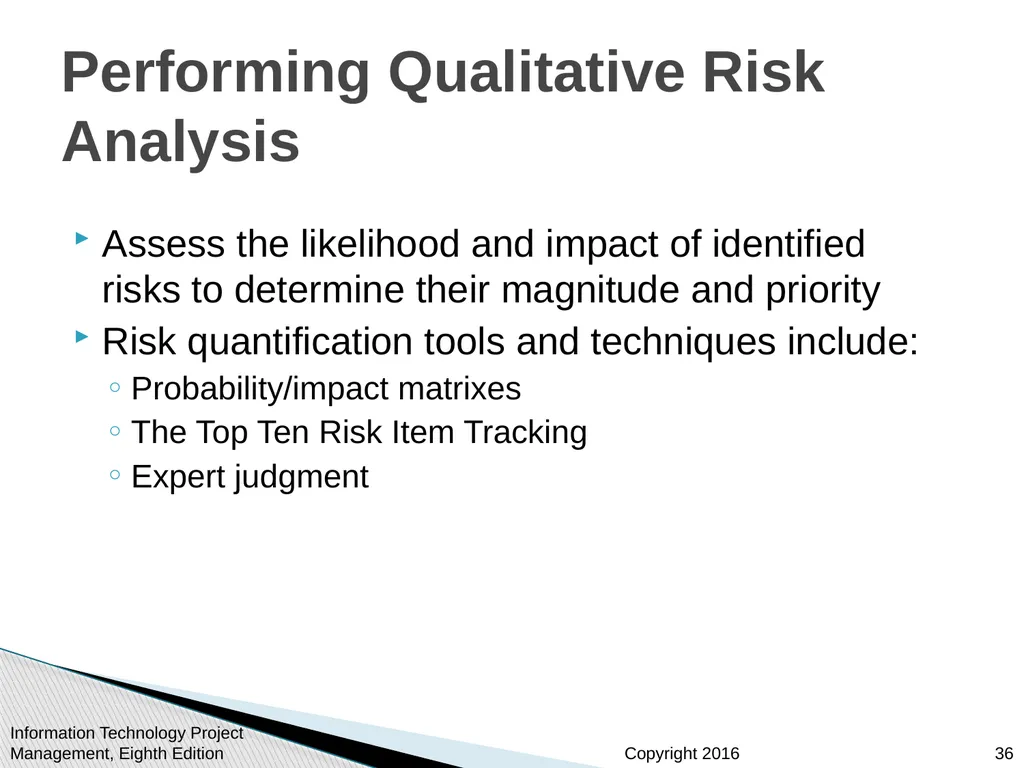
slide36. Performing Qualitative Risk Analysis Assess the likelihood and impact of identified risks to determine their magnitude and priority
Risk quantification tools and techniques include:
Probability/impact matrixes
The Top Ten Risk Item Tracking
Expert judgment Information Technology Project Management, Eighth Edition 36<br>
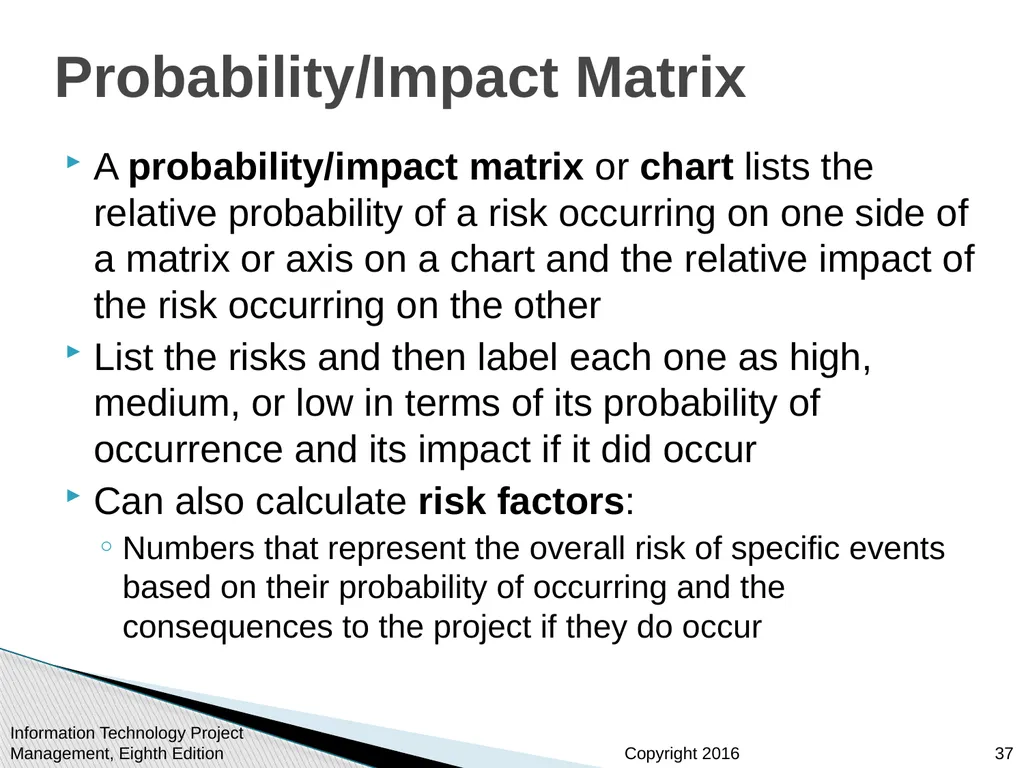
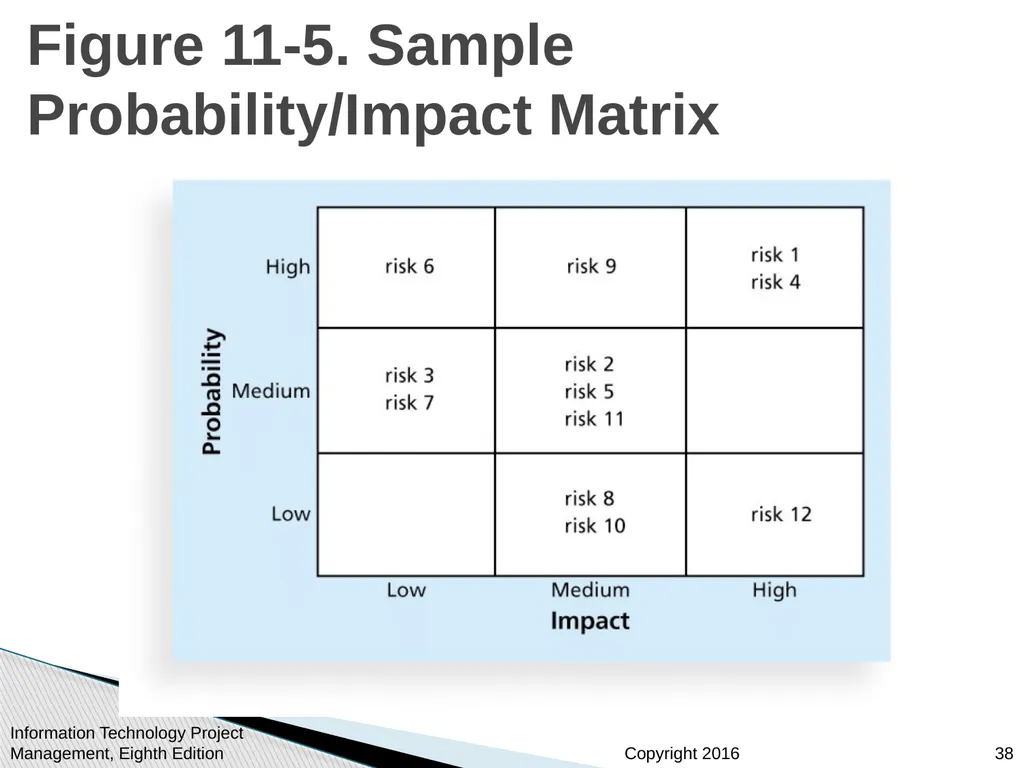
slide37. Probability/Impact Matrix A probability/impact matrix or chart lists the relative probability of a risk occurring on one side of a matrix or axis on a chart and the relative impact of the risk occurring on the other
List the risks and then label each one as high, medium, or low in terms of its probability of occurrence and its impact if it did occur
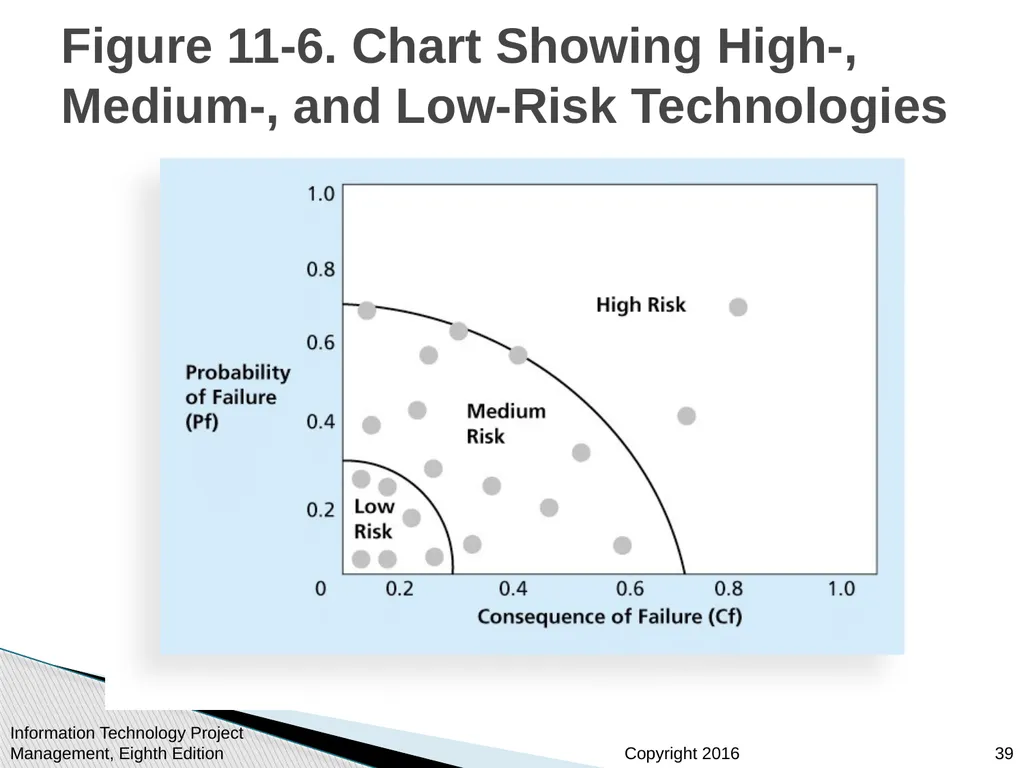
Can also calculate risk factors:
Numbers that represent the overall risk of specific events based on their probability of occurring and the consequences to the project if they do occur Information Technology Project Management, Eighth Edition 37<br>
slide38. Figure 11-5. Sample Probability/Impact Matrix Information Technology Project Management, Eighth Edition 38<br>
slide39. Figure 11-6. Chart Showing High-, Medium-, and Low-Risk Technologies Information Technology Project Management, Eighth Edition 39<br>
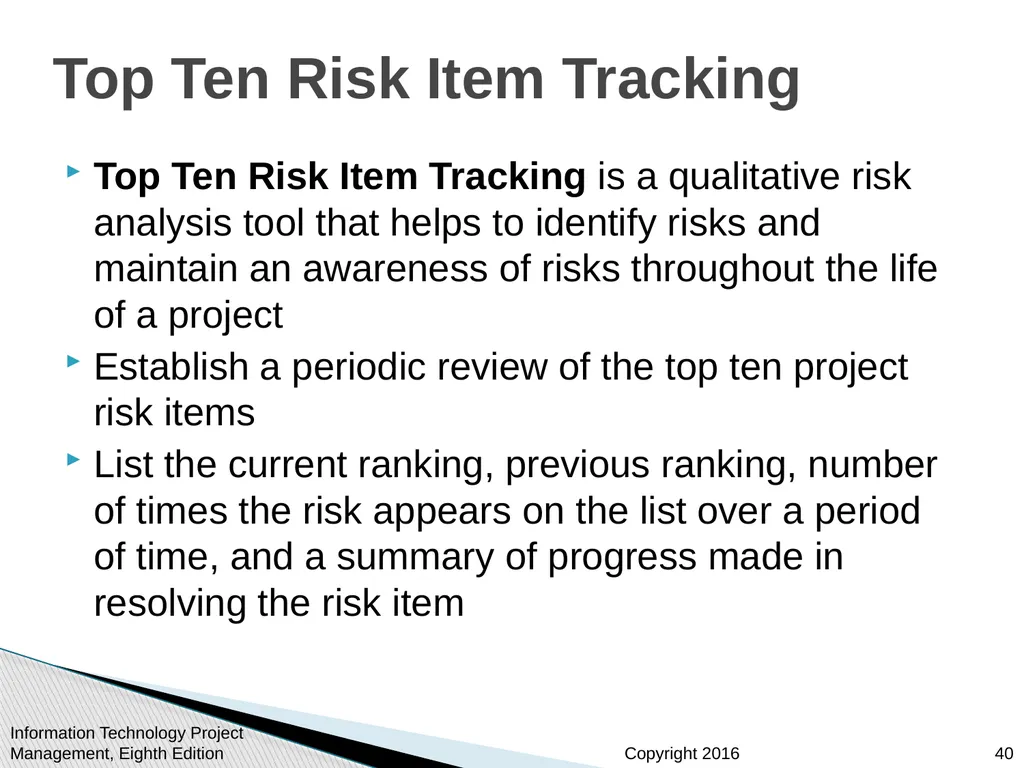
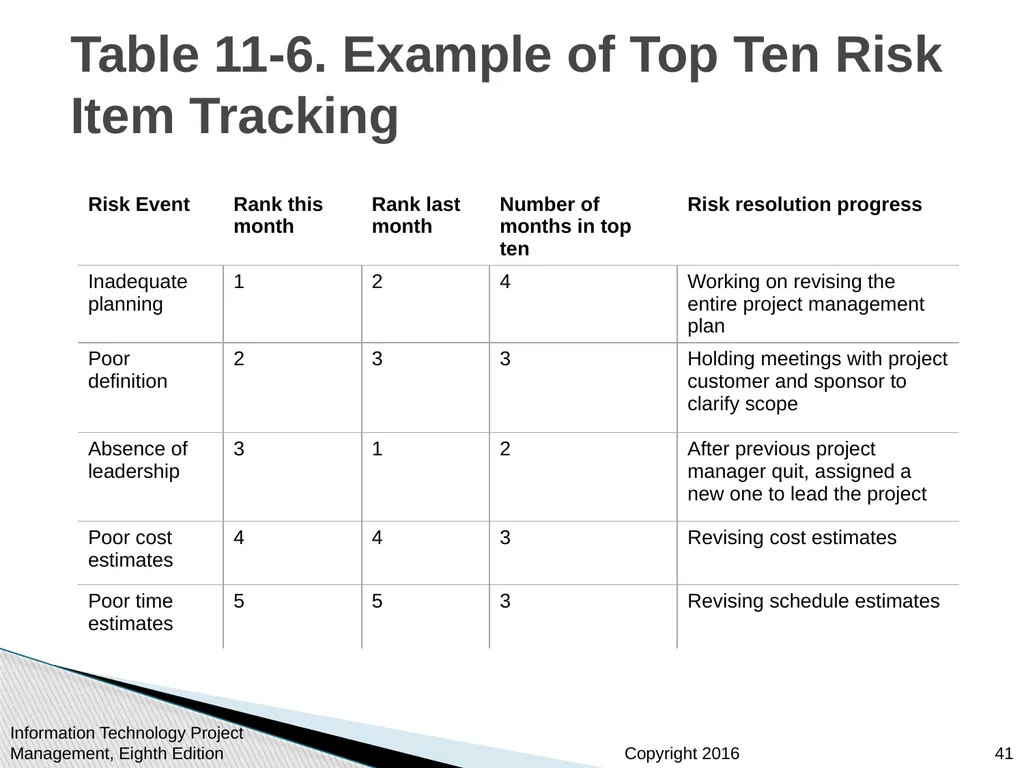
slide40. Top Ten Risk Item Tracking Top Ten Risk Item Tracking is a qualitative risk analysis tool that helps to identify risks and maintain an awareness of risks throughout the life of a project
Establish a periodic review of the top ten project risk items
List the current ranking, previous ranking, number of times the risk appears on the list over a period of time, and a summary of progress made in resolving the risk item Information Technology Project Management, Eighth Edition 40<br>
slide41. Table 11-6. Example of Top Ten Risk Item Tracking Information Technology Project Management, Eighth Edition 41<br>
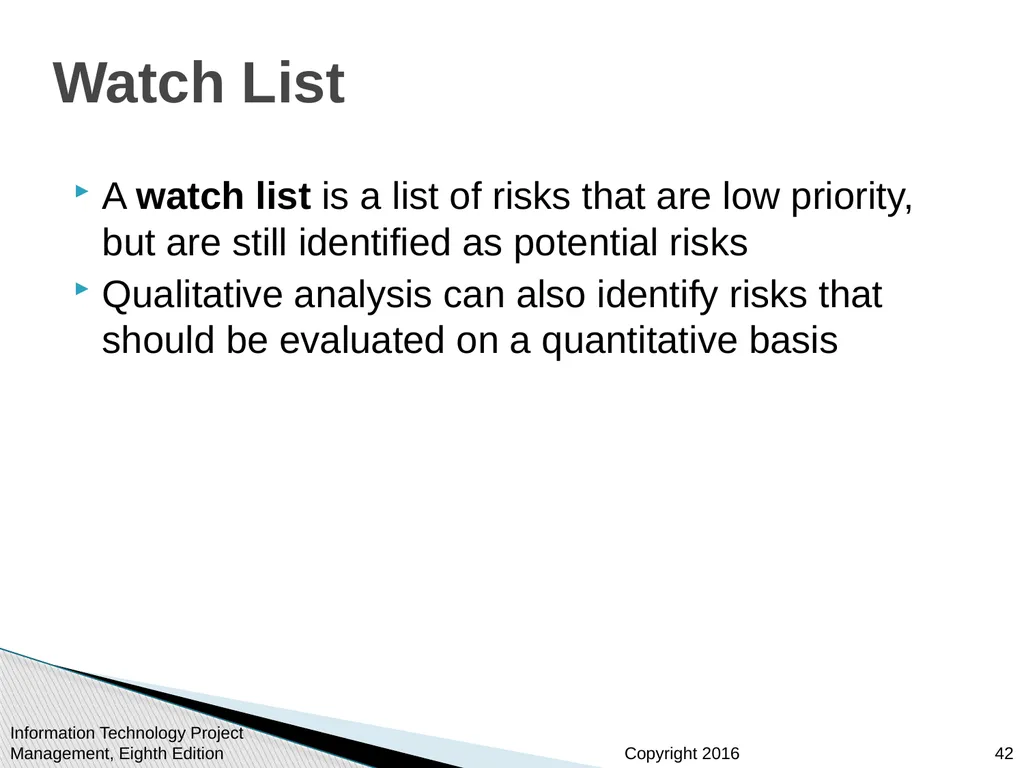
slide42. Watch List A watch list is a list of risks that are low priority, but are still identified as potential risks
Qualitative analysis can also identify risks that should be evaluated on a quantitative basis Information Technology Project Management, Eighth Edition 42<br>
slide43. Media Snapshot The story of the Titanic is known throughout the world, and on April 15, 2012, people acknowledged the 100th anniversary of the Titanic’s sinking
A recent article in PMI’s Virtual Library explains how to avoid “the Titanic factor” in your projects by analyzing the interdependence of risks
For example, the probability of one risk event occurring might change if another one materializes, and the response to one risk event might affect another Information Technology Project Management, Eighth Edition 43<br>
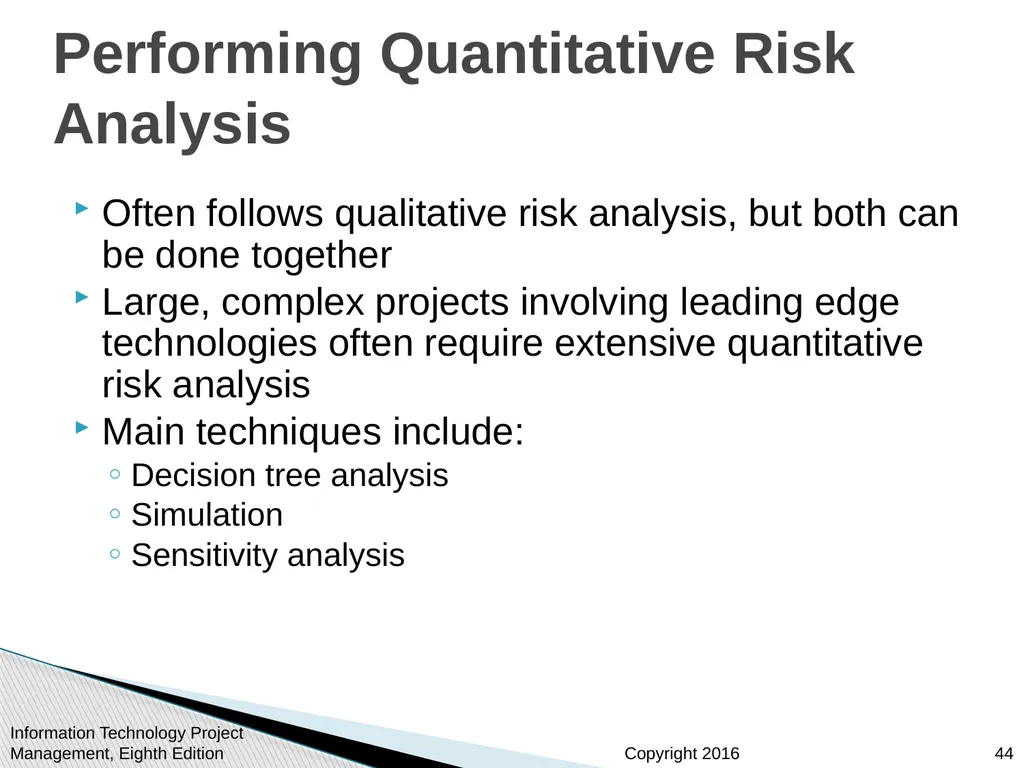
slide44. Performing Quantitative Risk Analysis Often follows qualitative risk analysis, but both can be done together
Large, complex projects involving leading edge technologies often require extensive quantitative risk analysis
Main techniques include:
Decision tree analysis
Simulation
Sensitivity analysis Information Technology Project Management, Eighth Edition 44<br>
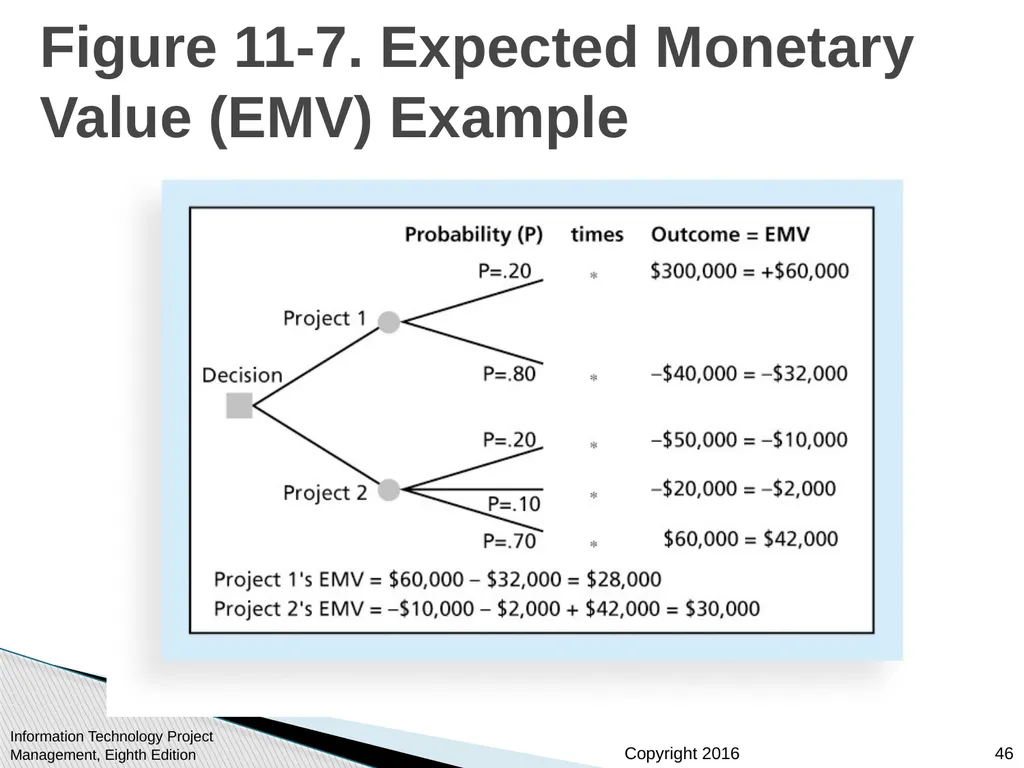
slide45. Decision Trees and Expected Monetary Value (EMV) A decision tree is a diagramming analysis technique used to help select the best course of action in situations in which future outcomes are uncertain
Estimated monetary value (EMV) is the product of a risk event probability and the risk event’s monetary value
You can draw a decision tree to help find the EMV Information Technology Project Management, Eighth Edition 45<br>
slide46. Figure 11-7. Expected Monetary Value (EMV) Example Information Technology Project Management, Eighth Edition 46<br>
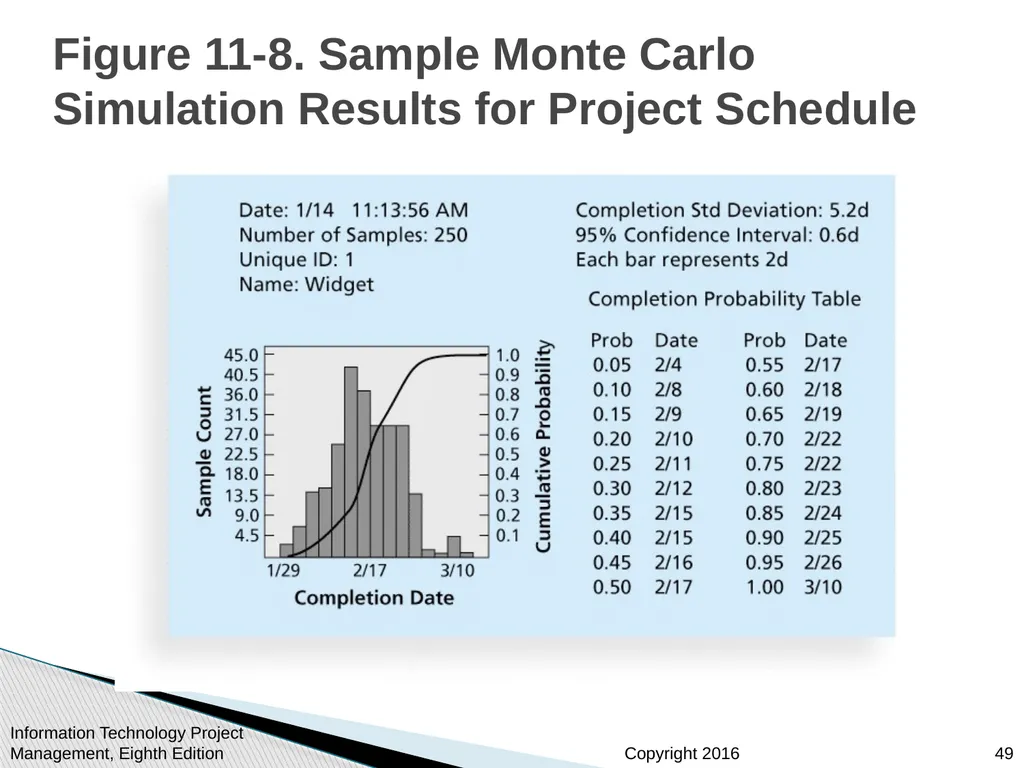
slide47. Simulation Simulation uses a representation or model of a system to analyze the expected behavior or performance of the system
Monte Carlo analysis simulates a model’s outcome many times to provide a statistical distribution of the calculated results
To use a Monte Carlo simulation, you must have three estimates (most likely, pessimistic, and optimistic) plus an estimate of the likelihood of the estimate being between the most likely and optimistic values Information Technology Project Management, Eighth Edition 47<br>
slide48. Steps of a Monte Carlo Analysis Assess the range for the variables being considered
Determine the probability distribution of each variable
For each variable, select a random value based on the probability distribution
Run a deterministic analysis or one pass through the model
Repeat steps 3 and 4 many times to obtain the probability distribution of the model’s results Information Technology Project Management, Eighth Edition 48<br>
slide49. Figure 11-8. Sample Monte Carlo Simulation Results for Project Schedule Information Technology Project Management, Eighth Edition 49<br>
slide50. What Went Right? Excel is a common tool for performing quantitative risk analysis
General Motors using simulation for forecasting its net income, predicting structural costs and purchasing costs of vehicles, and determining the company’s susceptibility to different kinds of risk
Procter & Gamble uses it to model foreign exchange risk
Simulation can also be used on agile projects Information Technology Project Management, Eighth Edition 50<br>
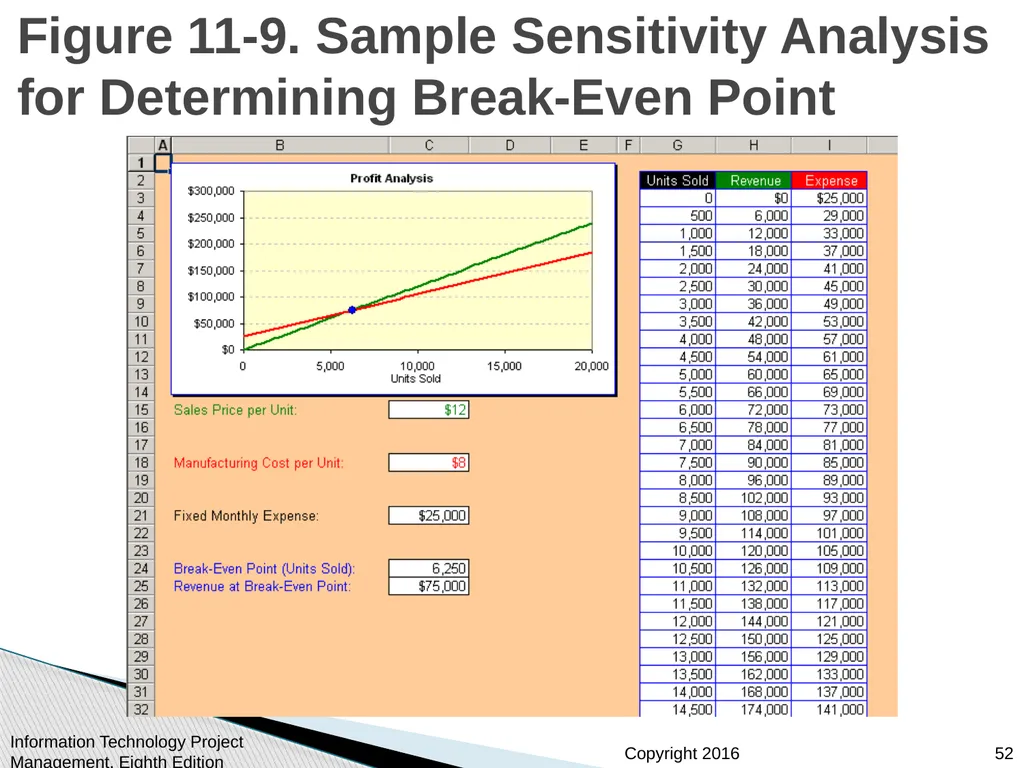
slide51. Sensitivity Analysis Sensitivity analysis is a technique used to show the effects of changing one or more variables on an outcome
For example, many people use it to determine what the monthly payments for a loan will be given different interest rates or periods of the loan, or for determining break-even points based on different assumptions
Spreadsheet software, such as Excel, is a common tool for performing sensitivity analysis Information Technology Project Management, Eighth Edition 51<br>
slide52. Figure 11-9. Sample Sensitivity Analysis for Determining Break-Even Point Information Technology Project Management, Eighth Edition 52<br>
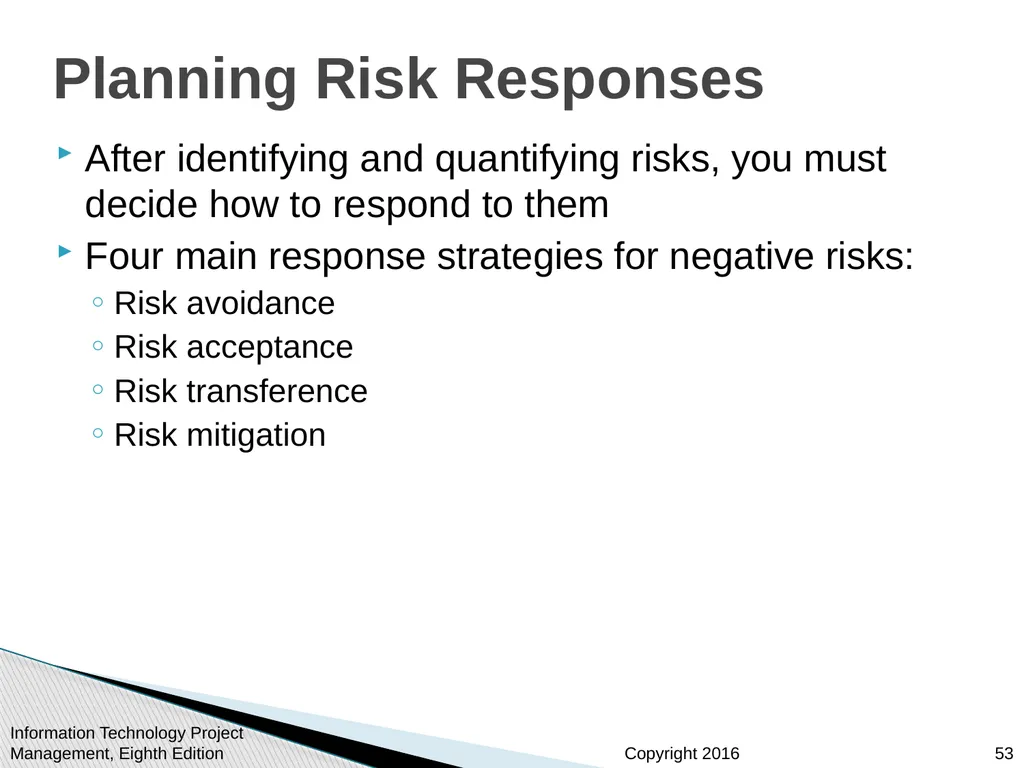
slide53. Planning Risk Responses After identifying and quantifying risks, you must decide how to respond to them
Four main response strategies for negative risks:
Risk avoidance
Risk acceptance
Risk transference
Risk mitigation Information Technology Project Management, Eighth Edition 53<br>
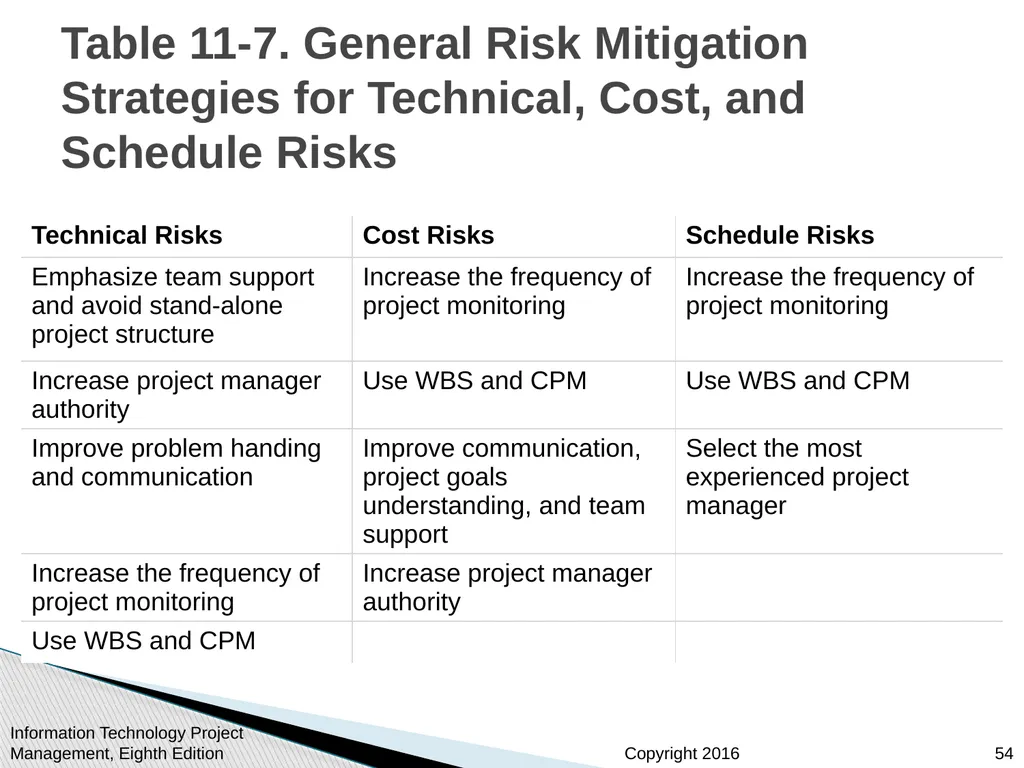
slide54. Table 11-7. General Risk Mitigation Strategies for Technical, Cost, and Schedule Risks Information Technology Project Management, Eighth Edition 54<br>
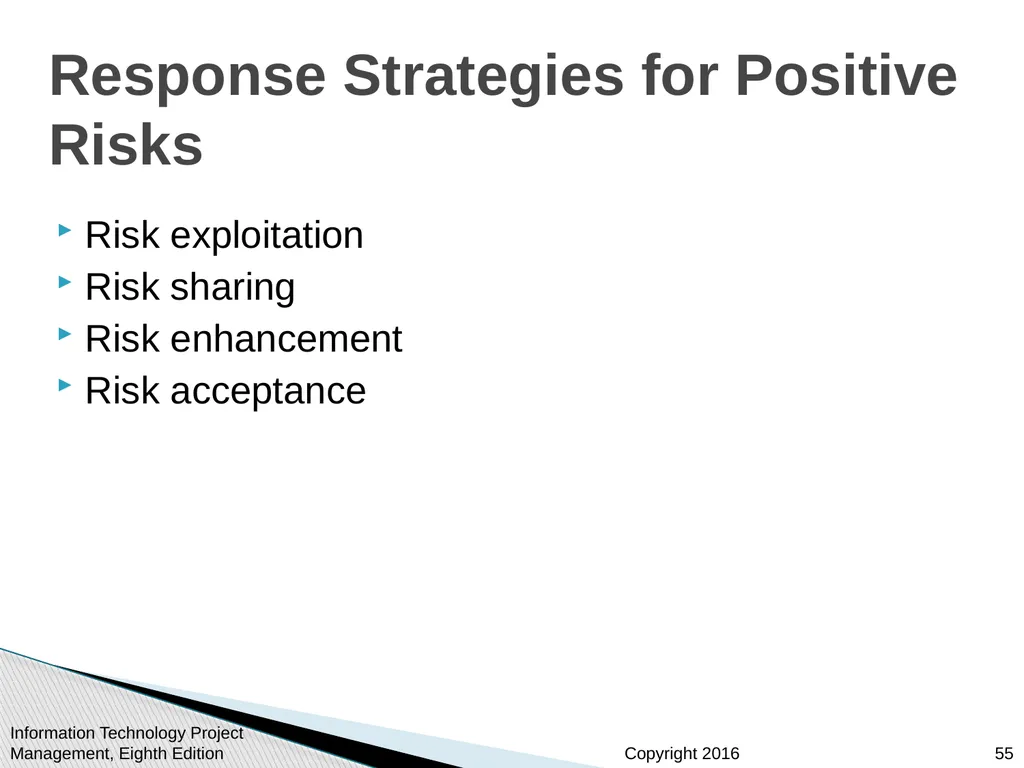
slide55. Response Strategies for Positive Risks Risk exploitation
Risk sharing
Risk enhancement
Risk acceptance Information Technology Project Management, Eighth Edition 55<br>
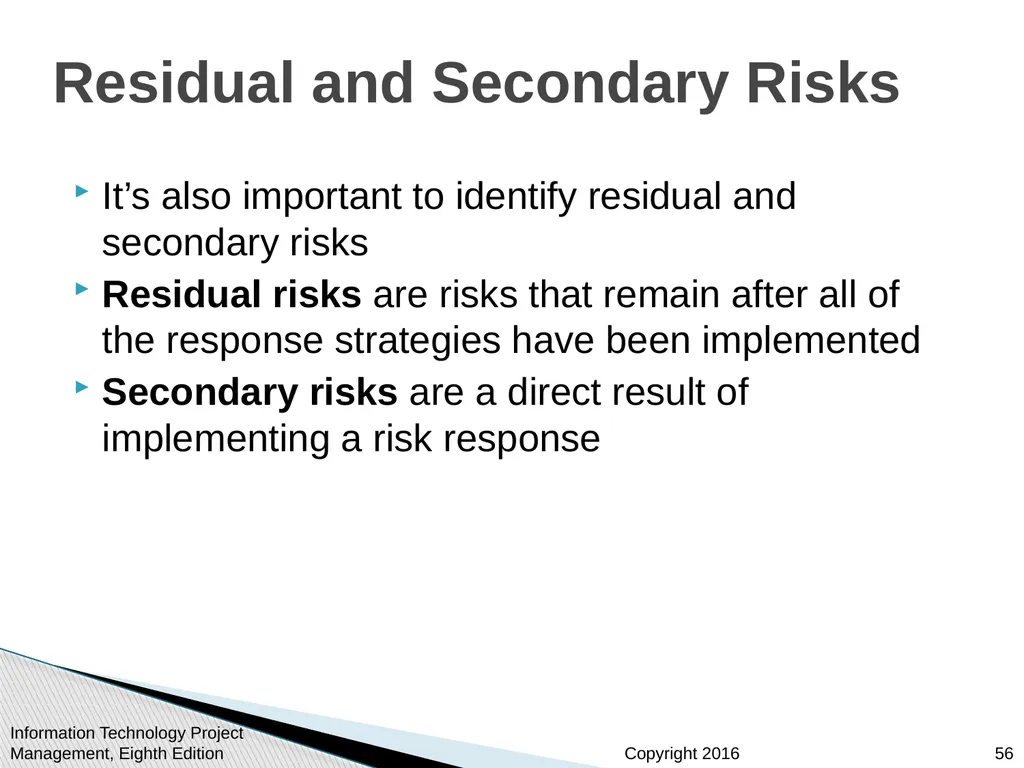
slide56. Residual and Secondary Risks It’s also important to identify residual and secondary risks
Residual risks are risks that remain after all of the response strategies have been implemented
Secondary risks are a direct result of implementing a risk response Information Technology Project Management, Eighth Edition 56<br>
slide57. Controlling Risks Involves executing the risk management process to respond to risk events and ensuring that risk awareness is an ongoing activity performed by the entire project team throughout the entire project
Workarounds are unplanned responses to risk events that must be done when there are no contingency plans
Main outputs of risk control are:
Work performance information
change requests
updates to the project management plan, other project documents, and organizational process assets Information Technology Project Management, Eighth Edition 57<br>
slide58. Using Software to Assist in Project Risk Management Risk registers can be created in a simple Word or Excel file or as part of a database
More sophisticated risk management software, such as Monte Carlo simulation tools, help in analyzing project risks
You can purchase add-ons for Excel and Project 2013 to perform simulations Information Technology Project Management, Eighth Edition 58<br>
slide59. Results of Good Project Risk Management Unlike crisis management, good project risk management often goes unnoticed
Well-run projects appear to be almost effortless, but a lot of work goes into running a project well
Project managers should strive to make their jobs look easy to reflect the results of well-run projects Information Technology Project Management, Eighth Edition 59<br>
slide60. Chapter Summary Project risk management is the art and science of identifying, analyzing, and responding to risk throughout the life of a project and in the best interests of meeting project objectives
Main processes include:
Plan risk management
Identify risks
Perform qualitative risk analysis
Perform quantitative risk analysis
Plan risk responses
Control risks Information Technology Project Management, Eighth Edition 60<br>
slide2. Learning Objectives, Part 1 Understand risk and the importance of good project risk management
Discuss the elements of planning risk management and the contents of a risk management plan
List common sources of risks on information technology (IT) projects
Describe the process of identifying risks and create a risk register
Discuss qualitative risk analysis and explain how to calculate risk factors, create probability/impact matrixes, and apply the Top Ten Risk Item Tracking technique to rank risks Information Technology Project Management, Eighth Edition 2<br>
slide3. Learning Objectives, Part 2 Explain quantitative risk analysis and how to apply decision trees, simulation, and sensitivity analysis to quantify risks
Provide examples of using different risk response planning strategies to address both negative and positive risks
Discuss how to control risks
Describe how software can assist in project risk management Information Technology Project Management, Eighth Edition 3<br>
slide4. The Importance of Project Risk Management Project risk management is the art and science of identifying, analyzing, and responding to risk throughout the life of a project and in the best interests of meeting project objectives
Risk management is often overlooked in projects, but it can help improve project success by helping select good projects, determining project scope, and developing realistic estimates Information Technology Project Management, Eighth Edition 4<br>
slide5. Research Shows Need to Improve Project Risk Management Study by Ibbs and Kwak shows risk has the lowest maturity rating of all knowledge areas
A similar survey was completed with software development companies in Mauritius, South Africa in 2003, and risk management also had the lowest maturity
KLCI study shows the benefits of following good software risk management practices Information Technology Project Management, Eighth Edition 5<br>
slide6. Table 11-1. Project Management Maturity by Industry Group and Knowledge Area* KEY: 1 = LOWEST MATURITY RATING 5 = HIGHEST MATURITY RATING *Ibbs, C. William and Young Hoon Kwak. “Assessing Project Management Maturity,” Project Management Journal (March 2000). Information Technology Project Management, Eighth Edition 6<br>
slide7. Figure 11-1. Benefits from Software Risk Management Practices* *Source: Kulik and Weber, KLCI Research Group Information Technology Project Management, Eighth Edition 7<br>
slide8. Global Issues Many people around the world suffered from financial losses as various financial markets dropped in the fall of 2008, even after the $700 billion bailout bill was passed by the U.S. Congress
According to a global survey of 316 financial services executives, over 70 percent of respondents believed that the losses stemming from the credit crisis were largely due to failures to address risk management issues
Worldwide banking and insurance sectors will spend about $78.6 billion on risk information technologies and services in 2015, growing to $96.3 billion by 2018 Information Technology Project Management, Eighth Edition 8<br>
slide9. Negative Risk A dictionary definition of risk is “the possibility of loss or injury”
Negative risk involves understanding potential problems that might occur in the project and how they might impede project success
Negative risk management is like a form of insurance; it is an investment Information Technology Project Management, Eighth Edition 9<br>
slide10. Risk Can Be Positive Positive risks are risks that result in good things happening; sometimes called opportunities
A general definition of project risk is an uncertainty that can have a negative or positive effect on meeting project objectives
The goal of project risk management is to minimize potential negative risks while maximizing potential positive risks Information Technology Project Management, Eighth Edition 10<br>
slide11. Best Practice Some organizations make the mistake of only addressing tactical and negative risks when performing project risk management
David Hillson, (www.risk-doctor.com) suggests overcoming this problem by widening the scope of risk management to encompass both strategic risks and upside opportunities, which he refers to as integrated risk management
In a 2014 paper Hillson described the importance of good working relationships, especially between the project sponsor and project manager Information Technology Project Management, Eighth Edition 11<br>
slide12. Risk Utility Risk utility or risk tolerance is the amount of satisfaction or pleasure received from a potential payoff
Utility rises at a decreasing rate for people who are risk-averse
Those who are risk-seeking have a higher tolerance for risk and their satisfaction increases when more payoff is at stake
The risk-neutral approach achieves a balance between risk and payoff Information Technology Project Management, Eighth Edition 12<br>
slide13. Figure 11-2. Risk Utility Function and Risk Preference Information Technology Project Management, Eighth Edition 13<br>
slide14. Project Risk Management Processes, Part 1 Planning risk management : Deciding how to approach and plan the risk management activities for the project
Identifying risks: Determining which risks are likely to affect a project and documenting the characteristics of each
Performing qualitative risk analysis: Prioritizing risks based on their probability and impact of occurrence Information Technology Project Management, Eighth Edition 14<br>
slide15. Project Risk Management Processes, Part 2 Performing quantitative risk analysis: Numerically estimating the effects of risks on project objectives
Planning risk responses: Taking steps to enhance opportunities and reduce threats to meeting project objectives
Controlling risk: Monitoring identified and residual risks, identifying new risks, carrying out risk response plans, and evaluating the effectiveness of risk strategies throughout the life of the project Information Technology Project Management, Eighth Edition 15<br>
slide16. Figure 11-3. Project Risk Management Summary Planning
Process: Plan risk management
Outputs: Risk, management plan
Process: Identify risks
Outputs: Risk register
Process: Perform qualitative risk analysis
Outputs: Project documents updates
Process: Perform quantitative risk analysis
Outputs: Project documents updates
Process: Plan risk responses
Outputs: Project management plan updates, project documents updates
project documents updates
Monitoring and Controlling
Process: Control risks
Outputs: Work performance information, change requests, projects managements plan updates, project documents updates, organizational process assets updates. Information Technology Project Management, Eighth Edition 16<br>
slide17. Planning Risk Management The main output of this process is a risk management plan—a plan that documents the procedures for managing risk throughout a project
The project team should review project documents and understand the organization’s and the sponsor’s approaches to risk
The level of detail will vary with the needs of the project Information Technology Project Management, Eighth Edition 17<br>
slide18. Table 11-2. Topics Addressed in a Risk Management Plan Methodology
Roles and responsibilities
Budget and schedule
Risk categories
Risk probability and impact
Revised stakeholders’ tolerances
Tracking
Risk documentation Information Technology Project Management, Eighth Edition 18<br>
slide19. Contingency and Fallback Plans, Contingency Reserves Contingency plans are predefined actions that the project team will take if an identified risk event occurs
Fallback plans are developed for risks that have a high impact on meeting project objectives, and are put into effect if attempts to reduce the risk are not effective
Contingency reserves or allowances are provisions held by the project sponsor or organization to reduce the risk of cost or schedule overruns to an acceptable level; management reserves are funds held for unknown risks that are NOT part of the cost baseline but ARE part of the budget and funding requirements Information Technology Project Management, Eighth Edition 19<br>
slide20. Common Sources of Risk in Information Technology Projects Several studies show that IT projects share some common sources of risk
The Standish Group developed an IT success potential scoring sheet based on potential risks
Other broad categories of risk help identify potential risks Information Technology Project Management, Eighth Edition 20<br>
slide21. Table 11-3. IT Success Potential Scoring Sheet Information Technology Project Management, Eighth Edition 21<br>
slide22. Broad Categories of Risk Market risk
Financial risk
Technology risk
People risk
Structure/process risk Information Technology Project Management, Eighth Edition 22<br>
slide23. What Went Wrong? In a 2013 survey, risk management was a high priority, but only 66 percent of companies said they often build it into their strategy planning decisions
Airline incidents cause concerns, especially when lives are lot. The 2015 Germanwings crash resulted in 150 deaths, allegedly due to the co-pilot’s poor mental state. They responded immediately by implementing a rule that two people must be in the cockpit at all times and are considering changes to medical and psychological tests for pilots Information Technology Project Management, Eighth Edition 23<br>
slide24. Risk Breakdown Structure A risk breakdown structure is a hierarchy of potential risk categories for a project
Similar to a work breakdown structure but used to identify and categorize risks Information Technology Project Management, Eighth Edition 24<br>
slide25. Figure 11-4. Sample Risk Breakdown Structure Information Technology Project Management, Eighth Edition 25<br>
slide26. Table 11-4. Potential Negative Risk Conditions Associated With Each Knowledge Area Information Technology Project Management, Eighth Edition 26<br>
slide27. Identifying Risks Identifying risks is the process of understanding what potential events might hurt or enhance a particular project
Another consideration is the likelihood of advanced discovery
Risk identification tools and techniques include:
Brainstorming
The Delphi Technique
Interviewing
SWOT analysis Information Technology Project Management, Eighth Edition 27<br>
slide28. Brainstorming Brainstorming is a technique by which a group attempts to generate ideas or find a solution for a specific problem by amassing ideas spontaneously and without judgment
An experienced facilitator should run the brainstorming session
Be careful not to overuse or misuse brainstorming.
Psychology literature shows that individuals produce a greater number of ideas working alone than they do through brainstorming in small, face-to-face groups
Group effects often inhibit idea generation Information Technology Project Management, Eighth Edition 28<br>
slide29. Delphi Technique The Delphi Technique is used to derive a consensus among a panel of experts who make predictions about future developments
Provides independent and anonymous input regarding future events
Uses repeated rounds of questioning and written responses and avoids the biasing effects possible in oral methods, such as brainstorming Information Technology Project Management, Eighth Edition 29<br>
slide30. Interviewing Interviewing is a fact-finding technique for collecting information in face-to-face, phone, e-mail, or instant-messaging discussions
Interviewing people with similar project experience is an important tool for identifying potential risks Information Technology Project Management, Eighth Edition 30<br>
slide31. SWOT Analysis SWOT analysis (strengths, weaknesses, opportunities, and threats) can also be used during risk identification
Helps identify the broad negative and positive risks that apply to a project Information Technology Project Management, Eighth Edition 31<br>
slide32. Risk Register The main output of the risk identification process is a list of identified risks and other information needed to begin creating a risk register
A risk register is:
A document that contains the results of various risk management processes and that is often displayed in a table or spreadsheet format
A tool for documenting potential risk events and related information
Risk events refer to specific, uncertain events that may occur to the detriment or enhancement of the project Information Technology Project Management, Eighth Edition 32<br>
slide33. Risk Register Contents, Part 1 An identification number for each risk event
A rank for each risk event
The name of each risk event
A description of each risk event
The category under which each risk event falls
The root cause of each risk Information Technology Project Management, Eighth Edition 33<br>
slide34. Risk Register Contents, Part 2 Triggers for each risk; triggers are indicators or symptoms of actual risk events
Potential responses to each risk
The risk owner or person who will own or take responsibility for each risk
The probability and impact of each risk occurring.
The status of each risk Information Technology Project Management, Eighth Edition 34<br>
slide35. Table 11-5. Sample Risk Register No.: R44
Rank: 1
Risk: New customer
Description: We have never done a project for this organization before and don’t know too much about them. One of our company’s strengths is building good customer relationships, which often leads to further projects with that customer. We might have trouble working with this customer because they are new to us.
Category: People risk
Etc. Information Technology Project Management, Eighth Edition 35<br>
slide36. Performing Qualitative Risk Analysis Assess the likelihood and impact of identified risks to determine their magnitude and priority
Risk quantification tools and techniques include:
Probability/impact matrixes
The Top Ten Risk Item Tracking
Expert judgment Information Technology Project Management, Eighth Edition 36<br>
slide37. Probability/Impact Matrix A probability/impact matrix or chart lists the relative probability of a risk occurring on one side of a matrix or axis on a chart and the relative impact of the risk occurring on the other
List the risks and then label each one as high, medium, or low in terms of its probability of occurrence and its impact if it did occur
Can also calculate risk factors:
Numbers that represent the overall risk of specific events based on their probability of occurring and the consequences to the project if they do occur Information Technology Project Management, Eighth Edition 37<br>
slide38. Figure 11-5. Sample Probability/Impact Matrix Information Technology Project Management, Eighth Edition 38<br>
slide39. Figure 11-6. Chart Showing High-, Medium-, and Low-Risk Technologies Information Technology Project Management, Eighth Edition 39<br>
slide40. Top Ten Risk Item Tracking Top Ten Risk Item Tracking is a qualitative risk analysis tool that helps to identify risks and maintain an awareness of risks throughout the life of a project
Establish a periodic review of the top ten project risk items
List the current ranking, previous ranking, number of times the risk appears on the list over a period of time, and a summary of progress made in resolving the risk item Information Technology Project Management, Eighth Edition 40<br>
slide41. Table 11-6. Example of Top Ten Risk Item Tracking Information Technology Project Management, Eighth Edition 41<br>
slide42. Watch List A watch list is a list of risks that are low priority, but are still identified as potential risks
Qualitative analysis can also identify risks that should be evaluated on a quantitative basis Information Technology Project Management, Eighth Edition 42<br>
slide43. Media Snapshot The story of the Titanic is known throughout the world, and on April 15, 2012, people acknowledged the 100th anniversary of the Titanic’s sinking
A recent article in PMI’s Virtual Library explains how to avoid “the Titanic factor” in your projects by analyzing the interdependence of risks
For example, the probability of one risk event occurring might change if another one materializes, and the response to one risk event might affect another Information Technology Project Management, Eighth Edition 43<br>
slide44. Performing Quantitative Risk Analysis Often follows qualitative risk analysis, but both can be done together
Large, complex projects involving leading edge technologies often require extensive quantitative risk analysis
Main techniques include:
Decision tree analysis
Simulation
Sensitivity analysis Information Technology Project Management, Eighth Edition 44<br>
slide45. Decision Trees and Expected Monetary Value (EMV) A decision tree is a diagramming analysis technique used to help select the best course of action in situations in which future outcomes are uncertain
Estimated monetary value (EMV) is the product of a risk event probability and the risk event’s monetary value
You can draw a decision tree to help find the EMV Information Technology Project Management, Eighth Edition 45<br>
slide46. Figure 11-7. Expected Monetary Value (EMV) Example Information Technology Project Management, Eighth Edition 46<br>
slide47. Simulation Simulation uses a representation or model of a system to analyze the expected behavior or performance of the system
Monte Carlo analysis simulates a model’s outcome many times to provide a statistical distribution of the calculated results
To use a Monte Carlo simulation, you must have three estimates (most likely, pessimistic, and optimistic) plus an estimate of the likelihood of the estimate being between the most likely and optimistic values Information Technology Project Management, Eighth Edition 47<br>
slide48. Steps of a Monte Carlo Analysis Assess the range for the variables being considered
Determine the probability distribution of each variable
For each variable, select a random value based on the probability distribution
Run a deterministic analysis or one pass through the model
Repeat steps 3 and 4 many times to obtain the probability distribution of the model’s results Information Technology Project Management, Eighth Edition 48<br>
slide49. Figure 11-8. Sample Monte Carlo Simulation Results for Project Schedule Information Technology Project Management, Eighth Edition 49<br>
slide50. What Went Right? Excel is a common tool for performing quantitative risk analysis
General Motors using simulation for forecasting its net income, predicting structural costs and purchasing costs of vehicles, and determining the company’s susceptibility to different kinds of risk
Procter & Gamble uses it to model foreign exchange risk
Simulation can also be used on agile projects Information Technology Project Management, Eighth Edition 50<br>
slide51. Sensitivity Analysis Sensitivity analysis is a technique used to show the effects of changing one or more variables on an outcome
For example, many people use it to determine what the monthly payments for a loan will be given different interest rates or periods of the loan, or for determining break-even points based on different assumptions
Spreadsheet software, such as Excel, is a common tool for performing sensitivity analysis Information Technology Project Management, Eighth Edition 51<br>
slide52. Figure 11-9. Sample Sensitivity Analysis for Determining Break-Even Point Information Technology Project Management, Eighth Edition 52<br>
slide53. Planning Risk Responses After identifying and quantifying risks, you must decide how to respond to them
Four main response strategies for negative risks:
Risk avoidance
Risk acceptance
Risk transference
Risk mitigation Information Technology Project Management, Eighth Edition 53<br>
slide54. Table 11-7. General Risk Mitigation Strategies for Technical, Cost, and Schedule Risks Information Technology Project Management, Eighth Edition 54<br>
slide55. Response Strategies for Positive Risks Risk exploitation
Risk sharing
Risk enhancement
Risk acceptance Information Technology Project Management, Eighth Edition 55<br>
slide56. Residual and Secondary Risks It’s also important to identify residual and secondary risks
Residual risks are risks that remain after all of the response strategies have been implemented
Secondary risks are a direct result of implementing a risk response Information Technology Project Management, Eighth Edition 56<br>
slide57. Controlling Risks Involves executing the risk management process to respond to risk events and ensuring that risk awareness is an ongoing activity performed by the entire project team throughout the entire project
Workarounds are unplanned responses to risk events that must be done when there are no contingency plans
Main outputs of risk control are:
Work performance information
change requests
updates to the project management plan, other project documents, and organizational process assets Information Technology Project Management, Eighth Edition 57<br>
slide58. Using Software to Assist in Project Risk Management Risk registers can be created in a simple Word or Excel file or as part of a database
More sophisticated risk management software, such as Monte Carlo simulation tools, help in analyzing project risks
You can purchase add-ons for Excel and Project 2013 to perform simulations Information Technology Project Management, Eighth Edition 58<br>
slide59. Results of Good Project Risk Management Unlike crisis management, good project risk management often goes unnoticed
Well-run projects appear to be almost effortless, but a lot of work goes into running a project well
Project managers should strive to make their jobs look easy to reflect the results of well-run projects Information Technology Project Management, Eighth Edition 59<br>
slide60. Chapter Summary Project risk management is the art and science of identifying, analyzing, and responding to risk throughout the life of a project and in the best interests of meeting project objectives
Main processes include:
Plan risk management
Identify risks
Perform qualitative risk analysis
Perform quantitative risk analysis
Plan risk responses
Control risks Information Technology Project Management, Eighth Edition 60<br>